EP0101239A2 - Zinc dendrite inhibitor - Google Patents
Zinc dendrite inhibitor Download PDFInfo
- Publication number
- EP0101239A2 EP0101239A2 EP83304448A EP83304448A EP0101239A2 EP 0101239 A2 EP0101239 A2 EP 0101239A2 EP 83304448 A EP83304448 A EP 83304448A EP 83304448 A EP83304448 A EP 83304448A EP 0101239 A2 EP0101239 A2 EP 0101239A2
- Authority
- EP
- European Patent Office
- Prior art keywords
- zinc
- quaternary ammonium
- dendrites
- lead
- ammonium salt
- Prior art date
- Legal status (The legal status is an assumption and is not a legal conclusion. Google has not performed a legal analysis and makes no representation as to the accuracy of the status listed.)
- Granted
Links
Images
Classifications
-
- H—ELECTRICITY
- H01—ELECTRIC ELEMENTS
- H01M—PROCESSES OR MEANS, e.g. BATTERIES, FOR THE DIRECT CONVERSION OF CHEMICAL ENERGY INTO ELECTRICAL ENERGY
- H01M10/00—Secondary cells; Manufacture thereof
- H01M10/36—Accumulators not provided for in groups H01M10/05-H01M10/34
- H01M10/365—Zinc-halogen accumulators
-
- C—CHEMISTRY; METALLURGY
- C25—ELECTROLYTIC OR ELECTROPHORETIC PROCESSES; APPARATUS THEREFOR
- C25D—PROCESSES FOR THE ELECTROLYTIC OR ELECTROPHORETIC PRODUCTION OF COATINGS; ELECTROFORMING; APPARATUS THEREFOR
- C25D3/00—Electroplating: Baths therefor
- C25D3/02—Electroplating: Baths therefor from solutions
- C25D3/22—Electroplating: Baths therefor from solutions of zinc
-
- H—ELECTRICITY
- H01—ELECTRIC ELEMENTS
- H01M—PROCESSES OR MEANS, e.g. BATTERIES, FOR THE DIRECT CONVERSION OF CHEMICAL ENERGY INTO ELECTRICAL ENERGY
- H01M10/00—Secondary cells; Manufacture thereof
- H01M10/02—Details
-
- Y—GENERAL TAGGING OF NEW TECHNOLOGICAL DEVELOPMENTS; GENERAL TAGGING OF CROSS-SECTIONAL TECHNOLOGIES SPANNING OVER SEVERAL SECTIONS OF THE IPC; TECHNICAL SUBJECTS COVERED BY FORMER USPC CROSS-REFERENCE ART COLLECTIONS [XRACs] AND DIGESTS
- Y02—TECHNOLOGIES OR APPLICATIONS FOR MITIGATION OR ADAPTATION AGAINST CLIMATE CHANGE
- Y02E—REDUCTION OF GREENHOUSE GAS [GHG] EMISSIONS, RELATED TO ENERGY GENERATION, TRANSMISSION OR DISTRIBUTION
- Y02E60/00—Enabling technologies; Technologies with a potential or indirect contribution to GHG emissions mitigation
- Y02E60/10—Energy storage using batteries
Definitions
- the present invention relates to a zinc dendrite inhibitor whereby in an electrolyte circulation-type secondary cell using zinc as an active material or in the case of electrochemical zinc plating, the zinc deposited and grown on an electrode surface is prevented from developing into dendric crystals (hereinafter referred to as dendrites) and a smooth deposited zinc surface is produced.
- dendrites dendric crystals
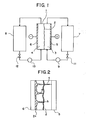
- the electrolyte circulation-type secondary cell is basically constructed as shown in Fig. 1 and it uses zinc halogen-electrolytes.
- This cell comprises a unit cell 1 partitioned by a separating membrane (separator) 2 to form a positive electrode chamber 3 and a negative electrode chamber 4 on its sides, a positive electrode 5 positioned in the positive electrode chamber 3 and a negative electrode (zinc electrode) 6 positioned in the negative electrode chamber 4.
- a positive electrode electrolyte (e.g., znBr 2 + Br 2 ) is circulated through the positive electrode chamber 3 from a positive electrode electrolyte storage tank 7 by a pump 9 and a negative electrode electrolyte (e.g., ZnBr 2 ) is circulated through the negative electrode chamber 4 from a negative electrolyte storage tank 8 by a pdmp 10.
- Numerals 11 and 12 designate valves which are opened during the charging and discharging, respectively.
- bromine is .deposited on the positive electrode side indicated by@ and zinc is deposited on the negative electrode side indicated by ⁇ . While there is no problem if the deposited zinc forms uniformly and gradually increases its thickness on the negative electrode surface, generally the deposited zinc tends to develop into dendrites and grows locally due to various causes.
- the process of formation of dendrites on the cathode surface is considered to approximately in include the following steps.
- metal zinc deposited on the negative electrode surface does not necessarily growing uniformly over the whole surface of the electrode but the metal zinc is deposited in a spotty manner.
- nuclei of dendrites are already produced.
- the electrodeposition preferentially takes place at the spottily produced nuclei thus eventually producing dendrites.
- the electric field concentrates so that the rate of growth of-the dendrites increases and the chance of the zinc electrode surface containing with a fresh supply of the electrolyte decreases, thus not only deteriorating the cell efficiency but also causing the extremely fragile dendrites to fall off the electrode by a relatively small stress.
- the dendrites fallen off in this way cause clogging of the electrolyte circulation pipe and deterioration of the pump efficiency.
- dendrites do not fall off the electrode but continue to grow so that the dendrites continue to grow progressively as shown at a, b and c in Fig. 2 or the growth progresses extremely, the dendrites directly contact with the positive electrode surface so that a electric short-circuit is formed and eventually the cell is damaged.
- the inhibition of growth of dendrites constitutes one of the very important requirements.
- dendrite inhibitors and ionic or nonionic surface active agents, zinc electrochemical plating brighteners, etc. have for example been used.
- these agents are inadequate and leave much room for improvement with respect to such chemical resistances as resistance to bromine, the smoothness of deposited zinc with a large current density and large electrical quantity and so on.
- these agents are not capable of maintaining stable performance during the cyclic use over a long period of time and they are also inadequate in terms of the essential dendrite inhibitory effect.
- a dendrite inhibitor including a quaternary ammonium salt and one or more metal ions selected from the group consisting of lead, tin and cadmium ions and used by mixing it with an electrolyte for effecting the electrolysis of zinc by an electrochemical reaction.
- the quaternary ammonium salt used with the present invention may consist of a chemical compound having the general formula [R 1 R 2 R 3 R 4 N] + X - (where R 1 , R 2 , R 3 and R 4 are radicals such as alkyl, benzyl or phenyl radicals and X represents a halogen, 1 ⁇ 2S0 4 ) or an intermolecular quaternary ammonium salt formed by one or more heterocyclic compounds selected from the group consisting of morpholine, piperidine and pyrolidine.
- trimethyldodecylammonium dimethylbenzyldodecylammonium, trimethylphenylammonium, methylethylmorpholinium, methylethylpiperidinium, methylethyl- pyrodinium, etc., may for example be used.
- lead, tin or cadmium ions are provided in the form of halides, sulfates, acetates, phosphates or the like and the resulting negative ions, have no effect on the electrochemical reaction.
- Table 1 shows the results of tests conducted by adding varying amounts of lead, tin and cadmium ions to zinc electrolytes containing quaternary ammonium salts and examining the resulting dendrite inhibitory effects.
- the addition of the metal ions was effected by adding SnCl 2 , PbBr 2 .and CdBr 2 .
- the evaluation A indicates a smooth surface without any dendrite, the evaluation B a surface having irregularities, the evaluation C a surface having a large quantity of small dendrites and the evaluation D a surface having a large quantity of dendrites.
- the first cycle showed the deposition of small dendrites and the third cycle showed the occurrence of electric short-circuiting between the positive electrode and the negative electrode due to the falling off of the dendrites from the electrode, etc.
- This result also shows that the addition of lead, tin or cadmium is especially effective in the case of secondary battery.
- the charging electric quantity used was 240 mA ⁇ H/cm 2 .
- the quaternary ammonium salt concentration is in the range from over 10 -4 mol/l to the saturated concentration
- the additional lead ion concentration is in the range from 1 x 10 -4 to the saturated concentration, preferably 5 x 10 -4 mol/l
- the additional tin ion concentration is substantially in the same range as the former
- the cadmium ion concentration is in the range from O to 10 -2 mol/l, preferably in the range from 1 x 10 -4 to 1 x 10- 3 mol/l.
- an inhibitor according to the invention has the effect of effectively suppressing the deposition of dendrites even at high current densities and producing a deposited zinc surface which is smooth and having a metallic luster. Further, this inhibitor contains metal ions and a quaternary ammonium salt and therefore it has no danger of decomposition, etc.
Landscapes
- Chemical & Material Sciences (AREA)
- Engineering & Computer Science (AREA)
- Chemical Kinetics & Catalysis (AREA)
- Electrochemistry (AREA)
- Manufacturing & Machinery (AREA)
- General Chemical & Material Sciences (AREA)
- Materials Engineering (AREA)
- Metallurgy (AREA)
- Organic Chemistry (AREA)
- Hybrid Cells (AREA)
- Electroplating And Plating Baths Therefor (AREA)
- Battery Electrode And Active Subsutance (AREA)
Abstract
Description
- The present invention relates to a zinc dendrite inhibitor whereby in an electrolyte circulation-type secondary cell using zinc as an active material or in the case of electrochemical zinc plating, the zinc deposited and grown on an electrode surface is prevented from developing into dendric crystals (hereinafter referred to as dendrites) and a smooth deposited zinc surface is produced.
- The electrolyte circulation-type secondary cell is basically constructed as shown in Fig. 1 and it uses zinc halogen-electrolytes. This cell comprises a unit cell 1 partitioned by a separating membrane (separator) 2 to form a
positive electrode chamber 3 and anegative electrode chamber 4 on its sides, apositive electrode 5 positioned in thepositive electrode chamber 3 and a negative electrode (zinc electrode) 6 positioned in thenegative electrode chamber 4. A positive electrode electrolyte (e.g., znBr2 + Br2) is circulated through thepositive electrode chamber 3 from a positive electrodeelectrolyte storage tank 7 by apump 9 and a negative electrode electrolyte (e.g., ZnBr2) is circulated through thenegative electrode chamber 4 from a negativeelectrolyte storage tank 8 by a pdmp 10.Numerals 11 and 12 designate valves which are opened during the charging and discharging, respectively. - When the above-mentioned cell is charged, bromine is .deposited on the positive electrode side indicated by@ and zinc is deposited on the negative electrode side indicated by ⊖ . While there is no problem if the deposited zinc forms uniformly and gradually increases its thickness on the negative electrode surface, generally the deposited zinc tends to develop into dendrites and grows locally due to various causes.
- The process of formation of dendrites on the cathode surface is considered to approximately in include the following steps. In other words, during the initial charging period metal zinc deposited on the negative electrode surface does not necessarily growing uniformly over the whole surface of the electrode but the metal zinc is deposited in a spotty manner. During this period, what can be considered as nuclei of dendrites are already produced. As a result, if the charging and discharging are continued in such a condition, the electrodeposition preferentially takes place at the spottily produced nuclei thus eventually producing dendrites.
- When the dendrites grow on the negative electrode surface, the electric field concentrates so that the rate of growth of-the dendrites increases and the chance of the zinc electrode surface containing with a fresh supply of the electrolyte decreases, thus not only deteriorating the cell efficiency but also causing the extremely fragile dendrites to fall off the electrode by a relatively small stress. As a result, the dendrites fallen off in this way cause clogging of the electrolyte circulation pipe and deterioration of the pump efficiency.
- Assuming that such dendrites do not fall off the electrode but continue to grow so that the dendrites continue to grow progressively as shown at a, b and c in Fig. 2 or the growth progresses extremely, the dendrites directly contact with the positive electrode surface so that a electric short-circuit is formed and eventually the cell is damaged. Thus, the inhibition of growth of dendrites constitutes one of the very important requirements.
- Such undesired phenomena occur even in the case of a electrochemical plating-involving the electrolysis of zinc giving rise to a disadvantage of damaging the smoothness of a processed object.
- In view of these requirements, various studies have been made on dendrite inhibitors and ionic or nonionic surface active agents, zinc electrochemical plating brighteners, etc., have for example been used. However, these agents are inadequate and leave much room for improvement with respect to such chemical resistances as resistance to bromine, the smoothness of deposited zinc with a large current density and large electrical quantity and so on. Also, these agents are not capable of maintaining stable performance during the cyclic use over a long period of time and they are also inadequate in terms of the essential dendrite inhibitory effect.
- It is an object of the present invention to provide an inhibitor capable of effectively inhibiting the deposition of dendrites.
- In accordance with the invention there is thus provided a dendrite inhibitor including a quaternary ammonium salt and one or more metal ions selected from the group consisting of lead, tin and cadmium ions and used by mixing it with an electrolyte for effecting the electrolysis of zinc by an electrochemical reaction.
-
- Fig. 1 is a schematic diagram showing the basic construction of a zinc-halogen secondary cell.
- Fig. 2 is a diagram for explaining the manner in which dendrites are deposited.
- The quaternary ammonium salt used with the present invention may consist of a chemical compound having the general formula [R1R2R3R4N]+ X- (where R1, R2, R3 and R4 are radicals such as alkyl, benzyl or phenyl radicals and X represents a halogen, ½S04) or an intermolecular quaternary ammonium salt formed by one or more heterocyclic compounds selected from the group consisting of morpholine, piperidine and pyrolidine. More specifically, trimethyldodecylammonium, dimethylbenzyldodecylammonium, trimethylphenylammonium, methylethylmorpholinium, methylethylpiperidinium, methylethyl- pyrodinium, etc., may for example be used.
- On the other hand, lead, tin or cadmium ions are provided in the form of halides, sulfates, acetates, phosphates or the like and the resulting negative ions, have no effect on the electrochemical reaction.
- The following Table 1 shows the results of tests conducted by adding varying amounts of lead, tin and cadmium ions to zinc electrolytes containing quaternary ammonium salts and examining the resulting dendrite inhibitory effects. The addition of the metal ions was effected by adding SnCℓ2, PbBr2.and CdBr2.
- Under the testing conditions of
zinc bromide 3 mol/ℓ pH 2.5 and charging current density 40 mA/cm2, the conditions obtained after the charging for 8 hours were observed. -


- The evaluation A indicates a smooth surface without any dendrite, the evaluation B a surface having irregularities, the evaluation C a surface having a large quantity of small dendrites and the evaluation D a surface having a large quantity of dendrites.
- These results have shown that by adding to an electrolyte a quaternary ammonium salt mixed with a suitable amount of lead, tin or cadmium ions, it is possible to inhibit the deposition of dendrites effectively and produce a deposited zinc surface which is smooth and having a metallic luster.
- On the other hand, the 6-hour charging and discharging cycle tests at 40 mA/cm2 have shown at the tests of over 20 cycles with the addition of 5 x 10⁻⁴ mol/i of lead, tin and cadmium ions, respectively, resulted in deposited zinc surfaces which were smooth and having a metallic luster.
- With the addition of no lead, tin or cadmium, the first cycle showed the deposition of small dendrites and the third cycle showed the occurrence of electric short-circuiting between the positive electrode and the negative electrode due to the falling off of the dendrites from the electrode, etc. This result also shows that the addition of lead, tin or cadmium is especially effective in the case of secondary battery.
- Then, using the electrolytes containing 5 x 10⁻⁴ mol/ℓ of lead, tine and cadmium ions, respectively, and 1 mol/k of methylethylmorpholiniumbromide and varying the current density, the resulting dendrite inhibitory effects were examined and the following results were obtained.
- 2 The charging electric quantity used was 240 mA·H/cm2.
-

- From these test results it has been confirmed that satisfactory inhibition of dendrites is ensured even at high current densities.
- Then, in addition to the examinations shown in Table 1, the extensive examinations were made on the concentration of the quaternary ammonium salts and the metal ions added and used with the former and it has been confirmed that the desired effects due to their use could be displayed if the quaternary ammonium salt concentration is in the range from over 10-4 mol/ℓ to the saturated concentration, the additional lead ion concentration is in the range from 1 x 10⁻⁴ to the saturated concentration, preferably 5 x 10⁻⁴ mol/ℓ, the additional tin ion concentration is substantially in the same range as the former and the cadmium ion concentration is in the range from O to 10-2 mol/ℓ, preferably in the range from 1 x 10⁻⁴ to 1 x 10⁻³ mol/ℓ.
- From the foregoing description it will be seen that the use of an inhibitor according to the invention has the effect of effectively suppressing the deposition of dendrites even at high current densities and producing a deposited zinc surface which is smooth and having a metallic luster. Further, this inhibitor contains metal ions and a quaternary ammonium salt and therefore it has no danger of decomposition, etc.
Claims (7)
Applications Claiming Priority (2)
| Application Number | Priority Date | Filing Date | Title |
|---|---|---|---|
| JP57137358A JPS5928588A (en) | 1982-08-09 | 1982-08-09 | Inhibitor for dendrite of zinc |
| JP137358/82 | 1982-08-09 |
Publications (3)
| Publication Number | Publication Date |
|---|---|
| EP0101239A2 true EP0101239A2 (en) | 1984-02-22 |
| EP0101239A3 EP0101239A3 (en) | 1984-03-21 |
| EP0101239B1 EP0101239B1 (en) | 1987-01-28 |
Family
ID=15196787
Family Applications (1)
| Application Number | Title | Priority Date | Filing Date |
|---|---|---|---|
| EP83304448A Expired EP0101239B1 (en) | 1982-08-09 | 1983-08-01 | Zinc dendrite inhibitor |
Country Status (5)
| Country | Link |
|---|---|
| US (1) | US4479856A (en) |
| EP (1) | EP0101239B1 (en) |
| JP (1) | JPS5928588A (en) |
| CA (1) | CA1228325A (en) |
| DE (1) | DE3369603D1 (en) |
Cited By (4)
| Publication number | Priority date | Publication date | Assignee | Title |
|---|---|---|---|---|
| WO1996018459A1 (en) * | 1994-12-13 | 1996-06-20 | Bp Chemicals Limited | Ionic liquids |
| WO2016057477A1 (en) * | 2014-10-06 | 2016-04-14 | Eos Energy Storage, Llc | Electrolyte for rechargeable electrochemical cell |
| WO2016190929A1 (en) * | 2015-05-22 | 2016-12-01 | General Electric Company | Zinc-based electrolyte compositions, and related electrochemical processes and articles |
| US10892524B2 (en) | 2016-03-29 | 2021-01-12 | Eos Energy Storage, Llc | Electrolyte for rechargeable electrochemical cell |
Families Citing this family (43)
| Publication number | Priority date | Publication date | Assignee | Title |
|---|---|---|---|---|
| FR2770339B1 (en) | 1997-10-27 | 2003-06-13 | Commissariat Energie Atomique | STRUCTURE HAVING FORMED ELECTRIC CONTACTS THROUGH THE SUBSTRATE OF THIS STRUCTURE AND METHOD OF OBTAINING SUCH A STRUCTURE |
| US6153328A (en) * | 1999-11-24 | 2000-11-28 | Metallic Power, Inc. | System and method for preventing the formation of dendrites in a metal/air fuel cell, battery or metal recovery apparatus |
| US6522955B1 (en) | 2000-07-28 | 2003-02-18 | Metallic Power, Inc. | System and method for power management |
| US6558849B2 (en) | 2001-04-19 | 2003-05-06 | Zinc Matrix Power, Inc. | Battery separator with copper-containing inorganic salt |
| US6743548B2 (en) | 2001-04-19 | 2004-06-01 | Zinc Matrix Power, Inc. | Silver-zinc alkaline rechargeable battery (stacking order) |
| DE60223254T2 (en) * | 2001-07-06 | 2008-08-14 | Penwest Pharmaceuticals Co. | DELAYED FORCULATING FORMULATIONS OF OXYMORPHONE |
| US20030035984A1 (en) | 2001-08-15 | 2003-02-20 | Colborn Jeffrey A. | Metal fuel cell system for providing backup power to one or more loads |
| US6679280B1 (en) | 2001-10-19 | 2004-01-20 | Metallic Power, Inc. | Manifold for fuel cell system |
| US6911274B1 (en) | 2001-10-19 | 2005-06-28 | Metallic Power, Inc. | Fuel cell system |
| US6873157B2 (en) * | 2002-04-04 | 2005-03-29 | Metallic Power, Inc. | Method of and system for determining the remaining energy in a metal fuel cell |
| US6764588B2 (en) * | 2002-05-17 | 2004-07-20 | Metallic Power, Inc. | Method of and system for flushing one or more cells in a particle-based electrochemical power source in standby mode |
| US6787260B2 (en) * | 2002-09-12 | 2004-09-07 | Metallic Power, Inc. | Electrolyte-particulate fuel cell anode |
| WO2008133642A2 (en) * | 2006-10-13 | 2008-11-06 | Ceramatec, Inc. | Advanced metal-air battery having a ceramic membrane electrolyte |
| US8771879B2 (en) * | 2007-09-05 | 2014-07-08 | Ceramatec, Inc. | Lithium—sulfur battery with a substantially non-porous lisicon membrane and porous lisicon layer |
| US9209445B2 (en) | 2007-11-26 | 2015-12-08 | Ceramatec, Inc. | Nickel-metal hydride/hydrogen hybrid battery using alkali ion conducting separator |
| US8012621B2 (en) * | 2007-11-26 | 2011-09-06 | Ceramatec, Inc. | Nickel-metal hydride battery using alkali ion conducting separator |
| CA2705270C (en) * | 2007-11-27 | 2016-07-26 | Ceramatec, Inc. | Process for recovering alkali metals and sulfur from alkali metal sulfides and polysulfides |
| WO2009070600A2 (en) | 2007-11-27 | 2009-06-04 | Ceramatec, Inc. | Substantially solid, flexible electrolyte for alkili-metal-ion batteries |
| US10320033B2 (en) | 2008-01-30 | 2019-06-11 | Enlighten Innovations Inc. | Alkali metal ion battery using alkali metal conductive ceramic separator |
| US20090189567A1 (en) * | 2008-01-30 | 2009-07-30 | Joshi Ashok V | Zinc Anode Battery Using Alkali Ion Conducting Separator |
| CN102017232B (en) | 2008-03-27 | 2014-07-02 | Z动力能源有限责任公司 | Electrode separator |
| US8323817B2 (en) * | 2008-09-12 | 2012-12-04 | Ceramatec, Inc. | Alkali metal seawater battery |
| US9475998B2 (en) | 2008-10-09 | 2016-10-25 | Ceramatec, Inc. | Process for recovering alkali metals and sulfur from alkali metal sulfides and polysulfides |
| US8936727B2 (en) * | 2009-03-06 | 2015-01-20 | Uop Llc | Multiple bed temperature controlled adsorption |
| KR20110139197A (en) * | 2009-03-16 | 2011-12-28 | 세라마테크, 인코오포레이티드 | Sodium-sulfur batteries with substantially nonporous membranes and improved cathode utilization |
| EP2497133B1 (en) | 2009-11-05 | 2018-12-26 | Field Upgrading USA, Inc. | Solid-state sodium-based secondary cell having a sodium ion conductive ceramic separator |
| US8771855B2 (en) | 2010-08-11 | 2014-07-08 | Ceramatec, Inc. | Alkali metal aqueous battery |
| EP2647080B8 (en) | 2010-12-01 | 2019-05-22 | Field Upgrading USA, Inc. | Moderate temperature sodium battery |
| JP2013124318A (en) * | 2011-12-15 | 2013-06-24 | Kuraray Co Ltd | Polyvinyl alcohol-based polymer and method for producing hydrolyzable cellulose using the same |
| US9269998B2 (en) | 2013-03-13 | 2016-02-23 | Fluidic, Inc. | Concave gas vent for electrochemical cell |
| US9325037B2 (en) | 2013-03-13 | 2016-04-26 | Fluidic, Inc. | Hetero-ionic aromatic additives for electrochemical cells comprising a metal fuel |
| US10056636B1 (en) | 2013-10-03 | 2018-08-21 | Primus Power Corporation | Electrolyte compositions for use in a metal-halogen flow battery |
| IL250456A0 (en) * | 2014-08-20 | 2017-03-30 | Albemarle Corp | Quaternary ammonium halides with ether functional groups for use as battery electrolytes |
| WO2016149019A1 (en) | 2015-03-19 | 2016-09-22 | Primus Power Corporation | Flow battery electrolyte compositions containing a chelating agent and a metal plating enhancer |
| US10218021B2 (en) * | 2015-07-21 | 2019-02-26 | Primus Power Corporation | Flow battery electrolyte compositions containing an organosulfate wetting agent and flow batteries including same |
| JP2019521497A (en) | 2016-07-22 | 2019-07-25 | ナントエナジー,インク. | Water and carbon dioxide management system in the electrochemical cell |
| US11228066B2 (en) | 2016-07-22 | 2022-01-18 | Form Energy, Inc. | Mist elimination system for electrochemical cells |
| CN108711633B (en) * | 2018-05-28 | 2021-09-10 | 安徽鹰龙工业设计有限公司 | Electrolyte for zinc-bromine flow battery |
| CN119481486A (en) | 2018-06-29 | 2025-02-18 | 福恩能源公司 | Rolling diaphragm seal |
| CN112805868A (en) | 2018-06-29 | 2021-05-14 | 福恩能源公司 | Metal air electrochemical cell frame |
| CN114207915A (en) | 2019-06-28 | 2022-03-18 | 福恩能源公司 | Device architecture for metal-air battery |
| US11283112B2 (en) | 2020-01-03 | 2022-03-22 | City University Of Hong Kong | Method for manipulating an energy storage device |
| WO2021226399A1 (en) | 2020-05-06 | 2021-11-11 | Form Energy, Inc. | Decoupled electrode electrochemical energy storage system |
Family Cites Families (13)
| Publication number | Priority date | Publication date | Assignee | Title |
|---|---|---|---|---|
| US2729602A (en) * | 1952-07-29 | 1956-01-03 | George Robert Van Houten | Electrodeposition of bright zinc plate |
| DE934508C (en) * | 1954-04-23 | 1955-10-27 | Dehydag Gmbh | Process for the production of galvanic metal coatings |
| US3660170A (en) * | 1970-04-08 | 1972-05-02 | Gen Electric | Dendrite-inhibiting additive for battery cell having zinc electrode |
| US3944430A (en) * | 1970-09-18 | 1976-03-16 | Union Carbide Corporation | Rechargeable galvanic cell and electrolyte therefor-II |
| FR2134302A1 (en) * | 1971-04-30 | 1972-12-08 | Comp Generale Electricite | Additives for electrolytes - for accumulators with zinc electrode giving uniform zinc deposit |
| GB1420710A (en) * | 1973-01-31 | 1976-01-14 | Furukawa Electric Co Ltd | Furukawa battery co ltd rechargeable galvanic cell with zinc anode |
| FR2236283A1 (en) * | 1973-06-22 | 1975-01-31 | Accumulateurs Fixes | Battery electrolyte contg ammonium derivs - for battery with nickel hydroxide positive electrode |
| US3957595A (en) * | 1975-01-10 | 1976-05-18 | Nalco Chemical Company | Zinc electroplating |
| US4064324A (en) * | 1976-04-07 | 1977-12-20 | Exxon Research & Engineering Co. | Metal-Halogenelectrochemical cell |
| IL50348A (en) * | 1976-08-24 | 1979-01-31 | Ate Of Israel Represented By M | Inorganic additives for zinc-alkaline secondary batteries |
| US4124743A (en) * | 1977-10-13 | 1978-11-07 | Yardngy Electric Corporation | Mercury-free secondary alkaline battery and improved negative interseparator therefor |
| US4306003A (en) * | 1980-03-28 | 1981-12-15 | Energy Development Associates, Inc. | Zinc halogen battery electrolyte composition with lead additive |
| GB2079522B (en) * | 1980-06-23 | 1983-08-03 | Sumitomo Metal Mining Co | Silver oxide cell |
-
1982
- 1982-08-09 JP JP57137358A patent/JPS5928588A/en active Granted
-
1983
- 1983-07-29 CA CA000433534A patent/CA1228325A/en not_active Expired
- 1983-08-01 EP EP83304448A patent/EP0101239B1/en not_active Expired
- 1983-08-01 DE DE8383304448T patent/DE3369603D1/en not_active Expired
- 1983-08-08 US US06/521,373 patent/US4479856A/en not_active Expired - Lifetime
Cited By (8)
| Publication number | Priority date | Publication date | Assignee | Title |
|---|---|---|---|---|
| WO1996018459A1 (en) * | 1994-12-13 | 1996-06-20 | Bp Chemicals Limited | Ionic liquids |
| WO2016057477A1 (en) * | 2014-10-06 | 2016-04-14 | Eos Energy Storage, Llc | Electrolyte for rechargeable electrochemical cell |
| WO2016057457A3 (en) * | 2014-10-06 | 2016-10-13 | Eos Energy Storage, Llc | Electolyte composition for a zinc-halide battery and bipolar electrode comprising a titanium carbide coated cathode box |
| CN107004823A (en) * | 2014-10-06 | 2017-08-01 | Eos能源储存有限责任公司 | Zinc halide electrochemical cell |
| CN107112576A (en) * | 2014-10-06 | 2017-08-29 | Eos能源储存有限责任公司 | Electrolyte for rechargeable electrochemical cells |
| US10276872B2 (en) | 2014-10-06 | 2019-04-30 | Eos Energy Storage, Llc | Electrolyte for rechargeable electrochemical cell |
| WO2016190929A1 (en) * | 2015-05-22 | 2016-12-01 | General Electric Company | Zinc-based electrolyte compositions, and related electrochemical processes and articles |
| US10892524B2 (en) | 2016-03-29 | 2021-01-12 | Eos Energy Storage, Llc | Electrolyte for rechargeable electrochemical cell |
Also Published As
| Publication number | Publication date |
|---|---|
| JPS5928588A (en) | 1984-02-15 |
| DE3369603D1 (en) | 1987-03-05 |
| US4479856A (en) | 1984-10-30 |
| EP0101239B1 (en) | 1987-01-28 |
| EP0101239A3 (en) | 1984-03-21 |
| CA1228325A (en) | 1987-10-20 |
| JPH0441473B2 (en) | 1992-07-08 |
Similar Documents
| Publication | Publication Date | Title |
|---|---|---|
| EP0101239B1 (en) | Zinc dendrite inhibitor | |
| US4074028A (en) | Dendrite-inhibiting electrolytic solution and rechargeable aqueous zinc-halogen cell containing the solution | |
| US3944430A (en) | Rechargeable galvanic cell and electrolyte therefor-II | |
| US4064324A (en) | Metal-Halogenelectrochemical cell | |
| McBreen | Zinc electrode shape change in secondary cells | |
| US3660170A (en) | Dendrite-inhibiting additive for battery cell having zinc electrode | |
| Wilcox et al. | Electrolyte additives for zinc-anoded secondary cells I. Brighteners, levellers and complexants | |
| Oren et al. | Growth of zinc dendrites in acidic zinc chloride solutions | |
| Ribes et al. | Correlation between cycling efficiency and surface morphology of electrodeposited lithium. Effect of fluorinated surface active additives | |
| JP3728791B2 (en) | Electrolyte for lithium secondary batteries | |
| EP0162322B1 (en) | Production of zn-ni alloy plated steel strips | |
| JPS61206180A (en) | Electrolytic solution for zinc-bromine electric cell | |
| US4631240A (en) | Electrochemical cell | |
| EP0109223B1 (en) | Electrolyte for zinc-bromine storage batteries | |
| US4040916A (en) | Zinc plating bath and method of forming a non-dendritic zinc layer | |
| JPH05166551A (en) | How to operate a metal halogen battery | |
| JPS62206770A (en) | Metal-halogen electrochemical battery | |
| Shou-guang et al. | Effect of stannum ion on the enhancement of the charge retention of single-flow zinc–nickel battery | |
| KR102852303B1 (en) | Electrolytic Copper Foil With Improved Anti Corrosion Properties Thereof, Electrode Comprising The Same, Secondary Battery Comprising The Same, and Method for Manufacturing The Same | |
| JPH0636375B2 (en) | Zinc-halogen battery | |
| KR20000062304A (en) | Method and anode for improving the power density of lithium secondary batteries | |
| Tomov et al. | Factors influencing the preferential orientations in zinc coatings electrodeposited from chloride baths | |
| JPH024989B2 (en) | ||
| US5236571A (en) | Electrode and method for measuring levelling power | |
| JPS58209073A (en) | Dendrite-suppressing agent for zinc-bromine secondary battery |
Legal Events
| Date | Code | Title | Description |
|---|---|---|---|
| PUAI | Public reference made under article 153(3) epc to a published international application that has entered the european phase |
Free format text: ORIGINAL CODE: 0009012 |
|
| PUAL | Search report despatched |
Free format text: ORIGINAL CODE: 0009013 |
|
| AK | Designated contracting states |
Designated state(s): DE FR GB IT |
|
| AK | Designated contracting states |
Designated state(s): DE FR GB IT |
|
| 17P | Request for examination filed |
Effective date: 19840915 |
|
| ITF | It: translation for a ep patent filed | ||
| GRAA | (expected) grant |
Free format text: ORIGINAL CODE: 0009210 |
|
| AK | Designated contracting states |
Kind code of ref document: B1 Designated state(s): DE FR GB IT |
|
| REF | Corresponds to: |
Ref document number: 3369603 Country of ref document: DE Date of ref document: 19870305 |
|
| ET | Fr: translation filed | ||
| PLBE | No opposition filed within time limit |
Free format text: ORIGINAL CODE: 0009261 |
|
| STAA | Information on the status of an ep patent application or granted ep patent |
Free format text: STATUS: NO OPPOSITION FILED WITHIN TIME LIMIT |
|
| 26N | No opposition filed | ||
| ITTA | It: last paid annual fee | ||
| ITPR | It: changes in ownership of a european patent |
Owner name: CESSIONE;NEW ENERGY AND INDUSTRIAL TECHNOLOGY DEVE |
|
| REG | Reference to a national code |
Ref country code: GB Ref legal event code: 732E |
|
| REG | Reference to a national code |
Ref country code: FR Ref legal event code: TP |
|
| PGFP | Annual fee paid to national office [announced via postgrant information from national office to epo] |
Ref country code: GB Payment date: 20010727 Year of fee payment: 19 |
|
| PGFP | Annual fee paid to national office [announced via postgrant information from national office to epo] |
Ref country code: FR Payment date: 20010830 Year of fee payment: 19 |
|
| PGFP | Annual fee paid to national office [announced via postgrant information from national office to epo] |
Ref country code: DE Payment date: 20010924 Year of fee payment: 19 |
|
| REG | Reference to a national code |
Ref country code: GB Ref legal event code: IF02 |
|
| PG25 | Lapsed in a contracting state [announced via postgrant information from national office to epo] |
Ref country code: GB Free format text: LAPSE BECAUSE OF NON-PAYMENT OF DUE FEES Effective date: 20020801 |
|
| PG25 | Lapsed in a contracting state [announced via postgrant information from national office to epo] |
Ref country code: DE Free format text: LAPSE BECAUSE OF NON-PAYMENT OF DUE FEES Effective date: 20030301 |
|
| GBPC | Gb: european patent ceased through non-payment of renewal fee |
Effective date: 20020801 |
|
| PG25 | Lapsed in a contracting state [announced via postgrant information from national office to epo] |
Ref country code: FR Free format text: LAPSE BECAUSE OF NON-PAYMENT OF DUE FEES Effective date: 20030430 |
|
| REG | Reference to a national code |
Ref country code: FR Ref legal event code: ST |