EP0101019A2 - Verfahren zum Transport, Kühlen und Komprimieren von Nitrogenoxyd enthaltenden Gasen - Google Patents
Verfahren zum Transport, Kühlen und Komprimieren von Nitrogenoxyd enthaltenden Gasen Download PDFInfo
- Publication number
- EP0101019A2 EP0101019A2 EP83107673A EP83107673A EP0101019A2 EP 0101019 A2 EP0101019 A2 EP 0101019A2 EP 83107673 A EP83107673 A EP 83107673A EP 83107673 A EP83107673 A EP 83107673A EP 0101019 A2 EP0101019 A2 EP 0101019A2
- Authority
- EP
- European Patent Office
- Prior art keywords
- gas
- cooling
- water vapour
- vapour pressure
- water
- Prior art date
- Legal status (The legal status is an assumption and is not a legal conclusion. Google has not performed a legal analysis and makes no representation as to the accuracy of the status listed.)
- Granted
Links
Images


Classifications
-
- C—CHEMISTRY; METALLURGY
- C01—INORGANIC CHEMISTRY
- C01B—NON-METALLIC ELEMENTS; COMPOUNDS THEREOF; METALLOIDS OR COMPOUNDS THEREOF NOT COVERED BY SUBCLASS C01C
- C01B21/00—Nitrogen; Compounds thereof
- C01B21/20—Nitrogen oxides; Oxyacids of nitrogen; Salts thereof
-
- F—MECHANICAL ENGINEERING; LIGHTING; HEATING; WEAPONS; BLASTING
- F04—POSITIVE - DISPLACEMENT MACHINES FOR LIQUIDS; PUMPS FOR LIQUIDS OR ELASTIC FLUIDS
- F04D—NON-POSITIVE-DISPLACEMENT PUMPS
- F04D29/00—Details, component parts, or accessories
- F04D29/70—Suction grids; Strainers; Dust separation; Cleaning
- F04D29/701—Suction grids; Strainers; Dust separation; Cleaning especially adapted for elastic fluid pumps
- F04D29/705—Adding liquids
Definitions
- the present invention relates to a method for removal and/or prevention of formation of salt deposits in critical sections of a process plant, in which nitrogen oxide-containing gas is transported, cooled, and possibly dried by removal of condensate and compressed.
- nitrogen oxide-containing gas In the gas of such a plant it might be maintained a water vapour pressure which lies above the critical vapour pressure at the existing temperature for the salt deposits.
- ammonia For catalytic combustion of ammonia to nitrogen oxides, it has been found that there will always be a certain penetration of uncombusted ammonia which proceeds in the process together with the nitrous gas. Especially during start up of the combustion furnaces the penetration of ammonia may be substantial. Ammonium salts will be formed during cooling of the gas, especially ammonium nitrate, which might crystallize and form deposits in the apparatus.
- the formed salts are hygroscopic and easily soluble in water.
- the relative humidity of the gases is higher than the critical humidity of ammonium nitrate, the ammonium nitrate will be present in form of a solution and will not crystallize and form deposits.
- the gases from the combustion unit are cooled before compression.
- ammonia When ammonia is combusted, water vapor is formed and removed from the gas as condensed water vapour during the latter part of the cooling step.
- the cooling is usually carried out by indirect cooling against cold surfaces such that the gas from the cooler has a dew point which is somewhat lower than the temperature of the gas. Accordingly, the gas will be reheated a few degrees because of the oxidation of NO to N0 2 , between the outlet of the coolers and the compressor, according to equation:
- Injected water droplets can also give substantial erosion in the compressor, especially on the rotor blades in axial compressors and around the pin holes in centrifugal compressors.
- the object of the present invention was to arrive at a simplified, but at the same time effective method for preventing and/or removing salt deposits in plants where nitrogen oxide-containing gases occurred.
- a special object was to arrive at a method which could be used on existing plants without having to make any substantial investments in new equipment and/or any substantial operational changes.
- the present method is based on the knowledge that ammonium nitrate can not exist in a stable solid form when it is in contact with gas having a water vapour partial pressure higher than the critical humidity of ammonium nitrate or when the temperature is above the sublimation point.
- the gas which comes from the combustion unit has a sufficient water vapour content if it is not reduced below the critical humidity of the ammonium nitrate during the cooling step.
- a normal course within the method according to the invention is shown by means of diagram 3 in figure 2.
- the cooling section can practically be changed in several ways which will give the same end effect regarding water vapour pressure in the gas.
- the simplest.way is to reduce the cooling of the gas such that the water vapour pressure will not be too low. This implies, however, the disadvantage that the gas volume into the compressor will be too large and thereby substantial reduction of the unit's capacity.
- the special features of the invention are that the prescribed vapour pressure which lies above the vapour pressure of the salt deposit at the existing temperature, is maintained just by cooling the gas in at least one cooler and/or by cooling the gas by direct injection of an amount of liquid which evaporates into the hot gas, and being sufficient to obtain the prescribed water vapour pressure.
- the invention is preferably carried out by dividing the gas into several streams, cooling in two or several parallel coolers and that the gas in at least one of them is cooled by injection of liquid directly into the gas.
- the rest of the gas is cooled by indirect cooling and the gas streams are mixed again before or in the unit where the salt deposits shall be removed or prevented.
- Fiqures 1 and 2 are described in the above text, and here it will just be referred to in connection with figures 3 and 4 and the examples.
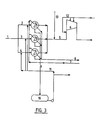
- FIG 3 shows a conventional unit in which nitrogen oxide-containing gas is conveyed in pipe (1) from an ammonia combustion unit (not shown) to a cooling section with three coolers (A, B, C) via separate pipes (2, 3, 4). Subsequent to the cooling, the gas streams are joined in one pipe (5) having supply of air for oxidation via pipes (13) and further to the compressor (6). To the compressor (6) and its inlet are means (12) for supply of water. To the coolers (A, B, C) is supplied water via pipe (7) for indirect cooling of the gas. The cooling water leaves the coolers through pipes (8). Condensate from the coolers is drained via pipes (9) and transferred to a tank (10) for condensate. Some condensate can be recirculated via pipe (11) to the separate gas pipes (2, 3, 4) ahead of the coolers (A, B, C).
- FIG 4 shows a process according to the invention when the function of the cooling section is changed relative to that shown in figure 3.
- cooler (8) acts as an indirect cooler as the gas here is only cooled with condensate via pipe (11).
- the gas in the coolers (B, C) is cooled in the same way as shown in figure 3.
- Condensate can be returned to the separate gas pipes (3, 4) in the same way as in figure 3.
- This example is a comparative example and shows cooling of nitrogen oxide-containing gases in a unit corresponding to that shown in figure 3.
- Gas having a temperature of about 160°C from an ammonia combustion unit is cooled in three parallel gas coolers (A, B, C) to about 18°C.
- the condensate formed at any time is pumped out of the cooling system and supplied at a suitable place later on in the process.
- the cooled gas is mixed with secondary air (13) before it is conveyed to an axial compressor in which the pressure is increased from about 0,95 bar to about 5 bar.
- the water vapour partial pressure in the inlet pipe (5) and through the compressor is shown by diagram 2 in figure 2.
- Crystalline ammonium nitrate is stable up to about 170°C. In spite of the low ammonia penetration in the combustion unit and the efforts for improved absorption of ammonia in the gas coolers, there will be constant formation of ammonium nitrate in the supply pipe (5) to the axial compressor and in the compressor (6) itself.
- This example shows the operation according to the invention over an operation period in a unit as shown in figure 4.
- the method was used for periodic removal of ammonium nitrate deposits in the apparatus.
- the gas from cooler (A) had a temperature of about 70°C and a water vapour pressure corresponding to equilibrium with the injected 5-8% nitric acid.
- the gas streams through the two other coolers (B, C) where cooled as stated above to about 18°C.
- the gas streams are again mixed after the coolers, and it is formed a oversaturated gas in which part of the water vapour condeses in form of fog which follows the gas.
- the fog reevaporates during the further heating which takes place during the oxidation of NO to N0 2 and further on in compressor.
- the water vapour pressure is higher than the equilibrium vapour pressure of the ammonium nitrate and ammonium nitrate will be transferred to a liquid phase and be transported out of the compressor and the supply pipe.
- This example shows an operation according to the invention and in a unit as shown in figure 4, during start up of the combustion unit when the penetration of ammonia is especially large.
- Diluted nitric acid was injected into the gas ahead of the gas coolers (A, B, C), and cooling water was supplied to coolers (B, C) while in the cooler (A) it was used direct cooling by injection of diluted nitric acid which might be earlier produced condensate from the tank (10).
- the high moisture content of the gas streams (5) prevented formation of ammonium nitrate deposit even during the large ammonia penetration which takes place during start up.
- removal of all of the ammonium nitrate deposits in the supply pipe and the nitrogen oxide gas compressor is obtained by the present invention without extra supply of water or vapour, by utilizing the water vapour content of the nitrogen oxide gas and the heat content from the combustion unit.
Landscapes
- Chemical & Material Sciences (AREA)
- Organic Chemistry (AREA)
- Inorganic Chemistry (AREA)
- Engineering & Computer Science (AREA)
- Mechanical Engineering (AREA)
- General Engineering & Computer Science (AREA)
- Treating Waste Gases (AREA)
- Separation By Low-Temperature Treatments (AREA)
- Agricultural Chemicals And Associated Chemicals (AREA)
- Preventing Corrosion Or Incrustation Of Metals (AREA)
- Physical Or Chemical Processes And Apparatus (AREA)
Priority Applications (1)
| Application Number | Priority Date | Filing Date | Title |
|---|---|---|---|
| AT83107673T ATE82229T1 (de) | 1982-08-06 | 1983-08-03 | Verfahren zum transport, kuehlen und komprimieren von nitrogenoxyd enthaltenden gasen. |
Applications Claiming Priority (2)
| Application Number | Priority Date | Filing Date | Title |
|---|---|---|---|
| NO822688A NO150688C (no) | 1982-08-06 | 1982-08-06 | Fremgangsmaate for aa fjerne og/eller forhindre dannelse av saltbelegg i utsatte avsnitt av et prosessanlegg hvor nitrogenoksydholdig gass transporteres, kjoeles og komprimeres |
| NO822688 | 1982-08-06 |
Publications (3)
| Publication Number | Publication Date |
|---|---|
| EP0101019A2 true EP0101019A2 (de) | 1984-02-22 |
| EP0101019A3 EP0101019A3 (en) | 1988-05-04 |
| EP0101019B1 EP0101019B1 (de) | 1992-11-11 |
Family
ID=19886680
Family Applications (1)
| Application Number | Title | Priority Date | Filing Date |
|---|---|---|---|
| EP83107673A Expired - Lifetime EP0101019B1 (de) | 1982-08-06 | 1983-08-03 | Verfahren zum Transport, Kühlen und Komprimieren von Nitrogenoxyd enthaltenden Gasen |
Country Status (6)
| Country | Link |
|---|---|
| US (1) | US4518438A (de) |
| EP (1) | EP0101019B1 (de) |
| JP (1) | JPS5950009A (de) |
| AT (1) | ATE82229T1 (de) |
| DE (1) | DE3382638T2 (de) |
| NO (1) | NO150688C (de) |
Families Citing this family (2)
| Publication number | Priority date | Publication date | Assignee | Title |
|---|---|---|---|---|
| US6926768B2 (en) | 2003-04-14 | 2005-08-09 | Sun Chemical Corporation | Treatment of high performance pigments |
| BR112014030850B1 (pt) * | 2012-06-11 | 2022-05-10 | Equinor Energy As | Método de limpeza de compressor submarino em que o líquido de limpeza é recuperado do fluido de processo de multifase |
Family Cites Families (8)
| Publication number | Priority date | Publication date | Assignee | Title |
|---|---|---|---|---|
| US3084076A (en) * | 1960-04-11 | 1963-04-02 | Dow Chemical Co | Chemical cleaning of metal surfaces employing steam |
| US3297481A (en) * | 1961-06-19 | 1967-01-10 | Purex Corp Ltd | Cleaning and descaling process |
| US3424371A (en) * | 1967-04-20 | 1969-01-28 | Ulrich Happe | Synthesis gas plant |
| US3796509A (en) * | 1972-05-10 | 1974-03-12 | Westinghouse Electric Corp | Scroll washer for centrifugal fans |
| US3830660A (en) * | 1972-11-30 | 1974-08-20 | Phillips Petroleum Co | Method for operating a compressor |
| US4400891A (en) * | 1980-03-28 | 1983-08-30 | Norsk Hydro A.S. | Steam cleaning system for process equipment and compressors |
| US4295895A (en) * | 1980-03-28 | 1981-10-20 | Norsk Hydro A.S. | Method for steam cleaning of compressors |
| JPS56144740A (en) * | 1980-04-04 | 1981-11-11 | Norsk Hydro As | Method and apparatus for removing and preventing formation of salt deposit |
-
1982
- 1982-08-06 NO NO822688A patent/NO150688C/no unknown
-
1983
- 1983-08-03 EP EP83107673A patent/EP0101019B1/de not_active Expired - Lifetime
- 1983-08-03 US US06/519,813 patent/US4518438A/en not_active Expired - Lifetime
- 1983-08-03 AT AT83107673T patent/ATE82229T1/de not_active IP Right Cessation
- 1983-08-03 DE DE8383107673T patent/DE3382638T2/de not_active Expired - Fee Related
- 1983-08-06 JP JP58144336A patent/JPS5950009A/ja active Granted
Also Published As
| Publication number | Publication date |
|---|---|
| ATE82229T1 (de) | 1992-11-15 |
| DE3382638T2 (de) | 1993-03-25 |
| EP0101019B1 (de) | 1992-11-11 |
| EP0101019A3 (en) | 1988-05-04 |
| JPS5950009A (ja) | 1984-03-22 |
| DE3382638D1 (de) | 1992-12-17 |
| NO822688L (no) | 1984-02-07 |
| US4518438A (en) | 1985-05-21 |
| JPH0459244B2 (de) | 1992-09-21 |
| NO150688B (no) | 1984-08-20 |
| NO150688C (no) | 1984-11-28 |
Similar Documents
| Publication | Publication Date | Title |
|---|---|---|
| US9155990B2 (en) | Method and plant for amine emission control | |
| US6804964B2 (en) | Water recovery from combustion turbine exhaust | |
| KR101329149B1 (ko) | 탄소 포집 시스템 및 프로세스 | |
| US4798910A (en) | Process sequencing for amine regeneration | |
| EP0503910A1 (de) | Verfahren zur Entfernung und Rückgewinnung von Kohlendioxyd und sauren Gasen aus Verbrennungskraftwerken | |
| US4663490A (en) | Process for the production of dinitrotoluene | |
| US4294590A (en) | Removal of undesired gaseous components from hot waste gases | |
| IL205191A (en) | A multi-stage system for extracting carbon dioxide and a method for processing a gas stream emitted from a chimney | |
| US4869890A (en) | Control of nitric acid plant stack opacity during start-up and shutdown | |
| US5122352A (en) | Heat exchanger and pollutant removal system | |
| US4378977A (en) | Removal of undesired gaseous components from hot waste gases | |
| WO2010020684A1 (en) | Method and plant for purification of exhaust from diesel engines | |
| EP0101019B1 (de) | Verfahren zum Transport, Kühlen und Komprimieren von Nitrogenoxyd enthaltenden Gasen | |
| FI72499B (fi) | Foerfarande foer energibesparing vid tio2-framstaellning. | |
| Bogart | Pitfalls in ammonia absorption refrigeration | |
| FI72799B (fi) | Saett att aostadkomma vaermeaotervinning ur fuktig gas genom vattenaongabsorption och anlaeggning foer saettets utfoerande. | |
| GB1260214A (en) | Method and apparatus for the desalination of water | |
| US4419334A (en) | Process for cooling and separating chlorides and fluorides from gas mixtures | |
| US4400891A (en) | Steam cleaning system for process equipment and compressors | |
| US4295895A (en) | Method for steam cleaning of compressors | |
| PL93535B1 (de) | ||
| RU2199375C1 (ru) | Способ абсорбционной осушки углеводородного газа | |
| NO144355B (no) | Fremgangsmaate og prosessanlegg for transport og kompresjon av nitrogenoksyder. | |
| JPS6348581B2 (de) | ||
| RU2171132C2 (ru) | Способ подготовки углеводородного газа к транспорту |
Legal Events
| Date | Code | Title | Description |
|---|---|---|---|
| PUAI | Public reference made under article 153(3) epc to a published international application that has entered the european phase |
Free format text: ORIGINAL CODE: 0009012 |
|
| AK | Designated contracting states |
Designated state(s): AT BE CH DE FR GB IT LI NL |
|
| PUAL | Search report despatched |
Free format text: ORIGINAL CODE: 0009013 |
|
| AK | Designated contracting states |
Kind code of ref document: A3 Designated state(s): AT BE CH DE FR GB IT LI NL |
|
| 17P | Request for examination filed |
Effective date: 19881018 |
|
| 17Q | First examination report despatched |
Effective date: 19900905 |
|
| GRAA | (expected) grant |
Free format text: ORIGINAL CODE: 0009210 |
|
| AK | Designated contracting states |
Kind code of ref document: B1 Designated state(s): AT BE CH DE FR GB IT LI NL |
|
| PG25 | Lapsed in a contracting state [announced via postgrant information from national office to epo] |
Ref country code: NL Effective date: 19921111 Ref country code: BE Effective date: 19921111 Ref country code: AT Effective date: 19921111 |
|
| REF | Corresponds to: |
Ref document number: 82229 Country of ref document: AT Date of ref document: 19921115 Kind code of ref document: T |
|
| REF | Corresponds to: |
Ref document number: 3382638 Country of ref document: DE Date of ref document: 19921217 |
|
| ET | Fr: translation filed | ||
| ITF | It: translation for a ep patent filed | ||
| NLV1 | Nl: lapsed or annulled due to failure to fulfill the requirements of art. 29p and 29m of the patents act | ||
| PG25 | Lapsed in a contracting state [announced via postgrant information from national office to epo] |
Ref country code: GB Effective date: 19930803 |
|
| PLBE | No opposition filed within time limit |
Free format text: ORIGINAL CODE: 0009261 |
|
| STAA | Information on the status of an ep patent application or granted ep patent |
Free format text: STATUS: NO OPPOSITION FILED WITHIN TIME LIMIT |
|
| 26N | No opposition filed | ||
| GBPC | Gb: european patent ceased through non-payment of renewal fee |
Effective date: 19930803 |
|
| PGFP | Annual fee paid to national office [announced via postgrant information from national office to epo] |
Ref country code: FR Payment date: 19950728 Year of fee payment: 13 |
|
| PGFP | Annual fee paid to national office [announced via postgrant information from national office to epo] |
Ref country code: DE Payment date: 19950831 Year of fee payment: 13 |
|
| PGFP | Annual fee paid to national office [announced via postgrant information from national office to epo] |
Ref country code: CH Payment date: 19960903 Year of fee payment: 14 |
|
| PG25 | Lapsed in a contracting state [announced via postgrant information from national office to epo] |
Ref country code: FR Effective date: 19970430 |
|
| PG25 | Lapsed in a contracting state [announced via postgrant information from national office to epo] |
Ref country code: DE Effective date: 19970501 |
|
| REG | Reference to a national code |
Ref country code: FR Ref legal event code: ST |
|
| PG25 | Lapsed in a contracting state [announced via postgrant information from national office to epo] |
Ref country code: LI Free format text: LAPSE BECAUSE OF NON-PAYMENT OF DUE FEES Effective date: 19970831 Ref country code: CH Free format text: LAPSE BECAUSE OF NON-PAYMENT OF DUE FEES Effective date: 19970831 |
|
| REG | Reference to a national code |
Ref country code: CH Ref legal event code: PL |