EP0100994A2 - Filterverfahren unter Gebrauch von halbfluidisierten Betten - Google Patents
Filterverfahren unter Gebrauch von halbfluidisierten Betten Download PDFInfo
- Publication number
- EP0100994A2 EP0100994A2 EP83107612A EP83107612A EP0100994A2 EP 0100994 A2 EP0100994 A2 EP 0100994A2 EP 83107612 A EP83107612 A EP 83107612A EP 83107612 A EP83107612 A EP 83107612A EP 0100994 A2 EP0100994 A2 EP 0100994A2
- Authority
- EP
- European Patent Office
- Prior art keywords
- filtration
- packed
- section
- solids
- bed
- Prior art date
- Legal status (The legal status is an assumption and is not a legal conclusion. Google has not performed a legal analysis and makes no representation as to the accuracy of the status listed.)
- Granted
Links
Images
Classifications
-
- B—PERFORMING OPERATIONS; TRANSPORTING
- B01—PHYSICAL OR CHEMICAL PROCESSES OR APPARATUS IN GENERAL
- B01D—SEPARATION
- B01D24/00—Filters comprising loose filtering material, i.e. filtering material without any binder between the individual particles or fibres thereof
- B01D24/36—Filters comprising loose filtering material, i.e. filtering material without any binder between the individual particles or fibres thereof with the filter bed fluidised during the filtration
-
- B—PERFORMING OPERATIONS; TRANSPORTING
- B01—PHYSICAL OR CHEMICAL PROCESSES OR APPARATUS IN GENERAL
- B01D—SEPARATION
- B01D24/00—Filters comprising loose filtering material, i.e. filtering material without any binder between the individual particles or fibres thereof
- B01D24/46—Regenerating the filtering material in the filter
- B01D24/4668—Regenerating the filtering material in the filter by moving the filtering element
-
- B—PERFORMING OPERATIONS; TRANSPORTING
- B01—PHYSICAL OR CHEMICAL PROCESSES OR APPARATUS IN GENERAL
- B01D—SEPARATION
- B01D24/00—Filters comprising loose filtering material, i.e. filtering material without any binder between the individual particles or fibres thereof
- B01D24/46—Regenerating the filtering material in the filter
- B01D24/4668—Regenerating the filtering material in the filter by moving the filtering element
- B01D24/4684—Regenerating the filtering material in the filter by moving the filtering element using spray devices
Definitions
- the field of this invention is the art of filtration of particulate solids from a liquid or gas, and particularly, filtration operations carried out with semifluidized beds of filtration media.
- Semifluidization refers to the phenomenon created when a mass of fluidized particles is compressed from above with a porous restraining plate, giving rise-to the formation of a fluidized bed and a fixed bed in series within a single containing vessel.
- the concept of semifluidization was first disclosed by Fan et al, A.I. Ch. E. Journal, Vol. 5, pp. 407-409, September, 1959, "Semifluidization”. See also Fan et al United States Patent 3,374,052.
- semifluidized beds were first described as a means for carrying out chemical reactions in which the high reaction rate of a fluidized bed is obtained within the initial fluidized portion of the bed, while the reaction is completed in the final packed section of the bed, taking advantage of the higher completion rate of fixed bed reactors.
- Semifluidized beds have also been referred to as "convertible" beds, since the relative size or extent of the fluidized and packed sections are subject to control, the bed being convertible over the range from a full bed fluidization to a completely packed bed, with the relative size and extent of the fluidized and packed sections being selectively variable.
- the degree of fluidization of a semifluidized bed can be controlled by the position of the upper porous retainer and/or by the fluidization velocity. As the retainer is moved downwardly and/or as the fluidization velocity is increased, the downward extent of the packed section is increased.
- processes may be carried out with fluidized and packed bed sections of selected relative size.
- the extent of the packed section relative to the fluidized section can be increased or decreased as required for promoting the process or operation. See, for example, Wen & Fan United States Patent 4,157,959 and Fan & Wen United States Patent 4,253,947. Further, as shown by these patents, at the conclusion of a filtration operation or a biological reaction, the upper retainer may be raised to a position at which the bed can be fully fluidized for purpose of removing accumulated solids, such as filtered solids, or bacterial floc.
- Wen & Fan Patent 4,157,959 describes the application of a convertible semifluidized bed of a filtration medium to the removal of fine particulate solids from a liquid or gas.
- the teachings of that patent are therefore particularly relevant to the subject matter of this application.
- the filtration operation is started with all, or at least most, of the filter medium in the form of a packed bed.
- the filtration proceeds with the fluid containing the particulates to be filtered being passed upwardly through the packed bed from the bottom to the top thereof.
- the solids accumulate in the entry section of the bed, the extent of solids penetration into the bed being limited, and with the formation of a typical filter cake.across the lower end of the fixed bed.
- This invention relates to an improved method of filtration using a semifluidized bed, which provides important operational advantages over the method disclosed in'United States Patent 4,157,959.
- the filtration cycle is started with a minor portion of the filtration medium in the form of a packed section above a fluidized section containing the major portion of the filtration medium.
- the relatively small packed section functions as a conventional fixed bed filter with the removed solids in the bottom or entry portion of the packed section adjacent to interface between the packed and fluidized sections.
- the circulating particles of the filtration medium act to scour the bottom of the packed bed section, delaying the build-up of the pressure drop, as in connection with the prior method of Patent 4,157,959.
- the circulating media particles will tend to establish a circulation pattern which will affect the upward flow pattern of the fluidizing liquid or gas containing the solid particles to be filtered.
- the filter cake builds up across the lower end portion of the packed bed, there will inherently be a variation in the rate at which solids are deposited across the interface.
- the first phase of the filtration is carried out without appreciably increasing the percent of the filtration medium in the packed section.
- This first phase is continued until a filter cake of removed solids has accumulated across the packed section interface, and until one area of the interface adjacent to wall portion of the filtration chamber contains a larger accumulation of solids than in an area adjacent an opposed wall portion of the chamber.
- This condition is reached as the buildup of the filter cake approaches a point at which the filtration operation would have been discontinued for removal of accumulated solids in a conventional fixed bed filtration, or in which the retainer plate would have been moved upwardly to break off the filter cake, and resuspend the filtered solids, as described in Patent 4,157,959.
- filtration need not be discontinued and the retainer plate need not be moved. Instead, the filtration is continued in a second phase in which there is fluid flow predominantly through the less plugged area of the packed section interface. With this shift in flow, there_is an increase in local flow velocity through the less completely packed section of the filter cake. This results in the addition of filter medium particles to the portion of the packed bed, increasing the downward extent of the packed section along one wall portion of the chamber.
- the solids being filtered are deposited together with the filter medium.
- the result is somewhat analogous to that produced with the addition of body feed filter aid to the slurry in precoat filtrations.
- the codeposition of the filter medium and filtered solids onto the progressively downwardly extending portion of the packed section limits the increase in pressure drop across the packed section. This effect permits the filtration cycle to be greatly extended.
- the amount of fluid filtered can be increased 4 to 8 times or more as compared with a conventional fixed bed filter.
- the filtrate obtained with respect to the solids removal is of as good quality as that produced by a conventional fixed bed filter.
- the packed section at the start of the filtration is of minimal extent, being only sufficient in depth to prevent breakthrough of the solids being filtered. This leaves the maximum amount of the filtration medium in the fluidized section so that the second phase of the filtration can be carried out for the maximum time.
- the second phase is continued until substantially all of the filtration medium has been transferred from the fluidized portion to the packed section.
- a final third filtration phase can be used in which the packed section again acts as a conventional fixed bed filter until it approaches plugging.
- the filtration cycle can be greatly extended in length, with much more volume of fluid processed, and a high quality solids-free filtrate obtained. Further, all of these advantages can be obtained without a complicated apparatus system in which progressive upward movement of the retainer is required.
- the retainer can be lifted to a level at which the bed can be fully fluidized, permitting easy removal of the accumulated solids with retention of the filter medium.
- the next filtration cycle can be started after a short cleaning period by returning the retainer to the same operating position.
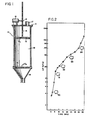
- the filter chamber 19 is the space in which the granular filter medium is confined and is therefore defined by the cylindrical side wall of the column 10 and by the perforated upper and lower plates 13 and 12, respectively.
- the porous upper plate is shown to .be movable for cleanup operations, it can remain in fixed relation to the remainder of the apparatus when the filtering method of this invention is carried out.
- Apertures 12a and 13a are schematically represented in the drawings and are shown to be uniformly spaced from each other in the respective plates.
- the size of the apertures should be small enough to prevent or restrain passage of the granules or particles of the filter medium without at the same time preventing passage of the fine solids or particulates intended to be captured by that medium.
- the sizes of openings 12a or 13a, or both, of the lower and upper plates may be varied slightly, or the pattern of apertures in one or both of the plates may be varied, to achieve the velocity differential.
- the plates 12 and 13 may each have apertures of equal size arranged in a uniform pattern, but certain of such openings may be partially or completely closed to achieve the difference in velocity necessary at the commencement of a filtering cycle. It will also be appreciated that similar results may be achieved by modifying the shape or construction of inlet section 18. While such variations can comprise desirable apparatus designs for purpose of the present invention, the method can also be carried out with standard fluid inlet means, which utilizes a fluid supply and distributor designed to achieve relatively uniform flow of the fluidizing fluid.
- the medium will be one which is capable of retaining the particulates or fine solids carried by the fluid (gas or liquid) when the fluid is passed through the bed in a fixed or packed state. If a granular filter medium would be suitable for a gravitational filtration for the specific fluid and solids contained therein, it should be usable for purposes of this invention. Where only filtration is involved, the bed granules would normally be inert to the fluid being filtered as well as to the filtered solids; however, as indicated, such a column may also advantageously be used for chemical or biological reactions, in which case the upper fixed bed section may be used to restrain solid biological waste products or solid chemical reaction products.
- the particles or granules of the upper bed section constitute the porous filter medium.
- the bed may be formed of particles or granules of sand, glass beads, or a wide variety of other granular filter materials. It will be understood that the density and sizes of the particles will be adjusted for the given system to be filtered. Also, in those cases where filtration occurs in conjunction with a biological reaction, as disclosed in patent 4,253,947, the granular medium that serves as a bacterial carrier in the reactor, and which is innoculated with bacteria in accordance with known practice, must be compatible with such bacteria.
- sand which has been sized to obtain the desired particle size is suitable, but other usable carriers include coal, carbon, alumina, plastic particles, and the like. In some cases, mixtures of different materials with different densities and particle sizes may be advantageous.
- a suitable pump is provided to supply the gas or liquid to be filtered under pressure to inlet section 18.
- the pump for example, may be a piston-type pump providing a constant flow volume, or a centifugal-type pump which permits the flow volume to decrease as the pressure drop increases across the packed section of the bed.
- the velocity of the incoming fluid should be greater than the minimum fluidization velocity for the particular filter medium.
- the fluid should have an upward velocity of at least 2 times the minimum fluidization velocity for the bed when that bed is unrestrained (i.e., when a free- board space exists between the upper foraminous plate 13 and the bed therebelow).
- the upward velocity of the fluid will fall within the range of 2 to 10 times the minimum fluidization velocity for an unrestrained bed, a preferred velocity range being from about 3 to 6 times the minimum fluidization velocity.
- the degree of fluidization may be controlled by the position of the upper porous plate 13 and may be expressed as where X is the fraction of bed particles in the upper packed section of the semifluidized bed, pS is the density of bed particles; A is the cross-sectional area of the bed; e p a and ⁇ f are the porosities of the packed and fluidized sections, respectively; W is the mass of the bed particles, h f is the unrestrained fluidized height of the bed, and h is the position of the upper porous plate or the height of the semifluidized bed.
- the top porous plate 13 Prior to starting a filtration run, the top porous plate 13 is moved to a predetermined position, which depending on the flow velocity to be used, will provide the desired relative sizes of the packed and fluidized sections of the bed.
- the semifluidized bed is designated in its entirety by numeral 30 and consists of an upper packed section 31 and a lower fluidized section 32.
- the packed section of the bed consists of particles or granules that would be fluidized if the bed were unrestrained but which are immobilized by the upper porous plate and the upward flow of fluid passing through the chamber 21.
- the height or thickness of the dense layer of particles in the fixed or packed bed section 31 is substantially less than the height or thickness of the fluidized section 32.
- the thickness of the fixed or packed bed section should at least be slightly greater than the minimum thickness necessary to produce effective removal of solids from the fluid flowing upwardly through the chamber. If the packed section is too thin, solids breakthrough can occur.
- the packed section at the start of the filtration will contain less than 50% of the total filtration medium, such as 25% or less of the filtration medium.
- the fluidized section will contain more than 50% of the filtration medium, such as 75% or more.
- the packed section at the start of the filtration can contain not over 10% of the filtration media.
- the minimum thickness of the packed section will depend on the particular filter medium, the solids being filtered, and other factors, such as the velocity of fluid flow. However, it appears that in general, packed section thicknesses of at least 0.07 to 0.1 meters are desirable to prevent solids breakthrough.
- This predominant particle circulation pattern develops and modifies the upward fluid flow so that in steady state operation there is slightly greater velocity of upward flow of fluid in one area of the packed bed.
- the circulation pattern is assumed to be clockwise and the greater velocity of fluid flow is indicated by heavier arrow 34a on the left side of chamber 21.
- the presentation is schematic and that in actuality no sharp demarcation exists between the different velocity flows but that a gradation of velocities will exist, ranging from a higher velocity adjacent the left wall portion to a lower velocity adjacent the right wall portion.
- the particular pattern of Figure 3 is given only for purposes of illustration and that, for example, the zone of greater velocity might instead be located on the right, or in some other portion of the cross-sectional area of the chamber 21 below the packed bed.
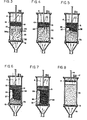
- the upward flow of fluid delivers filterable solids to the undersurface of packed bed section 31 but since the velocity of flow in the first phase of the filtering operation is somewhat greater in one area than another, the build-up of solids will not be completely uniform as the filter cake is formed at the interface of the packed and fluidized sections.
- Such filtered solids do not penetrate deeply into the packed bed section but are instead deposited in a layer or cake, as indicated by the darkened area 36 in Figure 4.
- the accumulated solids 36 increase the resistance to flow through the packed filter bed section more on one side than another, causing a diversion or deflection of flow as the fluid takes the path of lesser resistance through the less completely loaded portion of the packed section interface. This is indicated by the flow arrows in Fig. 4.
- the local flow velocity adjacent the entry to the less loaded interface portion causes more of the media to deposit.
- Media particles are transferred from the fluidized section 32 to that part of the packed section through which the predominant fJow is occurring. This results in the downward expansion or enlargement of the packed bed section along one wall of the filtration chamber, as indicated in Fig. 6.
- the downwardly growing portion of the packed bed will develop along a supporting wall rather than in a central area spaced from the walls, which would be unstable under the conditions of fluidized bed operation.
- the second phase of the filtration operation can be continued until substantially all of the medium is transferred from the fluidized section to the packed section of the unit. Depending on the length of the filtration chamber, this condition may occur at about the time the downwardly extending packed section reaches the distributor 12, as illustrated in Fig. 7.
- a clean-up or flushing operation may be carried out by raising the top porous plate so as to fully fluidize the medium and filtered solids with a purging fluid passing therethrough. Such a procedure is indicated in Figure 8. The solids captured by the bed in the prior filtering operation are thereby flushed from the chamber and carried away through outlet 17. Thereafter, the upper plate 13 is again lowered into its original position and the filtering operation described in connection with Figures 3-7 is repeated.
- the water without filtration
- the wash water will carry out the deposited solids through the upper retainer, as illustrated in Fig. 8, while any particles of the medium reaching the retainer 13 will be kept within the filtration chamber.
- an outlet for the wash fluid can be provided beneath the upper position of the retainer.
- inlets and outlets can be provided for changing the loaded filtration medium, the medium containing the accumulated solids being removed, cleaned external to the apparatus and fresh clean medium being introduced into the apparatus for each new filtration cycle.
- Fluids which may be used in the described process include both gases and liquids.
- Gases would include air, flue gas, combustion gas, oxygen, nitrogen, chlorine and other halogens, methane, ethylene and other hydrocarbons and other organic and inorganic gases. They may also include vaporized organic and inorganic solids and liquids; for example, naphthalene and benzene.
- Liquids which may be used include water, hydrocarbons, alcohols and other organic and inorganic liquids and solutions.
- a semifluidized bed filter was constructed from a transparent plastic column with an inside diameter of 0.132 meters and a length of 0.457 meters between the porous bottom distributor plate and the outlet.
- the filtering medium consisted of minus 20 to plus 30 (20 x 30) mesh or minus 14 to plus 20 (14 x 20) mesh (American Standard Screen size) silica sand having an average particle diameter of 710 ⁇ m or 1100 ⁇ m, respectively.
- the density of the sand was 2600 kg/m 3 .
- the minimum fluidization velocity of the 20 x 30 mesh sand was determined experimentally to be 13.1 m/hr.
- the sand between 0.149 m and 0.328 meter in depth under the least dense static condition was supported between a bottom distributor plate and a top movable porous plate.
- the fluid to be filtered was introduced below the lower plate.
- These plates retained the sand particles but allowed the entering slurry and the exit liquid to flow through.
- the slurry was composed of minus 50 mesh coal particles with a density of 15 40 kg/m 3 dispersed in water.
- the solids were maintained in suspension in a slurry tank with agitation provided by a propeller mixer.
- the top porous plate Prior to starting a filtration run, the top porous plate was moved to a predetermined position as calculated using the equation given in the foregoing specification, which would result in a proper degree of fluidization with the introduction of the slurry. During the course of the filtration run, the top porous plate was maintained in that position. Filter performance was determined with 25% of the filtering medium initially in the packed section of the semifluidized bed. For comparison purposes, filtration with 100% of the bed particles in the packed section was also undertaken. Filtration with 100% of the bed particles in the packed section corresponds to conventional up-flow deep bed filtration.
- the exhausted filter was cleaned by fluidizing the entire bed with water to remove the deposited solids. During this period, the upper porous plate was raised to a position well above the fluidizing sand particles. The coal particles which did not adhere to the sand were easily flushed from the filter in this manner. With the bed regenerated, the filtration cycle could then be reactivated.
- Figure 2 is a graph showing the pressure build-up during a filtering operation utilizing a semifluidized bed with 25% of the bed particles initially in the packed section at the commencement of the filtering cycle.
- the column was prepared as set forth in Example 1 utilizing 20 x 30 mesh sand and a concentration of solids in the feed slurry (c i ) of 0.0165 weight percent.
- the points on the graph represent the pressure differential values that were observed at the times indicated. Changes in the appearance of the semifluidized bed occurred as generally indicated in Figures 3 - 7.
- the numbered arrows in Figure 2 correlate respectively with Figs. 3 - 7.
- the first phase of the filtration is represented by Fig. 3 with arrow 50 and Fig.
- the method of this invention involves a novel mechanism of filtration.
- the theoretical explanation of the observed mechanism has not been established, but it can be related to certain known principles.
- Fluid velocity in a semifluidized bed is never constant with position in the bed, or with time, but varies constantly in conformance with the laws of fluid dynamics for turbulent flow.
- a semifluidized bed in a filtration is an unstable system. No self-regulating mechanism exists. The reverse is true in that perturbations are self- sustaining.
- the fluid velocity through a small area of the bed momentarily increases, the amount of solids deposited in that area in the small amount of time of increased velocity also increases. This increases the pressure drop in that area and shifts the flow to an adjoining area. Flow through the first area is not completely stopped but is reduced.
Landscapes
- Chemical & Material Sciences (AREA)
- Chemical Kinetics & Catalysis (AREA)
- Devices And Processes Conducted In The Presence Of Fluids And Solid Particles (AREA)
- Filtration Of Liquid (AREA)
Applications Claiming Priority (2)
| Application Number | Priority Date | Filing Date | Title |
|---|---|---|---|
| US405612 | 1982-08-10 | ||
| US06/405,612 US4438000A (en) | 1982-08-10 | 1982-08-10 | Method of filtration using semifluidized beds |
Publications (3)
| Publication Number | Publication Date |
|---|---|
| EP0100994A2 true EP0100994A2 (de) | 1984-02-22 |
| EP0100994A3 EP0100994A3 (en) | 1984-10-10 |
| EP0100994B1 EP0100994B1 (de) | 1987-04-01 |
Family
ID=23604433
Family Applications (1)
| Application Number | Title | Priority Date | Filing Date |
|---|---|---|---|
| EP83107612A Expired EP0100994B1 (de) | 1982-08-10 | 1983-08-02 | Filterverfahren unter Gebrauch von halbfluidisierten Betten |
Country Status (5)
| Country | Link |
|---|---|
| US (1) | US4438000A (de) |
| EP (1) | EP0100994B1 (de) |
| JP (1) | JPS5929010A (de) |
| CA (1) | CA1202577A (de) |
| DE (1) | DE3370591D1 (de) |
Cited By (5)
| Publication number | Priority date | Publication date | Assignee | Title |
|---|---|---|---|---|
| EP0259000A1 (de) * | 1986-08-04 | 1988-03-09 | JAMES HOWDEN & COMPANY LIMITED | Verfahren und Vorrichtung zum Filtrieren |
| FR2635468A1 (fr) * | 1988-08-19 | 1990-02-23 | Inst Textile De France | Appareil de separation d'au moins deux elements contenus dans un fluide gazeux ou liquide a l'aide d'un materiau filtrant ou absorbant |
| GB2239192A (en) * | 1989-12-19 | 1991-06-26 | Edward Andrew Seymour | Filter bed |
| NL1041872A (nl) * | 2016-05-18 | 2017-11-23 | Waterslag B V | Inrichting en werkwijze voor het filteren van een verontreiniging uit een vloeistof, tevens werkwijze voor het regenereren van zo een inrichting |
| US11185800B2 (en) | 2017-08-15 | 2021-11-30 | Conopco, Inc. | Apparatus and method for filtering aqueous liquid |
Families Citing this family (10)
| Publication number | Priority date | Publication date | Assignee | Title |
|---|---|---|---|---|
| US5158686A (en) * | 1991-02-25 | 1992-10-27 | Envar Services, Inc. | Impurity removal process and apparatus |
| US5145589A (en) * | 1991-04-29 | 1992-09-08 | Nishihara Environmental Sanitation Research Corporation Limited | Solid-liquid separator and process for washing the same |
| DE4138414C2 (de) * | 1991-11-22 | 1993-10-07 | Ieg Ind Engineering Gmbh | Anordnung zum Reinigen von verunreinigtem Grundwasser |
| US20050242018A1 (en) * | 2001-08-01 | 2005-11-03 | Teledyne Isco, Inc. | Disposable chromatographic columns |
| WO2010023656A1 (en) * | 2008-08-29 | 2010-03-04 | Nir Oz | Filter with adjustable porosity |
| DE102015118166A1 (de) * | 2015-10-23 | 2017-04-27 | Roland Lorch | Nachkläreinheit, Verfahren und Verwendung |
| WO2017161381A1 (en) | 2016-03-18 | 2017-09-21 | Schreiber, Llc | Improved methods for cleaning filtration system media |
| US10913667B2 (en) * | 2017-12-08 | 2021-02-09 | Westech Engineering, Inc. | Multi-media clarification systems and methods |
| CN110550789B (zh) * | 2019-08-14 | 2024-04-05 | 东莞市金唐水处理设备有限公司 | 一种半导体纯水处理系统 |
| US11583788B1 (en) * | 2022-01-18 | 2023-02-21 | Theodore A. Kuepper | Lightweight fibrous media (LFM) filter |
Family Cites Families (11)
| Publication number | Priority date | Publication date | Assignee | Title |
|---|---|---|---|---|
| CA686533A (en) | 1964-05-12 | S. Clements James | Process for treating liquids | |
| DE832596C (de) * | 1950-10-21 | 1952-02-25 | Metallgesellschaft Ag | Vorrichtung zur Behandlung von Fluessigkeiten mit koernigen Filtermaterialien |
| DE1442689C3 (de) | 1963-11-29 | 1978-11-30 | Bayer Ag, 5090 Leverkusen | Verfahren zur Behandlung von Flüssigkeiten mit Ionenaustauschern |
| GB1147054A (en) | 1965-06-14 | 1969-04-02 | Chepos Zd Y Chemickeho A Potra | Liquid clarifier |
| US3374052A (en) | 1965-12-20 | 1968-03-19 | Dept Of Chemical Engineering | System for solid particles-fluid contact operations |
| DE2550751C2 (de) | 1975-11-12 | 1981-10-15 | Uranerzbergbau- GmbH, 5300 Bonn | Verfahren und Vorrichtung zur Gewinnung von gelösten, suspendierten oder chemisch gebundenen Stoffen aus einer Flüssigkeit |
| JPS596715B2 (ja) | 1976-09-10 | 1984-02-14 | 日石三菱株式会社 | 排水の処理方法 |
| US4157959A (en) | 1977-08-15 | 1979-06-12 | Kansas State University Research Foundation | Method of filtration using convertible (semifluidized) beds |
| DE2842058A1 (de) | 1978-09-27 | 1980-04-10 | Uranerzbergbau Gmbh & Co Kg | Verfahren und vorrichtung zur gewinnung von geloesten, suspendierten oder chemisch gebundenen stoffen aus einem gewaesser |
| US4253947A (en) | 1979-02-12 | 1981-03-03 | Kansas State University Research Foundation | Method for wastewater treatment in fluidized bed biological reactors |
| DE3004614A1 (de) * | 1980-02-08 | 1981-08-13 | Hans 4720 Beckum Nowatzyk | Konstruktion einer filteranlage insbesondere zur filtration von fluessigkeiten mit koloidalem schmutzanteil zur blankfiltration von waessrigen loesungen, basierend auf schwimmenden filterfuellkoerpern die von unten nach oben durchstroemt werden |
-
1982
- 1982-08-10 US US06/405,612 patent/US4438000A/en not_active Expired - Fee Related
- 1982-09-27 JP JP57168230A patent/JPS5929010A/ja active Granted
-
1983
- 1983-07-07 CA CA000431983A patent/CA1202577A/en not_active Expired
- 1983-08-02 EP EP83107612A patent/EP0100994B1/de not_active Expired
- 1983-08-02 DE DE8383107612T patent/DE3370591D1/de not_active Expired
Cited By (8)
| Publication number | Priority date | Publication date | Assignee | Title |
|---|---|---|---|---|
| EP0259000A1 (de) * | 1986-08-04 | 1988-03-09 | JAMES HOWDEN & COMPANY LIMITED | Verfahren und Vorrichtung zum Filtrieren |
| US4776962A (en) * | 1986-08-04 | 1988-10-11 | James Howden & Company Limited, A British Company | Filtering apparatus and method |
| FR2635468A1 (fr) * | 1988-08-19 | 1990-02-23 | Inst Textile De France | Appareil de separation d'au moins deux elements contenus dans un fluide gazeux ou liquide a l'aide d'un materiau filtrant ou absorbant |
| EP0358543A1 (de) * | 1988-08-19 | 1990-03-14 | Centre Technique Industriel dit: INSTITUT TEXTILE DE FRANCE | Vorrichtung zum Schneiden von mindestens zwei Elementen in einem Gas oder in einer Flüssigkeit mit einem Filter- oder Absorptionsmaterial |
| US4971688A (en) * | 1988-08-19 | 1990-11-20 | Centre Technique Industriel: Institut Textile de France | Apparatus for separating at least two elements contained in a liquid or gaseous fluid by means of an absorbent filtering material |
| GB2239192A (en) * | 1989-12-19 | 1991-06-26 | Edward Andrew Seymour | Filter bed |
| NL1041872A (nl) * | 2016-05-18 | 2017-11-23 | Waterslag B V | Inrichting en werkwijze voor het filteren van een verontreiniging uit een vloeistof, tevens werkwijze voor het regenereren van zo een inrichting |
| US11185800B2 (en) | 2017-08-15 | 2021-11-30 | Conopco, Inc. | Apparatus and method for filtering aqueous liquid |
Also Published As
| Publication number | Publication date |
|---|---|
| JPS6121686B2 (de) | 1986-05-28 |
| CA1202577A (en) | 1986-04-01 |
| US4438000A (en) | 1984-03-20 |
| EP0100994A3 (en) | 1984-10-10 |
| JPS5929010A (ja) | 1984-02-16 |
| DE3370591D1 (en) | 1987-05-07 |
| EP0100994B1 (de) | 1987-04-01 |
Similar Documents
| Publication | Publication Date | Title |
|---|---|---|
| US4438000A (en) | Method of filtration using semifluidized beds | |
| US4157959A (en) | Method of filtration using convertible (semifluidized) beds | |
| RU2358798C2 (ru) | Способ получения жидких и газообразных продуктов из газообразных реагентов | |
| EP2508488B1 (de) | Verbesserter Reaktor und verbessertes Verfahren zur Reinigung von biologischem Abwasser | |
| US5844006A (en) | Process for producing liquid and, optionally, gaseous products from gaseous reactants | |
| US3698554A (en) | Method for backwashing filters | |
| US4021339A (en) | Water filter | |
| JPS5932197B2 (ja) | 廃水改良処理用の流動層生物反応方法 | |
| US5122287A (en) | Filtration system | |
| EP1608450B1 (de) | Filtrations-apparat | |
| US7378452B2 (en) | Filtration system for slurry hydrocarbon synthesis process using both small and large pore filter elements | |
| CA2154184C (en) | Solid/liquid slurry treatment apparatus and catalytic multi-phase reactor | |
| JPS62247812A (ja) | 加圧式上向流深層濾過方法及びそれに用いる濾過器 | |
| EP1940540B1 (de) | Filtrationsverfahren | |
| US5292436A (en) | Tapered bed filtration apparatus | |
| US3631983A (en) | Method for backwashing filters | |
| WO1991008817A1 (en) | Treating liquids in filters | |
| GB2124921A (en) | Filtering method and apparatus | |
| US3552573A (en) | Filtering apparatus | |
| EP0150616A2 (de) | Filteranlage | |
| AU729854C (en) | High rate filtration system | |
| CN117412797A (zh) | 带内部引流管的分层介质反冲洗 | |
| JP2518743B2 (ja) | 有機性汚水の下向流式生物ろ過装置 |
Legal Events
| Date | Code | Title | Description |
|---|---|---|---|
| PUAI | Public reference made under article 153(3) epc to a published international application that has entered the european phase |
Free format text: ORIGINAL CODE: 0009012 |
|
| AK | Designated contracting states |
Designated state(s): DE FR GB IT NL SE |
|
| 17P | Request for examination filed |
Effective date: 19840405 |
|
| PUAL | Search report despatched |
Free format text: ORIGINAL CODE: 0009013 |
|
| AK | Designated contracting states |
Designated state(s): DE FR GB IT NL SE |
|
| GRAA | (expected) grant |
Free format text: ORIGINAL CODE: 0009210 |
|
| AK | Designated contracting states |
Kind code of ref document: B1 Designated state(s): DE FR GB IT NL SE |
|
| PG25 | Lapsed in a contracting state [announced via postgrant information from national office to epo] |
Ref country code: NL Effective date: 19870401 Ref country code: IT Free format text: LAPSE BECAUSE OF FAILURE TO SUBMIT A TRANSLATION OF THE DESCRIPTION OR TO PAY THE FEE WITHIN THE PRESCRIBED TIME-LIMIT;WARNING: LAPSES OF ITALIAN PATENTS WITH EFFECTIVE DATE BEFORE 2007 MAY HAVE OCCURRED AT ANY TIME BEFORE 2007. THE CORRECT EFFECTIVE DATE MAY BE DIFFERENT FROM THE ONE RECORDED. Effective date: 19870401 Ref country code: FR Free format text: THE PATENT HAS BEEN ANNULLED BY A DECISION OF A NATIONAL AUTHORITY Effective date: 19870401 |
|
| PG25 | Lapsed in a contracting state [announced via postgrant information from national office to epo] |
Ref country code: SE Effective date: 19870430 |
|
| REF | Corresponds to: |
Ref document number: 3370591 Country of ref document: DE Date of ref document: 19870507 |
|
| EN | Fr: translation not filed | ||
| NLV1 | Nl: lapsed or annulled due to failure to fulfill the requirements of art. 29p and 29m of the patents act | ||
| PLBE | No opposition filed within time limit |
Free format text: ORIGINAL CODE: 0009261 |
|
| STAA | Information on the status of an ep patent application or granted ep patent |
Free format text: STATUS: NO OPPOSITION FILED WITHIN TIME LIMIT |
|
| 26N | No opposition filed | ||
| PGFP | Annual fee paid to national office [announced via postgrant information from national office to epo] |
Ref country code: GB Payment date: 19920707 Year of fee payment: 10 |
|
| PGFP | Annual fee paid to national office [announced via postgrant information from national office to epo] |
Ref country code: DE Payment date: 19920730 Year of fee payment: 10 |
|
| PG25 | Lapsed in a contracting state [announced via postgrant information from national office to epo] |
Ref country code: GB Effective date: 19930802 |
|
| GBPC | Gb: european patent ceased through non-payment of renewal fee |
Effective date: 19930802 |
|
| PG25 | Lapsed in a contracting state [announced via postgrant information from national office to epo] |
Ref country code: DE Effective date: 19940503 |