EP0100525A2 - Zentriervorrichtung - Google Patents
Zentriervorrichtung Download PDFInfo
- Publication number
- EP0100525A2 EP0100525A2 EP19830107403 EP83107403A EP0100525A2 EP 0100525 A2 EP0100525 A2 EP 0100525A2 EP 19830107403 EP19830107403 EP 19830107403 EP 83107403 A EP83107403 A EP 83107403A EP 0100525 A2 EP0100525 A2 EP 0100525A2
- Authority
- EP
- European Patent Office
- Prior art keywords
- assembly
- aperture
- throughbore
- plunger
- plate
- Prior art date
- Legal status (The legal status is an assumption and is not a legal conclusion. Google has not performed a legal analysis and makes no representation as to the accuracy of the status listed.)
- Withdrawn
Links
- 239000002245 particle Substances 0.000 claims abstract description 12
- 238000000034 method Methods 0.000 description 6
- 238000004458 analytical method Methods 0.000 description 2
- 238000010894 electron beam technology Methods 0.000 description 2
- RYGMFSIKBFXOCR-UHFFFAOYSA-N Copper Chemical compound [Cu] RYGMFSIKBFXOCR-UHFFFAOYSA-N 0.000 description 1
- 230000004075 alteration Effects 0.000 description 1
- 229910052802 copper Inorganic materials 0.000 description 1
- 239000010949 copper Substances 0.000 description 1
- 238000003754 machining Methods 0.000 description 1
- 238000012986 modification Methods 0.000 description 1
- 230000004048 modification Effects 0.000 description 1
- 238000007493 shaping process Methods 0.000 description 1
- 238000004611 spectroscopical analysis Methods 0.000 description 1
- 239000000126 substance Substances 0.000 description 1
- 239000013076 target substance Substances 0.000 description 1
- 238000003466 welding Methods 0.000 description 1
Images
Classifications
-
- H—ELECTRICITY
- H01—ELECTRIC ELEMENTS
- H01J—ELECTRIC DISCHARGE TUBES OR DISCHARGE LAMPS
- H01J49/00—Particle spectrometers or separator tubes
- H01J49/02—Details
- H01J49/04—Arrangements for introducing or extracting samples to be analysed, e.g. vacuum locks; Arrangements for external adjustment of electron- or ion-optical components
Definitions
- the present invention generally relates to an alignment assembly and, in particular, relates to such an assembly useful for externally aligning an element located in an ultra-high vacuum.
- the resultant signal from the collector assembly is then processed to provide a useful output signal indicative, or representative, of the elemental composition of the substance.
- the positioning, or alignment, of the collector assembly with the charged particles passing through the charged particle analyzer is the positioning, or alignment, of the collector assembly with the charged particles passing through the charged particle analyzer.
- the diameter of the particle beam, i.e. the incident beam, which liberated charged particles from the surface of the sample was relatively large and alignment of the beam with the analyzer was accomplished by, inter alia, deflecting the beam along its axis.
- object of the present invention to provide an alignment assembly which is quite accurate and requires only a relatively short time to achieve alignment.
- an alignment assembly having a plate with a plurality of radial throughbores containing means for positioning and securing the element of a charged particle analyzer being aligned.
- the present invention generally relates to any charged particle spectroscopic instrument,-the following description pertains to an electron spectroscope, in particular, an Auger electron spectroscope.
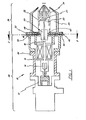
- An Auger electron spectroscopic instrument generally indicated at (10) in Figure 1, embodying the principles of the present invention, includes an electron beam source (12), having beam control elements including: a beam blanking element (14), a condenser lens (16), first beam steering plates (18), a variable objective aperture (20), second beam steering plates (22), and a fixed objective lens (24).
- the instrument (10) further includes an Auger electron analyzer (26) including, in this embodiment, a cylindrical mirror analyzer,(28), a collector assembly (30) and an alignment assembly (32).
- ultra-high vacuum As known in the art, the above elements are encased within the interior of a housing (34) which, during operation, is pumped down to an ultra-high vacuum (herein the term “ultra-high vacuum” is used to designate a pressure of less than about 10 -9 torr).
- the electron beam source can be of a conventional design, for example, such as that described in U.S. Patent No. 4,205,226, the entirety of which is incorporated by reference herein. Further, the conventional beam focusing and shaping elements discussed above are also described sufficiently therein and further description thereof is not believed to be warranted for a complete understanding of the present invention.
- the departure from the conventional instrument which is the subject of the present invention is the provision of the alignment assembly (32) between the target side (36) and the beam source side (38) of the collector assembly (30).
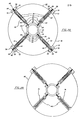
- the alignment assembly(32), as shown in Figure 2, includes a flange plate (40) having an aperture (42) therethrough.
- the aperture (42) is circular and coaxial with the flange plate (40) and has a diameter of about 4 cm and which loosely accepts the collector assembly (30) therewithin.
- the flange plate (40) further includes a plurality of spaced-apart throughbores (44) extending from the perimeter (46) of the flange plate (40) and communicating with the aperture (42).
- the throughbores (44) all lie in the same plane, which plane is substantially perpendicular to the axis of the beam path.
- each throughbore (44) includes a plunger (48) extendable into, and retractable from, the aperture (42) by a push rod (50) controllable external the perimeter (46) of the flange plate (40).
- Each push rod (50) extends through a bellows (52) within the throughbore (44), which bellows (52) is capable of sustaining an ultra-high vacuum thereacross.
- One such bellows (52) is manufactured and marketed as part number 321-4-X-2 by CAJON Company of Solon, Ohio.
- the flange plate (40) has an outside diameter of about 25 cm and a thickness of about 2.5 cm.
- Each of the throughbores (44) includes a comparatively wider portion (54) which extends inwardly from the perimeter (46) and a comparatively narrower portion (56) which exits into the aperture (42).
- a plunger retaining shoulder (58) is thus formed within the throughbore (44) at the interface.
- the comparatively wider portion (54) has a diameter of about 1.2 cm and the comparatively narrower portion (56) has a diameter of about 0.25 cm.
- the plunger (48) includes a head section,(60) having a diameter comparatively larger than the diameter of the narrower portion (56), which diameter is cooperatively compatible with movement within the wider portion (54), which head section (60), when the plunger (48) is fully extended, rests upon shoulder (58).
- the plunger (48) also includes a contact rod (62) extending from the head section (60) and extending through the comparatively narrower portion (56) of the throughbore.
- the push rod (50) contacts the head section (60) at one end (64) thereof and extends outwardly therefrom.
- the push rod (50) includes a threaded portion (66) at the other end (68) thereof, which threaded portion (66) is threaded into a threaded bore (70) of a flange (72) affixed to the perimeter (46) of the flange plate (40).
- the push rod (50) by means of a screwdriver, for example, can be urged toward the aperture (42) or withdrawn therefrom.
- the push rods (50) are used in conjunction with the plunger (48) as a means for positioning and securing the collector assembly (30) within the housing (34).
- two adjacent throughbores (44A) are provided with plungers (48) each being urged toward the aperture (42) by means of a spring (74).
- the throughbores (44A) are sealed, for example, by known techniques such as welding, to maintain the desired ultra-high vacuum therewithin.
- the springs (74) are capable of exerting a force between 10 to 50 pounds.
- the spring loaded plungers (48) provide sufficient counterforce to the adjustable plungers, i.e., those protruding from the throughbores (44), to allow both alignment of the collector assembly (30) but also sufficient counterforce to secure the assembly (30) in the aligned position.
- means (76) are included for retaining the collector assembly (30) in the direction parallel to the beam axis.
- the means (76) can be implemented by use of a plurality of Z springs.
- the collector assembly (30) can be angularly aligned with the beam axis by adjusting the plungers (48) from outside, or external to, the ultra-high vacuum.
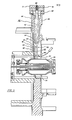
- the throughbores (44) have a uniform diameter over the entire distance thereof.
- the plunger (48) is rigidly affixed to the push rod (50).
- a bracket (78) having a pair of guidearms (80) affixed thereto is provided such that the guide arms (80) extend into the aperture (42).
- the guide arms (80) are provided with guide holes (82) through which the contact rod (62) of the plunger (48) is passed.
- the axes of the guide holes (82) are aligned with the axis of the throughbore (44).
- the flange plate (40) is configured to include mounting wall (84) extending beyond the throughbores (44) and into the aperture (42).
- the wall (84) has a reduced thickness compared to the thickness of the flange plate (40), which is cooperatively dimensioned such that the guide holes (82), are axially aligned with the throughbore (44) when the bracket (78) is rigidly affixed to the wall (84).
- the flange plate (40) can be configured using well known machining techniques.
- the instrument (10) is assembled and provided with a target, for example, 0 a copper target, and a 3Kev beam having a diameter between 100A-100 micrometers is directed thereat.
- the push rods (50) are adjusted until the collector assembly (30) is receiving the maximum reflected electrons, i.e., the collector assembly (30) is centered on the elastic peak of liberated electrons.
- the entire procedure can be easily accomplished in 5 to 10 minutes and the alignment is 2 to 3 times more accurate than conventional systems.
Landscapes
- Chemical & Material Sciences (AREA)
- Analytical Chemistry (AREA)
- Analysing Materials By The Use Of Radiation (AREA)
- Electron Tubes For Measurement (AREA)
- Other Investigation Or Analysis Of Materials By Electrical Means (AREA)
Applications Claiming Priority (2)
| Application Number | Priority Date | Filing Date | Title |
|---|---|---|---|
| US40493282A | 1982-08-02 | 1982-08-02 | |
| US404932 | 1982-08-02 |
Publications (1)
| Publication Number | Publication Date |
|---|---|
| EP0100525A2 true EP0100525A2 (de) | 1984-02-15 |
Family
ID=23601618
Family Applications (1)
| Application Number | Title | Priority Date | Filing Date |
|---|---|---|---|
| EP19830107403 Withdrawn EP0100525A2 (de) | 1982-08-02 | 1983-07-27 | Zentriervorrichtung |
Country Status (2)
| Country | Link |
|---|---|
| EP (1) | EP0100525A2 (de) |
| JP (1) | JPS5925154A (de) |
Cited By (1)
| Publication number | Priority date | Publication date | Assignee | Title |
|---|---|---|---|---|
| EP2400525A3 (de) * | 2010-06-25 | 2012-03-28 | Hitachi High-Technologies Corporation | Massenspektrometer |
-
1983
- 1983-07-07 JP JP58122461A patent/JPS5925154A/ja active Pending
- 1983-07-27 EP EP19830107403 patent/EP0100525A2/de not_active Withdrawn
Cited By (2)
| Publication number | Priority date | Publication date | Assignee | Title |
|---|---|---|---|---|
| EP2400525A3 (de) * | 2010-06-25 | 2012-03-28 | Hitachi High-Technologies Corporation | Massenspektrometer |
| US8669518B2 (en) | 2010-06-25 | 2014-03-11 | Hitachi High-Technologies Corporation | Mass spectrometer |
Also Published As
| Publication number | Publication date |
|---|---|
| JPS5925154A (ja) | 1984-02-09 |
Similar Documents
| Publication | Publication Date | Title |
|---|---|---|
| US4330208A (en) | Process and apparatus for regulating the impact of a light beam on a target | |
| US6320194B1 (en) | Portable high resolution scanning electron microscope column using permanent magnet electron lenses | |
| EP0196958B1 (de) | Elektronenstrahlprüfsonde zur Untersuchung integrierter Schaltungen | |
| Allyn et al. | Analyzer system capable of determining energy and direction of charged particles in ultrahigh vacuum | |
| US4563769A (en) | X-Ray generator device | |
| US4358680A (en) | Charged particle spectrometers | |
| US3783280A (en) | Method and apparatus for charged particle spectroscopy | |
| US4544845A (en) | Electron gun with a field emission cathode and a magnetic lens | |
| US4870283A (en) | Electric multipole lens | |
| US5091645A (en) | Selectable-resolution charged-particle beam analyzers | |
| US3949221A (en) | Double-focussing mass spectrometer | |
| US4487469A (en) | Mounting socket for a proximity switch | |
| US4296323A (en) | Secondary emission mass spectrometer mechanism to be used with other instrumentation | |
| EP0100525A2 (de) | Zentriervorrichtung | |
| JP4523594B2 (ja) | 粒子光学装置 | |
| US4050037A (en) | Laser beam alignment | |
| US2814729A (en) | X-ray microscope | |
| Skoczylas et al. | A proposed modular imaging system for photoelectron and electron probe microscopy with aberration correction, and for mirror microscopy and low-energy electron microscopy | |
| JPS6334844A (ja) | 絶縁材料のイオン分析方法および装置 | |
| US4829178A (en) | Apparatus for surface analysis | |
| US5920073A (en) | Optical system | |
| US6678932B1 (en) | Fixture for assembling parts of a device such as a Wien filter | |
| US4101778A (en) | Rod-shaped specimen holder for an optical corpuscular-beam apparatus | |
| GB2118361A (en) | Scanning electron beam apparatus | |
| DE3127441C2 (de) |
Legal Events
| Date | Code | Title | Description |
|---|---|---|---|
| PUAI | Public reference made under article 153(3) epc to a published international application that has entered the european phase |
Free format text: ORIGINAL CODE: 0009012 |
|
| AK | Designated contracting states |
Designated state(s): DE FR GB |
|
| STAA | Information on the status of an ep patent application or granted ep patent |
Free format text: STATUS: THE APPLICATION HAS BEEN WITHDRAWN |
|
| 18W | Application withdrawn |
Withdrawal date: 19850515 |
|
| RIN1 | Information on inventor provided before grant (corrected) |
Inventor name: GERLACH, ROBERT L. |