EP0098567A2 - Derivatives of diphosphonic acids, and pharmaceutical preparations containing them - Google Patents
Derivatives of diphosphonic acids, and pharmaceutical preparations containing them Download PDFInfo
- Publication number
- EP0098567A2 EP0098567A2 EP83106511A EP83106511A EP0098567A2 EP 0098567 A2 EP0098567 A2 EP 0098567A2 EP 83106511 A EP83106511 A EP 83106511A EP 83106511 A EP83106511 A EP 83106511A EP 0098567 A2 EP0098567 A2 EP 0098567A2
- Authority
- EP
- European Patent Office
- Prior art keywords
- bis
- general formula
- diphosphonic acid
- group
- phosphonic acid
- Prior art date
- Legal status (The legal status is an assumption and is not a legal conclusion. Google has not performed a legal analysis and makes no representation as to the accuracy of the status listed.)
- Withdrawn
Links
- 0 *C(*)CN(*)* Chemical compound *C(*)CN(*)* 0.000 description 1
Classifications
-
- C—CHEMISTRY; METALLURGY
- C07—ORGANIC CHEMISTRY
- C07F—ACYCLIC, CARBOCYCLIC OR HETEROCYCLIC COMPOUNDS CONTAINING ELEMENTS OTHER THAN CARBON, HYDROGEN, HALOGEN, OXYGEN, NITROGEN, SULFUR, SELENIUM OR TELLURIUM
- C07F9/00—Compounds containing elements of Groups 5 or 15 of the Periodic Table
- C07F9/02—Phosphorus compounds
- C07F9/28—Phosphorus compounds with one or more P—C bonds
- C07F9/38—Phosphonic acids [RP(=O)(OH)2]; Thiophosphonic acids ; [RP(=X1)(X2H)2(X1, X2 are each independently O, S or Se)]
- C07F9/3804—Phosphonic acids [RP(=O)(OH)2]; Thiophosphonic acids ; [RP(=X1)(X2H)2(X1, X2 are each independently O, S or Se)] not used, see subgroups
- C07F9/3839—Polyphosphonic acids
- C07F9/3873—Polyphosphonic acids containing nitrogen substituent, e.g. N.....H or N-hydrocarbon group which can be substituted by halogen or nitro(so), N.....O, N.....S, N.....C(=X)- (X =O, S), N.....N, N...C(=X)...N (X =O, S)
-
- A—HUMAN NECESSITIES
- A61—MEDICAL OR VETERINARY SCIENCE; HYGIENE
- A61P—SPECIFIC THERAPEUTIC ACTIVITY OF CHEMICAL COMPOUNDS OR MEDICINAL PREPARATIONS
- A61P29/00—Non-central analgesic, antipyretic or antiinflammatory agents, e.g. antirheumatic agents; Non-steroidal antiinflammatory drugs [NSAID]
-
- C—CHEMISTRY; METALLURGY
- C07—ORGANIC CHEMISTRY
- C07F—ACYCLIC, CARBOCYCLIC OR HETEROCYCLIC COMPOUNDS CONTAINING ELEMENTS OTHER THAN CARBON, HYDROGEN, HALOGEN, OXYGEN, NITROGEN, SULFUR, SELENIUM OR TELLURIUM
- C07F9/00—Compounds containing elements of Groups 5 or 15 of the Periodic Table
- C07F9/02—Phosphorus compounds
- C07F9/28—Phosphorus compounds with one or more P—C bonds
- C07F9/38—Phosphonic acids [RP(=O)(OH)2]; Thiophosphonic acids ; [RP(=X1)(X2H)2(X1, X2 are each independently O, S or Se)]
- C07F9/3804—Phosphonic acids [RP(=O)(OH)2]; Thiophosphonic acids ; [RP(=X1)(X2H)2(X1, X2 are each independently O, S or Se)] not used, see subgroups
- C07F9/3839—Polyphosphonic acids
- C07F9/3869—Polyphosphonic acids containing carboxylic acid or carboxylic acid derivative substituents
-
- C—CHEMISTRY; METALLURGY
- C07—ORGANIC CHEMISTRY
- C07F—ACYCLIC, CARBOCYCLIC OR HETEROCYCLIC COMPOUNDS CONTAINING ELEMENTS OTHER THAN CARBON, HYDROGEN, HALOGEN, OXYGEN, NITROGEN, SULFUR, SELENIUM OR TELLURIUM
- C07F9/00—Compounds containing elements of Groups 5 or 15 of the Periodic Table
- C07F9/02—Phosphorus compounds
- C07F9/28—Phosphorus compounds with one or more P—C bonds
- C07F9/38—Phosphonic acids [RP(=O)(OH)2]; Thiophosphonic acids ; [RP(=X1)(X2H)2(X1, X2 are each independently O, S or Se)]
- C07F9/40—Esters thereof
- C07F9/4003—Esters thereof the acid moiety containing a substituent or a structure which is considered as characteristic
- C07F9/4025—Esters of poly(thio)phosphonic acids
Definitions
- the invention relates to the diphosphonic acid derivatives characterized in the claims, a process for their preparation and pharmaceutical preparations which contain these compounds.
- the compounds according to the invention surprisingly have a pronounced anti-inflammatory and anti-arthritic activity.
- they are characterized by the fact that, among other things, they are able to influence the build-up and breakdown performance of the bone cells (osteoblasts / osteoclasts) in such a way that curative effects in rats with induced arthritis can be clearly demonstrated.
- the basis for a therapy of rheumatoid arthritis, osteoarthritis, ankylosing spondylitis and other related diseases, in particular the collagen and the skeletal system (osteoporosis, Paget's disease) is created.
- the phosphonates can be used therapeutically as good complexing agents for calcium wherever a disturbed Ca metabolism has been identified as the cause of a disease, e.g. for cardiovascular diseases, ectopic calcifications etc.
- the compounds can be used in the form of their esters, half-esters - but preferably in the form of the free phosphonic acids or their physiologically tolerable salts with alkali metal, alkaline earth metal hydroxides or compatible organic bases. Capsules, tablets, dragees, suppositories, but also injection solutions and dermal preparations are suitable as galenical formulations. Local application for the treatment of dermal or systemic diseases is also possible.
- the diphosphonic acid derivatives are prepared by methods which are well known to the person skilled in the art and which are shown in the schemes below.
- the reaction of the dimethylformamide dialkyl acetals of the general formula II with the methane bis (phosphonic acid dialkyl esters) of the general formula III to give the corresponding enamines can be carried out in a manner known per se (for example Enamines, G. Cook, Marcel-Dekker-Verlag New York and London, 1969, Chem. Ber. 101, 1968, 4048,), for example by heating the components in the presence of bases (potassium tert-butoxide, etc.).
- any subsequent saponification of the esters can be carried out using mineral acids (e.g. semi-concentrated hydrochloric acid or sulfuric acid). Cleavage is particularly gentle in an inert solvent (e.g. diethyl ether, diisopropyl ether, dioxane, tetrahydrofuran, dichloromethane, chloroform or carbon tetrachloride) with trimethylsilyl iodide. To form salts, the free acids are reacted with the corresponding bases in the usual way.
- mineral acids e.g. semi-concentrated hydrochloric acid or sulfuric acid.
- the condensation of the methane-bis (dialkyl phosphonate) of the general formula IV with acrylonitrile takes place under the conditions which are usually used for the cyanoethylation of active methylene compounds.
- compounds of the formula IV can be converted into their salts in an inert solvent (diethyl ether, diisopropyl ether, dioxane, tetrahydrofuran, etc.) with sodium, potassium or their hydrides and reacted with acrylonitrile.
- the subsequent subsequent reduction of the nitriles to the corresponding amines is also carried out under the conditions which are well known to the person skilled in the art.
- the nitriles can be hydrogenated with hydrogen in the presence of nickel or platinum catalysts, or reduced with complex metal hydrides such as lithium aluminum hydride.
- the aqueous phase is stirred again with 100 ml of dichloromethane overnight, processed as described above and 19 g are obtained.
- the free cyanomethane-1,1-diphosphonic acid can be obtained as an oil - by treating the sodium salt with the Amberlite IR 120 ion exchanger.
- the 3-cyanopropane-1,1-diphosphonic acid is prepared from 3-cyanopropane-1,1-bis (diethyl phosphonic acid) [Example 4] by cleavage with iodotrimethylsilane and converted into the disodium salt. Yield 71%. Melting point above 300 0 C.
- the representation is made from the sodium salt of Example 5 by catalytic hydrogenation with platinum dioxide in aqueous solution. Yield 80%; Melting point above 300 ° C (from dimethylformamide).
Landscapes
- Chemical & Material Sciences (AREA)
- Organic Chemistry (AREA)
- Health & Medical Sciences (AREA)
- Life Sciences & Earth Sciences (AREA)
- General Health & Medical Sciences (AREA)
- Biochemistry (AREA)
- Molecular Biology (AREA)
- Rheumatology (AREA)
- Pain & Pain Management (AREA)
- Chemical Kinetics & Catalysis (AREA)
- General Chemical & Material Sciences (AREA)
- Medicinal Chemistry (AREA)
- Nuclear Medicine, Radiotherapy & Molecular Imaging (AREA)
- Pharmacology & Pharmacy (AREA)
- Animal Behavior & Ethology (AREA)
- Public Health (AREA)
- Veterinary Medicine (AREA)
- Pharmaceuticals Containing Other Organic And Inorganic Compounds (AREA)
- Medicinal Preparation (AREA)
Abstract
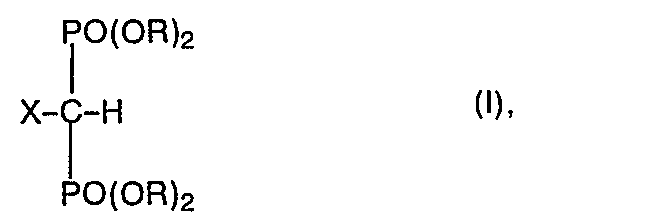
Diphosphonsäure-Derivate der allgemeinen Formel
Description
Die Erfindung betrifft die in den Patentansprüchen gekennzeichneten Diphosphonsäure-Derivate, ein Verfahren zu ihrer Herstellung und pharmazeutische Präparate, die diese Verbindungen enthalten.The invention relates to the diphosphonic acid derivatives characterized in the claims, a process for their preparation and pharmaceutical preparations which contain these compounds.
Die erfindungsgemäßen Verbindungen haben überraschenderweise eine ausgeprägte antiinflammatorische und antiarthritische Wirksamkeit. Darüberhinaus zeichnen sie sich dadurch aus, daß sie unter anderem imstande sind, die Aufbau- und Abbau-Leistung der Knochenzellen (Osteoblasten/Osteoklasten) so zu beeinflussen, daß kurative Effekte bei Ratten mit induzierter Arthritis eindeutig nachweisbar sind.The compounds according to the invention surprisingly have a pronounced anti-inflammatory and anti-arthritic activity. In addition, they are characterized by the fact that, among other things, they are able to influence the build-up and breakdown performance of the bone cells (osteoblasts / osteoclasts) in such a way that curative effects in rats with induced arthritis can be clearly demonstrated.
Mit dieser antiarthritischen Wirksamkeit der erfindungsgemäßen Verbindungen ist die Grundlage für eine Therapie der Rheumatoiden Arthritis, der Osteoarthritis, Spondylitis ankylosans und anderer verwandter Erkrankungen, besonders des Kollagens und des Skelettsystems (Osteoporose, Pagetskrankheit) geschaffen. Darüber hinaus können die Phosphonate als gute Komplexbildner für Calcium überall dort therapeutisch sinnvoll eingesetzt werden, wo ein gestörter Ca-Stoffwechsel als Ursache für eine Erkrankung erkannt wurde, z.B. bei cardiovaskulären Erkrankungen, ektopischen Calcifikationen etc..With this anti-arthritic activity of the compounds according to the invention, the basis for a therapy of rheumatoid arthritis, osteoarthritis, ankylosing spondylitis and other related diseases, in particular the collagen and the skeletal system (osteoporosis, Paget's disease) is created. In addition, the phosphonates can be used therapeutically as good complexing agents for calcium wherever a disturbed Ca metabolism has been identified as the cause of a disease, e.g. for cardiovascular diseases, ectopic calcifications etc.
Die Verbindungen können in Form ihrer Ester, Halbester - vorzugsweise jedoch in Form der freien Phosphonsäuren bzw. deren physiologisch verträglichen Salzen mit Alkali-, Erdalkalihydroxiden oder verträglichen organischen Basen - angewendet werden. Als galenische Formulierungen sind Kapseln, Tabletten, Dragees, Suppositorien, aber auch Injektionslösungen und dermale Zubereitungen geeignet. Auch eine lokale Anwendung zur Behandlung dermaler oder systemischer Erkrankungen ist möglich.The compounds can be used in the form of their esters, half-esters - but preferably in the form of the free phosphonic acids or their physiologically tolerable salts with alkali metal, alkaline earth metal hydroxides or compatible organic bases. Capsules, tablets, dragees, suppositories, but also injection solutions and dermal preparations are suitable as galenical formulations. Local application for the treatment of dermal or systemic diseases is also possible.
Die Herstellung der Diphosphonsäure-Derivate erfolgt nach Methoden wie sie dem Fachmann wohlbekannt sind und welche in den nachfolgenden Schemata dargestellt sind.


Die sich gewünschtenfalls anschließende Umsetzung der Enamine erfolgt ebenfalls unter dem Fachmann wohlbekannten Bedingungen ( Europäische Patentanmeldung 16 978), indem man beispielsweise diese Verbindungen in wässriger Lösung bei einem PH-Wert von 0 bis 1 mit der Hydroxylamin-0-sulfonsäure umsetzt.The subsequent reaction of the enamines, if desired, is also carried out under conditions well known to the person skilled in the art (European patent application 16 978), for example by reacting these compounds in aqueous solution with a pH of 0 to 1 with the hydroxylamine-0-sulfonic acid.
Die sich gegebenenfalls anschließende Verseifung der Ester kann mittels Mineralsäuren ( Z.B. halbkonzentrierte Salzsäure oder Schwefelsäure) durchgeführt werden. Besonders schonend gelingt die Spaltung in einem inerten Lösungsmittel ( z.B: Diethylether, Diisopropylether, Dioxan, Tetrahydrofuran, Dichlormethan, Chloroform oder Tetrachlorkohlenstoff) mit Trimethylsilyljodid. Zur Salzbildung werden die freien Säuren in üblicher Weise mit den entsprechenden Basen umgesetzt.Any subsequent saponification of the esters can be carried out using mineral acids (e.g. semi-concentrated hydrochloric acid or sulfuric acid). Cleavage is particularly gentle in an inert solvent (e.g. diethyl ether, diisopropyl ether, dioxane, tetrahydrofuran, dichloromethane, chloroform or carbon tetrachloride) with trimethylsilyl iodide. To form salts, the free acids are reacted with the corresponding bases in the usual way.
Die Kondensation der Methan-bis(phosphonsäuredialkylester) der allgemeinen Formel IV mit Acrylnitril erfolgt unter den Bedingungen, die man üblicherweise zur Cyanethylierung aktiver Methylenverbindungen verwendet. So kann man beispielsweise Verbindungen der Formel IV in einem inerten Lösungsmittel ( Diethylether, Diisopropylether, Dioxan, Tetrahydrofuran etc ) mit Natrium, Kalium oder deren Hydriden in ihre Salze überführen und diese mit Acrylnitril umsetzen.The condensation of the methane-bis (dialkyl phosphonate) of the general formula IV with acrylonitrile takes place under the conditions which are usually used for the cyanoethylation of active methylene compounds. For example, compounds of the formula IV can be converted into their salts in an inert solvent (diethyl ether, diisopropyl ether, dioxane, tetrahydrofuran, etc.) with sodium, potassium or their hydrides and reacted with acrylonitrile.
Die sich gegebenenfalls anschließende Reduktion der Nitrile zu den entsprechenden Aminen erfolgt ebenfalls unter den Bedingungen, wie sie dem Fachmann wohlbekannt sind. So kann man die Nitrile beispielsweise mit Wasserstoff in Gegenwart von Nickel- oder Platikatalysatoren hydrieren, oder mit komplexen Metallhydriden wie zum Beispiel Lithiumaluminiumhydrid reduzieren.The subsequent subsequent reduction of the nitriles to the corresponding amines is also carried out under the conditions which are well known to the person skilled in the art. For example, the nitriles can be hydrogenated with hydrogen in the presence of nickel or platinum catalysts, or reduced with complex metal hydrides such as lithium aluminum hydride.
Die nachfolgenden Aufführungsbeispiele dienen zur Erläuterung des erfindungsgemäßen Verfahrens.The following performance examples serve to explain the method according to the invention.
Eine Mischung von 2,9 g (20 mmol) Dimethylformamid-diethylacetal und 2,9 g (10 mmol) Methan-bis(phosphonsäure-diethylester) werden mit 110 mg Kalium-tert.-butylat versetzt und unter Stickstoff 1 Stunde auf 120° C (Badtemperatur) erhitzt. Danach wird das entstandene Ethanol sowie das überschüssige Acetal im Vakuum abdestilliert. Es bleibt ein helles Öl zurück: Ausbeute 3,4 g.110 mg of potassium tert-butoxide are added to a mixture of 2.9 g (20 mmol) of dimethylformamide diethyl acetal and 2.9 g (10 mmol) of methane bis (phosphonic acid diethyl ester) and the mixture is heated to 120 ° under nitrogen for 1 hour C (bath temperature) heated. The ethanol formed and the excess acetal are then distilled off in vacuo. A light oil remains: yield 3.4 g.
Eine Lösung von 45,2 g (0,4 mol) Hydroxylamin-0-sulfonsäure in 400 ml Wasser wird mit 68,6 g (0,2 mol) 2-Dimethyl- aminoethen-l,l-bis(phosphonsäure-diethylester) versetzt und 30 Minuten bei Raumtemperatur gerührt, anschließend rasch mit 3 x 100 ml Dichlormethan extrahiert. (Die organischen Extrakte werden verworfen). Die wässrige Phase wird mit 100 ml Dichlormethan versetzt und über Nacht bei Raumtemperatur weitergerührt. Nach Abtrennen der organischen Phase und Einengen erhält man 37 g.A solution of 45.2 g (0.4 mol) of hydroxylamine-0-sulfonic acid in 400 ml of water is mixed with 68.6 g (0.2 mol) of 2-dimethylaminoethene-l, l-bis (phosphonic acid diethyl ester) added and stirred for 30 minutes at room temperature, then extracted quickly with 3 x 100 ml dichloromethane. (The organic extracts are discarded). 100 ml of dichloromethane are added to the aqueous phase and stirring is continued overnight at room temperature. After separating the organic phase and concentrating, 37 g are obtained.
Die wässrige Phase wird erneut mit 100 ml Dichlormethan über Nacht gerührt, wie oben beschrieben aufbereitet und man erhält 19 g.The aqueous phase is stirred again with 100 ml of dichloromethane overnight, processed as described above and 19 g are obtained.
Eine dritte gleichartige Behandlung führt zu 9 g Produkt. Insgesamt erhält man also 65 g.A third similar treatment leads to 9 g of product. So you get a total of 65 g.
Nach Kugelrohrdestillation bei 170-175° C und 0,01 mm Druck werden 49,4 g erhalten.After Kugelrohr distillation at 170-175 ° C and 0.01 mm pressure, 49.4 g are obtained.
Eine Lösung von 6,3 g (20 mmol) Cyanomethan-bis(phosphonsäure-diethylester) in 30 ml Tetrachlorkohlenstoff werden unter Stickstoffatmosphäre bei 0° C tropfenweise mit 12 ml Jodtrimethylsilan versetzt und anschließend noch 1 Stunde bei Raumtemperatur gerührt. Nach dem Einengen wird der Rückstand mit Aceton und Wasser versetzt und erneut im Vakuum konzentriert. Durch Extraktion mit Dichlormethan werden jodhaltige Verunreinigungen abgetrennt, dann das in Wasser lösliche Material mit 5 g Natriumhydrogencarbonat versetzt und schließlich das entstandene Tri-Natriumsalz durch Zusatz von Ethanol aus der wässrigen Lösung gefällt. Ausbeute 3,74 g. Schmelzpunkt oberhalb 300° C.A solution of 6.3 g (20 mmol) of cyanomethane-bis (phosphonic acid diethyl ester) in 30 ml of carbon tetrachloride is added dropwise with 12 ml of iodotrimethylsilane under a nitrogen atmosphere at 0 ° C. and then stirred for a further 1 hour at room temperature. After concentration, the residue is mixed with acetone and water and concentrated again in vacuo. By extraction with dichloromethane, iodine-containing impurities are separated off, then the water-soluble material is mixed with 5 g of sodium hydrogen carbonate and finally the trisodium salt formed is precipitated from the aqueous solution by adding ethanol. Yield 3.74 g. Melting point above 300 ° C.
Die freie Cyanomethan-1,1-diphosphonsäure kann als Öl erhalten werden-durch Behandlung des Natriumsalzes mit dem Ionenaustauscher Amberlite IR 120.The free cyanomethane-1,1-diphosphonic acid can be obtained as an oil - by treating the sodium salt with the Amberlite IR 120 ion exchanger.
Eine Suspension von 2,4 g Natriumhydrid (80 %) in 100 ml Dimethoxyethan werden bei 0° C tropfenweise mit einer Lösung von 23,1 g Methan-bis(phosphonsäure-diethylester) in 20 ml Dimethoxyethan versetzt. Nach beendeter Gasentwicklung wird noch 15 Minuten bei 0° C nachgerührt, dann mit 4,25 g Acrylnitril versetzt und 5 Stunden auf 80° C erhitzt. Nach Stehen über Nacht wird mit 5 ml Eisessig versetzt, dann das Dimethoxyethan im Vakuum destilliert und der Rückstand an Kieselgel (Toluol-Aceton) chromatographiert. Die Nitrilfraktion wird anschließend noch einmal am Kugelrohr destilliert (Siedepunkt 180-190° C, 0,03 mm). Ausbeute 12 g.A suspension of 2.4 g of sodium hydride (80%) in 100 ml of dimethoxyethane is added dropwise at 0 ° C. with a solution of 23.1 g of methane bis (diethyl phosphate) in 20 ml of dimethoxyethane. After the evolution of gas has ceased, stirring is continued for a further 15 minutes at 0 ° C., then 4.25 g of acrylonitrile are added and the mixture is heated to 80 ° C. for 5 hours. After standing overnight, 5 ml of glacial acetic acid are added, then the dimethoxyethane is distilled in vacuo and the residue is chromatographed on silica gel (toluene-acetone). The nitrile fraction is then distilled again at the Kugelrohr (boiling point 180-190 ° C, 0.03 mm). Yield 12 g.
Analog Beispiel 3 wird aus 3-Cyanopropan-1,1-bis(phosphonsäure-diethylester) [Beispiel 4] durch Spaltung mit Jodtrimethylsilan die 3-Cyanopropan-1,1-diphosphonsäure dargestellt und in das Di-Natriumsalz überführt. Ausbeute 71 %. Schmelzpunkt oberhalb 3000 C.Analogously to Example 3, the 3-cyanopropane-1,1-diphosphonic acid is prepared from 3-cyanopropane-1,1-bis (diethyl phosphonic acid) [Example 4] by cleavage with iodotrimethylsilane and converted into the disodium salt. Yield 71%. Melting point above 300 0 C.
Eine Lösung von 2,44 g (7,1 mmol) 3-Cyanopropan-1,1-bis (phosphonsäure-diethylester) in 40 ml ethanolischer Salzsäure (0,7 N) wird mit 285 mg Platindioxid versetzt und bei Raumtemperatur hydriert. Nach Aufnahme der theoretischen Menge Wasserstoff wird vom Katalysator abgesaugt, dieser mit Ethanol nachgewaschen, und die vereinigte Ethanol-Phase im Vakuum eingeengt. Der Rückstand wird mit wenig Wasser und Natriumhydrogencarbonat behandelt und erschöpfend mit Dichlormethan extrahiert. Der Rückstand der Dichlormethanphase beträgt 1,9 g.A solution of 2.44 g (7.1 mmol) of 3-cyanopropane-1,1-bis (phosphonic acid diethyl ester) in 40 ml of ethanolic hydrochloric acid (0.7 N) is mixed with 285 mg of platinum dioxide and hydrogenated at room temperature. After the theoretical amount of hydrogen has been taken up, the catalyst is filtered off, washed with ethanol, and the combined ethanol phase is concentrated in vacuo. The residue is treated with a little water and sodium bicarbonate and extracted exhaustively with dichloromethane. The residue of the dichloromethane phase is 1.9 g.
Die Darstellung wird aus dem Natriumsalz des Beispiels 5 durch katalytische Hydrierung mit Platindioxid in wässriger Lösung vorgenommen. Ausbeute 80 %; Schmelzpunkt oberhalb 300° C (aus Dimethylformamid).The representation is made from the sodium salt of Example 5 by catalytic hydrogenation with platinum dioxide in aqueous solution. Yield 80%; Melting point above 300 ° C (from dimethylformamide).
Claims (13)


mit einem Methan-bis(phosphonsäuredialkylester) der allgemeinen Formel III

with a methane bis (dialkyl phosphonate) of the general formula III


worin R die obengenannte Bedeutung besitzt, mit Acrylnitril umsetzt und gewünschtenfalls in beliebiger Reihenfolge, die erhaltenen Nitrile zu den entsprechenden Aminen reduziert und/ oder die erhaltenen Ester verseift und die freien Säuren in ihre Salze überführt.13. Process for the preparation of diphosphonic acid derivatives of the general formula I
wherein R has the abovementioned meaning, reacted with acrylonitrile and, if desired, in any order, the nitriles obtained are reduced to the corresponding amines and / or the esters obtained are saponified and the free acids are converted into their salts.
Applications Claiming Priority (2)
| Application Number | Priority Date | Filing Date | Title |
|---|---|---|---|
| DE3225469 | 1982-07-05 | ||
| DE19823225469 DE3225469A1 (en) | 1982-07-05 | 1982-07-05 | DIPHOSPHONIC ACID DERIVATIVES AND PHARMACEUTICAL PREPARATIONS CONTAINING THEM |
Publications (2)
| Publication Number | Publication Date |
|---|---|
| EP0098567A2 true EP0098567A2 (en) | 1984-01-18 |
| EP0098567A3 EP0098567A3 (en) | 1984-02-22 |
Family
ID=6167887
Family Applications (1)
| Application Number | Title | Priority Date | Filing Date |
|---|---|---|---|
| EP83106511A Withdrawn EP0098567A3 (en) | 1982-07-05 | 1983-07-04 | Derivatives of diphosphonic acids, and pharmaceutical preparations containing them |
Country Status (13)
| Country | Link |
|---|---|
| US (1) | US4645762A (en) |
| EP (1) | EP0098567A3 (en) |
| JP (1) | JPS5973593A (en) |
| AU (1) | AU1656983A (en) |
| CA (1) | CA1222252A (en) |
| DE (1) | DE3225469A1 (en) |
| DK (1) | DK311383A (en) |
| ES (1) | ES8403492A1 (en) |
| FI (1) | FI832467L (en) |
| GB (1) | GB2122999A (en) |
| GR (1) | GR77589B (en) |
| IL (1) | IL69164A0 (en) |
| ZA (1) | ZA834908B (en) |
Cited By (6)
| Publication number | Priority date | Publication date | Assignee | Title |
|---|---|---|---|---|
| FR2558837A1 (en) * | 1984-01-26 | 1985-08-02 | Sanofi Sa | DERIVATIVES OF METHYLENEDIPHOSPHONIC ACID, PROCESS FOR OBTAINING THEM AND ANTIRHUMATISMAL DRUGS CONTAINING SAME |
| EP0197478A1 (en) * | 1985-04-06 | 1986-10-15 | Roche Diagnostics GmbH | Diphosphonic-acid derivatives, process for preparing them and medicines containing these compounds |
| EP0301351A3 (en) * | 1987-07-25 | 1989-04-26 | Henkel Kommanditgesellschaft auf Aktien | Hydroxyacetonitrile diphosphonic acid, process for its preparation and its use |
| EP0248854B1 (en) * | 1985-12-12 | 1990-04-25 | Leo Pharmaceutical Products Ltd. A/S (Lovens Kemiske Fabrik Produktionsaktieselskab) | Novel bisphosphonic derivatives, a method for their production and a pharmaceutical composition |
| WO1992011267A1 (en) * | 1990-12-20 | 1992-07-09 | Leiras Oy | Novel methylenebisphosphonic acid derivatives |
| EP0496520A1 (en) * | 1991-01-22 | 1992-07-29 | Merck & Co. Inc. | Novel bone acting agents |
Families Citing this family (4)
| Publication number | Priority date | Publication date | Assignee | Title |
|---|---|---|---|---|
| JP3021035B2 (en) * | 1988-11-01 | 2000-03-15 | アーク・デベロップメント・コーポレーション | Phosphonic acid and its use in separations |
| TW222637B (en) * | 1991-12-12 | 1994-04-21 | Hoechst Ag | |
| DE4228552A1 (en) * | 1992-08-27 | 1994-03-03 | Boehringer Mannheim Gmbh | Drugs containing diphosphonic acids and their salts |
| CA2372450A1 (en) * | 2001-05-10 | 2001-09-19 | Pharmaceutical Partners Of Canada Inc. | Liquid injectable formulation of disodium pamidronate |
Family Cites Families (9)
| Publication number | Priority date | Publication date | Assignee | Title |
|---|---|---|---|---|
| JPS4634186Y1 (en) * | 1967-12-29 | 1971-11-26 | ||
| US3683080A (en) * | 1970-08-28 | 1972-08-08 | Procter & Gamble | Compositions for inhibiting anomalous deposition and mobilization of calcium phosphate in animal tissue |
| US3813456A (en) * | 1972-01-17 | 1974-05-28 | Gates Rubber Co | Process for preparing amino-substituted phosphonates |
| DE2405254C2 (en) * | 1974-02-04 | 1982-05-27 | Henkel KGaA, 4000 Düsseldorf | Use of 3-amino-1-hydroxypropane-1, 1-diphosphonic acid or its water-soluble salts for influencing calcium metabolic disorders in the human or animal body |
| DE2602030C2 (en) * | 1976-01-21 | 1983-12-01 | Henkel KGaA, 4000 Düsseldorf | Diphosphonoalkanecarboxylic acids and processes for their preparation |
| JPS52127682U (en) * | 1976-03-25 | 1977-09-28 | ||
| EP0000061B1 (en) * | 1977-06-14 | 1980-10-15 | Hoechst Aktiengesellschaft | Derivatives of carboxylic acid that contain phosphorus, process for their preparation and their utilisation |
| DE3016289A1 (en) * | 1980-04-28 | 1981-10-29 | Henkel KGaA, 4000 Düsseldorf | METHOD FOR PRODUCING OMEGA-AMINO-1-HYDROXYALKYLIDEN-1,1-BIS-PHOSPHONIC ACIDS |
| IT1194748B (en) * | 1981-02-12 | 1988-09-28 | Gentili Ist Spa | PHARMACEUTICAL COMPOSITIONS FOR THE TREATMENT OF OSTEOPATHIES |
-
1982
- 1982-07-05 DE DE19823225469 patent/DE3225469A1/en not_active Withdrawn
-
1983
- 1983-07-01 ES ES523786A patent/ES8403492A1/en not_active Expired
- 1983-07-04 GR GR71850A patent/GR77589B/el unknown
- 1983-07-04 CA CA000431700A patent/CA1222252A/en not_active Expired
- 1983-07-04 EP EP83106511A patent/EP0098567A3/en not_active Withdrawn
- 1983-07-05 ZA ZA834908A patent/ZA834908B/en unknown
- 1983-07-05 DK DK311383A patent/DK311383A/en not_active Application Discontinuation
- 1983-07-05 JP JP58121154A patent/JPS5973593A/en active Pending
- 1983-07-05 FI FI832467A patent/FI832467L/en not_active Application Discontinuation
- 1983-07-05 US US06/511,116 patent/US4645762A/en not_active Expired - Fee Related
- 1983-07-05 GB GB08318157A patent/GB2122999A/en not_active Withdrawn
- 1983-07-05 IL IL69164A patent/IL69164A0/en unknown
- 1983-07-05 AU AU16569/83A patent/AU1656983A/en not_active Abandoned
Cited By (8)
| Publication number | Priority date | Publication date | Assignee | Title |
|---|---|---|---|---|
| FR2558837A1 (en) * | 1984-01-26 | 1985-08-02 | Sanofi Sa | DERIVATIVES OF METHYLENEDIPHOSPHONIC ACID, PROCESS FOR OBTAINING THEM AND ANTIRHUMATISMAL DRUGS CONTAINING SAME |
| EP0151072A3 (en) * | 1984-01-26 | 1985-08-21 | Sanofi | Derivatives of methylenediphosphonic acid, process for their preparation and antirheumatic pharmaceutical compositions containing them |
| US4876247A (en) * | 1984-01-26 | 1989-10-24 | Sanofi | Methlenediphosphonic acid derivatives, and antirheumatic pharmaceutical composition in which they are present and methods of using same |
| EP0197478A1 (en) * | 1985-04-06 | 1986-10-15 | Roche Diagnostics GmbH | Diphosphonic-acid derivatives, process for preparing them and medicines containing these compounds |
| EP0248854B1 (en) * | 1985-12-12 | 1990-04-25 | Leo Pharmaceutical Products Ltd. A/S (Lovens Kemiske Fabrik Produktionsaktieselskab) | Novel bisphosphonic derivatives, a method for their production and a pharmaceutical composition |
| EP0301351A3 (en) * | 1987-07-25 | 1989-04-26 | Henkel Kommanditgesellschaft auf Aktien | Hydroxyacetonitrile diphosphonic acid, process for its preparation and its use |
| WO1992011267A1 (en) * | 1990-12-20 | 1992-07-09 | Leiras Oy | Novel methylenebisphosphonic acid derivatives |
| EP0496520A1 (en) * | 1991-01-22 | 1992-07-29 | Merck & Co. Inc. | Novel bone acting agents |
Also Published As
| Publication number | Publication date |
|---|---|
| IL69164A0 (en) | 1983-11-30 |
| AU1656983A (en) | 1984-01-26 |
| CA1222252A (en) | 1987-05-26 |
| ES523786A0 (en) | 1984-04-01 |
| US4645762A (en) | 1987-02-24 |
| ZA834908B (en) | 1984-03-28 |
| GR77589B (en) | 1984-09-24 |
| FI832467A7 (en) | 1984-01-06 |
| DK311383D0 (en) | 1983-07-05 |
| DE3225469A1 (en) | 1984-01-05 |
| JPS5973593A (en) | 1984-04-25 |
| EP0098567A3 (en) | 1984-02-22 |
| FI832467L (en) | 1984-01-06 |
| GB2122999A (en) | 1984-01-25 |
| FI832467A0 (en) | 1983-07-05 |
| DK311383A (en) | 1984-01-06 |
| GB8318157D0 (en) | 1983-08-03 |
| ES8403492A1 (en) | 1984-04-01 |
Similar Documents
| Publication | Publication Date | Title |
|---|---|---|
| EP0085321B1 (en) | Diphosphonic acid derivatives and pharmaceutical preparations containing them | |
| DE3586543T2 (en) | DIPHOSPHONATES AND THEIR USE IN MEDICINAL PRODUCTS. | |
| DE3400278A1 (en) | ISOMERE O-PHOSPHONYLMETHYL DERIVATIVES OF VICINAL DIOLES, THEIR PRODUCTION AND USE | |
| EP0098567A2 (en) | Derivatives of diphosphonic acids, and pharmaceutical preparations containing them | |
| DE1720009A1 (en) | Process for the preparation of 5-basic substituted 10,11-dihydro-5H-dibenzo [b, e] [1,4] diazepines | |
| DE3229893A1 (en) | NEW AMINO ACID ISOMERS, METHOD FOR THE PRODUCTION THEREOF AND THEIR USE | |
| DE2416193A1 (en) | NEW PROSTAGLANDIN ANALOGS AND METHODS FOR THEIR PRODUCTION | |
| EP0027199B1 (en) | Process for the preparation of phosphono-hydroxy-acetic acid and salts thereof and autiviral compositions containing them | |
| WO1989010370A1 (en) | New alkylphosphono- and phosphoserines, method for preparing them, and pharmaceutical substances containing them | |
| DE1172671B (en) | Process for the preparation of 17ª-hydroxy-androstane-(3, 2-c)-pyrazole or a 17ª-hydroxy-17ª-lower-alkyl-androstane-(3, 2-c)-pyrazole | |
| DE69300011T2 (en) | Diacylglycerol nicotinates, processes for their preparation and pharmaceutical preparations containing them. | |
| DE2524619A1 (en) | (DL) -13-SUBSTITUTED SULFINYL- PROSTAGLANDINAL COMPOUNDS AND METHOD FOR THEIR PRODUCTION | |
| DE3881103T2 (en) | Process for the preparation of 1,3,2-oxazaphosphorinane. | |
| DE3890316C2 (en) | ||
| DE1620675C (en) | S-Benzoyloxymethylthiamines and processes for their preparation | |
| EP0144743B1 (en) | Process for the preparation of organic chlorophosphanes | |
| CH667093A5 (en) | PROCESS FOR THE PREPARATION OF THE ETHYL ESTER OF APOVINCAMINE ACID. | |
| DE2328758C2 (en) | 4,4-Diphenyl-2-methyl-2-hydroxybutylamines and therapeutic preparations containing them | |
| DE2422879C3 (en) | Process for the preparation of l- (2-hydroxy-2-indanyl) propylamine | |
| DE960819C (en) | Process for the production of 11ª ‰ -oxyprogesterone | |
| DE1620675B (en) | S Benzoyloxymethylthiamine and processes for their production | |
| DD228813A1 (en) | PROCESS FOR THE PREPARATION OF N-PHOSPHONYMETHYLAMINOSAURES AND THEIR DERIVATIVES | |
| DE1175231B (en) | Process for the preparation of 3ª ‡ -phosphato-11-oxo-20, 20-bis-hydroxymethyl-5ª ‰ -pregnane and corresponding alkali salts or mineral acid esters | |
| DE4329533A1 (en) | Dibenzyl-N,N-dialkylaminophosphines as phosphorylating reagents and a process for their preparation | |
| DE1668734A1 (en) | Alkyl benzoyl carbinol esters and processes for their preparation |
Legal Events
| Date | Code | Title | Description |
|---|---|---|---|
| PUAI | Public reference made under article 153(3) epc to a published international application that has entered the european phase |
Free format text: ORIGINAL CODE: 0009012 |
|
| PUAL | Search report despatched |
Free format text: ORIGINAL CODE: 0009013 |
|
| 17P | Request for examination filed |
Effective date: 19830704 |
|
| AK | Designated contracting states |
Designated state(s): AT BE CH DE FR GB IT LI LU NL SE |
|
| AK | Designated contracting states |
Designated state(s): AT BE CH DE FR GB IT LI LU NL SE |
|
| STAA | Information on the status of an ep patent application or granted ep patent |
Free format text: STATUS: THE APPLICATION IS DEEMED TO BE WITHDRAWN |
|
| 18D | Application deemed to be withdrawn |
Effective date: 19870223 |
|
| RIN1 | Information on inventor provided before grant (corrected) |
Inventor name: RUFER, CLEMENS, DR. Inventor name: BOETTCHER, IRMGARD, DR. Inventor name: BIERE, HELMUT, DR. |