EP0096955B1 - Two-component coating compositions for rusty steels - Google Patents
Two-component coating compositions for rusty steels Download PDFInfo
- Publication number
- EP0096955B1 EP0096955B1 EP83302065A EP83302065A EP0096955B1 EP 0096955 B1 EP0096955 B1 EP 0096955B1 EP 83302065 A EP83302065 A EP 83302065A EP 83302065 A EP83302065 A EP 83302065A EP 0096955 B1 EP0096955 B1 EP 0096955B1
- Authority
- EP
- European Patent Office
- Prior art keywords
- component
- composition according
- fatty acid
- ingredients
- volume
- Prior art date
- Legal status (The legal status is an assumption and is not a legal conclusion. Google has not performed a legal analysis and makes no representation as to the accuracy of the status listed.)
- Expired
Links
- 239000008199 coating composition Substances 0.000 title claims description 31
- 229910000831 Steel Inorganic materials 0.000 title claims description 15
- 239000010959 steel Substances 0.000 title claims description 15
- 239000000203 mixture Substances 0.000 claims description 56
- 239000004615 ingredient Substances 0.000 claims description 27
- 235000014113 dietary fatty acids Nutrition 0.000 claims description 22
- 239000000194 fatty acid Substances 0.000 claims description 22
- 229930195729 fatty acid Natural products 0.000 claims description 22
- 229920005989 resin Polymers 0.000 claims description 19
- 239000011347 resin Substances 0.000 claims description 19
- 239000007787 solid Substances 0.000 claims description 19
- VYPSYNLAJGMNEJ-UHFFFAOYSA-N Silicium dioxide Chemical group O=[Si]=O VYPSYNLAJGMNEJ-UHFFFAOYSA-N 0.000 claims description 18
- IISBACLAFKSPIT-UHFFFAOYSA-N bisphenol A Chemical compound C=1C=C(O)C=CC=1C(C)(C)C1=CC=C(O)C=C1 IISBACLAFKSPIT-UHFFFAOYSA-N 0.000 claims description 16
- 150000004665 fatty acids Chemical class 0.000 claims description 16
- 239000000463 material Substances 0.000 claims description 15
- KPAPHODVWOVUJL-UHFFFAOYSA-N 1-benzofuran;1h-indene Chemical compound C1=CC=C2CC=CC2=C1.C1=CC=C2OC=CC2=C1 KPAPHODVWOVUJL-UHFFFAOYSA-N 0.000 claims description 14
- 229910052782 aluminium Inorganic materials 0.000 claims description 12
- XAGFODPZIPBFFR-UHFFFAOYSA-N aluminium Chemical compound [Al] XAGFODPZIPBFFR-UHFFFAOYSA-N 0.000 claims description 12
- 239000004593 Epoxy Substances 0.000 claims description 11
- 239000013008 thixotropic agent Substances 0.000 claims description 11
- 238000009835 boiling Methods 0.000 claims description 9
- -1 fatty acid diamine salt Chemical class 0.000 claims description 9
- RTZKZFJDLAIYFH-UHFFFAOYSA-N Diethyl ether Chemical compound CCOCC RTZKZFJDLAIYFH-UHFFFAOYSA-N 0.000 claims description 8
- 229920006122 polyamide resin Polymers 0.000 claims description 8
- 150000004945 aromatic hydrocarbons Chemical class 0.000 claims description 7
- 239000003795 chemical substances by application Substances 0.000 claims description 7
- 238000005260 corrosion Methods 0.000 claims description 7
- 230000007797 corrosion Effects 0.000 claims description 7
- 239000000377 silicon dioxide Substances 0.000 claims description 7
- GYZLOYUZLJXAJU-UHFFFAOYSA-N diglycidyl ether Chemical compound C1OC1COCC1CO1 GYZLOYUZLJXAJU-UHFFFAOYSA-N 0.000 claims description 6
- 239000007788 liquid Substances 0.000 claims description 6
- 229920000768 polyamine Polymers 0.000 claims description 6
- AHDSRXYHVZECER-UHFFFAOYSA-N 2,4,6-tris[(dimethylamino)methyl]phenol Chemical compound CN(C)CC1=CC(CN(C)C)=C(O)C(CN(C)C)=C1 AHDSRXYHVZECER-UHFFFAOYSA-N 0.000 claims description 5
- CTQNGGLPUBDAKN-UHFFFAOYSA-N O-Xylene Chemical compound CC1=CC=CC=C1C CTQNGGLPUBDAKN-UHFFFAOYSA-N 0.000 claims description 5
- 125000003342 alkenyl group Chemical group 0.000 claims description 5
- 150000001412 amines Chemical class 0.000 claims description 5
- 239000000945 filler Substances 0.000 claims description 5
- 239000000049 pigment Substances 0.000 claims description 5
- 239000002904 solvent Substances 0.000 claims description 5
- 239000008096 xylene Substances 0.000 claims description 5
- 229930185605 Bisphenol Natural products 0.000 claims description 4
- 150000001338 aliphatic hydrocarbons Chemical class 0.000 claims description 4
- ZADYMNAVLSWLEQ-UHFFFAOYSA-N magnesium;oxygen(2-);silicon(4+) Chemical compound [O-2].[O-2].[O-2].[Mg+2].[Si+4] ZADYMNAVLSWLEQ-UHFFFAOYSA-N 0.000 claims description 4
- 239000000758 substrate Substances 0.000 claims description 4
- 230000000153 supplemental effect Effects 0.000 claims description 4
- FUIQBJHUESBZNU-UHFFFAOYSA-N 2-[(dimethylazaniumyl)methyl]phenolate Chemical group CN(C)CC1=CC=CC=C1O FUIQBJHUESBZNU-UHFFFAOYSA-N 0.000 claims description 3
- 239000007795 chemical reaction product Substances 0.000 claims description 3
- 230000002401 inhibitory effect Effects 0.000 claims description 3
- 239000000391 magnesium silicate Substances 0.000 claims description 3
- 229910052919 magnesium silicate Inorganic materials 0.000 claims description 3
- 235000019792 magnesium silicate Nutrition 0.000 claims description 3
- 239000000741 silica gel Substances 0.000 claims description 3
- 229910002027 silica gel Inorganic materials 0.000 claims description 3
- LRXTYHSAJDENHV-UHFFFAOYSA-H zinc phosphate Chemical group [Zn+2].[Zn+2].[Zn+2].[O-]P([O-])([O-])=O.[O-]P([O-])([O-])=O LRXTYHSAJDENHV-UHFFFAOYSA-H 0.000 claims description 3
- 229910000165 zinc phosphate Inorganic materials 0.000 claims description 3
- 239000002516 radical scavenger Substances 0.000 claims description 2
- 235000021122 unsaturated fatty acids Nutrition 0.000 claims description 2
- 150000004670 unsaturated fatty acids Chemical class 0.000 claims description 2
- NDKWCCLKSWNDBG-UHFFFAOYSA-N zinc;dioxido(dioxo)chromium Chemical compound [Zn+2].[O-][Cr]([O-])(=O)=O NDKWCCLKSWNDBG-UHFFFAOYSA-N 0.000 claims description 2
- 238000002156 mixing Methods 0.000 description 13
- 239000011248 coating agent Substances 0.000 description 8
- 238000000576 coating method Methods 0.000 description 8
- 125000004432 carbon atom Chemical group C* 0.000 description 6
- 150000003839 salts Chemical class 0.000 description 6
- 229910052500 inorganic mineral Inorganic materials 0.000 description 5
- 239000011707 mineral Substances 0.000 description 5
- 235000015096 spirit Nutrition 0.000 description 5
- 239000007921 spray Substances 0.000 description 5
- 239000001993 wax Substances 0.000 description 5
- 238000009472 formulation Methods 0.000 description 4
- 239000000047 product Substances 0.000 description 4
- 239000000126 substance Substances 0.000 description 4
- FGLBSLMDCBOPQK-UHFFFAOYSA-N 2-nitropropane Chemical compound CC(C)[N+]([O-])=O FGLBSLMDCBOPQK-UHFFFAOYSA-N 0.000 description 3
- 229920001807 Urea-formaldehyde Polymers 0.000 description 3
- 125000002947 alkylene group Chemical group 0.000 description 3
- 239000003822 epoxy resin Substances 0.000 description 3
- 239000002245 particle Substances 0.000 description 3
- 229920002647 polyamide Polymers 0.000 description 3
- 229920000647 polyepoxide Polymers 0.000 description 3
- RPNUMPOLZDHAAY-UHFFFAOYSA-N Diethylenetriamine Chemical compound NCCNCCN RPNUMPOLZDHAAY-UHFFFAOYSA-N 0.000 description 2
- YNQLUTRBYVCPMQ-UHFFFAOYSA-N Ethylbenzene Chemical compound CCC1=CC=CC=C1 YNQLUTRBYVCPMQ-UHFFFAOYSA-N 0.000 description 2
- OYHQOLUKZRVURQ-HZJYTTRNSA-N Linoleic acid Chemical compound CCCCC\C=C/C\C=C/CCCCCCCC(O)=O OYHQOLUKZRVURQ-HZJYTTRNSA-N 0.000 description 2
- LRHPLDYGYMQRHN-UHFFFAOYSA-N N-Butanol Chemical compound CCCCO LRHPLDYGYMQRHN-UHFFFAOYSA-N 0.000 description 2
- 239000004952 Polyamide Substances 0.000 description 2
- HCHKCACWOHOZIP-UHFFFAOYSA-N Zinc Chemical compound [Zn] HCHKCACWOHOZIP-UHFFFAOYSA-N 0.000 description 2
- 239000002253 acid Substances 0.000 description 2
- 125000000217 alkyl group Chemical group 0.000 description 2
- 239000003085 diluting agent Substances 0.000 description 2
- 239000000539 dimer Substances 0.000 description 2
- 230000003993 interaction Effects 0.000 description 2
- OYHQOLUKZRVURQ-IXWMQOLASA-N linoleic acid Natural products CCCCC\C=C/C\C=C\CCCCCCCC(O)=O OYHQOLUKZRVURQ-IXWMQOLASA-N 0.000 description 2
- 229910052751 metal Inorganic materials 0.000 description 2
- 239000002184 metal Substances 0.000 description 2
- 238000000034 method Methods 0.000 description 2
- 125000001997 phenyl group Chemical group [H]C1=C([H])C([H])=C(*)C([H])=C1[H] 0.000 description 2
- ODGAOXROABLFNM-UHFFFAOYSA-N polynoxylin Chemical compound O=C.NC(N)=O ODGAOXROABLFNM-UHFFFAOYSA-N 0.000 description 2
- 238000002360 preparation method Methods 0.000 description 2
- 239000011369 resultant mixture Substances 0.000 description 2
- 239000013638 trimer Substances 0.000 description 2
- 229910052725 zinc Inorganic materials 0.000 description 2
- 239000011701 zinc Substances 0.000 description 2
- CUXYLFPMQMFGPL-UHFFFAOYSA-N (9Z,11E,13E)-9,11,13-Octadecatrienoic acid Natural products CCCCC=CC=CC=CCCCCCCCC(O)=O CUXYLFPMQMFGPL-UHFFFAOYSA-N 0.000 description 1
- VILCJCGEZXAXTO-UHFFFAOYSA-N 2,2,2-tetramine Chemical compound NCCNCCNCCN VILCJCGEZXAXTO-UHFFFAOYSA-N 0.000 description 1
- WCOXQTXVACYMLM-UHFFFAOYSA-N 2,3-bis(12-hydroxyoctadecanoyloxy)propyl 12-hydroxyoctadecanoate Chemical group CCCCCCC(O)CCCCCCCCCCC(=O)OCC(OC(=O)CCCCCCCCCCC(O)CCCCCC)COC(=O)CCCCCCCCCCC(O)CCCCCC WCOXQTXVACYMLM-UHFFFAOYSA-N 0.000 description 1
- YSUQLAYJZDEMOT-UHFFFAOYSA-N 2-(butoxymethyl)oxirane Chemical compound CCCCOCC1CO1 YSUQLAYJZDEMOT-UHFFFAOYSA-N 0.000 description 1
- KUBDPQJOLOUJRM-UHFFFAOYSA-N 2-(chloromethyl)oxirane;4-[2-(4-hydroxyphenyl)propan-2-yl]phenol Chemical compound ClCC1CO1.C=1C=C(O)C=CC=1C(C)(C)C1=CC=C(O)C=C1 KUBDPQJOLOUJRM-UHFFFAOYSA-N 0.000 description 1
- 229920003319 Araldite® Polymers 0.000 description 1
- 239000004135 Bone phosphate Substances 0.000 description 1
- JOYRKODLDBILNP-UHFFFAOYSA-N Ethyl urethane Chemical compound CCOC(N)=O JOYRKODLDBILNP-UHFFFAOYSA-N 0.000 description 1
- CWYNVVGOOAEACU-UHFFFAOYSA-N Fe2+ Chemical compound [Fe+2] CWYNVVGOOAEACU-UHFFFAOYSA-N 0.000 description 1
- ISWSIDIOOBJBQZ-UHFFFAOYSA-N Phenol Chemical compound OC1=CC=CC=C1 ISWSIDIOOBJBQZ-UHFFFAOYSA-N 0.000 description 1
- 230000002378 acidificating effect Effects 0.000 description 1
- 230000002411 adverse Effects 0.000 description 1
- 238000013019 agitation Methods 0.000 description 1
- 150000001298 alcohols Chemical class 0.000 description 1
- GZCGUPFRVQAUEE-SLPGGIOYSA-N aldehydo-D-glucose Chemical compound OC[C@@H](O)[C@@H](O)[C@H](O)[C@@H](O)C=O GZCGUPFRVQAUEE-SLPGGIOYSA-N 0.000 description 1
- 125000001931 aliphatic group Chemical group 0.000 description 1
- 229920000180 alkyd Polymers 0.000 description 1
- CUXYLFPMQMFGPL-SUTYWZMXSA-N all-trans-octadeca-9,11,13-trienoic acid Chemical compound CCCC\C=C\C=C\C=C\CCCCCCCC(O)=O CUXYLFPMQMFGPL-SUTYWZMXSA-N 0.000 description 1
- 125000003118 aryl group Chemical group 0.000 description 1
- 235000012216 bentonite Nutrition 0.000 description 1
- 230000001680 brushing effect Effects 0.000 description 1
- 239000004359 castor oil Substances 0.000 description 1
- 235000019438 castor oil Nutrition 0.000 description 1
- 239000004927 clay Substances 0.000 description 1
- 230000000052 comparative effect Effects 0.000 description 1
- 238000009833 condensation Methods 0.000 description 1
- 230000005494 condensation Effects 0.000 description 1
- 238000011109 contamination Methods 0.000 description 1
- 230000002542 deteriorative effect Effects 0.000 description 1
- 238000001035 drying Methods 0.000 description 1
- 150000002170 ethers Chemical class 0.000 description 1
- 239000013505 freshwater Substances 0.000 description 1
- 239000003517 fume Substances 0.000 description 1
- 239000000499 gel Substances 0.000 description 1
- ZEMPKEQAKRGZGQ-XOQCFJPHSA-N glycerol triricinoleate Natural products CCCCCC[C@@H](O)CC=CCCCCCCCC(=O)OC[C@@H](COC(=O)CCCCCCCC=CC[C@@H](O)CCCCCC)OC(=O)CCCCCCCC=CC[C@H](O)CCCCCC ZEMPKEQAKRGZGQ-XOQCFJPHSA-N 0.000 description 1
- LNEPOXFFQSENCJ-UHFFFAOYSA-N haloperidol Chemical compound C1CC(O)(C=2C=CC(Cl)=CC=2)CCN1CCCC(=O)C1=CC=C(F)C=C1 LNEPOXFFQSENCJ-UHFFFAOYSA-N 0.000 description 1
- 229930195733 hydrocarbon Natural products 0.000 description 1
- 150000002430 hydrocarbons Chemical class 0.000 description 1
- 229910052739 hydrogen Inorganic materials 0.000 description 1
- 239000001257 hydrogen Substances 0.000 description 1
- 125000004435 hydrogen atom Chemical group [H]* 0.000 description 1
- 238000007654 immersion Methods 0.000 description 1
- 239000003112 inhibitor Substances 0.000 description 1
- 229910010272 inorganic material Inorganic materials 0.000 description 1
- 239000011147 inorganic material Substances 0.000 description 1
- NLYAJNPCOHFWQQ-UHFFFAOYSA-N kaolin Chemical compound O.O.O=[Al]O[Si](=O)O[Si](=O)O[Al]=O NLYAJNPCOHFWQQ-UHFFFAOYSA-N 0.000 description 1
- 235000020778 linoleic acid Nutrition 0.000 description 1
- 238000012423 maintenance Methods 0.000 description 1
- 239000013521 mastic Substances 0.000 description 1
- TUFJPPAQOXUHRI-KTKRTIGZSA-N n'-[(z)-octadec-9-enyl]propane-1,3-diamine Chemical compound CCCCCCCC\C=C/CCCCCCCCNCCCN TUFJPPAQOXUHRI-KTKRTIGZSA-N 0.000 description 1
- 239000003921 oil Substances 0.000 description 1
- 229940049964 oleate Drugs 0.000 description 1
- ZQPPMHVWECSIRJ-KTKRTIGZSA-N oleic acid Chemical compound CCCCCCCC\C=C/CCCCCCCC(O)=O ZQPPMHVWECSIRJ-KTKRTIGZSA-N 0.000 description 1
- 239000011368 organic material Substances 0.000 description 1
- 229920000573 polyethylene Polymers 0.000 description 1
- 229920001223 polyethylene glycol Polymers 0.000 description 1
- 229920005862 polyol Polymers 0.000 description 1
- 150000003077 polyols Chemical class 0.000 description 1
- 150000003141 primary amines Chemical group 0.000 description 1
- 239000011253 protective coating Substances 0.000 description 1
- 239000004576 sand Substances 0.000 description 1
- 238000005488 sandblasting Methods 0.000 description 1
- 239000013535 sea water Substances 0.000 description 1
- 150000003335 secondary amines Chemical group 0.000 description 1
- 238000005507 spraying Methods 0.000 description 1
- 239000000454 talc Substances 0.000 description 1
- 229910052623 talc Inorganic materials 0.000 description 1
- FAGUFWYHJQFNRV-UHFFFAOYSA-N tetraethylenepentamine Chemical compound NCCNCCNCCNCCN FAGUFWYHJQFNRV-UHFFFAOYSA-N 0.000 description 1
- 230000009974 thixotropic effect Effects 0.000 description 1
- 125000000391 vinyl group Chemical group [H]C([*])=C([H])[H] 0.000 description 1
- 229920002554 vinyl polymer Polymers 0.000 description 1
- 239000000080 wetting agent Substances 0.000 description 1
Classifications
-
- C—CHEMISTRY; METALLURGY
- C09—DYES; PAINTS; POLISHES; NATURAL RESINS; ADHESIVES; COMPOSITIONS NOT OTHERWISE PROVIDED FOR; APPLICATIONS OF MATERIALS NOT OTHERWISE PROVIDED FOR
- C09D—COATING COMPOSITIONS, e.g. PAINTS, VARNISHES OR LACQUERS; FILLING PASTES; CHEMICAL PAINT OR INK REMOVERS; INKS; CORRECTING FLUIDS; WOODSTAINS; PASTES OR SOLIDS FOR COLOURING OR PRINTING; USE OF MATERIALS THEREFOR
- C09D163/00—Coating compositions based on epoxy resins; Coating compositions based on derivatives of epoxy resins
-
- C—CHEMISTRY; METALLURGY
- C08—ORGANIC MACROMOLECULAR COMPOUNDS; THEIR PREPARATION OR CHEMICAL WORKING-UP; COMPOSITIONS BASED THEREON
- C08K—Use of inorganic or non-macromolecular organic substances as compounding ingredients
- C08K3/00—Use of inorganic substances as compounding ingredients
- C08K3/02—Elements
-
- C—CHEMISTRY; METALLURGY
- C08—ORGANIC MACROMOLECULAR COMPOUNDS; THEIR PREPARATION OR CHEMICAL WORKING-UP; COMPOSITIONS BASED THEREON
- C08L—COMPOSITIONS OF MACROMOLECULAR COMPOUNDS
- C08L45/00—Compositions of homopolymers or copolymers of compounds having no unsaturated aliphatic radicals in side chain, and having one or more carbon-to-carbon double bonds in a carbocyclic or in a heterocyclic ring system; Compositions of derivatives of such polymers
- C08L45/02—Compositions of homopolymers or copolymers of compounds having no unsaturated aliphatic radicals in side chain, and having one or more carbon-to-carbon double bonds in a carbocyclic or in a heterocyclic ring system; Compositions of derivatives of such polymers of coumarone-indene polymers
-
- C—CHEMISTRY; METALLURGY
- C08—ORGANIC MACROMOLECULAR COMPOUNDS; THEIR PREPARATION OR CHEMICAL WORKING-UP; COMPOSITIONS BASED THEREON
- C08L—COMPOSITIONS OF MACROMOLECULAR COMPOUNDS
- C08L63/00—Compositions of epoxy resins; Compositions of derivatives of epoxy resins
-
- C—CHEMISTRY; METALLURGY
- C08—ORGANIC MACROMOLECULAR COMPOUNDS; THEIR PREPARATION OR CHEMICAL WORKING-UP; COMPOSITIONS BASED THEREON
- C08L—COMPOSITIONS OF MACROMOLECULAR COMPOUNDS
- C08L77/00—Compositions of polyamides obtained by reactions forming a carboxylic amide link in the main chain; Compositions of derivatives of such polymers
-
- C—CHEMISTRY; METALLURGY
- C09—DYES; PAINTS; POLISHES; NATURAL RESINS; ADHESIVES; COMPOSITIONS NOT OTHERWISE PROVIDED FOR; APPLICATIONS OF MATERIALS NOT OTHERWISE PROVIDED FOR
- C09D—COATING COMPOSITIONS, e.g. PAINTS, VARNISHES OR LACQUERS; FILLING PASTES; CHEMICAL PAINT OR INK REMOVERS; INKS; CORRECTING FLUIDS; WOODSTAINS; PASTES OR SOLIDS FOR COLOURING OR PRINTING; USE OF MATERIALS THEREFOR
- C09D177/00—Coating compositions based on polyamides obtained by reactions forming a carboxylic amide link in the main chain; Coating compositions based on derivatives of such polymers
-
- C—CHEMISTRY; METALLURGY
- C09—DYES; PAINTS; POLISHES; NATURAL RESINS; ADHESIVES; COMPOSITIONS NOT OTHERWISE PROVIDED FOR; APPLICATIONS OF MATERIALS NOT OTHERWISE PROVIDED FOR
- C09D—COATING COMPOSITIONS, e.g. PAINTS, VARNISHES OR LACQUERS; FILLING PASTES; CHEMICAL PAINT OR INK REMOVERS; INKS; CORRECTING FLUIDS; WOODSTAINS; PASTES OR SOLIDS FOR COLOURING OR PRINTING; USE OF MATERIALS THEREFOR
- C09D5/00—Coating compositions, e.g. paints, varnishes or lacquers, characterised by their physical nature or the effects produced; Filling pastes
- C09D5/08—Anti-corrosive paints
- C09D5/10—Anti-corrosive paints containing metal dust
- C09D5/103—Anti-corrosive paints containing metal dust containing Al
Definitions
- This invention is directed to a two-component epoxy-polyamide based high solids coating composition for rusty steels.
- the invention resides in a two-component coating composition
- a Component A and a Component B wherein:
- Component A and/or Component B can optionally contain thixotropic agents, moisture scavengers, fillers such as microcrystalline silica and talc and anticorrosive pigments.
- the Component B mixture can also optionally contain supplemental amine-based curing agents and accelerators.
- the present invention also relates to rusty steel substrates coated with the above-mentioned compositions.
- the coating composition of this invention comprises two components A and B which are mixed just prior to application. Substantially equal volumes of each component can be mixed and thinned with an aromatic hydrocarbon solvent to form a coating composition which can then be applied to a ferrous metal substrate.
- Component A One essential ingredient in Component A is a undiluted liquid polyglycidyl ether of a bisphenol, having an epoxy equivalent weight between 170 and 200.
- Preferred materials of this type are epoxy resins which are diglycidyl ethers of bisphenol A (DGEBA), having an epoxy equivalent weight of from 185 to 192.
- DGEBA diglycidyl ethers of bisphenol A
- Materials of this type are readily available commercially in undiluted form and are sold under such Trademarks as "EPON”, e.g., "EPON 828", marketed by Shell.
- a mixture is leafing or non-leafing aluminum paste.
- leafing or non-leafing aluminum paste Such materials are readily available commercially.
- a preferred paste is a leafing paste which contains 68 weight percent aluminum flakes admixed with 32 weight percent of a mixture by volume of 92% aliphatic hydrocarbon (boiling range 150-180°C) and 8% aromatic hydrocarbon (boiling range 150 ⁇ 175°C).
- An essential ingredient of the total composition which may be used as another ingredient of the Component A mixture is a coumarone-indene resin.
- Coumarone-indene resins are also commercially available.
- this resin has a softening point between 40°F (4°C) and 60°F (15°C), most preferably 50°F (10°C).
- Component A can additionally contain a number of optional ingredients which serve to improve the characteristics or performance of the coating composition.
- a thixotropic agent is those organic or inorganic materials which tend to impart thixotropic properties to the Component A mixture.
- Organic thixotropic agents can include waxes which can be hydrocarbons, ethers of fatty acids and alcohols, ethylene polymers (e.g., Carbowax) or polyol ether-esters.
- a preferred organic thixotropic agent is castor wax, e.g., hydrogenated castor oil, which is commercially available at 24% solids in mineral spirits (boiling range 155-195°C).
- Inorganic thixotropic agents include commercially available clay materials such as smectites, attapulgites and bentonites marketed under such Trademarks as Bentone, Thixogel and Barasym.
- Component A Another optional ingredient which can be included in Component A is a moisture scavenging agent such as silica gel to substantially reduce any moisture contamination carried into the mixture with the other ingredients.
- a moisture scavenging agent such as silica gel to substantially reduce any moisture contamination carried into the mixture with the other ingredients.
- Silica gels are available commercially and can be obtained under the Trademark "Syloid".
- compositions can be admixed in any order to form the Component A of the coating composition. Suitable concentrations of such materials are set forth as follows: It has been discovered that by employing the particular ingredients hereinbefore described, preferably in the concentrations set forth, formulation of the Component A mixture can be simplified in comparison with the Component A mixture of U.S. Patent No. 4,342,674 which relates to similar two-component coating compositions.
- formulation of the Component A mixture can be simplified in comparison with the Component A mixture of U.S. Patent No. 4,342,674 which relates to similar two-component coating compositions.
- the particular epoxy resin specified for use in the instant Component A mixture in undiluted liquid form, it is not necessary to utilize either the diluent for the epoxy resin, the urea-formaldehyde flow control agent or the 2-nitropropane solvent which are required in the Component A mixture of the coating compositions of U.S. Patent No. 4,342,674.
- Component A of the instant compositions can thus be substantially
- Fatty acid polyamide resins are the reaction product of mono-, di- or tri-basic fatty acids with an alkenyl polyamine. Such materials are commercially available under a variety of tradenames.
- One useful type of polyamide is prepared from diethylenetriamine and a mixture of 75% dimer fatty acid (linoleic) and 25% mono/trimer fatty acid (linolenic), the resin having a base number between 300 and 360. Polyamide resins of this type are commercially marketed under the Tradename Versamid.
- a preferred type of polyamide resin for use in Component B is a fatty acid amidoamine formed by the reaction of a monobasic fatty acid and an alkenyl polyamine.
- an ethylenically unsaturated fatty acid is reacted with excess amounts of an alkenyl polyamine containing two primary amine groups and at least one secondary amine group whereby an acid amine is obtained.
- a preferred fatty acid amidoamine is prepared by the interaction of linoleic or eleostearic acid with an alkylene polyamine such as diethylenetriamine, triethylenetetramine, dimethylaminopropylene, diethylaminopropylene, and tetraethylenepentamine.
- alkylene polyamine such as diethylenetriamine, triethylenetetramine, dimethylaminopropylene, diethylaminopropylene, and tetraethylenepentamine.
- alkenyl polyamines have the formula: wherein R" is an alkylene group having 2 to 5 carbon atoms inclusive and p is an integer having values of 1 to 5 inclusive.
- Such fatty acid amidoamines are available commercially under the Trademarks "Genamid”, e.g., Genamid 2000, 250 and 747 from General Mills Chemicals Inc. and "Araldite 955" supplied by Ciba Company.
- Modified fatty acid amidoamines can also be used as the polyamide resin ingredient in the Component B mixtures.
- modified amidoamines can include the polyamide adducts in U.S. Patent No. 3,900,437. These are obtained by the interaction of: (a) an amine component having the formula: wherein R 1 is an aromatic group containing 6 to 10 carbon atoms or an alkylene group containing 2 to 4 carbon atoms and r is an integer having values from 1 to 5.
- a fatty acid diamine salt useful as a wetting agent and corrosion inhibitor.
- Such materials are the reaction product of a fatty acid amine and a fatty acid. Examples of such materials include N-tallow-1,3-propane diamine monooctadecenoate and N-tallow-1,3-propane diamine dioctadecenoate.
- Such fatty acid diamine salts are marketed under the Trademark "Duomeen”.
- Component B can also contain a courmarone-indene resin of the type described above with respect to Component A.
- the coumarone-indene resin can be used in either Component A only, in Component B only or, preferably in both Component A and Component B. It is essential, however, that at least some coumarone-indene resin be present in the coating composition formed by the admixture of Component A and Component B.
- the amount of coumarone-indene resin comprises from 3 to 10% by weight of the combined Component A and Component B mixtures.
- Component B can also contain a thixotropic agent as an optional ingredient.
- the thixotropic agents which can optionally be utilized in Component B are the same as those hereinbefore described with respect to Component A.
- Component B Another optional ingredient of Component B is an inert particulate filler material useful for building solids content and improving the rheological properties of the Component B mixture.
- Filler materials of this type include microcrystalline silica and magnesium silicate (talc).
- talc magnesium silicate
- a preferred Component B mixture contains both microcrystalline silica having an average particle size of 8.5 microns and magnesium silicate which is commercially available under the tradename Microtalc.
- Component B Another optional ingredient of Component B is a supplemental amine-based curing agent or curing accelerator.
- agents of this type include dimethylaminomethylphenol and 2,4,6 - tris(dimethylaminomethyl) phenol.
- Such materials are commercially marketed under the respective Trademarks DMP-10 and DMP-30 by the Rohm and Haas Company.
- Component B Another optional ingredient of Component B is a corrosion inhibitive pigment.
- Materials of this type are conventional and are known in the art.
- Zinc phosphate and zinc chromate are examples of corrosion inhibitive pigments which can be employed.
- Component A and Component B are mixed in a volume ratio of from 2:1 to 1:2 and preferably in substantially equal volumes to form the coating composition.
- the resultant compositions can be thinned with xylene or other non-reactive aromatic hydrocarbons (substituted or unsubstituted) for application.
- a preferred formulation contains, by volume, 40 percent Component A, 40 percent Component B, and 20 percent xylene. Prior to mixing, each component is packaged separately.
- the present coating composition is particularly suitable for coating rusty steel surfaces, where sandblasting is prohibited or impractical.
- the surface can be satisfactorily cleaned using hand or power wire brushing.
- Typical -uses include structures in coastal or industrial environments, bridges deteriorating because of deicing salts, paper machine room applications, and other surfaces subject to fume conditions or high humidity or moisture condensation.
- Such compositions also can be used for coating weathered galvanized siding, roofing, and fencing,
- the compositions are self-priming and can be used as such for general maintenance coating; but, when there is exposure to strongly acidic or alkaline environments, the coating should be topcoated with a suitable epoxy, vinyl, chlorinated rubber, or urethane coating.
- the preferred method of application is by spraying. Brush or roller application can be used, but brush marks and lap marks will be visible. Application should be sufficient to provide a dry film thickness of 5-8 mils (0.13-0.2 mm) [7-11 mils (0.18-0.28 mm) wet]. The coating is dry to touch 4 hours after application at room temperature and tack free in 12-24 hours. A drying time in air of at least 24 hours should be permitted if a topcoat is to be used.
- coating compositions in the foregoing manner using the particular ingredients hereinbefore described, it is possible to provide coating compositions which have improved corrosion resistance, pot life, shelf life and appearance in comparison with similar compositions as described in U.S. Patent No. 4,342,674.
- Such compositions embodied in this prior application are hereinafter referred to as the "Morgan" compositions.
- the present coating compositions are substantially anhydrous. Furthermore, they need not contain solvents or other materials which are irritating ortroublesome to package or ship. Thus, for example, unlike some coating products of the same general type, the coating compositions herein can be substantially free of irritating ingredients, e.g., phenol.
- the mixture was transferred to a mixing vessel, to which were then added 529 pounds (240 kg) of additional undiluted liquid diglycidyl ether of bisphenol A, having an epoxy equivalent weight of 185-192, 64 pounds (29 kg) of coumarone-indene resin [softening point 50°F (10°C)], and 323 pounds (146.5 kg) leafing aluminum paste (68% solids aluminum flakes in admixture with 92% aliphatic hydrocarbon, boiling range 150-180°C, and 8% aromatic hydrocarbon, boiling range 150-175°C, by volume). Mixing was continued until the mixture was smooth. This component contained 89.6 weight percent solids.
- the resultant mixture was ground to Hegman NS-3, whereafter here were added 15.0 pounds (6.8 kg) of 2,4,6 - tris(dimethylaminomethyl) phenol and mixing was continued for 10 minutes. This component contained 99.4 weight percent solids.
- the resultant composition had a solids content of 81.4 weight percent and a pot life of 3-1/2 hours at 75°F (24°C). It set in air, after application, dry to touch after 4 hours and tack free after 24 hours.
- the mixture was transferred to a mixing vessel, and there were added 511.7 pounds (232.1 kg) of diglycidyl ether of bisphenol A having an epoxy equivalent weight of 185-192, 62.4 pounds (28.3 kg) of coumarone-indene resin [softening point 50°F (10°C)], 20.0 pounds (9.1 kg) ureaformaldehyde resin (50% solids in a mixture of 80 volume % n-butanol and 20 volume % ethylbenzene), and 312.0 pounds (141.5 kg) leafing aluminum paste (68% solids aluminum flakes in mixture with 92% aliphatic hydrocarbon, boiling range 150 ⁇ 180°C, and 8% aromatic hydrocarbon, boiling range 150 ⁇ 175°C, by volume). Mixing was continued until the mixture was smooth. Then 11.2 pounds (5.1 kg) 2-nitropropane was added and mixing was continued until mixing was uniform. This component contained 87.8 weight percent solids.
- the resultant composition had a solids content of 80.91 weight percent and a pot life of 3 hours at 70°F (21°C). It set in air, after application, dry to touch after 4 hours and hard after 24 hours.
- Example 1 The composition of the instant invention (Example 1) and the Morgan composition (Example 2) were compared for pot life at room temperature (75°F/24°C). Results are shown as follows:
- compositions of Examples 1 and 2 were utilized as a topcoat over systems wherein zinc rich primers were used. Such systems were then tested in accordance with the procedure of Example 4 on sandblasted steel panels. Results after 3000 hours of salt spray are shown in Table II.
- Sandblasted steel panels and wirebrushed rusty steel panels were topcoated at 5 mils (0.13 mm) dry film thickness with the thinned compositions of Examples 1 and 2. These panels were then immersed in fresh water or seawater for 6-1/2 months.
- Example 1 composition The two components of the Example 1 composition were allowed to stand at room temperature for six months. After this period no settling or deleafing was observed in Component A. There was soft settling of the solids of Component B, but the solids of Component B sould be reincorporated to a homogeneous state by agitation.
Landscapes
- Chemical & Material Sciences (AREA)
- Organic Chemistry (AREA)
- Chemical Kinetics & Catalysis (AREA)
- Polymers & Plastics (AREA)
- Health & Medical Sciences (AREA)
- Medicinal Chemistry (AREA)
- Materials Engineering (AREA)
- Wood Science & Technology (AREA)
- Engineering & Computer Science (AREA)
- Life Sciences & Earth Sciences (AREA)
- Paints Or Removers (AREA)
- Compositions Of Macromolecular Compounds (AREA)
- Epoxy Resins (AREA)
Description
- This invention is directed to a two-component epoxy-polyamide based high solids coating composition for rusty steels.
- Some alkyds and other oil modified products have been formulated for application over rusty steel, but these products will not withstand exposure to a heavy industrial environment. For example, zinc-based amidoamine-containing protective coatings for ferrous metals are disclosed in U.S. Patent 4,084,971. Moreover, a two-component aluminum epoxy mastic composition said to be useful for protection of rusty steel surfaces is commercially marketed under the tradename "Carbomastic 15" by Carboline Company. An especially effective two-component coating composition suitable for rusty steels is described and claimed in U.S. Patent No. 4,342,674.
- It is an object of the present invention to provide a two-component coating composition having improved pot life and corrosion resistance.
- Accordingly, the invention resides in a two-component coating composition comprising a Component A and a Component B wherein:
- Component A contains an undiluted liquid polyglycidyl ether of a bisphenol, having an epoxy equivalent weight between 170 and 200; and an aluminum paste; and
- Component B contains a polyamide resin; and a fatty acid diamine salt; wherein one or both of Components A and B also contains a coumarone-indene resin having a softening point between 40°F and 60°F (4° and 15°C).
- Component A and/or Component B can optionally contain thixotropic agents, moisture scavengers, fillers such as microcrystalline silica and talc and anticorrosive pigments. The Component B mixture can also optionally contain supplemental amine-based curing agents and accelerators.
- The present invention also relates to rusty steel substrates coated with the above-mentioned compositions.
- The coating composition of this invention comprises two components A and B which are mixed just prior to application. Substantially equal volumes of each component can be mixed and thinned with an aromatic hydrocarbon solvent to form a coating composition which can then be applied to a ferrous metal substrate.
- One essential ingredient in Component A is a undiluted liquid polyglycidyl ether of a bisphenol, having an epoxy equivalent weight between 170 and 200. Preferred materials of this type are epoxy resins which are diglycidyl ethers of bisphenol A (DGEBA), having an epoxy equivalent weight of from 185 to 192. Materials of this type are readily available commercially in undiluted form and are sold under such Trademarks as "EPON", e.g., "EPON 828", marketed by Shell.
- Another essential ingredient of the Component A mixture is leafing or non-leafing aluminum paste. Such materials are readily available commercially. A preferred paste is a leafing paste which contains 68 weight percent aluminum flakes admixed with 32 weight percent of a mixture by volume of 92% aliphatic hydrocarbon (boiling range 150-180°C) and 8% aromatic hydrocarbon (boiling range 150―175°C).
- An essential ingredient of the total composition which may be used as another ingredient of the Component A mixture is a coumarone-indene resin. Coumarone-indene resins are also commercially available. Preferably, this resin has a softening point between 40°F (4°C) and 60°F (15°C), most preferably 50°F (10°C).
- In addition to the foregoing ingredients, Component A can additionally contain a number of optional ingredients which serve to improve the characteristics or performance of the coating composition. One such optional ingredient of the Component A mixture is a thixotropic agent. Such agents are those organic or inorganic materials which tend to impart thixotropic properties to the Component A mixture. Organic thixotropic agents can include waxes which can be hydrocarbons, ethers of fatty acids and alcohols, ethylene polymers (e.g., Carbowax) or polyol ether-esters. A preferred organic thixotropic agent is castor wax, e.g., hydrogenated castor oil, which is commercially available at 24% solids in mineral spirits (boiling range 155-195°C). Inorganic thixotropic agents include commercially available clay materials such as smectites, attapulgites and bentonites marketed under such Trademarks as Bentone, Thixogel and Barasym.
- Another optional ingredient which can be included in Component A is a moisture scavenging agent such as silica gel to substantially reduce any moisture contamination carried into the mixture with the other ingredients. Silica gels are available commercially and can be obtained under the Trademark "Syloid".
- The foregoing ingredients can be admixed in any order to form the Component A of the coating composition. Suitable concentrations of such materials are set forth as follows:

- One essential ingredient of Component B is a fatty acid polyamide resin. Fatty acid polyamide resins are the reaction product of mono-, di- or tri-basic fatty acids with an alkenyl polyamine. Such materials are commercially available under a variety of tradenames. One useful type of polyamide is prepared from diethylenetriamine and a mixture of 75% dimer fatty acid (linoleic) and 25% mono/trimer fatty acid (linolenic), the resin having a base number between 300 and 360. Polyamide resins of this type are commercially marketed under the Tradename Versamid.
- A preferred type of polyamide resin for use in Component B is a fatty acid amidoamine formed by the reaction of a monobasic fatty acid and an alkenyl polyamine. Preferably, an ethylenically unsaturated fatty acid is reacted with excess amounts of an alkenyl polyamine containing two primary amine groups and at least one secondary amine group whereby an acid amine is obtained.
- A preferred fatty acid amidoamine is prepared by the interaction of linoleic or eleostearic acid with an alkylene polyamine such as diethylenetriamine, triethylenetetramine, dimethylaminopropylene, diethylaminopropylene, and tetraethylenepentamine. These alkenyl polyamines have the formula:

- Modified fatty acid amidoamines can also be used as the polyamide resin ingredient in the Component B mixtures. Such modified amidoamines can include the polyamide adducts in U.S. Patent No. 3,900,437. These are obtained by the interaction of: (a) an amine component having the formula:

- (b) a monoepoxide component selected from monoepoxide having the formula:

- (c) an acid component selected from monomeric, aliphatic, unsaturated monocarboxylic fatty acids containing 16 to 22 carbon atoms or polymeric fatty acids containing 32 to 44 carbon atoms. Products of this type are commercially available under the Trademark Genamid 788 from General Mills Chemicals, Inc.
- Another essential ingredient of the Component B mixture is a fatty acid diamine salt useful as a wetting agent and corrosion inhibitor. Such materials are the reaction product of a fatty acid amine and a fatty acid. Examples of such materials include N-tallow-1,3-propane diamine monooctadecenoate and N-tallow-1,3-propane diamine dioctadecenoate. Such fatty acid diamine salts are marketed under the Trademark "Duomeen".
- Component B can also contain a courmarone-indene resin of the type described above with respect to Component A. The coumarone-indene resin can be used in either Component A only, in Component B only or, preferably in both Component A and Component B. It is essential, however, that at least some coumarone-indene resin be present in the coating composition formed by the admixture of Component A and Component B. Preferably the amount of coumarone-indene resin comprises from 3 to 10% by weight of the combined Component A and Component B mixtures.
- Component B can also contain a thixotropic agent as an optional ingredient. The thixotropic agents which can optionally be utilized in Component B are the same as those hereinbefore described with respect to Component A.
- Another optional ingredient of Component B is an inert particulate filler material useful for building solids content and improving the rheological properties of the Component B mixture. Filler materials of this type include microcrystalline silica and magnesium silicate (talc). A preferred Component B mixture contains both microcrystalline silica having an average particle size of 8.5 microns and magnesium silicate which is commercially available under the tradename Microtalc.
- Another optional ingredient of Component B is a supplemental amine-based curing agent or curing accelerator. Examples of agents of this type include dimethylaminomethylphenol and 2,4,6 - tris(dimethylaminomethyl) phenol. Such materials are commercially marketed under the respective Trademarks DMP-10 and DMP-30 by the Rohm and Haas Company.
- Another optional ingredient of Component B is a corrosion inhibitive pigment. Materials of this type are conventional and are known in the art. Zinc phosphate and zinc chromate are examples of corrosion inhibitive pigments which can be employed.
- The foregoing ingredients can be admixed in any convenient order to form the Component B of the coating compositions herein. Concentrations of such materials which may be utilized are set forth as follows:

- At the time of application, Component A and Component B are mixed in a volume ratio of from 2:1 to 1:2 and preferably in substantially equal volumes to form the coating composition. The resultant compositions can be thinned with xylene or other non-reactive aromatic hydrocarbons (substituted or unsubstituted) for application. A preferred formulation contains, by volume, 40 percent Component A, 40 percent Component B, and 20 percent xylene. Prior to mixing, each component is packaged separately.
- The present coating composition is particularly suitable for coating rusty steel surfaces, where sandblasting is prohibited or impractical. The surface can be satisfactorily cleaned using hand or power wire brushing. Typical -uses include structures in coastal or industrial environments, bridges deteriorating because of deicing salts, paper machine room applications, and other surfaces subject to fume conditions or high humidity or moisture condensation. Such compositions also can be used for coating weathered galvanized siding, roofing, and fencing, The compositions are self-priming and can be used as such for general maintenance coating; but, when there is exposure to strongly acidic or alkaline environments, the coating should be topcoated with a suitable epoxy, vinyl, chlorinated rubber, or urethane coating.
- The preferred method of application is by spraying. Brush or roller application can be used, but brush marks and lap marks will be visible. Application should be sufficient to provide a dry film thickness of 5-8 mils (0.13-0.2 mm) [7-11 mils (0.18-0.28 mm) wet]. The coating is dry to touch 4 hours after application at room temperature and tack free in 12-24 hours. A drying time in air of at least 24 hours should be permitted if a topcoat is to be used.
- By formulating coating compositions in the foregoing manner using the particular ingredients hereinbefore described, it is possible to provide coating compositions which have improved corrosion resistance, pot life, shelf life and appearance in comparison with similar compositions as described in U.S. Patent No. 4,342,674. Such compositions embodied in this prior application are hereinafter referred to as the "Morgan" compositions.
- The present coating compositions are substantially anhydrous. Furthermore, they need not contain solvents or other materials which are irritating ortroublesome to package or ship. Thus, for example, unlike some coating products of the same general type, the coating compositions herein can be substantially free of irritating ingredients, e.g., phenol.
- The present invention will now be illustrated by the following examples.
- In a drum, there were added 110 pounds (49.9 kg) of undiluted liquid diglycidyl ether of bisphenol A, having an epoxy equivalent weight of 185-192, 6 pounds (2.7 kg) of Syloid AL-1 silica gel and 7 pounds (3.2 kg) of organic wax (24% solids in mineral spirits)*. This mixture was mixed at high speed for 30 minutes. The mixture was transferred to a mixing vessel, to which were then added 529 pounds (240 kg) of additional undiluted liquid diglycidyl ether of bisphenol A, having an epoxy equivalent weight of 185-192, 64 pounds (29 kg) of coumarone-indene resin [softening point 50°F (10°C)], and 323 pounds (146.5 kg) leafing aluminum paste (68% solids aluminum flakes in admixture with 92% aliphatic hydrocarbon, boiling range 150-180°C, and 8% aromatic hydrocarbon, boiling range 150-175°C, by volume). Mixing was continued until the mixture was smooth. This component contained 89.6 weight percent solids.
- In a mixing vessel, there were added 438 pounds (198.7 kg) fatty acid amidoamine resin (Genamid 747), 50.0 pounds (22.7 kg) N-tallow-1,3-propylenediamine dioleate, 76 pounds (34.5 kg) of coumarone-indene resin [softening point 50°F (10°C)] and 10 pounds (4.5 kg) of organic wax (24% solids in mineral spirits)* and mixing was continued for 20 minutes. Then, 147 pounds (66.7 kg) of magnesium silicate, 397 pounds (180.1 kg) of microcrystalline silica (average particle size 8.5 microns) and 34 pounds (15.4 kg) of zinc phosphate were added. The resultant mixture was ground to Hegman NS-3, whereafter here were added 15.0 pounds (6.8 kg) of 2,4,6 - tris(dimethylaminomethyl) phenol and mixing was continued for 10 minutes. This component contained 99.4 weight percent solids.
- There were mixed 40 volumes of Component A, 40 volumes of Component B, and 20 volumes of xylene. The resultant composition had a solids content of 81.4 weight percent and a pot life of 3-1/2 hours at 75°F (24°C). It set in air, after application, dry to touch after 4 hours and tack free after 24 hours.
- In a drum, there were added 104 pounds (47.2 kg) of diglycidyl ether of bisphenol A, having an epoxy equivalent weight of 175-195, dissolved in 11 % butyl glycidyl ether and 6.7 pounds (3 kg) of organic wax (24% solids in mineral spirits)*. This mixture was mixed at high speed with a Hockmeyer mixer for 30 minutes. The mixture was transferred to a mixing vessel, and there were added 511.7 pounds (232.1 kg) of diglycidyl ether of bisphenol A having an epoxy equivalent weight of 185-192, 62.4 pounds (28.3 kg) of coumarone-indene resin [softening point 50°F (10°C)], 20.0 pounds (9.1 kg) ureaformaldehyde resin (50% solids in a mixture of 80 volume % n-butanol and 20 volume % ethylbenzene), and 312.0 pounds (141.5 kg) leafing aluminum paste (68% solids aluminum flakes in mixture with 92% aliphatic hydrocarbon, boiling range 150―180°C, and 8% aromatic hydrocarbon, boiling range 150―175°C, by volume). Mixing was continued until the mixture was smooth. Then 11.2 pounds (5.1 kg) 2-nitropropane was added and mixing was continued until mixing was uniform. This component contained 87.8 weight percent solids.
- In a mixing vessel, there were added 428.9 pöOïïds-(194.5 kg) polyamide resin (diethylenetriamine- *MPA 60, Trademark of NL Industries 75% dimer/25% trimer linoleic acid having a base number of 330), 50.0 pounds (22.7 kg) N - oleyl - 1,3 - propylenediamine oleate, and 76.2 pounds (34.6 kg) of coumarone-indene resin [softening point 50°F (10°C)]. The mixture was mixed at high speed for 15 minutes. Then, there was added 6.8 pounds (3.1 kg) of organic wax (24% solids in mineral spirits)* and mixing was continued for 30 minutes. Then, 571.6 pounds (259.3 kg) of microcrystalline silica (average particle size 8.5 microns) were added. The resultant mixture was ground to Hegman NS-3. When the grind was Hegman NS-3, there was added 15.0 pounds (6.8 kg) of 2,4,6 - tris - (dimethylaminomethyl) - phenol and mixing was continued for 15 minutes. This component contained 99.85 weight percent solids.
- There were mixed 40 volumes of Component A, 40 volumes of Component B, and 20 volumes of xylene. The resultant composition had a solids content of 80.91 weight percent and a pot life of 3 hours at 70°F (21°C). It set in air, after application, dry to touch after 4 hours and hard after 24 hours.
- The composition of the instant invention (Example 1) and the Morgan composition (Example 2) were compared for pot life at room temperature (75°F/24°C). Results are shown as follows:

- Sand blasted steel panels and wirebrushed rusty steel panels were topcoated at 5 mils (0.13 mm) dry film thickness with the thinned mixtures of Examples 1 and 2. The coated panels were then subjected to salt spray for up to 4000 hours. Results of the salt spray exposure testing are set forth in Table I.

- 8=About 1/32" in diameter
- 6=About 1/16" in diameter
- 4=About 1/8" in diameter
- 2=About 1/4" in diameter
- The thinned compositions of Examples 1 and 2 were utilized as a topcoat over systems wherein zinc rich primers were used. Such systems were then tested in accordance with the procedure of Example 4 on sandblasted steel panels. Results after 3000 hours of salt spray are shown in Table II.

- Sandblasted steel panels and wirebrushed rusty steel panels were topcoated at 5 mils (0.13 mm) dry film thickness with the thinned compositions of Examples 1 and 2. These panels were then immersed in fresh water or seawater for 6-1/2 months.
- Results of such testing are shown in Table III.

- The foregoing testing from Examples 3-6 indicates that the coating compositions of the instant invention have improved pot life and provide better corrosion resistance characteristics in comparison with the similar coating composition of Morgan as described in U.S. Patent No. 4,342,674.
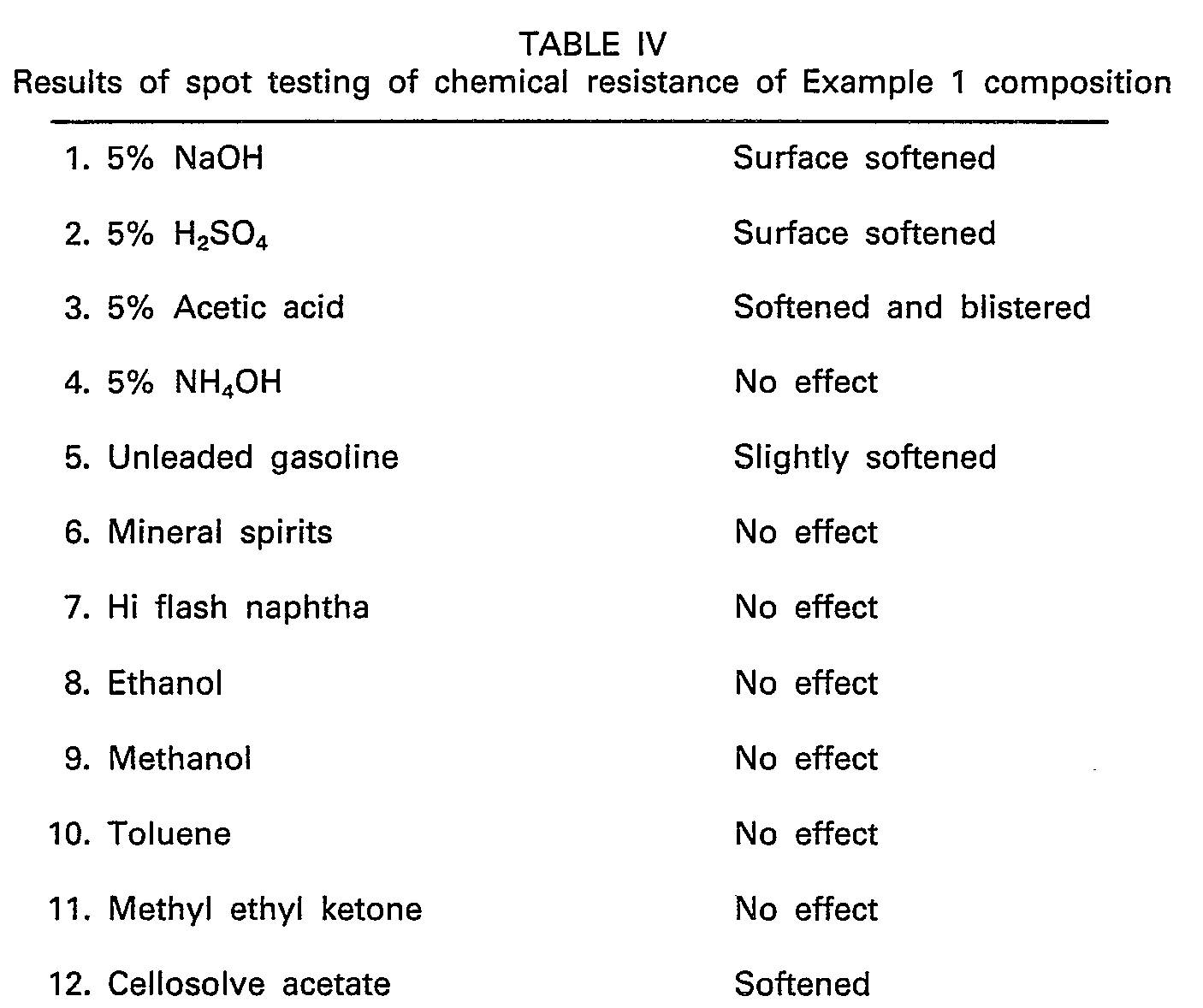
- Sandblasted steel panels coated with the thinned composition of Example 1 were tested for resistance to drops of various chemicals for a period of 24 hours. Results of such testing are shown in Table IV.
- The two components of the Example 1 composition were allowed to stand at room temperature for six months. After this period no settling or deleafing was observed in Component A. There was soft settling of the solids of Component B, but the solids of Component B sould be reincorporated to a homogeneous state by agitation.
Claims (9)


Applications Claiming Priority (2)
| Application Number | Priority Date | Filing Date | Title |
|---|---|---|---|
| US388836 | 1982-06-16 | ||
| US06/388,836 US4451591A (en) | 1982-06-16 | 1982-06-16 | Two-component high solids coating for rusty steels |
Publications (2)
| Publication Number | Publication Date |
|---|---|
| EP0096955A1 EP0096955A1 (en) | 1983-12-28 |
| EP0096955B1 true EP0096955B1 (en) | 1986-06-04 |
Family
ID=23535727
Family Applications (1)
| Application Number | Title | Priority Date | Filing Date |
|---|---|---|---|
| EP83302065A Expired EP0096955B1 (en) | 1982-06-16 | 1983-04-13 | Two-component coating compositions for rusty steels |
Country Status (14)
| Country | Link |
|---|---|
| US (1) | US4451591A (en) |
| EP (1) | EP0096955B1 (en) |
| JP (1) | JPS596265A (en) |
| AU (1) | AU558813B2 (en) |
| CA (1) | CA1196137A (en) |
| DE (1) | DE3363901D1 (en) |
| DK (1) | DK275283A (en) |
| ES (1) | ES522105A0 (en) |
| HK (1) | HK36887A (en) |
| IL (1) | IL68313A (en) |
| NO (1) | NO831592L (en) |
| NZ (1) | NZ203795A (en) |
| SG (1) | SG9487G (en) |
| ZA (1) | ZA832639B (en) |
Families Citing this family (15)
| Publication number | Priority date | Publication date | Assignee | Title |
|---|---|---|---|---|
| US5418271A (en) * | 1985-07-05 | 1995-05-23 | The Dow Chemical Company | Coating composition comprising solids having reversible stress-induced fluidity |
| US5443761A (en) * | 1985-07-05 | 1995-08-22 | The Dow Chemical Company | Elastic solids having reversible strain-induced fluidity |
| US5721198A (en) * | 1985-07-05 | 1998-02-24 | The Dow Chemical Company | Elastic solids having reversible stress-induced fluidity |
| FR2602239B1 (en) * | 1986-07-30 | 1988-10-07 | Savin Ronald | COATING COMPOSITIONS CONTAINING REACTIVE PIGMENTS AND HAVING EXCELLENT RESISTANCE TO AGGRESSION OF THE ENVIRONMENT |
| US4968538A (en) * | 1987-01-14 | 1990-11-06 | Freecom, Inc. | Abrasion resistant coating and method of application |
| JP2660542B2 (en) * | 1988-04-21 | 1997-10-08 | 神東塗料株式会社 | Steel coating method and steel coating composition |
| JPH02133421A (en) * | 1988-11-14 | 1990-05-22 | Sunstar Eng Inc | Epoxy resin composition |
| US5130351A (en) * | 1989-02-28 | 1992-07-14 | The Glidden Company | Epoxy-amine coatings with tricarboxylic acid thixotropic additive |
| US5243014A (en) * | 1990-07-25 | 1993-09-07 | Shomer John A | Homogeneous accelerator system for epoxy resins |
| DE69109773T2 (en) * | 1990-07-25 | 1995-09-21 | John A Shomer | Homogeneous accelerator system for epoxy resins. |
| GB9120078D0 (en) * | 1991-09-20 | 1991-11-06 | Ciba Geigy Ag | Resin formulation |
| BR9813191A (en) * | 1997-11-07 | 2000-08-29 | Cognis Corp | Amidoamine composition, cured epoxy composition, and, curing process of an epoxy resin composition |
| US6599965B2 (en) * | 2000-06-22 | 2003-07-29 | Basf Corporation | Coating composition for metallic substrates |
| WO2017151898A1 (en) * | 2016-03-02 | 2017-09-08 | 3M Innovative Properties Company | Composition including epoxy adhesive and aluminum flakes and method for making the same |
| FR3140371B1 (en) * | 2022-09-29 | 2024-09-27 | Bostik Sa | Two-component composition based on epoxy resin |
Family Cites Families (11)
| Publication number | Priority date | Publication date | Assignee | Title |
|---|---|---|---|---|
| US2987492A (en) * | 1958-03-13 | 1961-06-06 | Eastman Kodak Co | Lacquer composition |
| US3007888A (en) * | 1958-12-31 | 1961-11-07 | Electric Storage Battery Co | Epoxy resin base protective surfaces |
| US3183198A (en) * | 1960-08-09 | 1965-05-11 | Tile Council Of America | Two-part adhesive bonding compositions comprising an epoxy resinous material and a poly-amido amine |
| US3408318A (en) * | 1961-03-13 | 1968-10-29 | Celanese Coatings Co | Sacrificial zinc coating compositions |
| NL278270A (en) * | 1963-11-05 | 1900-01-01 | ||
| DE1570651A1 (en) * | 1964-03-11 | 1970-03-19 | Schering Ag | Suitable epoxy resin compounds for coatings such as synthetic resin varnishes and paints |
| DE1289221B (en) * | 1964-03-11 | 1969-02-13 | Schering Ag | Process for the production of coatings based on epoxy resins, a nitrogen-containing solid acid as a hardening agent and coumarone-indene resins |
| US3998771A (en) * | 1975-04-11 | 1976-12-21 | Mobil Oil Corporation | Water-based epoxy resin zinc-rich coating compositions |
| SU569148A1 (en) * | 1975-12-09 | 1978-12-05 | Ленинградский Ордена Трудового Красного Знамени Технологический Институт Им. Ленсовета | Powder composition for coating |
| US4352898A (en) * | 1980-04-25 | 1982-10-05 | Deft, Inc. | Water-reducible epoxy coating compositions without emulsifier |
| US4342674A (en) * | 1981-04-22 | 1982-08-03 | Mobil Oil Corporation | High solids coating for rusty steels |
-
1982
- 1982-06-16 US US06/388,836 patent/US4451591A/en not_active Expired - Fee Related
-
1983
- 1983-03-30 CA CA000424922A patent/CA1196137A/en not_active Expired
- 1983-04-06 NZ NZ203795A patent/NZ203795A/en unknown
- 1983-04-06 IL IL68313A patent/IL68313A/en unknown
- 1983-04-06 AU AU13196/83A patent/AU558813B2/en not_active Ceased
- 1983-04-13 DE DE8383302065T patent/DE3363901D1/en not_active Expired
- 1983-04-13 EP EP83302065A patent/EP0096955B1/en not_active Expired
- 1983-04-14 ZA ZA832639A patent/ZA832639B/en unknown
- 1983-05-05 NO NO831592A patent/NO831592L/en unknown
- 1983-05-05 ES ES522105A patent/ES522105A0/en active Granted
- 1983-06-13 JP JP58104358A patent/JPS596265A/en active Pending
- 1983-06-15 DK DK275283A patent/DK275283A/en not_active Application Discontinuation
-
1987
- 1987-02-10 SG SG94/87A patent/SG9487G/en unknown
- 1987-05-07 HK HK368/87A patent/HK36887A/en unknown
Non-Patent Citations (1)
| Title |
|---|
| H. JAHN "Epoxidharze", 1969, VEB DEUTSCHER VERLAG FÜR GRUNDSTOFFINDUSTRIE, Leipzig, pages 160,161,236 * |
Also Published As
| Publication number | Publication date |
|---|---|
| ES8406530A1 (en) | 1984-07-16 |
| SG9487G (en) | 1987-07-24 |
| HK36887A (en) | 1987-05-15 |
| AU558813B2 (en) | 1987-02-12 |
| IL68313A0 (en) | 1983-07-31 |
| US4451591A (en) | 1984-05-29 |
| DK275283A (en) | 1983-12-17 |
| EP0096955A1 (en) | 1983-12-28 |
| JPS596265A (en) | 1984-01-13 |
| ZA832639B (en) | 1984-11-28 |
| ES522105A0 (en) | 1984-07-16 |
| AU1319683A (en) | 1983-12-22 |
| NO831592L (en) | 1983-12-19 |
| DE3363901D1 (en) | 1986-07-10 |
| DK275283D0 (en) | 1983-06-15 |
| NZ203795A (en) | 1986-01-24 |
| CA1196137A (en) | 1985-10-29 |
| IL68313A (en) | 1986-04-29 |
Similar Documents
| Publication | Publication Date | Title |
|---|---|---|
| US6045873A (en) | One-pack epoxy resin composition, one-pack corrosion resistant paint composition, and coating method using said compositions | |
| JP5367983B2 (en) | Anti-corrosive pigment-containing polyfunctional epoxy resin coating composition, coating film thereof, substrate coated with coating film, and anticorrosion method | |
| US4451591A (en) | Two-component high solids coating for rusty steels | |
| US4891394A (en) | Coating composition containing metallic pigments exhibiting excellent resistance to environmental attack | |
| EP0136842B1 (en) | Low temperature curing coating composition | |
| EP0171102B1 (en) | Water-reducible coating composition based on an epoxy resin | |
| JP5913762B1 (en) | Anticorrosion paint composition, paint film, ship and marine structure | |
| US4086096A (en) | Coating composition | |
| EP1069167A2 (en) | Coating composition | |
| CN113773705A (en) | Aqueous polyvinylidene chloride single-component anti-rust primer and preparation method thereof | |
| CA1205231A (en) | Process for applying a coating to a substrate and a liquid aqueous composition to be used therein | |
| US4342674A (en) | High solids coating for rusty steels | |
| JP6086994B2 (en) | Modified epoxy resin | |
| US4495317A (en) | Warer reducible epoxy coating composition | |
| JP2640972B2 (en) | Rust prevention paint composition | |
| EP0244905B1 (en) | Water-reducible coating composition based on an epoxy resin | |
| US4086095A (en) | Coating composition | |
| JP7355908B1 (en) | Two-component base conditioner and aerosol base conditioner | |
| EP0116614B1 (en) | Coating compositions containing a hydrolyzed epoxy novolac resin | |
| KR800001221B1 (en) | Epoxy resin composition cured by reaction products of phenol carboxylic acids with polyamino compounds | |
| JPS6112928B2 (en) | ||
| WO2026052474A1 (en) | Anticorrosive primer coating composition | |
| JPH01201370A (en) | paint composition | |
| JPS6011728B2 (en) | Water-based chelate-modified epoxy resin composition | |
| EP2978791A1 (en) | Curing agent for epoxy resins |
Legal Events
| Date | Code | Title | Description |
|---|---|---|---|
| PUAI | Public reference made under article 153(3) epc to a published international application that has entered the european phase |
Free format text: ORIGINAL CODE: 0009012 |
|
| AK | Designated contracting states |
Designated state(s): BE DE FR GB IT NL SE |
|
| 17P | Request for examination filed |
Effective date: 19840601 |
|
| RAP1 | Party data changed (applicant data changed or rights of an application transferred) |
Owner name: THE VALSPAR CORPORATION |
|
| GRAA | (expected) grant |
Free format text: ORIGINAL CODE: 0009210 |
|
| AK | Designated contracting states |
Kind code of ref document: B1 Designated state(s): BE DE FR GB IT NL SE |
|
| REF | Corresponds to: |
Ref document number: 3363901 Country of ref document: DE Date of ref document: 19860710 |
|
| ET | Fr: translation filed | ||
| ITF | It: translation for a ep patent filed | ||
| PLBE | No opposition filed within time limit |
Free format text: ORIGINAL CODE: 0009261 |
|
| STAA | Information on the status of an ep patent application or granted ep patent |
Free format text: STATUS: NO OPPOSITION FILED WITHIN TIME LIMIT |
|
| PGFP | Annual fee paid to national office [announced via postgrant information from national office to epo] |
Ref country code: NL Payment date: 19870430 Year of fee payment: 5 |
|
| 26N | No opposition filed | ||
| PG25 | Lapsed in a contracting state [announced via postgrant information from national office to epo] |
Ref country code: SE Effective date: 19880414 |
|
| BERE | Be: lapsed |
Owner name: THE VALSPAR CORP. Effective date: 19880430 |
|
| PG25 | Lapsed in a contracting state [announced via postgrant information from national office to epo] |
Ref country code: NL Effective date: 19881101 |
|
| PG25 | Lapsed in a contracting state [announced via postgrant information from national office to epo] |
Ref country code: GB Effective date: 19881122 |
|
| NLV4 | Nl: lapsed or anulled due to non-payment of the annual fee | ||
| GBPC | Gb: european patent ceased through non-payment of renewal fee | ||
| PG25 | Lapsed in a contracting state [announced via postgrant information from national office to epo] |
Ref country code: FR Free format text: LAPSE BECAUSE OF NON-PAYMENT OF DUE FEES Effective date: 19881229 |
|
| PG25 | Lapsed in a contracting state [announced via postgrant information from national office to epo] |
Ref country code: DE Effective date: 19890103 |
|
| REG | Reference to a national code |
Ref country code: FR Ref legal event code: ST |
|
| PG25 | Lapsed in a contracting state [announced via postgrant information from national office to epo] |
Ref country code: BE Effective date: 19890430 |
|
| EUG | Se: european patent has lapsed |
Ref document number: 83302065.4 Effective date: 19890726 |