EP0095984A1 - Verfahren für die Ausgleichung von Fehlern bei der Projektion eines Filmes mittels eines Gerätes mit grösserer Geschwindigkeit arbeitend als das Aufnahmegerät - Google Patents
Verfahren für die Ausgleichung von Fehlern bei der Projektion eines Filmes mittels eines Gerätes mit grösserer Geschwindigkeit arbeitend als das Aufnahmegerät Download PDFInfo
- Publication number
- EP0095984A1 EP0095984A1 EP83401099A EP83401099A EP0095984A1 EP 0095984 A1 EP0095984 A1 EP 0095984A1 EP 83401099 A EP83401099 A EP 83401099A EP 83401099 A EP83401099 A EP 83401099A EP 0095984 A1 EP0095984 A1 EP 0095984A1
- Authority
- EP
- European Patent Office
- Prior art keywords
- images
- film
- luminance
- original
- image
- Prior art date
- Legal status (The legal status is an assumption and is not a legal conclusion. Google has not performed a legal analysis and makes no representation as to the accuracy of the status listed.)
- Withdrawn
Links
- 238000000034 method Methods 0.000 title claims abstract description 39
- 238000012360 testing method Methods 0.000 claims description 19
- 238000004519 manufacturing process Methods 0.000 claims description 4
- 230000007547 defect Effects 0.000 claims description 2
- 238000013100 final test Methods 0.000 claims description 2
- 230000010354 integration Effects 0.000 claims description 2
- 230000001052 transient effect Effects 0.000 claims description 2
- 230000000295 complement effect Effects 0.000 claims 1
- 238000009830 intercalation Methods 0.000 claims 1
- 230000033001 locomotion Effects 0.000 description 6
- 230000001360 synchronised effect Effects 0.000 description 3
- 230000003287 optical effect Effects 0.000 description 2
- 240000008042 Zea mays Species 0.000 description 1
- 230000005540 biological transmission Effects 0.000 description 1
- 238000006243 chemical reaction Methods 0.000 description 1
- 230000009466 transformation Effects 0.000 description 1
Images


Classifications
-
- G—PHYSICS
- G03—PHOTOGRAPHY; CINEMATOGRAPHY; ANALOGOUS TECHNIQUES USING WAVES OTHER THAN OPTICAL WAVES; ELECTROGRAPHY; HOLOGRAPHY
- G03B—APPARATUS OR ARRANGEMENTS FOR TAKING PHOTOGRAPHS OR FOR PROJECTING OR VIEWING THEM; APPARATUS OR ARRANGEMENTS EMPLOYING ANALOGOUS TECHNIQUES USING WAVES OTHER THAN OPTICAL WAVES; ACCESSORIES THEREFOR
- G03B27/00—Photographic printing apparatus
- G03B27/32—Projection printing apparatus, e.g. enlarger, copying camera
- G03B27/46—Projection printing apparatus, e.g. enlarger, copying camera for automatic sequential copying of different originals, e.g. enlargers, roll film printers
- G03B27/475—Projection printing apparatus, e.g. enlarger, copying camera for automatic sequential copying of different originals, e.g. enlargers, roll film printers copying cinematographic film
Definitions
- the present invention relates to a method making it possible to compensate for defects resulting from the projection of a cinematographic and / or television work, using an apparatus operating at a speed greater than that of taking pictures.
- a cinematographic film is a series of instant photos of the original movement, arranged in chronological order and taken at a speed usually of the order of 16 to 25 images / second.
- the camera In order to obtain a faithful reproduction of the work, the camera must be adjusted in such a way that the speed of unfolding of the film is synchronous with that of the shooting.
- each of the instant object images is explored pixel by pixel, according to a scanning process in which the explorer point moves the along successive horizontal lines dividing the image. The frequency of the instant images is therefore determined by the exploration time of each of these images.
- the invention therefore aims to eliminate these drawbacks; it therefore offers a process which not only makes the movements of subjects more natural (transformation of jerky movements into continuous movements), but also improves the quality of the initial image.
- Patent FR 2 475 245 describes in particular on this subject a process in which the final proof is obtained by a single passage of the original film inside a device in which synchronized shutters are interposed between a projector of the original film and a print camera. These shutters are used to cut the exposure time in sensitometrically and quantitatively added and mixed fractions, according to a code adapted to each type of conversion.
- the object of the invention is therefore to achieve similar results by means of much simpler apparatus.
- the invention further relates to a process more particularly involving an apparatus comprising, on the one hand, for the projection of the original, a projector comprising, in a conventional manner, a light source, a condenser, a film pass , a shutter, a diaphragm and a lens designed to emit in a light-tight projection chamber and, on the other hand, for the exposure of the print, a film pass, suitably arranged inside the projection room.
- a projector comprising, in a conventional manner, a light source, a condenser, a film pass , a shutter, a diaphragm and a lens designed to emit in a light-tight projection chamber and, on the other hand, for the exposure of the print, a film pass, suitably arranged inside the projection room.
- the aforementioned film passes, the shutter and the diaphragm are controlled by a possibly programmable control system, so as to automatically obtain the desired operating sequences.
- the method according to the invention consists in carrying out, during a first pass, a partial impression of the proof, by a first predetermined projection sequence of the images of the original and , during a second pass, an overprint of the test according to a second sequence different from the first, so as to obtain on the test a succession of clear images conforming to the original, between which are inserted one or more several intermediate images obtained by superimposing two successive images of the original with predetermined luminance or exposure ratios.
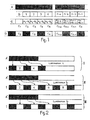
- FIG. 1 is a schematic representation illustrating the various stages of the method according to the invention, in which an intermediate image is inserted between the images of a cinematographic film
- Figure 2 is a schematic representation illustrating the different steps of a method according to the invention making it possible to obtain a result similar to the previous one;
- FIG. 3 is a schematic representation illustrating the steps of a method according to which two intermediate images are inserted between the images of a film;
- FIG. 4 is a schematic representation making it possible to illustrate a method according to the invention, according to which results similar to those obtained by the method according to FIG. 3 are obtained;
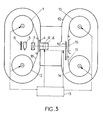
- Figure 5 is a schematic representation of an apparatus for implementing another embodiment of the method according to the invention.
- Figures 6 and 7 are tables for illustrating the image sequences impressed on the proof from the original, according to two embodiments of the invention.
- the process illustrated in FIG. 1 makes it possible to produce a film usable in a projection device at 25 frames per second from an original film taken using a camera at 16 frames per second.
- the method consists first of all in making two negative prints A and B of the original film.
- the two films are then superimposed by shifting them by an image and then a negative C is drawn from this superposition, making the luminance of this negative equal to that of the negative A or the negative B taken separately.
- the image C 2 of the negative will then be equal to the superposition A 2 + B 1 and the image C n will be equal to A n + B n-1 .
- the sensitive film of a film I is printed using a negative A ′ of the original film, so as to leave, between the impressed images I 1 , I 3 , I 5 ..., intervals I 2 , I 4 ... of width equal to that of an image.
- the diaphragm of the device used for this exposure is then adjusted for a luminance L.
- the intervals I 2 , I 4 ... are printed with the images A ' 1 , A' 2 , A ' 3 ... of the original with, this time, a diaphragm set for luminance .
- the intervals I 2 , I 4 ... are superimposed with the images A ' 1 , A' 2 , A ' 3 ... with an offset of one image, the diaphragm being also adjusted for a luminance .
- the sensitive film of a film J is printed using a negative A "'of the original film, so as to leave, between the impressed images J 1 , J 4 , J 7 , two image lengths, ie J 2 , J 3 , J 5 , J 6 ...
- the diaphragm of the camera used for this exposure is then adjusted for a luminance L.
- the blank image lengths J 2 , J 3 , J 5 , J 6 ... are printed in order, with the images A "' 1 , A"' 2 , A “' 3 ... from the original, the device then being set for a luminance of 2 L.
- the apparatus firstly comprises a projection member (left part of FIG. 5) which conventionally comprises a film-passing device involving a supply reel 1-take-up reel assembly 2 actuated from a possibly stepping motor, at frame rate, frame by frame, controllable from a programmable control system 3.
- the original film passes through a film guide 4 to the right of which is located, on one side, a light emitting assembly which may include a light source 5, a reflector 6 and a condenser 7.
- a lens 8 equipped with a diaphragm 9, controlled by the above-mentioned control member 3.
- This projection assembly is intended to carry out the projection of the images of the original film according to a predetermined sequence on a sensitive test 11 mounted on a film pass device arranged in a projection chamber 12 sealed against external light.
- This film-passing device comprises a supply reel 13-take-up reel 14 assembly, actuated from an optionally stepping motor, at frame-by-frame speed, also controllable by the programmable control system 3.
- This pass-through device film further comprises a film guide 15 arranged perpendicular to the optical axis and in the object image plane of the objective 8, as well as a shutter 10 for example of the conventional type, shown schematically by an openwork rotating disc.
- the images of the original have been designated by I 1 , I 2 , I 3 ... In.
- the diaphragm 9 is adjusted so as to obtain a luminance equal to of total luminance.
- the film-passing devices of the projection member and of the projection chamber 12 as well as the shutter 10 are adjusted so as to obtain on the blank proof the following sequence of impressed images: I ' 1 , I' 1 , I ' 3 , I' 3 , I ' 3 , I' 5 , I ' 5 , I' 5 , I' 7 , I' 7 , 1 ' 7 , in which the images T' 1 , I ' 3 .. I ' n correspond to the images I 1 , I 3 ... I n , but with a luminance equal to of the desired total luminance.
- the two films are rewound on their respective supply reels 1, 13 and then a second printing sequence (second pass) is carried out, this time adjusting the diaphragm 9 to a luminance equal to of total luminance.
- image I 3 of the original is impressed in image 3 of the proof with a luminance , in image 4 of the test, with a luminance 1, then in image 5 of the test with a luminance , so that the total luminance assigned to the image I 3 of the original will be equal to .
- the image I 4 of the original is impressed in images 4 and 5 of the proof with each time a luminance of , which leads to a total luminance of .
- the total luminance allocated to the projection of each of the images of the original will be constant and equal to 4 .
Landscapes
- Physics & Mathematics (AREA)
- General Physics & Mathematics (AREA)
- Projection-Type Copiers In General (AREA)
Applications Claiming Priority (4)
| Application Number | Priority Date | Filing Date | Title |
|---|---|---|---|
| FR8209608 | 1982-06-02 | ||
| FR8209608A FR2528217B1 (fr) | 1982-06-02 | 1982-06-02 | Procede permettant de compenser les defauts resultant de la projection d'un film a l'aide d'un appareil fonctionannt a une vitesse superieure a celle de la prise de vues |
| FR8306010A FR2544512A2 (fr) | 1983-04-13 | 1983-04-13 | Procede permettant de compenser les defauts resultant de la projection d'un film a l'aide d'un appareil fonctionnant a une vitesse superieure a celle de la prise de vues |
| FR8306010 | 1983-04-13 |
Publications (1)
| Publication Number | Publication Date |
|---|---|
| EP0095984A1 true EP0095984A1 (de) | 1983-12-07 |
Family
ID=26222934
Family Applications (1)
| Application Number | Title | Priority Date | Filing Date |
|---|---|---|---|
| EP83401099A Withdrawn EP0095984A1 (de) | 1982-06-02 | 1983-05-31 | Verfahren für die Ausgleichung von Fehlern bei der Projektion eines Filmes mittels eines Gerätes mit grösserer Geschwindigkeit arbeitend als das Aufnahmegerät |
Country Status (1)
| Country | Link |
|---|---|
| EP (1) | EP0095984A1 (de) |
Citations (3)
| Publication number | Priority date | Publication date | Assignee | Title |
|---|---|---|---|---|
| US2011353A (en) * | 1933-06-24 | 1935-08-13 | Eastman Kodak Co | Apparatus for copying motion picture films |
| GB631095A (en) * | 1945-04-18 | 1949-10-27 | Gen Electric Co Ltd | Improvements in and relating to television, photo-copying and like processes |
| FR2475245A1 (fr) * | 1980-02-04 | 1981-08-07 | Ygouf Yvon | Procede et dispositif de tirage pour conversions de cadences de films cinematographiques |
-
1983
- 1983-05-31 EP EP83401099A patent/EP0095984A1/de not_active Withdrawn
Patent Citations (3)
| Publication number | Priority date | Publication date | Assignee | Title |
|---|---|---|---|---|
| US2011353A (en) * | 1933-06-24 | 1935-08-13 | Eastman Kodak Co | Apparatus for copying motion picture films |
| GB631095A (en) * | 1945-04-18 | 1949-10-27 | Gen Electric Co Ltd | Improvements in and relating to television, photo-copying and like processes |
| FR2475245A1 (fr) * | 1980-02-04 | 1981-08-07 | Ygouf Yvon | Procede et dispositif de tirage pour conversions de cadences de films cinematographiques |
Similar Documents
| Publication | Publication Date | Title |
|---|---|---|
| US4344683A (en) | Quality control method and apparatus for photographic pictures | |
| CH621634A5 (de) | ||
| US6868231B2 (en) | Imaging using silver halide films with micro-lens capture and optical reconstruction | |
| JPH11341238A (ja) | 画像読取装置 | |
| US4930009A (en) | Method of making a print of color slide | |
| US2056600A (en) | Process and apparatus for producing stereopticon motion pictures | |
| EP0095984A1 (de) | Verfahren für die Ausgleichung von Fehlern bei der Projektion eines Filmes mittels eines Gerätes mit grösserer Geschwindigkeit arbeitend als das Aufnahmegerät | |
| US6909491B2 (en) | Electronic and film theatrical quality | |
| US2375962A (en) | Method of producing motion-picture films | |
| US1833015A (en) | Timing device for talking motion pictures and the like | |
| FR2544512A2 (fr) | Procede permettant de compenser les defauts resultant de la projection d'un film a l'aide d'un appareil fonctionnant a une vitesse superieure a celle de la prise de vues | |
| US3364814A (en) | Method of optical printing especially for disanamorphosation and anamorphosation of films | |
| FR2589300A1 (fr) | Dispositif permettant de transformer une representation d'une image en couleur en un signal electrique, et inversement | |
| US1324122A (en) | Thomas a | |
| US20260036822A1 (en) | Diffractive optical element and camera | |
| SU1377812A1 (ru) | Способ получени фильмокопии | |
| US1226135A (en) | Process of making moving-picture films. | |
| US1824446A (en) | Method of and apparatus for producing motion pictures in color | |
| US1545470A (en) | Stereoscopic moving-picture camera | |
| FR2544091A1 (fr) | Viseur d'appareil photographique | |
| Maurer | Developmental possibilities in 16mm projectors | |
| US1717405A (en) | Apparatus for printing positive pictures in natural colors | |
| BE393287A (de) | ||
| US20030090733A1 (en) | Device for digitally generating images | |
| BE503598A (de) |
Legal Events
| Date | Code | Title | Description |
|---|---|---|---|
| PUAI | Public reference made under article 153(3) epc to a published international application that has entered the european phase |
Free format text: ORIGINAL CODE: 0009012 |
|
| AK | Designated contracting states |
Designated state(s): BE CH DE GB IT LI NL |
|
| 17P | Request for examination filed |
Effective date: 19840116 |
|
| STAA | Information on the status of an ep patent application or granted ep patent |
Free format text: STATUS: THE APPLICATION HAS BEEN WITHDRAWN |
|
| 18W | Application withdrawn |
Withdrawal date: 19860515 |