EP0094271A2 - Arene and heteroarene carboxamide derivatives, process for their preparation and medicaments containing them - Google Patents
Arene and heteroarene carboxamide derivatives, process for their preparation and medicaments containing them Download PDFInfo
- Publication number
- EP0094271A2 EP0094271A2 EP83400749A EP83400749A EP0094271A2 EP 0094271 A2 EP0094271 A2 EP 0094271A2 EP 83400749 A EP83400749 A EP 83400749A EP 83400749 A EP83400749 A EP 83400749A EP 0094271 A2 EP0094271 A2 EP 0094271A2
- Authority
- EP
- European Patent Office
- Prior art keywords
- phenyl
- group
- methyl
- compounds
- chloro
- Prior art date
- Legal status (The legal status is an assumption and is not a legal conclusion. Google has not performed a legal analysis and makes no representation as to the accuracy of the status listed.)
- Granted
Links
- 0 *c1cc([s]cc2)c2c(*)n1 Chemical compound *c1cc([s]cc2)c2c(*)n1 0.000 description 1
Classifications
-
- C—CHEMISTRY; METALLURGY
- C07—ORGANIC CHEMISTRY
- C07D—HETEROCYCLIC COMPOUNDS
- C07D409/00—Heterocyclic compounds containing two or more hetero rings, at least one ring having sulfur atoms as the only ring hetero atoms
- C07D409/02—Heterocyclic compounds containing two or more hetero rings, at least one ring having sulfur atoms as the only ring hetero atoms containing two hetero rings
- C07D409/04—Heterocyclic compounds containing two or more hetero rings, at least one ring having sulfur atoms as the only ring hetero atoms containing two hetero rings directly linked by a ring-member-to-ring-member bond
-
- A—HUMAN NECESSITIES
- A61—MEDICAL OR VETERINARY SCIENCE; HYGIENE
- A61P—SPECIFIC THERAPEUTIC ACTIVITY OF CHEMICAL COMPOUNDS OR MEDICINAL PREPARATIONS
- A61P37/00—Drugs for immunological or allergic disorders
-
- A—HUMAN NECESSITIES
- A61—MEDICAL OR VETERINARY SCIENCE; HYGIENE
- A61P—SPECIFIC THERAPEUTIC ACTIVITY OF CHEMICAL COMPOUNDS OR MEDICINAL PREPARATIONS
- A61P9/00—Drugs for disorders of the cardiovascular system
-
- C—CHEMISTRY; METALLURGY
- C07—ORGANIC CHEMISTRY
- C07D—HETEROCYCLIC COMPOUNDS
- C07D215/00—Heterocyclic compounds containing quinoline or hydrogenated quinoline ring systems
- C07D215/02—Heterocyclic compounds containing quinoline or hydrogenated quinoline ring systems having no bond between the ring nitrogen atom and a non-ring member or having only hydrogen atoms or carbon atoms directly attached to the ring nitrogen atom
- C07D215/12—Heterocyclic compounds containing quinoline or hydrogenated quinoline ring systems having no bond between the ring nitrogen atom and a non-ring member or having only hydrogen atoms or carbon atoms directly attached to the ring nitrogen atom with substituted hydrocarbon radicals attached to ring carbon atoms
-
- C—CHEMISTRY; METALLURGY
- C07—ORGANIC CHEMISTRY
- C07D—HETEROCYCLIC COMPOUNDS
- C07D215/00—Heterocyclic compounds containing quinoline or hydrogenated quinoline ring systems
- C07D215/02—Heterocyclic compounds containing quinoline or hydrogenated quinoline ring systems having no bond between the ring nitrogen atom and a non-ring member or having only hydrogen atoms or carbon atoms directly attached to the ring nitrogen atom
- C07D215/12—Heterocyclic compounds containing quinoline or hydrogenated quinoline ring systems having no bond between the ring nitrogen atom and a non-ring member or having only hydrogen atoms or carbon atoms directly attached to the ring nitrogen atom with substituted hydrocarbon radicals attached to ring carbon atoms
- C07D215/14—Radicals substituted by oxygen atoms
-
- C—CHEMISTRY; METALLURGY
- C07—ORGANIC CHEMISTRY
- C07D—HETEROCYCLIC COMPOUNDS
- C07D215/00—Heterocyclic compounds containing quinoline or hydrogenated quinoline ring systems
- C07D215/02—Heterocyclic compounds containing quinoline or hydrogenated quinoline ring systems having no bond between the ring nitrogen atom and a non-ring member or having only hydrogen atoms or carbon atoms directly attached to the ring nitrogen atom
- C07D215/16—Heterocyclic compounds containing quinoline or hydrogenated quinoline ring systems having no bond between the ring nitrogen atom and a non-ring member or having only hydrogen atoms or carbon atoms directly attached to the ring nitrogen atom with hetero atoms or with carbon atoms having three bonds to hetero atoms with at the most one bond to halogen, e.g. ester or nitrile radicals, directly attached to ring carbon atoms
- C07D215/48—Carbon atoms having three bonds to hetero atoms with at the most one bond to halogen
-
- C—CHEMISTRY; METALLURGY
- C07—ORGANIC CHEMISTRY
- C07D—HETEROCYCLIC COMPOUNDS
- C07D217/00—Heterocyclic compounds containing isoquinoline or hydrogenated isoquinoline ring systems
- C07D217/22—Heterocyclic compounds containing isoquinoline or hydrogenated isoquinoline ring systems with hetero atoms or with carbon atoms having three bonds to hetero atoms with at the most one bond to halogen, e.g. ester or nitrile radicals, directly attached to carbon atoms of the nitrogen-containing ring
- C07D217/26—Carbon atoms having three bonds to hetero atoms with at the most one bond to halogen
-
- C—CHEMISTRY; METALLURGY
- C07—ORGANIC CHEMISTRY
- C07D—HETEROCYCLIC COMPOUNDS
- C07D239/00—Heterocyclic compounds containing 1,3-diazine or hydrogenated 1,3-diazine rings
- C07D239/70—Heterocyclic compounds containing 1,3-diazine or hydrogenated 1,3-diazine rings condensed with carbocyclic rings or ring systems
- C07D239/72—Quinazolines; Hydrogenated quinazolines
-
- C—CHEMISTRY; METALLURGY
- C07—ORGANIC CHEMISTRY
- C07D—HETEROCYCLIC COMPOUNDS
- C07D495/00—Heterocyclic compounds containing in the condensed system at least one hetero ring having sulfur atoms as the only ring hetero atoms
- C07D495/02—Heterocyclic compounds containing in the condensed system at least one hetero ring having sulfur atoms as the only ring hetero atoms in which the condensed system contains two hetero rings
- C07D495/04—Ortho-condensed systems
Definitions
- the esters of formula (VI) can be prepared by heating the acids of formula (V) in a low molecular weight alcohol such as methanol or ethanol, at reflux and in the presence of a mineral acid such as sulfuric acid or hydrochloric acid. The esters thus obtained are then treated with at least one equivalent of amine. in the presence of a metallating agent such as butyllithium, in an inert solvent such as ethyl ether or tetrahydrofuran, at a temperature between -10 ° C and + 30 ° C.
- a metallating agent such as butyllithium
- an inert solvent such as ethyl ether or tetrahydrofuran
- Phenyl-4 quinolinecarboxylic acid-2 can be prepared according to: TAKAHASHI and MITSUHASHI, J. Het. Chem. (15) p . 881 (1977).
- Example 8 [(PHENYL-1 ISOQUINOLYL) -3 CARBONYL] -4 MORPHOLINE.
- Example 15 N, N-DIETHYL (FLUORO-3 PHENYL) -1 ISOQUINOLEINECARBOXAMIDE-3.
- Example 21 N-METHYL N- (METHYL-1 PROPYL) (CHLORO-2 PHENYL) -1 ISOQUINOLEINECARBOXAMIDE-3.
- Example 25 N-METHYLN- (METHYL-1 PROPEN-2 YL) (CHLORO-2 PHENYL) -1 ISOQUINOLEINECARBOXAMIDE-3.
- the reaction medium is taken up in 100 ml of water.
- the toluene phase is decanted: the aqueous phase is extracted with 3 times 100 ml of ether.
- the organic phases are combined, washed with 2 times 50 ml of water, dried over magnesium sulfate and concentrated under reduced pressure.
- the residue is chromatographed on silica gel using a 70:30 cyclohexane / ethyl acetate mixture. After crystallization of the oil obtained in a 5: 2 isopropyl ether-ether mixture, 1.16 g of N-methyl N- (1-methyl-propyl) (2-fluoro-phenyl) -4 quinoline-2-carboxamide-melting is obtained. ° C.
- Example 46 N-METHYL N- (METHYL-1 PROPYL) (CHLORO-2 PHENYL) -7 THIENO [2,3-C] PYRIDINECARBOXAMIDE-5.
- Example 47 N-METHYL N- (METHYL-1 PROPYL) (CHLORO-2 PHENYL) -4 THIENO [3,2-c] PYRIDINECARBOXAMIDE-6.
- the acute toxicities of the compounds according to the invention were determined in the male CD1 mouse (Charles RIVER) by the oral route, the LD 50s were calculated, after 3 days of observation, by the cumulative method of JJ REED and H. MUENCH (Amer. J. Hyg. 1938, 27, 493).
Landscapes
- Chemical & Material Sciences (AREA)
- Organic Chemistry (AREA)
- Health & Medical Sciences (AREA)
- Animal Behavior & Ethology (AREA)
- Public Health (AREA)
- Chemical Kinetics & Catalysis (AREA)
- General Chemical & Material Sciences (AREA)
- Medicinal Chemistry (AREA)
- Nuclear Medicine, Radiotherapy & Molecular Imaging (AREA)
- Bioinformatics & Cheminformatics (AREA)
- Pharmacology & Pharmacy (AREA)
- Life Sciences & Earth Sciences (AREA)
- Engineering & Computer Science (AREA)
- General Health & Medical Sciences (AREA)
- Veterinary Medicine (AREA)
- Immunology (AREA)
- Cardiology (AREA)
- Heart & Thoracic Surgery (AREA)
- Pharmaceuticals Containing Other Organic And Inorganic Compounds (AREA)
- Plural Heterocyclic Compounds (AREA)
- Organic Low-Molecular-Weight Compounds And Preparation Thereof (AREA)
- Quinoline Compounds (AREA)
- Other In-Based Heterocyclic Compounds (AREA)
- Heterocyclic Carbon Compounds Containing A Hetero Ring Having Oxygen Or Sulfur (AREA)
- Acyclic And Carbocyclic Compounds In Medicinal Compositions (AREA)
- Nitrogen And Oxygen Or Sulfur-Condensed Heterocyclic Ring Systems (AREA)
Abstract
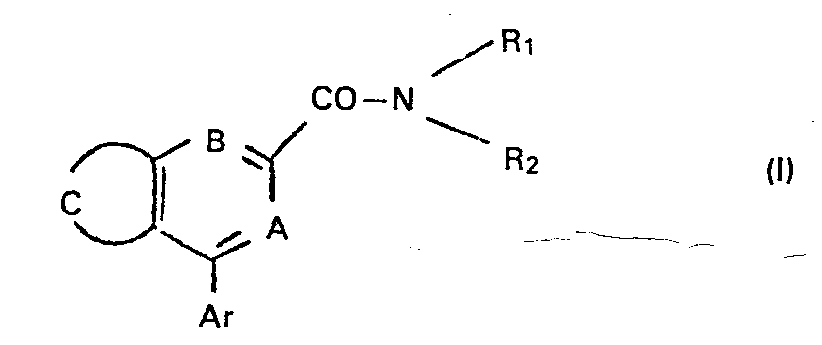
L'invention concerne de nouveaux composés répondant à la formule générale:
Description
La présente invention a pour objet de nouveaux dérivés d'arène et d'hétéroarènecarboxamides utilisables comme médicaments et leur procédé de préparation.The subject of the present invention is new arene derivatives and heteroarenecarboxamides which can be used as medicaments and their preparation process.
Les divers effets cliniques (anxiolytique, anticonvulsivant, hypnotique, myorelaxant) des benzodiazépines ont été attribués à la présence, dans le système nerveux central des mammifères, de sites de liaisons saturables, à haute affinité et stéréospécifiques. (C. BRAESTRUP et Coll. Nature 1977, 269, 702 ; J.F. TALLMAN et Coll. Science, 1980, 207, 274).The various clinical effects (anxiolytic, anticonvulsant, hypnotic, muscle relaxant) of benzodiazepines have been attributed to the presence in the central nervous system of mammals of saturable, high affinity and stereospecific binding sites. (C. BRAESTRUP and Coll. Nature 1977, 269, 702; J.F. TALLMAN and Coll. Science, 1980, 207, 274).
Certaines benzodiazépines se lient aussi à des membranes de tissus périphériques comme le rein avec également une forte affinité (C. BRAESTRUP et Coll. Proc. Natl. Acad. Sci. USA, 1977, 74, 3805). Les deux récepteurs de benzodiazépines présents dans ces tissus différent de ceux marqués par le [3H] diazépam et le [3H] flunitra- zépam dans le cerveau ; par exemple le clonazépam qui a une très forte affinité pour les sites de liaison du [3H] diazépam du cerveau est pratiquement inactif à l'égard des sites de liaison du [3H] diazépam dans le rein. A l'inverse un dérivé chloré du diazépam le Ro-5-4864 est très actif au niveau périphérique mais inactif au niveau central. Ainsi, il est possible de distinguer au moins 2 types de récepteurs de benzodiazépines, l'un de type "cérébral" dont le critère pharmacologique sera un classement par affinité décroissante dans l'ordre suivant : clonazépam > diazépam > Ro-5-4864 et l'autre de type "périphérique" dont le critère pharmacologique sera un classement par affinité décroissante dans l'ordre suivant : Ro-5-4864 > diazépam > clonazépam.Certain benzodiazepines also bind to membranes of peripheral tissues such as the kidney with also a strong affinity (C. BRAESTRUP and Coll. Proc. Natl. Acad. Sci. USA, 1977, 74, 3805). The two benzodiazepine receptors present in these tissues differ from those marked by [ 3 H] diazepam and [ 3 H] flunitrazepam in the brain; for example, clonazepam, which has a very strong affinity for [ 3 H] diazepam binding sites in the brain, is practically inactive with regard to [ 3 H] diazepam binding sites in the kidney. Conversely, a chlorinated derivative of diazepam Ro-5-4864 is very active at the peripheral level but inactive at the central level. Thus, it is possible to distinguish at least 2 types of benzodiazepine receptors, one of the "cerebral" type, the pharmacological criterion of which will be a classification by decreasing affinity in the following order: clonazepam>diazepam> Ro-5-4864 and the other of the "peripheral" type, the pharmacological criterion of which will be a classification by decreasing affinity in the following order: R o -5-4864>diazepam> clonazepam.
Ces récepteurs de type "périphérique" sont présents dans de nombreux organes : le coeur, le rein, le poumon, les plaquettes sanguines et également le cerveau (où sont donc présents les 2 types de récepteurs) L.P. DAVIES et Coll. Eur. J. Pharmacol. 1981, 73, 209 ; J.K.T. WANG et Coll. Life Sciences 1980, 27, 1881 ; J.W. REGAN et Coll. Life Sciences 1981, 28, 991 ; H. SCHOEMAKER, Eur. J. Pharmacol., 1981, 71, 1973). Enfin, il a été montré la présence de ces récepteurs de type "périphérique" dans les thymocytes (J.K.T. WANG et Coll. Pharmacologist, 1981, 23, 160) et que ces récepteurs régulent la prolifération des cellules de thymones (J.K.T. WANG et Coll. Fed. Proc. 1982, 41, 1328).These receptors of the "peripheral" type are present in many organs: the heart, the kidney, the lung, the blood platelets and also the brain (where the 2 types of receptors are therefore present) LP DAVIES et al. Eur. J. Pharmacol. 1981, 73, 209; JKT WANG and Coll. Life Sciences 1980, 27, 1881; JW REGAN et al. Life Sciences 1981, 28, 991; H. SCHOEMAKER, Eur. J. Pharmacol., 1981, 71, 1973). Finally, the presence of these "peripheral" type receptors has been shown in thymocytes (JKT WANG and Coll. Pharmacologist, 1981, 23, 160) and that these receptors regulate the proliferation of thymone cells (JKT WANG and Coll. Fed. Proc. 1982, 41, 1328).
Les composés selon l'invention qui, bien que de structuresdiffé- rentes de celles des benzodiazépines, se lient spécifiquement aux récepteurs des benzodiazépines de type "périphérique".The compounds according to the invention which, although of structures different from those of the benzodiazepines, bind specifically to the receptors of the "peripheral" type benzodiazepines.
Ces composée sont représentés par la formule générale :


En outre R1 et R2 peuvent former avec l'atome d'azote auquel ils sont rattachés un hétérocycle qui peut comporter un second hétéroatome : azote ou oxygène ; c'est-à-dire que

Ar représente un groupe phényle, pyridyle ou thiènyle ou un groupe phényle substitué par un ou deux substituants pris parmi les atomes d'halogène (chlore, fluor, brome), les groupes alkyle, alcoxy et alkylthio ayant 1 à 4 atomes de carbone, le groupe trifluorométhyle et le groupe nitro.Ar represents a phenyl, pyridyl or thienyl group or a phenyl group substituted by one or two substituents chosen from halogen atoms (chlorine, fluorine, bromine), alkyl, alkoxy and alkylthio groups having 1 to 4 carbon atoms, trifluoromethyl group and nitro group.
Les groupes A et B représentent indépendamment N ou CH-Le groupe

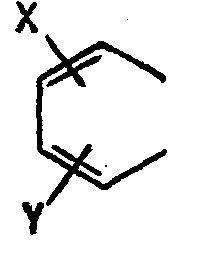
A représente N et B représente CH, l'un des enchaînements suivants :


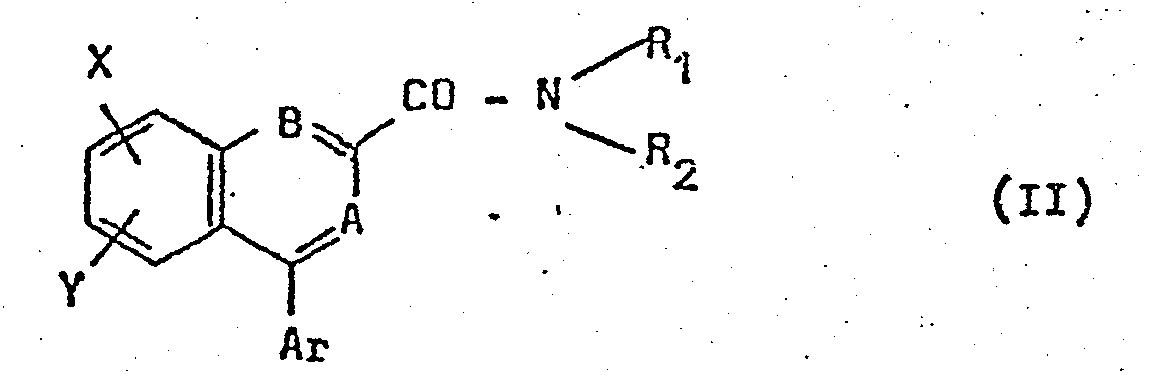
Dans les formules II, III et IV, R1, R2, Ar, A et B ont les significations exposées ci-dessus ; X et Y représentent indépendamment un atome d'hydrogène, d'halogène (fluor, chlore, brome), un groupe alkyle ou alcoxy comportant de 1 à 3 atomes de carbone, le groupe nitro ou trifluorométhyle.In formulas II, III and IV, R 1 , R 2 , Ar, A and B have the meanings set out above; X and Y independently represent a hydrogen or halogen atom (fluorine, chlorine, bromine), an alkyl or alkoxy group containing from 1 to 3 carbon atoms, the nitro or trifluoromethyl group.
Lorsque le groupe

Les produits de formule générale (I) peuvent être préparés à partir des acides de formule (V) et des amines


Les dérivés réactifs de formule (VI) les plus usités sont les esters (W représente un groupe alcoxy de bas poids moléculaire), les chlorures d'acides (W représente l'atome de chlore) et les anhydrides (W représente un groupe alcoxycarbonyloxy de bas poids moléculaire), (cf. C.A. BUEHLER et D.E. PEARSON, Survey of Organic Synthesis. Wiley Interscience, 1970, page 894).The most widely used reactive derivatives of formula (VI) are esters (W represents a low molecular weight alkoxy group), acid chlorides (W represents the chlorine atom) and anhydrides (W represents an alkoxycarbonyloxy group of low molecular weight), (cf. CA BUEHLER and DE PEARSON, Survey of Organic Synthesis. Wiley Interscience, 1970, page 894).
Les esters de formule (VI) peuvent être préparés par chauffage des acides de formule (V) au sein d'un alcool à bas poids moléculaire tel que le méthanol ou l'éthanol, au reflux et en présence d'un acide minéral tel que l'acide sulfurique ou l'acide chlorhydrique. Les esters ainsi obtenus sont ensuite traités par au moins un équivalent d'amine
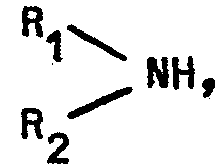
Les chlorures d'acide de formule (VI) peuvent être préparés par action sur les acides correspondants de formule (V) d'un agent de chloruration tel que le chlorure de thionyle en l'absence de solvant ou au sein d'un solvant inerte tel que le chloroforme et au reflux. On traite ensuite le chlorure d'acide brut ainsi obtenu par l'amine

Les anhydrides mixtes de formule (VI) peuvent être préparés en traitant les acides correspondants de formule (V) par un chloroformiate d'alkyle Cl-C00-R1 (R' représentant un groupe alkyle de bas poids moléculaire tel que méthyle ou éthyle), en présence d'une amine tertiaire telle que la triéthylamine ; le produit obtenu est ensuite traité par l'amine


Les acides carboxyliques de formule générale (V), suivant les significations de A, B et C appartiennent à l'une des familles définies par les formules ci-dessous :


De même, les acides carboxyliques de formule (VIII) peuvent être préparés par analogie avec le procédé décrit pour la préparation des produits de formule (VIII) connus (K. TAKAHASHI et Coll. J. Heterocycl. Chem. 1977, 14, 881).Likewise, the carboxylic acids of formula (VIII) can be prepared by analogy with the process described for the preparation of known products of formula (VIII) (K. TAKAHASHI and Coll. J. Heterocycl. Chem. 1977, 14, 881) .
Parmi les composés de formule (IX), quelques uns sont connus, en particulier l'acide phényl-1 isoquinoléinecarboxylique-3. (R. FILLER et Coll. J. Org. Chem. 1962, 27, 2403 ; D.A. WALSH et Coll.J. Med. Chem. 1978, 21, 582). Les procédés décrits dans ces publications peuvent être utilisés de façon analogue pour la préparation des produits de formule (IX), en partant des précurseurs appropriés.Among the compounds of formula (IX), some are known, in particular 1-phenyl-isoquinoline-3-carboxylic acid. (R. FILLER and Coll. J. Org. Chem. 1962, 27, 2403; D.A. WALSH and Coll. J. Med. Chem. 1978, 21, 582). The methods described in these publications can be used in an analogous manner for the preparation of the products of formula (IX), starting from the appropriate precursors.
Les composés de formule (X) et (XI) sont des produits nouveaux. Pour leur préparation il est avantageux d'utiliser un procédé analogue à celui décrit par R. FILLER etColl. (J. Org. Chem. 1962, 27, 2403), selon le schéma réactionnel ci-dessous :


Pour effectuer ces réactions, les oxazolones de départ sont traitées par 3 équivalents de chlorure d'aluminium au sein du tétrachloro-1, 1,2,2 éthane, à une température comprise entre 20°C et la température d'ébullition du solvant.To carry out these reactions, the starting oxazolones are treated with 3 equivalents of aluminum chloride in tetrachloro-1, 1,2,2 ethane, at a temperature between 20 ° C and the boiling point of the solvent.
Quelques composés de formule (XII) sont connus (notamment les produits pour lesquels X représente l'atome d'hydrogène, Y l'atome de chlore en position 6 et Ar le groupe phényle ou chloro-2 phényle) et ont été obtenus à partir de benzodiazépines (STERNBACH et Coll. J. Org. Chem. 1964, 29, 332). Néanmoins, il est plus avantageux de préparer ces composés ainsi que tous les composés de formule (XII) à partir des aroyl-2 anilines de formule (XIII), selon le schéma réactionnel suivant

Les aroyl-2 anilines de formule (XIII) sont traités par au moins un équivalent d'un chlorure d'alcoyloxalyle Cl-CO-COOR' (R' représentant un groupe alkyle de bas poids moléculaire tel que méthyle ou éthyle), au sein de la pyridine, à une température comprise entre 0 et 25°C. Le composé de formule (XIV) ainsi préparé est ensuite traité par un grand excès d'acétate d'ammonium au sein de l'acide acétique au reflux.The aroyl-2 anilines of formula (XIII) are treated with at least one equivalent of an alkylloyalyl chloride Cl-CO-COOR '(R' representing an alkyl group of low molecular weight such as methyl or ethyl), within pyridine, at a temperature between 0 and 25 ° C. The compound of formula (XIV) thus prepared is then treated with a large excess of ammonium acetate within acetic acid at reflux.
Les mélanges réactionnels obtenus par les divers procédésdécrits précédemment sont traités suivant des méthodes classiques, physiques (évaporation, extraction à l'aide d'un solvant, distillation, cristallisation, chromatographie, etc...) ou chimiques le cas échéant (formation de sel et régénération de la base ou de l'acide, etc...) afin d'isoler les composés do formule (I) à l'état pur.The reaction mixtures obtained by the various processes described above are treated according to conventional, physical (evaporation, extraction using a solvent, distillation, crystallization, chromatography, etc.) or chemical methods, as the case may be. appropriate (salt formation and regeneration of the base or the acid, etc.) in order to isolate the compounds of formula (I) in the pure state.
Les exemples suivants illustrent l'invention sans la limiter.The following examples illustrate the invention without limiting it.
On porte 4 heures à 80°C, 4 g d'acide phényl-4 naphtalènecarboxylique-2 dans 16 ml de chlorure de thionyle puis on concentre à sec sous pression réduite. On reprend le résidu dans 20 ml de pyridine puis ajoute 3,8 ml de diéthylamine. On agite 2 heures à la température ambiante, verse le mélange réactionnel dans 200 ml d'eau et extrait l'insoluble par 3 fois 80 ml d'éther. On lave la phase organique par 3 fois 50 ml d'eau, 3 fois 50 ml d'acide chlorhydrique 0,1 N et 1 fois 80 ml d'eau. On la sèche sur du sulfata de magnésium et l'évapore à sec sous pression réduite. Après recristallisation du solide résiduel dans l'éther éthylique on obtient 2 g do N,N-diéthyl phényl-4 naphtalènacarboxamide-2 fondant à 130°C.4 g of 4-phenyl-naphthalenecarboxylic-2 acid in 4 ml of thionyl chloride are brought to 80 ° C. for 4 hours, then concentrated to dryness under reduced pressure. The residue is taken up in 20 ml of pyridine and then 3.8 ml of diethylamine is added. The mixture is stirred for 2 hours at room temperature, the reaction mixture is poured into 200 ml of water and the insoluble material is extracted with 3 times 80 ml of ether. The organic phase is washed with 3 times 50 ml of water, 3 times 50 ml of 0.1 N hydrochloric acid and 1 time 80 ml of water. It is dried over magnesium sulfata and evaporated to dryness under reduced pressure. After recrystallization of the residual solid in ethyl ether, 2 g of N, N-diethyl phenyl-4 naphthalenacarboxamide-2, melting at 130 ° C., are obtained.
L'acide phényl-4 nephtalènecarboxylique-2 peut être obtenu selon R. FILLER et Coll. J. Org. Chem., 1962, 27, 4440.The phenyl-4-nephthalenecarboxylic-2 acid can be obtained according to R. FILLER et al. J. Org. Chem., 1962, 27, 4440.
On opère comme dans l'exemple 1 à partir de 4,3 g d'acide phényl-4 naphtalènacarhoxylique-2, 20 ml de chlorure de thionyle puis 1,5 g do N-méthyl butanamine-2 dans 20 ml de pyridine. On obtiont 3 g de N-méthyl N(méthyl-1 propyl) phényl-4 naphtalènecarboxamide-2 fondant à 108°C.The procedure is as in Example 1 from 4.3 g of 4-phenyl-naphthalenacarhoxylic-2 acid, 20 ml of thionyl chloride and then 1.5 g of N-methyl butanamine-2 in 20 ml of pyridine. 3 g of N-methyl N (1-methyl-propyl) -phenyl-4-naphthalenecarboxamide-2 are obtained, melting at 108 ° C.
On procède comme à l'exemple 1 en partant de 2 g d'acide phényl-4 quinoléinecarboxylique-2 de 6 ml de chlorure de thionyle et de 8,3 ml de diéthylamine. On isole après traitement 2,3 g de N,N-diéthyl phényl-4 quinoléinecarboxamide-2 sous forme d'une huile orangée. Après cristallisation dans un mélange hexane-éther 50/50, le produit présente un point de fusion inférieur à 50°C.The procedure is as in Example 1, starting with 2 g of 4-phenyl-quinolinecarboxylic-2 acid, 6 ml of thionyl chloride and 8.3 ml of diethylamine. 2.3 g of N, N-diethylphenyl-4-quinolinecarboxamide-2 are isolated after treatment in the form of an orange oil. After crystallization from a 50/50 hexane-ether mixture, the product has a melting point below 50 ° C.
L'acide phényl-4 quinoléinecarboxylique-2 peut être préparé selon : TAKAHASHI et MITSUHASHI, J. Het. Chem. (15) p. 881 (1977).Phenyl-4 quinolinecarboxylic acid-2 can be prepared according to: TAKAHASHI and MITSUHASHI, J. Het. Chem. (15) p . 881 (1977).
A 1,1 g de diméthylamine dans 20 ml de tétrahydrofuranne anhydre on ajoute, à -10°C et sous azote, 10,5 ml d'une solution 1,6 M de butyllithium dans l'hexane. Après 45 mn d'agitation, on ajoute 2,2 g de phényl-1 isoquinoléinecarboxylate-3 d'éthyle et on agite 4 h. à la température ambiante. On ajoute 50 ml d'eau et extrait l'insoluble avec 3 fois 100 ml d'acétate d'éthyle. On sèche la phase organique sur du sulfate de magnésium et l'évapore à sec sous pression réduite. On recristallise le résidu dans de l'éther isopropylique, on obtient 1,5 g de N,N-diméthyl phényl-1 isoquinoléinecarboxamide-3 fondant à 157°C.To 1.1 g of dimethylamine in 20 ml of anhydrous tetrahydrofuran is added, at -10 ° C. and under nitrogen, 10.5 ml of a 1.6 M solution of butyllithium in hexane. After 45 min of stirring, 2.2 g of 1-phenyl-isoquinoline-3-ethylcarboxylate are added and the mixture is stirred for 4 h. at room temperature. 50 ml of water are added and the insoluble material is extracted with 3 times 100 ml of ethyl acetate. The organic phase is dried over magnesium sulfate and evaporated to dryness under reduced pressure. The residue is recrystallized from isopropyl ether, 1.5 g of N, N-dimethyl phenyl-1 isoquinolinecarboxamide-3, melting at 157 ° C. , are obtained.
Le phényl-1 isoquinoléinecarboxylate-3 d'éthyle peut être préparé par action de l'éthanol sur l'acide phényl-1 isoquinoléinecarboxylique-3 en présence d'acide sulfurique concentré. Il a un point de fusion de 114-116°C.Ethyl phenyl-1 isoquinoline carboxylate-3 can be prepared by the action of ethanol on phenyl-1 isoquinolinecarboxylic acid-3 in the presence of concentrated sulfuric acid. It has a melting point of 114-116 ° C.
L'acide phényl-1 isoquinoléinecarboxylique-3 peut être préparé selon R. PILLER et Coll. J. Org. Chem., 1962, 27, 2403.Phenyl-1 isoquinoline-carboxylic acid-3 can be prepared according to R. PILLER et al. J. Org. Chem., 1962, 27, 2403.
On opère comme dans l'exemple 4 à partir de 3,9 g de phényl-1 isoquinoléinecarboxylate-3 d'éthyle, de 3,4 g de diéthylamine et de 19 ml d'une solution 1,6 M dans l'hexane de butyllithium. On obtient 1,75 g de N,N-diéthyl phényl-1 isoquinoléinecarboxamide-3 fondant à 72°C.The procedure is as in Example 4, starting with 3.9 g of ethyl phenyl-1 isoquinolinecarboxylate-3, 3.4 g of diethylamine and 19 ml of a 1.6 M solution in hexane of butyllithium. 1.75 g of N, N-diethyl phenyl-1 isoquinolinecarboxamide-3 are obtained, melting at 72 ° C.
On opère comme dans l'exemple 4 à partir de 3,4 g de (chloro-2 phényl)-1 isoquinoléinecarboxylate-3 d'éthyle, de 2,4 g de diéthylamine et de 14 ml d'une solution 1,6 M de butyllithium dans l'hexane. Après chromatographie sur du gel de silice avec un mélange cyclohexane-acétate d'éthyle (1:1) comme éluant et recristallisation dans l'éther isopropylique, on obtient 0,85 g de N,N-diéthyl (chloro-2 phényl)-1 isoquinoléinecarboxamide-3 fondant à 112°C.The procedure is as in Example 4 starting from 3.4 g of (2-chloro-phenyl) -1 isoquinoline-3-ethylcarboxylate, 2.4 g of diethylamine and 14 ml of a 1.6 M solution of butyllithium in hexane. After chromatography on silica gel with a cyclohexane-ethyl acetate mixture (1: 1) as eluent and recrystallization from isopropyl ether, 0.85 g of N, N-diethyl (2-chloro-phenyl) is obtained - 1 isoquinoline carboxamide-3 melting at 112 ° C.
Le (chloro-2 phényl)-1 isoquinoléinecarboxylate-3 d'éthyle peut être préparé par action de l'éthanol sur l'acide (chloro-2 phényl)-1 isoquinoléinecarboxylique-3, en présence d'acide sulfurique concentré. Il a un point de fusion de 126°C.Ethyl (2-chloro-phenyl) -1 isoquinoline carboxylate-3 can be prepared by the action of ethanol on (2-chloro phenyl) -1 isoquinoline carboxylic-3, in the presence of concentrated sulfuric acid. It has a melting point of 126 ° C.
L'acide (chloro-2 phényl)-1 isoquinoléinecarboxylique-3 peut être obtenu par action, à la température ambiante, du chlorure d'aluminium (0,165 mole) sur la (chloro-2 phényl)-2 phénylméthylène-4.4H-oxazolone-5 (0,055 mole) dans 250 ml de tétrachloroéthane. Il a un point de fusion de 195-196°C.(2-Chloro-phenyl) -1 isoquinoline-3-carboxylic acid can be obtained by action, at room temperature, of aluminum chloride (0.165 mole) on (2-chloro-phenyl) -2 phenylmethylene-4.4H-oxazolone -5 (0.055 mole) in 250 ml of tetrachloroethane. It has a melting point of 195-196 ° C.
A 3,74 g d'acide phényl-1 isoquinoléinecarboxylique-3 dans 1.50 ml de chloroforme on ajoute 1,73 g de triéthylamine. On refroidit à 10°C et ajoute 1,86 g de chloroformiate d'éthyle. On agite 40 mn à la température ambiante, introduit une solution de 1,63 g de pipéridine dans 10 ml de toluène et agite 4 h. à la température ambiante. On évapore le milieu réactionnel sous pression réduite, reprend le résidu dans de l'acétate d'éthyle, lave la phase organique avec une solution aqueuse saturée de carbonate de sodium, la sèche sur du sulfate de magnésium et l'évaporé à sec sous pression réduite. On chromatographie le résidu sur du gel de silice avec un mélange cyclohexane- acétate d'éthyle (1:1) comme éluant et recristallise le produit dans de l'éther isopropylique. On obtient 2,4 g de [(phényl-1 isoquinolyl)-3 carbonyl]-1 pipéridine fondant à 179°C.To 3.74 g of 1-phenyl isoquinoline-3-carboxylic acid in 1.50 ml of chloroform is added 1.73 g of triethylamine. Cool to 10 ° C and add 1.86 g of ethyl chloroformate. The mixture is stirred for 40 min at room temperature, a solution of 1.63 g of piperidine in 10 ml of toluene is introduced and the mixture is stirred for 4 h. at room temperature. The reaction medium is evaporated under reduced pressure, the residue is taken up in ethyl acetate, the organic phase is washed with a saturated aqueous solution of sodium carbonate, dried over magnesium sulfate and evaporated to dryness under pressure scaled down. The residue is chromatographed on silica gel with a cyclohexane-ethyl acetate mixture (1: 1) as eluent and the product is recrystallized from isopropyl ether. 2.4 g of [(1-phenyl isoquinolyl) -3 carbonyl] -1 piperidine are obtained, melting at 179 ° C.
On opère comme dans l'exemple 7 à partir de 3,74 g d'acide phényl-1 isoquinoléinecarboxylique-3, de 1,73 g de triéthylamine, de 1,86 g de chloroformiate d'éthyle, et de 1,67 g de morpholine dans 150 ml de chloroforme.The procedure is as in Example 7 from 3.74 g of 1-phenyl-isoquinoline-3-carboxylic acid, 1.73 g of triethylamine, 1.86 g of ethyl chloroformate, and 1.67 g of morpholine in 150 ml of chloroform.
On obtient 3 g de [(phényl-1 isoquinolyl)-3 carbonyl]-4 morpholine fondant à 178°C.3 g of [(1-phenyl isoquinolyl) -3 carbonyl] -4 morpholine are obtained, melting at 178 ° C.
On opère comme dans l'exemple 7 à partir de 3,74 g d'acide phényl-1 isoquinoléinecarboxylique-3, de 1,73 g de triéthylamine, de 1,86 g de chloroformiate d'éthyle et de 1,92 g de N-méthylpipérazine dans 150 ml de chloroforme. On obtient 1,7 g de méthyl-4 [(phényl-1 isoquinolyl)-3 carbonyl]-1 pipérazine fondant à 127 C.The procedure is as in Example 7 from 3.74 g of 1-phenyl-isoquinoline-3-carboxylic acid, 1.73 g of triethylamine, 1.86 g of ethyl chloroformate and 1.92 g of N-methylpiperazine in 150 ml of chloroform. 1.7 g of methyl-4 [(1-phenyl isoquinolyl) -3 carbonyl] -1 piperazine are obtained, melting at 127 C.
On opère comme à l'exemple 7 à partir de 2,96 g d'acide phényl-1 isoquinoléinecaboxylique-3, de 1,33 g de triéthylamine, de 1,49 g de chloroformiate d'éthyle et de 1,34 g de N-méthyl butanamine-2 dans 120 ml de chloroforme. On obtient 2,4 g de N-méthyl N-(méthyl-1 propyl) phényl-1 isoquinoléinecarboxamide-3 fondant à 95-96°C.The procedure is as in Example 7 from 2.96 g of 1-phenyl-isoquinoline-3-carboxylic acid, 1.33 g of triethylamine, 1.49 g of ethyl chloroformate and 1.34 g of N-methyl butanamine-2 in 120 ml of chloroform. 2.4 g of N-methyl N- (1-methyl-propyl) phenyl-1 isoquinolinecarboxamide-3 are obtained, melting at 95-96 ° C.
On opère comme dans l'exemple 7 à partir de 1,7 g d'acide (chloro-3 phényl)-1. isoquinoléinecarboxylique-3, de 0,69 g de triéthylamine, de 0,74 g de chloroformiate d'éthyle et de 0,56 g de diéthylamine dans 60 ml de chloroforme. On obtient 1,45 g de N,N-diéthyl(Chloro-3 phényl)-1 isoquinoléinecarboxamide-3 fondant à 116 C.The procedure is as in Example 7 starting from 1.7 g of acid (3-chloro-phenyl) -1. isoquinoline carboxylic-3, 0.69 g of triethylamine, 0.74 g of ethyl chloroformate and 0.56 g of diethylamine in 60 ml of chloroform. 1.45 g of N, N-diethyl (3-Chloro-phenyl) -1 isoquinolinecarboxamide-3 are obtained, melting at 116 C.
L'acide (chloro-3 phényl)-1 isoquinoléinecarboxylique-3 peut être préparé par action, à la température ambiante, de chlorure d'aluminium (0,369 mole) sur la (chloro-3 phényl)-2 phénylméthylène-4 4H-oxazolone-5 (0,123 mole) dans 500 ml de tétrachloroéthane. Il a un point de fusion de 236 C.(3-chloro-phenyl) -1 isoquinoline-3-carboxylic acid can be prepared by the action, at room temperature, of aluminum chloride (0.369 mole) on (3-chloro-phenyl) -2 4-phenylmethylene 4H-oxazolone -5 (0.123 mole) in 500 ml of tetrachloroethane. It has a melting point of 236 C.
On opère comme dans l'exemple 7 à parti.r de 5 g d'acide (méthyl-4 phényl)-1 isoquinoléinecarboxylique-3, de 2,18 g de triéthylamine, de 2,39 g de chloroformiate d'éthyle et de 1,83 g de diéthylamine dans 190 ml de chloroforme. On obtient 3,25 g de N,N-diéthyl (méthyl-4 phényl)-1 isoquinoléinecarboxamide-3 fondant à 113°C.The procedure is as in Example 7, starting with 5 g of (4-methylphenyl) -isoquinoline-3-carboxylic acid, 2.18 g of triethylamine, 2.39 g of ethyl chloroformate and 1.83 g of diethylamine in 190 ml of chloroform. 3.25 g of N, N-diethyl (4-methylphenyl) -1 isoquinolinecarboxamide-3 are obtained, melting at 113 ° C.
L'acide (méthyl-4 phényl)-1 isoquinoléinecarboxylique-3 peut être obtenu par action, à 60°C, du chlorure d'aluminium (0,138 mole) sur la (méthyl-4 phényl)-2 phénylméthylène-4 4H-oxazolone-5 (0,046 mole) dans 200 ml de tétrachloroéthane. Il a un point de fusion de 204°C.(4-methylphenyl) -1 isoquinoline-3-carboxylic acid can be obtained by action, at 60 ° C, of aluminum chloride (0.138 mole) on (4-methylphenyl) -2 4-phenylmethylene 4H-oxazolone -5 (0.046 mole) in 200 ml of tetrachloroethane. It has a melting point of 204 ° C.
On opère comme dans l'exemple 7 à partir de 1,42 g d'acide (chloro-2 phényl)-1 isoquinoléinecarboxylique-3, de 0,58 g de triéthylamine, de 0,62 g de chloroformiate d'éthyle et de 0,55 g de pipéridine dans 50 ml de chloroforme. On obtient 1,2 g de {[(chloro-2 phényl)-1 isoquinolyl-3] carbonyl}-1 pipéridine fondant à 161°C.The procedure is as in Example 7 from 1.42 g of (2-chloro-phenyl) -1 isoquinoline-carboxylic-3 acid, 0.58 g of triethylamine, 0.62 g of ethyl chloroformate and 0.55 g of piperidine in 50 ml of chloroform. 1.2 g of {[(2-chloro-phenyl) -1 isoquinolyl-3] carbonyl} -1 piperidine, melting at 161 ° C., are obtained.
On opère comme dans l'exemple 7 à partir de 1,42 g d'acide (chloro-2 phényl)-1 isoquinoléinecarboxylique-3, de 0,58 g de triéthylamine, de 0,62 g de chloroformiate d'éthyle et de 0,66 g de N-propyl propylamine dans 50 ml de chloroforme. On obtient 1,40 g de N,N-dipropyl (chloro-2 phényl)-1 isoquinoléinecarboxamide-3 fondant à 101°C.The procedure is as in Example 7 from 1.42 g of (2-chloro-phenyl) -1 isoquinoline-carboxylic-3 acid, 0.58 g of triethylamine, 0.62 g of ethyl chloroformate and 0.66 g of N-propyl propylamine in 50 ml of chloroform. 1.40 g of N, N-dipropyl (2-chloro-phenyl) -1 isoquinolinecarboxamide-3 are obtained, melting at 101 ° C.
On opère comme dans l'exemple 7 à partir de 1,.32 g d'acide (fluoro-3 phényl)-1 isoquinoléinecarboxylique-3, de 0,57 g de triéthylamine, de 0,62 g de chloroformiate d'éthyle et de 0,47 g de diéthylamine dans 50 ml de chloroforme. On obtient 1,86 g de N,N-diéthyl (fluoro-3 phényl)-1 isoquinoléinecarboxamide-3 fondant à 92 C.The procedure is as in Example 7, starting with 1.32 g of (3-fluoro-phenyl) -isoquinoline-3-carboxylic acid, 0.57 g of triethylamine, 0.62 g of ethyl chloroformate and 0.47 g of diethylamine in 50 ml of chloroform. 1.86 g of N, N-diethyl (3-fluoro-phenyl) -1 isoquinolineecarboxamide-3 are obtained, melting at 92 C.
L'acide (fluoro-3 phényl)-l isoquinoléinecarboxylique-3 est obtenu par action, à la température ambiante, du chlorure d'aluminium (0,219 mole) sur la (fluoro-3 phényl)-2 phénylméthylene-4 4H-oxazolone-5 (0,073 mole) dans 120 ml de tétrachloroéthane. Il a un point de fusion de 240°C.(3-fluoro-phenyl) -l isoquinoline-3-carboxylic acid is obtained by the action, at room temperature, of aluminum chloride (0.219 mole) on (3-fluoro phenyl) -2 phenylmethylene-4 4H-oxazolone-5 (0.073 mole) in 120 ml of tetrachloroethane. It has a melting point of 240 ° C.
On opère comme dans l'exemple 7 à partir de 2,3 g d'acide (fluoro-2 phényl)-1 isoquinoléinecarboxylique--3, de 1 g de triéthylamine, de 1,06 g de chloroformiate d'éthyle et de 0,96 g de N-méthyl butanamine-2 dans 85 ml de chloro- forme. On obtient 1,85 g de N-méthyl N-(méthyl-1 propyl) (fluoro-2 phényl )-1 isoquinoléinecarboxamide-3 fondant à 85°C.The procedure is as in Example 7, starting with 2.3 g of (2-fluoro-phenyl) -1 isoquinoline carboxylic acid - 3, 1 g of triethylamine, 1.06 g of ethyl chloroformate and 0 , 96 g of N-methyl-2-butanamine in 85 ml of chloro - form. 1.85 g of N-methyl N- (1-methyl-propyl) (2-fluoro-phenyl) -1 isoquinolinecarboxamide-3 are obtained, melting at 85 ° C.
L'acide (fluoro-2 phényl)-1 isoquinoléinecarboxy- lique-3 est obtenu par action, à la température ambiante, de chlorure d'aluminium (0,3 mole) sur la (fluoro-2 phényl)-2 phénylméthylène-4 4H-oxazolone-5 (0,1 mole) dans 220 ml de tétrachloroéthane. Il a un point de fusion de 238°C.The acid (2-fluorophenyl) -1 isoquinoléinecarboxy - lic-3 is obtained by reacting, at room temperature, aluminum chloride (0.3 mole) of the (2-fluorophenyl) -2-phenylmethylene 4 4H-oxazolone-5 (0.1 mole) in 220 ml of tetrachloroethane. It has a melting point of 238 ° C.
On opère comme dans l'exemple 7 à partir de 2,83 g d'acide (chloro-2 phényl)-1 isoquinoléinecarboxylique-3, de 1,15 g de triéthylamine, de 1,24 g de chloroformiate d'éthyle et de 1,56 g de N-méthyl benzylamine dans 100 ml de chloroforme. On obtient 2,5 g de N-méthyl N-phénylméthyl (chloro-2 phényl)-1 isoquinoléinecarboxamide-3 fondant à 128°C.The procedure is as in Example 7 from 2.83 g of (2-chloro-phenyl) -1 isoquinoline-carboxylic-3 acid, 1.15 g of triethylamine, 1.24 g of ethyl chloroformate and 1.56 g of N-methyl benzylamine in 100 ml of chloroform. 2.5 g of N-methyl N-phenylmethyl (2-chloro-phenyl) -1 isoquinolinecarboxamide-3 are obtained, melting at 128 ° C.
On opère comme dans l'exemple 7 à partir de 2,83 g d'acide (chloro-2 phényl)-1 isoquinoléinecarboxylique-3, de 1,15 g de triéthylamine, de 1,24 g de chloroformiate d'éthyle et de 1,46 g de N-méthyl cyclohexylamine dans 100 ml de chloroforme. On obtient 2,45 g de N-cyclohexyl N-méthyl (chloro-2 phényl)-1 isoquinoléinecarboxamide-3 fondant à 131°C.The procedure is as in Example 7 from 2.83 g of (2-chloro-phenyl) -1 isoquinoline-3-carboxylic acid, 1.15 g of triethylamine, 1.24 g of ethyl chloroformate and 1.46 g of N-methyl cyclohexylamine in 100 ml of chloroform. 2.45 g of N-cyclohexyl N-methyl (2-chloro-phenyl) -1 isoquinolinecarboxamide-3 are obtained, melting at 131 ° C.
On porte à ébullition 3 g d'acide (chloro-2 phényl)-1 méthyl-7 isoquinoléinecarboxylique-3 dans 30 ml de chlorure de thionyle. Après réaction, on évapore le chlorure de thionyle et reprend le résidu dans 30 ml de toluène que l'on évapore de nouveau. On redissout le résidu dans 30 ml de toluène et ajoute une solution de 2.61 g de N-méthyl butanamine-2 dans 10 ml de toluène. Après 4 heures, on évapore le toluène, reprend le résidu dans du chlorure de méthylène, lave la phase organique avec une solution aqueuse de carbonate de sodium, la sèche sur du sulfate de magnésium et l'évapore à sec sous pression réduite. On chromatographie le résidu sur du gel de silice au moyen d'un mélange cyclohexane-acétate d'éthyle (1:1) comme éluant. Après recristallisation dans l'éther, on obtient 1,95 g de N-méthyl N-(méthyl-1 propyl) (chloro-2 phényl)-1 méthyl-7 isoquinoléinecarboxamide-3 fondant à 132°C.3 g of (2-chloro-phenyl) -1-methyl-7 isoquinoline-carboxylic-3-acid in 30 ml of thionyl chloride are brought to the boil. After reaction, the thionyl chloride is evaporated and the residue is taken up in 30 ml of toluene which is again evaporated. The residue is redissolved in 30 ml of toluene and a solution of 2.61 g of N-methyl butanamine-2 in 10 ml of toluene is added. After 4 hours, the toluene is evaporated, the residue is taken up in methylene chloride, the organic phase is washed with an aqueous solution of sodium carbonate, dried over magnesium sulfate and evaporated to dryness under reduced pressure. The residue is chromatographed on silica gel using a cyclohexane-ethyl acetate mixture (1: 1) as eluent. After recrystallization from ether, 1.95 g of N-methyl N- (1-methyl-propyl) (2-chloro-phenyl) -1 methyl-7 isoquinolinecarboxamide-3 are obtained, melting at 132 ° C.
L'acide (chloro-2 phényl)-1 méthyl-7 isoquinoléinecarboxylique-3 est obtenu par action, à la température ambiante, du chlorure d'aluminium (0,219 mole) sur la (chloro-2 phényl)-2 (méthyl-4 phénylméthylène)-4 4H-oxazolone-5 (0,073 mole) dans 160 ml de tétrachloroéthane. Il a un point de fusion de 160°C.(2-Chloro-phenyl) -1 methyl-7 isoquinoline-3-carboxylic acid is obtained by action, at room temperature, of aluminum chloride (0.219 mole) on (2-chloro-phenyl) -2 (methyl-4 phenylmethylene) -4 4H-oxazolone-5 (0.073 mole) in 160 ml of tetrachloroethane. It has a melting point of 160 ° C.
On opère comme à l'exemple 19 à partir de 3 g d'acide (chloro-2 phényl)-1 méthyl-7 isoquinoléinecarboxylique-3, de 30 ml de chlorure de thionyle, de 1,46 g de diéthylamine et de 40 ml de toluène.The procedure is as in Example 19 from 3 g (2-chloro-phenyl) -1 methyl-7 isoquinoline-3-carboxylic acid, 30 ml of thionyl chloride, 1.46 g of diethylamine and 40 ml of toluene.
On obtient 2,08 g de N,N-diéthyl (chloro-2 phényl)-1 méthyl-7 isoquinoléinecarboxamide-3 fondant à 162°C.2.08 g of N, N-diethyl (2-chloro-phenyl) -1-methyl-7 isoquinolinecarboxamide-3 are obtained, melting at 162 ° C.
On opère comme dans l'exemple 7 à partir de 1,68 g d'acide (chloro-2 phényl)-1 isoquinoléinecarboxylique-3, de 0,7 g de triéthylamine, de 0,75 g de chloroformiate d'éthyle et de 0,68 g de N-méthyl butanamine-2 dans 60 ml de chloroforme. On obtient 1,4 g de N-méthyl N-(méthyl-l propyl) (chloro-2 phényl)-1 isoquinoléinecarboxamide-3 fondant à 136°C.The procedure is as in Example 7, starting from 1.68 g of (2-chloro-phenyl) -1 isoquinoline-3-carboxylic acid, 0.7 g of triethylamine, 0.75 g of ethyl chloroformate and 0.68 g of N-methyl butanamine-2 in 60 ml of chloroform. 1.4 g of N-methyl N- (methyl-1 propyl) (2-chloro-phenyl) -1 isoquinolinecarboxamide-3 are obtained, melting at 136 ° C.
On opère comme dans l'exemple 7 à partir de 3,18 g d'acide chloro-7 (chloro-2 phényl)-1 isoquinoléinecarboxylique-3, de 1,16 g de triéthylamine, de 1,25 g de chloroformiate d'éthyle et de 0,95 g de diéthylamine dans 100 ml de chloroforme. On obtient 2,2 g de N,N-diéthyl chloro-7 (chloro-2 phényl)-1 isoquinoléinecarboxamide-3 fondant à 145 C.The procedure is as in Example 7 starting from 3.18 g of chloro-7 (2-chloro-phenyl) -1 isoquinoline-carboxylic acid-3, 1.16 g of triethylamine, 1.25 g of chloroformate ethyl and 0.95 g of diethylamine in 100 ml of chloroform. 2.2 g of N, N-diethyl chloro-7 (2-chloro-phenyl) -1 isoquinolinecarboxamide-3 are obtained, melting at 145 C.
L'acide chloro-7 (chloro-2 phényl)-1 isoquinoléinecarboxylique-3 est obtenu, par action, à 60°C, du chlorure d'aluminium (0,33 mole) sur la (chloro-2 phényl)-2 (chloro-4 phénylméthylène)-4 4H-oxazolone-5 (0,11 mole) dans 460 ml de tétrachloroéthane. Il a un point de fusion de 180-182°c.Chloro-7 (2-chloro-phenyl) -1 isoquinoline-carboxylic acid-3 is obtained, by action, at 60 ° C, aluminum chloride (0.33 mole) on (2-chloro phenyl) -2 ( 4-chloro-phenylmethylene) -4 4H-oxazolone-5 (0.11 mole) in 460 ml of tetrachloroethane. It has a melting point of 180-182 ° c.
On opère comme dans l'exemple 7 à partir de 2,13 g d'acide (chloro-2 phényl)-1 isoquinoléinecarboxylique-3, de 0,88 g de triéthylamine, de 0,95 g de chloroformiate d'éthyle et de 0,95 g de N-méthylpipérazine dans 75 ml de chloroforme. On obtient 1,05 g de {[(chloro-2 phényl)-1 isoquinolyl]-3 carbonyl}-1 méthyl-4 pipérazine fondant à 139°C.The procedure is as in Example 7 from 2.13 g (2-chloro-phenyl) -1 isoquinoline-carboxylic acid-3, 0.88 g of triethylamine, 0.95 g of ethyl chloroformate and 0.95 g of N-methylpiperazine in 75 ml of chloroform. 1.05 g of {[(2-chloro-phenyl) -1 isoquinolyl] -3 carbonyl} -1 methyl-4 piperazine are obtained, melting at 139 ° C.
On opère comme dans l'exemple 7 à partir de 2,83 g d'acide (chloro-2 phényl)-1 isoquinoléinecarboxylique-3, de 1,17 g de triéthylamine, de 1,25 g de chloroformiate d'éthyle et de 1,31 g de diisopropylamine dans 100 ml de chloroforme. On obtient 0,85 g de N,N-di(méthyl-1 éthyl) (chloro-2 phényl)-1 isoquinoléinecarboxamide-3 fondant à 161°C.The procedure is as in Example 7 starting from 2.83 g of (2-chloro-phenyl) -1 isoquinoline-3-carboxylic acid, 1.17 g of triethylamine, 1.25 g of ethyl chloroformate and 1.31 g of diisopropylamine in 100 ml of chloroform. 0.85 g of N, N-di (1-methyl-ethyl) (2-chloro-phenyl) -1 isoquinolinecarboxamide-3 is obtained, melting at 161 ° C.
On opère comme dans l'exemple 7 à partir de 9,2 g d'acide (chloro-2 phényl)-1 isoquinoléinecarboxylique-3, de 3,8 g de triéthylamine, de 4,08 g de chloroformiate d'éthyle et de 3,6 g de N-méthyl methyl-1 propen-2 ylamine dans 325 ml de chloroforme. On obtient 7,9 g de N-méthyl N-(méthyl-1 propen-2 yl) (chloro-2 phényl)-1 isoquinoléinecarboxamide-3 fondant à 108°C.The procedure is as in Example 7 starting from 9.2 g of (2-chloro-phenyl) -1 isoquinoline-3-carboxylic acid, 3.8 g of triethylamine, 4.08 g of ethyl chloroformate and 3.6 g of N-methyl methyl-1 propen-2 ylamine in 325 ml of chloroform. 7.9 g of N-methyl N- (1-methyl-propen-2 yl) (2-chloro-phenyl) -1 isoquinolinecarboxamide-3 are obtained, melting at 108 ° C.
On opère comme dans l'exemple 7 à partir de 3 g d'acide (thiényl-2)-1 isoquinoléinecarboxylique-3, de 1,73 g de triéthylamine, de 1,86 g de chloroformiate d'éthyle et de 1,69 g de N-méthyl butanamine-2 dans 150 ml de chloroforme. On obtient 2,5 g de N-méthyl N-(méthyl-1 propyl) (thiènyl-2)-1 isoquinoléinecarboxamide-3 fondant à 146°C.The procedure is as in Example 7, starting from 3 g of (2-thienyl) -1 isoquinoline-3-carboxylic acid, 1.73 g of triethylamine, 1.86 g of ethyl chloroformate and 1.69 g of N-methyl butanamine-2 in 150 ml of chloroform. 2.5 g of N-methyl N- (1-methyl propyl) (2-thienyl) -1 isoquinoline-carboxamide-3 are obtained, melting at 146 ° C.
L'acide (thiènyl-2)-1 isoquinoléinecarboxylique-3 est obtenu par action, à la température ambiante, du chlorure d'aluminium (0,42 mole) sur la phénylméthylène-4 (thiènyl-2)-2 4H-oxazolone-5 (0,14 mole) dans 300 ml de tétrachloroéthane. Il a un point de fusion de 162°C.Isoquinoline-3-carboxylic acid (thienyl-2) -1 is obtained by the action, at room temperature, of aluminum chloride (0.42 mole) on phenylmethylene-4 (2-thienyl) -2 4H-oxazolone-5 (0.14 mole) in 300 ml of tetrachloroethane. It has a melting point of 162 ° C.
On opère comme dans l'exemple 7 à partir de 2,83 g d'acide (chloro-4 phényl)-1 isoquinoléinecarboxylique-3, de 1,15 g de triéthylamine, de 1,24 g de chloroformiate d'éthyle et de 0,95 g de diéthylamine dans 100 ml de chloroforme. On obtient 1,55 g de N,N-diéthyl (chloro-4 phényl)-1 isoquinoléinecarboxamide-3 fondant à 122°C.The procedure is as in Example 7, starting from 2.83 g of (4-chloro-phenyl) -1 isoquinoline-3-carboxylic acid, 1.15 g of triethylamine, 1.24 g of ethyl chloroformate and 0.95 g of diethylamine in 100 ml of chloroform. 1.55 g of N, N-diethyl (4-chloro-phenyl) -1 isoquinolinecarboxamide-3 are obtained, melting at 122 ° C.
L'acide (chloro-4 phényl)-1 isoquinoléinecarboxylique-3 est obtenu à partir de la (chloro-4 phényl)-1 méthyl-3 isoquinoléine. Au moyen de la N-bromosuccinimide, on forme tout d'abord la (chloro-4 phényl)-1 dibromométhyl-3 isoquinoléine que l'on oxyde ensuite avec du nitrate d'argent tout d'abord en milieu neutre, puis en milieu basique. Cet acide a un point de fusion de 232-234°C. Exemple 28: N,N-DIETHYL DIMETHOXY-6,7 PHENYL-1 ISOQUINOLEINECARBOXAMIDE-3.(4-Chloro-phenyl) -1 isoquinoline-3-carboxylic acid is obtained from (4-chloro-phenyl) -1 3-methyl-isoquinoline. Using N-bromosuccinimide, we first form (4-chloro-phenyl) -1-dibromomethyl-3 isoquinoline which is then oxidized with silver nitrate first in neutral medium, then in medium basic. This acid has a melting point of 232-234 ° C. Example 28: N, N-DIETHYL DIMETHOXY-6,7 PHENYL-1 ISOQUINOLEINECARBOXAMIDE-3.
On opère comme dans l'exemple 4 à partir de 1,26 g de diméthoxy-6,7 phényl-1 isoquinoléinecarboxylate-3 d'éthyle, de 0,81 g de diéthylamine et de 4,6 ml de butyllithium, 1,6 M dans l'hexane, dans 50 ml de tétrahydrofuranne. On obtient 0,95 g de N,N-diéthyl diméthoxy-6,7 phényl-1 isoquinoléinecarboxamide-3 fondant à 134°C.The procedure is as in Example 4 from 1.26 g of dimethyloxy-6,7 phenyl-1 isoquinoline-3-ethylcarboxylate, 0.81 g of diethylamine and 4.6 ml of butyllithium, 1.6 M in hexane, in 50 ml of tetrahydrofuran. Obtained 0.95 g of N, N-diethyl-6,7-dimethoxy-1-phenylisoquinolinecarboxamide-3, melting at 134 ° C.
Le diméthoxy-6,7 phényl-1 isoquinoléinecarboxylate-3 d'éthyle peut être préparé selon T. HOSONO, J. Pharm. Soc. Japan 65, N° 7/8A, 11, (1945).Dimethyloxy-6,7 phenyl-1 isoquinolinecarboxylate-3 ethyl can be prepared according to T. HOSONO, J. Pharm. Soc. Japan 65, N ° 7 / 8A, 11, (1945).
On opère comme dans l'exemple 7 à partir de 3,82 g d'acide phényl-7 thièno [2,3-c] pyridinecarboxylique-5, de 1,74 g de triéthylamine, de 1,87 g de chloroformiate d' éthyle et de 1,7 g de N-méthyl butanamine--2 dans 150 ml de chloroforme. On obtient 3,15 g de N-méthyl N-(méthyl-1 propyl) phényl-7 thièno [2,3-c] pyridinecarboxamide-5 fondant à 117°C.The procedure is as in Example 7 from 3.82 g of 7-phenyl thieno [2,3-c] pyridinecarboxylic-5 acid, 1.74 g of triethylamine, 1.87 g of chloroformate ethyl and 1.7 g of N-methyl butanamine - 2 in 150 ml of chloroform. 3.15 g of N-methyl N- (1-methyl-propyl) phenyl-7 thieno [2,3-c] pyridinecarboxamide-5 are obtained, melting at 117 ° C.
L'acide phényl-7 thièno [2,3-c] pyridinecarboxylique-5 est obtenu par action, à la température ambiante, du chlorure d'aluminium (0,225 mole) sur la phényl-2 [thiènyl-3 méthylène]-4 4H-oxazolone-5 (0,075 mole) dans 150 ml de tétrachloroéthane. Il a un point de fusion de 208°C.Phenyl-7 thieno [2,3-c] pyridinecarboxylic-5 acid is obtained by the action, at room temperature, of aluminum chloride (0.225 mole) on phenyl-2 [thienyl-3 methylene] -4 4H -oxazolone-5 (0.075 mole) in 150 ml of tetrachloroethane. It has a melting point of 208 ° C.
On opère comme dans l'exemple 7 à partir de 3,82 g d'acide phényl-4 thièno [3,2-cJ pyridinecarboxylique-6, de 1,74 g de triéthylamine, de 1,87 g de chloroformiate d'éthyle et de 1,7 g de N-méthyl butanamine-2 dans 150 ml de chloroforme. On obtient 1,9 g de N-méthyl N-(méthyl-1 propyl) phényl-4 thièno [3,2-c] pyridinecarboxamide-6 fondant à 104°C.The procedure is as in Example 7, starting from 3.82 g of 4-phenyl thieno acid [3,2-cJ pyridinecarboxylic-6, 1.74 g of triethylamine, 1.87 g of ethyl chloroformate and 1.7 g of N-methyl butanamine-2 in 150 ml of chloroform. 1.9 g of N-methyl N- (1-methyl-propyl) -phenyl-4-thieno [3,2-c] pyridinecarboxamide-6 are obtained, melting at 104 ° C.
L'acide phényl-4 thièno [3,2-c] pyridinecarboxylique-6 est obtenu par action, à la température ambiante, du chlorure d'aluminium (0,352 mole) sur la phényl-2 [thiènyl-2 méthylène ]-4 4H-oxazolone-5 (0,117 mole) dans 235 ml de tétrachloroéthane. Il a un point de fusion de 165°C.The phenyl-4 thièno [3,2-c] pyridinecarboxylic-6 acid is obtained by the action, at room temperature, of aluminum chloride (0.352 mole) on the phenyl-2 [2-thiènyl-methylene] -4 4H -oxazolone-5 (0.117 mole) in 235 ml of tetrachloroethane. It has a melting point of 165 ° C.
On opère comme dans l'exemple 7 à partir de 2,9 g d'acide (chloro-2 phényl)-4 thièno [3,2-c] pyridinecarboxylique-6, de 1,17 g de triéthylamine, de 1,25 g de chloroformiate d'éthyle et de 0,94 g de diéthylamine dans 100 ml de chloroforme. On obtient 2,1 g de N,N-diéthyl (chloro-2 phényl)-4 thièno [3,2-c] pyridinecarboxamide-6 fondant à 119°C.The procedure is as in Example 7, starting from 2.9 g of (2-chloro-phenyl) -4 thieno [3,2-c] pyridinecarboxylic-6 acid, 1.17 g of triethylamine, 1.25 g of ethyl chloroformate and 0.94 g of diethylamine in 100 ml of chloroform. 2.1 g of N, N-diethyl (2-chloro-phenyl) -4 thieno [3,2-c] pyridinecarboxamide-6 are obtained, melting at 119 ° C.
L'acide (chloro-2 phényl)-4 thièno [3,2-c] pyridinecarboxylique-6 est obtenu par action, à 60 C, du chlorure d'aluminium (0,103 mole) sur la (chloro-2 phényl)-2 [thiènyl-2 méthylène]-4 4H-oxazolone-5 (0,034 mole) dans 145 ml de tétrachloro-1,1,2,2 éthane. Il a un point de fusion de 210°C.(2-Chloro-phenyl) -4 thièno [3,2-c] pyridinecarboxylic-6 acid is obtained by the action, at 60 C, of aluminum chloride (0.103 mole) on (2-chloro phenyl) -2 [2-thienyl methylene] -4 4H-oxazolone-5 (0.034 mole) in 145 ml of tetrachloro-1,1,2,2 ethane. It has a melting point of 210 ° C.
On opère comme dans l'exemple 7 à partir de 2,9 g d'acide (chloro-2 phényl)-7 thièno [2,3-c] pyridinecarboxylique-5, de 1,17 g de triéthylamine, de 1,25 g de chloroformiate d'éthyle et de 0,94 g de diéthylamine dans 100 ml de chloroforme. On obtient 1,4 g de N,N-diéthyl (chloro-2 phényl)-7 thièno [2,3-c] pyridinecarboxamide-5 fondant à 86°C.The procedure is as in Example 7, starting from 2.9 g of (2-chloro-phenyl) -7 thieno [2,3-c] pyridinecarboxylic-5 acid, of 1.17 g of triethylamine, of 1.25 g of ethyl chloroformate and 0.94 g of diethylamine in 100 ml of chloroform. 1.4 g of N, N-diethyl (2-chloro-phenyl) -7 thieno [2,3-c] pyridinecarboxamide-5 are obtained, melting at 86 ° C.
L'acide (chloro-2 phényl)-7 thièno [2,3-c] pyridinecarboxylique-5 est obtenu par action, à 60°C, du chlorure d'aluminium (0,342 mole) sur la (chloro-2 phényl)-2 [thiènyl-3 méthylène]-4 4H-oxazolone-5 (0,114 mole) dans 475 ml de tétrachloro-1,1,2,2 éthane. Il a un point de fusion de 152°C.(2-Chloro-phenyl) -7 thièno [2,3-c] pyridinecarboxylic-5 acid is obtained by the action, at 60 ° C, of aluminum chloride (0.342 mole) on (2-chloro phenyl) 2 [3-thienyl methylene] -4 4H-oxazolone-5 (0.114 mole) in 475 ml of tetrachloro-1,1,2,2 ethane. It has a melting point of 152 ° C.
On opère comme dans l'exemple 19 à partir de 2,5 g d'acide phényl-4 quinazolinecarboxylique-2, de 10 ml de chlorure de thionyle, de 25 ml de toluène et de 25 ml de diéthylamine. On obtient 1,27 g de N,N-diéthyl phényl-4 quinazolinecarboxamide-2 fondant à 101°C.The procedure is as in Example 19, starting with 2.5 g of 4-phenyl quinazolinecarboxylic-2 acid, of 10 ml of thionyl chloride, 25 ml of toluene and 25 ml of diethylamine. 1.27 g of N, N-4-diethylphenyl quinazolinecarboxamide-2 are obtained, melting at 101 ° C.
L'acide phényl-4 quinazolinecarboxylique-2 est obtenu par action, du chlorure de méthyloxalyle sur l'amino-2 benzophénone dans la pyridine. La N(méthyloxalyl) benzoyl-2 aniline ainsi formée étant ensuite traitée par l'acétate d'ammonium dans l'acide acétique à l'ébullition. L'acide a un point de fusion de 167°C.4-phenyl quinazolinecarboxylic-2 acid is obtained by the action of methyloxalyl chloride on 2-amino benzophenone in pyridine. The N (methyloxalyl) benzoyl-2 aniline thus formed is then treated with ammonium acetate in acetic acid at the boil. The acid has a melting point of 167 ° C.
On opère comme dans l'exemple 19 à partir de 2,5 g d'acide phényl-4 quinazolinecarboxylique-2, de 10 ml de chlorure de thionyle, de 25 ml de toluène et de 10 ml de N-méthyl butanamine-2. On obtient 2,2 g de N-méthyl N-(méthyl-1 propyl) phényl-4 quinazolinecarboxamide-2 fondant à 128°C.The operation is carried out as in Example 19 from 2.5 g of 4-phenyl quinazolinecarboxylic-2 acid, 10 ml of thionyl chloride, 25 ml of toluene and 10 ml of N-methyl butanamine-2. 2.2 g of N -methyl N- (1-methylpropyl) -phenyl-4-phenazolinecarboxamide-2 are obtained, melting at 128 ° C.
On porte à ébullition 3,3 g d'acide (fluoro-2 phényl)-4 quinoléinecarboxylique-2 dans 10 ml de chlorure de thionyle.3.3 g of (2-fluoro-phenyl) -4 quinolinecarboxylic-2 acid are brought to the boil in 10 ml of thionyl chloride.
Après réaction, on évapore le chlorure de thionyle et reprend le résidu dans 30 ml de toluène que l'on évapore de nouveau.After reaction, the thionyl chloride is evaporated and the residue is taken up in 30 ml of toluene which is again evaporated.
Le résidu est mis en suspension dans 100 ml de toluène. On ajoute alors 4,8 ml de triéthylamine, puis sous agitation, 1,8 g de chlorhydrate de N-méthyl butanamine-2. On agite 14 heures à température ambiante.The residue is suspended in 100 ml of toluene. Then added 4.8 ml of triethylamine, then with stirring, 1.8 g of N-methyl butanamine-2 hydrochloride. The mixture is stirred for 14 hours at room temperature.
Le milieu réactionnel est repris par 100 ml d'eau. La phase toluènique est décantée: la phase aqueuse est extraite par 3 fois 100 ml d'éther. Les phases organiques sont rassemblées, lavées par 2 fois 50 ml d'eau, séchées sur sulfate de magnésium et concentrées sous pression réduite. Le résidu est chromatographié sur du gel de silice au moyen d'un mélange cyclohexane/acétate d'éthyle 70:30. Après cristallisation de l'huile obtenue dans un mélange éther isopropylique-éther 5:2, on obtient 1,16 g de N-méthyl N-(méthyl-1 propyl) (fluoro-2 phényl)-4 quinoléinecarboxamide-2 fondant à 86°C.The reaction medium is taken up in 100 ml of water. The toluene phase is decanted: the aqueous phase is extracted with 3 times 100 ml of ether. The organic phases are combined, washed with 2 times 50 ml of water, dried over magnesium sulfate and concentrated under reduced pressure. The residue is chromatographed on silica gel using a 70:30 cyclohexane / ethyl acetate mixture. After crystallization of the oil obtained in a 5: 2 isopropyl ether-ether mixture, 1.16 g of N-methyl N- (1-methyl-propyl) (2-fluoro-phenyl) -4 quinoline-2-carboxamide-melting is obtained. ° C.
L'acide (fluoro-2 phényl)-4 quinoléinecarboxylique-2 est obtenu par action de l'acide chlorhydrique concentré (400 ml) sur la tribromométhyl-2 (fluoro-2 phényl)-4 quinoléine pendant 48 heures au reflux. Il présente un point de fusion égal à 210°C.(2-fluoro-phenyl) -4 quinolinecarboxylic-2 acid is obtained by the action of concentrated hydrochloric acid (400 ml) on tribromomethyl-2 (2-fluoro-phenyl) -4 quinoline for 48 hours at reflux. It has a melting point of 210 ° C.
La tribromométhyl-2 (fluoro-2 phényl)-4 quinoléine est obtenue par action du brome (2,7 10-1 mole) en solution dans l'acide acétique (36 ml) sur la (fluoro-2 phényl)-4 méthyl-2 quinoléine (4,6 10-2 mole) en solution dans 55 ml d'acide acétique en présence d'acétate de sodium (1,8 10-1 mole) et d'anhydride acétique (4,9 10-2 mole).Tribromomethyl-2 (2-fluoro-phenyl) -4 quinoline is obtained by the action of bromine (2.7 10 -1 mole) in solution in acetic acid (36 ml) on (2-fluoro-phenyl) -4 methyl -2 quinoline (4.6 10 -2 mole) in solution in 55 ml of acetic acid in the presence of sodium acetate (1.8 10 -1 mole) and acetic anhydride (4.9 10 -2 mole ).
La (fluoro-2 phényl)-4 méthyl-2 quinoléine peut être obtenuepar action de l'acétone (5,6 10-2 mole) sur l'(amino-2 phényl) (fluoro-2 phényl) méthanone (5,6 10-2 mole) dans l'acide acétique (60 ml), en présence d'acide sulfurique (0,6 ml). Elle présente un point de fusion égal à 119 C.(2-Fluoro-phenyl) -4 2-methyl-quinoline can be obtained by the action of acetone (5.6 10 -2 mole) on (2-amino phenyl) (2-fluoro-phenyl) methanone (5.6 10 -2 mole) in acetic acid (60 ml), in the presence of sulfuric acid (0.6 ml). It has a melting point of 119 C.
On opère comme dans l'exemple 35 en partant de 2,1 g d'acide (méthoxy-4 phényl)-4 quinoléinecarboxylique-2, de 6,4 ml de chlorure de thionyle et de 1,4 g de chlorhydrate de N-méthyl butanamine-2.The procedure is as in Example 35, starting with 2.1 g of (4-methoxyphenyl) -4 quinolinecarboxylic-2, 6.4 ml of thionyl chloride and 1.4 g of N- hydrochloride. methyl butanamine-2.
Après chromatographie sur gel de silice au moyen d'un mélange cyclohexane-acétate d'éthyle (60:40) comme éluant et recristallisation dans l'éther isopropylique, on obtient 0,77 g de N-méthyl N-(méthyl-1 propyl) (méthoxy-4 phényl)-4 quinoléinecarboxamide-2 fondant à 114°C.After chromatography on silica gel using a cyclohexane-ethyl acetate mixture (60:40) as eluent and recrystallization from isopropyl ether, 0.77 g of N-methyl N- (1-methyl-propyl) (4-methoxyphenyl) -4 quinolinecarboxamide-2, melting at 114 ° C., is obtained.
L'acide (méthoxy-4 phényl)-4 quinoléinecarboxylique-2 peut être obtenu par une double oxydation de la (méthoxy-4 phényl)-4 méthyl-2 quinoléine (5,6 10-2 mole) tout d'abord en (méthoxy-4 phényl)-4 quinoléinecarboxaldéhyde-2 au moyen du dioxyde de sélénium (5,6 10-2 mole) dans 50 ml d'un mélange dioxanne-eau 9:1, puis en acide (méthoxy-4 phényl)-4 quinoléinecarboxylique-2 par action sur l'aldéhyde brute obtenue précédemment (2,2 10-2 mole) de'l'eau oxygénée à 110 vol. (18 ml) au sein de l'acétone (200 ml).(4-methoxy-phenyl) -4 quinoline-2-carboxylic acid can be obtained by double oxidation of (4-methoxy-phenyl) -4-methyl-2-quinoline (5.6 10 -2 mole) first of all by ( 4-methoxyphenyl) -4 quinolinecarboxaldehyde-2 using selenium dioxide (5.6 10 -2 mole) in 50 ml of a dioxane-water mixture 9: 1, then in acid (4-methoxy phenyl) -4 quinolinecarboxylic-2 by action on the crude aldehyde obtained previously (2.2 10 -2 mole) of hydrogen peroxide at 110 vol. (18 ml) within acetone (200 ml).
L'acide (méthoxy-4 phényl)-4 quinoléinecarboxylique-2 présente un point dé fusion égal à 213°C; on observe néanmoins une première fusion puis ressolidification à partir de 130°C.(4-methoxyphenyl) -4 quinolinecarboxylic-2 acid has a melting point of 213 ° C; however, a first melting is observed then re-solidification from 130 ° C.
La (méthoxy-4 phényl)-4 méthyl-2 quinoléine peut être préparée par action de l'acétone (1,48 10-1 mole) sur l'(amino-2 phényl) (méthoxy-4 phényl) méthanone (7,4 10-2 mole) dans l'acide acétique (85 ml), en présence d'acide sulfurique (0,85 ml). Elle a un point de fusion de 101°C. L'(amino-2 phényl) (méthoxy-4 phényl) méthanone peut être préparée selon ULLMANN et BLEIER BER, 35, 4278, (1902).(4-methoxyphenyl) -4 2-methyl-quinoline can be prepared by the action of acetone (1.48 10 -1 mole) on (2-amino phenyl) (4-methoxyphenyl) methanone (7, 4 10 -2 mole) in acetic acid (85 ml), in the presence of sulfuric acid (0.85 ml). It has a melting point of 101 ° C. (2-Aminophenyl) (4-methoxyphenyl) methanone can be prepared according to ULLMANN and BLEIER BER, 35, 4278, (1902).
On procède comme à l'exemple 1, en partant de 21 g d'acide (méthoxy-4 phényl)-4 quinoléinecarboxylique-2, de 64 ml de chlorure de thionyle et de 39 ml de diéthylamine. On isole après traitement 2,2 g de N,N-diéthyl (méthoxy-4 phényl)-4 quinoléinecarboxamide-2.The procedure is as in Example 1, starting with 21 g of (4-methoxyphenyl) -4 quinolinecarboxylic-2, 64 ml of thionyl chloride and 39 ml of diethylamine. 2.2 g of N, N-diethyl (4-methoxyphenyl) -4 quinolinecarboxamide-2 are isolated after treatment.
Après recristallisation dans l'éther isopropylique, le produit présente un point de fusion égal à 91 C.After recrystallization from isopropyl ether, the product has a melting point of 91 C.
On procède comme à l'exemple 1 en partant de 57 g d'acide (nitro-3 phényl)-4 quinoléinecarboxylique-2, de 28,5 ml de chlorure de thionyle et de 9,9 ml de diéthylamine dans 50 ml de toluène.The procedure is as in Example 1, starting with 57 g of (3-nitro-phenyl) -4 quinolinecarboxylic-2 acid, 28.5 ml of thionyl chloride and 9.9 ml of diethylamine in 50 ml of toluene. .
Après une première chromatographie sur gel de silice au moyen d'un mélange chloroforme-éther (90:10) comme éluant, puis une seconde chromatographie sur le même support, mais.en utilisant un mélange cyclohexane-diéthylamine (90:10), on obtient 1 g de N,N-diéthyl (nitro-3 phényl)-4 quinoléinecarboxamide-2 sous forme d'une laque brune.After a first chromatography on silica gel using a chloroform-ether mixture (90:10) as eluent, then a second chromatography on the same support, but using a cyclohexane-diethylamine mixture (90:10), obtains 1 g of N, N-diethyl (3-nitro-phenyl) -4 quinolinecarboxamide-2 in the form of a brown lacquer.
Spectre R.M.N. du produit obtenu:
- protons des noyaux aromatiques: S = 7,3 à 8,4 ppm


- protons of aromatic nuclei: S = 7.3 to 8.4 ppm
L'acide (nitro-3 phényl)-4 quinoléinecarboxylique-2 peut être préparé par analogie avec l'acide (méthoxy-4 phényl)-4 quinoleinecarboxylique-2 décrit à l'exemple 36 mais en partant de méthyl-2 (nitro-3 phényl)-4 quinoléine (2,46 10-2 mole), de 2,73 g de dioxyde de sélénium et de 20,9 ml d'eau oxygénée à 110 vol.The (3-nitro-phenyl) -4 quinolinecarboxylic-2 acid can be prepared by analogy with the (4-methoxyphenyl) -4 quinoleinecarboxylic-2 acid described in Example 36 but starting with 2-methyl (nitro- 3 phenyl) -4 quinoline (2.46 10 -2 mole), 2.73 g of selenium dioxide and 20.9 ml of hydrogen peroxide at 110 vol.
La méthyl-2 (nitro-3 phényl)-4 quinoléine est préparée par nitration à 0° de la méthyl-2 phényl-4 quinoléine (1,36 10-1 mole) au moyen d'un mélange sulfonitrique composé de 90 ml d'acide nitrique à 60% et de 90 ml d'acide sulfurique concentré, puis séparation des isomères obtenues. Elle fond à 157°C.Methyl-2 (3-nitro-phenyl) -4 quinoline is prepared by nitration at 0 ° of methyl-2-phenyl-quinoline (1.36 10 -1 mole) using a sulfonitric mixture composed of 90 ml d '60% nitric acid and 90 ml of concentrated sulfuric acid, then separation of the isomers obtained. It melts at 157 ° C.
La méthyl-2 phényl-4 quinoléine peut être préparée selon GEIGY et KOENIGS BER, 18, 2406,(1885).2-methylphenyl-4-quinoline can be prepared according to GEIGY and KOENIGS B E R, 18, 2406, (1885).
On opère comme dans l'exemple 7 à partir de 2,5 g d'acide phényl-1 isoquinoléinecarboxylique-3, de 1,15 g de triéthylamine, de 1,24 g de chloroformiate d'éthyle et de 1,66 g de dibutylamine dans 100 ml de toluène. Après chromatographie et recristallisation dans l'éther de pétrole, on obtient 1,5 g de N,N-dibutyl phényl-1 isoquinoléinecarboxamide-3 fondant à 62°C.The procedure is as in Example 7, starting with 2.5 g of 1-phenyl-isoquinoline-3-carboxylic acid, 1.15 g of triethylamine, 1.24 g of ethyl chloroformate and 1.66 g of dibutylamine in 100 ml of toluene. After chromatography and recrystallization from petroleum ether, 1.5 g of N, N-dibutyl phenyl-1 isoquinolinecarboxamide-3, melting at 62 ° C., are obtained.
On opère comme dans l'exemple 7 à partir de 2,5 g d'acide phényl-1 isoquinoléinecarboxylique-3, de 1,15 g de triéthylamine, de 1,24 g de chloroformiate d'éthyle et de 1,46 g d'éthyl-2 pipéridine dans 100 ml de toluène. Après recristallisation dans l'éther de pétrole, on obtient 2,2 g d'éthyl-2 [(phényl-1 isoquinolyl-3) carbonyl]-1 pipéridine fondant à 86°C.The procedure is as in Example 7 starting with 2.5 g of 1-phenyl-isoquinoline-3-carboxylic acid, 1.15 g of triethylamine, 1.24 g of ethyl chloroformate and 1.46 g of 2-ethyl piperidine in 100 ml of toluene. After recrystallization from petroleum ether, 2.2 g of ethyl-2 [(phenyl-1 isoquinolyl-3) carbonyl] -1 piperidine, melting at 86 ° C., are obtained.
On opère comme à l'exemple 7 à partir de 2,5 g d'acide phényl-1 isoquinoléinecarboxylique-3, de 2,86 g de triéthylamine, de 1,24 g de chloroformiate d'éthyle et de 1,93 g de chlorhydrate d'éthyl-2 (R) pipéridine dans 100 ml de toluène. On obtient, après chromatographie, 2 g d'éthyl-2 (R) [(phényl-1 isoquinolyl-3) carbonyl]-1 pipéridine sous for- me d'huile 
On opère comme dans l'exemple 7 à partir de 2,5 g d'acide phényl-1 isoquinoléinecarboxylique-3, de 1,15 g de triéthylamine, de 1,24 g de. chloroformiate d'éthyle et de 1,2 g d'éthyl-2 (S) pipéridine dans 100 ml de toluène. On obtient, après chromatographie, 3 g d'éthyl-2 (S) [(phényl-1 isoquinolyl-3) carbonyl]-1 pipéridine sous forme d'huile.
On opère comme dans l'exemple 7 à partir de 1,55 g d'acide (trifluorométhyl-3 phényl)-1 isoquinoléinecarboxylique-3, de 0,57 g de triéthylamine, de 0,62 g de chloroformiate d'éthyle et de 0,48 g de diéthylamine dans 50 ml de toluène. On obtient, après recristallisation dans l'éther de pétrole, 0,95 g de N,N-diéthyl (trifluorométhyl-3 phényl)-1 isoquinoléinecarboxamide-3 fondant à 76°C.The procedure is as in Example 7, starting from 1.55 g of (3-trifluoromethyl-phenyl) -1 isoquinoline-carboxylic-3 acid, 0.57 g of triethylamine, 0.62 g of ethyl chloroformate and 0.48 g of diethylamine in 50 ml of toluene. After recrystallization from petroleum ether, 0.95 g of N, N-diethyl (3-trifluoromethyl-phenyl) -1 isoquinolinecarboxamide-3 are obtained, melting at 76 ° C.
L'acide (trifluorométhyl-3 phényl)-1 isoquinoléinecarboxylique-3 peut être obtenu à partir de la méthyl-3 (trifluorométhyl-3 phényl)-1 isoquinoléine. Au moyen de la N-bromosuccinimide, on forme la dibromométhyl-3 (trifluorométhyl-3 phényl)-1 isoquinoléine que l'on traite par du nitrate d'argent d'abord en milieu neutre, puis en milieu alcalin. Cet acide a un point de fusion de 170 C.(3-trifluoromethyl-phenyl) -1 isoquinoline-3-carboxylic acid can be obtained from methyl-3 (3-trifluoromethyl-phenyl) -1 isoquinoline. Using N-bromosuccinimide, dibromomethyl-3 (3-trifluoromethyl-phenyl) -1 isoquinoline is formed, which is treated with silver nitrate first in a neutral medium, then in an alkaline medium. This acid has a melting point of 170 C.
On opère comme dans l'exemple 7 à partir de 1,7 g d'acide (chloro-2 phényl)-1 isoquinoléinecarboxylique-3, de 2,1 g de triéthylamine, de 0,75 g de chloroformiate d'éthyle et de 0,96 g de chlorhydrate de N-méthyl butanamine-2 (S) dans 60 ml de toluène. Après chromatographie et recristallisation dans le cyclohexane, on obtient 0,5 g de N-méthyl N-(méthyl-1 (S) propyl) (chloro-2 phényl)-1 isoquinoléinecarboxamide-3 fondant à 134°C. 
On opère comme dans l'exemple 7 à partir de 1,7 g d'acide (chloro-2 phényl)-1 isoquinoléinecarboxylique-3, de 0,75 g de chloroformiate d'éthyle de 2,1 g de triéthylamine et de 0,96 g de chlorhydrate de N-méthylbutanamine-2 (R) dans 60 ml de toluène. Après chromatographie et recristallisation dans le cyclohexane, on obtient 0,6 g de N-méthyl N-(méthyl-1 (R) propyl) (chloro-2 phényl)-1 isoquinoléine- . carboxamide-3 fondant à 134°C. 
On opère comme dans l'exemple 7 à partir de 3,5 g d'acide (chloro-2 phényl)-7 thièno [2,3-c] pyridinecarboxylique-5 de 5,85 ml de triéthylamine, de 1,33 ml de chloroformiate d'éthyle et de 1,94 g de chlorhydrate de N-méthyl butanamine-2 dans 60 ml de chloroforme. On obtient après recristallisation dans l'éther de pétrole, 0,6 g de N-méthyl N-(méthyl-1 propyl) (chloro-2 phényl)-7 thièno [2,3-c] pyridinecarboxamide-5 fondant à 97 C.The procedure is as in Example 7 from 3.5 g of (2-chloro-phenyl) -7 thieno [2,3-c] pyridinecarboxylic-5 acid of 5.85 ml of triethylamine, of 1.33 ml ethyl chloroformate and 1.94 g of N-methyl butanamine-2 hydrochloride in 60 ml of chloroform. After recrystallization from petroleum ether, 0.6 g of N-methyl is obtained N- (1-methylpropyl) (2-chloro-phenyl) -7 thièno [2,3-c] pyridinecarboxamide-5 melting at 97 C.
On opère comme dans l'exemple 7 à partir de 10 g d'acide (chloro-2 phényl)-4 thièno [3,2-c] pyridinecarboxylique-6, de 11,9 ml de triéthylamine, de 4 ml de chloroformiate d'éthyle et de 4,8 ml de N-méthyl butanamine-2 dans 200 ml de chloroforme.The procedure is as in Example 7, starting with 10 g of (2-chloro-phenyl) -4 thieno [3,2-c] pyridinecarboxylic-6 acid, 11.9 ml of triethylamine, 4 ml of chloroformate d ethyl and 4.8 ml of N-methyl butanamine-2 in 200 ml of chloroform.
On obtient, après chromatographie et cristallisation dans l'éther de pétrole, 1 g de N-méthyl N-(méthyl-l propyl) (chloro-2 phényl)-4 thièno [3,2-c] pyridinecarboxamide-6 fondant à 82°C.1 g of N-methyl N- (methyl-1 propyl) (2-chloro-phenyl) -4 thieno [3,2-c] pyridinecarboxamide-6, melting at 82, is obtained after chromatography and crystallization from petroleum ether ° C.
Affinité pour les sites récepteurs "périphériques" des benzodiazépines.Affinity for "peripheral" benzodiazepine receptor sites.
Cette affinité est mesurée par l'aptitude des produits à déplacer le diazépam tritié (3H-diazépam) de son site de liaison et est exprimée par une valeur Ki, en nano- moles (nM) qui est calculée par la formule:
Les produits ont été étudiés selon le protocole de C. BRAESTRUP et Coll., Proc. Natl, Acad. Sci. USA, 1977, 74, 3805, sur des membranes de rein de rat.The products were studied according to the protocol of C. BRAESTRUP et al., Proc. Natl, Acad. Sci. USA, 1977, 74, 3805, on rat kidney membranes.
A titre d'exemple, on a obtenu les résultats suivants:As an example, the following results were obtained:

Les toxicités aiguës des composés selon l'invention ont été déterminées chez la souris mâle CD1 (Charles RIVER) par voie orale, Les DL50 ont été calculées, après 3 jours d'observation, par la méthode cumulative de J.J. REED et H. MUENCH (Amer. J. Hyg. 1938, 27 , 493).The acute toxicities of the compounds according to the invention were determined in the male CD1 mouse (Charles RIVER) by the oral route, the LD 50s were calculated, after 3 days of observation, by the cumulative method of JJ REED and H. MUENCH (Amer. J. Hyg. 1938, 27, 493).
Les composés se comportent comme des substances relativement peu toxiques chez la souris, puisque les DL50 des composés se situent entre 200 et 1,000 mg/kg.The compounds behave as relatively non-toxic substances in mice, since the LD 50 of the compounds are between 200 and 1,000 mg / kg.
Les composés de l'invention peuvent être utilisés en thérapeutique humaine, sous forme de comprimés, capsules, gélules, suppositoires, solutions ingérables ou injectables, etc....pour le traitement des troubles pulmonaires, rénaux, cardiovasculaires et circulatoires, pour le traitement des états pathologiques associés à des désordres immunitaires, pour le traitement des états d'aggressivité, ainsi que dans les diverses indications des benzodiazépines, (par exemple hypnotiques, anticonvulsivants et anxiolytiques).The compounds of the invention can be used in human therapy, in the form of tablets, capsules, capsules, suppositories, ingestible or injectable solutions, etc. for the treatment of pulmonary, renal, cardiovascular and circulatory disorders, for the treatment pathological conditions associated with immune disorders, for the treatment of aggressive conditions, as well as in the various indications for benzodiazepines (for example hypnotics, anticonvulsants and anxiolytics).
La posologie dépend des effets recherchés et de la voie d'administration utilisée. Par exemple, par voie orale, elle peut être comprise entre 20 et 1,000 mg de substance active par jour, avec des doses unitaires allant de 5 à 200 mg.The dosage depends on the desired effects and the route of administration used. For example, orally, it can be between 20 and 1,000 mg of active substance per day, with unit doses ranging from 5 to 200 mg.
Claims (8)




Applications Claiming Priority (2)
| Application Number | Priority Date | Filing Date | Title |
|---|---|---|---|
| FR8207217A FR2525595A1 (en) | 1982-04-27 | 1982-04-27 | NOVEL ARENE AND HETEROARENECARBOXAMIDE DERIVATIVES AND THEIR USE AS MEDICAMENTS |
| FR8207217 | 1982-04-27 |
Publications (3)
| Publication Number | Publication Date |
|---|---|
| EP0094271A2 true EP0094271A2 (en) | 1983-11-16 |
| EP0094271A3 EP0094271A3 (en) | 1984-07-04 |
| EP0094271B1 EP0094271B1 (en) | 1986-08-06 |
Family
ID=9273433
Family Applications (1)
| Application Number | Title | Priority Date | Filing Date |
|---|---|---|---|
| EP83400749A Expired EP0094271B1 (en) | 1982-04-27 | 1983-04-15 | Arene and heteroarene carboxamide derivatives, process for their preparation and medicaments containing them |
Country Status (16)
| Country | Link |
|---|---|
| US (1) | US4499094A (en) |
| EP (1) | EP0094271B1 (en) |
| JP (1) | JPS58201756A (en) |
| AU (1) | AU555417B2 (en) |
| CA (1) | CA1207324A (en) |
| DE (1) | DE3365086D1 (en) |
| DK (1) | DK184783A (en) |
| ES (1) | ES521864A0 (en) |
| FR (1) | FR2525595A1 (en) |
| GR (1) | GR77909B (en) |
| HU (1) | HU189271B (en) |
| IL (1) | IL68326A0 (en) |
| MA (1) | MA19777A1 (en) |
| NO (1) | NO831466L (en) |
| PT (1) | PT76528B (en) |
| ZA (1) | ZA832925B (en) |
Cited By (5)
| Publication number | Priority date | Publication date | Assignee | Title |
|---|---|---|---|---|
| FR2599033A1 (en) * | 1986-05-21 | 1987-11-27 | Egyt Gyogyszervegyeszeti Gyar | 3- (HYDROXYMETHYL) -ISOQUINOLINE DERIVATIVES, PROCESS FOR PREPARING THEM AND PHARMACEUTICAL COMPOSITIONS CONTAINING SAME |
| EP0285671A4 (en) * | 1986-10-13 | 1989-06-14 | Asahi Chemical Ind | Pyridine derivatives |
| EP0505058A1 (en) * | 1991-03-12 | 1992-09-23 | Kyowa Hakko Kogyo Co., Ltd. | Thienopyridine derivatives and pharmaceutical compositions containing them |
| WO1999058117A1 (en) * | 1998-05-13 | 1999-11-18 | Sanofi-Synthelabo | Use of compounds for reducing apoptosis |
| FR2778564A1 (en) * | 1998-05-13 | 1999-11-19 | Sanofi Sa | Inhibition of apoptosis using a benzodiazepine peripheral receptor ligand |
Families Citing this family (18)
| Publication number | Priority date | Publication date | Assignee | Title |
|---|---|---|---|---|
| FR2538388B1 (en) * | 1982-12-24 | 1985-06-21 | Pharmuka Lab | NOVEL NAPHTHALENE- OR AZANAPHTHALENECARBOXAMIDE DERIVATIVES, PROCESSES FOR THEIR PREPARATION AND THEIR USE AS MEDICAMENTS |
| US4649146A (en) * | 1983-01-31 | 1987-03-10 | Fujisawa Pharmaceutical Co., Ltd. | Thiazole derivatives and pharmaceutical composition comprising the same |
| FR2582514B1 (en) * | 1985-05-30 | 1988-02-19 | Rhone Poulenc Sante | AMIDE DRUGS, NEW AMIDES AND THEIR PREPARATION |
| DE3919348A1 (en) * | 1988-06-16 | 1989-12-21 | Ciba Geigy Ag | MICROBICIDAL AGENTS |
| US5550124A (en) * | 1991-12-10 | 1996-08-27 | University Of Southern California | Use of peripheral-type benzodiazpine sites for treatment of CNS trauma or disease |
| IL117659A (en) * | 1995-04-13 | 2000-12-06 | Dainippon Pharmaceutical Co | Substituted 2-phenyl pyrimidino amino acetamide derivative process for preparing the same and a pharmaceutical composition containing same |
| KR20000048847A (en) | 1996-10-01 | 2000-07-25 | 스즈키 다다시 | Mitochondrial membrane stabilizer |
| EP0975621A1 (en) * | 1997-04-25 | 2000-02-02 | Takeda Chemical Industries, Ltd. | Cell differentiation inducing amide derivatives, their production and use |
| US5998624A (en) * | 1997-05-07 | 1999-12-07 | Emory University | Haloisoquinoline carboxamide |
| ZA9810490B (en) | 1997-12-03 | 1999-05-20 | Dainippon Pharmaceutical Co | 2-Aryl-8-oxodihydropurine derivative process for the preparation thereof pharmaceutical composition containing the same and intermediate therefor |
| EP1140106B1 (en) * | 1998-12-18 | 2005-08-03 | Scios Inc. | Treatment of diseases involving cyst formation |
| GB0516723D0 (en) * | 2005-08-15 | 2005-09-21 | Novartis Ag | Organic compounds |
| EP2589597B1 (en) * | 2006-08-22 | 2019-03-06 | Technion Research & Development Foundation | Heterocyclic derivatives binding to the peripheral-type benzodiazepine receptor (PBR) |
| WO2008063625A2 (en) * | 2006-11-20 | 2008-05-29 | Adolor Corporation | Pyridine compounds and methods of their use |
| JP5441060B2 (en) * | 2007-10-31 | 2014-03-12 | 独立行政法人理化学研究所 | Kit for producing a molecular probe for PET screening for drug discovery |
| GB0907284D0 (en) | 2009-04-28 | 2009-06-10 | Queen Mary & Westfield College | Compounds for inducing cellular apoptosis |
| WO2014164678A1 (en) * | 2013-03-12 | 2014-10-09 | The United States Of America, As Represented By The Secretary, Department Of Health And Human Services | Translocator protein imaging agents; methods of manufacture, and methods of use thereof |
| CN106458933B (en) | 2014-04-23 | 2021-03-05 | 泰克年研究发展基金会公司 | Quinazoline scaffold-based compounds, pharmaceutical compositions thereof, and methods of use |
Family Cites Families (4)
| Publication number | Priority date | Publication date | Assignee | Title |
|---|---|---|---|---|
| US1069296A (en) * | 1912-07-31 | 1913-08-05 | Hoechst Ag | Derivatives of phenylcinchoninic acid. |
| BE764299A (en) * | 1971-03-12 | 1971-08-16 | Malesci Sas | Antifibrillatory ethylenediamines or imida- - zolines |
| FR2417512A1 (en) * | 1978-02-17 | 1979-09-14 | Parcor | THIENO (3,2-C) AND THIENO (2,3-C) PYRIDINES, THEIR PREPARATION PROCESS AND THEIR APPLICATION IN THERAPEUTICS |
| FR2485014A1 (en) * | 1980-06-20 | 1981-12-24 | Pharmindustrie | NOVEL DERIVATIVES OF (QUINOLYL-2, -3 OR -4) -1 (PIPERIDYL OR PYRROLIDINYL-2 OR -3) -2 OR -3 ETHANONE OR PROPANONE, PROCESSES FOR THEIR PREPARATION, AND THEIR USE AS MEDICAMENTS |
-
1982
- 1982-04-27 FR FR8207217A patent/FR2525595A1/en active Granted
-
1983
- 1983-03-30 GR GR70936A patent/GR77909B/el unknown
- 1983-04-05 US US06/482,082 patent/US4499094A/en not_active Expired - Fee Related
- 1983-04-07 IL IL68326A patent/IL68326A0/en unknown
- 1983-04-08 PT PT76528A patent/PT76528B/en unknown
- 1983-04-14 CA CA000425918A patent/CA1207324A/en not_active Expired
- 1983-04-15 DE DE8383400749T patent/DE3365086D1/en not_active Expired
- 1983-04-15 EP EP83400749A patent/EP0094271B1/en not_active Expired
- 1983-04-25 MA MA19997A patent/MA19777A1/en unknown
- 1983-04-26 HU HU831431A patent/HU189271B/en unknown
- 1983-04-26 DK DK184783A patent/DK184783A/en not_active Application Discontinuation
- 1983-04-26 ZA ZA832925A patent/ZA832925B/en unknown
- 1983-04-26 NO NO831466A patent/NO831466L/en unknown
- 1983-04-26 JP JP58073653A patent/JPS58201756A/en active Granted
- 1983-04-26 ES ES521864A patent/ES521864A0/en active Granted
- 1983-04-27 AU AU14002/83A patent/AU555417B2/en not_active Ceased
Cited By (8)
| Publication number | Priority date | Publication date | Assignee | Title |
|---|---|---|---|---|
| FR2599033A1 (en) * | 1986-05-21 | 1987-11-27 | Egyt Gyogyszervegyeszeti Gyar | 3- (HYDROXYMETHYL) -ISOQUINOLINE DERIVATIVES, PROCESS FOR PREPARING THEM AND PHARMACEUTICAL COMPOSITIONS CONTAINING SAME |
| BE1000719A4 (en) * | 1986-05-21 | 1989-03-21 | Egyt Gyogyszervegyeszeti Gyar | DERIVATIVES OF 3- (HYDROXYMETHYL) -ISOQUINOLEINE, PROCESS FOR THEIR PREPARATION AND PHARMACEUTICAL COMPOSITIONS CONTAINING THEM. |
| EP0285671A4 (en) * | 1986-10-13 | 1989-06-14 | Asahi Chemical Ind | Pyridine derivatives |
| US5126448A (en) * | 1986-10-13 | 1992-06-30 | Asahi Kasei Kogyo K.K. | Pyridine derivatives |
| EP0505058A1 (en) * | 1991-03-12 | 1992-09-23 | Kyowa Hakko Kogyo Co., Ltd. | Thienopyridine derivatives and pharmaceutical compositions containing them |
| US5219864A (en) * | 1991-03-12 | 1993-06-15 | Kyowa Hakko Kogyo Co., Ltd. | Thienopyridine derivatives |
| WO1999058117A1 (en) * | 1998-05-13 | 1999-11-18 | Sanofi-Synthelabo | Use of compounds for reducing apoptosis |
| FR2778564A1 (en) * | 1998-05-13 | 1999-11-19 | Sanofi Sa | Inhibition of apoptosis using a benzodiazepine peripheral receptor ligand |
Also Published As
| Publication number | Publication date |
|---|---|
| DK184783A (en) | 1983-10-28 |
| IL68326A0 (en) | 1983-07-31 |
| ZA832925B (en) | 1984-01-25 |
| PT76528B (en) | 1985-12-09 |
| FR2525595A1 (en) | 1983-10-28 |
| CA1207324A (en) | 1986-07-08 |
| DK184783D0 (en) | 1983-04-26 |
| JPS58201756A (en) | 1983-11-24 |
| MA19777A1 (en) | 1983-12-31 |
| EP0094271A3 (en) | 1984-07-04 |
| EP0094271B1 (en) | 1986-08-06 |
| HU189271B (en) | 1986-06-30 |
| JPH0324467B2 (en) | 1991-04-03 |
| ES8406419A1 (en) | 1984-08-01 |
| NO831466L (en) | 1983-10-28 |
| US4499094A (en) | 1985-02-12 |
| FR2525595B1 (en) | 1985-03-22 |
| PT76528A (en) | 1983-05-01 |
| AU555417B2 (en) | 1986-09-25 |
| DE3365086D1 (en) | 1986-09-11 |
| GR77909B (en) | 1984-09-25 |
| AU1400283A (en) | 1983-11-03 |
| ES521864A0 (en) | 1984-08-01 |
Similar Documents
| Publication | Publication Date | Title |
|---|---|---|
| EP0094271B1 (en) | Arene and heteroarene carboxamide derivatives, process for their preparation and medicaments containing them | |
| EP0112776B1 (en) | Medicaments based on naphthalene or azanaphthalene carboxamides, naphtalene or azanaphthalene carboxamide derivatives and processes for their preparation | |
| EP0210084B1 (en) | Amides, processes for their preparation and medicaments containing them | |
| EP0281459B1 (en) | Dextrorotatory enantiomer of alpha-(4,5,6,7-tetrahydrothieno[3,2-c]pyrid-5-yl)(2-chlorophenyl)methyl acetate, process for its preparation and pharmaceutical compositions containing it | |
| EP0850235B1 (en) | Quinolein-2(1h)-one derivatives as serotonin antagonists | |
| EP0248734B1 (en) | Benzo[b]thiophene and benzo[b]furancarboxamide derivatives, processes for their preparation and therapeutical agents containing them | |
| EP0239445B1 (en) | 1,2,5,6-tetrahydropyridine-3-carboxaldehyde oxime derivatives, process for their preparation, compositions containing them and their use as medicines | |
| EP0042781B1 (en) | 1-(4 quinolyl), 2- or 3- (2- or 3- piperidyl or pyrrolidinyl) ethanone or propanone, process for their preparation and their use as medicaments | |
| EP0233793B1 (en) | Decahydroquinoline derivatives, process for their preparation, intermediates for their preparation, their use as medicaments and compositions containing them | |
| EP0001534B1 (en) | Pyrrole derivatives, method for their preparation and their therapeutical use | |
| FR2531707A1 (en) | SUBSTITUTED TRIFLUOROMETHYLPHENYLTETRAHYDROPYRIDINES WITH ANOREXIGENIC ACTIVITY, A PREPARATION PROCESS AND PHARMACEUTICAL COMPOSITIONS | |
| EP0031753B1 (en) | 2-(4-piperidyl)-1-(4-quinolyl)-ethanone derivatives, intermediates in and process for their preparation, and their use as medicines | |
| EP0049555A1 (en) | 2-Trifluoromethyl-4-hydroxy-3 quinoline-carboxylic-acid derivatives and their preparation | |
| FR2468601A1 (en) | NEW FLAVANNE DERIVATIVES USEFUL IN PARTICULAR AS ANTI-CONVULSANTS | |
| EP0076199B1 (en) | Triazoloquinazolones and their salts, process and intermediates for preparing them, their use as medicines and compositions containing them | |
| MC1795A1 (en) | BANZAZECIN DERIVATIVES | |
| LU84841A1 (en) | NOVEL DERIVATIVES OF 4-HYDROX 3-QUINOLEINE CARBOXYCLIC ACID SUBSTITUTED IN 2, THEIR PREPARATION, THEIR APPLICATION AS MEDICAMENTS, THE COMPOSITIONS CONTAINING THEM AND THE INTERMEDIATES OBTAINED | |
| EP0099303A2 (en) | Benzothiopyranopyridinones and their salts, their preparation and use as medicaments, and compositions containing them | |
| EP0035925B1 (en) | 3-chloroquinoline derivatives, processes for their preparation and medicaments containing them | |
| EP0176444B1 (en) | Process for the preparation of derivatives of 4h-1,2,4-triazole, triazoles so obtained, their use as medicaments, and pharmaceutical compositons containing them | |
| EP0294258A1 (en) | Hydrazine derivatives, process for obtaining them and pharmaceutical composition containing them | |
| EP0172041B1 (en) | 5,6-dihydro-4h-cyclopenta(b)thiophene-6-carboxylic acids, processes for their preparation and therapeutical agents containing them | |
| EP0362006A1 (en) | Quinoline derivatives, method for their preparation and medicaments containing them | |
| EP0335758A2 (en) | Derivatives of 1-arylsulfonyl-2-pyrolidinone, process for their preparation, their use as medicaments and compositions containing them | |
| EP0412898A1 (en) | Oxazolo-pyridine derivatives, process for their preparation and pharmaceutical compositions containing them |
Legal Events
| Date | Code | Title | Description |
|---|---|---|---|
| PUAI | Public reference made under article 153(3) epc to a published international application that has entered the european phase |
Free format text: ORIGINAL CODE: 0009012 |
|
| 17P | Request for examination filed |
Effective date: 19830420 |
|
| AK | Designated contracting states |
Designated state(s): BE CH DE FR GB IT LI LU NL SE |
|
| PUAL | Search report despatched |
Free format text: ORIGINAL CODE: 0009013 |
|
| AK | Designated contracting states |
Designated state(s): BE CH DE FR GB IT LI LU NL SE |
|
| ITF | It: translation for a ep patent filed | ||
| RIN1 | Information on inventor provided before grant (corrected) |
Inventor name: LE FUR, GERARD ROGER Inventor name: RENAULT, CHRISTIAN LOUIS ALBERT Inventor name: DUBROEUCQ, MARIE-CHRISTINE |
|
| GRAA | (expected) grant |
Free format text: ORIGINAL CODE: 0009210 |
|
| AK | Designated contracting states |
Kind code of ref document: B1 Designated state(s): BE CH DE FR GB IT LI LU NL SE |
|
| REF | Corresponds to: |
Ref document number: 3365086 Country of ref document: DE Date of ref document: 19860911 |
|
| R20 | Corrections of a patent specification |
Effective date: 19860917 |
|
| PG25 | Lapsed in a contracting state [announced via postgrant information from national office to epo] |
Ref country code: LU Free format text: LAPSE BECAUSE OF NON-PAYMENT OF DUE FEES Effective date: 19870430 |
|
| PLBE | No opposition filed within time limit |
Free format text: ORIGINAL CODE: 0009261 |
|
| STAA | Information on the status of an ep patent application or granted ep patent |
Free format text: STATUS: NO OPPOSITION FILED WITHIN TIME LIMIT |
|
| 26N | No opposition filed | ||
| PGFP | Annual fee paid to national office [announced via postgrant information from national office to epo] |
Ref country code: LU Payment date: 19900329 Year of fee payment: 8 |
|
| PGFP | Annual fee paid to national office [announced via postgrant information from national office to epo] |
Ref country code: GB Payment date: 19900404 Year of fee payment: 8 |
|
| PGFP | Annual fee paid to national office [announced via postgrant information from national office to epo] |
Ref country code: SE Payment date: 19900409 Year of fee payment: 8 |
|
| PGFP | Annual fee paid to national office [announced via postgrant information from national office to epo] |
Ref country code: FR Payment date: 19900424 Year of fee payment: 8 |
|
| ITTA | It: last paid annual fee | ||
| PGFP | Annual fee paid to national office [announced via postgrant information from national office to epo] |
Ref country code: NL Payment date: 19900430 Year of fee payment: 8 |
|
| PGFP | Annual fee paid to national office [announced via postgrant information from national office to epo] |
Ref country code: CH Payment date: 19900507 Year of fee payment: 8 |
|
| PGFP | Annual fee paid to national office [announced via postgrant information from national office to epo] |
Ref country code: BE Payment date: 19900613 Year of fee payment: 8 |
|
| PGFP | Annual fee paid to national office [announced via postgrant information from national office to epo] |
Ref country code: DE Payment date: 19900618 Year of fee payment: 8 |
|
| PG25 | Lapsed in a contracting state [announced via postgrant information from national office to epo] |
Ref country code: GB Effective date: 19910415 |
|
| PG25 | Lapsed in a contracting state [announced via postgrant information from national office to epo] |
Ref country code: SE Effective date: 19910416 |
|
| PG25 | Lapsed in a contracting state [announced via postgrant information from national office to epo] |
Ref country code: LI Effective date: 19910430 Ref country code: CH Effective date: 19910430 Ref country code: BE Effective date: 19910430 |
|
| BERE | Be: lapsed |
Owner name: PHARMUKA LABORATOIRES Effective date: 19910430 |
|
| PG25 | Lapsed in a contracting state [announced via postgrant information from national office to epo] |
Ref country code: NL Effective date: 19911101 |
|
| GBPC | Gb: european patent ceased through non-payment of renewal fee | ||
| NLV4 | Nl: lapsed or anulled due to non-payment of the annual fee | ||
| PG25 | Lapsed in a contracting state [announced via postgrant information from national office to epo] |
Ref country code: FR Effective date: 19911230 |
|
| REG | Reference to a national code |
Ref country code: CH Ref legal event code: PL |
|
| PG25 | Lapsed in a contracting state [announced via postgrant information from national office to epo] |
Ref country code: DE Effective date: 19920201 |
|
| REG | Reference to a national code |
Ref country code: FR Ref legal event code: ST |
|
| EUG | Se: european patent has lapsed |
Ref document number: 83400749.4 Effective date: 19911108 |