EP0093014A2 - System zur Geschwindigkeitsmessung eines Raumschiffes - Google Patents
System zur Geschwindigkeitsmessung eines Raumschiffes Download PDFInfo
- Publication number
- EP0093014A2 EP0093014A2 EP83302359A EP83302359A EP0093014A2 EP 0093014 A2 EP0093014 A2 EP 0093014A2 EP 83302359 A EP83302359 A EP 83302359A EP 83302359 A EP83302359 A EP 83302359A EP 0093014 A2 EP0093014 A2 EP 0093014A2
- Authority
- EP
- European Patent Office
- Prior art keywords
- spacecraft
- pulse train
- pulse
- velocity
- pulsars
- Prior art date
- Legal status (The legal status is an assumption and is not a legal conclusion. Google has not performed a legal analysis and makes no representation as to the accuracy of the status listed.)
- Granted
Links
Images
Classifications
-
- G—PHYSICS
- G01—MEASURING; TESTING
- G01S—RADIO DIRECTION-FINDING; RADIO NAVIGATION; DETERMINING DISTANCE OR VELOCITY BY USE OF RADIO WAVES; LOCATING OR PRESENCE-DETECTING BY USE OF THE REFLECTION OR RERADIATION OF RADIO WAVES; ANALOGOUS ARRANGEMENTS USING OTHER WAVES
- G01S11/00—Systems for determining distance or velocity not using reflection or reradiation
- G01S11/02—Systems for determining distance or velocity not using reflection or reradiation using radio waves
- G01S11/10—Systems for determining distance or velocity not using reflection or reradiation using radio waves using Doppler effect
Definitions
- This invention relates to a system for measuring the velocity of a spacecraft or of a satellite.
- the velocity of a spacecraft is measured by computing Doppler shift of a radio wave which is transmitted from the spacecraft to a station on the earth.
- the positions of a spacecraft relative to the earth are measured at different points of time on the basis of detected radio wave propagation time between the earth and the spacecraft, and then the velocity of the spacecraft is calculated from the obtained position data and the time intervals of the measurements.
- a system for measuring the velocity of a spacecraft onboard the spacecraft comprising a radio wave receiving and speed measuring onboard unit which has the function of measuring the spacecraft velocity based on Doppler shift of a pulse train transmitted from each of a plurality of preselected pulsars.
- pulsars emit pulsating radio wave having pulse repetition periods ranging from about 10 msec to a few seconds and having pulse widths from 10 to 30 msec.
- the pulse repetition period of each individual pulsar is constant generally with a accuracy of the order of 10- 8 .
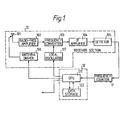
- Fig. 1 exemplifies a preferred arrangement of a spacecraft velocity measurement system according to the invention.
- the receiving unit includes a receiver section 10, a high-accuracy frequency counter 11 and a computer section 12.
- the receiver section 10 is set to receive the UHF band in that most of the hitherto obtained data about pulsars are present therein.
- the frequency counter 11 has an accuracy of the order of 1 nsec in terms of time resulution, and, for example, MODEL 5345A manufactured by Hewlett-Packard Company is suitable therefor.
- a pulse-like radio wave emitted from a pulsar and received by antenna 101 is amplified by a radio-frequency amplifier 102 and then fed to a frequency converter 103.
- the frequency converter 103 receives a local oscillation signal from a local oscillator 107 and converts the frequency of the pulse-like radio wave into a corresponding intermediate frequency (IF).
- the signal from the frequency converter 103 is amplified by an IF amplifier 104 and then fed to a detector 105 which performs detection or demodulation and wave-shaping and produces a pulse signal therefrom.
- the frequency counter 11 is adapted to measure the pulse repetition period and pulse width of the signal from the detector 105, and applies data of pulse period and pulse width obtained within a prefixed time duration to the computer 12. Using these two kinds of data, the computer 12 computes the velocity vector of the spacecraft installed with the unit of Fig. 1 in accordance with the algorithm described hereinafter to thereby measure the speed and the direction of flight of the spacecraft.
- the computer 12 has a central processing unit (CPU) 121 and a data memory 122 such as a read-only memory (ROM).
- the ROM 122 stores therein the necessary data, viz. pulse repetition periods and pulse widths of the preselected pulsars.
- the CPU 121 applies, based on the information stored in the ROM 122, an antenna direction signal to an antenna driver 106 and also a receiving frequency preset signal to the local oscillator 107 in order to set the receiver section 10 in an optimum receiving state.
- the pulse repetition period t s of a pulsar measured by the frequency counter 11 is expressed by the following equation: where t b is the pulse repetition period of the pulsar determined in a coordinate system with the center of gravity of the solar system at its origin, which is obtained in advance by subtracting from a value measured on the earth a value representative of the effect of the motion of the earth and stored in the ROM 122, v is the velocity vector to be measured, n is the unit vector in the direction toward the pulsar from the spacecraft, and c is the velocity of light.
- a suitable number K of pulsars are used to measure the velocity of the spacecraft. For each of these pulsars the pulse repetition period t s is measured, and a difference ⁇ t of the measured period t s from the period t b stored in the ROM 122 is calculated:
- the velocity vector v is determined by the least squares method, that is, by a series of calculation to render the result of the following summation minimum.
- the velocity vector v is computed by solving the simultaneous linear equations (6) with three variables v , v , v by the operation of the computer section 12. If the absolute value v of the computed valocity vector is larger than a predetermined value v c , the aforementioned difference ⁇ t i is multiplied by a correction factor according to the special theory of relativity, and then the above described calculation is repeated.
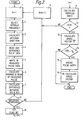
- the CPU 121 in the computer section 12 determines the identification number N of a target pulsar. In the initial state the value of N is 1.
- the CPU 121 reads out the data corresponding to the determined identification number N from the ROM 122 to compute an optimum oscillation frequency of the local oscillator 107 and an optimum direction of the antenna 101 and provides control signals indicative of the results of the computation to the local oscillator 107 and to the antenna driver 106, respectively, thereby adjusting the receiver section 10 to an optimum receiving state.
- the CPU 121 reads out the reference values of the pulse repetition period and pulse width of the same pulsar stored in the ROM 122, and at step 5 the measured values of the pulse repetition period and pulse width are loaded into the CPU 121 from the frequency counter 11.
- the variance and mean value of the measured pulse data are calculated, and at step 7 the differences of the values calculated at step 6 from the reference values read out from the ROM 122 at step 4 are calculated.
- the CPU makes a judgement whether or not the received pulse signal is the pulse train transmitted from the target pulsar by checking whether or not the differences calculated at step 7 are each smaller than a predetermined threshold value.
- step 9 If the differences checked at step 8 are each larger the than the threshold value, the processing advances to step 9 where another preselected pulsar is taken as the target, and the procedure of steps 1-8 is repeated. Otherwise the processing goes to step 10 where a flag bit is set to indicate that the pulse signal emitted from the target pulsar is received. Then, at step 11 the Doppler shift of the pulse of the target pulsar in the line-of-sight direction is calculated from the aforementioned differences. At step 12, a judgement is made whether or not the pulse data have been obtained for the predetermined number of pulsars, and in case of negative judgement the procedure of steps 1-8 is repeated via step 9.
- step 12 the processing advances from step 12 to step 13 where the velocity vector of the spacecraft in the employed inertial coordinate system is calculated according to the above described algorithm for the computation of the velocity vector.
- step 14 a judgement is made if the absolute value of the velocity vector of the spacecraft measured in the employed inertial coordinate system is so large as to need correction according to the special theory of relativity. When such a correction is not necessary the processing comes to an end. If the correction is necessary the processing goes to step 15 where the aforementioned correctic according to the special theory of relativity is made, and then at step 16 the velocity vector is re-calculated on the basis of the corrected data.
- the present invention has made it possible to independently determine the velocity of a spacecraft onboard the spacecraft and, therefore, will enable to make space flight to very distant planets such as Uranus and Neptune or beyond the boundary of the solar system.
- this invention is applicable also to the relatively short range space flight with the advantage of higher accuracy in measuring the orbit of each spacecraft compared with conventional velocity measurement methods. It is also possible to jointly use a system according to the invention and a conventional velocity measurement system, and in this case the total system becomes very high in accuracy and reliability.
Landscapes
- Physics & Mathematics (AREA)
- Engineering & Computer Science (AREA)
- General Physics & Mathematics (AREA)
- Radar, Positioning & Navigation (AREA)
- Remote Sensing (AREA)
- Radar Systems Or Details Thereof (AREA)
- Position Fixing By Use Of Radio Waves (AREA)
- Control Of Position, Course, Altitude, Or Attitude Of Moving Bodies (AREA)
- Control Of Velocity Or Acceleration (AREA)
Applications Claiming Priority (2)
| Application Number | Priority Date | Filing Date | Title |
|---|---|---|---|
| JP57070917A JPS58186810A (ja) | 1982-04-26 | 1982-04-26 | 宇宙船速度決定装置 |
| JP70917/82 | 1982-04-26 |
Publications (3)
| Publication Number | Publication Date |
|---|---|
| EP0093014A2 true EP0093014A2 (de) | 1983-11-02 |
| EP0093014A3 EP0093014A3 (en) | 1984-12-27 |
| EP0093014B1 EP0093014B1 (de) | 1987-09-02 |
Family
ID=13445329
Family Applications (1)
| Application Number | Title | Priority Date | Filing Date |
|---|---|---|---|
| EP83302359A Expired EP0093014B1 (de) | 1982-04-26 | 1983-04-26 | System zur Geschwindigkeitsmessung eines Raumschiffes |
Country Status (4)
| Country | Link |
|---|---|
| US (1) | US4647932A (de) |
| EP (1) | EP0093014B1 (de) |
| JP (1) | JPS58186810A (de) |
| DE (1) | DE3373359D1 (de) |
Cited By (2)
| Publication number | Priority date | Publication date | Assignee | Title |
|---|---|---|---|---|
| EP0167683A1 (de) * | 1984-06-08 | 1986-01-15 | Decca Limited | Ortungsmessungsanordnung |
| WO2001049565A1 (en) * | 2000-01-04 | 2001-07-12 | The Johns Hopkins University | Method and apparatus for autonomous solar navigation |
Families Citing this family (4)
| Publication number | Priority date | Publication date | Assignee | Title |
|---|---|---|---|---|
| JPH0634174B2 (ja) * | 1984-12-25 | 1994-05-02 | 中録クリエイシヨン株式会社 | 宇宙音の生成方法及び装置 |
| US5006855A (en) * | 1986-08-20 | 1991-04-09 | The Mitre Corporation | Ranging and processing system for mobile surveillance and data link |
| DE3830467A1 (de) * | 1988-09-08 | 1990-03-15 | Hoechst Ag | Feuchtmittel fuer den offsetdruck |
| CN113375677B (zh) * | 2021-08-12 | 2021-11-02 | 中国人民解放军国防科技大学 | 一种基于脉冲星观测的航天器定速方法 |
Family Cites Families (6)
| Publication number | Priority date | Publication date | Assignee | Title |
|---|---|---|---|---|
| US2770795A (en) * | 1951-03-30 | 1956-11-13 | Raytheon Mfg Co | Acoustic log |
| US3866229A (en) * | 1961-02-02 | 1975-02-11 | Hammack Calvin M | Method and apparatus for automatically determining position-motion state of a moving object |
| US3550002A (en) * | 1969-02-25 | 1970-12-22 | Us Navy | Pulsar communication systems |
| US3605095A (en) * | 1969-10-01 | 1971-09-14 | Robert A Higgins | Device for measuring relative velocities |
| US4263539A (en) * | 1977-10-04 | 1981-04-21 | Zenith Radio Corporation | Automatic antenna positioning apparatus |
| US4445119A (en) * | 1981-04-30 | 1984-04-24 | Raytheon Company | Distributed beam steering computer |
-
1982
- 1982-04-26 JP JP57070917A patent/JPS58186810A/ja active Granted
-
1983
- 1983-04-25 US US06/488,342 patent/US4647932A/en not_active Expired - Fee Related
- 1983-04-26 DE DE8383302359T patent/DE3373359D1/de not_active Expired
- 1983-04-26 EP EP83302359A patent/EP0093014B1/de not_active Expired
Cited By (2)
| Publication number | Priority date | Publication date | Assignee | Title |
|---|---|---|---|---|
| EP0167683A1 (de) * | 1984-06-08 | 1986-01-15 | Decca Limited | Ortungsmessungsanordnung |
| WO2001049565A1 (en) * | 2000-01-04 | 2001-07-12 | The Johns Hopkins University | Method and apparatus for autonomous solar navigation |
Also Published As
| Publication number | Publication date |
|---|---|
| US4647932A (en) | 1987-03-03 |
| JPS6232808B2 (de) | 1987-07-16 |
| EP0093014A3 (en) | 1984-12-27 |
| JPS58186810A (ja) | 1983-10-31 |
| DE3373359D1 (en) | 1987-10-08 |
| EP0093014B1 (de) | 1987-09-02 |
Similar Documents
| Publication | Publication Date | Title |
|---|---|---|
| US4910526A (en) | Airborne surveillance method and system | |
| US5075694A (en) | Airborne surveillance method and system | |
| US4097837A (en) | Underwater transponder calibration arrangement | |
| RU2100820C1 (ru) | Прецизионная система посадки для наведения самолета вдоль заданной посадочной траектории в пределах радиуса действия наземного запросчика (варианты) | |
| US4063240A (en) | Electronic docking system | |
| EP3056922B1 (de) | Geschwindigkeits- und lageschätzung mithilfe eines interferrometrischen radarhöhenmesser | |
| US7986264B2 (en) | Positioning system, IC chip for positioning, positioning method, and positioning program | |
| JPS63503166A (ja) | 受動電波高度計 | |
| US3975731A (en) | Airborne positioning system | |
| EP0093014B1 (de) | System zur Geschwindigkeitsmessung eines Raumschiffes | |
| RU99100109A (ru) | Приемник спутниковых сигналов с контролем достоверности вычисленной скорости | |
| US5999130A (en) | Determination of radar threat location from an airborne vehicle | |
| RU2558699C1 (ru) | Комплексный способ навигации летательных аппаратов | |
| US6256264B1 (en) | Localization of a submerged tow vehicle (lost) | |
| JPH0613977B2 (ja) | 車両用走行誘導装置 | |
| US4445120A (en) | Radiosonde | |
| EP0661553A2 (de) | Verfahren zur Bestimmung von Erdpositionen entsprechend der beobachteten Änderung des Abstandes des Satelliten | |
| US4814994A (en) | Relative position navigation system with means for computing synthetic azimuth | |
| EP1218770B1 (de) | Satellitensystem zur ortung einer signalquelle | |
| US20030163280A1 (en) | Method and device for estimating movement parameters of targets | |
| JP7379551B2 (ja) | レーダ装置、トランスポンダの反射波の検出方法、及び測位方法 | |
| JP2008304329A (ja) | 測定装置 | |
| RU2606241C1 (ru) | Способ определения относительного положения летательных аппаратов при межсамолетной навигации | |
| RU2551896C2 (ru) | Способ однолучевого измерения высоты и составляющих скорости летательного аппарата и устройство радиовысотомера, реализующего способ | |
| RU2847478C2 (ru) | Способ определения координат района радиолокационного зондирования |
Legal Events
| Date | Code | Title | Description |
|---|---|---|---|
| PUAI | Public reference made under article 153(3) epc to a published international application that has entered the european phase |
Free format text: ORIGINAL CODE: 0009012 |
|
| AK | Designated contracting states |
Designated state(s): DE FR GB |
|
| PUAL | Search report despatched |
Free format text: ORIGINAL CODE: 0009013 |
|
| AK | Designated contracting states |
Designated state(s): DE FR GB |
|
| 17P | Request for examination filed |
Effective date: 19841108 |
|
| 17Q | First examination report despatched |
Effective date: 19861029 |
|
| GRAA | (expected) grant |
Free format text: ORIGINAL CODE: 0009210 |
|
| AK | Designated contracting states |
Kind code of ref document: B1 Designated state(s): DE FR GB |
|
| REF | Corresponds to: |
Ref document number: 3373359 Country of ref document: DE Date of ref document: 19871008 |
|
| ET | Fr: translation filed | ||
| PLBE | No opposition filed within time limit |
Free format text: ORIGINAL CODE: 0009261 |
|
| STAA | Information on the status of an ep patent application or granted ep patent |
Free format text: STATUS: NO OPPOSITION FILED WITHIN TIME LIMIT |
|
| 26N | No opposition filed | ||
| PGFP | Annual fee paid to national office [announced via postgrant information from national office to epo] |
Ref country code: GB Payment date: 19940419 Year of fee payment: 12 |
|
| PGFP | Annual fee paid to national office [announced via postgrant information from national office to epo] |
Ref country code: FR Payment date: 19940421 Year of fee payment: 12 |
|
| PGFP | Annual fee paid to national office [announced via postgrant information from national office to epo] |
Ref country code: DE Payment date: 19940629 Year of fee payment: 12 |
|
| PG25 | Lapsed in a contracting state [announced via postgrant information from national office to epo] |
Ref country code: GB Effective date: 19950426 |
|
| GBPC | Gb: european patent ceased through non-payment of renewal fee |
Effective date: 19950426 |
|
| PG25 | Lapsed in a contracting state [announced via postgrant information from national office to epo] |
Ref country code: FR Effective date: 19951229 |
|
| PG25 | Lapsed in a contracting state [announced via postgrant information from national office to epo] |
Ref country code: DE Effective date: 19960103 |
|
| REG | Reference to a national code |
Ref country code: FR Ref legal event code: ST |