EP0087446B1 - Method of forming a photographic dye image - Google Patents
Method of forming a photographic dye image Download PDFInfo
- Publication number
- EP0087446B1 EP0087446B1 EP82902681A EP82902681A EP0087446B1 EP 0087446 B1 EP0087446 B1 EP 0087446B1 EP 82902681 A EP82902681 A EP 82902681A EP 82902681 A EP82902681 A EP 82902681A EP 0087446 B1 EP0087446 B1 EP 0087446B1
- Authority
- EP
- European Patent Office
- Prior art keywords
- colour
- dye
- coupler
- developing agent
- forming
- Prior art date
- Legal status (The legal status is an assumption and is not a legal conclusion. Google has not performed a legal analysis and makes no representation as to the accuracy of the status listed.)
- Expired
Links
- 238000000034 method Methods 0.000 title claims abstract description 49
- 239000003795 chemical substances by application Substances 0.000 claims abstract description 50
- -1 silver halide Chemical class 0.000 claims abstract description 26
- 229910021645 metal ion Inorganic materials 0.000 claims abstract description 16
- 239000000463 material Substances 0.000 claims abstract description 15
- 229910052751 metal Inorganic materials 0.000 claims abstract description 14
- 239000002184 metal Substances 0.000 claims abstract description 14
- 229910052709 silver Inorganic materials 0.000 claims abstract description 11
- 239000004332 silver Substances 0.000 claims abstract description 11
- 125000000623 heterocyclic group Chemical group 0.000 claims abstract description 10
- 239000000975 dye Substances 0.000 claims description 46
- 239000000203 mixture Substances 0.000 claims description 25
- 239000000987 azo dye Substances 0.000 claims description 21
- 125000003118 aryl group Chemical group 0.000 claims description 19
- 238000011161 development Methods 0.000 claims description 18
- PXHVJJICTQNCMI-UHFFFAOYSA-N Nickel Chemical compound [Ni] PXHVJJICTQNCMI-UHFFFAOYSA-N 0.000 claims description 16
- 125000000217 alkyl group Chemical group 0.000 claims description 15
- 238000005859 coupling reaction Methods 0.000 claims description 14
- 125000004432 carbon atom Chemical group C* 0.000 claims description 13
- 230000008878 coupling Effects 0.000 claims description 13
- 238000010168 coupling process Methods 0.000 claims description 13
- 125000000547 substituted alkyl group Chemical group 0.000 claims description 12
- 239000001257 hydrogen Substances 0.000 claims description 10
- 229910052739 hydrogen Inorganic materials 0.000 claims description 10
- 125000004435 hydrogen atom Chemical group [H]* 0.000 claims description 10
- 238000001465 metallisation Methods 0.000 claims description 10
- 230000015572 biosynthetic process Effects 0.000 claims description 8
- 125000003178 carboxy group Chemical group [H]OC(*)=O 0.000 claims description 8
- 125000004429 atom Chemical group 0.000 claims description 7
- 229910052759 nickel Inorganic materials 0.000 claims description 6
- 125000003545 alkoxy group Chemical group 0.000 claims description 5
- 150000003839 salts Chemical class 0.000 claims description 5
- 125000003107 substituted aryl group Chemical group 0.000 claims description 5
- KJCVRFUGPWSIIH-UHFFFAOYSA-N 1-naphthol Chemical compound C1=CC=C2C(O)=CC=CC2=C1 KJCVRFUGPWSIIH-UHFFFAOYSA-N 0.000 claims description 4
- 150000002500 ions Chemical class 0.000 claims description 4
- 125000004433 nitrogen atom Chemical group N* 0.000 claims description 4
- 150000004986 phenylenediamines Chemical group 0.000 claims description 4
- 239000002243 precursor Substances 0.000 claims description 4
- JEXVQSWXXUJEMA-UHFFFAOYSA-N pyrazol-3-one Chemical compound O=C1C=CN=N1 JEXVQSWXXUJEMA-UHFFFAOYSA-N 0.000 claims description 4
- MCSKRVKAXABJLX-UHFFFAOYSA-N pyrazolo[3,4-d]triazole Chemical compound N1=NN=C2N=NC=C21 MCSKRVKAXABJLX-UHFFFAOYSA-N 0.000 claims description 4
- RYGMFSIKBFXOCR-UHFFFAOYSA-N Copper Chemical compound [Cu] RYGMFSIKBFXOCR-UHFFFAOYSA-N 0.000 claims description 3
- 229910052802 copper Inorganic materials 0.000 claims description 3
- 239000010949 copper Substances 0.000 claims description 3
- 125000004093 cyano group Chemical group *C#N 0.000 claims description 3
- 239000012992 electron transfer agent Substances 0.000 claims description 3
- ISWSIDIOOBJBQZ-UHFFFAOYSA-N phenol group Chemical group C1(=CC=CC=C1)O ISWSIDIOOBJBQZ-UHFFFAOYSA-N 0.000 claims description 3
- VYZAMTAEIAYCRO-UHFFFAOYSA-N Chromium Chemical compound [Cr] VYZAMTAEIAYCRO-UHFFFAOYSA-N 0.000 claims description 2
- PWHULOQIROXLJO-UHFFFAOYSA-N Manganese Chemical compound [Mn] PWHULOQIROXLJO-UHFFFAOYSA-N 0.000 claims description 2
- HCHKCACWOHOZIP-UHFFFAOYSA-N Zinc Chemical compound [Zn] HCHKCACWOHOZIP-UHFFFAOYSA-N 0.000 claims description 2
- 239000003093 cationic surfactant Substances 0.000 claims description 2
- 229910052804 chromium Inorganic materials 0.000 claims description 2
- 239000011651 chromium Substances 0.000 claims description 2
- 229910017052 cobalt Inorganic materials 0.000 claims description 2
- 239000010941 cobalt Substances 0.000 claims description 2
- GUTLYIVDDKVIGB-UHFFFAOYSA-N cobalt atom Chemical compound [Co] GUTLYIVDDKVIGB-UHFFFAOYSA-N 0.000 claims description 2
- 150000004696 coordination complex Chemical class 0.000 claims description 2
- 229910052736 halogen Inorganic materials 0.000 claims description 2
- 150000002367 halogens Chemical class 0.000 claims description 2
- 229910052748 manganese Inorganic materials 0.000 claims description 2
- 239000011572 manganese Substances 0.000 claims description 2
- 125000001302 tertiary amino group Chemical group 0.000 claims description 2
- 239000011701 zinc Substances 0.000 claims description 2
- 229910052725 zinc Inorganic materials 0.000 claims description 2
- QVGXLLKOCUKJST-UHFFFAOYSA-N atomic oxygen Chemical compound [O] QVGXLLKOCUKJST-UHFFFAOYSA-N 0.000 claims 1
- PXBRQCKWGAHEHS-UHFFFAOYSA-N dichlorodifluoromethane Chemical group FC(F)(Cl)Cl PXBRQCKWGAHEHS-UHFFFAOYSA-N 0.000 claims 1
- 229910052760 oxygen Inorganic materials 0.000 claims 1
- 239000001301 oxygen Substances 0.000 claims 1
- 125000005415 substituted alkoxy group Chemical group 0.000 claims 1
- 150000001875 compounds Chemical class 0.000 abstract description 8
- 229940042795 hydrazides for tuberculosis treatment Drugs 0.000 abstract description 2
- GVLRTOYGRNLSDW-UHFFFAOYSA-N 1h-pyrazolo[3,4-b]pyridine Chemical class C1=CC=C2C=NNC2=N1 GVLRTOYGRNLSDW-UHFFFAOYSA-N 0.000 abstract 1
- 239000000243 solution Substances 0.000 description 44
- WYURNTSHIVDZCO-UHFFFAOYSA-N Tetrahydrofuran Chemical compound C1CCOC1 WYURNTSHIVDZCO-UHFFFAOYSA-N 0.000 description 40
- XEKOWRVHYACXOJ-UHFFFAOYSA-N Ethyl acetate Chemical compound CCOC(C)=O XEKOWRVHYACXOJ-UHFFFAOYSA-N 0.000 description 37
- 239000000047 product Substances 0.000 description 32
- LFQSCWFLJHTTHZ-UHFFFAOYSA-N Ethanol Chemical compound CCO LFQSCWFLJHTTHZ-UHFFFAOYSA-N 0.000 description 27
- YMWUJEATGCHHMB-UHFFFAOYSA-N Dichloromethane Chemical compound ClCCl YMWUJEATGCHHMB-UHFFFAOYSA-N 0.000 description 26
- YLQBMQCUIZJEEH-UHFFFAOYSA-N tetrahydrofuran Natural products C=1C=COC=1 YLQBMQCUIZJEEH-UHFFFAOYSA-N 0.000 description 20
- XLYOFNOQVPJJNP-UHFFFAOYSA-N water Substances O XLYOFNOQVPJJNP-UHFFFAOYSA-N 0.000 description 20
- 238000002360 preparation method Methods 0.000 description 19
- OKKJLVBELUTLKV-UHFFFAOYSA-N Methanol Chemical compound OC OKKJLVBELUTLKV-UHFFFAOYSA-N 0.000 description 18
- JUJWROOIHBZHMG-UHFFFAOYSA-N Pyridine Chemical compound C1=CC=NC=C1 JUJWROOIHBZHMG-UHFFFAOYSA-N 0.000 description 18
- 238000004611 spectroscopical analysis Methods 0.000 description 18
- VEXZGXHMUGYJMC-UHFFFAOYSA-N Hydrochloric acid Chemical compound Cl VEXZGXHMUGYJMC-UHFFFAOYSA-N 0.000 description 17
- 238000004458 analytical method Methods 0.000 description 15
- 235000019439 ethyl acetate Nutrition 0.000 description 15
- 239000010410 layer Substances 0.000 description 15
- 238000004809 thin layer chromatography Methods 0.000 description 15
- 239000007787 solid Substances 0.000 description 13
- 238000003756 stirring Methods 0.000 description 12
- 239000011248 coating agent Substances 0.000 description 10
- 238000000576 coating method Methods 0.000 description 10
- 239000002904 solvent Substances 0.000 description 10
- FYSNRJHAOHDILO-UHFFFAOYSA-N thionyl chloride Chemical compound ClS(Cl)=O FYSNRJHAOHDILO-UHFFFAOYSA-N 0.000 description 10
- WFDIJRYMOXRFFG-UHFFFAOYSA-N Acetic anhydride Chemical compound CC(=O)OC(C)=O WFDIJRYMOXRFFG-UHFFFAOYSA-N 0.000 description 9
- QGZKDVFQNNGYKY-UHFFFAOYSA-N Ammonia Chemical compound N QGZKDVFQNNGYKY-UHFFFAOYSA-N 0.000 description 9
- IAZDPXIOMUYVGZ-UHFFFAOYSA-N Dimethylsulphoxide Chemical compound CS(C)=O IAZDPXIOMUYVGZ-UHFFFAOYSA-N 0.000 description 9
- UMJSCPRVCHMLSP-UHFFFAOYSA-N pyridine Natural products COC1=CC=CN=C1 UMJSCPRVCHMLSP-UHFFFAOYSA-N 0.000 description 9
- RTZKZFJDLAIYFH-UHFFFAOYSA-N Diethyl ether Chemical compound CCOCC RTZKZFJDLAIYFH-UHFFFAOYSA-N 0.000 description 8
- 239000002244 precipitate Substances 0.000 description 8
- 0 *C1(CNC(*#C)NC1)C1CCCC1 Chemical compound *C1(CNC(*#C)NC1)C1CCCC1 0.000 description 7
- QTBSBXVTEAMEQO-UHFFFAOYSA-N Acetic acid Chemical compound CC(O)=O QTBSBXVTEAMEQO-UHFFFAOYSA-N 0.000 description 7
- IJGRMHOSHXDMSA-UHFFFAOYSA-N Atomic nitrogen Chemical compound N#N IJGRMHOSHXDMSA-UHFFFAOYSA-N 0.000 description 6
- ZMXDDKWLCZADIW-UHFFFAOYSA-N N,N-Dimethylformamide Chemical compound CN(C)C=O ZMXDDKWLCZADIW-UHFFFAOYSA-N 0.000 description 6
- 238000001816 cooling Methods 0.000 description 6
- 239000000839 emulsion Substances 0.000 description 6
- 239000000706 filtrate Substances 0.000 description 6
- 229910052757 nitrogen Inorganic materials 0.000 description 6
- 125000001997 phenyl group Chemical group [H]C1=C([H])C([H])=C(*)C([H])=C1[H] 0.000 description 6
- 125000000751 azo group Chemical group [*]N=N[*] 0.000 description 5
- HZAXFHJVJLSVMW-UHFFFAOYSA-N 2-Aminoethan-1-ol Chemical compound NCCO HZAXFHJVJLSVMW-UHFFFAOYSA-N 0.000 description 4
- CSNNHWWHGAXBCP-UHFFFAOYSA-L Magnesium sulfate Chemical compound [Mg+2].[O-][S+2]([O-])([O-])[O-] CSNNHWWHGAXBCP-UHFFFAOYSA-L 0.000 description 4
- YNAVUWVOSKDBBP-UHFFFAOYSA-N Morpholine Chemical compound C1COCCN1 YNAVUWVOSKDBBP-UHFFFAOYSA-N 0.000 description 4
- NQRYJNQNLNOLGT-UHFFFAOYSA-N Piperidine Chemical compound C1CCNCC1 NQRYJNQNLNOLGT-UHFFFAOYSA-N 0.000 description 4
- 150000001793 charged compounds Chemical class 0.000 description 4
- 239000006185 dispersion Substances 0.000 description 4
- 239000007788 liquid Substances 0.000 description 4
- 229910052943 magnesium sulfate Inorganic materials 0.000 description 4
- 125000002496 methyl group Chemical group [H]C([H])([H])* 0.000 description 4
- 238000012545 processing Methods 0.000 description 4
- FKHIFSZMMVMEQY-UHFFFAOYSA-N talc Chemical compound [Mg+2].[O-][Si]([O-])=O FKHIFSZMMVMEQY-UHFFFAOYSA-N 0.000 description 4
- 238000005406 washing Methods 0.000 description 4
- FJLUATLTXUNBOT-UHFFFAOYSA-N 1-Hexadecylamine Chemical compound CCCCCCCCCCCCCCCCN FJLUATLTXUNBOT-UHFFFAOYSA-N 0.000 description 3
- KWYUFKZDYYNOTN-UHFFFAOYSA-M Potassium hydroxide Chemical compound [OH-].[K+] KWYUFKZDYYNOTN-UHFFFAOYSA-M 0.000 description 3
- 241000786363 Rhampholeon spectrum Species 0.000 description 3
- HEMHJVSKTPXQMS-UHFFFAOYSA-M Sodium hydroxide Chemical compound [OH-].[Na+] HEMHJVSKTPXQMS-UHFFFAOYSA-M 0.000 description 3
- RAHZWNYVWXNFOC-UHFFFAOYSA-N Sulphur dioxide Chemical group O=S=O RAHZWNYVWXNFOC-UHFFFAOYSA-N 0.000 description 3
- 229910021529 ammonia Inorganic materials 0.000 description 3
- 150000002148 esters Chemical class 0.000 description 3
- 239000012535 impurity Substances 0.000 description 3
- 239000011541 reaction mixture Substances 0.000 description 3
- 238000010992 reflux Methods 0.000 description 3
- 238000001228 spectrum Methods 0.000 description 3
- 239000000725 suspension Substances 0.000 description 3
- NWZSZGALRFJKBT-KNIFDHDWSA-N (2s)-2,6-diaminohexanoic acid;(2s)-2-hydroxybutanedioic acid Chemical compound OC(=O)[C@@H](O)CC(O)=O.NCCCC[C@H](N)C(O)=O NWZSZGALRFJKBT-KNIFDHDWSA-N 0.000 description 2
- DDWAPSXNXHYQLK-UHFFFAOYSA-N (5-nitropyridin-2-yl)hydrazine Chemical compound NNC1=CC=C([N+]([O-])=O)C=N1 DDWAPSXNXHYQLK-UHFFFAOYSA-N 0.000 description 2
- CBCKQZAAMUWICA-UHFFFAOYSA-N 1,4-phenylenediamine Chemical compound NC1=CC=C(N)C=C1 CBCKQZAAMUWICA-UHFFFAOYSA-N 0.000 description 2
- NGNBDVOYPDDBFK-UHFFFAOYSA-N 2-[2,4-di(pentan-2-yl)phenoxy]acetyl chloride Chemical compound CCCC(C)C1=CC=C(OCC(Cl)=O)C(C(C)CCC)=C1 NGNBDVOYPDDBFK-UHFFFAOYSA-N 0.000 description 2
- UOMQUZPKALKDCA-UHFFFAOYSA-K 2-[2-[bis(carboxylatomethyl)amino]ethyl-(carboxymethyl)amino]acetate;iron(3+) Chemical compound [Fe+3].OC(=O)CN(CC([O-])=O)CCN(CC([O-])=O)CC([O-])=O UOMQUZPKALKDCA-UHFFFAOYSA-K 0.000 description 2
- ZAJALNCZCSSGJC-UHFFFAOYSA-N 2-chloro-5-nitrobenzenesulfonamide Chemical compound NS(=O)(=O)C1=CC([N+]([O-])=O)=CC=C1Cl ZAJALNCZCSSGJC-UHFFFAOYSA-N 0.000 description 2
- COZWQPZDKVIVFS-UHFFFAOYSA-N 2-chloro-5-nitrobenzenesulfonyl chloride Chemical compound [O-][N+](=O)C1=CC=C(Cl)C(S(Cl)(=O)=O)=C1 COZWQPZDKVIVFS-UHFFFAOYSA-N 0.000 description 2
- ACQXHCHKMFYDPM-UHFFFAOYSA-N 2-chloro-6-methylpyridine-3-carboxylic acid Chemical compound CC1=CC=C(C(O)=O)C(Cl)=N1 ACQXHCHKMFYDPM-UHFFFAOYSA-N 0.000 description 2
- HKZSRFNJSOUMAK-UHFFFAOYSA-N 2-cyano-n-hexadecylacetamide Chemical compound CCCCCCCCCCCCCCCCNC(=O)CC#N HKZSRFNJSOUMAK-UHFFFAOYSA-N 0.000 description 2
- QGZUKXUDQSAJOM-UHFFFAOYSA-N 2-hydrazinyl-5-nitrobenzenesulfonamide Chemical compound NNC1=CC=C([N+]([O-])=O)C=C1S(N)(=O)=O QGZUKXUDQSAJOM-UHFFFAOYSA-N 0.000 description 2
- USRQKULXSAKRST-UHFFFAOYSA-N 2-hydrazinyl-6-methylpyridine-3-carboxylic acid Chemical compound CC1=CC=C(C(O)=O)C(NN)=N1 USRQKULXSAKRST-UHFFFAOYSA-N 0.000 description 2
- 125000004105 2-pyridyl group Chemical group N1=C([*])C([H])=C([H])C([H])=C1[H] 0.000 description 2
- UYEMGAFJOZZIFP-UHFFFAOYSA-N 3,5-dihydroxybenzoic acid Chemical compound OC(=O)C1=CC(O)=CC(O)=C1 UYEMGAFJOZZIFP-UHFFFAOYSA-N 0.000 description 2
- DSVIHYOAKPVFEH-UHFFFAOYSA-N 4-(hydroxymethyl)-4-methyl-1-phenylpyrazolidin-3-one Chemical compound N1C(=O)C(C)(CO)CN1C1=CC=CC=C1 DSVIHYOAKPVFEH-UHFFFAOYSA-N 0.000 description 2
- PLIKAWJENQZMHA-UHFFFAOYSA-N 4-aminophenol Chemical compound NC1=CC=C(O)C=C1 PLIKAWJENQZMHA-UHFFFAOYSA-N 0.000 description 2
- QNGVNLMMEQUVQK-UHFFFAOYSA-N 4-n,4-n-diethylbenzene-1,4-diamine Chemical compound CCN(CC)C1=CC=C(N)C=C1 QNGVNLMMEQUVQK-UHFFFAOYSA-N 0.000 description 2
- FTFXTBBEMSWGHU-UHFFFAOYSA-N 5-amino-1-hydroxynaphthalene-2-carboxylic acid Chemical compound OC(=O)C1=CC=C2C(N)=CC=CC2=C1O FTFXTBBEMSWGHU-UHFFFAOYSA-N 0.000 description 2
- AWDGTOAKGXJCAO-UHFFFAOYSA-N 6-methyl-1,2-dihydropyrazolo[3,4-b]pyridin-3-one Chemical compound CC1=CC=C2C(=O)NNC2=N1 AWDGTOAKGXJCAO-UHFFFAOYSA-N 0.000 description 2
- CSCPPACGZOOCGX-UHFFFAOYSA-N Acetone Chemical compound CC(C)=O CSCPPACGZOOCGX-UHFFFAOYSA-N 0.000 description 2
- 229920003319 Araldite® Polymers 0.000 description 2
- LZZYPRNAOMGNLH-UHFFFAOYSA-M Cetrimonium bromide Chemical compound [Br-].CCCCCCCCCCCCCCCC[N+](C)(C)C LZZYPRNAOMGNLH-UHFFFAOYSA-M 0.000 description 2
- 108010010803 Gelatin Proteins 0.000 description 2
- OAKJQQAXSVQMHS-UHFFFAOYSA-N Hydrazine Chemical compound NN OAKJQQAXSVQMHS-UHFFFAOYSA-N 0.000 description 2
- MHAJPDPJQMAIIY-UHFFFAOYSA-N Hydrogen peroxide Chemical compound OO MHAJPDPJQMAIIY-UHFFFAOYSA-N 0.000 description 2
- KYQCOXFCLRTKLS-UHFFFAOYSA-N Pyrazine Chemical compound C1=CN=CC=N1 KYQCOXFCLRTKLS-UHFFFAOYSA-N 0.000 description 2
- 229910006069 SO3H Inorganic materials 0.000 description 2
- VYPSYNLAJGMNEJ-UHFFFAOYSA-N Silicium dioxide Chemical compound O=[Si]=O VYPSYNLAJGMNEJ-UHFFFAOYSA-N 0.000 description 2
- CDBYLPFSWZWCQE-UHFFFAOYSA-L Sodium Carbonate Chemical compound [Na+].[Na+].[O-]C([O-])=O CDBYLPFSWZWCQE-UHFFFAOYSA-L 0.000 description 2
- YTPLMLYBLZKORZ-UHFFFAOYSA-N Thiophene Chemical compound C=1C=CSC=1 YTPLMLYBLZKORZ-UHFFFAOYSA-N 0.000 description 2
- 239000007864 aqueous solution Substances 0.000 description 2
- 239000007844 bleaching agent Substances 0.000 description 2
- 238000004440 column chromatography Methods 0.000 description 2
- ARUVKPQLZAKDPS-UHFFFAOYSA-L copper(II) sulfate Chemical compound [Cu+2].[O-][S+2]([O-])([O-])[O-] ARUVKPQLZAKDPS-UHFFFAOYSA-L 0.000 description 2
- 239000012043 crude product Substances 0.000 description 2
- 230000000694 effects Effects 0.000 description 2
- 125000001495 ethyl group Chemical group [H]C([H])([H])C([H])([H])* 0.000 description 2
- 238000005562 fading Methods 0.000 description 2
- 239000008273 gelatin Substances 0.000 description 2
- 229920000159 gelatin Polymers 0.000 description 2
- 235000019322 gelatine Nutrition 0.000 description 2
- 235000011852 gelatine desserts Nutrition 0.000 description 2
- IKDUDTNKRLTJSI-UHFFFAOYSA-N hydrazine monohydrate Substances O.NN IKDUDTNKRLTJSI-UHFFFAOYSA-N 0.000 description 2
- 235000019341 magnesium sulphate Nutrition 0.000 description 2
- QARBMVPHQWIHKH-UHFFFAOYSA-N methanesulfonyl chloride Chemical compound CS(Cl)(=O)=O QARBMVPHQWIHKH-UHFFFAOYSA-N 0.000 description 2
- IDQADTWQBNZNCH-UHFFFAOYSA-N methoxymethane perchloric acid Chemical compound COC.Cl(=O)(=O)(=O)O IDQADTWQBNZNCH-UHFFFAOYSA-N 0.000 description 2
- 229960003226 nikethamide Drugs 0.000 description 2
- 125000000636 p-nitrophenyl group Chemical group [H]C1=C([H])C(=C([H])C([H])=C1*)[N+]([O-])=O 0.000 description 2
- XHXFXVLFKHQFAL-UHFFFAOYSA-N phosphoryl trichloride Chemical compound ClP(Cl)(Cl)=O XHXFXVLFKHQFAL-UHFFFAOYSA-N 0.000 description 2
- 229920000139 polyethylene terephthalate Polymers 0.000 description 2
- 239000005020 polyethylene terephthalate Substances 0.000 description 2
- 239000004848 polyfunctional curative Substances 0.000 description 2
- XSCHRSMBECNVNS-UHFFFAOYSA-N quinoxaline Chemical compound N1=CC=NC2=CC=CC=C21 XSCHRSMBECNVNS-UHFFFAOYSA-N 0.000 description 2
- 239000000376 reactant Substances 0.000 description 2
- 238000011160 research Methods 0.000 description 2
- 229910000029 sodium carbonate Inorganic materials 0.000 description 2
- OLCXQJPKADTGMQ-UHFFFAOYSA-N (4-chlorosulfonylnaphthalen-1-yl) ethyl carbonate Chemical compound C1=CC=C2C(OC(=O)OCC)=CC=C(S(Cl)(=O)=O)C2=C1 OLCXQJPKADTGMQ-UHFFFAOYSA-N 0.000 description 1
- ISNKSXRJJVWFIL-UHFFFAOYSA-N (sulfonylamino)amine Chemical compound NN=S(=O)=O ISNKSXRJJVWFIL-UHFFFAOYSA-N 0.000 description 1
- WSLDOOZREJYCGB-UHFFFAOYSA-N 1,2-Dichloroethane Chemical compound ClCCCl WSLDOOZREJYCGB-UHFFFAOYSA-N 0.000 description 1
- QLDQYRDCPNBPII-UHFFFAOYSA-N 1,2-benzoxazol-3-one Chemical compound C1=CC=C2C(O)=NOC2=C1 QLDQYRDCPNBPII-UHFFFAOYSA-N 0.000 description 1
- FUOSTELFLYZQCW-UHFFFAOYSA-N 1,2-oxazol-3-one Chemical compound OC=1C=CON=1 FUOSTELFLYZQCW-UHFFFAOYSA-N 0.000 description 1
- PAEBEUZTAPIOIO-UHFFFAOYSA-N 1-(4-chlorophenyl)-3-(1-methyl-3-oxo-2-phenyl-5-propan-2-ylpyrazol-4-yl)urea Chemical compound O=C1N(C=2C=CC=CC=2)N(C)C(C(C)C)=C1NC(=O)NC1=CC=C(Cl)C=C1 PAEBEUZTAPIOIO-UHFFFAOYSA-N 0.000 description 1
- KAMCBFNNGGVPPW-UHFFFAOYSA-N 1-(ethenylsulfonylmethoxymethylsulfonyl)ethene Chemical compound C=CS(=O)(=O)COCS(=O)(=O)C=C KAMCBFNNGGVPPW-UHFFFAOYSA-N 0.000 description 1
- VKONPNAILGGMSR-UHFFFAOYSA-N 2-(2-sulfanylidene-3h-1,3-thiazol-4-yl)acetic acid Chemical compound OC(=O)CC1=CSC(=S)N1 VKONPNAILGGMSR-UHFFFAOYSA-N 0.000 description 1
- FJEFFKYBTSWLBH-UHFFFAOYSA-N 2-acetyl-1h-indazol-3-one Chemical class C1=CC=C2C(=O)N(C(=O)C)NC2=C1 FJEFFKYBTSWLBH-UHFFFAOYSA-N 0.000 description 1
- SZIFAVKTNFCBPC-UHFFFAOYSA-N 2-chloroethanol Chemical compound OCCCl SZIFAVKTNFCBPC-UHFFFAOYSA-N 0.000 description 1
- IPOVOSHRRIJKBR-UHFFFAOYSA-N 2-ethylpropanedioyl dichloride Chemical compound CCC(C(Cl)=O)C(Cl)=O IPOVOSHRRIJKBR-UHFFFAOYSA-N 0.000 description 1
- QBTDQJMLMVEUTQ-UHFFFAOYSA-N 3,5-diacetyloxybenzoic acid Chemical compound CC(=O)OC1=CC(OC(C)=O)=CC(C(O)=O)=C1 QBTDQJMLMVEUTQ-UHFFFAOYSA-N 0.000 description 1
- ORWQBKPSGDRPPA-UHFFFAOYSA-N 3-[2-[ethyl(methyl)amino]ethyl]-1h-indol-4-ol Chemical compound C1=CC(O)=C2C(CCN(C)CC)=CNC2=C1 ORWQBKPSGDRPPA-UHFFFAOYSA-N 0.000 description 1
- CWLKGDAVCFYWJK-UHFFFAOYSA-N 3-aminophenol Chemical compound NC1=CC=CC(O)=C1 CWLKGDAVCFYWJK-UHFFFAOYSA-N 0.000 description 1
- 229940018563 3-aminophenol Drugs 0.000 description 1
- 125000003349 3-pyridyl group Chemical group N1=C([H])C([*])=C([H])C([H])=C1[H] 0.000 description 1
- OZYOAOYHMMDTNZ-UHFFFAOYSA-N 4-[2,4-bis(2-methylbutan-2-yl)phenoxy]butan-1-amine Chemical compound CCC(C)(C)C1=CC=C(OCCCCN)C(C(C)(C)CC)=C1 OZYOAOYHMMDTNZ-UHFFFAOYSA-N 0.000 description 1
- OBHKONRNYCDRKM-UHFFFAOYSA-N 4-chloro-2-phenylquinazoline Chemical compound N=1C2=CC=CC=C2C(Cl)=NC=1C1=CC=CC=C1 OBHKONRNYCDRKM-UHFFFAOYSA-N 0.000 description 1
- ICGLPKIVTVWCFT-UHFFFAOYSA-N 4-methylbenzenesulfonohydrazide Chemical compound CC1=CC=C(S(=O)(=O)NN)C=C1 ICGLPKIVTVWCFT-UHFFFAOYSA-N 0.000 description 1
- AXBVSRMHOPMXBA-UHFFFAOYSA-N 4-nitrothiophenol Chemical compound [O-][N+](=O)C1=CC=C(S)C=C1 AXBVSRMHOPMXBA-UHFFFAOYSA-N 0.000 description 1
- 125000000339 4-pyridyl group Chemical group N1=C([H])C([H])=C([*])C([H])=C1[H] 0.000 description 1
- FCMFXVBZJSXLQM-UHFFFAOYSA-N 5-(benzenesulfonamido)-1-hydroxy-n,n-dioctadecylnaphthalene-2-carboxamide Chemical compound C=1C=CC2=C(O)C(C(=O)N(CCCCCCCCCCCCCCCCCC)CCCCCCCCCCCCCCCCCC)=CC=C2C=1NS(=O)(=O)C1=CC=CC=C1 FCMFXVBZJSXLQM-UHFFFAOYSA-N 0.000 description 1
- UVIIIDLFYMGFAJ-UHFFFAOYSA-N 5-(benzenesulfonamido)-1-hydroxy-n-octadecylnaphthalene-2-carboxamide Chemical compound C=1C=CC2=C(O)C(C(=O)NCCCCCCCCCCCCCCCCCC)=CC=C2C=1NS(=O)(=O)C1=CC=CC=C1 UVIIIDLFYMGFAJ-UHFFFAOYSA-N 0.000 description 1
- NQBABGXNLXYJQX-UHFFFAOYSA-N 5-(benzenesulfonamido)-1-hydroxynaphthalene-2-carbonyl chloride Chemical compound C1=CC=C2C(O)=C(C(Cl)=O)C=CC2=C1NS(=O)(=O)C1=CC=CC=C1 NQBABGXNLXYJQX-UHFFFAOYSA-N 0.000 description 1
- UDXXESCHSDPWMR-UHFFFAOYSA-N 5-(benzenesulfonamido)-1-hydroxynaphthalene-2-carboxylic acid Chemical compound C=1C=CC2=C(O)C(C(=O)O)=CC=C2C=1NS(=O)(=O)C1=CC=CC=C1 UDXXESCHSDPWMR-UHFFFAOYSA-N 0.000 description 1
- OFVPBQOQYKZWBO-UHFFFAOYSA-N 5-amino-2-(diethylazaniumyl)benzoate Chemical compound CCN(CC)C1=CC=C(N)C=C1C(O)=O OFVPBQOQYKZWBO-UHFFFAOYSA-N 0.000 description 1
- XRIHTJYXIHOBDQ-UHFFFAOYSA-N 6-methyl-2-oxo-1h-pyridine-3-carboxylic acid Chemical compound CC1=CC=C(C(O)=O)C(=O)N1 XRIHTJYXIHOBDQ-UHFFFAOYSA-N 0.000 description 1
- VHUUQVKOLVNVRT-UHFFFAOYSA-N Ammonium hydroxide Chemical compound [NH4+].[OH-] VHUUQVKOLVNVRT-UHFFFAOYSA-N 0.000 description 1
- CPELXLSAUQHCOX-UHFFFAOYSA-M Bromide Chemical compound [Br-] CPELXLSAUQHCOX-UHFFFAOYSA-M 0.000 description 1
- QRUONTJAYTXZKY-UHFFFAOYSA-N C(C)(=O)N1N=C2N=C(C=CC2=C1O)C Chemical compound C(C)(=O)N1N=C2N=C(C=CC2=C1O)C QRUONTJAYTXZKY-UHFFFAOYSA-N 0.000 description 1
- BVKZGUZCCUSVTD-UHFFFAOYSA-L Carbonate Chemical compound [O-]C([O-])=O BVKZGUZCCUSVTD-UHFFFAOYSA-L 0.000 description 1
- 229910004373 HOAc Inorganic materials 0.000 description 1
- 239000012359 Methanesulfonyl chloride Substances 0.000 description 1
- ASXDNZNBGABJMV-UHFFFAOYSA-N OC1=C(C=CC=C1)CCCCCCCCCCCCCCCCNS(=O)=O Chemical compound OC1=C(C=CC=C1)CCCCCCCCCCCCCCCCNS(=O)=O ASXDNZNBGABJMV-UHFFFAOYSA-N 0.000 description 1
- IEHLDOQVSAZJGC-UHFFFAOYSA-N OC1=CC=C(C=C1)CCCCCCCCCCCCCCCCNS(=O)=O Chemical compound OC1=CC=C(C=C1)CCCCCCCCCCCCCCCCNS(=O)=O IEHLDOQVSAZJGC-UHFFFAOYSA-N 0.000 description 1
- HFWODOQSSFMQQE-UHFFFAOYSA-N OC=1C=C(C=CC1C)CCCCCCCCCCCCCCCCNS(=O)=O Chemical compound OC=1C=C(C=CC1C)CCCCCCCCCCCCCCCCNS(=O)=O HFWODOQSSFMQQE-UHFFFAOYSA-N 0.000 description 1
- BSIUDUIWKOABSW-UHFFFAOYSA-N OC=1C=C(C=CC=1)CCCCCCCCCCCCCCCCNS(=O)=O Chemical compound OC=1C=C(C=CC=1)CCCCCCCCCCCCCCCCNS(=O)=O BSIUDUIWKOABSW-UHFFFAOYSA-N 0.000 description 1
- BGYGCGDJJISODW-UHFFFAOYSA-N OC=1C=CC(=C(C1)CCCCCCCCCCCCCCCCNS(=O)=O)C Chemical compound OC=1C=CC(=C(C1)CCCCCCCCCCCCCCCCNS(=O)=O)C BGYGCGDJJISODW-UHFFFAOYSA-N 0.000 description 1
- 240000007817 Olea europaea Species 0.000 description 1
- PCNDJXKNXGMECE-UHFFFAOYSA-N Phenazine Natural products C1=CC=CC2=NC3=CC=CC=C3N=C21 PCNDJXKNXGMECE-UHFFFAOYSA-N 0.000 description 1
- 239000004159 Potassium persulphate Substances 0.000 description 1
- CZPWVGJYEJSRLH-UHFFFAOYSA-N Pyrimidine Chemical compound C1=CN=CN=C1 CZPWVGJYEJSRLH-UHFFFAOYSA-N 0.000 description 1
- BQCADISMDOOEFD-UHFFFAOYSA-N Silver Chemical compound [Ag] BQCADISMDOOEFD-UHFFFAOYSA-N 0.000 description 1
- KEAYESYHFKHZAL-UHFFFAOYSA-N Sodium Chemical compound [Na] KEAYESYHFKHZAL-UHFFFAOYSA-N 0.000 description 1
- 239000004904 UV filter Substances 0.000 description 1
- LWGNOXDQWRGIDP-UHFFFAOYSA-N [3-acetyloxy-5-(hexadecylcarbamoyl)phenyl] acetate Chemical compound CCCCCCCCCCCCCCCCNC(=O)C1=CC(OC(C)=O)=CC(OC(C)=O)=C1 LWGNOXDQWRGIDP-UHFFFAOYSA-N 0.000 description 1
- 238000010521 absorption reaction Methods 0.000 description 1
- WETWJCDKMRHUPV-UHFFFAOYSA-N acetyl chloride Chemical compound CC(Cl)=O WETWJCDKMRHUPV-UHFFFAOYSA-N 0.000 description 1
- 239000012346 acetyl chloride Substances 0.000 description 1
- 239000012190 activator Substances 0.000 description 1
- 239000000654 additive Substances 0.000 description 1
- 238000013019 agitation Methods 0.000 description 1
- 125000004397 aminosulfonyl group Chemical group NS(=O)(=O)* 0.000 description 1
- 239000000908 ammonium hydroxide Substances 0.000 description 1
- 229940051880 analgesics and antipyretics pyrazolones Drugs 0.000 description 1
- CSKNSYBAZOQPLR-UHFFFAOYSA-N benzenesulfonyl chloride Chemical compound ClS(=O)(=O)C1=CC=CC=C1 CSKNSYBAZOQPLR-UHFFFAOYSA-N 0.000 description 1
- UDYGXWPMSJPFDG-UHFFFAOYSA-M benzyl(tributyl)azanium;bromide Chemical compound [Br-].CCCC[N+](CCCC)(CCCC)CC1=CC=CC=C1 UDYGXWPMSJPFDG-UHFFFAOYSA-M 0.000 description 1
- USFRYJRPHFMVBZ-UHFFFAOYSA-M benzyl(triphenyl)phosphanium;chloride Chemical compound [Cl-].C=1C=CC=CC=1[P+](C=1C=CC=CC=1)(C=1C=CC=CC=1)CC1=CC=CC=C1 USFRYJRPHFMVBZ-UHFFFAOYSA-M 0.000 description 1
- OHJMTUPIZMNBFR-UHFFFAOYSA-N biuret Chemical compound NC(=O)NC(N)=O OHJMTUPIZMNBFR-UHFFFAOYSA-N 0.000 description 1
- 238000004061 bleaching Methods 0.000 description 1
- 238000009835 boiling Methods 0.000 description 1
- 229910052799 carbon Inorganic materials 0.000 description 1
- 229960001927 cetylpyridinium chloride Drugs 0.000 description 1
- YMKDRGPMQRFJGP-UHFFFAOYSA-M cetylpyridinium chloride Chemical compound [Cl-].CCCCCCCCCCCCCCCC[N+]1=CC=CC=C1 YMKDRGPMQRFJGP-UHFFFAOYSA-M 0.000 description 1
- 238000006243 chemical reaction Methods 0.000 description 1
- MXOAEAUPQDYUQM-UHFFFAOYSA-N chlorphenesin Chemical compound OCC(O)COC1=CC=C(Cl)C=C1 MXOAEAUPQDYUQM-UHFFFAOYSA-N 0.000 description 1
- 239000008139 complexing agent Substances 0.000 description 1
- 239000006071 cream Substances 0.000 description 1
- 239000013058 crude material Substances 0.000 description 1
- 239000013078 crystal Substances 0.000 description 1
- 125000004122 cyclic group Chemical group 0.000 description 1
- ZBCBWPMODOFKDW-UHFFFAOYSA-N diethanolamine Chemical compound OCCNCCO ZBCBWPMODOFKDW-UHFFFAOYSA-N 0.000 description 1
- 239000003085 diluting agent Substances 0.000 description 1
- 238000001035 drying Methods 0.000 description 1
- RUFWJCXCVXSNQN-UHFFFAOYSA-N ethyl 2-(4-nitrophenyl)sulfanylacetate Chemical compound CCOC(=O)CSC1=CC=C([N+]([O-])=O)C=C1 RUFWJCXCVXSNQN-UHFFFAOYSA-N 0.000 description 1
- IADNJKLOCURMTC-UHFFFAOYSA-N ethyl 2-(4-nitrophenyl)sulfonylacetate Chemical compound CCOC(=O)CS(=O)(=O)C1=CC=C([N+]([O-])=O)C=C1 IADNJKLOCURMTC-UHFFFAOYSA-N 0.000 description 1
- ZIUSEGSNTOUIPT-UHFFFAOYSA-N ethyl 2-cyanoacetate Chemical compound CCOC(=O)CC#N ZIUSEGSNTOUIPT-UHFFFAOYSA-N 0.000 description 1
- MESIIHCVKLDWAO-UHFFFAOYSA-N ethyl [4-(hexadecylsulfamoyl)naphthalen-1-yl] carbonate Chemical compound C1=CC=C2C(S(=O)(=O)NCCCCCCCCCCCCCCCC)=CC=C(OC(=O)OCC)C2=C1 MESIIHCVKLDWAO-UHFFFAOYSA-N 0.000 description 1
- VEUUMBGHMNQHGO-UHFFFAOYSA-N ethyl chloroacetate Chemical compound CCOC(=O)CCl VEUUMBGHMNQHGO-UHFFFAOYSA-N 0.000 description 1
- RIFGWPKJUGCATF-UHFFFAOYSA-N ethyl chloroformate Chemical compound CCOC(Cl)=O RIFGWPKJUGCATF-UHFFFAOYSA-N 0.000 description 1
- 238000001704 evaporation Methods 0.000 description 1
- 230000008020 evaporation Effects 0.000 description 1
- 238000001914 filtration Methods 0.000 description 1
- 238000010438 heat treatment Methods 0.000 description 1
- YOSVFFVBSPQTTP-UHFFFAOYSA-N hexadecane-1-sulfonyl chloride Chemical compound CCCCCCCCCCCCCCCCS(Cl)(=O)=O YOSVFFVBSPQTTP-UHFFFAOYSA-N 0.000 description 1
- 239000005457 ice water Substances 0.000 description 1
- LOCAIGRSOJUCTB-UHFFFAOYSA-N indazol-3-one Chemical compound C1=CC=C2C(=O)N=NC2=C1 LOCAIGRSOJUCTB-UHFFFAOYSA-N 0.000 description 1
- 239000011229 interlayer Substances 0.000 description 1
- 238000001819 mass spectrum Methods 0.000 description 1
- 239000000434 metal complex dye Substances 0.000 description 1
- 150000002736 metal compounds Chemical class 0.000 description 1
- VKHZYWVEBNIRLX-UHFFFAOYSA-N methanesulfonohydrazide Chemical compound CS(=O)(=O)NN VKHZYWVEBNIRLX-UHFFFAOYSA-N 0.000 description 1
- 125000000956 methoxy group Chemical group [H]C([H])([H])O* 0.000 description 1
- 210000004088 microvessel Anatomy 0.000 description 1
- XQRAZEZSFSYOBV-UHFFFAOYSA-N n'-(5-nitropyridin-2-yl)acetohydrazide Chemical compound CC(=O)NNC1=CC=C([N+]([O-])=O)C=N1 XQRAZEZSFSYOBV-UHFFFAOYSA-N 0.000 description 1
- XDCHZRJODRNKDZ-UHFFFAOYSA-N n'-(5-nitropyridin-2-yl)methanesulfonohydrazide Chemical compound CS(=O)(=O)NNC1=CC=C([N+]([O-])=O)C=N1 XDCHZRJODRNKDZ-UHFFFAOYSA-N 0.000 description 1
- HSZJABYWKYJKFG-UHFFFAOYSA-N n-(3-hydroxyphenyl)-2,4,6-tri(propan-2-yl)benzenesulfonamide Chemical compound CC(C)C1=CC(C(C)C)=CC(C(C)C)=C1S(=O)(=O)NC1=CC=CC(O)=C1 HSZJABYWKYJKFG-UHFFFAOYSA-N 0.000 description 1
- AJDUTMFFZHIJEM-UHFFFAOYSA-N n-(9,10-dioxoanthracen-1-yl)-4-[4-[[4-[4-[(9,10-dioxoanthracen-1-yl)carbamoyl]phenyl]phenyl]diazenyl]phenyl]benzamide Chemical compound O=C1C2=CC=CC=C2C(=O)C2=C1C=CC=C2NC(=O)C(C=C1)=CC=C1C(C=C1)=CC=C1N=NC(C=C1)=CC=C1C(C=C1)=CC=C1C(=O)NC1=CC=CC2=C1C(=O)C1=CC=CC=C1C2=O AJDUTMFFZHIJEM-UHFFFAOYSA-N 0.000 description 1
- QIDONSMHRJPBTI-UHFFFAOYSA-N n-[2,4-bis(2-methylbutan-2-yl)phenoxy]butan-1-amine Chemical compound CCCCNOC1=CC=C(C(C)(C)CC)C=C1C(C)(C)CC QIDONSMHRJPBTI-UHFFFAOYSA-N 0.000 description 1
- SCWKACOBHZIKDI-UHFFFAOYSA-N n-[3-(5-sulfanylidene-2h-tetrazol-1-yl)phenyl]acetamide Chemical compound CC(=O)NC1=CC=CC(N2C(N=NN2)=S)=C1 SCWKACOBHZIKDI-UHFFFAOYSA-N 0.000 description 1
- LGSLBUHYQUDNGI-UHFFFAOYSA-N n-[4-[2,4-bis(2-methylbutan-2-yl)phenoxy]butyl]-2-(4-nitrophenyl)sulfonylacetamide Chemical compound CCC(C)(C)C1=CC(C(C)(C)CC)=CC=C1OCCCCNC(=O)CS(=O)(=O)C1=CC=C([N+]([O-])=O)C=C1 LGSLBUHYQUDNGI-UHFFFAOYSA-N 0.000 description 1
- QXHAAVLEWZYYKO-UHFFFAOYSA-N n-[4-[2,4-bis(2-methylbutan-2-yl)phenoxy]butyl]-2-cyanoacetamide Chemical compound CCC(C)(C)C1=CC=C(OCCCCNC(=O)CC#N)C(C(C)(C)CC)=C1 QXHAAVLEWZYYKO-UHFFFAOYSA-N 0.000 description 1
- LQSGLPQVBJKDCJ-UHFFFAOYSA-N n-hexadecyl-1-hydroxy-2h-naphthalene-1-sulfonamide Chemical compound C1=CC=C2C(S(=O)(=O)NCCCCCCCCCCCCCCCC)(O)CC=CC2=C1 LQSGLPQVBJKDCJ-UHFFFAOYSA-N 0.000 description 1
- HPFBGZOPXPQSGO-UHFFFAOYSA-N n-hexadecyl-2,4-dihydroxybenzamide Chemical compound CCCCCCCCCCCCCCCCNC(=O)C1=CC=C(O)C=C1O HPFBGZOPXPQSGO-UHFFFAOYSA-N 0.000 description 1
- FKPVPTMEBCAZAG-UHFFFAOYSA-N n-hexadecyl-2-(4-hydroxynaphthalen-1-yl)oxypropanamide Chemical compound C1=CC=C2C(OC(C)C(=O)NCCCCCCCCCCCCCCCC)=CC=C(O)C2=C1 FKPVPTMEBCAZAG-UHFFFAOYSA-N 0.000 description 1
- LLAYDKNHTIOWEL-UHFFFAOYSA-N n-hexadecyl-3,5-dihydroxybenzamide Chemical compound CCCCCCCCCCCCCCCCNC(=O)C1=CC(O)=CC(O)=C1 LLAYDKNHTIOWEL-UHFFFAOYSA-N 0.000 description 1
- VZUCVFYUDCPBQU-UHFFFAOYSA-N n-hexadecyl-3-hydroxynaphthalene-2-carboxamide Chemical compound C1=CC=C2C=C(O)C(C(=O)NCCCCCCCCCCCCCCCC)=CC2=C1 VZUCVFYUDCPBQU-UHFFFAOYSA-N 0.000 description 1
- GKAFCLVTTAFWHP-UHFFFAOYSA-N n-hexadecyl-4-hydroxynaphthalene-1-sulfonamide Chemical compound C1=CC=C2C(S(=O)(=O)NCCCCCCCCCCCCCCCC)=CC=C(O)C2=C1 GKAFCLVTTAFWHP-UHFFFAOYSA-N 0.000 description 1
- HKUFIYBZNQSHQS-UHFFFAOYSA-N n-octadecyloctadecan-1-amine Chemical compound CCCCCCCCCCCCCCCCCCNCCCCCCCCCCCCCCCCCC HKUFIYBZNQSHQS-UHFFFAOYSA-N 0.000 description 1
- 150000004780 naphthols Chemical class 0.000 description 1
- 230000007935 neutral effect Effects 0.000 description 1
- LGQLOGILCSXPEA-UHFFFAOYSA-L nickel sulfate Chemical compound [Ni+2].[O-]S([O-])(=O)=O LGQLOGILCSXPEA-UHFFFAOYSA-L 0.000 description 1
- 229910000069 nitrogen hydride Inorganic materials 0.000 description 1
- 125000001209 o-nitrophenyl group Chemical group [H]C1=C([H])C(*)=C(C([H])=C1[H])[N+]([O-])=O 0.000 description 1
- 125000004430 oxygen atom Chemical group O* 0.000 description 1
- 239000003208 petroleum Substances 0.000 description 1
- 150000002989 phenols Chemical class 0.000 description 1
- UHZYTMXLRWXGPK-UHFFFAOYSA-N phosphorus pentachloride Chemical compound ClP(Cl)(Cl)(Cl)Cl UHZYTMXLRWXGPK-UHFFFAOYSA-N 0.000 description 1
- 125000000587 piperidin-1-yl group Chemical group [H]C1([H])N(*)C([H])([H])C([H])([H])C([H])([H])C1([H])[H] 0.000 description 1
- 229920002006 poly(N-vinylimidazole) polymer Polymers 0.000 description 1
- USHAGKDGDHPEEY-UHFFFAOYSA-L potassium persulfate Chemical compound [K+].[K+].[O-]S(=O)(=O)OOS([O-])(=O)=O USHAGKDGDHPEEY-UHFFFAOYSA-L 0.000 description 1
- 235000019394 potassium persulphate Nutrition 0.000 description 1
- 239000000843 powder Substances 0.000 description 1
- 238000001556 precipitation Methods 0.000 description 1
- NDGRWYRVNANFNB-UHFFFAOYSA-N pyrazolidin-3-one Chemical class O=C1CCNN1 NDGRWYRVNANFNB-UHFFFAOYSA-N 0.000 description 1
- JWVCLYRUEFBMGU-UHFFFAOYSA-N quinazoline Chemical compound N1=CN=CC2=CC=CC=C21 JWVCLYRUEFBMGU-UHFFFAOYSA-N 0.000 description 1
- 150000003246 quinazolines Chemical class 0.000 description 1
- 238000001953 recrystallisation Methods 0.000 description 1
- 230000000717 retained effect Effects 0.000 description 1
- 239000012266 salt solution Substances 0.000 description 1
- 238000000926 separation method Methods 0.000 description 1
- 238000005055 short column chromatography Methods 0.000 description 1
- 239000000377 silicon dioxide Substances 0.000 description 1
- 239000002356 single layer Substances 0.000 description 1
- RPACBEVZENYWOL-XFULWGLBSA-M sodium;(2r)-2-[6-(4-chlorophenoxy)hexyl]oxirane-2-carboxylate Chemical compound [Na+].C=1C=C(Cl)C=CC=1OCCCCCC[C@]1(C(=O)[O-])CO1 RPACBEVZENYWOL-XFULWGLBSA-M 0.000 description 1
- OUERFXCJVYJQJO-UHFFFAOYSA-M sodium;2-chloro-5-nitrobenzenesulfonate Chemical compound [Na+].[O-][N+](=O)C1=CC=C(Cl)C(S([O-])(=O)=O)=C1 OUERFXCJVYJQJO-UHFFFAOYSA-M 0.000 description 1
- MGEUJYYUPKGMPC-UHFFFAOYSA-M sodium;4-ethoxycarbonyloxynaphthalene-1-sulfonate Chemical compound [Na+].C1=CC=C2C(OC(=O)OCC)=CC=C(S([O-])(=O)=O)C2=C1 MGEUJYYUPKGMPC-UHFFFAOYSA-M 0.000 description 1
- IAAKNVCARVEIFS-UHFFFAOYSA-M sodium;4-hydroxynaphthalene-1-sulfonate Chemical compound [Na+].C1=CC=C2C(O)=CC=C(S([O-])(=O)=O)C2=C1 IAAKNVCARVEIFS-UHFFFAOYSA-M 0.000 description 1
- 239000010902 straw Substances 0.000 description 1
- 239000000979 synthetic dye Substances 0.000 description 1
- 238000012956 testing procedure Methods 0.000 description 1
- 239000004753 textile Substances 0.000 description 1
- 229930192474 thiophene Natural products 0.000 description 1
- 238000002371 ultraviolet--visible spectrum Methods 0.000 description 1
- 238000005292 vacuum distillation Methods 0.000 description 1
- 238000010792 warming Methods 0.000 description 1
- 239000001043 yellow dye Substances 0.000 description 1
Classifications
-
- G—PHYSICS
- G03—PHOTOGRAPHY; CINEMATOGRAPHY; ANALOGOUS TECHNIQUES USING WAVES OTHER THAN OPTICAL WAVES; ELECTROGRAPHY; HOLOGRAPHY
- G03C—PHOTOSENSITIVE MATERIALS FOR PHOTOGRAPHIC PURPOSES; PHOTOGRAPHIC PROCESSES, e.g. CINE, X-RAY, COLOUR, STEREO-PHOTOGRAPHIC PROCESSES; AUXILIARY PROCESSES IN PHOTOGRAPHY
- G03C7/00—Multicolour photographic processes or agents therefor; Regeneration of such processing agents; Photosensitive materials for multicolour processes
- G03C7/30—Colour processes using colour-coupling substances; Materials therefor; Preparing or processing such materials
- G03C7/407—Development processes or agents therefor
- G03C7/413—Developers
- G03C7/4136—Developers p-Phenylenediamine or derivatives thereof
-
- G—PHYSICS
- G03—PHOTOGRAPHY; CINEMATOGRAPHY; ANALOGOUS TECHNIQUES USING WAVES OTHER THAN OPTICAL WAVES; ELECTROGRAPHY; HOLOGRAPHY
- G03C—PHOTOSENSITIVE MATERIALS FOR PHOTOGRAPHIC PURPOSES; PHOTOGRAPHIC PROCESSES, e.g. CINE, X-RAY, COLOUR, STEREO-PHOTOGRAPHIC PROCESSES; AUXILIARY PROCESSES IN PHOTOGRAPHY
- G03C5/00—Photographic processes or agents therefor; Regeneration of such processing agents
- G03C5/26—Processes using silver-salt-containing photosensitive materials or agents therefor
- G03C5/29—Development processes or agents therefor
- G03C5/30—Developers
- G03C5/3028—Heterocyclic compounds
-
- G—PHYSICS
- G03—PHOTOGRAPHY; CINEMATOGRAPHY; ANALOGOUS TECHNIQUES USING WAVES OTHER THAN OPTICAL WAVES; ELECTROGRAPHY; HOLOGRAPHY
- G03C—PHOTOSENSITIVE MATERIALS FOR PHOTOGRAPHIC PURPOSES; PHOTOGRAPHIC PROCESSES, e.g. CINE, X-RAY, COLOUR, STEREO-PHOTOGRAPHIC PROCESSES; AUXILIARY PROCESSES IN PHOTOGRAPHY
- G03C7/00—Multicolour photographic processes or agents therefor; Regeneration of such processing agents; Photosensitive materials for multicolour processes
- G03C7/30—Colour processes using colour-coupling substances; Materials therefor; Preparing or processing such materials
- G03C7/3046—Processing baths not provided for elsewhere, e.g. final or intermediate washings
-
- G—PHYSICS
- G03—PHOTOGRAPHY; CINEMATOGRAPHY; ANALOGOUS TECHNIQUES USING WAVES OTHER THAN OPTICAL WAVES; ELECTROGRAPHY; HOLOGRAPHY
- G03C—PHOTOSENSITIVE MATERIALS FOR PHOTOGRAPHIC PURPOSES; PHOTOGRAPHIC PROCESSES, e.g. CINE, X-RAY, COLOUR, STEREO-PHOTOGRAPHIC PROCESSES; AUXILIARY PROCESSES IN PHOTOGRAPHY
- G03C7/00—Multicolour photographic processes or agents therefor; Regeneration of such processing agents; Photosensitive materials for multicolour processes
- G03C7/30—Colour processes using colour-coupling substances; Materials therefor; Preparing or processing such materials
- G03C7/32—Colour coupling substances
-
- G—PHYSICS
- G03—PHOTOGRAPHY; CINEMATOGRAPHY; ANALOGOUS TECHNIQUES USING WAVES OTHER THAN OPTICAL WAVES; ELECTROGRAPHY; HOLOGRAPHY
- G03C—PHOTOSENSITIVE MATERIALS FOR PHOTOGRAPHIC PURPOSES; PHOTOGRAPHIC PROCESSES, e.g. CINE, X-RAY, COLOUR, STEREO-PHOTOGRAPHIC PROCESSES; AUXILIARY PROCESSES IN PHOTOGRAPHY
- G03C7/00—Multicolour photographic processes or agents therefor; Regeneration of such processing agents; Photosensitive materials for multicolour processes
- G03C7/30—Colour processes using colour-coupling substances; Materials therefor; Preparing or processing such materials
- G03C7/32—Colour coupling substances
- G03C7/3231—Couplers containing an indazolone ring
-
- G—PHYSICS
- G03—PHOTOGRAPHY; CINEMATOGRAPHY; ANALOGOUS TECHNIQUES USING WAVES OTHER THAN OPTICAL WAVES; ELECTROGRAPHY; HOLOGRAPHY
- G03C—PHOTOSENSITIVE MATERIALS FOR PHOTOGRAPHIC PURPOSES; PHOTOGRAPHIC PROCESSES, e.g. CINE, X-RAY, COLOUR, STEREO-PHOTOGRAPHIC PROCESSES; AUXILIARY PROCESSES IN PHOTOGRAPHY
- G03C7/00—Multicolour photographic processes or agents therefor; Regeneration of such processing agents; Photosensitive materials for multicolour processes
- G03C7/30—Colour processes using colour-coupling substances; Materials therefor; Preparing or processing such materials
- G03C7/392—Additives
- G03C7/39208—Organic compounds
-
- Y—GENERAL TAGGING OF NEW TECHNOLOGICAL DEVELOPMENTS; GENERAL TAGGING OF CROSS-SECTIONAL TECHNOLOGIES SPANNING OVER SEVERAL SECTIONS OF THE IPC; TECHNICAL SUBJECTS COVERED BY FORMER USPC CROSS-REFERENCE ART COLLECTIONS [XRACs] AND DIGESTS
- Y10—TECHNICAL SUBJECTS COVERED BY FORMER USPC
- Y10S—TECHNICAL SUBJECTS COVERED BY FORMER USPC CROSS-REFERENCE ART COLLECTIONS [XRACs] AND DIGESTS
- Y10S430/00—Radiation imagery chemistry: process, composition, or product thereof
- Y10S430/156—Precursor compound
Definitions
- This invention relates to methods of forming a photographic dye image.
- the photographic colour development process relies on the imagewise development of an exposed silver halide layer with a colour developing agent.
- the oxidised colour developing agent so formed then couples with a colour coupler to form an image dye.
- the literature of this process is vast and many references to the couplers and developers used in this process of colour photography are given in Bailey and Williams, The Photographic Color Development Process, Chapter 6, The Chemistry of Synthetic Dyes, Vol. 4, Ed. K. Venkataraman, Academic Press.
- Dye images formed in the photographic colour development process have always displayed less than ideal fastness properties and although improvements have been made over the years, better fastness, properties have always been desired.
- German Auslegeschrift 1,119,667 describes the metallisation of conventional photographic azamethine image dyes by an after-treatment with a metal salt solution followed by a rinse.
- the present invention now provides a method whereby photographic images of superior fastness properties are produced by a colour coupling development process which leads to the formation of azo dyes which are bi-, tri- or higher-dentate metal complexes.
- a method of forming a photographic metallised azo dye image in an imagewise exposed photographic silver halide material comprising the steps of
- the colour couplers and colour developing agents can be khowrf compounds, or known compounds can be modified for use in this invention.
- at least one, and preferably both, of the coupler and the developing agent should possess a metal chelating group in such a location that, following coupling, a coordination complex can be formed between the chelating group or groups, the metal ion and a nitrogen atom in the azo linkage of the dye.
- the metal chelating group can be any atom or moiety which will donate a pair of electrons to the metal ion used for metallisation.
- Preferred chelating groups contain a nitrogen or oxygen atom which forms the chelating site.
- Preferred chelating groups include hydroxy, amino, carboxy, sulfonamido and sulfamoyl as well as salts and hydrolyzable precursors of such groups.
- Useful colour couplers include phenols, naphthols, pyrazolones, pyrazolotriazoles and open chain ketomethylene compounds as well as other couplers illustrated below. If the developing agent intended to be used to form a dye image with the colour coupler does not possess a chelating group, then the colour coupler should have one, preferably attached to one of the positions adjacent the coupling position.
- both the colour coupler and the colour developing agent each possess at least one chelating group so that following coupling a tri-/ or higher-dentate metallised dye can be formed.
- couplers of formula I include all of which optionally contain ballasting groups to render them non-diffusible wherein R 2 is as defined above and Ph is a phenyl group.
- R 2 is as defined above and Ph is a phenyl group.
- azo dyes as follows:
- couplers of formula 11 include 2-acetylindazolones of the formula: wherein G is as defined above and the 1H-pyrazolo[3,4-b]pyridine compound of the formula: both of which optionally contain ballasting groups to render them non-diffusible, and which couple with, for example, oxidised N,N-diethyl-2-carboxy-p-phenylenediamine to form the following azo dyes:
- the colour developing agent is a hydrazide of the formula: wherein
- ballast group may be present in either Z 3 or R 5 .
- R 5 groups are methyl, phenyl, p-methyl-, p-chloro- or p-nitrophenyl, 3-chloro-5-nitrophenyl, or 2-, 3- or 4-pyridyl.
- nuclei which Z 3 may complete are pyridine, pyrimidine, quinoxaline, pyrazine, quinazoline and thiophene nuclei.
- the developing agents of formula V couple, inter alia, with appropriate conventional couplers, e.g. phenol, naphthol, pyrazolone, 1 H-pyrazolo[3,2-c]-s-triazole or open chain ketomethylene couplers, to form a bi-, tri- or higher-dentate azo dye.
- appropriate conventional couplers e.g. phenol, naphthol, pyrazolone, 1 H-pyrazolo[3,2-c]-s-triazole or open chain ketomethylene couplers
- Preferred groups of developing agents of formula V have the formulae: wherein
- the sulphonylhydrazide developing agents and, in most cases the conventional p-phenylenediamine and p-aminophenol developing agents will couple with the following classes of coupler compounds of formulae XVII or XXXV although the couplers may not necessarily couple in the same position with the sulfonylhydrazides as they do with the conventional developing agents.
- the couplers and developing agents to be used in the present process may be prepared by organic preparative methods which are, in themselves, known.
- benzisoxazolone couplers may be prepared as described in British Specification 778,089.
- Typical pyrazolone couplers may be prepared as described in British Specification 1,183,515 or U.S. Specification 3,519,429 while typical l3-keto-amide couplers may be prepared as described in British Specification 1,078,838 or U.S. Specification 3,384,657.
- Typical pyrazolotriazole couplers may be prepared as described in British Specifications 1,252,418, 1,334,515, 1,340,191, 1,458,377 and Research Disclosure 12443 (1974).
- couplers and the colour developing agents employed herein may each be incorporated in the photographic material or dissolved in one of the processing solutions employed.
- a conventional arrangement is to incorporate ballasted coupler in the photographic material and to dissolve the developing agent in the developer solution.
- the photographic material will have three colour forming units designed to produce a multicolour image.
- Such materials conventionally contain image-forming units sensitive to blue, green and red light capable of forming yellow, magenta and cyan dye images respectively.
- Each colour forming unit can be comprised of a single emulsion layer or of multiple emulsion layers sensitive to a given region of the spectrum.
- the layers of the element, including the layers of the colour-forming units, can be arranged in various orders as known in the art.
- the emulsions sensitive to each of the three primary regions of the spectrum can be disposed as a single segmented layer, e.g., as by the use of microvessels as described in Whitmore U.S. Patent Application 184,714 filed October 1, 1980.
- a typical multicolour photographic element would comprise a support bearing a cyan dye image-forming unit comprised of at least one red-sensitive silver halide emulsion layer having associated therewith at least one cyan dye-forming coupler, a magenta dye image-forming unit comprising at least one green-sensitive silver halide emulsion layer having associated therewith at least one magenta dye-forming coupler and a yellow dye image-forming unit comprising at least one blue-sensitive silver halide emulsion layer having associated therewith at least one yellow dye-forming coupler.
- the element can contain additional layers, such as metal providing layers, filter layers, interlayers, overcoat layers, subbing layers and the like.
- Metal compounds may simply be dissolved in a processing solution, e.g. a fix solution, hence watersoluble salts may be used, for example, nickel sulphate or copper sulphate.
- a preferred separate metallising solution contains nickel or copper sulphate together with ammonium hydroxide at pH 11.
- the metal ions are preferably used at a concentration of from 0.1 to 100, preferably 1 to 15 g ion/litre.
- the degree of metallisation can be improved by adding cationic surfactant to the metallising solution, for example benzyltributylammonium bromide, cetylpyridinium chloride, benzyltriphenylphosphonium chloride or cetyltrimethylammonium bromide which may be employed at concentrations of from 1 to 75, preferably 2 to 15 g/litre.
- cationic surfactant for example benzyltributylammonium bromide, cetylpyridinium chloride, benzyltriphenylphosphonium chloride or cetyltrimethylammonium bromide which may be employed at concentrations of from 1 to 75, preferably 2 to 15 g/litre.
- the colour development step may be carried out with a conventional colour developer solution containing an appropriate colour developing agent preferably at a pH of 10.5 to 12, especially at pH 11 ⁇ 11.6.
- an appropriate colour developing agent preferably at a pH of 10.5 to 12, especially at pH 11 ⁇ 11.6.
- the colour developing agent may be incorporated in the photographic material and an alkaline activator used having a pH of 12.5-14.
- an electron transfer agent or development accelerator aids development and, with certain developing agents, is essential to the present colour development step. This is particularly so with the sulphonyl hydrazide developing agents and especially with the quinazoline compounds of formula XI.
- electron transfer agents are pyrazolidinones, for example 4-hydroxymethyl-4-methyl-1-phenylpyrazolidin-3-one which may be employed at concentrations of 0.05-5.0 preferably 0.1-1.0 g/litre.
- development accelerators are N-benzyl-a-picolinium bromide and bis-pyridinium methyl ether perchlorate which may be employed at concentrations of 0.2-10 preferably 1.0-5.0 g/litre.
- the photographic silver halide materials to be used in the present invention may be of any of the structures and contain any of the additives as are described in Research Disclosure Item 17643 December 1978, published by Industrial Opportunities Ltd., Havant, Hampshire, U.K.
- Acetyl chloride (0.51 g, 6.5 mmole) was added dropwise to a stirred solution of 2-hydrazino-5-nitropyridine (1.0 g, 6.5 mmole) in tetrahydrofuran (20 ml). Pyridine (0.51 g, 6.5 mmole) was added, the mixture stirred for 0.5 h, and then poured into water (200 ml). The aqueous solution was extracted with ethyl acetate, the extract dried (MgS0 4 ) and the solvent removed under reduced pressure. Recrystallisation of the residue from 1,2-dichloroethane afforded the pure product, 1.1 g, 86%, as a cream coloured solid,
- 3,5-Dihydroxybenzoic acid (30.8 g, 0.2 mole) was refluxed with acetic anhydride (50 ml) for 15 minutes, cooled and poured into stirred water (500 ml). The mixture was brought to the boiling point and the clear solution allowed to cool overnight at 4°C. The product was obtained as white needles, m.p. 154--156°C, 35.0 g, 74%. Spectroscopic data was consistent with the product.
- 3,5-Diacetoxybenzoic acid (17.0 g, 71.4 mmole) was added to thionyl chloride (50 ml) and heated under reflux for 30 minutes. Excess thionyl chloride was removed by vacuum distillation. Dichloromethane was added to the residue (50 ml) and then evaporated (helps to remove last traces of thionyl chloride). On cooling, the pale straw coloured liquid solidified to a mass of needles. This was used as such in the next stage.
- the acid chloride was dissolved in tetrahydrofuran (100 ml) and a solution of hexadecylamine (34.4 g, 142.8 mmole) in tetrahydrofuran (430 ml) added in one portion with vigorous stirring. After 15 minutes the amine hydrochloride was filtered off and washed with tetrahydrofuran. The combined filtrate and washings were evaporated to approximately 300 ml and then poured into 1 N hydrochloric acid (31). The product was obtained as a fine white precipitate which was filtered off, washed with water and dried, 28.82 g, 82%, m.p. 100 ⁇ 102°C.
- N-Hexadecyl-3,5-diacetoxybenzamide (28.8 g, 62.5 mmole) was suspended in methanol (500 ml) and purged with nitrogen.
- the resulting solution was poured into 1 N hydrochloric acid (5 1) and the white precipitate filtered off, washed and dried.
- the yield of crude material was 50.24 g, 77%.
- the structure was characterised by spectroscopic analysis.
- a convenient test-tube method for evaluating unballasted couplers consists of dissolving the coupler and developer in 10% sodium carbonate solution, and adding excess potassium persulphate.
- the oxidised colour developer couples to give the unmetallised azo dye.
- a strip of mordant coating (shown in structure A) is then dipped in the reaction mixture and the azo dye is mordanted and metallised.
- the strip is washed briefly in running water and then dried.
- a number of metallised azo dyes formed this way are shown in Tables A and B. Couplers which have the desired activity and give the desired hues can be incorporated in a colour developer composition or can be ballasted and incorporated into the photographic layer (see Example 2)
- Mordant 1 poly(1-vinylimidazole) partially quaternised (10%) with 2-chloroethanol Hardener 2 - Araldite Diluent DY 022 - 1,4-butane diol-di-glycidyl ether.
- Solution A was added slowly to solution B using ultrasonic agitation and mixture was homogenised for 2 min.
- the resulting dispersion was cooled, noodle-washed at pH 6.0 for 6 hrs. (4°C) and made up to 100 g wt. pH 5.0.
- the final dispersion was 7% coupler and 7% gelatin.
- Hardener 4 bis-(vinyl sulphonyl methyl)ether
- Antifoggant 5 1-(3-acetamido phenyl)-5-mercaptotetrazole (Na salt)
- the metallised dyes shown in Table K were prepared as described in Example 2 and faded in a fading device for 400 hrs.
- the percentage fade from a density of 1.0 shows that a substantial improvement can be obtained by using metallised azo dyes compared with typical unmetallised azamethine dyes.
- the samples were irradiated from both sides using two Thorn 65/80W north light fluorescent tubes (NL) and two Philips 40W Actinic Blue 05 tubes (UV) arranged so that one of each type of lamp was directed at each side of the sample at a distance of about 6 cm.
- NL Thorn 65/80W north light fluorescent tubes
- UV Philips 40W Actinic Blue 05 tubes
- Each side of the sample was covered with an Ektalux 2B UV filter and the temperature and humidity were controlled to 21°C, 50% RH respectively.
- the stop bath (c) had the following composition:-
- the processed sample using developer 1 showed only a weak cyan image.
- Both developers 2 and 3 showed strong cyan, magenta and yellow images.
- the sensitometric data is shown in Table L.
- the sulphonyl hydrazine developers can be used to process a full colour multilayer at low pH (11.6). I he addition of a development accelerator or ETA is not as necessary at higher pH levels.
- the Contrbl Coating was like coating B except that the Coupler B and C were replaced by Couplers of Structure Table 11 Structure 26 and Table II Structure 31 respectively.
- the control coating was processed in the C41 process described in the British Journal of Photography Annual 1977 pp. 204 ⁇ 5 (using a p-phenylenediamine colour developer and no metallising step).
Landscapes
- Physics & Mathematics (AREA)
- General Physics & Mathematics (AREA)
- Spectroscopy & Molecular Physics (AREA)
- Silver Salt Photography Or Processing Solution Therefor (AREA)
- Pyridine Compounds (AREA)
- Heterocyclic Carbon Compounds Containing A Hetero Ring Having Nitrogen And Oxygen As The Only Ring Hetero Atoms (AREA)
- Nitrogen Condensed Heterocyclic Rings (AREA)
- Cosmetics (AREA)
Abstract
Description
- This invention relates to methods of forming a photographic dye image.
- The photographic colour development process relies on the imagewise development of an exposed silver halide layer with a colour developing agent. The oxidised colour developing agent so formed then couples with a colour coupler to form an image dye. The literature of this process is vast and many references to the couplers and developers used in this process of colour photography are given in Bailey and Williams, The Photographic Color Development Process, Chapter 6, The Chemistry of Synthetic Dyes, Vol. 4, Ed. K. Venkataraman, Academic Press.
- It is customary in presently available photographic colour materials to form azamethine dyes but proposals for the formation of azo dyes by photographic colour development have been made. Such proposals include the use of indazolone and 2-ethoxycarbonylindazolin-3-one couplers in British Patent Specifications 663,190 and 722,281 respectively while the use of isoxazolone couplers is described in British Patent Specification 778,089.
- Dye images formed in the photographic colour development process have always displayed less than ideal fastness properties and although improvements have been made over the years, better fastness, properties have always been desired.
- German Auslegeschrift 1,119,667 describes the metallisation of conventional photographic azamethine image dyes by an after-treatment with a metal salt solution followed by a rinse.
- It is known from the textile dye field and more recently in the photographic field from U.S. Patent 4,142,891 that tridentate metallised azo dyes having chelating groups located adjacent each end of the azo linkage show superior fastness properties compared to their unmetallised counterparts.
- The prior art describing the formation of image dyes by colour coupling development do not describe the formation of metallised azo dye images, nor do they describe the formation of azo dyes capable of forming tri- or higher-dentate metallised dye complexes.
- The present invention now provides a method whereby photographic images of superior fastness properties are produced by a colour coupling development process which leads to the formation of azo dyes which are bi-, tri- or higher-dentate metal complexes.
- According to the present invention there is provided a method of forming a photographic metallised azo dye image in an imagewise exposed photographic silver halide material, the method comprising the steps of
- a) developing the imagewise exposed material to form an imagewise pattern of oxidised colour developing agent, .
- b) reacting the oxidised colour developing agent with a colour coupler to produce an azo image dye, wherein at least one of the colour developing agent and the colour coupler possesses chelating sites such that the image dye is capable of forming a bi-, tri- or higher-dentate metallised dye, and
- c) contacting the image dye with polyvalent metal ions to form the metallised dye image.
- The colour couplers and colour developing agents can be khowrf compounds, or known compounds can be modified for use in this invention. To be suitable for use in this invention at least one, and preferably both, of the coupler and the developing agent should possess a metal chelating group in such a location that, following coupling, a coordination complex can be formed between the chelating group or groups, the metal ion and a nitrogen atom in the azo linkage of the dye.
- The metal chelating group can be any atom or moiety which will donate a pair of electrons to the metal ion used for metallisation. Preferred chelating groups contain a nitrogen or oxygen atom which forms the chelating site. Preferred chelating groups include hydroxy, amino, carboxy, sulfonamido and sulfamoyl as well as salts and hydrolyzable precursors of such groups.
- Useful colour developing agents include phenylene diamines and arylhydrazides. If the developing agent is intended to be used with a colour coupler which does not possess a chelating group, the developing agent should possess such a group, preferably ortho to the nitrogen atom (e.g. in or attached to the 2-position of a phenylene diamine).
- Useful colour couplers include phenols, naphthols, pyrazolones, pyrazolotriazoles and open chain ketomethylene compounds as well as other couplers illustrated below. If the developing agent intended to be used to form a dye image with the colour coupler does not possess a chelating group, then the colour coupler should have one, preferably attached to one of the positions adjacent the coupling position.
- In a preferred embodiment of this invention, both the colour coupler and the colour developing agent each possess at least one chelating group so that following coupling a tri-/ or higher-dentate metallised dye can be formed.
- In one embodiment of the invention a metallisable azo dye is formed using a colour coupler of the formula:
-

- wherein
- X is ―O―or =NY in which Y is ―COR1,―COOR1, ―SO2R2, ―CONR2R3 or ―CSNHR2, the residue of X preferably forming a chelating group after coupling,
- R' is an alkyl group of 1-4 carbon atoms,
- R2 is an alkyl, preferably having 1-20 carbon atoms, which is optionally substituted, (e.g. with -COOH, ―SO2N(R19)2, ―OH, ―SO3H, aryl or substituted aryl groups), or an aryl, preferably having 6―20 carbon atoms, which is optionally substituted (e.g. with -Br, ―Cl, -F, ―NO2, -COOH, -S03H, ―SO2N(R19)2, or alkyl having 1―4 carbon atoms),
- R3 is H or an optionally substituted alkyl or aryl group as specified for R2,
- each R19 is H or an optionally substituted alkyl or aryl group as specified for R2 or together they may form a heterocyclic ring, (e.g. morpholine or piperidine),
- Z' represents the atoms necessary to complete a diffusible or non-diffusible coupler capable of forming a non-diffusible azo dye on coupling with an oxidised colour developing agent.
- Examples of couplers of formula I include


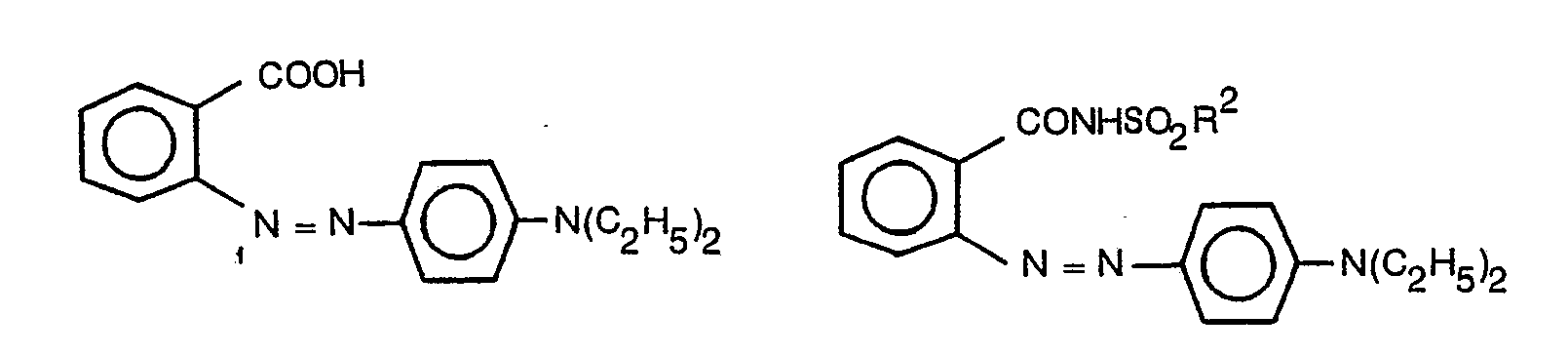

- In another embodiment of the invention a metallisable azo dye is formed using a colour coupler of the formula:

- wherein

- Y is ―COR1, -COOR', ―SO2R2, ―CONR2R3 or -CSNHR2,
- R', R2 and R3 are as defined above,
- Z2 represents the atoms necessary to complete a diffusible or non-diffusible coupler capable of forming a non-diffusible azo dye on coupling with an oxidised colour developing agent.
- Examples of couplers of formula 11 include 2-acetylindazolones of the formula:



- One class of colour developing agents which is especially useful in conjunction with couplers of formula I or II have the general formula:

- R4 is-OH or ―NR2R3 (R2 and R3 being as defined above) and
- G2 is a chelating group.
- Examples of groups which G2 may represent are ―COOH, ―OH, ―NHSO2R2, -CH20H and ―CH2NH2.
- In a further embodiment of the invention the colour developing agent is a hydrazide of the formula:

- R5 is an alkyl, preferably having 1-20 carbon atoms, aryl, preferably having 6-20 carbon atoms or heterocyclic group all of which are optionally substituted, (e.g. as exemplified for R2),
- x2 is -N= or

- X3 is -CO- or, preferably, ―SO2―,
- Z3 represents the atoms necessary to complete an aromatic carbocyclic or heterocyclic nucleus which is optionally substituted, and
- G is as defined above.
- If the developing agents of formula V are ballasted the ballast group may be present in either Z3 or R5.
- Examples of R5 groups are methyl, phenyl, p-methyl-, p-chloro- or p-nitrophenyl, 3-chloro-5-nitrophenyl, or 2-, 3- or 4-pyridyl. Examples of nuclei which Z3 may complete are pyridine, pyrimidine, quinoxaline, pyrazine, quinazoline and thiophene nuclei.
- The developing agents of formula V couple, inter alia, with appropriate conventional couplers, e.g. phenol, naphthol, pyrazolone, 1 H-pyrazolo[3,2-c]-s-triazole or open chain ketomethylene couplers, to form a bi-, tri- or higher-dentate azo dye. An example of such a coupling reaction is as follows:

- Preferred groups of developing agents of formula V have the formulae:


- R6 is hydrogen or alkoxy, preferably having 1-20 carbon atoms, e.g. methoxy,
- R7 is -N02, ―SO2R8 or ―COR2,
- R8 is a tertiary amino group, preferably a piperidino group,
- R9 is hydrogen or-N02,
- R10 is alkyl or alkoxy, preferably containing 1-20 carbon atoms, e.g.-CH3 or-OCH3,
- R" is H, -N02 or ―SO2N(R2)2,
- R12 is H, aryl, substituted aryl, alkyl, substituted alkyl, (e.g. as exemplified for R2 or-CF3), heterocyclic, (e.g. 2-pyridyl), or -CN,
- R3, R6, G and each R2 are as defined above.
- Especially preferred developing agents of the above classes are those having the formulae VI, X, XI and XII.
- Examples of preferred values for R2 in the above formulae include ―CH3, ―C4H9-n, ―C16H33-n, phenyl, o- or p-methyl-, o- or p-chloro- and o- or p-nitro-phenyl.
- In addition to the conventional colour couplers mentioned above, the sulphonylhydrazide developing agents and, in most cases the conventional p-phenylenediamine and p-aminophenol developing agents, will couple with the following classes of coupler compounds of formulae XVII or XXXV although the couplers may not necessarily couple in the same position with the sulfonylhydrazides as they do with the conventional developing agents.


- wherein R13 is R5―NHCO―, ―CN, R14―O―CO―, O2N
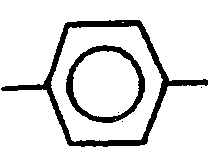
- or p-nitrophenylsulfonyl,
- R14 is an alkyl, preferably having 1-20 carbon atoms, which is optionally substituted, (e.g. with -COOH, ―SO2N(R19)2, -OH, ―SO3H, aryl or substituted aryl groups),
- R15 is hydrogen or an alkyl or aryl both of which are optionally substituted, (e.g., as specified for R2), or where R'4 and R15 are joined to the same nitrogen atom, they may together form a heterocyclic ring, (e.g. morpholine or piperidine),
- R'6 is ―O―R14 or―SO2NH―R15,
- R" is R'4 or ―CONHR14,
- R18 is-OH or-NH2,
- R20 is R2, ―NHCOR2 or ―NHR2,
- R21 is halogen or an alkyl or alkoxy, preferably having 1-20 carbon atoms, which is optionally substituted, e.g. with -COOH, ―SO2N(R19)2, -OH, -S03H, aryl or substituted aryl groups.
- R5 and each R2 are as defined above.
- Especially preferred couplers have the formulae XVII, XIX, XX, XXIII and XXV.
- Specific sulphonyl hydrazide developing agents are listed below in Table I. All alkyl groups in this and other tables are normal (unbranched) unless otherwise specified.


- Specific couplers of formulae XVII to XXXV are listed below in Table 11.


- The couplers and developing agents to be used in the present process may be prepared by organic preparative methods which are, in themselves, known. In particular benzisoxazolone couplers may be prepared as described in British Specification 778,089. Typical pyrazolone couplers may be prepared as described in British Specification 1,183,515 or U.S. Specification 3,519,429 while typical l3-keto-amide couplers may be prepared as described in British Specification 1,078,838 or U.S. Specification 3,384,657. Typical pyrazolotriazole couplers may be prepared as described in British Specifications 1,252,418, 1,334,515, 1,340,191, 1,458,377 and Research Disclosure 12443 (1974).
- The couplers and the colour developing agents employed herein may each be incorporated in the photographic material or dissolved in one of the processing solutions employed. A conventional arrangement is to incorporate ballasted coupler in the photographic material and to dissolve the developing agent in the developer solution.
- In selecting a combination of colour developing agent and colour coupler for use in the present invention, it must be borne in mind that at least one of them and preferably both, should provide a chelating group adjacent to the azo group in the image dye to be formed. The azo groups themselves also act as coordinating sites thus forming bi or tri-dentate dyes. The structures of these reactants should be chosen so that, with the chelated metal ion, a 5- or 6-membered ring is formed with bi-dentate dyes and 5,5, 5,6 or 6,6 two ring systems are formed with tridentate dyes.
- In a preferred embodiment of the present invention the photographic material will have three colour forming units designed to produce a multicolour image. Such materials conventionally contain image-forming units sensitive to blue, green and red light capable of forming yellow, magenta and cyan dye images respectively. Each colour forming unit can be comprised of a single emulsion layer or of multiple emulsion layers sensitive to a given region of the spectrum. The layers of the element, including the layers of the colour-forming units, can be arranged in various orders as known in the art. In an alternative format, the emulsions sensitive to each of the three primary regions of the spectrum can be disposed as a single segmented layer, e.g., as by the use of microvessels as described in Whitmore U.S. Patent Application 184,714 filed October 1, 1980.
- A typical multicolour photographic element would comprise a support bearing a cyan dye image-forming unit comprised of at least one red-sensitive silver halide emulsion layer having associated therewith at least one cyan dye-forming coupler, a magenta dye image-forming unit comprising at least one green-sensitive silver halide emulsion layer having associated therewith at least one magenta dye-forming coupler and a yellow dye image-forming unit comprising at least one blue-sensitive silver halide emulsion layer having associated therewith at least one yellow dye-forming coupler. The element can contain additional layers, such as metal providing layers, filter layers, interlayers, overcoat layers, subbing layers and the like.
- The metal ions which may be employed to form the metal complex dyes are preferably ions of copper, nickel, chromium, cobalt, manganese or zinc. Metallisation may be achieved by incorporating a metal ion, preferably a metal ion which is chelated, in the photographic material. Best results will be obtained if the incorporated metal ion is kept away from the dye-forming reactants until after dye formation has occurred. Preferably, however, metallisation is effected by treatment with a solution containing metal ions. This solution may be the colour developer itself or preferably a subsequently used processing solution, for example an alkaline fix, or separate metallising solution. Metallisation can take place at pH 5.0-12.0 and at normal processing temperatures but usually metallisation will be more efficient at elevated temperatures and under alkaline conditions, e.g. pH 9.5-12.
- Metal compounds may simply be dissolved in a processing solution, e.g. a fix solution, hence watersoluble salts may be used, for example, nickel sulphate or copper sulphate. A preferred separate metallising solution contains nickel or copper sulphate together with ammonium hydroxide at pH 11. The metal ions are preferably used at a concentration of from 0.1 to 100, preferably 1 to 15 g ion/litre.
- The degree of metallisation can be improved by adding cationic surfactant to the metallising solution, for example benzyltributylammonium bromide, cetylpyridinium chloride, benzyltriphenylphosphonium chloride or cetyltrimethylammonium bromide which may be employed at concentrations of from 1 to 75, preferably 2 to 15 g/litre.
- The colour development step may be carried out with a conventional colour developer solution containing an appropriate colour developing agent preferably at a pH of 10.5 to 12, especially at pH 11―11.6. Alternatively the colour developing agent may be incorporated in the photographic material and an alkaline activator used having a pH of 12.5-14.
- It has been found that in many cases the presence of an electron transfer agent or development accelerator aids development and, with certain developing agents, is essential to the present colour development step. This is particularly so with the sulphonyl hydrazide developing agents and especially with the quinazoline compounds of formula XI. Examples of electron transfer agents are pyrazolidinones, for example 4-hydroxymethyl-4-methyl-1-phenylpyrazolidin-3-one which may be employed at concentrations of 0.05-5.0 preferably 0.1-1.0 g/litre. Examples of development accelerators are N-benzyl-a-picolinium bromide and bis-pyridinium methyl ether perchlorate which may be employed at concentrations of 0.2-10 preferably 1.0-5.0 g/litre.
- The photographic silver halide materials to be used in the present invention may be of any of the structures and contain any of the additives as are described in Research Disclosure Item 17643 December 1978, published by Industrial Opportunities Ltd., Havant, Hampshire, U.K.
- Development is followed by the conventional steps of bleaching, fixing, or bleach-fixing, to remove silver and silver halide, washing and drying. As indicated above, metallization can be performed during development or at any point in the process subsequently to development.
- The following Preparations describe the preparation of compounds useful in the present invention.
-

- Sodium 2-chloro-5-nitrobenzenesulphonate (104 g, 0.4 mole) was added to thionyl chloride (240 ml) and dimethylformamide (8 ml) added dropwise with cooling and vigorous stirring. After the initial vigorous reaction had subsided the mixture was stirred for 2 hours at 50°C and then at 90°C for 3 hours. The cooled mixture was poured onto a mixture of ice and water (4 I), the precipitate was filtered off, washed and then dried. The yield of crude product was 70 g, 68%. TLC analysis (CH2CI2) showed one spot of Rf = 0.8. Spectroscopic data was consistent with 2-chloro-5-nitrobenzenesulphonyl chloride which was used crude in the next stage.

- 2-Chloro-5-nitrobenzenesulphonyl chloride (5.12 g, 20 mmole) was added in portions to liquid ammonia with stirring at -78°C (methanol/dry-cold). The mixture was stirred for 0.5 h. and the excess ammonia then allowed to evaporate. The residue was crystallised from aqueous ethanol (1:1) to afford-lustrous prisms of 2-chloro-5-nitrobenzenesulphonamide, 4.42 g, 93%, (m.p. 180°-187°C). TLC analysis (CH2CI2) showed one spot (R, = 0.2). Spectroscopic data was consistent with the product.


- 2-Chloro-5-nitrobenzenesulphonamide (3.35 g, 14.2 mmole) was dissolved in ethanol (75 ml) with heating and hydrazine hydrate (5 ml. 100 mmole) added. The mixture was refluxed for 45 minutes and then allowed to cool to room temperature. The product crystallised in long needles, 2.4 g. A second crop was obtained on cooling the filtrate in an ice bath, 0.5 g. The combined crops were recrystallised from water (120 ml) to afford pure 2-hydrazino-5-nitrobenzenesulphonamide, m.p. 209-210°C, 1.85 gm, 60% as orange-yellow needles. TLC analysis (EtOAc: petrol, 1:1 ) showed one spot (Rf = 0.3). Spectroscopic data was consistent with the product.


- 2-Hydrazino-5-nitrobenzenesulphonamide (1.30 g, 5.6 mmole) was dissolved in dry tetrahydrofuran (25 ml) and pyridine (2 ml). Mesyl chloride (1.28 g, 11.2 mmole) was added dropwise with stirring, the mixture stirred for a further 2 h, and then poured into stirred water (250 ml) cooled to 0°-5°C. The solid was filtered off, 1.47 g, and crystallised from water (100 ml) to afford pure n'-(4-nitro-2-sulphamoylphenyl)-methanesulphonyl hydrazide, m.p. 211-212°C (dec), 1.1 g, 63% as long orange needles. TLC analysis (EtOAc) showed one spot (Rf = 0.7). Analysis indicated the product crystallises as the hemi-hydrate, and was confirmed by spectroscopic data.
-

-


-


-

-

-

- Acetyl chloride (0.51 g, 6.5 mmole) was added dropwise to a stirred solution of 2-hydrazino-5-nitropyridine (1.0 g, 6.5 mmole) in tetrahydrofuran (20 ml). Pyridine (0.51 g, 6.5 mmole) was added, the mixture stirred for 0.5 h, and then poured into water (200 ml). The aqueous solution was extracted with ethyl acetate, the extract dried (MgS04) and the solvent removed under reduced pressure. Recrystallisation of the residue from 1,2-dichloroethane afforded the pure product, 1.1 g, 86%, as a cream coloured solid,

- Further hydrazides were prepared by either Method 1 or Method 2 illustrated in Preparations 1-4 above. Each compound was used as developing agent in the photographic testing procedure described in Example 5 below. The maximum density and photographic speed were each measured and the compounds' relative activity as a colour developing agent was assessed therefrom. Full details are recorded below in Table III.


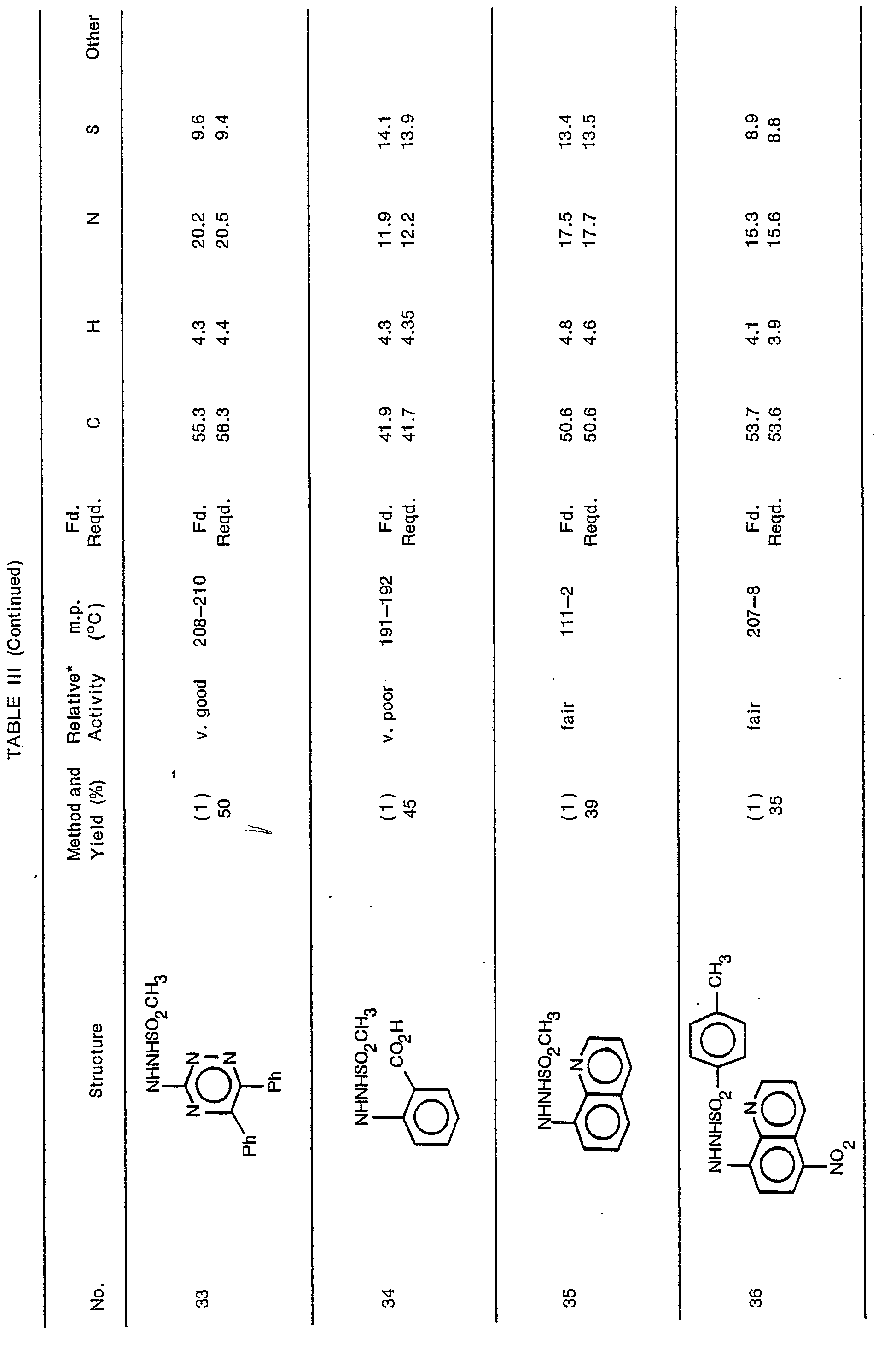

- COLOUR COUPLERS
-

- A mixture of ethyl cyanoacetate (22.6 g, 0.2 mole), hexadecylamine (48.2 g, 0.2 mole) and tetrahydrofuran (200 ml) was refluxed for 1 h. and stirred overnight at room temperature to afford a white precipitate, 27.4 g. The filtrate was stirred for two days to afford a second crop of white precipitate, 11.5 g. The total yield of N-hexadecylcyanoacetamide was 38.9 g, 63% m.p. 95.5-96.5°C. Spectroscopic data was consistent with the product.

- N-[4-(2,4-di-t-pentylphenoxy)butyl]cyanoacetamide.
- N-{4-[2-(cyanoacetamide)ethyl]phenyl}-3-(2,4-di-t-pentylphenoxy)butanoamide.

-

- Hexadecyl sulphonyl chloride (9.74 g, 30 mmole) in tetrahydrofuran (20 ml) was added portionwise to a stirred solution of 3-aminophenol (3.77 g, 34.6 mmole) in tetrahydrofuran (15 ml) and pyridine (15 ml). The mixture was stirred for 2.5 h. and then poured into 1 NHCI solution (600 ml). The crude product was filtered off, washed with water and dried, 11.66 g. Short column chromatography (Florisil/ether) gave the pure product, m.p. 90.5-91.5°C, as white flakes, 9.75 g, 82%. Spectroscopic data confirmed the structure, "Florisil" is a trade mark.

- N-(3-hydroxy-4-methylphenyl)hexadecylsulphonamide

- N-(5-hydroxy-2-methylphenyl)hexadecylsulphonamide

- N-[3-(3-hydroxybenzenesulphamoyl)phenyl]-2-(3-t-butyl-4-hydroxyphenoxy)tridecanoamide

- N-[3-(3-hydroxybenzenesulphamoyl)phenyl]pentadecanoamide

- N-(3-hydroxyphenyl)-2,4,6-triisopropylbenzenesulphonamide

- N-(2-hydroxyphenyl)hexadecylsulphonamide

- N-(4-hydroxyphenyl)hexadecylsulphonamide

-

- 3,5-Dihydroxybenzoic acid (30.8 g, 0.2 mole) was refluxed with acetic anhydride (50 ml) for 15 minutes, cooled and poured into stirred water (500 ml). The mixture was brought to the boiling point and the clear solution allowed to cool overnight at 4°C. The product was obtained as white needles, m.p. 154--156°C, 35.0 g, 74%. Spectroscopic data was consistent with the product.


- 3,5-Diacetoxybenzoic acid (17.0 g, 71.4 mmole) was added to thionyl chloride (50 ml) and heated under reflux for 30 minutes. Excess thionyl chloride was removed by vacuum distillation. Dichloromethane was added to the residue (50 ml) and then evaporated (helps to remove last traces of thionyl chloride). On cooling, the pale straw coloured liquid solidified to a mass of needles. This was used as such in the next stage. The acid chloride was dissolved in tetrahydrofuran (100 ml) and a solution of hexadecylamine (34.4 g, 142.8 mmole) in tetrahydrofuran (430 ml) added in one portion with vigorous stirring. After 15 minutes the amine hydrochloride was filtered off and washed with tetrahydrofuran. The combined filtrate and washings were evaporated to approximately 300 ml and then poured into 1 N hydrochloric acid (31). The product was obtained as a fine white precipitate which was filtered off, washed with water and dried, 28.82 g, 82%, m.p. 100―102°C.


- N-Hexadecyl-3,5-diacetoxybenzamide (28.8 g, 62.5 mmole) was suspended in methanol (500 ml) and purged with nitrogen. A similarly purged solution of potassium hydroxide in water (35 g, 0.625 mole in 50 ml) and methanol (100 ml) was added to the suspension with stirring, and stirred for 2 h. under nitrogen. The resulting solution was poured into 1 N hydrochloric acid (5 1) and the white precipitate filtered off, washed and dried. The product was recrystallised from aqueous ethanol (200 ml H20 + 130 ml ethanol) to afford pure product, 22.11 g, 94%, m.p. 122°-124°C. TLC analysis (EtOAc) showed one spot spectroscopic data was consistent.

- N-Hexadecyl-2,4-dihydroxybenzamide, m.p. 85-86°CN-Hexadecyl-2-(4-hydroxy-1-naphthoxy)propionamide, m.p. 72-73°C.

-

- N-Hexadecyl-3-hydroxy-2-naphthamide, m.p. 98―100°C.

-

- Sodium 4-hydroxynaphthalene-1-sulphonate (50 g, 0.205 mole) was dissolved in 5% aqueous sodium hydroxide solution (200 ml, 0.25 mole) and stirred at 0°C while ethyl chloroformate (24.3 g, 0.225 mole) was added dropwise. The mixture was stirred at 0-5°C for 5 h, during which time a solid precipitated out of solution. The grey solid was filtered off and dried at 60°C under vacuum.
- The yield of crude material was 50.24 g, 77%.

- Crude sodium 4-ethoxycarbonyloxynaphthalene-1-sulphonate (50 g, 0.157 mole) and phosphorus pentachloride (100 g, excess) were intimately mixed and heated on a steam bath with stirring for 0.5 h, and then poured onto crushed ice-water (3 1) while still warm. After stirring for 0.5 h, the sticky olive coloured solid was filtered off, dissolved in dichloromethane, washed with water, and dried over magnesium sulphate.
- The dichloromethane solution was reduced in volume and passed through a short column (Florisil-CH2CI2) to afford a yellow solution. Evaporation of the solvent gave pure product as a pale yellow crystalline mass, 40.4 g, 82%. TLC analysis (CH2CI2) showed one spot (Rf = 0.9) and spectroscopic data was consistent with the required product.

- 4-Ethoxycarbonyloxy-1-naphthalenesulphonyl chloride (40.0 g, 128.5 mmole) was dissolved in tetrahydrofuran (100 ml) and a solution of hexadecylamine (31.0 g, 128.5 mmole) and pyridine (10.2 g, 129 mmole)'in tetrahydrofuran (200 ml) was added with stirring. The mixture was stirred for 2 h, filtered, and the filtrate poured into water (3 1) containing concentrated hydrochloric acid (20 ml). The gum that was obtained was dissolved in ethyl acetate, washed and dried. The solvent was removed, (TLC analysis 1:3 EtOAc:petrol) showed several products at this stage - though one was predominant) and the residue crystallised twice from methanol to afford a beige solid, 22.76 g, 34%. The product had a purity of ~95% by spectroscopic criteria.

- 4-Ethoxycarbonyloxy-N-hexadecylnaphthalene-1-sulphonamide (21.5 g, 41.4 mmole) was added to liquid ammonia (250 ml), in portions with stirring, at -78°C (acetone - drycold bath). The mixture was stirred for 1 h, and the excess ammonia allowed to evaporate. The residue was dissolved in ethyl acetate, washed with water and dried (MgS04). Removal of the solvent gave a pale brown oil which was dissolved in hot dichloromethane (100 ml) and then cooled in an ice-bath. The off-white precipitate was collected and dried in airto yield pure N-hexadecyl-4-hydroxynaphthalene-4-sulphonamide, 7.7 g, 42%. TLC analysis (1:3 EtOAc:40―60° petrol) showed one spot (R, = 0.4) and spectroscopic data was consistent with the product.

-

- 5-Amino-1-hydroxy-2-naphthoic acid (20.3 g, 0.1 mole) was dissolved in tetrahydrofuran (500 ml), water (50 ml) and pyridine (15.8 g, 0.2 mole). Benzene sulphonyl chloride (20 g, 15 ml, 0.113 mole) was added with stirring. The mixture was stirred for 3 h, poured into vigorously stirred 1 N hydrochloric acid (6 1) and the grey precipitate filtered off, washed with water and dried. The yield of product was 23 g, 67%. TLC analysis (5% HOAc in EtOAc) showed one spot (blue fluorescence) and spectroscopic data was consistent with the proposed structure.


- 5-Benzenesulphonamido-1-hydroxy-2-naphthoic acid (22.0 g, 64 mmole) was suspended in a mixture of dry methylene chloride (500 ml), thionyl chloride (17 ml, 236 mmole) and dimethyl formamide (1 ml). The mixture was stirred and heated under reflux for 2 h. The solution was cooled and refrigerated for 1 h. The precipitated acid chloride was filtered off, washed with dry methylene chloride until the washings were pale yellow, and dried at 40°C under vacuum. The yield of product was 16.21 g, 70%. A sample dissolved in hot methanol and subjected to TLC analysis (2:1 EtOAc:petrol) showed one major spot (Rf = 0.8, run as ester) and a small amount of dark baseline material. The product was used crude in the next stage.

- 5-Benzenesulphonamido-1-hydroxy-2-naphthoyl chloride (8.0 g, 22.1 mmole, crude) was suspended in dry tetrahydrofuran (50 ml) and dioctadecylamine (23 g, 44.2 mmole) in warm tetrahydrofuran (100 ml) added with stirring. Athick precipitate was obtained which was stirred overnight. The amine hydrochloride was removed by filtration, washed with tetrahydrofuran and the washings combined with the filtrate. Removal of the solvent gave a dark oil which was taken up in ether and passed through a Florisil® plug to remove dark baseline material. The eluate was evaporated to dryness and chromatographed on a Florisil column. A minor impurity (note 1 ) was removed with methylene chloride: 40-60° petrol (1:1 ) and the product was isolated using ether as eluant. The yield of pure product was 2.6 g, 14%. TLC analysis (CH2Cl2) showed one spot (R, = 0.5). Spectroscopic data was consistent with the proposed structure.

-

- The title compound was prepared by the method described by J. M. Woolley in British Specification 778,089 (1957).
-

- (a) 2-Hydroxy-6-methyl-nicotinic acid (3.6 g, 0.02 m) was heated at 125° for 2 hours with phosphorus oxychloride (10 ml). The reaction mixture was poured onto ice, the solid was collected and crystallised from aqueous ethanol to give colourless fine needles of 2-chloro-6-methylnicotinic acid (72%).The n.m.r. spectrum (DMSO) showed signals at δ 2.58 (Ar.CH3, singlet), 7.40 (1H, doublet), 8.12 (1H, doublet), 10.38 (COOH, broad peak). Molecular ion mle 171.

- (b) 2-Chloro-6-methyl nicotinic acid (3.5 g, 0.02 m) was refluxed with hydrazine hydrate (5 ml) and absolute alcohol (20 ml) for 5 hours. The solid was separated, washed with alcohol and crystallised from water to yield 50% of 2-hydrazino-6-methylnicotinic acid.The n.m.r. spectrum (DMSO) showed signals at δ 2.37 (CH3-Ar, singlet), 6.42 (1H, singlet), 6.86 (NH.NH2, broad peak), 7.90 (1H, doublet), 9.60 (COOH, broad peak). Molecular ion m/e 167.

- (c) 2-Hydrazino-6-methyl nicotinic acid (1.7 g, 0.01 m) was refluxed with water (5 ml) and concentrated hydrochloric acid (10 ml) for 5 hours. The solution was concentrated to one third of the original volume, cooling gave yellow fine needles of 3-hydroxy-6-methyl-1H-pyrazolo[3,4-b]pyridine (58%) as the hydrochloride.The n.m.r. spectrum (DMSO) showed signals at 6 2.75 (CH3-Ar, singlet), 7.18 (1H, doublet), 8.48 (1H, doublet). Molecular ion m/e 149.

- (d) 3-Hydroxy-6-methyl-1H-pyrazolo(3,4-b]pyridine HCI (2 g) was stirred at room temperature with acetic acid (5 ml) and acetic anhydride (10 ml) for 4 hours in presence of pyridine (2 ml) to give the mono-acetylated product, crystallised from aqueous ethanol (49%).Molecular ion m/e 191.

-

- 4-(2,4-Di-t-pentylphenoxy)butylamine (3.05 g, 0.01 m) in dry pyridine (20 ml) was cooled to 0-5°C in an ice bath. Ethyl malonyl chloride (1.05 g, 0.01 m) was added dropwise keeping the temperature at 0-5°C. The reaction mixture was stirred at room temperature for 8 hrs. and then was poured onto ice and conc. hydrochloric acid (5 ml). The yellow sticky gum was extracted with ethyl acetate. Thin layer chromatography using eluant ethyl acetate- petroleum ether (40-60°C) (4: 1), showed one major spot and baseline material. Column chromatography afforded a yellow liquid which on cooling solidified, (mp 35°) in 75% yield. The product was characterised by its accurate mass spectrum and N.M.R.

-
- (i) Ethyl 2-(4-nitrophenylthio)acetate

- (ii) Ethyl 2-(4-nitrophenylsulphonyl)acetate
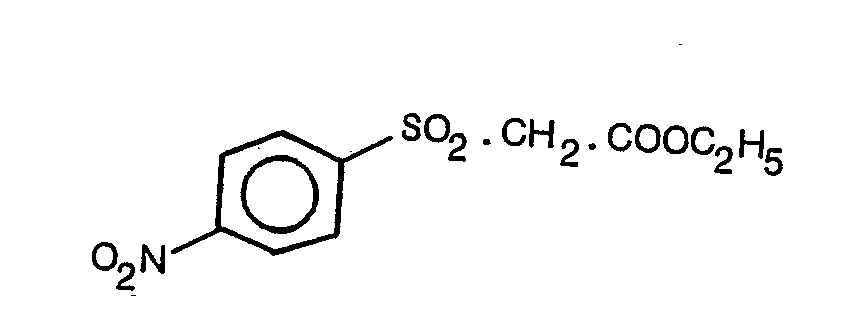
- (iii) 2-(4-nitrophenylsulphonyl)-N-[4-(2,4-di-t-pentylphenoxy)butyl]acetamide
- The structure was characterised by spectroscopic analysis.

- The following Examples are included for a better understanding of the invention. The following words used therein are trade marks: Araldite, Alkanol, Ektalux and Tinuvin.
- A convenient test-tube method for evaluating unballasted couplers consists of dissolving the coupler and developer in 10% sodium carbonate solution, and adding excess potassium persulphate. The oxidised colour developer couples to give the unmetallised azo dye. After 30 seconds, a strip of mordant coating (shown in structure A) is then dipped in the reaction mixture and the azo dye is mordanted and metallised. The strip is washed briefly in running water and then dried. A number of metallised azo dyes formed this way are shown in Tables A and B. Couplers which have the desired activity and give the desired hues can be incorporated in a colour developer composition or can be ballasted and incorporated into the photographic layer (see Example 2)
-

- Mordant 1 - poly(1-vinylimidazole) partially quaternised (10%) with 2-chloroethanol Hardener 2 - Araldite Diluent DY 022 - 1,4-butane diol-di-glycidyl ether.

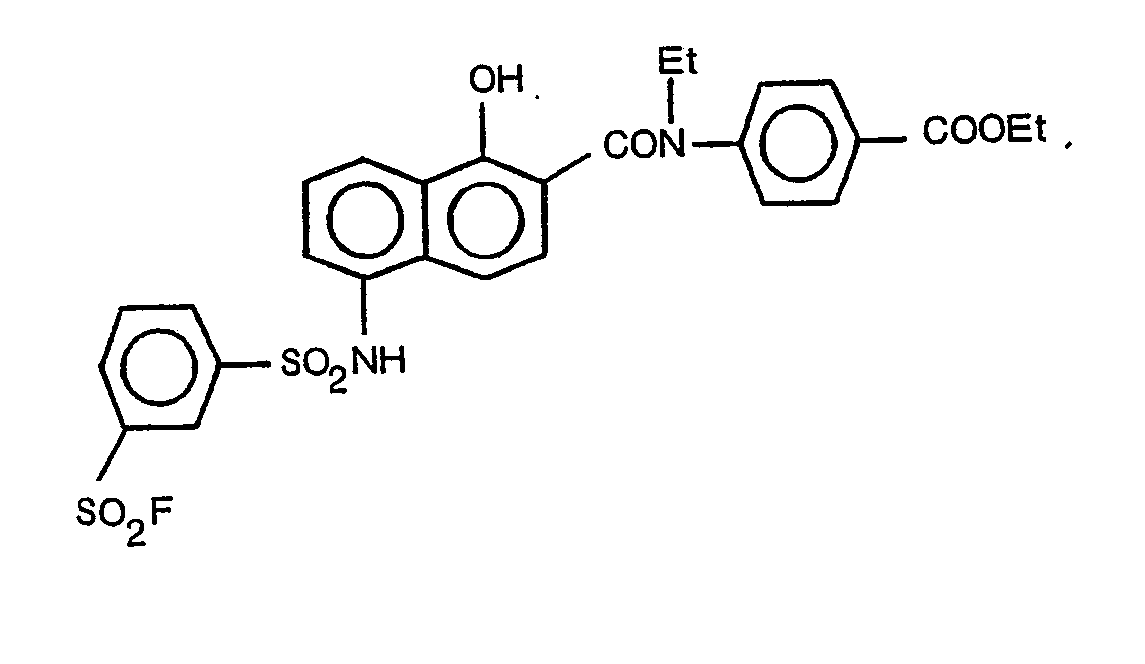

- A coupler dispersion was made by the following method:


- Solution A was added slowly to solution B using ultrasonic agitation and mixture was homogenised for 2 min. The resulting dispersion was cooled, noodle-washed at pH 6.0 for 6 hrs. (4°C) and made up to 100 g wt. pH 5.0. The final dispersion was 7% coupler and 7% gelatin.
- Dispersions of the following couplers were made:-


- Three fogged strips of the coating were developed in a solution of the sulphonylhydrazide developer (approx. 10 mg developer in 5 cm310% Na2C03 solution) for 0.5-5 min. (21°C). The strips were then rinsed in 10% carbonate solution for 0.5 min. to remove retained developer from the coating, washed 2' (30°C), bleach-fixed 2' (ferric EDTA bleach fix) and washed 2' (30°C). One strip was then dried and its spectrum taken - this represented the unmetallised form of the dye. The other strips were metallised for 2-5 min. (21°C) in a nickel or copper metallising bath of the following composition:-


- Samples of the dye formed between developer 10, Table I and coupler 14, Table 11 were prepared as outlined in Example 2 but were metallised in the following solutions for 2 minutes and then washed 10 mins. (30°C).
-

-

-


- Metallisation is also possible at low Ni++ levels (approx. 0.02%) and with other complexing agents instead of ammonia or an ethanolamine.
- Two samples of the dye formed between developer 7 Table I and coupler 14 Table II were prepared as outlined in Example 2 but were metallised in the following solutions for 2 min. at 21°C and washed 2 minutes.
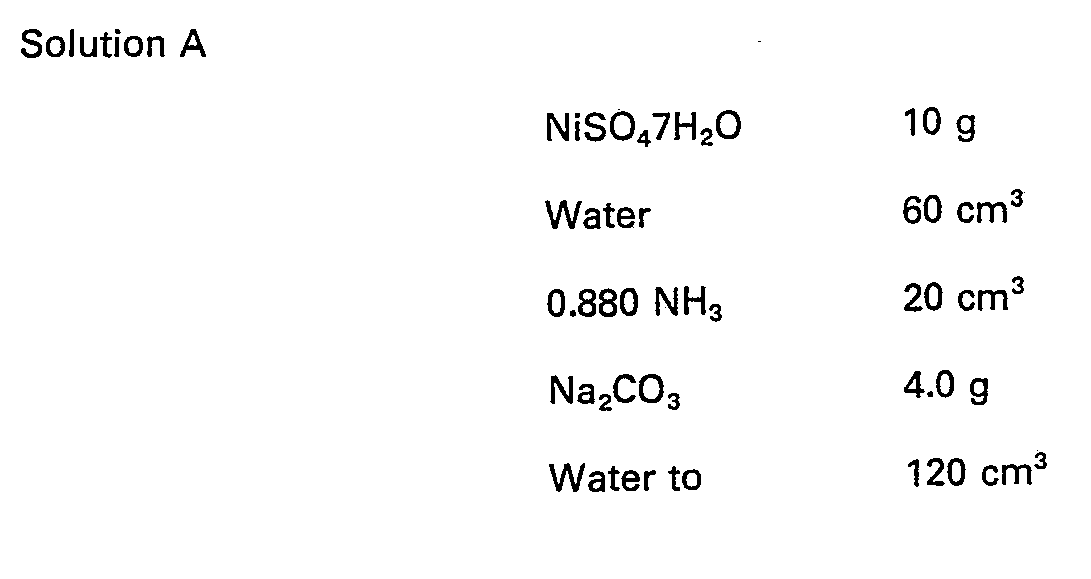

-

- 35 mm strips of coating B containing coupler 24, Table II were exposed to a 0.3 log E increment step wedge. The ,strips were then developed for 1


-
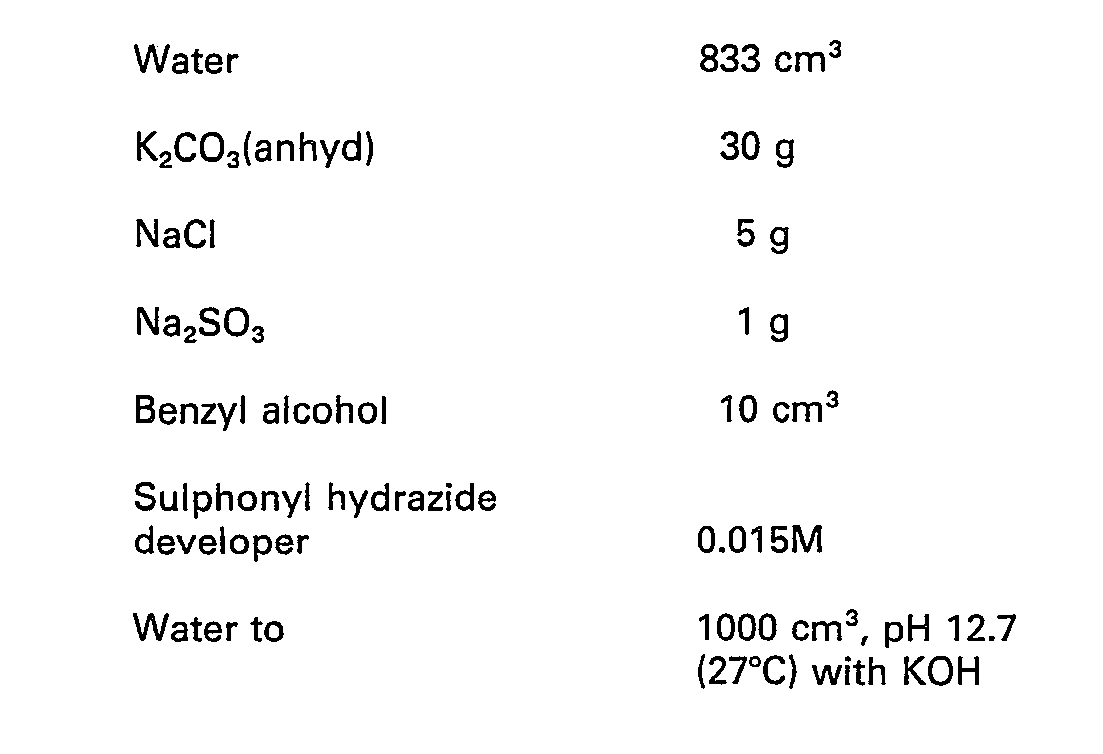
- After development the strips were treated as follows:-

- From the resulting step wedge, Dmax/Dmin, and speed parameters were measured and the spectrophotometric curve of the metallised azo dye was also taken.
- The results are shown in Table J. A fairly wide range of dyes was observed. (Amax 536―618 nm) using the naphthol coupler. The dyes would probably be bidentate complexes with nickel.

- The metallised dyes shown in Table K were prepared as described in Example 2 and faded in a fading device for 400 hrs. The percentage fade from a density of 1.0 shows that a substantial improvement can be obtained by using metallised azo dyes compared with typical unmetallised azamethine dyes.
- In the fading device the samples were irradiated from both sides using two Thorn 65/80W north light fluorescent tubes (NL) and two Philips 40W Actinic Blue 05 tubes (UV) arranged so that one of each type of lamp was directed at each side of the sample at a distance of about 6 cm. Each side of the sample was covered with an Ektalux 2B UV filter and the temperature and humidity were controlled to 21°C, 50% RH respectively.
- The results are recorded in Table K below.


- Three strips of multilayer coating B were exposed to a four colour step wedge (neutral R, G and B exposures) and processed in the following manner:-
- a) Develop. 22 min. at 30°C
- b) Water rinse 2 sec.
- c) Stop Bath 30 sec.
- d) Water rinse 2 sec.
- e) Ferric EDTA bleach fix, 2 min. at 21°C.
- f) Wash 5 min. 30°C.
- g) Metallise (Ni) - solution A, 2 min at 21°C.
- h) Wash 10 min 30°C.
- The developer solution was varied:-
-

- 4-carboxymethyl-4-thiazoline-2-thione
- Developer 1 + 2.0 g/litre bis-pyridinium methyl ether perchlorate.
- Developer 1 + 0.20 g/litre, 4-hydroxymethyl-4-methyl-1-phenyl-pyrazolidin-3-one.


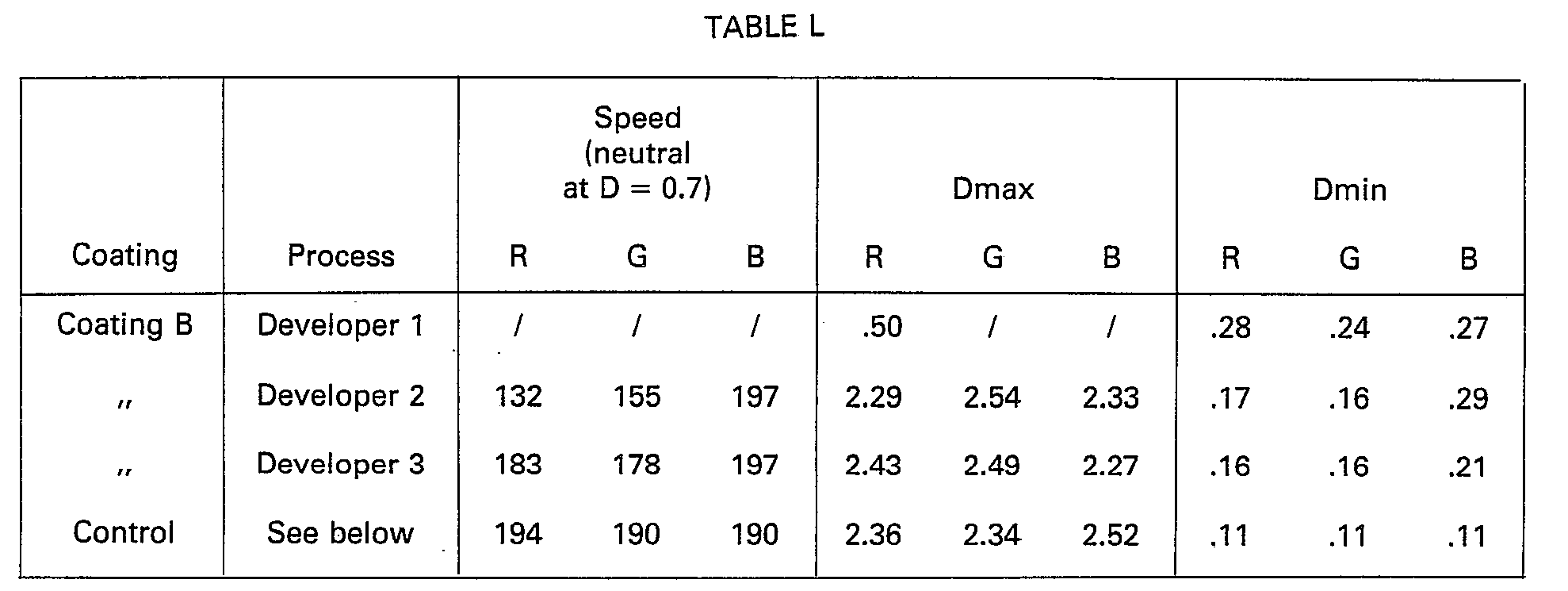
- The Contrbl Coating was like coating B except that the Coupler B and C were replaced by Couplers of Structure Table 11 Structure 26 and Table II Structure 31 respectively. The control coating was processed in the C41 process described in the British Journal of Photography Annual 1977 pp. 204―5 (using a p-phenylenediamine colour developer and no metallising step).
Sodium metal (3.6 g, 0.16 m) was dissolved in ethanol (250 ml) and 4-nitrothiophenol (25 g, 0.13 m) was added to it. To the above mixture was added ethyl chloroacetate (16.0 g). After refluxing for 1 hr, the suspension was filtered. The filtrate was concentrated (50 ml) and allowed to cool, precipitation occurred. The product was collected and dried under vacuum to afford yellow crystals 78% yield, mp. 43-45°C. It was characterised by spectroscopic analysis.

The previous product ester (2.41 g) was dissolved by warming in acetic acid (15 ml) and acetic anhydride (5 ml). It was then cooled in an ice bath (0-5°C), hydrogen peroxide (100 vol, 10 ml) was added and stirred for 1 hr. at 0-5°C. The suspension was then stirred at room temperature for further 2 hrs, after which was poured on to ice and stirred for another half hour. The solid so formed was collected, crystallised from ethanol/40―60° petrol as colourless needles mp. 76-77°, 70% yield. The structure was characterised by spectroscopic analysis.


The previous product ester (2.58 g, 0.01 m) and 2,4-di-t-pentylphenoxy-4-butylamine (3.05 g, 0.01 m) was refluxed on a steam bath in tetrahydrofuran (20 ml) for 6 hrs. The solvent was evaporated under vacuum to give a yellow liquid. Column chromatography on silica (ethyl acetate : pet. ether-4:1 ) afforded a yellow liquid which solidified mp. 36-37° in 80% yield.
Claims (22)

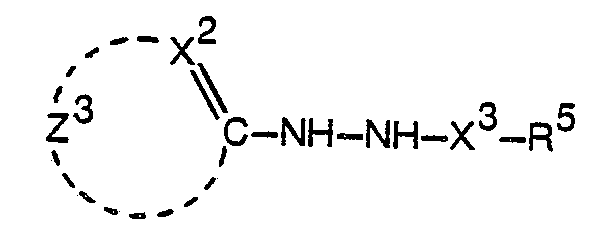


Applications Claiming Priority (2)
| Application Number | Priority Date | Filing Date | Title |
|---|---|---|---|
| GB8126620 | 1981-09-02 | ||
| GB8126620 | 1981-09-02 |
Publications (2)
| Publication Number | Publication Date |
|---|---|
| EP0087446A1 EP0087446A1 (en) | 1983-09-07 |
| EP0087446B1 true EP0087446B1 (en) | 1986-07-09 |
Family
ID=10524278
Family Applications (1)
| Application Number | Title | Priority Date | Filing Date |
|---|---|---|---|
| EP82902681A Expired EP0087446B1 (en) | 1981-09-02 | 1982-09-02 | Method of forming a photographic dye image |
Country Status (6)
| Country | Link |
|---|---|
| US (1) | US4481268A (en) |
| EP (1) | EP0087446B1 (en) |
| JP (1) | JPS58501339A (en) |
| CA (1) | CA1247916A (en) |
| DE (1) | DE3271939D1 (en) |
| WO (1) | WO1983000939A1 (en) |
Families Citing this family (26)
| Publication number | Priority date | Publication date | Assignee | Title |
|---|---|---|---|---|
| DE3580785D1 (en) * | 1984-05-10 | 1991-01-17 | Fuji Photo Film Co Ltd | COLOR PHOTOGRAPHIC LIGHT SENSITIVE SILVER HALOGENIDE MATERIAL. |
| JPS61120154A (en) * | 1984-11-15 | 1986-06-07 | Konishiroku Photo Ind Co Ltd | Silver halide color photographic sensitive material |
| AU4743985A (en) * | 1984-09-14 | 1986-04-10 | Konishiroku Photo Industry Co., Ltd. | Silver halide photographic material with magenta coupler |
| JPS61120147A (en) * | 1984-11-15 | 1986-06-07 | Konishiroku Photo Ind Co Ltd | Silver halide color photographic sensitive material |
| EP0186868A3 (en) * | 1985-01-02 | 1988-09-21 | Eastman Kodak Company | Photographic element and process for providing metal complex color images |
| JPH077201B2 (en) * | 1985-10-19 | 1995-01-30 | 富士写真フイルム株式会社 | Processing method of silver halide color photographic light-sensitive material |
| US4774167A (en) * | 1986-02-24 | 1988-09-27 | Fuji Photo Film Co., Ltd. | Method for processing silver halide color photographic materials wherein the color developer contains low concentrations of benzyl alcohol, hydroxylamine and sulfite |
| EP0254294B1 (en) * | 1986-07-23 | 1992-12-23 | Fuji Photo Film Co., Ltd. | Method of processing a silver halide color photographic material and a color developer |
| JPH087407B2 (en) * | 1988-10-03 | 1996-01-29 | 富士写真フイルム株式会社 | Processing method of silver halide color photographic light-sensitive material |
| GB9125688D0 (en) * | 1991-12-03 | 1992-01-29 | Kodak Ltd | Photographic silver halide colour materials |
| US5415981A (en) * | 1992-03-31 | 1995-05-16 | Eastman Kodak Company | Photographic silver halide color materials |
| GB9209258D0 (en) * | 1992-04-29 | 1992-06-17 | Kodak Ltd | Photographic silver halide colour materials |
| GB9219313D0 (en) * | 1992-09-11 | 1992-10-28 | Kodak Ltd | Method of forming a photographic colour image |
| JP3418043B2 (en) * | 1995-02-15 | 2003-06-16 | 富士写真フイルム株式会社 | Color developing agent, silver halide photographic material and image forming method |
| US5695913A (en) * | 1995-02-28 | 1997-12-09 | Fuji Photo Film Co., Ltd. | Process for the formation of color image |
| US5851749A (en) * | 1995-11-30 | 1998-12-22 | Fuji Photo Film Co., Ltd. | Color-developing agent, silver halide photographic light-sensitive material and image-forming method |
| JP3335053B2 (en) * | 1995-11-30 | 2002-10-15 | 富士写真フイルム株式会社 | Silver halide color photographic light-sensitive material and image forming method |
| JP3699760B2 (en) * | 1995-11-30 | 2005-09-28 | 富士写真フイルム株式会社 | Method for producing azo dye compound |
| JP3337886B2 (en) * | 1995-11-30 | 2002-10-28 | 富士写真フイルム株式会社 | Color developing agent, silver halide photographic material and image forming method |
| JP3361001B2 (en) * | 1995-11-30 | 2003-01-07 | 富士写真フイルム株式会社 | Color developing agent, silver halide photographic material and image forming method |
| JP3579157B2 (en) * | 1995-11-30 | 2004-10-20 | 富士写真フイルム株式会社 | Color diffusion transfer type silver halide photographic material and image forming method |
| JPH09152696A (en) | 1995-11-30 | 1997-06-10 | Fuji Photo Film Co Ltd | Silver halide color photographic sensitive material |
| JPH1048789A (en) * | 1996-08-02 | 1998-02-20 | Fuji Photo Film Co Ltd | Method for processing silver halide color photographic sensitive material |
| US6184226B1 (en) | 1998-08-28 | 2001-02-06 | Scios Inc. | Quinazoline derivatives as inhibitors of P-38 α |
| KR100680584B1 (en) * | 2005-08-19 | 2007-02-08 | (주)아모레퍼시픽 | Hydroxybenzamide compound and preparation method thereof, and cosmetic composition containing the same as an active ingredient |
| WO2012079164A1 (en) * | 2010-12-16 | 2012-06-21 | The Governing Council Of The University Of Toronto | Activators of cylindrical proteases |
Citations (2)
| Publication number | Priority date | Publication date | Assignee | Title |
|---|---|---|---|---|
| US4142891A (en) * | 1976-09-10 | 1979-03-06 | Eastman Kodak Company | Photographic products and processes employing nondiffusible azo dye-releasing compounds |
| EP0047449A2 (en) * | 1980-09-09 | 1982-03-17 | Agfa-Gevaert AG | Process for the production of colour-photographic images |
Family Cites Families (22)
| Publication number | Priority date | Publication date | Assignee | Title |
|---|---|---|---|---|
| US2339213A (en) * | 1939-10-16 | 1944-01-11 | Du Pont | Color development process using aromatic hydrazines |
| BE465310A (en) * | 1945-01-26 | |||
| NL80779C (en) * | 1948-11-23 | |||
| US2708625A (en) * | 1951-01-19 | 1955-05-17 | Gen Aniline & Film Corp | Photographic element for the production of subtractive color images by sulfonhydrazide color development |
| US2964402A (en) * | 1951-10-03 | 1960-12-13 | Gevaert Photo Prod Nv | Mono-acetyl indazolone color couplers |
| BE518561A (en) * | 1952-03-21 | |||
| BE536764A (en) * | 1954-07-13 | |||
| BE542229A (en) * | 1954-10-22 | |||
| BE563765A (en) * | 1957-01-10 | |||
| BE563764A (en) * | 1957-01-10 | |||
| GB875470A (en) * | 1958-07-18 | 1961-08-23 | Ici Ltd | New colour couplers |
| DE1119667B (en) * | 1960-03-25 | 1961-12-14 | Wolfen Filmfab Veb | Process for stabilizing color photographic images |
| US3629336A (en) * | 1968-02-19 | 1971-12-21 | Polaroid Corp | Ligands which are also silver halide developing agents |
| GB1285432A (en) * | 1970-01-07 | 1972-08-16 | Ilford Ltd | Indazole colour couplers |
| US3782949A (en) * | 1971-03-11 | 1974-01-01 | Eastman Kodak Co | Photographic element comprising a hydroxy substituted aliphatic carboxylic acid aryl hydrazide |
| US3762922A (en) * | 1971-03-31 | 1973-10-02 | Du Pont | Silver halide photographic images |
| US3907875A (en) * | 1971-12-03 | 1975-09-23 | Eastman Kodak Co | Di-p-toluenesulfonic acid salt of N-ethyl-N-methoxyethyl-3-methyl 1,4 benzenediamine |
| BE792265R (en) * | 1971-12-03 | 1973-06-04 | Eastman Kodak Co | PHOTOGRAPHIC PROCESSING IN COLORS AND CHEMICAL COMPOUNDS USEFUL FOR IMPLEMENTING THIS |
| JPS5465185A (en) * | 1977-11-04 | 1979-05-25 | Fuji Photo Film Co Ltd | Stablizing method for organic basic substance to light |
| JPS55152750A (en) * | 1979-05-17 | 1980-11-28 | Fuji Photo Film Co Ltd | Stabilization of organic substrate substance against light |
| US4252959A (en) * | 1979-06-28 | 1981-02-24 | Henkel Corporation | Sulfonylhydrazines, metal complexes thereof, and solutions containing such compounds for use in extraction of metal values |
| JPS6029937B2 (en) * | 1979-10-18 | 1985-07-13 | 富士写真フイルム株式会社 | Color image stabilization method for color photographic materials |
-
1982
- 1982-08-31 CA CA000410528A patent/CA1247916A/en not_active Expired
- 1982-09-02 JP JP57502683A patent/JPS58501339A/en active Granted
- 1982-09-02 DE DE8282902681T patent/DE3271939D1/en not_active Expired
- 1982-09-02 US US06/499,754 patent/US4481268A/en not_active Expired - Fee Related
- 1982-09-02 EP EP82902681A patent/EP0087446B1/en not_active Expired
- 1982-09-02 WO PCT/GB1982/000263 patent/WO1983000939A1/en not_active Ceased
Patent Citations (2)
| Publication number | Priority date | Publication date | Assignee | Title |
|---|---|---|---|---|
| US4142891A (en) * | 1976-09-10 | 1979-03-06 | Eastman Kodak Company | Photographic products and processes employing nondiffusible azo dye-releasing compounds |
| EP0047449A2 (en) * | 1980-09-09 | 1982-03-17 | Agfa-Gevaert AG | Process for the production of colour-photographic images |
Also Published As
| Publication number | Publication date |
|---|---|
| WO1983000939A1 (en) | 1983-03-17 |
| JPH0447811B2 (en) | 1992-08-05 |
| EP0087446A1 (en) | 1983-09-07 |
| JPS58501339A (en) | 1983-08-11 |
| US4481268A (en) | 1984-11-06 |
| CA1247916A (en) | 1989-01-03 |
| DE3271939D1 (en) | 1986-08-14 |
Similar Documents
| Publication | Publication Date | Title |
|---|---|---|
| US4481268A (en) | Method of forming a photographic dye image | |
| EP0313308B1 (en) | Photographic element and process comprising a dye releasing group | |
| EP0394974B1 (en) | Photographic material and process | |
| EP0028099B1 (en) | Photographic couplers, emulsions, materials and processes | |
| DE3527116A1 (en) | COLOR PHOTOGRAPHIC, LIGHT-SENSITIVE SILVER HALOGENIDE MATERIAL | |
| DE69022296T2 (en) | Photographic material and process. | |
| JP2633878B2 (en) | Photographic materials containing stabilizer compounds | |
| US4555477A (en) | Photographic element and process utilizing metal complex color masking dyes | |
| US4728599A (en) | Sterically hindered phenolic ester photographic coupler dispersion addenda and photographic elements employing same | |
| EP0593110B1 (en) | Method of forming a photographic colour image | |
| JPS62103640A (en) | Silver halide color photographic sensitive material | |
| US4871652A (en) | Photographic silver halide material and process | |
| JPH01553A (en) | Silver halide color photographic material containing a new cyan coupler | |
| JP3247492B2 (en) | Dyes useful in photographic elements, and photographic elements | |
| EP0115194B1 (en) | Light-sensitive silver halide color photographic material | |
| US5382502A (en) | Hydroxyquinoline cyan couplers and their process of production | |
| US5510235A (en) | Photographic elements comprising 2-phenylcarbamoyl-naphthol image-modifying couplers yielding dyes resistant to crystallization and reduction | |
| JP3310044B2 (en) | Pyrazolotriazole coupler, photographic element and dye image forming method | |
| EP0636934B1 (en) | Photographic elements comprising 2-phenylcarbamoyl-1-naphthol image-modifying couplers yielding dyes resistant to crystallization and reduction | |
| EP0651288B1 (en) | Photographic elements comprising 2-phenylcarbamoyl-1-naphthol image-modifying couplers yielding dyes resistant to crystallization and reduction | |
| EP0655648B1 (en) | Photographic elements comprising 2-phenylcarbomoyl-1-naphthol image-modifying couplers yielding dyes resistant to crystallization and reduction | |
| EP0186868A2 (en) | Photographic element and process for providing metal complex color images | |
| JPS60107649A (en) | Silver halide photosensitive material | |
| JPS6381425A (en) | Silver halide photographic sensitive material | |
| JPS6270846A (en) | Silver halide photographic sensitive material |
Legal Events
| Date | Code | Title | Description |
|---|---|---|---|
| PUAI | Public reference made under article 153(3) epc to a published international application that has entered the european phase |
Free format text: ORIGINAL CODE: 0009012 |
|
| AK | Designated contracting states |
Designated state(s): BE CH DE FR GB LI NL |
|
| 17P | Request for examination filed |
Effective date: 19830819 |
|
| GRAA | (expected) grant |
Free format text: ORIGINAL CODE: 0009210 |
|
| AK | Designated contracting states |
Kind code of ref document: B1 Designated state(s): BE CH DE FR GB LI NL |
|
| REF | Corresponds to: |
Ref document number: 3271939 Country of ref document: DE Date of ref document: 19860814 |
|
| ET | Fr: translation filed | ||
| PLBE | No opposition filed within time limit |
Free format text: ORIGINAL CODE: 0009261 |
|
| STAA | Information on the status of an ep patent application or granted ep patent |
Free format text: STATUS: NO OPPOSITION FILED WITHIN TIME LIMIT |
|
| 26N | No opposition filed | ||
| PGFP | Annual fee paid to national office [announced via postgrant information from national office to epo] |
Ref country code: GB Payment date: 19940812 Year of fee payment: 13 |
|
| PGFP | Annual fee paid to national office [announced via postgrant information from national office to epo] |
Ref country code: FR Payment date: 19940908 Year of fee payment: 13 |
|
| PGFP | Annual fee paid to national office [announced via postgrant information from national office to epo] |
Ref country code: CH Payment date: 19940914 Year of fee payment: 13 |
|
| PGFP | Annual fee paid to national office [announced via postgrant information from national office to epo] |
Ref country code: NL Payment date: 19940930 Year of fee payment: 13 Ref country code: DE Payment date: 19940930 Year of fee payment: 13 |
|
| PGFP | Annual fee paid to national office [announced via postgrant information from national office to epo] |
Ref country code: BE Payment date: 19941012 Year of fee payment: 13 |
|
| PG25 | Lapsed in a contracting state [announced via postgrant information from national office to epo] |
Ref country code: GB Effective date: 19950902 |
|
| PG25 | Lapsed in a contracting state [announced via postgrant information from national office to epo] |
Ref country code: LI Effective date: 19950930 Ref country code: CH Effective date: 19950930 Ref country code: BE Effective date: 19950930 |
|
| BERE | Be: lapsed |
Owner name: EASTMAN KODAK CY Effective date: 19950930 |
|
| PG25 | Lapsed in a contracting state [announced via postgrant information from national office to epo] |
Ref country code: NL Effective date: 19960401 |
|
| GBPC | Gb: european patent ceased through non-payment of renewal fee |
Effective date: 19950902 |
|
| REG | Reference to a national code |
Ref country code: CH Ref legal event code: PL |
|
| PG25 | Lapsed in a contracting state [announced via postgrant information from national office to epo] |
Ref country code: FR Effective date: 19960531 |
|
| PG25 | Lapsed in a contracting state [announced via postgrant information from national office to epo] |
Ref country code: DE Effective date: 19960601 |
|
| NLV4 | Nl: lapsed or anulled due to non-payment of the annual fee |
Effective date: 19960401 |
|
| REG | Reference to a national code |
Ref country code: FR Ref legal event code: ST |