EP0086099B1 - Führungsseilsystem für Positionierung von Unterwasserausrüstung - Google Patents
Führungsseilsystem für Positionierung von Unterwasserausrüstung Download PDFInfo
- Publication number
- EP0086099B1 EP0086099B1 EP83300581A EP83300581A EP0086099B1 EP 0086099 B1 EP0086099 B1 EP 0086099B1 EP 83300581 A EP83300581 A EP 83300581A EP 83300581 A EP83300581 A EP 83300581A EP 0086099 B1 EP0086099 B1 EP 0086099B1
- Authority
- EP
- European Patent Office
- Prior art keywords
- guidelines
- splayed
- item
- tension
- subsea equipment
- Prior art date
- Legal status (The legal status is an assumption and is not a legal conclusion. Google has not performed a legal analysis and makes no representation as to the accuracy of the status listed.)
- Expired
Links
- XLYOFNOQVPJJNP-UHFFFAOYSA-N water Substances O XLYOFNOQVPJJNP-UHFFFAOYSA-N 0.000 claims description 22
- 238000000034 method Methods 0.000 claims description 14
- 238000012544 monitoring process Methods 0.000 claims description 5
- 239000002131 composite material Substances 0.000 description 2
- 238000006073 displacement reaction Methods 0.000 description 2
- 239000012530 fluid Substances 0.000 description 2
- 230000001154 acute effect Effects 0.000 description 1
- 238000010276 construction Methods 0.000 description 1
Images

Classifications
-
- E—FIXED CONSTRUCTIONS
- E21—EARTH OR ROCK DRILLING; MINING
- E21B—EARTH OR ROCK DRILLING; OBTAINING OIL, GAS, WATER, SOLUBLE OR MELTABLE MATERIALS OR A SLURRY OF MINERALS FROM WELLS
- E21B41/00—Equipment or details not covered by groups E21B15/00 - E21B40/00
- E21B41/10—Guide posts, e.g. releasable; Attaching guide lines to underwater guide bases
-
- E—FIXED CONSTRUCTIONS
- E21—EARTH OR ROCK DRILLING; MINING
- E21B—EARTH OR ROCK DRILLING; OBTAINING OIL, GAS, WATER, SOLUBLE OR MELTABLE MATERIALS OR A SLURRY OF MINERALS FROM WELLS
- E21B41/00—Equipment or details not covered by groups E21B15/00 - E21B40/00
- E21B41/08—Underwater guide bases, e.g. drilling templates; Levelling thereof
-
- E—FIXED CONSTRUCTIONS
- E21—EARTH OR ROCK DRILLING; MINING
- E21B—EARTH OR ROCK DRILLING; OBTAINING OIL, GAS, WATER, SOLUBLE OR MELTABLE MATERIALS OR A SLURRY OF MINERALS FROM WELLS
- E21B43/00—Methods or apparatus for obtaining oil, gas, water, soluble or meltable materials or a slurry of minerals from wells
- E21B43/01—Methods or apparatus for obtaining oil, gas, water, soluble or meltable materials or a slurry of minerals from wells specially adapted for obtaining from underwater installations
- E21B43/017—Production satellite stations, i.e. underwater installations comprising a plurality of satellite well heads connected to a central station
-
- E—FIXED CONSTRUCTIONS
- E21—EARTH OR ROCK DRILLING; MINING
- E21B—EARTH OR ROCK DRILLING; OBTAINING OIL, GAS, WATER, SOLUBLE OR MELTABLE MATERIALS OR A SLURRY OF MINERALS FROM WELLS
- E21B7/00—Special methods or apparatus for drilling
- E21B7/12—Underwater drilling
- E21B7/128—Underwater drilling from floating support with independent underwater anchored guide base
Definitions
- This invention relates generally to a splayed guideline system for positioning subsea equipment as the equipment is lowered from a surface structure to a fixed structure located therebelow in a body of water.
- the prior art has generally included two types of systems for achieving such lateral positioning.
- One system utilizes a plurality of tensioned parallel guidelines connected between the surface structure and a structure located therebelow. Examples of such parallel guidelines are shown in US-A-4,226,555 to Bourne et al. US-A-4,192,383 to Kirkland et al., US ⁇ A ⁇ 4,273,471 to Burke and US-A-3,032,125 to Hiser et al.
- Parallel wire guidelines permit a relatively large lateral displacement of the subsea equipment being lowered, when currents or other hydrodyamic forces ar moderately large. If there is no other adjacent equipment to interfere with the equipment being lowered, this causes no problem.
- the second type of prior art system utilizes thruster jets to maneuver the subsea equipment being lowered.
- Those systems generally do not provide sufficient force to position large subsea equipment.
- An example of such a system is shown in US-A-3,215,202 to Pollard et al.
- position indicating devices such as cameras or ultrasonic transducers to give an indication at the surface of a position of the equipment as it is being lowered.
- position indicating equipment is shown in US-A-3,215,202 to Pollard et al. which shows the use of television cameras.
- An ultrasonic type of positioning system is shown in US-A-3,458,853 to Daniels et al.
- a method according to the first part of claim 1 and apparatus according to the first part of claim 7 are both known from US-A-3,129,774.
- the present invention provides a method of laterally positioning a second item of subsea equipment relative to an existing first item of subsea equipment while lowering said second item from a surface structure toward a floor of a body of water, said method comprising providing at least two guidelines extending under tension between said surface structure and a fixed structure located within said body of water below said surface structure, slidably connecting said second item to said guidelines with said guidelines outwardly splayed in at least one direction above or below the sliding connection between said guidelines and said second item, and lowering said second item from said surface structure so that said second item moves downward along said splayed guidelines, characterised in that the method further comprises independently controlling the tension in each of said splayed guidelines, monitoring the position of the said second item relative to the first item, and during said lowering so controlling the tension in each of said splayed guidelines as to move said second item laterally to a desired position thereof in relation to said first item.
- the present invention provides apparatus for laterally positioning an item of subsea equipment while lowering said subsea equipment from a surface structure toward a floor of a body of water, such apparatus comprising follower means attached to said subsea equipment, at least two guidelines connected between said surface structure and a fixed structure located within said body of water below said surface structure, said guidelines being slidably received by said follower means and being arranged so that said guidelines are outwardly splayed in at least one direction above or below said follower means, and tension means for tensioning said splayed guidelines, characterised in that said tension means includes independently variable guideline tensioners one attached to each of said splayed guidelines, arranged independently to vary the tension in each of said splyed guidelines, the apparatus further comprising position monitoring means, operably associated with said subsea equipment, for providing an indication at the surface of said body of water of the position of said subsea equipment being lowered in relation to an adjacent item or items of subsea equipment, and control means
- the present invention provides a system and methods for laterally positioning subsea equipment such as a production riser while lowering said subsea equipment from a surface structure such as a tension leg platform toward a floor of a body of water.
- This system includes follower means attached to the subsea equipment, and includes at least two and preferably at least three guidelines connected between the surface structure and fixed structure, such as a subsea wellhead template, located within the body of water below the surface structure, with the guidelines being slidably received by the follower means and arranged so that the guidelines are outwardly splayed in at least one direction above or below the follower means.
- the guidelines are splayed in both directions above and below the follower means.
- Tension means is provided for tensioning the splayed guidlines to exert a lateral force on the subsea equipment.
- This tension means provides an individually variable tension on the three guidelines. Additionally, constantly tensioned parallel guidelines may be utilized to assist in the guidance of the subsea equipment as it is being lowered.
- a tension leg platform 10 is there shown anchored in a body of water 12 by a plurality of tethering elements 14 attached to anchor bases 16 which are anchored in place on the floor 18 of the body of water.
- a subsea wellhead template 20 is located on the ocean floor 18.
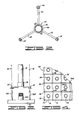
- Fig. 4 shows a plan view of a portion of the subsea wellhead template 20.
- the template 20 includes a framework 22 within which is arranged a plurality of regularly spaced wellheads 24.
- the framework 22 also supports a plurality of guide posts 26 which are generally arranged so that a square pattern of four guideposts 26 are provided about any one of the wellheads 24.
- two risers 28 and 30 are shown alreadly in place between the tension leg platform 10 and the subsea wellhead template 20.
- a third riser 32 is shown being lowered from the tension leg platform 10 to the wellhead template 20.
- Two conventional constantly tensioned parallel guidelines 34 and 36 are connected between tension leg platform 10 and subsea wellhead template 20 on diagonally opposite sides of a wellhead 24A to which the riser 32 is to be connected.
- FIG. 4 one of the wellheads thereof has been denoted as 24A for purposes of illustration, and two diagonal guideposts such as 26A and 26B would be utilized to connect the parallel guidelines 34 and 36.
- Parallel guidelines could be connected to all four guideposts 26 around wellhead 24A.
- a schematic elevation view is thereshown of the wellhead 24A, the guideposts 26A and 26B, and the parallel constantly tensioned guidelines 34 and 36.
- the constant tension on parallel guidelines 34 and 36 is provided in a manner analogous to that illustrated in Fig. 6 and described below.
- riser 32 On the lower end of riser 32 there is a conventional wellhead connector 38 and conventional follower means 40 and 42 are attached thereto and have the constantly tensioned parallel guidelines 34 and 36 slidably received therein for guiding the wellhead connector 38 into engagement with the wellhead 24A.
- a splayed guideline follower means 44 is connected to the riser 32.
- An enlarged plan view of splayed guideline follower means 44 is shown in Fig. 2.
- a central ring 46 is bolted about riser 32 and has three arms 48, 50 and 52 extending radially therefrom with guideline receivers 54, 56 and 58 attached to the radially outer ends thereof.
- the guideline receivers 54, 56 and 58 may be constructed in a manner similar to those which have been conventionally used for receiving parallel guidelines such as shown in Fig. 3.
- Tension leg platform 10 may be referred to as a surface structure
- subsea wellhead template 20 may be referred to as a fixed structure located within the body of water 12 below the tension leg platform 10.
- Fig. 1 is a schematic illustration and only two of the splayed guidelines are there shown for ease of illustration.
- Each of the splayed guidelines 60, 62, and 64 is slidably received within one of the guideline receivers 54, 56 and 58 and is arranged as seen in Fig. 1 so that the guidelines are outwardly splayed away from each other both above and below the follower means 44 attached to the riser 32.
- the exact portion of the guidelines 60, 62 and 64 touching the follower means 44 is generally referred to as a point of sliding engagement of the guidlines 60, 62 and 64 with the riser 32.
- the upper ends of the splayed guidelines are attached to a tension means for tensioning the splayed guidelines to exert a lateral force on the riser 32 as it is being lowered.
- the tension means may include various types of guideline tensioners, two of which are schematically illustrated in Fig. 1.
- a hydraulic ram type tensioner 66 is shown connected to the upper end of splayed guideline 60.
- a rotary winch type tensioner 68 is shown connected to the upper end of splayed guideline 62. It. will be understood that generally the same type of tensioner will be utilized for all three of the splayed guidelines, but alternative versions are shown in Fig. 1 merely to prevent unnecessary duplication of drawings.
- the hydraulic ram type tensioner 66 may for example be obtained from the NL Shaffer company or the Vetco company in the form illustrated at pages 4950-4954 and pages 6861 ⁇ 6862, respectively, of the 1978-79 COMPOSITE CATALOG OF OIL FIELD EQUIPMENT & SERVICES.
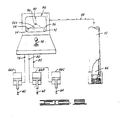
- the system providing separately variable guideline tensioners to each of the splayed guidelines 60, 62 and 64 is schematically illustrated in Fig. 5.
- the tension means illustrated in Fig. 5 includes first, second and third separately variable guideline tensioners 66A, 66B and 66C, respectively, one of which is attached to each of the splayed guidelines 60, 62 and 64 for separately varying a tension in each of said splayed guidelines.
- a position indicator means for providing an indication at surface of the body of water 12 of the position of the riser 32 as it is lowered in relation to adjacent previously positioned subsea equipment such as first and second risers 28 and 30.
- a position indicator means is illustrated schematically in Fig. 5, and includes a TV camera 84 mounted in the lower end of riser 32 and pointed downward so as to view directly below the riser 32.
- TV camera 84 is connected to a video display screen 86 located in a control room on the tension leg platform 10. This connection is provided by electrical connecting means 88.
- Schematically illustrated as displayed on the screen 86 is an image of the upper end of wellhead 24A and of the parallel guidelines 34 and 36 on diagonally opposite sides thereof. It will be understood that as the riser 32 moves laterally relative to the wellhead 24A, the position of the image of wellhead 24A and parallel guidelines 34 and 36 on the screen 86 will move on the screen 86.
- the screen 86 has three fixed target lines 90, 92 and 94 superimposed thereon which intersect at center point 96 representing the desired location of the image of wellhead 24A.
- the target lines 90, 92 and 94 are arranged at angles of 120° therebetween to represent the orientation of the three splayed guidelines 60, 62 and 64 which are themselves arranged preferably at angles of 120° about the periphery of riser 32.
- the target lines 90, 92 and 94 may be thought of as corresponding to guidelines 60, 62 and 64, respectively.
- a control means 98 is provided for controlling the tension in each of the splayed guidelines 60, 62 and 64.
- the control means 98 includes a joystick operator handle, the position of which, in conjunction with a suitable fluid power source and supply valve control system (not shown), determines simultaneously the separately variable hydraulic pressures being directed to each of the hydraulic ram tensioners 66A, 66B and 66C.
- the center point 96 represents the position of the camera 84, and thus of the lower end of riser 32, and thus a human operator working the joystick operator handle 98 will observe the position of the riser relative to surrounding equipment and control the position of riser 32 by moving the joystick operator handle 98 so that the image of wellhead 24A coincides with center point 96.
- the television cameras such as 84 could be mounted adjacent the riser 32 by a framework such as illustrated in U.S. Patent No. 3,215,202 to Pollard et al. so that the screen 86 will directly display the image of the lower end of riser 32 and the adjacent surroundings so that the actual engagement of riser 32 with wellhead 24A could be viewed.
- a combination of both types of position indicator systems could be utilized such that one video display screen displays a view such as that illustrated in Fig. 5, and a second screen illustrates a view such as would be provided by a system like that of U.S. Patent No. 3,215,202 to Pollard et al.
- the system just illustrated and described utilizes three double splayed guidelines located at angles of 120° about the riser 32.
- the preferred embodiment of the invention illustrated in the drawing and just described above has three splayed guidelines. It is necessary to have at least three splayed guidelines to provide complete control of lateral movement of riser 32 in any horizontal direction. It is of course possible to utilize more than three splayed guidelines. There are, however, situations where only two splayed guidelines may be necessary to achieve the desired positioning. Those would be situations wherein control in only one general horizontal direction was needed. For example, only two splayed guidelines would be required if the current were constantly from only one direction and/or if adjacent risers were only on diametrically opposite sides of a subsea location to which a third riser being lowered is to be connected.
- the splayed guidelines 60, 62 and 64 are illustrated as being splayed both above and below the point of sliding engagement with the follower means 44, and thus they have been referred to as double splayed guidelines. It is possible to achieve the advantages of the present invention to a somewhat lesser degree by utilizing single splayed guidelines, i.e., an arrangement of guidelines wherein the guidelines were outwardly splayed only in one direction either above or below the follower means 44.
Landscapes
- Life Sciences & Earth Sciences (AREA)
- Engineering & Computer Science (AREA)
- Geology (AREA)
- Mining & Mineral Resources (AREA)
- Physics & Mathematics (AREA)
- Environmental & Geological Engineering (AREA)
- Fluid Mechanics (AREA)
- General Life Sciences & Earth Sciences (AREA)
- Geochemistry & Mineralogy (AREA)
- Earth Drilling (AREA)
Claims (15)
Applications Claiming Priority (2)
| Application Number | Priority Date | Filing Date | Title |
|---|---|---|---|
| US346854 | 1982-02-08 | ||
| US06/346,854 US4451177A (en) | 1982-02-08 | 1982-02-08 | Guideline system for positioning subsea equipment |
Publications (3)
| Publication Number | Publication Date |
|---|---|
| EP0086099A2 EP0086099A2 (de) | 1983-08-17 |
| EP0086099A3 EP0086099A3 (en) | 1984-05-16 |
| EP0086099B1 true EP0086099B1 (de) | 1988-08-17 |
Family
ID=23361302
Family Applications (1)
| Application Number | Title | Priority Date | Filing Date |
|---|---|---|---|
| EP83300581A Expired EP0086099B1 (de) | 1982-02-08 | 1983-02-04 | Führungsseilsystem für Positionierung von Unterwasserausrüstung |
Country Status (6)
| Country | Link |
|---|---|
| US (1) | US4451177A (de) |
| EP (1) | EP0086099B1 (de) |
| JP (1) | JPS58156615A (de) |
| CA (1) | CA1187868A (de) |
| DK (1) | DK153931C (de) |
| NO (1) | NO830380L (de) |
Families Citing this family (4)
| Publication number | Priority date | Publication date | Assignee | Title |
|---|---|---|---|---|
| NL2006982C2 (en) * | 2011-06-22 | 2013-01-02 | Ihc Holland Ie Bv | Centre system. |
| CA2784630C (en) | 2012-07-30 | 2015-07-07 | Jeremy Leonard | Method of dredging a pond |
| CA2784850C (en) | 2012-07-30 | 2015-11-24 | Jeremy Leonard | Method of automated variable speed control of movement of a cutter head of a dredging cutter |
| CA3004270C (en) | 2018-05-08 | 2022-01-25 | Jeremy Leonard | Autonomous vertically-adjustable dredge |
Family Cites Families (15)
| Publication number | Priority date | Publication date | Assignee | Title |
|---|---|---|---|---|
| US3032125A (en) * | 1957-07-10 | 1962-05-01 | Jersey Prod Res Co | Offshore apparatus |
| US3021909A (en) * | 1958-10-01 | 1962-02-20 | California Research Corp | Means for offshore drilling |
| US3129774A (en) * | 1960-09-09 | 1964-04-21 | California Research Corp | Method and apparatus for drilling and working in offshore wells |
| US3215202A (en) * | 1961-10-10 | 1965-11-02 | Richfield Oil Corp | Off-shore drilling and production apparatus |
| US3209827A (en) * | 1962-09-13 | 1965-10-05 | Shell Oil Co | Well drilling method and apparatus |
| US3333820A (en) * | 1966-05-17 | 1967-08-01 | Moore Corp Lee C | Oil well drilling apparatus with traveling block guide |
| FR1498353A (fr) * | 1966-05-25 | 1967-10-20 | Grenobloise Etude Appl | Système d'amarrage pour corps flottants en particulier pour appontements |
| US3458853A (en) * | 1967-08-08 | 1969-07-29 | Eg & G Inc | Underwater guidance method and apparatus |
| US3430695A (en) * | 1967-11-08 | 1969-03-04 | Mobil Oil Corp | Method and apparatus for installing underwater wellhead support |
| FR2242290B1 (de) * | 1973-09-03 | 1977-02-25 | Subsea Equipment Ass Ltd | |
| US4181453A (en) * | 1977-08-24 | 1980-01-01 | Sea Tank Co. | Apparatus for positioning an off-shore weight structure on a previously positioned sea bed unit |
| US4192383A (en) * | 1978-05-02 | 1980-03-11 | Armco Inc. | Offshore multiple well drilling and production apparatus |
| US4226555A (en) * | 1978-12-08 | 1980-10-07 | Conoco, Inc. | Mooring system for tension leg platform |
| US4260291A (en) * | 1979-02-27 | 1981-04-07 | J. Ray Mcdermott & Co., Inc. | Installation of an offshore structure |
| US4273471A (en) * | 1979-06-13 | 1981-06-16 | Chevron Research Company | Marine-drilling sub-base assembly for a soft-bottom foundation |
-
1982
- 1982-02-08 US US06/346,854 patent/US4451177A/en not_active Expired - Fee Related
-
1983
- 1983-01-28 CA CA000420514A patent/CA1187868A/en not_active Expired
- 1983-02-04 EP EP83300581A patent/EP0086099B1/de not_active Expired
- 1983-02-04 NO NO830380A patent/NO830380L/no unknown
- 1983-02-04 DK DK046683A patent/DK153931C/da not_active IP Right Cessation
- 1983-02-07 JP JP58017597A patent/JPS58156615A/ja active Pending
Also Published As
| Publication number | Publication date |
|---|---|
| DK46683A (da) | 1983-08-09 |
| US4451177A (en) | 1984-05-29 |
| CA1187868A (en) | 1985-05-28 |
| JPS58156615A (ja) | 1983-09-17 |
| DK153931B (da) | 1988-09-26 |
| EP0086099A2 (de) | 1983-08-17 |
| EP0086099A3 (en) | 1984-05-16 |
| DK46683D0 (da) | 1983-02-04 |
| NO830380L (no) | 1983-08-09 |
| DK153931C (da) | 1989-02-06 |
Similar Documents
| Publication | Publication Date | Title |
|---|---|---|
| EP2420439B1 (de) | Verfahren zum Absenken eines Objekts zu einer Unterwasserinstallation unter Verwendung eines ferngesteuerten Fahrzeugs | |
| US6588985B1 (en) | Apparatus and method for deploying an object or a load on a seabed | |
| GB2109325A (en) | Mooring system for tension leg platform | |
| CN102834583A (zh) | 用于安装和测试水下井口装备的系统 | |
| EP3735509B1 (de) | Integration von bohrlöchern in schleppbaren unterwassereinheiten | |
| AU661511B2 (en) | Multiplexed electrohydraulic type of control system for use in undersea production system | |
| JPH0432918B2 (de) | ||
| GB2226063A (en) | Production system for subsea oil wells | |
| EP0086099B1 (de) | Führungsseilsystem für Positionierung von Unterwasserausrüstung | |
| GB2069955A (en) | Anchoring apparatus for a ship used in the production of hydrocarbons | |
| US4430023A (en) | Rope guiding device | |
| KR20140068790A (ko) | 드릴링리그용 워킹웰의 호스들을 조작하기 위한 장치 | |
| EP2328726B1 (de) | Vorrichtung für spritzzonenarbeitsgänge | |
| US4687377A (en) | Method and apparatus for subsea flexible conduit installation | |
| CN111101947B (zh) | 不同水深级别深海采矿的硬管系统角度偏移补偿装置 | |
| GB1582950A (en) | Submersible pipe installation systems | |
| EP0058159B1 (de) | Tau-führungsvorrichtung | |
| US3696864A (en) | Undersea riser structure | |
| WO1998017893A1 (en) | Well head with control module and connection assembly | |
| US10794139B2 (en) | Umbilical method | |
| AU537441B2 (en) | Rope guiding device | |
| KR20150042394A (ko) | 무어링 유닛 및 이를 이용한 수중 작업 방법 | |
| CA2147562C (en) | Single drilling guide base for subsea oil wells | |
| EP0638747A2 (de) | Verbindungsstelle zum Anschluss eines ferngesteuerten Fahrzeugs an eine Stütze für Unterwasserpipelines | |
| EP0045653A1 (de) | Verankern schwimmfähiger Anlagen |
Legal Events
| Date | Code | Title | Description |
|---|---|---|---|
| PUAI | Public reference made under article 153(3) epc to a published international application that has entered the european phase |
Free format text: ORIGINAL CODE: 0009012 |
|
| AK | Designated contracting states |
Designated state(s): FR GB NL |
|
| PUAL | Search report despatched |
Free format text: ORIGINAL CODE: 0009013 |
|
| AK | Designated contracting states |
Designated state(s): FR GB NL |
|
| 17P | Request for examination filed |
Effective date: 19840716 |
|
| 17Q | First examination report despatched |
Effective date: 19860305 |
|
| GRAA | (expected) grant |
Free format text: ORIGINAL CODE: 0009210 |
|
| AK | Designated contracting states |
Kind code of ref document: B1 Designated state(s): FR GB NL |
|
| ET | Fr: translation filed | ||
| PLBE | No opposition filed within time limit |
Free format text: ORIGINAL CODE: 0009261 |
|
| STAA | Information on the status of an ep patent application or granted ep patent |
Free format text: STATUS: NO OPPOSITION FILED WITHIN TIME LIMIT |
|
| 26N | No opposition filed | ||
| PGFP | Annual fee paid to national office [announced via postgrant information from national office to epo] |
Ref country code: GB Payment date: 19910116 Year of fee payment: 9 |
|
| PGFP | Annual fee paid to national office [announced via postgrant information from national office to epo] |
Ref country code: FR Payment date: 19910219 Year of fee payment: 9 |
|
| PGFP | Annual fee paid to national office [announced via postgrant information from national office to epo] |
Ref country code: NL Payment date: 19910228 Year of fee payment: 9 |
|
| PG25 | Lapsed in a contracting state [announced via postgrant information from national office to epo] |
Ref country code: GB Effective date: 19920204 |
|
| PG25 | Lapsed in a contracting state [announced via postgrant information from national office to epo] |
Ref country code: NL Effective date: 19920901 |
|
| GBPC | Gb: european patent ceased through non-payment of renewal fee | ||
| NLV4 | Nl: lapsed or anulled due to non-payment of the annual fee | ||
| PG25 | Lapsed in a contracting state [announced via postgrant information from national office to epo] |
Ref country code: FR Effective date: 19921030 |
|
| REG | Reference to a national code |
Ref country code: FR Ref legal event code: ST |