EP0086080A2 - Rohrförmiges Transportsystem für Schüttgut - Google Patents
Rohrförmiges Transportsystem für Schüttgut Download PDFInfo
- Publication number
- EP0086080A2 EP0086080A2 EP83300505A EP83300505A EP0086080A2 EP 0086080 A2 EP0086080 A2 EP 0086080A2 EP 83300505 A EP83300505 A EP 83300505A EP 83300505 A EP83300505 A EP 83300505A EP 0086080 A2 EP0086080 A2 EP 0086080A2
- Authority
- EP
- European Patent Office
- Prior art keywords
- tube
- cars
- car
- coal
- set forth
- Prior art date
- Legal status (The legal status is an assumption and is not a legal conclusion. Google has not performed a legal analysis and makes no representation as to the accuracy of the status listed.)
- Ceased
Links
Images

Classifications
-
- B—PERFORMING OPERATIONS; TRANSPORTING
- B61—RAILWAYS
- B61B—RAILWAY SYSTEMS; EQUIPMENT THEREFOR NOT OTHERWISE PROVIDED FOR
- B61B13/00—Other railway systems
- B61B13/10—Tunnel systems
Definitions
- This invention relates generally to coal transportation, and more particularly to a tubular coal transport system in which a continuous succession of small, individually-powered loaded cylindrical cars travel through a tube, the empty cars being returned in the same tube to the coal site in a collapsed state, the arrangement being such that the loaded and empty cars travelling in opposing directions occupy substantially all available space in the tube.
- Coal usable as an energy source takes many forms.
- anthracite which is hard, compact and shiny black, ignites with some difficulty and burns with a smokeless blue flame.
- electric power generating plants situated in or close to anthracite- producing regions are important users of such coal.
- the use of anthracite produced at mines remote from power plants is presently discouraged by the high cost of coal transport.
- low-volatile, medium volatile and high-volatile bituminous coal are also available.
- the principal ranks of coal mines in major coal- producing states in the United States are set forth in bulletins published by the U.S. Bureau of Mines. Among the several states in which coal is mined are Colorado, New Mexico, Utah and Wyoming.
- a conventional unit-train is composed of as many as one to two hundred coal cars which are linked together and drawn by one or more diesel or steam locomotives. Its length is such that it takes several minutes for a unit train to pass through a road crossing; and with a number of unit trains passing through in the course of a single day, these trains represent a serious interference in the daily life of communities which lie on the path of the railroad.
- Coal may be transported over a considerable distance by solids pipelines.
- a solids pipeline as distinct from a fluid pipeline, requires that the solid product to be transported be prepared for pipeline conveyance.
- the largest particle size must be limited to that which can readily pass through commercially-available pipes and related equipment.
- Unclean coal can be transported by pipeline, but the use of clean coal creates a slurry with a lower and more uniform friction-heat loss; it reduces pipe-wall wear and enlarges the system capacity.
- the modern practice is to first clean the coal, then grind the clean coal to the proper particle size and size range distribution, and finally mix the particles with water in the prescribed concentration.
- coal slurry pipeline system In a coal slurry pipeline system, one not only requires heavy-duty pumping stations at various points along the travel path as well as high-strength durable pipes, but at the receiving terminals the coal must be dewatered, use being made for this purpose of settling ponds.
- the coal slurry system despite high installation, operating and maintenance costs, is usually feasible, especially when its costs are compared to unit-train transport costs, for medium distances.
- any slurry pipeline system for coal water must be available at the transmitting end of the line in plentiful quantities, for the water used for the slurry is not returned to its point of origin but is discharged at the receiving end of the pipeline.
- a slurry system is therefore inappropriate to mining sites located in semi-arid regions or those such as Wyoming and Utah which lack adequate surface water supplies.
- water can be obtained by drawing it by pumps from a deep underground water-bearing stratum of permeable rock or sand, yet it may be inadvisable to deplete this resource.
- the extration of water over a period of years from aquifers may lead to a significant shrinkage thereof, thereby lowering the ground water level, with possible disastrous consequences to regional agricultural operations.
- Slurry pipelines make use of centrifugal pumps located at a series of stations along the line.
- the mechanisms of such pumps are eroded by coal particles and affected by sub-zero weather, causing the water to freeze or become highly viscous.
- the pump therefore, have a relatively short life, thereby adding to capital and maintenance costs.
- the pumping stations are located above ground to provide ready access thereto, whereas the line itself is usually buried underground. This arrangement creates a further complication; for with a centrifugal pump, the inlet thereto is in line with the pipe, whereas the pump has a peripheral exist which dictates a large bend to return the output of the pump to the inline direction at the pumping station.
- the cost per ton increases to a point where it approaches and possibly exceeds the cost-per-ton of a conventional unit-train system.
- Both conventional unit-train and slurry pipeline systems when travel distances run about 1000 miles, involve transport costs estimated in 1981 money terms, to exceed $36 per ton. This cost is about three times the present cost of coal at the mining site.
- the main object of this invention is to provide an efficient and reliable coal transport system which requires no water to operate and which makes it feasible to transport coal over long distances at a cost substantially lower per ton than existing unit-train or slurry pipeline systems.
- an object of this invention is to provide a tubular coal transport system in which coal is conveyed through a tube from a coal source to a receiving terminal over an extended distance, the coal being carried by a continuous succession of small, individually-powered cars travelling at low speed; for example, 15 miles per hour. While it takes any one slowly moving car travelling a distance of one thousand miles several days to traverse this distance, each car is quickly succeeded by another; hence it is as if the coal were being conveyed continuously through the tube.
- an object of this invention is to provide a tubular system of the above type capable of delivering many millions of tons per year over an extended route without disturbing the communities in the path of the tube, for the tube readily lends itself to underground burial at crossing points.
- Still another object of this invention is to provide a tubular coal transport system in which a succession of loaded coal cars travel through the tube in the forward direction and travel empty in a collapsed state in the return direction, the arrangement being such that the succession of loaded cars and the succession of empty tubes occupy substantially all of the available space of the tube, thereby making it possible to use a tube having a relatively small cross-sectional area.
- a tubular coal transport system in which a continuous succession of small, individually-powered loaded cars travel through a tube from a coal source to a receiving terminal over an extended distance.
- Each wheeled car has a generally cylindrical form and includes a bottom trough in which electric motors are installed. to drive the car wheels at a controlled rate, and a cover composed of two arcuate sections hinged to the trough and foldable therein to collapse the car when it is empty, thereby reducing the volume of the car.
- the cars When loaded, the cars travel from the source to the receiving terminal along a forward track mounted on the base of the tube adjacent one side thereof.
- the collapsed cars When empty, the collapsed cars travel back to the coal source on a return track mounted on the opposite side of the tube, the arrangement being such that the succession of loaded and empty cars travelling in opposing directions occupy substantially all available space in the tube.
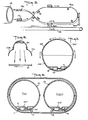
- Figs. 1 and 2 there is shown the tube 10 included in a tubular coal transport system in accordance with the invention.
- the tube which in this embodiment has an elliptical cross-section, may be fabricated of many short sections, each of which is made of concrete or galvanized sheet steel or any other material appropriate to the environment in which the tube is located, suitable joints being provided to intercouple the sections.
- the length of the tube depends on the distance to be traversed between the coal source or transmitting terminal and the receiving terminal which may be a port or a transfer point.
- a forward track composed of parallel rails 11 and 12, the rails being constructed to take into account the curvature of the tube so that their wheel-engaging surfaces lie at the same level.
- Each wheel set is powered by its own motor (15F and 15R).
- Car 13 has a generally cylindrical form and includes a lower trough 13A having a semi-cylindrical shape and an upper cover defined by a pair of arcuate sections 13B and 13C which are hinged to opposite sides of the trough.
- the hinge points H1 and H2 are at a level above the center plane P of the cylindrical car, so that when sections 13B and 13C are folded down, these sections then lie within trough 13A to collapse the car and thereby reduce its effective volume.
- the car includes catches to hold the cover sections in their folded-in positions. As shown in Fig. 2, each cylindrical car is enclosed by end plates 16 formed by semi-circular sections 16A and 16B, the upper section being hinged from the lower sections so that the upper section may be folded down when the car is empty.
- trough 13A Mounted for rotation on trough 13A on opposite sides thereof at a point just below center plane P are a pair of free-running guide wheels 17 which operate in bearings 17'.
- the cars travelling on the forward track are fully loaded with coal, the cars in this mode having their cover sections joined together to complete the cylinder in which in a practical embodiment may have a four foot diameter and a ten foot length.
- the collapsed cars travelling on the return track have a little more than half the volume of the loaded cars, hence occupy much less space in the tube. Since the loaded and unloaded cars run along their respective tracks in a continuous succession in close proximity to each other, the available space in the tube is almost fully exploited, thereby making it possible to provide a tube whose small cross-sectional area makes the per- foot construction cost of the tube relatively low.
- the midplane width of the elliptical tube may be about 6-1/2 feet, and the center height about 4-1/2 feet.
- Power is supplied to the forward and return tracks (11-12, 18-19) by a power grid, as in a conventional electrical railroad system, by way of a multiplicity of connections at suitable intervals along the 1000 mile route.
- a connection may be made at 10 mile intervals, this resulting in 100 connections.
- the wheels physically and electrically engage the power rails which act to supply power to the motors.
- the rails may be grounded and power supplied by an insulated power rail place between the travel rails and engaged by a shoe projecting below the car.
- the contact surfaces of the rails are hardened to produce a low coefficient of rolling friction, thereby reducing energy requirements as well as extending the effective life of the rails.
- the rails When the tube is fabricated of metal, the rails must, of course, be electrically insulated therefrom.
- Each car may, therefore, include a speed monitoring sensor operating in conjunction with a microprocessor which compares the actual or real time speed with a predetermined nominal speed and acts in response to any deviation therebetween to adjust the motor speed accordingly, thereby maintaining the desired car speed under varying conditions.
- Or motor speed may be remotely controlled from a central computer through a carrier communication system which conveys digital information over the rails, . each moving car having control signals addressed thereto by the same computer.
- the tube may be provided at spaced points along its length with transmitting stations whose field is intercepted by a detector borne by the car as the car passes therethrough. The signal then sent out by the car identifies the car and its speed relative to the transmitting station, this information being conveyed over the rails to the central computer which digests this information and then addresses to the car the corrective measures necessary to cause the car to move at the proper speed.
- the collapsed empty cars from the return track of tube 10 are designated cars 13E and the loaded cars entering the forward track are designated cars 13L.
- the input terminal is provided with an input track section which intercouples the forward and reverse tracks and takes the form of a reversing loop RL 1 .
- an empty car 13E emerges from the return track in the tube, it travels through the reversing zone Z onto the lower course of the loop.
- the car then passes onto the upper course of the loop where, before it runs under a coal hopper 22, its hinged, folded-in cover sections 13B and 13C are folded out to render the car receptive to a load of coal, as shown in Fig. 4.
- the car cover sections are then closed and the end sections are raised before the car passes again through the reversing zone Z to enter the forward track in the tube.
- the empty cars entering the input terminal and the loaded cars leaving the terminal are automatically inspected by inspection stations 23 or robots 24, a defective car being switched out of the reversing loop for maintenance before being returned thereto in proper working order.
- the track section intercoupling the forward and return tracks at the far end of the tube also take the form of a reversing loop RL 2 in which the loaded cars 13L, after passing reversing zone Z travel along the upper course of the loop.
- a conveyor belt 25 is located under the lower course of the reversing loop, the cover sections 13B and 13C of the cars being folded out (see Fig. 6), so that as the loaded cars pass into the lower course, the coal therein is dumped onto the conveyor.
- the cover sections of the empty cars are then folded in and the end plate sections are dropped before entering the return track in the collapsed state.
- robots 24 and inspection stations 23 serve to detect defective cars and to switch them out of the loop before going back into the tube.
- cover sections for the cars which are hinged to trough 13A use may be made of arcuate sections 13B' and 13C', as shown in Fig. 7, in the form of sliding doors.
- the sections are either joined together at their adjacent ends to complete the cylinder, or they are angularly displaced to lie against the curved sides of the trough to open the car.
- Fig. 8 In some instances, particularly when land or right-of-way costs are low, use may be made, as shown in Fig. 8, of a tube whose cross-sectional dimension is large enough to accommodate two uncollapsed cars; one being loaded with coal, and the other being empty. These cars may be of the type previously disclosed, but there is no need to fold in the cover sections to reduce the volume of the empty car.
- One advantage of this arrangement is that the forward track formed by rails 11 and 12 and the return track formed by rails 18 and 19 may both be placed along the bottom of the' tube, thereby obviating the need for guide rails, as in the Fig. 1 embodiment in which the empty cars travel on a return track mounted on a side wall.
- the operation of the system in Fig. 8 is essentially the same as in Fig. 1.
Landscapes
- Engineering & Computer Science (AREA)
- Transportation (AREA)
- Mechanical Engineering (AREA)
- Chutes (AREA)
- Filling Or Emptying Of Bunkers, Hoppers, And Tanks (AREA)
Applications Claiming Priority (2)
| Application Number | Priority Date | Filing Date | Title |
|---|---|---|---|
| US34569982A | 1982-02-04 | 1982-02-04 | |
| US345699 | 1999-06-30 |
Publications (2)
| Publication Number | Publication Date |
|---|---|
| EP0086080A2 true EP0086080A2 (de) | 1983-08-17 |
| EP0086080A3 EP0086080A3 (de) | 1983-11-16 |
Family
ID=23356114
Family Applications (1)
| Application Number | Title | Priority Date | Filing Date |
|---|---|---|---|
| EP83300505A Ceased EP0086080A3 (de) | 1982-02-04 | 1983-02-01 | Rohrförmiges Transportsystem für Schüttgut |
Country Status (1)
| Country | Link |
|---|---|
| EP (1) | EP0086080A3 (de) |
Cited By (3)
| Publication number | Priority date | Publication date | Assignee | Title |
|---|---|---|---|---|
| WO1993023275A1 (fr) * | 1992-05-11 | 1993-11-25 | Ac Atelier Commun Etudes Et Realisations D'architecture S.A. | Installation de changement de voie pour vehicule |
| FR2780692A1 (fr) * | 1998-07-03 | 2000-01-07 | Cgea Comp Gen Entre Auto | Utilisation de wagon-conteneur |
| WO2003022654A1 (en) * | 2001-09-13 | 2003-03-20 | Kimberley Vere Sadleir | Conduit conveyor |
Families Citing this family (1)
| Publication number | Priority date | Publication date | Assignee | Title |
|---|---|---|---|---|
| CN108528462A (zh) * | 2018-03-29 | 2018-09-14 | 西京学院 | 一种具有侧导向轮的轮式车辆海底真空管道交通系统 |
Family Cites Families (4)
| Publication number | Priority date | Publication date | Assignee | Title |
|---|---|---|---|---|
| US3358812A (en) * | 1966-02-23 | 1967-12-19 | Tribe Norman George | Conveyor system for moving solids over long distances |
| US3443677A (en) * | 1967-10-30 | 1969-05-13 | Norman G Tribe | Conveyor system for moving solids over long distances |
| FR2315475A1 (fr) * | 1975-06-25 | 1977-01-21 | Pailleron Stephane | Dispositif de levage et de manutention pour vehicules circulant notamment dans des structures souterraines |
| CH616891A5 (en) * | 1977-09-26 | 1980-04-30 | Vevey Atel Const Mec | Bucket car with opening roof |
-
1983
- 1983-02-01 EP EP83300505A patent/EP0086080A3/de not_active Ceased
Cited By (3)
| Publication number | Priority date | Publication date | Assignee | Title |
|---|---|---|---|---|
| WO1993023275A1 (fr) * | 1992-05-11 | 1993-11-25 | Ac Atelier Commun Etudes Et Realisations D'architecture S.A. | Installation de changement de voie pour vehicule |
| FR2780692A1 (fr) * | 1998-07-03 | 2000-01-07 | Cgea Comp Gen Entre Auto | Utilisation de wagon-conteneur |
| WO2003022654A1 (en) * | 2001-09-13 | 2003-03-20 | Kimberley Vere Sadleir | Conduit conveyor |
Also Published As
| Publication number | Publication date |
|---|---|
| EP0086080A3 (de) | 1983-11-16 |
Similar Documents
| Publication | Publication Date | Title |
|---|---|---|
| AU2022201996B2 (en) | Rail transport dump loop system for conveying bulk materials | |
| EP0086080A2 (de) | Rohrförmiges Transportsystem für Schüttgut | |
| Dos Santos | Sandwich Belt High Angle Conveyors Coal Mine to Prep Plant and Beyond–2016 | |
| US4609097A (en) | High angle conveyor | |
| WO2019060948A1 (en) | ROPE CONVEYOR SYSTEM | |
| Sevim et al. | Comparative economic analysis of transportation systems in surface coal mines | |
| US3013499A (en) | Conveyer systems | |
| US20230295882A1 (en) | Rail transport over-under bypass system for conveying bulk materials | |
| CN101702898A (zh) | 大量材料运输系统 | |
| CN219859195U (zh) | 井下水平巷道用煤量均衡煤仓及原煤输送系统 | |
| Kessler | Recent developments in the field of bulk conveying | |
| Cowan | Study of Continuous Face Haulage Systems | |
| Kesimal | Different types of belt conveyors and their applications in surface mines | |
| Rietschel et al. | Coal handling along the supply chain | |
| Hartley | Belt Conveyor Transportation | |
| SU912576A1 (ru) | Транспортное средство дл перевозки крупногабаритных грузов | |
| Manno | Outlook for Pipelining Solids | |
| Lieberwirth | Economic advantages of belt conveying in open-pit | |
| Christo et al. | Research Study of Continuous Haulage from Open Pit Mines | |
| Liu | Freight Pipelines: An Overview | |
| Woodcock et al. | Capsule transport | |
| WHITE | AVAILABILITY AND SELECTION OF COAL HANDLING PLANT | |
| MOYNIHAN et al. | EVALUATION OF THE SERPENTIX CONVEYING SYSTEM | |
| Eklund | Economic implications of innovations in railway vehicle design | |
| GB190930006A (en) | Improvements in Portable Railways and Conveyors for Running thereon for Conveying the Cut Coal in Mines and Discharging the same. |
Legal Events
| Date | Code | Title | Description |
|---|---|---|---|
| PUAI | Public reference made under article 153(3) epc to a published international application that has entered the european phase |
Free format text: ORIGINAL CODE: 0009012 |
|
| AK | Designated contracting states |
Designated state(s): DE FR GB IT |
|
| PUAL | Search report despatched |
Free format text: ORIGINAL CODE: 0009013 |
|
| AK | Designated contracting states |
Designated state(s): DE FR GB IT |
|
| RHK1 | Main classification (correction) |
Ipc: E21F 13/02 |
|
| 17P | Request for examination filed |
Effective date: 19840511 |
|
| STAA | Information on the status of an ep patent application or granted ep patent |
Free format text: STATUS: THE APPLICATION HAS BEEN REFUSED |
|
| 18R | Application refused |
Effective date: 19860703 |