EP0084809A2 - Dispersion of acryl plastics - Google Patents
Dispersion of acryl plastics Download PDFInfo
- Publication number
- EP0084809A2 EP0084809A2 EP83100223A EP83100223A EP0084809A2 EP 0084809 A2 EP0084809 A2 EP 0084809A2 EP 83100223 A EP83100223 A EP 83100223A EP 83100223 A EP83100223 A EP 83100223A EP 0084809 A2 EP0084809 A2 EP 0084809A2
- Authority
- EP
- European Patent Office
- Prior art keywords
- weight
- acrylic
- formaldehyde
- dispersions
- plastic
- Prior art date
- Legal status (The legal status is an assumption and is not a legal conclusion. Google has not performed a legal analysis and makes no representation as to the accuracy of the status listed.)
- Granted
Links
Classifications
-
- D—TEXTILES; PAPER
- D04—BRAIDING; LACE-MAKING; KNITTING; TRIMMINGS; NON-WOVEN FABRICS
- D04H—MAKING TEXTILE FABRICS, e.g. FROM FIBRES OR FILAMENTARY MATERIAL; FABRICS MADE BY SUCH PROCESSES OR APPARATUS, e.g. FELTS, NON-WOVEN FABRICS; COTTON-WOOL; WADDING ; NON-WOVEN FABRICS FROM STAPLE FIBRES, FILAMENTS OR YARNS, BONDED WITH AT LEAST ONE WEB-LIKE MATERIAL DURING THEIR CONSOLIDATION
- D04H1/00—Non-woven fabrics formed wholly or mainly of staple fibres or like relatively short fibres
- D04H1/40—Non-woven fabrics formed wholly or mainly of staple fibres or like relatively short fibres from fleeces or layers composed of fibres without existing or potential cohesive properties
- D04H1/58—Non-woven fabrics formed wholly or mainly of staple fibres or like relatively short fibres from fleeces or layers composed of fibres without existing or potential cohesive properties by applying, incorporating or activating chemical or thermoplastic bonding agents, e.g. adhesives
- D04H1/587—Non-woven fabrics formed wholly or mainly of staple fibres or like relatively short fibres from fleeces or layers composed of fibres without existing or potential cohesive properties by applying, incorporating or activating chemical or thermoplastic bonding agents, e.g. adhesives characterised by the bonding agents used
-
- D—TEXTILES; PAPER
- D04—BRAIDING; LACE-MAKING; KNITTING; TRIMMINGS; NON-WOVEN FABRICS
- D04H—MAKING TEXTILE FABRICS, e.g. FROM FIBRES OR FILAMENTARY MATERIAL; FABRICS MADE BY SUCH PROCESSES OR APPARATUS, e.g. FELTS, NON-WOVEN FABRICS; COTTON-WOOL; WADDING ; NON-WOVEN FABRICS FROM STAPLE FIBRES, FILAMENTS OR YARNS, BONDED WITH AT LEAST ONE WEB-LIKE MATERIAL DURING THEIR CONSOLIDATION
- D04H1/00—Non-woven fabrics formed wholly or mainly of staple fibres or like relatively short fibres
- D04H1/40—Non-woven fabrics formed wholly or mainly of staple fibres or like relatively short fibres from fleeces or layers composed of fibres without existing or potential cohesive properties
- D04H1/58—Non-woven fabrics formed wholly or mainly of staple fibres or like relatively short fibres from fleeces or layers composed of fibres without existing or potential cohesive properties by applying, incorporating or activating chemical or thermoplastic bonding agents, e.g. adhesives
- D04H1/64—Non-woven fabrics formed wholly or mainly of staple fibres or like relatively short fibres from fleeces or layers composed of fibres without existing or potential cohesive properties by applying, incorporating or activating chemical or thermoplastic bonding agents, e.g. adhesives the bonding agent being applied in wet state, e.g. chemical agents in dispersions or solutions
-
- Y—GENERAL TAGGING OF NEW TECHNOLOGICAL DEVELOPMENTS; GENERAL TAGGING OF CROSS-SECTIONAL TECHNOLOGIES SPANNING OVER SEVERAL SECTIONS OF THE IPC; TECHNICAL SUBJECTS COVERED BY FORMER USPC CROSS-REFERENCE ART COLLECTIONS [XRACs] AND DIGESTS
- Y10—TECHNICAL SUBJECTS COVERED BY FORMER USPC
- Y10T—TECHNICAL SUBJECTS COVERED BY FORMER US CLASSIFICATION
- Y10T428/00—Stock material or miscellaneous articles
- Y10T428/31504—Composite [nonstructural laminate]
- Y10T428/31786—Of polyester [e.g., alkyd, etc.]
-
- Y—GENERAL TAGGING OF NEW TECHNOLOGICAL DEVELOPMENTS; GENERAL TAGGING OF CROSS-SECTIONAL TECHNOLOGIES SPANNING OVER SEVERAL SECTIONS OF THE IPC; TECHNICAL SUBJECTS COVERED BY FORMER USPC CROSS-REFERENCE ART COLLECTIONS [XRACs] AND DIGESTS
- Y10—TECHNICAL SUBJECTS COVERED BY FORMER USPC
- Y10T—TECHNICAL SUBJECTS COVERED BY FORMER US CLASSIFICATION
- Y10T428/00—Stock material or miscellaneous articles
- Y10T428/31504—Composite [nonstructural laminate]
- Y10T428/31786—Of polyester [e.g., alkyd, etc.]
- Y10T428/31797—Next to addition polymer from unsaturated monomers
-
- Y—GENERAL TAGGING OF NEW TECHNOLOGICAL DEVELOPMENTS; GENERAL TAGGING OF CROSS-SECTIONAL TECHNOLOGIES SPANNING OVER SEVERAL SECTIONS OF THE IPC; TECHNICAL SUBJECTS COVERED BY FORMER USPC CROSS-REFERENCE ART COLLECTIONS [XRACs] AND DIGESTS
- Y10—TECHNICAL SUBJECTS COVERED BY FORMER USPC
- Y10T—TECHNICAL SUBJECTS COVERED BY FORMER US CLASSIFICATION
- Y10T442/00—Fabric [woven, knitted, or nonwoven textile or cloth, etc.]
- Y10T442/20—Coated or impregnated woven, knit, or nonwoven fabric which is not [a] associated with another preformed layer or fiber layer or, [b] with respect to woven and knit, characterized, respectively, by a particular or differential weave or knit, wherein the coating or impregnation is neither a foamed material nor a free metal or alloy layer
- Y10T442/2549—Coating or impregnation is chemically inert or of stated nonreactance
- Y10T442/2566—Organic solvent resistant [e.g., dry cleaning fluid, etc.]
Definitions
- the invention relates to aqueous plastic dispersions which contain no formaldehyde and no acrylonitrile and do not release these substances when the dispersion or the plastic is heated.
- the invention further relates to its application for solidifying textile fabrics.
- acrylic plastic dispersions are used which contain N-methylolamide groups or formaldehyde condensation resins as crosslinking agents and / or whose plastic content can be partially made up of acrylonitrile.
- These dispersions or the plastics contained therein release - at least when heated - small amounts of formaldehyde or acrylonitrile, which is particularly undesirable if products equipped with them are to be used in the food or clothing sector.
- the content of acrylonitrile or formaldehyde-releasing substances has hitherto been considered indispensable in order to give the products equipped with the dispersions sufficient resistance to chemical cleaning agents.
- a formaldehyde- and acrylonitrile-free acrylate dispersion is known from EP-A 12032, which is suitable for solidifying predominantly hydrophilic fiber structures.
- the plastic part of the dispersion is largely made up of plasticizing monomers, such as higher acrylic or methacrylic acid esters, and the rest of it made up of plasticizing monomers, such as styrene or methyl methacrylate, and from an unsaturated carboxylic acid.
- plasticizing monomers such as higher acrylic or methacrylic acid esters
- plasticizing monomers such as styrene or methyl methacrylate
- Such dispersions have been known for a long time. Textile fabrics equipped with this have the disadvantage that they are not very resistant to the solvents commonly used in chemical cleaning.
- Acrylic or methacrylamide or hydroxyalkyl esters of acrylic or methacrylic acid or mixtures thereof can also be used as further comonomers to build up the dispersed plastic. This does not lead to a decisive improvement in the resistance to organic solvents.
- the fiber structures solidified with these binders can therefore not be used for purposes in which they come into contact with organic solvents, plasticizers or plastic articles produced therewith.
- Similar binders are proposed in EP-A 12033 for hydrophobic fiber structures; they have the same disadvantages.
- Acrylonitrile and formaldehyde-free acrylic plastic dispersions suitable for solidifying fiber structures should be improved to the extent that the fiber structures solidified therewith have sufficient resistance to the solvents used in chemical cleaning and to plasticizers.
- the properties of such fiber structures which have been produced using conventional, self-crosslinking acrylic resin dispersions can be used as a yardstick for sufficient resistance.
- These dispersions always contain N-methylolamide groups, from which small amounts of formaldehyde can be split off, and in some cases acrylonitrile.
- the task is accomplished by acrylic plastic dispersions with the composition of the plastic specified in the main claim.
- the following table compares the evaluation results that were obtained on textile fabrics that had been solidified with various binders under standardized test conditions.
- One test consists in determining the loss of binders during chemical cleaning with trichlorethylene at 20 ° C.
- the swelling is determined after storage for 4 hours in methyl isobutyl ketone at room temperature. This test leaves sensitivity to plasticizers detect. In both cases, low numerical values are aimed for.
- a conventional self-crosslinking acrylic dispersion and various other acrylic dispersions were used as binders, which are free of acrylonitrile and formaldehyde-releasing substances and which were made from a mixture of higher acrylic and methacrylic esters as well as a hydroxyalkyl ester, an unsaturated carboxylic acid and optionally with acrylamide. It has been shown that the sensitivity of the solidified fiber structures to organic cleaning agents and plasticizers is considerably greater than when using known self-crosslinking acrylic dispersions and leads to results which are practically unusable.
- Test specimens are an impregnated and dried at 80 ° C polyester fabric with a binder layer of 50 wt .-% in the determination of the binder loss and in the determination of the methyl isobutyl ketone absorption polymer films of 30 x 30 mm in size and 0.5 mm in thickness, which by drying the dispersion at 35 ° C.
- the resistance to organic cleaning agents and plasticizers is significantly increased if small amounts of a multifunctional crosslinking agent are involved in the build-up of the binder.
- a multifunctional crosslinking agent in principle, it is of course known that the resistance of a binder to organic solvents and plasticizers can be improved by crosslinking.
- crosslinking affects film formation, it has previously been considered essential to bring about crosslinking, for example by means of N-methylolamide groups, only after film formation when heated.
- the plastics according to the invention are therefore only crosslinked to such a small extent that perfect film formation is possible. It was not to be expected that such a low level of crosslinking could have a lasting effect on the resistance to organic solvents and plasticizers.
- the increased resistance is not based solely on the crosslinking, but rather on a synergistic interaction of the crosslinking agent with the amide groups and hydroxyalkyl ester groups. It is not known how this synergism comes about, but it turns out that each of the three components mentioned is indispensable for the high durability achieved.
- the new dispersions can be used successfully wherever previously self-crosslinking acrylic plastic dispersions were used with N-methylolamide groups.
- the consolidation of textile fabrics is a preferred area of application.
- the predominant structural component a) consists of the acrylic or methacrylic esters characterized in the main claim, some, but generally not more than half, of which can be replaced by styrene.
- acrylic and methacrylic acid alkyl esters those with at least 4 carbon atoms in the alkyl radical are particularly preferred, in particular n-butyl acrylate and methacrylate and 2-ethylhexyl acrylate.
- High proportions of these esters ensure a low minimum film formation temperature (according to DIN 53787) and a low dynamic freezing temperature (according to DIN 53445).
- the minimum film formation temperature of the dispersion is preferably below 70 ° C. and the dynamic freezing temperature of the films produced therefrom is preferably below 40 ° C.
- Esters of acrylic acid, methacrylic acid, maleic acid, fumaric acid or itaconic acid can be used as the hydroxyalkyl ester component b). They contain at least 2 and generally not more than 12, preferably at most 4 carbon atoms in the hydroxyalkyl radical.
- Preferred monomers of this type are hydroxyethyl acrylate and methacrylate, 2-hydroxypropyl acrylate and methacrylate and 4-hydroxybutyl acrylate and methacrylate.
- the preferred proportion of component b) in the copolymer is 3 to 15% by weight.
- Acrylic and / or methacrylamide are used in an amount of 1 to 10, preferably 2 to 6% by weight.
- Crosslinking comonomers d) with at least two polymerizable carbon double bonds can be compounds which contain double bonds of the same or different reactivity.
- the former are acrylic and methacrylic esters of glycols, such as ethylene glycol, diethylene glycol, 1,4-butanediol; Methylene bis-acrylamide and methacrylamide, divinylbenzene, diallyl phthalate and triallyl cyanurate.
- Crosslinking monomers with different reactivity of the double bonds are, for example, vinyl methacrylate, allyl acrylate and allyl methacrylate.
- the amount of the crosslinking comonomer depends on its crosslinking activity, which depends on the reactivity of the double bonds and on the molecular weight of the monomer. With proportions below 0.05% by weight, calculated on the weight of the copolymer, the desired improvement in solvent resistance is generally not achieved to a sufficient extent. If the proportion exceeds 3% by weight, film formation can be disturbed. Within the range of 0.5 to 3% by weight, the solvent resistance of the films increases with increasing crosslinking and is appropriately chosen so high that the film formation is just not affected.
- the preferred level of crosslinking monomers is 0.1 to 1% by weight.
- Unsaturated carboxylic acids do not necessarily have to be involved in the structure of the copolymer, but a proportion of up to 5% by weight, based on the weight of the copolymer, can improve the stability of the dispersion. Fractions of 0.5 to 3% by weight are usually sufficient for this.
- Acrylic or methacrylic acid is preferably used.
- Other usable unsaturated polymerizable mono- or dicarboxylic acids are crotonic acid, maleic acid, fumaric acid and itaconic acid.
- N-vinylimidazole or of dialkylaminoalkyl esters of acrylic or methacrylic acid or of their salts are examples of further comonomers which can be used for other purposes.
- further comonomers which can be used for other purposes are N-vinylpyrrolidone, vinyl acetate and other vinyl esters, vinyl chloride, vinylidene chloride, butadiene, ethylene and propylene.
- the dispersions according to the invention can be produced by the known processes of emulsion polymerization in the presence of the anionic, nonionic or cationic emulsifiers and water-soluble free-radical initiators commonly used.
- Anionic emulsifiers or combinations of anionic and nonionic emulsifiers are preferably used.
- the average particle diameter (weight average) can be between 20 and 2000 nm and is preferably 100 to 500 nm.
- the solids content is preferably between 50 and 70% of the total weight.
- the preferred field of application for the dispersions according to the invention is the solidification of textile fabrics. These include nonwovens, wadding, fabrics and knitted fabrics made from natural or synthetic fibers or their mixtures. Quantities of, for example, 1 to more than 100% by weight of plastic, based on the weight of the fiber, can be used for consolidation. 10 to 30% by weight are preferably used for nonwoven bonding.
- the method of introduction depends in a known manner on the nature of the fiber structure and the amount of dispersion to be applied.
- the usual application methods such as spraying, impregnation, splashing, knife coating, can be used in a known manner.
- the treated fiber material should be dried at temperatures above 100 ° C., preferably in the range from 120 to 160 ° C.
- BTV denotes the binder loss (in% by weight, based on binder weight) of a polyester fabric consolidated with 50% by weight (based on fiber weight) of binder Treatment with trichlorethylene in a laboratory washing machine.
- MIBK absorption denotes the swelling after storage for 4 hours in methyl isobutyl ketone at 20 ° C., measured in% by weight, based on the binder weight.
Landscapes
- Textile Engineering (AREA)
- Engineering & Computer Science (AREA)
- Chemical & Material Sciences (AREA)
- Chemical Kinetics & Catalysis (AREA)
- Dispersion Chemistry (AREA)
- General Chemical & Material Sciences (AREA)
- Compositions Of Macromolecular Compounds (AREA)
- Treatments For Attaching Organic Compounds To Fibrous Goods (AREA)
- Addition Polymer Or Copolymer, Post-Treatments, Or Chemical Modifications (AREA)
- Nonwoven Fabrics (AREA)
- Coating Of Shaped Articles Made Of Macromolecular Substances (AREA)
- Polymerisation Methods In General (AREA)
- Processes Of Treating Macromolecular Substances (AREA)
Abstract
Neue, zur Verfestigung von Fasergebilden geeignete, formaldehyd- und acrylnitrilfreie Acrylkunststoffdispersionen enthalten ein in der wäßrigen Phase dispergiertes Mischpolymerisiert aus 70 bis 96,95 Gew.-% Alkylestern der Acryl- und/oder Methacrylsäure oder deren Gemisch mit Styrol, 2 bis 30 Gew.-% eines Hydroxyalkylesters einer ungesättigten Carbonsäure, 1 bis 10 Gew.-% Acryl- oder Methacrylamid, 0,05-3 Gew.% Comonomeren mit wenigstens zwei polymerisierbaren Doppelbindungen sowie gegebenenfalls bis zu 5 Gew.-% ungesättigten Carbonsäuren und bis zu 20 Gew.-% weiteren Monomeren. Mit den Dispersionen verfestigte Fasergebilde zeichnen sich durch einen verminderten Binderverlust bei der chemischen Reinigung und durch verminderte Weichmacheraufnahme aus.New formaldehyde- and acrylonitrile-free acrylic plastic dispersions suitable for the consolidation of fiber structures contain a copolymerized dispersion of 70 to 96.95% by weight alkyl esters of acrylic and / or methacrylic acid or their mixture with styrene, 2 to 30% by weight dispersed in the aqueous phase. % of a hydroxyalkyl ester of an unsaturated carboxylic acid, 1 to 10% by weight of acrylic or methacrylamide, 0.05-3% by weight of comonomers with at least two polymerizable double bonds and optionally up to 5% by weight of unsaturated carboxylic acids and up to 20% by weight .-% other monomers. Fiber structures solidified with the dispersions are distinguished by reduced binder loss during chemical cleaning and by reduced plasticizer absorption.
Description
Die Erfindung betrifft wäßrige Kunststoffdispersionen, die keinen Formaldehyd und kein Acrylnitril enthalten und diese Stoffe beim Erhitzen der Dispersion oder des Kunststoffes nicht freisetzen. Die Erfindung betrifft weiterhin ihre Anwendung zum Verfestigen von textilen Flächengebilden. Für diesen Zweck werden Acrylkunststoffdispersionen eingesetzt, die N-Methylolamidgruppen oder Formaldehydkondensationsharze als Vernetzungsmittel enthalten und/oder deren Kunststoffanteil zum Teil aus Acrylnitril aufgebaut sein kann. Diese Dispersionen oder die darin enthaltenen Kunststoffe geben - zumindest beim Erhitzen - kleine Mengen von Formaldehyd oder Acrylnitril ab, was insbesondere dann unerwünscht ist, wenn damit ausgerüstete Produkte im Nahrungsmittel- oder Bekleidungsbereich eingesetzt werden sollen. Der Gehalt an Acrylnitril bzw. Formaldehyd abgebenden Stoffen galt bisher als unverzichtbar, um den mit den Dispersionen ausgerüsteten Produkten eine ausreichende Beständigkeit gegen chemische Reinigungsmittel zu verleihen.The invention relates to aqueous plastic dispersions which contain no formaldehyde and no acrylonitrile and do not release these substances when the dispersion or the plastic is heated. The invention further relates to its application for solidifying textile fabrics. For this purpose, acrylic plastic dispersions are used which contain N-methylolamide groups or formaldehyde condensation resins as crosslinking agents and / or whose plastic content can be partially made up of acrylonitrile. These dispersions or the plastics contained therein release - at least when heated - small amounts of formaldehyde or acrylonitrile, which is particularly undesirable if products equipped with them are to be used in the food or clothing sector. The content of acrylonitrile or formaldehyde-releasing substances has hitherto been considered indispensable in order to give the products equipped with the dispersions sufficient resistance to chemical cleaning agents.
Es besteht daher ein Bedarf an wäßrigen Kunststoffdispersionen, die frei von Formaldehyd, formaldehydabgebenden Stoffen und Acrylnitril sind und trotzdem die Herstellung reinigungsbeständiger verfestigter Fasergebilde gestatten.There is therefore a need for aqueous plastic dispersions which are free of formaldehyde, formaldehyde-releasing substances and Acrylonitrile are and still allow the production of cleaning-resistant solidified fiber structures.
Aus der EP-A 12032 ist eine formaldehyd- und acrylnitrilfreie Acrylatdispersion bekannt, die sich zum Verfestigen von überwiegend hydrophilen Fasergebilden eignet. Der Kunststoffanteil der Dispersion ist zum größten Teil aus weichmachenden Monomeren, wie höheren Acryl- oder Methacrylsäureestern, und zum übrigen Teil aus hartmachenden Monomeren, wie Styrol oder Methylmethacrylat, sowie aus einer ungesättigten Carbonsäure aufgebaut. Derartige Dispersionen sind seit langer Zeit bekannt. Damit ausgerüstete textile Flächengebilde haben den Nachteil, daß sie gegenüber den in der chemischen Reinigung gebräuchlichen Lösungsmitteln wenig beständig sind. Als weitere Comonomere können zum Aufbau des dispergierten Kunststoffes Acryl- oder Methacrylamid oder Hydroxyalkylester der Acryl- oder Methacrylsäure oder Gemische davon mitverwendet werden. Dadurch wird keine entscheidende Verbesserung der Beständigkeit gegenüber organischen Lösungsmitteln erreicht. Die mit diesen Bindemitteln verfestigten Fasergebilde können daher nicht für Zwecke verwendet werden, bei denen sie mit organischen Lösungsmitteln, Kunststoff-Weichmachern oder damit hergestellten Kunststoff-artikeln in Berührung kommen. Ahnliche Bindemittel werden in der EP-A 12033 für hydrophobe Fasergebilde vorgeschlagen; sie haben die gleichen Nachteile.A formaldehyde- and acrylonitrile-free acrylate dispersion is known from EP-A 12032, which is suitable for solidifying predominantly hydrophilic fiber structures. The plastic part of the dispersion is largely made up of plasticizing monomers, such as higher acrylic or methacrylic acid esters, and the rest of it made up of plasticizing monomers, such as styrene or methyl methacrylate, and from an unsaturated carboxylic acid. Such dispersions have been known for a long time. Textile fabrics equipped with this have the disadvantage that they are not very resistant to the solvents commonly used in chemical cleaning. Acrylic or methacrylamide or hydroxyalkyl esters of acrylic or methacrylic acid or mixtures thereof can also be used as further comonomers to build up the dispersed plastic. This does not lead to a decisive improvement in the resistance to organic solvents. The fiber structures solidified with these binders can therefore not be used for purposes in which they come into contact with organic solvents, plasticizers or plastic articles produced therewith. Similar binders are proposed in EP-A 12033 for hydrophobic fiber structures; they have the same disadvantages.
Zum Verfestigen von Fasergebilden geeignete, acrylnitril-und formaldehydfreie Acrylkunststoffdispersionen sollen dahingehend verbessert werden, daß die damit verfestigten Fasergebilde eine ausreichende Beständigkeit gegenüber den in der chemischen Reinigung verwendeten Lösungsmitteln und gegenüber Weichmachungsmitteln haben. Als Maßstab für eine ausreichende Beständigkeit können die Eigenschaften solcher Fasergebilde herangezogen werden, die mit herkömmlichen, selbstvernetzenden Acrylharzdispersionen hergestellt worden sind. Diese Dispersionen enthalten stets N-Methylolamidgruppen, aus denen kleine Mengen Formaldehyd abgespalten werden können, sowie in manchen Fällen Acrylnitril. Die gestellte Aufgabe wird durch Acrylkunststoffdispersionen mit der im Hauptanspruch angegebenen Zusammensetzung des Kunststoffes erfüllt.Acrylonitrile and formaldehyde-free acrylic plastic dispersions suitable for solidifying fiber structures should be improved to the extent that the fiber structures solidified therewith have sufficient resistance to the solvents used in chemical cleaning and to plasticizers. The properties of such fiber structures which have been produced using conventional, self-crosslinking acrylic resin dispersions can be used as a yardstick for sufficient resistance. These dispersions always contain N-methylolamide groups, from which small amounts of formaldehyde can be split off, and in some cases acrylonitrile. The task is accomplished by acrylic plastic dispersions with the composition of the plastic specified in the main claim.
In der nachfolgenden Tabelle werden Bewertungsergebnisse gegenübergestellt, die an textilen Flächengebilden, die mit verschiedenen Bindemitteln verfestigt worden waren, unter standardisierten Prüfungsbedingungen erhalten wurden. Die eine Prüfung besteht in der Ermittlung des Verlustes an Bindemitteln bei der chemischen Reinigung mit Trichloräthylen bei 20°C. Bei der anderen Prüfung wird die Quellung bei der 4-stündigen Lagerung in Methylisobutylketon bei Raumtemperatur bestimmt. Diese Prüfung läßt die Empfindlichkeit gegen Weichmachungsmittel erkennen. In beiden Fällen werden niedrige Zahlenwerte angestrebt.The following table compares the evaluation results that were obtained on textile fabrics that had been solidified with various binders under standardized test conditions. One test consists in determining the loss of binders during chemical cleaning with trichlorethylene at 20 ° C. In the other test, the swelling is determined after storage for 4 hours in methyl isobutyl ketone at room temperature. This test leaves sensitivity to plasticizers detect. In both cases, low numerical values are aimed for.
Als Bindemittel wurde eine herkömmliche selbstvernetzende Acryldispersion sowie verschiedene andere Acryldispersionen eingesetzt, die von Acrylnitril und Formaldehyd abgebenden Stoffen frei sind und die aus einem Gemisch höherer Acryl- und Methacrylester sowie einem Hydroxyalkylester, einer ungesättigten Carbonsäure und gegebenenfalls mit Acrylamid hergestellt worden sind. Es zeigt sich, daß die Empfindlichkeit der verfestigten Fasergebilde gegenüber organischen Reinigungsmitteln und Weichmachungsmitteln wesentlich größer als bei der Verwendung bekannter selbstvernetzender Acryldispersionen ist und zu praktisch unbrauchbaren Resultaten führt.A conventional self-crosslinking acrylic dispersion and various other acrylic dispersions were used as binders, which are free of acrylonitrile and formaldehyde-releasing substances and which were made from a mixture of higher acrylic and methacrylic esters as well as a hydroxyalkyl ester, an unsaturated carboxylic acid and optionally with acrylamide. It has been shown that the sensitivity of the solidified fiber structures to organic cleaning agents and plasticizers is considerably greater than when using known self-crosslinking acrylic dispersions and leads to results which are practically unusable.
Prüfkörper sind bei der Bestimmung des Binderverlustes ein imprägniertes und bei 80°C getrocknetes Polyestergewebe mit einer Binderauflage von 50 Gew.-% und bei der Bestimmung der Methylisobutylketonaufnahme Polymerisatfilme von 30 x 30 mm Größe und 0,5 mm Dicke, die durch Eintrocknen der Dispersion bei 35°CAhergestellt worden sind.Test specimens are an impregnated and dried at 80 ° C polyester fabric with a binder layer of 50 wt .-% in the determination of the binder loss and in the determination of the methyl isobutyl ketone absorption polymer films of 30 x 30 mm in size and 0.5 mm in thickness, which by drying the dispersion at 35 ° C.
*) und Kondensieren bei 140°C während 5 min * ) and condensing at 140 ° C for 5 min

Überraschenderweise wird die Beständigkeit gegenüber organischen Reinigungsmitteln und Weichmachungsmitteln wesentlich erhöht, wenn am Aufbau des Bindemittels geringe Mengen eines mehrfunktionellen Vernetzungsmittels beteiligt sind. Grundsätzlich ist es natürlich bekannt, daß die Beständigkeit eines Bindemittels gegenüber organischen Lösungsmitteln und Weichmachungsmitteln durch Vernetzung verbessert werden kann. Da die Vernetzung jedoch die Filmbildung beeinträchtigt, wurde es bisher als unerläßlich angesehen, die Vernetzung, beispielsweise mittels N-Methylolamidgruppen erst nach der Filmbildung beim Erhitzen herbeizuführen. Die erfindungsgemäßen Kunststoffe werden daher nur in so geringem Maße vernetzt, daß eine einwandfreie Filmbildung möglich ist. Es war nicht zu erwarten, daß eine solche geringe Vernetzung die Beständigkeit gegen organische Lösungsmittel und Weichmachungsmittel nachhaltig beeinflussen könnte. Tatsächlich beruht die erhöhte Beständigkeit auch nicht allein auf der Vernetzung, sondern auf einer synergistischen Zusammenwirkung des Vernetzungsmittels mit den Amidgruppen und Hydroxyalkylestergruppen. Es ist nicht bekannt, wie dieser Synergismus zustande konmt, jedoch zeigt es sich, daß jeder der drei genannten Bestandteile für die erzielte hohe Beständigkeit unerläßlich ist.Surprisingly, the resistance to organic cleaning agents and plasticizers is significantly increased if small amounts of a multifunctional crosslinking agent are involved in the build-up of the binder. In principle, it is of course known that the resistance of a binder to organic solvents and plasticizers can be improved by crosslinking. However, since crosslinking affects film formation, it has previously been considered essential to bring about crosslinking, for example by means of N-methylolamide groups, only after film formation when heated. The plastics according to the invention are therefore only crosslinked to such a small extent that perfect film formation is possible. It was not to be expected that such a low level of crosslinking could have a lasting effect on the resistance to organic solvents and plasticizers. In fact, the increased resistance is not based solely on the crosslinking, but rather on a synergistic interaction of the crosslinking agent with the amide groups and hydroxyalkyl ester groups. It is not known how this synergism comes about, but it turns out that each of the three components mentioned is indispensable for the high durability achieved.
Dank der erhöhten Beständigkeit der aus den erfindungsgemäßen Dispersionen erzeugten Filme gegenüber organischen Lösungsmitteln und Weichmachungsmitteln können die neuen Dispersionen überall da mit Erfolg eingesetzt werden, wo bisher selbstvernetzende Acrylkunststoffdispersionen mit N-Methylolamidgruppen eingesetzt wurden. Die Verfestigung von textilen Flächengebilden ist ein bevorzugtes Anwendungsgebiet.Thanks to the increased resistance of the films produced from the dispersions according to the invention to organic solvents and plasticizers, the new dispersions can be used successfully wherever previously self-crosslinking acrylic plastic dispersions were used with N-methylolamide groups. The consolidation of textile fabrics is a preferred area of application.
Die überwiegende Aufbaukomponente a) besteht aus den im Hauptanspruch gekennzeichneten Acryl- oder Methacrylestern, die teilweise, in der Regel jedoch nicht mehr als zur Hälfte, durch Styrol ersetzt sein können. Unter den Acryl- und Methacrylsäurealkylestern sind solche mit mindestens 4 C-Atomen im Alkylrest besonders bevorzugt, insbesondere n-Butyl-acrylat und -methacrylat und 2-Athylhexylacrylat. Hohe Anteile dieser Ester gewährleisten eine niedrige Mindestfilmbildungstemperatur (nach DIN 53787) und eine niedrige dynamische Einfriertemperatur (nach DIN 53445). Die minimale Filmbildungstemperatur der Dispersion liegt vorzugsweise unter 70°C und die dynamische Einfriertemperatur der daraus hergestellten Filme vorzugsweise unter 40°C. Diese Werte werden im wesentlichen durch die Wahl der Esterkomponente a) festgelegt. Bekanntlich wirken Styrol und die niederen Alkylester der Methacrylsäure erhöhend auf diese Werte, während sie durch Acrylsäureester und höhere Methacrylsäureester herabgesetzt werden.The predominant structural component a) consists of the acrylic or methacrylic esters characterized in the main claim, some, but generally not more than half, of which can be replaced by styrene. Among the acrylic and methacrylic acid alkyl esters, those with at least 4 carbon atoms in the alkyl radical are particularly preferred, in particular n-butyl acrylate and methacrylate and 2-ethylhexyl acrylate. High proportions of these esters ensure a low minimum film formation temperature (according to DIN 53787) and a low dynamic freezing temperature (according to DIN 53445). The minimum film formation temperature of the dispersion is preferably below 70 ° C. and the dynamic freezing temperature of the films produced therefrom is preferably below 40 ° C. These values are essentially determined by the choice of the ester component a). As is known, styrene and the lower alkyl esters of methacrylic acid have an increasing effect on these values, while they are reduced by acrylic acid esters and higher methacrylic acid esters.
Als Hydroxyalkylester-Komponente b) können Ester der Acrylsäure, Methacrylsäure, Maleinsäure, Fumarsäure oder Itakonsäure eingesetzt werden. Sie enthalten wenigstens 2 und im allgemeinen nicht mehr als 12, vorzugsweise höchstens 4 C-Atome im Hydroxyalkylrest. Bevorzugte Monomere dieser Art sind Hydroxyäthylacrylat und -methacrylat, 2-Hydroxypropylacrylat und -methacrylat und 4-Hydroxybutylacrylat und -methacrylat. Der bevorzugte Mengenanteil der Komponente b) an dem Mischpolymerisat beträgt 3 bis 15 Gew.-%.Esters of acrylic acid, methacrylic acid, maleic acid, fumaric acid or itaconic acid can be used as the hydroxyalkyl ester component b). They contain at least 2 and generally not more than 12, preferably at most 4 carbon atoms in the hydroxyalkyl radical. Preferred monomers of this type are hydroxyethyl acrylate and methacrylate, 2-hydroxypropyl acrylate and methacrylate and 4-hydroxybutyl acrylate and methacrylate. The preferred proportion of component b) in the copolymer is 3 to 15% by weight.
Acryl- und/oder Methacrylamid werden in einer Menge von 1 bis 10, vorzugsweise 2 bis 6 Gew.-% eingesetzt.Acrylic and / or methacrylamide are used in an amount of 1 to 10, preferably 2 to 6% by weight.
Als vernetzende Comonomere d) mit wenigstens zwei polymerisierbaren Kohlenstoff-Doppelbindungen können Verbindungen eingesetzt werden, die Doppelbindungen von gleicher oder unterschiedlicher Reaktivität enthalten. Beispiele für die ersteren sind'Acryl- und Methacrylester von Glykolen, wie Athylenglykol, Diäthylenglykol, Butandiol-1,4; Methylen-bis-acrylamid und -methacrylamid, Divinylbenzol, Diallylphthalat und Triallylcyanurat. Vernetzende Monomere mit unterschiedlicher Reaktivität der Doppelbindungen sind z.B. Vinylmethacrylat, Allylacrylat und Allylmethacrylat. Die Menge des vernetzenden Comonomeren richtet sich nach seiner Vernetzungswirksamkeit, die von der Reaktivität der Doppelbindungen und vom Molekulargewicht des Monomeren abhängt. Bei Anteilen unter 0,05 Gew.-%, berechnet auf das Gewicht des Mischpolymerisats, wird die erwünschte Verbesserung der Lösungsmittelbeständigkeit im allgemeinen nicht in ausreichendem Maße erreicht. Bei Anteilen über 3 Gew.-% kann die Filmbildung gestört werden. Innerhalb des Bereiches von 0,5 bis 3 Gew.-% nimmt die Lösungsmittelbeständigkeit der Filme mit steigender Vernetzung zu und wird zweckmäßig so hoch gewählt, daß die Filmbildung gerade noch nicht beeinträchtigt wird. Der bevorzugte Gehalt an vernetzenden Monomeren beträgt 0,1 bis 1 Gew.-%.Crosslinking comonomers d) with at least two polymerizable carbon double bonds can be compounds which contain double bonds of the same or different reactivity. Examples of the former are acrylic and methacrylic esters of glycols, such as ethylene glycol, diethylene glycol, 1,4-butanediol; Methylene bis-acrylamide and methacrylamide, divinylbenzene, diallyl phthalate and triallyl cyanurate. Crosslinking monomers with different reactivity of the double bonds are, for example, vinyl methacrylate, allyl acrylate and allyl methacrylate. The amount of the crosslinking comonomer depends on its crosslinking activity, which depends on the reactivity of the double bonds and on the molecular weight of the monomer. With proportions below 0.05% by weight, calculated on the weight of the copolymer, the desired improvement in solvent resistance is generally not achieved to a sufficient extent. If the proportion exceeds 3% by weight, film formation can be disturbed. Within the range of 0.5 to 3% by weight, the solvent resistance of the films increases with increasing crosslinking and is appropriately chosen so high that the film formation is just not affected. The preferred level of crosslinking monomers is 0.1 to 1% by weight.
Ungesättigte Carbonsäuren brauchen am Aufbau des Mischpolymerisats nicht unbedingt beteiligt zu sein, jedoch kann ein Anteil bis zu 5 Gew.-%, bezogen auf das Gewicht des Mischpolymerisats, die Stabilität der Dispersion verbessern. Anteile von 0,5 bis 3 Gew.-% sind dafür meistens ausreichend. Vorzugsweise werden Acryl- oder Methacrylsäure verwendet. Andere verwendbare ungesättigte polymerisierbare Mono- oder Dicarbonsäuren sind Crotonsäure, Maleinsäure, Fumarsäure und Itakonsäure.Unsaturated carboxylic acids do not necessarily have to be involved in the structure of the copolymer, but a proportion of up to 5% by weight, based on the weight of the copolymer, can improve the stability of the dispersion. Fractions of 0.5 to 3% by weight are usually sufficient for this. Acrylic or methacrylic acid is preferably used. Other usable unsaturated polymerizable mono- or dicarboxylic acids are crotonic acid, maleic acid, fumaric acid and itaconic acid.
In begrenzten Mengen, die 20 Gew.-% nicht überschreiten, können weitere Monomere am Aufbau des Mischpolymerisats beteiligt sein, sofern es sich nicht um Acryl- oder Methacrylnitril handelt und keine Formaldehyd abspaltenden Gruppen darin enthalten sind. Darunter sind solche Gruppen zu verstehen, die zumindest beim Erwärmen zur Freisetzung von Formaldehyd führen können. Hierzu zählen vor allem N-Methylol-amidgruppen, sowie verkappte Methylolgruppen, wie Manhibh-Basen oder N-Amid-methylol-alkyläther. Für die Zwecke der Erfindung sind zusätzliche Monomerkomponenten f) in der Regel nicht erforderlich, können aber zweckmäßig sein, wenn damit bestimmte Aufgaben erfüllt werden. Als Beispiel sei der Einbau von N-Vinylimidazol oder von Dialkylaminoalkylestern der Acryl-oder Methacrylsäure oder von deren Salzen genannt. Diese Comonomeren verbessern in Anteilen von z.B. 1 - 5 Gew.-% die Affinität des Kunststoffes gegenüber Cellulosefasern. Beispiele weiterer, für andere Zwecke mitverwendbarer Comonomerer sind N-Vinylpyrrolidon, Vinylacetat und andere Vinylester, Vinylchlorid, Vinylidenchlorid, Butadien, Äthylen und Propylen.In limited amounts, which do not exceed 20% by weight, other monomers can be involved in the construction of the copolymer, provided that it is not acrylonitrile or methacrylonitrile and does not contain any formaldehyde-releasing groups. These are to be understood as groups which, at least when heated, can lead to the release of formaldehyde. These include, above all, N-methylol amide groups, and also blocked methylol groups, such as Man h i b h bases or N-amide methylol alkyl ethers. Additional monomer components f) are generally not required for the purposes of the invention, but can be expedient if certain tasks are thereby performed. An example is the incorporation of N-vinylimidazole or of dialkylaminoalkyl esters of acrylic or methacrylic acid or of their salts. In a proportion of, for example, 1-5% by weight, these comonomers improve the affinity of the plastic for cellulose fibers. Examples of further comonomers which can be used for other purposes are N-vinylpyrrolidone, vinyl acetate and other vinyl esters, vinyl chloride, vinylidene chloride, butadiene, ethylene and propylene.
Die erfindungsgemäßen Dispersionen können nach den bekannten Verfahren der Emulsionspolymerisation in Gegenwart der dabei gebräuchlichen anionischen, nicht-ionischen oder kationischen Emulgiermittel und wasserlöslicher radikalbildender Initiatoren erzeugt werden. Vorzugsweise werden anionische Emulgatoren oder Kombinationen von anionischen und nichtionischen Emulgatoren verwendet. Der mittlere Teilchendurchmesser (Gewichtsmittelwert) kann zwischen 20 und 2000 nm liegen und beträgt vorzugsweise 100 bis 500 nm. Der Feststoffgehalt liegt vorzugsweise zwischen 50 und 70 % des Gesamtgewichts.The dispersions according to the invention can be produced by the known processes of emulsion polymerization in the presence of the anionic, nonionic or cationic emulsifiers and water-soluble free-radical initiators commonly used. Anionic emulsifiers or combinations of anionic and nonionic emulsifiers are preferably used. The average particle diameter (weight average) can be between 20 and 2000 nm and is preferably 100 to 500 nm. The solids content is preferably between 50 and 70% of the total weight.
Das bevorzugte Anwendungsgebiet für die erfindungsgemäßen Dispersionen ist das Verfestigen von textilen Flächengebilden. Dazu gehören Faservliese, Watten, Gewebe und Gewirke aus natürlichen oder synthetischen Fasern oder deren Gemischen. Zur Verfestigung können Mengen von beispielsweise 1 bis über 100 Gew.-% Kunststoff , bezogen auf das Fasergewicht angewendet werden. Zur Vliesverfestigung werden vorzugsweise 10 bis 30 Gew.-% eingesetzt. Das Verfahren der Einbringung richtet sich in bekannter Weise nach der Beschaffenheit des Fasergebildes und der aufzubringenden Menge der Dispersion.The preferred field of application for the dispersions according to the invention is the solidification of textile fabrics. These include nonwovens, wadding, fabrics and knitted fabrics made from natural or synthetic fibers or their mixtures. Quantities of, for example, 1 to more than 100% by weight of plastic, based on the weight of the fiber, can be used for consolidation. 10 to 30% by weight are preferably used for nonwoven bonding. The method of introduction depends in a known manner on the nature of the fiber structure and the amount of dispersion to be applied.
Die üblichen Auftragsmethoden, wie Sprühen, Imprägnieren, Pflatschen, Rakeln, können in bekannter Weise angewendet werden. Die Trocknung des behandelten Fasermaterials sollte bei Temperaturen über 100°C erfolgen, vorzugsweise im Bereich von 120 bis 160°C.The usual application methods, such as spraying, impregnation, splashing, knife coating, can be used in a known manner. The treated fiber material should be dried at temperatures above 100 ° C., preferably in the range from 120 to 160 ° C.
Andere flächige Substrate, wie Papier, Holz, Kunststofffolien, Bleche, u.dergl. können mit den erfindungsgemäßen Dispersionen, gegebenenfalls nach Pigmentierung, beschichtet werden und werden dann ebenfalls bei Temperaturen über 100°C getrocknet. Während der Trocknung verfestigt sich der Film und erhält seine hohe Beständigkeit gegen organische Lösungsmittel und organische Weichmachungsmittel.Other flat substrates, such as paper, wood, plastic films, sheets, etc. can be coated with the dispersions according to the invention, optionally after pigmentation, and are then likewise dried at temperatures above 100 ° C. The film solidifies during drying and maintains its high resistance to organic solvents and organic plasticizers.
Herstellungsverfahren der Dispersionen nach Beispielen 1 bis 6.Production process of the dispersions according to Examples 1 to 6.
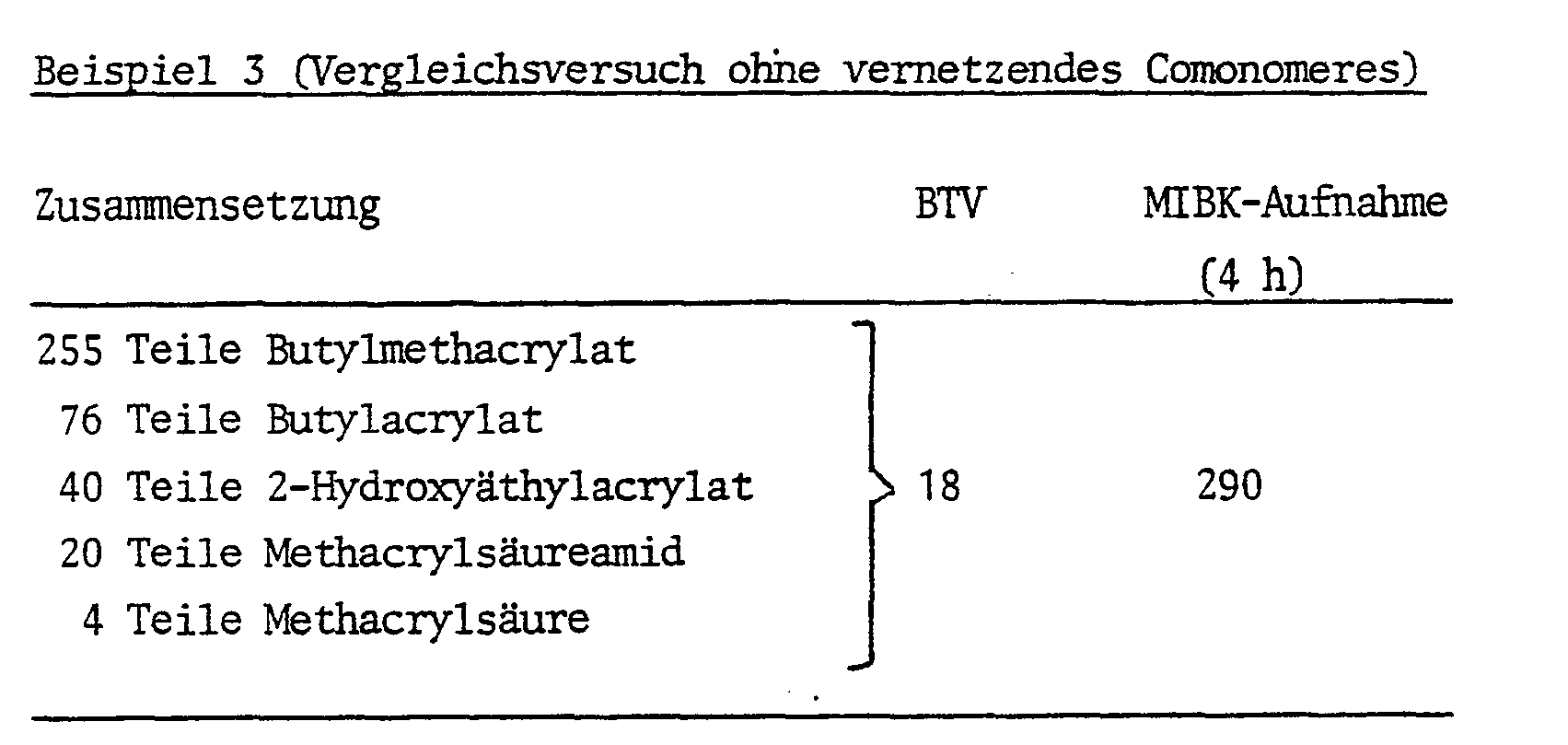
In einem 1 1-Rundkolben, mit Rührer und Kontaktthermometer ausgerüstet, wurden 155 Teile vollentsalztes Wasser unter Rühren auf 80°C erhitzt und mit 0,16 Teilen einer 90 %igen sulfonierten äthoxylierten Alkyl-arylol-maleinsäure, gelöst, in 5 Teilen Butylmethacrylat, sowie mit 5 Teilen einer 4 %igen Ammoniumperoxodisulfatlösung versetzt. Dann wurde nach einer Pause von 4 Minuten bei 80°C innerhalb von 4 Stunden eine Emulsion aus:
- 240 Teilen vollentsalztem Wasser 1 Teil 90 %iger sulfonierter äthoxylierter Alkyl-arylol-maleinsäure 0,9 Teilen Ammoniumperoxodisulfat 395 Teilen der Monomerenmischung gemäß nachfolgender Tabelle
- 240 parts of demineralized water 1 part of 90% sulfonated ethoxylated alkyl arylol maleic acid 0.9 part of ammonium peroxodisulfate 395 parts of the monomer mixture according to the table below
zugetropft. Anschließend wurde die Temperatur 2 weitere Stunden auf 80°C gehalten. Danach wurde auf Raumtemperatur abgekühlt und der pH-Wert durch Zugabe von Phosphorsäure auf einen Wert von 2,2 eingestellt. Es wurden stabile, koagulatfreie Dispersionen erhalten.dripped. The temperature was then kept at 80 ° C. for a further 2 hours. The mixture was then cooled to room temperature and the pH was adjusted to 2.2 by adding phosphoric acid. Stable, coagulate-free dispersions were obtained.
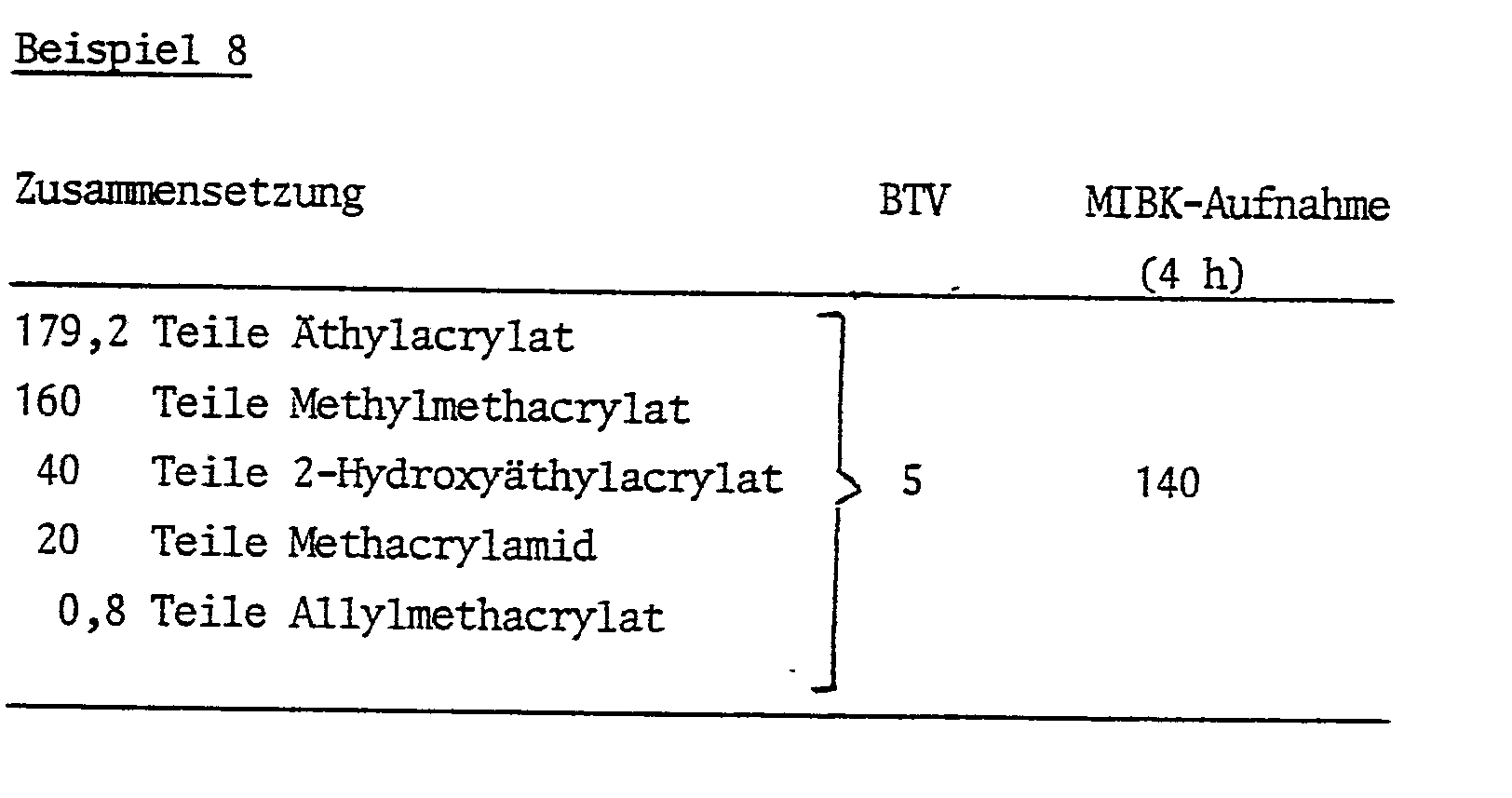
In der nachfolgenden Tabelle sind in den beiden rechten Spalten Ergebnisse der anwendungstechnischen Prüfung der Dispersionen angegeben. "BTV" bezeichnet den Binderverlust (in Gew.-%, bezogen auf Bindergewicht) eines mit 50 Gew.-% (bezogen auf Fasergewicht) Binder verfestigten Polyestergewebes bei der Behandlung mit Trichloräthylen in einer Laborwaschmaschine. Mit "MIBK-Aufnahme" ist die Quellung bei 4-stündiger Lagerung in Methylisobutylketon bei 20°C, gemessen in Gew.-%, bezogen auf Bindergewicht, bezeichnet.The following table shows the results of the performance test of the dispersions in the two columns on the right. "BTV" denotes the binder loss (in% by weight, based on binder weight) of a polyester fabric consolidated with 50% by weight (based on fiber weight) of binder Treatment with trichlorethylene in a laboratory washing machine. "MIBK absorption" denotes the swelling after storage for 4 hours in methyl isobutyl ketone at 20 ° C., measured in% by weight, based on the binder weight.
Herstellungsverfahren der Dispersionen nach Beispielen 7 bis 11.Production process of the dispersions according to Examples 7 to 11.
In einem 1 1 Rundkolben, mit Rührer und Kontaktthermometer ausgerüstet, wurden 155 Teile vollentsalztes Wasser sowie 0,06 Teile eines Emulgators, der durch Umsetzung von 1 Mol Tributylphenol mit 7 Mol Äthylenoxid, Sulfatierung und Überführung in das Natriumsalz erhalten worden ist, unter Rühren auf 80°C erhitzt und mit 5 Teilen einer 4 %igen Ammoniumperoxodisulfatlösung versetzt. Dann wurden bei 80°C innerhalb von 4 Stunden eine Emulsion aus

Es wurden stabile,koagulatfreie Dispersionen erhalten.






Claims (4)
Applications Claiming Priority (2)
| Application Number | Priority Date | Filing Date | Title |
|---|---|---|---|
| DE3202093 | 1982-01-23 | ||
| DE19823202093 DE3202093A1 (en) | 1982-01-23 | 1982-01-23 | ACRYLIC PLASTIC DISPERSION |
Publications (3)
| Publication Number | Publication Date |
|---|---|
| EP0084809A2 true EP0084809A2 (en) | 1983-08-03 |
| EP0084809A3 EP0084809A3 (en) | 1987-04-08 |
| EP0084809B1 EP0084809B1 (en) | 1989-05-03 |
Family
ID=6153740
Family Applications (1)
| Application Number | Title | Priority Date | Filing Date |
|---|---|---|---|
| EP19830100223 Expired EP0084809B1 (en) | 1982-01-23 | 1983-01-13 | Dispersion of acryl plastics |
Country Status (4)
| Country | Link |
|---|---|
| US (1) | US4455342A (en) |
| EP (1) | EP0084809B1 (en) |
| JP (1) | JPS58127715A (en) |
| DE (2) | DE3202093A1 (en) |
Cited By (7)
| Publication number | Priority date | Publication date | Assignee | Title |
|---|---|---|---|---|
| GB2172292A (en) * | 1985-03-08 | 1986-09-17 | Mitsubishi Rayon Co | Acrylic copolymer coatings |
| EP0147759A3 (en) * | 1983-12-27 | 1988-07-27 | The B.F. Goodrich Company | Latex containing odor inhibitors |
| EP0184153A3 (en) * | 1984-12-03 | 1988-08-24 | The B.F. Goodrich Company | Formaldehyde-free latex and fabrics made therewith |
| EP0312008A3 (en) * | 1987-10-16 | 1990-05-02 | National Starch And Chemical Corporation | Heat resistant acrylic binders for nonwovens |
| EP0437268A1 (en) * | 1990-01-12 | 1991-07-17 | National Starch and Chemical Investment Holding Corporation | Method for binding a non-woven fiber-web by using a formaldehyde-free binder composition and products manufactured therewith |
| EP0326298A3 (en) * | 1988-01-28 | 1991-08-07 | Rohm And Haas Company | Fast curing binder for cellulose |
| US5314943A (en) * | 1990-11-30 | 1994-05-24 | Rohm And Haax Company | Low viscosity high strength acid binder |
Families Citing this family (25)
| Publication number | Priority date | Publication date | Assignee | Title |
|---|---|---|---|---|
| US4617230A (en) * | 1983-12-27 | 1986-10-14 | The B. F. Goodrich Company | Latex containing odor inhibitor |
| US5230761A (en) * | 1984-05-21 | 1993-07-27 | Qst Industries, Inc. | Waistband interlining with thin edges and its ultrasonic formation |
| US4860774A (en) * | 1985-12-06 | 1989-08-29 | Maria Talerico | Fingernail reinforcement material and method |
| US5143971A (en) * | 1986-10-20 | 1992-09-01 | The B.F. Goodrich Company | Rubbery carboxylated acrylate polymer, latex, and preparation thereof |
| US4929495A (en) * | 1986-10-20 | 1990-05-29 | The B.F. Goodrich Company | Nonwoven fabric coated with carboxylated acrylate polymers, and process for making the nonwoven fabric |
| US4956434A (en) * | 1986-10-20 | 1990-09-11 | The B. F. Goodrich Company | Rubbery carboxylated acrylate polymer, latex, and preparation thereof |
| DE3700534A1 (en) * | 1987-01-10 | 1988-07-21 | Basf Ag | AQUEOUS POLYMER DISPERSIONS FOR WOOD COATING |
| JPH0651762B2 (en) * | 1987-05-19 | 1994-07-06 | 三菱油化バ−デイツシエ株式会社 | Method for producing aqueous copolymer dispersion for adhesives |
| JPH07121975B2 (en) * | 1987-05-26 | 1995-12-25 | ユニ・チャーム株式会社 | Method for producing water-absorbent composite |
| JPH07119264B2 (en) * | 1987-11-06 | 1995-12-20 | ユニ・チャーム株式会社 | Method for producing water-absorbent composite |
| US5008326A (en) * | 1987-12-15 | 1991-04-16 | Union Oil Company Of California | Process for preparing a fast cure, zero formaldehyde binder for cellulose |
| US5028655A (en) * | 1987-12-15 | 1991-07-02 | Union Oil Company Of California | Fast cure, zero formaldehyde binder for cellulose |
| DE3902067A1 (en) * | 1989-01-25 | 1990-07-26 | Roehm Gmbh | FILM-FORMING, SELF-NETWORKING AQUEOUS PLASTIC DISPERSION |
| US5227423A (en) * | 1989-08-29 | 1993-07-13 | Rohm And Haas Company | Paints and binders for use therein |
| US5134186A (en) * | 1989-08-29 | 1992-07-28 | Union Oil Company Of California | Latex paints |
| US5219917A (en) * | 1989-08-29 | 1993-06-15 | Rohm And Haas Company | Latex-paints |
| US5213901A (en) * | 1989-08-29 | 1993-05-25 | Rohm And Haas Company | Coated articles |
| US5124393A (en) * | 1989-08-29 | 1992-06-23 | Union Oil Company Of California | Latex paints |
| US5212225A (en) * | 1989-08-29 | 1993-05-18 | Rohm And Haas Company | Binder synthesis process |
| US5451432A (en) * | 1990-08-31 | 1995-09-19 | Rohm And Haas Company | Treating flexible, porous substrates with formaldehyde free binder |
| US5143582A (en) * | 1991-05-06 | 1992-09-01 | Rohm And Haas Company | Heat-resistant nonwoven fabrics |
| DE19540725A1 (en) † | 1995-11-02 | 1997-05-07 | Basf Ag | Aqueous polymer dispersions as binders for oil-resistant, abrasion-resistant floor paints |
| CN1325713C (en) * | 2003-09-02 | 2007-07-11 | 徐方坤 | Hard non-woven cotton and its manufactuling method |
| US20070128121A1 (en) * | 2005-12-05 | 2007-06-07 | The Regents Of The University Of California | Polymer hydrogels for controlled release and absorption of biocides |
| EP4206374A1 (en) | 2021-12-31 | 2023-07-05 | Arkema France | Chemically bonded nonwoven substrates |
Family Cites Families (6)
| Publication number | Priority date | Publication date | Assignee | Title |
|---|---|---|---|---|
| US4036788A (en) * | 1975-02-11 | 1977-07-19 | Plastomedical Sciences, Inc. | Anionic hydrogels based on heterocyclic N-vinyl monomers |
| DE2749386A1 (en) * | 1977-11-04 | 1979-05-10 | Roehm Gmbh | DISPERSIONS OF HYDROPHILIC ACRYLIC RESINS |
| DE2833601A1 (en) * | 1978-07-31 | 1980-02-28 | Roehm Gmbh | PLASTIC POWDER FOR COATING AGENTS FOR THE PRODUCTION OF GLOSSY, NON-BLOCKING, ELASTIC COATINGS |
| CA1144294A (en) * | 1978-12-04 | 1983-04-05 | Walter G. De Witt, Iii | Bonded nonwoven fabrics suitable for diaper coverstock |
| CA1132856A (en) * | 1978-12-04 | 1982-10-05 | Jerome F. Levy | Non-woven fabrics |
| US4305860A (en) * | 1980-08-21 | 1981-12-15 | National Starch And Chemical Corporation | Stable, pumpable, solvent-free colloidal polyampholyte latices, their preparation and use in paper |
-
1982
- 1982-01-23 DE DE19823202093 patent/DE3202093A1/en not_active Withdrawn
-
1983
- 1983-01-05 US US06/455,660 patent/US4455342A/en not_active Expired - Lifetime
- 1983-01-13 EP EP19830100223 patent/EP0084809B1/en not_active Expired
- 1983-01-13 DE DE8383100223T patent/DE3379793D1/en not_active Expired
- 1983-01-21 JP JP58007512A patent/JPS58127715A/en active Pending
Cited By (8)
| Publication number | Priority date | Publication date | Assignee | Title |
|---|---|---|---|---|
| EP0147759A3 (en) * | 1983-12-27 | 1988-07-27 | The B.F. Goodrich Company | Latex containing odor inhibitors |
| EP0184153A3 (en) * | 1984-12-03 | 1988-08-24 | The B.F. Goodrich Company | Formaldehyde-free latex and fabrics made therewith |
| GB2172292A (en) * | 1985-03-08 | 1986-09-17 | Mitsubishi Rayon Co | Acrylic copolymer coatings |
| US4741932A (en) * | 1985-03-08 | 1988-05-03 | Mitsubishi Rayon Company Limited | Coating composition and method for forming a multi-layered coating |
| EP0312008A3 (en) * | 1987-10-16 | 1990-05-02 | National Starch And Chemical Corporation | Heat resistant acrylic binders for nonwovens |
| EP0326298A3 (en) * | 1988-01-28 | 1991-08-07 | Rohm And Haas Company | Fast curing binder for cellulose |
| EP0437268A1 (en) * | 1990-01-12 | 1991-07-17 | National Starch and Chemical Investment Holding Corporation | Method for binding a non-woven fiber-web by using a formaldehyde-free binder composition and products manufactured therewith |
| US5314943A (en) * | 1990-11-30 | 1994-05-24 | Rohm And Haax Company | Low viscosity high strength acid binder |
Also Published As
| Publication number | Publication date |
|---|---|
| US4455342A (en) | 1984-06-19 |
| DE3379793D1 (en) | 1989-06-08 |
| JPS58127715A (en) | 1983-07-29 |
| EP0084809B1 (en) | 1989-05-03 |
| DE3202093A1 (en) | 1983-08-04 |
| EP0084809A3 (en) | 1987-04-08 |
Similar Documents
| Publication | Publication Date | Title |
|---|---|---|
| EP0084809B1 (en) | Dispersion of acryl plastics | |
| DE2749386C2 (en) | ||
| EP0376096B1 (en) | Aqueous dispersion of a multiphase plastic material and its use in coating compositions | |
| EP0080635B1 (en) | Self-cross-linking aqueous polymer dispersion | |
| EP0019169A1 (en) | Use of an aqueous dispersion of an emulsion copolymer that contains amide groups for bonding nonwovens | |
| EP0048320B1 (en) | Aqueous dispersions of synthetic materials without emulsifier | |
| DE3902067A1 (en) | FILM-FORMING, SELF-NETWORKING AQUEOUS PLASTIC DISPERSION | |
| EP0765960B1 (en) | Method for producing reusable, fibrous, composite materials | |
| DE3328456A1 (en) | FORMALDEHYDE-FREE AQUEOUS PLASTIC DISPERSIONS BASED ON A CROSSLINKABLE POLYMERISAT, METHOD FOR THEIR PRODUCTION AND THEIR USE | |
| EP0007391A1 (en) | Polymeric powder for coating compositions, coating composition and coating process for plasticized polyvinyl chloride | |
| EP0084810B1 (en) | Process for strengthening fibre products with aqueous plastics dispersions | |
| DE1024481B (en) | Impregnation of sheet material with synthetic resin dispersions | |
| CH499578A (en) | Process for making non-textile goods oil and water repellent | |
| EP0027850B1 (en) | Emulsion polymer with thickening action in acid media, and its use | |
| EP0661305A1 (en) | Aqueous dispersions of synthetic resins without formaldehyde | |
| DE2135828A1 (en) | PLASTIC SUSPENSIONS FOR COATING OR / AND STRENGTHENING POROESE AREAS | |
| DE1720058A1 (en) | Process for agglomerating aqueous synthetic rubber dispersions | |
| EP0193107B1 (en) | Bonded textile fabric and method for its production | |
| EP0392353B1 (en) | Aqueous resin dispersions | |
| DE1232103B (en) | Process for the production of coatings, impregnations and gluing of fiber substrates such as fabrics, fleeces as well as for the lamination of foams with fabrics using graft polymers | |
| DE1804159A1 (en) | Acrylic resin dispersions | |
| DE2626174A1 (en) | CROSS-LINKABLE ACRYLONITRILE COPOLYMERISATES | |
| EP0527411B1 (en) | Aqueous binder for textile material | |
| EP0392350B1 (en) | Aqueous dispersions of synthetic resins | |
| EP0054573B1 (en) | Process for the consolidation of fibrous material with dispersions of synthetic resin |
Legal Events
| Date | Code | Title | Description |
|---|---|---|---|
| PUAI | Public reference made under article 153(3) epc to a published international application that has entered the european phase |
Free format text: ORIGINAL CODE: 0009012 |
|
| AK | Designated contracting states |
Designated state(s): DE FR GB IT NL SE |
|
| PUAL | Search report despatched |
Free format text: ORIGINAL CODE: 0009013 |
|
| AK | Designated contracting states |
Kind code of ref document: A3 Designated state(s): DE FR GB IT NL SE |
|
| 17P | Request for examination filed |
Effective date: 19870515 |
|
| 17Q | First examination report despatched |
Effective date: 19880919 |
|
| GRAA | (expected) grant |
Free format text: ORIGINAL CODE: 0009210 |
|
| AK | Designated contracting states |
Kind code of ref document: B1 Designated state(s): DE FR GB IT NL SE |
|
| ITF | It: translation for a ep patent filed | ||
| REF | Corresponds to: |
Ref document number: 3379793 Country of ref document: DE Date of ref document: 19890608 |
|
| ET | Fr: translation filed | ||
| GBT | Gb: translation of ep patent filed (gb section 77(6)(a)/1977) | ||
| PLBE | No opposition filed within time limit |
Free format text: ORIGINAL CODE: 0009261 |
|
| STAA | Information on the status of an ep patent application or granted ep patent |
Free format text: STATUS: NO OPPOSITION FILED WITHIN TIME LIMIT |
|
| 26N | No opposition filed | ||
| ITTA | It: last paid annual fee | ||
| EAL | Se: european patent in force in sweden |
Ref document number: 83100223.3 |
|
| PGFP | Annual fee paid to national office [announced via postgrant information from national office to epo] |
Ref country code: DE Payment date: 20000120 Year of fee payment: 18 |
|
| PGFP | Annual fee paid to national office [announced via postgrant information from national office to epo] |
Ref country code: GB Payment date: 20010104 Year of fee payment: 19 |
|
| PGFP | Annual fee paid to national office [announced via postgrant information from national office to epo] |
Ref country code: FR Payment date: 20010111 Year of fee payment: 19 |
|
| PGFP | Annual fee paid to national office [announced via postgrant information from national office to epo] |
Ref country code: NL Payment date: 20010131 Year of fee payment: 19 |
|
| PG25 | Lapsed in a contracting state [announced via postgrant information from national office to epo] |
Ref country code: DE Free format text: LAPSE BECAUSE OF NON-PAYMENT OF DUE FEES Effective date: 20011101 |
|
| REG | Reference to a national code |
Ref country code: GB Ref legal event code: IF02 |
|
| PG25 | Lapsed in a contracting state [announced via postgrant information from national office to epo] |
Ref country code: GB Free format text: LAPSE BECAUSE OF NON-PAYMENT OF DUE FEES Effective date: 20020113 |
|
| PGFP | Annual fee paid to national office [announced via postgrant information from national office to epo] |
Ref country code: SE Payment date: 20020125 Year of fee payment: 20 |
|
| PG25 | Lapsed in a contracting state [announced via postgrant information from national office to epo] |
Ref country code: NL Free format text: LAPSE BECAUSE OF NON-PAYMENT OF DUE FEES Effective date: 20020801 |
|
| GBPC | Gb: european patent ceased through non-payment of renewal fee |
Effective date: 20020113 |
|
| PG25 | Lapsed in a contracting state [announced via postgrant information from national office to epo] |
Ref country code: FR Free format text: LAPSE BECAUSE OF NON-PAYMENT OF DUE FEES Effective date: 20020930 |
|
| NLV4 | Nl: lapsed or anulled due to non-payment of the annual fee |
Effective date: 20020801 |
|
| REG | Reference to a national code |
Ref country code: FR Ref legal event code: ST |
|
| EUG | Se: european patent has lapsed |