EP0084716B1 - Method for feeding the growing substrate into the cells in a set of growing cells - Google Patents
Method for feeding the growing substrate into the cells in a set of growing cells Download PDFInfo
- Publication number
- EP0084716B1 EP0084716B1 EP82306584A EP82306584A EP0084716B1 EP 0084716 B1 EP0084716 B1 EP 0084716B1 EP 82306584 A EP82306584 A EP 82306584A EP 82306584 A EP82306584 A EP 82306584A EP 0084716 B1 EP0084716 B1 EP 0084716B1
- Authority
- EP
- European Patent Office
- Prior art keywords
- feeding
- cells
- feeding rolls
- growing
- rolls
- Prior art date
- Legal status (The legal status is an assumption and is not a legal conclusion. Google has not performed a legal analysis and makes no representation as to the accuracy of the status listed.)
- Expired
Links
- 239000000758 substrate Substances 0.000 title claims abstract description 17
- 238000000034 method Methods 0.000 title claims abstract description 13
- 239000000463 material Substances 0.000 claims abstract description 24
- 239000002361 compost Substances 0.000 claims abstract description 5
- 230000000694 effects Effects 0.000 claims abstract description 5
- 239000011490 mineral wool Substances 0.000 claims abstract description 5
- 239000003415 peat Substances 0.000 claims abstract description 5
- 239000010451 perlite Substances 0.000 claims abstract description 5
- 235000019362 perlite Nutrition 0.000 claims abstract description 5
- 239000002689 soil Substances 0.000 claims abstract description 5
- 229910052902 vermiculite Inorganic materials 0.000 claims abstract description 5
- 239000010455 vermiculite Substances 0.000 claims abstract description 5
- 235000019354 vermiculite Nutrition 0.000 claims abstract description 5
- 229920001971 elastomer Polymers 0.000 claims abstract description 4
- 239000004033 plastic Substances 0.000 claims abstract description 4
- 229920003023 plastic Polymers 0.000 claims abstract description 4
- 229920002635 polyurethane Polymers 0.000 claims abstract description 4
- 239000004814 polyurethane Substances 0.000 claims abstract description 4
- 239000012858 resilient material Substances 0.000 claims abstract description 4
- 239000000428 dust Substances 0.000 description 1
- 230000002349 favourable effect Effects 0.000 description 1
- 239000010419 fine particle Substances 0.000 description 1
Images
Classifications
-
- A—HUMAN NECESSITIES
- A01—AGRICULTURE; FORESTRY; ANIMAL HUSBANDRY; HUNTING; TRAPPING; FISHING
- A01G—HORTICULTURE; CULTIVATION OF VEGETABLES, FLOWERS, RICE, FRUIT, VINES, HOPS OR SEAWEED; FORESTRY; WATERING
- A01G9/00—Cultivation in receptacles, forcing-frames or greenhouses; Edging for beds, lawn or the like
- A01G9/08—Devices for filling-up flower-pots or pots for seedlings; Devices for setting plants or seeds in pots
- A01G9/081—Devices for filling-up pots
-
- Y—GENERAL TAGGING OF NEW TECHNOLOGICAL DEVELOPMENTS; GENERAL TAGGING OF CROSS-SECTIONAL TECHNOLOGIES SPANNING OVER SEVERAL SECTIONS OF THE IPC; TECHNICAL SUBJECTS COVERED BY FORMER USPC CROSS-REFERENCE ART COLLECTIONS [XRACs] AND DIGESTS
- Y10—TECHNICAL SUBJECTS COVERED BY FORMER USPC
- Y10S—TECHNICAL SUBJECTS COVERED BY FORMER USPC CROSS-REFERENCE ART COLLECTIONS [XRACs] AND DIGESTS
- Y10S100/00—Presses
- Y10S100/903—Pelleters
- Y10S100/907—Rotary
Definitions
- the present invention is concerned with a method for feeding a growing substrate, such as peat, soil, compost, crushed mineral wool, perlite, vermiculite, or bark, by means of feeding equipment into the cells of a set of growing cells placed underneath the said equipment.
- a growing substrate such as peat, soil, compost, crushed mineral wool, perlite, vermiculite, or bark
- filling lines have followed two different filling methods.
- the commonest method is the dosage of the filling material onto the cell system by allowing it to fall by the effect of the force of gravitation and compacting by vibrating the cell system and by compacting it from the top by means of various elements, such as brushes or pegs.
- a good filling material of uniform quality must be used and, in case of cell systems of paper, the material must also be relatively dry (relative moisture content below 35%).
- Cell systems with thin and soft walls do not stand very vigorous compacting, and therefore their filling has been slow and often unsatisfactory.
- a secondary prior art filling line type operates so that the filling material is first compacted to an appropriate density, and it is coated with a suitable material, cut, and placed into the boxes. The method is slow and expensive, even though the filling result is good. This filling method also operates with less expensive filling materials of inferior quality.
- the object of the present invention is to provide a feeding method with properties considerably more favourable than corresponding prior art methods.
- the present invention provides a method for feeding a growing substrate, such as peat, soil, compost, crushed mineral wool, perlite, vermiculite, or bark, by means of feeding equipment into the cells of a set of growing cells placed underneath the said equipment comprising two horizontal feeding rolls, which are spaced apart side by side and which are parallel to each other, and pins of a resilient material, e.g.
- the growing substrate is, by the effect of a circumferential velocity of the feeding rolls of about 3 to 10 m/s, projected in the vertical direction into the cells of the growing cell set so that, beginning from the bottom, growing substrate introduced into the cells earlier is compacted by means of the kinetic energy of growing substrate introduced later.
- an inexpensive filling material (growing substrate) may be used, it has high capacity, it does not cause dust problems, because moist filling material can be used therein, which filling material may also be relatively coarse, whereby macropores, which are important for the plants, remain in the cells.
- the degree of compacting of the feeding equipment is readily adjustable, and the constructional embodiment of the equipment is inexpensive and simple.
- the feeding equipment functions as a shredder of clodded filling material, but it does not grind the filling material to fine particles.
- the feeding equipment consists of two horizontal feeding rolls 2 parallel to each other and placed side by side, which are arranged to be rotated in opposite directions in the way shown by arrows 8 in Fig. 1.
- Pins of a resilient material such as rubber or plastic, favourably polyurethane, have been arranged as projecting from the roller faces 7 of the feeding rolls 2.
- the pins 3 project from the roller faces 7 radially.
- the pins 3 are placed in the normal planes of the axes of the feeding rolls 2 as uniformly spaced in the longitudinal direction of the feeding rolls 2.
- the pins 3 are located preferably as uniformly spaced around the feeding rolls 2, whereat longitudinal lines of pins are formed on the feeding rolls 2 out of the pins 3.
- the feeding rolls 2 are fitted, in accordance with Figures 1 and 2, so that in the space between the feeding rolls the pins 3 on the feeding rolls 2 are located as interlocking each other.
- the width of the space between the feeding rolls 2 must, of course, be larger than the length of the pins 3 in order that the pins 3 should not contact the adjoining roller face.
- the pins 3 In order that the feeding device should be sufficiently efficient, the pins 3 must overlap each other in the space between the feeding rolls 2 by more than half their length.
- the diameter of the roller face 7 of the feeding roll 2 is more than half the overall diameter of the feeding roll 2.
- the feeding equipment operates as follow.
- the arrow 1 denotes the growing substrate to be fed.
- the growing substrate such as peat, soil, compost, crushed mineral wool, perlite, vermiculite, bark, etc.
- the circumferential speed of the feeding rolls 2 is most appropriately 3 to 10 m/s.
- the circumferential speed of the feeding rolls 2 is adjusted low for materials of the high specific weight and high for the light materials.
- the feeding rolls 2 and their pins 3 accelerate the filling material to a high vertical speed, by the effect of which the filling material is rushed down to the bottom of the cell system 4 in a box 5 and fills the cells 6 beginning from the bottom so that, at the same time, any material introduced into the cell previously is compacted by means of the kinetic energy of the filling material.
- the box 5 with the growing cells 4 is placed on a conveyor, which moves the box 5 at a constant speed under the filling position.
Landscapes
- Life Sciences & Earth Sciences (AREA)
- Environmental Sciences (AREA)
- Cultivation Receptacles Or Flower-Pots, Or Pots For Seedlings (AREA)
- Cultivation Of Plants (AREA)
- Processing Of Solid Wastes (AREA)
- Soy Sauces And Products Related Thereto (AREA)
- Beans For Foods Or Fodder (AREA)
- Micro-Organisms Or Cultivation Processes Thereof (AREA)
- Apparatus Associated With Microorganisms And Enzymes (AREA)
Abstract
Description
- The present invention is concerned with a method for feeding a growing substrate, such as peat, soil, compost, crushed mineral wool, perlite, vermiculite, or bark, by means of feeding equipment into the cells of a set of growing cells placed underneath the said equipment.
- In prior art, filling lines have followed two different filling methods. The commonest method is the dosage of the filling material onto the cell system by allowing it to fall by the effect of the force of gravitation and compacting by vibrating the cell system and by compacting it from the top by means of various elements, such as brushes or pegs. With this method, in order that a good result could be obtained, a good filling material of uniform quality must be used and, in case of cell systems of paper, the material must also be relatively dry (relative moisture content below 35%). Cell systems with thin and soft walls do not stand very vigorous compacting, and therefore their filling has been slow and often unsatisfactory.
- A secondary prior art filling line type operates so that the filling material is first compacted to an appropriate density, and it is coated with a suitable material, cut, and placed into the boxes. The method is slow and expensive, even though the filling result is good. This filling method also operates with less expensive filling materials of inferior quality.
- The object of the present invention is to provide a feeding method with properties considerably more favourable than corresponding prior art methods.
- The present invention provides a method for feeding a growing substrate, such as peat, soil, compost, crushed mineral wool, perlite, vermiculite, or bark, by means of feeding equipment into the cells of a set of growing cells placed underneath the said equipment comprising two horizontal feeding rolls, which are spaced apart side by side and which are parallel to each other, and pins of a resilient material, e.g. rubber or plastic, preferably polyurethane, projecting radially from the roll faces in alternating planes normal to the axes of the feeding rolls so that, in the space between the feeding rolls, the pins on the respective feeding rolls intermesh with each other, wherein the feeding rolls are rotated in opposite directions so that the roll faces directed towards each other have a downwardly oriented direction of rotation, and the growing substrate is fed, preferably moist, at a high speed into the cells by rotating the feeding rolls at a rotation speed of 500 to 1000 r.p.m. - the lower the specific weight of the filling material, the higher the speed of rotation - whereby the growing substrate is, by the effect of a circumferential velocity of the feeding rolls of about 3 to 10 m/s, projected in the vertical direction into the cells of the growing cell set so that, beginning from the bottom, growing substrate introduced into the cells earlier is compacted by means of the kinetic energy of growing substrate introduced later.
- As advantages of the feeding method in accordance with the invention should be mentioned that therein an inexpensive filling material (growing substrate) may be used, it has high capacity, it does not cause dust problems, because moist filling material can be used therein, which filling material may also be relatively coarse, whereby macropores, which are important for the plants, remain in the cells. The degree of compacting of the feeding equipment is readily adjustable, and the constructional embodiment of the equipment is inexpensive and simple. The feeding equipment functions as a shredder of clodded filling material, but it does not grind the filling material to fine particles.
- The invention comes out more closely from the following description and from the attached drawing, wherein
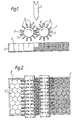
- Figure 1 is a schematical side view of the filling of a growing cell system by means of the feeding equipment, and
- in Figure 2 the growing cell system and the feeding equipment are illustrated as viewed from above.
- The feeding equipment consists of two
horizontal feeding rolls 2 parallel to each other and placed side by side, which are arranged to be rotated in opposite directions in the way shown byarrows 8 in Fig. 1. Pins of a resilient material, such as rubber or plastic, favourably polyurethane, have been arranged as projecting from the roller faces 7 of thefeeding rolls 2. The pins 3 project from the roller faces 7 radially. The pins 3 are placed in the normal planes of the axes of thefeeding rolls 2 as uniformly spaced in the longitudinal direction of thefeeding rolls 2. Likewise, the pins 3 are located preferably as uniformly spaced around thefeeding rolls 2, whereat longitudinal lines of pins are formed on thefeeding rolls 2 out of the pins 3. In the feeding equipment, thefeeding rolls 2 are fitted, in accordance with Figures 1 and 2, so that in the space between the feeding rolls the pins 3 on thefeeding rolls 2 are located as interlocking each other. The width of the space between thefeeding rolls 2 must, of course, be larger than the length of the pins 3 in order that the pins 3 should not contact the adjoining roller face. In order that the feeding device should be sufficiently efficient, the pins 3 must overlap each other in the space between thefeeding rolls 2 by more than half their length. The diameter of the roller face 7 of thefeeding roll 2 is more than half the overall diameter of thefeeding roll 2. - The feeding equipment operates as follow. In Fig. 1, the arrow 1 denotes the growing substrate to be fed. The growing substrate, such as peat, soil, compost, crushed mineral wool, perlite, vermiculite, bark, etc., is introduced from the quantity-control device onto the
rotary feeding rolls 2 into the space between them, from the top. The circumferential speed of thefeeding rolls 2 is most appropriately 3 to 10 m/s. The circumferential speed of thefeeding rolls 2 is adjusted low for materials of the high specific weight and high for the light materials. Thefeeding rolls 2 and their pins 3 accelerate the filling material to a high vertical speed, by the effect of which the filling material is rushed down to the bottom of thecell system 4 in abox 5 and fills the cells 6 beginning from the bottom so that, at the same time, any material introduced into the cell previously is compacted by means of the kinetic energy of the filling material. Thebox 5 with the growingcells 4 is placed on a conveyor, which moves thebox 5 at a constant speed under the filling position.
Claims (1)
Priority Applications (1)
| Application Number | Priority Date | Filing Date | Title |
|---|---|---|---|
| AT82306584T ATE16442T1 (en) | 1981-12-31 | 1982-12-09 | PROCEDURE FOR LOADING GROWING SUBSTRATE INTO THE CELLS OF A PICK BOX. |
Applications Claiming Priority (2)
| Application Number | Priority Date | Filing Date | Title |
|---|---|---|---|
| FI814225 | 1981-12-31 | ||
| FI814225A FI69385C (en) | 1981-12-31 | 1981-12-31 | FOERFARANDE FOER INMATNING AV VAEXTSUBSTRAT I ETT ODLINGSCELLVERKS CELLER |
Publications (2)
| Publication Number | Publication Date |
|---|---|
| EP0084716A1 EP0084716A1 (en) | 1983-08-03 |
| EP0084716B1 true EP0084716B1 (en) | 1985-11-13 |
Family
ID=8514990
Family Applications (1)
| Application Number | Title | Priority Date | Filing Date |
|---|---|---|---|
| EP82306584A Expired EP0084716B1 (en) | 1981-12-31 | 1982-12-09 | Method for feeding the growing substrate into the cells in a set of growing cells |
Country Status (8)
| Country | Link |
|---|---|
| US (1) | US4530383A (en) |
| EP (1) | EP0084716B1 (en) |
| JP (1) | JPS58121729A (en) |
| AT (1) | ATE16442T1 (en) |
| CA (1) | CA1200101A (en) |
| DE (1) | DE3267462D1 (en) |
| FI (1) | FI69385C (en) |
| SU (1) | SU1168084A3 (en) |
Families Citing this family (3)
| Publication number | Priority date | Publication date | Assignee | Title |
|---|---|---|---|---|
| US5316197A (en) * | 1992-12-01 | 1994-05-31 | Cemen Tech, Inc. | Feeder for adding fibrous material to a conveyor having concrete ingredients |
| DE10206660C1 (en) * | 2002-02-12 | 2003-07-24 | Atotech Deutschland Gmbh | Flat material transport device in wet chemical treatment plant e.g. for circuit boards or conductor foils, uses cooperating transport rollers with offset rounded peripheral beads |
| NL1019976C2 (en) * | 2002-02-15 | 2003-01-16 | Gerardus Johannes Fr Linthorst | Bark spreader. |
Family Cites Families (10)
| Publication number | Priority date | Publication date | Assignee | Title |
|---|---|---|---|---|
| US1426615A (en) * | 1922-08-22 | Method osi and apparatus eos ramming sand into molds | ||
| US1705012A (en) * | 1919-10-15 | 1929-03-12 | Endless Belt Corp Inc | Cigarette-making machine |
| US1515181A (en) * | 1923-10-22 | 1924-11-11 | Howard C Toomey | Spreading or sowing machine for vegetative planting |
| DE566820C (en) * | 1927-02-25 | 1932-12-22 | Ernst Wolff Dipl Ing | Oilseed press consisting of two pressing devices connected in series |
| US2884022A (en) * | 1954-08-16 | 1959-04-28 | Robert J Geary | Plant-potting machine |
| US2826003A (en) * | 1955-11-28 | 1958-03-11 | Richard K Oki | Machine for depositing and shaping soil in a transplanting container |
| CS158635B2 (en) * | 1968-02-15 | 1974-11-25 | ||
| US4002004A (en) * | 1974-02-04 | 1977-01-11 | Johns-Manville Corporation | Packaging asbestos fibers |
| US4271876A (en) * | 1979-04-05 | 1981-06-09 | Nash Henry R | Method and apparatus for filling honeycomb panels with fiber insulation |
| US4273495A (en) * | 1979-07-23 | 1981-06-16 | Pannell Manufacturing Corporation | Apparatus and method for laying compost in a mushroom bed |
-
1981
- 1981-12-31 FI FI814225A patent/FI69385C/en not_active IP Right Cessation
-
1982
- 1982-12-09 DE DE8282306584T patent/DE3267462D1/en not_active Expired
- 1982-12-09 EP EP82306584A patent/EP0084716B1/en not_active Expired
- 1982-12-09 AT AT82306584T patent/ATE16442T1/en not_active IP Right Cessation
- 1982-12-14 CA CA000417614A patent/CA1200101A/en not_active Expired
- 1982-12-22 SU SU823525375A patent/SU1168084A3/en active
- 1982-12-27 JP JP57234934A patent/JPS58121729A/en active Granted
- 1982-12-30 US US06/454,858 patent/US4530383A/en not_active Expired - Fee Related
Also Published As
| Publication number | Publication date |
|---|---|
| JPS6350967B2 (en) | 1988-10-12 |
| FI69385B (en) | 1985-10-31 |
| FI69385C (en) | 1986-02-10 |
| FI814225L (en) | 1983-07-01 |
| CA1200101A (en) | 1986-02-04 |
| DE3267462D1 (en) | 1985-12-19 |
| EP0084716A1 (en) | 1983-08-03 |
| ATE16442T1 (en) | 1985-11-15 |
| US4530383A (en) | 1985-07-23 |
| JPS58121729A (en) | 1983-07-20 |
| SU1168084A3 (en) | 1985-07-15 |
Similar Documents
| Publication | Publication Date | Title |
|---|---|---|
| US4494919A (en) | Apparatus for laying a mat of wood strands | |
| DE3561337D1 (en) | Apparatus for uniformly distributing a disintegrated fibrous material on a fiber layer forming surface in plants for the dry forming of paper | |
| CA2086569A1 (en) | Disintegration of Baled Crop Materials | |
| ES8704844A1 (en) | Device for the contactless guiding of material webs, in particular metal webs, by means of a gas. | |
| CN102188038B (en) | Novel low-density tobacco packet remoistening device | |
| CN104703702A (en) | Loose-fill thermal insulation apparatus and apparatus and method for dismantling thermally insulated compressed blocks | |
| EP0084716A1 (en) | Method for feeding the growing substrate into the cells in a set of growing cells | |
| US3954364A (en) | Method and apparatus for forming boards from particles | |
| GB1468781A (en) | Apparatus for cruashing solids in a liquid medium | |
| GB1412035A (en) | Separating apparatus and method | |
| US6508965B1 (en) | Process and apparatus for the production of paper products | |
| WO1992001833A1 (en) | Process and apparatus for the production of paper products | |
| EP0887328A2 (en) | Conversion of waste material using earth worms | |
| GB712148A (en) | Process and apparatus for the dry separation of mixtures on a vibrating deck | |
| US2836846A (en) | Apparatus and process for granulating material | |
| DE3478562D1 (en) | Seeder | |
| SU917779A1 (en) | Device for grinding vegetable materials | |
| CN220192064U (en) | Broken shell sieving mechanism | |
| CN211756856U (en) | Pig feed production raw materials multi-stage screening device | |
| RU2054405C1 (en) | Installation for continuous processing of organic substrate | |
| US3446218A (en) | Agglomerating finely divided material | |
| SU1641630A1 (en) | Apparatus for producing granulated material | |
| EP0055308A1 (en) | Furnish handling method and a furnish forming line for use in the manufacture of composition board | |
| IT1067935B (en) | Granular material pile handling appts. - has charging hopper and transporter in ball bearing mounted frame on upper extension of central rotary column | |
| SU1062155A1 (en) | Arrangement for unloading loose materials from open car |
Legal Events
| Date | Code | Title | Description |
|---|---|---|---|
| PUAI | Public reference made under article 153(3) epc to a published international application that has entered the european phase |
Free format text: ORIGINAL CODE: 0009012 |
|
| AK | Designated contracting states |
Designated state(s): AT BE CH DE FR GB IT LI NL SE |
|
| 17P | Request for examination filed |
Effective date: 19830930 |
|
| ITF | It: translation for a ep patent filed | ||
| GRAA | (expected) grant |
Free format text: ORIGINAL CODE: 0009210 |
|
| AK | Designated contracting states |
Designated state(s): AT BE CH DE FR GB IT LI NL SE |
|
| REF | Corresponds to: |
Ref document number: 16442 Country of ref document: AT Date of ref document: 19851115 Kind code of ref document: T |
|
| REF | Corresponds to: |
Ref document number: 3267462 Country of ref document: DE Date of ref document: 19851219 |
|
| ET | Fr: translation filed | ||
| PLBE | No opposition filed within time limit |
Free format text: ORIGINAL CODE: 0009261 |
|
| STAA | Information on the status of an ep patent application or granted ep patent |
Free format text: STATUS: NO OPPOSITION FILED WITHIN TIME LIMIT |
|
| 26N | No opposition filed | ||
| PGFP | Annual fee paid to national office [announced via postgrant information from national office to epo] |
Ref country code: AT Payment date: 19861204 Year of fee payment: 5 |
|
| PG25 | Lapsed in a contracting state [announced via postgrant information from national office to epo] |
Ref country code: AT Effective date: 19871209 |
|
| PG25 | Lapsed in a contracting state [announced via postgrant information from national office to epo] |
Ref country code: LI Effective date: 19871231 Ref country code: CH Effective date: 19871231 |
|
| GBPC | Gb: european patent ceased through non-payment of renewal fee | ||
| PG25 | Lapsed in a contracting state [announced via postgrant information from national office to epo] |
Ref country code: FR Free format text: LAPSE BECAUSE OF NON-PAYMENT OF DUE FEES Effective date: 19880831 |
|
| REG | Reference to a national code |
Ref country code: CH Ref legal event code: PL |
|
| PG25 | Lapsed in a contracting state [announced via postgrant information from national office to epo] |
Ref country code: DE Effective date: 19880901 |
|
| REG | Reference to a national code |
Ref country code: FR Ref legal event code: ST |
|
| PG25 | Lapsed in a contracting state [announced via postgrant information from national office to epo] |
Ref country code: GB Free format text: LAPSE BECAUSE OF NON-PAYMENT OF DUE FEES Effective date: 19881122 |
|
| PGFP | Annual fee paid to national office [announced via postgrant information from national office to epo] |
Ref country code: SE Payment date: 19911127 Year of fee payment: 10 |
|
| PGFP | Annual fee paid to national office [announced via postgrant information from national office to epo] |
Ref country code: BE Payment date: 19911218 Year of fee payment: 10 |
|
| PGFP | Annual fee paid to national office [announced via postgrant information from national office to epo] |
Ref country code: NL Payment date: 19911231 Year of fee payment: 10 |
|
| PG25 | Lapsed in a contracting state [announced via postgrant information from national office to epo] |
Ref country code: SE Effective date: 19921210 |
|
| PG25 | Lapsed in a contracting state [announced via postgrant information from national office to epo] |
Ref country code: BE Effective date: 19921231 |
|
| BERE | Be: lapsed |
Owner name: LANNEN TEHTAAT OY Effective date: 19921231 |
|
| PG25 | Lapsed in a contracting state [announced via postgrant information from national office to epo] |
Ref country code: NL Effective date: 19930701 |
|
| NLV4 | Nl: lapsed or anulled due to non-payment of the annual fee | ||
| EUG | Se: european patent has lapsed |
Ref document number: 82306584.2 Effective date: 19930709 |