EP0082506B1 - Photosensitive element, film unit, photographic process and dyes - Google Patents
Photosensitive element, film unit, photographic process and dyes Download PDFInfo
- Publication number
- EP0082506B1 EP0082506B1 EP82111743A EP82111743A EP0082506B1 EP 0082506 B1 EP0082506 B1 EP 0082506B1 EP 82111743 A EP82111743 A EP 82111743A EP 82111743 A EP82111743 A EP 82111743A EP 0082506 B1 EP0082506 B1 EP 0082506B1
- Authority
- EP
- European Patent Office
- Prior art keywords
- dye
- image
- group
- photosensitive element
- silver halide
- Prior art date
- Legal status (The legal status is an assumption and is not a legal conclusion. Google has not performed a legal analysis and makes no representation as to the accuracy of the status listed.)
- Expired
Links
- 239000000975 dye Substances 0.000 title claims description 87
- 238000000034 method Methods 0.000 title claims description 21
- 230000008569 process Effects 0.000 title claims description 20
- 150000001875 compounds Chemical class 0.000 claims description 99
- 239000000203 mixture Substances 0.000 claims description 72
- -1 silver halide Chemical class 0.000 claims description 52
- 238000009792 diffusion process Methods 0.000 claims description 47
- 229910052709 silver Inorganic materials 0.000 claims description 44
- 239000004332 silver Substances 0.000 claims description 44
- 238000012545 processing Methods 0.000 claims description 32
- 238000012546 transfer Methods 0.000 claims description 27
- 239000000839 emulsion Substances 0.000 claims description 26
- 239000002243 precursor Substances 0.000 claims description 22
- 125000000217 alkyl group Chemical group 0.000 claims description 20
- 125000003118 aryl group Chemical group 0.000 claims description 17
- 238000005859 coupling reaction Methods 0.000 claims description 15
- 230000008878 coupling Effects 0.000 claims description 13
- 238000010168 coupling process Methods 0.000 claims description 13
- 230000003647 oxidation Effects 0.000 claims description 13
- 238000007254 oxidation reaction Methods 0.000 claims description 13
- 238000011161 development Methods 0.000 claims description 10
- 125000001424 substituent group Chemical group 0.000 claims description 10
- 125000000687 hydroquinonyl group Chemical group C1(O)=C(C=C(O)C=C1)* 0.000 claims description 9
- 238000003776 cleavage reaction Methods 0.000 claims description 7
- MOXDGMSQFFMNHA-UHFFFAOYSA-N 2-hydroxybenzenesulfonamide Chemical group NS(=O)(=O)C1=CC=CC=C1O MOXDGMSQFFMNHA-UHFFFAOYSA-N 0.000 claims description 6
- AJDUTMFFZHIJEM-UHFFFAOYSA-N n-(9,10-dioxoanthracen-1-yl)-4-[4-[[4-[4-[(9,10-dioxoanthracen-1-yl)carbamoyl]phenyl]phenyl]diazenyl]phenyl]benzamide Chemical compound O=C1C2=CC=CC=C2C(=O)C2=C1C=CC=C2NC(=O)C(C=C1)=CC=C1C(C=C1)=CC=C1N=NC(C=C1)=CC=C1C(C=C1)=CC=C1C(=O)NC1=CC=CC2=C1C(=O)C1=CC=CC=C1C2=O AJDUTMFFZHIJEM-UHFFFAOYSA-N 0.000 claims description 5
- 230000007017 scission Effects 0.000 claims description 5
- 125000001984 thiazolidinyl group Chemical group 0.000 claims description 5
- 239000001043 yellow dye Substances 0.000 claims description 5
- 125000002887 hydroxy group Chemical group [H]O* 0.000 claims description 3
- 125000005647 linker group Chemical group 0.000 claims description 3
- 239000001018 xanthene dye Substances 0.000 claims description 3
- KJCVRFUGPWSIIH-UHFFFAOYSA-N 1-naphthol Chemical group C1=CC=C2C(O)=CC=CC2=C1 KJCVRFUGPWSIIH-UHFFFAOYSA-N 0.000 claims description 2
- ISWSIDIOOBJBQZ-UHFFFAOYSA-N Phenol Chemical compound OC1=CC=CC=C1 ISWSIDIOOBJBQZ-UHFFFAOYSA-N 0.000 claims description 2
- 239000000049 pigment Substances 0.000 claims 1
- YMWUJEATGCHHMB-UHFFFAOYSA-N Dichloromethane Chemical compound ClCCl YMWUJEATGCHHMB-UHFFFAOYSA-N 0.000 description 102
- 239000000243 solution Substances 0.000 description 52
- 239000010410 layer Substances 0.000 description 51
- OKKJLVBELUTLKV-UHFFFAOYSA-N Methanol Chemical compound OC OKKJLVBELUTLKV-UHFFFAOYSA-N 0.000 description 45
- ZMXDDKWLCZADIW-UHFFFAOYSA-N N,N-Dimethylformamide Chemical compound CN(C)C=O ZMXDDKWLCZADIW-UHFFFAOYSA-N 0.000 description 36
- XEKOWRVHYACXOJ-UHFFFAOYSA-N Ethyl acetate Chemical compound CCOC(C)=O XEKOWRVHYACXOJ-UHFFFAOYSA-N 0.000 description 27
- VEXZGXHMUGYJMC-UHFFFAOYSA-N Hydrochloric acid Chemical compound Cl VEXZGXHMUGYJMC-UHFFFAOYSA-N 0.000 description 26
- 239000000047 product Substances 0.000 description 26
- RTZKZFJDLAIYFH-UHFFFAOYSA-N Diethyl ether Chemical compound CCOCC RTZKZFJDLAIYFH-UHFFFAOYSA-N 0.000 description 25
- 239000011541 reaction mixture Substances 0.000 description 25
- HEMHJVSKTPXQMS-UHFFFAOYSA-M Sodium hydroxide Chemical compound [OH-].[Na+] HEMHJVSKTPXQMS-UHFFFAOYSA-M 0.000 description 24
- 238000001914 filtration Methods 0.000 description 24
- XLYOFNOQVPJJNP-UHFFFAOYSA-N water Substances O XLYOFNOQVPJJNP-UHFFFAOYSA-N 0.000 description 23
- 239000002244 precipitate Substances 0.000 description 21
- XKRFYHLGVUSROY-UHFFFAOYSA-N Argon Chemical compound [Ar] XKRFYHLGVUSROY-UHFFFAOYSA-N 0.000 description 20
- ILAHWRKJUDSMFH-UHFFFAOYSA-N boron tribromide Chemical compound BrB(Br)Br ILAHWRKJUDSMFH-UHFFFAOYSA-N 0.000 description 20
- QTBSBXVTEAMEQO-UHFFFAOYSA-N Acetic acid Chemical compound CC(O)=O QTBSBXVTEAMEQO-UHFFFAOYSA-N 0.000 description 18
- HEDRZPFGACZZDS-UHFFFAOYSA-N Chloroform Chemical compound ClC(Cl)Cl HEDRZPFGACZZDS-UHFFFAOYSA-N 0.000 description 18
- PMZURENOXWZQFD-UHFFFAOYSA-L Sodium Sulfate Chemical compound [Na+].[Na+].[O-]S([O-])(=O)=O PMZURENOXWZQFD-UHFFFAOYSA-L 0.000 description 17
- 229910052938 sodium sulfate Inorganic materials 0.000 description 17
- 235000011152 sodium sulphate Nutrition 0.000 description 17
- 108010010803 Gelatin Proteins 0.000 description 16
- 229920000159 gelatin Polymers 0.000 description 16
- 239000008273 gelatin Substances 0.000 description 16
- 235000019322 gelatine Nutrition 0.000 description 16
- 235000011852 gelatine desserts Nutrition 0.000 description 16
- 239000007787 solid Substances 0.000 description 16
- ZMANZCXQSJIPKH-UHFFFAOYSA-N Triethylamine Chemical compound CCN(CC)CC ZMANZCXQSJIPKH-UHFFFAOYSA-N 0.000 description 15
- IJGRMHOSHXDMSA-UHFFFAOYSA-N Atomic nitrogen Chemical compound N#N IJGRMHOSHXDMSA-UHFFFAOYSA-N 0.000 description 14
- UIIMBOGNXHQVGW-UHFFFAOYSA-M Sodium bicarbonate Chemical compound [Na+].OC([O-])=O UIIMBOGNXHQVGW-UHFFFAOYSA-M 0.000 description 14
- 238000006243 chemical reaction Methods 0.000 description 14
- 239000002904 solvent Substances 0.000 description 14
- 238000002390 rotary evaporation Methods 0.000 description 13
- BQCADISMDOOEFD-UHFFFAOYSA-N Silver Chemical compound [Ag] BQCADISMDOOEFD-UHFFFAOYSA-N 0.000 description 12
- 239000012043 crude product Substances 0.000 description 12
- 238000003756 stirring Methods 0.000 description 12
- 0 *c1ccc(*)c(*)c1 Chemical compound *c1ccc(*)c(*)c1 0.000 description 11
- QDLAGTHXVHQKRE-UHFFFAOYSA-N lichenxanthone Natural products COC1=CC(O)=C2C(=O)C3=C(C)C=C(OC)C=C3OC2=C1 QDLAGTHXVHQKRE-UHFFFAOYSA-N 0.000 description 11
- JUJWROOIHBZHMG-UHFFFAOYSA-N Pyridine Chemical compound C1=CC=NC=C1 JUJWROOIHBZHMG-UHFFFAOYSA-N 0.000 description 10
- 229910052786 argon Inorganic materials 0.000 description 10
- 238000004440 column chromatography Methods 0.000 description 10
- VYPSYNLAJGMNEJ-UHFFFAOYSA-N Silicium dioxide Chemical compound O=[Si]=O VYPSYNLAJGMNEJ-UHFFFAOYSA-N 0.000 description 9
- 239000000463 material Substances 0.000 description 9
- 229910052757 nitrogen Inorganic materials 0.000 description 9
- 239000012074 organic phase Substances 0.000 description 9
- XNWFRZJHXBZDAG-UHFFFAOYSA-N 2-METHOXYETHANOL Chemical compound COCCO XNWFRZJHXBZDAG-UHFFFAOYSA-N 0.000 description 8
- GJCOSYZMQJWQCA-UHFFFAOYSA-N 9H-xanthene Chemical compound C1=CC=C2CC3=CC=CC=C3OC2=C1 GJCOSYZMQJWQCA-UHFFFAOYSA-N 0.000 description 7
- 229960000583 acetic acid Drugs 0.000 description 7
- 229910000030 sodium bicarbonate Inorganic materials 0.000 description 7
- IAZDPXIOMUYVGZ-UHFFFAOYSA-N Dimethylsulphoxide Chemical compound CS(C)=O IAZDPXIOMUYVGZ-UHFFFAOYSA-N 0.000 description 6
- 239000002585 base Substances 0.000 description 6
- 239000003795 chemical substances by application Substances 0.000 description 6
- MKRTXPORKIRPDG-UHFFFAOYSA-N diphenylphosphoryl azide Chemical compound C=1C=CC=CC=1P(=O)(N=[N+]=[N-])C1=CC=CC=C1 MKRTXPORKIRPDG-UHFFFAOYSA-N 0.000 description 6
- VLKZOEOYAKHREP-UHFFFAOYSA-N n-Hexane Chemical compound CCCCCC VLKZOEOYAKHREP-UHFFFAOYSA-N 0.000 description 6
- ZUNKMNLKJXRCDM-UHFFFAOYSA-N silver bromoiodide Chemical compound [Ag].IBr ZUNKMNLKJXRCDM-UHFFFAOYSA-N 0.000 description 6
- 235000017557 sodium bicarbonate Nutrition 0.000 description 6
- 238000004809 thin layer chromatography Methods 0.000 description 6
- 238000001429 visible spectrum Methods 0.000 description 6
- RYHBNJHYFVUHQT-UHFFFAOYSA-N 1,4-Dioxane Chemical compound C1COCCO1 RYHBNJHYFVUHQT-UHFFFAOYSA-N 0.000 description 5
- DWYHDSLIWMUSOO-UHFFFAOYSA-N 2-phenyl-1h-benzimidazole Chemical compound C1=CC=CC=C1C1=NC2=CC=CC=C2N1 DWYHDSLIWMUSOO-UHFFFAOYSA-N 0.000 description 5
- 238000010521 absorption reaction Methods 0.000 description 5
- 239000008346 aqueous phase Substances 0.000 description 5
- 125000004432 carbon atom Chemical group C* 0.000 description 5
- 238000004128 high performance liquid chromatography Methods 0.000 description 5
- 238000002329 infrared spectrum Methods 0.000 description 5
- UMJSCPRVCHMLSP-UHFFFAOYSA-N pyridine Natural products COC1=CC=CN=C1 UMJSCPRVCHMLSP-UHFFFAOYSA-N 0.000 description 5
- 229920006395 saturated elastomer Polymers 0.000 description 5
- 239000002002 slurry Substances 0.000 description 5
- KFDVPJUYSDEJTH-UHFFFAOYSA-N 4-ethenylpyridine Chemical compound C=CC1=CC=NC=C1 KFDVPJUYSDEJTH-UHFFFAOYSA-N 0.000 description 4
- FKLJPTJMIBLJAV-UHFFFAOYSA-N Compound IV Chemical compound O1N=C(C)C=C1CCCCCCCOC1=CC=C(C=2OCCN=2)C=C1 FKLJPTJMIBLJAV-UHFFFAOYSA-N 0.000 description 4
- JGFZNNIVVJXRND-UHFFFAOYSA-N N,N-Diisopropylethylamine (DIPEA) Chemical compound CCN(C(C)C)C(C)C JGFZNNIVVJXRND-UHFFFAOYSA-N 0.000 description 4
- KFSLWBXXFJQRDL-UHFFFAOYSA-N Peracetic acid Chemical compound CC(=O)OO KFSLWBXXFJQRDL-UHFFFAOYSA-N 0.000 description 4
- FAPWRFPIFSIZLT-UHFFFAOYSA-M Sodium chloride Chemical compound [Na+].[Cl-] FAPWRFPIFSIZLT-UHFFFAOYSA-M 0.000 description 4
- WYURNTSHIVDZCO-UHFFFAOYSA-N Tetrahydrofuran Chemical compound C1CCOC1 WYURNTSHIVDZCO-UHFFFAOYSA-N 0.000 description 4
- GWEVSGVZZGPLCZ-UHFFFAOYSA-N Titan oxide Chemical compound O=[Ti]=O GWEVSGVZZGPLCZ-UHFFFAOYSA-N 0.000 description 4
- 239000011358 absorbing material Substances 0.000 description 4
- 150000001412 amines Chemical class 0.000 description 4
- SBZXBUIDTXKZTM-UHFFFAOYSA-N diglyme Chemical compound COCCOCCOC SBZXBUIDTXKZTM-UHFFFAOYSA-N 0.000 description 4
- 239000000706 filtrate Substances 0.000 description 4
- 239000011229 interlayer Substances 0.000 description 4
- CPLXHLVBOLITMK-UHFFFAOYSA-N magnesium oxide Inorganic materials [Mg]=O CPLXHLVBOLITMK-UHFFFAOYSA-N 0.000 description 4
- 125000001624 naphthyl group Chemical group 0.000 description 4
- 125000001997 phenyl group Chemical group [H]C1=C([H])C([H])=C(*)C([H])=C1[H] 0.000 description 4
- BWHMMNNQKKPAPP-UHFFFAOYSA-L potassium carbonate Chemical compound [K+].[K+].[O-]C([O-])=O BWHMMNNQKKPAPP-UHFFFAOYSA-L 0.000 description 4
- 238000000425 proton nuclear magnetic resonance spectrum Methods 0.000 description 4
- 239000000741 silica gel Substances 0.000 description 4
- 229910002027 silica gel Inorganic materials 0.000 description 4
- 239000000725 suspension Substances 0.000 description 4
- 239000006188 syrup Substances 0.000 description 4
- 235000020357 syrup Nutrition 0.000 description 4
- VJVCQKOMUMNIGE-UHFFFAOYSA-N 1,3-thiazolidin-2-amine Chemical compound NC1NCCS1 VJVCQKOMUMNIGE-UHFFFAOYSA-N 0.000 description 3
- 239000004354 Hydroxyethyl cellulose Substances 0.000 description 3
- 229920000663 Hydroxyethyl cellulose Polymers 0.000 description 3
- UCKMPCXJQFINFW-UHFFFAOYSA-N Sulphide Chemical compound [S-2] UCKMPCXJQFINFW-UHFFFAOYSA-N 0.000 description 3
- 239000002253 acid Substances 0.000 description 3
- 239000003153 chemical reaction reagent Substances 0.000 description 3
- WGLUMOCWFMKWIL-UHFFFAOYSA-N dichloromethane;methanol Chemical compound OC.ClCCl WGLUMOCWFMKWIL-UHFFFAOYSA-N 0.000 description 3
- 150000005690 diesters Chemical class 0.000 description 3
- XIMFCGSNSKXPBO-UHFFFAOYSA-N ethyl 2-bromobutanoate Chemical compound CCOC(=O)C(Br)CC XIMFCGSNSKXPBO-UHFFFAOYSA-N 0.000 description 3
- 239000012362 glacial acetic acid Substances 0.000 description 3
- 235000019447 hydroxyethyl cellulose Nutrition 0.000 description 3
- 239000000395 magnesium oxide Substances 0.000 description 3
- 230000007935 neutral effect Effects 0.000 description 3
- 229920002401 polyacrylamide Polymers 0.000 description 3
- 229910000027 potassium carbonate Inorganic materials 0.000 description 3
- 239000000843 powder Substances 0.000 description 3
- 238000012746 preparative thin layer chromatography Methods 0.000 description 3
- 238000002211 ultraviolet spectrum Methods 0.000 description 3
- FECNOIODIVNEKI-UHFFFAOYSA-N 2-[(2-aminobenzoyl)amino]benzoic acid Chemical class NC1=CC=CC=C1C(=O)NC1=CC=CC=C1C(O)=O FECNOIODIVNEKI-UHFFFAOYSA-N 0.000 description 2
- PLIKAWJENQZMHA-UHFFFAOYSA-N 4-aminophenol Chemical compound NC1=CC=C(O)C=C1 PLIKAWJENQZMHA-UHFFFAOYSA-N 0.000 description 2
- FCSKOFQQCWLGMV-UHFFFAOYSA-N 5-{5-[2-chloro-4-(4,5-dihydro-1,3-oxazol-2-yl)phenoxy]pentyl}-3-methylisoxazole Chemical compound O1N=C(C)C=C1CCCCCOC1=CC=C(C=2OCCN=2)C=C1Cl FCSKOFQQCWLGMV-UHFFFAOYSA-N 0.000 description 2
- QIGBRXMKCJKVMJ-UHFFFAOYSA-N Hydroquinone Chemical compound OC1=CC=C(O)C=C1 QIGBRXMKCJKVMJ-UHFFFAOYSA-N 0.000 description 2
- DGAQECJNVWCQMB-PUAWFVPOSA-M Ilexoside XXIX Chemical compound C[C@@H]1CC[C@@]2(CC[C@@]3(C(=CC[C@H]4[C@]3(CC[C@@H]5[C@@]4(CC[C@@H](C5(C)C)OS(=O)(=O)[O-])C)C)[C@@H]2[C@]1(C)O)C)C(=O)O[C@H]6[C@@H]([C@H]([C@@H]([C@H](O6)CO)O)O)O.[Na+] DGAQECJNVWCQMB-PUAWFVPOSA-M 0.000 description 2
- 239000004372 Polyvinyl alcohol Substances 0.000 description 2
- PPBRXRYQALVLMV-UHFFFAOYSA-N Styrene Chemical compound C=CC1=CC=CC=C1 PPBRXRYQALVLMV-UHFFFAOYSA-N 0.000 description 2
- PCSMJKASWLYICJ-UHFFFAOYSA-N Succinic aldehyde Chemical compound O=CCCC=O PCSMJKASWLYICJ-UHFFFAOYSA-N 0.000 description 2
- QAOWNCQODCNURD-UHFFFAOYSA-L Sulfate Chemical compound [O-]S([O-])(=O)=O QAOWNCQODCNURD-UHFFFAOYSA-L 0.000 description 2
- 239000003513 alkali Substances 0.000 description 2
- 229910052925 anhydrite Inorganic materials 0.000 description 2
- 229910052799 carbon Inorganic materials 0.000 description 2
- 239000006229 carbon black Substances 0.000 description 2
- 239000001913 cellulose Substances 0.000 description 2
- 229920002678 cellulose Polymers 0.000 description 2
- 238000004587 chromatography analysis Methods 0.000 description 2
- 239000003086 colorant Substances 0.000 description 2
- 239000000356 contaminant Substances 0.000 description 2
- 238000001816 cooling Methods 0.000 description 2
- VAYGXNSJCAHWJZ-UHFFFAOYSA-N dimethyl sulfate Chemical compound COS(=O)(=O)OC VAYGXNSJCAHWJZ-UHFFFAOYSA-N 0.000 description 2
- NLFBCYMMUAKCPC-KQQUZDAGSA-N ethyl (e)-3-[3-amino-2-cyano-1-[(e)-3-ethoxy-3-oxoprop-1-enyl]sulfanyl-3-oxoprop-1-enyl]sulfanylprop-2-enoate Chemical compound CCOC(=O)\C=C\SC(=C(C#N)C(N)=O)S\C=C\C(=O)OCC NLFBCYMMUAKCPC-KQQUZDAGSA-N 0.000 description 2
- 238000003402 intramolecular cyclocondensation reaction Methods 0.000 description 2
- INQOMBQAUSQDDS-UHFFFAOYSA-N iodomethane Chemical compound IC INQOMBQAUSQDDS-UHFFFAOYSA-N 0.000 description 2
- AXZKOIWUVFPNLO-UHFFFAOYSA-N magnesium;oxygen(2-) Chemical compound [O-2].[Mg+2] AXZKOIWUVFPNLO-UHFFFAOYSA-N 0.000 description 2
- 229920000728 polyester Polymers 0.000 description 2
- 229920002451 polyvinyl alcohol Polymers 0.000 description 2
- SCVFZCLFOSHCOH-UHFFFAOYSA-M potassium acetate Chemical compound [K+].CC([O-])=O SCVFZCLFOSHCOH-UHFFFAOYSA-M 0.000 description 2
- LPNYRYFBWFDTMA-UHFFFAOYSA-N potassium tert-butoxide Chemical compound [K+].CC(C)(C)[O-] LPNYRYFBWFDTMA-UHFFFAOYSA-N 0.000 description 2
- 150000003856 quaternary ammonium compounds Chemical class 0.000 description 2
- 238000006479 redox reaction Methods 0.000 description 2
- 239000011734 sodium Substances 0.000 description 2
- 229910052708 sodium Inorganic materials 0.000 description 2
- 229910000342 sodium bisulfate Inorganic materials 0.000 description 2
- GEHJYWRUCIMESM-UHFFFAOYSA-L sodium sulfite Chemical compound [Na+].[Na+].[O-]S([O-])=O GEHJYWRUCIMESM-UHFFFAOYSA-L 0.000 description 2
- 238000012360 testing method Methods 0.000 description 2
- YLQBMQCUIZJEEH-UHFFFAOYSA-N tetrahydrofuran Natural products C=1C=COC=1 YLQBMQCUIZJEEH-UHFFFAOYSA-N 0.000 description 2
- 239000004408 titanium dioxide Substances 0.000 description 2
- RTPBEMVDAXPYRC-JLAZNSOCSA-N (2r)-4-amino-2-[(1s)-1,2-dihydroxyethyl]-3-hydroxy-2h-furan-5-one Chemical compound NC1=C(O)[C@@H]([C@@H](O)CO)OC1=O RTPBEMVDAXPYRC-JLAZNSOCSA-N 0.000 description 1
- QGKMIGUHVLGJBR-UHFFFAOYSA-M (4z)-1-(3-methylbutyl)-4-[[1-(3-methylbutyl)quinolin-1-ium-4-yl]methylidene]quinoline;iodide Chemical compound [I-].C12=CC=CC=C2N(CCC(C)C)C=CC1=CC1=CC=[N+](CCC(C)C)C2=CC=CC=C12 QGKMIGUHVLGJBR-UHFFFAOYSA-M 0.000 description 1
- WKVZMKDXJFCMMD-UVWUDEKDSA-L (5ar,8ar,9r)-5-[[(2r,4ar,6r,7r,8r,8as)-7,8-dihydroxy-2-methyl-4,4a,6,7,8,8a-hexahydropyrano[3,2-d][1,3]dioxin-6-yl]oxy]-9-(4-hydroxy-3,5-dimethoxyphenyl)-5a,6,8a,9-tetrahydro-5h-[2]benzofuro[6,5-f][1,3]benzodioxol-8-one;azanide;n,3-bis(2-chloroethyl)-2-ox Chemical compound [NH2-].[NH2-].Cl[Pt+2]Cl.ClCCNP1(=O)OCCCN1CCCl.COC1=C(O)C(OC)=CC([C@@H]2C3=CC=4OCOC=4C=C3C(O[C@H]3[C@@H]([C@@H](O)[C@@H]4O[C@H](C)OC[C@H]4O3)O)[C@@H]3[C@@H]2C(OC3)=O)=C1 WKVZMKDXJFCMMD-UVWUDEKDSA-L 0.000 description 1
- NMPXULTUCPFWGH-UHFFFAOYSA-N 1,3-thiazolidin-2-amine;hydrochloride Chemical compound Cl.NC1NCCS1 NMPXULTUCPFWGH-UHFFFAOYSA-N 0.000 description 1
- CBCKQZAAMUWICA-UHFFFAOYSA-N 1,4-phenylenediamine Chemical compound NC1=CC=C(N)C=C1 CBCKQZAAMUWICA-UHFFFAOYSA-N 0.000 description 1
- SMZOUWXMTYCWNB-UHFFFAOYSA-N 2-(2-methoxy-5-methylphenyl)ethanamine Chemical compound COC1=CC=C(C)C=C1CCN SMZOUWXMTYCWNB-UHFFFAOYSA-N 0.000 description 1
- BRDIEXWCAJNNQS-UHFFFAOYSA-N 2-(4-methylphenyl)benzene-1,4-diol Chemical compound C1=CC(C)=CC=C1C1=CC(O)=CC=C1O BRDIEXWCAJNNQS-UHFFFAOYSA-N 0.000 description 1
- NIXOWILDQLNWCW-UHFFFAOYSA-N 2-Propenoic acid Natural products OC(=O)C=C NIXOWILDQLNWCW-UHFFFAOYSA-N 0.000 description 1
- XQSVTAGLMOFRNT-UHFFFAOYSA-N 2-chloro-9h-xanthene-1-sulfonic acid Chemical class O1C2=CC=CC=C2CC2=C1C=CC(Cl)=C2S(=O)(=O)O XQSVTAGLMOFRNT-UHFFFAOYSA-N 0.000 description 1
- JCUVRDGYUZQUAW-UHFFFAOYSA-N 2-methyl-3-phenylbenzene-1,4-diol Chemical compound CC1=C(O)C=CC(O)=C1C1=CC=CC=C1 JCUVRDGYUZQUAW-UHFFFAOYSA-N 0.000 description 1
- BGBXTBDQBZDLPO-UHFFFAOYSA-N 3-anilino-1-methyl-1-phenylurea Chemical compound C=1C=CC=CC=1N(C)C(=O)NNC1=CC=CC=C1 BGBXTBDQBZDLPO-UHFFFAOYSA-N 0.000 description 1
- SJSJAWHHGDPBOC-UHFFFAOYSA-N 4,4-dimethyl-1-phenylpyrazolidin-3-one Chemical group N1C(=O)C(C)(C)CN1C1=CC=CC=C1 SJSJAWHHGDPBOC-UHFFFAOYSA-N 0.000 description 1
- PJKWPBGXUWKQPJ-UHFFFAOYSA-N 9h-xanthene-1-sulfonic acid Chemical compound O1C2=CC=CC=C2CC2=C1C=CC=C2S(=O)(=O)O PJKWPBGXUWKQPJ-UHFFFAOYSA-N 0.000 description 1
- HRPVXLWXLXDGHG-UHFFFAOYSA-N Acrylamide Chemical compound NC(=O)C=C HRPVXLWXLXDGHG-UHFFFAOYSA-N 0.000 description 1
- JOYRKODLDBILNP-UHFFFAOYSA-N Ethyl urethane Chemical compound CCOC(N)=O JOYRKODLDBILNP-UHFFFAOYSA-N 0.000 description 1
- 239000005909 Kieselgur Substances 0.000 description 1
- CERQOIWHTDAKMF-UHFFFAOYSA-N Methacrylic acid Chemical compound CC(=C)C(O)=O CERQOIWHTDAKMF-UHFFFAOYSA-N 0.000 description 1
- AVKHCKXGKPAGEI-UHFFFAOYSA-N Phenicarbazide Chemical compound NC(=O)NNC1=CC=CC=C1 AVKHCKXGKPAGEI-UHFFFAOYSA-N 0.000 description 1
- 239000004698 Polyethylene Substances 0.000 description 1
- FOIXSVOLVBLSDH-UHFFFAOYSA-N Silver ion Chemical compound [Ag+] FOIXSVOLVBLSDH-UHFFFAOYSA-N 0.000 description 1
- UIIMBOGNXHQVGW-DEQYMQKBSA-M Sodium bicarbonate-14C Chemical compound [Na+].O[14C]([O-])=O UIIMBOGNXHQVGW-DEQYMQKBSA-M 0.000 description 1
- HCHKCACWOHOZIP-UHFFFAOYSA-N Zinc Chemical compound [Zn] HCHKCACWOHOZIP-UHFFFAOYSA-N 0.000 description 1
- 239000012670 alkaline solution Substances 0.000 description 1
- 239000002168 alkylating agent Substances 0.000 description 1
- 229940100198 alkylating agent Drugs 0.000 description 1
- JDXKTOBMLZLCSB-UHFFFAOYSA-N anilinothiourea Chemical compound NC(=S)NNC1=CC=CC=C1 JDXKTOBMLZLCSB-UHFFFAOYSA-N 0.000 description 1
- 239000001000 anthraquinone dye Substances 0.000 description 1
- 239000000987 azo dye Substances 0.000 description 1
- XFOZBWSTIQRFQW-UHFFFAOYSA-M benzyl-dimethyl-prop-2-enylazanium;chloride Chemical compound [Cl-].C=CC[N+](C)(C)CC1=CC=CC=C1 XFOZBWSTIQRFQW-UHFFFAOYSA-M 0.000 description 1
- 230000005540 biological transmission Effects 0.000 description 1
- 230000015572 biosynthetic process Effects 0.000 description 1
- CQEYYJKEWSMYFG-UHFFFAOYSA-N butyl acrylate Chemical compound CCCCOC(=O)C=C CQEYYJKEWSMYFG-UHFFFAOYSA-N 0.000 description 1
- OSGAYBCDTDRGGQ-UHFFFAOYSA-L calcium sulfate Chemical compound [Ca+2].[O-]S([O-])(=O)=O OSGAYBCDTDRGGQ-UHFFFAOYSA-L 0.000 description 1
- 230000008859 change Effects 0.000 description 1
- 239000011248 coating agent Substances 0.000 description 1
- 238000000576 coating method Methods 0.000 description 1
- 229920001577 copolymer Polymers 0.000 description 1
- 239000013058 crude material Substances 0.000 description 1
- 230000001419 dependent effect Effects 0.000 description 1
- 238000000921 elemental analysis Methods 0.000 description 1
- 239000003480 eluent Substances 0.000 description 1
- 125000004185 ester group Chemical group 0.000 description 1
- ZKQFHRVKCYFVCN-UHFFFAOYSA-N ethoxyethane;hexane Chemical compound CCOCC.CCCCCC ZKQFHRVKCYFVCN-UHFFFAOYSA-N 0.000 description 1
- 239000012065 filter cake Substances 0.000 description 1
- 238000005187 foaming Methods 0.000 description 1
- 239000012458 free base Substances 0.000 description 1
- 229920000578 graft copolymer Polymers 0.000 description 1
- 150000004820 halides Chemical class 0.000 description 1
- 238000010438 heat treatment Methods 0.000 description 1
- UKJFVOWPUXSBOM-UHFFFAOYSA-N hexane;oxolane Chemical compound C1CCOC1.CCCCCC UKJFVOWPUXSBOM-UHFFFAOYSA-N 0.000 description 1
- 239000007788 liquid Substances 0.000 description 1
- 239000011777 magnesium Substances 0.000 description 1
- AGJSNMGHAVDLRQ-HUUJSLGLSA-N methyl (2s)-2-[[(2r)-2-[[(2s)-2-[[(2r)-2-amino-3-sulfanylpropanoyl]amino]-3-methylbutanoyl]amino]-3-(4-hydroxy-2,3-dimethylphenyl)propanoyl]amino]-4-methylsulfanylbutanoate Chemical compound SC[C@H](N)C(=O)N[C@@H](C(C)C)C(=O)N[C@@H](C(=O)N[C@@H](CCSC)C(=O)OC)CC1=CC=C(O)C(C)=C1C AGJSNMGHAVDLRQ-HUUJSLGLSA-N 0.000 description 1
- AGJSNMGHAVDLRQ-IWFBPKFRSA-N methyl (2s)-2-[[(2s)-2-[[(2s)-2-[[(2r)-2-amino-3-sulfanylpropanoyl]amino]-3-methylbutanoyl]amino]-3-(4-hydroxy-2,3-dimethylphenyl)propanoyl]amino]-4-methylsulfanylbutanoate Chemical compound SC[C@H](N)C(=O)N[C@@H](C(C)C)C(=O)N[C@H](C(=O)N[C@@H](CCSC)C(=O)OC)CC1=CC=C(O)C(C)=C1C AGJSNMGHAVDLRQ-IWFBPKFRSA-N 0.000 description 1
- 125000002496 methyl group Chemical group [H]C([H])([H])* 0.000 description 1
- 238000012986 modification Methods 0.000 description 1
- 230000004048 modification Effects 0.000 description 1
- 239000012452 mother liquor Substances 0.000 description 1
- UICBCXONCUFSOI-UHFFFAOYSA-N n'-phenylacetohydrazide Chemical compound CC(=O)NNC1=CC=CC=C1 UICBCXONCUFSOI-UHFFFAOYSA-N 0.000 description 1
- BJOXIRAGBLTXIZ-UHFFFAOYSA-N n,n-bis(2-methoxyethyl)hydroxylamine Chemical compound COCCN(O)CCOC BJOXIRAGBLTXIZ-UHFFFAOYSA-N 0.000 description 1
- OMNKZBIFPJNNIO-UHFFFAOYSA-N n-(2-methyl-4-oxopentan-2-yl)prop-2-enamide Chemical compound CC(=O)CC(C)(C)NC(=O)C=C OMNKZBIFPJNNIO-UHFFFAOYSA-N 0.000 description 1
- 230000003472 neutralizing effect Effects 0.000 description 1
- 125000006501 nitrophenyl group Chemical group 0.000 description 1
- 150000004010 onium ions Chemical class 0.000 description 1
- 230000003287 optical effect Effects 0.000 description 1
- 239000012044 organic layer Substances 0.000 description 1
- 230000020477 pH reduction Effects 0.000 description 1
- 239000003208 petroleum Substances 0.000 description 1
- 239000012071 phase Substances 0.000 description 1
- 229960001206 phenicarbazide Drugs 0.000 description 1
- 239000001007 phthalocyanine dye Substances 0.000 description 1
- 229920003229 poly(methyl methacrylate) Polymers 0.000 description 1
- 229920002037 poly(vinyl butyral) polymer Polymers 0.000 description 1
- 229920000573 polyethylene Polymers 0.000 description 1
- 229920000139 polyethylene terephthalate Polymers 0.000 description 1
- 239000005020 polyethylene terephthalate Substances 0.000 description 1
- 229920000642 polymer Polymers 0.000 description 1
- 239000004926 polymethyl methacrylate Substances 0.000 description 1
- 235000011056 potassium acetate Nutrition 0.000 description 1
- 125000002924 primary amino group Chemical group [H]N([H])* 0.000 description 1
- NDGRWYRVNANFNB-UHFFFAOYSA-N pyrazolidin-3-one Chemical compound O=C1CCNN1 NDGRWYRVNANFNB-UHFFFAOYSA-N 0.000 description 1
- 230000000717 retained effect Effects 0.000 description 1
- 239000012266 salt solution Substances 0.000 description 1
- 150000003839 salts Chemical class 0.000 description 1
- 239000004576 sand Substances 0.000 description 1
- 125000002914 sec-butyl group Chemical group [H]C([H])([H])C([H])([H])C([H])(*)C([H])([H])[H] 0.000 description 1
- 238000000926 separation method Methods 0.000 description 1
- 238000010898 silica gel chromatography Methods 0.000 description 1
- 239000000377 silicon dioxide Substances 0.000 description 1
- 239000011780 sodium chloride Substances 0.000 description 1
- 235000010265 sodium sulphite Nutrition 0.000 description 1
- 125000006850 spacer group Chemical group 0.000 description 1
- 238000001228 spectrum Methods 0.000 description 1
- 239000000126 substance Substances 0.000 description 1
- 239000000758 substrate Substances 0.000 description 1
- 125000005420 sulfonamido group Chemical group S(=O)(=O)(N*)* 0.000 description 1
- 150000003457 sulfones Chemical class 0.000 description 1
- 239000002562 thickening agent Substances 0.000 description 1
- 238000005406 washing Methods 0.000 description 1
Classifications
-
- G—PHYSICS
- G03—PHOTOGRAPHY; CINEMATOGRAPHY; ANALOGOUS TECHNIQUES USING WAVES OTHER THAN OPTICAL WAVES; ELECTROGRAPHY; HOLOGRAPHY
- G03C—PHOTOSENSITIVE MATERIALS FOR PHOTOGRAPHIC PURPOSES; PHOTOGRAPHIC PROCESSES, e.g. CINE, X-RAY, COLOUR, STEREO-PHOTOGRAPHIC PROCESSES; AUXILIARY PROCESSES IN PHOTOGRAPHY
- G03C8/00—Diffusion transfer processes or agents therefor; Photosensitive materials for such processes
- G03C8/02—Photosensitive materials characterised by the image-forming section
- G03C8/08—Photosensitive materials characterised by the image-forming section the substances transferred by diffusion consisting of organic compounds
- G03C8/10—Photosensitive materials characterised by the image-forming section the substances transferred by diffusion consisting of organic compounds of dyes or their precursors
-
- C—CHEMISTRY; METALLURGY
- C09—DYES; PAINTS; POLISHES; NATURAL RESINS; ADHESIVES; COMPOSITIONS NOT OTHERWISE PROVIDED FOR; APPLICATIONS OF MATERIALS NOT OTHERWISE PROVIDED FOR
- C09B—ORGANIC DYES OR CLOSELY-RELATED COMPOUNDS FOR PRODUCING DYES, e.g. PIGMENTS; MORDANTS; LAKES
- C09B1/00—Dyes with anthracene nucleus not condensed with any other ring
- C09B1/16—Amino-anthraquinones
- C09B1/20—Preparation from starting materials already containing the anthracene nucleus
- C09B1/26—Dyes with amino groups substituted by hydrocarbon radicals
- C09B1/28—Dyes with amino groups substituted by hydrocarbon radicals substituted by alkyl, aralkyl or cyclo alkyl groups
- C09B1/285—Dyes with no other substituents than the amino groups
-
- C—CHEMISTRY; METALLURGY
- C09—DYES; PAINTS; POLISHES; NATURAL RESINS; ADHESIVES; COMPOSITIONS NOT OTHERWISE PROVIDED FOR; APPLICATIONS OF MATERIALS NOT OTHERWISE PROVIDED FOR
- C09B—ORGANIC DYES OR CLOSELY-RELATED COMPOUNDS FOR PRODUCING DYES, e.g. PIGMENTS; MORDANTS; LAKES
- C09B11/00—Diaryl- or thriarylmethane dyes
- C09B11/04—Diaryl- or thriarylmethane dyes derived from triarylmethanes, i.e. central C-atom is substituted by amino, cyano, alkyl
- C09B11/10—Amino derivatives of triarylmethanes
- C09B11/12—Amino derivatives of triarylmethanes without any OH group bound to an aryl nucleus
-
- C—CHEMISTRY; METALLURGY
- C09—DYES; PAINTS; POLISHES; NATURAL RESINS; ADHESIVES; COMPOSITIONS NOT OTHERWISE PROVIDED FOR; APPLICATIONS OF MATERIALS NOT OTHERWISE PROVIDED FOR
- C09B—ORGANIC DYES OR CLOSELY-RELATED COMPOUNDS FOR PRODUCING DYES, e.g. PIGMENTS; MORDANTS; LAKES
- C09B11/00—Diaryl- or thriarylmethane dyes
- C09B11/04—Diaryl- or thriarylmethane dyes derived from triarylmethanes, i.e. central C-atom is substituted by amino, cyano, alkyl
- C09B11/10—Amino derivatives of triarylmethanes
- C09B11/24—Phthaleins containing amino groups ; Phthalanes; Fluoranes; Phthalides; Rhodamine dyes; Phthaleins having heterocyclic aryl rings; Lactone or lactame forms of triarylmethane dyes
-
- C—CHEMISTRY; METALLURGY
- C09—DYES; PAINTS; POLISHES; NATURAL RESINS; ADHESIVES; COMPOSITIONS NOT OTHERWISE PROVIDED FOR; APPLICATIONS OF MATERIALS NOT OTHERWISE PROVIDED FOR
- C09B—ORGANIC DYES OR CLOSELY-RELATED COMPOUNDS FOR PRODUCING DYES, e.g. PIGMENTS; MORDANTS; LAKES
- C09B23/00—Methine or polymethine dyes, e.g. cyanine dyes
- C09B23/10—The polymethine chain containing an even number of >CH- groups
- C09B23/105—The polymethine chain containing an even number of >CH- groups two >CH- groups
Definitions
- This invention relate to a photosensitive element, a diffusion transfer color film unit, a diffusion transfer color process and compounds which are useful in providing diffusion transfer color images.
- Multicolor images formed in accordance with the principles of subtractive color photography employ yellow, magenta and cyan image dyes.
- the yellow dye ideally transmits only green and red light and absorbs only blue light, and thus is sometimes referred to as "minus blue”.
- the magenta (“minus green”) dye ideally absorbs only green light and transmits only blue and red light
- the cyan (“minus red”) dye ideally absorbs only red light and transmits only blue and green light.
- the dyes available for use in subtractive color photography are not “ideal” dyes, but tend to absorb some of the light that they ideally should transmit. This extra absorption results in less effective reproduction by the final image of one or more colors present in the original subject.
- a multicolor photosensitive element containing a blue-sensitive silver halide layer, a green-sensitive silver halide layer and a red-sensitive silver halide layer, said silver halide layers having associated therewith, respectively, a yellow image dye-providing compound, a magenta image dye-providing compound, and a cyan image dye-providing compound, is exposed to blue light in an amount effective to fully expose the blue-sensitive layer. Only the blue-sensitive silver halide layer is exposed; the green-sensitive and red-sensitive silver halide emulsion layers remain unexposed.
- magenta and cyan image dyes would be transferred to the image-receiving layer (positive component). Since the magenta and cyan image dyes are "minus green” and “minus red” respectively, the combination of magenta and cyan dyes appear blue, i.e., they transmit blue light to the viewer and absorb green and red, thus reproducing the blue record of the original subject.
- US-A-3 844 785 discloses a color photographic diffusion transfer process and a photographic material for use in this process.
- This photographic material includes dye-providing compounds which contain an -NH-NH-linkage. This linkage is the photographically active group and will be oxidized and split upon reaction with the developer oxidation products to release the dye group or the dye precursor group.
- It is another object to provide image dye-providing materials i.e. a photosensitive element and a diffusion transfer color film unit) which are useful in photography.
- Still another object is to provide image dye-providing compounds which are useful in dye release diffusion transfer processes, for example, of the redox dye release or the silver-catalyzed dye release types.
- the invention provides a photosensitive element comprising a support, a silver halide emulsion in a layer carried by said support and in image dye providing compound in a layer carried by said support on the same side thereof as said silver halide emulsion; such element is characterized in that said image-dye providing compound contains at least one diffusion control moiety which is capable of providing a diffusible image dye containing the chromophoric system represented by the formula wherein X is or-S02-R,; Z is H, alkyl, preferably having 2 or 3 carbon atoms, or aryl such as phenyl or naphthyl; R is H, alkyl, preferably having 2 or 3 carbon atoms, or aryl such as phenyl or naphthyl, provided that Z and R are not both H; DYE is a dye moiety which preferably has an absorption peak within the ultraviolet, visible and infrared regions of the electromagnetic spectrum and which exhibits the substantial absorption in the visible region thus
- the chain length can vary considerably dependent upon the characteristics desired.
- one or more of these groups may be a relatively long alkyl chain having 15 carbon atoms or more.
- Preferred photosensitive elements are recited in claims 2 to 7.
- the invention also relates to a diffusion transfer color film unit as recited in claims 8 and 9 and a diffusion transfer color process as recited in claims 9 to 12.
- the image dye-providing compounds include a diffusion control moiety such as hydroquinonyl group, or a precursor thereof, and may be diffusible or nonfiffusible as a function of the diffusion control moiety.
- the dye moiety of the image dye-providing compounds may be of any type such as, for example, azo dyes, azomethine dyes, xanthene dyes, anthraquinone dyes, cyanine dyes, phthalocyanine dyes, nitrophenyl dyes, quinone-methide dyes, etc.
- the image dye-providing compounds of the invention may be symmetrical or unsymmetrical compounds.
- the desired image is obtained by processing an exposed photosensitive silver halide emulsion with a processing composition distributed between two sheet-like elements, one of said elements including said photosensitive emulsion.
- the processing composition is so applied and confined within and between the two sheet-like elements as not to contact or wet outer surfaces of the superposed elements, thus providing a film unit or film packet whose outer surfaces are dry.
- the processing composition may be viscous or nonviscous and preferably is distributed from a single-use container; such pressure rupturable processing composition containers are frequently referred to as "pods".
- the final image may be monochrome or multicolor and is formed in an image-receiving layer included in one of said sheet-like elements.
- the image dye-providing compounds which may be utilized in such processing generally may be characterized as either (1) initially soluble or diffusible in the processing composition but which are selectively rendered nondiffusible imagewise as a function of development; or (2) initially insoluble or nondiffusible in the processing composition but which selectively provide a diffusible product imagewise as a function of development.
- the image dye-providing compounds of the invention may be complete dyes or dye intermediates, e.g., color couplers.
- the requisite differential in mobility or solubility may, for example, be obtained by a chemical reaction such as a redox reaction, a coupling reaction or a cleavage reaction.
- the image dye-providing compounds which are capable of providing image dyes including the chromophoric system of Formula A include a diffusion control substituent, Y, which substituent includes a diffusion control moiety, D.
- Y which substituent includes a diffusion control moiety, D.
- One such group of image dye-providing compounds according to the invention is represented by the formula wherein X is or -S0 2 -R,; Z is H, alkyl or aryl; R is H, alkyl or aryl, provided that Z and R are not both H; DYE is a xanthene dye moiety; R, is H, alkyl, aryl, -NH 2 , -NHR 2 , or -OR 2 ; R 2 is H, alkyl or aryl; m is 1 or 2; each Y is a substituent including at least one diffusion control moiety selected from the group consisting of a hydroquinonyl silver halide developing moiety having an available coupling position para to
- Image dye-providing compounds within Formula B are suitable for use in diffusion transfer processes.
- E may, for example be an alkylene radical.
- a suitable ballast group for example a long chain alkyl group may be attached to the diffusion control moiety.
- Image dye-providing compounds of the invention are represented by the formulas:
- the image dye-providing compouunds of the invention include a diffusion control moiety such as a hydroquinonyl group or a precursor thereof.
- Dyes XI, XII and XIII include diffusion control moieties which are precursors of a hydroquinonyl group.
- the image dye-providing compounds of the invention can be prepared by reacting the dye moiety with a small excess of an appropriate hydrazide compound in the presence of a solvent and base.
- the sulfoxanthene hydrazide compounds can be prepared by heating a substituted chloro- sulfoxanthene with an excess of a hydrazide in the presence of a solvent and base.
- each substituent, Y may include one or more diffusion control moiety(ies).
- Compounds wherein the substituent, Y, includes more than one diffusion control moiety can be prepared by judicious choice of hydrazide, dye, alkylating agent or by making subsequent modifications.
- the xanthene image dye-providing compounds of the invention typically have broader absorption bandwidths and shorter max than the corresponding amino derivatives.
- the absorption properties of these compounds can be utilized to address metamerism considerations when they are used in combination with other image dye-providing compounds in multi-color photographic systems.
- the image dye-providing compounds of the invention may be used generally in association with any silver halide emulsion.
- the image dye-providing compounds may be characterized as either (1) initially soluble or diffusible in the processing composition but which are selectively rendered non-diffusible imagewise as a function of development; or (2) initially insoluble or nondiffusible in the processing composition but which selectively provide a diffusible product imagewise as a function of development.
- the image dye-providing compounds may be complete dyes or dye intermediates, e.g., color couplers. The requisite differential in mobility or solubility may be obtained, for example, by a chemical reaction such as a redox reaction, a coupling reaction or a cleavage reaction.
- the image dye-providing compounds are dye developers which are initially diffusible compounds.
- the dye developers contain, in the same molecule, both the chromophoric system of a dye and a silver halide developing function as it is described in U.S. Patent 2,983,606.
- Other image dye-providing compounds of the invention are: initially diffusible coupling dyes such as are useful in the diffusion transfer process described in U.S. Patent 3,087,817 and which are rendered nondiffusible by coupling with the oxidation product of a color developer; initially nondiffusible dyes which release a diffusible dye following oxidation, sometimes referred to as "redox dye releaser" dyes, such as described in U.S.
- Patents 3,725,062 and 4,076,529 initially non-diffusible image dye-providing compounds which release a diffusible dye following oxidation and intramolecular ring closure as are described in U.S. Patent 3,443,940 or undergo silver assisted cleavage to release a diffusible dye in accordance with the disclosure of U.S. Patent 3,719,489; and initially non-diffusible image dye-providing compounds which release a diffusible dye following coupling with an oxidized color developer as described in U.S. Patent 3,227,550.
- the diffusion transfer color film units of the invention include those wherein the image receiving element is designed to be separated from the photosensitive element after processing and integral positive-negative diffusion transfer film units which are retained intact after processing.
- the diffusion transfer film units of the invention utilize initially diffusible dye developers as.the image dye-providing compounds.
- Dye developers are compounds which contain, in the same molecule, both the chromophoric system of a dye and also a silver halide developing function.
- a silver halide developing function is meant a grouping adapted to develop exposed silver halide.
- a preferred silver halide development function is a hydroquinonyl group.
- the development function includes a benzonoid developing function, that is, an aromatic developing group which forms quinonoid or guinone substances when oxidized.
- U.S. Patent No. 3,415,644 discloses photographic products wherein a photosensitive element and an image-receiving element are maintained in fixed relationship prior to exposure, and this relationship is maintained as a laminate after processing and image formation. In these products, the final image is viewed through a transparent (support) element against a light-reflecting, i.e., white background. Photoexposure is made through said transparent element and application of the processing composition provides a layer of light-reflecting material to provide a white background.
- the light-reflecting material (referred to in said patent as an "opacifying agent”) is preferably titanium dioxide, and it also performs an opacifying function, i.e., it is effective to mask the developed silver halide emulsions so that the transfer image may be viewed without interference therefrom, and it also acts to protect the photoexposed silver halide emulsions from post-exposure fogging by light passing through the transparent layer if the photoexposed film unit is removed from the camera before image-formation is completed.
- an opacifying agent is preferably titanium dioxide, and it also performs an opacifying function, i.e., it is effective to mask the developed silver halide emulsions so that the transfer image may be viewed without interference therefrom, and it also acts to protect the photoexposed silver halide emulsions from post-exposure fogging by light passing through the transparent layer if the photoexposed film unit is removed from the camera before image-formation is completed.
- U.S. Patent No. 3,647,437 is concerned with improvements in products and processes disclosed in said U.S. Patent No. 3,415,644, and discloses the provision of light-absorbing materials to permit such processes to be performed, outside of the camera in which photoexposure is effected, under much more intense ambient light conditions.
- a light-absorbing material or reagent preferably a pH-sensitive phthalein dye, is provided so positioned and/or constituted as not to interfere with photoexposure but so positioned between the photoexposed silver halide emulsions and the transparent support during processing after photoexposure as to absorb light which otherwise might fog the photoexposed emulsions.
- the light-absorbing material is so positioned and/or constituted after processing as not to interfere with viewing the desired image shortly after said image has been formed.
- the light-absorbing material also sometimes referred to as an optical filter agent, is initially contained in the processing composition together with a light-reflecting material, e.g., titanium dioxide.
- the concentration of the light-absorbing dye is selected to provide the light transmission opacity required to perform the particular process under the selected light conditions.
- the light-absorbing dye is highly colored at the pH of the processing composition, e.g., 13-14, but is substantially non-absorbing of visible light at a lower pH, e.g., less than 10-12.
- This pH reduction may be effected by an acid-reacting reagent appropriately positioned in the film unit, e.g., in a layer between the transparent support and the image-receiving layer.
- the dye developers are preferably selected for their ability to provide colors that are useful in carrying out subtractive color photography, that is, the previously mentioned cyan, magenta and yellow.
- the dye developers employed may be incorporated in the respective silver halide emulsion or, in the preferred embodiment, in a separate layer behind the respective silver halide emulsion, and such a layer of dye developer may be applied by use of a coating solution containing the respective dye developer distributed, in a concentration calculated to give the desired coverage of dye developer per unit area, in a film-forming natural, or synthetic, polymer, for example, gelatin, polyvinyl alcohol, and the like, adapted to be permeated by the processing composition.
- a particularly useful diffusion transfer color film unit according to the invention is one wherein the photosensitive element includes a light-reflecting layer between the silver halide layer and the image dye-providing layer (as described in Canadian Patent 668,952), the substrate of the photosensitive element carries the polymeric acid neutralizing layer which in turn carries the timing layer (as described in U.S. Patent 3,573,043) and the processing composition includes an oximated polydiacetone acrylamide thickening agent (as described in U.S. Patent 4,202,694.
- the image dye-providing compounds of the invention are not restricted to dye developers but rather may include many other types of initially diffusible and initially nondiffusible image dye-providing compounds.
- an initially diffusible coupling dye which is useful in the diffusion transfer process described in U.S. Patent 3,087,817 may be provided by attaching to the chromophoric system one or more color coupling moieties such as a phenol or'a naphthol having a free position para to the hydroxyl group.
- an image dye-providing compound according to the invention is
- This dye is initially diffusible but is rendered nondiffusible by coupling with the oxidation product of a color developer, e.g., a p-phenylenediamine or a p-aminophenol, to form a less diffusible product.
- a color developer e.g., a p-phenylenediamine or a p-aminophenol
- the coupling position is substituted by a substituent which renders the dye initially nondiffusible by virtue of a ballast group and which substituent is displaceable upon coupling, such a dye may be employed to provide a diffusible dye where coupling occurs employing the principles described in U.S. Patent 3,227,550.
- An initialy nondiffusible "redox dye releaser" image dye-providing compound useful in the diffusion transfer process described in U.S. Patent 4,076,529 may be provided by attaching one or more sulfonamidophenol or sulfonamidonaphthol groups to the chromophoric system.
- An example of such a compound according to the invention is represented by the formula
- sulfonamidophenol and sulfonamidonaphthol groups known in the art, for example, such as those described in U.S. Patent Nos. 4,053,312 and 4,055,428, which cleave in alkaline solution at the sulfonamido groups following oxidation may be used in place of the p-sulfonamidophenol group shown above.
- image dye-providing compounds which cleave in alkali following oxidation may be provided by a compound within Formula B wherein Y is-O-or-S-and the hydroquinonyl group contains a ballast group, e.g., C, 5 H 3 , in accordance with the disclosure of U.S. Patent 3,725,062.
- a ballast group e.g., C, 5 H 3
- ballast group shown in the above illustrated compounds is a long chain alkyl group, other ballast groups known in the art may also be used.
- the requisite oxidation may be effected by the oxidation product of a mobile developing agent used to develop the photoexposed silver halide emulsion.
- a particularly effective developing agent for this purpose is 1-phenyl-4,4-dimethyl-3-pyrazolidone; other suitable developing agents are known in the art.
- Development may be effected in the presence of a colorless auxiliary or accelerating developing agent such as, for example, a 3-pyrazolidone or a hydroquinone such as 4-methylphenylhydroquinone, which may be initially arranged in a layer of the photosensitive element or in the processing composition.
- a colorless auxiliary or accelerating developing agent such as, for example, a 3-pyrazolidone or a hydroquinone such as 4-methylphenylhydroquinone, which may be initially arranged in a layer of the photosensitive element or in the processing composition.
- the diffusion control moiety is a thiazolidine group whose cleavage is silver catalyzed.
- image dye-providing compounds of this type are photographically inert in the photographic processing composition but are capable of undergoing cleavage in the presence of an imagewise distribution of silver ions and/or soluble silver complex containing silver ions made available as a function of development to liberate a reagent in an imagewise distribution corresponding to that of said silver ion and/or said complex.
- Dyes XIV-XIX are examples of such image dye-providing compounds according to the invention.
- Compound VI the blocked precursor of Dye III, can be converted to Dye III by reaction with boron tribromide as is described in Examples I and II.
- the blocked precursor can be converted to Dye IV by reaction with boron tribromide as is described in Examples I and II.
- the blocked precursor can be converted to Dye V by reaction with boron tribromide as described in Examples I and II.
- the crude methoxy-blocked precursor of Dye V was dissolved in 500 ml of methylene chloride and excess conc. KOH/methanol was added until the solution turned blue, after which 13 ml of methyl iodide were added and the solution stirred for 1 hour. Thin layer chromatography showed the reaction to be complete. The solution was washed with water and evaporated to dryness on a rotary evaporator. Separation by high performance liquid chromatography gave 3.18 g of pure product the methoxy-blocked precursor of Dye VI.
- the methoxy-blocked precursor of Dye VIII can be converted to Dye VIII by reaction with boron tribromide as described in other examples.
- the methoxy-blocked precursor of Dye IX can be converted to Dye IX by reaction with boron tribromide as described in other examples.
- the precursor can be converted to Dye X by reaction with boron tribromide as described in other examples.
- magenta solid (2.6 g, 3.5 mmole) was dissolved in 25 ml of dimethylformamide along with 5.84 g (30 mmole) of ethyl bromobutyrate and 4.83 g (35 mmole) of finely ground anhydrous potassium carbonate.
- the solution was stirred and heated in a 100°C oil bath under nitrogen for 14 hours, cooled, diluted with chloroform and washed with 1 N hydrochloric acid and saline solution. The solution was then dried over sodium sulfate.
- the xanthene diester sulfide (1.85 g, 2.144 mmole) was dissolved in 24 ml of glacial acetic acid and 1.34 g of 40% (w/w) peracetic acid in acetic acid (7.07 mmole, 3.3 equiv.) were added. After 1 hour 10 minutes the mixture was poured into water and saturated aqueous sodium bicarbonate solution was added slowly until the acid was neutralized. The mixture was then extracted with chloroform. The organic extract was washed with water, dried, and evaporated under vacuum to give 2.145 g (2.4 mmole) of a xanthene diester sulfone.
- the xanthene diester sulfone (2.14 g, 2.4 mmole) was dissolved in 20 ml of p-dioxane and to the solution there were added 9.6 ml of 1 N NaOH (9.6 mmole, 4 equiv.). The resulting solution was stirred at room temperature for 1.5 hours and then poured into crushed ice slurried with 1 N HCI. The solid precipitate was collected by filtration, washed with water and then dissolved in tetrahydrofuran. This solution was evaporated to dryness under vacuum and the residue dried under high vacuum to give, as a powder, 1.5 g (1.76 mmole) of xanthene diacid sulfone represented by the formula
- Exactly 390 mg (0.535 mmole) of a xanthene diacid represented by the formula were combined with 625 mg (1.07 mmole) of aminothiazolidine and 108 mg (1.07 mmole) of triethylamine in 9 ml of dry dimethylformamide and stirred under nitrogen while cooling in a -25°C bath.
- a solution of 295 mg (1.07 mmole) of diphenylphosphoryl azide in 1 ml of dimethylformamide was added to the mixture which was then stirred at -25°C for 1 hour and allowed to warm slowly.
- Exactly 900 mg (1.09 mmole) of a xanthene diacid represented by the formula were mixed with 1.27 g (2.18 mmole) of aminothiazolidine and 220 mg (2.18 mmole) of triethylamine in 10 ml of dry dimethylformamide. The mixture was stirred under nitrogen while cooling in a -25°C bath. A solution of 601 mg (2.18 mmole) of diphenylphosphoryl azide in 2 ml of dimethylformamide was added to the mixture in one portion. The resulting mixture was stirred for 1 hour in the -25°C bath, then allowed to warm slowly toward room temperature.
- the xanthene diester sulfide (308 mg, 0.351 mmole) was dissolved in 4 ml of glacial acetic acid. To this solution there were added, dropwise from a syringe at room temperature, 220.2 mg (1.159 mmole), diluted with 0.5 ml of acetic acid, of a solution of 40% w/w of peracetic acid in acetic acid. The reaction mixture was stirred at room temperature under argon for 3i hours, poured carefully into saturated sodium bicarbonate solution and stirred until vigorous foaming had subsided. Methylene chloride and additional sodium bicarbonate were added and the mixture stirred for 2 hours.
- the organic phase was separated, washed with sodium bicarbonate, dried over sodium sulfate and the solvent removed by rotary evaporation to give 294 mg of a bis ester compound represented by the formula
- the bis ester compound (294 mg, 0.323 mmole) was dissolved in 6 ml of dry p-dioxane and 0.65 ml of . 1N aqueous sodium hydroxide was added with stirring. The resulting mixture was stirred for 2 hours under argon. Additional sodium hydroxide (0.65 ml) was added and stirring continued for 1 hour. Another 0.65 ml of sodium hydroxide was added and stirring continued for 50 minutes. The mixture was poured into an ice-1 N HCI mixture and the precipitate collected by filtration.
- the crude compound (5.89 g, 9.55 mmole) was dissolved in 60 ml of dry tetrahydrofuran and ethyl bromo butyrate (11.6 ml, 15.8 g, 81.2 mmole) and finely ground anhydrous K 2 C0 3 (13.18 g, 95.5 mmole) were added.
- the mixture under a CaS0 4 tube, was heated with stirring in a 100°-105°C oil bath for 3 hours.
- the cooled reaction mixture was poured into a 1 N HCI-ice mixture and then extracted with methylene chloride.
- the organic phase was washed with water, dried over sodium sulfate and evaporated to dryness leaving a liquidy residue.
- the xanthene ester (2.625 g, 3.59 mmole) was dissolved in 29 ml of absolute methanol and 11 ml of 1 N NaOH were added dropwise over a one minute period. The solution was stirred under argon for 5) hours and then poured into a 1 N HCI-ice mixture. The resulting precipitate was collected by filtration, washed with 1N HCI and water and dried in air overnight. The residue was dissolved in about 250 ml of saturated aqueous NaHC0 3 and washed thoroughly with ethyl acetate. The aqueous phase was then layered with methylene chloride and 2N HCI (150 ml) was added dropwise with stirring to acidify to pH 2.
- the aqueous phase was layered with ethyl acetate, stirred and acidified with 2N HCI.
- the organic phase was isolated.
- the aqueous phase was extracted with ethyl acetate.
- the combined organic phases were washed with a saturated salt solution, dried over sodium sulfate and the solvent removed by rotary evaporation to leave a thick colorless syrup which was dried under high vacuum overnight.
- the syrup was dissolved in diethyl ether, washed ten times withn 100 ml portions of water and dried over sodium sulfate. The solvent was removed by rotary evaporation and the residue was dried under high vacuum to give 21 g of a thick, clear, colorless syrup represented by the formula
- the mixture was stirred under argon and cooled in a -30°C methanol-ice-dry ice bath. After 15 minutes diphenyl phosphoryl azide (19.79 ml) was added. The resulting mixture was stirred for 1: hours at -20°C to -25°C and then stirred overnight with the bath temperature being allowed to rise toward room temperature. After a total of 20 hours the mixture was diluted with ethyl acetate, washed three times with 1N HCI and then twice with saturated aqueous sodium bicarbonate. The organic phase was dried over sodium sulfate and the solvent was removed by rotary evaporation.
- the desired product (38 g) was separated from contaminants by column chromatography (with silica gel) eluting with 2.5%/97.5% (VN) methanol-methylene chloride.
- the product (12 g) was further purified by column chromatography eluting with 2%/98% (VN) methanol/methylene chloride to give 7.59 g of a pure thiazolidine compound represented by the formula
- the reaction mixture was diluted with methylene chloride, washed thoroughly with 1 N HCI and dried over sodium sulfate. The solvent was removed by rotary evaporation and the residue dried under high vacuum.
- a film unit according to the invention was prepared wherein the negative element comprised an opaque subcoated polyester photographic film base having the following layers coated thereon in succession:
- the image-receiving element comprised a transparent subcoated polyethylene terephthalate base on which the following layers were coated in succession:
- the film unit was processed with a processing composition comprised of:
- the film unit was then exposed (2 meter-candle-seconds) on a sensitometer to a test exposure scale, or step wedge, through a 0.6 neutral density filter and passed through a pair of rollers at a gap spacing of 0.076 mm.
- the film unit was kept intact and viewed through the base. A well developed dye image was obtained.
- the reflection densities of the neutral areas of the image were:
- a film unit according to the invention was prepared wherein the negative element comprised an opaque subcoated polyester photographic film base having the following layers coated thereon in succession:
- the image-receiving element and the processing composition were the same as those described in Example XVIII, and the film unit was processed in the same manner as described therein.
Landscapes
- Chemical & Material Sciences (AREA)
- Organic Chemistry (AREA)
- Physics & Mathematics (AREA)
- General Physics & Mathematics (AREA)
- Plural Heterocyclic Compounds (AREA)
- Silver Salt Photography Or Processing Solution Therefor (AREA)
Description
- This invention relate to a photosensitive element, a diffusion transfer color film unit, a diffusion transfer color process and compounds which are useful in providing diffusion transfer color images.
- Multicolor images formed in accordance with the principles of subtractive color photography employ yellow, magenta and cyan image dyes. The yellow dye ideally transmits only green and red light and absorbs only blue light, and thus is sometimes referred to as "minus blue". In like manner, the magenta ("minus green") dye ideally absorbs only green light and transmits only blue and red light, and the cyan ("minus red") dye ideally absorbs only red light and transmits only blue and green light. Unfortunately, the dyes available for use in subtractive color photography are not "ideal" dyes, but tend to absorb some of the light that they ideally should transmit. This extra absorption results in less effective reproduction by the final image of one or more colors present in the original subject.
- This problem may be illustrated by considering the reproduction of blue light: a multicolor photosensitive element containing a blue-sensitive silver halide layer, a green-sensitive silver halide layer and a red-sensitive silver halide layer, said silver halide layers having associated therewith, respectively, a yellow image dye-providing compound, a magenta image dye-providing compound, and a cyan image dye-providing compound, is exposed to blue light in an amount effective to fully expose the blue-sensitive layer. Only the blue-sensitive silver halide layer is exposed; the green-sensitive and red-sensitive silver halide emulsion layers remain unexposed. If such an exposed photosensitive element were-processed by diffusion transfer techniques, the yellow image dye-providing compound would remain in the developed photosensitive element (negative component) but magenta and cyan image dyes would be transferred to the image-receiving layer (positive component). Since the magenta and cyan image dyes are "minus green" and "minus red" respectively, the combination of magenta and cyan dyes appear blue, i.e., they transmit blue light to the viewer and absorb green and red, thus reproducing the blue record of the original subject.
- US-A-3 844 785 discloses a color photographic diffusion transfer process and a photographic material for use in this process. This photographic material includes dye-providing compounds which contain an -NH-NH-linkage. This linkage is the photographically active group and will be oxidized and split upon reaction with the developer oxidation products to release the dye group or the dye precursor group.
- It is therefore the object of this invention to provide novel compounds.
- It is another object to provide image dye-providing materials (i.e. a photosensitive element and a diffusion transfer color film unit) which are useful in photography.
- It is still another object to provide image dye-providing compounds which include a diffusion control moiety and which are useful in diffusion transfer photographic application.
- Still another object is to provide image dye-providing compounds which are useful in dye release diffusion transfer processes, for example, of the redox dye release or the silver-catalyzed dye release types.
- Accordingly, the invention provides a photosensitive element comprising a support, a silver halide emulsion in a layer carried by said support and in image dye providing compound in a layer carried by said support on the same side thereof as said silver halide emulsion; such element is characterized in that said image-dye providing compound contains at least one diffusion control moiety which is capable of providing a diffusible image dye containing the chromophoric system represented by the formula

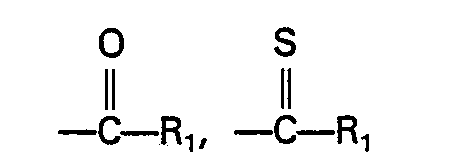

- Preferred photosensitive elements are recited in claims 2 to 7. The invention also relates to a diffusion transfer color film unit as recited in claims 8 and 9 and a diffusion transfer color process as recited in claims 9 to 12.
- The image dye-providing compounds include a diffusion control moiety such as hydroquinonyl group, or a precursor thereof, and may be diffusible or nonfiffusible as a function of the diffusion control moiety.
- The dye moiety of the image dye-providing compounds may be of any type such as, for example, azo dyes, azomethine dyes, xanthene dyes, anthraquinone dyes, cyanine dyes, phthalocyanine dyes, nitrophenyl dyes, quinone-methide dyes, etc. The image dye-providing compounds of the invention may be symmetrical or unsymmetrical compounds.
- In the diffusion transfer color process of the invention the desired image is obtained by processing an exposed photosensitive silver halide emulsion with a processing composition distributed between two sheet-like elements, one of said elements including said photosensitive emulsion. The processing composition is so applied and confined within and between the two sheet-like elements as not to contact or wet outer surfaces of the superposed elements, thus providing a film unit or film packet whose outer surfaces are dry. The processing composition may be viscous or nonviscous and preferably is distributed from a single-use container; such pressure rupturable processing composition containers are frequently referred to as "pods". The final image may be monochrome or multicolor and is formed in an image-receiving layer included in one of said sheet-like elements.
- As is well known in diffusion transfer photography the image dye-providing compounds which may be utilized in such processing generally may be characterized as either (1) initially soluble or diffusible in the processing composition but which are selectively rendered nondiffusible imagewise as a function of development; or (2) initially insoluble or nondiffusible in the processing composition but which selectively provide a diffusible product imagewise as a function of development. The image dye-providing compounds of the invention may be complete dyes or dye intermediates, e.g., color couplers. The requisite differential in mobility or solubility may, for example, be obtained by a chemical reaction such as a redox reaction, a coupling reaction or a cleavage reaction.
- The image dye-providing compounds which are capable of providing image dyes including the chromophoric system of Formula A include a diffusion control substituent, Y, which substituent includes a diffusion control moiety, D. One such group of image dye-providing compounds according to the invention is represented by the formula


- Image dye-providing compounds within Formula B are suitable for use in diffusion transfer processes.
- E may, for example be an alkylene radical. Further, when the image dye providing compound is initially diffusible a suitable ballast group, for example a long chain alkyl group may be attached to the diffusion control moiety.
- Image dye-providing compounds of the invention are represented by the formulas:


- As disclosed previously the image dye-providing compouunds of the invention include a diffusion control moiety such as a hydroquinonyl group or a precursor thereof. Dyes XI, XII and XIII include diffusion control moieties which are precursors of a hydroquinonyl group. When the compounds come in contact with an aqueous alkaline processing composition during photographic processing, the ester groups are cleaved and the hydroquinonyl groups are formed.
- In general, the image dye-providing compounds of the invention can be prepared by reacting the dye moiety with a small excess of an appropriate hydrazide compound in the presence of a solvent and base. For example, the sulfoxanthene hydrazide compounds can be prepared by heating a substituted chloro- sulfoxanthene with an excess of a hydrazide in the presence of a solvent and base. As noted previously, each substituent, Y, may include one or more diffusion control moiety(ies). Compounds wherein the substituent, Y, includes more than one diffusion control moiety can be prepared by judicious choice of hydrazide, dye, alkylating agent or by making subsequent modifications.
- The xanthene image dye-providing compounds of the invention typically have broader absorption bandwidths and shorter max than the corresponding amino derivatives. The absorption properties of these compounds can be utilized to address metamerism considerations when they are used in combination with other image dye-providing compounds in multi-color photographic systems.
- The image dye-providing compounds of the invention may be used generally in association with any silver halide emulsion. The image dye-providing compounds may be characterized as either (1) initially soluble or diffusible in the processing composition but which are selectively rendered non-diffusible imagewise as a function of development; or (2) initially insoluble or nondiffusible in the processing composition but which selectively provide a diffusible product imagewise as a function of development. The image dye-providing compounds may be complete dyes or dye intermediates, e.g., color couplers. The requisite differential in mobility or solubility may be obtained, for example, by a chemical reaction such as a redox reaction, a coupling reaction or a cleavage reaction. In a particularly preferred embodiment of the invention, the image dye-providing compounds are dye developers which are initially diffusible compounds. The dye developers contain, in the same molecule, both the chromophoric system of a dye and a silver halide developing function as it is described in U.S. Patent 2,983,606. Other image dye-providing compounds of the invention are: initially diffusible coupling dyes such as are useful in the diffusion transfer process described in U.S. Patent 3,087,817 and which are rendered nondiffusible by coupling with the oxidation product of a color developer; initially nondiffusible dyes which release a diffusible dye following oxidation, sometimes referred to as "redox dye releaser" dyes, such as described in U.S. Patents 3,725,062 and 4,076,529; initially non-diffusible image dye-providing compounds which release a diffusible dye following oxidation and intramolecular ring closure as are described in U.S. Patent 3,443,940 or undergo silver assisted cleavage to release a diffusible dye in accordance with the disclosure of U.S. Patent 3,719,489; and initially non-diffusible image dye-providing compounds which release a diffusible dye following coupling with an oxidized color developer as described in U.S. Patent 3,227,550.
- The diffusion transfer color film units of the invention include those wherein the image receiving element is designed to be separated from the photosensitive element after processing and integral positive-negative diffusion transfer film units which are retained intact after processing. In a preferred embodiment the diffusion transfer film units of the invention utilize initially diffusible dye developers as.the image dye-providing compounds.
- Dye developers, as noted in U.S. Patent No. 2,983,606, are compounds which contain, in the same molecule, both the chromophoric system of a dye and also a silver halide developing function. By "a silver halide developing function" is meant a grouping adapted to develop exposed silver halide. A preferred silver halide development function is a hydroquinonyl group. In general, the development function includes a benzonoid developing function, that is, an aromatic developing group which forms quinonoid or guinone substances when oxidized.
- Particularly useful products for obtaining multicolor dye developer images are disclosed in U.S. Patent No. 3,415,644. This patent discloses photographic products wherein a photosensitive element and an image-receiving element are maintained in fixed relationship prior to exposure, and this relationship is maintained as a laminate after processing and image formation. In these products, the final image is viewed through a transparent (support) element against a light-reflecting, i.e., white background. Photoexposure is made through said transparent element and application of the processing composition provides a layer of light-reflecting material to provide a white background. The light-reflecting material (referred to in said patent as an "opacifying agent") is preferably titanium dioxide, and it also performs an opacifying function, i.e., it is effective to mask the developed silver halide emulsions so that the transfer image may be viewed without interference therefrom, and it also acts to protect the photoexposed silver halide emulsions from post-exposure fogging by light passing through the transparent layer if the photoexposed film unit is removed from the camera before image-formation is completed.
- U.S. Patent No. 3,647,437 is concerned with improvements in products and processes disclosed in said U.S. Patent No. 3,415,644, and discloses the provision of light-absorbing materials to permit such processes to be performed, outside of the camera in which photoexposure is effected, under much more intense ambient light conditions. A light-absorbing material or reagent, preferably a pH-sensitive phthalein dye, is provided so positioned and/or constituted as not to interfere with photoexposure but so positioned between the photoexposed silver halide emulsions and the transparent support during processing after photoexposure as to absorb light which otherwise might fog the photoexposed emulsions. Furthermore, the light-absorbing material is so positioned and/or constituted after processing as not to interfere with viewing the desired image shortly after said image has been formed. In the preferred embodiments, the light-absorbing material, also sometimes referred to as an optical filter agent, is initially contained in the processing composition together with a light-reflecting material, e.g., titanium dioxide. The concentration of the light-absorbing dye is selected to provide the light transmission opacity required to perform the particular process under the selected light conditions.
- In a particularly useful embodiment, the light-absorbing dye is highly colored at the pH of the processing composition, e.g., 13-14, but is substantially non-absorbing of visible light at a lower pH, e.g., less than 10-12. This pH reduction may be effected by an acid-reacting reagent appropriately positioned in the film unit, e.g., in a layer between the transparent support and the image-receiving layer.
- The dye developers are preferably selected for their ability to provide colors that are useful in carrying out subtractive color photography, that is, the previously mentioned cyan, magenta and yellow. The dye developers employed may be incorporated in the respective silver halide emulsion or, in the preferred embodiment, in a separate layer behind the respective silver halide emulsion, and such a layer of dye developer may be applied by use of a coating solution containing the respective dye developer distributed, in a concentration calculated to give the desired coverage of dye developer per unit area, in a film-forming natural, or synthetic, polymer, for example, gelatin, polyvinyl alcohol, and the like, adapted to be permeated by the processing composition.
- Other diffusion transfer products and processes are the types described in U.S. Patents 3 573 043 and 3 594 165. A particularly useful diffusion transfer color film unit according to the invention is one wherein the photosensitive element includes a light-reflecting layer between the silver halide layer and the image dye-providing layer (as described in Canadian Patent 668,952), the substrate of the photosensitive element carries the polymeric acid neutralizing layer which in turn carries the timing layer (as described in U.S. Patent 3,573,043) and the processing composition includes an oximated polydiacetone acrylamide thickening agent (as described in U.S. Patent 4,202,694.
- As described previously, the image dye-providing compounds of the invention are not restricted to dye developers but rather may include many other types of initially diffusible and initially nondiffusible image dye-providing compounds. Thus, for example, an initially diffusible coupling dye which is useful in the diffusion transfer process described in U.S. Patent 3,087,817 may be provided by attaching to the chromophoric system one or more color coupling moieties such as a phenol or'a naphthol having a free position para to the hydroxyl group. An example of such an image dye-providing compound according to the invention is
-

- This dye is initially diffusible but is rendered nondiffusible by coupling with the oxidation product of a color developer, e.g., a p-phenylenediamine or a p-aminophenol, to form a less diffusible product. If the coupling position is substituted by a substituent which renders the dye initially nondiffusible by virtue of a ballast group and which substituent is displaceable upon coupling, such a dye may be employed to provide a diffusible dye where coupling occurs employing the principles described in U.S. Patent 3,227,550.
- An initialy nondiffusible "redox dye releaser" image dye-providing compound useful in the diffusion transfer process described in U.S. Patent 4,076,529 may be provided by attaching one or more sulfonamidophenol or sulfonamidonaphthol groups to the chromophoric system. An example of such a compound according to the invention is represented by the formula
-

- Other sulfonamidophenol and sulfonamidonaphthol groups known in the art, for example, such as those described in U.S. Patent Nos. 4,053,312 and 4,055,428, which cleave in alkaline solution at the sulfonamido groups following oxidation may be used in place of the p-sulfonamidophenol group shown above.
- Another class of initially nondiffusible image dye-providing compounds (described in U.S. Patent 3,443,940) release a diffusible dye following oxidation and intramolecular ring closure. An image dye-providing compound of this type according to the invention is represented by the formula

- Other image dye-providing compounds which cleave in alkali following oxidation may be provided by a compound within Formula B wherein Y is-O-or-S-and the hydroquinonyl group contains a ballast group, e.g., C,5H3, in accordance with the disclosure of U.S. Patent 3,725,062. An example of such a compound according to the invention is represented by the formula

- It should be understood that although the ballast group shown in the above illustrated compounds is a long chain alkyl group, other ballast groups known in the art may also be used.
- In the use of a nondiffusible image dye-providing compound which releases a diffusible image dye-providing compound following oxidation in an alkaline environment, the requisite oxidation may be effected by the oxidation product of a mobile developing agent used to develop the photoexposed silver halide emulsion. A particularly effective developing agent for this purpose is 1-phenyl-4,4-dimethyl-3-pyrazolidone; other suitable developing agents are known in the art.
- Development is advantageously effected in the presence of an onium compound, particularly a quaternary ammonium compound, in accordance with the disclosure of U.S. Patent 3,173,786. Quaternary ammonium compounds which form an active methylene compound in alkali are especially useful.
- Development may be effected in the presence of a colorless auxiliary or accelerating developing agent such as, for example, a 3-pyrazolidone or a hydroquinone such as 4-methylphenylhydroquinone, which may be initially arranged in a layer of the photosensitive element or in the processing composition.
- In another preferred embodiment of the invention the diffusion control moiety is a thiazolidine group whose cleavage is silver catalyzed. As described in U.S. Patent 3,719,489, image dye-providing compounds of this type are photographically inert in the photographic processing composition but are capable of undergoing cleavage in the presence of an imagewise distribution of silver ions and/or soluble silver complex containing silver ions made available as a function of development to liberate a reagent in an imagewise distribution corresponding to that of said silver ion and/or said complex. Dyes XIV-XIX are examples of such image dye-providing compounds according to the invention.
- The invention will now be described further in detail with respect to specific preferred embodiments by way of examples, it being understood that these are illustrative only and the invention is not intended to be limited to the compounds, conditions, process parameters, etc., recited therein. All parts and percentages are by weight unless otherwise specified.
- A mixture of 4.05 g (10 mmole) of a compound represented by the formula


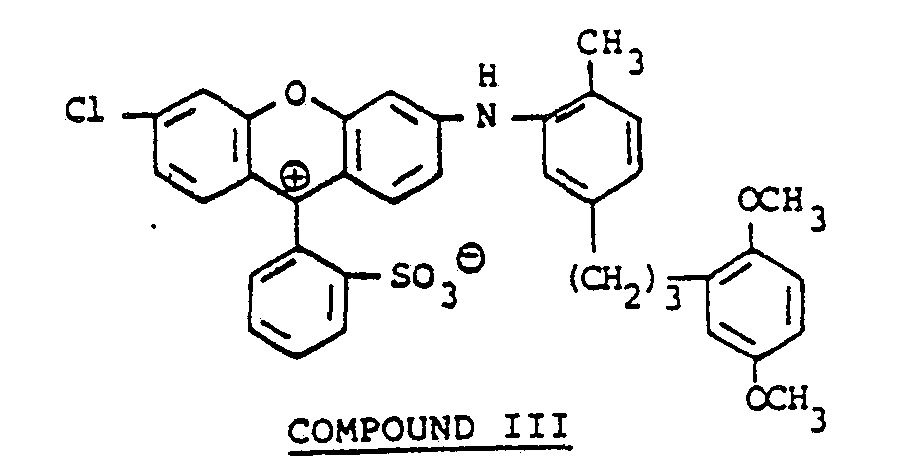
- A mixture of 6.53 g (10 mmole) of compound III in 50 ml. of diglyme was treated with 1.78 (15 mmole) of potassium tertiary butoxide. Compound III gradually dissolved and the solution became dark. The solution was cooled to 0°C and 1.42 ml (15 mmole) of dimethyl sulfate were added. The reaction mixture was stirred at 0°C for 1 hour and at room temperature over the weekend. The reaction mixture was poured into 700 ml of water (including some salt to encourage floculation), the precipitate collected by filtration, dissolved in methylene chloride and dried over sodium sulfate. The methylene chloride was removed and the residue recrystallized from a tetrahydrofuran-hexane mixture to give 4.41 g of a compound represented by the formula

- A mixture of 4.10 g (6.0 mmole) of compound IV, 2.02 g (13.3 mmole) of phenylsemicarbazide


- A solution of 340 mg of compound V in 5 ml of methylene chloride was slowly added to a solution of excess boron tribromide in about 30 ml of methylene chloride. The mixture was stirred for 1 hour at room temperature and an equivalent volume of ether added. The mixture was then poured into 100 ml of 5% sodium sulfite, stirred for 20 minutes and the suspension filtered to collect the crude dye which was dried to give 295 mg of Dye I λmax (methyl cellosolve) = 544 nm, s = 74,700.
- A solution of 100 mg of compound V in 5 ml of dyglyme was treated with excess potassium tertiary butoxide for 1 hour during which time the solution turned blue. Excess dimethyl sulfate was added to the solution and it gradually turned back to a magenta color over a 1/2 hour period. The reaction mixture was stirred over a weekend and then poured into a saturated sodium chloride solution. The resulting precipitate was collected by filtration, purified by preparative thin layer chromatography (10/90 VN MeOH/CH2CI2) to give a reddish-magenta compound.
- A solution of 613 mg (0.776 mmole) of the compound prepared above in 10 ml of methylene chloride was quickly added to excess boron tribromide in 400 ml of methylene chloride. The reaction mixture was stirred for 1 hour and 100 ml of a 5% NaHS04 solution added to it. The resulting precipitate was collected by filtration, washed with water and dried to give 361 mg of Dye II, a purple powder, Àmax (methyl cellosolve) = 541 nm, e = 74,500.
- The structure of the product was confirmed by IR and UV spectra.
- A mixture of 5.08 g (7.6 mmole) of compound IV and 2.02 g (8.4 mmole) of 1,4-diphenyl-4-methyl semicarbazide in 80 ml of dry pyridine was heated at 110°C for 50 minutes. The reaction mixture was poured into 5% hydrochloric acid and the resulting precipitate collected by filtration. Thin layer chromatography showed the crude product to be similar to a sample of crude material which had been purified by preparative thin layer chromatography (6/94 VN MeOH/CH2CI2), having the formula

- Compound VI, the blocked precursor of Dye III, can be converted to Dye III by reaction with boron tribromide as is described in Examples I and II.
- Crude compound VI was dissolved in 10 ml of methanol and 2 ml of methyl iodide were added to the solution. An aliquot of 5% NaOH was added. The reaction mixture turned purplish and then gradually back to magenta over a period of an hour. The process was repeated until no color change could be observed. The solvent was removed and the residue and water dissolved in methylene chloride. The methylene chloride was removed to give the crude product (the methoxy-blocked precursor of Dye IV) which was purified by high performance liquid chromatography. The pure product exhibited λmax = 542 nm, ε = 81,100. The structure of the product was confirmed by IR, visible and UV spectra.
- The blocked precursor can be converted to Dye IV by reaction with boron tribromide as is described in Examples I and II.
- A mixture of 6.675 g (10.0 mmole) of compound IV and 3.15 g (10.5 mmole) of a compound represented by the formula

- The structure of the product was confirmed by IR and visible spectra.
- The blocked precursor can be converted to Dye V by reaction with boron tribromide as described in Examples I and II.
- The crude methoxy-blocked precursor of Dye V was dissolved in 500 ml of methylene chloride and excess conc. KOH/methanol was added until the solution turned blue, after which 13 ml of methyl iodide were added and the solution stirred for 1 hour. Thin layer chromatography showed the reaction to be complete. The solution was washed with water and evaporated to dryness on a rotary evaporator. Separation by high performance liquid chromatography gave 3.18 g of pure product the methoxy-blocked precursor of Dye VI.
- A solution of 4.03 g df the blocked material in 25 ml of methylene chloride was added to 6 ml of boron tribromide in 500 ml of methylene chloride and the reaction mixture stirred for hour. To the reaction mixture there were added 250 ml of 10% NaHS04 solution and the mixture was stirred for hour. The resulting precipitate was collected by filtration, suspended in 400 ml of water and heated to 90°C for hour. The precipitate was collected by filtration and dried to give 3.45 g of Dye V, λmax (methyl cellosolve) = 545 nm, s = 75,000.
- The structure of the product was confirmed by IR and visible spectra.
- To a solution of 20 g of the methoxy-blocked prcursor of Dye V in 400 ml of dry dimethylformamide there were added 1.1 g of NaH with stirring and the stirring continued until the solution turned blue (20 minutes). To the solution there were added 12 g of an iodide compound represented by the formula

- A solution of 1.036 g of the methoxy-blocked precursor of Dye VII in 3 ml of methylene chloride was added dropwise, under nitrogen, to a stirred solution of 4 ml of boron tribromide in 4 ml of methylene chloride and stirring was continued for hour. The reaction mixture was poured into 30 ml of methanol containing bis-methoxyethyl hydroxylamine and 5 ml of pyridine. The solution was then subjected to rotary evaporation, poured into 500 ml of diluted hydrochloric acid and the precipitate collected and dried to give 950 mg of crude product. The crude product (9.1 g) was dissolved in methanol and 136.5 g of sand were added to the solution. The mixture was evaporated to dryness and the residue purified by chromatography to give 7.5 g of Dye VII, λmax (methyl cellosolve) = 545 nm, s = 76,424.
- A mixture of 40 mg (0.0599 mmole) of compound IV and 0.01 g of phenylthiosemicarbazide in 0.5 ml of dry diglyme was refluxed for 14 hours. The resulting precipitate was collected by filtration. Both the crystalline precipitate and the mother liquor were chromatographed on thick silica gel plates and developed in 4%, and then 6% methanol/methylene chloride. The precipitate was then collected and dried to give the methoxy-blocked precursor of Dye VIII, λmax (methyl cellosolve) = 544 nm, e = 46,000. The structure of the compound was confirmed by IR and UV spectra.
- The methoxy-blocked precursor of Dye VIII can be converted to Dye VIII by reaction with boron tribromide as described in other examples.
- A mixture of 40 mg of compound I and 32 mg of compound VII in 0.5 ml of dry pyridine were allowed to stand in a test tube at room temperature for 15 minutes. Thin layer chromatography showed the reaction to be complete. The resulting precipitate was collected and purified by dissolving it in methylene chloride, placing the solution on a silica column and washing with a 3/97 (VN) mixture of methanol and methylene chloride. The residue was collected and dried to give the methoxy-blocked precursor of Dye IX, λmax (methyl cellosolve) = 5.10 nm, s = 9,000.
- The methoxy-blocked precursor of Dye IX can be converted to Dye IX by reaction with boron tribromide as described in other examples.
- A mixture of 4 g (0.01 mole) of compound I, 12 g (0.04 mole) of compound VII nd 2 g (0.02 mole) of potassium acetate in 40 ml of diglyme was heated on a steam bath for 4 hours. Thin layer chromatography (90/10 VN chloroform/methanol) showed the reaction to be virtually complete. The magenta solution was filtered and the filtrate was poured over a slurry of crushed ice and dilute hydrochloric acid. The precipitate was recovered by filtration and dried to give about 8.4 g of the crude methoxy-blocked precursor of Dye X.
- The crude product was purified to give the pure methoxy-blocked precursor of Dye X, λmax (methyl cellolsolve) = 536 nm, e = 70,000.
- The precursor can be converted to Dye X by reaction with boron tribromide as described in other examples.
- To a mixture of 1.28 g of Dye VI and 2.15 g of a compound represented by the formula

- To a suspension of 8.89 g (10 mmole) of Dye VI and 11.6 g of a compound represented by the formula

- Pyridine was added to a mixture of a small amount of Dye VI and an excess of a compound represented by the formula

- To a stirred suspension 2.2 g (3.46 mmole) of a compound represented by the formula
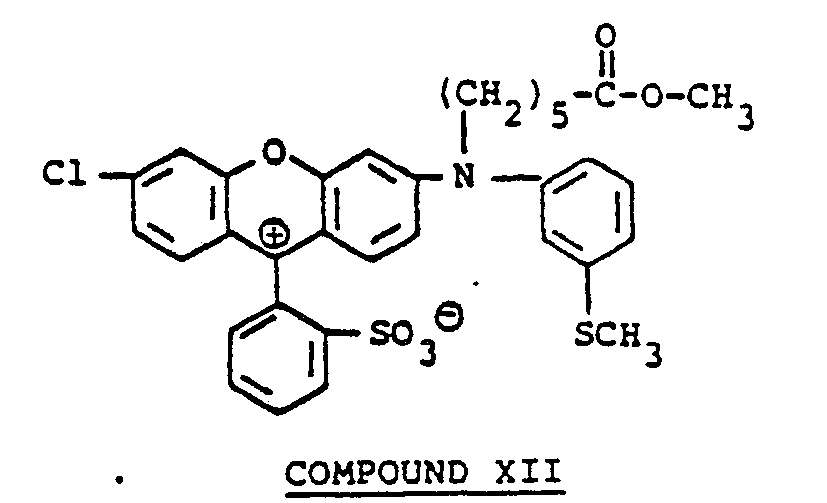
- The magenta solid (2.6 g, 3.5 mmole) was dissolved in 25 ml of dimethylformamide along with 5.84 g (30 mmole) of ethyl bromobutyrate and 4.83 g (35 mmole) of finely ground anhydrous potassium carbonate. The solution was stirred and heated in a 100°C oil bath under nitrogen for 14 hours, cooled, diluted with chloroform and washed with 1 N hydrochloric acid and saline solution. The solution was then dried over sodium sulfate. The organic solution was then evaporated on a rotary evaporator and the residue dried under vacuum, triturated with petroleum ether and purified by column chromatography with chloroform as the eluent to give 1.85 g of pure magenta product, a xanthane diester sulfide.
- The xanthene diester sulfide (1.85 g, 2.144 mmole) was dissolved in 24 ml of glacial acetic acid and 1.34 g of 40% (w/w) peracetic acid in acetic acid (7.07 mmole, 3.3 equiv.) were added. After 1 hour 10 minutes the mixture was poured into water and saturated aqueous sodium bicarbonate solution was added slowly until the acid was neutralized. The mixture was then extracted with chloroform. The organic extract was washed with water, dried, and evaporated under vacuum to give 2.145 g (2.4 mmole) of a xanthene diester sulfone.
- The xanthene diester sulfone (2.14 g, 2.4 mmole) was dissolved in 20 ml of p-dioxane and to the solution there were added 9.6 ml of 1 N NaOH (9.6 mmole, 4 equiv.). The resulting solution was stirred at room temperature for 1.5 hours and then poured into crushed ice slurried with 1 N HCI. The solid precipitate was collected by filtration, washed with water and then dissolved in tetrahydrofuran. This solution was evaporated to dryness under vacuum and the residue dried under high vacuum to give, as a powder, 1.5 g (1.76 mmole) of xanthene diacid sulfone represented by the formula

- To 1.5 g (1.76 mmole) of the compound there were added 20.72 ml of a 99.4 mg/ml (0.17 mmole/mg) methylene chloride solution of aminothiazolidine (2.06 g, 3.52 mmole) represented by the formula

- Exactly 390 mg (0.535 mmole) of a xanthene diacid represented by the formula

- The structure of the compound was confirmed by proton NMR and visible spectra.
- Exactly 900 mg (1.09 mmole) of a xanthene diacid represented by the formula

- The structure of the product was confirmed by proton NMR and visible spectra.
- To a solution of 676 mg (0.886 mole) of a compound represented by the formula


- The xanthene diester sulfide (308 mg, 0.351 mmole) was dissolved in 4 ml of glacial acetic acid. To this solution there were added, dropwise from a syringe at room temperature, 220.2 mg (1.159 mmole), diluted with 0.5 ml of acetic acid, of a solution of 40% w/w of peracetic acid in acetic acid. The reaction mixture was stirred at room temperature under argon for 3i hours, poured carefully into saturated sodium bicarbonate solution and stirred until vigorous foaming had subsided. Methylene chloride and additional sodium bicarbonate were added and the mixture stirred for 2 hours. The organic phase was separated, washed with sodium bicarbonate, dried over sodium sulfate and the solvent removed by rotary evaporation to give 294 mg of a bis ester compound represented by the formula


- Exactly 367 mg (0.544 mmole) of aminothiazolidine hydrochloride were partitioned between ethyl acetate/aqueous sodium bicarbonate and removal of ethyl acetate left the free base as an oil. The oil was combined with 236 mg (0.272 mmole) of the purple diacid and 75 µl (55 mg, 0.5444 mmole) of triethylamine in 3 ml of dimethylformamide. The resulting solution was cooled under argon in a -30°C bath and 117.5 (150 mg, 0.544 mmole) of diphenyl phosphoryl azide were added. The resulting mixture was stirred for 69 hours. The mixture was diluted with ethyl acetate, washed twice with 1 N HCI and twice with saturated aqueous sodium bicarbonate and dried over sodium sulfate. The solvent was removed by rotary evaporation to give crude Dye XVII. The crude product was purified by column chromatography on silica gel to give 120 mg of Dye XVII, λmax = 545 nm, s = 99,500.
- Exactly 1.502 g (10 mmole) of a hydrazide compound represented by the formula


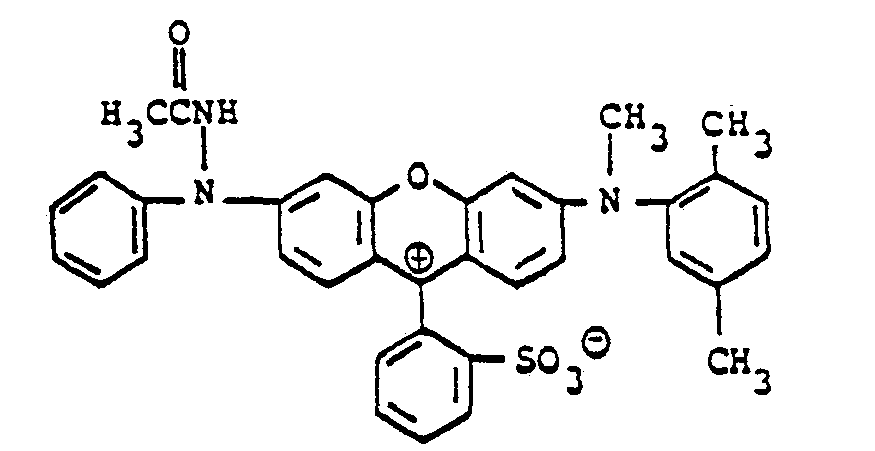
- The crude compound (5.89 g, 9.55 mmole) was dissolved in 60 ml of dry tetrahydrofuran and ethyl bromo butyrate (11.6 ml, 15.8 g, 81.2 mmole) and finely ground anhydrous K2C03 (13.18 g, 95.5 mmole) were added. The mixture, under a CaS04 tube, was heated with stirring in a 100°-105°C oil bath for 3 hours. The cooled reaction mixture was poured into a 1 N HCI-ice mixture and then extracted with methylene chloride. The organic phase was washed with water, dried over sodium sulfate and evaporated to dryness leaving a liquidy residue. The residue was dried under high vacuum overnight to give a syrup which was triturated with hexane and dried again under vacuum. The residue was subjected to column chromatography on A1203 eluting with methylene chloride. The pure product was then collected and dried under high vacuum overnight. The residue was suspended in ethyl ether, collected by filtration and dried under vacuum to yield 3.46 g of a dark greenish solid xanthene ester represented by the formula

- The xanthene ester (2.625 g, 3.59 mmole) was dissolved in 29 ml of absolute methanol and 11 ml of 1 N NaOH were added dropwise over a one minute period. The solution was stirred under argon for 5) hours and then poured into a 1 N HCI-ice mixture. The resulting precipitate was collected by filtration, washed with 1N HCI and water and dried in air overnight. The residue was dissolved in about 250 ml of saturated aqueous NaHC03 and washed thoroughly with ethyl acetate. The aqueous phase was then layered with methylene chloride and 2N HCI (150 ml) was added dropwise with stirring to acidify to pH 2. The methylene chloride layer was isolated and washed with 1N HCI and then water and dried over sodium sulfate. The solvent was removed by rotary evaporation leaving a solid which was suspended in ethyl ether, collected by filtration, washed with ethyl ether and dried under vacuum to give 2.1597 g of a magenta solid represented by the formula

- L-glutaric acid (11 g, 75 mmole) was dissolved in water (150 ml) with 1 N NaOH (160 ml) and ethyl ether (150 ml) was added. The two phase mixture was stirred vigorously in an ice-salt bath and to it there were added, dropwise and at the same time (from two dropping funnels), 100 ml of 1 N NaOH and a solution of β.β.β-trichloroethylchloroformate in 100 ml of dioxane. The resulting mixture was stirred for 100 minutes and then washed with 500 ml of diethyl ether. The aqueous phase was layered with ethyl acetate, stirred and acidified with 2N HCI. The organic phase was isolated. The aqueous phase was extracted with ethyl acetate. The combined organic phases were washed with a saturated salt solution, dried over sodium sulfate and the solvent removed by rotary evaporation to leave a thick colorless syrup which was dried under high vacuum overnight. The syrup was dissolved in diethyl ether, washed ten times withn 100 ml portions of water and dried over sodium sulfate. The solvent was removed by rotary evaporation and the residue was dried under high vacuum to give 21 g of a thick, clear, colorless syrup represented by the formula

- The diacid urethane (14.8 g, 0.0459 mole) was dissolved in 450 ml of dry dimethylformamide and 28 ml of triethylamirre were added followed by 61.9 g (0.0918 mole) of a thiazolidine compound represented by the formula

- The mixture was stirred under argon and cooled in a -30°C methanol-ice-dry ice bath. After 15 minutes diphenyl phosphoryl azide (19.79 ml) was added. The resulting mixture was stirred for 1: hours at -20°C to -25°C and then stirred overnight with the bath temperature being allowed to rise toward room temperature. After a total of 20 hours the mixture was diluted with ethyl acetate, washed three times with 1N HCI and then twice with saturated aqueous sodium bicarbonate. The organic phase was dried over sodium sulfate and the solvent was removed by rotary evaporation. The desired product (38 g) was separated from contaminants by column chromatography (with silica gel) eluting with 2.5%/97.5% (VN) methanol-methylene chloride. The product (12 g) was further purified by column chromatography eluting with 2%/98% (VN) methanol/methylene chloride to give 7.59 g of a pure thiazolidine compound represented by the formula

- Compound XV (7.59 g, 5.225 mole) was dissolved in 80 ml of glacial acetic acid under argon and 8.2 g of zinc dust added in portions over a period of one minute. The resulting mixture was stirred under argon for 3 hours 20 minutes and then diluted with ethyl acetate and filtered through diatomaceous earth. Water was added to the filtrate and the mixture was stirred as sodium bicarbonate was added to neutralize the acetic acid. The organic layer was isolated and the aqueous phase was washed with ethyl acetate. The combined organic phases were washed with saturated sodium bicarbonate solution, then dried and the solvent removed by rotary evaporation to give a crude white residue. The residue was purified by column chromatography on Si02 eluting with 3/97 (VN) methanol/methylene chloride to elute off contaminants and then with 6/94 (VN) methanol/methylene chloride to give 3.6647 of an amino bis thiazolidine compound represented by the formula

- To a stirred solution of compound-XIV (2.0169 g, 2.869 mmole) and compound XVI (3.6647 g, 2.869 mmole) in 40 ml of dry dimethylformamide, there was added triethylamine (0.4 ml, 2.869 mmole) and the solution cooled under argon in a -30°C bath. After 15 minutes diphenyl phosphoryl azide (0.62 ml, 2.869 mmole) was added dropwise with a syringe over a period of 20 seconds. The resulting mixture was stirred in a cold bath under argon for 1 1/2 hours. The mixture was then stirred overnight with the bath being allowed to rise toward room temperature. The reaction mixture was diluted with methylene chloride, washed thoroughly with 1 N HCI and dried over sodium sulfate. The solvent was removed by rotary evaporation and the residue dried under high vacuum. The compound was purified by silica gel column chromatography eluting with 3/97 (V/V) methanol-methylene chloride which was gradually changed to 4/96 (v/v) methanol- methylene chloride affording a solid which was suspended in a 2:1 (V/V) hexane-ether solution, filtered and vacuum dried to give 3.564 g of Dye XIX, λmax = 548 nm, s = 79,560.
- C107H154N10O14S5 requires 65.41 % C, 7.90% H, 7.13% N and 8.16% S. Elemental analysis found 65.03% C, 7.78% H, 6.81 % N and 8.02% S.
- The structure of the compound was confirmed by proton NMR.
- A film unit according to the invention was prepared wherein the negative element comprised an opaque subcoated polyester photographic film base having the following layers coated thereon in succession:
- 1. a layer of sodium cellulose sulfate coated at a coverage of 10 mg/m2;
- 2. a cyan dye developer comprising 747 mg/m2 of a cyan dye developer represented by the formula

- 3. a red sensitive gelatino silver iodobromide emulsion layer coated at a coverage of 640 mg/m2 of silver (1.05 µm), 640 mg/m2 of silver (1.8 µm) and 768 mg/m2 of gelatin;
- 4. an interlayer coated at a coverage of 2582 mg/m2 and comprising 97 parts of a 60-29-6-4-0.4 pentapolymer of butylacrylate, diacetone acrylamide, methacrylic acid, styrene and acrylic acid and 3 parts of polyacrylamide;
- 5. a magenta dye developer layer coated at a coverage of 646 mg/m2 of Dye I, 323 mg/m2 of gelatin and 150 mg/m2 of 2-phenylbenzimidazole;
- 6. a green sensitive gelatino silver iodobromide emulsion layer coated at a coverage of 435 mg/m2 of silver (1.05 µm), 435 mg/m2 of silver (1.8 µm), 382 mg/m2 of gelatin and 1528 mg/m2 of polymethylmethacrylate;
- 7. a spacer layer coated at a coverage of 215 mg/m2 of gelatin;
- 8. an interlayer coated at a coverage of 872 mg/m2 of 94 parts of the pentapolymer described in layer 4 and 6 parts of polyacrylamide; and 70.5 mg/m2 of succinaldehyde;
- 9. a yellow dye developer layer coated at a coverage of 968 mg/m2 of a yellow dye developer represented by the formula

- 10. a blue sensitive gelatino silver iodobromide emulsion layer coated at a coverage of 640 mg/m2 of silver (1.05 µm), 640 mg/m2 of silver (1.8 µm), 654 mg/m2 of gelatin and 204 mg/m2 of MPHQ; and
- 11. a top coat layer of 484 mg/m2 of gelatin and 42 mg/m2 of carbon black.
- The image-receiving element comprised a transparent subcoated polyethylene terephthalate base on which the following layers were coated in succession:
- 1. as a polymeric acid layer approximately 9 parts of a 1/2 butyl ester of polyethylene/maleic anhydride copolymer and 1 part of polyvinyl butyral coated at a coverage of 26,372 mg/m2;
- 2. a timing layer comprising 4515 mg/m2 of the pentapolymer described in the negative above; and
- 3. a polymeric image receiving layer of: (a) 3 parts of a mixture of 2 parts polyvinyl alcohol and 1 part poly-4-vinyl pyridine and (b) 1 part of a graft copolymer comprised of 4-vinylpyridine (4VP) and vinylbenzyl trimethyl ammonium chloride (TMQ) grafted onto hydroxyethyl cellulose (HEC) at a ratio of HEC/4VP/TMQ of 2.2/2.2/1 coated at a coverage of 3229 mg/m2.
- The film unit was processed with a processing composition comprised of:


- The film unit was then exposed (2 meter-candle-seconds) on a sensitometer to a test exposure scale, or step wedge, through a 0.6 neutral density filter and passed through a pair of rollers at a gap spacing of 0.076 mm. The film unit was kept intact and viewed through the base. A well developed dye image was obtained. The reflection densities of the neutral areas of the image were:

- A film unit according to the invention was prepared wherein the negative element comprised an opaque subcoated polyester photographic film base having the following layers coated thereon in succession:
- 1. a layer of sodium cellulose sulfate coated at a coverage of 10 mg/m2;
- 2. a cyan dye developer layer comprising 747 mg/m2 of the cyan dye developer shown in Example XVIII, 1554 mg/m2 of gelatin, 270 mg/m2 of 2-phenylbenzimidazole and 67.8 mg/m2 of MPHQ;
- 3. a red sensitive gelatino silver iodobromide emulsion layer coated at a coverage of 1280 mg/m2 of silver (1.8 µm and 768 Mg/M 2 of gelatin;
- 4. an interlayer as described in layer 4 of the negative in Example XVIII;
- 5. a magenta dye developer layer coated at a coverage of 646 mg/m2 of Dye VI, 323 mg/m2 of gelatin and 230 mg/m2 of 2-phenylbenzimidazole;
- 6. a green sensitive gelatino silver iodobromide emulsion layer coated at a coverage of 913 mg/m2 of silver (1.8 pm) and 438 mg/m2 of gelatin;
- 7. a layer comprising 215 mg/m2 of gelatin and 215 mg/m2 of aminoreductone;
- 8. an interlayer coated at a coverage of 1453 mg/m2 of 94 parts of the pentapolymer described in Example XVIII and 6 parts of polyacrylamide; and 70.5 mg/m2 of succinaldehyde;
- 9. a yellow dye developer layer as described in layer 9 of the negative in Example XVIII;
- 10. a blue sensitive gelatino silver iodobromide emulsion layer coated at a coverage of 1280 mg/m2 of silver (1.8 pm), 653 mg/m2 of gelatin and 204 mg/m2 of MPHQ; and
- 11. a top coat layer of 485 mg/m2 of gelatin and 21 mg/m2 of carbon black.
- The image-receiving element and the processing composition were the same as those described in Example XVIII, and the film unit was processed in the same manner as described therein.
- A well developed dye image was obtained. The reflection densities of the neutral areas of the image were:
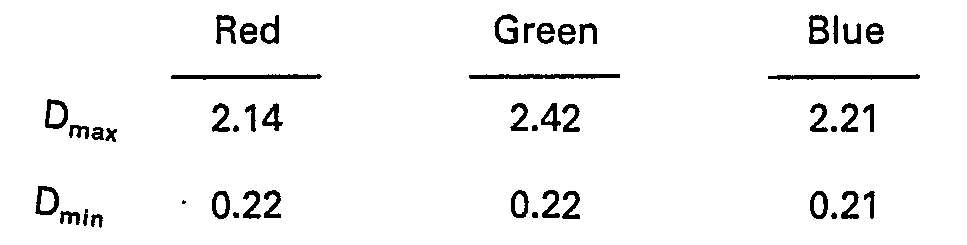
- Although the invention has been described with respect to specific preferred embodiments, it is not intended to be limited thereto.
Claims (13)

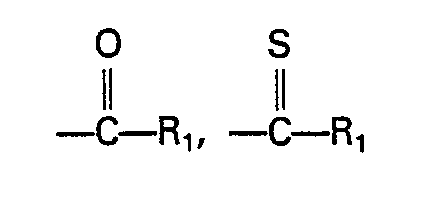


Applications Claiming Priority (2)
| Application Number | Priority Date | Filing Date | Title |
|---|---|---|---|
| US331995 | 1981-12-18 | ||
| US06/331,995 US4386150A (en) | 1981-12-18 | 1981-12-18 | Novel image dye-providing materials and photographic products and processes |
Publications (3)
| Publication Number | Publication Date |
|---|---|
| EP0082506A2 EP0082506A2 (en) | 1983-06-29 |
| EP0082506A3 EP0082506A3 (en) | 1984-05-02 |
| EP0082506B1 true EP0082506B1 (en) | 1988-06-29 |
Family
ID=23296245
Family Applications (1)
| Application Number | Title | Priority Date | Filing Date |
|---|---|---|---|
| EP82111743A Expired EP0082506B1 (en) | 1981-12-18 | 1982-12-17 | Photosensitive element, film unit, photographic process and dyes |
Country Status (5)
| Country | Link |
|---|---|
| US (1) | US4386150A (en) |
| EP (1) | EP0082506B1 (en) |
| JP (1) | JPS58111033A (en) |
| CA (1) | CA1179330A (en) |
| DE (1) | DE3278723D1 (en) |
Families Citing this family (11)
| Publication number | Priority date | Publication date | Assignee | Title |
|---|---|---|---|---|
| US4840884A (en) * | 1987-10-19 | 1989-06-20 | Eastman Kodak Company | Photographic element and process comprising a dye releasing group |
| US5414091A (en) * | 1992-07-31 | 1995-05-09 | Polaroid Corporation | Dye-providing compounds |
| US5316887A (en) * | 1992-07-31 | 1994-05-31 | Polaroid Corporation | Thermally developable photosensitive material |
| US5340689A (en) * | 1992-07-31 | 1994-08-23 | Polaroid Corporation | Image-recording materials with cyclic 1,3-sulfur-nitrogen dye providing compounds |
| US5464738A (en) * | 1995-01-06 | 1995-11-07 | Minnesota Mining And Manufacturing Company | Sulfonyl hydrazide developers for photothermographic and thermographic elements |
| US5492803A (en) * | 1995-01-06 | 1996-02-20 | Minnesota Mining And Manufacturing Company | Hydrazide redox-dye-releasing compounds for photothermographic elements |
| WO2009094536A1 (en) * | 2008-01-24 | 2009-07-30 | Life Technologies Corporation | Fluorogenic hydrazine-substituted compounds |
| WO2015083605A1 (en) * | 2013-12-05 | 2015-06-11 | 株式会社Adeka | Novel compound and composition containing novel compound |
| KR102069938B1 (en) * | 2016-06-10 | 2020-01-23 | 주식회사 엘지화학 | Compound, colorant composition comprising the same and resin composition comprising the same |
| KR102162610B1 (en) * | 2016-08-19 | 2020-10-07 | 주식회사 엘지화학 | Compound, colorant composition comprising the same and resin composition comprising the same |
| KR102314483B1 (en) * | 2018-06-22 | 2021-10-19 | 주식회사 엘지화학 | Compound, polymer, colorant composition, resin composition, color filter and display device |
Family Cites Families (14)
| Publication number | Priority date | Publication date | Assignee | Title |
|---|---|---|---|---|
| DE895041C (en) | 1951-02-10 | 1953-10-29 | Hoechst Ag | Process for the preparation of triphenylmethane dyes |
| US3245789A (en) * | 1961-05-05 | 1966-04-12 | Polaroid Corp | Photographic products and processes |
| DE1930215C3 (en) * | 1969-06-13 | 1974-10-31 | Agfa-Gevaert Ag, 5090 Leverkusen | Diffusion transfer color photographic process and related photographic material |
| DE2032711A1 (en) * | 1970-07-02 | 1972-01-05 | Agfa-Gevaert Ag, 5090 Leverkusen | Dye diffusion transfer process for the production of positive color photographic images |
| BE792590A (en) * | 1971-12-15 | 1973-06-12 | Ici Ltd | NEW COLORANTS REACTIVE AGAINST CELLULOSE |
| GB1423346A (en) | 1972-02-21 | 1976-02-04 | Wiggins Teape Ltd | Colour formers |
| DE2228361A1 (en) * | 1972-06-10 | 1974-01-03 | Agfa Gevaert Ag | COLOR PHOTOGRAPHIC DIFFUSION TRANSFER PROCESS AND RELATED PHOTOGRAPHIC MATERIAL |
| GB1435776A (en) * | 1973-09-06 | 1976-05-12 | Ici Ltd | Reactive xanthenium dyestuffs |
| DE2460491A1 (en) | 1974-12-20 | 1976-07-01 | Hoechst Ag | PROCESS FOR THE MANUFACTURING OF XANTHENE DYES |
| GB2016031A (en) | 1978-02-28 | 1979-09-19 | Ciba Geigy Ag | Azo compounds |
| US4237281A (en) * | 1978-10-13 | 1980-12-02 | Ciba-Geigy Aktiengesellschaft | Dyestuffs containing amino or imino groups |
| US4264701A (en) * | 1979-04-24 | 1981-04-28 | Polaroid Corporation | Magenta dye developers |
| WO1980002334A1 (en) * | 1979-04-24 | 1980-10-30 | Polaroid Corp | Magenta dye developers |
| US4264507A (en) * | 1979-04-24 | 1981-04-28 | Polaroid Corporation | Novel xanthene dye developers |
-
1981
- 1981-12-18 US US06/331,995 patent/US4386150A/en not_active Expired - Lifetime
-
1982
- 1982-11-22 CA CA000416100A patent/CA1179330A/en not_active Expired
- 1982-12-17 EP EP82111743A patent/EP0082506B1/en not_active Expired
- 1982-12-17 DE DE8282111743T patent/DE3278723D1/en not_active Expired
- 1982-12-17 JP JP57221747A patent/JPS58111033A/en active Granted
Also Published As
| Publication number | Publication date |
|---|---|
| JPH0228133B2 (en) | 1990-06-21 |
| EP0082506A3 (en) | 1984-05-02 |
| JPS58111033A (en) | 1983-07-01 |
| EP0082506A2 (en) | 1983-06-29 |
| CA1179330A (en) | 1984-12-11 |
| DE3278723D1 (en) | 1988-08-04 |
| US4386150A (en) | 1983-05-31 |
Similar Documents
| Publication | Publication Date | Title |
|---|---|---|
| US4345017A (en) | Photographic products and processes with a pH sensitive xanthene light screening dye | |
| US4386150A (en) | Novel image dye-providing materials and photographic products and processes | |
| CA1222762A (en) | Photographic products and processes | |
| US4605613A (en) | Ballasted dye compounds with linkages containing three aromatic nuclei for use in a dye diffusion transfer process and element | |
| EP0031698B1 (en) | Xanthene dyes and photographic products and processes utilising them | |
| US4267251A (en) | Novel image dye-providing materials, photographic products and processes | |
| EP0129033A2 (en) | Photographic products and novel compounds | |
| US4598158A (en) | Novel image dye-providing materials and photographic products and processes | |
| US4290951A (en) | 3,6-Di(N-indolinyl)-9-sulfonamidophenyl-xanthenes | |
| US4264701A (en) | Magenta dye developers | |
| US4355101A (en) | Phenylmercaptoazole compounds | |
| US4615966A (en) | Color transfer photographic processes and products with indole phthalein filter dyes | |
| US4386216A (en) | Magenta dye developers | |
| US4619784A (en) | Image dye-providing materials | |
| US4543317A (en) | Photographic system with salt of phenylmercaptoazole and quaternary radical | |
| EP0027462B1 (en) | Photosensitive element, film unit for forming a diffusion transfer color image, photographic image, diffusion transfer color process and compounds therefor | |
| US4355092A (en) | Novel phenylmercaptoazole compounds | |
| CA1142525A (en) | Magenta dye developers | |
| US4429142A (en) | Xanthene compounds | |
| US4588672A (en) | Photographic system with quaternary releaser | |
| US4677206A (en) | 2-hydroxy ethyl benzyl pyridinium compounds | |
| US4593108A (en) | 1-phenyl-5-mercapto tetrazoles | |
| EP0149158B1 (en) | Novel chrome-complexed compounds and photographic system | |
| JPS6239734B2 (en) | ||
| US4563412A (en) | Black image dye-providing materials and photographic products and processes utilizing same |
Legal Events
| Date | Code | Title | Description |
|---|---|---|---|
| PUAI | Public reference made under article 153(3) epc to a published international application that has entered the european phase |
Free format text: ORIGINAL CODE: 0009012 |
|
| AK | Designated contracting states |
Designated state(s): DE FR GB |
|
| PUAL | Search report despatched |
Free format text: ORIGINAL CODE: 0009013 |
|
| AK | Designated contracting states |
Designated state(s): DE FR GB |
|
| 17P | Request for examination filed |
Effective date: 19840726 |
|
| GRAA | (expected) grant |
Free format text: ORIGINAL CODE: 0009210 |
|
| AK | Designated contracting states |
Kind code of ref document: B1 Designated state(s): DE FR GB |
|
| REF | Corresponds to: |
Ref document number: 3278723 Country of ref document: DE Date of ref document: 19880804 |
|
| ET | Fr: translation filed | ||
| PLBE | No opposition filed within time limit |
Free format text: ORIGINAL CODE: 0009261 |
|
| STAA | Information on the status of an ep patent application or granted ep patent |
Free format text: STATUS: NO OPPOSITION FILED WITHIN TIME LIMIT |
|
| 26N | No opposition filed | ||
| PGFP | Annual fee paid to national office [announced via postgrant information from national office to epo] |
Ref country code: FR Payment date: 19941108 Year of fee payment: 13 |
|
| PGFP | Annual fee paid to national office [announced via postgrant information from national office to epo] |
Ref country code: GB Payment date: 19941116 Year of fee payment: 13 |
|
| PGFP | Annual fee paid to national office [announced via postgrant information from national office to epo] |
Ref country code: DE Payment date: 19951122 Year of fee payment: 14 |
|
| PG25 | Lapsed in a contracting state [announced via postgrant information from national office to epo] |
Ref country code: GB Effective date: 19951217 |
|
| GBPC | Gb: european patent ceased through non-payment of renewal fee |
Effective date: 19951217 |
|
| PG25 | Lapsed in a contracting state [announced via postgrant information from national office to epo] |
Ref country code: FR Effective date: 19960830 |
|
| REG | Reference to a national code |
Ref country code: FR Ref legal event code: ST |
|
| PG25 | Lapsed in a contracting state [announced via postgrant information from national office to epo] |
Ref country code: DE Effective date: 19970902 |