EP0075868A2 - Optically active amino alcohols and their production - Google Patents
Optically active amino alcohols and their production Download PDFInfo
- Publication number
- EP0075868A2 EP0075868A2 EP82108806A EP82108806A EP0075868A2 EP 0075868 A2 EP0075868 A2 EP 0075868A2 EP 82108806 A EP82108806 A EP 82108806A EP 82108806 A EP82108806 A EP 82108806A EP 0075868 A2 EP0075868 A2 EP 0075868A2
- Authority
- EP
- European Patent Office
- Prior art keywords
- amino
- optically active
- active amino
- formula
- group
- Prior art date
- Legal status (The legal status is an assumption and is not a legal conclusion. Google has not performed a legal analysis and makes no representation as to the accuracy of the status listed.)
- Withdrawn
Links
- 0 *C(*)CC(C(*)(*)*)N Chemical compound *C(*)CC(C(*)(*)*)N 0.000 description 1
Classifications
-
- C—CHEMISTRY; METALLURGY
- C07—ORGANIC CHEMISTRY
- C07C—ACYCLIC OR CARBOCYCLIC COMPOUNDS
- C07C213/00—Preparation of compounds containing amino and hydroxy, amino and etherified hydroxy or amino and esterified hydroxy groups bound to the same carbon skeleton
- C07C213/02—Preparation of compounds containing amino and hydroxy, amino and etherified hydroxy or amino and esterified hydroxy groups bound to the same carbon skeleton by reactions involving the formation of amino groups from compounds containing hydroxy groups or etherified or esterified hydroxy groups
-
- C—CHEMISTRY; METALLURGY
- C07—ORGANIC CHEMISTRY
- C07C—ACYCLIC OR CARBOCYCLIC COMPOUNDS
- C07C215/00—Compounds containing amino and hydroxy groups bound to the same carbon skeleton
- C07C215/02—Compounds containing amino and hydroxy groups bound to the same carbon skeleton having hydroxy groups and amino groups bound to acyclic carbon atoms of the same carbon skeleton
- C07C215/04—Compounds containing amino and hydroxy groups bound to the same carbon skeleton having hydroxy groups and amino groups bound to acyclic carbon atoms of the same carbon skeleton the carbon skeleton being saturated
- C07C215/06—Compounds containing amino and hydroxy groups bound to the same carbon skeleton having hydroxy groups and amino groups bound to acyclic carbon atoms of the same carbon skeleton the carbon skeleton being saturated and acyclic
- C07C215/08—Compounds containing amino and hydroxy groups bound to the same carbon skeleton having hydroxy groups and amino groups bound to acyclic carbon atoms of the same carbon skeleton the carbon skeleton being saturated and acyclic with only one hydroxy group and one amino group bound to the carbon skeleton
-
- C—CHEMISTRY; METALLURGY
- C07—ORGANIC CHEMISTRY
- C07C—ACYCLIC OR CARBOCYCLIC COMPOUNDS
- C07C215/00—Compounds containing amino and hydroxy groups bound to the same carbon skeleton
- C07C215/02—Compounds containing amino and hydroxy groups bound to the same carbon skeleton having hydroxy groups and amino groups bound to acyclic carbon atoms of the same carbon skeleton
- C07C215/22—Compounds containing amino and hydroxy groups bound to the same carbon skeleton having hydroxy groups and amino groups bound to acyclic carbon atoms of the same carbon skeleton the carbon skeleton being unsaturated
- C07C215/28—Compounds containing amino and hydroxy groups bound to the same carbon skeleton having hydroxy groups and amino groups bound to acyclic carbon atoms of the same carbon skeleton the carbon skeleton being unsaturated and containing six-membered aromatic rings
-
- C—CHEMISTRY; METALLURGY
- C07—ORGANIC CHEMISTRY
- C07C—ACYCLIC OR CARBOCYCLIC COMPOUNDS
- C07C215/00—Compounds containing amino and hydroxy groups bound to the same carbon skeleton
- C07C215/02—Compounds containing amino and hydroxy groups bound to the same carbon skeleton having hydroxy groups and amino groups bound to acyclic carbon atoms of the same carbon skeleton
- C07C215/22—Compounds containing amino and hydroxy groups bound to the same carbon skeleton having hydroxy groups and amino groups bound to acyclic carbon atoms of the same carbon skeleton the carbon skeleton being unsaturated
- C07C215/28—Compounds containing amino and hydroxy groups bound to the same carbon skeleton having hydroxy groups and amino groups bound to acyclic carbon atoms of the same carbon skeleton the carbon skeleton being unsaturated and containing six-membered aromatic rings
- C07C215/30—Compounds containing amino and hydroxy groups bound to the same carbon skeleton having hydroxy groups and amino groups bound to acyclic carbon atoms of the same carbon skeleton the carbon skeleton being unsaturated and containing six-membered aromatic rings containing hydroxy groups and carbon atoms of six-membered aromatic rings bound to the same carbon atom of the carbon skeleton
- C07C215/32—Compounds containing amino and hydroxy groups bound to the same carbon skeleton having hydroxy groups and amino groups bound to acyclic carbon atoms of the same carbon skeleton the carbon skeleton being unsaturated and containing six-membered aromatic rings containing hydroxy groups and carbon atoms of six-membered aromatic rings bound to the same carbon atom of the carbon skeleton containing hydroxy groups and carbon atoms of two six-membered aromatic rings bound to the same carbon atom of the carbon skeleton
Definitions
- the present invention relates to optically active amino alcohols and their production.
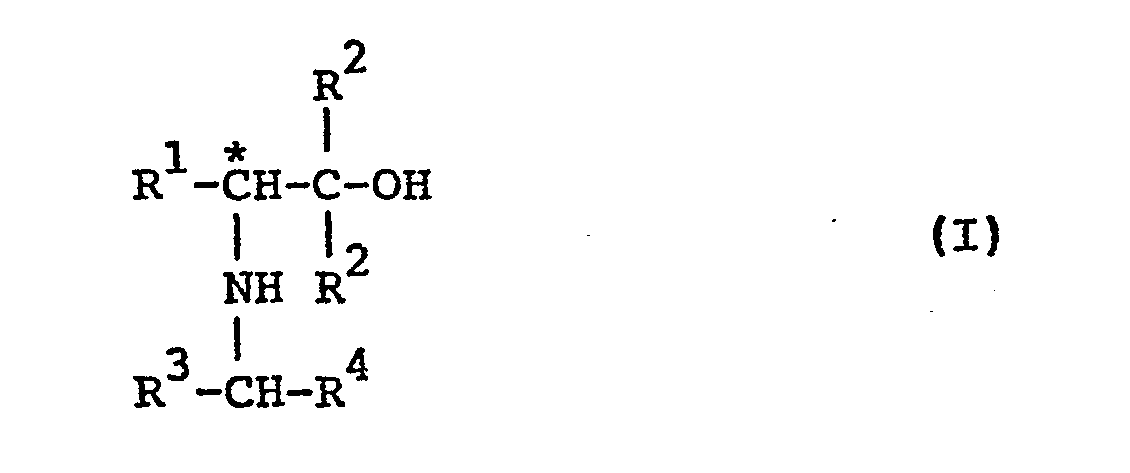
- This invention provides optically active amino alcohols of the formula: wherein R1is a lower alkyl group, a benzyl group or a phenyl group, R 2 is a benzyl group, a phenyl group or a phenyl group substituted with at least one of lower alkyl and lower alkoxy, R 3 and R 4 are each a hydrogen atom, a lower alkyl group or a phenyl group and the carbon atom accompanied by an asterisk ( * ) indicates an asymmetric carbon atom.
- a group with the term "lower” is intended to mean any atomic group having not more than 4 carbon atoms. Therefore, examples of lower alkyl are methyl, ethyl, n-propyl, isopropyl, n-butyl, isobutyl, t-butyl, etc., and examples of lower alkoxy are methoxy, ethoxy, n-propoxy, isopropoxy, n-butoxy, isobutoxy, etc. Examples of the phenyl group substituted with at least one of lower alkyl and lower alkoxy are 2-methoxyphenyl, 2-isopropoxyphenyl, 2-isopropoxy-5-methylphenyl, etc.
- optically active amino alcohols (I) are novel and useful as reagents for asymmetric synthesis. For instance, their use as the chiral reagents for asymmetric synthesis of intermediates in the synthesis of.biotin accomplishes a high asymmetric yield (cf. EP 0044158A, which corresponds to Japanese Patent Publication (unexamined) No. 21374/1982).
- the optically active amino alcohol (I), i.e. the secondary amino tertiary alcohol can be produced from the corresponding primary amino tertiary alcohol by (A) converting the primary amino group of the latter into a Schiff base, followed by reduction, or by (B) acylating the primary amino group of the latter, followed by reduction of the resulting acylated amino group as shown below: wherein R 1 , R 2 , R 3 and R 4 are each as defined above.
- the starting material is the optically active amino alcohol (II), i.e. the primary amino tertiary alcohol. It may be in the form of (R)-isomer or (S)-isomer. It is generally known and can be produced by conventional procedures (cf. J.Chem.Soc., 127, 291 (1925) and 128, 785 (1926); Yakugaku Zasshi (Bull.Pharm.Soc.Japan), 48, 46 (1928); Japanese Patent Publication (examined) No. 13133/1976).
- II optically active amino alcohol
- 2-amino-1,1-diphenyl-l-propanol 2-amino-1,1-dibenzyl-l-propanol, 2-amino-1,1-diphenyl-4-methyl-l-pentanol, 2-amino-1,1-dibenzyl-4-methyl-1-pentanol, 2-amino-1,1,2-triphenylethanol, 2-amino-1,1,3-triphenyl-l-propanol, 2-amino-1,1-di(2-methoxyphenyl)-1-propanol, 2-amino-1,1-di(2-isopropoxyphenyl)-3-phenyl-I-propanol, 2-amino-1,1-di(2-isopropoxy-5-methylphenyl)-3-phenyl-l-propanol, etc.
- carbonyl compound (III) examples include formaldehyde, acetaldehyde, propionaldehyde, butyraldehyde, benzaldehyde, acetone, methyl ethyl ketone, acetophenone, etc.
- the reaction between the optically active amino alcohol (II) and the carbonyl compound (III) is usually carried out in an inert solvent such as an aromatic hydrocarbon (e.g. benzene, toluene) or a lower alkanol (e.g. methanol, ethanol) at a temperature of about 20°C to the boiling point of the solvent, preferably with removal of water, for instance, by azeotropic distillation.
- an aromatic hydrocarbon e.g. benzene, toluene
- a lower alkanol e.g. methanol, ethanol
- the molar ratio of the optically active amino alcohol (II) and the carbonyl compound (III) may be normally from 0.8 - 1.2 : 1.
- the yield of the Schiff base (IV) is almost quantitative.
- the Schiff base (IV) may be subjected to reduction in the subsequent step with or without its isolation from the reaction mixture.
- the reduction of the Schiff base (IV) may be accomplished by the use of a metal hydride or by catalytic hydrogenation.
- the Schiff base (IV) may be treated with a metal hydride (e.g. lithium aluminum hydride, sodium aluminum hydride, sodium di(methoxyethoxy)-aluminum hydride, sodium borohydride, diborane), usually in an inert solvent such as an ether (e.g. ether, tetrahydrofuran) or a lower alkanol (e.g. methanol, ethanol) at a temperature from 0°C to the boiling point of the solvent.
- a metal hydride e.g. lithium aluminum hydride, sodium aluminum hydride, sodium di(methoxyethoxy)-aluminum hydride, sodium borohydride, diborane
- an inert solvent such as an ether (e.g. ether, tetrahydrofuran) or a lower alkanol (e
- the Schiff base (IV) may be treated with hydrogen in the presence of a catalyst such as palladium, palladium oxide, platinum, platinum oxide, nickel or nickel oxide, when desired, deposited on a carrier such as activated charcoal or alumina, usually in an inert solvent such as a lower alkanol (e.g. methanol, ethanol) at a temperature of 0°C to the boiling point of the solvent, particularly around room temperature under a hydrogen pressure of 1 to 100 atm.
- a catalyst such as palladium, palladium oxide, platinum, platinum oxide, nickel or nickel oxide
- a carrier such as activated charcoal or alumina
- an inert solvent such as a lower alkanol (e.g. methanol, ethanol) at a temperature of 0°C to the boiling point of the solvent, particularly around room temperature under a hydrogen pressure of 1 to 100 atm.
- the amount of the catalyst may be normally from 0.1 to 10 % by weight on the basis of the weight of the Schiff base (IV).
- the optically active amino alcohol (II) is reacted with the carboxylic acid (V) or its reactive derivative and the resulting N-acylamino alcohol (VI) is reduced to give the objective optically active amino alcohol (I).
- carboxylic acid (V) there may be exemplified formic acid, acetic acid, propionic acid, butyric acid, benzoic acid, etc.
- Examples of its reactive derivative are anhydrides (e.g. mixed acid anhydride of formic acid and acetic acid, acetic anhydride, propionic anhydride, benzoic anhydride), halides (e.g. acetyl chloride, acetyl bromide, butyryl chloride, benzoyl chloride), etc.
- the reaction between the otically active amino alcohol (II) and the carboxylic acid (V) or its reactive derivative may be carried out, for instance, in an inert solvent such as an ether (e.g. diethyl ether, tetrahydrofuran), an aromatic hydrocarbon (e.g. benzene, toluene) or a halogenated hydrocarbon (e.g. chloroform, methylene chloride), preferably in the presence of a base such as a tertiary amine (e.g. pyridine, triethylamine, tributylamine) at a temperature of -78°C to the boiling point of the solvent, particularly of -20 to 40°C.
- an inert solvent such as an ether (e.g. diethyl ether, tetrahydrofuran), an aromatic hydrocarbon (e.g. benzene, toluene) or a halogenated hydrocarbon (e.g. chloroform, m
- the carboxylic acid (V) or its reactive derivative is an oil, it may be used in an excessive amount so as to serve by itself as the reaction medium. In such case, the said solvent is not necessarily required to use.
- the molar ratio of the optically active amino alcohol (II) and the carboxylic acid (V) or its reactive derivative is normally 1 : 1 - 20.
- the yield of the N-acylamino alcohol (VI) is almost quantitative.
- the reduction of the N-acylamino alcohol (VI) may be accomplished by the use of a metal hydride.
- a metal hydride e.g. lithium aluminum hydride, sodium aluminum hydride, sodium di(methoxyethoxy)aluminum hydride, aluminum hydride, sodium borohydride mixed with aluminum chloride, diborane
- an inert solvent such as an ether (e.g. diethyl ether, tetrahydrofuran, dioxane, dimethoxyethane, diglyme) or an aromatic hydrocarbon (e.g. benzene, toluene) at a temperature of 0°C to the boiling point of the solvent.
- the molar ratio of the N-acylamino alcohol (VI) and the metal hydride is normally 1 : 0.5 - 20.
- the separation and purification of the thus prepared optically active amino alcohol (I) -from the reaction mixture may be achieved by a per se conventional procedure such as extraction of its mineral acid salt (e.g. hydrochloride, sulfate) with water, recrystallization from an appropriate solvent or column chromatography on a suitable adsorbent.
- its mineral acid salt e.g. hydrochloride, sulfate
- optically active amino alcohol (I) are N-methyl-2-amino-1,1-diphenyl-1-propanol, N-ethyl-2-amino-1,1-diphenyl-l-propanol, N-isopropyl-2-amino-l,l-diphenyl-l-propanol, N-benzyl-2-amino-1,1-dipheny-1-propanol, N-benzyl-2-amino-1,1-dipheny-1-propanol, N-benzyl-2-amino-1,1-diphenyl-4-methyl-1-pentanol, N-methyl-2-amino-1,1-dibenzyl-1-propanoi, N-methyl-2-amino-1,1-diphenyl-4-methyl-1-pentanol, N-isopropyl-2-amino-l,1-diphenyl-4-methyl-l-pentanol, N-methyl-2-a
Landscapes
- Chemical & Material Sciences (AREA)
- Organic Chemistry (AREA)
- Chemical Kinetics & Catalysis (AREA)
- Organic Low-Molecular-Weight Compounds And Preparation Thereof (AREA)
Abstract
Description
- The present invention relates to optically active amino alcohols and their production.
- This invention provides optically active amino alcohols of the formula:

- In the above significances, a group with the term "lower" is intended to mean any atomic group having not more than 4 carbon atoms. Therefore, examples of lower alkyl are methyl, ethyl, n-propyl, isopropyl, n-butyl, isobutyl, t-butyl, etc., and examples of lower alkoxy are methoxy, ethoxy, n-propoxy, isopropoxy, n-butoxy, isobutoxy, etc. Examples of the phenyl group substituted with at least one of lower alkyl and lower alkoxy are 2-methoxyphenyl, 2-isopropoxyphenyl, 2-isopropoxy-5-methylphenyl, etc.
- The optically active amino alcohols (I) are novel and useful as reagents for asymmetric synthesis. For instance, their use as the chiral reagents for asymmetric synthesis of intermediates in the synthesis of.biotin accomplishes a high asymmetric yield (cf. EP 0044158A, which corresponds to Japanese Patent Publication (unexamined) No. 21374/1982).
- According to the present invention, the optically active amino alcohol (I), i.e. the secondary amino tertiary alcohol, can be produced from the corresponding primary amino tertiary alcohol by (A) converting the primary amino group of the latter into a Schiff base, followed by reduction, or by (B) acylating the primary amino group of the latter, followed by reduction of the resulting acylated amino group as shown below:

- The starting material is the optically active amino alcohol (II), i.e. the primary amino tertiary alcohol. It may be in the form of (R)-isomer or (S)-isomer. It is generally known and can be produced by conventional procedures (cf. J.Chem.Soc., 127, 291 (1925) and 128, 785 (1926); Yakugaku Zasshi (Bull.Pharm.Soc.Japan), 48, 46 (1928); Japanese Patent Publication (examined) No. 13133/1976). Specific examples are 2-amino-1,1-diphenyl-l-propanol, 2-amino-1,1-dibenzyl-l-propanol, 2-amino-1,1-diphenyl-4-methyl-l-pentanol, 2-amino-1,1-dibenzyl-4-methyl-1-pentanol, 2-amino-1,1,2-triphenylethanol, 2-amino-1,1,3-triphenyl-l-propanol, 2-amino-1,1-di(2-methoxyphenyl)-1-propanol, 2-amino-1,1-di(2-isopropoxyphenyl)-3-phenyl-I-propanol, 2-amino-1,1-di(2-isopropoxy-5-methylphenyl)-3-phenyl-l-propanol, etc.
- According to the procedure (A), the optically active aminoalcohol (II) is reacted with the carbonyl compound (III), and the resulting Schiff base (IV) is reduced to give the objective optically active amino alcohol (I)
- Specific examples of the carbonyl compound (III) are formaldehyde, acetaldehyde, propionaldehyde, butyraldehyde, benzaldehyde, acetone, methyl ethyl ketone, acetophenone, etc.
- The reaction between the optically active amino alcohol (II) and the carbonyl compound (III) is usually carried out in an inert solvent such as an aromatic hydrocarbon (e.g. benzene, toluene) or a lower alkanol (e.g. methanol, ethanol) at a temperature of about 20°C to the boiling point of the solvent, preferably with removal of water, for instance, by azeotropic distillation. The molar ratio of the optically active amino alcohol (II) and the carbonyl compound (III) may be normally from 0.8 - 1.2 : 1. The yield of the Schiff base (IV) is almost quantitative. The Schiff base (IV) may be subjected to reduction in the subsequent step with or without its isolation from the reaction mixture.
- The reduction of the Schiff base (IV) may be accomplished by the use of a metal hydride or by catalytic hydrogenation. In the former case, the Schiff base (IV) may be treated with a metal hydride (e.g. lithium aluminum hydride, sodium aluminum hydride, sodium di(methoxyethoxy)-aluminum hydride, sodium borohydride, diborane), usually in an inert solvent such as an ether (e.g. ether, tetrahydrofuran) or a lower alkanol (e.g. methanol, ethanol) at a temperature from 0°C to the boiling point of the solvent. The molar ratio of the Schiff base (IV) and the metal hydride is normally 1 : 0.5 - 20.
- In the latter case, the Schiff base (IV) may be treated with hydrogen in the presence of a catalyst such as palladium, palladium oxide, platinum, platinum oxide, nickel or nickel oxide, when desired, deposited on a carrier such as activated charcoal or alumina, usually in an inert solvent such as a lower alkanol (e.g. methanol, ethanol) at a temperature of 0°C to the boiling point of the solvent, particularly around room temperature under a hydrogen pressure of 1 to 100 atm. The amount of the catalyst may be normally from 0.1 to 10 % by weight on the basis of the weight of the Schiff base (IV).
- According to the procedure (B), the optically active amino alcohol (II) is reacted with the carboxylic acid (V) or its reactive derivative and the resulting N-acylamino alcohol (VI) is reduced to give the objective optically active amino alcohol (I).
- As the carboxylic acid (V), there may be exemplified formic acid, acetic acid, propionic acid, butyric acid, benzoic acid, etc. Examples of its reactive derivative are anhydrides (e.g. mixed acid anhydride of formic acid and acetic acid, acetic anhydride, propionic anhydride, benzoic anhydride), halides (e.g. acetyl chloride, acetyl bromide, butyryl chloride, benzoyl chloride), etc.
- The reaction between the otically active amino alcohol (II) and the carboxylic acid (V) or its reactive derivative may be carried out, for instance, in an inert solvent such as an ether (e.g. diethyl ether, tetrahydrofuran), an aromatic hydrocarbon (e.g. benzene, toluene) or a halogenated hydrocarbon (e.g. chloroform, methylene chloride), preferably in the presence of a base such as a tertiary amine (e.g. pyridine, triethylamine, tributylamine) at a temperature of -78°C to the boiling point of the solvent, particularly of -20 to 40°C. When the carboxylic acid (V) or its reactive derivative is an oil, it may be used in an excessive amount so as to serve by itself as the reaction medium. In such case, the said solvent is not necessarily required to use. The molar ratio of the optically active amino alcohol (II) and the carboxylic acid (V) or its reactive derivative is normally 1 : 1 - 20. The yield of the N-acylamino alcohol (VI) is almost quantitative.
- The reduction of the N-acylamino alcohol (VI) may be accomplished by the use of a metal hydride. Thus, the N-acylamino alcohol (VI) is treated with a metal hydride (e.g. lithium aluminum hydride, sodium aluminum hydride, sodium di(methoxyethoxy)aluminum hydride, aluminum hydride, sodium borohydride mixed with aluminum chloride, diborane), usually in an inert solvent such as an ether (e.g. diethyl ether, tetrahydrofuran, dioxane, dimethoxyethane, diglyme) or an aromatic hydrocarbon (e.g. benzene, toluene) at a temperature of 0°C to the boiling point of the solvent. The molar ratio of the N-acylamino alcohol (VI) and the metal hydride is normally 1 : 0.5 - 20.
- The separation and purification of the thus prepared optically active amino alcohol (I) -from the reaction mixture may be achieved by a per se conventional procedure such as extraction of its mineral acid salt (e.g. hydrochloride, sulfate) with water, recrystallization from an appropriate solvent or column chromatography on a suitable adsorbent.
- Specific examples of the optically active amino alcohol (I) are N-methyl-2-amino-1,1-diphenyl-1-propanol, N-ethyl-2-amino-1,1-diphenyl-l-propanol, N-isopropyl-2-amino-l,l-diphenyl-l-propanol, N-benzyl-2-amino-1,1-dipheny-1-propanol, N-benzyl-2-amino-1,1-diphenyl-4-methyl-1-pentanol, N-methyl-2-amino-1,1-dibenzyl-1-propanoi, N-methyl-2-amino-1,1-diphenyl-4-methyl-1-pentanol, N-isopropyl-2-amino-l,1-diphenyl-4-methyl-l-pentanol, N-methyl-2-amino-1,1-dibenzyl-4-methyl-l-pentanol, N-methyl-2-amino-1,1,2-triphenylethanol, N-methyl-2-amino-1,1,3-triphenyl-1-propanol, N-methyl-2-amino-1,1-di(2-methoxyphenyl)-1-propanol, N-methyl-2-amino-1,1-di(2-isopropoxyphenyl)-3-phenyl-I-propanol, N-methyl-2-amino-1,1-di(2-isopropxoy-5-methylphenyl)-3-phenyl-l-propanol, etc.
- Practical and presently preferred embodiments of the invention are illustratively shown in the following examples wherein % and parts are by weight unless otherwise indicated.
- (1) Preparation of (S)-N-formyl-2-amino-1,1-diphenyl-1-propanol:-
- To a solution of mixed acid anhydride of formic acid with acetic acid, which was prepared by heating a mixture of acetic anhydride (30 ml) and formic acid (13 ml) at 50 to 60°C for 2 hours, (S)-2-amino-1,1-diphenyl-1-propanol (45.4 g; 0.2 mol) was added at room temperature, and the resulting mixture was stirred at room temperature for 24 hours. The reaction mixture was admixed with chloroform (200 ml) and washed successively with water (100 ml) twice, saturated sodium bicarbonate solution (100 ml) twice, N hydrochloric acid (100 ml) once and water (100 ml) once. The washed chloroform solution was dried over anhydrous sodium sulfate and concentrated to give (S)-N-formyl-2-amino-1,1-diphenyl-1-propanol (46.6 g) as white crystals. Yield, 91.4 %.
- M.P., 162.1°C. [α]D -98.1° (c=100, CHCl3). IR V NH 3330 cm-1. νco 1660, 1640 cm-1.
- (2) Preparation of (S)-N-methyl-2-amino-1,1-diphenyl-1-propanol:-A solution of (S)-N-formyl-2-amino-1,1-diphenyl-1-propanol (40.0 g; 0.156 mol) obtained in (1) in tetrahydrofuran (100 ml) was dropwise added to a suspension of lithium aluminum hydride (11.78 g; 0.31 mol) in tetrahydrofuran (150 ml) in 1 hour at room temperature in nitrogen atmosphere, whereby heat was generated to elevate the inner temperature up to 60°C. The reaction mixture was refluxed for 5 hours. After cooling with ice, water (20 ml) and then 12 % sodium hydroxide solution (40 ml) were added thereto to decompose lithium aluminum hydride. The resulting mixture was admixed with celite (10 g) and filtered. The residue was washed with tetrahydrofuran (100 ml). The filtrate and the washing solution were combined together, dried over anhydrous sodium sulfate and concentrated. The residue was purified by colum chromatography on silica gel to give (S)-N-methyl-2-amino-1,1-diphenyl-1-propanol (29.21 g) as an oily product. Yield, 88.4 %.
- [α]D -64.1° (c=1.02, CHCl3). NMR (τ) 2.3 - 2.93 (m, 10H, ØH), 6.37 (q, 1H, CH), 8.70 (s, 3H, N-CH3), 9.05 (d, 3H, CH3). Elemental analysis (C16H19NO): Calcd.: C, 79.63 %; H, 7.94 %; N, 5.80 %. Found: C, 80.01 %; H, 8.03 %; N, 5.62 %.
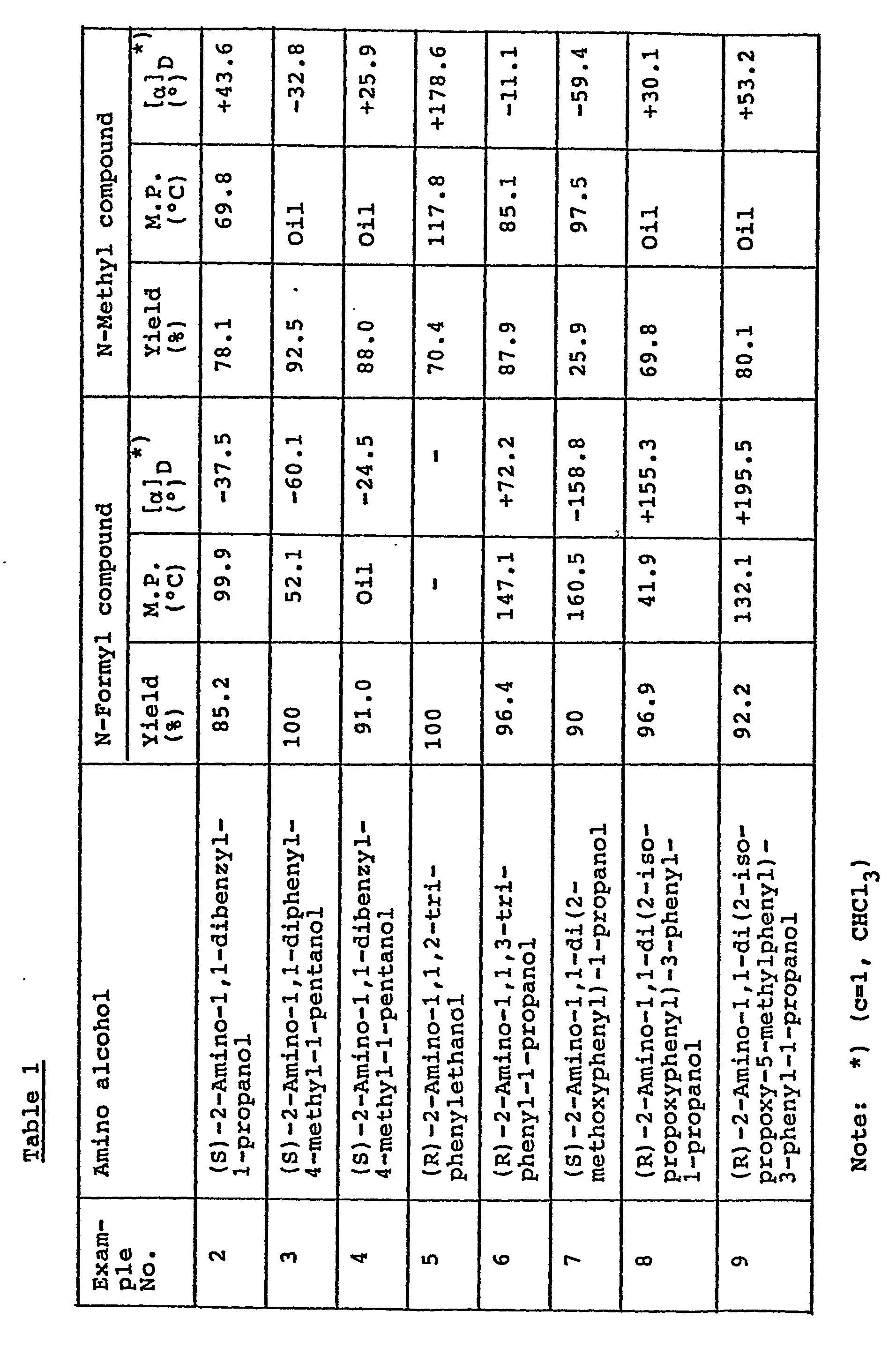
- In the same manner as in Example 1, the starting amino alcohol (II) was converted into the corresponding N-methyl compound (I) through the corresponding N-formyl compound (VI).
- The results are shown in Table 1.
- Preparation of (S)-N-ethyl-2-amino-1,1-diphenyl-1-propanol:-A mixture of (S)-2-amino-1,1-diphenyl-1-propanol (11.35 g; 50 mmol) and acetaldehyde (2.64 g; 60 mmol) in ethanol (100 ml) was stirred at room temperature for 2 hours. Analysis of the reaction mixture on thin layer chromatography showed the disappearance of the starting amino alcohol and the appearance of the Schiff base.
- Sodium borohydride (3.8 g; 100 mmol) was added to the reaction mixture, and the resulting mixture was refluxed for 1.5 hours. The solvent was distilled and the residue was extracted with chloroform. The chloforom extract was washed with water, dried over anhydrous sodium sulfate and concentrated. Purification by column chromatography on silica gel gave (S)-N-ethyl-2-amino-1,1-diphenyl-1-propanol (12.80 g) as an oil. Yield, 100 %.
- [α]D -50.3° (c=1.05, CHCl3). NMR (τ) 2.4-3.0 (m, 10H, -C6H6), 6.3 (q, 1H, CH), 7.5 (m, 2H, CH2), 9.05 (t, 3H, CH2), 9.07 (d, 3H, CH3).
- Hydrogenation with 5 % palladium carbon under the atmospheric pressure in place of reduction with sodium borohydride gave the same product as above.
- Preparation of (S)-N-benzyl-2-amino-1,1-diethyl-1-propanol:-A mixture of (S)-2-amino-1,1-diphenyl-1-propanol (9.09 g), benzaldehyde (4.4 g) and ethanol (75 ml) was stirred while refluxing for 2.5 hours. The reaction mixture was concentrated under reduced pressure. Recrystallization of the residue from isopropanol (60 ml) gave the corresponding N-benzylidene product (9.15 g) as colorless crystals. Yield, 72.6 %.
- IR (1640 cm-1). NMR (T) 1.65 and 7.75.
- A mixture of the N-benzylidene product (7.3 g), sodium borohydride (0.73 g) and ethanol (40 ml) was stirred at 60°C for 8 hours. The reaction mixture was allowed to stand at room temperature overnight. The precipitated crystals (5.8 g) were collected by filtration and recrystallized from ethanol (35 ml) to give (S)-N-benzyl-2-amino-1,1-diethyl-l-propanol (3.80 g) as colorless crystals. Yield, 51.7 %.
- [a]D -37.1° (c=1.0, chloroform).
- Preparation of (S)-N-benzyl-2-amino-1,1-diphenyl-4-methyl-l-pentanol:-In the same manner as above, (S)-2-amino-1,1-diphenyl-4-methyl-1-pentanol was reacted with benzaldehyde to give the corresponding N-benzylidene product. Yield, 77.2 %.
- In the same manner as above, the N-benzylidene product was reduced with sodium borohydride to give (S)-N-benzyl-2-amino-1,1-diphenyl-4-methyl-1-pentanol. Yield, 98 %.
- M.P., 64 - 70°C. [α]D -22.1° (c=1.0, chloforom).
- Preparation of (S)-N-isopropyl-2-amino-1,1-diphenyl-1-propanol:-Into an autoclave, platinum oxide previously absorbed with hydrogen (Adams catalyst) (0.15 g), (S)-amino-1,1-diphenyl-1-propanol (10.0 g; 44 mmol), acetone (5.0 g; 86 mmol), ethanol (10 ml) and toluene (20 ml) were charged, and the atmosphere was replaced by hydrogen to make a pressure of 6.7 to 6.9 atm. The mixture was stirred at room temperature vigorously. Absorption of hydrogen stopped after 3 days. After removal of the catalyst from the reaction mixture by filtration, the filtrate was concentrated under reduced pressure. The residue was recrystallized from methanol to give (S)-N-isopropyl-2-amino-1,1-diphenyl-1-propanol (11.7 g) as colorless crystals. Yield, 99 %.
- M.P., 93.6°C. [α]D -45.0° (c=1.02, chloforom).
- Preparation of (S)-N-isopropyl-2-amino-1,1-diphenyl-4-methyl-l-pentanol:-In the same manner as in Example 1, (S)-2-amino-1,1-diphenyl-4-methyl-l-pentanol was converted into -(S)-N-isopropyl-2-amino-1,1-diphenyl-4-methyl-1-pentanol as colorless crystals. Yield, 87 %.
- M.P., 101.7°C. [α]D -28.3° (c=1.02, chloroform).
Claims (3)


Applications Claiming Priority (2)
| Application Number | Priority Date | Filing Date | Title |
|---|---|---|---|
| JP151786/81 | 1981-09-24 | ||
| JP15178681A JPS5852249A (en) | 1981-09-24 | 1981-09-24 | Novel optically active aminoalcohol and its preparation |
Publications (2)
| Publication Number | Publication Date |
|---|---|
| EP0075868A2 true EP0075868A2 (en) | 1983-04-06 |
| EP0075868A3 EP0075868A3 (en) | 1983-07-27 |
Family
ID=15526259
Family Applications (1)
| Application Number | Title | Priority Date | Filing Date |
|---|---|---|---|
| EP82108806A Withdrawn EP0075868A3 (en) | 1981-09-24 | 1982-09-23 | Optically active amino alcohols and their production |
Country Status (2)
| Country | Link |
|---|---|
| EP (1) | EP0075868A3 (en) |
| JP (1) | JPS5852249A (en) |
Cited By (1)
| Publication number | Priority date | Publication date | Assignee | Title |
|---|---|---|---|---|
| EP0167019A1 (en) * | 1984-06-20 | 1986-01-08 | Bayer Ag | Diaryl-ethylamino derivatives |
Family Cites Families (5)
| Publication number | Priority date | Publication date | Assignee | Title |
|---|---|---|---|---|
| DE675817C (en) * | 1935-12-07 | 1939-05-17 | Albert Ag Chem Werke | Process for the preparation of readily water-soluble salts of diarylaminoalkylcarbinoln |
| GB805511A (en) * | 1956-01-25 | 1958-12-10 | Mead Johnson & Co | 1,1-diaryl-2-aminoalkanols |
| GB1217038A (en) * | 1967-04-01 | 1970-12-23 | Pietro Pratesi | 3,4 disubstituted phenyl ethanolamines and method of producing the same |
| JPS5629551A (en) * | 1979-08-20 | 1981-03-24 | Sumitomo Chem Co Ltd | Preparation of optically active threo-3- 3,4- dihydroxyphenyl serine |
| JPS603387B2 (en) * | 1980-07-10 | 1985-01-28 | 住友化学工業株式会社 | Novel optically active imidazolidin-2-one derivatives and their production method |
-
1981
- 1981-09-24 JP JP15178681A patent/JPS5852249A/en active Pending
-
1982
- 1982-09-23 EP EP82108806A patent/EP0075868A3/en not_active Withdrawn
Cited By (1)
| Publication number | Priority date | Publication date | Assignee | Title |
|---|---|---|---|---|
| EP0167019A1 (en) * | 1984-06-20 | 1986-01-08 | Bayer Ag | Diaryl-ethylamino derivatives |
Also Published As
| Publication number | Publication date |
|---|---|
| JPS5852249A (en) | 1983-03-28 |
| EP0075868A3 (en) | 1983-07-27 |
Similar Documents
| Publication | Publication Date | Title |
|---|---|---|
| US5225585A (en) | Production of fluoxetine and new intermediates | |
| RU2029761C1 (en) | Process for preparing 1-(aminomethyl) cyclohexaneacetic acid | |
| US4978793A (en) | Novel process for the preparation of serinol | |
| JP2580736B2 (en) | Optically active hydroxybenzylamine derivative, intermediate thereof and method for producing the same | |
| EP0044158A1 (en) | Novel optically active imidazolidin-2-one derivatives and their production | |
| US4895943A (en) | Preparation of 1,4-diazabicyclo(3.2.2)nonane | |
| US4412958A (en) | Stereospecific synthesis of 5-phenyl-2S-pentanol | |
| EP0084377B1 (en) | Process for preparing biotin | |
| CA2180101C (en) | Process for the preparation of n-substituded glycine acids or glycine esters and use of said process for indigo synthesis | |
| EP1904469B1 (en) | New pyrocatechin derivatives | |
| US4031108A (en) | 2-Hydroxymethyl-3-benzyloxypyridine-6-epoxyethane | |
| EP0285270B1 (en) | A method for producing 1-propargyl-2,4-dioxoimidazolidine | |
| CA1037047A (en) | 2-hydroxymethyl-3-hydroxy-6-(1-hydroxy-2-t-butylaminoethyl)pyridine preparation and intermediate compounds | |
| CA1300141C (en) | Piperazine derivatives and process for the preparation thereof | |
| EP0058071A2 (en) | Process and intermediates for preparing pirbuterol | |
| US4987247A (en) | Production of tetrahydrophthalimide compound | |
| EP0483674B1 (en) | A process for producing an aliphatic amide and salts thereof | |
| JP2786300B2 (en) | Stereoselective process for producing optically active S, S- or R, R-β-amino alcohols | |
| AU658060B2 (en) | Process for the preparation of 5-chloroxindole | |
| CA1285571C (en) | Anisole derivatives | |
| CA1150316A (en) | Process for the preparation of benzyl alcohol derivatives | |
| US5026845A (en) | 1,4-diazabicyclo[3.2.2.]nonane and intermediates for the preparation thereof | |
| US4496762A (en) | Process for the preparation of N-(2-(cyclo-hexen-1-yl)ethyl)-4-methoxybenzeneacetamide | |
| EP0976731B1 (en) | Process for producing 5-methylindolines | |
| US5395984A (en) | Process for preparing 2-phenyl-1,3-propanediol |
Legal Events
| Date | Code | Title | Description |
|---|---|---|---|
| PUAI | Public reference made under article 153(3) epc to a published international application that has entered the european phase |
Free format text: ORIGINAL CODE: 0009012 |
|
| AK | Designated contracting states |
Designated state(s): BE CH DE FR GB IT LI |
|
| PUAL | Search report despatched |
Free format text: ORIGINAL CODE: 0009013 |
|
| AK | Designated contracting states |
Designated state(s): BE CH DE FR GB IT LI |
|
| STAA | Information on the status of an ep patent application or granted ep patent |
Free format text: STATUS: THE APPLICATION IS DEEMED TO BE WITHDRAWN |
|
| 18D | Application deemed to be withdrawn |
Effective date: 19840328 |
|
| RIN1 | Information on inventor provided before grant (corrected) |
Inventor name: YONEYOSHI, YUKIO Inventor name: SUZUKAMO, GOHFU Inventor name: ARATANI, TADATOSHI Inventor name: HAZAMA, MOTOO |