EP0071236B1 - Photosensitive lithographic plate - Google Patents
Photosensitive lithographic plate Download PDFInfo
- Publication number
- EP0071236B1 EP0071236B1 EP82106755A EP82106755A EP0071236B1 EP 0071236 B1 EP0071236 B1 EP 0071236B1 EP 82106755 A EP82106755 A EP 82106755A EP 82106755 A EP82106755 A EP 82106755A EP 0071236 B1 EP0071236 B1 EP 0071236B1
- Authority
- EP
- European Patent Office
- Prior art keywords
- photosensitive
- polyester
- acid
- lithographic plate
- photosensitive lithographic
- Prior art date
- Legal status (The legal status is an assumption and is not a legal conclusion. Google has not performed a legal analysis and makes no representation as to the accuracy of the status listed.)
- Expired
Links
- 229920000728 polyester Polymers 0.000 claims description 60
- 150000001875 compounds Chemical class 0.000 claims description 27
- 229920005989 resin Polymers 0.000 claims description 26
- 239000011347 resin Substances 0.000 claims description 26
- 150000002009 diols Chemical group 0.000 claims description 21
- 238000012644 addition polymerization Methods 0.000 claims description 13
- 125000001142 dicarboxylic acid group Chemical group 0.000 claims description 13
- 239000003999 initiator Substances 0.000 claims description 13
- 125000000217 alkyl group Chemical group 0.000 claims description 10
- 125000001273 sulfonato group Chemical group [O-]S(*)(=O)=O 0.000 claims description 10
- 239000000758 substrate Substances 0.000 claims description 8
- ISWSIDIOOBJBQZ-UHFFFAOYSA-N phenol group Chemical group C1(=CC=CC=C1)O ISWSIDIOOBJBQZ-UHFFFAOYSA-N 0.000 claims description 6
- 125000004435 hydrogen atom Chemical group [H]* 0.000 claims description 5
- 125000004432 carbon atom Chemical group C* 0.000 claims description 4
- 125000002947 alkylene group Chemical group 0.000 claims description 3
- 239000001257 hydrogen Substances 0.000 claims description 3
- 229910052739 hydrogen Inorganic materials 0.000 claims description 3
- 239000003505 polymerization initiator Substances 0.000 claims description 2
- 239000000203 mixture Substances 0.000 description 26
- 238000006243 chemical reaction Methods 0.000 description 22
- 150000002148 esters Chemical class 0.000 description 21
- 239000007864 aqueous solution Substances 0.000 description 19
- 239000002904 solvent Substances 0.000 description 19
- XLYOFNOQVPJJNP-UHFFFAOYSA-N water Substances O XLYOFNOQVPJJNP-UHFFFAOYSA-N 0.000 description 19
- 239000007788 liquid Substances 0.000 description 18
- 238000005299 abrasion Methods 0.000 description 17
- -1 cinnamylidene Chemical group 0.000 description 16
- HEMHJVSKTPXQMS-UHFFFAOYSA-M Sodium hydroxide Chemical compound [OH-].[Na+] HEMHJVSKTPXQMS-UHFFFAOYSA-M 0.000 description 15
- 239000000126 substance Substances 0.000 description 14
- 239000000243 solution Substances 0.000 description 13
- UHOVQNZJYSORNB-UHFFFAOYSA-N Benzene Chemical compound C1=CC=CC=C1 UHOVQNZJYSORNB-UHFFFAOYSA-N 0.000 description 12
- LYCAIKOWRPUZTN-UHFFFAOYSA-N Ethylene glycol Chemical compound OCCO LYCAIKOWRPUZTN-UHFFFAOYSA-N 0.000 description 12
- LFQSCWFLJHTTHZ-UHFFFAOYSA-N Ethanol Chemical compound CCO LFQSCWFLJHTTHZ-UHFFFAOYSA-N 0.000 description 11
- MTHSVFCYNBDYFN-UHFFFAOYSA-N diethylene glycol Chemical compound OCCOCCO MTHSVFCYNBDYFN-UHFFFAOYSA-N 0.000 description 11
- IJGRMHOSHXDMSA-UHFFFAOYSA-N Atomic nitrogen Chemical compound N#N IJGRMHOSHXDMSA-UHFFFAOYSA-N 0.000 description 10
- OFOBLEOULBTSOW-UHFFFAOYSA-N Malonic acid Chemical compound OC(=O)CC(O)=O OFOBLEOULBTSOW-UHFFFAOYSA-N 0.000 description 10
- SWXVUIWOUIDPGS-UHFFFAOYSA-N diacetone alcohol Chemical compound CC(=O)CC(C)(C)O SWXVUIWOUIDPGS-UHFFFAOYSA-N 0.000 description 10
- 239000003960 organic solvent Substances 0.000 description 10
- 230000035945 sensitivity Effects 0.000 description 10
- 238000012360 testing method Methods 0.000 description 10
- 150000001735 carboxylic acids Chemical class 0.000 description 9
- 230000003287 optical effect Effects 0.000 description 9
- NBIIXXVUZAFLBC-UHFFFAOYSA-N Phosphoric acid Chemical compound OP(O)(O)=O NBIIXXVUZAFLBC-UHFFFAOYSA-N 0.000 description 8
- 229910052782 aluminium Inorganic materials 0.000 description 8
- XAGFODPZIPBFFR-UHFFFAOYSA-N aluminium Chemical compound [Al] XAGFODPZIPBFFR-UHFFFAOYSA-N 0.000 description 8
- 239000000178 monomer Substances 0.000 description 8
- 229920000642 polymer Polymers 0.000 description 8
- 125000003118 aryl group Chemical group 0.000 description 7
- 125000002768 hydroxyalkyl group Chemical group 0.000 description 7
- ZIBGPFATKBEMQZ-UHFFFAOYSA-N triethylene glycol Chemical compound OCCOCCOCCO ZIBGPFATKBEMQZ-UHFFFAOYSA-N 0.000 description 7
- ZWEHNKRNPOVVGH-UHFFFAOYSA-N 2-Butanone Chemical compound CCC(C)=O ZWEHNKRNPOVVGH-UHFFFAOYSA-N 0.000 description 6
- VVBLNCFGVYUYGU-UHFFFAOYSA-N 4,4'-Bis(dimethylamino)benzophenone Chemical compound C1=CC(N(C)C)=CC=C1C(=O)C1=CC=C(N(C)C)C=C1 VVBLNCFGVYUYGU-UHFFFAOYSA-N 0.000 description 6
- ZMXDDKWLCZADIW-UHFFFAOYSA-N N,N-Dimethylformamide Chemical compound CN(C)C=O ZMXDDKWLCZADIW-UHFFFAOYSA-N 0.000 description 6
- DNIAPMSPPWPWGF-UHFFFAOYSA-N Propylene glycol Chemical compound CC(O)CO DNIAPMSPPWPWGF-UHFFFAOYSA-N 0.000 description 6
- 239000003054 catalyst Substances 0.000 description 6
- 125000000118 dimethyl group Chemical group [H]C([H])([H])* 0.000 description 6
- WQGWDDDVZFFDIG-UHFFFAOYSA-N pyrogallol Chemical compound OC1=CC=CC(O)=C1O WQGWDDDVZFFDIG-UHFFFAOYSA-N 0.000 description 6
- 229910052708 sodium Inorganic materials 0.000 description 6
- 239000011734 sodium Substances 0.000 description 6
- TXBCBTDQIULDIA-UHFFFAOYSA-N 2-[[3-hydroxy-2,2-bis(hydroxymethyl)propoxy]methyl]-2-(hydroxymethyl)propane-1,3-diol Chemical compound OCC(CO)(CO)COCC(CO)(CO)CO TXBCBTDQIULDIA-UHFFFAOYSA-N 0.000 description 5
- 239000004115 Sodium Silicate Substances 0.000 description 5
- HVVWZTWDBSEWIH-UHFFFAOYSA-N [2-(hydroxymethyl)-3-prop-2-enoyloxy-2-(prop-2-enoyloxymethyl)propyl] prop-2-enoate Chemical compound C=CC(=O)OCC(CO)(COC(=O)C=C)COC(=O)C=C HVVWZTWDBSEWIH-UHFFFAOYSA-N 0.000 description 5
- 150000001252 acrylic acid derivatives Chemical class 0.000 description 5
- 125000001931 aliphatic group Chemical group 0.000 description 5
- 125000005907 alkyl ester group Chemical group 0.000 description 5
- WURBFLDFSFBTLW-UHFFFAOYSA-N benzil Chemical compound C=1C=CC=CC=1C(=O)C(=O)C1=CC=CC=C1 WURBFLDFSFBTLW-UHFFFAOYSA-N 0.000 description 5
- 238000000576 coating method Methods 0.000 description 5
- 238000004132 cross linking Methods 0.000 description 5
- QYGWZBFQWUBYAT-WGDLNXRISA-N ethyl (e)-3-[4-[(e)-3-ethoxy-3-oxoprop-1-enyl]phenyl]prop-2-enoate Chemical compound CCOC(=O)\C=C\C1=CC=C(\C=C\C(=O)OCC)C=C1 QYGWZBFQWUBYAT-WGDLNXRISA-N 0.000 description 5
- 239000011521 glass Substances 0.000 description 5
- 238000000034 method Methods 0.000 description 5
- 229910052700 potassium Inorganic materials 0.000 description 5
- 239000011591 potassium Substances 0.000 description 5
- NTHWMYGWWRZVTN-UHFFFAOYSA-N sodium silicate Chemical compound [Na+].[Na+].[O-][Si]([O-])=O NTHWMYGWWRZVTN-UHFFFAOYSA-N 0.000 description 5
- 229910052911 sodium silicate Inorganic materials 0.000 description 5
- LBTDHCQNAQRHCE-UHFFFAOYSA-N 2-[4-(2-hydroxyethoxy)cyclohexyl]oxyethanol Chemical compound OCCOC1CCC(OCCO)CC1 LBTDHCQNAQRHCE-UHFFFAOYSA-N 0.000 description 4
- SKBCSCHPOLWLCN-UHFFFAOYSA-N 2-sulfohexanedioic acid Chemical compound OC(=O)CCCC(C(O)=O)S(O)(=O)=O SKBCSCHPOLWLCN-UHFFFAOYSA-N 0.000 description 4
- QIGBRXMKCJKVMJ-UHFFFAOYSA-N Hydroquinone Chemical compound OC1=CC=C(O)C=C1 QIGBRXMKCJKVMJ-UHFFFAOYSA-N 0.000 description 4
- QAOWNCQODCNURD-UHFFFAOYSA-N Sulfuric acid Chemical compound OS(O)(=O)=O QAOWNCQODCNURD-UHFFFAOYSA-N 0.000 description 4
- 150000008065 acid anhydrides Chemical class 0.000 description 4
- 230000001476 alcoholic effect Effects 0.000 description 4
- 150000001298 alcohols Chemical class 0.000 description 4
- 229910000147 aluminium phosphate Inorganic materials 0.000 description 4
- ISAOCJYIOMOJEB-UHFFFAOYSA-N benzoin Chemical compound C=1C=CC=CC=1C(O)C(=O)C1=CC=CC=C1 ISAOCJYIOMOJEB-UHFFFAOYSA-N 0.000 description 4
- WERYXYBDKMZEQL-UHFFFAOYSA-N butane-1,4-diol Chemical compound OCCCCO WERYXYBDKMZEQL-UHFFFAOYSA-N 0.000 description 4
- 150000001732 carboxylic acid derivatives Chemical class 0.000 description 4
- 239000011248 coating agent Substances 0.000 description 4
- 238000011161 development Methods 0.000 description 4
- 239000004615 ingredient Substances 0.000 description 4
- 229910052757 nitrogen Inorganic materials 0.000 description 4
- 238000007254 oxidation reaction Methods 0.000 description 4
- 239000003208 petroleum Substances 0.000 description 4
- 238000006116 polymerization reaction Methods 0.000 description 4
- VXUYXOFXAQZZMF-UHFFFAOYSA-N titanium(IV) isopropoxide Chemical compound CC(C)O[Ti](OC(C)C)(OC(C)C)OC(C)C VXUYXOFXAQZZMF-UHFFFAOYSA-N 0.000 description 4
- PUPZLCDOIYMWBV-UHFFFAOYSA-N (+/-)-1,3-Butanediol Chemical group CC(O)CCO PUPZLCDOIYMWBV-UHFFFAOYSA-N 0.000 description 3
- WBYWAXJHAXSJNI-VOTSOKGWSA-M .beta-Phenylacrylic acid Natural products [O-]C(=O)\C=C\C1=CC=CC=C1 WBYWAXJHAXSJNI-VOTSOKGWSA-M 0.000 description 3
- FALRKNHUBBKYCC-UHFFFAOYSA-N 2-(chloromethyl)pyridine-3-carbonitrile Chemical compound ClCC1=NC=CC=C1C#N FALRKNHUBBKYCC-UHFFFAOYSA-N 0.000 description 3
- PTJWCLYPVFJWMP-UHFFFAOYSA-N 2-[[3-hydroxy-2-[[3-hydroxy-2,2-bis(hydroxymethyl)propoxy]methyl]-2-(hydroxymethyl)propoxy]methyl]-2-(hydroxymethyl)propane-1,3-diol Chemical compound OCC(CO)(CO)COCC(CO)(CO)COCC(CO)(CO)CO PTJWCLYPVFJWMP-UHFFFAOYSA-N 0.000 description 3
- RAADBCJYJHQQBI-UHFFFAOYSA-N 2-sulfoterephthalic acid Chemical compound OC(=O)C1=CC=C(C(O)=O)C(S(O)(=O)=O)=C1 RAADBCJYJHQQBI-UHFFFAOYSA-N 0.000 description 3
- SDGNNLQZAPXALR-UHFFFAOYSA-N 3-sulfophthalic acid Chemical compound OC(=O)C1=CC=CC(S(O)(=O)=O)=C1C(O)=O SDGNNLQZAPXALR-UHFFFAOYSA-N 0.000 description 3
- YMWUJEATGCHHMB-UHFFFAOYSA-N Dichloromethane Chemical compound ClCCl YMWUJEATGCHHMB-UHFFFAOYSA-N 0.000 description 3
- XEKOWRVHYACXOJ-UHFFFAOYSA-N Ethyl acetate Chemical compound CCOC(C)=O XEKOWRVHYACXOJ-UHFFFAOYSA-N 0.000 description 3
- PEDCQBHIVMGVHV-UHFFFAOYSA-N Glycerine Chemical compound OCC(O)CO PEDCQBHIVMGVHV-UHFFFAOYSA-N 0.000 description 3
- OKKJLVBELUTLKV-UHFFFAOYSA-N Methanol Chemical compound OC OKKJLVBELUTLKV-UHFFFAOYSA-N 0.000 description 3
- UWHCKJMYHZGTIT-UHFFFAOYSA-N Tetraethylene glycol, Natural products OCCOCCOCCOCCO UWHCKJMYHZGTIT-UHFFFAOYSA-N 0.000 description 3
- YXFVVABEGXRONW-UHFFFAOYSA-N Toluene Chemical compound CC1=CC=CC=C1 YXFVVABEGXRONW-UHFFFAOYSA-N 0.000 description 3
- IISBACLAFKSPIT-UHFFFAOYSA-N bisphenol A Chemical class C=1C=C(O)C=CC=1C(C)(C)C1=CC=C(O)C=C1 IISBACLAFKSPIT-UHFFFAOYSA-N 0.000 description 3
- 230000003247 decreasing effect Effects 0.000 description 3
- 230000000694 effects Effects 0.000 description 3
- 239000004744 fabric Substances 0.000 description 3
- YLQWCDOCJODRMT-UHFFFAOYSA-N fluoren-9-one Chemical compound C1=CC=C2C(=O)C3=CC=CC=C3C2=C1 YLQWCDOCJODRMT-UHFFFAOYSA-N 0.000 description 3
- XPFVYQJUAUNWIW-UHFFFAOYSA-N furfuryl alcohol Chemical compound OCC1=CC=CO1 XPFVYQJUAUNWIW-UHFFFAOYSA-N 0.000 description 3
- 150000002576 ketones Chemical class 0.000 description 3
- 239000000463 material Substances 0.000 description 3
- QSHDDOUJBYECFT-UHFFFAOYSA-N mercury Chemical compound [Hg] QSHDDOUJBYECFT-UHFFFAOYSA-N 0.000 description 3
- 229910052753 mercury Inorganic materials 0.000 description 3
- 125000001624 naphthyl group Chemical group 0.000 description 3
- 230000003647 oxidation Effects 0.000 description 3
- 238000006068 polycondensation reaction Methods 0.000 description 3
- 229940079877 pyrogallol Drugs 0.000 description 3
- 229960001755 resorcinol Drugs 0.000 description 3
- 238000003756 stirring Methods 0.000 description 3
- 229940014800 succinic anhydride Drugs 0.000 description 3
- 239000008399 tap water Substances 0.000 description 3
- 235000020679 tap water Nutrition 0.000 description 3
- LGPAKRMZNPYPMG-UHFFFAOYSA-N (3-hydroxy-2-prop-2-enoyloxypropyl) prop-2-enoate Chemical compound C=CC(=O)OC(CO)COC(=O)C=C LGPAKRMZNPYPMG-UHFFFAOYSA-N 0.000 description 2
- AAFXQFIGKBLKMC-KQQUZDAGSA-N (e)-3-[4-[(e)-2-carboxyethenyl]phenyl]prop-2-enoic acid Chemical compound OC(=O)\C=C\C1=CC=C(\C=C\C(O)=O)C=C1 AAFXQFIGKBLKMC-KQQUZDAGSA-N 0.000 description 2
- XNWFRZJHXBZDAG-UHFFFAOYSA-N 2-METHOXYETHANOL Chemical compound COCCO XNWFRZJHXBZDAG-UHFFFAOYSA-N 0.000 description 2
- NIXOWILDQLNWCW-UHFFFAOYSA-N 2-Propenoic acid Natural products OC(=O)C=C NIXOWILDQLNWCW-UHFFFAOYSA-N 0.000 description 2
- INQDDHNZXOAFFD-UHFFFAOYSA-N 2-[2-(2-prop-2-enoyloxyethoxy)ethoxy]ethyl prop-2-enoate Chemical compound C=CC(=O)OCCOCCOCCOC(=O)C=C INQDDHNZXOAFFD-UHFFFAOYSA-N 0.000 description 2
- BQZJOQXSCSZQPS-UHFFFAOYSA-N 2-methoxy-1,2-diphenylethanone Chemical compound C=1C=CC=CC=1C(OC)C(=O)C1=CC=CC=C1 BQZJOQXSCSZQPS-UHFFFAOYSA-N 0.000 description 2
- JWAZRIHNYRIHIV-UHFFFAOYSA-N 2-naphthol Chemical compound C1=CC=CC2=CC(O)=CC=C21 JWAZRIHNYRIHIV-UHFFFAOYSA-N 0.000 description 2
- KUDUQBURMYMBIJ-UHFFFAOYSA-N 2-prop-2-enoyloxyethyl prop-2-enoate Chemical compound C=CC(=O)OCCOC(=O)C=C KUDUQBURMYMBIJ-UHFFFAOYSA-N 0.000 description 2
- HUKPVYBUJRAUAG-UHFFFAOYSA-N 7-benzo[a]phenalenone Chemical class C1=CC(C(=O)C=2C3=CC=CC=2)=C2C3=CC=CC2=C1 HUKPVYBUJRAUAG-UHFFFAOYSA-N 0.000 description 2
- HEDRZPFGACZZDS-UHFFFAOYSA-N Chloroform Chemical compound ClC(Cl)Cl HEDRZPFGACZZDS-UHFFFAOYSA-N 0.000 description 2
- WBYWAXJHAXSJNI-SREVYHEPSA-N Cinnamic acid Chemical compound OC(=O)\C=C/C1=CC=CC=C1 WBYWAXJHAXSJNI-SREVYHEPSA-N 0.000 description 2
- XDTMQSROBMDMFD-UHFFFAOYSA-N Cyclohexane Chemical compound C1CCCCC1 XDTMQSROBMDMFD-UHFFFAOYSA-N 0.000 description 2
- IAZDPXIOMUYVGZ-UHFFFAOYSA-N Dimethylsulphoxide Chemical compound CS(C)=O IAZDPXIOMUYVGZ-UHFFFAOYSA-N 0.000 description 2
- 239000001856 Ethyl cellulose Substances 0.000 description 2
- ZZSNKZQZMQGXPY-UHFFFAOYSA-N Ethyl cellulose Chemical compound CCOCC1OC(OC)C(OCC)C(OCC)C1OC1C(O)C(O)C(OC)C(CO)O1 ZZSNKZQZMQGXPY-UHFFFAOYSA-N 0.000 description 2
- IAYPIBMASNFSPL-UHFFFAOYSA-N Ethylene oxide Chemical compound C1CO1 IAYPIBMASNFSPL-UHFFFAOYSA-N 0.000 description 2
- VZCYOOQTPOCHFL-OWOJBTEDSA-N Fumaric acid Chemical compound OC(=O)\C=C\C(O)=O VZCYOOQTPOCHFL-OWOJBTEDSA-N 0.000 description 2
- LGRFSURHDFAFJT-UHFFFAOYSA-N Phthalic anhydride Natural products C1=CC=C2C(=O)OC(=O)C2=C1 LGRFSURHDFAFJT-UHFFFAOYSA-N 0.000 description 2
- JUJWROOIHBZHMG-UHFFFAOYSA-N Pyridine Chemical compound C1=CC=NC=C1 JUJWROOIHBZHMG-UHFFFAOYSA-N 0.000 description 2
- 244000028419 Styrax benzoin Species 0.000 description 2
- 235000000126 Styrax benzoin Nutrition 0.000 description 2
- 235000008411 Sumatra benzointree Nutrition 0.000 description 2
- KKEYFWRCBNTPAC-UHFFFAOYSA-N Terephthalic acid Chemical compound OC(=O)C1=CC=C(C(O)=O)C=C1 KKEYFWRCBNTPAC-UHFFFAOYSA-N 0.000 description 2
- GQPVFBDWIUVLHG-UHFFFAOYSA-N [2,2-bis(hydroxymethyl)-3-(2-methylprop-2-enoyloxy)propyl] 2-methylprop-2-enoate Chemical compound CC(=C)C(=O)OCC(CO)(CO)COC(=O)C(C)=C GQPVFBDWIUVLHG-UHFFFAOYSA-N 0.000 description 2
- CQHKDHVZYZUZMJ-UHFFFAOYSA-N [2,2-bis(hydroxymethyl)-3-prop-2-enoyloxypropyl] prop-2-enoate Chemical compound C=CC(=O)OCC(CO)(CO)COC(=O)C=C CQHKDHVZYZUZMJ-UHFFFAOYSA-N 0.000 description 2
- JUDXBRVLWDGRBC-UHFFFAOYSA-N [2-(hydroxymethyl)-3-(2-methylprop-2-enoyloxy)-2-(2-methylprop-2-enoyloxymethyl)propyl] 2-methylprop-2-enoate Chemical compound CC(=C)C(=O)OCC(CO)(COC(=O)C(C)=C)COC(=O)C(C)=C JUDXBRVLWDGRBC-UHFFFAOYSA-N 0.000 description 2
- 239000002253 acid Substances 0.000 description 2
- 239000000654 additive Substances 0.000 description 2
- WNLRTRBMVRJNCN-UHFFFAOYSA-N adipic acid Chemical compound OC(=O)CCCCC(O)=O WNLRTRBMVRJNCN-UHFFFAOYSA-N 0.000 description 2
- 239000012298 atmosphere Substances 0.000 description 2
- 125000004429 atom Chemical group 0.000 description 2
- QVGXLLKOCUKJST-UHFFFAOYSA-N atomic oxygen Chemical compound [O] QVGXLLKOCUKJST-UHFFFAOYSA-N 0.000 description 2
- 229960002130 benzoin Drugs 0.000 description 2
- RWCCWEUUXYIKHB-UHFFFAOYSA-N benzophenone Chemical compound C=1C=CC=CC=1C(=O)C1=CC=CC=C1 RWCCWEUUXYIKHB-UHFFFAOYSA-N 0.000 description 2
- 239000012965 benzophenone Substances 0.000 description 2
- 239000011230 binding agent Substances 0.000 description 2
- JHIWVOJDXOSYLW-UHFFFAOYSA-N butyl 2,2-difluorocyclopropane-1-carboxylate Chemical compound CCCCOC(=O)C1CC1(F)F JHIWVOJDXOSYLW-UHFFFAOYSA-N 0.000 description 2
- 125000003178 carboxy group Chemical group [H]OC(*)=O 0.000 description 2
- YCIMNLLNPGFGHC-UHFFFAOYSA-N catechol Chemical compound OC1=CC=CC=C1O YCIMNLLNPGFGHC-UHFFFAOYSA-N 0.000 description 2
- 229920002678 cellulose Polymers 0.000 description 2
- 239000001913 cellulose Substances 0.000 description 2
- 229920006217 cellulose acetate butyrate Polymers 0.000 description 2
- 239000007810 chemical reaction solvent Substances 0.000 description 2
- MVPPADPHJFYWMZ-UHFFFAOYSA-N chlorobenzene Chemical compound ClC1=CC=CC=C1 MVPPADPHJFYWMZ-UHFFFAOYSA-N 0.000 description 2
- 229930016911 cinnamic acid Natural products 0.000 description 2
- 235000013985 cinnamic acid Nutrition 0.000 description 2
- 239000000470 constituent Substances 0.000 description 2
- 239000013078 crystal Substances 0.000 description 2
- JHIVVAPYMSGYDF-UHFFFAOYSA-N cyclohexanone Chemical compound O=C1CCCCC1 JHIVVAPYMSGYDF-UHFFFAOYSA-N 0.000 description 2
- 229910001873 dinitrogen Inorganic materials 0.000 description 2
- SZXQTJUDPRGNJN-UHFFFAOYSA-N dipropylene glycol Chemical compound OCCCOCCCO SZXQTJUDPRGNJN-UHFFFAOYSA-N 0.000 description 2
- 238000009826 distribution Methods 0.000 description 2
- 230000032050 esterification Effects 0.000 description 2
- 238000005886 esterification reaction Methods 0.000 description 2
- LZCLXQDLBQLTDK-UHFFFAOYSA-N ethyl 2-hydroxypropanoate Chemical compound CCOC(=O)C(C)O LZCLXQDLBQLTDK-UHFFFAOYSA-N 0.000 description 2
- 229920001249 ethyl cellulose Polymers 0.000 description 2
- 235000019325 ethyl cellulose Nutrition 0.000 description 2
- 239000007789 gas Substances 0.000 description 2
- 235000019382 gum benzoic Nutrition 0.000 description 2
- NWVVVBRKAWDGAB-UHFFFAOYSA-N hydroquinone methyl ether Natural products COC1=CC=C(O)C=C1 NWVVVBRKAWDGAB-UHFFFAOYSA-N 0.000 description 2
- 125000002887 hydroxy group Chemical group [H]O* 0.000 description 2
- WGCNASOHLSPBMP-UHFFFAOYSA-N hydroxyacetaldehyde Natural products OCC=O WGCNASOHLSPBMP-UHFFFAOYSA-N 0.000 description 2
- 239000003112 inhibitor Substances 0.000 description 2
- QQVIHTHCMHWDBS-UHFFFAOYSA-N isophthalic acid Chemical compound OC(=O)C1=CC=CC(C(O)=O)=C1 QQVIHTHCMHWDBS-UHFFFAOYSA-N 0.000 description 2
- WBYWAXJHAXSJNI-UHFFFAOYSA-N methyl p-hydroxycinnamate Natural products OC(=O)C=CC1=CC=CC=C1 WBYWAXJHAXSJNI-UHFFFAOYSA-N 0.000 description 2
- LVHBHZANLOWSRM-UHFFFAOYSA-N methylenebutanedioic acid Natural products OC(=O)CC(=C)C(O)=O LVHBHZANLOWSRM-UHFFFAOYSA-N 0.000 description 2
- SLCVBVWXLSEKPL-UHFFFAOYSA-N neopentyl glycol Chemical compound OCC(C)(C)CO SLCVBVWXLSEKPL-UHFFFAOYSA-N 0.000 description 2
- LQNUZADURLCDLV-UHFFFAOYSA-N nitrobenzene Chemical compound [O-][N+](=O)C1=CC=CC=C1 LQNUZADURLCDLV-UHFFFAOYSA-N 0.000 description 2
- 239000001301 oxygen Substances 0.000 description 2
- 229910052760 oxygen Inorganic materials 0.000 description 2
- 125000001997 phenyl group Chemical group [H]C1=C([H])C([H])=C(*)C([H])=C1[H] 0.000 description 2
- 238000006552 photochemical reaction Methods 0.000 description 2
- XNGIFLGASWRNHJ-UHFFFAOYSA-N phthalic acid Chemical compound OC(=O)C1=CC=CC=C1C(O)=O XNGIFLGASWRNHJ-UHFFFAOYSA-N 0.000 description 2
- 229920002037 poly(vinyl butyral) polymer Polymers 0.000 description 2
- CYIDZMCFTVVTJO-UHFFFAOYSA-N pyromellitic acid Chemical compound OC(=O)C1=CC(C(O)=O)=C(C(O)=O)C=C1C(O)=O CYIDZMCFTVVTJO-UHFFFAOYSA-N 0.000 description 2
- GHMLBKRAJCXXBS-UHFFFAOYSA-N resorcinol Chemical compound OC1=CC=CC(O)=C1 GHMLBKRAJCXXBS-UHFFFAOYSA-N 0.000 description 2
- 150000003839 salts Chemical class 0.000 description 2
- CXMXRPHRNRROMY-UHFFFAOYSA-N sebacic acid Chemical compound OC(=O)CCCCCCCCC(O)=O CXMXRPHRNRROMY-UHFFFAOYSA-N 0.000 description 2
- 239000003381 stabilizer Substances 0.000 description 2
- 125000000020 sulfo group Chemical group O=S(=O)([*])O[H] 0.000 description 2
- JOXIMZWYDAKGHI-UHFFFAOYSA-N toluene-4-sulfonic acid Chemical compound CC1=CC=C(S(O)(=O)=O)C=C1 JOXIMZWYDAKGHI-UHFFFAOYSA-N 0.000 description 2
- CNHDIAIOKMXOLK-UHFFFAOYSA-N toluquinol Chemical compound CC1=CC(O)=CC=C1O CNHDIAIOKMXOLK-UHFFFAOYSA-N 0.000 description 2
- VZCYOOQTPOCHFL-UHFFFAOYSA-N trans-butenedioic acid Natural products OC(=O)C=CC(O)=O VZCYOOQTPOCHFL-UHFFFAOYSA-N 0.000 description 2
- ARCGXLSVLAOJQL-UHFFFAOYSA-N trimellitic acid Chemical compound OC(=O)C1=CC=C(C(O)=O)C(C(O)=O)=C1 ARCGXLSVLAOJQL-UHFFFAOYSA-N 0.000 description 2
- QXJQHYBHAIHNGG-UHFFFAOYSA-N trimethylolethane Chemical compound OCC(C)(CO)CO QXJQHYBHAIHNGG-UHFFFAOYSA-N 0.000 description 2
- 229920006337 unsaturated polyester resin Polymers 0.000 description 2
- 229920002554 vinyl polymer Polymers 0.000 description 2
- DNIAPMSPPWPWGF-VKHMYHEASA-N (+)-propylene glycol Chemical compound C[C@H](O)CO DNIAPMSPPWPWGF-VKHMYHEASA-N 0.000 description 1
- MUTGBJKUEZFXGO-OLQVQODUSA-N (3as,7ar)-3a,4,5,6,7,7a-hexahydro-2-benzofuran-1,3-dione Chemical compound C1CCC[C@@H]2C(=O)OC(=O)[C@@H]21 MUTGBJKUEZFXGO-OLQVQODUSA-N 0.000 description 1
- KMOUUZVZFBCRAM-OLQVQODUSA-N (3as,7ar)-3a,4,7,7a-tetrahydro-2-benzofuran-1,3-dione Chemical compound C1C=CC[C@@H]2C(=O)OC(=O)[C@@H]21 KMOUUZVZFBCRAM-OLQVQODUSA-N 0.000 description 1
- JMMVHMOAIMOMOF-UHFFFAOYSA-N (4-prop-2-enoyloxyphenyl) prop-2-enoate Chemical compound C=CC(=O)OC1=CC=C(OC(=O)C=C)C=C1 JMMVHMOAIMOMOF-UHFFFAOYSA-N 0.000 description 1
- QGKMIGUHVLGJBR-UHFFFAOYSA-M (4z)-1-(3-methylbutyl)-4-[[1-(3-methylbutyl)quinolin-1-ium-4-yl]methylidene]quinoline;iodide Chemical compound [I-].C12=CC=CC=C2N(CCC(C)C)C=CC1=CC1=CC=[N+](CCC(C)C)C2=CC=CC=C12 QGKMIGUHVLGJBR-UHFFFAOYSA-M 0.000 description 1
- WOGITNXCNOTRLK-VOTSOKGWSA-N (e)-3-phenylprop-2-enoyl chloride Chemical compound ClC(=O)\C=C\C1=CC=CC=C1 WOGITNXCNOTRLK-VOTSOKGWSA-N 0.000 description 1
- BZCOSCNPHJNQBP-UPHRSURJSA-N (z)-2,3-dihydroxybut-2-enedioic acid Chemical compound OC(=O)C(\O)=C(\O)C(O)=O BZCOSCNPHJNQBP-UPHRSURJSA-N 0.000 description 1
- SORHAFXJCOXOIC-CCAGOZQPSA-N (z)-4-[2-[(z)-3-carboxyprop-2-enoyl]oxyethoxy]-4-oxobut-2-enoic acid Chemical compound OC(=O)\C=C/C(=O)OCCOC(=O)\C=C/C(O)=O SORHAFXJCOXOIC-CCAGOZQPSA-N 0.000 description 1
- UOCLXMDMGBRAIB-UHFFFAOYSA-N 1,1,1-trichloroethane Chemical compound CC(Cl)(Cl)Cl UOCLXMDMGBRAIB-UHFFFAOYSA-N 0.000 description 1
- MYWOJODOMFBVCB-UHFFFAOYSA-N 1,2,6-trimethylphenanthrene Chemical compound CC1=CC=C2C3=CC(C)=CC=C3C=CC2=C1C MYWOJODOMFBVCB-UHFFFAOYSA-N 0.000 description 1
- ZXHDVRATSGZISC-UHFFFAOYSA-N 1,2-bis(ethenoxy)ethane Chemical compound C=COCCOC=C ZXHDVRATSGZISC-UHFFFAOYSA-N 0.000 description 1
- JIHQDMXYYFUGFV-UHFFFAOYSA-N 1,3,5-triazine Chemical class C1=NC=NC=N1 JIHQDMXYYFUGFV-UHFFFAOYSA-N 0.000 description 1
- KOMNUTZXSVSERR-UHFFFAOYSA-N 1,3,5-tris(prop-2-enyl)-1,3,5-triazinane-2,4,6-trione Chemical compound C=CCN1C(=O)N(CC=C)C(=O)N(CC=C)C1=O KOMNUTZXSVSERR-UHFFFAOYSA-N 0.000 description 1
- YPFDHNVEDLHUCE-UHFFFAOYSA-N 1,3-propanediol Substances OCCCO YPFDHNVEDLHUCE-UHFFFAOYSA-N 0.000 description 1
- RYHBNJHYFVUHQT-UHFFFAOYSA-N 1,4-Dioxane Chemical compound C1COCCO1 RYHBNJHYFVUHQT-UHFFFAOYSA-N 0.000 description 1
- OCJBOOLMMGQPQU-UHFFFAOYSA-N 1,4-dichlorobenzene Chemical compound ClC1=CC=C(Cl)C=C1 OCJBOOLMMGQPQU-UHFFFAOYSA-N 0.000 description 1
- ZUTCJXFCHHDFJS-UHFFFAOYSA-N 1,5-dinitronaphthalene Chemical compound C1=CC=C2C([N+](=O)[O-])=CC=CC2=C1[N+]([O-])=O ZUTCJXFCHHDFJS-UHFFFAOYSA-N 0.000 description 1
- QCSZITHNACKGTF-UHFFFAOYSA-N 1,8-dimethoxyanthracene-9,10-dione Chemical compound O=C1C2=CC=CC(OC)=C2C(=O)C2=C1C=CC=C2OC QCSZITHNACKGTF-UHFFFAOYSA-N 0.000 description 1
- RTBFRGCFXZNCOE-UHFFFAOYSA-N 1-methylsulfonylpiperidin-4-one Chemical compound CS(=O)(=O)N1CCC(=O)CC1 RTBFRGCFXZNCOE-UHFFFAOYSA-N 0.000 description 1
- RJKGJBPXVHTNJL-UHFFFAOYSA-N 1-nitronaphthalene Chemical compound C1=CC=C2C([N+](=O)[O-])=CC=CC2=C1 RJKGJBPXVHTNJL-UHFFFAOYSA-N 0.000 description 1
- QUMXJMPCPSCCIC-UHFFFAOYSA-N 11-chloro-6-hydroxybenzo[a]phenalen-7-one Chemical compound C1=CC=C2C3=C(Cl)C=CC=C3C(=O)C3=C2C1=CC=C3O QUMXJMPCPSCCIC-UHFFFAOYSA-N 0.000 description 1
- VDSSCEGRDWUQAP-UHFFFAOYSA-N 2,2-dipropylpropane-1,3-diol Chemical compound CCCC(CO)(CO)CCC VDSSCEGRDWUQAP-UHFFFAOYSA-N 0.000 description 1
- IHZCVUBSTYOFSJ-UHFFFAOYSA-N 2,7-dinitro-9h-fluorene Chemical compound [O-][N+](=O)C1=CC=C2C3=CC=C([N+](=O)[O-])C=C3CC2=C1 IHZCVUBSTYOFSJ-UHFFFAOYSA-N 0.000 description 1
- FPZWZCWUIYYYBU-UHFFFAOYSA-N 2-(2-ethoxyethoxy)ethyl acetate Chemical compound CCOCCOCCOC(C)=O FPZWZCWUIYYYBU-UHFFFAOYSA-N 0.000 description 1
- SMZOUWXMTYCWNB-UHFFFAOYSA-N 2-(2-methoxy-5-methylphenyl)ethanamine Chemical compound COC1=CC=C(C)C=C1CCN SMZOUWXMTYCWNB-UHFFFAOYSA-N 0.000 description 1
- SBASXUCJHJRPEV-UHFFFAOYSA-N 2-(2-methoxyethoxy)ethanol Chemical compound COCCOCCO SBASXUCJHJRPEV-UHFFFAOYSA-N 0.000 description 1
- IEXIIPOUMNDEEJ-UHFFFAOYSA-N 2-(2-methylprop-2-enoyloxy)butyl 2-methylprop-2-enoate Chemical compound CC(=C)C(=O)OC(CC)COC(=O)C(C)=C IEXIIPOUMNDEEJ-UHFFFAOYSA-N 0.000 description 1
- DJCYDDALXPHSHR-UHFFFAOYSA-N 2-(2-propoxyethoxy)ethanol Chemical compound CCCOCCOCCO DJCYDDALXPHSHR-UHFFFAOYSA-N 0.000 description 1
- JAHNSTQSQJOJLO-UHFFFAOYSA-N 2-(3-fluorophenyl)-1h-imidazole Chemical compound FC1=CC=CC(C=2NC=CN=2)=C1 JAHNSTQSQJOJLO-UHFFFAOYSA-N 0.000 description 1
- RGADKZXRWFOTFV-UHFFFAOYSA-N 2-(hydroxymethyl)-2-methylpropane-1,3-diol;prop-2-enoic acid Chemical compound OC(=O)C=C.OC(=O)C=C.OCC(C)(CO)CO RGADKZXRWFOTFV-UHFFFAOYSA-N 0.000 description 1
- APJRQJNSYFWQJD-GGWOSOGESA-N 2-[(e)-but-2-enoyl]oxyethyl (e)-but-2-enoate Chemical compound C\C=C\C(=O)OCCOC(=O)\C=C\C APJRQJNSYFWQJD-GGWOSOGESA-N 0.000 description 1
- NGNBDVOYPDDBFK-UHFFFAOYSA-N 2-[2,4-di(pentan-2-yl)phenoxy]acetyl chloride Chemical compound CCCC(C)C1=CC=C(OCC(Cl)=O)C(C(C)CCC)=C1 NGNBDVOYPDDBFK-UHFFFAOYSA-N 0.000 description 1
- HWSSEYVMGDIFMH-UHFFFAOYSA-N 2-[2-[2-(2-methylprop-2-enoyloxy)ethoxy]ethoxy]ethyl 2-methylprop-2-enoate Chemical compound CC(=C)C(=O)OCCOCCOCCOC(=O)C(C)=C HWSSEYVMGDIFMH-UHFFFAOYSA-N 0.000 description 1
- FDSUVTROAWLVJA-UHFFFAOYSA-N 2-[[3-hydroxy-2,2-bis(hydroxymethyl)propoxy]methyl]-2-(hydroxymethyl)propane-1,3-diol;prop-2-enoic acid Chemical compound OC(=O)C=C.OC(=O)C=C.OC(=O)C=C.OC(=O)C=C.OC(=O)C=C.OCC(CO)(CO)COCC(CO)(CO)CO FDSUVTROAWLVJA-UHFFFAOYSA-N 0.000 description 1
- ZNQVEEAIQZEUHB-UHFFFAOYSA-N 2-ethoxyethanol Chemical compound CCOCCO ZNQVEEAIQZEUHB-UHFFFAOYSA-N 0.000 description 1
- SVONRAPFKPVNKG-UHFFFAOYSA-N 2-ethoxyethyl acetate Chemical compound CCOCCOC(C)=O SVONRAPFKPVNKG-UHFFFAOYSA-N 0.000 description 1
- QPIAAQDLOJNQMP-UHFFFAOYSA-N 2-ethyl-2-propylpropane-1,3-diol Chemical compound CCCC(CC)(CO)CO QPIAAQDLOJNQMP-UHFFFAOYSA-N 0.000 description 1
- KXGFMDJXCMQABM-UHFFFAOYSA-N 2-methoxy-6-methylphenol Chemical compound [CH]OC1=CC=CC([CH])=C1O KXGFMDJXCMQABM-UHFFFAOYSA-N 0.000 description 1
- PIYJQTKZHLLZQE-UHFFFAOYSA-N 2-methyl-n-[2-(2-methylprop-2-enoylamino)ethyl]prop-2-enamide Chemical compound CC(=C)C(=O)NCCNC(=O)C(C)=C PIYJQTKZHLLZQE-UHFFFAOYSA-N 0.000 description 1
- YBKWKURHPIBUEM-UHFFFAOYSA-N 2-methyl-n-[6-(2-methylprop-2-enoylamino)hexyl]prop-2-enamide Chemical compound CC(=C)C(=O)NCCCCCCNC(=O)C(C)=C YBKWKURHPIBUEM-UHFFFAOYSA-N 0.000 description 1
- GDHSRTFITZTMMP-UHFFFAOYSA-N 2-methylidenebutanedioic acid;propane-1,2-diol Chemical compound CC(O)CO.OC(=O)CC(=C)C(O)=O.OC(=O)CC(=C)C(O)=O GDHSRTFITZTMMP-UHFFFAOYSA-N 0.000 description 1
- AJEAHBZZHSLIQP-UHFFFAOYSA-N 2-nitrofluoren-9-one Chemical compound C1=CC=C2C(=O)C3=CC([N+](=O)[O-])=CC=C3C2=C1 AJEAHBZZHSLIQP-UHFFFAOYSA-N 0.000 description 1
- 125000003903 2-propenyl group Chemical group [H]C([*])([H])C([H])=C([H])[H] 0.000 description 1
- YEYKMVJDLWJFOA-UHFFFAOYSA-N 2-propoxyethanol Chemical compound CCCOCCO YEYKMVJDLWJFOA-UHFFFAOYSA-N 0.000 description 1
- YZTJKOLMWJNVFH-UHFFFAOYSA-N 2-sulfobenzene-1,3-dicarboxylic acid Chemical compound OC(=O)C1=CC=CC(C(O)=O)=C1S(O)(=O)=O YZTJKOLMWJNVFH-UHFFFAOYSA-N 0.000 description 1
- WZHHYIOUKQNLQM-UHFFFAOYSA-N 3,4,5,6-tetrachlorophthalic acid Chemical compound OC(=O)C1=C(Cl)C(Cl)=C(Cl)C(Cl)=C1C(O)=O WZHHYIOUKQNLQM-UHFFFAOYSA-N 0.000 description 1
- KLWPBEWWHJTYDC-SNAWJCMRSA-N 3-[(e)-2-carboxyethenyl]benzoic acid Chemical compound OC(=O)\C=C\C1=CC=CC(C(O)=O)=C1 KLWPBEWWHJTYDC-SNAWJCMRSA-N 0.000 description 1
- KRXUBZPHAPGHPE-UHFFFAOYSA-N 3-[3-(2-carboxyethenyl)phenyl]prop-2-enoic acid Chemical compound OC(=O)C=CC1=CC=CC(C=CC(O)=O)=C1 KRXUBZPHAPGHPE-UHFFFAOYSA-N 0.000 description 1
- KTFJPMPXSYUEIP-UHFFFAOYSA-N 3-benzoylphthalic acid Chemical compound OC(=O)C1=CC=CC(C(=O)C=2C=CC=CC=2)=C1C(O)=O KTFJPMPXSYUEIP-UHFFFAOYSA-N 0.000 description 1
- CDOUZKKFHVEKRI-UHFFFAOYSA-N 3-bromo-n-[(prop-2-enoylamino)methyl]propanamide Chemical compound BrCCC(=O)NCNC(=O)C=C CDOUZKKFHVEKRI-UHFFFAOYSA-N 0.000 description 1
- OFNISBHGPNMTMS-UHFFFAOYSA-N 3-methylideneoxolane-2,5-dione Chemical compound C=C1CC(=O)OC1=O OFNISBHGPNMTMS-UHFFFAOYSA-N 0.000 description 1
- XOJWAAUYNWGQAU-UHFFFAOYSA-N 4-(2-methylprop-2-enoyloxy)butyl 2-methylprop-2-enoate Chemical compound CC(=C)C(=O)OCCCCOC(=O)C(C)=C XOJWAAUYNWGQAU-UHFFFAOYSA-N 0.000 description 1
- DBCAQXHNJOFNGC-UHFFFAOYSA-N 4-bromo-1,1,1-trifluorobutane Chemical compound FC(F)(F)CCCBr DBCAQXHNJOFNGC-UHFFFAOYSA-N 0.000 description 1
- HAEJSGLKJYIYTB-ZZXKWVIFSA-N 4-carboxycinnamic acid Chemical compound OC(=O)\C=C\C1=CC=C(C(O)=O)C=C1 HAEJSGLKJYIYTB-ZZXKWVIFSA-N 0.000 description 1
- FUGYGGDSWSUORM-UHFFFAOYSA-N 4-hydroxystyrene Chemical compound OC1=CC=C(C=C)C=C1 FUGYGGDSWSUORM-UHFFFAOYSA-N 0.000 description 1
- KOKPBCHLPVDQTK-UHFFFAOYSA-N 4-methoxy-4-methylpentan-2-one Chemical compound COC(C)(C)CC(C)=O KOKPBCHLPVDQTK-UHFFFAOYSA-N 0.000 description 1
- VGVHNLRUAMRIEW-UHFFFAOYSA-N 4-methylcyclohexan-1-one Chemical compound CC1CCC(=O)CC1 VGVHNLRUAMRIEW-UHFFFAOYSA-N 0.000 description 1
- JHWGFJBTMHEZME-UHFFFAOYSA-N 4-prop-2-enoyloxybutyl prop-2-enoate Chemical compound C=CC(=O)OCCCCOC(=O)C=C JHWGFJBTMHEZME-UHFFFAOYSA-N 0.000 description 1
- CUARLQDWYSRQDF-UHFFFAOYSA-N 5-Nitroacenaphthene Chemical compound C1CC2=CC=CC3=C2C1=CC=C3[N+](=O)[O-] CUARLQDWYSRQDF-UHFFFAOYSA-N 0.000 description 1
- HLURXBJWOYRABC-UHFFFAOYSA-N 6,11-dichlorobenzo[a]phenalen-7-one Chemical compound C1=CC(C=2C(Cl)=CC=CC=2C2=O)=C3C2=C(Cl)C=CC3=C1 HLURXBJWOYRABC-UHFFFAOYSA-N 0.000 description 1
- LPEKGGXMPWTOCB-UHFFFAOYSA-N 8beta-(2,3-epoxy-2-methylbutyryloxy)-14-acetoxytithifolin Natural products COC(=O)C(C)O LPEKGGXMPWTOCB-UHFFFAOYSA-N 0.000 description 1
- NIXOWILDQLNWCW-UHFFFAOYSA-M Acrylate Chemical compound [O-]C(=O)C=C NIXOWILDQLNWCW-UHFFFAOYSA-M 0.000 description 1
- MRABAEUHTLLEML-UHFFFAOYSA-N Butyl lactate Chemical compound CCCCOC(=O)C(C)O MRABAEUHTLLEML-UHFFFAOYSA-N 0.000 description 1
- NLZUEZXRPGMBCV-UHFFFAOYSA-N Butylhydroxytoluene Chemical compound CC1=CC(C(C)(C)C)=C(O)C(C(C)(C)C)=C1 NLZUEZXRPGMBCV-UHFFFAOYSA-N 0.000 description 1
- XHCNFMLEZLEFIX-UHFFFAOYSA-N C(C(=C)CC(=O)O)(=O)O.C(C(=C)CC(=O)O)(=O)O.C(C(=C)CC(=O)O)(=O)O.OCC(CO)(CO)CO Chemical compound C(C(=C)CC(=O)O)(=O)O.C(C(=C)CC(=O)O)(=O)O.C(C(=C)CC(=O)O)(=O)O.OCC(CO)(CO)CO XHCNFMLEZLEFIX-UHFFFAOYSA-N 0.000 description 1
- ZCQYHKYUSARBOB-HFBXSBKTSA-N C\C=C\C(=O)OCC(COC(=O)\C=C\C)(COC(=O)\C=C\C)COC(=O)\C=C\C Chemical compound C\C=C\C(=O)OCC(COC(=O)\C=C\C)(COC(=O)\C=C\C)COC(=O)\C=C\C ZCQYHKYUSARBOB-HFBXSBKTSA-N 0.000 description 1
- 229920000623 Cellulose acetate phthalate Polymers 0.000 description 1
- 229920008347 Cellulose acetate propionate Polymers 0.000 description 1
- FBPFZTCFMRRESA-FSIIMWSLSA-N D-Glucitol Natural products OC[C@H](O)[C@H](O)[C@@H](O)[C@H](O)CO FBPFZTCFMRRESA-FSIIMWSLSA-N 0.000 description 1
- FBPFZTCFMRRESA-JGWLITMVSA-N D-glucitol Chemical compound OC[C@H](O)[C@@H](O)[C@H](O)[C@H](O)CO FBPFZTCFMRRESA-JGWLITMVSA-N 0.000 description 1
- 239000004641 Diallyl-phthalate Substances 0.000 description 1
- 229930194542 Keto Natural products 0.000 description 1
- CERQOIWHTDAKMF-UHFFFAOYSA-N Methacrylic acid Chemical compound CC(=C)C(O)=O CERQOIWHTDAKMF-UHFFFAOYSA-N 0.000 description 1
- NTIZESTWPVYFNL-UHFFFAOYSA-N Methyl isobutyl ketone Chemical compound CC(C)CC(C)=O NTIZESTWPVYFNL-UHFFFAOYSA-N 0.000 description 1
- UIHCLUNTQKBZGK-UHFFFAOYSA-N Methyl isobutyl ketone Natural products CCC(C)C(C)=O UIHCLUNTQKBZGK-UHFFFAOYSA-N 0.000 description 1
- SECXISVLQFMRJM-UHFFFAOYSA-N N-Methylpyrrolidone Chemical compound CN1CCCC1=O SECXISVLQFMRJM-UHFFFAOYSA-N 0.000 description 1
- YDMUKYUKJKCOEE-SPIKMXEPSA-N OC(=O)\C=C/C(O)=O.OC(=O)\C=C/C(O)=O.OCC(CO)(CO)CO Chemical compound OC(=O)\C=C/C(O)=O.OC(=O)\C=C/C(O)=O.OCC(CO)(CO)CO YDMUKYUKJKCOEE-SPIKMXEPSA-N 0.000 description 1
- 229910019142 PO4 Inorganic materials 0.000 description 1
- GOOHAUXETOMSMM-UHFFFAOYSA-N Propylene oxide Chemical compound CC1CO1 GOOHAUXETOMSMM-UHFFFAOYSA-N 0.000 description 1
- XUIMIQQOPSSXEZ-UHFFFAOYSA-N Silicon Chemical compound [Si] XUIMIQQOPSSXEZ-UHFFFAOYSA-N 0.000 description 1
- ULUAUXLGCMPNKK-UHFFFAOYSA-N Sulfobutanedioic acid Chemical compound OC(=O)CC(C(O)=O)S(O)(=O)=O ULUAUXLGCMPNKK-UHFFFAOYSA-N 0.000 description 1
- FZWLAAWBMGSTSO-UHFFFAOYSA-N Thiazole Chemical group C1=CSC=N1 FZWLAAWBMGSTSO-UHFFFAOYSA-N 0.000 description 1
- RTAQQCXQSZGOHL-UHFFFAOYSA-N Titanium Chemical compound [Ti] RTAQQCXQSZGOHL-UHFFFAOYSA-N 0.000 description 1
- ZJCCRDAZUWHFQH-UHFFFAOYSA-N Trimethylolpropane Chemical compound CCC(CO)(CO)CO ZJCCRDAZUWHFQH-UHFFFAOYSA-N 0.000 description 1
- DAKWPKUUDNSNPN-UHFFFAOYSA-N Trimethylolpropane triacrylate Chemical compound C=CC(=O)OCC(CC)(COC(=O)C=C)COC(=O)C=C DAKWPKUUDNSNPN-UHFFFAOYSA-N 0.000 description 1
- OKKRPWIIYQTPQF-UHFFFAOYSA-N Trimethylolpropane trimethacrylate Chemical compound CC(=C)C(=O)OCC(CC)(COC(=O)C(C)=C)COC(=O)C(C)=C OKKRPWIIYQTPQF-UHFFFAOYSA-N 0.000 description 1
- HCHKCACWOHOZIP-UHFFFAOYSA-N Zinc Chemical compound [Zn] HCHKCACWOHOZIP-UHFFFAOYSA-N 0.000 description 1
- 239000001089 [(2R)-oxolan-2-yl]methanol Substances 0.000 description 1
- GCNKJQRMNYNDBI-UHFFFAOYSA-N [2-(hydroxymethyl)-2-(2-methylprop-2-enoyloxymethyl)butyl] 2-methylprop-2-enoate Chemical compound CC(=C)C(=O)OCC(CO)(CC)COC(=O)C(C)=C GCNKJQRMNYNDBI-UHFFFAOYSA-N 0.000 description 1
- TUOBEAZXHLTYLF-UHFFFAOYSA-N [2-(hydroxymethyl)-2-(prop-2-enoyloxymethyl)butyl] prop-2-enoate Chemical compound C=CC(=O)OCC(CO)(CC)COC(=O)C=C TUOBEAZXHLTYLF-UHFFFAOYSA-N 0.000 description 1
- UEWRBFQCMADDNI-UHFFFAOYSA-N [2-[2-(diethylamino)ethyl]phenyl]-phenylmethanone Chemical compound CCN(CC)CCC1=CC=CC=C1C(=O)C1=CC=CC=C1 UEWRBFQCMADDNI-UHFFFAOYSA-N 0.000 description 1
- HSZUHSXXAOWGQY-UHFFFAOYSA-N [2-methyl-3-prop-2-enoyloxy-2-(prop-2-enoyloxymethyl)propyl] prop-2-enoate Chemical compound C=CC(=O)OCC(C)(COC(=O)C=C)COC(=O)C=C HSZUHSXXAOWGQY-UHFFFAOYSA-N 0.000 description 1
- UKMBKKFLJMFCSA-UHFFFAOYSA-N [3-hydroxy-2-(2-methylprop-2-enoyloxy)propyl] 2-methylprop-2-enoate Chemical compound CC(=C)C(=O)OCC(CO)OC(=O)C(C)=C UKMBKKFLJMFCSA-UHFFFAOYSA-N 0.000 description 1
- MPIAGWXWVAHQBB-UHFFFAOYSA-N [3-prop-2-enoyloxy-2-[[3-prop-2-enoyloxy-2,2-bis(prop-2-enoyloxymethyl)propoxy]methyl]-2-(prop-2-enoyloxymethyl)propyl] prop-2-enoate Chemical compound C=CC(=O)OCC(COC(=O)C=C)(COC(=O)C=C)COCC(COC(=O)C=C)(COC(=O)C=C)COC(=O)C=C MPIAGWXWVAHQBB-UHFFFAOYSA-N 0.000 description 1
- MDMKOESKPAVFJF-UHFFFAOYSA-N [4-(2-methylprop-2-enoyloxy)phenyl] 2-methylprop-2-enoate Chemical compound CC(=C)C(=O)OC1=CC=C(OC(=O)C(C)=C)C=C1 MDMKOESKPAVFJF-UHFFFAOYSA-N 0.000 description 1
- 150000003926 acrylamides Chemical class 0.000 description 1
- HFBMWMNUJJDEQZ-UHFFFAOYSA-N acryloyl chloride Chemical compound ClC(=O)C=C HFBMWMNUJJDEQZ-UHFFFAOYSA-N 0.000 description 1
- 125000003647 acryloyl group Chemical group O=C([*])C([H])=C([H])[H] 0.000 description 1
- 230000003213 activating effect Effects 0.000 description 1
- 239000001361 adipic acid Substances 0.000 description 1
- 235000011037 adipic acid Nutrition 0.000 description 1
- 150000001299 aldehydes Chemical class 0.000 description 1
- 125000003342 alkenyl group Chemical group 0.000 description 1
- 125000005189 alkyl hydroxy group Chemical group 0.000 description 1
- JFCQEDHGNNZCLN-UHFFFAOYSA-N anhydrous glutaric acid Natural products OC(=O)CCCC(O)=O JFCQEDHGNNZCLN-UHFFFAOYSA-N 0.000 description 1
- 150000001450 anions Chemical class 0.000 description 1
- 125000006615 aromatic heterocyclic group Chemical group 0.000 description 1
- 150000004945 aromatic hydrocarbons Chemical class 0.000 description 1
- LHMRXAIRPKSGDE-UHFFFAOYSA-N benzo[a]anthracene-7,12-dione Chemical compound C1=CC2=CC=CC=C2C2=C1C(=O)C1=CC=CC=C1C2=O LHMRXAIRPKSGDE-UHFFFAOYSA-N 0.000 description 1
- 150000008366 benzophenones Chemical class 0.000 description 1
- PIPBVABVQJZSAB-UHFFFAOYSA-N bis(ethenyl) benzene-1,2-dicarboxylate Chemical compound C=COC(=O)C1=CC=CC=C1C(=O)OC=C PIPBVABVQJZSAB-UHFFFAOYSA-N 0.000 description 1
- JZQAAQZDDMEFGZ-UHFFFAOYSA-N bis(ethenyl) hexanedioate Chemical compound C=COC(=O)CCCCC(=O)OC=C JZQAAQZDDMEFGZ-UHFFFAOYSA-N 0.000 description 1
- ZPOLOEWJWXZUSP-AATRIKPKSA-N bis(prop-2-enyl) (e)-but-2-enedioate Chemical compound C=CCOC(=O)\C=C\C(=O)OCC=C ZPOLOEWJWXZUSP-AATRIKPKSA-N 0.000 description 1
- QUDWYFHPNIMBFC-UHFFFAOYSA-N bis(prop-2-enyl) benzene-1,2-dicarboxylate Chemical compound C=CCOC(=O)C1=CC=CC=C1C(=O)OCC=C QUDWYFHPNIMBFC-UHFFFAOYSA-N 0.000 description 1
- AOESAXAWXYJFNC-UHFFFAOYSA-N bis(prop-2-enyl) propanedioate Chemical compound C=CCOC(=O)CC(=O)OCC=C AOESAXAWXYJFNC-UHFFFAOYSA-N 0.000 description 1
- KFUJUTFTRXYQMG-UHFFFAOYSA-N bis[4-(dimethylamino)phenyl]methanethione Chemical compound C1=CC(N(C)C)=CC=C1C(=S)C1=CC=C(N(C)C)C=C1 KFUJUTFTRXYQMG-UHFFFAOYSA-N 0.000 description 1
- OZXVKWSATMZXPQ-UHFFFAOYSA-N bis[4-(dimethylamino)phenyl]methanone;1,2-diphenylethane-1,2-dione Chemical compound C=1C=CC=CC=1C(=O)C(=O)C1=CC=CC=C1.C1=CC(N(C)C)=CC=C1C(=O)C1=CC=C(N(C)C)C=C1 OZXVKWSATMZXPQ-UHFFFAOYSA-N 0.000 description 1
- PXKLMJQFEQBVLD-UHFFFAOYSA-N bisphenol F Chemical class C1=CC(O)=CC=C1CC1=CC=C(O)C=C1 PXKLMJQFEQBVLD-UHFFFAOYSA-N 0.000 description 1
- FPCJKVGGYOAWIZ-UHFFFAOYSA-N butan-1-ol;titanium Chemical compound [Ti].CCCCO.CCCCO.CCCCO.CCCCO FPCJKVGGYOAWIZ-UHFFFAOYSA-N 0.000 description 1
- BMRWNKZVCUKKSR-UHFFFAOYSA-N butane-1,2-diol Chemical compound CCC(O)CO BMRWNKZVCUKKSR-UHFFFAOYSA-N 0.000 description 1
- AYDUQZRVHZUTQK-UHFFFAOYSA-N butane-1,2-diol 2-methylidenebutanedioic acid Chemical compound C(C(=C)CC(=O)O)(=O)O.C(C(=C)CC(=O)O)(=O)O.C(C(CC)O)O AYDUQZRVHZUTQK-UHFFFAOYSA-N 0.000 description 1
- GKRVGTLVYRYCFR-UHFFFAOYSA-N butane-1,4-diol;2-methylidenebutanedioic acid Chemical compound OCCCCO.OC(=O)CC(=C)C(O)=O.OC(=O)CC(=C)C(O)=O GKRVGTLVYRYCFR-UHFFFAOYSA-N 0.000 description 1
- 239000001191 butyl (2R)-2-hydroxypropanoate Substances 0.000 description 1
- 229910052799 carbon Inorganic materials 0.000 description 1
- 239000011203 carbon fibre reinforced carbon Substances 0.000 description 1
- BVKZGUZCCUSVTD-UHFFFAOYSA-N carbonic acid Chemical class OC(O)=O BVKZGUZCCUSVTD-UHFFFAOYSA-N 0.000 description 1
- 230000015556 catabolic process Effects 0.000 description 1
- 229940081734 cellulose acetate phthalate Drugs 0.000 description 1
- 229940114081 cinnamate Drugs 0.000 description 1
- 238000009833 condensation Methods 0.000 description 1
- 230000005494 condensation Effects 0.000 description 1
- 238000007796 conventional method Methods 0.000 description 1
- 238000001816 cooling Methods 0.000 description 1
- 229920001577 copolymer Polymers 0.000 description 1
- IFDVQVHZEKPUSC-UHFFFAOYSA-N cyclohex-3-ene-1,2-dicarboxylic acid Chemical compound OC(=O)C1CCC=CC1C(O)=O IFDVQVHZEKPUSC-UHFFFAOYSA-N 0.000 description 1
- VKONPUDBRVKQLM-UHFFFAOYSA-N cyclohexane-1,4-diol Chemical compound OC1CCC(O)CC1 VKONPUDBRVKQLM-UHFFFAOYSA-N 0.000 description 1
- 125000000113 cyclohexyl group Chemical group [H]C1([H])C([H])([H])C([H])([H])C([H])(*)C([H])([H])C1([H])[H] 0.000 description 1
- 230000007547 defect Effects 0.000 description 1
- 238000006731 degradation reaction Methods 0.000 description 1
- 239000008367 deionised water Substances 0.000 description 1
- 229910021641 deionized water Inorganic materials 0.000 description 1
- 230000008021 deposition Effects 0.000 description 1
- 238000013461 design Methods 0.000 description 1
- 150000001991 dicarboxylic acids Chemical class 0.000 description 1
- 229940117389 dichlorobenzene Drugs 0.000 description 1
- XXJWXESWEXIICW-UHFFFAOYSA-N diethylene glycol monoethyl ether Chemical compound CCOCCOCCO XXJWXESWEXIICW-UHFFFAOYSA-N 0.000 description 1
- 229940075557 diethylene glycol monoethyl ether Drugs 0.000 description 1
- 239000000539 dimer Substances 0.000 description 1
- 235000019329 dioctyl sodium sulphosuccinate Nutrition 0.000 description 1
- 238000003618 dip coating Methods 0.000 description 1
- NVLHKSGUMYMKRR-UHFFFAOYSA-N dodeca-2,10-dienediamide Chemical compound NC(=O)C=CCCCCCCC=CC(N)=O NVLHKSGUMYMKRR-UHFFFAOYSA-N 0.000 description 1
- ODQWQRRAPPTVAG-GZTJUZNOSA-N doxepin Chemical compound C1OC2=CC=CC=C2C(=C/CCN(C)C)/C2=CC=CC=C21 ODQWQRRAPPTVAG-GZTJUZNOSA-N 0.000 description 1
- 239000000975 dye Substances 0.000 description 1
- 238000010894 electron beam technology Methods 0.000 description 1
- 239000003822 epoxy resin Substances 0.000 description 1
- DAOJMFXILKTYRL-UHFFFAOYSA-N ethane-1,2-diol;2-methylidenebutanedioic acid Chemical compound OCCO.OC(=O)CC(=C)C(O)=O.OC(=O)CC(=C)C(O)=O DAOJMFXILKTYRL-UHFFFAOYSA-N 0.000 description 1
- IQIJRJNHZYUQSD-UHFFFAOYSA-N ethenyl(phenyl)diazene Chemical compound C=CN=NC1=CC=CC=C1 IQIJRJNHZYUQSD-UHFFFAOYSA-N 0.000 description 1
- RTZKZFJDLAIYFH-UHFFFAOYSA-N ether Substances CCOCC RTZKZFJDLAIYFH-UHFFFAOYSA-N 0.000 description 1
- 229940116333 ethyl lactate Drugs 0.000 description 1
- STVZJERGLQHEKB-UHFFFAOYSA-N ethylene glycol dimethacrylate Substances CC(=C)C(=O)OCCOC(=O)C(C)=C STVZJERGLQHEKB-UHFFFAOYSA-N 0.000 description 1
- 238000001914 filtration Methods 0.000 description 1
- 239000001530 fumaric acid Substances 0.000 description 1
- 229910052736 halogen Inorganic materials 0.000 description 1
- LNEPOXFFQSENCJ-UHFFFAOYSA-N haloperidol Chemical compound C1CC(O)(C=2C=CC(Cl)=CC=2)CCN1CCCC(=O)C1=CC=C(F)C=C1 LNEPOXFFQSENCJ-UHFFFAOYSA-N 0.000 description 1
- 238000010438 heat treatment Methods 0.000 description 1
- 238000005984 hydrogenation reaction Methods 0.000 description 1
- 150000002440 hydroxy compounds Chemical class 0.000 description 1
- 125000004356 hydroxy functional group Chemical group O* 0.000 description 1
- 238000010348 incorporation Methods 0.000 description 1
- 239000011261 inert gas Substances 0.000 description 1
- 238000011835 investigation Methods 0.000 description 1
- 230000001678 irradiating effect Effects 0.000 description 1
- 125000000959 isobutyl group Chemical group [H]C([H])([H])C([H])(C([H])([H])[H])C([H])([H])* 0.000 description 1
- 238000002386 leaching Methods 0.000 description 1
- 230000031700 light absorption Effects 0.000 description 1
- CDOSHBSSFJOMGT-UHFFFAOYSA-N linalool Chemical compound CC(C)=CCCC(C)(O)C=C CDOSHBSSFJOMGT-UHFFFAOYSA-N 0.000 description 1
- 239000010808 liquid waste Substances 0.000 description 1
- VZCYOOQTPOCHFL-UPHRSURJSA-N maleic acid Chemical compound OC(=O)\C=C/C(O)=O VZCYOOQTPOCHFL-UPHRSURJSA-N 0.000 description 1
- 239000011976 maleic acid Substances 0.000 description 1
- 150000002688 maleic acid derivatives Chemical class 0.000 description 1
- FPYJFEHAWHCUMM-UHFFFAOYSA-N maleic anhydride Chemical compound O=C1OC(=O)C=C1 FPYJFEHAWHCUMM-UHFFFAOYSA-N 0.000 description 1
- 238000005259 measurement Methods 0.000 description 1
- 150000002734 metacrylic acid derivatives Chemical class 0.000 description 1
- 229910052751 metal Inorganic materials 0.000 description 1
- 239000002184 metal Substances 0.000 description 1
- 229910001507 metal halide Inorganic materials 0.000 description 1
- 150000005309 metal halides Chemical class 0.000 description 1
- FQPSGWSUVKBHSU-UHFFFAOYSA-N methacrylamide Chemical class CC(=C)C(N)=O FQPSGWSUVKBHSU-UHFFFAOYSA-N 0.000 description 1
- 125000002496 methyl group Chemical group [H]C([H])([H])* 0.000 description 1
- 229940057867 methyl lactate Drugs 0.000 description 1
- 238000002156 mixing Methods 0.000 description 1
- 229940017144 n-butyl lactate Drugs 0.000 description 1
- 239000002120 nanofilm Substances 0.000 description 1
- 150000002828 nitro derivatives Chemical class 0.000 description 1
- MCSAJNNLRCFZED-UHFFFAOYSA-N nitroethane Chemical compound CC[N+]([O-])=O MCSAJNNLRCFZED-UHFFFAOYSA-N 0.000 description 1
- QJGQUHMNIGDVPM-UHFFFAOYSA-N nitrogen group Chemical group [N] QJGQUHMNIGDVPM-UHFFFAOYSA-N 0.000 description 1
- WXZMFSXDPGVJKK-UHFFFAOYSA-N pentaerythritol Chemical compound OCC(CO)(CO)CO WXZMFSXDPGVJKK-UHFFFAOYSA-N 0.000 description 1
- 229920001568 phenolic resin Polymers 0.000 description 1
- 239000005011 phenolic resin Substances 0.000 description 1
- 150000002989 phenols Chemical class 0.000 description 1
- 239000010452 phosphate Substances 0.000 description 1
- 238000000016 photochemical curing Methods 0.000 description 1
- XNGIFLGASWRNHJ-UHFFFAOYSA-M phthalate(1-) Chemical compound OC(=O)C1=CC=CC=C1C([O-])=O XNGIFLGASWRNHJ-UHFFFAOYSA-M 0.000 description 1
- 239000000049 pigment Substances 0.000 description 1
- 239000004014 plasticizer Substances 0.000 description 1
- 229920000058 polyacrylate Polymers 0.000 description 1
- 229920000647 polyepoxide Polymers 0.000 description 1
- 229920001225 polyester resin Polymers 0.000 description 1
- 239000004645 polyester resin Substances 0.000 description 1
- 229920001223 polyethylene glycol Polymers 0.000 description 1
- 229920000139 polyethylene terephthalate Polymers 0.000 description 1
- 239000005020 polyethylene terephthalate Substances 0.000 description 1
- 229920000193 polymethacrylate Polymers 0.000 description 1
- 229920000166 polytrimethylene carbonate Polymers 0.000 description 1
- 239000004814 polyurethane Substances 0.000 description 1
- 229920002635 polyurethane Polymers 0.000 description 1
- XRVCFZPJAHWYTB-UHFFFAOYSA-N prenderol Chemical compound CCC(CC)(CO)CO XRVCFZPJAHWYTB-UHFFFAOYSA-N 0.000 description 1
- 238000002360 preparation method Methods 0.000 description 1
- 230000002265 prevention Effects 0.000 description 1
- UMJSCPRVCHMLSP-UHFFFAOYSA-N pyridine Natural products COC1=CC=CN=C1 UMJSCPRVCHMLSP-UHFFFAOYSA-N 0.000 description 1
- WVIICGIFSIBFOG-UHFFFAOYSA-N pyrylium Chemical compound C1=CC=[O+]C=C1 WVIICGIFSIBFOG-UHFFFAOYSA-N 0.000 description 1
- 150000004053 quinones Chemical class 0.000 description 1
- 150000003254 radicals Chemical class 0.000 description 1
- 239000000376 reactant Substances 0.000 description 1
- 230000009257 reactivity Effects 0.000 description 1
- 230000002940 repellent Effects 0.000 description 1
- 239000005871 repellent Substances 0.000 description 1
- 229910052710 silicon Inorganic materials 0.000 description 1
- 239000010703 silicon Substances 0.000 description 1
- 239000000600 sorbitol Substances 0.000 description 1
- 238000005507 spraying Methods 0.000 description 1
- 125000001424 substituent group Chemical group 0.000 description 1
- 230000002195 synergetic effect Effects 0.000 description 1
- 150000003512 tertiary amines Chemical class 0.000 description 1
- BSYVTEYKTMYBMK-UHFFFAOYSA-N tetrahydrofurfuryl alcohol Chemical compound OCC1CCCO1 BSYVTEYKTMYBMK-UHFFFAOYSA-N 0.000 description 1
- UFDHBDMSHIXOKF-UHFFFAOYSA-N tetrahydrophthalic acid Natural products OC(=O)C1=C(C(O)=O)CCCC1 UFDHBDMSHIXOKF-UHFFFAOYSA-N 0.000 description 1
- 238000012719 thermal polymerization Methods 0.000 description 1
- 239000010936 titanium Substances 0.000 description 1
- 229910052719 titanium Inorganic materials 0.000 description 1
- 239000013638 trimer Substances 0.000 description 1
- 125000000391 vinyl group Chemical group [H]C([*])=C([H])[H] 0.000 description 1
- 229910052725 zinc Inorganic materials 0.000 description 1
- 239000011701 zinc Substances 0.000 description 1
Classifications
-
- G—PHYSICS
- G03—PHOTOGRAPHY; CINEMATOGRAPHY; ANALOGOUS TECHNIQUES USING WAVES OTHER THAN OPTICAL WAVES; ELECTROGRAPHY; HOLOGRAPHY
- G03F—PHOTOMECHANICAL PRODUCTION OF TEXTURED OR PATTERNED SURFACES, e.g. FOR PRINTING, FOR PROCESSING OF SEMICONDUCTOR DEVICES; MATERIALS THEREFOR; ORIGINALS THEREFOR; APPARATUS SPECIALLY ADAPTED THEREFOR
- G03F7/00—Photomechanical, e.g. photolithographic, production of textured or patterned surfaces, e.g. printing surfaces; Materials therefor, e.g. comprising photoresists; Apparatus specially adapted therefor
- G03F7/004—Photosensitive materials
- G03F7/038—Macromolecular compounds which are rendered insoluble or differentially wettable
- G03F7/0384—Macromolecular compounds which are rendered insoluble or differentially wettable with ethylenic or acetylenic bands in the main chain of the photopolymer
-
- C—CHEMISTRY; METALLURGY
- C08—ORGANIC MACROMOLECULAR COMPOUNDS; THEIR PREPARATION OR CHEMICAL WORKING-UP; COMPOSITIONS BASED THEREON
- C08G—MACROMOLECULAR COMPOUNDS OBTAINED OTHERWISE THAN BY REACTIONS ONLY INVOLVING UNSATURATED CARBON-TO-CARBON BONDS
- C08G63/00—Macromolecular compounds obtained by reactions forming a carboxylic ester link in the main chain of the macromolecule
- C08G63/68—Polyesters containing atoms other than carbon, hydrogen and oxygen
- C08G63/688—Polyesters containing atoms other than carbon, hydrogen and oxygen containing sulfur
- C08G63/6884—Polyesters containing atoms other than carbon, hydrogen and oxygen containing sulfur derived from polycarboxylic acids and polyhydroxy compounds
- C08G63/6888—Polycarboxylic acids and polyhydroxy compounds in which at least one of the two components contains aliphatic unsaturation
-
- G—PHYSICS
- G03—PHOTOGRAPHY; CINEMATOGRAPHY; ANALOGOUS TECHNIQUES USING WAVES OTHER THAN OPTICAL WAVES; ELECTROGRAPHY; HOLOGRAPHY
- G03F—PHOTOMECHANICAL PRODUCTION OF TEXTURED OR PATTERNED SURFACES, e.g. FOR PRINTING, FOR PROCESSING OF SEMICONDUCTOR DEVICES; MATERIALS THEREFOR; ORIGINALS THEREFOR; APPARATUS SPECIALLY ADAPTED THEREFOR
- G03F7/00—Photomechanical, e.g. photolithographic, production of textured or patterned surfaces, e.g. printing surfaces; Materials therefor, e.g. comprising photoresists; Apparatus specially adapted therefor
- G03F7/004—Photosensitive materials
- G03F7/027—Non-macromolecular photopolymerisable compounds having carbon-to-carbon double bonds, e.g. ethylenic compounds
- G03F7/032—Non-macromolecular photopolymerisable compounds having carbon-to-carbon double bonds, e.g. ethylenic compounds with binders
-
- G—PHYSICS
- G03—PHOTOGRAPHY; CINEMATOGRAPHY; ANALOGOUS TECHNIQUES USING WAVES OTHER THAN OPTICAL WAVES; ELECTROGRAPHY; HOLOGRAPHY
- G03F—PHOTOMECHANICAL PRODUCTION OF TEXTURED OR PATTERNED SURFACES, e.g. FOR PRINTING, FOR PROCESSING OF SEMICONDUCTOR DEVICES; MATERIALS THEREFOR; ORIGINALS THEREFOR; APPARATUS SPECIALLY ADAPTED THEREFOR
- G03F7/00—Photomechanical, e.g. photolithographic, production of textured or patterned surfaces, e.g. printing surfaces; Materials therefor, e.g. comprising photoresists; Apparatus specially adapted therefor
- G03F7/004—Photosensitive materials
- G03F7/038—Macromolecular compounds which are rendered insoluble or differentially wettable
Definitions
- the aromatic dicarboxylic acid unit (a) represented by the above general formula (I) is introduced, for example, from p-phenylene diacrylic acid, m-phenylene diacrylic acid, p-carboxy cinnamic acid, m-carboxy cinnamic acid and their derivatives such as alkyl esters.
- p-phenylene diacrylic acid m-phenylene diacrylic acid
- p-carboxy cinnamic acid p-carboxy cinnamic acid
- m-carboxy cinnamic acid m-carboxy cinnamic acid and their derivatives such as alkyl esters.
- Dicarboxylic acid unit (b) having sulfonate group is introduced, for example, from 5-sodium sulfoisophthalic acid, 5-potassium sulfoisophthalic acid or their derivatives such as alkyl esters and hydroxyalkyl esters, 3-sodium sulfophthalic acid, 3-potassium sulfophthalic acid, 4-sodium sulfophthalic acid, 4- potassium sulfophthalic acid or their derivatives such as alkyl esters and hydroxyalkyl esters, 2-sodium sulfoterephthalic acid, 2-potassium sulfoterephthalic acid or their derivatives such as alkyl esters and hydroxyalkyl esters, a-sodium sulfosuccinic acid, a-potassium sulfosuccinic acid, ⁇ -sodium sulfoadipic acid, ⁇ -potassium sulfoa
- the dicarboxylic acid unit having sulfonate group may be contained, sufficiently, by more than 5 mol % in the photosensitive polyester. However, since the adhesiveness to the support and the affinity to highly oleophilic lithographic ink are tend to decrease with the increase of the content, it is preferably used in a range usually of less than 40 mol % and, particularly, between 10-35 mol %.
- the aromatic dicarboxylic acid unit (a) and the dicarboxylic acid unit having sulfonate group (b) constitute the dicarboxylic acid component in the photosensitive polyester according to the present invention and, in view of the sensitivity and the developing property, a preferred ratio of the unit (a) to the unit (b) is between 1:0.1-10 (molar ratio) and, particularly, 1:0.25-3 (molar ratio).
- the modified ethylenically unsaturated monomers having terminal unsaturated double bonds enabling addition polymerization include, for example, monomers containing free carboxylic acid as disclosed in Japanese Patent Application No. 210920/1981, which can be prepared through the reaction of (metha)acrylate containing hydroxyalkyl group and acid anhydride of dibasic carboxylic acid.
- the acid anhydrides for reaction with the (metha)acrylates containing hydroxyalkyl group include, for example, succinic anhydride, maleic anhydride, itaconic anhydride, phthalic anhydride, hexahydrophthalic anhydride and tetrahydrophthalic anhydride.
- ethylencially unsaturated compounds having at least two terminal unsaturated double bonds enabling addition polymerization those containing alcoholic hydroxy groups, phenolic hydroxy group or free carboxyl groups in the molecule, for example, (metha)acrylic esters such as pentaerythritol triacrylate and the products modified with succinic anhydride are particularly preferred in view of the developing performance in water or weakly alkaline aqueous solution containing no organic solvent.
- the ethylenically unsaturated compound is used in a range from 5 to 200 parts by weight and, preferably, from 10 to 100 parts by weight per 100 parts by weight of the photosensitive polyester as mentioned above.
- the polymerization initiator (C) is the one which produces radicals under the irradiation of actinic rays and brings about addition polymerization for the ethylenically unsaturated compound (B) having at least two terminal unsaturated double bonds enabling addition polymerization as mentioned above.
- the resin containing phenolic hydroxy groups is used usually in a range from 1 to 500 parts by weight and, preferably, from 5 to 150 parts by weight to - 100 parts by weight of the photocrosslinkable polyester.
- Preferred sensitizers include, for example, benzophenone derivatives such as Michler's ketone, diethylaminoethyl benzophenone and thiomichler's ketone; benzanthrone derivatives such as benzanthrone, 6,11-dichlorobenzanthrone, 11-chloro-6-hydroxybenzanthrone and 1-carboethoxy-2-keto-3-methyl-3-aza-1, 9-benzanthrone; quinones such as 1,8-dichioroanthraquinone, 1,8-dimethoxy- anthraquinone and 1,2-benzanthraquinone, pyrylium orthiapyrylium salts such as 2,4,6-triphenyl-pyrylium tetrafluoroborate, 2,4,6-triphenyl-thiapyrylium tetrafluoroborate, 4-(4-butoxyphenyl)-2,6-diphenylpyr
- a printing aluminum plate whose surface is subjected to anodic oxidation is preferred and a plate subjected to anodic oxidization in the bath of phosphoric acid or an mixture consisting of phosphoric acid and sulfuric acid is particularly preferred since it has a good adhering property with the photosensitive polyester according to the present invention.
- the printing plate was exposed through a step wedge with a step difference of optical density of 0.15 using 3 KW high pressure mercury lamp from the distance of 1 m for 50 seconds.
- insolubilization was observed as far as the fifth step.
- the ink affinity was very satisfactory and the roll-up for the image area on the printing plate required only several sheets.
- the image obtained by the exposure and the development was subjected to chemical resistance test using petroleum type solvent and alcoholic solvent respectively, no changes were recognized at all in the image area (Example 9).
- the reduced viscosity of the polyester @ thus obtained was 0.54.
- the photosensitive liquids (11) and (12) each of the composition as shown in Table 2 below were prepared using the polyester to obtain photosensitive lithographic plates (11) and (12) in the same manner as in Example 9.
- Each of the photosensitive lithographic plates (17)-(20) was exposed through a step wedge a step difference of optical density of 0.15 using a 1 KW metal halide lamp from the distance of 1 m for 60 seconds, developed using an alkaline aqueous solution containing 5.5% of sodium silicate and 1.2% of sodium hydroxide in the same manner as Examples 13 and 14.
- the developed images were subjected to the chemical resistant test and the abrasion resistant test using petroleum type solvent solvent and alcohol type solvent, and the image area after the treatment was observed under a scanning electronic microscope. The results of the tests are shown in Table 6.
- Polyesters 7 ⁇ were prepared under conditions as shown in Table 8, and photosensitive liquids (26)-(29) each of the compositions as shown in Table 9 were prepared using these polyesters in the same manner as in Example 9 to botain photosensitive lithographic plates (26)-(29).
Landscapes
- Physics & Mathematics (AREA)
- Spectroscopy & Molecular Physics (AREA)
- General Physics & Mathematics (AREA)
- Chemical & Material Sciences (AREA)
- Health & Medical Sciences (AREA)
- Chemical Kinetics & Catalysis (AREA)
- Medicinal Chemistry (AREA)
- Polymers & Plastics (AREA)
- Organic Chemistry (AREA)
- Polyesters Or Polycarbonates (AREA)
Description
- The present invention relates to a photosensitive lithographic plate of high sensitivity, excellent in chemical resistance and abrasion resistance and being capable of developing with water or weakly alkaline aqueous solution.
- Various studies have hitherto been made for unsaturated polyester resin in which skeltons of cinnamic acid are introduced to side or main chains of high molecular structures and it well known that such resins have been already applied as photosensitive resin layers for lithographic plates. However, in the known photosensitive lithographic plates using the unsaturated polyester resin containing cinnamic acid skeltons, a developer mainly composed of organic solvent has to be used for leaching out unexposed portion since the resin is soluble generally only in an organic solvenf. This results in economical disadvantages, as well as brings about sanitary problems in view of the working circumstance and further leads to troubles such as the treatment of liquid wastes of the spent developer.
- In view of the foregoings, recent studies have been directed earnestly to photosensitive lithographic plates being capable of being developed with water or weakly alkaline aqueous solution. For instance, Japanese Patent Laid-Open No. 130897/1977 proposes a photosensitive material being capable of being developed with an alkaline aqueous solution which comprises, as a photosensitive layer, an unsaturated resin containing in the main chain the residue of oxymonocarboxylic acid derived from alkyl hydroxy alkoxy cinnamate and the residue of aromatic hydrocarbon having sulfo group.
- However, since the photosensitive lithographic plates of the prior art were not quite satisfactory with respect to their sensitivity, chemical resistance, abrasion resistance or the like, a further improvement has still been desired.
- The present inventors, taking notices of the foregoings, have made a study on a photosensitive lithographic plate which is highly sensitive, excellent in the chemical resistance and the abrasion resistance and capable of being developed with water or weakly alkaline aqueous solution and, as the result, have found that the above object can be attained by the use of a photosensitive polyester containing, as essential ingredients, a particular aromatic dicarboxylic acid unit, a particular dicarboxylic acid unit having sulfonate group and a particular diol unit containing hydrogenated benzene ring.
- We have also found that the chemnical resistance, the ink affinity and the abrasion resistance can be improved further by the combined use of a photopolymerization initiator and an ethylenically unsaturated compound having at least two terminal unsaturation double bonds which make possible addition polymerization.
- As photosensitive compositions comprising an unsaturated compound and a photopolymerization initiator added to a photosensitive polyester, there are proposed various compositions for use in relief printing resin being capable of being developed with water, which comprise a binder polyester resin using a sulfo-containing dicarboxylic acid as a polyester forming component and contain an unsaturated compound having carbon-carbon double bonds which make possible addition polymerization and an initiator for photochemical reaction (for example, refer to Japanese Patent Publication No. 6191/1973 and Japanese Patent Laid-Open No. 105888/1974). However, these compositions have significant drawbacks as the material for lithographic plates in that the sensitivity thereof is extremely decreased upon photo- irradiation under an oxygen atmosphere, basically, due to the fact that the polyester itself as the binder resin is not capable of being cross-linked to be insolubilized by the photochemical reactions, in that long time pretreatment under a particular inert gas atmosphere is required for the prevention of effects caused by the presence of minor amount of oxygen dissolved in the photosensitive layer or in that it has less affinity to a lithographic printing ink which is more oleophilic that relief printing ink after the photocuring since the composition itself is highly hydrophilic. There are further proposed those photosensitive compositions for use in dry film or releasing development containing a photo-crosslinkable polymer having cinnamic groups, cinnamylidene acetic groups, furylacrylic groups in the main or side chains and, added thereto, an ethylenically unsaturated monomer having at least two terminal double bonds making possible addition polymerization and a photopolymerization initiator (for example in Japanese Patent Publication No. 12857/1981 and Japanese Patent Laid-Open No. 161538/1981).
- However, these compositions cannot, naturally, be developed at all with water or weakly alkaline aqueous solution containing no organic solvent. Besides, the main purpose of these compositions resides in the improvement or control in their adhesion property to a substrate by adding an ethylenically unsaturated monomer as a liquid substance having plasticizing effect.
- EP-A 0009223 describes a photosensitive composition comprising a polyester containing at least an aromatic dicarboxylic acid unit and a diol unit, which polyester is coated on a substrate thus forming a photosensitive lithographic plate. The polyester contained in the known photosensitive composition does not comprise dicarboxylic acid units having a sulfonate group.
- Further on US-A-3 622 320 discloses a photosensitive polyester made of dihydric alcohols and dicarboxylic acids and which does not comprise sulfonatic groups as well.
- According to the present invention a photosensitive lithographic plate is provided having a photosensitive layer comprising a photosensitive polyester (A) composed of dicarboxylic acid units and diol units, which allows the developing of the lithographic plate with water or a weakly alkaline aqueous solution containing no organic solvent that can compensate for the defects of the known photosensitive compositions and which is more excellent in the ink affinity, the chemical resistance and the abrasion resistance and of high sensitivity that can be used as a printing plate in a lithographic process in which printing is carried out while utilizing the most delicate balance between the hydrophilic property and the oleophilic property in the art of printing.
- Subject matter of the invention therefore is a photosensitive lithographic plate having, on a substrate, a photosensitive layer comprising a photosensitive polyester (A) composed of dicarboxylic acid units and diol units, which is characterized in that the photosensitive polyester (A) contains at least:
- (a) an aromatic dicarboxylic acid unit represented by the general formula;

- (b) a dicarboxylic acid unit having a sulfonate group, and
- (c) a diol unit represented by the general formula:


- The aromatic dicarboxylic acid unit (a) represented by the above general formula (I) is introduced, for example, from p-phenylene diacrylic acid, m-phenylene diacrylic acid, p-carboxy cinnamic acid, m-carboxy cinnamic acid and their derivatives such as alkyl esters. In view of the sensitivity those represented by the general formula (I) wherein m=n=1 are particularly preferred.
- The aromatic dicarboxylic acid is preferably contained in the photosensitive polyester usually in a range between 5―45 mol % and, particularly, between 15-40 mol %.
- Dicarboxylic acid unit (b) having sulfonate group is introduced, for example, from 5-sodium sulfoisophthalic acid, 5-potassium sulfoisophthalic acid or their derivatives such as alkyl esters and hydroxyalkyl esters, 3-sodium sulfophthalic acid, 3-potassium sulfophthalic acid, 4-sodium sulfophthalic acid, 4- potassium sulfophthalic acid or their derivatives such as alkyl esters and hydroxyalkyl esters, 2-sodium sulfoterephthalic acid, 2-potassium sulfoterephthalic acid or their derivatives such as alkyl esters and hydroxyalkyl esters, a-sodium sulfosuccinic acid, a-potassium sulfosuccinic acid, β-sodium sulfoadipic acid, β-potassium sulfoadipic acid, 2,5-disodium sulfoadipic acid, 2,5-dipotassium sulfoadipic acid or their derivatives such as alkyl esters and hydroalkyl esters and, preferably, derived from dimethyl 5-sodium sulfoisophthalate, dibutyl 2-sodium sulfoterephthalate and the like.
- The dicarboxylic acid unit having sulfonate group may be contained, sufficiently, by more than 5 mol % in the photosensitive polyester. However, since the adhesiveness to the support and the affinity to highly oleophilic lithographic ink are tend to decrease with the increase of the content, it is preferably used in a range usually of less than 40 mol % and, particularly, between 10-35 mol %.
- The aromatic dicarboxylic acid unit (a) and the dicarboxylic acid unit having sulfonate group (b) constitute the dicarboxylic acid component in the photosensitive polyester according to the present invention and, in view of the sensitivity and the developing property, a preferred ratio of the unit (a) to the unit (b) is between 1:0.1-10 (molar ratio) and, particularly, 1:0.25-3 (molar ratio).
- The diol unit (c) represented by the above general formula (II) is derived, for example, from 1,4-bis(j3-hydroxyethoxy)cyclohexane, 1,4-bis(j3-hydroxypropoxy)cyciohexane, cyclohexane-1,4-diol or their derivatives, hydrogenated bisphenol-F, hydrogenated bisphenol-A or their derivatives in which ethylene oxide or propylene oxide is added to the hydroxy group thereof. In view of the chemical resistance and the abrasion resistance of the polymer obtained,

- As the diol component in the photosensitive polyester according to the present invention, the diol unit (c) represented by the above general formula (II) may be used alone or in combination with other diol component, that is, an aliphatic diol unit (d) in order to improve the reactivity with the dicarboxylic acid component or the balance between the ink affinity and the developing speed. Usually, the diol unit (c) represented by the above general formula (II) and the aliphatic diol unit (d) is combined, preferably, at a ratio between 1:0.2-5 (molar ratio).
- The aliphatic diol unit (d) usable herein includes, for example, those aliphatic diols such as ethylene glycol, propylene glycol, diethylene glycol, dipropylene glycol, triethylene glycol, tetraethylene glycol, neopentyl glycol, 2,2-diethyltrimethylene glycol, 2,2-dipropyltrimethylene glycol, 2-ethyl-2-propyl- trimethylene glycol, 1,3-propanediol, 1,4-butanediol and 1,5-putanediol. In view of the water solubility, the chemical resistance and the like of the polymer obtained, those diols having ether bond such as diethylene glycol, triethylene glycol and tetraethylene glycol are particularly preferred.
- The photosensitive polyester according to the present invention can be produced with easy by any known process for forming the above units (a)-(c) or the units (a)-(d), for example, by the process disclosed in U.S. Patent No. 3,622,320.
- Namely, it can be produced with ease during an ester derivative of the aromatic dicarboxylic acid represented by the general formula (I), an ester derivative of the dicarboxylic acid having sulfonate group and, optionally, other well known ester derivative of the dicarboxylic acid as the constituent for the dicarboxylic acid unit, mixing them with at least one diol component in the diols represented by the above general formula (11) and, optionally, other diol as the diol unit component, heating to dissolve them, then adding a titanium type catalyst to carry out ester exchange reaction, thereafter, gradually decreasing the pressure and increasing the temperature and distilling off the excess diols and the diols resulted upon proceeding of the polycondensation.
- In the present invention, the use of photosensitive polyesters having a reduced viscosity (in 0.25 g/dl N,N-dimethylformaide solution at 30°C) of 0.1-1.5 and, particularly, 0.2-0.8 is preferred in view of the improvement in the sensitivity with no degradation in the developing performance.
- In addition to the photosensitive polyester (A) containing the units (a)-(c) or the units (a)-(b) as mentioned above, the photosensitive layer in the present invention may further comprise an ethylenically unsaturated compound (B) having a photopolymerization initiator (c) and at least two terminal unsaturated double bonds which make possible addition polymerization.
- The ethylenically unsaturated compound (B) having at least two terminal unsaturated double bonds enabling addition polymerization means monomer, or polymer that takes place addition polymerization and is substantially insolubilized upon irradiation of actinic rays in the presence of a photopolymerization initiator which will be described later in more detail. The monomer may involve herein dimers, trimers and oligomers in addition to monomers in their strict meanings.
- Examples of the ethylenically unsaturated monomer having addition-polymerizable terminal unsaturated double bonds include, for example, esters of unsaturated carboxylic acid and aliphatic polyhydroxy compounds, esters of unsaturated carboxylic acids and aromatic polyhydroxy compounds, and esters obtained by the esterification of unsaturated carboxylic acids and polybasic carboxylic acids with polyhydroxy compounds such as the aliphatic polyhydroxy compounds and the aromatic polyhydroxy compounds as mentioned above or modified products of these esters.
- Specific examples of the unsaturated carboxylic acids include acrylic acid, methacrylic acid and itaconic acid.
- The aliphatic polyhydroxy compounds include, for example, dihydric alcohols, such as ethylene glycol, diethylene glycol, triethylene glycol, tetraethylene glycol, neopentyl glycol, propylene glycol, dipropylene glycol, 1,4-butanediol and 1,2-butanediol, trihydric alcohols such as trimethylolethane, trimethylolpropane and glycerol, tetrahydric or more than tetrahydric alcohols such as pentaerythritol and tripentaerythritol and polyhydric hydroxy carboxylic acids such as dihydroxy maleic acid.
- The aromatic polyhydroxy compounds include, for example, hydroquinone, resorcin, catechol and pyrogallol.
- The polybasic carboxylic acids include, for example, phthalic acid, isophthalic acid, terephthalic acid, tetrachlorophthalic acid, trimellitic acid, pyromellitic acid, benzophenone dicarboxylic acid, maleic acid, fumaric acid, malonic acid, glutaric acid, adipic acid, sebacic acid and tetrahydrophthalic acid.
- The esters of aliphatic polyhydroxy compounds and unsaturated carboxylic acids include, for example, acrylates such as ethylene glycol diacrylate, triethylene glycol diacrylate, tetramethylene glycol diacrylate, trimethylolpropane triacrylate, trimethylolethane triacrylate, pentaerythritol diacrylate, pentaerythritol triacrylate, pentaerythritol tetraacrylate, dipentaerythritol tetraacrylate, dipentaerythritol pentaacrylate, dipentaerythritol hexaacrylate, tripentaerythritol octaacrylate and glycerol diacrylate, methacrylates such as triethylene glycol dimethacrylate, tetramethylene glycol dimethacrylate, trimethylolpropane trimethacrylate, trimethylolethane, trimethacrylate, pentaerythritol dimethacrylate, pentaerythritol trimethacrylate, pentaerythritol tetramethacrylate, dipentaerythritol dimethacrylate, dipentaerythritol trimethacrylate, dipentaerythritol tetramethacrylate, tripentaerythritol octamethacrylate, ethylene glycol dimethacrylate, 1,2-butanediol dimethacrylate and sorbitol tetramethacrylate; itaconates such as ethylene glycol diitaconate, propylene glycol diitaconate, 1,2-butanediol diitaconate, tetramethylene glycol diitaconate, pentaerythritol triitaconate; crotonates such as ethylene glycol dicrotonate, diethylele glycol dicrotonate and pentaerythritol tetracrotonate; and maleates such as ethylene glycol dimaleate, triethylele glycol dimaleate and pentaerythritol dimaleate.
- The esters of the aromatic polyhydroxy compounds and the unsaturated carboxylic acids include, for example, hydroquinone diacrylate, hydroquinone dimethacrylate, resorcin diacrylate, resorcin dimethacrylate and pyrogallol triacrylate.
- Typical examples of the esters obtained by the esterification of the unsaturated carboxylic acids and the polybasic carboxylic acids, and the polyhydric hydroxy compounds are set forth in Table 1 although they are not simple compounds. In the Table, z represents acryloyl group or methacryloyl group.

- Referring further to the compounds having ethylenically unsaturated double bonds usable in this invention, they include, for example, acrylamides such as ethylene bisacrylamide and hexamethylene bisacrylamide, methacrylamides such as ethylene bismethacrylamide and hexamethylene bismethacrylamide, allyl esters such as diallyl phthalate, diallyl malonate, diallyl fumarate and triallyl isocyanurate, and vinyl-containing compounds such as divinyl adipate, divinyl phthalate and ethylene glycol divinyl ether.
- The modified ethylenically unsaturated monomers having terminal unsaturated double bonds enabling addition polymerization include, for example, monomers containing free carboxylic acid as disclosed in Japanese Patent Application No. 210920/1981, which can be prepared through the reaction of (metha)acrylate containing hydroxyalkyl group and acid anhydride of dibasic carboxylic acid.
- The (metha)acrylates containing hydroxyalkyl group include polyvalent esters such as trimethylolethane diacrylate, trimethylolpropane diacrylate, trimethylolpropane dimethacrylate, glycerol diacrylate, glycerol dimethacrylate, pentaerythritol diacrylate, pentaerythritol dimethacrylate, pentaerythritol triacrylate, pentaerythritol trimethacrylate and dipentaerythritol tetraacrylate.
- The acid anhydrides for reaction with the (metha)acrylates containing hydroxyalkyl group include, for example, succinic anhydride, maleic anhydride, itaconic anhydride, phthalic anhydride, hexahydrophthalic anhydride and tetrahydrophthalic anhydride.
- The (metha)acrylate compounds having the carboxyl group may be prepared by the semiesterification reaction between the (metha)acrylates having the hydroxyalkyl group and the acid anhydrides as mentioned above, and desired reaction conditions are such that the mixture of both of the reactants is heated with or without reaction solvent in the presence of a so-called heat polymerization inhibitor and an optional presence of catalyst such as pyridine, tertiary amine, sulfuric acid and p-toluene sulfonic acid. Benzene, toluene, methyl ethyl ketone, dioxane or the like is useful as the reaction solvent.
- Among the ethylencially unsaturated compounds having at least two terminal unsaturated double bonds enabling addition polymerization, those containing alcoholic hydroxy groups, phenolic hydroxy group or free carboxyl groups in the molecule, for example, (metha)acrylic esters such as pentaerythritol triacrylate and the products modified with succinic anhydride are particularly preferred in view of the developing performance in water or weakly alkaline aqueous solution containing no organic solvent.
- The ethylenically unsaturated compound is used in a range from 5 to 200 parts by weight and, preferably, from 10 to 100 parts by weight per 100 parts by weight of the photosensitive polyester as mentioned above.
- The polymerization initiator (C) is the one which produces radicals under the irradiation of actinic rays and brings about addition polymerization for the ethylenically unsaturated compound (B) having at least two terminal unsaturated double bonds enabling addition polymerization as mentioned above.
- The photopolymerization initiators usable in the present invention are required to initiate photopolymerization reaction efficiently without hindering the photo-crosslinking reaction of the photosensitive polyester mentioned above. Furthermore, since most of the optical sources which are employed for the working step of drawing picture images by the irradiation of actinic rays on the photosensitive lithographic plate usually issue optical energy at a wave length higher than 340 nm, it is necessary that the initiators take place the photopolymerizing reaction efficiently in the above wave length region. Further, although the photo-crosslinking reaction of the photosensitive polyester can be carried out sufficiently when the polyester is used alone, a suitable sensitizer can usually be added into the photosensitive layer as described hereinafter in order to attain an actually required sensitivity. By taking into consideration the optical energy distribution of the optical source for use in the drawing of picture images, the sensitizer is also prepared with such a chemical design that the optical energy can be converted into the photo-crosslinking reaction efficiently.
- As described above, it is necessary for the photopolymerization initiators (C) in the present invention that they can intensely initiate the photo addition polymerization of the ethylenically unsaturated compound (B) having at least two terminal unsaturated double bonds enabling of addition polymerization, being well compatible with the light absorption of the sensitizer added for the improvement of the optical energy distribution from the optical source and the promotion of the photo-crosslinking reaction, in parallel with the occurrence of the photo-crosslinking of the photo-crosslinkable polyester.
- As the result of the investigation in view of the foregoings, the present inventors have found that a so-called photoinitiator system, that is, the combination of benzil 4,4'-bis(dimethylamino)benzophenone is particularly effective as the photopolymerization initiator for use in the present invention.
- The photoinitiator system means specific mixtures that can develop synergistic activating effect as the photopolymerization initiator in the photopolymerizing reaction when used as a mixture of specific compounds and produce excellent effects that are far beyond anticipation in the case where each of the compounds is used individually.
- Preferred combinations as the examples of the photoinitiator systems includes the followings: a combination of compounds such as benzoin, benzoin methyl ether, benzil, fluorenone with 4,4'- bis(dialkylamino)benzophenone as disclosed in Japanese Patent Publication No. 20067/1969, a combination of benzil, fluorenone or substituted benzils disclosed in Japanese Patent Laid-Open No. 106505/1982 with p-dialkylaminophenyl ketones represented by the general formula:


- While any of them can be used satisfactorily, the combination of such compounds as benzoin, benzoin methyl ether, benzil and fluorenone with 4,4'-bis(dialkylamino)benzophenone is most preferred.
- It is advantageous to use each of the specific compounds as the constituent of the photoinitiator system by the addition amount in a range from 0.1 to 20% by weight, and preferably, from 1 to 10% by weight in the photosensitive layer.
- It is also very useful to add a phenolic hydroxy group-containing resin (D) in addition to the above mentioned ingredients. Addition of the resin containing phenolic hydroxy group can significantly improve the water proofness of the lithographic plate in the not-exposed state.
- Such resins include, for example, so-called phenolic resin which are synthesized from the phenols and aldehydes or ketones by the addition condensation, polyhydroxyl phenyl resins as represented by poly-p-hydroxy-styrene, or polyhydroxyphenyl resin further containing other substituents. In addition, those resin which are partially esterified by reacting the phenolic hydroxy groups in the resin with acid chloride such as cinnamic acid chloride and (metha)acrylic acid chloride modified so as to contain free carboxylic acid residue partially by reacting with acid anhydride such as succinic anhydride and phthalic anhydride.
- The resin containing phenolic hydroxy groups is used usually in a range from 1 to 500 parts by weight and, preferably, from 5 to 150 parts by weight to-100 parts by weight of the photocrosslinkable polyester.
- The photosensitive lithographic plate according to the present invention is prepared by coating, on a substrate, the photosensitive polyester composition containing a photosensitive polyester in the manner as stated above.
- The photosensitive composition according to the present invention is generally produced by dissolving the photosensitive polyester as mentioned above into a solvent and, optionally, also dissolving other ingredients in the solution.
- While different depending on the composition and the molecular weight of the polymer, preferred solvent include, in the case where the content of dicarboxylic acid unit containing sulfonate groups is low, for example, chloric solvent such as methylene chloride, chloroform, trichloroethane, chlorobenzene and dichlorobenzene, alcoholic solvent such as furfuryl alcohol, tetrahydrofurfuryl alcohol and benzyl alcohol, ethylene glycol monoalkyl ether and diethylene glycol monoalkyl ether type solvent such as ethylene glycol monomethyl ether, ethylene glycol monoethyl ether, ethylene glycol monopropyl ether, diethylene glycol monomethyl ether, diethylene glycol monoethyl ether and diethylene glycol monopropyl ether, ester type solvent such as ethylene glycol ethylether acetate, diethylene glycol ethylether acetate and ethyl acetate, nitrogen-containing type solvent such as dimethylformamide, methylpyrrolidone, nitroethane and nitrobenzene, ketone type solvent such as methyl ethyl ketone, methyl isobutyl ketone, cyclohexanone, methylcyclohexanone and 4-methyl-4-methoxy-2-pentanone, as well as dimethyl sulfoxide.
- In the case where the content of the dicarboxylic acid unit containing sulfonate group is higher, the solubility thereof changes greatly and in this case there are some combinations which are less soluble in the solvents as mentioned above.
- As the solvent for such photosensitive polyester, those solvents are particularly effective including keto alcohols such as diacetone alcohol, methyl lactate, ethyl lactate, n-butyl lactate, and i-butyl lactate, or hydroxy-containing aliphatic acid esters, as well as water.
- The photosensitive layer according to the present invention may be incorporated, as required, with various other known ingredients than above. For instance, additives such as other resin, pigment, plasticizer, stabilizer, dye and sensitizer may be contained in such a range as not hinder the developing property to water or weakly alkaline aqueous solution. These additives may be added during the preparation of the photosensitive polyester composition.
- In the present invention, addition of a film-forming resin soluble in organic solvent by a range between 2-50 parts by weight and, preferably, between 5―45 parts by weight to 100 parts by weight of the photosensitive polyester is preferred for significantly improving the ink affinity.
- Such film forming resins soluble in organic solvent include, for example, cellulose derivatives such as cellulose acetate butyrate, cellulose acetate propionate, cellulose acetate phthalate, cellulose hydrogen phthalate and ethyl cellulose, acetalized resins such as polyvinyl formal and polyvinyl butyral or copolymers having partial structural unit thereof, polyacrylates, polymethacrylates, polyesters, polyurethanes and epoxy resins.
- Among them, cellulose acetate butyrate, ethyl cellulose and polyvinyl butyral are preferred particularly.
- Preferred sensitizers include, for example, benzophenone derivatives such as Michler's ketone, diethylaminoethyl benzophenone and thiomichler's ketone; benzanthrone derivatives such as benzanthrone, 6,11-dichlorobenzanthrone, 11-chloro-6-hydroxybenzanthrone and 1-carboethoxy-2-keto-3-methyl-3-aza-1, 9-benzanthrone; quinones such as 1,8-dichioroanthraquinone, 1,8-dimethoxy- anthraquinone and 1,2-benzanthraquinone, pyrylium orthiapyrylium salts such as 2,4,6-triphenyl-pyrylium tetrafluoroborate, 2,4,6-triphenyl-thiapyrylium tetrafluoroborate, 4-(4-butoxyphenyl)-2,6-diphenylpyrylium tetrafluoroborate, 4-(4-butoxyphenyl)-2,6-diphenylthiapyrylium tetrafluoroborate, 4-(4-butoxyphenyl)-2,6-di-(4-methoxyphenyl) pyrylium tetrafluoroborate, 4-(4-butoxyphenyl)-2,6-di-(4-methoxyphenyl) thiapyrylium fluoroborate or their corresponding hexafluoro phosphate; mono- or poly-nitro compounds such as 5-nitroacenaphthene, 2-nitrofluorenone, 2,7-dinitrofluorene, 1-nitronaphthalene and 1,5-dinitro- naphthalene; naphthotiazoline derivatives such as 2-dibenzoyi-methyiene-3-methyi-j3-naphthothiazoiine, 2-benzoyl-methylene-3-methyl-β-naphthotiazoline and 2-di-(2-furoyl)methylene-3-methyl-(3-naphtho- thiazoline. Known thermal polymerization inhibitors can, for example, be mentioned as the stabilizer and those used preferably include hydroquinone, methylhydroquinone, p-methoxyphenol, pyrogallol, cathecol, 2,6-di-t-butyl-p-cresol and β-naphthol.
- A photosensitive lithographic plate can be produced by coating the photosensitive polyester composition according to the present invention by way of a conventional method onto a substrate made of high molecular film or metal plate such as polyethylene terephthalate, printing zinc plate, printing aluminum plate, silicon wafer and chromium-vapor deposited glass plate using well known coating methods such as dip coating, coating rod, spinner coating and spray coating.
- As the substrate for use in the present invention, a printing aluminum plate whose surface is subjected to anodic oxidation is preferred and a plate subjected to anodic oxidization in the bath of phosphoric acid or an mixture consisting of phosphoric acid and sulfuric acid is particularly preferred since it has a good adhering property with the photosensitive polyester according to the present invention.
- By exposing a copy material laid over a photosensitive lithographic plate or irradiating electron beams on the plate to prepare picture images and, thereafter, developing them using water or a weakly alkaline aqueous solution by conventional ways, corresponding picture images can be formed on the substrate. Particularly, since satisfactory development can be obtained without incorporation of organic solvent to the liquid developer, the present invention is superior over the prior art. Of course, excellent developing performance can also be obtained with an alkaline aqueous solution containing a small amount of hydrophilic organic solvent.
- As has been previously specifically for the present invention, the photosensitive polymer contained in the photosensitive polyester composition according to the present invention has advantageous features in that it can be developed using water or weakly alkaline aqueous solution, and that the printing plate thus obtained is excellent in the chemical resistance and the abrasion resistance, as well as in the ink affinity.
- Having generally described the invention, a more complete understanding can be obtained by reference to certain specific examples, which are included for purposes of illustration only and are not intended to be limiting unless otherwise specified.
- To a polymerization tube made of glass, were charged 2.74 g (10 mmol) of diethyl p-phenylene diacrylate, 2.96 g (10 mmol) of dimethyl 5-sodium sulfoisophthalate and 9.79 g (48 mmol) of 1,4-bis(2-hydroxyethoxy) cyclohexane and 1 ml of 3% ethanol solution of isopropyl orthotitanate was added as the catalyst. Then, ester exchange reaction was carried out while passing nitrogen gas at 220°C for about one hour and, thereafter, ethanol and methanol formed were distilled off. Then, the bath temperature was increased to 250°C, at which reaction was carried out under a reduced pressure of 133 Pa (1 mmHg) for about one hour and excess diol was distilled off. After cooling, the glass tube was broken down to obtain transparent polyester tQ. The polyester had a reduced viscosity (nsp/c, in 0.25 g/dl of N,N-dimethylformamide solution at 30°C) (the reduced viscosities for polyesters were measured in the same manner as above in all of the following examples) of 0.11 and it was water soluble to such as extent as to provide its 10 wt.% clear aqeuous solution.
- The polyester was used to prepare 4 wt.% diacetone alcohol solution. Then, 2-dibenzoylmethylene-3-methyl-o-naphthothiazoline (referred to hereinafter as DBT) was added in an amount of 5% by weight based on the polyester and crystal violet was further added for coloration to prepare a photosensitive liquid (1). The photosensitive liquid was coated using a whirler on an aluminum plate which has been sand-blasted and further subjected to anodic oxidation in a phosphoric acid solution. The photosensitive plate (1) was exposed through a step wedge with a step difference of 0.15 using a 3 KW high pressure mercury lamp from the distance of 1 m for 100 sec.
- Upon developing the plate by gently rubbing with a soft cloth for several seconds under the flow of tap water, insolubilization was observed to an extent of fourth step. When developing usual ink for lithographic process was deposited on the images thus obtained, the ink affinity (deposition) was found to be satisfactory. The picture images obtained by the exposure and the development were subjected to chemical resistance tests using petroleum type solvent and alcoholic type solvent respectively, revealing that no changes were observed in the image areas.
- Into a three-necked flask equipped with a stirrer, a nitrogen gas inlet pipe and a cooler, were charged 13.7 g (50 mmol) of p-phenylene diacrylic acid, 14.8 g (50 mmol) of dimethyl 5-sodium sulfoisophthalate and 48.9 g (240 mmol) of 1,4-bis-(2-hydroxyethoxy)cyclohexane, and 0.15 g of isopropyl orthotitanate were added as the catalyst. Then, the bath temperature was gradually increased under stirring while introducing nitrogen gases. Ester exchange reaction was carried out while maintaining them at 200°C for one hour and then the temperature was increased to 250°C to carry out polycondensation reaction under a reduced pressure of 133 Pa (1 mmHg) for 30 minutes to obtain a transparent resin polyester (2). The polyester had a reduced viscosity of 0.54 and it formed a transparent 10 wt.% aqueous solution.
- A photosensitive liquid (2) was prepared in the same manner as in Example 1 and coated on an aluminum plate to prepare a photosensitive plate (2). The photosensitive plate, when measured, showed a sensitivity three times as high as that in Example 1.
- In the same manner as in Example 1, 2.74 g (10 mmol) of diethyl p-phenylene diacrylate, 2.96 g (10 mmol) of dimethyl 5-sodium sulfoisophthalate, 3.28 g (10 mml) of ethylene oxide (2 molar) addition product of hydrogenated bisphenol-A ("Rikaresin" HEO-20, manufactured by Shin Nihon Rika Co., Ltd.) and 10.5'g (70 mmol) of triethylene glycol were measured into a polymerization tube made of glass and 1 ml of 3 wt.% ethanol solution of isopropyl orthotitanate was added as the catalyst. Then, ester exchange reaction was carried out at 240°C for one hour while feeding nitrogen.
- Then the temperature was increased to 250°C and reaction was carried out under a reduced pressure of 33 Pa (0.25 mmHg) for 30 minutes to obtain a clear resin (polyester @) having a reduced viscosity of 0.27. The resin forms a transparent 10 wt.% aqueous solution. A photosensitive liquid (3) was prepared quite in the same manner as in Example 1 and coated onto an aluminum plate to prepare a photosensitive plate (3). The photosensitive plate, when measured, showed a sensitivity twice as high as that in Example 1.
- Into a polymerization tube made of glass, were measured 2.74 g (10 mmol) of diethyl p-phenylene diacrylate, 4.45 g (10 mmol) of dioctyl sodium sulfosuccinate, 1.44 g (6 mmol) of hydrogenated bisphenol-A ("Rikabinol" HB, manufactured by Shin Nihon Rika Co., Ltd.) and 2.40 g (16 mmol) of triethylene glycol, and 1 ml of 3 wt.% ethanol solution of isopropyl orthotitanate was added as the catalyst. Then, ester exchange reaction was carried out at 200°C for one hour while feeding nitrogen, followed by polycondensation reaction under a reduced pressure of 160 Pa (1.2 mmHg) for 30 minutes. A clear resin (polyester (4)) thus obtained was soluble in water, diacetone alcohol and cyclohexane to form transparent 10 wt.% aqueous solution in each case.
- A photosensitive liquid (4) was prepared using the above resin in the same manner as in Example 1 to prepare a photosensitive plate (4). When the photosensitive plate was exposed in the same manner as in Example 1 and then developed using aqueous solution containing 5.5% of sodium silicate and 1.2% of sodium hydroxide, the photosensitive layer at the not-exposed area could be removed completely and the ink affinity in the contained image area was very excellent.
- 95 parts of the polyester @ and 5 parts of each film-forming resin soluble in organic solvent as shown in Table 1 were dissolved in diacetone alcohol to prepare a 4 wt.% diacetone alcohol solution. DBT was added to the solution in an amount of 5% by weight based on the total amount of the polymer and crystal violet was further added for coloration to prepare a photosensitive liquids (5)-(8). Then, they were coated on aluminum plates in the same manner as in Example 1 to prepare photosensitive lithographic plates (5)-(8).
- Then, each of the photosensitive lithographic plates was directly exposed to a 3 KW high pressure mercury lamp from the distance of 1 m for 100 seconds and, thereafter, developed by being gently rubbed with soft cloth for several seconds under the flow of tap water on the exposed surface and then air-dried. The contact angle was deionized water at the surface of the image area thus treated was measured (using a contact angle meter, model Kyowa CA-D, manufactured by Kyowa Kagaku Co., Ltd.) as the index for the water repellent property at the surfact of the image area. The results are shown in Table 1 below.
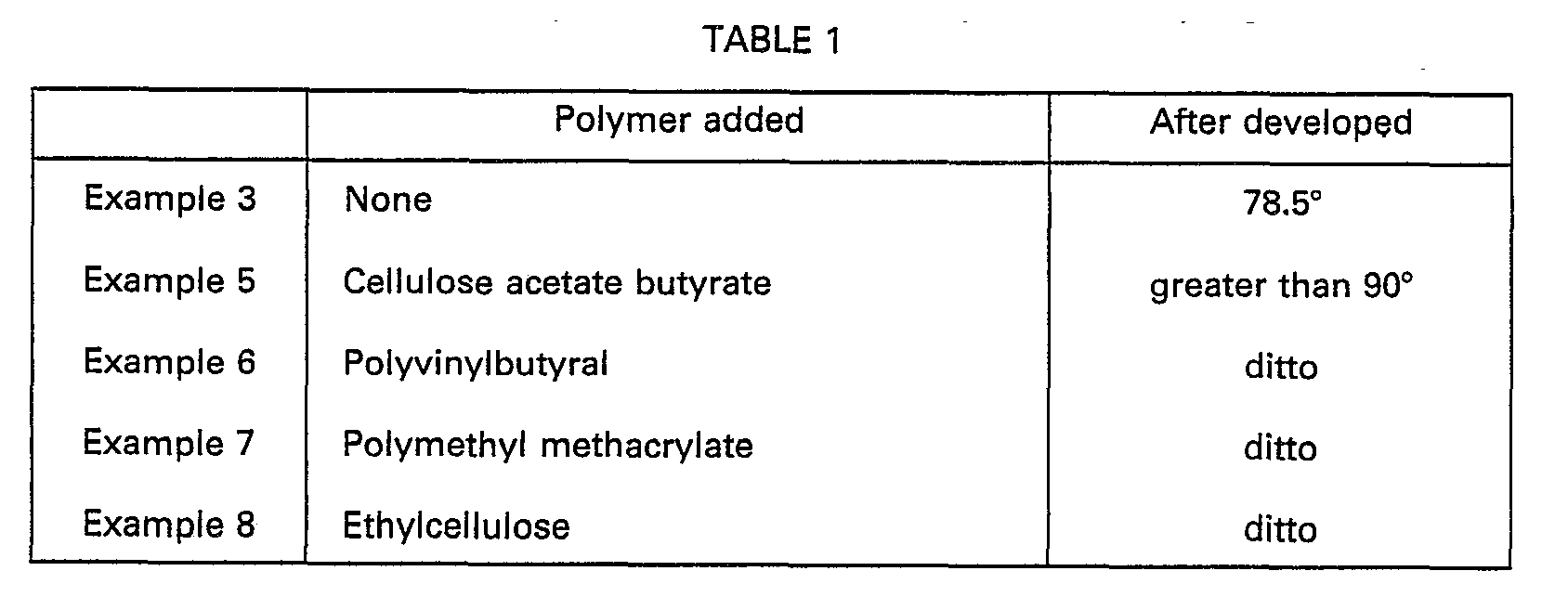
- Upon actual printing, roll-up for the image area required only several sheets and satisfactory printing products could be obtained when printed as far as 50,000 sheets.
- To a 200 ml three-necked flask, were charged 32.88 g (120 mmol) of diethyl p-phenylene diacrylate, 23.68 g (80 mmol) of dimethyl 5-sodium sulfoisophthlate, 20.40 g (100 mmol) of 1,4-bis(2-hydroxy- ethoxy)cyclohexane and 42.0 g (280 mmol) of triethylene glycol, and 10 ml of 5% ethanol solution of butyl orthotitanate was added. Then, the temperature was gradually increased under stirring at 200 r.p.m. while feeding nitrogen gases and the ester exchange reaction was carried out at 210°C for about one hour. Thereafter, the number of rotation for stirring was reduced to 100 r.p.m. and the pressure on the system was gradually decreased in one hour. As soon as the pressure was reduced to 133 Pa (1 mmHg), the bath temperature was rapidly increased to 250°C, under which conditions reaction was carried out for about 30 minutes to obtain a transparent polyester ⑤. The polyester obtained had a reduced viscosity of 0.45.
- The polyester was used to prepare 4 wt.% ethylene glycol monomethyl ether solution, to which DBT was added in an amount of 5% by weight based on the polyester.
- Further, 40% by weight of pentaerythritol triacrylate ("Biscoat 300", manufactured by Osaka Yuki Kagaku Kogyo Co., Ltd.) and each 2.8% by weight of benzil and Michler's ketone as the photopolymerization initiator were added to the polyester. After confirming that they were dissolved uniformly, Aizen Victoria rure Blue BOR (C.I.No. 42595 (manufactured oy moaogaya Kagaku Co., Lta.) was added by 1 % by weight based on the polyester, followed by filtration to obtain a photosensitive liquid (9).
- The photosensitive liquid (9) was coated on an aluminum plate which has been sand-blasted and subjected to anodic oxidation in a phosphoric acid bath using a whirler to obtain a photosensitive lithographic plate (9).
- The printing plate was exposed through a step wedge with a step difference of optical density of 0.15 using 3 KW high pressure mercury lamp from the distance of 1 m for 50 seconds. When it was developed by being gently rubbed with soft cloth under the flow of tap water for several seconds, insolubilization was observed as far as the fifth step. When usual developing ink for lithographic process was deposited to the picture images obtained, the ink affinity was very satisfactory and the roll-up for the image area on the printing plate required only several sheets. Further, when the image obtained by the exposure and the development was subjected to chemical resistance test using petroleum type solvent and alcoholic solvent respectively, no changes were recognized at all in the image area (Example 9).
- A photosensitive liquid (10) was prepared with no addition of pentaerythritol triacrylate, benzil and Michler's ketone and coated on the aluminum plate as mentioned above using a whirler to prepare a photosensitive lithographic plate (10) (Example 10). For the roll-up of the image area ten and several sheets of paper were required. Further, abrasion resistant test was carried out using petroleum type solvent on both of the photosensitive lithographic plates (9) and (10) and the image area after the abrasion was observed using a scanning type electronic microscope. As a result, it was confirmed that the photosensitive lithographic plate (9) was excellent and improved as compared with the lithographic plate (10).
- To a 200 ml of three-necked flask, were charged 32.88 g (120 mmol) of diethyl p-phenylene diacrylate, 23.68 g (80 mmol) of dimethyl 5-sodium sulfoisophthalate, 12.24 g (60 mmol) of 1,4-bis(2-hydroxyethoxy)-cyclohexane and 42.00 g (280 mmol) of triethylene glycol, and ester exchange reaction was carried out in the same manner as in Example 9.
- Then, after reducing the pressure to 133 Pa (1 mmHg) in the same manner as in Example 9 at 210°C, the bath temperature was rapidly increased to 240°C, under which conditions the reaction was carried out for 45 minutes.
- The reduced viscosity of the polyester @ thus obtained was 0.54. The photosensitive liquids (11) and (12) each of the composition as shown in Table 2 below were prepared using the polyester to obtain photosensitive lithographic plates (11) and (12) in the same manner as in Example 9.

- When the lithographic plates thus obtained were exposed and developed in the same manner as in Example 9, respectively, they were insolubilized as far as the eighth and ninth steps respectively.
- When the printing plates prepared by using the photosensitive liquid (11) was attached to a printer for the printing test, it showed excellent ink affinity, produced satisfactory printing products after printing up to 150,000 sheets and exhibited extremely excellent printing adaptability.
- The photosensitive liquids (13) and (14) each of the composition as shown in Table 3 were prepared using the polyester ⑥ and photosensitive lithographic plates (13) and (14) were obtained in the same manner as in Example 9.

- When the photosensitive lithographic plates (13) and (14) were exposed respectively in the same manner as in the previous Example 9 and developed using an alkaline aqueous solution containing 5.5% of sodium silicate and 1.2% of sodium hydroxide, their not-imaged areas were quite clearly removed to show excellent developing performance and insolubilization was observed to an extent of sixth step for each of them. The printing plates, when subjected to abrasion resistant test, showed excellent abrasion resistance as in Example 2 and excellent ink affinity.
- Further, when the photosensitive lithographic plate (13) obtained in Example 13 was exposed and developed afterthe store in a chamber at 60°C and 90% of humidity for 3 days in the same manner, printing plate with satisfactory image area could be obtained with not-imaged area being removed clearly. When subjected to the abrasion resistant test, the printing plate exhibited excellent abrasion resistance and very satisfactory ink affinity.
- Photosensitive liquids (15 and (16) each of the compositions as shown in Table 4 were prepared using the polyester ⑥ to obtain photosensitive lithographic plates (15) and (16) in the same manner as in Example 9.
-

- When the photosensitive lithographic plates (15) and (16) were exposed respectively in the same manner as in Example 9 and developed using an alkaline aqueous solution containing 5.5% of sodium silicate and 1.2% of sodium hydroxide, not-imaged area was removed quite clearly and the printing plates (15) and (16) were insolubilized to an extent of sixth step and fourth step respectively. The result of the abrasion resistant test and the ink affinity for the printing plates were extremely excellent in both of them.
- Photosensitive liquids (17)-(20) each of the compositions as shown in Table 5 were prepared using the polyester @ and photosensitive lithographic plates (17)-(20) were obtained in the same manner as Example 9.


- Each of the photosensitive lithographic plates (17)-(20) was exposed through a step wedge a step difference of optical density of 0.15 using a 1 KW metal halide lamp from the distance of 1 m for 60 seconds, developed using an alkaline aqueous solution containing 5.5% of sodium silicate and 1.2% of sodium hydroxide in the same manner as Examples 13 and 14. The developed images were subjected to the chemical resistant test and the abrasion resistant test using petroleum type solvent solvent and alcohol type solvent, and the image area after the treatment was observed under a scanning electronic microscope. The results of the tests are shown in Table 6.

- Further, the ink affinity of the image areas on the printing plates were extremely excellent and the roll-up for the image area on the printer required only several sheets of paper.
- Photosensitive liquids (21)-(25) each of the compositions as shown in Table 7 were prepared using the polyester ⑤ to obtain photosensitive printing plates (21 )-(25) in the same manner as in Example 9.

- The photosensitive lithographic plate (21)-(25) were exposed and developed using an alkaline aqueous solution containing 5.5% of sodium silicate and 1.2% of sodium hydroxide in the same manner as in Example 9.
- All of the developed image areas had satisfactory chemical resistance, abrasion resistance and ink affinity.
- The water proofness for the not-exposed area was also very satisfactory.
- Polyesters ⑦―were prepared under conditions as shown in Table 8, and photosensitive liquids (26)-(29) each of the compositions as shown in Table 9 were prepared using these polyesters in the same manner as in Example 9 to botain photosensitive lithographic plates (26)-(29).


- The chemical resistance, the abrasion resistance and the ink affinity for the imaged areas obtained by exposing and developing the printing plates (26)-(29) were measured quite in the same manner as in Example 9, and satisfactory results were obtained.
Claims (5)


Applications Claiming Priority (4)
| Application Number | Priority Date | Filing Date | Title |
|---|---|---|---|
| JP118345/81 | 1981-07-28 | ||
| JP11834581A JPS5818625A (en) | 1981-07-28 | 1981-07-28 | photosensitive composition |
| JP57056183A JPS58173740A (en) | 1982-04-05 | 1982-04-05 | photosensitive composition |
| JP56183/82 | 1982-04-05 |
Publications (2)
| Publication Number | Publication Date |
|---|---|
| EP0071236A1 EP0071236A1 (en) | 1983-02-09 |
| EP0071236B1 true EP0071236B1 (en) | 1986-04-23 |
Family
ID=26397118
Family Applications (1)
| Application Number | Title | Priority Date | Filing Date |
|---|---|---|---|
| EP82106755A Expired EP0071236B1 (en) | 1981-07-28 | 1982-07-26 | Photosensitive lithographic plate |
Country Status (5)
| Country | Link |
|---|---|
| US (1) | US4421841A (en) |
| EP (1) | EP0071236B1 (en) |
| AU (1) | AU555661B2 (en) |
| CA (1) | CA1178473A (en) |
| DE (1) | DE3270758D1 (en) |
Families Citing this family (17)
| Publication number | Priority date | Publication date | Assignee | Title |
|---|---|---|---|---|
| US4640887A (en) * | 1984-02-09 | 1987-02-03 | Dainippon Ink And Chemicals, Inc. | Photosensitive image-forming material comprised of carboxyl groups developable in aqueous alkaline base solutions |
| US5238774A (en) * | 1985-08-07 | 1993-08-24 | Japan Synthetic Rubber Co., Ltd. | Radiation-sensitive composition containing 1,2-quinonediazide compound, alkali-soluble resin and monooxymonocarboxylic acid ester solvent |
| JPS62123444A (en) | 1985-08-07 | 1987-06-04 | Japan Synthetic Rubber Co Ltd | Radiation sensitive resinous composition |
| US5215857A (en) * | 1985-08-07 | 1993-06-01 | Japan Synthetic Rubber Co., Ltd. | 1,2-quinonediazide containing radiation-sensitive resin composition utilizing methyl 2-hydroxypropionate, ethyl 2-hydroxypropionate or methyl 3-methoxypropionate as the solvent |
| DE3542368A1 (en) * | 1985-11-30 | 1987-06-04 | Basf Ag | POLYVINYL ALCOHOLS WITH OLEFINICALLY UNSATURATED SIDE GROUPS AND THEIR PRODUCTION AND USE, IN PARTICULAR IN OFFSET PRINTING PLATES |
| US5128230A (en) * | 1986-12-23 | 1992-07-07 | Shipley Company Inc. | Quinone diazide containing photoresist composition utilizing mixed solvent of ethyl lactate, anisole and amyl acetate |
| JPS63178228A (en) * | 1987-01-20 | 1988-07-22 | Fuji Photo Film Co Ltd | Positive type photoresist composition |
| JPH07117746B2 (en) * | 1987-04-16 | 1995-12-18 | 富士写真フイルム株式会社 | Method for producing photosensitive lithographic printing plate |
| US5143947A (en) * | 1989-11-13 | 1992-09-01 | Hoechst Celanese Corporation | Radiation curable composition based on 4-hydroxystyrene copolymers |
| US5432249A (en) * | 1993-12-22 | 1995-07-11 | Nippon Oil Company, Limited | Liquid crystalline polyesters |
| GB9710551D0 (en) * | 1997-05-23 | 1997-07-16 | Horsell Graphic Ind Ltd | Planographic printing |
| JP2004163904A (en) * | 2002-09-30 | 2004-06-10 | Rohm & Haas Electronic Materials Llc | Improved photoinitiator |
| US7851124B2 (en) * | 2003-06-03 | 2010-12-14 | Mitsui Chemicals, Inc. | Composition for forming wiring protective film and uses thereof |
| US7351773B2 (en) * | 2003-07-31 | 2008-04-01 | Fujifilm Corporation | Polymerizable composition |
| JP4820640B2 (en) * | 2005-12-20 | 2011-11-24 | 富士フイルム株式会社 | Preparation method of lithographic printing plate |
| KR100655045B1 (en) * | 2005-12-30 | 2006-12-06 | 제일모직주식회사 | Photosensitive resin composition and black matrix using same |
| KR101261618B1 (en) * | 2009-12-22 | 2013-05-07 | 주식회사 엘지화학 | Crosslinkable compound and photosensitive composition comprising the same |
Family Cites Families (4)
| Publication number | Priority date | Publication date | Assignee | Title |
|---|---|---|---|---|
| US3622320A (en) * | 1968-02-29 | 1971-11-23 | Mona Armstrong Allen | Thermographic processes and elements utilizing photocrosslinkable polyesters |
| US3926642A (en) * | 1972-11-09 | 1975-12-16 | Hercules Inc | Photopolymer lithographic plate element |
| US4073777A (en) * | 1975-01-17 | 1978-02-14 | Eastman Kodak Company | Radiation crosslinkable polyester and polyesteramide compositions containing sulfonate groups in the form of a metallic salt and unsaturated groups |
| JPS5540415A (en) * | 1978-09-14 | 1980-03-21 | Mitsubishi Chem Ind Ltd | Photosensitive composition |
-
1982
- 1982-07-14 US US06/398,442 patent/US4421841A/en not_active Expired - Lifetime
- 1982-07-19 AU AU86164/82A patent/AU555661B2/en not_active Ceased
- 1982-07-26 EP EP82106755A patent/EP0071236B1/en not_active Expired
- 1982-07-26 DE DE8282106755T patent/DE3270758D1/en not_active Expired
- 1982-07-28 CA CA000408244A patent/CA1178473A/en not_active Expired
Also Published As
| Publication number | Publication date |
|---|---|
| EP0071236A1 (en) | 1983-02-09 |
| AU555661B2 (en) | 1986-10-02 |
| DE3270758D1 (en) | 1986-05-28 |
| CA1178473A (en) | 1984-11-27 |
| AU8616482A (en) | 1983-02-03 |
| US4421841A (en) | 1983-12-20 |
Similar Documents
| Publication | Publication Date | Title |
|---|---|---|
| US4421841A (en) | Photosensitive lithographic plate with sulfonate containing photosensitive polyester | |
| US4419437A (en) | Image-forming compositions and elements containing ionic polyester dispersing agents | |
| US4481276A (en) | Photopolymerizable composition containing a combination of photoinitiators | |
| US4367280A (en) | Photopolymerizable composition | |
| CA1178478A (en) | Photopolymerisation process employing compounds containing acryloyl groups and anthryl groups | |
| CA1103508A (en) | Radiation-sensitive copying composition | |
| JPH0269A (en) | Photopolymerizable composition | |
| US20030166750A1 (en) | Method for the production of anhydride modified polyvinyl acetals useful for photosensitive compositions | |
| JPS6136872B2 (en) | ||
| JPH0522228B2 (en) | ||
| JP2575178B2 (en) | Photopolymerizable recording material, and photoresist layer and lithographic printing plate based on this recording material | |
| JPH09281698A (en) | Photopolymerizable composition for color filter | |
| JPH01201652A (en) | Photocurable composition | |
| JPH0411857B2 (en) | ||
| JP2551232B2 (en) | Novel photoinitiator system and photopolymerizable composition using the same | |
| JPH1045741A (en) | Coumarin compound and its use | |
| JPS624046B2 (en) | ||
| JPS6079036A (en) | Preparation of photosensitive polyester resin | |
| JPH0549697B2 (en) | ||
| JP2561841B2 (en) | Photosensitive composition | |
| JPS5937539A (en) | Photosensitive lithographic plate | |
| JP3552437B2 (en) | Photopolymerizable composition | |
| JPH1020494A (en) | Photopolymerizable composition, photosensitive original plate using the composition and its exposing method | |
| JPS59159156A (en) | Lithographic printing plate material | |
| JPH0876369A (en) | Photopolymerizable photosensitive material |
Legal Events
| Date | Code | Title | Description |
|---|---|---|---|
| PUAI | Public reference made under article 153(3) epc to a published international application that has entered the european phase |
Free format text: ORIGINAL CODE: 0009012 |
|
| AK | Designated contracting states |
Designated state(s): DE FR GB NL |
|
| 17P | Request for examination filed |
Effective date: 19830110 |
|
| GRAA | (expected) grant |
Free format text: ORIGINAL CODE: 0009210 |
|
| AK | Designated contracting states |
Kind code of ref document: B1 Designated state(s): DE FR GB NL |
|
| REF | Corresponds to: |
Ref document number: 3270758 Country of ref document: DE Date of ref document: 19860528 |
|
| ET | Fr: translation filed | ||
| PLBE | No opposition filed within time limit |
Free format text: ORIGINAL CODE: 0009261 |
|
| STAA | Information on the status of an ep patent application or granted ep patent |
Free format text: STATUS: NO OPPOSITION FILED WITHIN TIME LIMIT |
|
| 26N | No opposition filed | ||
| NLT1 | Nl: modifications of names registered in virtue of documents presented to the patent office pursuant to art. 16 a, paragraph 1 |
Owner name: MITSUBISHI KASEI CORPORATION TE TOKIO, JAPAN. |
|
| REG | Reference to a national code |
Ref country code: FR Ref legal event code: CD |
|
| PGFP | Annual fee paid to national office [announced via postgrant information from national office to epo] |
Ref country code: FR Payment date: 19960625 Year of fee payment: 15 |
|
| PGFP | Annual fee paid to national office [announced via postgrant information from national office to epo] |
Ref country code: GB Payment date: 19960627 Year of fee payment: 15 |
|
| PGFP | Annual fee paid to national office [announced via postgrant information from national office to epo] |
Ref country code: NL Payment date: 19960703 Year of fee payment: 15 |
|
| PGFP | Annual fee paid to national office [announced via postgrant information from national office to epo] |
Ref country code: DE Payment date: 19960930 Year of fee payment: 15 |
|
| PG25 | Lapsed in a contracting state [announced via postgrant information from national office to epo] |
Ref country code: GB Free format text: LAPSE BECAUSE OF NON-PAYMENT OF DUE FEES Effective date: 19970726 |
|
| PG25 | Lapsed in a contracting state [announced via postgrant information from national office to epo] |
Ref country code: NL Free format text: LAPSE BECAUSE OF NON-PAYMENT OF DUE FEES Effective date: 19980201 |
|
| GBPC | Gb: european patent ceased through non-payment of renewal fee |
Effective date: 19970726 |
|
| PG25 | Lapsed in a contracting state [announced via postgrant information from national office to epo] |
Ref country code: FR Free format text: LAPSE BECAUSE OF NON-PAYMENT OF DUE FEES Effective date: 19980331 |
|
| NLV4 | Nl: lapsed or anulled due to non-payment of the annual fee |
Effective date: 19980201 |
|
| PG25 | Lapsed in a contracting state [announced via postgrant information from national office to epo] |
Ref country code: DE Free format text: LAPSE BECAUSE OF NON-PAYMENT OF DUE FEES Effective date: 19980401 |
|
| REG | Reference to a national code |
Ref country code: FR Ref legal event code: ST |