EP0071002A2 - Datenverarbeitungsgerät mit Zugriffsteuerung von gespeicherten Werten zu einem gemeinsambenutzten Speicher - Google Patents
Datenverarbeitungsgerät mit Zugriffsteuerung von gespeicherten Werten zu einem gemeinsambenutzten Speicher Download PDFInfo
- Publication number
- EP0071002A2 EP0071002A2 EP82104820A EP82104820A EP0071002A2 EP 0071002 A2 EP0071002 A2 EP 0071002A2 EP 82104820 A EP82104820 A EP 82104820A EP 82104820 A EP82104820 A EP 82104820A EP 0071002 A2 EP0071002 A2 EP 0071002A2
- Authority
- EP
- European Patent Office
- Prior art keywords
- memory
- common
- access
- volatile storage
- host
- Prior art date
- Legal status (The legal status is an assumption and is not a legal conclusion. Google has not performed a legal analysis and makes no representation as to the accuracy of the status listed.)
- Granted
Links
Images
Classifications
-
- G—PHYSICS
- G06—COMPUTING OR CALCULATING; COUNTING
- G06F—ELECTRIC DIGITAL DATA PROCESSING
- G06F12/00—Accessing, addressing or allocating within memory systems or architectures
- G06F12/02—Addressing or allocation; Relocation
- G06F12/08—Addressing or allocation; Relocation in hierarchically structured memory systems, e.g. virtual memory systems
-
- G—PHYSICS
- G06—COMPUTING OR CALCULATING; COUNTING
- G06F—ELECTRIC DIGITAL DATA PROCESSING
- G06F12/00—Accessing, addressing or allocating within memory systems or architectures
- G06F12/02—Addressing or allocation; Relocation
- G06F12/0223—User address space allocation, e.g. contiguous or non contiguous base addressing
- G06F12/0284—Multiple user address space allocation, e.g. using different base addresses
Definitions
- the present invention relates to data processing apparatus having stored value access control to shared storage.
- the present invention provides data processing apparatus including multiple processing units, each having private storage and sharing common volatile storage as a serially resuable resource, each processor being constrained to gain access to the common volatile storage via a stored value access control mechanism, characterized in that the access control mechanism causes
- the memory units such as magnetic tape units and disk file units have retentive characteristics; that is, data is stored in the retentive magnetic coating of the memory element which maintains memory irrespective of whether or not electrical power is being supplied to such memory units.
- Such retentive memory units generally are characterized by relatively long access times.
- the semiconductor type memory which is a non-retentive or volatile memory, has been employed in connection with storing data for multiple data processing units, hereinafter referred to as hosts. When these volatile memories are shared by a plurality of hosts, particularly loosely coupled hosts.
- IPL initial program load
- IPL may include transmission of data from the retentive memories to the volatile memories of the hosts. Such transmissions can include transmission of data from a retentive memory to the above-discussed volatile shared memory. Before the shared memory can be used, the directory of that shared memory has to be created. Unfortunately, such volatile memories when powered on result in a random and unknown state of the various volatile memory elements, in the semiconductor memory such elements are usually flip-flops.
- initialization of a shared volatile memory loosely-coupled in a multi-host environment be readily determined under various operational conditions. Being able to verify memory initialization is important even though one or more hosts are not operative or able to communicate, the shared memory is faulty or, one of the hosts operational but a path to the shared volatile memory is inoperative. Further, simultaneous attempted accesses to the shared memory can occur (tie-breaking is required).
- the present invention provides for initializing loosely-coupled volatile shared memories which include a procedure and apparatus for accessing such a memory shared among a plurality of hosts in a loosely-coupled environment.
- a given storage area of the shared volatile memory is dedicated for memorizing a so-called token.
- the token has sufficient digital bit positions to ensure against randomness representing the token.
- the host Upon an access to the shared volatile memory, the host will read the token area and compare the read token with a known token. If the tokens have a favorable compare, then the memory has been initialized and normal data processing ensues. If the tokens do not have a favorable compare; then the accessing hosts initialize the shared memory by constructing a data directory and other ancillary tables such that the shared volatile memory can be successfully accessed by any of the plurality of hosts.
- the initializing host Upon successful completion of this initialization, the initializing host records the token in the token area of the memory such that any subsequent access to the memory by any of the hosts can verify the appropriate initialization of the shared volatile memory.
- each of the hosts will have its own main or local memory which it uses in a tightly-coupled relationship. Further, the main or local memories can be accessed by only one of the hosts.
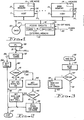
- External resource 10 shown as external volatile memory
- Each of the hosts 11 have their own main memory 13.
- Each of the main memories 13 further includes a latch 14 for indicating the mode of usage of the shared memory 10.
- Each use-mode indication in the main memories 13 refer to whether or not the external resource has been appropriately initialized, as later described.
- the external memory 10 is accessed by any of the hosts 11 through access circuits 15 which include the usual tie-breaking circuits (not shown) such that simultaneous access is prohibited.
- External memory 10 can be of the volatile type such that upon each "power on" the contents of the memory are unknown.
- Such an external memory in addition to containing data for use by the hosts 11, includes a directory 16 which is an indirect addressing mechanism for accessing the stored host data in external memory 10.
- a simple mechanism for showing proper initialization of a volatile memory such as a semiconductor memory is to store a token 17 in predetermined addressable storage registers of memory 10.
- the token is a predetermined data pattern stored in memory of such size as to minimize the probability of indicating a memory as being initialized when it is in fact not initialized.
- Such a probability is 0.5N where N is the number of bits in the token. If error correction bits are included in the token, the power of N applies also to those error correction bits.
- N is the number of bits in the token. If error correction bits are included in the token, the power of N applies also to those error correction bits.
- a 16 byte (eight bits plus a parity bit per byte) token has been found to be satisfactory for indicating initialization.
- An example of the token usable in the course of the present invention set forth in hexidecimal is:
- a host 11 in initially accessing the external memory will first read the token 17 and then compare it with a token internal to the host. If the tokens compare, then the memory 10 is initialized. If there is a mis-compare, then the memory is uninitialized. It should be noted the memory may be marked uninitialized by a host 11 merely by recording a value in token 17 not equal to the permitted value. Hence, the token provides absolute initialization indications as well as logical initialization indications. An external memory 10 can be indicated as being uninitialized because of an error condition in the token 17 area errors in the token 17 area caused by memory refresh errors, errors caused by access circuit 15 or by bus 12, etc. It is assumed that all detected errors that affect integrity of memory contents are reported to all using hosts.
- each of the hosts 11 have to be initial program loaded (IPL) as indicated by arrow 21. Once a host 11 is IPL'ed then such host will try to initialize the external memory 10. It should be noted that any host 11 will attempt this initialization; this means, that the use of the token 17 eliminates complex inter- host communications with regard to the initialization of external memory 10.
- FIG. 2 illustrates the logical machine operations of the host 11 during IPL with regard to initialization of external memory 10.
- IPL is initiated by a bootstrap operation (not shown), indicated at 30. Some non-pertinent logic steps 31 are performed with regard to initialization of host 11 including initialization of its main memory 13.
- external memory 10 is accessed for reading token 17. If access circuits 15 are not yet powered on, token 17 cannot be fetched. In that instance, host 11 follows logic path 33 to step 34 for setting poll flag 35 in its main memory 13 indicating to host 11 that external memory 10 should be polled for power-on on a predetermined repetitive basis.
- poll 34 sets poll flip-flop 35 of memory 13
- host 11 follows logic path 36 to exit the IPL routine at 37.
- the token 17 is in fact fetched at 32 and transferred to an internal register (not shown) of host 11. Following path 40, the fetched token 17 is compared at 41 with a predetermined token generated for host 11 via IPL 21. If there is a favorable compare of the tokens, then external memory 10 has already been initialized by another host 11. Then following logic path 42, host 11 at 43 sets the use mode latch 14 to the on condition, i.e., external memory 10 is available for use.
- step 4l If at step 4l, the tokens do not compare; then host 11 following logic path 44 will initialize external memory 10. This is achieved by constructing the directory 16 at step 45. Following step 45, error conditions are checked at 46. With no errors, logic path 47 leads host 11 to step 48 whereat the token 17 is set to the value indicated above, use mode flip-flop 14 is set to the use state while flip-flop 23 is again set to the on state. In case there is an error condition, at 49, host 11 sets flip-flop 14 to the non-use mode and sets poll latch 35 such that the status of external memory 10 can be polled on a periodic or predetermined basis. An error message (not shown) can be sent to an operator's console (not shown) for remedial action.
- Figure 3 shows a logic of machine operation for using external memory 10.
- the use of external memory 10 is indicated.
- a command is sent over I/O connection 12 at 56. Errors are checked at 57. With no errors, machine operations continue as indicated at 58.
- use mode latch 14 is set to non-use state
- poll latch 35 is set in the errors log with an error message being sent to the operator via the console. Other machine operations are performed at 60.
- the poll flip-flop 35 causes host 11 to initiate fetching the token at 32 (Fig. 2) as indicated by arrow 37. In this manner, examination of token 17 can be conducted in an re-entrant manner.
- Figure 4 illustrates an electronic circuit within access circuit 15 suitable for performing the step 41 of Figure 2. Other logic steps are still performed in host 11.
- Memory 10 is addressed via address circuit 66 at an address received over bus 67 which is a portion of input/output connection 12. Contents of token area 17 are supplied over bus 70 to be stored in register 69 as enabled by a signal on line 68 associated with the address on bus 67 for accessing token 17.
- Numeral 67 and 68 correspond to the fetch token step 32 of Fig. 2.
- the contents of register 69 are compared by compare circuit 73 with a token set in a pinboard 72. When a favorable compare is sensed, a signal on line 74 is sent to host 11, which corresponds to logic path 42 of Figure 2, indicating the initialization of external memory 10; otherwise host 11 follows logic path 44 for initializing external memory 10.
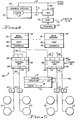
- a pair of programmed control units 83 can perform the host's functions as described in terms of the arrangements of Figures 1 through 3.
- the programmed control units 85 (separately denominated 83) operate with the external memory 10 and a plurality of DASD 101, 103, 112 and 113.
- a plurality of hosts 80 each have their own main memories 81 which in turn have a mode flip-flop 82 comparable to the host 11, main memory 13 mode latch 14 of Figure 1.
- Each control unit 85 includes a programmed digital processor (not shown) and a memory (not shown) which includes a flip-flop 86 corresponding to use mode flip-flops 14 of Fig. 1.
- the control units 85 operate with memory 10 in the same manner as described for hosts 11.
- a plurality of input/output channels 90 connect the hosts 80 to the control units.
- Each of the control units 85 have a plurality of channel adapters 88 which respectively connect to channels 90 via the input/output connections 89.
- Each control unit is IMPL'd (initial microprogram loaded) as indicated by arrows 87.
- Control units are programmed to transfer data signals between DASD 101, 103, 112 and l13 and external memory 10 using known techniques as indicated by dash lines 105 and 115. Electrical connections from control units to the DASDs, indicated by numerals 104 and 114 are through two so-called A boxes 101, 102, 110, and lll, respectively.
- the A boxes are DASD controllers of known design.
- External memory 10 is independently electrically connected to the control units 85 via connections 91 and 92.
- Access circuits 15 include flip-flop 23 and provide for tie-breaking access to external memory 10 by control units 83.
- Memory 10 includes the directory 16 and token area 17. All operations are identical to Figure 1 except that control units 85 provide the initialization of external memory 10 either independently or upon command from a host 80.
Landscapes
- Engineering & Computer Science (AREA)
- Theoretical Computer Science (AREA)
- Physics & Mathematics (AREA)
- General Engineering & Computer Science (AREA)
- General Physics & Mathematics (AREA)
- Techniques For Improving Reliability Of Storages (AREA)
- Storage Device Security (AREA)
- Multi Processors (AREA)
- Memory System (AREA)
Applications Claiming Priority (2)
| Application Number | Priority Date | Filing Date | Title |
|---|---|---|---|
| US28690981A | 1981-07-27 | 1981-07-27 | |
| US286909 | 1981-07-27 |
Publications (3)
| Publication Number | Publication Date |
|---|---|
| EP0071002A2 true EP0071002A2 (de) | 1983-02-09 |
| EP0071002A3 EP0071002A3 (en) | 1986-07-16 |
| EP0071002B1 EP0071002B1 (de) | 1988-05-25 |
Family
ID=23100682
Family Applications (1)
| Application Number | Title | Priority Date | Filing Date |
|---|---|---|---|
| EP82104820A Expired EP0071002B1 (de) | 1981-07-27 | 1982-06-02 | Datenverarbeitungsgerät mit Zugriffsteuerung von gespeicherten Werten zu einem gemeinsambenutzten Speicher |
Country Status (3)
| Country | Link |
|---|---|
| EP (1) | EP0071002B1 (de) |
| JP (1) | JPS5819800A (de) |
| DE (1) | DE3278544D1 (de) |
Cited By (4)
| Publication number | Priority date | Publication date | Assignee | Title |
|---|---|---|---|---|
| EP0355072A1 (de) * | 1988-08-17 | 1990-02-21 | ETAT FRANCAIS représenté par le Ministère des Postes, des Télécommunications et de l'Espace | Speichererweiterungsanordnung für mindestens eine Datenverarbeitungseinheit |
| EP0457345A3 (en) * | 1990-05-18 | 1992-11-19 | Nec Corporation | Information processing apparatus |
| US7225341B2 (en) * | 2001-03-15 | 2007-05-29 | Sony Corporation | Memory access control system and management method using access control ticket |
| US8315996B2 (en) | 2008-08-13 | 2012-11-20 | International Business Machines Corporation | Efficient management of customized functionality within shared data objects |
Families Citing this family (1)
| Publication number | Priority date | Publication date | Assignee | Title |
|---|---|---|---|---|
| US12366986B2 (en) * | 2021-03-16 | 2025-07-22 | Sk Hynix Nand Product Solutions Corp. | On-SSD-copy techniques using copy-on-write |
Family Cites Families (4)
| Publication number | Priority date | Publication date | Assignee | Title |
|---|---|---|---|---|
| US4070704A (en) * | 1976-05-17 | 1978-01-24 | Honeywell Information Systems Inc. | Automatic reconfiguration apparatus for input/output processor |
| JPS5494850A (en) * | 1978-01-11 | 1979-07-26 | Nissan Motor | Arithmetic processor |
| JPS5925320B2 (ja) * | 1978-03-10 | 1984-06-16 | 株式会社日立製作所 | 共有記憶装置の制御装置 |
| US4240143A (en) * | 1978-12-22 | 1980-12-16 | Burroughs Corporation | Hierarchical multi-processor network for memory sharing |
-
1982
- 1982-06-02 DE DE8282104820T patent/DE3278544D1/de not_active Expired
- 1982-06-02 EP EP82104820A patent/EP0071002B1/de not_active Expired
- 1982-06-15 JP JP57101486A patent/JPS5819800A/ja active Pending
Cited By (6)
| Publication number | Priority date | Publication date | Assignee | Title |
|---|---|---|---|---|
| EP0355072A1 (de) * | 1988-08-17 | 1990-02-21 | ETAT FRANCAIS représenté par le Ministère des Postes, des Télécommunications et de l'Espace | Speichererweiterungsanordnung für mindestens eine Datenverarbeitungseinheit |
| FR2635599A1 (fr) * | 1988-08-17 | 1990-02-23 | Finger Ulrich | Systeme d'extension de memoire pour au moins un ensemble de traitement de donnees |
| EP0457345A3 (en) * | 1990-05-18 | 1992-11-19 | Nec Corporation | Information processing apparatus |
| US5440728A (en) * | 1990-05-18 | 1995-08-08 | Nec Corporation | Information processing apparatus |
| US7225341B2 (en) * | 2001-03-15 | 2007-05-29 | Sony Corporation | Memory access control system and management method using access control ticket |
| US8315996B2 (en) | 2008-08-13 | 2012-11-20 | International Business Machines Corporation | Efficient management of customized functionality within shared data objects |
Also Published As
| Publication number | Publication date |
|---|---|
| EP0071002A3 (en) | 1986-07-16 |
| JPS5819800A (ja) | 1983-02-04 |
| EP0071002B1 (de) | 1988-05-25 |
| DE3278544D1 (en) | 1988-06-30 |
Similar Documents
| Publication | Publication Date | Title |
|---|---|---|
| US4667288A (en) | Enable/disable control checking apparatus | |
| US4686621A (en) | Test apparatus for testing a multilevel cache system with graceful degradation capability | |
| US5446741A (en) | Fast memory power-on diagnostics using DMA | |
| US4943966A (en) | Memory diagnostic apparatus and method | |
| US5038320A (en) | Computer system with automatic initialization of pluggable option cards | |
| CA1335843C (en) | Programmable option select | |
| US4575792A (en) | Shared interface apparatus for testing the memory sections of a cache unit | |
| US4150428A (en) | Method for providing a substitute memory in a data processing system | |
| US3815103A (en) | Memory presence checking apparatus | |
| US5956349A (en) | Semiconductor memory device for high speed data communication capable of accurate testing of pass/fail and memory system employing the same | |
| US4562536A (en) | Directory test error mode control apparatus | |
| US4127768A (en) | Data processing system self-test enabling technique | |
| US5329634A (en) | Computer system with automatic adapter card setup | |
| EP0071002B1 (de) | Datenverarbeitungsgerät mit Zugriffsteuerung von gespeicherten Werten zu einem gemeinsambenutzten Speicher | |
| US5229999A (en) | Method and apparatus for integrity testing of fault monitoring logic | |
| EP1675009A2 (de) | Systeme und Verfahren zur Erkennung von Adressierungsfehlern und Adressen | |
| US5394536A (en) | Stable memory circuit using dual ported VRAM with shift registers in a multiple memory bank setup for high speed data-transfer | |
| US5673419A (en) | Parity bit emulator with write parity bit checking | |
| US4989210A (en) | Pipelined address check bit stack controller | |
| US3727039A (en) | Single select line storage system address check | |
| EP0382390A2 (de) | Fehlerprüfungsverfahren und -mittel für dynamische RAM-Kontrollsignale zwischen Systemmodulen | |
| US4531215A (en) | Validity checking arrangement for extended memory mapping of external devices | |
| EP0383891B1 (de) | Steuergerät für einen pipeline-adressenprüfbit-stapelspeicher | |
| US5797032A (en) | Bus for connecting extension cards to a data processing system and test method | |
| JPH0430059B2 (de) |
Legal Events
| Date | Code | Title | Description |
|---|---|---|---|
| PUAI | Public reference made under article 153(3) epc to a published international application that has entered the european phase |
Free format text: ORIGINAL CODE: 0009012 |
|
| AK | Designated contracting states |
Designated state(s): DE FR GB |
|
| 17P | Request for examination filed |
Effective date: 19830420 |
|
| PUAL | Search report despatched |
Free format text: ORIGINAL CODE: 0009013 |
|
| AK | Designated contracting states |
Kind code of ref document: A3 Designated state(s): DE FR GB |
|
| 17Q | First examination report despatched |
Effective date: 19870720 |
|
| GRAA | (expected) grant |
Free format text: ORIGINAL CODE: 0009210 |
|
| AK | Designated contracting states |
Kind code of ref document: B1 Designated state(s): DE FR GB |
|
| REF | Corresponds to: |
Ref document number: 3278544 Country of ref document: DE Date of ref document: 19880630 |
|
| ET | Fr: translation filed | ||
| PLBE | No opposition filed within time limit |
Free format text: ORIGINAL CODE: 0009261 |
|
| STAA | Information on the status of an ep patent application or granted ep patent |
Free format text: STATUS: NO OPPOSITION FILED WITHIN TIME LIMIT |
|
| 26N | No opposition filed | ||
| PGFP | Annual fee paid to national office [announced via postgrant information from national office to epo] |
Ref country code: FR Payment date: 19910528 Year of fee payment: 10 |
|
| PGFP | Annual fee paid to national office [announced via postgrant information from national office to epo] |
Ref country code: DE Payment date: 19910619 Year of fee payment: 10 |
|
| PGFP | Annual fee paid to national office [announced via postgrant information from national office to epo] |
Ref country code: GB Payment date: 19920506 Year of fee payment: 11 |
|
| PG25 | Lapsed in a contracting state [announced via postgrant information from national office to epo] |
Ref country code: FR Effective date: 19930226 |
|
| PG25 | Lapsed in a contracting state [announced via postgrant information from national office to epo] |
Ref country code: DE Effective date: 19930302 |
|
| REG | Reference to a national code |
Ref country code: FR Ref legal event code: ST |
|
| PG25 | Lapsed in a contracting state [announced via postgrant information from national office to epo] |
Ref country code: GB Effective date: 19930602 |
|
| GBPC | Gb: european patent ceased through non-payment of renewal fee |
Effective date: 19930602 |