EP0062236A2 - Verwendung von Triazolylderivate zur Bekämpfung von Pilzen - Google Patents
Verwendung von Triazolylderivate zur Bekämpfung von Pilzen Download PDFInfo
- Publication number
- EP0062236A2 EP0062236A2 EP82102446A EP82102446A EP0062236A2 EP 0062236 A2 EP0062236 A2 EP 0062236A2 EP 82102446 A EP82102446 A EP 82102446A EP 82102446 A EP82102446 A EP 82102446A EP 0062236 A2 EP0062236 A2 EP 0062236A2
- Authority
- EP
- European Patent Office
- Prior art keywords
- triazolyl
- methyl
- dioxan
- propan
- propen
- Prior art date
- Legal status (The legal status is an assumption and is not a legal conclusion. Google has not performed a legal analysis and makes no representation as to the accuracy of the status listed.)
- Granted
Links
Classifications
-
- C—CHEMISTRY; METALLURGY
- C07—ORGANIC CHEMISTRY
- C07D—HETEROCYCLIC COMPOUNDS
- C07D231/00—Heterocyclic compounds containing 1,2-diazole or hydrogenated 1,2-diazole rings
- C07D231/02—Heterocyclic compounds containing 1,2-diazole or hydrogenated 1,2-diazole rings not condensed with other rings
- C07D231/10—Heterocyclic compounds containing 1,2-diazole or hydrogenated 1,2-diazole rings not condensed with other rings having two or three double bonds between ring members or between ring members and non-ring members
- C07D231/12—Heterocyclic compounds containing 1,2-diazole or hydrogenated 1,2-diazole rings not condensed with other rings having two or three double bonds between ring members or between ring members and non-ring members with only hydrogen atoms, hydrocarbon or substituted hydrocarbon radicals, directly attached to ring carbon atoms
-
- A—HUMAN NECESSITIES
- A01—AGRICULTURE; FORESTRY; ANIMAL HUSBANDRY; HUNTING; TRAPPING; FISHING
- A01N—PRESERVATION OF BODIES OF HUMANS OR ANIMALS OR PLANTS OR PARTS THEREOF; BIOCIDES, e.g. AS DISINFECTANTS, AS PESTICIDES OR AS HERBICIDES; PEST REPELLANTS OR ATTRACTANTS; PLANT GROWTH REGULATORS
- A01N43/00—Biocides, pest repellants or attractants, or plant growth regulators containing heterocyclic compounds
- A01N43/64—Biocides, pest repellants or attractants, or plant growth regulators containing heterocyclic compounds having rings with three nitrogen atoms as the only ring hetero atoms
- A01N43/647—Triazoles; Hydrogenated triazoles
- A01N43/653—1,2,4-Triazoles; Hydrogenated 1,2,4-triazoles
-
- C—CHEMISTRY; METALLURGY
- C07—ORGANIC CHEMISTRY
- C07D—HETEROCYCLIC COMPOUNDS
- C07D233/00—Heterocyclic compounds containing 1,3-diazole or hydrogenated 1,3-diazole rings, not condensed with other rings
- C07D233/54—Heterocyclic compounds containing 1,3-diazole or hydrogenated 1,3-diazole rings, not condensed with other rings having two double bonds between ring members or between ring members and non-ring members
- C07D233/56—Heterocyclic compounds containing 1,3-diazole or hydrogenated 1,3-diazole rings, not condensed with other rings having two double bonds between ring members or between ring members and non-ring members with only hydrogen atoms or radicals containing only hydrogen and carbon atoms, attached to ring carbon atoms
-
- C—CHEMISTRY; METALLURGY
- C07—ORGANIC CHEMISTRY
- C07D—HETEROCYCLIC COMPOUNDS
- C07D249/00—Heterocyclic compounds containing five-membered rings having three nitrogen atoms as the only ring hetero atoms
- C07D249/02—Heterocyclic compounds containing five-membered rings having three nitrogen atoms as the only ring hetero atoms not condensed with other rings
- C07D249/08—1,2,4-Triazoles; Hydrogenated 1,2,4-triazoles
-
- C—CHEMISTRY; METALLURGY
- C07—ORGANIC CHEMISTRY
- C07D—HETEROCYCLIC COMPOUNDS
- C07D319/00—Heterocyclic compounds containing six-membered rings having two oxygen atoms as the only ring hetero atoms
- C07D319/04—1,3-Dioxanes; Hydrogenated 1,3-dioxanes
- C07D319/06—1,3-Dioxanes; Hydrogenated 1,3-dioxanes not condensed with other rings
Definitions
- the present invention relates to fungicidal compositions which contain triazolyl derivatives or their salts or metal complex compounds and to methods for controlling phytopathogenic fungi with them.
- triazole derivatives such as 2,2-dimethyl-4- (1,2,4-triazol-1-yl) '- 5-phenylpentan-3-one (cf. DE-OS 26 38 470) are fungicidal Possess effectiveness. The effect of these substances is not always sufficient at low application rates and concentrations. In addition, their fungitoxic action is associated with a high level of phytotoxicity, so that important concentrations of crops are damaged or severely inhibited in their growth at the concentrations required for combating phytopathogenic fungi, for example in combating mildew, scab or rust fungi. For these reasons, they are not always suitable for combating phytopathogenic fungi and not for all crops.
- the new compounds of formula I contain chiral centers and / or double bonds and are generally obtained in the form of racemates or as diastereomer mixtures or as Z and E isomer mixtures.
- the diastereomers and E and Z isomers can be separated, for example by column chromatography, or isolated in pure form on account of differences in solubility. Uniform enantiomers can also be obtained from uniform diastereomers using known methods. These are also encompassed by the present invention.
- both the uniform diastereomers, enantiomers or geometric isomers Z and E and also their mixtures which are obtained in the synthesis are suitable. The latter are preferably used.
- R 1 and R 2 mean, for example, hydrogen, methyl, ethyl, n-propyl, isopropyl, n-butyl, sec-butyl, isobutyl, tert-butyl, n-pentyl or one by fluorine, chlorine, bromine, methyl , Ethyl, trifluoromethyl, methoxy, ethoxy and nitro substituted phenyl.
- Ar means, for example, 2-furanyl, 2- and 3-thienyl, 4-biphenylyl, l- and 2-naphthyl, phenyl, 4-fluorophenyl, 2-chlorophenyl, 3-chlorophenyl, 4-chlorophenyl, 4-bromophenyl, 2,4 -Dichlorophenyl, 3,4-dichlorophenyl, 3,5-dichloro-2-methoxyphenyl, 2,3,4-trichlorophenyl, 2-methoxyphenyl, 2,4-dimethoxyphenyl, 3-methoxyphenyl, 4-methoxyphenyl, 4-ethoxyphenyl, 4 -tert.-butoxyphenyl, 4-methylphenyl, 4-ethylphenyl, 4-isopropylphenyl, 4-tert.-butylphenyl, 3-nitrophenyl, 4-nitrophenyl, 3-trifluoromethylphenyl, 4-trifluor
- R 3 means, for example, methyl, ethyl, n-propyl, n-butyl, 4-chlorobutyl, n-pentyl, n-hexyl, allyl, buten-2-yl, propargyl, benzyl, 4-fluorobenzyl, 4-chlorobenzyl, 4 -Brombenzyl, 2,4-dichlorobenzyl and 4-trifluoromethylbenzyl.
- R 4 is preferably methyl, ethyl, n-propyl, isopropyl, chloromethyl, chloropropyl, methoxymethyl, vinyl and propenyl.
- the reaction a) is optionally carried out in the presence of a solvent or diluent, if appropriate with the addition of an inorganic or organic base and if appropriate with the addition of a reaction accelerator at temperatures between 10 and 120 ° C.
- a solvent or diluent include ketones such as acetone, methyl ethyl ketone or cyclohexanone, nitriles such as acetonitrile, esters such as ethyl acetate, ethers such as diethyl ether, tetrahydrofuran or dioxane, sulfoxides such as dimethyl sulfoxide, amides such as dimethylformamide, dimethylacetamide or N-methylpyrrolidone, furthermore sulfolane or corresponding mixtures.
- Suitable bases which may also be used as acid-binding agents in the reaction, are, for example, alkali metal hydroxides such as lithium, sodium or potassium hydroxide; Alkali carbonates such as sodium or potassium carbonate or sodium and potassium hydrogen carbonate, excesses of 1,2,4-triazole, pyridine or 4-dimethylamino-pyridine.
- alkali metal hydroxides such as lithium, sodium or potassium hydroxide
- Alkali carbonates such as sodium or potassium carbonate or sodium and potassium hydrogen carbonate, excesses of 1,2,4-triazole, pyridine or 4-dimethylamino-pyridine.
- other common bases can also be used.
- reaction accelerators used are preferably metal halides such as sodium iodide or potassium iodide, quaternary ammonium salts such as tetrabutylammonium chloride, bromide or iodide, benzyl-triethylammonium chloride or bromide or crown ethers such as 12-crown-4 "15-crown-5, 18-crown-6, Dibenzo-18-Krone-6 or Dicyclohexano-18-Krone-6 in question.
- metal halides such as sodium iodide or potassium iodide
- quaternary ammonium salts such as tetrabutylammonium chloride, bromide or iodide, benzyl-triethylammonium chloride or bromide or crown ethers
- 12-crown-4 15-crown-5, 18-crown-6, Dibenzo-18-Krone-6 or Dicyclohexano-18-
- the reaction b) is optionally carried out in the presence of a solvent or diluent and, if appropriate, under Add a strong inorganic or organic base at temperatures between -10 and 120 ° C.
- a solvent or diluent include amides such as dimethylformamide, diethylformamide, dimethylacetamide, diethylacetamide, N-methylpyrrolidone, hexamethylphosphorus triamide, sulfoxides such as dimethyl sulfoxide and finally sulfolane.
- Suitable bases which can optionally also be used as acid-binding agents in the reaction, are, for example, alkali hydrides, such as lithium, sodium and potassium hydride, alkali amides such as sodium and potassium amide, furthermore sodium or potassium tert-butoxide, lithium -, sodium - and potassium triphenylmethyl and naphthalene-lithium, -sodium or -potassium.
- alkali hydrides such as lithium, sodium and potassium hydride
- alkali amides such as sodium and potassium amide
- furthermore sodium or potassium tert-butoxide lithium -, sodium - and potassium triphenylmethyl and naphthalene-lithium, -sodium or -potassium.
- the aldehydes V be optionally fused with the compounds IV in the presence of a solvent or diluent and optionally with the addition of an inorganic or organic base and / or acid at temperatures from -10 to 150 0 C, if appropriate under azeotropic Ausnikung water of reaction.
- the preferred solvents and diluents include water, alcohols such as methanol, ethanol, isopropanol and tert-butanol, hydrocarbons such as n-hexane, n-heptane, n- and iso-octane, cyclohexane, tetrahydronaphthalene, decahydronaphthalene, toluene, xylene , Cumene; Amides such as dimethylformamide, dimethylacetamide, N-methylpyrrolidone and ethers such as diethyl ether, methyl tert-butyl ether, dioxane, tetrahydrofuran or corresponding mixtures.
- alcohols such as methanol, ethanol, isopropanol and tert-butanol
- hydrocarbons such as n-hexane, n-heptane, n- and iso-octane, cyclo
- the reactions are generally carried out at temperatures between 20 and 150 ° C, without pressure or under pressure, continuously or batchwise.
- the 1- (1,3-dioxan-5-yl) -2- (1,2,4-triazolyl- (1)) - ethane-1-ones of the formula IV are new. You can, for example, by reacting 1- (1,3-dioxan-5-yl) -2-halogenoethan-l-ones of the formula VI in which R 1 and R 2 have the meanings given above and Y is chlorine or bromine, are obtained with the sodium salt of 1,2,4-triazole.
- the compounds of formula VI are also new. They are obtained, for example, by reacting known (1,3-dioxan-5-yl) ethan-l-ones of the formula VII in which R 1 and R 2 have the meanings given above, for example with the pyrrolidone-bromine complex according to DP Wyman u. PR Kaufman, J. Org. Chem. 29, 1956 (1964).
- ketones obtained according to a), b) or c) can, if appropriate, in the presence of a solvent or diluent, at temperatures between -20 to 150 ° C, at normal pressure or under elevated pressure with hydrogen in the presence of a catalyst, with complex boron or aluminum hydrides, with aluminum isopropoxide and isopropanol, with sodium dithionite or electrochemically.
- Suitable solvents or diluents for this are, for example, water, methanol, ethanol, isopropanol, acetic acid, diethyl ether, tetrahydrofuran, dioxane, ethyl acetate, toluene, dimethylformamide or corresponding mixtures.
- platinum or palladium catalysts are used on inert supports and hydrogenated at pressures from 2 to 80 bar until no more hydrogen is taken up.
- sodium borohydride or lithium aluminum hydride may be mentioned, for example.
- solvents or diluents are suitable for this: diethyl ether, tetrahydrofuran, dioxane, n-pentane, monohalogenated hydrocarbons with 2 to 6 carbon atoms such as, for example, chloroethane, bromoethane, 1-chloropropane, 1-bromopropane, 1-chlorobutane, 1-bromobutane, 1-chloropentane, 1-bromopentane, 1-chlorohexane, 1-bromohexane, also cyclo hexane, methylene chloride, chloroform, toluene or dimethylformamide.
- monohalogenated hydrocarbons with 2 to 6 carbon atoms such as, for example, chloroethane, bromoethane, 1-chloropropane, 1-bromopropane, 1-chlorobutane, 1-bromobutane, 1-chloropentane, 1-brom
- inorganic bases examples include: alkali and alkaline earth metal hydroxides such as sodium hydroxide, potassium hydroxide, calcium hydroxide, barium hydroxide, alkali and alkaline earth metal carbonates such as sodium carbonate, potassium carbonate, sodium hydrogen carbonate, potassium hydrogen carbonate, calcium carbonate, barium carbonate, alkali metal or alkaline earth metal alcoholates such as sodium methylate, sodium ethylate, sodium ethylate, magnesium ethylate Potassium tert-butoxide.
- alkali and alkaline earth metal hydroxides such as sodium hydroxide, potassium hydroxide, calcium hydroxide, barium hydroxide
- alkali and alkaline earth metal carbonates such as sodium carbonate, potassium carbonate, sodium hydrogen carbonate, potassium hydrogen carbonate, calcium carbonate, barium carbonate
- alkali metal or alkaline earth metal alcoholates such as sodium methylate, sodium ethylate, sodium ethylate, magnesium ethylate Potassium
- Suitable reaction accelerators are, for example, metal halides such as sodium bromide, sodium iodide, potassium bromide, potassium iodide, tertiary amines such as 4-dimethylaminopyridine and 4-pyrrolidinopyridine, crown ethers such as 12-crown-4-, 14-crown-5, 18-crown-6, dibenzo-18- Crown-6 or dicyclohexano-18-crown-6 or azoles such as imidazole and 1,2,4-triazole.
- metal halides such as sodium bromide, sodium iodide, potassium bromide, potassium iodide
- tertiary amines such as 4-dimethylaminopyridine and 4-pyrrolidinopyridine
- crown ethers such as 12-crown-4-, 14-crown-5, 18-crown-6, dibenzo-18- Crown-6 or dicyclohexano-18-crown-6 or azoles such as imi
- phase transfer catalysts are quaternary ammonium salts such as tetrabutylammonium chloride, bromide, iodide or hydrogen sulfate, benzyl triethylammonium chloride, methyl trioctylammonium chloride and bromide and phosphonium salts such as tetrabutylphosphonium bromide and iodide pentyl and tetraiodide bromide and tetraiodide bromide and tetraiodide bromide and tetraiodide bromide and iodide pentyl and fragments such as iodide pentyl and quaternary iodide and tetraiodide and tetra-iodide and tetra-iodide and tetra-iodide and tetra-iodide and tetra-iodide and te
- a solvent or diluent optionally with the addition of an acid-binding agent and optionally with the addition of a reaction accelerator.
- the same solvents and bases are suitable for this as for etherification.
- tertiary amines such as Trimethylamine, triethylamine, N, N-dimethylaniline, N, N-dimethylcyclohexylamine ,. N-methylpiperidine or pyridine can be used as the base.
- the alcohols can also be converted into their alcoholate salts in a first reaction and then reacted as such.
- suitable bases such as Alkali hydride such as sodium hydride or alkali or alkaline earth alcoholates such as sodium methylate
- the compounds according to the invention and their salts and metal complex compounds are distinguished by excellent activity against a broad spectrum of phytopathogenic fungi, in particular from the classes of the Ascomycetes and Basidiomycetes. Some of them are systemically effective and can be used as foliar and soil fungicides. They can also be used in material protection, e.g. to combat wood-destroying fungi such as Coniophora tenuna and Polystictus versicolor.
- the fungicidal compounds are particularly interesting for. Control a variety of fungi on different crops or their seeds, especially wheat, rye, barley. Oats, rice, corn, cotton, soybeans ,. Coffee, sugar cane, fruit and ornamental plants in horticulture, as well as vegetables - such as cucumber, beans and pumpkin plants -.
- the compounds are applied by spraying or dusting the plants with the active compounds or by spraying the seeds of the plants treated with the active ingredients. It is used before or after the plants or seeds are infected by the fungi.
- the substances according to the invention can be converted into the customary formulations, such as solutions, emulsions, suspensions, dusts, powders, pastes and granules.
- the application forms depend entirely on the purposes; in any case, they should ensure a fine and uniform distribution of the active substance.
- the formulations are prepared in a known manner, for example. by stretching the active ingredient with solvents and / or carriers, if appropriate using emulsifiers and dispersants, where, if water is used as the diluent, other organic solvents can also be used as auxiliary solvents.
- auxiliaries solvents such as aromatics (eg xylene, benzene), chlorinated aromatics (eg chlorobenzenes), paraffins (eg petroleum fractions), alcohols (eg methanol, butanol), amines (eg ethanolamine, dimethylformamide) and water; Carriers such as natural rock powder, e.g. Kaolins, clays, talc, chalk and synthetic stone powder (e.g. highly disperse silica, silicates); Emulsifiers such as nonionic and anionic emulsifiers (e.g. polyoxyethylene - fatty alcohol - ethers, alkyl sulfonates and aryl sulfonates) and dispersants such as lignin, sulfite liquors and methyl cellulose.
- solvents such as aromatics (eg xylene, benzene), chlorinated aromatics (eg chlorobenzenes), paraffins (eg petroleum fractions), alcohol
- the fungicidal compositions generally contain between 0.1 and 95, preferably between 0.5 and 90% by weight of active ingredient.
- the application rates are between 0.1 and 3 kg of active ingredient or more per hectare.
- the new connections can also be used in material protection, among other things. to combat wood-destroying fungi, such as Coniophora souna and Polystictus versicolor.
- the active ingredients in material protection e.g. as fungicides for paints and soft polyvinyl chloride
- the application rates are 0.05 to 5% by weight of active ingredient, based on the total weight of the paints to be preserved or of the microcidic polyvinyl chloride.
- the new active ingredients can also be used as fungicidally active components of oily wood preservatives to protect wood against wood-staining fungi. They are used in such a way that the wood is treated with these agents, for example soaked or painted.
- agents or the ready-to-use preparations produced therefrom such as solutions, emulsions, suspensions, powders, dusts, pastes or granules, are used in known manner, for example by spraying, atomizing, dusting, scattering, pickling or pouring.
- IV 40 parts by weight of the compound of Example 34 are intimately mixed with 10 parts of sodium salt of a phenolsulfonic acid-urea-formaldehyde condensate, 2 parts of silica gel and 48 parts of water. A stable aqueous dispersion is obtained. Dilution with 100,000 parts by weight of water gives an aqueous dispersion which contains 0.04% by weight of active ingredient.
- V 20 parts of the compound of Example 46 are intimately mixed with 2 parts of calcium salt of dodecylbenzenesulfonic acid, 8 parts of fatty alcohol polyglycol ether, 2 parts of sodium salt of a phenolsulfonic acid-urea-formaldehyde condensate and 68 parts of a paraffinic mineral oil. A stable oily dispersion is obtained.
- IX 10 parts by weight of the compound of Example 101, 20 parts by weight of polyoxyethylene sorbitan monolaurate (®Tween 20), 20 parts by weight of methanol and 50 parts by weight of water are stirred into a solution which contains 10% by weight of the active ingredient. By adding more water, more dilute solutions can be prepared.
- compositions according to the invention can also be present together with other active compounds, such as, for example, herbicides, insecticides, growth regulators and fungicides, or else mixed and applied with fertilizers.
- active compounds such as, for example, herbicides, insecticides, growth regulators and fungicides, or else mixed and applied with fertilizers.
- fungicides When mixed with fungicides, the spectrum of action is increased in many cases.
- a number of such fungicide mixtures also have synergistic effects, ie the effectiveness of the combination product is greater than the ad- dated efficacies of the individual components.
- Fungicides which can be combined with the compounds according to the invention are, for example, dithiocarbamates and their derivatives, such as ferridimethyldithiocarbamate, zinc dimethyldithiocarbamate, manganese ethylene bishiocarbamate, manganese-zinc-ethylene diamine-bis-dithiocarbamate, zinc ethylene bisthiocide-ammonium-ammonium-naphtham-disulfonate, tetram-disamethyl-tamamulfamate, tetram ethylene bis-dithiocarbamate) and N, N'-polyethylene bis (thiocarbamoyl) disulfide, zinc (N-N'-propylene bis-dithiocarbamate), ammonia complex of tin (N, N'-propylene) bis-dithiocarbamate) and N, N'-polypropylene bis (thiocarbamoyl) disulfide
- heterocyclic structures such as N-trichloromethylthio-tetrahydrophthalimide, N-trichloromethylthio-phthalimide, 2-heptadecyl-2-imidazole acetate, 2,4-dichloro-6- (o-chloroanilino) -s-triazine, O, O-diethyl- phthalimidophosphonothionate, 5-amino-1- (bis- (dimethylamino) phosphinyl) -3-phenyl-1,2,4-triazole, 5-ethoxy-3-trichloromethyl-1,2,4-thiadiazole, 2,3 -Dicyano-1,4-di
- Polychloronitrobenzenes such as pentachloronitrobenzene, methyl isocyanate, fungicidal antibiotics, such as griseofulvin or kasugamycin, tetrafluorodichloroacetone, 1-phenylthiosemicarbazide, Bordeaux mixture, nickel-containing compounds and sulfur.
- Leaves of potted wheat seedlings of the "Jubilar" variety are sprayed with aqueous emulsions of 80% (% by weight) active ingredient and 20% emulsifier and, after the spray coating has dried on, are dusted with oidia (spores) of the powdery mildew (Erysiphe graminis var. Tritici) .
- the test plants are then placed in a greenhouse at temperatures between 20 and 22 ° C and 75 to 80% relative humidity. The extent of mildew development is determined after 10 days. In this test, the substances of Examples 2, 3, 5, 10, 25, 30, 33, 34, 40, 63, 65, 75 and 105 in particular showed a better action than X.
- Leaves of cucumber seedlings grown in pots are sprayed with aqueous emulsions of 80% active ingredient and 20% emulsifier and, after the spray coating has dried on, are dusted with oidia (spores) of the cucumber powdery mildew (Erysiphe cichoracearum).
- the test plants were then placed in a greenhouse at temperatures between 20 and 22 ° C and 75 to 80% relative humidity. After 10 days, the extent of mildew development is determined.
- Leaves of potted wheat plants of the "Jubilar" variety are sprayed to runoff point with aqueous spray liquors which contain 0.1% (% by weight) of active ingredient emulsified. After the spray coating has dried on, the plants are sprayed with a spore suspension of the Septoria nodorum fungus and placed at 16 to 18 ° C. in a chamber with high air humidity in order to obtain optimal conditions for the development of the fungus. After 14 days, the disease on the untreated control plants has developed so strongly that the leaf spots formed cover most of the leaves.
- Pepper seedlings of the "Neusiedler Ideal Elite" variety after 4 to 5 leaves have developed well, are sprayed to runoff point with 0.1% (% by weight) aqueous suspensions containing 80% active ingredient and 20% sodium lignin sulfonate in the dry matter. After the spray coating has dried on, the plants are sprayed with a conidia suspension of the botrytis cinerea fungus and placed at 22 to 24 ° C. in a chamber with high atmospheric humidity in order to obtain optimum conditions for the development of the fungus. After 5 days, the disease on the untreated control plants developed so much that the resulting leaf necrosis covered most of the leaves.
- Leaves of tomato plants of the "Professor Rudloff” variety are sprayed with aqueous suspensions which contain 80% (% by weight) of the active ingredient to be tested and 20% sodium lignin sulfonate in the dry matter. 0.05 and 0.025% spray liquors (calculated on the dry substance) are used. After the spray coating has dried on, the leaves are infected with a zoospore suspension of the fungus Phytophthora infestans. The plants are then placed in a steam-saturated chamber at temperatures between 16 and 18 ° C. After 5 days, the disease on the untreated but infected control plants has developed to such an extent that the fungicidal activity of the substances can be assessed.
Landscapes
- Chemical & Material Sciences (AREA)
- Organic Chemistry (AREA)
- Life Sciences & Earth Sciences (AREA)
- Dentistry (AREA)
- Pest Control & Pesticides (AREA)
- Plant Pathology (AREA)
- Health & Medical Sciences (AREA)
- Engineering & Computer Science (AREA)
- Agronomy & Crop Science (AREA)
- General Health & Medical Sciences (AREA)
- Wood Science & Technology (AREA)
- Zoology (AREA)
- Environmental Sciences (AREA)
- Agricultural Chemicals And Associated Chemicals (AREA)
- Plural Heterocyclic Compounds (AREA)
- Pharmaceuticals Containing Other Organic And Inorganic Compounds (AREA)
Abstract
Description
- Die vorliegende Erfindung betrifft fungizide Mittel, die Triazolylderivate oder deren Salze oder Metallkomplexverbindungen enthalten sowie Verfahren zur Bekämpfung von phytopathogenen Pilzen mit ihnen.
- Es ist bekannt, daß Triazolderivate wie beispielsweise 2,2--Dimethyl-4-(1,2,4-triazol-1-yl)'-5-phenylpentan-3-on (vgl. DE-OS 26 38 470) fungizide Wirksamkeit besitzen. Die Wirkung dieser Stoffe ist bei niedrigen Aufwandmengen und Konzentrationen nicht immer ausreichend. Darüber hinaus ist ihre fungitoxische Wirkung mit einer hohen Phytotoxizität verbunden, so daß bei den für die Bekämpfung von phytopathogenen Pilzen, beispielsweise bei der Bekämpfung von Mehltau, Schorf oder Rostpilzen notwendigen Konzentrationen auch wichtige Kulturpflanzen geschädigt oder in ihrem Wachstum stark gehemmt werden. Aus diesen Gründen sind sie zur Bekämpfung von phytopathogenen Pilzen nicht immer und nicht bei allen Kulturpflanzen geeignet.
- Es wurde nun gefunden, daß Verbindungen der Formel I

- Rl und R2 Wasserstoff, Alkyl mit 1 bis 5 C-Atomen oder Phenyl bedeuten, wobei der Phenylrest durch Fluor, Chlor, Brom, Nitro, Trifluormethyl, weiterhin durch Alkyl, Alkoxy oder Alkenyl mit jeweils 1 bis 3 C-Atomen sein kann und
- Ar Furanyl, Thienyl, Biphenylyl, Naphthyl oder Phenyl bedeutet, wobei der Phenylrest durch Fluor, Chlor, Brom, Iod, Nitro, Trifluormethyl, weiterhin durch Alkyl, Alkoxy oder Alkenyl mit jeweils 1 bis 5 C--Atomen und ferner durch Phenoxy substituiert sein kann und
- Z-Y die Bedeutung CH=C oder CH2-CH haben und
- X eine -CO-, -CH(OH)- oder -CH(OR3)-Gruppe bedeutet, wobei R3 einen Alkylrest mit 1 bis 8 C-Atomen oder einen gegebenenfalls durch Chlor substituierten Alkenylrest mit 2 bis 5 C-Atomen oder einen Alkinylrest mit 3 bis 4 C-Atomen oder Benzyl bedeutet - wobei der Benzylrest durch Fluor, Chlor, Brom, Nitro, Trifluormethyl; ferner durch Alkyl oder Alkoxy mit 1 bis 3 C-Atomen substituiert sein kann - oder R3 4 einen -CO-R -Rest bedeutet, wobei einen gegebenenfalls durch Halogen, Alkoxy, Oxo (=0) oder Carboxyalkylsubstituierten Alkylrest mit 1 bis 5 C-Atomen oder einen aromatischen Rest bedeutet, sowie deren Salze und Metallkomplexverbindungen ausgezeichnet wirksam gegen Schadpilze, insbesondere aus der Klasse der Ascomyceten mit Basidiomyceten sind und eine sehr gute Pflanzenverträglichkeit zeigen.
- Die neuen Verbindungen der Formel I enthalten chirale Zentren und/oder Doppelbindungen und werden im allgemeinen in Form von Racematen oder als Diastereomerengemische bzw. als Z- und E-Isomerengemische erhalten. Die Diastereomeren und E- und Z-Isomeren lassen sich bei einigen der erfindungsgemäßen Verbindungen beispielsweise durch Säulenchromatographie trennen oder aufgrund von Löslichkeitsunterschieden in reiner Form isolieren. Aus einheitlichen Diastereomeren kann man ferner mit bekannten Methoden einheitliche Enantiomeren erhalten. Diese werden von der vorliegenden Erfindung ebenfalls umfaßt. Für die Anwendung der erfindungsgemäßen Verbindungen als Fungizide sind sowohl die einheitlichen Diastereomeren, Enantiomeren bzw. geometrische Isomeren Z und E wie auch deren bei der Synthese anfallenden Gemische geeignet.. Bevorzugt werden die letzteren verwendet.
- R 1 und R2 bedeuten beispielsweise Wasserstoff, Methyl, Ethyl, n-Propyl, Isopropyl, n-Butyl, sek.-Butyl, iso-Butyl, tert.-Butyl, n-Pentyl oder einen durch Fluor, Chlor, Brom, Methyl, Ethyl, Trifluormethyl, Methoxy, Ethoxy und Nitro substituierten Phenylrest.
- Ar bedeutet beispielsweise 2-Furanyl, 2- und 3-Thienyl, 4-Biphenylyl, l- und 2-Naphthyl, Phenyl, 4-Fluorphenyl, 2-Chlorphenyl, 3-Chlorphenyl, 4-Chlorphenyl, 4-Bromphenyl, 2,4-Dichlorphenyl, 3,4-Dichlorphenyl, 3,5-Dichlor-2-methoxyphenyl, 2,3,4-Trichlorphenyl, 2-Methoxyphenyl, 2,4-Dimethoxyphenyl, 3-Methoxyphenyl, 4-Methoxyphenyl, 4-Ethoxyphenyl, 4-tert.-Butoxyphenyl, 4-Methylphenyl, 4-Ethylphenyl, 4-Isopropylphenyl, 4-tert.-Butylphenyl, 3-Nitrophenyl, 4-Nitrophenyl, 3-Trifluormethylphenyl, 4-Trifluormethylphenyl und 4-Phenoxyphenyl.
- X bedeutet beispielsweise eine Carbonylgruppe (C=0) oder die daraus durch Reduktion resultierenden Alkohole (-CHOH), die man weiterhin verethern (zu -CH-OR3) oder verestern (zu -CH-OCOR4) kann. Dabei bedeutet beispielsweise R3 Methyl, Ethyl, n-Propyl, n-Butyl, 4-Chlorbutyl, n-Pentyl, n-Hexyl, Allyl, Buten-2-yl, Propargyl, Benzyl, 4-Fluorbenzyl, 4-Chlorbenzyl, 4-Brombenzyl, 2,4-Dichlorbenzyl und 4-Trifluormethylbenzyl. R4 bedeutet vorzugsweise Methyl, Ethyl, n-Propyl, Isopropyl, Chlormethyl, Chlorpropyl, Methoxymethyl, Vinyl und Propenyl.
- Die Verbindungen lassen sich herstellen, indem man
- a) 1,2,4-Triazol mit α-Bromketonen der Formel II

- b) ein Arylmethylhalogenid der Formel III


- c) einen Aldehyd der Formel V

- Die Reaktion a) erfolgt gegebenenfalls in Gegenwart eines Lösungs- oder Verdünnungsmittels, gegebenenfalls unter Zusatz einer anorganischen oder organischen Base und gegebenenfalls unter Zusatz eines Reaktionsbeschleunigers bei Temperaturen zwischen 10 und 1200C. Zu den bevorzugten Lösungs- und Verdünnungsmitteln gehören Ketone wie Aceton, Methylethylketon oder Cyclohexanon, Nitrile wie Acetonitril, Ester wie Essigsäureethylester, Ether wie Diethylether, Tetrahydrofuran oder Dioxan, Sulfoxide wie Dimethylsulfoxid, Amide wie Dimethylformamid, Dimethylacetamid oder N-Methylpyrrolidon, ferner Sulfolan oder entsprechende Gemische.
- Geeignete Basen, die gegebenenfalls auch'als säurebindende Mittel bei der Reaktion verwendet werden können, sind beispielsweise Alkalihydroxide wie Lithium, Natrium- oder Kaliumhydroxid; Alkalicarbonate wie Natrium- oder Kaliumcarbonat oder Natrium- und Kaliumhydrogencarbonat, Überschüsse an 1,2,4-Triazol, Pyridin oder 4-Dimethylamino--pyridin. Es können aber auch andere übliche Basen verwendet werden.
- Als Reaktionsbeschleuniger kommen vorzugsweise Metallhalogenide wie Natriumiodid oder Kaliumiodid, quaternäre Ammoniumsalze wie Tetrabutylammoniumchlorid, -bromid oder -iodid, Benzyl-triethylammonium-chlorid oder -bromid oder Kronenether wie 12-Krone-4" 15-Krone-5, 18-Krone-6, Dibenzo-18-Krone-6 oder Dicyclohexano-18-Krone-6 in Frage.
- Die Reaktion b) erfolgt gegebenenfalls in Gegenwart eines Lösungs- oder Verdünnungsmittels und gegebenenfalls unter Zusatz einer starken anorganischen oder_organischen Base bei Temperaturen zwischen -10 und 120°C. Zu den bevorzugten Lösungs- oder Verdünnungsmitteln gehören Amide wie Dimethylformamid, Diethylformamid, Dimethylacetamid, Diethylacetamid, N-Methylpyrrolidon, Hexamethyl-phosphortriamid, Sulfoxide wie Dimethylsulfoxid und schließlich Sulfolan.
- Geeignete Basen, die gegebenenfalls auch als säurebindende Mittel bei der Reaktion verwendet werden können, sind beispielsweise Alkalihydride, wie Lithium-, Natrium-und Kaliumhydrid, Alkaliamide wie Natrium- und Kaliumamid, ferner Natrium- oder kalium.-tert..-butoxid, Lithium-, Natrium- oder Kalium-Triphenylmethyl und Naphthalin-Lithium, -Natrium oder -Kalium.
- Die Aldehyde V werden mit den Verbindungen IV gegebenenfalls in Gegenwart eines Lösungs- oder-Verdünnungsmittels und gegebenenfalls unter Zusatz einer anorganischen oder organischen Base und/oder Säure bei Temperaturen zwischen -10 und 1500C gegebenenfalls unter azeotropischer Auskreisung des Reaktionswassers kondensiert. Zu den bevorzugten Lösungs- und Verdünnungsmitteln gehören Wasser, Alkohole wie Methanol, Ethanol, Isopropanol und tert.--Butanol, Kohlenwasserstoffe wie n-Hexan, n-Heptan, n-und iso-Octan, Cyclohexan, Tetrahydronaphthalin, Decahydronaphthalin, Toluol, Xylol, Cumol; Amide wie Dimethylformamid, Dimethylacetamid, N-Methylpyrrolidon und Ether wie Diethylether, Methyl-tert.-butylether, Dioxan, Tetrahydrofuran oder entsprechende Gemische.
- Die Umsetzungen werden im allgemeinen bei Temperaturen zwischen 20 und 150°C, drucklos oder unter Druck, kontinuierlich oder diskontinuierlich durchgeführt.
- Die 1-(1,3-Dioxan-5-yl)-2-(1,2,4-triazolyl-(1))-ethan--1-one der Formel IV sind neu. Sie können beispielsweise durch Umsetzung von 1-(1,3-Dioxan-5-yl)-2-halogen-ethan--l-onen der Formel VI
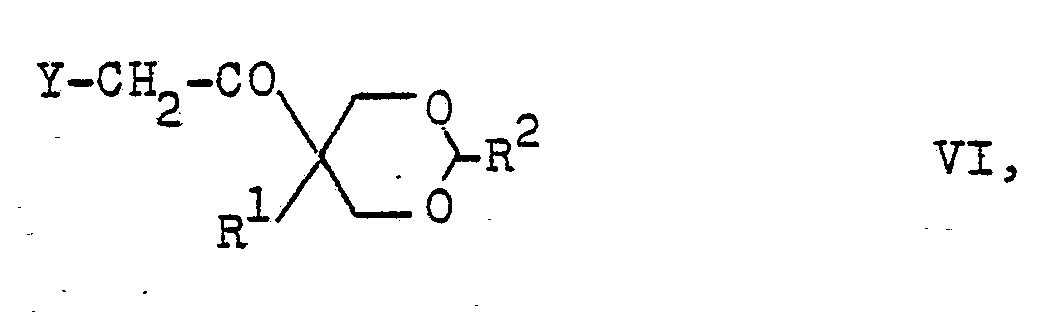
- Die Verbindungen der Formel VI sind ebenfalls neu. Man erhält sie z.B. durch Umsetzung von bekannten (1,3-Dioxan--5-yl)-ethan-l-onen der Formel VII

- Die gemäß a), b) oder c) erhaltenen Ketone lassen sich gegebenenfalls in Gegenwart eines Lösungs- oder Verdünnungsmittels, bei Temperaturen zwischen -20 bis 150°C, bei Normaldruck oder unter erhöhtem Druck mit Wasserstoff in Gegenwart eines Katalysators, mit komplexen Bor- bzw. Aluminiumhydriden, mit Aluminiumisopropoxid und Isopropanol, mit Natriumdithionit oder elektrochemisch reduzieren.
- Geeignete Lösungs- oder Verdünnungsmittel hierfür sind beispielsweise Wasser, Methanol, Ethanol, Isopropanol, Essigsäure, Diethylether, Tetrahydrofuran, Dioxan, Essigester, Toluol, Dimethylformamid oder entsprechende Gemische.
- Zur katalytischen Hydrierung verwendet man Platin- oder Palladiumkatalysatoren auf inerten Trägern und hydriert bei Drucken von 2 bis 80 bar bis keine Wasserstoffaufnahme mehr erfolgt.
- Für die als Reduktionsmittel verwendbaren Hydride seien beispielsweise Natriumborhydrid oder Lithiumaluminiumhydrid genannt.
- Die so erhaltenen Alkohole der Formel I (X = CHOH) lassen sich mit Alkylierungsmitteln der Formel VIII

- Hierfür eignen sich folgende Lösungs- oder Verdünnungsmittel: Diethylether, Tetrahydrofuran, Dioxan, n-Pentan, monohalogenierte Kohlenwasserstoffe mit 2 bis 6 C-Atomen wie beispielsweise Chlorethan, Bromethan, 1-Chlorpropan, 1-Brompropan, 1-Chlorbutan, 1-Brombutan, 1-Chlorpentan, 1-Brompentan, 1-Chlorhexan, 1-Bromhexan, ferner Cyclohexan, Methylenchlorid, Chloroform, Toluol oder Dimethylformamid.
- Als anorganische Basen seien beispielsweise genannt: Alkali- und Erdalkalihydroxide wie Natriumhydroxid, Kaliumhydroxid, Calciumhydroxid, Bariumhydroxid, Alkali- und Erdalkalicarbonate wie Natriumcarbonat, Kaliumcarbonat, Natriumhydrogencarbonat, Kaliumhydrogencarbonat, Calciumcarbonat, Bariumcarbonat, Alkali- oder Erdalkalialkoholate wie Natriummethylat, Natriumethylat, Magnesiummethylat, Natriumisopropylat oder Kalium-tert.-butylat.
- Geeignete Reaktionsbeschleuniger sind beispielsweise Metallhalogenide wie Natriumbromid, Natriumiodid, Kaliumbromid, Kaliumiodid, tertiäre Amine wie 4-Dimethylaminopyridin und 4-Pyrrolidinopyridin, Kronenether wie 12-Krone-4-, 14-Krone-5, 18-Krone-6, Dibenzo-18-Krone-6 oder Dicyclohexano-l8-Krone-6 oder Azole'wie Imidazol und 1,2,4-Triazol.
- Als Phasentransferkatalysatoren kommen vorzugsweise quaternäre Ammoniumsalze wie Tetrabutylammoniumchlorid, -bromid, -iodid oder -hydrogensulfat, Benzyl-triethylammoniumchlorid, Methyl-trioctylammoniumchlorid und -bromid und Phosphoniumsalze wie Tetrabutylphosphoniumbromid und -iodid und Tetra-n-pentylphosphqniumbromid und -iodid in Frage..
- Die Veresterung der Alkohole der Formel I (X = CHOH) kann mit Säurechloriden oder -anhydriden der Formeln Y-CO-R 4 (IX) oder (R4-CO)2O (X) gegebenenfalls in Gegenwart eines Lösungs- oder Verdünnungsmittels, gegebenenfalls unter Zusatz eines säurebindenden Mittels und gegebenenfalls unter Zusatz eines Reaktionsbeschleunigers erfolgen. Hierfür eignen sich dieselben Lösungsmittel und Basen wie für die Veretherung. Zusätzlich können tertiäre Amine wie Trimethylamin, Triethylamin, N,N-Dimethylanilin, N,N-Dimethylcyclohexylamin,. N-Methylpiperidin oder Pyridin als Base verwendet werden.
- Mit geeigneten Basen wie z.B. Alkalihydrid wie Natriumhydrid oder Alkali- oder Erdalkalialkoholaten wie Natriummethylat können die Alkohole auch in einer ersten Umsetzung zunächst in ihre Alkoholat-Salze überführt werden und dann als solche zur Reaktion gebracht werden.
- Die so erhaltenen Verbindungen der Formel I werden nach üblichen Methoden isoliert, gegebenenfalls gereinigt und gegebenenfalls mit Säuren oder Metallsalzen zu Salzen bzw. zu Metall-Komplexen umgesetzt.
- Als Beispiele für die neuen Verbindungen der Formel I seien im einzelnen genannt:
- 1-(5-Methyl-1,3-dioxan-5-yl)-2-(1,2,4-triazolyl-(1))-3--(2-furanyl)-propen-1-on,
- 1-(5-Methyl-1,3-dioxan5-yl)-2-(1,2,4-triazolyi-(1))-3--(2-furanyl)-propen-1-ol,
- 1-(5-Methyl-I,3-dioxan-5-yl)-2-(1,2,4-triazolyl-(1))-3--(2-furanyl)-propen-2,
- 1-(5-Methyl-1,3-dioxan-5-yl)-2-(1,2,4-triazolyl-(1))-3--phenyl-propan-1-on,
- 1-(5-Methyl-1,3-dioxan-5-yl)-2-(1,2,4-triazolyl-(1))-3--phenyl-propan-1-ol,
- 1-(5-Methyl-1,3-dioxan-5-yl)-1-methoxy-2-(1,2,4-triazolyl-(1))-3-phenyl-propan,
- 1-(5-Methyl-1,3-dioxan-5-yl)-1-ethoxy-2-(1,2,4-triazolyl-(1))-3-phenyl-propan,
- 1-(2-(4'-Methylphenyl)-5-methyl-1,3-dioxan-5-yl)-2--(1,2,4-triazolyl-(1))-3-phenyl-propan-1-on
- 1-(2-(4'-Methoxyphenyl)-5-methyl-1,3-dioxan-5-yl)-2--(1,2,4-triazolyl-(1))-3-phenyl-propan-1-on,
- 1-(2-(4'-Nitrophenyl)-5-methyl-1,3-dioxan-5-yl)-2-(1,2,4--triazolyl-(1))-3-phenyl-propan-1-on,
- 1-(5-Methyl-1,3-dioxan-5-yl)-1-n-pentyloxy-2-(1,2,4-triazolyl-(1))-3-phenyl-propan,
- 1-(5-Methyl-1,3-dioxan-5-yl)-1-allyloxy-2-(1,2,4-tri- azolyi-(1))-3-phenyl-propan,
- 1-(5-Methyl-1,3-dioxan-5-yl)-1-propoargyloxy-2-(1,2,4--triazolyl-(1))-3-phenyl-propan,
- 1-(5-Methyl-1,3-dioxan-5-yl)-2-(1,2,4-Triazolyl-(1))-3--phenyl-propen-1-on,
- 1-(5-Methyl-1,3-dioxan-5-yl)-2-(1,2,4-triazolyl-(1))-3--phenyl-propen-1-ol,
- 1-C2-Ethyl-5-methyl-1,3-dioxan-5-yl)-2-(1,2,4-triazolyl-(1))-3-phenyl-propan-1-on,
- 1-(2-Ethyl-5-methyl-1,3-dioxan-5-yl)-2-(1,2,4-triazolyl-(1))-3-phenyl-propan-1-ol,
- 1-(2-Ethyl-5-methyl-1,3-dioxan-5-yl)-2-(1,2,4-triazolyl--(1))-3-phenyl-propen-1-ol,
- 1-(2-Ethyl-5-methyl-1,3-dioxan-5-yl)-2-(1,2,4-triazolyl--(l))-3-phenyl-propen-l-on,
- 1-(2-n-Propyl-5-methyl-1,3-dioxan-5-yl)-2-(1,2,4-triazolyl-(1))-3-phenyl-propen-1-on,
- 1-(2-n-Propyl-5-methyl-1,3-dioxan-5-yl)-2-(1,2,4-triazolyl-(1))-3-phenyl-propen-1-ol,
- 1-(5-Methyl-1,3-dioxan-5-yl)-1-acetoxy-(1,2,4-triazolyl--(1))-3-phenyl-propen-2,
- 1-(5-Methyl-1,3-dioxan-5-yl)-1-propionyloxy-(1,2,4-triazolyl-(1))-3-phenyl-propen-2,
- 1-(2-Ethyl-5-methyl-1,3-dioxan-5-yl)-1-propionyloxy--(1,2,4-triazolyl-(1))-3-phenyl-propen-2,
- 1-(2-Ethyl-5-methyl-1,3-dioxan-5-yl)-2-benzoyloxy--(1,2,4-triazolyl-(1))-3-phenyl-propen-2,
- 1-(5-Methyl-1,3-dioxan-5-yl)-2-(1,2,4-triazolyl-(1))-3--(1-naphthyl)-propan-1-on,
- 1-(5-Methyl-1,3-dioxan-5-yl)-2-(1,2,4-triazolyl-(1))-3--(1-naphthyl)-propan-1-ol,
- 1-(5-Methyl-1,3-dioxan-5-yl)-2-(1,2,4-triazolyl-(1))-3--(l-naphthyl)-propen-1-on,
- 1-(5-Methyl-1,3-dioxan5-yl)-2-(1,2,4-triazolyl-(1))-3--(1-naphthyl)-propen-1-ol,
- 3-(2-Ethyl-5-methyl-i,3-dioxan-5-yl)-2-(1,2,4-triazolyl--(1))-3-(1-naphthyl)-ProPen-1-on,
- 1-(2-Ethyl-5-methyl-1,3-dioxan-5-yl)-2-(1,2,4-triazolyl--(1))-3-(1-naphthyl)-propen-1-ol,
- 1-(2,5-diethyl-1,3-dioxan-5-yl)-2-(1,2,4-triazolyl-(1))--3-(1-naphthyl)-propen-1-on,
- 3-(2,5-Dethyl-1,3-dioxa-5-yl)-2-(1,2,4-triazolyl-(1))--3-(3-naphthyl)-propen-1-ol,
- 1-(2-Ethyl-5-methyl-1,3-dioxan-5-yl)-1-acetoxy-(1,2,4--triazolyl-(1))-3-(1-naphthyl)-propen-2,
- 1-(5-Methyl-1,3-dioxan-5-yl)-2-(1,2,4-triazolyl-(1))--3-(4-biphenylyl)-propen-l-on,
- 1-(5-Methyl-1,3-dioxan-5-yl)-2-(1,2,4-triazolyl-(1))-3--(4-biphenylyl-propen-1-ol,
- 1-(2-Ethyl-5-methyl-1,3-dioxan-5-yl)-2-(1,2,4-triazolyl--(1))-3-(i-naphthyl)-propan-1-on,
- 1-(2-Ethyi-5-methyl-1,3-dioxan-5-yl)-2-(1,2,4-triazolyl--C1))-3-(i-naphthyl)-propan-1-ol,
- 1-(2-Prnpyl-5-methyl-1,3-dioxan-5-yl)-2-(1,2,4-triazolyl-(1))-3-(1-naphthyl)-propan-1-on,
- 1-(2-Ethyl-5-methyl-1,3-dioxan-5-yl)-1-acetoxy-2-(1,2,4--triazolyl-(1))-3-(1-naphthyl)-propan,
- 1-(5-Methyl-1,3-dioxan-5-yl)-2-(1,2,4-triazolyl-(1))-3--(4-fluorphenyl)-propan-i-on,
- 1-(5-Methyl-1,3-dioxan-5-yl)-2-(1,2,4-triazolyl-(1))-3--(4-fluorphenyl)-propan-1-ol,
- 1-(5-Methyl-1,3-dioxan-5-yl)-2-(1,2,4-triazolyl-(1))-3--(4-fluorphenyl)-propen-l-on,
- 1-(5-Methyl-1,3-dioxan-5-yl)-2-(1,2,4-triazolyl-(1))-3--(4-fluorphenyl)-propen-1-ol,
- 1-(2-Ethyl-5-methyl-1,3-dioxan-5-yl)-2-(1,2,4-trialoly--(1))-3-(4-fluorphenyl)-propan-1-on,
- 1-(2-Ethyl-5-methyl-1,3-dioxan-5-yl)-2-(1,2,4-triazolyl--(1))-3-(4-fluorphenyl)-propan-1-ol,
- 1-(5-Methyl-1,3-dioxan-5-yl)-2-(1,2,4-triazolyl-(1))-3--(4-chlorphenyl)-propan-1-on,
- 1-(5-Methyl-1,3-dioxan-5-yl)-2-(1,2,4-triazolyl-(1))-3--(2-chlorphenyl)-propen-l-ol,
- 1-(2-Ethylen-5-methyl-T,3-dioxan-5-yl)-2-(1,2,4-triazolyl-(1))-3-(2-chlorphenyl)-propen-1-on,
- 1-(2-Ethyl-5-methyl-1,3-dioxan-5-yl)-2-(1,2,4-triazolyl--(1))-3-(2-chlorphenyl)-propen-1-ol,
- 1-(2-Ethyl-5-methyl-1,3-dioxan-5-yl)-I-acetoxy-(1,2,4--triazolyl-(1))-3-(2-chlorphenyl)-progen-2,
- 1-(5-Methyl-1,3-dioxan-5-yl)-2-(1,2,4-triazolyl-(1))-3--(3-chlorphenyl)-propen-1-on,
- 1-(5-Methyl-1,3-dioxan-5-yl)-2-(1,2,4-triazolyl-(1))-3--(3-chlorphenyl)-propen-1-ol,
- 1-(5-Methyl-1,3-dioxan-5-yl)-1-propionyloxy-2-(1,2,4--triazolyl-(1))-3-(3-chlorphenyl)-propen-2,
- 1-(5-Methyl-1,3-dioxan-5-yl)-2-(1,2,4-triazalyl-(1))-3--(4-chlorphenyl)-propen-1-on,
- 1-(5-Methyl-1,3-dioxan-5-yl)-2-(1,2,4-triazolyl-(1))-3--(4-chlorphenyl)-propen-1-ol,
- 1-(5-Methyl-1,3-dioxan-5-yl)-2-(1,2,4-triazolyl-(1))-3--(4-chlorphenyl)-propan-1-ol,
- 1-(5-Methyl-1,3-dioxan-5-yl)-1-propionyloxy-2-(1,2,4--triazolyl-(1))-3-(4-fluorphenyl)-propen-2,
- 1-(2-Ethyl-5-methyl-1,3-dioxan-5-yl)-2-(1,2,4-triazolyl--(1))-3-(4-chlorphenyl)-propen-1-on,
- 1-(2-Ethyl-5-methyl-1,3-dioxan-5-yl)-2-(1,2,4-triazolyl--(i))-3-(4-chlorphenyi)-propen-1-ol-
- 1-(2-n-Propyl-5-methyl-1,3-dioxan-5-yl)-2-(1,2,4-triazolyl--(1))-3-(4-chlorphenyi)-propen-1-on,
- 1-(5-Methyl-1,3-dioxan-5-yl)-2-(1,2,3-triazolyl-(1))-3-(2--chlorphenyl)-propen-l-on,
- 1-(2,5-Diethyl-1,3-dioxan-5-yl)-2-(1,2,4-triazolyl-(1))--3-(4-chlorphenyl)-propen-l-ol,
- I-(2,5-Diethyl-1,3-dioxan-5-y1)-2-(1,2,4-triazolyl-(1))--3-(4-chlorphenyl)-propen-l-on,
- 1-(2,5-Dimethyl-1,3-dioxan-5-yl)-2-(1,2,4-triazolyl-(1)) -3-(4-chlorphenyl)-propan-l-on,
- 1-(2,5-Dimethyl-1,3-dioxan-5-yl)-2-(1,2,4-triazoiyl-(1))--3-(4-chlorphenyl)-propan-l-ol,
- 1-(2-Ethyl-5-methyl-1,3-dioxan-5-yl)-2-(1,2,4-triazolyl--(l))-3-(4-chlorphenyl)-propan-1-on,
- 1-(2-Ethyl-5-methyl-1,3-dioxan-5-yl)-2-(1,2,4-triazoly--(1))-3-(4-chiorphenyl)-Propan-1-ol,
- 1-(2-n-Prapyl-5-methyl-1,3-dioxan-dioxan-5-yl)-2-(1,2,4,-tri- azoly-(1))-3-(4-chlorphenyl)-propan-1-on,
- 1-(2-n-Propyl-5-methyl-1,3-dioxan-5-yl)-2-(1,2,4-triazolyl-(1))-3-(4-chlorphenyl)-propan-1-ol,
- 1-(2-Isopropyl-5-methyl-1,3-dioxan-5-yl)-2-(1,2,4-triazolyl-(1))-3-(4-chlorphenyl)-propan-1-on,
- 1-(2-Isopropyl-5-methyl-1,3-dioxan-5-yl)-2-(1,2,4-triazolyl-(1))-3-(4-chlorphenyl)-propan-1-ol,
- 1-(2-n-Butyl-5-methyl-1,3-dioxan-5-yl)-2-(1,2,4-triazolyl-(1))-3-(4-chlorphenyl)-propan-1-on,
- 1-(2-n-Butyl-5-methyl-1,3-dioxan-5-yl)-2-(1,2,4-triazolyl-(3))-3-(4-chlorphenyl)-propan-1-ol,
- 1-(5-Methyl-1,3-dioxan-5-yl)-1-methoxy-2-(1,2,4-triazolyl-(1))-3-(4-chlorphenyl)-propan,
- 3-(5-Methyl-1,3-dioxan:5-yl)-1-(2-butenoyloxy)-2-(1,2,4--triazolyl-(1))-3-(4-chlorphenyl)-propan,
- 1-(5-Methyl-1,3-dioxan-5-yl)-1-n-propoxy-2-(1,2,4-triazolyl-(1)-3-(4-chlorphenyl)-propan,
- 1-(5-Methyl-1,3-dioxan-5-yl)-1-n-butoxy-2-(1,2,4-triazolyl-(1))-3-(4-chlorphenyl)-propan,
- 1-(5-Methyl-1,3-dioxan-5-yl)-i-acetoxy-2-(1,2,4-triazolyl-(1))-3-(4-chlorphenyl)-propan,
- 1-(2-Ethyl-5-methyl-1,3-dioxan-5-yl)-1-methoxy-2-(1,2,4--triazolyl-(1))-3-(4-chlorphenyl)propan,
- 1-(2-Ethyl-5-methyl-1,3-dioxan-5-yl)-1-n-propoxy-2-(1,2,4--triazolyl-(1))-3-(4-chlorphenyl)-propan,
- 1-(2-Phenyl-5-methyl-1,3-dioxan-5-yl)-2-(1,2,4-triazolyl--(1))-3-(4-chlorphenyl)-propan-1-on,
- 1-(2-Phenyl-5-methyl-1,3-dioxan-5-yl)-2-(1,2,4-triazolyl--(1))-3-(4-chlorphenyl)-propan-1-ol,
- 1-(2-Phenyl-5-methyl-1,3-dioxan-5-yl)-1-propoxy-2-(1,2,4--triazolyl-(1))-3-(4-chlorphenyl)-propan,
- 1-(2-Ethyl-5-methyl-1,3-dioxan-5-yl)-1-acetoxy-2-(1,2,4--triazoIyl-(1))-3-(4-ahlorphenyl)-propan,
- 1-(2-Ethyl-5-methyl-1,3-dioxan-5-yl)-1-propionyloxy-2--(1,2,4-triazoTyl-(I))-3-(4-chlorphenyl)-propan,
- 1-(2-Ethyl-5-methyl-1,3-dioxan-5-yl)-1-butyryloxy-2--(1,2,4-triazolyl-(1))-3-(4-chlorphenyl)-propan,
- 1-(5-Methyl-1,3-dioxan-5-yl)-2-(1,2,4-triazolyl--(1))-3-(4-bromphenyl)-propan-1-on,
- 1-(5-Methyl-1,3-dioxan-5-yl)-2-(1,2,4-triazolyl-(1))--3-(4-bromphenyl)-propan-1-ol,
- 1-(2-Ethyl-5-methyl-1,3-dioxan-5-yl)-2-(1,2,4-triazoiyl--(1))-3-(4-bromphenyl)-propan-1-on,
- 1-(2-Ethyl-5-methyl-1,3-dioxan-5-yl)-2-(1,2,4-triazolyl)--(1))-3-(4-bromphenyl)-propan-1-ol,
- 1-(5-Methyl-1,3-dioxan-5-yl)-2-(1,2,4-triazolyl-(1))-3--(4-bromphenyl)-propen-l-on,
- 1-(5-Methyl-1,3-dioxan-5-yl)-2-(1,2,4-triazolyl-(1))-3--(4-bromphenyl)-propen-1-ol,
- 1-(5-Methyl-1,3-dioxan-5-yl)-2-(1,2,4-triazolyl-(1))-3--(2,4-dichlorphenyl)-propan-1-on,
- 1-(5-Methyl-1,3-dioxan-5-yl)-2-(1,2,4-triazolyl-(1))-3- -(2,4-dichlorphenyl)-propan-l-ol,
- I-(2-Ethyl-5-methyl-1,3-dioxan-5-yl)-2-(1,2,4-triazolyl--(1))-3-(2,4-dichlorpheny2)-propan-1-on,
- 3-(2-Ethyl-5-methyl-1,3-dioxan-5-yl)-2-(1,2,4-triazolyl--(1))-3-(2,4-dichlorphenyl)-propan-1-ol,
- 1-(2,5-Methyl-1,3-dioxan-5-yl)-2-(1,2,4-triazolyl-(1))-3--(2,4-dichlorphenyl)-propan-l-on,
- 1-(2,5-Diethyl-1,3-dioxan-5-yl)-2-(1,2,4-triazolyl-(1))-3--(2,4-dichlorphenyl)-propan-l-ol,
- 1-(2-n-Propyl-5-methyl-1,3-dioxan-5-yl)-2-(1,2,4-triazolyl--(1))-3-(2,4-dichlcrphenyl)-propan-1-ol,
- 1-(2-n-Propyl-5-methyl-1,3-dioxan-5-yl)-2-(1,2,4-triazoly -(1)-3-(2,4-dichlorphenyl)-propan-1-on,
- 1-(2-Phenyl-5-methyl-1,3-dioxan-5-yl)-2-(1,2,4-triazolyl--(1))-3-(2,4-dichlorphenyl)-propan-1-on,
- 1-(2-Phenyl-5-methyl-1,3-dioxa-5-yl)-2-(1,2,4-triazolyl--(1))-3-(2,4-dichlorphenyl)-propan-1-ol,
- 1-(2-(4'-Chlorphenyl)-5-methyl-1,3-dioxan-5-yl)-2-(1,2,4,--triazolyl-(1))-(2,4-dichlorphenyl)-propan-1-on,
- 1-(5-Methyl-1,3-dioxan-5-yl)-2-(1,2,4-triazolyl-(1))-3--(3,4-dichlorphenyl)-propen-1-on,
- 1-(5-Methyl-1,3-dioxan-5-yl)-2-(1,2,4-triazolyl-(1))-3--(3,4-dichlorphenyl)-propan-I-ol,
- 1-(5-Methyl-1,3-dioxan-5-yl)-2-(1,2,4-triazolyl-(1))-3--(2,4-dichlorphenyl)-propen-1-on,
- 1-(5-Methyl-1,3-dioxan-5-yl)-2-(1,2,4-triazolyl-(1))-3--(2,4-dichlorphenyl)-propen-l-ol,
- 1-(2-Ethyl-5-methyl-1,3-dioxan-5-yl)-2-(1,2,4-triazolyl--(1))-3-(2,4-dichlorphenyl)-propen-1-on,
- 1-(2-Ethyl-5-methyl-1,3-dioxan-5-yl)-2-(1,2,4-triazolyl--(1))-3-(2,4-dichlorphenyl)-propen-1-ol,
- 1-(2,5-Diethyl-1,3-dioxan-5-yl)-2-(1,2,4-triazolyl-(1))--3-(2,4-dichlorphenyl)-propen-l-on,
- 1-(2,5-Diethyl-1,3-dioxan-5-yl)-2-(1,2,4-triazolyl-(1))--3-(2,4-dichlorphenyl)-propen-1-ol,
- 1-(2-Isopropyl-5-methyl-1,3-dioxan-5-yl)-2-(1,2,4-triazolyl-(1))-3-(2,4-dichlorphenyl)-propen-1-on,
- 1-(2-Isopropyl-5-methyl-1,3-dioxan-5-yl)-2-(1,2,4,-triazolyl-(1))-3-(2,4-dichlorphenyl)-propen-1-ol,
- 1-(2-n-Butyl-5-methyl-1,3-dioxan-5-yl)-2-(1,2,4-triazolyl--(1))-3-(2,4-dichlorphenyl)-propen-1-on,
- 1-(2-n-Butyl-5-methyl-1,3-dioxan-5-yl)-2-(1,2,4-triazolyl--(1))-3-(2,4-dichlorphenyl)-propen-1-ol,
- 1-(5-Methyl-1,3-dioxan-5-yl)-1-acetoxy-2-(1,2,4-triazolyl--(1))-3-(2,4-dichlorphenyl)-propen-2,
- 1-(5-Methyl-1,3-dioxan-5-yl)-1-butyryloxy-2-(1,2,4-triazolyl-(1))-3-(2,4-dichlorphenyl)-propen-2,
- 1-(2-Ethyl-5-methyl-1,3-dioxan-5-yl)-1-acetoxy-2-(1,2,4--triazolyl-(1))-3-(2,4-dichlorphenyl)propen-2,
- 1-(2--Ethyl-5-methyl-1,3-dioxan-5-yl)-1-propionyloxy-2--(1,2,4-triazolyl-(1))-3-(2,4-dichlorphenyl)-propen-2,
- 1-(5-Methyl-1,3-dioxan-5-yl)-2-(1,2,4-triazolyl-(1))-3--(2,3,4-trichlorphenyl)-propen-1-on,
- 1-(5-Methyl-1,3-dioxan-5-yl)-2-(1,2,4-triazolyl-(1))-3--(2,3,4-trichlorphenyl)-propen-1-ol,
- 1-(2-Isopropyl-5-methyl-1,3-dioxan-5-yl)-2-(1,2,4-triazolyl-(1))-3-(2,4-dichlorphenyl)-propan-1-on,
- 1-(2-Isopropyl-5-methyl-1,3-dioxan-5-yl)-2-(1,2,4-triazolyl-(1))-3-(2,4-dichlorphenyl)-propan-1-ol,
- 1-E2-n-Butyl-5-methyl-1,3-dioxan-5-yl)-2-(1,2,4-triazolyl-(1)-3-(2,4-dichlorphenyl)-propan-1-on,
- 1-(2-n-Butyl-5-methyl-1,3-dioxan-5-yl)-2-(1,2,4-triazolyl-(1))-3-(2,4-dichlorphenyl)-propan-1-ol,
- 1-(2-tert.-Butyl-5-methyl-1,3-dioxan-5-yl)-2-(1,2,4-triazolyl-(1))-3-(2,4-dichlorphenyl)-propan-1-on,
- 1-(2-tert.-Butyl-5-methyl-1,3-dioxan-5-yl)-2-(1,2,4-triazolyl-(1))-3-(2,4-dichlorphenyl)-propan-1-ol,
- 1-(5-Methyl-1,3-dioxan-5-yl)-1-acetoxy-2-(1,2,4-triazolyl-(1))=3-(2,4-dichlorphenyl)-propan,
- 1-(5-Methyl-1,3-dioxan-5-yl)-1-propienyloxy-2-(1,2,4-tri- azoiyi-(1))-3-(2,4-dichlorphenyl)-propan,
- 1-(2-Ethyl-5-methy3-1,3-dioxan-5-yl)-1-acetoxy-2-(1,2,4--triazolyl-(1))-3-(2,4-dichlorphenyl)-propan,
- 1-(2-Isopropyl-5-methyl-1,3-dioxan-5-yl)-1-acetoxy-2--(1,2,4-triazolyl-(1))-3-(2,4-dichiorphenyl)-propan,
- 1-(5-Methyl-1,3-dioxan-5-yl)-2-(1,2,4-triazolyl-(1))-3--(3,4-dichlorphenyl)-propan-1-on,
- 1-(5-Methyl-1,3-dioxan 5-yl)-2-(1,2,4-triazoly2-(1))-3--(3,4-dtchlorphenyi)-propan-1-ol,
- 1-(2-Ethyl-5-methyl-1,3.-dioxan-5-yl)-2-(1,2,4-triazolyl--(1))-3-(3,4-dichlorphenyl)-propan-l-ol,
- 1-(2-Ethyl-5-methyl-1,2-dioxan-5-yl)-2-(1,2,4-triazolyl--(1))-3-(3,4-dichlorphenyl)-propan-1-on,
- 1-(2-Ethyl-5-methyl-1,2-dioxan-5-yl)-1-acetoacetoxy-2--(1,2,4-triazolyl-(1))-3-(3,4-dichlorphenyl)-propan,
- 1-(2-Ethyl-5-propyl-1,2-dioxan-5-yl)-1-benzoyl-2--(1,2,4-triazolyl-(1))-3-(3,4-dichlorphenyl)-propan,
- 1-(5-Methyl-3,2-dioxan-5-yl)-2-(1,2,4-triazalyl-(1))--3-(4-methylphenyl)-propan-1-on,
- 1-(5-Methyl-1,3-diaxan-5-yl)-2-(1,2,4-triazolyl-(1))--3-(4-methylphenyl)-propen-l-on,
- 1-(5-Methyl-l,3-dioxan-5-yl)-2-(1,2,4-triazolyl-(1))--3-(4-methylphenyl)-propen-l-ol,
- 1-(5-Methyl-1,3-dioxan-5-yl)-2-(1,2,4-triazolyl-(1))--3-(4-methylphenyl)-propan-1-ol,
- 1-(2-Ethyl-5-methyl-1,3-dioxan-5-yl)-2-(1,2,4-triazolyl--(1))-3-(4-methylphenyl)-propan-1-on,
- 1-(2-Ethyl-5-methyl-1,3-dioxan-5-yl)-2-(1,2,4-triazolyl--(1))-3-(4-methylphenyl)-propan-1-ol,
- 1-(5-Methyl-1,3-dioxan-5-yl)-2-(1,2,4-triazolyl-(1))-3--(3-methylphenyl)-propan-1-on,
- 1-(5-Methyl-1,3-dioxan-5-yl)-2-(1,2,4-triazolyl-(1))-3--(3-methylphenyl)-propan-1-ol,
- 1-(5-Methyl-1,3-dioxan-5-yl)-2-(1,2,4-triazolyl-(1))-3--(4-ethylphenyl)-propan-i-on,
- 1-(5-Methyl-1,3-dioxan-5-yl)-2-(1,2,4-triazolyl-(1))-3--(4-ethylphenyl)-propan-l-ol,
- 1-(5-Methyl-1,3-dioxan-5-yl)-2-(1,2,4-triazolyl-(1))-3--(3,4-dimethylphenyl)-propan-1-on,
- 1-(5-Methyl-1,3-dioxan-5-yl)-2-(1,2,4-triazolyl-(1))-3--(3,4-dimethylphenyl)-propan-1-ol,
- 1-(2-Ethyl-5-methyl-1,3-dioxan-5-yl)-2-(1,2,4-triazolyl--(1))-3-(4-methoxyphenyl)-propan-1-on,
- 1-(2-Ethyl-5-methyl-1,3-dioxan-5-yl)-2-(I,2,4-triazolyl--(1))-3-(4-methoxyphenyl)-propan-1-ol,
- 1-(2-Ethyl-5-methyl-1,3-dioxan-5-yl)-2-(1,2,4-triazolyl--(1))-3-(4-nitrophenyl)-propan-1-on,
- 1-(5-Methyl-1,3-dioxan-5-yl)-2-(1,2,4-triazolyl-(1))-3--(4-trifluormethylphenyl)-propan-1-on,
- 1-(5-Methyl-1,3-dioxan-5-yl)-2-(1,2,4-triazolyl-(1))-3β--(4-trifluormethylphenyl)-propan-1-ol,
- 1-(2-Ethyl-5-methyl-1,3-dioxan-5-yl)-2-(1,2,4-triazolyl--(1))-3-(4-trifluormethylphenyl)-propan-1-on,
- 1-(2-Ethyl-5-methyl-1,3-dioxan-5-yl)-2-(1,2,4-triazolyl--(1))-3-(4-trifluormethylphenyl)-propan-1-ol,
- 1-(2-Ethyl-5-methyl-1,3-dioxan-5-yl)-2-(1,2,4-triazolyl--(1))-3-(4-tert.-Butylphenyl)-propan-1-on,
- 1-(5-Methyl-1,3-dioxan-5-yl)-2-(1,2,4-triazolyl-(1))-3--(4-tert.-butylphenyl)-propen-l-ol,
- 1-(5-Methyl-1,3-dioxan-5-yl)-2-(1,2,4-triazolyl-(1))-3--(4-methoxyphenyl)-propen-l-ol,
- 1-(5-Methyl-1,3-dioxan-5-yl)-2-(1,2,4-triazolyl-(1))-3--(4-methoxyphenyl)-propen-1-on,
- 1-(2-Ethyl-5-methyl-1,3-dioxan-5-yl)-2-(1,2,4-triazolyl--(1))-3-(4-methoxyphenyl)-propen-1-on,
- 1-(2-Ethyl-5-methyl-1,3-dioxan-5-yl)-2-(1,2,4-triazolyl--(1))-3-(4-methoxyphenyl)-propen-1-ol,
- 1-(5-Methyl-1,3-dioxan-5-yl)-2-(1,2,4-triazolyl-(1))-3--(4-ethoxyphenyl)-propen-l-on,
- 1-(5-Methyl-1,3-dioxan-5-yl)-2-(1,2,4-triazolyl-(1))-3- -(4-ethoxyphenyl)-propen-1-ol,
- 1-(5-Methyl-1,3-dioxan-5-yl)-2-(1,2,4-triazolyl-(1))-3--(4-n-butoxyphenyl)-propen-1-on,
- 1-(5-Methyl-1,3-dioxan-5-yl)-2-(1,2,4-triazolyl-(1))-3--(4-n-butoxyphenyl)-propen-l-ol,
- 1-(5-Methyl-1,3-dioxan-5-yl)-2-(1,2,4-triazolyl-(1))-3--(4-tert.-butoxyphenyl)-propen-1-ol,
- 1-(5-Methyl-1,3-dioxan-5-yl)-2-(1,2,4-triazolyl-(1))-3--(4-tert.-butoxyphenyl)-propen-1-on,
- 1-(5-Methyl-1,3-dioxan-5-yl)-2-(1,2,4-triazolyl-(1))-3--(4-nitrophenyl)-propen-1-on,
- 1-(5-Methyl-1,3-dioxan-5-yl)-2-(1,2,4-triazolyl-(1))-3- .-(4-nitrophenyl)-propen-l-ol,
- 1-(5-Methyl-1,3-dioxan-5-yl)-2-(1,2,4-triazolyl-(1))-3--(3-trifluormethylphenyl)-propen-1-on,
- 1-(5-Methyl-1,3-dioxan-5-yl)-2-(1,2,4-triazolyl-(1))-3--(3-trifluormethylphenyl)-propen-1-ol,
- 1-(5-Methyl-1,3-dioxan-5-yl)-1-propionyloxy-2-(1,2,4-triazolyl-(1))-3-(3-trifluormethylphenyl)-propen-2,
- 1-(5-Methyl-1,3-dioxan-5-yl)-2-(1,2,4-triazolyl-(1))-3--(4-trifluormethylphenyl)-propen-1-on,
- 1-(5-Methyl-1,3-dioxan-5-yl)-2-(1,2,4-triazolyl-(1))-3--(4-trifluormethylphenyl)-propen-l-ol,
- 1-(2-Ethyl-5-methyl-1,3-dioxan-5-yl)-2-(1,2,4-triazolyl--(1))-3-(4-trifluormethylphenyl)-propen-1-on,
- 1-(2-Ethyl-5-methyl-1,3-dioxan-5-yl)-2-(1,2,4-triazolyl--(1))-3-(4-trifluormethylphenyl)-propen-1-ol,
- 1-(5-Methyl-1,3-dioxan-5-yl)-2-(1,2,4-triazolyl-(1))-3--(4-ethoxyphenyl)-propan-l-on,
- 1-(5-Methyl-1,3-dioxan-5-yl)-2-(1,2,4-triazolyl-(1))-3--(4-ethoxyphenyl)-propan-1-on,
- Die folgenden Beispiele erläutern die Herstellung der Substanzen:
- Zu einer Lösung von 144 g (1 Mol) 5-Acetyl-5-methyl-1,3--dioxan und 85,5 g (1 Mol) Pyrrolidon in 500 ml Tetrahydrofuran wird in 2 Stunden bei 50°C die Lösung von 498 g (1 Mol) Pyrrolidon-Brom-Komplex in 1 1 Tetrahydrofuran zugetropft. Nach achtstündigem Nachrühren bei 50°C wird der weiße Niederschlag von Pyrrolidon-Hydrobromid abgesaugt, mit 50 ml Tetrahydrofuran gewaschen und das Filtrat im Vakuum eingeengt. Man erhält 220 g (99 %) rohes, öliges 1-(5-Methyl-1,3-dioxan-5-yl)-2-brom-ethan-l-on.
- Zu einer unter reinem Stickstoff gerührten Suspension von 100,1 g (1,1 Mol) Natrium-1,2,4-triazolid in 300 ml trockenem Tetrahydrofuran wird die Lösung von 223 g (1 Mol (1-(5-Methyl-1,3-dioxan-5-yl)-2-brom-ethan-1-on in 200 ml Tetrahydrofuran bei 25°C in 2 Stunden zugetropft. Nach achtstündigem Erhitzen unter Rückfluß wird der anorganische Niederschlag abfiltriert und das Filtrat zur Hälfte eingeengt. Das Gemisch wird angeimpft und.über Nacht bei +30C stehen gelassen. Der Niederschlag wird abgesaugt, mit 30 ml kaltem (+50 C) Tetrahydrofuran, dann mit 80 ml Ether und anschließend mit 100 ml n-Pentan gewaschen und getrocknet. Man erhält 184 g (87,2 %) 1-(5-Methyl-1,3-dioxan-5--yl)-2-(1,2,4-triazolyl-(1))-ethan-1-on als weiße Kristalle vom Schmelzpunkt 95 bis 97°C.
- Zu einer unter reinem Stickstoff gerührten Suspension von 13,2 g (0,55 Mol) Natriumhydrid in 100 ml trockenem Dimethylformamid wird die Lösung von 105,5 (0,5 Mol) 1-(5--Methyl-1,3-dioxan-5-yl)-2-(1,2,4-triazolyl-(1))-ethan- -1-on in 100 ml Dimethylformamid bei 20 bis 25°C zugetropft. Nach dreistündigem Nachrühren wird bei 25°C die Lösung von 81 g (0,5 Mol) 4-Chlorbenzylchlörid in 50 ml Dimethylformamid zugetropft und das Reaktionsgemisch weitere 14 Stunden nachgerührt. 50 ml Eiswasser werden vorsichtig zugetropft und das Gemisch wird im Vakuum eingeengt. Der Rückstand wird zwischen 400 ml Methylenchlorid und 200 ml Wasser verteilt, die organische Phase dreimal mit je 200 ml Wasser gewaschen, über Na2SO2 getrocknet und eingeengt. Man erhält 112 g (66,8 %) 1-(5--Methyl-1,3-dioxan-5-yl)-2-(1,2,4-triazolyl-(1))-3-(4--chlorphenyl)-propan-1-on als blaßgelbes Harz.
- 1H-NMR (80 MHz/CDCl3) : = 0,87 (s, 3H). 3,1-3,6 (m, 4H), 3,95-4,4 (t, 2H), 4,5-5,0 (2 dd, zus. 2H), 5,65-5,95 (q, 1H), 6,8-7,3 (m, 4H), 7,8 (s 1H), 8,0 ppm (s, 1H).
- Zu einer Lösung von 90 g (0,269 Mol) 1-(5-Methyl-1,3--dioxan-5-yl)-2-(1,2,4-triazolyl-(1))-3-(4-chlorphenyl)--propan-1-on in 250 ml Methanol werden zwischen 0 und +5°C 11,5 g (0,3 Mol) Natriumborhydrid portionsweise zugegeben. Nach 12stündigem Rühren bei 20°C wird das Gemisch eingeengt. Der Rückstand wird mit 200 ml 20 %iger Kalilauge 1 Stunde gerührt und mit 500 ml Methylenchlorid extrahiert. Die organische Phase wird dreimal mit je 50 ml Wasser gewaschen, über Natriumsulfat getrocknet und eingeengt. Der Rückstand kristallisiert bei +5°C nach Zugabe von 20 ml Ether. Man isoliert 45 g (49,6 %) 1-(5-Methyl--1,3-dioxan-5-yl)-2-(1,2,4-triazolyl-(1))-3-(4-chlorphenyl)-propan-1-ol als weiße Kristalle vom Schmelzpunkt 152 bis 154°C.
- Unter kräftigem Rühren wird eine Mischung aus 15,2 g (0,045 Mol) 1-(5-Methyl-1,3-dioxan-5-yl)-2-(1,2,4-triazolyl-(1))-3-(4-chlorphenyl)-propan-1-ol, 100 g 1-Chlorpropan, 3 g Tetrabutylammoniumhydrogensulfat und 65 g 50 %iger Natronlauge 36 Stunden auf 30°C erwärmt. Die' Mischung wird sodann mit 300 ml Wasser versetzt und zweimal mit je 150 ml Methylenchlorid extrahiert. Die vereinigten Extrakte werden achtmal mit je 100 ml Wasser ausgeschüttelt, über Magnesiumsulfat getrocknet und eingeengt. Der Rückstand kristallisiert nach Zugabe von 20 ml Petrolether und 5 ml Ether. Man isoliert 12 g (70,3 %) 1-(5-Methyl-1,3-dioxan-5-yl)-1-n-prop-oxy-2-(1,2,4-triazolyl-(1))-3-(4-chlorphenyl)-propan als weiße Kristalle vom Schmelzpunkt 94 bis 96°C.
- Zu einer Suspension von 2,4 g Natriumhydrid in 120 ml trockenem Tetrahydrofuran wird die Lösung von 23,6 g (0,07 Mol) 1-(5-Methyl-1,3-dioxan-5-yl)-2-(1,2,4-triazolyl-(1))-3-(4-chlorphenyl)-propan-1-ol in 100 ml Tetrahydrofuran getropft. Nach 12s tündigem Rühren bei 250C wird das Gemisch mit der Lösung von 9,7 g (0,08 Mol) Allylbromid in 20 ml Tetrahydrofuran zugetropft. Nach 36stündigem Rühren wird das Reaktionsgemisch vorsichtig mit 20 ml Wasser versetzt und eingeengt. Der Rückstand wird in 350 ml Methylenchlorid aufgenommen, dreimal mit je 100 ml Wasser gewaschen, die organische Phase getrocknet und eingeengt. Der Rückstand wird mit 30 ml Petrolether und 10 ml Ether über Nacht bei +3°C gelassen. Der kristalline, farblose Niederschlag wird abgesaugt, mit Petrolether gewaschen und trocknet. Man erhält 22,6 g (87,5 %) 1-(5--Methyl-1,3-dioxan-5-yl)-1-allyloxy-2-(1,2,4-triazolyl- -(1))-3-(4-chlorphenyl)-propan vom Schemlzpunkt 113 bis 115°C.
- Eine Mischung aus 20 g (0,053 Mol) 1-(5-Methyl-1,3-dioxan--5-yl)-2-(1,2,4-triazolyl-(1))-3-(2,4-dichlorphenyl)-propan-l-ol (vgl. Beispiel 35), 2 g Imidazol und 100 ml Propionanhydrid werden 10 Stunden bei 60°C gerührt und anschließend im Vakuum eingeengt. Der Rückstand wird in 250 ml Ether gelöst und 30 Minuten mit 100 ml einer 6 %igen Natriumhydrogencarbonat-Lösung gerührt. Die organische Phase wird über Natriumsulfat getrocknet und im Vakuum - schließlich bis 50°C und 0,1 mbar - eingeengt. Man erhält 17,1 g (75,4 %) 1-(5-Methyl-1,3-dioxan-5-yl)-1--acetoxy-(1,2,4-triazolyl-(1))-3-(2,4-dichlorphenyl)-propan als hellbraunes Harz.
- 1H-NMR (80 MHz/CDCl3): = 0,85 (s, 3H), 1,15-1,4 (t, 3H), 2,4-3,2 (q, 2H), 3,3-3,6 (m, 2H), 3,8-4,2 (m, 2H), 4,6-5,1 (2 dd, zus. 2H), 6,1 (s, IH), 6,5-7,6 (2 tt, zus. 4H), 8,1 (s, 1H) und 8,28 ppm (s, 1H).
- Unter Wasserabscheidung am Rückfluß wird eine Mischung aus 12,7 g (0,06 Mol) 1-(5-Methyl-1,3-dioxan-5-yl)-2--(1,2,4-triazolyl-(1)0-ethan-1-on, 10,8 g (0,06 Mol) 2,4-Dichlorbenzaldehyd, 1 g Piperidin, 0,5 g Essigsäure und 150 ml Toluol 10 Stunden gerührt. Das Gemisch wird abgekühlt, dreimal mit je 80 ml Wasser gewaschen, über Natriumsulfat getrocknet und im Vakuum eingeengt. Der Rückstand wird in 250 ml Acetonitril aufgelöst, bei 40°C mit 1 g Tierkohle entfärbt, auf 40 ml eingeengt und auf 0°C abgekühlt. Der farblose Niederschlag wird abgesaugt, mit 40.ml Ether gewaschen und getrocknet. Man erhält 18,4 g (83,3 %) 1-(5-Methyl-1,3-dioxan-5-yl)-2-(1,2,4-triazolyl--(1))-3-(2,4-dichlorphenyl)-propen-1-on vom Schmelzpunkt 133-135°C.
- Zu einer Lösung von 36,1.g (0,1 Mol) 1-(5-Methyl-1,3-dioxan-5-yl)-2-(1,2,5-triazolyl-(1))-3-(2,4-dichlorphenyl)--propen-1-on in 250 ml Methanol werden zwischen -5 und 0°C 4,5 g (0,118 Mol) Natriumborhydrid portionsweise zugegeben. Nach l4stündigem Rühren bei 22°C wird der weiße Niederschlag abgesaugt_und das Filtrat im Vakuum eingeengt. Niederschlag und Rückstand werden vereinigt und 0,5 Stunden mit 3 1 Methylenchlorid um 500 ml 10 %iger Kalilauge bei 25°C gerührt. Die organische Schicht wird abgetrennt, dreimal mit je 100 ml Wasser gewaschen, über Natriumsulfat getrocknet und eingeengt. Der Rückstand kristallisiert nach Zugabe von 10 ml Ether. Man erhält 31,3 g (84,6 %) 1-(5-Methyl-1,3-dioxan-5-yl)-2-(1,2,4--triazolyl-(1))-3-(2,4-dichlorphenyl)-propen-1-ol als farblose Kristalle vom Schmelzpunkt 190-192°C.
- Eine Mischung aus 14 g (0,0378 Mol) 1-(5-Methyl-1,3-dioxan-5-yl)-2-(1,2,4-triazolyl-(1))-3-(3,4-dichlorphenyl)--propen-1-ol (Beispiel 25) 1 g Imidazol und 80 g Acetanhydrid werden 8 Stunden bei 70°C gerührt und anschließend im Vakuum eingeengt. Der Rückstand wird in 300 ml Ether aufgelöst und 0,5 Stunden mit 100 ml einer 6 %igen Natriumhydrogencarbonat-Lösung gerührt. Die organische Phase wird über Natriumsulfat getrocknet und im Vakuum - schließlich bis 50°C und 0,1 mbar - eingeengt. Man erhält 10,8 g (69,3 % der Theorie) 1-(5-Methyl-1,3-dioxan-5-yl)-1-acet- oxy-2-(1,2,4-triazolyl-(1))-3-(3,4-dichlorphenyl)-propen-2 als blaßgelbes Harz.
- 1H-NMR (80 MHz/CDCl3): = 0,6 (s, 3H), 2,08 (s, 3H), 3,2--3,4 (m, 2H), 3,8-4,0 (g, 2H), 4,4-4,9 (2dd, zus. 2H), 5,5 (s, 1H), 6,3-7,4 (m, zus. 4H), 8,0 (s, 1H) und 8,2 ppm (s, 1H).
- In entsprechender Weise können die in der folgenden Tabelle aufgeführten Verbindungen hergestellt werden.


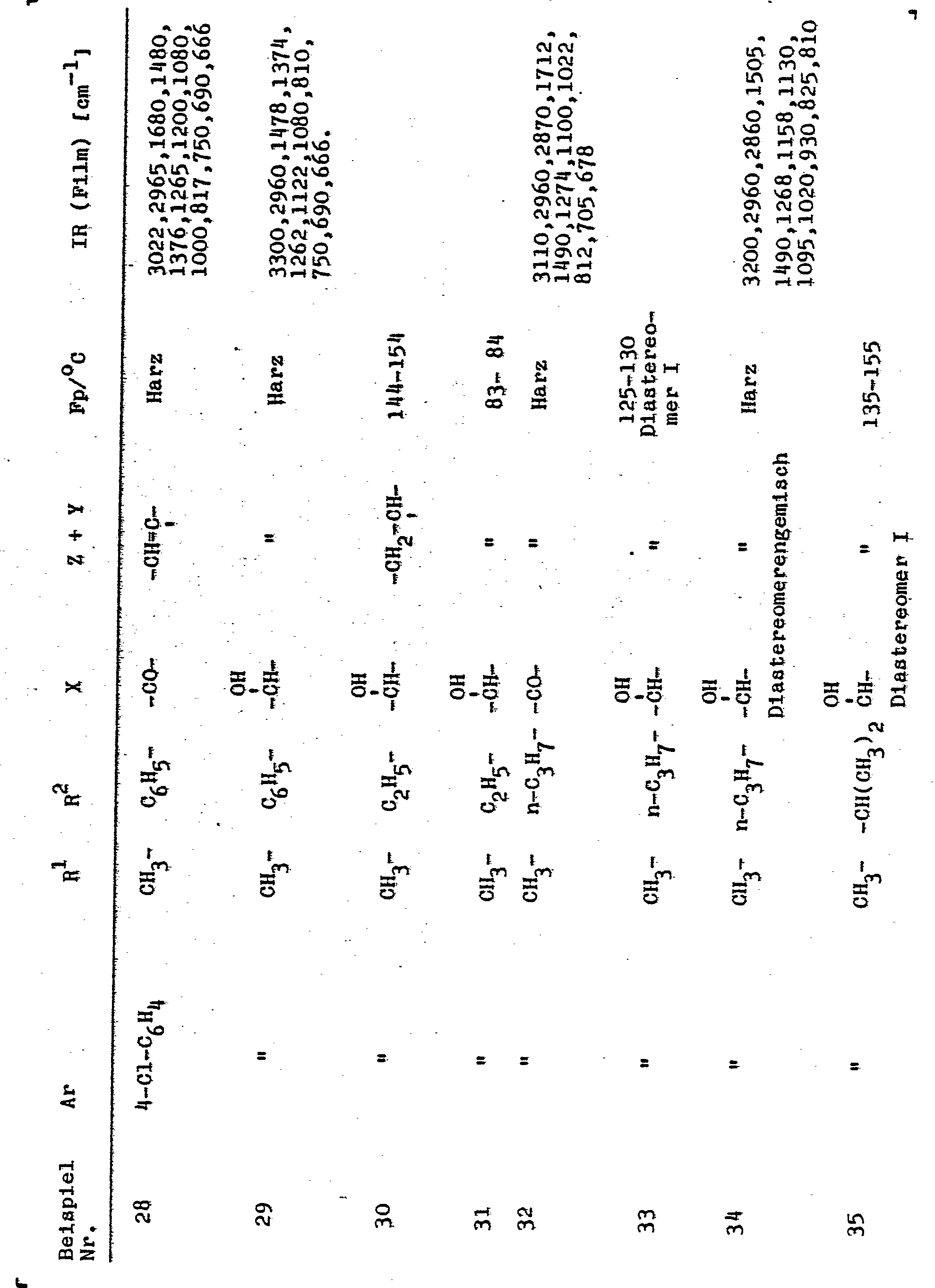


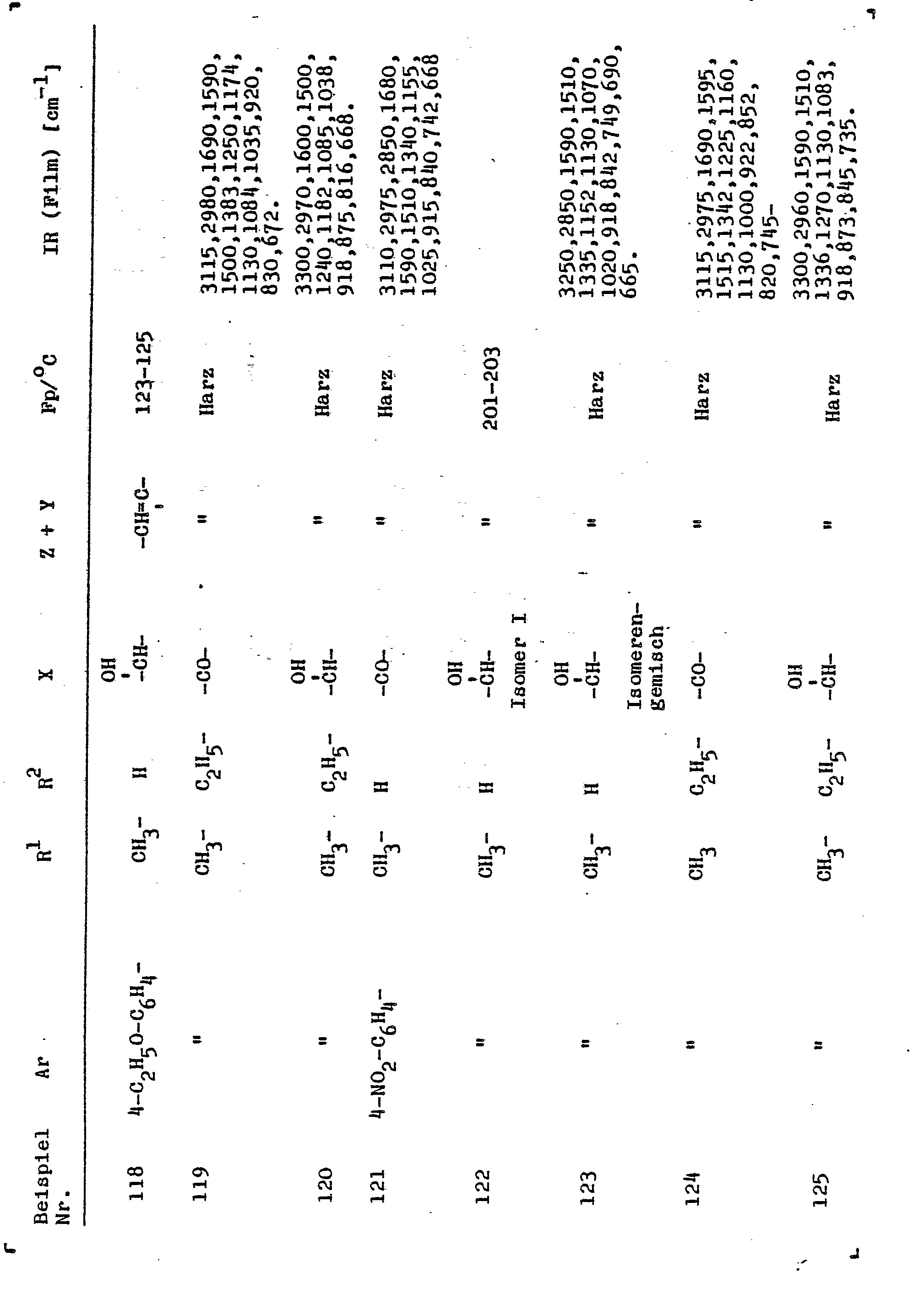


- Die erfindungsgemäßen Verbindungen und ihre Salze und Metallkomplexverbindungen zeichnen sich durch eine hervorragende Wirksamkeit gegen ein breites Spektrum von pflanzenpathogenen Pilzen, insbesondere aus der Klasse der Ascomyceten und Basidiomyceten, aus. Sie sind zum Teil systemisch wirksam und können als Blatt- und Bodenfungizide eingesetzt werden. Ferner können sie auch im Materialschutz, u.a. zur Bekämpfung holzzerstörender Pilze, wie Coniophora puteana und Polystictus versicolor, verwendet werden.
- Besonders interessant sind die fungiziden Verbindungen für die. Bekämpfung einer Vielzahl von Pilzen an verschiedenen Kulturpflanzen oder ihren Samen, insbesondere Weizen, Roggen, Gerste,. Hafer, Reis, Mais, Baumwolle, Soja,. Kaffee, Zuckerrohr, Obst und Zierpflanzen im Gartenbau, sowie Gemüse - wie Gurken, Bohnen und Kürbisgewächse -.
- Die neuen Verbindungen sind insbesondere geeignet zur Bekämpfung folgender Pflanzenkrankheiten:
- Erysiphe graminis (echter Mehltau) in Getreide,
- Erysiphe cichoriacearum an Kürbisgewächsen,
- Podosphaera leucotricha an Äpfeln,
- Uncinula necator an Reben,
- Puccinia-Arten an Getreide,
- Rhizoctonia solani an Baumwolle
- Ustilago-Arten an Getreide und Zuckerrohr,
- Venturia inaequalis (Schorf) an Äpfeln,
- Septoria nodorum an Weizen,
- Botrytis cinerea (Grauschimmel) an Erdbeeren, Reben,
- Phtophthora infestans (falscher Mehltau) an Kartoffeln, Tomaten.
- Die Verbindungen werden angewendet, indem man die Pflanzen mit den Wirkstoffen besprüht oder bestäubt oder die Samen der Pflanzen mit den Wirkstoffen behandelt. Die Anwendung erfolgt vor oder nach der Infektion der Pflanzen oder Samen durch die Pilze.
- Die erfindungsgemäßen Substanzen können in die üblichen Formulierungen übergeführt werden, wie Lösungen, Emulsionen, Suspensionen, Stäube, Pulver, Pasten und Granulate. Die Anwendungsformen richten sich ganz nach den Verwendungszwecken; sie sollen in jedem Fall eine feine und gleichmäßige Verteilung der wirksamen Substanz gewährleisten. Die Formulierungen werden in bekannter Weise hergestellt, z..B. durch Verstrecken des Wirkstoffs mit Lösungsmitteln und/oder Trägerstoffen, gegebenenfalls unter Verwendung von Emulgiermitteln und Dispergiermitteln, wobei im Falle der Benutzung von Wasser als Verdünnungsmittel auch andere organische Lösungsmittel als Hilfslösungsmittel verwendet werden können. Als Hilfsstoffe kommen dafür -im wesentlichen in Frage: Lösungsmittel'wie- Aromaten (z.B. Xylol, Benzol), chlorierte Aromaten (z.B. Chlorbenzole), Paraffine (z.B. Erdölfraktionen), Alkohole (z.B. Methanol, Butanol), Amine (z.B. Ethanolamin, Dimethylformamid) und Wasser; Trägerstoffe wie natürliche Gesteinsmehle, z.B. Kaoline, Tonerden, Talkum, Kreide und synthetische Gesteinsmehle (z.B. hochdisperse Kieselsäure, Silikate); Emulgiermittel, wie nichtionogene und anionische Emulgatoren (z.B. Polyoxyethylen - Fettalkohol - Ether, Alkylsulfonate und Arylsulfonate) und Dispergiermittel, wie Lignin, Sulfitablaugen und Methylcellulose.
- Die fungiziden Mittel enthalten im allgemeinen zwischen 0,1 und 95, vorzugsweise zwischen 0,5 und 90 Gew.% Wirkstoff.
- Die Aufwandmengen liegen je nach Art des gewünschten Effektes zwischen 0,1 und 3 kg Wirkstoff oder mehr je ha.
- Die neuen Verbindungen-können auch im Materialschutz u.a. zur Bekämpfung holzzerstörender Pilze, wie Coniophora puteana und Polystictus versicolor eingesetzt werden. Bei der Anwendung der Wirkstoffe im Materialschutz, z.B. als Fungizide für Anstrichfarben und Weich-Polyvinylchlorid, betragen die Aufwandmengen 0,05 bis 5 Gew.% Wirkstoff, bezogen auf das Gesamtgewicht der zu konservierenden Farben bzw. des mikrozidauszurüstenden Polyvinylchlorids. Die neuen Wirkstoffe können auch als fungizid wirksame Bestandteile öliger Holzschutzmittel zum Schutz von Holz gegen holzverfärbende Pilze eingesetzt werden. Die Anwendung erfolgt in der Weise, daß man das Holz mit diesen Mitteln behandelt, beispielsweise tränkt oder anstreicht.
- Die Mittel bzw. die daraus hergestellten gebrauchsfertigen Zubereitungen, wie Lösungen, Emulsionen, Suspensionen, Pulver, Stäube,-Pasten oder Granulate-werden in bekannter Weise angewendet, beispielsweise durch Versprühen, Vernebeln, Verstäuben, Verstreuen, Beizen oder Gießen.
- I. 20 Gewichtsteile.der Verbindung des Beispiels 7 werden in 3 Gewichtsteilen des Natriumsalzes der Diisobutylnaphthalin-sulfonsäure, 17 Gewichtsteilen des Natriumsalzes einer Ligninsulfonsäure aus einer Sulfitablauge und 60 Gewichtsteilen pulverförmigem Kieselsäuregel gut vermischt und in einer Hammermühle vermahlen. Durch feines Verteilen der Mischung in 20 000 Gewichtsteilen Wasser erhält man eine Spritzbrühe, die 0,1 Gew.% des Wirkstoffs enthält.
- II. 3 Gewichtsteile der Verbindung des Beispiels 28 werden mit 97 Gewichtsteilen feinteiligem Kaolin innig vermischt. Man erhält auf diese Weise ein Stäubemittel, das 3 Gew.% des Wirkstoffs enthält.
- III 30 Gewichtsteile der Verbindung des Beispiels 1 werden mit einer Mischung aus 92 Gewichtsteilen pulverförmigem Kieselsäuregel und 8 Gewichtsteilen Paraffinöl, das auf die Oberfläche dieses Kieselsäuregels gesprüht wurde, innig vermischt. Man erhält auf diese Weise eine Aufbereitung des Wirkstoffs mit - guter Haftfähigkeit.
- IV 40 Gewichtsteile der Verbindung des Beispiels 34 werden mit 10 Teilen Natriumsalz eines Phenolsulfonsäure-harnstoff-formaldehyd-Kondensats, 2 Teilen Kieselgel und 48 Teilen Wasser-innig vermischt. Man erhält eine stabile wäßrige Dispersion. Durch Verdünnen mit 100 000 Gewichtsteilen Wasser erhält man eine wäßrige Dispersion, die 0,04 Gew.% Wirkstoff enthält.
- V 20 Teile der Verbindung des Beispiels 46 werden mit 2 Teilen Calciumsalz der Dodecylbenzolsulfonsäure, 8 Teilen Fettalkohol-polyglykolether, 2 Teilen Natriumsalz eines Phenolsulfonsäure-harnstoff-formaldehyd-Kondensats und 68 Teilen eines paraffinisehen Mineralöls innig vermischt. Man erhält eine stabile ölige Dispersion.
- VI Man vermischt 90 Gewichtsteile der Verbindung des Beispiels l mit 10 Gewichtsteilen N-Methyl-α-pyrrolidon und erhält eine Lösung, die zur Anwendung in Form kleinster Tropfen geeignet ist.
- VII 20 Gewichtsteile der Verbindung des Beispiels 29 werden in einer Mischung gelöst, die aus 80 Gewichtsteilen Xylol, 10 Gewichtsteilen des Anlagerungsproduktes von 8 bis 10 Mol Ethylenoxid an 1 Mol ölsäure-N-monoethanolamid, 5 Gewichtsteilen Calcium- salz der Dodecylbenzolsulfonsäure und 5 Gewichtsteilen des Anlagerungsproduktes von 40 Mol Ethylenoxid an 1 Mol Ricinusöl besteht. Durch Ausgießen und feines Verteilen der Lösung in 100 000 Gewichtsteilen Wasser erhält man eine wäßrige Dispersion, die 0,02 Gew.% des Wirkstoffs enthält.
- VIII 20 Gewichtsteile der Verbindung des Beispiels 38 werden in einer Mischung gelöst, die aus 40 Gewichtsteilen Cyclohexanon, 30 Gewichtsteilen Isobutanol, 20 Gewichtsteilen des Anlagerungsproduktes von 7 Mol Ethylenoxid an 1 Mol Isooctylphenol und 10 Gewichtsteilen des Anlagerungsproduktes von 40 Mol Ethylenoxid an 1 Mol Ricinusöl besteht. Durch Eingießen und feines Verteilen der Lösung in 100 000 Gewichtsteilen Wässer erhält man eine wäßrige Dispersion, die 0,02 Gew.% des Wirkstoffs enthält.
- IX 10 Gewichtsteile der Verbindung des Beispiels 101, 20 Gewichtsteile Polyoxyethylensorbitan-monolaurat (®Tween 20), 20 Gewichtsteile Methanol und 50 Gew.--Teile Wasser werden zu einer Lösung verrührt, die 10 Gew.% des Wirkstoffs enthält. Durch Hinzufügen von weiterem Wasser können stärker verdünnte Lösungen hergestellt werden.
- Die erfindungsgemäßen Mittel können in diesen Aufwendungsformen auch zusammen mit anderen Wirkstoffen vorliegen, wie z.B. Herbiziden, Insektiziden, Wachstumsregulatoren und Fungiziden oder auch mit Düngemitteln vermischt und ausgebracht werden. Beim Vermischen mit Fungiziden erhält man dabei in vielen Fällen eine Vergrößerung des Wirkungsspektrums. Bei einer Anzahl solcher Fungizidmischungen treten auch synergistische Effekte auf, d.h. die Wirksamkeit des Kombinationsproduktes ist größer als die ad- dierten Wirksamkeiten der Einzelkomponenten.
- Fungizide, die mit den erfindungsgemäßen Verbindungen kombiniert werden können, sind beispielsweise Dithiocarbamate und deren Derivate, wie Ferridimethyldithiocarbamat, Zinkdimethyldithiocarbamat, Manganethylenbisthiocarbamat, Mangan-Zink-ethylendiamin-bis-dithiocarbamat, Zinkethylenbisthiocarbamat, Tetramethylthiuramdisulfide, Ammoniak-Komplex von Zink-(N,N-ethylen-bis-dithiocarbamat) und N,N'-Polyethylen-bis-(thiocarbamoyl)-disulfid, Zink-(N-N'-propylen-bis-dithiocarbamat), Ammoniak-Komplex von Zinn-(N,N'-propylen-bis-dithiocarbamat) und N,N'-Polypropylen-bis-(thiocarbamoyl)-disulfid; Nitrophenolderivate,. wie Dinitro-(1-methylheptyl)-phenylcrotonat, 2-sec-Butyl-4,6-dinitrophenyl-3,3-dimethylacrylat, 2-sec-Butyl-4,6-dinitrophenyl-isopropylcarbonat; heterocyclische Strukturen, wie N-Trichlormethylthio-tetrahydrophthalimid, N-Trichlormethylthio-phthalimid, 2-Heptadecyl-2-imidazol-acetat, 2,4-Dichlor-6-(o-chloranilino)-s-triazin, O,O-Diethyl-phthalimidophosphonthionat, 5-Amino-l-(bis-(dimethylamino)-phosphinyl)-3-phenyl--1,2,4-triazol, 5-Ethoxy-3-trichlormethyl-1,2,4-thiadiazol, 2,3-Dicyano-1,4-dithiaanthrachinon, 2-Thio-l,3-dithio-(4,5-b)-chinoxalin, 1-Butylcarbamoyl-2-benzimidazol-carbaminsäuremethylester, 2-Methoxycarbonylamino-benzimidazol, 2-Rhodanmethylthio-benzthiazol, 4-(2-Chlorphenylhydrazono)-3-methyl-5-isoxazolon, Pyridin-2-thiol-1-oxid, 8-Hydrochinolin bzw. dessen Kupfersalz, 2,3-Dihydro-5-carboxanilido-6-methyl-1,4-oxathiin-4,4-dioxid, 2,3-Dihydro-5-carboxanilido-6-methyl-1,4-oxathiin, 2-(Furyl-2))-benzimidazol, Piperazin-1,4-diyl-bis-1-(2,2,2-trichlor-ethyl)-formamid, -2-Thiazolyl-(4))-benzimidazol, 5-Butyl-2-dimethylamino-4-hydroxy-6-methyl-pyrimidin, Bis-(p-chlarphenyl)-3-pyridinmethanol, 1,2-Bis-(3-ethaxycarhonyl-2-thioureido)-benzol, 1,2-Bis-(3-methoxycarbonyl-2-thioureido)-benzol, und verschiedene Fungizide, wie Dodecylguanidinacetat, 3-(2-(3,5-Dimethyl-2-oxycyclohexyl)-2-hydroxyethyl)--glutarimid, Hexachiorbenzol, N-Dichlorfluormethylthio-N,N'-dimethyl-N-phenyl-schwefel- säurediamid, D,L-Methyl-N-(2,6-dimethyl-phenyl)-N-furyl(2)-alaninat, D,L-N-(2,6-Dimethyl-phenyl)-N-(2'-methoxyacetyl)-alanin- methylester, 5-Nitro-isophthalsäure-di-isopropylester, 2,5-Dimethyl-furan-3-carbonsäureanilid, 2,5-Dimethyl-furan-3-carbonsäure-cyclohexylamid, 2-Methyl-benzoesäure-anilid, 1-(3,4-Dichloranilino)-1-formylamino-2,2,2-trichlorethan, 2,6-Dimethyl-N-tridecyl-morpholin bzw. dessen Salze, 2,6-Dimethyl-N-cyclododecyl-morpholin bzw. dessen Salze, 2,3-Dichlor-1,4-naphthochinon, 1,4-Dichlor-2,5-dimethoxybenzol, p-Dimethylaminobenzol-diazinnatriumsulfonat, l-Chlor-2-nitro-propan,
- Polychlornitrobenzole, wie Pentachlornitrobenzol, Methylisocyanat, fungizide Antibiotika, wie Griseofulvin oder Kasugamycin, Tetrafluordichloraceton, 1-Phenylthiosemicarbazid, Bordeauxmischung, nickelhaltige Verbindungen und Schwefel.
- Die folgenden Beispiele zeigen die biologische Wirkung der neuen Substanzen. Als Vergleichssubstanz diente 2,2-Dimethyl-4-(1,2,4-triazol-1-yl)-5-phenylpentan-3-on (X) (DE-OS 26 38 470).
- Blätter von in Töpfen gewachsenen Weizenkeimlingen der Sorte "Jubilar" werden mit wäßrigen Emulsionen aus 80 % (Gew.%) Wirkstoff und 20 % Emulgiermittel besprüht und nach dem Antrocknen des Spritzbelages mit Oidien (Sporen) des Weizenmehltaus (Erysiphe graminis var. tritici) bestäubt. Die Versuchspflanzen werden anschließend im Gewächshaus bei Temperaturen zwischen 20 und 22°C und 75 bis 80 % relativer Luftfeuchtigkeit aufgestellt. Nach 10 Tagen wird das Ausmaß der Mehltauentwicklung ermittelt. In diesem Versuch zeigten insbesondere die Substanzen der Beispiele 2, 3, 5, 10, 25, 30, 33, 34, 40, 63, 65, 75 und 105 eine bessere Wirkung als X.
- Blätter von in Töpfen gewachsenen Weizensämlingen der orte "Caribo" werden mit Sporen des Braunrostes (Puccinia recondita) bestäubt. Danach werden die Töpfe für 24 Std. bei 20 bis 22°C in eine Kammer mit hoher Luftfeuchtigkeit (90 bis 95 %) gestellt. Während dieser Zeit keimen die Sporen aus und die Keimschläuche dringen in das Blattgewebe ein. Die infizierten Pflanzen werden anschließend mit einer 0,025 %igen (Gew.%) wäßrigen Spritzbrühe, die 80 % Wirkstoff und 20 % Ligninsulfonat in der Trockensubstanz enthält, tropfnaß gespritzt. Nach dem Antrocknen des Spritzbelages werden die Versuchspflanzen im Gewächshaus bei Temperaturen zwischen 20 und 22°C und 65 bis 70 % relativer Luftfeuchte aufgestellt. Nach 8 Tagen wird das Ausmaß der Rostpilzentwicklung auf den Blättern ermittelt.
- In diesem Versuch zeigten insbesondere die neuen Substanzen 29 und 63 eine bessere Wirkung als X.
- Blätter von in Töpfen gewachsenen Gurkenkeimlingen werden mit wäßrigen Emulsionen aus 80 % Wirkstoff und 20 % Emulgiermittel besprüht und nach dem Antrocknen des Spritzbelages mit Oidien (Sporen) des Gurkenmehltaus (Erysiphe cichoracearum) bestäubt. Die Versuchspflanzen wurden anschließend im Gewächshaus bei Temperaturen zwischen 20 und 22°C und 75 bis 80 % relativer Luftfeuchtigkeit aufgestellt. Nach 10 Tagen wird das Ausmaß der Mehltaupilzentwicklung ermittelt.
- In diesem Versuch zeigten insbesondere die Substanzen der Beispiele 2, 3, 5, 7, 25, 28-38, 43, 46, 52, 54, 57, 58, 60, 62-69, 71, 72, 75, 79, 81, 87, 90, 91, 93, 105, 107, 108, 110, 120, 122, 125, 127, 132-135 eine bessere Wirkung als X.
- Blätter von in Töpfen gewachsenen Weizenpflanzen der Sorte "Jubilar" werden mit wäßrigen Spritzbrühen, die 0,1 % (Gew.--Prozent) Wirkstoff emulgiert enthalten, tropfnaß gespritzt. Nach dem Antrocknen des Spritzbelages werden die Pflanzen mit einer Sporenaufschwemmung des Pilzes Septoria nodorum besprüht und bei 16 bis 18°C in eine Kammer mit hoher Luftfeuchtigkeit gestellt, um optimale Bedingungen für die Pilzentwicklung zu erhalten. Nach 14 Tagen hat sich die Krankheit auf den unbehandelten Kontrollpflanzen so stark entwickelt, daß die entstandenen Blattflecken den üerwiegenden Teil der Blätter bedecken.
- In diesem Versuch zeigten insbesondere die Substanzen der Beispiele 73 und 86 bessere Eigenschaften als X.
- Paprikasämlinge der Sorte "Neusiedler Ideal Elite" werden, nachdem sich 4 bis 5 Blätter gut entwickelt haben, mit 0,1 % (Gew.-%) wäßrigen Suspensionen, die 80 % Wirkstoff und 20 % Natriumligninsulfonat in der Trockensubstanz enthalten, tropfnaß gespritzt. Nach dem Antrocknen des Spritzbelages werden die Pflanzen mit einer Konidienaufschwemmung des Pilzes Botrytis cinerea besprüht und bei 22 bis 24°C in eine Kammer mit hoher Luftfeuchtigkeit gestellt, um optimale Bedingungen für die Pilzentwicklung zu erhalten. Nach 5 Tagen hat sich die Krankheit auf den unbehandelten Kontrollpflanzen so stark entwickelt, daß die entstandenen Blattnekrosen den überwiegenden Teil der Blätter bedecken.
- In diesem Versuch zeigten insbesondere die Substanzen der Beispiele 34, 40, 47 und 63 bessere Wirkungen als X.
- Blätter von Tomatenpflanzen der Sorte "Professor Rudloff" werden mit wäßrigen Suspensionen, die 80 % (Gew.%) des zu prüfenden Wirkstoffs und 20 % Natriumligninsulfonat in der Trockensubstanz enthalten, besprüht. Es werden 0,05 und 0,025 %ige Spritzbrühen (berechnet auf die Trockensubstanz) verwendet. Nach dem Antrocknen des Spritzbelages werden die Blätter mit einer Zoosporenaufschwemmung des Pilzes Phytophthora infestans infiziert. Die Pflanzen werden dann in einer wasserdampfgesättigten Kammer bei Temperaturen zwischen 16 und 18°C aufgestellt.. Nach 5 Tagen hat sich die Krankheit auf den unbehandelten, jedoch infizierten.Kontrollpflanzen so stark entwickelt, daß die fungizide Wirksamkeit der Substanzen beurteilt werden kann.
- In diesem Versuch zeigten insbesondere die Substanzen der Beispiele 40 und 63 eine bessere Wirkung als X.
Claims (6)
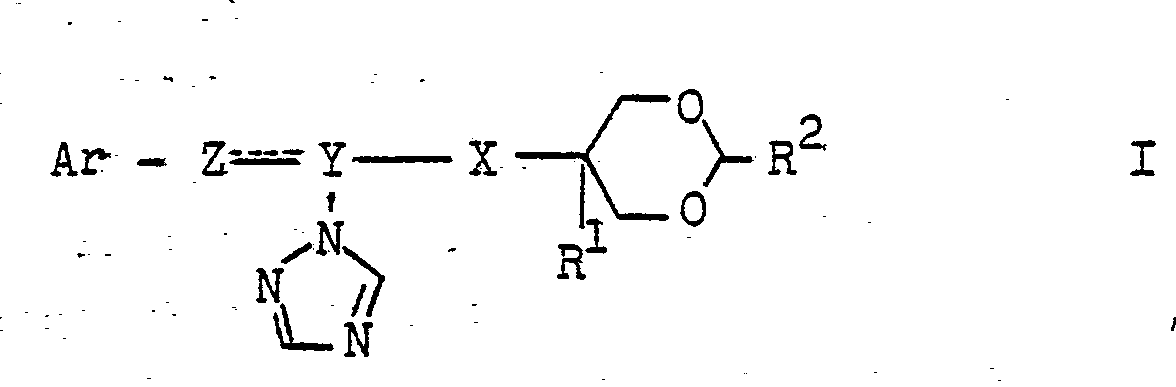


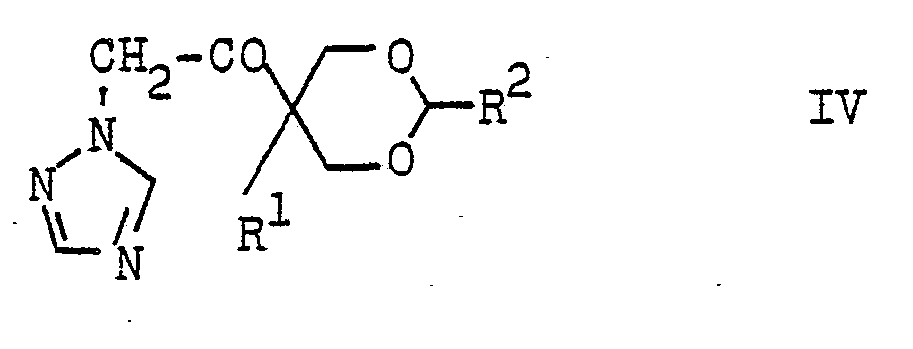

Priority Applications (1)
| Application Number | Priority Date | Filing Date | Title |
|---|---|---|---|
| AT82102446T ATE66921T1 (de) | 1981-04-04 | 1982-03-24 | Verwendung von triazolylderivate zur bekaempfung von pilzen. |
Applications Claiming Priority (2)
| Application Number | Priority Date | Filing Date | Title |
|---|---|---|---|
| DE19813113628 DE3113628A1 (de) | 1981-04-04 | 1981-04-04 | Fungizide mittel, enthaltend triazolylderivate und verfahren zur bekaempfung von pilzen mit ihnen |
| DE3113628 | 1981-04-04 |
Publications (3)
| Publication Number | Publication Date |
|---|---|
| EP0062236A2 true EP0062236A2 (de) | 1982-10-13 |
| EP0062236A3 EP0062236A3 (en) | 1983-08-17 |
| EP0062236B1 EP0062236B1 (de) | 1991-09-04 |
Family
ID=6129333
Family Applications (1)
| Application Number | Title | Priority Date | Filing Date |
|---|---|---|---|
| EP82102446A Expired - Lifetime EP0062236B1 (de) | 1981-04-04 | 1982-03-24 | Verwendung von Triazolylderivate zur Bekämpfung von Pilzen |
Country Status (5)
| Country | Link |
|---|---|
| EP (1) | EP0062236B1 (de) |
| AT (1) | ATE66921T1 (de) |
| DE (2) | DE3113628A1 (de) |
| DK (1) | DK156608C (de) |
| GR (1) | GR74782B (de) |
Cited By (4)
| Publication number | Priority date | Publication date | Assignee | Title |
|---|---|---|---|---|
| EP0111711A3 (en) * | 1982-11-15 | 1984-10-03 | Bayer Ag | Heterocyclically substituted hydroxyalkyl-azolyl derivatives |
| US4622334A (en) * | 1983-08-11 | 1986-11-11 | Bayer Aktiengesellschaft | Combating fungi with 3-cycloalkyl-1-(1,3-dioxan-5-yl)2-(1,2,4-triazol-1-yl)-propan-1-ones and propan-1-ols |
| EP0174567A3 (en) * | 1984-09-08 | 1986-12-10 | Basf Aktiengesellschaft | Tetrahydropyran-2-yl-alkanylderivatives, fungicides containing them, process for the preparation of the triazole compounds and intermediates for the preparation |
| EP0111146B1 (de) * | 1982-11-15 | 1986-12-30 | Bayer Ag | Antimykotische Hydroxyalkyl-azolyl-Derivate |
Family Cites Families (4)
| Publication number | Priority date | Publication date | Assignee | Title |
|---|---|---|---|---|
| DE2634511A1 (de) * | 1976-07-31 | 1978-02-02 | Basf Ag | Beta-azolylketone |
| DE3000643A1 (de) * | 1980-01-10 | 1981-07-16 | Bayer Ag, 5090 Leverkusen | Verfahren zur herstellung von azolyl-vinyl-ketonen |
| DE3025879A1 (de) * | 1980-07-09 | 1982-02-11 | Basf Ag, 6700 Ludwigshafen | 1,3-dioxan-5-yl-alkyltriazole, ihre herstellung, ihre verwendung zur regulierung des pflanzenwachstums und mittel dafuer |
| DE3026140A1 (de) * | 1980-07-10 | 1982-02-18 | Basf Ag, 6700 Ludwigshafen | 1,3-dioxan-5-yl-alkenyltriazole, ihre herstellung, ihre verwendung zur regulierung des pflanzenwachstums und mittel dafuer |
-
1981
- 1981-04-04 DE DE19813113628 patent/DE3113628A1/de not_active Withdrawn
-
1982
- 1982-02-22 GR GR67373A patent/GR74782B/el unknown
- 1982-03-24 DE DE8282102446T patent/DE3280354D1/de not_active Expired - Lifetime
- 1982-03-24 AT AT82102446T patent/ATE66921T1/de not_active IP Right Cessation
- 1982-03-24 EP EP82102446A patent/EP0062236B1/de not_active Expired - Lifetime
- 1982-04-02 DK DK151082A patent/DK156608C/da not_active IP Right Cessation
Cited By (6)
| Publication number | Priority date | Publication date | Assignee | Title |
|---|---|---|---|---|
| EP0111711A3 (en) * | 1982-11-15 | 1984-10-03 | Bayer Ag | Heterocyclically substituted hydroxyalkyl-azolyl derivatives |
| EP0193642A3 (en) * | 1982-11-15 | 1986-12-17 | Bayer Ag | Heterocyclically substituted hydroxyalkyl-azolyl derivatives |
| EP0111146B1 (de) * | 1982-11-15 | 1986-12-30 | Bayer Ag | Antimykotische Hydroxyalkyl-azolyl-Derivate |
| US4639462A (en) * | 1982-11-15 | 1987-01-27 | Bayer Aktiengesellschaft | Heterocyclo-hydroxyalkyl-azolyl derivatives and use as fungicides |
| US4622334A (en) * | 1983-08-11 | 1986-11-11 | Bayer Aktiengesellschaft | Combating fungi with 3-cycloalkyl-1-(1,3-dioxan-5-yl)2-(1,2,4-triazol-1-yl)-propan-1-ones and propan-1-ols |
| EP0174567A3 (en) * | 1984-09-08 | 1986-12-10 | Basf Aktiengesellschaft | Tetrahydropyran-2-yl-alkanylderivatives, fungicides containing them, process for the preparation of the triazole compounds and intermediates for the preparation |
Also Published As
| Publication number | Publication date |
|---|---|
| DK151082A (da) | 1982-10-05 |
| ATE66921T1 (de) | 1991-09-15 |
| EP0062236B1 (de) | 1991-09-04 |
| DK156608B (da) | 1989-09-18 |
| DE3280354D1 (de) | 1991-10-10 |
| GR74782B (de) | 1984-07-12 |
| EP0062236A3 (en) | 1983-08-17 |
| DK156608C (da) | 1990-02-05 |
| DE3113628A1 (de) | 1982-10-21 |
Similar Documents
| Publication | Publication Date | Title |
|---|---|---|
| DE3218130A1 (de) | Azolylmethyloxirane, verfahren zu ihrer herstellung und diese enthaltende fungizide | |
| EP0196038A2 (de) | Azolylmethyloxirane - ihre Herstellung und Verwendung als Pflanzenschutzmittel | |
| EP0192055B1 (de) | Hydroxyalkinyl-azolyl-Derivate, Verfahren zu ihrer Herstellung sowie ihre Verwendung als Fungizide | |
| EP0021345A1 (de) | Alpha-Azolylglykolderivate, ihre Herstellung, sie enthaltende pflanzenwachstumsregulierende Mittel und ihre Verwendung | |
| EP0025882A1 (de) | N-phenylpropylsubstituierte Azole, Verfahren zu ihrer Herstellung und diese enthaltende Fungizide | |
| EP0129186B1 (de) | Azolderivate | |
| EP0021327A1 (de) | Neue beta-Triazolylether, ihre Herstellung, sie enthaltende Fungizide, Verfahren zur Bekämpfung von Fungi und zur Herstellung von Fungiziden | |
| EP0044407B1 (de) | 1,3-Dioxan-5-yl-alkyltriazole, ihre Herstellung, ihre Verwendung zur Regulierung des Pflanzenwachstums und Mittel dafür | |
| EP0062236B1 (de) | Verwendung von Triazolylderivate zur Bekämpfung von Pilzen | |
| EP0102540B1 (de) | Beta-Triazolylketale, Verfahren zu ihrer Herstellung und diese enthaltende Fungizide | |
| EP0159586A2 (de) | Azolverbindungen, Verfahren zu ihrer Herstellung und diese enthaltende Fungizide | |
| EP0121081A2 (de) | Azolylmethylcycloalkane, Verfahren zu ihrer Herstellung und ihre Verwendung als Arzneimittel | |
| US4708960A (en) | N-(arylpropyl)-azolylureas, and fungicides containing these compounds | |
| EP0174565B1 (de) | Piperidinderivate und diese enthaltende Fungizide sowie Verfahren zur Bekämpfung von Pilzen | |
| EP0082400B1 (de) | Fungizide alpha-Azolylglykole | |
| EP0102559A2 (de) | Neopentyl-phenethyltriazole, Verfahren zu ihrer Herstellung und diese enthaltende Fungizide | |
| EP0071095B1 (de) | Phenylketenacetale und diese enthaltende Fungizide | |
| EP0056089B1 (de) | Azolylalkyl-2,3-dihydrobenzofurane, diese enthaltende Fungizide und Verfahren zu ihrer Herstellung | |
| US4628058A (en) | N-(2,3-dihydrobenzofuran-2-yl)-azolylureas and fungicides containing these compounds | |
| EP0102543B1 (de) | Dioxanylazolderivate, diese enthaltende fungizide Mittel und Verfahren zur Bekämpfung von Pilzen mit diesen Verbindungen | |
| EP0171502A2 (de) | Vinylazolylharnstoffe und diese enthaltende Fungizide | |
| EP0174567B1 (de) | Tetrahydropyran-2-yl-alkenyltriazole, diese enthaltende Fungizide, Verfahren zur Herstellung der Triazolverbindungen und Zwischenprodukte für die Herstellung | |
| DE3601430A1 (de) | Halogenierte azolverbindungen und diese enthaltende fungizide | |
| DE3541156A1 (de) | Triazolylglykolether, fungizide und bioregulatoren | |
| EP0166956A1 (de) | Vinylazole, Verfahren zu ihrer Herstellung und ihre Verwendung bei der Bekämpfung von Pilzen |
Legal Events
| Date | Code | Title | Description |
|---|---|---|---|
| PUAI | Public reference made under article 153(3) epc to a published international application that has entered the european phase |
Free format text: ORIGINAL CODE: 0009012 |
|
| AK | Designated contracting states |
Designated state(s): AT BE CH DE FR GB IT LU NL SE |
|
| 17P | Request for examination filed |
Effective date: 19821211 |
|
| PUAL | Search report despatched |
Free format text: ORIGINAL CODE: 0009013 |
|
| AK | Designated contracting states |
Designated state(s): AT BE CH DE FR GB IT LI LU NL SE |
|
| GRAA | (expected) grant |
Free format text: ORIGINAL CODE: 0009210 |
|
| AK | Designated contracting states |
Kind code of ref document: B1 Designated state(s): AT BE CH DE FR GB IT LI LU NL SE |
|
| REF | Corresponds to: |
Ref document number: 66921 Country of ref document: AT Date of ref document: 19910915 Kind code of ref document: T |
|
| ITF | It: translation for a ep patent filed | ||
| REF | Corresponds to: |
Ref document number: 3280354 Country of ref document: DE Date of ref document: 19911010 |
|
| GBT | Gb: translation of ep patent filed (gb section 77(6)(a)/1977) | ||
| ET | Fr: translation filed | ||
| PG25 | Lapsed in a contracting state [announced via postgrant information from national office to epo] |
Ref country code: DE Effective date: 19920321 |
|
| PG25 | Lapsed in a contracting state [announced via postgrant information from national office to epo] |
Ref country code: GB Effective date: 19920324 Ref country code: AT Effective date: 19920324 |
|
| PG25 | Lapsed in a contracting state [announced via postgrant information from national office to epo] |
Ref country code: SE Effective date: 19920325 |
|
| PG25 | Lapsed in a contracting state [announced via postgrant information from national office to epo] |
Ref country code: LU Free format text: LAPSE BECAUSE OF NON-PAYMENT OF DUE FEES Effective date: 19920331 Ref country code: LI Effective date: 19920331 Ref country code: CH Effective date: 19920331 Ref country code: BE Effective date: 19920331 |
|
| PLBE | No opposition filed within time limit |
Free format text: ORIGINAL CODE: 0009261 |
|
| STAA | Information on the status of an ep patent application or granted ep patent |
Free format text: STATUS: NO OPPOSITION FILED WITHIN TIME LIMIT |
|
| 26N | No opposition filed | ||
| BERE | Be: lapsed |
Owner name: BASF A.G. Effective date: 19920331 |
|
| PG25 | Lapsed in a contracting state [announced via postgrant information from national office to epo] |
Ref country code: NL Effective date: 19921001 |
|
| NLV4 | Nl: lapsed or anulled due to non-payment of the annual fee | ||
| GBPC | Gb: european patent ceased through non-payment of renewal fee | ||
| PG25 | Lapsed in a contracting state [announced via postgrant information from national office to epo] |
Ref country code: FR Effective date: 19921130 |
|
| REG | Reference to a national code |
Ref country code: CH Ref legal event code: PL |
|
| REG | Reference to a national code |
Ref country code: FR Ref legal event code: ST |
|
| EUG | Se: european patent has lapsed |
Ref document number: 82102446.0 Effective date: 19921005 |