EP0059959A2 - System, um die Übereinstimmung von Mustern zu erreichen - Google Patents
System, um die Übereinstimmung von Mustern zu erreichen Download PDFInfo
- Publication number
- EP0059959A2 EP0059959A2 EP82101757A EP82101757A EP0059959A2 EP 0059959 A2 EP0059959 A2 EP 0059959A2 EP 82101757 A EP82101757 A EP 82101757A EP 82101757 A EP82101757 A EP 82101757A EP 0059959 A2 EP0059959 A2 EP 0059959A2
- Authority
- EP
- European Patent Office
- Prior art keywords
- similarity measure
- signal
- timing
- recurrence
- indicative
- Prior art date
- Legal status (The legal status is an assumption and is not a legal conclusion. Google has not performed a legal analysis and makes no representation as to the accuracy of the status listed.)
- Granted
Links
Images



Classifications
-
- G—PHYSICS
- G10—MUSICAL INSTRUMENTS; ACOUSTICS
- G10L—SPEECH ANALYSIS TECHNIQUES OR SPEECH SYNTHESIS; SPEECH RECOGNITION; SPEECH OR VOICE PROCESSING TECHNIQUES; SPEECH OR AUDIO CODING OR DECODING
- G10L15/00—Speech recognition
- G10L15/08—Speech classification or search
- G10L15/12—Speech classification or search using dynamic programming techniques, e.g. dynamic time warping [DTW]
-
- G—PHYSICS
- G06—COMPUTING OR CALCULATING; COUNTING
- G06V—IMAGE OR VIDEO RECOGNITION OR UNDERSTANDING
- G06V10/00—Arrangements for image or video recognition or understanding
- G06V10/70—Arrangements for image or video recognition or understanding using pattern recognition or machine learning
- G06V10/74—Image or video pattern matching; Proximity measures in feature spaces
- G06V10/75—Organisation of the matching processes, e.g. simultaneous or sequential comparisons of image or video features; Coarse-fine approaches, e.g. multi-scale approaches; using context analysis; Selection of dictionaries
- G06V10/754—Organisation of the matching processes, e.g. simultaneous or sequential comparisons of image or video features; Coarse-fine approaches, e.g. multi-scale approaches; using context analysis; Selection of dictionaries involving a deformation of the sample pattern or of the reference pattern; Elastic matching
-
- G—PHYSICS
- G10—MUSICAL INSTRUMENTS; ACOUSTICS
- G10L—SPEECH ANALYSIS TECHNIQUES OR SPEECH SYNTHESIS; SPEECH RECOGNITION; SPEECH OR VOICE PROCESSING TECHNIQUES; SPEECH OR AUDIO CODING OR DECODING
- G10L15/00—Speech recognition
Definitions
- This invention relates to a pattern matching device for carrying out pattern matching between two information compressed patterns by resorting to a DP (dynamic programming) technique on calculating a similarity or likelihood measure or degree between the patterns.
- Each of the patterns is generally an approximation of an original pattern represented by a sequence of feature vectors and is represented by a sequence of extracted vectors positioned with variable intervals or spacings along a time axis.
- the extracted vectors correspond to those representative or typical ones of the feature vectors for an original pattern which are arranged at such intervals to characterize the original pattern.
- the extracted vectors are feature vectors representative of each information compressed pattern.
- Each original pattern may be given by a spoken word or a plurality of continuously spoken words.
- the pattern may be a figure or diagram which, in turn, may be type-printed characters or hand-printed letters.
- the pattern matching device serves as a main structural unit of a pattern recognition system as disclosed in United States Patent No. 3.816,722.
- the pattern matching device is useful also in a continuous speech recognition system as revealed in United States Patent No. 4,039.723.
- the DP technique or algorithm as called in the art is resorted to in a majority of pattern matching devices which are in actual use.
- the original patterns are represented by a first and a second sequence of feature vectors, respectively.
- Each sequence consists of a certain number of feature vectors depending on the pattern represented by the sequence under consideration.
- An intervector similarity measure is calculated between each feature vector of the first sequence and each feature vector of the second sequence.
- iterative calculation is carried out on a recurrence formula for use in defining a recurrence value by an extremum of several sums which are equal to a prescribed number of previously calculated recurrence values plus at least one intervector similarity measure, respectively.
- the extremum is a minimum and a maximum when the intervector similarity measure is given, for example, as a distance measure and a correlation measure between the two feature vectors, respectively.
- the recurrence formula eventually gives an interpattern similarity measure representative of whether the two original patterns are similar or dissimilar to each other.
- the intervector similarity measure may be called an elementary or primitive similarity measure.
- the interpattern similarity measure may be named an overall or eventual similarity measure.
- a plurality of reference patterns are preliminarily registered in a pattern memory as reference feature vector sequences.
- An unknown pattern to be recognized is supplied to a pattern buffer as an input feature _vector sequence.
- the unknown pattern is subjected to the pattern matching operation successively with the reference patterns.
- the unknown pattern is recognized to be one of the reference patterns that provides an extremum interpattern similarity measure relative to the unknown pattern.
- each reference feature vector sequence consists of a considerable number of feature vectors.
- the number is called a reference pattern duration or length.
- a conventional pattern matching device must therefore comprise a pattern memory of an appreciably large memory capacity. A longer time is necessary on carrying out the pattern matching operation with each reference pattern when an input pattern is either long or covers a wide area to have, in either case, a longer input pattern duration or length. The device has therefore been bulky and expensive.
- a variation in adjacent feature vectors is little at stationary part, such as in a vowel, and considerable at a transient part, such as at a transition from a vowel to a consonant.
- a feature vector sequence representative of a speech pattern usually includes an appreciable number of redundant feature vectors which carry redundant information and are interspersed in a smaller number of representative feature vectors characterizing the speech pattern. It has therefore been proposed to substitute an information compressed pattern for an original pattern.
- the information compressed pattern is represented by a sequence of "extracted” vectors extracted directly from the original pattern at a plurality of those "extracting" instants or points, respectively, which are placed with variable intervals of time along a time axis, namely, positioned at discrete instants.
- the information compressed pattern is therefore represented by a combination of the extracted vector sequence and a timing or point sequence composed of the instants.
- the extracted vectors correspond to the respective characteristic feature vectors.
- a conventional pattern matching device comprises a work memory and a calculating circuit which must deal with signals having a multiplicity of bits particularly when an input extracted vector sequence is considerably long.
- the pattern matching device comprises a pattern memory and a work memory of a smaller memory capacity than a conventional pattern matching device and is operable with signals of a relatively smaller number of bits; accordingly the pattern matching device according to the invention and the pattern recognition system with which it may be used are rendered more compact and yet inexpensive.
- the above-mentioned pattern rejection technique is implemented in the pattern matching device according to the invention to give a pattern recognition system a higher speed of pattern recognition.
- a pattern matching device to which this invention is applicable, is for calculating an overall similarity measure between a first pattern U represented by a first vector sequence of first through I-th extracted vectors positioned at first through I-th instants, respectively, which are arranged with variable intervals of time as a first timing sequence, and a second pattern V represented by a second vector sequence of first through J-th extracted vectors positioned at first through J-th instants, respectively, which are arranged with variable specings of time as a second timing sequence, and that the device comprises first means for generating first and second timing signals indicative of a pair of instants in the first and the second timing sequence at one time, respectively.
- second means responsive to the first and the second timing signals for calculating an (i, j)-th elementary similarity measure for the i-th and the j-th extracted vectors when the first and the second timing signals are indicative of the (i, j)-th pair
- third means responsive to the first and the second timing signals and to the (i, j)-th elementary similarity measures for iteratively calculating a recurrence formula to successively give a plurality of recurrence values.
- the recurrence formula gives, when the first and the second timing signals are indicative of the (i, j)-th pair, an (i, j)-th one f(i, j) of the recurrence values by an extremum of a plurality of results of addition which are calculated by the use of a prescribed number of previously calculated recurrence values and at least the (i, j)-th elementary similarity measure, respectively.
- the recurrence formula eventually gives the overall similarity measure by an (I, J)-th one f(I, J) of the recurrence values.
- the second means of the above-specified device comprises fourth means coupled to the first means for calculating, when the first and the second timing signals are indicative of the (i, j)-th pair, an (i, j)-th intervector similarity measure d(i, j) between the i-th and the j-th extracted vectors and an (i, j)-th weighting factor w(i, j) by the use of the interval of time from the (i-l)-th instant to the i-th instant, and fifth means coupled to the fourth means for calculating, when the fourth means calculates the (i, j)-th intervector similarity measure and the (i, j)-th weighting factor, the (i, j)-th elementary similarity measure.
- each result of addition for each recurrence value such as the (i, j)-th recurrence value f(i, j)
- the result of addition may somewhat indirectly be given by such a sum.
- the fifth means of the device calculates, when the fourth means calculates the (i, j)-th intervector similarity measure, an (i, j)-th weighted similarity measure d (i, j) as the (i, j)-th elementary similarity measure oy multiplying the (i, j)-th intervector similarity measure d(i, j) by the (i, j)-th weighting factor w(i, j).
- the overall similarity measure is equal to an interpattern similarity measure D(U, V) representative of whether the first and the second patterns U and V are similar or dissimilar to each other.
- the first means of a conventional pattern matching device generates the first and the second timing signals with the first timing signal rendered ascendingly consecutively indicative of the first through the I-th instants.
- the second timing signal is successively rendered indicative of a plurality of ascendingly consecutive instants of the second timing sequence within each of the intervals of time during which the first timing signal indicates one of the instants of the first timing sequence.
- the first and the second timing sequences used in such a conventional device are indicative of equally spaced instants rather than the extracting instants of the type described heretobefore.
- the third means for use in the conventional device under the usual circumstances calculates the recurrence formula with three results of addition calculated by the use of the (i-1, j)-th, the (i-1, j-l)-th, and the (i-1, j-2)-th recurrence values as the previously calculated recurrence values, three in number, respectively.
- the three results of addition may be given in the device according to the aspect described above, when the first and the second timing signals are indicative of the (i, j)-th extracting instant pair, by three sums which are equal to the three previously calculated recurrence values plus the (i, j)-th weighted similarity measure d (i, j), respectively.
- the second means for use in the device according to the above-mentioned aspect of this invention under the usual circumstances with three selected for the prescribed number further comprises sixth means coupled to the first means for calculating, when the first and the second timing signals are indicative of the (i, j)-th pair,.j-th and (j-l)-th intervector spacings of the second timing sequence t. J and t j-1 by two differences which are equal to the j-th instant q(j) minus the (j-l)-th instant q(j - 1) and to the (j-l)-th instant minus the (j-2)-th instant q(j - 2), respectively.
- the fifth means is further coupled to the sixth means for additionally calculating, when the fourth means calculates the (i, j)-th intervector similarity measure, an (i, j)-th additional similarity measure d (i, j) by a linear combination of the (i, j)-th and the (i, j-l)-th intervector similarity measures d(i, j) and d(i, j - 1) to which the (i, j)-th weighting factor w(i, j) is proportionally distributed in proportion to the j-th and the (j-l)-th intervector spacings.
- the fifth means of the above-described aspect of this invention is for additionally calculating, when the fourth means calculates the (i, j)-th intervector similarity measure, an (i, j)-th additional similarity measure d a (i, j) by a linear combination of the (i, j)-th and the (i, j-l)-th intervector similarity measures d(i, j) and d(i, j - 1), each of which is multiplied by a half of the (i, j)-th weighting factor w(i, j).
- the third means calculates the three results of addition, when the first and the second timing signals are indicative of the (i, j)-th.pair, by two sums which are equal to the (i-1, j)-th and the (i-1, j-l)-th recurrence values f(i - 1, j) and f(i - 1, j - 1) plus the (i, j)-th weighted similarity measure d w (i, j), respectively, and a sum which is equal to the (i-1, j-2)-th recurrence value f(i - 1, j - 2) plus the (i, j)-th additional similarity measure d a (i, j).
- the second means of the device further comprises subtracting means coupled to the fourth means for calculating, when the fourth means calculates the (i, j)-th intervector similarity measure, an (i, j)-th compensated similarity measure d'(i, j) by subtracting a predetermined value 6 from the (i, j)-th intervector similarity measure d(i, j).
- the fifth means is further coupled to the subtracting means for calculating, when the subtracting means calculates the (i, j)-th compensated similarity measure, an (i, j)-th compensated and weighted similarity measure d w '(i, j) as the (i, j)-th elementary similarity measure by multiplying the (i, j)-th compensated similarity measure d'(i, j) by the (i, j)-th weighting factor w(i, j).
- the overall similarity measure is related to the interpattern similarity measure D(U, V) of the above-mentioned type,
- the third means of a pattern matching device preferably comprises means responsive to the first and the second timing signals and the (i, j)-th elementary similarity measures for calculating, when the first and the second timing signals are indicative of the (i, j)-th pair and consequently when the recurrence formula gives the (i, j)-th recurrence value f(i, j), a plurality of sums of an (i, j)-th group which are equal to the previously i calculated recurrence values of the prescribed number plus at least the (i, j)-th compensated and weighted similarity measure d w '(i, j), respectively, means responsive to the sums of the (i, j)-th group for producing an overflow signal which takes first, second, and third signal values when each of the sums of the (i, j)-th group is greater than a first preselected value, is less than a second preselected value, and is
- the compensated and weighted similarity measures d '(i, j)'s are substituted for the merely weighted similarity measures d w (i, j)'s on calculating the recurrence formula under the usual circumstances with three used for the prescribed number.
- compensated additional similarity measures d a '(i, j)'s calculated by the use of the compensated similarity measures d'(i, j)'s instead of the intervector similarity measures d(i, j)'s are substituted for the mere additional similarity measures d a (i. j)'s.
- the device according to this invention is used under the usual circumstances with three used as the prescribed number.
- the second means of such a device further comprises sixth means coupled to the first means for calculating, when the first and the second timing signals are indicative of the (i, j)-th pair, j-th and (j-1)-th intervector spacings in the second timing sequence t. J and t j-1 by subtracting the (j-l)-th instant from the j-th instant and by subtracting the (j-2)-th instant from the (j-l)-th instant.
- seventh means coupled to the fourth means for calculating, when the fourth means calculates the (i, j)-th weighting factor, an (i, j)-th compensation factor by multiplying the (i, j)-th weighting factor w(i, j) by a predetermined value ⁇
- the fifth means is further coupled to the sixth means for calculating, when the fourth means calculates the (i, j)-th intervector similarity measure, an (i, j)-th weighted similarity measure d w (i, j) by multiplying the (i, j)-th intervector similarity measure d(i, j) by the (i, j)-th weighting factor w(i, j) and an (i, j)-th additional similarity measure d a (i, j) by a linear combination of the (i, j)-th and the (i, j-l)-th intervector similarity measures d(i, j) and d(i,
- the fifth means is still furtner coupled to the seventh means for subtracting the (i, j)-th compensation factor from the (i, j)-th weighted similarity measure and the (i. j)-th additional similarity measure to provide an (i, j)-th compensated and weighted similarity measure d '(i, j) as the (i, j)-th elementary similarity measure and an (i, j)-th compensated additional similarity measure d '(i, j), respectively.
- the third means uses the compensated and weighted similarity measures d w '(i, j)'s and the compensated additional similarity measures d a '(i, j)'s instead of the merely weighted similarity measures d w (i, j)'s and the mere additional similarity measures d a (i, j)'s, respectively.
- the overall similarity measure is again related to the interpattern similarity measure D(U, V). If desired, the former is readily converted to the latter.
- the sum restricting scheme is readily applicable to a device according to the last-described aspect of this invention.
- the scheme is equally well applicable to a device according to the first-mentioned aspect of this invention. It is easy to resort to the above-mentioned pattern rejection technique with a device in which the sum restricting scheme is implemented.
- a pattern matching device illustrated in the above-referenced Sakoe patent of United States Patent No. 4,059,723 with reference to Fig. 6 thereof, will be described at first as an example of conventional pattern matching devices in order to facilitate an understanding of the present invention.
- the pattern matching device is for use in a speech recognition system.
- an interpattern distance D(A, B) between first and second patterns A and B will be used as an interpattern similarity measure between the patterns A and B on carrying out the pattern matching operation.
- vectors a. u , and the like will be denoted by corresponding usual letters, such as a and u.
- the first and the second patterns A and B will be referred to as an input and a reference pattern, respectively.
- the reference pattern B is represented by a second time sequence of first through Q -th reference or second pattern feature vectors b l , b 2 , .... b q .
- first and the second time sequences have first and second total durations or lengths P and Q. It is possible to understand that the first and the second time sequences are arranged along first and second time axes E and g (the same reference letters being thus often used merely for simplicity of denotation), respectively.
- the pattern matching device comprises a control unit 21 for producing first and second address or timing signals p and q representative, at one time, of one of integers 1 through P of a first set and one of integers 1 through Q of a second set, respectively.
- a (p, q)-th integer pair (p, q) of a p-th integer p of the first set and a q-th integer a of the second set is for use, among others, in designating the p-th input and the q-th reference pattern feature vectors.
- the control unit 21 furthermore produces various control signals for use in controlling other parts of the device. Such control signals are not depicted in the figure being referred to.
- a pattern buffer 22 is for holding a predetermined number of the input pattern feature vectors at a time.
- the pattern buffer 22 Responsive to the first address signal p, the pattern buffer 22 produces a first vector signal a representative of the input pattern feature vectors designated by the integers p's of the first set.
- a pattern memory 23 is for holding the second time sequence or sequences. Supplied with the second address signal q, the pattern memory 23 produces a second vector signal b representative of the reference pattern feature vectors which are designated by the integers q's of the second set and by a pattern specifying signal produced by the control unit 21 as one of the control signals to specify one of the second time sequences if the pattern memory 23 is loaded with a plurality of the second time sequences.
- the pattern buffer 22 and the pattern memory 23 may also be called first and second pattern memories or buffers, respectively.
- a distance calculator 25 calculates an intervector distance d(p, q) between the vectors a and b to produce a distance measure signal d successively representative of such calculated distances.
- the successively calculated intervector distances d(p, q)'s are for use in calculating the interpattern distance D(A, B).
- Equation (1) the right-hand side of Equation (1) is minimized by iteratively calculating a recurrence formula which defines a recurrence value by a sum of each intervector distance and an extremum of a prescribed number of previous recurrence values which, in turn, are already calculated before calculation of the recurrence formula for a new recurrence value.
- the recurrence formula is given by: where g(p, q) will be named a (p, q)-th recurrence value.
- the recurrence formula (2) is calculated with the first address signal made to indicate ascendingly consecutive integers p's of the first set and with the second address signal made to successively indicate a plurality of ascendingly consecutive integers q's of the second set within an interval of time during which the first address signal indicates each integer of the first set. It is sufficient that the integers q's of the second set be varied for each integer p of the first set in compliance with an adjustment window condition: where r represents a preselected positive integer known as a window length in the art. In this event, it is preferred that the distance calculator 25 (Fig.
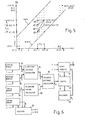
- an adjustment window is illustrated on a p-q coordinate plane defined by the first and the second time axes p and a which are depicted as a pair of orthogonal coordinate axes merely for clarity of illustration.
- the integers q's of the second set are varied in the adjust- ment window for each integer p of the first set as exemplified by thick lines with arrowheads.
- the above-mentioned interval of time should be equal to the sampling period with which the input speech pattern is sampled so that the input pattern feature vectors are successively supplied to the pattern buffer 22 (Fig. 1).
- a work memory or operational register 26 has a plurality of addresses, such as addresses (1, 1) to (r, 1), (1, r) to (r, 2r), (P - 2r, Q - r) to (P, Q - r), and (P - r, Q) to (P, Q) in the adjustment window exemplified in Fig. 2.
- the addresses are accessible by pairs of the integers indicated by the first and the second address signals p and q, At first, the initial condition is set in the work memory 26 at the address (1, 1) as will become clear as the description proceeds.
- the work memory 26 When the address signals are indicative of the (p, q)-th integer pair (p, q), the work memory 26 is already loaded with those previous recurrence values at pertinent addresses which are previously calculated according to the recurrence formula (2). Responsive to the address signals indicative of the (p, q)-th integer pair, the work memory 26 produces three signals g 1 , g 2 , and g 3 from the addresses (p - 1, q), (p - 1, q - 1), and (p - 1, q - 2). The three signals are representative of three previous recurrence values for use in minimization of the recurrence formula (2).
- a minimum deciding circuit 27 finds a minimum of the three previous recurrence values to produce a minimum representing signal g m successively representative of such minima, namely, the second term in the right-hand side of the recurrence formula (2).
- the work memory 26 should produce a sufficiently great value as any one of the three previous recurrence values when the accessed address lies outside of the adjustment window.
- an adder 28 calculates a sum of the intervector distance and the minimum to produce a sum signal g o successively representative of such sums.
- the sum gives the (p, q)-th recurrence value g(p, q).
- the sum signal representative of the ( p , q)-th recurrence value is supplied oack to the work memory 26 and stored in the address (p, q) as a new recurrence value by a write-in signal (not shown) produced by tne control unit 21 as one of the control signals.
- the recurrence values represented by the sum signal g o previously of the currently calculated (p, q)-th recurrence value, are already stored in tne work memory 26 as the previous recurrence values,
- the control unit 21 Keeps the first address signal p indicative of the P-th integer P as descrioed in, for example.
- the work memory 26 produces an interpattern similarity measure signal D representative of tne interpattern distance D(A, B).
- the pattern memory 23 must have an appreciably large memory capacity. This applies to the work memory 26.
- the input pattern A has a longer total duration P, an accordingly longer time is necessary on carrying out the pattern matching operation relative to each reference pattern B.
- Fig. 3 a sequence of one-dimensional feature "vectors" is depicted.
- the sequence of first through P-th feature vectors a 1 to a P are positioned at first through P-th instants 1 to P which are equally spaced along a time axis p and are indicated by dots.
- the sequence represents an original pattern A illustrated by a curve.
- the original pattern A varies at several of the intervals with those rates of variation which exceed a predetermined threshold.
- the original pattern A is approximated by a plurality of discrete rectangles, each of which has a base on the time axis p between two of the instants D's.
- the illustrated rectangle is specific and is represented by a mere line segment.
- a trailing end of each base is indicated by encircled dots.
- the rectangles are selected according to the multistep method, known in tne art, so as to minimize errors (indicated by hatched areas) relative to the curve. It is thus possible to define the extracted vectors described before, by those upright sides of the respective rectangles which reach the trailing ends, respectively, and are representative of characteristic or typical feature vectors of the original pattern A.
- the extracting instants described hereinabove are defined by the trailing ends. In general, the extracting instants are nonuniformly distributed along the time axis p.
- the original pattern A When the original pattern A is represented by the extracted vectors, redundant feature vectors which are interspersed between the characteristic feature vectors, are omitted or skipped over. Although the'information as regards the original pattern A is thus successfully compressed, it has been impossible to apply the DP technique to an information compressed pattern defined by the discrete rectangles. Incidentally, the information compressed pattern may exactly be coincident with the original pattern A in a special case.
- the discrete rectangles are again depicted by dashed lines, together with first through I-th extracted vectors u 1 , u 2 , .... u i ,... and u r positioned along the time axis p at first through I-th extracting instants p(l), ..., p(i - l), p(i), ..., and p(l), respectively.
- serial numbers i's for the respective extracting instants are given by ascendingly consecutive natural numoers, intervals of time between pairs of two consecutive extracting instants, such as p(i - 1) and p(i), are variable, namely, not necessarily equal to each other.
- the discrete rectangles are representative of an information compressed pattern U.
- a first or input information compressed pattern U exemplified in Fig. 4 is represented by a first or input vector sequence Ev(U) of first through I-th input pattern extracted vectors, I in number, and a first or input timing or point sequence Ep(U) of first through I-th input pattern extracting instants for the respective extracted vectors as follows: and where u i and p(i) are representative of an i-th input pattern extracted vector and an i-th input pattern extracting instant.
- a second or reference information compressed pattern V is likewise represented by a second or reference vector sequence Ev(V) of first through J-th reference pattern extracted vectors and a second or reference timing sequence Ep(V) of first through J-th reference pattern extracting instants as follows: and where v j and q(j) are indicative of a j-th reference pattern extracted vector and a j-th reference pattern extracting instant.
- the numbers I and J are related to the input and the reference pattern durations P and Q for the original input and reference patterns A and B.
- some of the sampling instants p's for an original input pattern A are indicated by mere dots on the p-q plane along the abscissa representative of the first time axis z and some of the sampling instants q's for an original reference pattern B, also mere gots along the ordinate representative of the second time axis q
- a few of the extracting instants p(i)'s for an input information compressed pattern U approximating the original input pattern A are exemplified by encircled dots along the abscissa and several of the extracting instants q(j)'s for a reference information compressed pattern V approximating the original reference pattern B, again by encircled dots along the ordinate.
- One of the input pattern intervector intervals s i 's and a few of tne reference pattern intervector spacings t j 's are labelled along the respective coordinate axes.
- Each point (p, q) defined in an adjustment window by a (p, q)-th integer pair of the p-th and the q-th integers p and a of the first and the second sets, is indicated also by a mere dot and each point (p(i). q(j)) specified by an (i, j)-th instant pair of the i-th and the j-th extracting instants p(i) and q(j) for the respective information compressed patterns U and V, again by an encircled dot.
- an interpattern distance D(U, V) between the information compressed patterns U and V is calculated to approximate the interpaitern distance D( A , B) between the original patterns A and B if the recurrence formula (2) is calculated with the extracted vectors weighted by the corresponding intervals of time and likewise corresponding spacings of time.
- the recurrence formula (2) need not be calculated with respect to all integer pairs (p, q)'s in the adjustment window for the original patterns A and B but only as regards the extracting instant pairs (p(i), q(j))'s for the information compressed patterns U and V.
- the weighted distances are given by: where w(i, j) represents an (i, j)-th weighting factor for weighting an (i, j)-th intervector distance d(i, j) between the i-th input pattern extracted vector u i and the j-th reference pattern extracted vector v . so that the patterns regenerated from the information compressed patterns U and V, may become well coincident with the respective original patterns A and B.
- the (i, j)-th weighting factor for use in the recurrence formula (9) may be equal to the i-th input pattern intervector interval s i .
- the weighted distance d w (i, j) is equal to an intervector distance d(p, q) used in the recurrence formula (2) if an interval from the (i-l)-th instant to the i-th instant s i for the i-th input pattern extracted vector u i , is equal to the sampling period.
- the weighting factor w(i, j) is equal to unity.
- the (i, j)-th weighted distance is equal to ten times the (i, j)-th intervector distance d(i, j).
- the weighting factor w(i, j) is now equal to ten.
- the initial condition is given by: where d(1, 1) now represents the intervector distance between the first input pattern extracted vector u 1 and the first reference pattern extracted vector v 1 .
- the interpattern distance is given by: and the adjustment window, by:
- tne recurrence formula (9) is equivalent to minimization of three sums which are equal to the previous recurrence values g(i - 1, j), g(i - 1, j - 1), and g(i - 1, j - 2) plus the weighted intervector distance d w (i, j) ⁇
- a pattern matching device comprises a first pattern memory 31 for holding the input pattern extracted vectors u i 's of the type given by Equation (3) in consecutive addresses.
- a second pattern memory 32 is for likewise holding the reference pattern extracted vectors v j 's of tne type of Equation (5).
- a control unit 33 is for generating first and second address or timing signals i and j and various control signals as described in conjunction with Fig. 1.
- the first address signal indicates first through I-th integers 1 to I of a first set rather than the input pattern extracting instants p(1) through p(I). This applies to tne second address signal indicative of first through J-th integers 1 to J of a second set.
- Tne first and the second address signals are tnus generated for use in calculating the recurrence formula (9) under the usual circumstances of the type described heretobefore.
- Each set consists of a considerably smaller number of integers than the set mentioned in connection with Figs. 1 and 2.
- the first pattern memory 31 Responsive to the first address signal i, the first pattern memory 31 produces a first vector signal u.
- the first vector signal represents the i-th input pattern extracted vector u i
- the second address signal indicates a j-tn integer j
- a second vector signal v produced by the second pattern memory 32 represents the j-th reference pattern extracted vector v..
- an elementary distance calculator 34 calculates an (i, j)-th intervector distance d(i, j) between the i-th input pattern extracted vector u i and the j-th reference pattern extracted vector v j when the vector signals are representative of such vectors u. and v..
- the distance calculator 34 produces a distance measure signal d representative of the successively calculated intervector distances.
- First and second timing memories 36 and 37 are for holding the input and the reference pattern extracting instants p(i)'s and q(j)'s of Equations (4) and (6), respectively. Responsive to the first address signal i, the first timing memory 36 produces a first instant sisnal p which represents the i-th input pattern extracting instant p(i) when the first address signal indicates the i-th integer i, when the second address signal indicates the j-th integer j, a second instant signal q produced by the second timing memory 37 represents the j-th reference pattern extracting instant q(j).
- the integer memers (i, j)'s and the extracting instant pairs (p(i), q(j))'s are thus in one-to-one correspondence.
- a weighting factor calculator 38 of the device being illustrated is supplied with the first instant signal p and successively calculates the weighting factors w(i, j)'s, which are now equal to the input pattern intervector intervals s i 's, respectively.
- a weighting factor signal w produced by the factor calculator 38 represents the (i, j)-th weighting factor w(i, j) when the instant signal p represents the i-th input pattern extracting instant p(i).
- the distance measure signal d and the weighting factor signal w are delivered to a weighted distance calculator 39, which successively calculates the weighted distances d w (i, j)'s in compliance with Equation (10).
- the weighted distance calculator 39 is a mere multiplier for the time being, and produces a weighted distance signal d w representative of tne successively calculated weighted distances, when the first and the second address signals are indicative of the (i, j)-th integer pair (i, j), the weighted distance signal d w represents the (i, j)-th weighted distance d w (i, j).
- Circuitry for producing the vector sequences Ev(U) and Ev(V) and either the timing sequences Ep(U) and Ep(V) or the timing sequences Ei(U) and Ei(V) will not be described because the circuitry is known in the art and is outside of the scope of this invention.
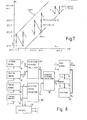
- FIG. 7 an adjustment window is depicted again on the p-q plane,
- the integer indicated oy the first address signal i is varied from 1 up to I
- the first through the I-th input pattern extracting instants p(l) to p(I) are ascendingly consecutively designated.
- the integer indicated by the second address signal j is varied so as to successively designate a plurality of ascendingly consecutive reference pattern extracting instants q(j)'s conditioned by Equation (11).
- Equation (11) does not always hold.
- tne control unit 33 Responsive to the first and the second instant signals p and q, tne control unit 33 (Fig. 6) produces the first and the second address signais i and j so that the instant signals p and a produced by the timing memories 36 and 37 may successively designate a plurality of extracting instant pairs from the (1, l)-th pair (p(1), q(l)) eventually up to the (I, J)-th pair (p(I), q(J)) in a staggering manner exemplified in the figure being referred to.
- a work memory 41 has a plurality of addresses like the work memory 26 used in the device illustrated with reference to Fig. 1.
- the memory 41 may, however, have a much less number of addresses than the memory 26 because the integers I and J are considerably less than the integers P and Q.
- the work memory 41 be capable of producing a previous recurrence value signal g -1 which successively represents, when the first and the second address signals i and are indicative of the (i, j)-th integer pair (i, j), three previous recurrence values g(i - 1, j), g(i - 1, j - 1), and g(i - l, j - 2) rather than substantially concurrently.
- An adder 42 is supplied with the previous recurrence value signal g - , and the weighted distance signal d and produces a sum signal g .
- tne sum signal successively represents three sums which are equal to the (i, j)-th weighted distance d w (i, j) plus the three previous recurrence values g(i - 1, j), g(i - 1, j - 1), and g(i - 1, j - 2), respectively.
- a minimum deciding circuit 43 finds out a minimum of tne tnree sums and supplies the work memory 41 with a new recurrence value signal g o ,
- the work memory 41 when the address signals are eventually indicative of the (I, J)-th integer pair (I, J), the work memory 41 produces an interpattern distance signal D representative of the interpattern distance D(U, V), which is in close approximation to the interpattern distance D(A, B) between the original patterns A and B.
- the three sums calculated by the adder 42 correspond to additions of the intervector distances d(i. j)'s along first through third paths 46, 47, and 48, respectively.
- the addition along the third path 48 is objectionable because the intervector distance d(i, j - 1) for an instant pair (p(i), q(j - 1)) or an integer pair (i, j - 1) is neglected.
- the modified recurrence formula is: where d a (i, j) will be called an (i, j)-th additional distance and is given by: where, in turn, it is possible to understand that [w(i, j)][c 1 (i, j)] and [w(i, j)][c 2 (i, j)] are a first and a second additional weighting factor of an (i, j)-th set.
- c l (i, j) and c 2 (i, j) will be named a first and a second factor (multiplier) of an (i, j)-th set and are defined by: and
- a pattern matching device comprises similar parts designated by like reference numerals.
- a modified weighting factor calculator 38' produces a factor signal, which is again designated by the reference letter w.
- the factor signal w successively represents the (i, j)-th weighting factor w(i, j) as already described in connection with Fig. 6 and subsequently tne second and the first weighting factors of the (i, j)-th set as will presently be described more in detail.
- the weighted distance calculator 39 Responsive to the factor signal w and the distance measure signal d, the weighted distance calculator 39 produces a weighted distance signal which is again designated by d w and successively represents the (i, j)-th weighted distance d w (i, j) as before and the (i, j)-th additional distance d a (i, j) given by Equation (13) when the address signals are indicative of the (i, j)-th integer pair.
- the factor signal w may represent the first and the second factors of tne (i, j)-th set c 1 (i, j) and c 2 (i, j), respectively.
- the illustrated device eventually provides the interpattern distance D(U, V).
- the weighting factor calculator 38' comprises first and second instant memories 51 and 52 for retaining the first and the second instant signals p and q, respectively.
- the first instant memory 51 retains the (i-l)-th and the i-th input pattern extracting instants p(i - 1) and p(i) and the second instant memory 52, the reference pattern extracting instants q(j - 2), q(j - l), and q(j).
- An arithmetic circuit 53 calculates the (i, j)-th weighting factor w(i, j) at first by reading the instants p(i - 1) and p(i) from the first instant memory 51. Subsequently, the instants q(j - 2) through q(j) are read out of the second instant memory 52.
- the second and the first factors of the (i, j)-th set c 2 (i, j) and c l (i, j) are successively calculated according to Equations (15) and (14), respectively. Immediately following the respective instants of the successive calculation, the second and the first weighting factors of the (i, j)-th set are calculated.
- the weighted distance calculator 39 comprises a distance memory 56 for retaining the intervector distances d(i, j - l) and d(i, j) when the distance measure signal d represents the i-th intervector distance d(i, j).
- a multiplier-adder 57 calculates the (i, j)-th weighted distance d w (i, j) at first by reading the (i, j)-th intervector distance d(i, j) and the (i, j)-th weighting factor w(i, j) from the distance memory 56 and the arithmetic circuit 53, respectively.
- the (i, j)-th additional distance d a (i, j) is calculated by reading the intervector distances d(i, j - l) and d(i, j) and the first and the second weighting factors of tie (i, j)-th set from the distance memory 56 and the arithmetic circuit 53.
- the additional distance d a (i, j) it is possible to calculate the additional distance d a (i, j) at first and then tne weighted distance d w (i, j).
- the order of calculation in the weighting factor calculator 38' such as calculation of the (i, j)-th weighting factor and either the first and the second additional weighting factors of the (i, j)-th set or the first and the second factors (multipliers) of the (i, j)-th set, is also optional.
- Equation (13) means that the (i, j)-th additional distance d a (i, j) is calculated by a linear combination of the (i, j)-th and the (i, j-l)-th intervector distances to which the (i, j)-th weighting factor is proportionally distributed in proportion to the j-th and the (j-l)-th intervector spacings t j and t j-1 . respectively. The proportion is equal to a ratio of the j-th intervector spacing t.
- a weighting factor calculator 38 used in a pattern matching device comprises only the first instant memory 51 and the arithmetic circuit 53 described in conjunction with Fig. 9.
- the illustrated arithmetic circuit may comprise a subtractor for calculating each weighting factor w(i, j) and a shift register for subsequently carrying out the division by two.
- the weighted distance calculator 39 is similar in structure to that described in conjunction with Fi g. 9.
- the devices are for calculating an overall similarity measure D(U, V) between a first pattern U represented by a first vector sequence of first through I-th extracted vectors u 1 to u I positioned at those first through I-th instants p(l) to p(I), respectively, which are arranged with variable intervals of time as a first timing sequence, and a second pattern V represented by a second vector sequence of first through J-th extracted vectors v 1 to v i positioned at those first through J-th instants q(l) to q( J ), respectively, which are arranged with variable spacings of time as a second timing sequence.
- the intervals may or may not be equal to durations between the consecutive "extracting" instants.
- the control unit 33 (in practice, in cooperation with the timing memories 36 and 37) serves as first circuitry for generating first and second timing signals i and j indicative of a pair of instants in the respective timing sequences at a time with the pair varied from a (1, l)-th pair (p(l), q(l)) eventually to an (I, J)-th pair (p(I), q(J)) through an (i, j)-th pair (p(i), q(j)).
- Second circuitry comprising the pattern memories 31 and 32 and the calculators 34, 38 or 38', and 39, is responsive to the respective timing sequences for calculating an elementary similarity measure for the i-th and the j-th extracted vectors u i and v j when the timing sequences are indicative of the (i, j)-th pair.
- Third circuitry comprising the units 41 through 43, is responsive to the first and the second timing signals for iteratively calculating a recurrence formula, exemplified by the recurrence formulae (9) and (12), to successively give a plurality of recurrence values.
- the recurrence formula gives an (i, j)-th recurrence value g(i, j) by an extremum of a plurality of results of calculation which are calculated by the use of a prescribed number of previously calculated recurrence values and at least the (i, j)-th elementary similarity measure, respectively.
- the recurrence formula eventually gives the overall similarity measure by an (1, J)-th recurrence value g(I, J).
- the device is characterised in that the second circuitry comprises fourth circuitry exemplified by the pattern memories 31 and 32, the elementary distance calculator 34, and the weighting factor calculator 38 or 38' and coupled to tne first circuitry for calculating, when the timing signals are indicative of the (i, j)-th pair, an (i, j)-th intervector similarity measure d(i, j) between the i-th and the j-th extracted vectors u i and v . and an (i, j)-th weighting factor w(i, j) by the use of the interval of time [p(i) - p(i - 1)].
- the second circuitry furthermore comprises fifth circuitry comprising the weighted distance calculator 39 and coupled to the fourth circuitry for calculating, when the fourth circuitry calculates the (i, j)-th intervector similarity measure and the (i, j)-th weighting factor, the (i, j)-th elementary similarity measure.
- the fifth circuitry is for calculating, when the fourth circuitry calculates the (i, j)-th intervector similarity measure, an (i, j)-th weighted similarity measure d w (i, j) as the (i, j)-th elementary similarity measure according to Equation (10).
- the first and the second timing signals i and J may be rendered indicative of the instants as described hereinabove as regards the usual circumstances and with three selected as the prescribed number.
- the second circuitry further comprises sixth circuitry comprising the second timing memory 37 and the weighting factor calculator 38' coupled to the first circuitry for calculating, when the timing signals are indicative of the (i, j)-th pair, first and second factors of an (i, j)-th set c 1 (i, j) and c 2 (i, j) by two differences which are defined by Equations (14) and (15), respectively.
- the fifth circuitry comprising the weighted distance calculator 39 is further coupled to the sixth circuitry for calculating, when the fourth circuitry calculates the (i, j)-th intervector similarity measure, not only the (i, j)-th weighted similarity measure d w (i, j) but additionally an (i, j)-th additional similarity measure d a (i, j) in compliance with Equation (13).
- the (i, j)-th weighted similarity measure is added by the third circuitry to the (i-1, j)-th and the (i-1, j-l)-th recurrence values to provide two of three sums.
- the (i, j)-th additional similarity measure is added to the (i-1, j-2)-th recurrence value to provide the remaining one of tne three sums.
- the address signals are again indicative of the instants under the usual circumstances. Also, three is used for the prescribed number.
- the fourth circuitry calculates the (i, j)-th intervector similarity measure and consequently the (i, j)-th weighting factor
- the fifth circuitry additionally calculates an (i, j)-th additional similarity measure according to Equation (l6).
- the memory capacity of the device is remarkably reduced not only as regards the work memory 41 as pointed out before but also the pattern memories 31 and 32 despite the necessity of the timing memories 36 and 37.
- the device provides the interpattern distance D(u, V) in an accordingly short time. It has been confirmed through computer simulation tests that a speech recognition system comprising a pattern matching device according to this invention, is capable of well recognizing input speech patterns even with as small an information compression rate as the order of 1/3.
- the total memory capacity of each pattern memory 31 or 32 together with each timing memory 36 or 37 is reduced to about 1/3 of the memory capacity of each pattern memory 22 or 23 used in a conventional pattern matching device.
- Tne interpattern distance D(U, V) is calculated with the time shortened to about 1/9 as compared with the time which has been necessary with the conventional device.
- the information compression rate is 1/c
- the memory capacity and the time for the calculation are reduced to aoout 1/c and 1/c , respectively.
- the interpattern distance D(A, B) for the original patterns A and B is defined according to Equation (1) as a summation.
- Each recurrunce value g(i, j) is likewise defined by the recurrence formula (9) or (l2) as a minimum of a plurality of sums, equal in number to the prescribed number. Both values are greater when the total number I of the extracted vectors of the input vector sequence Ev(U) is greater.
- the work memory 41 must be capable of storing an accordingly great number of bits.
- the adder 42 and the minimum deciding circuit 43 must deal with that great number of bits.
- Equation (18) holds true only when the additional distance is given by Equation (16). If the additional distance defined by Equation (13) is preferred, the iollowing equation should be used instead of Equation (18): in which the compensation factor is again used.
- the input pattern extracting instants wlll be referred to as compensated extracting instants.
- the compensated extracting instant ⁇ [p(i)) will be called an i-th compensated extracting instant.
- a function of such compensated extracting instants substantially linearly monotonously increases with an increase in the integers i's of the first set by a constant rate which is equal to the predetermined value ⁇ , when related to the function, namely, when expressed by the use of a deviation from the function, the (i, j)-th recurrence value g(i, j) is represented by: where f(i, j), representative of the deviation, will be called an (i, j)-th relative recurrence value for the time being.
- a signal representative of the relative recurrence values f(i, j)'s has only a small number of bits.
- Calculation defined by Equations (17) through (19) correspond to calculation of the recurrence formula (9) or (12) by the use of the relative recurrence values implicitly defined by Equation (2u).
- Equation (20) By substituting Equation (20) into, for example, the recurrence formula (12) and by rearranging the resulting formula: which may temporarily be called a relative recurrence formula.
- the initial condition and an overall distance D'(U, V) are given by: and
- the interpattern distance is calculated by:
- the relative recurrence formula and tne (i. j)-th relative recurrence value merely as a recurrence formula (21) and an (i, j)-th recurrence value f(i, j).
- the recurrence value g(i, j) defined by the recurrence formula (9) or (12) may be denoted by f(i, j).
- Each of the (i, j)-th compensated and weighted distance d '(i, j) and the (i, j)-th compensated additional distance d a '(i, j) may be referred to merely as an (i, j)-th elementary similarity measure.
- a pattern matching device comprises similar parts designated again by like reference numerals.
- a compensated distance calculator 61 is responsive to the distance measure signal d and a signal representative of the predetermined value ⁇ for successively calculating compensated distances d'(i, j)'s to produce a compensated distance signal d' representative thereof.
- the weighted distance calculator 39 produces a compensated and weighted distance signal d w ',
- the compensated and weighted distance signal d w ' represents the (i, j)-th compensated and weighted distance d '(i, j) given by Equation (17) and, deuending on the circumstances, also the (i, j)-th compensated additional distance d a '(i, j) according to Equation (18).
- the work memory 41 is already loaded with previously calculated ones of the recurrence values f(i, j)'s and makes, under the usual circumstances described heretobefore, a previous recurrence value signal f -1 represent the (i-1, j)-th. tne (i-1, j-1)-th, and the (i-1, j-2)-th recurrence values f(i - 1, j), f(i - 1, j - 1), and f(i - 1, j - 2).
- the auder 42 produces a sum signal f s .
- the minimum deciding circuit 43 supplies the work memory 41 with a minimum representing signal f o .
- the signals f s and f o are similar to tne signals g s and g o described oefore.
- the work memory 41 produces an eventual distance signal D' representative of tne overall distance D'(U, V).
- an end signal E representing arrival at the end point, namely, the I-th extracting instant p(I), of the input information compressed pattern U, is supplied to the control unit 33.
- Tne first instant signal p representative of the I-th extracting instant is supplied to a converter 62 together with the signal representative of the predetermined value ⁇ and the overall distance signal D'.
- the converter 62 which is now a multiplier-adder, produces an interpattern distance signal D representative of the interpattern distance D(U, V) calculated in compliance with Equation (22).
- a pattern matching device according to a fifth emoodiment of this invention is similar in structure to that illustrated with reference to Fig. 11. It is assumed that the compensated additional distances snould be calculated according to Equation (19). The elementary distance calculator 34 is substituted for the compensated distance calculator 61.
- a weighting and compensation factor calculator 63 calculates, when the instant signals are representative of the (i, j)-th instant pair (p(i), q(j), an (i, j)-th group of factors comprising the (i, j)-th weighting factor w(i, j), the first and the second weighting factors of the (i, j)-th set, and the (i, j)-th compensation factor ⁇ [w(i, j)].
- An output signal of the calculator 63 successively represents the factors of the (i, j)-th group and will again be referred to as a weighting factor signal w,
- a compensated and weighted distance calculator 64 subtracts, when tne elementary distance calculator 34 calculates the (i, j)-th intervector distance d(i, j), the (i, j)-th compensation factor from the weighted and tne additional ( i, j)-th distances d w (i, j) and d a (i, j) to provide the (i, j)-th compensated and weighted distance d w '(i, j) of Equation (17) as the (i, j)-th elementary similarity measure and the (i, j)-th compensated additional distance d '(i, j) of Equation (19).
- the weighting and compensation factor calculator 63 is composed by supplying the signal representative of the predetermined value ⁇ to the arithmetic circuit 53.
- the compensated and weighted distance calculator 64 is implemented by making the adder of the multiplier-adder 57 carry out the above-described subtraction.
- the work memory 41 produces, as will shortly become clear, a previous recurrence value signal f -1 ' having a still less number of bits than the previous recurrence value signal f -1 described in conjunction with Fig. 11.
- a modified adder 66 is substituted for the adder 42 thus far described.
- the adder 66 is for calculating the sums in compliance with the recurrence formula (21) or the like. Only when the calculated sum is not greater than a first preselected value N 1 and is not less than a second preselected value N 2 , the adder 66 produces a restricted sum signal f s ' successively representative of such restricted sums.
- the first preselected value N 1 is greater than the second preselected value N 2 .
- the first and the second preselected values may be equal to twice tne predetermined value 2 ⁇ and zero, respectively.
- the adder 66 produces an overflow signal ⁇ which takes first, second, and third signal values when the positive overflow, the negative overflow, and no overflow occur, respectively.
- an overflow protection circuit 67 carries out a saturation processing operation to produce a saturation processed signal f 1 ' representative of the restricted sum and the first and the second preselected values when the overflow signal m takes the third, the first, and the second values, respectively.
- the values thus represented by the saturation processed signal f 1 ', will be called saturation processed sums.
- the minimum deciding circuit 43 finds a minimum of the saturation processed sums to provide an (i, j)-th saturation processed recurrence value f'(i, j).
- a new recurrence value signal f o ' supplied from the minimum deciding circuit 43 back to the work memory 41 represents such saturation processed recurrence values f'(i, j)'s.
- An (I, J)-th saturation processed recurrence value f'(I, J) eventually calculated in this manner may be different from the above-described (I, J)-th recurrence value f(I, J) depending on the overflow.
- the saturation processing operation suppresses the difference to a minimum, in any event, it is preferred that the end signal E be supplied to the weighting and compensation factor calculator 63 rather than to the control unit 33.
- the calculator 63 produces an I-th compensated instant signal ⁇ representative of tne i-th compensated instant ⁇ [p(i)].
- the converter 62 described in connection with Fig. 11 may now be a subtractor and is designated at 62'.
- the second circuitry further comprises subtracting circuitry indicated by the signal line for the signal representative of the predetermined value ⁇ .
- Tne subtracting circuitry is coupled to the fourth circuitry for calculating, when the fourth circuitry calculates the (i, j)-th intervector similarity measure, an (i, j)-th compensated similarity measure d'(i. j) by subtracting the predetermined value ⁇ from the (i, j)-th intervector similarity measure d(i, j).
- the fifth circuitry is coupled additionally to the subtracting circuitry for calculating, when the subtracting circuitry calculates the (i, j)-th compensated similarity measure, an (i, j)-th compensated and weighted similarity measure dw'(i, j) as the (i, j)-th elementary similarity measure in compliance with Equation (17).
- the weighting factor calculator 38' described with reference to Figs. 8 and 9 should be supplied with the signal fcr the predetermined value ⁇ and calculates not only each group of the weighting factor and the first and the second factors but also the compensation factor.
- the alternative is equivalent to the second circuitry comprising the fourth and tne suatracting circuitry. In either event, tne overall similarity measure given by tne (I, J)-th recurrence value f(i. J) or f'(I, J) is related to the interpattern similarity measure D(U. V).
- the tnird circuitry of such a device may additionally comprise circuitry, such as a line labelled in Fig. 12 with the reference letter m, responsive to, on calculating the (i, j)-th recurrence value f'(i, j) or f(i, j), a plurality of sums of an (i, j)-th group which are equal to the previously calculated recurrence values plus at least the (i, j)-th compensated and weighted distance d w '(i, j), respectively, for producing an overflow signal m which takes first, second, and third signal values when each of the sums of the (i, j)-th group is greater than a first preselected value, is less than a second preselected value, and is an (i, j)-th restricted sum which, in turn, is neither greater tnan the first preselected value nor less than the second preselected value, respectively.
- circuitry such as a line labelled in
- the third circuitry should further comprise circuitry, such as the overflow protection circuit 67, responsive to the overflow signal for providing each of the above-mentioned result of addition by the first and the second preselected values and the (i, j)-th restricted sum when the overflow signal takes the first through the third signal values, respectively.
- circuitry such as the overflow protection circuit 67, responsive to the overflow signal for providing each of the above-mentioned result of addition by the first and the second preselected values and the (i, j)-th restricted sum when the overflow signal takes the first through the third signal values, respectively.
- tne overail similarity measure D'(U, V) is ccnverted to tne interpattern similarity measure D(U, V).
- the first circuitry generates the first and the second timing signals i and j with the first timing signal rendered ascendingly consecutively indicative of the first through the I-th instants p(1) to p(I) and with the second timing signal successively rendered indicative of a plurality of ascendingly consecutive instants of the second timing sequence within each interval of time during which the first timing signal indicates one instant of the first timing sequence
- tne conversion is carried out by circuitry, such as the control unit 33 supplied with tne end signal E, responsive to the first timing signal ior totalizing the intervals of time to provide a total duration of the first pattern U.
- Such a device should further comprise circuitry, such as the converter 62, for calculating a product of the total duration and the predetermined value ⁇ and for adding the product to the overall similarity measure to provide the interpattern similarity measure
- tne fifth circuitry coupled to the subtracting circuitry as already described should additionally calculate, when the subtracting circuitry calculates the (i, j)-th compensated similarity measure, an (i, j)-th compensated additional similarity measure d a '(i, j) according to Equation (18).
- the second circuitry should further comprise the sixtn circuitry of the type described before and seventh circuitry.
- the fifth circuitry is coupled to the sixth circuitry for calculating, when the fourth circuitry calculates the (i, j)-th intervector similarity measure, an (i, ,j)-th weighted similarity measure d w (i, j) and an (i, j)-th additional similarity measure d a (i, j) according to Equations (10) and (13).
- the fifth circuitry is further coupled to the seventh circuitry for calculating, when tne fourth circuitry calculates the (i, j)-th intervector similarity measure, an (i, j)-th compensated and weighted similarity measure d w '(i, j) as the (i, j)-th elementary similarity measure according to Equation (17) and an (i, j)-th compensated additional similarity measure d a '(i, j) by the use of Equation (19).
- a pattern matching device is for use in a pattern recognition system and is capable of implementing the pattern rejection technique described heretobefore.
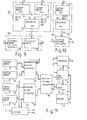
- the illustrated device comprises a rejection discriminator 71.
- the control unit 33 produces a discrimination initiating signal k at the beginning of each interval of time during which the first address signal indicates one of the first through the I-th integers i's of the first set.
- the pattern rejection technique will now be described in greater detail.
- the recurrence values f(i, j) shows a generally monotonous increase with an increase in the integers i's of the first set.
- the recurrence values successively calculated for a reference pattern V within an interval of time during which the first address signal indicates the i-th integer i, namely, the recurrence values [f(i, j)'s] i-j will now be denoted by f i (j).
- the overflow signal m If the positive overflow continues, namely, the overflow signal m always takes the first signal value, throughout the interval under consideration, t ne recurrence values f.(j) and the subsequently calculated recurrence values f i+1 (j) through f I (j) are greater than the first preselected value N 1 .
- the overall distance f(I, J) would have an appreciably great value.
- the pattern matching operation for such a reference pattern V is meaningless and should be rejected or discontinued. Only when the overflow signal m does not always take the first signal value during the interval in question, calculation of tne subsequent recurrence values f i+1 (j) and so forth should be carried on. In other woras, the pattern matching operation should be kept in progress.
- the rejection discriminator 71 monitors the overflow signal m and produces a signal pulse x if the overflow signal always takes the first signal value throughout an interval during which the first address signal i indicates a certain one of the instants of the first timing sequence.
- Tne signal pulse x is supplied back to the control unit 33 to stop generation of the first and the second address signals and thereby to discontinue the pattern matching operation.
- the control unit 33 may change the above-mentioned pattern specifying signal to specify another of the reference patterns V's.
- the signal pulse may furthermore be delivered to other part or parts of tne pattern recognition system.
- the discrimination initiating signal k may be a sequence of timed pulses building up to a logic one level from a logic zero level and down to the logic zero level at the leading end portions of tne respective intervals of time.
- the second address signal j makes tne second instant signal g designate a plurality of reference pattern extracting instants q(j)'s conditioned by Equation (11).
- Such instants q(j)'s are denoted by q(i - r'), q(i - r' + 1), ..., and q(i + r'), where r' represents a positive integer decided by the window length r and the i-th integer i.
- Instant pairs (p(i), q(i - r')) and so on, are exemplified in Fig. 7 by the encircled dots.
- the rejection discriminator 71 comprises a decoder 76 for decoding the overflow signal m to produce a pulse signal y only when the overflow signal taxes either of the second and the third signal values.
- a flip-flop 77 is set by each timed pulse k supplied to tne set input terminal thereof to produce a set output signal z switched to the logic one level from the logic zero level at the trailing edge of the timed pulse k.
- the pulse signal y when produced, is supplied to the reset input terminal of the flip-flop 77 to switch the set output signal z from the logic one level back to the logic zero level at the trailing edge of tne pulse signal.
- the set output signal z of the logic one level is for enabling an AND gate 78 to allow passesge therethrough of the timed pulse k as the signal pulse x. Inasmuch as the set output signal z is turned back to the logic zero level and kept there before later switched to the logic one level at the beginnig of the next following interval in which the first address signal i indicates the (i+l)-th instant p(i + 1), no signal pulse x appears. The pattern matching operation is kept in progress.
- Fig. 15 (B). another case is shown in which the positive overflow continues throughout the interval for the i-th instant p(i).
- the set output signal z is kept at the logic one level.
- the timed pulse k produced at the beginning of the interval for the (i+1)-th instant p(i + 1) passes through the AND gate 78 (Fig. 14) as a signal pulse x.
- the pattern matching operation should be rejected if the negative overflow, rather than the positive one, continues throughout an interval of time for a certain instant of tne first time sequence under the circumstances of tne type descrioed above.
- the work memory 41 may produce the previous recurrence value signal g -1 , f -1 , or f -1 ' as a plurality of parallel signals, such as the signals g 1 through g 3 described in connection with Fig. 1.
- the rejection discriminator 71 may be implemented by various other circuit elements. Furthermore, the signal levels exemplified with reference to Figs. 15 (A) and (3) are optional insofar as the rejection operation is properly carried out.
- the timing memories 36 and 37 may be loaded with the timing sequences of the intervals and spacings defined by Equations (7) and (8).
- the pattern matching device is of the type illustrated with reference to Fig. 6, 10. or 11, it is possible to omit the weighting factor calculator 38 with the weighted distance calculator 39 rendered, on using also the additional similarity measures of Equation (16) or (l8), capable of dividing the respective weighting factors by two.
- Such a device is equivalent to the device in which the timing sequences of Equations (4) and (6) are used.
- the control unit 33 should sum up the intervals s i 's and the spacings t j 's so as to provide the i-th and the j-th instants p(i)'s and q(j)'s.
- the device comprising the weighting factor calculator 38 as illustrated with reference to Fig. 6, 10, or 11, is equivalent to a device instead comprising the weighting and compensation factor calculator 63.
Landscapes
- Engineering & Computer Science (AREA)
- Physics & Mathematics (AREA)
- Health & Medical Sciences (AREA)
- Multimedia (AREA)
- Audiology, Speech & Language Pathology (AREA)
- Theoretical Computer Science (AREA)
- Acoustics & Sound (AREA)
- Human Computer Interaction (AREA)
- Computer Vision & Pattern Recognition (AREA)
- Computational Linguistics (AREA)
- Software Systems (AREA)
- Computing Systems (AREA)
- General Physics & Mathematics (AREA)
- Artificial Intelligence (AREA)
- Databases & Information Systems (AREA)
- Medical Informatics (AREA)
- General Health & Medical Sciences (AREA)
- Evolutionary Computation (AREA)
- Image Analysis (AREA)
- Complex Calculations (AREA)
- Image Processing (AREA)
Applications Claiming Priority (2)
| Application Number | Priority Date | Filing Date | Title |
|---|---|---|---|
| JP32060/81 | 1981-03-06 | ||
| JP56032060A JPS57147781A (en) | 1981-03-06 | 1981-03-06 | Pattern matching device |
Publications (3)
| Publication Number | Publication Date |
|---|---|
| EP0059959A2 true EP0059959A2 (de) | 1982-09-15 |
| EP0059959A3 EP0059959A3 (en) | 1984-03-28 |
| EP0059959B1 EP0059959B1 (de) | 1987-11-19 |
Family
ID=12348331
Family Applications (1)
| Application Number | Title | Priority Date | Filing Date |
|---|---|---|---|
| EP82101757A Expired EP0059959B1 (de) | 1981-03-06 | 1982-03-05 | System, um die Übereinstimmung von Mustern zu erreichen |
Country Status (5)
| Country | Link |
|---|---|
| US (1) | US4467437A (de) |
| EP (1) | EP0059959B1 (de) |
| JP (1) | JPS57147781A (de) |
| CA (1) | CA1179779A (de) |
| DE (1) | DE3277711D1 (de) |
Families Citing this family (47)
| Publication number | Priority date | Publication date | Assignee | Title |
|---|---|---|---|---|
| US4608708A (en) * | 1981-12-24 | 1986-08-26 | Nippon Electric Co., Ltd. | Pattern matching system |
| JPS58115490A (ja) * | 1981-12-29 | 1983-07-09 | 日本電気株式会社 | パタン間距離計算装置 |
| JP2595495B2 (ja) * | 1982-09-03 | 1997-04-02 | 日本電気株式会社 | パタンマッチング装置 |
| JPS59183158A (ja) * | 1983-03-31 | 1984-10-18 | Aisin Warner Ltd | 車両用自動変速機の制御装置 |
| US5131043A (en) * | 1983-09-05 | 1992-07-14 | Matsushita Electric Industrial Co., Ltd. | Method of and apparatus for speech recognition wherein decisions are made based on phonemes |
| FR2554623B1 (fr) * | 1983-11-08 | 1986-08-14 | Texas Instruments France | Procede d'analyse de la parole independant du locuteur |
| AU586167B2 (en) * | 1984-05-25 | 1989-07-06 | Sony Corporation | Speech recognition method and apparatus thereof |
| US4718094A (en) * | 1984-11-19 | 1988-01-05 | International Business Machines Corp. | Speech recognition system |
| JPS61145599A (ja) * | 1984-12-19 | 1986-07-03 | 日本電気株式会社 | 連続音声認識装置 |
| EP0216902A4 (de) * | 1985-04-02 | 1989-02-20 | Fingermatrix Inc | Übereinstimmungsprüfer. |
| US4696046A (en) * | 1985-08-02 | 1987-09-22 | Fingermatrix, Inc. | Matcher |
| US4852181A (en) * | 1985-09-26 | 1989-07-25 | Oki Electric Industry Co., Ltd. | Speech recognition for recognizing the catagory of an input speech pattern |
| US4885791A (en) * | 1985-10-18 | 1989-12-05 | Matsushita Electric Industrial Co., Ltd. | Apparatus for speech recognition |
| US4820059A (en) * | 1985-10-30 | 1989-04-11 | Central Institute For The Deaf | Speech processing apparatus and methods |
| EP0243479A4 (de) * | 1985-10-30 | 1989-12-13 | Central Inst Deaf | Sprachverarbeitungsanordnung und -verfahren. |
| US4751737A (en) * | 1985-11-06 | 1988-06-14 | Motorola Inc. | Template generation method in a speech recognition system |
| US4827521A (en) * | 1986-03-27 | 1989-05-02 | International Business Machines Corporation | Training of markov models used in a speech recognition system |
| US4805121A (en) * | 1986-05-30 | 1989-02-14 | Dba Systems, Inc. | Visual training apparatus |
| JPS63158596A (ja) * | 1986-12-23 | 1988-07-01 | 株式会社東芝 | 音韻類似度計算装置 |
| US4842710A (en) * | 1987-03-23 | 1989-06-27 | Siemens Aktiengesellschaft | Method of making mixed nitride films with at least two metals |
| US4905162A (en) * | 1987-03-30 | 1990-02-27 | Digital Equipment Corporation | Evaluation system for determining analogy and symmetric comparison among objects in model-based computation systems |
| DE3711342A1 (de) * | 1987-04-03 | 1988-10-20 | Philips Patentverwaltung | Verfahren zum erkennen zusammenhaengend gesprochener woerter |
| DE3819178A1 (de) * | 1987-06-04 | 1988-12-22 | Ricoh Kk | Spracherkennungsverfahren und -einrichtung |
| WO1988010413A1 (en) * | 1987-06-09 | 1988-12-29 | Central Institute For The Deaf | Speech processing apparatus and methods |
| US4899290A (en) * | 1987-10-16 | 1990-02-06 | Digital Equipment Corporation | System for specifying and executing protocols for using iterative analogy and comparative induction in a model-based computation system |
| US5214719A (en) * | 1989-02-28 | 1993-05-25 | Phoenix Imaging | Computer-based system and method for character recognition |
| JPH0821065B2 (ja) * | 1989-03-13 | 1996-03-04 | シャープ株式会社 | 文字認識装置 |
| JPH0782544B2 (ja) * | 1989-03-24 | 1995-09-06 | インターナショナル・ビジネス・マシーンズ・コーポレーション | マルチテンプレートを用いるdpマツチング方法及び装置 |
| EP0441176B1 (de) * | 1990-01-25 | 1994-03-30 | Mitsubishi Jidosha Kogyo Kabushiki Kaisha | Regelsystem für die Antriebsleistung von Kraftfahrzeugen |
| WO1992006469A1 (en) * | 1990-10-02 | 1992-04-16 | The Dsp Group, Inc. | Boundary relaxation for speech pattern recognition |
| JPH04194999A (ja) * | 1990-11-27 | 1992-07-14 | Sharp Corp | 学習を用いた動的計画法 |
| US5438676A (en) * | 1991-05-10 | 1995-08-01 | Siemens Corporate Research, Inc. | Method for adapting a similarity function for identifying misclassified software objects |
| EP0513652A2 (de) * | 1991-05-10 | 1992-11-19 | Siemens Aktiengesellschaft | Verfahren zur Modellierung einer Ähnlichkeitsfunktion mittels eines Neuronalnetzes |
| US5440742A (en) * | 1991-05-10 | 1995-08-08 | Siemens Corporate Research, Inc. | Two-neighborhood method for computing similarity between two groups of objects |
| US5317741A (en) * | 1991-05-10 | 1994-05-31 | Siemens Corporate Research, Inc. | Computer method for identifying a misclassified software object in a cluster of internally similar software objects |
| US5428788A (en) * | 1991-05-10 | 1995-06-27 | Siemens Corporate Research, Inc. | Feature ratio method for computing software similarity |
| US5485621A (en) * | 1991-05-10 | 1996-01-16 | Siemens Corporate Research, Inc. | Interactive method of using a group similarity measure for providing a decision on which groups to combine |
| JP2980420B2 (ja) * | 1991-07-26 | 1999-11-22 | 富士通株式会社 | 動的計画法照合装置 |
| US5189709A (en) * | 1991-08-26 | 1993-02-23 | The United States Of America As Represented By The United States National Aeronautics And Space Administration | Dynamic pattern matcher using incomplete data |
| JP3706646B2 (ja) * | 1993-10-22 | 2005-10-12 | キヤノン株式会社 | Ocrの制御方法並びに分類方法及び装置 |
| JP3114468B2 (ja) * | 1993-11-25 | 2000-12-04 | 松下電器産業株式会社 | 音声認識方法 |
| US6052481A (en) * | 1994-09-02 | 2000-04-18 | Apple Computers, Inc. | Automatic method for scoring and clustering prototypes of handwritten stroke-based data |
| IL113204A (en) * | 1995-03-30 | 1999-03-12 | Advanced Recognition Tech | Pattern recognition system |
| US6195638B1 (en) * | 1995-03-30 | 2001-02-27 | Art-Advanced Recognition Technologies Inc. | Pattern recognition system |
| US20050240397A1 (en) * | 2004-04-22 | 2005-10-27 | Samsung Electronics Co., Ltd. | Method of determining variable-length frame for speech signal preprocessing and speech signal preprocessing method and device using the same |
| JP2007047575A (ja) * | 2005-08-11 | 2007-02-22 | Canon Inc | パターンマッチング方法およびその装置、および音声情報検索システム |
| KR102697424B1 (ko) * | 2016-11-07 | 2024-08-21 | 삼성전자주식회사 | 대표 파형 제공 장치 및 방법 |
Family Cites Families (3)
| Publication number | Priority date | Publication date | Assignee | Title |
|---|---|---|---|---|
| JPS5529803A (en) * | 1978-07-18 | 1980-03-03 | Nippon Electric Co | Continuous voice discriminating device |
| JPS55157799A (en) * | 1979-05-29 | 1980-12-08 | Nippon Electric Co | High efficiency pattern matching unit |
| US4412098A (en) * | 1979-09-10 | 1983-10-25 | Interstate Electronics Corporation | Audio signal recognition computer |
-
1981
- 1981-03-06 JP JP56032060A patent/JPS57147781A/ja active Granted
-
1982
- 1982-03-01 US US06/353,293 patent/US4467437A/en not_active Expired - Lifetime
- 1982-03-05 CA CA000397662A patent/CA1179779A/en not_active Expired
- 1982-03-05 EP EP82101757A patent/EP0059959B1/de not_active Expired
- 1982-03-05 DE DE8282101757T patent/DE3277711D1/de not_active Expired
Non-Patent Citations (1)
| Title |
|---|
| IEEE TRANSACTIONS ON ACOUSTICS, SPEECH, AND SIGNAL PROCESSING, vol. ASSP-26, no. 6, December 1978, pages 583-586, New York, USA * |
Also Published As
| Publication number | Publication date |
|---|---|
| EP0059959B1 (de) | 1987-11-19 |
| JPS612996B2 (de) | 1986-01-29 |
| CA1179779A (en) | 1984-12-18 |
| DE3277711D1 (en) | 1987-12-23 |
| US4467437A (en) | 1984-08-21 |
| EP0059959A3 (en) | 1984-03-28 |
| JPS57147781A (en) | 1982-09-11 |
Similar Documents
| Publication | Publication Date | Title |
|---|---|---|
| EP0059959A2 (de) | System, um die Übereinstimmung von Mustern zu erreichen | |
| US4282403A (en) | Pattern recognition with a warping function decided for each reference pattern by the use of feature vector components of a few channels | |
| US4256924A (en) | Device for recognizing an input pattern with approximate patterns used for reference patterns on mapping | |
| US4319221A (en) | Similarity calculator comprising a buffer for a single input pattern feature vector to be pattern matched with reference patterns | |
| US4479236A (en) | Pattern matching device operable with signals of a compressed dynamic range | |
| Rabiner et al. | Isolated and connected word recognition-theory and selected applications | |
| US6092045A (en) | Method and apparatus for speech recognition | |
| JP2795058B2 (ja) | 時系列信号処理装置 | |
| US4363102A (en) | Speaker identification system using word recognition templates | |
| US4513435A (en) | System operable as an automaton for recognizing continuously spoken words with reference to demi-word pair reference patterns | |
| US6374212B2 (en) | System and apparatus for recognizing speech | |
| US5377301A (en) | Technique for modifying reference vector quantized speech feature signals | |
| US5621858A (en) | Neural network acoustic and visual speech recognition system training method and apparatus | |
| EP0082000B1 (de) | Anpassungssystem mit dynamischer Programmierung zur Erkennung einer Wörterfolge | |
| US6278970B1 (en) | Speech transformation using log energy and orthogonal matrix | |
| US4015088A (en) | Real-time speech analyzer | |
| US5073939A (en) | Dynamic time warping (DTW) apparatus for use in speech recognition systems | |
| US4827521A (en) | Training of markov models used in a speech recognition system | |
| US5602960A (en) | Continuous mandarin chinese speech recognition system having an integrated tone classifier | |
| US4049913A (en) | System for recognizing speech continuously spoken with number of word or words preselected | |
| EP0694906A1 (de) | Verfahren und Vorrichtung zur Spracherkennung | |
| US6226613B1 (en) | Decoding input symbols to input/output hidden markoff models | |
| EP0112717B1 (de) | Einrichtung zur Erkennung kontinuierlicher Sprache | |
| US4799262A (en) | Speech recognition | |
| Robinson | Several improvements to a recurrent error propagation network phone recognition system |
Legal Events
| Date | Code | Title | Description |
|---|---|---|---|
| PUAI | Public reference made under article 153(3) epc to a published international application that has entered the european phase |
Free format text: ORIGINAL CODE: 0009012 |
|
| AK | Designated contracting states |
Designated state(s): DE FR GB IT |
|
| RAP1 | Party data changed (applicant data changed or rights of an application transferred) |
Owner name: NEC CORPORATION |
|
| PUAL | Search report despatched |
Free format text: ORIGINAL CODE: 0009013 |
|
| AK | Designated contracting states |
Designated state(s): DE FR GB IT |
|
| 17P | Request for examination filed |
Effective date: 19840330 |
|
| RIN1 | Information on inventor provided before grant (corrected) |
Inventor name: SAKOE, HIROAKI Inventor name: TSURUTA, SHICHIRO |
|
| GRAA | (expected) grant |
Free format text: ORIGINAL CODE: 0009210 |
|
| AK | Designated contracting states |
Kind code of ref document: B1 Designated state(s): DE FR GB IT |
|
| REF | Corresponds to: |
Ref document number: 3277711 Country of ref document: DE Date of ref document: 19871223 |
|
| ET | Fr: translation filed | ||
| ITF | It: translation for a ep patent filed | ||
| PLBE | No opposition filed within time limit |
Free format text: ORIGINAL CODE: 0009261 |
|
| STAA | Information on the status of an ep patent application or granted ep patent |
Free format text: STATUS: NO OPPOSITION FILED WITHIN TIME LIMIT |
|
| 26N | No opposition filed | ||
| ITTA | It: last paid annual fee | ||
| PGFP | Annual fee paid to national office [announced via postgrant information from national office to epo] |
Ref country code: GB Payment date: 19960301 Year of fee payment: 15 |
|
| PGFP | Annual fee paid to national office [announced via postgrant information from national office to epo] |
Ref country code: FR Payment date: 19960321 Year of fee payment: 15 |
|
| PGFP | Annual fee paid to national office [announced via postgrant information from national office to epo] |
Ref country code: DE Payment date: 19960530 Year of fee payment: 15 |
|
| PG25 | Lapsed in a contracting state [announced via postgrant information from national office to epo] |
Ref country code: GB Effective date: 19970305 |
|
| GBPC | Gb: european patent ceased through non-payment of renewal fee |
Effective date: 19970305 |
|
| PG25 | Lapsed in a contracting state [announced via postgrant information from national office to epo] |
Ref country code: FR Free format text: LAPSE BECAUSE OF NON-PAYMENT OF DUE FEES Effective date: 19971128 |
|
| PG25 | Lapsed in a contracting state [announced via postgrant information from national office to epo] |
Ref country code: DE Effective date: 19971202 |
|
| REG | Reference to a national code |
Ref country code: FR Ref legal event code: ST |