EP0058290B1 - Composition of a road surfacing mass - Google Patents
Composition of a road surfacing mass Download PDFInfo
- Publication number
- EP0058290B1 EP0058290B1 EP81850237A EP81850237A EP0058290B1 EP 0058290 B1 EP0058290 B1 EP 0058290B1 EP 81850237 A EP81850237 A EP 81850237A EP 81850237 A EP81850237 A EP 81850237A EP 0058290 B1 EP0058290 B1 EP 0058290B1
- Authority
- EP
- European Patent Office
- Prior art keywords
- asphalt
- fibre
- mass
- stone material
- temperature
- Prior art date
- Legal status (The legal status is an assumption and is not a legal conclusion. Google has not performed a legal analysis and makes no representation as to the accuracy of the status listed.)
- Expired
Links
- 239000000203 mixture Substances 0.000 title claims description 11
- 239000000463 material Substances 0.000 claims abstract description 74
- 239000010426 asphalt Substances 0.000 claims abstract description 64
- 239000000835 fiber Substances 0.000 claims abstract description 64
- 239000004575 stone Substances 0.000 claims abstract description 50
- 238000002156 mixing Methods 0.000 claims abstract description 21
- 229910052500 inorganic mineral Inorganic materials 0.000 claims abstract description 20
- 239000011707 mineral Substances 0.000 claims abstract description 20
- 238000004519 manufacturing process Methods 0.000 claims abstract description 4
- 230000006835 compression Effects 0.000 claims abstract description 3
- 238000007906 compression Methods 0.000 claims abstract description 3
- 238000000034 method Methods 0.000 claims description 13
- 230000008719 thickening Effects 0.000 claims description 4
- 239000000080 wetting agent Substances 0.000 claims description 3
- 239000008240 homogeneous mixture Substances 0.000 claims description 2
- 238000010438 heat treatment Methods 0.000 abstract description 3
- 239000011230 binding agent Substances 0.000 description 11
- 238000012856 packing Methods 0.000 description 9
- 230000000694 effects Effects 0.000 description 8
- LYCAIKOWRPUZTN-UHFFFAOYSA-N Ethylene glycol Chemical compound OCCO LYCAIKOWRPUZTN-UHFFFAOYSA-N 0.000 description 6
- 239000002245 particle Substances 0.000 description 5
- 238000012423 maintenance Methods 0.000 description 3
- 229940093476 ethylene glycol Drugs 0.000 description 2
- 238000003756 stirring Methods 0.000 description 2
- 238000009736 wetting Methods 0.000 description 2
- 229910000746 Structural steel Inorganic materials 0.000 description 1
- XAGFODPZIPBFFR-UHFFFAOYSA-N aluminium Chemical compound [Al] XAGFODPZIPBFFR-UHFFFAOYSA-N 0.000 description 1
- 229910052782 aluminium Inorganic materials 0.000 description 1
- 150000003868 ammonium compounds Chemical class 0.000 description 1
- 239000010425 asbestos Substances 0.000 description 1
- 230000015572 biosynthetic process Effects 0.000 description 1
- 230000000052 comparative effect Effects 0.000 description 1
- 150000001875 compounds Chemical class 0.000 description 1
- 238000001816 cooling Methods 0.000 description 1
- 238000006073 displacement reaction Methods 0.000 description 1
- 230000002349 favourable effect Effects 0.000 description 1
- 239000000945 filler Substances 0.000 description 1
- 239000011888 foil Substances 0.000 description 1
- 238000005259 measurement Methods 0.000 description 1
- 238000002844 melting Methods 0.000 description 1
- 230000008018 melting Effects 0.000 description 1
- 239000011490 mineral wool Substances 0.000 description 1
- 238000012986 modification Methods 0.000 description 1
- 230000004048 modification Effects 0.000 description 1
- 230000003014 reinforcing effect Effects 0.000 description 1
- 229910052895 riebeckite Inorganic materials 0.000 description 1
- 239000002002 slurry Substances 0.000 description 1
- 239000000126 substance Substances 0.000 description 1
- 239000004094 surface-active agent Substances 0.000 description 1
- 238000012546 transfer Methods 0.000 description 1
- XLYOFNOQVPJJNP-UHFFFAOYSA-N water Substances O XLYOFNOQVPJJNP-UHFFFAOYSA-N 0.000 description 1
Images

Classifications
-
- E—FIXED CONSTRUCTIONS
- E01—CONSTRUCTION OF ROADS, RAILWAYS, OR BRIDGES
- E01C—CONSTRUCTION OF, OR SURFACES FOR, ROADS, SPORTS GROUNDS, OR THE LIKE; MACHINES OR AUXILIARY TOOLS FOR CONSTRUCTION OR REPAIR
- E01C7/00—Coherent pavings made in situ
- E01C7/08—Coherent pavings made in situ made of road-metal and binders
- E01C7/18—Coherent pavings made in situ made of road-metal and binders of road-metal and bituminous binders
- E01C7/26—Coherent pavings made in situ made of road-metal and binders of road-metal and bituminous binders mixed with other materials, e.g. cement, rubber, leather, fibre
- E01C7/262—Coherent pavings made in situ made of road-metal and binders of road-metal and bituminous binders mixed with other materials, e.g. cement, rubber, leather, fibre with fibrous material, e.g. asbestos; with animal or vegetal admixtures, e.g. leather, cork
-
- E—FIXED CONSTRUCTIONS
- E01—CONSTRUCTION OF ROADS, RAILWAYS, OR BRIDGES
- E01C—CONSTRUCTION OF, OR SURFACES FOR, ROADS, SPORTS GROUNDS, OR THE LIKE; MACHINES OR AUXILIARY TOOLS FOR CONSTRUCTION OR REPAIR
- E01C11/00—Details of pavings
- E01C11/16—Reinforcements
- E01C11/165—Reinforcements particularly for bituminous or rubber- or plastic-bound pavings
-
- E—FIXED CONSTRUCTIONS
- E01—CONSTRUCTION OF ROADS, RAILWAYS, OR BRIDGES
- E01C—CONSTRUCTION OF, OR SURFACES FOR, ROADS, SPORTS GROUNDS, OR THE LIKE; MACHINES OR AUXILIARY TOOLS FOR CONSTRUCTION OR REPAIR
- E01C19/00—Machines, tools or auxiliary devices for preparing or distributing paving materials, for working the placed materials, or for forming, consolidating, or finishing the paving
- E01C19/02—Machines, tools or auxiliary devices for preparing or distributing paving materials, for working the placed materials, or for forming, consolidating, or finishing the paving for preparing the materials
- E01C19/10—Apparatus or plants for premixing or precoating aggregate or fillers with non-hydraulic binders, e.g. with bitumen, with resins, i.e. producing mixtures or coating aggregates otherwise than by penetrating or surface dressing; Apparatus for premixing non-hydraulic mixtures prior to placing or for reconditioning salvaged non-hydraulic compositions
- E01C19/1013—Plant characterised by the mode of operation or the construction of the mixing apparatus; Mixing apparatus
-
- E—FIXED CONSTRUCTIONS
- E01—CONSTRUCTION OF ROADS, RAILWAYS, OR BRIDGES
- E01C—CONSTRUCTION OF, OR SURFACES FOR, ROADS, SPORTS GROUNDS, OR THE LIKE; MACHINES OR AUXILIARY TOOLS FOR CONSTRUCTION OR REPAIR
- E01C19/00—Machines, tools or auxiliary devices for preparing or distributing paving materials, for working the placed materials, or for forming, consolidating, or finishing the paving
- E01C19/02—Machines, tools or auxiliary devices for preparing or distributing paving materials, for working the placed materials, or for forming, consolidating, or finishing the paving for preparing the materials
- E01C19/10—Apparatus or plants for premixing or precoating aggregate or fillers with non-hydraulic binders, e.g. with bitumen, with resins, i.e. producing mixtures or coating aggregates otherwise than by penetrating or surface dressing; Apparatus for premixing non-hydraulic mixtures prior to placing or for reconditioning salvaged non-hydraulic compositions
- E01C19/1059—Controlling the operations; Devices solely for supplying or proportioning the ingredients
- E01C19/1068—Supplying or proportioning the ingredients
- E01C19/1072—Supplying or proportioning the ingredients the solid ingredients
-
- E—FIXED CONSTRUCTIONS
- E01—CONSTRUCTION OF ROADS, RAILWAYS, OR BRIDGES
- E01C—CONSTRUCTION OF, OR SURFACES FOR, ROADS, SPORTS GROUNDS, OR THE LIKE; MACHINES OR AUXILIARY TOOLS FOR CONSTRUCTION OR REPAIR
- E01C7/00—Coherent pavings made in situ
- E01C7/08—Coherent pavings made in situ made of road-metal and binders
- E01C7/18—Coherent pavings made in situ made of road-metal and binders of road-metal and bituminous binders
- E01C7/182—Aggregate or filler materials, except those according to E01C7/26
Definitions
- the present invention relates to a method of manufacturing and the use of a compression resistant and highly stable surfacing mass for heavy loaded surfaces, especially for high traffic and heavy loaded parts of streets and roads, the surfacing mass mainly comprising a stone material which is bound by an asphalt mass, as defined in the first part of claim 1.
- a lack of stability in the surfacing mass comes to the effect that the mass is deformed especially due to the fact that the vehicle wheels depending on where unpacking of the surfacing mass provides lowered wheel tracks in the road way which necessitate an expensive maintenance. On the said exposed places the maintenance work further is difficult to carry out and causes traffic disturbances to a higher degree than normal road maintenance.
- the demands on the properties of the binder increases correspondingly, and in practice the character of the binder has become the most important factor for the stability of the surfacing mass.
- the binding capacity may be increased by adding an increasing amount of binder in relation to the amount of stone material.
- asphalt run-off what means that the hot asphalt during the mixing of asphalt with the stone material runs off the stone particles, what both counteracts the intension of increasing the amount of binder, and also causes problems at storing and transport.
- the stability of the surfacing masses is not substantially increased, possibly depending on the so called cold flow of the asphalt.
- a mineral fibre material having a small fibre diameter preferably a fibre material having an average diameter which is less than 5 pm and in which the particles are even distributed in the asphalt mainly as separate fibres strongly reduces or eliminates the above mentioned cold flow problem of the binder or the asphalt.
- a binder phase is obtained giving the ready surfacing mass substantially increased stability as compared with previously known surfacing masses without giving a too high viscosity at mixing temperatures for a quick and careful mixing.
- the increased stability depends on an increased strength of the binder which probably depends both on the increased thickness of the binder film around the stone grains and also that the added fibre material, which is evenly distributed as separate fibres in the asphalt, as a reinforcing action.
- fibres may be used many different types of material provided that the fibres do not melt in the asphalt which during the mixing with the stone material is kept at a temperature of 140-170°C or preferably 150-160°C and also supposing that the fibres are sufficiently stiff and maintain at least a substantial stiffness in the hot asphalt. It has shown that a particularly suitable material is mineral fibres, for instance stone fibres, viz. fibres manufactured by melting stone like diabas and a subsequent fibrating of the melted stone.
- the average fibre diameter should be less than 5 ,um.
- the average fibre diameter is less than 1 ,um the favourable effect of the fibres is obviously reduced, probably in that the thin fibres irrevocably are shortened substantially during the mixing operation.
- the average fibre diameter consequently should be between 1 pm and 5 ,um.
- the fibres should be added in an amount by weight of 0.5 and 20% as calculated on the weight of asphalt, what corresponds to about 0.03-1.2% by weight of the ready surfacing mass.
- the fibres are not present in the form of tots or other baked together aggregates. This can be avoided by a correct admixing techniques.
- all kinds of non-polar compounds can be used, or instance wetting agents like catjonic tensides in the form of tertiary or quartery ammonium compounds.
- the fibres are as dry as possible when being admixed in the asphalt, and for obaining an effect similar to the above mentioned treatment with a wetting agent it may be advantageous to dry the fibres before mixing the fibres into the asphalt or surfacing masses so the main part of the water molecules normally absorbed to the surfaces of the fibres are removed.
- the admixing of the fibres may be made by adding the fibres to the stone material before the asphalt is admixed therein or the fibres may be admixed into the ready asphalt-stone mass.
- An especially good effect, however, is obtained if the fibres are mixed with the asphalt mass before adding said mass to the stone material. This facilitates the mixing and the equilizing of the fibres, and the mixing of the fibre material and the asphalt material can be made indulgently to the fibres so that the fibres are not broken.
- Uneven and tot free distribution of the fibres in the asphalt is further favourized if the asphalt in connection to the admixing of the asphalt is heated, for instance to 20-40 0 C over the temperature of about 150-160°C which the asphalt material and the stone material are mixed, whereupon the asphalt-fibre mixture is cooled to said temperature and is admixed in the stone material.
- the temperature increase reduces the viscosity of the asphalt and thereby facilitates a homogenous and indulgent admixing of the fibre material, and further the wetting of the fibre surfaces is facilitated at the said increased temperature, and the dispersing of the fibres in the asphalt is made quickly and effectively.
- n f the so called thickening number (n f ) is defined, which is calculated by the formula in which n is the viscosity of a slurry of 1.5 g dry fibre in 200 ml ethyleneglycol at 20°C and in which ⁇ o is the viscosity of the same ethyleneglycol without fibres likewise at 20°C and measured with the same equipment, viz. a Brook- field viscosimeter having a spindle LV1 or corresponding.
- the thickening number is 1.0-5.0.
- the height position for eight different points along the center line of the frame is measured in relation to the frame.
- the mutual distance between the points is 200 mm.
- the measuring points are provided by a circular disc having a diameter of 20 mm which is put on the measuring point.
- a cylindric roll having a length of 100 mm and a diameter of 350 mm and loaded by 2000 N (200 kg) is rolled five times in both directions over the mass along the center line.
- the height of the above mentioned measuring points are once again noted and the difference to the original height is utilized as a measurement on the post-packing of the mass.
- the values are compared with corresponding values of post-packing of a normal mass, whereby the following value bases are used:
- Example 1 the mass had an obvious post- packing tendency.
- Example 1 was repeated with the same type of mineral fibre but of different length for the admixed fibre.
- the amount of admixed fibres and the results are made account for in the following table.
- Example 2 a comparative mineral fibre having an average diameter of 6-8 gm, but for the rest the method according to Example 1 above was repeated.
- an apparatus for manufacture of a surfacing mass In a tank 1 having heating coils 2 an asphalt mass 3 is heated to normal mixing temperature or, as mentioned above, to a temperature which is 20-40°C above said mixing temperature.
- a pump 4 By means of a pump 4 the hot asphalt is batchwise pumped over to a mixing container 5 which is formed with a stirring device 6, and to which mineral fibres are batchwise added from a container 7.
- the asphalt fibre mass After stirring to provide a homogenous mixture the asphalt fibre mass is pumped through a heat exchanger 9 by means of a pump 8, in which heat exchanger the temperature of the asphalt fibre mixture is adjusted to correct temperature for being mixed with the stone mass.
- the mass is cooled, and if the mixture is made at the normal admixing temperature at for instance 150-160C and some cooling may have occurred during the handling of the mass some adjustment for increasing the temperature may be necessary.
- the stone material is heated in a container 10 having heating means 11 and from there the stone material is batchwise transferred to a rotating mixer drum 12.
- the mass coming from the mixing container 5 for asphalt and mineral fibre is likewise pumped batchwise through the heat exchanger 9 to the mixer drum 12 and is mixed with a stone material with the same temperature for the two phases.
- the mineral fibre material can be supplied directly from the mineral fibre container 7 to the mixer drum 12 for asphalt and stone material, and in this case, of course, the asphalt is also pumped directly from the asphalt tank 1 to the mixture drum 12.
Landscapes
- Engineering & Computer Science (AREA)
- Architecture (AREA)
- Civil Engineering (AREA)
- Structural Engineering (AREA)
- Road Paving Structures (AREA)
- Compositions Of Macromolecular Compounds (AREA)
- Glass Compositions (AREA)
- Transition And Organic Metals Composition Catalysts For Addition Polymerization (AREA)
- Application Of Or Painting With Fluid Materials (AREA)
- Soil Conditioners And Soil-Stabilizing Materials (AREA)
Abstract
Description
- The present invention relates to a method of manufacturing and the use of a compression resistant and highly stable surfacing mass for heavy loaded surfaces, especially for high traffic and heavy loaded parts of streets and roads, the surfacing mass mainly comprising a stone material which is bound by an asphalt mass, as defined in the first part of
claim 1. - The progress of the traffic in streets and roads, both as concerns the traffic intensity and the weight of the individual vehicles, has caused great demands on the stability of the road surfaces. This is to a special degree the case for exposed places like in front of traffic lights, at cross roads, at roundabouts etc., where surfaces masses comprising a stone material having asphalt as a binder often show to have insufficient stability.
- A lack of stability in the surfacing mass comes to the effect that the mass is deformed especially due to the fact that the vehicle wheels depending on where unpacking of the surfacing mass provides lowered wheel tracks in the road way which necessitate an expensive maintenance. On the said exposed places the maintenance work further is difficult to carry out and causes traffic disturbances to a higher degree than normal road maintenance.
- Attempts have been made to solve the problem involved in lack of stability by using so called skeleton masses i.e. masses in which the grain size in the stone material is graded, so that the load mainly is transferred over coarse stone grains which support each other. Thereby it has been possible to reduce the risk for settlings or packings, since the stone particles of the stone material have less possibility of regrouping the fewer stones take part in the transfer of load.
- The demands on the properties of the binder, however, increases correspondingly, and in practice the character of the binder has become the most important factor for the stability of the surfacing mass. Thus it is important that the binder locks the stone particles effectively in their taken positions and prevents displacements or regroupings of the stone particles. The binding capacity may be increased by adding an increasing amount of binder in relation to the amount of stone material. In such case, however, there may be problems with so called asphalt run-off, what means that the hot asphalt during the mixing of asphalt with the stone material runs off the stone particles, what both counteracts the intension of increasing the amount of binder, and also causes problems at storing and transport. The stability of the surfacing masses is not substantially increased, possibly depending on the so called cold flow of the asphalt.
- Attempts have been made to solve these problems by adding a fine grain filler material, but the result does not seem to have been satisfactory. Obviously the skeleton principle partly gets lost when adding a fine grain filling material.
- Attempts have been made to solve the problem by adding asbestos-fibres, but asbestos-fibres do not seem to give the skeleton masses sufficient increase to stability for the amounts which can be used technically. The reason for this probably is the tendency of the asbestos-fibres to hook to each other thereby forming larger aggregates. The knowledge of the health risk with asbestos-fibres further makes it out of question to use asbestos for road covering.
- In the Swedish patent 211,163 a surfacing material is described which comprises mineral fibres having a diameter of between 5 and 15 ,um, also the suggested coarse mineral fibres have proved not to be useful. Probably such fibres tend to orientate parallelly to the stone surfaces of the asphalt-stone mass and thereby to the plane of the binder film. Therefore they hardly contribute to the stability of the skeleton mass. None of the suggested methods has come to any substantial practical use.
- The above mentioned problems are solved by the method according to the characterising part of
claim 1. - Surprisingly it has now shown that an addition of a mineral fibre material having a small fibre diameter preferably a fibre material having an average diameter which is less than 5 pm and in which the particles are even distributed in the asphalt mainly as separate fibres strongly reduces or eliminates the above mentioned cold flow problem of the binder or the asphalt. Thereby a binder phase is obtained giving the ready surfacing mass substantially increased stability as compared with previously known surfacing masses without giving a too high viscosity at mixing temperatures for a quick and careful mixing. The increased stability depends on an increased strength of the binder which probably depends both on the increased thickness of the binder film around the stone grains and also that the added fibre material, which is evenly distributed as separate fibres in the asphalt, as a reinforcing action.
- As fibres may be used many different types of material provided that the fibres do not melt in the asphalt which during the mixing with the stone material is kept at a temperature of 140-170°C or preferably 150-160°C and also supposing that the fibres are sufficiently stiff and maintain at least a substantial stiffness in the hot asphalt. It has shown that a particularly suitable material is mineral fibres, for instance stone fibres, viz. fibres manufactured by melting stone like diabas and a subsequent fibrating of the melted stone.
- As mentioned above the average fibre diameter should be less than 5 ,um. When the average fibre diameter is less than 1 ,um the favourable effect of the fibres is obviously reduced, probably in that the thin fibres irrevocably are shortened substantially during the mixing operation. The average fibre diameter consequently should be between 1 pm and 5 ,um. For giving the intended effect the fibres should be added in an amount by weight of 0.5 and 20% as calculated on the weight of asphalt, what corresponds to about 0.03-1.2% by weight of the ready surfacing mass.
- It is important that the fibres are not present in the form of tots or other baked together aggregates. This can be avoided by a correct admixing techniques. For facilitating the distribution of the fibres and for avoiding formation of tots and for providing an optimum wetting of the fibre surfaces with asphalt it may be advantageous to treat the surfaces of the fibres with some suitable substance. For this purpose all kinds of non-polar compounds can be used, or instance wetting agents like catjonic tensides in the form of tertiary or quartery ammonium compounds.
- It is also advantageous that the fibres are as dry as possible when being admixed in the asphalt, and for obaining an effect similar to the above mentioned treatment with a wetting agent it may be advantageous to dry the fibres before mixing the fibres into the asphalt or surfacing masses so the main part of the water molecules normally absorbed to the surfaces of the fibres are removed.
- The admixing of the fibres may be made by adding the fibres to the stone material before the asphalt is admixed therein or the fibres may be admixed into the ready asphalt-stone mass. An especially good effect, however, is obtained if the fibres are mixed with the asphalt mass before adding said mass to the stone material. This facilitates the mixing and the equilizing of the fibres, and the mixing of the fibre material and the asphalt material can be made indulgently to the fibres so that the fibres are not broken.
- Uneven and tot free distribution of the fibres in the asphalt is further favourized if the asphalt in connection to the admixing of the asphalt is heated, for instance to 20-400C over the temperature of about 150-160°C which the asphalt material and the stone material are mixed, whereupon the asphalt-fibre mixture is cooled to said temperature and is admixed in the stone material. The temperature increase reduces the viscosity of the asphalt and thereby facilitates a homogenous and indulgent admixing of the fibre material, and further the wetting of the fibre surfaces is facilitated at the said increased temperature, and the dispersing of the fibres in the asphalt is made quickly and effectively.
- For estimating the effect of the admixing of the fibre material on the stability of the asphalt surfacing a number of fibre masses were made according to three different methods and within each group with different amounts of admixed fibre material.
- In a mixing apparatus for asphalt masses was introduced 1,100 kg of a stone material having a predetermined distribution of the average grain size. The stone material was heated to 160°C, and to the stone material was added 5,8 kg of a mineral fibre material named "INORPHIL 057"a by the manufacturer Rock- wool AB which material has an average fibre diameter of 3 pm and in which the main parts of the fibres are within the area of between 1 and 5 um.
- For characterizing the fibre length there are no acceptdble direct method. Therefore preferably the so called thickening number (nf) is defined, which is calculated by the formula

- To the mixture of stone material and fibre material was admixed 195 kg asphalt. After finished mixing the mass was taken out and the stability and postpacking tendency was measured. This is made according to the following method:
- A predetermined amount of the surfacing mass is put into a frame of angle iron 80x80 mm. The frame has a length of 2,000 mm and a width of 400 mm and is lying on a concrete floor. The surfacing mass is isolated from the concrete floor by an aluminum foil.
- After two days (48 hours) at about 18°C the height position for eight different points along the center line of the frame is measured in relation to the frame. The mutual distance between the points is 200 mm. The measuring points are provided by a circular disc having a diameter of 20 mm which is put on the measuring point.
- Thereafter a cylindric roll having a length of 100 mm and a diameter of 350 mm and loaded by 2000 N (200 kg) is rolled five times in both directions over the mass along the center line. The height of the above mentioned measuring points are once again noted and the difference to the original height is utilized as a measurement on the post-packing of the mass. The values are compared with corresponding values of post-packing of a normal mass, whereby the following value bases are used:
- "Normal", 0.8-1.2 times the deformation of the normal mass;
- "Slight postpacking" 1.2-1.6 times the deformation of the normal mass;
- "Obvious postpacking", more than 1.6 times the deformation of the normal mass.
- In Example 1 the mass had an obvious post- packing tendency.
- Example 1 was repeated with the same type of mineral fibre but of different length for the admixed fibre. The amount of admixed fibres and the results are made account for in the following table.
- In these examples the mineral fibre material was admixed in the hot asphalt before the asphalt-mineral fibre mixture was added to the stone material and was mixed therewith. The results are shown in the table.
- In these Examples the asphalt was heated to 190°C, whereupon the mineral fibre material was admixed in the asphalt, the asphalt-mineral fibre mixture was cooled to 160°C and was admixed in the stone material. The results are shown in the table.
- In this Example was used a comparative mineral fibre having an average diameter of 6-8 gm, but for the rest the method according to Example 1 above was repeated.
- In this case was used the same type of mineral fibre as in Examples 1-12 above, but in order to determine the effect of the fibre length, the fibre material was ground, whereby the fibre material obtained a thickening number of 0.2.
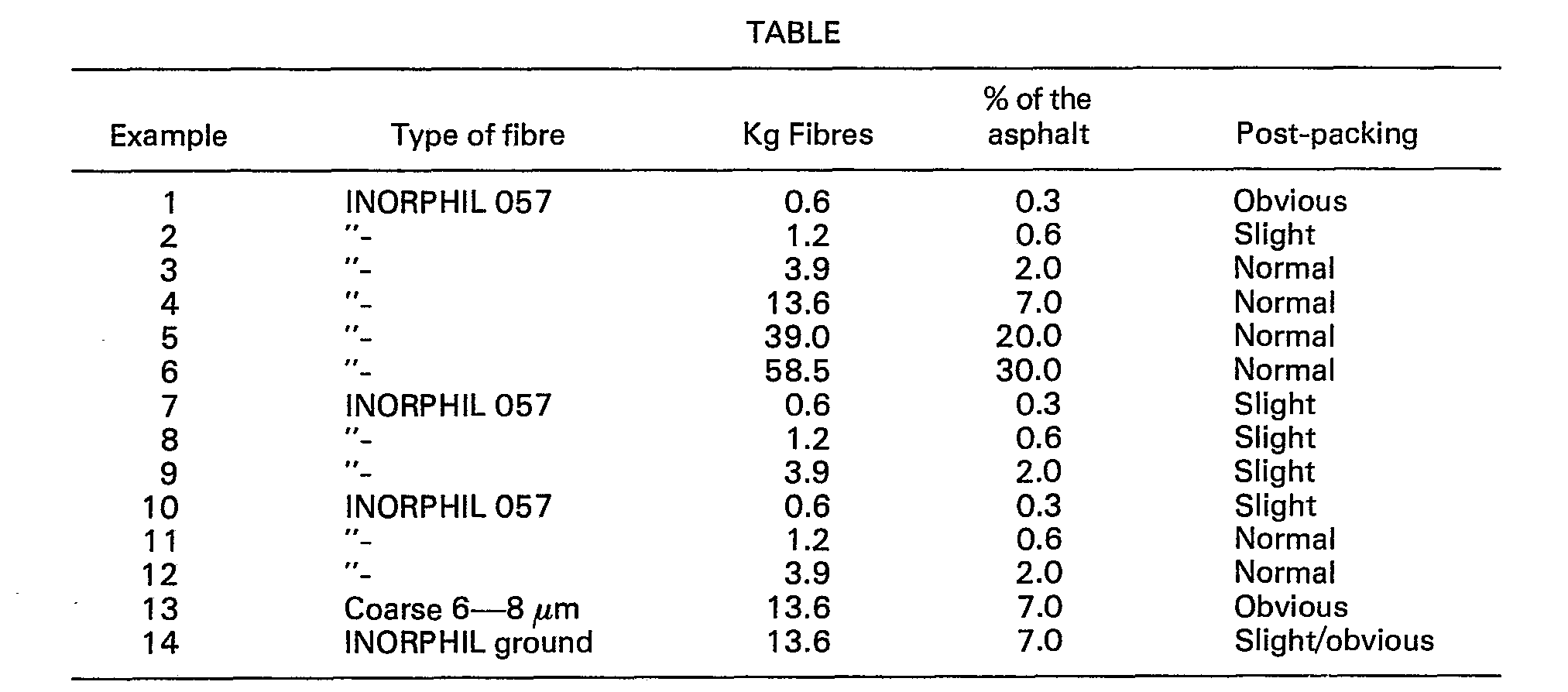
- From the above table it is evident that even the least amount of admixed fibre has a substantially effect on the stability and the post- packing tendency of the material. When adding 0.3% by weight of the fibre material of the indicated type there is an obvious post-packing tendency according to Example 1, and according to Example 7 there is a slight post-packing tendency. In case that about 0.5 or a higher percentage of mineral fibre is admixed a normal post-packing is obtained. This is especially the case when the admixing follows according to Examples 7-9 and 10-12 respectively. The table also shows that coarse fibre according to Example 13 gives an obvious post-packing tendency and that also fibres having an average diameter of less than 5 pm give substantially better property than the coarser fibres. The table also shows that the fibre length has some effect in that the ground fibre material is used in Example 14 gives an obvious postpacking tendency.
- In the accompanying drawing is diagrammatically shown an apparatus for manufacture of a surfacing mass according to the invention. In a
tank 1 havingheating coils 2 an asphalt mass 3 is heated to normal mixing temperature or, as mentioned above, to a temperature which is 20-40°C above said mixing temperature. By means of a pump 4 the hot asphalt is batchwise pumped over to a mixingcontainer 5 which is formed with a stirringdevice 6, and to which mineral fibres are batchwise added from acontainer 7. After stirring to provide a homogenous mixture the asphalt fibre mass is pumped through aheat exchanger 9 by means of a pump 8, in which heat exchanger the temperature of the asphalt fibre mixture is adjusted to correct temperature for being mixed with the stone mass. In case the mixture of asphalt and mineral fibre is made at elevated temperature the mass is cooled, and if the mixture is made at the normal admixing temperature at for instance 150-160C and some cooling may have occurred during the handling of the mass some adjustment for increasing the temperature may be necessary. - The stone material is heated in a
container 10 having heating means 11 and from there the stone material is batchwise transferred to arotating mixer drum 12. The mass coming from the mixingcontainer 5 for asphalt and mineral fibre is likewise pumped batchwise through theheat exchanger 9 to themixer drum 12 and is mixed with a stone material with the same temperature for the two phases. - As previously mentioned the mineral fibre material can be supplied directly from the
mineral fibre container 7 to themixer drum 12 for asphalt and stone material, and in this case, of course, the asphalt is also pumped directly from theasphalt tank 1 to themixture drum 12. - It is to be understood that the above specification and the apparatus illustrated in the drawings are only illustrating examples, and that many different modifications may be presented within the scope of the appended claims.
Claims (8)
Priority Applications (1)
| Application Number | Priority Date | Filing Date | Title |
|---|---|---|---|
| AT81850237T ATE8283T1 (en) | 1980-12-19 | 1981-12-08 | COMPOSITION OF A ROAD PAVING COMPOUND. |
Applications Claiming Priority (2)
| Application Number | Priority Date | Filing Date | Title |
|---|---|---|---|
| SE8009021 | 1980-12-19 | ||
| SE8009021A SE441938B (en) | 1980-12-19 | 1980-12-19 | PROCEDURE FOR PREPARING A PRESSURE HALL FIXED AND HIGH-STABLE COATING MASS FOR HIGHLY LOADED SURFACES |
Publications (2)
| Publication Number | Publication Date |
|---|---|
| EP0058290A1 EP0058290A1 (en) | 1982-08-25 |
| EP0058290B1 true EP0058290B1 (en) | 1984-07-04 |
Family
ID=20342535
Family Applications (1)
| Application Number | Title | Priority Date | Filing Date |
|---|---|---|---|
| EP81850237A Expired EP0058290B1 (en) | 1980-12-19 | 1981-12-08 | Composition of a road surfacing mass |
Country Status (8)
| Country | Link |
|---|---|
| EP (1) | EP0058290B1 (en) |
| JP (1) | JPS57127003A (en) |
| AT (1) | ATE8283T1 (en) |
| DE (1) | DE3164615D1 (en) |
| DK (1) | DK152850B (en) |
| FI (1) | FI72993C (en) |
| NO (1) | NO165641C (en) |
| SE (1) | SE441938B (en) |
Cited By (1)
| Publication number | Priority date | Publication date | Assignee | Title |
|---|---|---|---|---|
| DE102007027306A1 (en) * | 2007-06-10 | 2008-12-18 | Evonik Goldschmidt Gmbh | Use of a bonding agent for fibers, in particular for their introduction into bitumen-containing masses |
Families Citing this family (9)
| Publication number | Priority date | Publication date | Assignee | Title |
|---|---|---|---|---|
| JPS6076560A (en) * | 1983-10-03 | 1985-05-01 | Ube Ind Ltd | Asphalt mixture |
| GB2187272A (en) * | 1986-01-08 | 1987-09-03 | John Harry Clarke | Heat exchange apparatus |
| GB2215370A (en) * | 1988-03-10 | 1989-09-20 | Fibredec Ltd | Method of repairing or surfacing roads and the like |
| DE3930599A1 (en) * | 1989-09-13 | 1991-04-04 | Strabag Bau Ag | Cast asphalt for heavy duty traffic surfaces - contains reinforcing fibres esp. of polyacrylonitrile |
| FR2682308B1 (en) * | 1991-10-14 | 1995-04-21 | Screg Routes Travaux Publics | PROCESS AND STATION FOR COATING AGGREGATES WITH BITUMEN AND FIBERS, PARTICULARLY GLASS FIBERS, AND DEVICE FOR INCORPORATING A PARTICULATE PRODUCT INTO BITUMEN. |
| FR2721952B1 (en) * | 1994-07-01 | 1996-08-02 | Soc D Pavage Et Des Asphaltes | ASPHALT COULE ARME |
| FR2724952B1 (en) * | 1994-09-27 | 1996-12-20 | Orgel | PROCESS FOR REINFORCING SOILS, GROUND LAYERS OR PAVEMENTS BY WIRE OF GLASS |
| FR2770235A1 (en) * | 1997-10-23 | 1999-04-30 | Et L Entretien Des Routes Sa P | Mineral metalling for road surfaces |
| JP6531022B2 (en) * | 2015-10-06 | 2019-06-12 | 大成ロテック株式会社 | Method for producing cold construction type asphalt mixture and cold construction type asphalt mixture |
Family Cites Families (6)
| Publication number | Priority date | Publication date | Assignee | Title |
|---|---|---|---|---|
| NL6815771A (en) * | 1968-01-09 | 1969-07-11 | ||
| US3822340A (en) * | 1972-03-27 | 1974-07-02 | Franklin Key | Calcium sulfate whisker fibers and the method for the manufacture thereof |
| JPS51139819A (en) * | 1975-05-29 | 1976-12-02 | Mitsui Toatsu Chemicals | Composite of paving asphalt |
| US4175978A (en) * | 1977-03-17 | 1979-11-27 | Owens-Corning Fiberglas Corporation | Road pavement and repair |
| CH638005A5 (en) * | 1978-12-06 | 1983-08-31 | Kibag Ag | METHOD FOR PRODUCING A BLACK COVER, AND A BLACK COVER PRODUCED THEREOF. |
| FI67072C (en) * | 1979-02-09 | 1985-01-10 | Amiantus Ag | FOER FARING FOER FRAMSTAELLNING AV FIBERFOERSTAERKT HYDRAULISKT BINDANDE MATERIAL |
-
1980
- 1980-12-19 SE SE8009021A patent/SE441938B/en unknown
-
1981
- 1981-12-08 DE DE8181850237T patent/DE3164615D1/en not_active Expired
- 1981-12-08 AT AT81850237T patent/ATE8283T1/en active
- 1981-12-08 EP EP81850237A patent/EP0058290B1/en not_active Expired
- 1981-12-17 DK DK561781A patent/DK152850B/en not_active Application Discontinuation
- 1981-12-18 FI FI814083A patent/FI72993C/en not_active IP Right Cessation
- 1981-12-18 NO NO814354A patent/NO165641C/en unknown
- 1981-12-18 JP JP56203860A patent/JPS57127003A/en active Granted
Cited By (1)
| Publication number | Priority date | Publication date | Assignee | Title |
|---|---|---|---|---|
| DE102007027306A1 (en) * | 2007-06-10 | 2008-12-18 | Evonik Goldschmidt Gmbh | Use of a bonding agent for fibers, in particular for their introduction into bitumen-containing masses |
Also Published As
| Publication number | Publication date |
|---|---|
| FI814083L (en) | 1982-06-20 |
| DE3164615D1 (en) | 1984-08-09 |
| FI72993B (en) | 1987-04-30 |
| SE441938B (en) | 1985-11-18 |
| NO814354L (en) | 1982-06-21 |
| JPH0235802B2 (en) | 1990-08-14 |
| DK152850B (en) | 1988-05-24 |
| FI72993C (en) | 1987-08-10 |
| SE8009021L (en) | 1982-06-20 |
| JPS57127003A (en) | 1982-08-07 |
| NO165641C (en) | 1991-03-13 |
| EP0058290A1 (en) | 1982-08-25 |
| ATE8283T1 (en) | 1984-07-15 |
| NO165641B (en) | 1990-12-03 |
| DK561781A (en) | 1982-06-20 |
Similar Documents
| Publication | Publication Date | Title |
|---|---|---|
| US20240270648A1 (en) | Methods & compositions to increase performance of asphalt cement concrete comprising recycled asphalt pavement | |
| DE69014459T2 (en) | Method and device for producing a coating on a surface, e.g. A street. | |
| EP0324491B1 (en) | Method and machine for renewing a road surface of bituminous mix, with cold application of the recycled covering material | |
| DE10392508B4 (en) | Bound grinding tool, grinding wheel grinding method and deep grinding method | |
| EP0058290A1 (en) | Composition of a road surfacing mass | |
| CN104762862B (en) | SMA asphaltic road-mix surface course construction methods | |
| US7939154B2 (en) | Road and repair materials including magnetite and methods regarding same | |
| US6220782B1 (en) | Method and apparatus for altering an aggregate gradation mixture of an asphalt concrete mixture | |
| JPH06146212A (en) | Method and device for stabilizing or repairing damaged road | |
| CN112195713A (en) | Asphalt laying method for road construction | |
| JP2000344562A (en) | Regenerated heating larger-sized asphalt mixture and its production and constructing method of pavement using the same | |
| EP0545740B1 (en) | Process for double cold mixing of granular material for road construction | |
| US4155654A (en) | Apparatus for continuous preparation of sulfur asphalt binders and paving compositions | |
| US4613376A (en) | Asphalt surfacing mass | |
| CN112960938B (en) | A kind of wear-resistant asphalt concrete pavement and construction method thereof | |
| US1954997A (en) | Production of asphalt paving mixtures | |
| CA2222072A1 (en) | A method of preparing and producing asphalt materials to be laid out as a cold road construction or paving material | |
| EP1098937B1 (en) | A method for manufacturing granulated mastic asphalt | |
| McQuillen Jr et al. | Construction of rubber-modified asphalt pavements | |
| US20040146351A1 (en) | Road repair material | |
| DE69502428T2 (en) | Recycled rubber-containing hot bituminous pavement mix | |
| DE2703414B2 (en) | Abrasion and corrosion resistant material for lining machine parts and lines and processes for their manufacture | |
| EP0055233A1 (en) | Composition of a surfacing mass | |
| CN117843264A (en) | Application of diabase and basalt in pavement slurry seal | |
| JP2000063677A (en) | Asphalt composition |
Legal Events
| Date | Code | Title | Description |
|---|---|---|---|
| PUAI | Public reference made under article 153(3) epc to a published international application that has entered the european phase |
Free format text: ORIGINAL CODE: 0009012 |
|
| 17P | Request for examination filed |
Effective date: 19820521 |
|
| AK | Designated contracting states |
Designated state(s): AT BE CH DE FR GB IT LU NL |
|
| ITF | It: translation for a ep patent filed | ||
| GRAA | (expected) grant |
Free format text: ORIGINAL CODE: 0009210 |
|
| AK | Designated contracting states |
Designated state(s): AT BE CH DE FR GB IT LI LU NL |
|
| REF | Corresponds to: |
Ref document number: 8283 Country of ref document: AT Date of ref document: 19840715 Kind code of ref document: T |
|
| REF | Corresponds to: |
Ref document number: 3164615 Country of ref document: DE Date of ref document: 19840809 |
|
| ET | Fr: translation filed | ||
| BECN | Be: change of holder's name |
Effective date: 19840704 |
|
| PLBE | No opposition filed within time limit |
Free format text: ORIGINAL CODE: 0009261 |
|
| STAA | Information on the status of an ep patent application or granted ep patent |
Free format text: STATUS: NO OPPOSITION FILED WITHIN TIME LIMIT |
|
| 26N | No opposition filed | ||
| NLS | Nl: assignments of ep-patents |
Owner name: LAXA BRUK AB TE LAXA EN AKTIEBOLAGET SKANSKA CEMEN |
|
| ITPR | It: changes in ownership of a european patent |
Owner name: CESSIONE;LAXA BRUK A.B. |
|
| REG | Reference to a national code |
Ref country code: FR Ref legal event code: TP |
|
| REG | Reference to a national code |
Ref country code: GB Ref legal event code: 732 |
|
| ITTA | It: last paid annual fee | ||
| REG | Reference to a national code |
Ref country code: CH Ref legal event code: PUE Owner name: LAXA BRUKS AKTIEBOLAG |
|
| EPTA | Lu: last paid annual fee | ||
| PGFP | Annual fee paid to national office [announced via postgrant information from national office to epo] |
Ref country code: AT Payment date: 19941229 Year of fee payment: 14 |
|
| PG25 | Lapsed in a contracting state [announced via postgrant information from national office to epo] |
Ref country code: AT Effective date: 19951208 |
|
| PGFP | Annual fee paid to national office [announced via postgrant information from national office to epo] |
Ref country code: LU Payment date: 19991201 Year of fee payment: 19 |
|
| PGFP | Annual fee paid to national office [announced via postgrant information from national office to epo] |
Ref country code: GB Payment date: 19991207 Year of fee payment: 19 |
|
| PGFP | Annual fee paid to national office [announced via postgrant information from national office to epo] |
Ref country code: BE Payment date: 19991214 Year of fee payment: 19 |
|
| PGFP | Annual fee paid to national office [announced via postgrant information from national office to epo] |
Ref country code: FR Payment date: 19991220 Year of fee payment: 19 |
|
| PGFP | Annual fee paid to national office [announced via postgrant information from national office to epo] |
Ref country code: DE Payment date: 19991222 Year of fee payment: 19 |
|
| PGFP | Annual fee paid to national office [announced via postgrant information from national office to epo] |
Ref country code: NL Payment date: 19991231 Year of fee payment: 19 |
|
| PGFP | Annual fee paid to national office [announced via postgrant information from national office to epo] |
Ref country code: CH Payment date: 20000308 Year of fee payment: 19 |
|
| PG25 | Lapsed in a contracting state [announced via postgrant information from national office to epo] |
Ref country code: LU Free format text: LAPSE BECAUSE OF EXPIRATION OF PROTECTION Effective date: 20001208 Ref country code: GB Free format text: LAPSE BECAUSE OF NON-PAYMENT OF DUE FEES Effective date: 20001208 |
|
| PG25 | Lapsed in a contracting state [announced via postgrant information from national office to epo] |
Ref country code: LI Free format text: LAPSE BECAUSE OF NON-PAYMENT OF DUE FEES Effective date: 20001231 Ref country code: CH Free format text: LAPSE BECAUSE OF NON-PAYMENT OF DUE FEES Effective date: 20001231 Ref country code: BE Free format text: LAPSE BECAUSE OF NON-PAYMENT OF DUE FEES Effective date: 20001231 |
|
| BERE | Be: lapsed |
Owner name: LAXA BRUK A.B. Effective date: 20001231 |
|
| PG25 | Lapsed in a contracting state [announced via postgrant information from national office to epo] |
Ref country code: NL Free format text: LAPSE BECAUSE OF NON-PAYMENT OF DUE FEES Effective date: 20010701 |
|
| GBPC | Gb: european patent ceased through non-payment of renewal fee |
Effective date: 20001208 |
|
| REG | Reference to a national code |
Ref country code: CH Ref legal event code: PL |
|
| PG25 | Lapsed in a contracting state [announced via postgrant information from national office to epo] |
Ref country code: FR Free format text: LAPSE BECAUSE OF NON-PAYMENT OF DUE FEES Effective date: 20010831 |
|
| NLV4 | Nl: lapsed or anulled due to non-payment of the annual fee |
Effective date: 20010701 |
|
| REG | Reference to a national code |
Ref country code: FR Ref legal event code: ST |
|
| PG25 | Lapsed in a contracting state [announced via postgrant information from national office to epo] |
Ref country code: DE Free format text: LAPSE BECAUSE OF NON-PAYMENT OF DUE FEES Effective date: 20011002 |