EP0057071B1 - Vorbehandlung von Einsatzmaterialien für die katalytische Entwachsung - Google Patents
Vorbehandlung von Einsatzmaterialien für die katalytische Entwachsung Download PDFInfo
- Publication number
- EP0057071B1 EP0057071B1 EP82300224A EP82300224A EP0057071B1 EP 0057071 B1 EP0057071 B1 EP 0057071B1 EP 82300224 A EP82300224 A EP 82300224A EP 82300224 A EP82300224 A EP 82300224A EP 0057071 B1 EP0057071 B1 EP 0057071B1
- Authority
- EP
- European Patent Office
- Prior art keywords
- zsm
- dewaxing
- fuel oil
- zeolite
- molecular sieve
- Prior art date
- Legal status (The legal status is an assumption and is not a legal conclusion. Google has not performed a legal analysis and makes no representation as to the accuracy of the status listed.)
- Expired
Links
- 230000003197 catalytic effect Effects 0.000 title description 23
- 239000010457 zeolite Substances 0.000 claims description 92
- HNPSIPDUKPIQMN-UHFFFAOYSA-N dioxosilane;oxo(oxoalumanyloxy)alumane Chemical compound O=[Si]=O.O=[Al]O[Al]=O HNPSIPDUKPIQMN-UHFFFAOYSA-N 0.000 claims description 61
- 229910021536 Zeolite Inorganic materials 0.000 claims description 58
- 239000003054 catalyst Substances 0.000 claims description 43
- 238000000034 method Methods 0.000 claims description 40
- 239000000295 fuel oil Substances 0.000 claims description 31
- 239000013078 crystal Substances 0.000 claims description 30
- 239000011148 porous material Substances 0.000 claims description 30
- 239000002808 molecular sieve Substances 0.000 claims description 29
- URGAHOPLAPQHLN-UHFFFAOYSA-N sodium aluminosilicate Chemical compound [Na+].[Al+3].[O-][Si]([O-])=O.[O-][Si]([O-])=O URGAHOPLAPQHLN-UHFFFAOYSA-N 0.000 claims description 29
- 230000008569 process Effects 0.000 claims description 28
- 239000002594 sorbent Substances 0.000 claims description 27
- 150000002430 hydrocarbons Chemical class 0.000 claims description 24
- 229930195733 hydrocarbon Natural products 0.000 claims description 23
- 239000004215 Carbon black (E152) Substances 0.000 claims description 20
- 239000003502 gasoline Substances 0.000 claims description 16
- 230000002939 deleterious effect Effects 0.000 claims description 14
- UFHFLCQGNIYNRP-UHFFFAOYSA-N Hydrogen Chemical compound [H][H] UFHFLCQGNIYNRP-UHFFFAOYSA-N 0.000 claims description 13
- 239000001257 hydrogen Substances 0.000 claims description 12
- 229910052739 hydrogen Inorganic materials 0.000 claims description 12
- 239000012535 impurity Substances 0.000 claims description 12
- 238000001179 sorption measurement Methods 0.000 claims description 12
- 125000004435 hydrogen atom Chemical group [H]* 0.000 claims description 10
- TVMXDCGIABBOFY-UHFFFAOYSA-N octane Chemical compound CCCCCCCC TVMXDCGIABBOFY-UHFFFAOYSA-N 0.000 claims description 9
- 238000009835 boiling Methods 0.000 claims description 7
- 238000011160 research Methods 0.000 claims description 4
- VYPSYNLAJGMNEJ-UHFFFAOYSA-N Silicium dioxide Chemical compound O=[Si]=O VYPSYNLAJGMNEJ-UHFFFAOYSA-N 0.000 description 26
- 239000003921 oil Substances 0.000 description 26
- PNEYBMLMFCGWSK-UHFFFAOYSA-N aluminium oxide Inorganic materials [O-2].[O-2].[O-2].[Al+3].[Al+3] PNEYBMLMFCGWSK-UHFFFAOYSA-N 0.000 description 14
- 238000006243 chemical reaction Methods 0.000 description 14
- 239000000377 silicon dioxide Substances 0.000 description 12
- 239000000126 substance Substances 0.000 description 11
- 239000007789 gas Substances 0.000 description 10
- 239000000463 material Substances 0.000 description 10
- 230000000694 effects Effects 0.000 description 8
- 239000007787 solid Substances 0.000 description 8
- 239000006227 byproduct Substances 0.000 description 7
- 239000000203 mixture Substances 0.000 description 7
- PXHVJJICTQNCMI-UHFFFAOYSA-N Nickel Chemical compound [Ni] PXHVJJICTQNCMI-UHFFFAOYSA-N 0.000 description 6
- 239000000356 contaminant Substances 0.000 description 6
- 239000002574 poison Substances 0.000 description 6
- 231100000614 poison Toxicity 0.000 description 6
- 239000000047 product Substances 0.000 description 6
- 239000003570 air Substances 0.000 description 5
- 238000001354 calcination Methods 0.000 description 5
- 150000001768 cations Chemical class 0.000 description 5
- 239000011159 matrix material Substances 0.000 description 5
- 238000007670 refining Methods 0.000 description 5
- 238000012360 testing method Methods 0.000 description 5
- XUIMIQQOPSSXEZ-UHFFFAOYSA-N Silicon Chemical group [Si] XUIMIQQOPSSXEZ-UHFFFAOYSA-N 0.000 description 4
- AZDRQVAHHNSJOQ-UHFFFAOYSA-N alumane Chemical group [AlH3] AZDRQVAHHNSJOQ-UHFFFAOYSA-N 0.000 description 4
- 229910052782 aluminium Inorganic materials 0.000 description 4
- XAGFODPZIPBFFR-UHFFFAOYSA-N aluminium Chemical compound [Al] XAGFODPZIPBFFR-UHFFFAOYSA-N 0.000 description 4
- 230000015572 biosynthetic process Effects 0.000 description 4
- VLKZOEOYAKHREP-UHFFFAOYSA-N n-Hexane Chemical compound CCCCCC VLKZOEOYAKHREP-UHFFFAOYSA-N 0.000 description 4
- 239000003208 petroleum Substances 0.000 description 4
- 230000009467 reduction Effects 0.000 description 4
- 239000001993 wax Substances 0.000 description 4
- IJGRMHOSHXDMSA-UHFFFAOYSA-N Atomic nitrogen Chemical compound N#N IJGRMHOSHXDMSA-UHFFFAOYSA-N 0.000 description 3
- UHOVQNZJYSORNB-UHFFFAOYSA-N Benzene Chemical compound C1=CC=CC=C1 UHOVQNZJYSORNB-UHFFFAOYSA-N 0.000 description 3
- CPLXHLVBOLITMK-UHFFFAOYSA-N Magnesium oxide Chemical compound [Mg]=O CPLXHLVBOLITMK-UHFFFAOYSA-N 0.000 description 3
- YXFVVABEGXRONW-UHFFFAOYSA-N Toluene Chemical compound CC1=CC=CC=C1 YXFVVABEGXRONW-UHFFFAOYSA-N 0.000 description 3
- MCMNRKCIXSYSNV-UHFFFAOYSA-N ZrO2 Inorganic materials O=[Zr]=O MCMNRKCIXSYSNV-UHFFFAOYSA-N 0.000 description 3
- 150000001340 alkali metals Chemical group 0.000 description 3
- QGZKDVFQNNGYKY-UHFFFAOYSA-O ammonium group Chemical group [NH4+] QGZKDVFQNNGYKY-UHFFFAOYSA-O 0.000 description 3
- 125000000129 anionic group Chemical group 0.000 description 3
- 239000002585 base Substances 0.000 description 3
- 230000008901 benefit Effects 0.000 description 3
- 238000004517 catalytic hydrocracking Methods 0.000 description 3
- 238000006555 catalytic reaction Methods 0.000 description 3
- 239000004927 clay Substances 0.000 description 3
- 239000000470 constituent Substances 0.000 description 3
- 239000001307 helium Substances 0.000 description 3
- 229910052734 helium Inorganic materials 0.000 description 3
- SWQJXJOGLNCZEY-UHFFFAOYSA-N helium atom Chemical compound [He] SWQJXJOGLNCZEY-UHFFFAOYSA-N 0.000 description 3
- 239000007788 liquid Substances 0.000 description 3
- 229910052759 nickel Inorganic materials 0.000 description 3
- 150000002892 organic cations Chemical class 0.000 description 3
- 230000008929 regeneration Effects 0.000 description 3
- 238000011069 regeneration method Methods 0.000 description 3
- 229910052710 silicon Inorganic materials 0.000 description 3
- 239000010703 silicon Substances 0.000 description 3
- 238000011282 treatment Methods 0.000 description 3
- WJYMPXJVHNDZHD-UHFFFAOYSA-N 1,3,5-triethylbenzene Chemical compound CCC1=CC(CC)=CC(CC)=C1 WJYMPXJVHNDZHD-UHFFFAOYSA-N 0.000 description 2
- PFEOZHBOMNWTJB-UHFFFAOYSA-N 3-methylpentane Chemical compound CCC(C)CC PFEOZHBOMNWTJB-UHFFFAOYSA-N 0.000 description 2
- YNQLUTRBYVCPMQ-UHFFFAOYSA-N Ethylbenzene Chemical compound CCC1=CC=CC=C1 YNQLUTRBYVCPMQ-UHFFFAOYSA-N 0.000 description 2
- KDLHZDBZIXYQEI-UHFFFAOYSA-N Palladium Chemical compound [Pd] KDLHZDBZIXYQEI-UHFFFAOYSA-N 0.000 description 2
- 230000004913 activation Effects 0.000 description 2
- 230000032683 aging Effects 0.000 description 2
- 229910052783 alkali metal Inorganic materials 0.000 description 2
- 235000012211 aluminium silicate Nutrition 0.000 description 2
- 150000003863 ammonium salts Chemical class 0.000 description 2
- 239000011230 binding agent Substances 0.000 description 2
- 238000004523 catalytic cracking Methods 0.000 description 2
- 230000008859 change Effects 0.000 description 2
- 238000005336 cracking Methods 0.000 description 2
- 238000000605 extraction Methods 0.000 description 2
- 239000012634 fragment Substances 0.000 description 2
- 239000000446 fuel Substances 0.000 description 2
- HYBBIBNJHNGZAN-UHFFFAOYSA-N furfural Chemical compound O=CC1=CC=CO1 HYBBIBNJHNGZAN-UHFFFAOYSA-N 0.000 description 2
- 239000000499 gel Substances 0.000 description 2
- 230000002209 hydrophobic effect Effects 0.000 description 2
- 229910052500 inorganic mineral Inorganic materials 0.000 description 2
- 229910003480 inorganic solid Inorganic materials 0.000 description 2
- 238000005342 ion exchange Methods 0.000 description 2
- NLYAJNPCOHFWQQ-UHFFFAOYSA-N kaolin Chemical compound O.O.O=[Al]O[Si](=O)O[Si](=O)O[Al]=O NLYAJNPCOHFWQQ-UHFFFAOYSA-N 0.000 description 2
- 239000000395 magnesium oxide Substances 0.000 description 2
- QSHDDOUJBYECFT-UHFFFAOYSA-N mercury Chemical compound [Hg] QSHDDOUJBYECFT-UHFFFAOYSA-N 0.000 description 2
- 229910052753 mercury Inorganic materials 0.000 description 2
- 229910052751 metal Inorganic materials 0.000 description 2
- 239000002184 metal Substances 0.000 description 2
- 229910044991 metal oxide Inorganic materials 0.000 description 2
- 150000004706 metal oxides Chemical class 0.000 description 2
- 239000011707 mineral Substances 0.000 description 2
- 238000002156 mixing Methods 0.000 description 2
- 229910052757 nitrogen Inorganic materials 0.000 description 2
- 229910017464 nitrogen compound Inorganic materials 0.000 description 2
- 150000002830 nitrogen compounds Chemical class 0.000 description 2
- 125000004430 oxygen atom Chemical group O* 0.000 description 2
- 239000002245 particle Substances 0.000 description 2
- 239000008188 pellet Substances 0.000 description 2
- 239000003209 petroleum derivative Substances 0.000 description 2
- 238000012545 processing Methods 0.000 description 2
- 239000000243 solution Substances 0.000 description 2
- 239000005995 Aluminium silicate Substances 0.000 description 1
- OYPRJOBELJOOCE-UHFFFAOYSA-N Calcium Chemical compound [Ca] OYPRJOBELJOOCE-UHFFFAOYSA-N 0.000 description 1
- RYGMFSIKBFXOCR-UHFFFAOYSA-N Copper Chemical compound [Cu] RYGMFSIKBFXOCR-UHFFFAOYSA-N 0.000 description 1
- 238000002441 X-ray diffraction Methods 0.000 description 1
- HCHKCACWOHOZIP-UHFFFAOYSA-N Zinc Chemical compound [Zn] HCHKCACWOHOZIP-UHFFFAOYSA-N 0.000 description 1
- 238000010306 acid treatment Methods 0.000 description 1
- 239000003463 adsorbent Substances 0.000 description 1
- 230000029936 alkylation Effects 0.000 description 1
- 238000005804 alkylation reaction Methods 0.000 description 1
- JYIBXUUINYLWLR-UHFFFAOYSA-N aluminum;calcium;potassium;silicon;sodium;trihydrate Chemical compound O.O.O.[Na].[Al].[Si].[K].[Ca] JYIBXUUINYLWLR-UHFFFAOYSA-N 0.000 description 1
- HPTYUNKZVDYXLP-UHFFFAOYSA-N aluminum;trihydroxy(trihydroxysilyloxy)silane;hydrate Chemical group O.[Al].[Al].O[Si](O)(O)O[Si](O)(O)O HPTYUNKZVDYXLP-UHFFFAOYSA-N 0.000 description 1
- 238000004458 analytical method Methods 0.000 description 1
- 125000004429 atom Chemical group 0.000 description 1
- QVGXLLKOCUKJST-UHFFFAOYSA-N atomic oxygen Chemical compound [O] QVGXLLKOCUKJST-UHFFFAOYSA-N 0.000 description 1
- LTPBRCUWZOMYOC-UHFFFAOYSA-N beryllium oxide Inorganic materials O=[Be] LTPBRCUWZOMYOC-UHFFFAOYSA-N 0.000 description 1
- -1 brewsterite Inorganic materials 0.000 description 1
- 229910052791 calcium Inorganic materials 0.000 description 1
- 239000011575 calcium Substances 0.000 description 1
- 238000001833 catalytic reforming Methods 0.000 description 1
- 125000002091 cationic group Chemical group 0.000 description 1
- 238000005119 centrifugation Methods 0.000 description 1
- 238000007385 chemical modification Methods 0.000 description 1
- 229910001603 clinoptilolite Inorganic materials 0.000 description 1
- 239000002131 composite material Substances 0.000 description 1
- 229910052802 copper Inorganic materials 0.000 description 1
- 239000010949 copper Substances 0.000 description 1
- 230000001419 dependent effect Effects 0.000 description 1
- 238000011161 development Methods 0.000 description 1
- 230000018109 developmental process Effects 0.000 description 1
- GUJOJGAPFQRJSV-UHFFFAOYSA-N dialuminum;dioxosilane;oxygen(2-);hydrate Chemical compound O.[O-2].[O-2].[O-2].[Al+3].[Al+3].O=[Si]=O.O=[Si]=O.O=[Si]=O.O=[Si]=O GUJOJGAPFQRJSV-UHFFFAOYSA-N 0.000 description 1
- 229910001649 dickite Inorganic materials 0.000 description 1
- 238000010790 dilution Methods 0.000 description 1
- 239000012895 dilution Substances 0.000 description 1
- 238000007323 disproportionation reaction Methods 0.000 description 1
- 238000004821 distillation Methods 0.000 description 1
- 238000002474 experimental method Methods 0.000 description 1
- 229910001657 ferrierite group Inorganic materials 0.000 description 1
- 238000004817 gas chromatography Methods 0.000 description 1
- 239000011521 glass Substances 0.000 description 1
- 230000012010 growth Effects 0.000 description 1
- 229910052621 halloysite Inorganic materials 0.000 description 1
- 238000010438 heat treatment Methods 0.000 description 1
- 229910052677 heulandite Inorganic materials 0.000 description 1
- 150000002431 hydrogen Chemical class 0.000 description 1
- 238000005984 hydrogenation reaction Methods 0.000 description 1
- 229910010272 inorganic material Inorganic materials 0.000 description 1
- 239000011147 inorganic material Substances 0.000 description 1
- 229910052809 inorganic oxide Inorganic materials 0.000 description 1
- 230000002427 irreversible effect Effects 0.000 description 1
- 238000006317 isomerization reaction Methods 0.000 description 1
- 229910052622 kaolinite Inorganic materials 0.000 description 1
- 239000012263 liquid product Substances 0.000 description 1
- 238000004519 manufacturing process Methods 0.000 description 1
- 238000005259 measurement Methods 0.000 description 1
- 238000002844 melting Methods 0.000 description 1
- 230000008018 melting Effects 0.000 description 1
- 229910052901 montmorillonite Inorganic materials 0.000 description 1
- 229910052680 mordenite Inorganic materials 0.000 description 1
- QJGQUHMNIGDVPM-UHFFFAOYSA-N nitrogen(.) Chemical compound [N] QJGQUHMNIGDVPM-UHFFFAOYSA-N 0.000 description 1
- 239000003960 organic solvent Substances 0.000 description 1
- 239000001301 oxygen Substances 0.000 description 1
- 229910052760 oxygen Inorganic materials 0.000 description 1
- 229910052763 palladium Inorganic materials 0.000 description 1
- 239000012188 paraffin wax Substances 0.000 description 1
- 230000000737 periodic effect Effects 0.000 description 1
- 238000005504 petroleum refining Methods 0.000 description 1
- 230000036619 pore blockages Effects 0.000 description 1
- 238000002459 porosimetry Methods 0.000 description 1
- 239000002244 precipitate Substances 0.000 description 1
- 239000002243 precursor Substances 0.000 description 1
- 229910052761 rare earth metal Inorganic materials 0.000 description 1
- 150000002910 rare earth metals Chemical class 0.000 description 1
- 230000009257 reactivity Effects 0.000 description 1
- 238000012552 review Methods 0.000 description 1
- 239000004576 sand Substances 0.000 description 1
- 238000000926 separation method Methods 0.000 description 1
- 235000012239 silicon dioxide Nutrition 0.000 description 1
- 238000010025 steaming Methods 0.000 description 1
- 229910052678 stilbite Inorganic materials 0.000 description 1
- 238000003860 storage Methods 0.000 description 1
- 238000006467 substitution reaction Methods 0.000 description 1
- HXJUTPCZVOIRIF-UHFFFAOYSA-N sulfolane Chemical compound O=S1(=O)CCCC1 HXJUTPCZVOIRIF-UHFFFAOYSA-N 0.000 description 1
- 150000003464 sulfur compounds Chemical class 0.000 description 1
- 230000002459 sustained effect Effects 0.000 description 1
- 238000003786 synthesis reaction Methods 0.000 description 1
- GWEVSGVZZGPLCZ-UHFFFAOYSA-N titanium dioxide Inorganic materials O=[Ti]=O GWEVSGVZZGPLCZ-UHFFFAOYSA-N 0.000 description 1
- 230000009466 transformation Effects 0.000 description 1
- XLYOFNOQVPJJNP-UHFFFAOYSA-N water Substances O XLYOFNOQVPJJNP-UHFFFAOYSA-N 0.000 description 1
- 239000008096 xylene Substances 0.000 description 1
- 150000003738 xylenes Chemical class 0.000 description 1
- 229910052725 zinc Inorganic materials 0.000 description 1
- 239000011701 zinc Substances 0.000 description 1
Images
Classifications
-
- C—CHEMISTRY; METALLURGY
- C10—PETROLEUM, GAS OR COKE INDUSTRIES; TECHNICAL GASES CONTAINING CARBON MONOXIDE; FUELS; LUBRICANTS; PEAT
- C10G—CRACKING HYDROCARBON OILS; PRODUCTION OF LIQUID HYDROCARBON MIXTURES, e.g. BY DESTRUCTIVE HYDROGENATION, OLIGOMERISATION, POLYMERISATION; RECOVERY OF HYDROCARBON OILS FROM OIL-SHALE, OIL-SAND, OR GASES; REFINING MIXTURES MAINLY CONSISTING OF HYDROCARBONS; REFORMING OF NAPHTHA; MINERAL WAXES
- C10G67/00—Treatment of hydrocarbon oils by at least one hydrotreatment process and at least one process for refining in the absence of hydrogen only
- C10G67/02—Treatment of hydrocarbon oils by at least one hydrotreatment process and at least one process for refining in the absence of hydrogen only plural serial stages only
- C10G67/06—Treatment of hydrocarbon oils by at least one hydrotreatment process and at least one process for refining in the absence of hydrogen only plural serial stages only including a sorption process as the refining step in the absence of hydrogen
Definitions
- This invention relates to a method for the catalytic dewaxing of waxy hydrocarbon fuel oils to produce dewaxed fuel oils of reduced pour point together with a gasoline fraction having an octane number greater than about 86.
- porous inorganic solids that were originally found useful for catalytic processes included certain clays, aluminas, silica-aluminas and other silicas coprecipitated with magnesia, for example, and such solids are still extensively used in the industry. In general, all of these solids had pores that were not of uniform size, and most of the pore volume was in pores having diameters larger than about 3 nm, with some of the pores as large or larger than 10 nm. However, a large fraction of the molecules present in a hydrocarbon feed, such as a gas oil, is capable of entering the pores of such typical porous solids. In recent years, much attention has been given to the synthesis and properties of a class of porous solids known as "molecular sieves".
- porous crystalline solids usually composed of silica and alumina and, because the pore structure is defined by the crystal lattice, the pores of any particular molecular sieve have a uniquely determined, uniform pore diameter.
- the pores of these crystals are further distinguished from those in the earlier used solids by being smaller, i.e., by having effective pore diameters not greater than about 1.3 nm.
- effective pore diameter means the diameter of the most constricted part of the channels of the dehydrated crystal as estimated from the diameter of the largest molecule that the crystal is capable of sorbing.
- Zeolite molecular sieves are available that have effective pore diameters ranging from about 0.3 nm, which is too small to allow occlusion of any hydrocarbon in the pores, to about 1.3 nm, which allows occlusion of molecules as large as 1,3,5-triethylbenzene.
- the structures and uses of these solids are described in "Zeolite Molecular Sieves," by Donald W. Breck, John Wiley and Sons, New York (1974). As indicated by Breck, the zeolite molecular sieves are useful as adsorbents (ibid, page 3), and in catalysts (ibid, page 2).
- a particularly interesting catalytic transformation which requires a molecular sieve catalyst is the reduction of the pour point of waxy distillates and residual hydrocarbon fractions.
- Effective pour point reduction depends on the selective conversion of normal high melting point paraffin molecules that have an effective critical diameter of about 0.5 nm into substances of lower molecular weight that are easily separated from the low-pour point product.
- Effective catalytic dewaxing depends at least in part on the regularity of the pore size of the crystalline zeolites, which allows selective conversion of unwanted constituents.
- the present invention is based on the observation that a fuel oil dewaxing process in which zeolite molecular sieve dewaxing catalysts is used becomes more effective when the fuel oil feed, prior to dewaxing, is contacted under certain sorption conditions with a zeolite molecular sieve having an effective pore diameter at least as large as that of the dewaxing catalyst.
- the term "more effective” used herein means that the dewaxing catalyst behaves as if it was catalytically more active or more resistant to aging when the feed stream is pretreated according to the invention.
- the refiner when using the method of the invention to reduce the pour point of a waxy feed to some predetermined temperature, may elect to take advantage of the increased catalyst activity by reducing the inventory of dewaxing catalyst or by reducing the operating temperature of the zeolite dewaxing catalyst from the temperature required by the prior art; or, he may elect to increase the space velocity of the feed and obtain more product with the same pour point reduction as was obtained by the prior art method; or, he may extend the cycle life of the dewaxing catalyst by running the process with a lower initial equilibrium temperature and finishing with the same end of cycle temperature as in the prior art.
- the process of the invention has the additional advantage that the dewaxing step produces a valuable high octane gasoline fraction as by-product, a feature that adds considerably to the economic attraction of the process.
- a process for catalytically dewaxing a waxy hydrocarbon fuel oil boiling in the range of 177 to 552°C which comprises contacting the fuel oil and hydrogen under dewaxing conditions with a catalyst comprising a molecular sieve zeolite having a Constraint Index from 1 to 12 and a dried crystal density in the hydrogen form of not less than 1.6 grams per cubic centimeter, to produce a dewaxed fuel oil of lower pour point than the waxy fuel oil, characterized in that
- pretreating the feed with a zeolite molecular sieve maintained under sorption conditions serves to increase the effectiveness of the dewaxing catalyst.
- the feed contains minute amounts of catalytically deleterious impurities which, in the prior art processes, were sorbed by the catalyst and served as catalyst poisons.
- the content of these poisons is reduced by the pretreatment according to the invention with the effect that the catalytic activity of the dewaxing catalyst appears to be increased or that the reactivity of the feed has been increased. It seems appropriate to consider the pretreatment as a method for refining the feed, and that term is used below to convey such a meaning.
- the precise nature or composition of the catalyst poisons is not known, but again one may speculate that basic nitrogen compounds, and oxygen and sulfur compounds, may be involved.
- the zeolite molecular sieve sorbent is unusually effective in increasing the apparent activity of the dewaxing catalyst. Substitution of a clay or other sorbent for the zeolite also may produce some increase, but of much lesser magnitude, even though the clay may remove a greater fraction of nitrogen compounds than is removed by the zeolite. And, although it may prove useful in some instances to measure basic nitrogen level, for example, as in index for degree of refinement of the feed, an example later presented herein suggests that such a measurement by itself may be misleading.
- the zeolite sorbent selectively removes and effectively retains those poisons that have a shape sufficiently small to enter the catalyst pores, leaving only the larger poisons available for contact with the catalyst. Since these can act only on non-selective surface sites, they may in some cases serve to increase the shape selectively of the dewaxing catalyst, or at worst to do little harm.
- Contemplated as within the scope of this invention is to regenerate the zeolite molecular sieve sorbent at intervals, as needed.
- the feed to be dewaxed by the process of this invention may be any waxy hydrocarbon fuel oil that has a pour point which is undesirably high.
- Petroleum distillates such as atmospheric tower gas oils, kerosenes, jet fuels and vacuum gas oils, are suitable feeds in this respect.
- the first step of the process of the invention requires that the waxy fuel oil feed is treated by contact with a sorbent under sorption conditions effective to remove at least some of the deleterious impurity. These conditions may cover a fairly wide range of time, temperature and pressure, and may be conducted in the absence of presence of hydrogen. The conditions, both broad and preferred, for this step of the process are indicated in Table I.
- contaminants The impurities deleterious to the catalysts, or poisons, will be referred to herein as "contaminants" regardless of whether these occur naturally associated with the feed or are acquired by the feed from some known or unknown source during transportation, processing, etc.
- the sorbent particles are in the form of a fixed bed of 0.16 cm to 0.64 cm extrudate or pellets
- other modes of contact may be employed such as slurrying the feed oil with a finely powdered sorbent followed by centrifugation and recycle of the sorbent.
- the precise conditions selected for the sorption step will be determined by various considerations, including the nature of the feed and the desired degree of refinement, the latter being judged from the observed catalytic consequences of the treatment.
- the sorbent consists of a molecular sieve zeolite having pores with an effective diameter of at least 0.5 nm, a Constraint Index from 1 to 12 and a dried crystal density in the hydrogen form of not less than 1.6 g/cc.
- Any of the zeolites described more fully below which are useful as dewaxing catalysts may be used as sorbents.
- the zeolite utilized as sorbent and as dewaxing catalyst have the same crystal structure.
- the pretreated feed is separated from the sorbent and passed to the catalytic dewaxing step where its pour point is reduced, usually by selective conversion of the high molecular weight waxes to more volatile hydrocarbon fragments.
- the feed is contacted with a dewaxing catalyst under sorption conditions, after which a pretreated feed is recovered and passed to storage.
- the material used as sorbent is then treated, for example with steam at elevated temperature, to remove the sorbed deleterious impurity, and the stored treated hydrocarbon is passed over the regenerated sorbent maintained at dewaxing conditions.
- the step of catalytically dewaxing the pretreated fuel oil feed is illustrated in U.S. Reissue Patent No. 28,398 and in U.S. Patent Nos. 3,956,102 and U.S. 4,137,148, for example. It will be understood, however, that the reaction conditions will be milder, in general, when adapting the dewaxing step to the pretreated fuel or feed.
- the dewaxing step may in general be conducted with or without hydrogen, although use of hydrogen is preferred. In general, the dewaxing step is carried out under the dewaxing conditions shown in Table II.
- a particularly preferred aspect of the dewaxing process of the invention is provided when the molecular sieve zeolite of the dewaxing catalyst is selected from a class of zeolitic materials which exhibit unusual properties.
- these zeolites have unusually low alumina contents, i.e. high silica to alumina mole ratios, they are very active even when the silica to alumina mole ratio exceeds 30.
- the activity is surprising since catalytic activity is generally attributed to framework aluminum atoms and/or cations associated with these aluminum atoms.
- These zeolites retain their crystallinity for long periods in spite of the presence of steam at high temperature which induces irreversible collapse of the framework of other zeolites, e.g.
- zeolites used as catalysts, generally have low coke- forming activity and therefore are conducive to long times on stream between regenerations.
- the structure provides a selective constrained access to and egress from the intercrystalline free space by virtue of having an effective pore size intermediate the small pore Linde A and the large pore Linde X, i.e. the pore windows of the structure are of about a size such as would be provided by 10-membered rings of silicon atoms interconnected by oxygen atoms. It is to be understood, of course, that these rings are those formed by the regular disposition of the tetrahedra making up the anionic framework of the crystalline zeolite, the oxygen atoms themselves being bonded to the silicon (or aluminum, etc). atoms at the centers of the tetrahedra.
- the silica to alumina mole ratio referred to may be determined by conventional analysis. This ratio is meant to represent, as closely as possible, the ratio in the rigid anionic framework of the Zeolite crystal and to exclude aluminum in the binder or in cationic or other form within the channels. Although zeolites with silica to alumina mole ratios of at least 12 are useful, it is preferred to use zeolites having higher ratios than about 30. In addition, zeolites as otherwise characterized herein but which are substantially free of aluminum, that is zeolites having silica to alumina mole ratios of up to infinity, are found to be useful and even preferable in some instances.
- Such "high silica” or “highly siliceous” zeolites are intended to be included within this description. Also included within this definition are substantially pure silica analogs of the useful zeolites described herein, that is to say those zeolites having no measurable amount of aluminum (silica to alumina mole ratio of infinity) but which otherwise embody the characteristics disclosed.
- This class of zeolites after activation, acquire an intracrystalline sorption capacity for normal hexane which is greater than that for water, i.e. they exhibit "hydrophobic" properties. This hydrophobic character can be used to advantage in some applications.
- zeolites have an effective pore size such as to freely sorb normal hexane.
- the structure must provide constrained access to larger molecules. It is sometimes possible to judge from a known crystal structure whether such constrined access exists. For example, if the only pore windows in a crystal are formed by 8-membered rings of silicon and aluminum atoms, then access by molecules of larger cross-section than normal hexane is excluded and the zeolite is not of the desired type. Windows of 10-membered rings are preferred, although in some instances excessive puckering of the rings or pore blockage may render these zeolites ineffective.
- a simple determination of the "Constraint Index" as herein defined may be made by passing continuously a mixture of an equal weight of normal hexane and 3-methylpentane over a sample of zeolite at atmospheric pressure according to the following procedure.
- a sample of the zeolite, in the form of pellets or extrudate, is crushed to a particle size about that of coarse sand and mounted in a glass tube.
- the zeolite Prior to testing, the zeolite is treated with a stream of air at 540°C for at least 15 minutes.
- the zeolite is then flushed with helium and the temperature is adjusted between 290°C and 510°C to give an overall conversion of between 10% and 60%.
- the mixture of hydrocarbons is passed at 1 liquid hourly space velocity (i.e., 1 volume of liquid hydrocarbon per volume of zeolite per hour) over the zeolite with a helium dilution to give a helium to (total) hydrocarbon mole ratio of 4:1.
- a sample of the effluent is taken and analyzed, most conveniently by gas chromatography, to determine the fraction remaining unchanged for each of the two hydrocarbons.
- Constraint Index approximates the ratio of the cracking rate constants for the two hydrocarbons.
- Zeolites suitable for the present invention are those having a Constraint Index of 1 to 12.
- Constraint Index (CI) values for some typical materials are:
- Constraint Index is an important and even critical definition of those zeolites which are useful in the instant invention.
- Constraint Index seems to vary somewhat with severity of operation (conversion) and the presence or absence of binders.
- other variables such as crystal size of the zeolite, the presence of occluded contaminants, etc., may affect the constraint index. Therefore, it will be appreciated that it may be possible to so select test conditions as to establish more than one value in the range of 1 to 12 for the Constraint Index of a particular zeolite.
- Such a zeolite exhibits the constrained access as herein defined and is to be regarded as having a Constraint Index in the range of 1 to 12.
- the Constraint Index value as used herein is an inclusive rather than an exclusive value.
- a crystalline zeolite when identified by any combination of conditions within the testing definition set forth herein as having a Constraint Index in the range of 1 to 12 is intended to be included in the instant novel zeolite definition whether or not the same identical zeolite, when tested under other of the defined conditions, may give a Constraint Index value outside of the range of 1 to 12.
- This class of zeolites is exemplified by ZSM-5, ZSM-11, ZSM-12, ZSM-23, ZSM-35, ZSM-38, ZSM-48, and other similar materials, with ZSM-5, ZSM-11 and ZSM-5/ZSM-11 inter growths being especially preferred.
- ZSM-5 is described in greater detail in U.S. Patents No. 3,702,886 and Reissue 29,948.
- ZSM-11 in U.S. Patent No. 3,709,979
- ZSM-12 in U.S. Patent No. 3,832,449
- ZSM-23 in U.S. Patent No. 4,076,842
- ZSM-35 in U.S. Patent No. 4,016,245, ZSM-38 in U.S. Patent No. 4,046,859 and ZSM-48 in EP-A-23,089 and EP-B-15,132.
- the specific zeolites described, when prepared in the presence of organic cations, are substantially catalytically inactive, possibly because the intra-crystalline free space is occupied by organic cations from the forming solution. They may be activated by heating in an inert atmosphere at 540°C for one hour, for example, followed by base exchange with ammonium salts followed by calcination at 540°C in air.
- the presence of organic cations in the forming solution may not be absolutely essential to the formation of this type zeolite; however, the presence of these cations does appear to favor the formation of this special class of zeolite. More generally, it is desirable to activate this type catalyst by base exchange with ammonium salts followed by calcination in air at about 540°C for from about 15 minutes to about 24 hours.
- Natural zeolites may sometimes be converted to zeolite structures of the class herein identified by various activation procedures and other treatments such as base exchange, steaming, alumina extraction and calcination, alone or in combinations.
- Natural minerals which may be so treated include ferrierite, brewsterite, stilbite, dachiardite, epistilbite, heulandite, and clinop- tilolite.
- the zeolites are selected also from those providing a crystal framework density, in the dry hydrogen form, of not less than 1.6 grams per cubic centimeter. It has been found that zeolites which satisfy this criterion also are most desired for several reasons. When hydrocarbon products or byproducts are catalytically formed, for example, such zeolites tend to maximize the production of gasoline boiling range hydrocarbon products. Therefore, the preferred zeolites useful with respect to this invention are those having a Constraint Index as defined above of about 1 to about 12, a silica to alumina mole ratio of at least about 12 and a dried crystal density of not less than about about 1.6 grams per cubic centimeter.
- the dry density for known structures may be calculated from the number of silicon plus aluminum atoms per 1000 cubic Angstroms, as given, e.g., on Page 19 of the article Zeolite Structure by W. M. Meier, Proceedings of the Conference on Molecular Sieves, (London, April 1967) published by the Society of Chemical Industry, London, 1968.
- the crystal framework density may be determined by classical pycnometer techniques. For example, it may be determined by immersing the dry hydrogen form of the zeolite in an organic solvent which is not sorbed by the crystal. Or, the crystal density may be determined by mercury porosi- metry, since mercury will fill the interstices between crystals but will not penetrate the intra- crystalline free space.
- this special class of zeolites is associated with its high crystal anionic framework density of not less than about 1.6 grams per cubic centimeter.
- This high density must necessarily be associated with a relatively small amount of free space within the crystal, which might be expected to result in more stable structures. This free space, however, is important as the locus of catalytic activity.
- Crystal framework densities of some typical zeolites, including some which are not useful in the process of the invention are:
- the zeolite When synthesized in the alkali metal form, the zeolite is conveniently converted to the hydrogen form, generally by intermediate formation of the ammonium form as a result of ammonium ion exchange and calcination of the ammonium form to yield the hydrogen form.
- otherforms of the zeolite wherein the original alkali metal has been reduced to less than about 1.5 percent by weight may be used.
- the original alkali metal of the zeolite may be replaced by ion exchange with other suitable metal cations of Groups I through VIII of the Periodic Table, including, by way of example, nickel, copper, zinc, palladium, calcium or rare earth metals.
- any one of the zeolites mentioned above may be recognized from its x-ray diffraction pattern which results essentially from its crystal structure, the alumina and cation content of the crystal having but little effect on the pattern.
- the crystalline zeolite used to refine the feed and that used as catalyst may have the same crystal structure and either the same or a different chemical composition. Also within the scope of this invention is to refine the feed with a crystalline zeolite having a crystal structure different from that of the zeolite used in the catalyst.
- Useful matrix materials include both synthetic and naturally occurring substances, as well as inorganic materials such as clay, silica and/or metal oxides.
- the latter may be either naturally occurring or in the form of gelatinous precipitates or gels including mixtures of silica and metal oxides.
- Naturally occurring clays which can be composited with the zeolite include those of the montmorillonite and kaolin families, which families include the sub-bentonites and the kaolins commonly known as Dixie, McNamee-Georgia and Florida clays or others in which the main mineral constituent is halloysite, kaolinite, dickite, nactrite or anauxite.
- Such clays can be used in the raw state as originally mined or initially subjected to calcination, acid treatment or chemical modification.
- the zeolites employed herein may be composited with a porous matrix material, such as alumina, silica-alumina, silica-magnesia, silica-zirconia, silica-thoria, silica-beryllia, and silica-titania, as well as ternary compositions, such as silica-alumina-thoria, silica-alumina-zirconia, silica-alumina-magnesia and silica-magnesia-zirconia.
- the matrix may be in the form of a cogel.
- the relative proportions of zeolite component and inorganic oxide gel matrix, on an anhydrous basis, may vary widely with the zeolite content ranging from between about 1 to about 99 percent by weight and more usually in the range of about 5 to about 8 percent by weight of the dry composite.
- the process of the invention for the dewaxing of waxy fuel oils produces not only low pour point fuel oils but also a by-product naphtha within the boiling range of gasoline and having a high octane number.
- the wax responsible for the high pour point of the feed is cracked or hydrocracked to form lower molecular weight fragments.
- Dewaxing is usually followed by distillation to a cut point of 166°C, which separates the dewaxed fuel oil from more volatile material, most of which is in the boiling range of C s to about 166°C, and therefore suitable as gasoline blending stock.
- This fraction will be referred to herein simply as the "gasoline fraction", which is a significant by-product of the catalytic dewaxing process.
- This gasoline fraction will vary in amount depending on the wax content of the fuel oil and may constitute as much as about 38% of the total liquid product with high wax content feeds.
- gasoline by-product of the catalytic dewaxing of fuel oils must be used effectively to avoid economic penalty.
- Use as motor gasoline or as blending stock for such is an effective use but its economic value for such end use depends at least in part on its octane value.
- a preferred procedure according to the process of the invention for catalytically dewaxing a fuel oil and forming a gasoline boiling range by-product of improved octane number comprises contacting a waxy hydrocarbon fuel oil that boils in the range of from 177 to 552°C with a sorbent to reduce its content of catalytically deleterious impurity, thereby refining the feed, followed by catalytic dewaxing at a temperature from 385 to 538°C, a pressure from 101 to 6996 kPa and a LHSV of 0.1 to 10.
- the effluent from the catalytic dewaxer is distilled to recover the principal product, a fuel oil boiling in the range of from 166°C to 510°C and by-product gasoline with a clear research octane number greater than about 86.
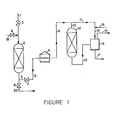
- the contaminated oil be adequately refined prior to catalytic dewaxing. If the refining is done in a flow system such as is provided in Figure 1 of the drawing, the LHSV for the sorption step should be equal to or less than the LHSV for the catalytic dewaxing step, requiring an equally sized or larger sorption unit than that provided for the reactor. Adequate refining will provide a relatively long cycle before regeneration is required for the dewaxing catalyst. A relatively simple test may be used to determine the degree of refinement achieved by treatment with the sorbent.
- the untreated and the refined waxy fuel oils are each dewaxed to a pour point of -4°C under practical dewaxing conditions at 1 LHSV and the initial equilibrium temperature determined for each oil. If a reduction of the initial equilibrium temperature of at least about 10°C is observed for the refined oil compared with the untreated oil, a substantial fraction of the catalytically deleterious impurity is deemed to have been removed and the degree of refining is adequate for the process of this invention.
- a hydrocarbon oil feed such as a gas oil with a pour point of 24°C (75°F)
- sorption tower 2 which is filled with a molecular sieve zeolite such as ZSM-5 containing a small amount of nickel.
- Valve 3 is open in this stage of the operation, and valve 4 is maintained closed.
- the treated oil passes out of sorption tower 2 via line 5 and is heated to dewaxing temperature in furnace 6.
- Valve 7 is maintained open during this phase of the operation and valve 8 is maintained closed.
- the heated oil is passed from the furnace via lines 9 and 10 along with hydrogen introduced via line 11 to the catalytic dewaxing reactor 12 filled with ZSM-5 dewaxing catalyst that contains a small amount of nickel.
- the dewaxed oil and cracked fragments together with excess hydrogen are passed from the dewaxing reactor 12 via line 13 to high pressure separator 14.
- the excess hydrogen passes from high pressure separator 14 via lines 15 and 11 and is recycled to the dewaxing reactor.
- Fresh make-up hydrogen is added via line 16.
- a bleed stream of gas is removed via line 19.
- the dewaxed oil and light ends are removed from the high pressure separator via line 17 and are passed to downstream facilities for recovering a dewaxed oil having a pour point of -7°C, for example, and the separated light fraction.
- the sorbent contained in vessel 2 becomes ineffective and needs to be regenerated. This may be done by shutting valves 3 and 7 and introducing stripping steam via line 18 and valve 4 into vessel 1 and removing the excess steam and deleterious impurities via valve 8 and line 20.
- Various stripping gases may be used in place of steam such as heated air, nitrogen or hydrogen gas.
- the sorbent also may be regenerated by burning in air at elevated temperature. The preferred methods of regeneration are to use steam at about 177°C or hydrogen gas at about 482°C.
- contaminant refers to whatever substance behaves in a deleterious way in catalytic dewaxing, and that the chemical composition of the contaminant need not be ascertained.
- contaminant or the phrase “catalytically deleterious impurity,” is intended to include deleterious organic substances which occur in natural association with the hydrocarbon oil or its precursor, such as a crude petroleum, as well as materials which may be formed during processing of the oil.
- the term also includes, of course, contaminants of well defined and known chemical structure such as furfural, sulfolane and the like which are used for extraction or separation of fractions.
- the H-ZSM-5 sorbent had the properties set out in Table IV:
- a dewaxed oil and a gasoline fraction were obtained by this dewaxing process.
- the clear research octane number of the gasoline fraction and the pour point of the dewaxed oil at various dewaxing temperatures were as follows:
Landscapes
- Chemical & Material Sciences (AREA)
- Oil, Petroleum & Natural Gas (AREA)
- Engineering & Computer Science (AREA)
- Chemical Kinetics & Catalysis (AREA)
- General Chemical & Material Sciences (AREA)
- Organic Chemistry (AREA)
- Production Of Liquid Hydrocarbon Mixture For Refining Petroleum (AREA)
- Catalysts (AREA)
Claims (4)
Applications Claiming Priority (2)
| Application Number | Priority Date | Filing Date | Title |
|---|---|---|---|
| US225294 | 1981-01-15 | ||
| US06/225,294 US4358363A (en) | 1981-01-15 | 1981-01-15 | Method for enhancing catalytic activity |
Publications (2)
| Publication Number | Publication Date |
|---|---|
| EP0057071A1 EP0057071A1 (de) | 1982-08-04 |
| EP0057071B1 true EP0057071B1 (de) | 1985-09-11 |
Family
ID=22844329
Family Applications (1)
| Application Number | Title | Priority Date | Filing Date |
|---|---|---|---|
| EP82300224A Expired EP0057071B1 (de) | 1981-01-15 | 1982-01-15 | Vorbehandlung von Einsatzmaterialien für die katalytische Entwachsung |
Country Status (6)
| Country | Link |
|---|---|
| US (1) | US4358363A (de) |
| EP (1) | EP0057071B1 (de) |
| JP (1) | JPS57145178A (de) |
| AU (1) | AU547536B2 (de) |
| CA (1) | CA1181355A (de) |
| DE (1) | DE3266078D1 (de) |
Families Citing this family (16)
| Publication number | Priority date | Publication date | Assignee | Title |
|---|---|---|---|---|
| US4600497A (en) * | 1981-05-08 | 1986-07-15 | Union Oil Company Of California | Process for treating waxy shale oils |
| US4790927A (en) * | 1981-05-26 | 1988-12-13 | Union Oil Company Of California | Process for simultaneous hydrotreating and hydrodewaxing of hydrocarbons |
| US4877762A (en) * | 1981-05-26 | 1989-10-31 | Union Oil Company Of California | Catalyst for simultaneous hydrotreating and hydrodewaxing of hydrocarbons |
| US4395327A (en) * | 1982-08-17 | 1983-07-26 | Mobil Oil Corporation | Hydrotreating process |
| DE3587895T2 (de) * | 1984-05-03 | 1994-12-01 | Mobil Oil Corp | Katalytische Entwachsung von leichten und schweren Ölen in zwei Parallelreaktoren. |
| NZ214433A (en) * | 1984-12-21 | 1988-02-12 | Mobil Oil Corp | Dewaxing hydrocarbon mixtures by using zeolites in a two step process |
| US4752378A (en) * | 1985-02-26 | 1988-06-21 | Mobil Oil Corporation | Catalysis over crystalline silicate ZSM-58 |
| US4622130A (en) * | 1985-12-09 | 1986-11-11 | Shell Oil Company | Economic combinative solvent and catalytic dewaxing process employing methylisopropyl ketone as the solvent and a silicate-based catalyst |
| US4917788A (en) * | 1987-07-12 | 1990-04-17 | Mobil Oil Corporation | Manufacture of lube base stocks |
| US4929334A (en) * | 1988-11-18 | 1990-05-29 | Mobil Oil Corp. | Fluid-bed reaction process |
| US4997543A (en) * | 1988-12-21 | 1991-03-05 | Mobil Oil Corporation | Reduction of benzene in gasoline |
| US5135643A (en) * | 1990-09-28 | 1992-08-04 | Union Oil Company Of California | Process for producing aromatic compounds |
| US5407559A (en) * | 1991-08-15 | 1995-04-18 | Mobil Oil Corporation | Gasoline upgrading process |
| US5599439A (en) * | 1993-03-13 | 1997-02-04 | Mobil Oil Corporation | Gasoline and reformate upgrading process |
| US7119239B2 (en) * | 2002-06-19 | 2006-10-10 | Exxonmobil Chemical Patents Inc. | Manufacture of xylenes using reformate |
| JP5007022B2 (ja) * | 2002-06-19 | 2012-08-22 | エクソンモービル・ケミカル・パテンツ・インク | 改質油を用いるキシレンの製造 |
Family Cites Families (12)
| Publication number | Priority date | Publication date | Assignee | Title |
|---|---|---|---|---|
| US2925375A (en) * | 1956-11-26 | 1960-02-16 | Union Oil Co | Hydrocarbon refining and conversion process including removal of organic nitrogen compounds with azeolite |
| US3189539A (en) * | 1962-05-14 | 1965-06-15 | California Research Corp | Removal of nitrogen compounds from hydrocarbon oils by adsorption on cracking catalyst |
| US3732326A (en) * | 1970-05-19 | 1973-05-08 | Mobil Oil Corp | Selective sorption of less polar molecules with crystalline zeolites of high silica/alumina ratio |
| US3767563A (en) * | 1971-12-23 | 1973-10-23 | Texaco Inc | Adsorption-desorption process for removing an unwanted component from a reaction charge mixture |
| US3894938A (en) * | 1973-06-15 | 1975-07-15 | Mobil Oil Corp | Catalytic dewaxing of gas oils |
| US3989617A (en) * | 1973-08-21 | 1976-11-02 | Mobil Oil Corporation | Catalytic treatment of lubrication oil base stock for improvement of oxidative stability |
| US3956102A (en) * | 1974-06-05 | 1976-05-11 | Mobil Oil Corporation | Hydrodewaxing |
| US4028223A (en) * | 1974-11-08 | 1977-06-07 | Uop Inc. | Guard beds in hydrocarbon conversion with an acidic multimetallic catalytic composite |
| US4057489A (en) * | 1976-12-29 | 1977-11-08 | Gulf Research & Development Company | Process for producing a transformer oil having lower pour point and improved oxidation stability |
| US4137154A (en) * | 1977-07-05 | 1979-01-30 | Mobil Oil Corporation | Process for the removal of nitrogen compounds from various organic media |
| US4222855A (en) * | 1979-03-26 | 1980-09-16 | Mobil Oil Corporation | Production of high viscosity index lubricating oil stock |
| US4229282A (en) * | 1979-04-27 | 1980-10-21 | Mobil Oil Corporation | Catalytic dewaxing of hydrocarbon oils |
-
1981
- 1981-01-15 US US06/225,294 patent/US4358363A/en not_active Expired - Fee Related
-
1982
- 1982-01-15 DE DE8282300224T patent/DE3266078D1/de not_active Expired
- 1982-01-15 AU AU79560/82A patent/AU547536B2/en not_active Ceased
- 1982-01-15 EP EP82300224A patent/EP0057071B1/de not_active Expired
- 1982-01-15 CA CA000394217A patent/CA1181355A/en not_active Expired
- 1982-01-16 JP JP57005322A patent/JPS57145178A/ja active Pending
Also Published As
| Publication number | Publication date |
|---|---|
| US4358363A (en) | 1982-11-09 |
| EP0057071A1 (de) | 1982-08-04 |
| DE3266078D1 (en) | 1985-10-17 |
| JPS57145178A (en) | 1982-09-08 |
| AU547536B2 (en) | 1985-10-24 |
| AU7956082A (en) | 1982-07-22 |
| CA1181355A (en) | 1985-01-22 |
Similar Documents
| Publication | Publication Date | Title |
|---|---|---|
| EP0056718B1 (de) | Vorbehandlung von Einsatzmaterialien für katalytische Umwandlungen | |
| US4097367A (en) | Conversion of olefinic naphtha | |
| US4137148A (en) | Manufacture of specialty oils | |
| US4213847A (en) | Catalytic dewaxing of lubes in reactor fractionator | |
| EP0038140B1 (de) | Katalytisches Hydrocracken | |
| US4810357A (en) | Catalytic dewaxing of light and heavy oils in dual parallel reactors | |
| US3968024A (en) | Catalytic hydrodewaxing | |
| US4437975A (en) | Manufacture of lube base stock oil | |
| EP0057071B1 (de) | Vorbehandlung von Einsatzmaterialien für die katalytische Entwachsung | |
| US4181598A (en) | Manufacture of lube base stock oil | |
| US4357232A (en) | Method for enhancing catalytic activity | |
| US4211635A (en) | Catalytic conversion of hydrocarbons | |
| US3980550A (en) | Catalytic hydrodewaxing | |
| US4867861A (en) | Process and catalyst for the dewaxing of shale oil | |
| US4210521A (en) | Catalytic upgrading of refractory hydrocarbon stocks | |
| US4648957A (en) | Lube hydrodewaxing method and apparatus with light product removal and enhanced lube yields | |
| US4269695A (en) | Reclaiming wax contaminated lubricating oils | |
| US4332670A (en) | Catalytic dewaxing of middle distillates | |
| US4695364A (en) | Lube or light distillate hydrodewaxing method and apparatus with light product removal and enhanced lube yields | |
| US4749467A (en) | Lube dewaxing method for extension of cycle length | |
| US4483760A (en) | Process for dewaxing middle distillates | |
| US3989617A (en) | Catalytic treatment of lubrication oil base stock for improvement of oxidative stability | |
| EP0104855A2 (de) | Katalysator und Verfahren zur hydrogenierenden Entwachsung | |
| EP0104807B1 (de) | Verwendung von Hochdruck zur Verbesserung der Produktqualität und zur Verlängerung des Zyklusses beim katalytischen Entwacksen von Schmierölen | |
| US4428826A (en) | Dewaxing and upgrading of raw shale oils |
Legal Events
| Date | Code | Title | Description |
|---|---|---|---|
| PUAI | Public reference made under article 153(3) epc to a published international application that has entered the european phase |
Free format text: ORIGINAL CODE: 0009012 |
|
| 17P | Request for examination filed |
Effective date: 19820127 |
|
| AK | Designated contracting states |
Designated state(s): BE DE FR GB IT NL |
|
| ITF | It: translation for a ep patent filed | ||
| GRAA | (expected) grant |
Free format text: ORIGINAL CODE: 0009210 |
|
| AK | Designated contracting states |
Designated state(s): BE DE FR GB IT NL |
|
| REF | Corresponds to: |
Ref document number: 3266078 Country of ref document: DE Date of ref document: 19851017 |
|
| ET | Fr: translation filed | ||
| PLBE | No opposition filed within time limit |
Free format text: ORIGINAL CODE: 0009261 |
|
| STAA | Information on the status of an ep patent application or granted ep patent |
Free format text: STATUS: NO OPPOSITION FILED WITHIN TIME LIMIT |
|
| 26N | No opposition filed | ||
| PGFP | Annual fee paid to national office [announced via postgrant information from national office to epo] |
Ref country code: GB Payment date: 19890115 Year of fee payment: 8 |
|
| ITTA | It: last paid annual fee | ||
| PG25 | Lapsed in a contracting state [announced via postgrant information from national office to epo] |
Ref country code: FR Effective date: 19890131 |
|
| PGFP | Annual fee paid to national office [announced via postgrant information from national office to epo] |
Ref country code: NL Payment date: 19890131 Year of fee payment: 8 |
|
| PGFP | Annual fee paid to national office [announced via postgrant information from national office to epo] |
Ref country code: BE Payment date: 19890313 Year of fee payment: 8 |
|
| PGFP | Annual fee paid to national office [announced via postgrant information from national office to epo] |
Ref country code: DE Payment date: 19891212 Year of fee payment: 9 |
|
| PG25 | Lapsed in a contracting state [announced via postgrant information from national office to epo] |
Ref country code: GB Effective date: 19900115 |
|
| PG25 | Lapsed in a contracting state [announced via postgrant information from national office to epo] |
Ref country code: BE Effective date: 19900131 |
|
| BERE | Be: lapsed |
Owner name: MOBIL OIL CORP. Effective date: 19900131 |
|
| PG25 | Lapsed in a contracting state [announced via postgrant information from national office to epo] |
Ref country code: NL Effective date: 19900801 |
|
| GBPC | Gb: european patent ceased through non-payment of renewal fee | ||
| NLV4 | Nl: lapsed or anulled due to non-payment of the annual fee | ||
| REG | Reference to a national code |
Ref country code: FR Ref legal event code: ST |
|
| PG25 | Lapsed in a contracting state [announced via postgrant information from national office to epo] |
Ref country code: DE Effective date: 19911001 |