EP0056577B1 - Triazolylcumarinverbindungen, sowie deren Herstellung und Verwendung als optische Aufheller, Scintillatoren und Laserfarbstoffe - Google Patents
Triazolylcumarinverbindungen, sowie deren Herstellung und Verwendung als optische Aufheller, Scintillatoren und Laserfarbstoffe Download PDFInfo
- Publication number
- EP0056577B1 EP0056577B1 EP82100040A EP82100040A EP0056577B1 EP 0056577 B1 EP0056577 B1 EP 0056577B1 EP 82100040 A EP82100040 A EP 82100040A EP 82100040 A EP82100040 A EP 82100040A EP 0056577 B1 EP0056577 B1 EP 0056577B1
- Authority
- EP
- European Patent Office
- Prior art keywords
- formula
- triazolylcoumarins
- methyl
- phenyl
- triazol
- Prior art date
- Legal status (The legal status is an assumption and is not a legal conclusion. Google has not performed a legal analysis and makes no representation as to the accuracy of the status listed.)
- Expired
Links
- 0 C*C1=CC(C#CC(C2)[*@@](C)*=C(N)N=*)=C2OC1O Chemical compound C*C1=CC(C#CC(C2)[*@@](C)*=C(N)N=*)=C2OC1O 0.000 description 3
- BWTHIUQJUJXESW-UHFFFAOYSA-N CC1c2cc(C)ccc12 Chemical compound CC1c2cc(C)ccc12 BWTHIUQJUJXESW-UHFFFAOYSA-N 0.000 description 1
- URLKBWYHVLBVBO-UHFFFAOYSA-N Cc1ccc(C)cc1 Chemical compound Cc1ccc(C)cc1 URLKBWYHVLBVBO-UHFFFAOYSA-N 0.000 description 1
- SAJOTMOOMUTFCZ-UHFFFAOYSA-N NN/C=N\N=C\N[IH]N Chemical compound NN/C=N\N=C\N[IH]N SAJOTMOOMUTFCZ-UHFFFAOYSA-N 0.000 description 1
Classifications
-
- C—CHEMISTRY; METALLURGY
- C07—ORGANIC CHEMISTRY
- C07D—HETEROCYCLIC COMPOUNDS
- C07D231/00—Heterocyclic compounds containing 1,2-diazole or hydrogenated 1,2-diazole rings
- C07D231/02—Heterocyclic compounds containing 1,2-diazole or hydrogenated 1,2-diazole rings not condensed with other rings
- C07D231/10—Heterocyclic compounds containing 1,2-diazole or hydrogenated 1,2-diazole rings not condensed with other rings having two or three double bonds between ring members or between ring members and non-ring members
- C07D231/12—Heterocyclic compounds containing 1,2-diazole or hydrogenated 1,2-diazole rings not condensed with other rings having two or three double bonds between ring members or between ring members and non-ring members with only hydrogen atoms, hydrocarbon or substituted hydrocarbon radicals, directly attached to ring carbon atoms
-
- C—CHEMISTRY; METALLURGY
- C07—ORGANIC CHEMISTRY
- C07D—HETEROCYCLIC COMPOUNDS
- C07D233/00—Heterocyclic compounds containing 1,3-diazole or hydrogenated 1,3-diazole rings, not condensed with other rings
- C07D233/54—Heterocyclic compounds containing 1,3-diazole or hydrogenated 1,3-diazole rings, not condensed with other rings having two double bonds between ring members or between ring members and non-ring members
- C07D233/56—Heterocyclic compounds containing 1,3-diazole or hydrogenated 1,3-diazole rings, not condensed with other rings having two double bonds between ring members or between ring members and non-ring members with only hydrogen atoms or radicals containing only hydrogen and carbon atoms, attached to ring carbon atoms
-
- C—CHEMISTRY; METALLURGY
- C07—ORGANIC CHEMISTRY
- C07D—HETEROCYCLIC COMPOUNDS
- C07D249/00—Heterocyclic compounds containing five-membered rings having three nitrogen atoms as the only ring hetero atoms
- C07D249/02—Heterocyclic compounds containing five-membered rings having three nitrogen atoms as the only ring hetero atoms not condensed with other rings
- C07D249/08—1,2,4-Triazoles; Hydrogenated 1,2,4-triazoles
Definitions
- Suitable quaternization and protonation products are those which can be obtained from the «neutral compounds of the formula I by treatment with quaternizing and protonating agents customary in dye or brightener chemistry, such as eg. B. are described in DE-OS 2 821 116 or US Pat. No. 4,051,117.
- Preferred agents of this type are dimethyl sulfate, diethyl sulfate, hydrochloric acid, optionally benzenesulfonic acid substituted by CI or CH 3, formic acid, acetic acid and lactic acid.
- the new triazolylcoumarins can be obtained by various methods.
- One method is characterized in that salicylaldehydes of the formula with triazole compounds of the formula or their quaternization or protonation products, in which Z is an optionally functionally modified carboxyl group, condensed in a manner known per se (cf. US Pat. No. 3,271,412 and German Pat. No. 1,296,121).
- the "neutral" compounds of formula III are, if B is a direct bond, also by reacting 1,2,4-triazoles of the formula wherein R 'is a tri- (C 1 -C 4 alkyl) silyl, a C 1 -C 6 alkanoyl, a benzoyl, a C 1 -C 6 alkylsulfonyl, a Phenylsufonyl, a C 1 -C 6 alkoxycarbonyl, a phenoxycarbonyl, a C 1 -C 6 alkylaminocarbonyl, a phenylaminocarbonyl, a C 1 -C a alkylaminothiocarbonyl or a phenylaminothiocarbonyl group, in which the phenyl radical can still carry methyl, methoxy, chlorine and / or hydroxycarbonyl, means preferably with haloacetic acid derivatives of the formula where Hal is chlorine, bromine or io
- the quaternization products of the compounds of the formula III can, if B is a direct bond, not only by quaternizing the corresponding neutral compounds but also by reacting 1,2,4-triazoles of the formula IV, where R 'is the quaternizing group, preferably using halogenoacetic acid derivatives of the formula V.
- reaction of VI with VII is preferably carried out in a conventional polar organic solvent at reflux temperatures of the solvent and, if appropriate, in the presence of an acidic or basic catalyst.
- aminocoumarins VI are either from J. Ind. Chem. Soc. 48, 371 (1971) and US-PS 2702296 known or available by analogous processes.
- the new coumarins of formula I by reacting amidinocoumarins of the formula obtained with formyl hydrazine and optionally subsequent quaternization or protonation.
- the compounds of the formula VIII are obtained by reacting aminocoumarins of the formula VI or their N-acylation products with Vilsmeyer compounds of the formula wherein Y is a leaving group, preferably halogen.
- the reaction of corresponding 7-hydrazinocoumarins with suitable a-oximinoketones is preferred.
- the new coumarin compounds of the formula I differ from the fluorescent dyes according to EP-A1-0021 304 by the lack of a CN group in the 4-position and also from the optical brighteners according to AT-B 2 848 34, AT-B 311 295 and DE-A 2 844 299 through the special selection of the triazolyl radicals in the 3- and 7-position.
- they When dissolved or finely divided, they show strong fluorescence and are outstandingly suitable as scintillators, laser dyes and preferably as optical brighteners.
- the "neutral" compounds are preferably used to whiten textile materials made of hydrophobic fibers, especially polyester fibers, the quaternized and protonated products are used to lighten acid-modified fiber materials, such as. B. acrylic fibers by conventional dyeing methods.
- the new whiteners are characterized by high color strengths, good build-up ability and a low tendency to turn green - even with high active ingredient concentrations.
- Examples 2-8 can be obtained in an analogous manner.
- the amino acetic acid is to be replaced by 4-aminophenylacetic acid.
- connection is identical to that of example 2.
- Examples 10-16 can be prepared in an analogous manner.
- the ester of other alcohols can also be used, such as Methyl, propyl, butyl or benzyl ester.
- an ester of 4- (1,2,4-triazol-4-yl) phenylacetic acid, for example the ethyl ester is used instead.
- the compound is identical to that of Examples 5 and 13.
- reaction can be carried out in an analogous manner with z.
- B 1-methyl-4- (methylcarbonylmethyl) -1,2,4-triazolium chloride or 1-methyl-4- (ethoxycarbonylmethyl) -1, 2,4-triazolium chloride.
- 1-ethyl-, 1-benzyl-, 1- (2-hydroxyethyl) - or 1-phenyl-1,2,4-triazole can also be reacted with, for example, bromoacetic acid, methyl chloroacetate or ethyl bromoacetate.
- Examples 29-35 can be prepared in an analogous manner (substituted examples of alkyl halides are used in Examples 31 and 33).
- Examples 45-52 can be prepared in an analogous manner.
- acrylonitrile is added instead of ethylene oxide.
- Polyacrylonitrile textile fabrics are treated in a liquor ratio of 1 40 for 30 minutes with a dyeing liquor containing 0.2% of the compound of the formula 21, 8% Na chorite 50%, 4% Na nitrate, 4% chlorite stabilizer (all percentages based on contains the textile material) and is adjusted to pH 3.5 with formic acid. After rinsing and drying, a very well and brilliantly lightened polyacrylonitrile fabric is obtained.
Landscapes
- Chemical & Material Sciences (AREA)
- Organic Chemistry (AREA)
- Plural Heterocyclic Compounds (AREA)
Description
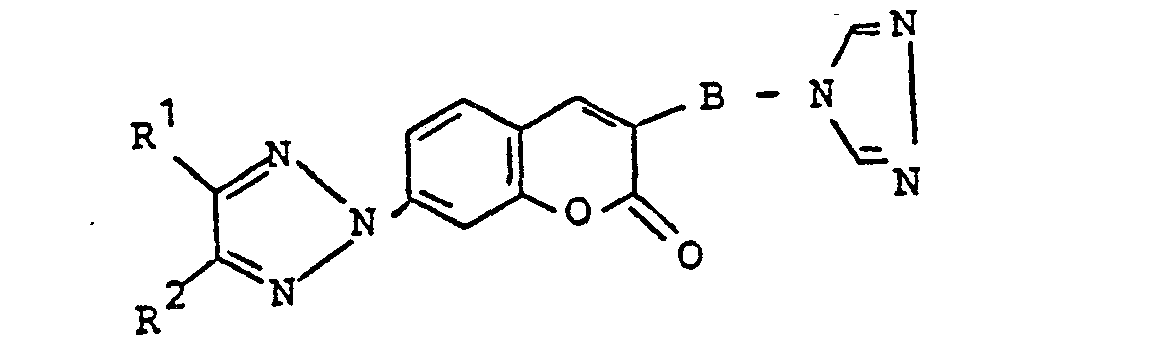
- Gegenstand der Erfindung sind Triazolylcumarine der Formel

- B eine direkte Bindung oder den 1,4-Phenylenrest und
- R1 C1-C4-Alkyl
- R2 C1-C4-Alkyl oder gegebenenfalls durch Phenyl, CH3, OCH3 oder Cl substituiertes Phenyl bedeuten oder
- R1 und R2 gemeinsam einen anellierten Benzol- oder Naphthalinring bilden,
- Geeignete Quaternierungs- und Protonierungsprodukte sind solche, die man aus den « neutralen Verbindungen der Formel I durch Behandlung mit in der Farbstoff- oder Aufheller-Chemie üblichen Quaternierungs- und Protonierungsmitteln, wie zie z. B. in der DE-OS 2 821 116 oder US-PS 4 051 117 beschrieben sind, erhält.
- Bevorzugte Mittel dieser Art sind Dimethylsulfat, Diethylsulfat, Chlorwasserstoffsäure, gegebenenfalls durch CI oder CH3 substituierte Benzolsulfonsäure Ameisensäure, Essigsäure und Milchsäure.
- Bevorzugte erfindungsgemäße Verbindungen sind solche der Formel worin
- R1 Methyl,
- R2 Ethyl, Phenyl oder 4-Biphenylyl bedeuten oder
- R1 und R2 gemeinsam die fehlenden Glieder eines über C1/C2-verknüpften Naphthalinringes bilden.
- Die neuen Triazolylcumarine sind nach verschiedenen Verfahren zugänglich.
- Ein Verfahren ist dadurch gekennzeichnet, daß man Salicylaldehyde der Formel


in an sich bekannter Weise kondensiert (vgl. US-PS 3271 412 bzw. DE-PS 1 296 121). - Geeignete Reste Z sind COOH, COOCnH2n+1 (n = 1-4) und CN.
- Die Verbindungen der Formel II sind praktisch durchweg bekannt (vgl. DE-OS 2 335 218 und DE-OS 2 848 670).
- Auch die « neutralen » Verbindungen der Formel III sind in der Literatur beschrieben worden (vgl. US-PS 4120 864).
- Die « neutralen » Verbindungen der Formel III sind, wenn B eine direkte Bindung bedeutet, auch durch Umsetzung von 1,2,4-Triazolen der Formel


- Die Quaternierungsprodukte der Verbindungen der Formel III lassen sich, wenn B eine direkte Bindung bedeutet, außer durch Quaternierung der entsprechenden neutralen Verbindungen auch durch Umsetzung von 1,2,4-Triazolen der Formel IV,
worin R' die Quaternierungsgruppe bedeutet, mit vorzugsweise Halogenessigsäurederivaten der Formel V herstellen. - Ein weiteres Verfahren zur Herstellung der Verbindungen der Formel ist dadurch gekennzeichnet, daß man Aminocumarine der Formel


- W1 und W2 C1-C4-Alkyl, Phenyl oder gemeinsam ―(CH2)4― oder ―(CH2)5― bedeuten, in ebenfalls an sich bekannter Weise umsetzt (vgl. US-PS 4120864 sowie J. Chem. Soc. 1967, 1664-1666) und die Reaktionsprodukte gegebenenfalls anschließend quaterniert oder protoniert.
- Die Umsetzung von VI mit VII erfolgt vorzugsweise in einem üblichen polaren organischen Lösungsmittel bei Rückflußtemperaturen des Lösungsmittels und gegebenenfalls in Anwesenheit eines sauren oder basischen Katalysators.
- Die Verbindungen der Formel VII sind in der vorstehend genannten Literatur beschrieben.
- Die Aminocumarine VI sind entweder aus J. Ind. Chem. Soc. 48, 371 (1971) und US-PS 2702296 bekannt oder nach analogen Verfahren erhältlich.
- Weiterhin werden die neuen Cumarine der Formel I durch Umsetzung von Amidinocumarinen der Formel

- Die Verbindungen der Formel VIII erhält man durch Umsetzung von Aminocumarinen der Formel VI oder deren N-Acylierungsprodukten mit Vilsmeyer-Verbindungen der Formel

- Die Umsetzung der Amidinocumarine (VIII) erfolgt unter ähnlichen Bedingungen wie bei der Umsetzung von VI mit VII.
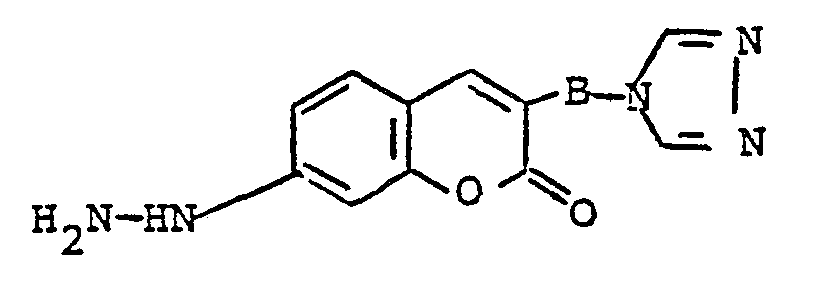
- Schließlich können die Verbindungen der Formel dadurch hergestellt werden, daß man in Cumarine der Formel

- Bevorzugt ist die Umsetzung entsprechender 7-Hydrazinocumarine mit geeigneten a-Oximinoketonen. Die als Ausgangsmaterial benötigten Verbindungen der Formel X erhält man in üblicher Weise (vgl. z. B. DE-OS 2528 698) durch Umsetzung von entsprechenden Acylaminosalicylaldehyden mit den Verbindungen III, anschließende Abspaltung der Acylschutzgruppe und gegebenenfalls Umwandlung der Aminogruppe in eine Hydrazinogruppe (vgl. DE-A 2 528 698 = US-A 4 069 228 und DE-A 1 94 845 = US-A 3 646 052).
- Die neuen Cumarinverbindungen der Formel I unterscheiden sich von den Fluoreszenzfarbstoffen gemäß EP-A1-0021 304 durch das Fehlen einer CN-Gruppe in 4-Stellung und ebenso wie von den optischen Aufhellern gemäß AT-B 2 848 34, AT-B 311 295 und DE-A 2 844 299 durch die spezielle Auswahl der Triazolylreste in 3- und 7-Stellung. Sie zeigen in gelöstem oder feinverteiltem Zustand eine starke Fluoreszenz und eignen sich hervorragend als Scintillatoren, Laserfarbstoffe und vorzugsweise als optische Aufheller. Während die « neutralen » Verbindungen bevorzugt zum Weißtönen von Textilmaterialien aus hydrophoben Fasern, insbesondere Polyesterfasern eingesetzt werden, dienen die quaternierten und protonierten Produkte zum Aufhellen von sauer-modifizierten Fasermaterialien, wie z. B. Acrylfasern nach üblichen Färbemethoden.
- Die neuen Weißtöner zeichnen sich dabei durch hohe Farbstärkte, gutes Aufbauvermögen und eine geringe Neigung zum Vergrünen aus - selbst bei hohen Wirkstoffkonzentrationen.
-
- 6,50 g (20 mmol) 3-(Dimethylaminomethylenamino)-7-(4-ethyl-5-methyl-2H-1,2,3-triazol-2-yl) cumarin und
- 1,44 g (24,0 mmol) Formylhydrazin werden in
- 18 ml wasserfreiem Dimethylformamid 1,5 h unter N2-Atmosphäre refluxiert. Nach dem Abkühlen wird der dicke gelbe Brei scharf abgesaugt und mit
- 10 ml wasserfreiem Dimethylformamid und
- 20 ml Chloroform gewaschen und getrocknet : 2,00 g (31 %) blaßgelbes Pulver, das aus Dimethylacetamid umkristallisiert wird : 1,62 g (25 %) 3-(1,2,4-Triazol-4-yl)-7-(4-ethyl-5-methyl-2H-1,2,3-triazol-2-yl)-cumarin in Form blaßgelber verfilzter Nädelchen vom Schmp. 263-264 °C.
- IR (KBr) : 3 110, 1 740, 1 618 cm-1.
- UV (DMF) : λmax (Ig ε) = 347 nm (4.518).
- Fluoreszenz : rotstichig blau.
- Die Ausgangsmaterialien können auf folgendem Weg hergestellt werden :
- 50,6 g (200 mmol) 2-Hydroxy-4-(4-ethyl-5-methyl-2H-1,2,3-triazol-2-yl)-benzaldehyd-Na-Salz,
- 6,00 g (80,0 mmol) wasserfreies Natriumacetat,
- 18,0 g (240 mmol) Aminoessigsäure und
- 102 g (1,00 mol) Acetanhydrid werden während 1 h unter N2-Atmosphäre zum Rückfluß gebracht und 15 h am Rückfluß gekocht. Nach Abkühlen auf 90 °C werden
- 100 ml Methanol zugesetzt, 30 Min. refluxiert, auf 0°C gekühlt, abgesaugt, mit
- 350 ml Methanol gewaschen und getrocknet : 55,3 g (89 %) braunes Pulver, das aus 1,2-Dichlorbenzol umkristallisiert wird : 19,6 g (31 %) 3-Acetylamino-7-(4-ethyl-5-methyl-2H-1,2,3-triazol-2-yl)cumarin in Form rosa Schuppen vom Schmp. 237-238 °C.
- 15,6 g (50,0 mmol) 3-Acetylamino-7-(4-ethyl-5-methyl-2H-1,2,3-triazol-2-yl)-cumarin werden in
- 100 ml wasserfreiem Dimethylformamid suspendiert. Bei 10-15 °C werden
- 11,5 g (75,0 mmol) Phosphoroxychlorid zugetropft und 22 h bei Raumtemperatur gerührt. Der Brei wird in
- 500 ml Eiswasser eingetragen, filtriert und mit Natriumcarbonat auf pH = 8 gebracht. Das gelbe Kristallisat wird abgesaugt, mit Wasser gewaschen und getrocknet: 15,5 g (95,5 %). Umkristallisation aus Ethanol ergibt 12,9 g (80 %) 3-(Dimethylaminomethylenamino)-7-(4-ethyl-5-methyl-2H-1,2,3-triazol-2-yl) cumarin in Form hellgelber Kriställchen vom Schmp. 158-159 °C.
- IR (KBr) : 1 723, 1 620 cm-1.
- UV (DMF) : λmax (Ig ε) = 280 (3.975), 370 nm (4.615).
- Auf diesem Weg lassen sich in analoger Weise die Verbindungen der Beispiele 2-8 erhalten. In den Beispielen 5-8 ist die Aminoessigsäure durch 4-Aminophenylessigsäure zu ersetzen.

-
- 15,0 g (50,0 mmol) 2-Hydroxy-4-(4-methyl-5-phenyl-2H-1,2,3-triazol-2-yl)-benzaldehyd-Na-Salz,
- 7,75 g (50,0 mmol) 1,2,4-Triazol-4-yl-essigsäureethylester,
- 1,50 g (25,0 mmol) Eisessig und
- 500 mg (6,00 mmol) Piperidin werden unter N2-Atmosphäre in
- 70 ml wasserfreiem Ethanol 8 h refluxiert. Es wird scharf abgesaugt und mit Ethanol und Wasser gewaschen. Schließlich wird nochmal mit
- 100 ml Ethanol 2 h bei 60 °C verrührt, abgesaugt und getrocknet: 12,0 g (65 %) hellgelbes Kristallpulver. Umkristallisation aus Dimethylformamid ergibt 9,64 g (52 %) 3-(1,2,4-Triazol-4-yl)-7-(4-methyl-5-phenyl 2H-1,2,3-triazol-2-yl)-cumarin in Form hellgelber Mikroplättchen vom Schmp. 324-326 °C (Zers.)
- IR (KBr) : 3 110, 1 745, 1 733, 1 618 cm-1.
- UV (DMF) : λmax (Ig e) = 355 nm (4.617).
- Fluoreszenz : blau
- Die Verbindung ist identisch mit der des Beispiels 2.
- Auf diesem Weg lassen sich in analoger Weise die Verbindungen der Beispiele 10-16 herstellen. Statt des 1,2,4-Triazol-4-yl-essigsäureethylester kann auch der Ester anderer Alkohole verwendet werden wie Methyl-, Propyl-, Butyl- oder Benzylester. In den Beispielen 13-16 ist statt dessen ein Ester der 4-(1,2,4-Triazol-4-yl)-phenylessigsäure, beispielsweise der Ethylester, zu verwenden.

-
- 17,3 g (50,0 mmol) 3-(4-Aminophenyl)-7-(4-ethyl-5-methyl-2H-1,2,3-triazol-2-yl)cumarin,
- 10,5 g (75,0 mmol) 1,2-Bis(dimethylaminomethylen)hydrazin und
- 200 mg 4-Methylbenzolsulfonsäure werden in
- 40 ml wasserfreiem Dimethylformamid 10 h unter N2-Atmosphäre refluxiert. Dann werden nochmal
- 3,50 g (25,0 mmol) 1,2-Bis(dimethylaminomethylen)-hydrazin zugesetzt und weitere 10 h refluxiert. Beim Abkühlen scheiden sich 16,1 g (81 %) hellgelbes Kristallisat aus. Umkristallisation aus Dimethylformamid ergibt 14,3 g (72 %) 3-(4-(1,2,4-Triazol-4-yl)-phenyl)-7-(4-ethyl-5-methyl-2H-1,2,3-triazol-2-yl)-cumarin in Form blaßgelber Kriställchen vom Schmp. 321-323 °C.
- IR (KBr) : 3 110, 1 730, 1 615, 1 532 cm-1.
- UV (DMF) : λmax (Ig ε) = 357 nm (4.611).
- 1H-NMR([D6]DMSO) : δ 1,24 (t, J = 7,5 Hz ; 3H, CH3CH2), 2,30 (s ; 3H, CH3), 2,67 (q, J = 7,5 Hz ; 2H ; CH3CH2 7,84 (mc ; 7H), 8,31 (s ; 1H,

- Fluoreszenz : blau
- Die Verbindung ist identisch mit der der Beispiele 5 und 13.
- Die Ausgangsmaterialien können auf folgendem Weg hergestellt werden :
- 50,6 g (200 mmol) 2-Hydroxy-4-(4-ethyl-5-methyl-2H-1,2,3-triazol-2-yl)benzaldehyd-Na-Salz,
- 41,8 g (200 mmol) 4-Nitrophenylessigsäureethylester und
- 2ml Piperidin werden in
- 250 ml Ethanol 4 h refluxiert. Nach Abkühlen wird mit Eisessig neutralisiert, mit Ethanol und Wasser gewaschen und getrocknet: 46,3 g (61,5 %). Umkristallisation aus Toluol liefert 41,4 g (55 %) 3-(4-Nitrophenyl)-7-(4-ethyl-5-methyl-2H-1,2,3-triazol-2-yl) cumarin in Form eines hellgelben Kristallpulvers vom Schmp. 278-279 °C.
- IR (KBr) : 1 723, 1 618, 1 516, 1 350 cm-1.
- 37,6 g (100 mmol) 3-(4-Nitrophenyl)-7-(4-ethyl-5-methyl-2H-1,2,3-triazol-2-yl)-cumarin werden in
- 1000 ml Ethanol suspendiert. In der Siedehitze wird eine Lösung von
- 160 g (708 mmol) Zinn(II)chlorid in
- 125 ml konz. Salzsäure während 1,5 h zugetropft und weitere 3 h refluxiert. Nach dem Abkühlen wird abgesaugt, mit Ethanol gewaschen und der Filterkuchen durch Verrühren mit
- 30 g Kaliumcarbonat in
- 600 ml Wasser und
- 600 ml Chloroform deprotoniert. Die Chloroformphase wird nach dem Trocknen über Kaliumcarbonat eingedampft und der Rückstand aus Toluol umkristallisiert : 29,5 g (85 %) 3-(4-Aminophenyl)-7-(4-ethyl-5-methyl-2H-1,2,3-triazol-2-yl)-cumarin in Form eines hellgelben Pulvers vom Schmp. 162-163 °C.
- IR (KBr) : 3 465, 3 375, 1 723, 1 620 cm-1.
- UV (DMF) : λmax (Ig ε) = 306 (4.204), 392 nm (4.453).
- Auf diesem Weg lassen sich in analoger Weise die Verbindungen der Beispiele 18-20 herstellen.

-
- Zu
- 6,02 g (20,0 mmol) 2-Hydroxy-4-(4-methyl-5-phenyl-2H-1,2,3-triazol-2-yl)-benzaldehyd-Na-Salz und
- 4,80 g (80,0 mmol) Eisessig in
- 20 ml wasserfreiem Dimethylformamid werden unter N2-Atmosphäre
- 3,48 g (22,0 mmol) 1-Methyl-4-cyanomethyl-1,2,4-triazolium-chlorid gegeben und 24 h bei Raumtemperatur gerührt. Der Niederschlag wird abgesaugt, mit Dimethylformamid gewaschend und getrocknet : 3,60 g (43 %) hellgelbes Pulver. Umkristallisation aus Wasser liefert 2,90 g (35 %) 1-Methyl-4-[7-(4-methyl-5-phenyl-2H-1,2,3-triazol-2-yl)-cumarin-3-yl]-1,2,4-triazolium-chlorid in Form hellgelber Kriställchen vom Schmp. 249-252 °C (Zers.).
- IR (KBr) : 3 060, 1 737, 1 620 cm-1.
- UV (DMF) : λmax (Ig ε) = 360 nm (4.577).
- Fluoreszenz : blau.
- Die Reaktion läßt sich in analoger Weise auch mit z. B. 1-Methyl-4-(methylcarbonylmethyl)-1,2,4-triazoliumchlorid oder 1-Methyl-4-(ethoxycarbonylmethyl)-1 ,2,4-triazoliumchlorid durchführen.
- Die Ausgangsmaterialien können auf folgendem Weg hergestellt werden :
- 16,6 g (200 mmol) 1-Methyl-1,2,4-triazol und
- 15,1 g (200 mmol) Chloracetonitril werden 24 h auf 80 °C erwärmt. Beim Abkühlen kristallisiert die Schmelze spontan durch : 31,7 g (100 %) farblose Nadeln. Umkristallisation aus Ethanol/Wasser ergibt 28,8 g (91 %) 1-Methyl-4-cyanomethyl-1,2,4-triazoliumchlorid in Form farbl. Nadeln vom Schmp. 186-187 °C.
- IR (KBr) : 3 170, 2 255, 1 820, 1 583 cm-1.
- Analog können beispielsweise auch 1-Ethyl-, 1-Benzyl-, 1-(2-Hydroxyethyl)- oder 1-Phenyl-1,2,4-triazol mit beispielsweise Bromessigsäure, Chloressigsäuremethylester oder Bromessigsäureethylester umgesetzt werden.
- Auf diesem Weg lassen sich in analoger Weise die Verbindungen der Beispiele 22-27 herstellen.

-
- 7,96 g (20,0 mmol) 3-(4-(1,2,4-Triazol-4-yl)-phenyl)-7-(4-ethyl-5-methyl-2H-1,2,3-triazol-2-yl)-cumarin werden in
- 45 ml wasserfreiem Dimethylformamid bei 100 °C unter N2-Atmosphäre mit
- 2,77 g (22,0 mmol) Dimethylsulfat versetzt. Es entsteht eine Lösung, die abgekühlt und mit Toluol bis zur vollständigen Fällung versetzt wird : 8,16 g (78 %) 1-Methyl-4-[4-(7-(4-ethyl-5-methyl-2H-1,2,3-triazol-2-yl)cumarin-3-yl)-phenyl]-1,2,4-triazolium-methosulfat in Form blaßgelber Kriställchen vom Schmp. 221-225 °C (Zers.).
- IR (KBr) : 1 724, 1 620 cm-1.
- UV (DMF) : λmax (Ig ε) = 356 nm (4.607)
- 1H-NMR ([D6]DMSO) : δ = 1,26 (t, J = 7,5 Hz ; 3H, CH3CH2), 2,33 (s ; 3H. CH3). 2.73 (a. J = 7.5 Hz : 2H, CH3CH2), 3,42 (s ; 3H, CH3OSO3), 4,21 (s ; 3H, CH3N⊕), 7,8-8,15 (m ; 7H), 8,45 (s ; 1H,

- Fluoreszenz : blau
- Auf diesem Weg lassen sich in analoger Weise die Verbindungen der Beispiele 29-35 herstellen (bei den Beispielen 31 und 33 werden substituierte Alkylhalogenide verwendet).


-
- 3,70 g (10,0 mmol) 3-(1,2,4-Triazol-4-yl)-7-(4-methyl-5-phenyl-2H-1,2,3-triazol-2-yl)cumarin und
- 3,45 g (20,0 mmol) Benzolsulfonsäuremethylester werden in
- 25 ml wasserfreiem 1,2-Dichlorbenzol 10 min auf 190 °C erhitzt. Die Suspension wird nach dem Abkühlen abgesaugt, mit
- 5 ml heißem 1,2-Dichlorbenzol gewaschen und getrocknet : 5,42g (100 %) 1-Methyl-4-[7-(4-methyl-5-phenyl-2H-1,2,3-triazol-2-yl)cumarin-3-yl]-1,2,4-triazolium-benzosulfonat in Form eines hellgelben Pulvers vom Schmp. 261-262° (Zers.)
- IR (KBr) : 3 060, 1 737, 1 620 cm-1.
- UV (DMF) : λmax (Ig ε) = 360 nm (4.577).
- Fluoreszenz : blau
- Auf diesen Weg lassen sich in analoger Weise die Verbindungen der Beispiele 37-43 herstellen.


-
- 6,44 g (20 mmol) 3-(1,2,4-Triazol-4-yl)-7-(44-ethyl-5-methyl-2H-1,2,3-triazol-2-yl)cumarin werden bei 50 °C in
- 15 g Ameisensäure und
- 5 g Toluol gelöst. Dann wird solange Ethylenoxid eingeleitet, bis eine von Toluol befreite Probe klar in Wasser löslich ist. Anschließend wird vom ganzen Ansatz das Toluol und der größte Teil der Ameisensäure im Vakuum abdestilliert. Zurück bleiben 1-(2-Hydroxyethyl)-4-[7-(4-ethyl-5-methyl-2H-1,2,3-triazol-2-yl)cumarin-3-yl]-1,2,4-triazolium-formiat und Ameisensäureglycolester, die zu einer 20-30 %igen Lösung in Wasser aufgenommen werden können.
- Fluoreszenz : rotstichig blau.
- Auf diesem Weg lassen sich in analoger Weise die Verbindungen der Beispiele 45-52 herstellen. Bei Beispiel 52 wird statt Ethylenoxid Acrylnitril zugesetzt.

-
- 3,98 g (10,0 mmol) 3-(4-(1,2,4-Triazol-4-yl)-phenyl)-7-(4-ethyl-5-methyl-2H-1,2,3-triazol-2-yl)-cumarin werden in
- 15 ml Dimethylformamid auf 70 °C erwärmt und solange
- 70 %ige Perchlorsäure zugesetzt, bis eine Lösung entsteht. Nach dem Abkühlen wird mit Wasser verdünnt und der blaßgelbe Niederschlag abgesaugt und mit Wasser gewaschen : 3,43 g (85 %) 4-[4-(7-(4-Ethyl-5-methyl-2H-1,2,3-triazol-2-yl)-cumarin-3-yl)-phenyl]-1,2,4-triazolium-perchlorat vom Schmp. 260-264 °C (Zers.)
- Fluoreszenz : blau.
- Auf diesem Weg lassen sich in analoger Weise die Verbindungen der Beispiele 54-60 herstellen.

- Polyacrylnitril-Textilgewebe werden im Flottenverhältnis 1 40 30 Minuten kochend mit einer Färbeflotte behandelt, die 0,2 % der Verbindung der Formel 21, 8 % Na-chorit 50 %ig, 4 % Na-nitrat, 4 % Chloritstabilisator (alle Prozentangaben bezogen auf das Textilmaterial) enthält und mit Ameisensäure auf pH 3,5 gestellt ist. Nach dem Spülen und Trocknen erhält man ein sehr gut und brillant aufgehelltes Polyacrylnitrilgewebe.
- Ähnliche Ergebnisse erhält man, wenn man gleich wie oben beschrieben verfährt, jedoch die Verbindungen der Formeln 24, 26, 32, 33, 38 oder 40 einsetzt.
sowie deren Quaternierungs- und Protonierungsprodukte.
Claims (9)



Applications Claiming Priority (2)
| Application Number | Priority Date | Filing Date | Title |
|---|---|---|---|
| DE19813101141 DE3101141A1 (de) | 1981-01-16 | 1981-01-16 | Triazolylcumarinverbindungen, sowie deren herstellung und verwendung als optiche aufheller, scintillatoren und laserfarbstoffe |
| DE3101141 | 1981-01-16 |
Publications (2)
| Publication Number | Publication Date |
|---|---|
| EP0056577A1 EP0056577A1 (de) | 1982-07-28 |
| EP0056577B1 true EP0056577B1 (de) | 1984-12-19 |
Family
ID=6122693
Family Applications (1)
| Application Number | Title | Priority Date | Filing Date |
|---|---|---|---|
| EP82100040A Expired EP0056577B1 (de) | 1981-01-16 | 1982-01-07 | Triazolylcumarinverbindungen, sowie deren Herstellung und Verwendung als optische Aufheller, Scintillatoren und Laserfarbstoffe |
Country Status (4)
| Country | Link |
|---|---|
| US (1) | US4426530A (de) |
| EP (1) | EP0056577B1 (de) |
| JP (1) | JPS57141454A (de) |
| DE (2) | DE3101141A1 (de) |
Families Citing this family (2)
| Publication number | Priority date | Publication date | Assignee | Title |
|---|---|---|---|---|
| DE59010069D1 (de) * | 1989-11-21 | 1996-02-29 | Bayer Ag | Cumarinderivate, Verfahren zu ihrer Herstellung, ihre Verwendung und Thiazolyl-essigsäurederivate als Zwischenprodukte |
| JP6193881B2 (ja) | 2011-12-30 | 2017-09-06 | ピーティーシー セラピューティクス, インコーポレイテッド | 脊髄性筋萎縮症を治療するための化合物 |
Family Cites Families (8)
| Publication number | Priority date | Publication date | Assignee | Title |
|---|---|---|---|---|
| NL282249A (de) | 1961-08-19 | |||
| DE1670999C3 (de) * | 1968-03-16 | 1979-03-15 | Bayer Ag, 5090 Leverkusen | Triazolyl-cumarine |
| DE2040189A1 (de) | 1970-08-13 | 1972-02-17 | Bayer Ag | Aufhellungsmittel |
| US4120864A (en) | 1970-08-26 | 1978-10-17 | Rohm And Haas Company | 1,2,4-4H-triazole derivatives |
| DE2050726A1 (de) | 1970-10-15 | 1972-04-20 | Farbenfabriken Bayer Ag, 5090 Leverkusen | Aufhellungsmittel |
| LU78311A1 (de) | 1977-10-13 | 1979-06-01 | Ciba Geigy Ag | Neue cumarinfarbstoffe,deren herstellung und verwendung |
| DE2815956A1 (de) | 1978-04-13 | 1979-10-18 | Bayer Ag | Verfahren zur herstellung von in 2-stellung substituierten triazolen-1,2,3 |
| DE2925546A1 (de) * | 1979-06-25 | 1981-01-15 | Bayer Ag | Cumarinverbindungen sowie deren herstellung und verwendung als farbstoffe |
-
1981
- 1981-01-16 DE DE19813101141 patent/DE3101141A1/de not_active Withdrawn
- 1981-12-30 US US06/335,987 patent/US4426530A/en not_active Expired - Fee Related
-
1982
- 1982-01-07 DE DE8282100040T patent/DE3261560D1/de not_active Expired
- 1982-01-07 EP EP82100040A patent/EP0056577B1/de not_active Expired
- 1982-01-12 JP JP57002359A patent/JPS57141454A/ja active Pending
Also Published As
| Publication number | Publication date |
|---|---|
| EP0056577A1 (de) | 1982-07-28 |
| DE3101141A1 (de) | 1982-09-02 |
| US4426530A (en) | 1984-01-17 |
| DE3261560D1 (en) | 1985-01-31 |
| JPS57141454A (en) | 1982-09-01 |
Similar Documents
| Publication | Publication Date | Title |
|---|---|---|
| EP0014344B1 (de) | Cumarinverbindungen, Verfahren zu ihrer Herstellung und deren Verwendung als Weisstöner und Laserfarbstoffe | |
| EP0086946B1 (de) | Azolylstyrylverbindungen | |
| US4282355A (en) | Process for the manufacture of bis-benzoxazolyl-stilbene compounds | |
| US4260776A (en) | Heterocyclic dyestuffs | |
| GB1563073A (en) | Stilbene derivatives and process for preparing them | |
| DE2000027A1 (de) | Optische Aufheller | |
| EP0056577A1 (de) | Triazolylcumarinverbindungen, sowie deren Herstellung und Verwendung als optische Aufheller, Scintillatoren und Laserfarbstoffe | |
| US4001221A (en) | 4-stilbenyl-5-cyano-1,2,3-triazoles | |
| DE2733439C2 (de) | ||
| DE2508333A1 (de) | Triazolo eckige klammer auf 4,3-a eckige klammer zu chinazoline | |
| DE2929414A1 (de) | Pyrimido- eckige klammer auf 5',4' zu 5,6 eckige klammer zu -pyrido- eckige klammer auf 1,2-a eckige klammer zu -benzimidazole, verfahren zu ihrer herstellung und deren verwendung | |
| EP0005465B1 (de) | Benzofuranyl-benzimidazole, Verfahren zu ihrer Herstellung sowie ihre Verwendung zum optischen Aufhellen von organischen Materialien | |
| CH638517A5 (en) | Process for preparing substituted aminoquinazoline derivatives | |
| DE2331307C3 (de) | 4.5-Dialkoxynaphthalimidverbindungen | |
| EP0021304A1 (de) | Cumarinverbindungen sowie deren Herstellung und Verwendung als Farbstoffe | |
| EP0005172B1 (de) | Cumarin-Verbindungen und ihre Verwendung als Aufheller für organische hochmolekulare Materialien | |
| EP0002461A1 (de) | Pyrazolin-Weisstöner, Verfahren zu ihrer Herstellung sowie ihre Verwendung zum Behandeln von Polyacrylnitril und Wolle | |
| US4016172A (en) | Azolindolines and azolindoline dyestuffs | |
| DE1670873A1 (de) | Pyrazolyl-triazolyl-cumarine | |
| DE3620825A1 (de) | Heterocyclische verbindungen der 1,4-divinylenbenzol-reihe | |
| DE1445719A1 (de) | Verfahren zur Herstellung von 4-Chlor- oder 4-Brom-pyrazolo[3,4-]chinolinen | |
| DE2029157C3 (de) | Verfahren zur Herstellung von halogenhaltigen v-Triazolverbindungen | |
| DE1445719C (de) | Verfahren zur Herstellung von 4-Chlor- und 4-Brom-pyrazolo- eckige Klammer auf 3,4b eckige Klammer zu chinolinen. Ausscheidung aus: 1152421 | |
| DE1152421B (de) | Verfahren zur Herstellung von 4-Hydroxy-pyrazolo[3, 4-b]chinolinen | |
| EP0019182A1 (de) | Benzofuranverbindungen sowie deren Verwendung als optische Aufheller |
Legal Events
| Date | Code | Title | Description |
|---|---|---|---|
| PUAI | Public reference made under article 153(3) epc to a published international application that has entered the european phase |
Free format text: ORIGINAL CODE: 0009012 |
|
| 17P | Request for examination filed |
Effective date: 19820107 |
|
| AK | Designated contracting states |
Designated state(s): CH DE FR GB |
|
| GRAA | (expected) grant |
Free format text: ORIGINAL CODE: 0009210 |
|
| PGFP | Annual fee paid to national office [announced via postgrant information from national office to epo] |
Ref country code: DE Payment date: 19841218 Year of fee payment: 4 |
|
| AK | Designated contracting states |
Designated state(s): CH DE FR GB LI |
|
| REF | Corresponds to: |
Ref document number: 3261560 Country of ref document: DE Date of ref document: 19850131 |
|
| ET | Fr: translation filed | ||
| PLBE | No opposition filed within time limit |
Free format text: ORIGINAL CODE: 0009261 |
|
| STAA | Information on the status of an ep patent application or granted ep patent |
Free format text: STATUS: NO OPPOSITION FILED WITHIN TIME LIMIT |
|
| 26N | No opposition filed | ||
| PG25 | Lapsed in a contracting state [announced via postgrant information from national office to epo] |
Ref country code: LI Effective date: 19860131 Ref country code: CH Effective date: 19860131 |
|
| GBPC | Gb: european patent ceased through non-payment of renewal fee | ||
| REG | Reference to a national code |
Ref country code: CH Ref legal event code: PL |
|
| PG25 | Lapsed in a contracting state [announced via postgrant information from national office to epo] |
Ref country code: DE Effective date: 19861001 |
|
| PG25 | Lapsed in a contracting state [announced via postgrant information from national office to epo] |
Ref country code: FR Free format text: LAPSE BECAUSE OF NON-PAYMENT OF DUE FEES Effective date: 19870930 |
|
| REG | Reference to a national code |
Ref country code: FR Ref legal event code: ST |
|
| PG25 | Lapsed in a contracting state [announced via postgrant information from national office to epo] |
Ref country code: GB Effective date: 19881121 |