EP0055048B1 - Polymere, deren Herstellung und Verwendungen - Google Patents
Polymere, deren Herstellung und Verwendungen Download PDFInfo
- Publication number
- EP0055048B1 EP0055048B1 EP81305756A EP81305756A EP0055048B1 EP 0055048 B1 EP0055048 B1 EP 0055048B1 EP 81305756 A EP81305756 A EP 81305756A EP 81305756 A EP81305756 A EP 81305756A EP 0055048 B1 EP0055048 B1 EP 0055048B1
- Authority
- EP
- European Patent Office
- Prior art keywords
- polymer
- units
- formula
- sub
- solution
- Prior art date
- Legal status (The legal status is an assumption and is not a legal conclusion. Google has not performed a legal analysis and makes no representation as to the accuracy of the status listed.)
- Expired
Links
- 229920000642 polymer Polymers 0.000 title claims abstract description 100
- 238000002360 preparation method Methods 0.000 title description 8
- 239000007864 aqueous solution Substances 0.000 claims abstract description 35
- 238000004659 sterilization and disinfection Methods 0.000 claims abstract description 22
- 125000004432 carbon atom Chemical group C* 0.000 claims abstract description 18
- 125000004435 hydrogen atom Chemical group [H]* 0.000 claims abstract description 16
- 150000001450 anions Chemical class 0.000 claims abstract description 13
- 125000000217 alkyl group Chemical group 0.000 claims abstract description 12
- 125000001183 hydrocarbyl group Chemical group 0.000 claims abstract description 5
- 238000000034 method Methods 0.000 claims description 27
- 239000003795 chemical substances by application Substances 0.000 claims description 12
- 239000008194 pharmaceutical composition Substances 0.000 claims description 10
- 239000004094 surface-active agent Substances 0.000 claims description 9
- 239000002674 ointment Substances 0.000 claims description 8
- 238000009736 wetting Methods 0.000 claims description 6
- VEXZGXHMUGYJMC-UHFFFAOYSA-M Chloride anion Chemical compound [Cl-] VEXZGXHMUGYJMC-UHFFFAOYSA-M 0.000 claims description 5
- 239000003937 drug carrier Substances 0.000 claims description 3
- 239000000243 solution Substances 0.000 abstract description 71
- 230000000845 anti-microbial effect Effects 0.000 abstract description 14
- 208000035143 Bacterial infection Diseases 0.000 abstract description 2
- 208000025865 Ulcer Diseases 0.000 abstract description 2
- 208000022362 bacterial infectious disease Diseases 0.000 abstract description 2
- 239000008311 hydrophilic ointment Substances 0.000 abstract description 2
- 238000007654 immersion Methods 0.000 abstract description 2
- 230000003902 lesion Effects 0.000 abstract description 2
- 231100000397 ulcer Toxicity 0.000 abstract description 2
- 244000052769 pathogen Species 0.000 abstract 1
- 241000894007 species Species 0.000 abstract 1
- XLYOFNOQVPJJNP-UHFFFAOYSA-N water Substances O XLYOFNOQVPJJNP-UHFFFAOYSA-N 0.000 description 24
- 229910052757 nitrogen Inorganic materials 0.000 description 23
- RTZKZFJDLAIYFH-UHFFFAOYSA-N Diethyl ether Chemical compound CCOCC RTZKZFJDLAIYFH-UHFFFAOYSA-N 0.000 description 15
- LFQSCWFLJHTTHZ-UHFFFAOYSA-N Ethanol Chemical compound CCO LFQSCWFLJHTTHZ-UHFFFAOYSA-N 0.000 description 15
- PEDCQBHIVMGVHV-UHFFFAOYSA-N Glycerine Chemical compound OCC(O)CO PEDCQBHIVMGVHV-UHFFFAOYSA-N 0.000 description 15
- -1 dimethyldiallylammonium halides Chemical class 0.000 description 15
- 239000000644 isotonic solution Substances 0.000 description 14
- 239000000203 mixture Substances 0.000 description 14
- 239000000047 product Substances 0.000 description 12
- VEXZGXHMUGYJMC-UHFFFAOYSA-N Hydrochloric acid Chemical compound Cl VEXZGXHMUGYJMC-UHFFFAOYSA-N 0.000 description 11
- 238000005886 esterification reaction Methods 0.000 description 11
- 239000012528 membrane Substances 0.000 description 11
- IJGRMHOSHXDMSA-UHFFFAOYSA-N Atomic nitrogen Chemical compound N#N IJGRMHOSHXDMSA-UHFFFAOYSA-N 0.000 description 10
- KFZMGEQAYNKOFK-UHFFFAOYSA-N Isopropanol Chemical compound CC(C)O KFZMGEQAYNKOFK-UHFFFAOYSA-N 0.000 description 10
- 239000003921 oil Substances 0.000 description 10
- 235000019198 oils Nutrition 0.000 description 10
- HEMHJVSKTPXQMS-UHFFFAOYSA-M Sodium hydroxide Chemical compound [OH-].[Na+] HEMHJVSKTPXQMS-UHFFFAOYSA-M 0.000 description 9
- 239000000463 material Substances 0.000 description 9
- 210000004379 membrane Anatomy 0.000 description 9
- FAPWRFPIFSIZLT-UHFFFAOYSA-M Sodium chloride Chemical compound [Na+].[Cl-] FAPWRFPIFSIZLT-UHFFFAOYSA-M 0.000 description 8
- XSQUKJJJFZCRTK-UHFFFAOYSA-N Urea Chemical compound NC(N)=O XSQUKJJJFZCRTK-UHFFFAOYSA-N 0.000 description 8
- 239000002253 acid Substances 0.000 description 8
- 102000004169 proteins and genes Human genes 0.000 description 8
- 108090000623 proteins and genes Proteins 0.000 description 8
- DNIAPMSPPWPWGF-UHFFFAOYSA-N Propylene glycol Chemical compound CC(O)CO DNIAPMSPPWPWGF-UHFFFAOYSA-N 0.000 description 7
- 150000002148 esters Chemical class 0.000 description 7
- 239000000178 monomer Substances 0.000 description 7
- 230000001954 sterilising effect Effects 0.000 description 7
- 238000001704 evaporation Methods 0.000 description 6
- 229910052500 inorganic mineral Inorganic materials 0.000 description 6
- 239000007788 liquid Substances 0.000 description 6
- 239000011707 mineral Substances 0.000 description 6
- SNRUBQQJIBEYMU-UHFFFAOYSA-N Dodecane Natural products CCCCCCCCCCCC SNRUBQQJIBEYMU-UHFFFAOYSA-N 0.000 description 5
- 239000004599 antimicrobial Substances 0.000 description 5
- 229920001400 block copolymer Polymers 0.000 description 5
- 230000008020 evaporation Effects 0.000 description 5
- 150000003839 salts Chemical class 0.000 description 5
- 239000007787 solid Substances 0.000 description 5
- 239000002904 solvent Substances 0.000 description 5
- 239000007858 starting material Substances 0.000 description 5
- QGZKDVFQNNGYKY-UHFFFAOYSA-N Ammonia Chemical compound N QGZKDVFQNNGYKY-UHFFFAOYSA-N 0.000 description 4
- NLXLAEXVIDQMFP-UHFFFAOYSA-N Ammonium chloride Substances [NH4+].[Cl-] NLXLAEXVIDQMFP-UHFFFAOYSA-N 0.000 description 4
- WQZGKKKJIJFFOK-GASJEMHNSA-N Glucose Natural products OC[C@H]1OC(O)[C@H](O)[C@@H](O)[C@@H]1O WQZGKKKJIJFFOK-GASJEMHNSA-N 0.000 description 4
- RVGRUAULSDPKGF-UHFFFAOYSA-N Poloxamer Chemical compound C1CO1.CC1CO1 RVGRUAULSDPKGF-UHFFFAOYSA-N 0.000 description 4
- 150000008044 alkali metal hydroxides Chemical class 0.000 description 4
- 230000000844 anti-bacterial effect Effects 0.000 description 4
- 239000004202 carbamide Substances 0.000 description 4
- 229920002301 cellulose acetate Polymers 0.000 description 4
- 238000010438 heat treatment Methods 0.000 description 4
- 239000011541 reaction mixture Substances 0.000 description 4
- 239000011780 sodium chloride Substances 0.000 description 4
- 229920001897 terpolymer Polymers 0.000 description 4
- QTBSBXVTEAMEQO-UHFFFAOYSA-N Acetic acid Chemical compound CC(O)=O QTBSBXVTEAMEQO-UHFFFAOYSA-N 0.000 description 3
- CSCPPACGZOOCGX-UHFFFAOYSA-N Acetone Chemical compound CC(C)=O CSCPPACGZOOCGX-UHFFFAOYSA-N 0.000 description 3
- CPELXLSAUQHCOX-UHFFFAOYSA-M Bromide Chemical compound [Br-] CPELXLSAUQHCOX-UHFFFAOYSA-M 0.000 description 3
- OKKJLVBELUTLKV-UHFFFAOYSA-N Methanol Chemical compound OC OKKJLVBELUTLKV-UHFFFAOYSA-N 0.000 description 3
- ZMXDDKWLCZADIW-UHFFFAOYSA-N N,N-Dimethylformamide Chemical compound CN(C)C=O ZMXDDKWLCZADIW-UHFFFAOYSA-N 0.000 description 3
- 235000019270 ammonium chloride Nutrition 0.000 description 3
- 239000002585 base Substances 0.000 description 3
- 239000000872 buffer Substances 0.000 description 3
- 238000006243 chemical reaction Methods 0.000 description 3
- 239000007795 chemical reaction product Substances 0.000 description 3
- 229920001577 copolymer Polymers 0.000 description 3
- 230000008021 deposition Effects 0.000 description 3
- 238000000502 dialysis Methods 0.000 description 3
- 239000012153 distilled water Substances 0.000 description 3
- 238000001914 filtration Methods 0.000 description 3
- 239000007789 gas Substances 0.000 description 3
- QABLOFMHHSOFRJ-UHFFFAOYSA-N methyl 2-chloroacetate Chemical compound COC(=O)CCl QABLOFMHHSOFRJ-UHFFFAOYSA-N 0.000 description 3
- 230000007935 neutral effect Effects 0.000 description 3
- 239000003208 petroleum Substances 0.000 description 3
- CIHOLLKRGTVIJN-UHFFFAOYSA-N tert‐butyl hydroperoxide Chemical compound CC(C)(C)OO CIHOLLKRGTVIJN-UHFFFAOYSA-N 0.000 description 3
- 238000010998 test method Methods 0.000 description 3
- NWUYHJFMYQTDRP-UHFFFAOYSA-N 1,2-bis(ethenyl)benzene;1-ethenyl-2-ethylbenzene;styrene Chemical compound C=CC1=CC=CC=C1.CCC1=CC=CC=C1C=C.C=CC1=CC=CC=C1C=C NWUYHJFMYQTDRP-UHFFFAOYSA-N 0.000 description 2
- PBLNBZIONSLZBU-UHFFFAOYSA-N 1-bromododecane Chemical compound CCCCCCCCCCCCBr PBLNBZIONSLZBU-UHFFFAOYSA-N 0.000 description 2
- VMKOFRJSULQZRM-UHFFFAOYSA-N 1-bromooctane Chemical compound CCCCCCCCBr VMKOFRJSULQZRM-UHFFFAOYSA-N 0.000 description 2
- OZAIFHULBGXAKX-UHFFFAOYSA-N 2-(2-cyanopropan-2-yldiazenyl)-2-methylpropanenitrile Chemical compound N#CC(C)(C)N=NC(C)(C)C#N OZAIFHULBGXAKX-UHFFFAOYSA-N 0.000 description 2
- 0 CCC(C1)C(CC)C*1(*)[N+]([N-])O Chemical compound CCC(C1)C(CC)C*1(*)[N+]([N-])O 0.000 description 2
- 241000222122 Candida albicans Species 0.000 description 2
- GHXZTYHSJHQHIJ-UHFFFAOYSA-N Chlorhexidine Chemical class C=1C=C(Cl)C=CC=1NC(N)=NC(N)=NCCCCCCN=C(N)N=C(N)NC1=CC=C(Cl)C=C1 GHXZTYHSJHQHIJ-UHFFFAOYSA-N 0.000 description 2
- IAYPIBMASNFSPL-UHFFFAOYSA-N Ethylene oxide Chemical compound C1CO1 IAYPIBMASNFSPL-UHFFFAOYSA-N 0.000 description 2
- DHMQDGOQFOQNFH-UHFFFAOYSA-N Glycine Chemical compound NCC(O)=O DHMQDGOQFOQNFH-UHFFFAOYSA-N 0.000 description 2
- MHAJPDPJQMAIIY-UHFFFAOYSA-N Hydrogen peroxide Chemical compound OO MHAJPDPJQMAIIY-UHFFFAOYSA-N 0.000 description 2
- KFSLWBXXFJQRDL-UHFFFAOYSA-N Peracetic acid Chemical compound CC(=O)OO KFSLWBXXFJQRDL-UHFFFAOYSA-N 0.000 description 2
- 229920003171 Poly (ethylene oxide) Polymers 0.000 description 2
- 241000191967 Staphylococcus aureus Species 0.000 description 2
- JAWMENYCRQKKJY-UHFFFAOYSA-N [3-(2,4,6,7-tetrahydrotriazolo[4,5-c]pyridin-5-ylmethyl)-1-oxa-2,8-diazaspiro[4.5]dec-2-en-8-yl]-[2-[[3-(trifluoromethoxy)phenyl]methylamino]pyrimidin-5-yl]methanone Chemical group N1N=NC=2CN(CCC=21)CC1=NOC2(C1)CCN(CC2)C(=O)C=1C=NC(=NC=1)NCC1=CC(=CC=C1)OC(F)(F)F JAWMENYCRQKKJY-UHFFFAOYSA-N 0.000 description 2
- 150000001350 alkyl halides Chemical class 0.000 description 2
- 229910021529 ammonia Inorganic materials 0.000 description 2
- 239000012298 atmosphere Substances 0.000 description 2
- 229940006460 bromide ion Drugs 0.000 description 2
- 229940095731 candida albicans Drugs 0.000 description 2
- 239000003054 catalyst Substances 0.000 description 2
- 229920002678 cellulose Polymers 0.000 description 2
- 150000003841 chloride salts Chemical class 0.000 description 2
- 150000001875 compounds Chemical class 0.000 description 2
- 238000009833 condensation Methods 0.000 description 2
- 230000005494 condensation Effects 0.000 description 2
- 239000008121 dextrose Substances 0.000 description 2
- 238000011049 filling Methods 0.000 description 2
- ZFKJVJIDPQDDFY-UHFFFAOYSA-N fluorescamine Chemical compound C12=CC=CC=C2C(=O)OC1(C1=O)OC=C1C1=CC=CC=C1 ZFKJVJIDPQDDFY-UHFFFAOYSA-N 0.000 description 2
- 239000011953 free-radical catalyst Substances 0.000 description 2
- 229920001519 homopolymer Polymers 0.000 description 2
- IXCSERBJSXMMFS-UHFFFAOYSA-N hydrogen chloride Substances Cl.Cl IXCSERBJSXMMFS-UHFFFAOYSA-N 0.000 description 2
- 229910000041 hydrogen chloride Inorganic materials 0.000 description 2
- 230000000937 inactivator Effects 0.000 description 2
- 239000003456 ion exchange resin Substances 0.000 description 2
- 229920003303 ion-exchange polymer Polymers 0.000 description 2
- 229920001684 low density polyethylene Polymers 0.000 description 2
- 239000004702 low-density polyethylene Substances 0.000 description 2
- 150000004702 methyl esters Chemical class 0.000 description 2
- 125000002496 methyl group Chemical group [H]C([H])([H])* 0.000 description 2
- 238000002156 mixing Methods 0.000 description 2
- WGESLFUSXZBFQF-UHFFFAOYSA-N n-methyl-n-prop-2-enylprop-2-en-1-amine Chemical compound C=CCN(C)CC=C WGESLFUSXZBFQF-UHFFFAOYSA-N 0.000 description 2
- 150000002978 peroxides Chemical class 0.000 description 2
- 229920001983 poloxamer Polymers 0.000 description 2
- 238000006116 polymerization reaction Methods 0.000 description 2
- 229920001296 polysiloxane Polymers 0.000 description 2
- 229960004063 propylene glycol Drugs 0.000 description 2
- 235000013772 propylene glycol Nutrition 0.000 description 2
- 238000010992 reflux Methods 0.000 description 2
- 230000000717 retained effect Effects 0.000 description 2
- 239000012465 retentate Substances 0.000 description 2
- 239000012085 test solution Substances 0.000 description 2
- RYHBNJHYFVUHQT-UHFFFAOYSA-N 1,4-Dioxane Chemical compound C1COCCO1 RYHBNJHYFVUHQT-UHFFFAOYSA-N 0.000 description 1
- DPZHKLJPVMYFCU-UHFFFAOYSA-N 2-(5-bromopyridin-2-yl)acetonitrile Chemical compound BrC1=CC=C(CC#N)N=C1 DPZHKLJPVMYFCU-UHFFFAOYSA-N 0.000 description 1
- QTBSBXVTEAMEQO-UHFFFAOYSA-M Acetate Chemical compound CC([O-])=O QTBSBXVTEAMEQO-UHFFFAOYSA-M 0.000 description 1
- NIXOWILDQLNWCW-UHFFFAOYSA-M Acrylate Chemical compound [O-]C(=O)C=C NIXOWILDQLNWCW-UHFFFAOYSA-M 0.000 description 1
- 229920001817 Agar Polymers 0.000 description 1
- 108010088751 Albumins Proteins 0.000 description 1
- 102000009027 Albumins Human genes 0.000 description 1
- 241000894006 Bacteria Species 0.000 description 1
- 239000004342 Benzoyl peroxide Substances 0.000 description 1
- OMPJBNCRMGITSC-UHFFFAOYSA-N Benzoylperoxide Chemical compound C=1C=CC=CC=1C(=O)OOC(=O)C1=CC=CC=C1 OMPJBNCRMGITSC-UHFFFAOYSA-N 0.000 description 1
- BTBUEUYNUDRHOZ-UHFFFAOYSA-N Borate Chemical compound [O-]B([O-])[O-] BTBUEUYNUDRHOZ-UHFFFAOYSA-N 0.000 description 1
- 108091003079 Bovine Serum Albumin Proteins 0.000 description 1
- 102100026735 Coagulation factor VIII Human genes 0.000 description 1
- RGHNJXZEOKUKBD-SQOUGZDYSA-M D-gluconate Chemical compound OC[C@@H](O)[C@@H](O)[C@H](O)[C@@H](O)C([O-])=O RGHNJXZEOKUKBD-SQOUGZDYSA-M 0.000 description 1
- RGHNJXZEOKUKBD-UHFFFAOYSA-N D-gluconic acid Natural products OCC(O)C(O)C(O)C(O)C(O)=O RGHNJXZEOKUKBD-UHFFFAOYSA-N 0.000 description 1
- IAZDPXIOMUYVGZ-UHFFFAOYSA-N Dimethylsulphoxide Chemical compound CS(C)=O IAZDPXIOMUYVGZ-UHFFFAOYSA-N 0.000 description 1
- RGHNJXZEOKUKBD-SQOUGZDYSA-N Gluconic acid Natural products OC[C@@H](O)[C@@H](O)[C@H](O)[C@@H](O)C(O)=O RGHNJXZEOKUKBD-SQOUGZDYSA-N 0.000 description 1
- 239000004471 Glycine Substances 0.000 description 1
- 241000448472 Gramma Species 0.000 description 1
- 101000911390 Homo sapiens Coagulation factor VIII Proteins 0.000 description 1
- WOBHKFSMXKNTIM-UHFFFAOYSA-N Hydroxyethyl methacrylate Chemical compound CC(=C)C(=O)OCCO WOBHKFSMXKNTIM-UHFFFAOYSA-N 0.000 description 1
- GRYLNZFGIOXLOG-UHFFFAOYSA-N Nitric acid Chemical compound O[N+]([O-])=O GRYLNZFGIOXLOG-UHFFFAOYSA-N 0.000 description 1
- 235000019502 Orange oil Nutrition 0.000 description 1
- 239000004698 Polyethylene Substances 0.000 description 1
- 229920001214 Polysorbate 60 Polymers 0.000 description 1
- GOOHAUXETOMSMM-UHFFFAOYSA-N Propylene oxide Chemical compound CC1CO1 GOOHAUXETOMSMM-UHFFFAOYSA-N 0.000 description 1
- 241000589517 Pseudomonas aeruginosa Species 0.000 description 1
- RWRDLPDLKQPQOW-UHFFFAOYSA-N Pyrrolidine Chemical group C1CCNC1 RWRDLPDLKQPQOW-UHFFFAOYSA-N 0.000 description 1
- 239000012891 Ringer solution Substances 0.000 description 1
- DBMJMQXJHONAFJ-UHFFFAOYSA-M Sodium laurylsulphate Chemical compound [Na+].CCCCCCCCCCCCOS([O-])(=O)=O DBMJMQXJHONAFJ-UHFFFAOYSA-M 0.000 description 1
- QAOWNCQODCNURD-UHFFFAOYSA-L Sulfate Chemical compound [O-]S([O-])(=O)=O QAOWNCQODCNURD-UHFFFAOYSA-L 0.000 description 1
- QAOWNCQODCNURD-UHFFFAOYSA-N Sulfuric acid Chemical compound OS(O)(=O)=O QAOWNCQODCNURD-UHFFFAOYSA-N 0.000 description 1
- 238000010521 absorption reaction Methods 0.000 description 1
- 230000004913 activation Effects 0.000 description 1
- 239000008272 agar Substances 0.000 description 1
- 239000012670 alkaline solution Substances 0.000 description 1
- 125000005907 alkyl ester group Chemical group 0.000 description 1
- 230000003260 anti-sepsis Effects 0.000 description 1
- 238000010533 azeotropic distillation Methods 0.000 description 1
- 235000019400 benzoyl peroxide Nutrition 0.000 description 1
- WQZGKKKJIJFFOK-VFUOTHLCSA-N beta-D-glucose Chemical compound OC[C@H]1O[C@@H](O)[C@H](O)[C@@H](O)[C@@H]1O WQZGKKKJIJFFOK-VFUOTHLCSA-N 0.000 description 1
- 230000015572 biosynthetic process Effects 0.000 description 1
- 229940098773 bovine serum albumin Drugs 0.000 description 1
- 150000001649 bromium compounds Chemical class 0.000 description 1
- 230000003139 buffering effect Effects 0.000 description 1
- 239000006227 byproduct Substances 0.000 description 1
- 239000000969 carrier Substances 0.000 description 1
- 229920006217 cellulose acetate butyrate Polymers 0.000 description 1
- 239000013522 chelant Substances 0.000 description 1
- 229920001429 chelating resin Polymers 0.000 description 1
- 238000004140 cleaning Methods 0.000 description 1
- 230000002939 deleterious effect Effects 0.000 description 1
- MTHSVFCYNBDYFN-UHFFFAOYSA-N diethylene glycol Chemical compound OCCOCCO MTHSVFCYNBDYFN-UHFFFAOYSA-N 0.000 description 1
- 229960001760 dimethyl sulfoxide Drugs 0.000 description 1
- GQOKIYDTHHZSCJ-UHFFFAOYSA-M dimethyl-bis(prop-2-enyl)azanium;chloride Chemical compound [Cl-].C=CC[N+](C)(C)CC=C GQOKIYDTHHZSCJ-UHFFFAOYSA-M 0.000 description 1
- 150000002009 diols Chemical class 0.000 description 1
- 201000010099 disease Diseases 0.000 description 1
- 208000037265 diseases, disorders, signs and symptoms Diseases 0.000 description 1
- BNIILDVGGAEEIG-UHFFFAOYSA-L disodium hydrogen phosphate Chemical compound [Na+].[Na+].OP([O-])([O-])=O BNIILDVGGAEEIG-UHFFFAOYSA-L 0.000 description 1
- 230000000694 effects Effects 0.000 description 1
- 239000000839 emulsion Substances 0.000 description 1
- HQPMKSGTIOYHJT-UHFFFAOYSA-N ethane-1,2-diol;propane-1,2-diol Chemical compound OCCO.CC(O)CO HQPMKSGTIOYHJT-UHFFFAOYSA-N 0.000 description 1
- 230000002349 favourable effect Effects 0.000 description 1
- 238000004108 freeze drying Methods 0.000 description 1
- 239000000295 fuel oil Substances 0.000 description 1
- 239000000499 gel Substances 0.000 description 1
- 229940050410 gluconate Drugs 0.000 description 1
- 239000000174 gluconic acid Substances 0.000 description 1
- 235000012208 gluconic acid Nutrition 0.000 description 1
- 229910052736 halogen Inorganic materials 0.000 description 1
- 150000002367 halogens Chemical group 0.000 description 1
- 125000000623 heterocyclic group Chemical group 0.000 description 1
- 239000001257 hydrogen Substances 0.000 description 1
- 229910052739 hydrogen Inorganic materials 0.000 description 1
- XMBWDFGMSWQBCA-UHFFFAOYSA-N hydrogen iodide Chemical compound I XMBWDFGMSWQBCA-UHFFFAOYSA-N 0.000 description 1
- 230000002209 hydrophobic effect Effects 0.000 description 1
- 230000001771 impaired effect Effects 0.000 description 1
- 239000012535 impurity Substances 0.000 description 1
- 239000012442 inert solvent Substances 0.000 description 1
- 239000003999 initiator Substances 0.000 description 1
- 238000005342 ion exchange Methods 0.000 description 1
- 150000002500 ions Chemical class 0.000 description 1
- 238000002955 isolation Methods 0.000 description 1
- 239000006210 lotion Substances 0.000 description 1
- 229910052751 metal Inorganic materials 0.000 description 1
- 239000002184 metal Substances 0.000 description 1
- 229910000402 monopotassium phosphate Inorganic materials 0.000 description 1
- 235000019796 monopotassium phosphate Nutrition 0.000 description 1
- 210000004400 mucous membrane Anatomy 0.000 description 1
- DYUWTXWIYMHBQS-UHFFFAOYSA-N n-prop-2-enylprop-2-en-1-amine Chemical class C=CCNCC=C DYUWTXWIYMHBQS-UHFFFAOYSA-N 0.000 description 1
- 238000006386 neutralization reaction Methods 0.000 description 1
- 229910017604 nitric acid Inorganic materials 0.000 description 1
- 239000012299 nitrogen atmosphere Substances 0.000 description 1
- 231100000252 nontoxic Toxicity 0.000 description 1
- 230000003000 nontoxic effect Effects 0.000 description 1
- 239000007764 o/w emulsion Substances 0.000 description 1
- 239000003883 ointment base Substances 0.000 description 1
- 239000010502 orange oil Substances 0.000 description 1
- 150000001451 organic peroxides Chemical class 0.000 description 1
- 238000004806 packaging method and process Methods 0.000 description 1
- 239000006072 paste Substances 0.000 description 1
- 150000004965 peroxy acids Chemical class 0.000 description 1
- PJNZPQUBCPKICU-UHFFFAOYSA-N phosphoric acid;potassium Chemical compound [K].OP(O)(O)=O PJNZPQUBCPKICU-UHFFFAOYSA-N 0.000 description 1
- 239000002798 polar solvent Substances 0.000 description 1
- 229920001993 poloxamer 188 Polymers 0.000 description 1
- 229920001992 poloxamer 407 Polymers 0.000 description 1
- 229920003229 poly(methyl methacrylate) Polymers 0.000 description 1
- 229920000573 polyethylene Polymers 0.000 description 1
- 229920002338 polyhydroxyethylmethacrylate Polymers 0.000 description 1
- 239000004926 polymethyl methacrylate Substances 0.000 description 1
- 229920002503 polyoxyethylene-polyoxypropylene Polymers 0.000 description 1
- 229920001451 polypropylene glycol Polymers 0.000 description 1
- 238000001556 precipitation Methods 0.000 description 1
- 239000002243 precursor Substances 0.000 description 1
- 150000003856 quaternary ammonium compounds Chemical class 0.000 description 1
- 125000001453 quaternary ammonium group Chemical group 0.000 description 1
- 239000000376 reactant Substances 0.000 description 1
- 238000011084 recovery Methods 0.000 description 1
- 239000011369 resultant mixture Substances 0.000 description 1
- WTGQALLALWYDJH-AKTDCHNFSA-N scopolamine hydrobromide Chemical compound Br.C1([C@@H](CO)C(=O)OC2C[C@@H]3N([C@@H](C2)[C@H]2[C@@H]3O2)C)=CC=CC=C1 WTGQALLALWYDJH-AKTDCHNFSA-N 0.000 description 1
- 239000004065 semiconductor Substances 0.000 description 1
- 229920005573 silicon-containing polymer Polymers 0.000 description 1
- UEJSSZHHYBHCEL-UHFFFAOYSA-N silver(1+) sulfadiazinate Chemical compound [Ag+].C1=CC(N)=CC=C1S(=O)(=O)[N-]C1=NC=CC=N1 UEJSSZHHYBHCEL-UHFFFAOYSA-N 0.000 description 1
- 235000019333 sodium laurylsulphate Nutrition 0.000 description 1
- 239000012265 solid product Substances 0.000 description 1
- 239000000126 substance Substances 0.000 description 1
- 229910021653 sulphate ion Inorganic materials 0.000 description 1
- 239000000725 suspension Substances 0.000 description 1
- 238000013268 sustained release Methods 0.000 description 1
- 239000012730 sustained-release form Substances 0.000 description 1
- RTKIYNMVFMVABJ-UHFFFAOYSA-L thimerosal Chemical compound [Na+].CC[Hg]SC1=CC=CC=C1C([O-])=O RTKIYNMVFMVABJ-UHFFFAOYSA-L 0.000 description 1
- 229960004906 thiomersal Drugs 0.000 description 1
- 230000000699 topical effect Effects 0.000 description 1
- 229940055835 triptone Drugs 0.000 description 1
- 238000005406 washing Methods 0.000 description 1
- 239000000080 wetting agent Substances 0.000 description 1
Classifications
-
- A—HUMAN NECESSITIES
- A01—AGRICULTURE; FORESTRY; ANIMAL HUSBANDRY; HUNTING; TRAPPING; FISHING
- A01N—PRESERVATION OF BODIES OF HUMANS OR ANIMALS OR PLANTS OR PARTS THEREOF; BIOCIDES, e.g. AS DISINFECTANTS, AS PESTICIDES OR AS HERBICIDES; PEST REPELLANTS OR ATTRACTANTS; PLANT GROWTH REGULATORS
- A01N43/00—Biocides, pest repellants or attractants, or plant growth regulators containing heterocyclic compounds
- A01N43/34—Biocides, pest repellants or attractants, or plant growth regulators containing heterocyclic compounds having rings with one nitrogen atom as the only ring hetero atom
- A01N43/36—Biocides, pest repellants or attractants, or plant growth regulators containing heterocyclic compounds having rings with one nitrogen atom as the only ring hetero atom five-membered rings
-
- A—HUMAN NECESSITIES
- A61—MEDICAL OR VETERINARY SCIENCE; HYGIENE
- A61L—METHODS OR APPARATUS FOR STERILISING MATERIALS OR OBJECTS IN GENERAL; DISINFECTION, STERILISATION OR DEODORISATION OF AIR; CHEMICAL ASPECTS OF BANDAGES, DRESSINGS, ABSORBENT PADS OR SURGICAL ARTICLES; MATERIALS FOR BANDAGES, DRESSINGS, ABSORBENT PADS OR SURGICAL ARTICLES
- A61L12/00—Methods or apparatus for disinfecting or sterilising contact lenses; Accessories therefor
- A61L12/08—Methods or apparatus for disinfecting or sterilising contact lenses; Accessories therefor using chemical substances
- A61L12/14—Organic compounds not covered by groups A61L12/10 or A61L12/12
- A61L12/143—Quaternary ammonium compounds
- A61L12/145—Polymeric quaternary ammonium compounds
-
- A—HUMAN NECESSITIES
- A61—MEDICAL OR VETERINARY SCIENCE; HYGIENE
- A61P—SPECIFIC THERAPEUTIC ACTIVITY OF CHEMICAL COMPOUNDS OR MEDICINAL PREPARATIONS
- A61P31/00—Antiinfectives, i.e. antibiotics, antiseptics, chemotherapeutics
- A61P31/04—Antibacterial agents
-
- C—CHEMISTRY; METALLURGY
- C08—ORGANIC MACROMOLECULAR COMPOUNDS; THEIR PREPARATION OR CHEMICAL WORKING-UP; COMPOSITIONS BASED THEREON
- C08G—MACROMOLECULAR COMPOUNDS OBTAINED OTHERWISE THAN BY REACTIONS ONLY INVOLVING UNSATURATED CARBON-TO-CARBON BONDS
- C08G73/00—Macromolecular compounds obtained by reactions forming a linkage containing nitrogen with or without oxygen or carbon in the main chain of the macromolecule, not provided for in groups C08G12/00 - C08G71/00
- C08G73/02—Polyamines
- C08G73/0273—Polyamines containing heterocyclic moieties in the main chain
-
- C—CHEMISTRY; METALLURGY
- C08—ORGANIC MACROMOLECULAR COMPOUNDS; THEIR PREPARATION OR CHEMICAL WORKING-UP; COMPOSITIONS BASED THEREON
- C08G—MACROMOLECULAR COMPOUNDS OBTAINED OTHERWISE THAN BY REACTIONS ONLY INVOLVING UNSATURATED CARBON-TO-CARBON BONDS
- C08G73/00—Macromolecular compounds obtained by reactions forming a linkage containing nitrogen with or without oxygen or carbon in the main chain of the macromolecule, not provided for in groups C08G12/00 - C08G71/00
- C08G73/06—Polycondensates having nitrogen-containing heterocyclic rings in the main chain of the macromolecule
- C08G73/0605—Polycondensates containing five-membered rings, not condensed with other rings, with nitrogen atoms as the only ring hetero atoms
- C08G73/0611—Polycondensates containing five-membered rings, not condensed with other rings, with nitrogen atoms as the only ring hetero atoms with only one nitrogen atom in the ring, e.g. polypyrroles
Definitions
- This invention relates to a novel class of heterocyclic polymers possessing quaternary ammonium groups, to their preparation and to their use as antimicrobial agents.
- British Patent Application No. 2027040A describes inter alia terpolymers based on various units of formula (II): wherein R 2 is most aptly methyl, R 3 is most aptly methyl, n-octyl or n-dodecyl and Y ⁇ is an anion compatible with water solubility of the polymer. These compounds were said to be useful inter alia for the sterilisation of soft contact lenses.
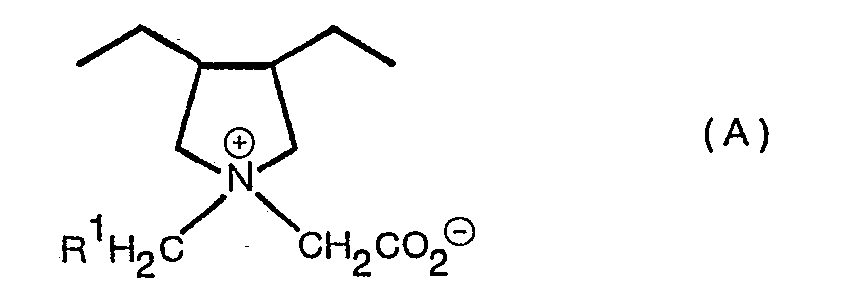
- the present invention provides a polymer which consists essentially of 55 to 90% by weight of units of formula (A); wherein R 1 is a hydrogen atom or an alkyl group of 1 to 3 carbon atoms; and 10 to 45% by weight of units of formula (B) and (C): wherein R 2 is a hydrocarbon group of 5 to 19 carbon atoms; R 3 is a hydrogen atom or an alkyl group of 1 to 3 carbon atoms, R 4 is a hydrocarbon group of 5 to 19 carbon atoms and X a is an anion.
- the polymers of the present invention consist essentially of units of formula (A), (B), and (C) as hereinbefore described up to 10% of the polymer may comprise of one or more compatible monomers capable of copolymerisation with units of formula (A), (B) and (C). Generally not more than 5% and preferably not more than 2% of such other units are included. Most preferably no such other units are included.
- R 1 is a hydrogen atom.
- Suitable groups R 2 include alkyl groups and especially those in which the alkyl group is an n-alkyl group. Favourably the group R 2 contains from 7 to 13 carbon atoms. A preferred group for R 2 is the n-C 11 H 23 group.
- R 3 is a hydrogen atom.
- Suitable groups R 4 include alkyl groups and especially those in which the alkyl group is an n-alkyl group. Favourably the group R 4 contains from 7 to 13 carbon atoms. A preferred group for R 4 is the n-C 11 H 23 group.
- Suitable anions X 8 include chloride, bromide, iodide, sulphate, acetate, gluconate and the like. Generally the anion is chosen to impart a water solubility of at least 0.1 % and preferably at least 0.5% w/v at 20°C. The anion is naturally a non toxic anion and is preferably suitable for instillation into the eye.
- X ⁇ is Cl ⁇ .
- the content of units of the formula (A) in the polymer is from 60 to 80%, more suitably is from 62 to 70% and preferably is 65%.
- the contents of units of the formula (B) in the polymer is up to 22%, more suitably is 15 to 20% and preferably is 17.5%.
- the content of units of the formula (C) in the polymer is from 10 to 35%, more suitably is from 15 to 30% and preferably is 17.5%.
- the combined weight of units of the formulae (B) and (C) in the polymer of this invention is favourably from 20 to 40%.
- At least 10% of the weight of the polymer should be present as units of formula (C).
- a preferred polymer consists of 65% units of the formula (A), 17.5% of units of the formula (B) and 17.5% of units of the formula (C).
- Such polymer is especially preferred when R 1 and R 3 are hydrogen atoms and R 2 and R 4 are n-C 11 H 23 groups and X a is a chloride anion.
- Such a polymer is believed to posses particularly advantageous properties with regard to bactericidal effectiveness and low protein deposition on contact lenses.
- a further aspect of the present invention comprises a process for the preparation of the polymers of the invention by de-esterification of an ester of a salt of the polymer of the invention followed by isolation of the polymer of the invention.
- the ester of the polymer is an alkyl ester in which the alkyl group contains 1 to 4 carbon atoms.
- the ester is the methyl ester.
- the salt of the polymer is a salt having the anion X I as described above.
- the anion X a is Cl e .
- the de-esterification of the ester is carried out in an aqueous solution at acid neutral or alkaline pH values.
- the de-esterification is carried out in the presence of a mineral acid, such as sulphuric, hydrochloric or nitric acid and the like.
- a particularly preferred mineral acid is hydrochloric acid.
- the de-esterification is carried out at an elevated temperature, most aptly the temperature is from 80 to 100°C and is preferably from 96 to 98°C.
- the polymer of the invention is isolated after the de-esterification reaction by de-acidifying the product of the de-esterification reaction.
- This may be carried out by chemical means, such as precipitation of the anion X a as insoluble metallic salt followed by neutralisation of the acid by a suitable base such as an aqueous solution of an alkali metal hydroxide or ammonia or by physical means such as passing through an ion exchange resin to remove the anion X I or by dialysing through a semi-permeable membrane.
- the polymer of this invention is free from low molecular weight materials, for example is free of material of weight less than 10,000 and preferably less than 15,000. (Molecular weights are expressed on wt. average basis).
- the process is carried out in an aqueous solution having an alkaline pH value.
- the viscous oil obtained is diluted with water and an aqueous solution of an alkali metal hydroxide or ammonia is added and the alkaline solution allowed to stand for a period sufficient for de-esterification to be complete, for example 1 to 4 hours, at ambient temperature, that is 15 to 25°C.
- the alkali metal hydroxide used is sodium hydroxide.
- the pH value of the solution is adjusted to pH 7 by addition of an aqueous solution of a mineral acid as defined above.
- a preferred mineral acid is hydrochloric acid.
- the neutral solution is then dialysed using cellulose acetate tubing as described above for a period of up to 21 days, preferably 7 to 16 days, for example 14 days.
- a further aspect of this invention comprises a pharmaceutical composition containing an antimicrobially effective amount of a polymer of the invention hereinbefore described together with a pharmaceutically acceptable carrier.
- the antimicrobially effective amount present in the compositions of this invention will normally be 0.001 to 0.5%, will suitably be 0.002 to 0.25%, more suitably be 0.005 to 0.1 % and preferably will be 0.01 to 0.05%.
- the higher concentrations for example greater than or equal to 0.1 % will generally be suitable for skin antisepsis or the like whereas lower concentrations (less than 0.1% and preferably less than 0.05% may be employed in the sterilisation of soft contact lenses).
- Suitable pharmaceutically acceptable carriers will include liquids, ointments, lotions, pastes, emulsions, aqueous gels, oily suspensions, water soluble polymeric films, water-insoluble films capable of sustained release of the antimicrobial agent and the like.
- the preferred carriers will be aqueous solutions suitable for soft lens sterilisation.
- compositions of the present invention are substantially free of ionic materials.
- ionic material such as sodium chloride and the like may cause reduction in the activity of the polymers of the present invention.
- the pharmaceutical composition of this invention is preferably sterile.
- Liquid compositions are most easily prepared and sterilised by dissolving an appropriate amount of polymer of this invention in the liquid and filtering through an 0.22 micron cellulose ester filtration membrane (available from Millepore Corp., Bedford, Mass.) into the appropriate sterile package presentation.
- a preferred liquid composition comprises a sterile aqueous solution.
- composition particularly suitable for topical application is a sterile ointment.
- a sterile ointment This will conveniently have a hydrophilic ointment base such as an oil-in-water emulsion.
- Suitable ointment bases are described in Chapter 87 in Remingtons Pharmaceutical Sciences, 15th Edn. 1975 pages 1532-4 and in U.K. Patent Specification No. 1240545.
- the ointments are conveniently made by mixing together under aseptic conditions the pre-sterilised components at elevated temperature and allowing to cool before filling into the appropriate packaging.
- the ointment may also contain an additional antimicrobial agent such as silver sulphadiazine or a chlorhexidine salt.
- Preferred chlorhexidine salts are those of gluconic or acetic acid.
- the present invention also provides a method of treating diseases of the skin or other mucous membranes arising from bacterial infection or lesions of the skin such as burns or ulcers which comprises applying thereto a pharmaceutical composition (especially an ointment) of this invention.
- a further aspect of this invention provides an aqueous solution containing an antimicrobially effective amount of the polymer adapted to use in the sterilisation of a surface.
- the aqueous solution is preferably adapted for the sterilisation of a contact lens and most preferably adapted for the sterilisation of a soft contact lens.
- an aqueous solution for this aspect of the invention will contain 0.001 to 0.1 % of a polymer of this invention, suitably from 0.002 to 0.06%, more suitably from 0.005 to 0.05% of a polymer of this invention and preferably will contain 0.02 to 0.03% of a polymer of this invention.
- the aqueous solution of this aspect of the invention will contain a tonicity adjusting agent in an amount suitable to render the solution substantially isotonic with human tears, that is, a tonicity equivalent to an aqueous solution containing from 0.8 to 1.1% of sodium chloride and preferably equivalent to 0.9% sodium chloride.
- a tonicity adjusting agent are nonionic agents such as glycerol, polypropylene glycol, dextrose, urea or other non-ionic tonicity agents.
- the amount of tonicity adjusting agent will differ depending upon the agent used.
- a list of sodium chloride equivalents is given in Remingtons Pharmaceutical Sciences, 15th Edn. Chapter 79 pages 1408-12.
- the amount of dextrose present in the solution is suitably from 4.0 to 5.5%, and is most preferably 5%, while the amount of urea present in the solution is suitably from 1.5 to 1.7% and is preferably 1.63% and the amount of glycerol present in the solution is suitably from 2.0 to 3.0% and is preferably 2.5% and the amount of propylene glycol present in the solution is suitably from 1.8 to 2.5% and is preferably 2.0%.
- the aqueous solution may also contain other compatible antimicrobial agents such as thiomersal but in general this is not a preferred feature of the invention.
- other compatible antimicrobial agents such as thiomersal but in general this is not a preferred feature of the invention.
- One of the considerable advantages of the use of the present polymers is that, if desired, they allow the avoidance of the use of additional antimicrobial agents.
- the aqueous solution may also contain a buffering system such as disodium hydrogen phosphate and potassium dihydrogen phosphate but in general the polymer will dissolve in water to give a pH value of between 6.5 and 7.5 and the presence of a buffer is not a preferred feature of the invention.
- a buffering system such as disodium hydrogen phosphate and potassium dihydrogen phosphate
- the polymer will dissolve in water to give a pH value of between 6.5 and 7.5 and the presence of a buffer is not a preferred feature of the invention.
- the avoidance, if desired, of such buffers is also an advantage of use of the polymers of this invention.
- the invention also provides a method of sterilising a contact lens by contacting said lens with an aqueous solution containing an antimicrobially effective amount of a polymer of the invention for sufficient time to sterilise said lens, suitably is from 2 to 10 hours and preferably is from 4 to 8 hours.
- a solution containing an antimicrobially effective amount of a polymer of this invention is employed per lens to be sterilised and preferably from 3 to 12 ml, for example 5 or 10 ml is used.
- the lens may be contacted with the aqueous solution in a lens case.
- Suitable lens cases will have a volume of between 1 and 20 ml and more suitably from 3 to 12 ml, for example 10 ml.
- the lens case may comprise a single chamber for receiving the solution. In such cases a lens holder capable of holding each lens from right or left eye separate from each other is required.
- the lens case may comprise a pair of chambers (one for each lens). It is desirable that which ever type of lens case is used the lens is allowed to float freely in the solution so that the entire surface is wetted by the solution and thereby effectively sterilised.
- Suitable lens cases will be closed by a bacteria-proof closure so that bacteria are not admitted to the interior of the lens case during the sterilising cycle. The skilled worker willknow the type of screw cap or snap top closure which is bacteria-proof.
- Containers for compositions of this invention are made from materials which are sterilisable and will not absorb deleterious amounts of polymer from the composition. Suitable materials include low density polyethylene. Containers made from low density polyethylene may be sterilised using ethylene oxide or gramma irradiation and stored until required for filling. Such containers of polyethylene may be filled and stored without the composition unacceptably losing effectiveness through absorption of the polymer from the solution into the walls of the container. Suitable multi-dose containers will have a volume of 25 to 250 ml. Although it is preferred that the volume of the container is 100 to 150 ml, for example about 125 ml to contain solution for 20 to 30 days of daily use.
- Suitable multi-dose containers may be closed by a screw cap and the solution dispensed through a restricted opening such as a dropper tip.
- the compositions of the present invention may be filled into unit dose containers, for example sachets capable of containing 10 to 20 ml of solution.
- the method of this invention is applied to the sterilisation of contact lenses, such as soft (that is hydrophilic) contact lenses, silicone-based contact lenses and gas permeable contact lenses.
- contact lenses such as soft (that is hydrophilic) contact lenses, silicone-based contact lenses and gas permeable contact lenses.
- the method is preferably used to sterilise soft contact lenses.
- a further aspect of this invention provides an aqueous solution containing an antimicrobially effective amount of the polymer together with a non-ionic surface active agent which solution is adapted for use as a cleaning, sterilising and wetting solution for contact lenses, particularly hard and gas-permeable lenses.
- Hard and gas-permeable lenses are conventionally manufactured from hydrophobic materials such as polymethyl methacrylate, cellulose acetate butyrate, silicone polymers and copolymers of silicone and acrylate monomers. After sterilisation and removal from the sterilising solution it is desirable that the surfaces of the lenses should be treated with a sterile, isotonic solution of a wetting agent to avoid possible discomfort immediately after replacement of the lens in the eye.
- the solutions of this aspect of the invention will be substantially isotonic as hereinbefore defined.
- the tonicity adjusting agent will be a non-ionic tonicity adjusting agent as hereinbefore defined.
- Suitable non-ionic surface active agents for inclusion in the. solutions of this aspect of the invention include poly(oxyethylene)-poly(oxypropylene) block copolymers (commonly known as Pluronics, trade mark of Wyandotte Corp.). Such polymers are formed by the condensation of propylene oxide onto a propylene-glycol nucleus followed by the condensation of ethylene oxide on to both ends of poly(oxypropylene) base. The poly(oxyethylene) groups on the ends of the molecule are controlled in length to constitute from 10 to 80% by weight of the final molecule. Suitable polymers will have a molecular weight of between 1900 to 15,500.
- Suitable block copolymers for use in the invention include the following Pluronic copolymers, Pluronic L62 (molecular weight 2100, % polyoxyethylene 20%), Pluronic L64 (2900,40%), Pluronic F68 (8350, 80%), Pluronic F108 (15,500, 80%) and Pluronic F127 (11,500, 70%).
- a preferred block copolymer is the polymer having a molecular weight of 2900 and containing 40% polyoxyethylene in the total molecule, known as Pluronic L64.
- the solutions of the present invention will contain 0.01 to 2.5% of the non-ionic surface active agent based on the weight of the composition. More suitably the solutions will contain 0.05 to 1.5% and preferably 0.1 to 1% for example 0.5%.
- this invention provides an aqueous isotonic solution suitable for the sterilisation and wetting of contact lenses which comprises a sterile, isotonic, aqueous solution of from 0.001 to 0.1 % of a polymer of the present invention, from 0.01 to 2.5% of a non-ionic surface active agent rendered isotonic with a non-ionic tonicity adjusting agent.
- this invention provides an aqueous isotonic solution suitable for the sterilisation and wetting of contact lenses which comprises a sterile isotonic aqueous solution of from 0.002 to 0.025% of a polymer of the present invention, from 0.1 to 1.0% of a poly(oxyethylene)-poly(oxypropylene) block copolymer having a molecular weight between 2100 and 15,500, rendered isotonic with a non-ionic tonicity adjusting agent.
- Prepolymers for units of formula (A) and (B) may be prepared by condensing an N-alkyl substituted diallyl amine with a halocarboxylic ester in an inert solvent (see for example United States Patent No. 35 15 707).
- a N,N - diallyl - glycinate may be reacted with an alkyl halide such as octyl bromide in a solvent such: as a lower alkanol (see also for example United States Patent No. 3515707).
- Prepolymersfor units of formula (C) may be prepared by reacting N - methyl - N,N - diallyl amine with an alkyl halide such as n-octyl bromide or n-dodecyl bromide in an appropriate solvent (see for example British Patent No. 1037028).
- the bromide ion can be replaced by chloride ion by passage through a suitable ion-exchange resin. It is believed that polymerisation is best achieved using precursors in the form of chloride salts.
- the monomers may be polymerised by a free-radical polymerisation process.
- the monomers may be dissolved in the desired final ratios in a polar solvent such as water, dimethylsulphoxide, dimethyl formamide, a lower alkanol, dioxane, glycol ether or other solvent of like polarity.
- a free radical catalyst will be present as polymerisation initiators.
- Apt catalysts include peroxides including inorganic peroxides such as hydrogen peroxide, organic peroxides, such as tertiary butyl hydroperoxide and benzoyl peroxide and peracids, such as peracetic acid.
- free radical catalysts may be employed such as azobisisobutyronitrile.
- the amount of catalyst used will generally be 0.5 to 5% by weight of the monomer present.
- a non-extreme temperature will normally be employed, for example, from 0°Cto 100°C, but a particularly suitable range is from 50°C to 80°C, for example 70°C.
- the polymerisation can be carried out most conveniently at atmospheric pressure.
- An inert atmosphere is preferred for the polymerisation to avoid the formation of undesirable by-products.
- the reactant mixture may be purged with nitrogen before polymerisation is initiated and a nitrogen atmosphere may aptly be maintained during the reaction.
- the initial product of the polymerisation is the chloride salt of the methyl ester of the required polymer.
- the polymer may be de-esterified by heating in the presence of an aqueous solution of a mineral acid. Particularly preferred is a 6N solution of hydrogen chloride.
- the temperature of the reaction is preferably from'80°C to 100°C.
- the resultant solution may be finally transformed to the required polymer by dialysing using a semi-permeable membrane. This process may be carried out over a period of 7 days. The polymer is retained within the membrane whilst the impurities in the polymer are removed through the membrane.
- the reaction product of the polymerisation reaction is dialysed through a cellulose acetate membrane to remove excess ions, low molecular weight reaction products and low molecular weight polymeric reaction products.
- a suitable cellulose acetate membrane is a Visking membrane (available from Medicell Inernational Ltd. London).
- the polymer remaining within the dialysis membrane has a molecular weight of greater than 10,000 and preferably is greater than 15,000. (Molecular weights are expressed on wt. average basis).
- the polymer may be de-esterified by allowing the polymer stand at ambient temperature, 15° to 25°C in the presence of an aqueous solution of an alkali metal hydroxide, suitably sodium hydroxide, for sufficient time to allow de-esterification to take place.
- the de-esterification reaction is exothermic. Although during the course of the reaction the temperature of the reaction mixture may rise no external heating means is required.
- the resultant solution is neutralised with dilute mineral acid and the neutral solution dialysed using a semi-permeable membrane as described above. Suitably the dialysis will be carried out over a period of 14 days.
- the polymers of the invention may be isolated from the dialysed solution by freeze drying.
- the petroleum ether layer was decanted.
- the product was made more mobile with ethanol (0.5 ml) and finally any residual petroleum ether and the ethanol were removed by evaporation under a vacuum of 1 mm Hg and gentle heating.
- the product N - carbomethoxy methyl - N - dodecyl - N,N - diallyl ammonium chloride (29.95 g) was isolated as a red oil (free of starting materials by glc).
- the oil was then dissolved in water (130 ml) and extracted with diethyl ether (3x25 ml) to remove unchanged starting materials.
- the product is isolated in approximately 50% w/w solution in water by evaporating the aqueous solution to remove water (90 ml. approximately).
- the product N - methyl - N - n - dodecyl - N,N - diallyl ammonium chloride was obtained as a 95% yield (34.20 g) based on the dry weight of the aqueous solution.
- N - carbomethoxymethyl- N - methyl - N,N - diallyl ammonium chloride 5.2 g
- N - carbomethoxymethyl- N - n - dodecyl - N,N - diallyl ammonium chloride 1:4 g
- a 51% aqueous solution of N - methyl - N - n - dodecyl - N,N - diallyl ammonium chloride (2.86 g, equivalent of 1.40 g dry monomer) in water (2.54 g) was added t-butyl hydroperoxide (0.28 g).
- the resultant solution was purged with nitrogen and maintained at 70°C for 40 hours under nitrogen.
- the reaction mixture was cooled and water (150 ml) added.
- the resultant solution was sealed into 18/32" Visking tubing and allowed to dialyse in water (4 litres) for 7 days, replacing the water (4 litres) each day.
- the retentate was evaporated to dryness under reduced pressure to yield a viscous oil (4.20 g).
- This oil was dissolved in 6N hydrochloric acid (20 ml) and heated to 98°C for 4 hours.
- the reaction mixture was cooled and water (100 ml) added.
- the water along with excess hydrogen chloride was removed by evaporation under reduced pressure. To the residue a further amount of water (100 ml) was added.
- the proportions of starting materials are chosen such that the resultant polymer contains 65% of units of formula (A), 17.5% of units of formula (B) and 17.5% of units of formula (C) (wherein R 1 and R 3 are hydrogen atoms and R 2 and R 4 are n-unadecyl groups).
- each example 1-8 units of formula (A) are derived from N - carboxymethyl - N,N - diallyl - N - methyl quaternary ammonium compound, that is where R 1 as defined above is a hydrogen atom.
- each example 1-8 units of formula (C) are derived from N - methyl - N,N - diallyl - N - alkyl quaternary ammonium chloride, that is where R 3 as defined above is a hydrogen atom.
- Antimicrobial activity was assessed using four organisms Pseudomonas aeruginosa, Staphyloccocus aureus, Escherichi coli and Candida albicans.
- the four organisms were inoculated separately into aqueous solutions of the test polymers at concentrations of 10 6 organisms/ml.
- the concentrations of test polymers in each solution was either 0.02 or 0.05%.
- Samples were withdrawn after 4 hours and were cultured in a recovery broth containing suitable inactivators. If no viable organisms were recovered the polymer had passed the test. The results are given in Table 2.
- Bovine serum albumin/fluorescamine to be used as the source of protein was prepared as described by Brynda et. al. in J. Biomed. Mat. Res. 1978, 12, 55.
- a series of polyhydroxyethyl methacrylate, (poly HEMA) contact lenses were cleaned by immersion in a 10% aqueous solution of polyoxyethylene stearate (Tween 60) subjecting the lenses and solution to ultrasonic waves for 5 minutes at 50°C. The lenses were thoroughly rinsed in distilled water to remove all traces of the surface active agent.
- the cleaned lenses were then allowed to stand overnight in the presence of 5 ml. of an aqueous test solution containing 0.02% of a polymer dissolved in it.
- the test solution was aspirated from above the lens and the lens washed six times with distilled water, the liquid was aspirated from above the lens each time. Then the lenses were allowed to stand overnight in the presence of a 3.5 ml. of solution of 0.5 mg/ml Albumin/fluorescamine in Ringer solution.
- the non-bound protein was rinsed from the lens by aspirating the liquid from above the lens without allowing the coated lens to become exposed to the air. This washing and aspiration was repeated six times. Finally 4 ml.
- An isotonic solution of a portion of the polymer prepared in Example 1 suitable for the sterilisation of soft contact lenses was formulated as follows:
- the polymer and urea were taken and dissolved in water (90 ml). When all the solid had dissolved the solution was made up to 100% with distilled water.
- the solution may then be sterilised by filtration through a 0.22 micron cellulose ester membrane filter and aseptically filled into sterile containers.
- a second isotonic solution of a portion of the polymer prepared in Example 1 which is suitable for the sterilisation of soft contact lenses was formulated as follows:
- the solution was prepared and tested for antimicrobial activity as described in Example 9. The solution passed the test.
- N - carbomethoxymethyl - N - methyldiallyl ammonium chloride 130 g, 0.59M
- N - carbomethoxymethyl - N - n - dodecyl - N,N - diallyl ammonium chloride 35 g, 0.094M
- N - methyl - N - n - dodecyl - N,N - diallyl ammonium chloride 35 g, 0.11 M
- the reaction mixture was cooled and then the volume of the mixture was diluted to 1000 ml by addition of water.
- Sodium hydroxide solution (272 ml, 10% solution) was added and the mixture allowed to stand for 1 hour.
- the pH of the resultant solution was adjusted to pH 7 by addition of dilute hydrochloric acid, the resultant solution was dialyzed in 18/32" Visking tubing for 14 days.
- the solution retained in the Visking tubing was freeze dried to yield the polymer (86 g, 52%) as a white solid.
- the proportions of starting materials are chosen such that the resultant polymer contains 65% of units of formula (A), 17.5% of units of formula (B) and 17.5% of units of formula (C) (wherein R 1 and R 3 are hydrogen atoms and R 2 and R 4 are n-unadecyl groups).
- An isotonic solution containing polymer prepared according to the method of Example 11 which is suitable for the sterilisation of soft contact lenses was formulated as follows:
- the solution was prepared and tested for antimicrobial activity by the plate method described hereinbefore. The solution passed that test.
- An isotonic solution containing polymer was prepared according to the method of Example 11 and which also contains a surface active agent was formulated as follows:
- the solution was prepared and tested for antimicrobial activity by the plate method described hereinbefore.
- the solution passed the test.
- This solution is suitable for use as a wetting and sterilising solution for hard and gas permeable contact lenses.
- An isotonic solution containing polymer was prepared according to the method of Example 11 which is suitable for the sterilisation of soft contact lenses was formulated as follows:
- the solution was prepared and tested for antimicrobial activity by the plate method as described hereinbefore.
- the solution passed the test.
- An isotonic solution containing polymer prepared according to the method of Example 1 which is suitable for sterilisation of soft contact lenses was formulated as follows:
- the solution was prepared and tested for antimicrobial activity by the plate method as described hereinbefore.
- the solution passed the test.
- a hydrophilic contact lens was placed into a closable lens case (volume 12 mI).
- a sterilising solution of Example 11 was introduced into the lens case which was then closed and left at ambient temperature for 6 hours. At the end of this time the lens was deemed to satisfactorily sterilised.
Landscapes
- Health & Medical Sciences (AREA)
- Chemical & Material Sciences (AREA)
- Life Sciences & Earth Sciences (AREA)
- Chemical Kinetics & Catalysis (AREA)
- General Health & Medical Sciences (AREA)
- Medicinal Chemistry (AREA)
- Organic Chemistry (AREA)
- Polymers & Plastics (AREA)
- General Chemical & Material Sciences (AREA)
- Veterinary Medicine (AREA)
- Public Health (AREA)
- Animal Behavior & Ethology (AREA)
- Agronomy & Crop Science (AREA)
- Wood Science & Technology (AREA)
- Epidemiology (AREA)
- Environmental Sciences (AREA)
- Zoology (AREA)
- Pest Control & Pesticides (AREA)
- Plant Pathology (AREA)
- Engineering & Computer Science (AREA)
- Dentistry (AREA)
- Pharmacology & Pharmacy (AREA)
- Communicable Diseases (AREA)
- Oncology (AREA)
- Nuclear Medicine, Radiotherapy & Molecular Imaging (AREA)
- Addition Polymer Or Copolymer, Post-Treatments, Or Chemical Modifications (AREA)
- Pharmaceuticals Containing Other Organic And Inorganic Compounds (AREA)
- Medicinal Preparation (AREA)
- Apparatus For Disinfection Or Sterilisation (AREA)
- Plural Heterocyclic Compounds (AREA)
- Agricultural Chemicals And Associated Chemicals (AREA)
- Eyeglasses (AREA)
Claims (13)


Priority Applications (1)
| Application Number | Priority Date | Filing Date | Title |
|---|---|---|---|
| AT81305756T ATE12511T1 (de) | 1980-12-12 | 1981-12-07 | Polymere, deren herstellung und verwendungen. |
Applications Claiming Priority (2)
| Application Number | Priority Date | Filing Date | Title |
|---|---|---|---|
| GB8039934 | 1980-12-12 | ||
| GB8039934 | 1980-12-12 |
Publications (3)
| Publication Number | Publication Date |
|---|---|
| EP0055048A2 EP0055048A2 (de) | 1982-06-30 |
| EP0055048A3 EP0055048A3 (en) | 1982-08-11 |
| EP0055048B1 true EP0055048B1 (de) | 1985-04-03 |
Family
ID=10517959
Family Applications (1)
| Application Number | Title | Priority Date | Filing Date |
|---|---|---|---|
| EP81305756A Expired EP0055048B1 (de) | 1980-12-12 | 1981-12-07 | Polymere, deren Herstellung und Verwendungen |
Country Status (11)
| Country | Link |
|---|---|
| US (1) | US4451624A (de) |
| EP (1) | EP0055048B1 (de) |
| JP (1) | JPS57131215A (de) |
| AT (1) | ATE12511T1 (de) |
| AU (1) | AU553160B2 (de) |
| CA (1) | CA1208844A (de) |
| DE (1) | DE3169753D1 (de) |
| GB (1) | GB2090605B (de) |
| IE (1) | IE52006B1 (de) |
| NZ (1) | NZ199234A (de) |
| ZA (1) | ZA818621B (de) |
Families Citing this family (28)
| Publication number | Priority date | Publication date | Assignee | Title |
|---|---|---|---|---|
| US4708998A (en) * | 1985-01-02 | 1987-11-24 | Exxon Research And Engineering Company | Cyclopolymerizable sulfobetaine monomer |
| PH21406A (en) * | 1985-04-19 | 1987-10-15 | Ciba Geigy Ag | Ophthalmic solution and methods for improving the comfort and safety of contact lenses |
| US4748189A (en) * | 1985-04-19 | 1988-05-31 | Ciba-Geigy Corporation | Ophthalmic solutions and methods for improving the comfort and safety of contact lenses |
| US4822847A (en) * | 1986-01-27 | 1989-04-18 | Exxon Research And Engineering Company | Method of increasing viscosity of an aqueous solution with a sulfo betaine polymer |
| US4999410A (en) * | 1987-08-18 | 1991-03-12 | University Of Southern Mississippi | Acrylate ester ether derivatives |
| US4986963A (en) * | 1989-01-24 | 1991-01-22 | Corcoran Richard A | Method of disinfecting contact lenses with peracetic acid |
| US5487888A (en) | 1993-05-20 | 1996-01-30 | Geltex, Inc. | Iron-binding polymers for oral administration |
| US6129910A (en) * | 1993-06-02 | 2000-10-10 | Geltex Pharmaceuticals, Inc. | Water-insoluble noncrosslinked bile acid sequestrants |
| US5929184A (en) * | 1993-06-02 | 1999-07-27 | Geltex Pharmaceuticals, Inc. | Hydrophilic nonamine-containing and amine-containing copolymers and their use as bile acid sequestrants |
| US5667775A (en) | 1993-08-11 | 1997-09-16 | Geltex Pharmaceuticals, Inc. | Phosphate-binding polymers for oral administration |
| US5496545A (en) * | 1993-08-11 | 1996-03-05 | Geltex Pharmaceuticals, Inc. | Phosphate-binding polymers for oral administration |
| US6034129A (en) | 1996-06-24 | 2000-03-07 | Geltex Pharmaceuticals, Inc. | Ionic polymers as anti-infective agents |
| US6203785B1 (en) | 1996-12-30 | 2001-03-20 | Geltex Pharmaceuticals, Inc. | Poly(diallylamine)-based bile acid sequestrants |
| US6423754B1 (en) | 1997-06-18 | 2002-07-23 | Geltex Pharmaceuticals, Inc. | Method for treating hypercholesterolemia with polyallylamine polymers |
| US6060235A (en) * | 1997-09-19 | 2000-05-09 | Geltex Pharmaceuticals, Inc. | Antiviral polymers comprising acid functional groups and hydrophobic groups |
| US6290947B1 (en) | 1997-09-19 | 2001-09-18 | Geltex Pharmaceuticals, Inc. | Ionic polymers as toxin-binding agents |
| US6007803A (en) * | 1997-09-19 | 1999-12-28 | Geltex Pharmaceuticals, Inc. | Ionic polymers as toxin binding agents |
| US6726905B1 (en) | 1997-11-05 | 2004-04-27 | Genzyme Corporation | Poly (diallylamines)-based phosphate binders |
| US6083497A (en) | 1997-11-05 | 2000-07-04 | Geltex Pharmaceuticals, Inc. | Method for treating hypercholesterolemia with unsubstituted polydiallylamine polymers |
| GB9816163D0 (en) | 1998-07-25 | 1998-09-23 | Secr Defence | Liquid crystal polymers |
| US6482402B1 (en) | 1999-05-13 | 2002-11-19 | Geltex Pharmaceuticals, Inc. | Antimicrobial compositions and methods |
| US6733780B1 (en) | 1999-10-19 | 2004-05-11 | Genzyme Corporation | Direct compression polymer tablet core |
| US7361206B1 (en) | 2004-09-07 | 2008-04-22 | United States Of America As Represented By The Secretary Of The Navy | Apparatus and method for water vapor removal in an ion mobility spectrometer |
| US7985418B2 (en) | 2004-11-01 | 2011-07-26 | Genzyme Corporation | Aliphatic amine polymer salts for tableting |
| EP1951266A2 (de) | 2005-09-02 | 2008-08-06 | Genzyme Corporation | Verfahren zur entfernung von phosphat und dafür verwendetes polymer |
| KR101547925B1 (ko) | 2005-09-15 | 2015-08-27 | 젠자임 코포레이션 | 아민 중합체에 대한 샤셋 제형 |
| CA2786141A1 (en) | 2009-12-30 | 2011-07-07 | Axcelon Biopolymers Corporation | Transparent bacterial cellulose nanocomposite hydrogels |
| MA41202A (fr) | 2014-12-18 | 2017-10-24 | Genzyme Corp | Copolymères polydiallymine réticulé pour le traitement du diabète de type 2 |
Family Cites Families (8)
| Publication number | Priority date | Publication date | Assignee | Title |
|---|---|---|---|---|
| US3515707A (en) * | 1967-02-16 | 1970-06-02 | Allied Chem | Metal derivatives of novel saturated heterocyclic polymers |
| US3551384A (en) * | 1968-06-19 | 1970-12-29 | Calgon C0Rp | Water soluble polymers of diacetone acrylamide |
| US3539684A (en) * | 1968-11-21 | 1970-11-10 | Calgon C0Rp | Bactericidal polymers |
| US3840504A (en) * | 1970-01-26 | 1974-10-08 | Hercules Inc | Reaction products of epihalohydrin and polymers of diallylamine and their use in paper |
| US3912693A (en) * | 1973-04-05 | 1975-10-14 | Nitto Boseki Co Ltd | Process for producing polyamines |
| US4026945A (en) * | 1974-10-03 | 1977-05-31 | Millmaster Onyx Corporation | Anti-microbial quaternary ammonium co-polymers |
| JPS5513778A (en) * | 1978-04-26 | 1980-01-30 | Smith & Nephew Pharma | Water soluble polymer*sterilization*and disinfectant colution |
| GB2027040B (en) * | 1978-04-26 | 1982-09-29 | Smith & Nephew Pharma | Polymers of diallylamine quarternary salts sterilizing agents |
-
1981
- 1981-12-07 DE DE8181305756T patent/DE3169753D1/de not_active Expired
- 1981-12-07 AT AT81305756T patent/ATE12511T1/de not_active IP Right Cessation
- 1981-12-07 EP EP81305756A patent/EP0055048B1/de not_active Expired
- 1981-12-07 IE IE2873/81A patent/IE52006B1/en unknown
- 1981-12-07 GB GB8136770A patent/GB2090605B/en not_active Expired
- 1981-12-10 NZ NZ199234A patent/NZ199234A/en unknown
- 1981-12-11 CA CA000392125A patent/CA1208844A/en not_active Expired
- 1981-12-11 ZA ZA818621A patent/ZA818621B/xx unknown
- 1981-12-11 US US06/330,013 patent/US4451624A/en not_active Expired - Lifetime
- 1981-12-12 JP JP56200810A patent/JPS57131215A/ja active Pending
- 1981-12-16 AU AU78571/81A patent/AU553160B2/en not_active Ceased
Also Published As
| Publication number | Publication date |
|---|---|
| AU7857181A (en) | 1982-06-17 |
| DE3169753D1 (en) | 1985-05-09 |
| US4451624A (en) | 1984-05-29 |
| EP0055048A2 (de) | 1982-06-30 |
| GB2090605B (en) | 1984-09-05 |
| NZ199234A (en) | 1984-07-06 |
| ZA818621B (en) | 1983-02-23 |
| GB2090605A (en) | 1982-07-14 |
| ATE12511T1 (de) | 1985-04-15 |
| CA1208844A (en) | 1986-07-29 |
| JPS57131215A (en) | 1982-08-14 |
| AU553160B2 (en) | 1986-07-03 |
| IE812873L (en) | 1982-06-12 |
| IE52006B1 (en) | 1987-05-13 |
| EP0055048A3 (en) | 1982-08-11 |
Similar Documents
| Publication | Publication Date | Title |
|---|---|---|
| EP0055048B1 (de) | Polymere, deren Herstellung und Verwendungen | |
| US4615882A (en) | Disinfectant solution for contact lens | |
| AU737541B2 (en) | Disinfecting contact lenses with polyquaterniums and polymeric biguanides | |
| EP1545635B1 (de) | Zusammensetzungen mit verbesserter antimikrobieller wirksamkeit gegen acanthamoebae | |
| US4499077A (en) | Anti-microbial compositions and associated methods for preparing the same and for the disinfecting of various objects | |
| US4046706A (en) | Contact lens cleaning composition | |
| EP0180309B1 (de) | Desinfektions- und Aufbewahrungslösungen für Kontaktlinsen und Verfahren zur Verwendung | |
| US7067479B2 (en) | Compositions with enhanced antimicrobial efficacy against E. coli | |
| EP0668885A1 (de) | Polymerbiguanide | |
| US20050214382A1 (en) | Zinc preservative composition and method of use | |
| JP2001504246A (ja) | コンタクトレンズを消毒するためにビス(ビグアニド)が増強された抗菌効力を提供する組成物および方法 | |
| US5512597A (en) | Polymeric quaternary ammonium compounds and their use as ophthalmic antimicrobials | |
| DE69902197T2 (de) | Verwendung einer Flüssigkeit zum Desinfizieren von Kontaktlinsen | |
| EP1852133A2 (de) | Zusammensetzungen mit verbesserter antimikrobieller Wirksamkeit gegen Acanthamoebae | |
| MXPA00004566A (en) | Disinfecting contact lenses with polyquaterniums and polymeric biguanides |
Legal Events
| Date | Code | Title | Description |
|---|---|---|---|
| PUAI | Public reference made under article 153(3) epc to a published international application that has entered the european phase |
Free format text: ORIGINAL CODE: 0009012 |
|
| PUAL | Search report despatched |
Free format text: ORIGINAL CODE: 0009013 |
|
| AK | Designated contracting states |
Designated state(s): AT BE CH DE FR IT LI NL SE |
|
| AK | Designated contracting states |
Designated state(s): AT BE CH DE FR IT LI NL SE |
|
| 17P | Request for examination filed |
Effective date: 19820826 |
|
| RAP1 | Party data changed (applicant data changed or rights of an application transferred) |
Owner name: SMITH AND NEPHEW ASSOCIATED COMPANIES P.L.C. |
|
| GRAA | (expected) grant |
Free format text: ORIGINAL CODE: 0009210 |
|
| AK | Designated contracting states |
Designated state(s): AT BE CH DE FR IT LI NL SE |
|
| PG25 | Lapsed in a contracting state [announced via postgrant information from national office to epo] |
Ref country code: NL Effective date: 19850403 Ref country code: LI Effective date: 19850403 Ref country code: IT Free format text: LAPSE BECAUSE OF FAILURE TO SUBMIT A TRANSLATION OF THE DESCRIPTION OR TO PAY THE FEE WITHIN THE PRESCRIBED TIME-LIMIT;WARNING: LAPSES OF ITALIAN PATENTS WITH EFFECTIVE DATE BEFORE 2007 MAY HAVE OCCURRED AT ANY TIME BEFORE 2007. THE CORRECT EFFECTIVE DATE MAY BE DIFFERENT FROM THE ONE RECORDED. Effective date: 19850403 Ref country code: CH Effective date: 19850403 Ref country code: BE Effective date: 19850403 Ref country code: AT Effective date: 19850403 |
|
| REF | Corresponds to: |
Ref document number: 12511 Country of ref document: AT Date of ref document: 19850415 Kind code of ref document: T |
|
| PG25 | Lapsed in a contracting state [announced via postgrant information from national office to epo] |
Ref country code: SE Effective date: 19850430 |
|
| REF | Corresponds to: |
Ref document number: 3169753 Country of ref document: DE Date of ref document: 19850509 |
|
| ET | Fr: translation filed | ||
| REG | Reference to a national code |
Ref country code: CH Ref legal event code: PL |
|
| NLV1 | Nl: lapsed or annulled due to failure to fulfill the requirements of art. 29p and 29m of the patents act | ||
| PLBE | No opposition filed within time limit |
Free format text: ORIGINAL CODE: 0009261 |
|
| STAA | Information on the status of an ep patent application or granted ep patent |
Free format text: STATUS: NO OPPOSITION FILED WITHIN TIME LIMIT |
|
| 26N | No opposition filed | ||
| PG25 | Lapsed in a contracting state [announced via postgrant information from national office to epo] |
Ref country code: FR Free format text: LAPSE BECAUSE OF NON-PAYMENT OF DUE FEES Effective date: 19880831 |
|
| PG25 | Lapsed in a contracting state [announced via postgrant information from national office to epo] |
Ref country code: DE Effective date: 19880901 |
|
| REG | Reference to a national code |
Ref country code: FR Ref legal event code: ST |