EP0054971B1 - 1-Carba-6-(1-hydroxyethyl)-2-carbonyl-penem-3-Carbonsäure, Verfahren zur Herstellung und sie enthaltende pharmazeutische Zusammensetzungen - Google Patents
1-Carba-6-(1-hydroxyethyl)-2-carbonyl-penem-3-Carbonsäure, Verfahren zur Herstellung und sie enthaltende pharmazeutische Zusammensetzungen Download PDFInfo
- Publication number
- EP0054971B1 EP0054971B1 EP81110740A EP81110740A EP0054971B1 EP 0054971 B1 EP0054971 B1 EP 0054971B1 EP 81110740 A EP81110740 A EP 81110740A EP 81110740 A EP81110740 A EP 81110740A EP 0054971 B1 EP0054971 B1 EP 0054971B1
- Authority
- EP
- European Patent Office
- Prior art keywords
- azetidin
- butyldimethylsilyl
- dimethylthio
- propyl
- hydroxyethyl
- Prior art date
- Legal status (The legal status is an assumption and is not a legal conclusion. Google has not performed a legal analysis and makes no representation as to the accuracy of the status listed.)
- Expired
Links
Classifications
-
- C—CHEMISTRY; METALLURGY
- C07—ORGANIC CHEMISTRY
- C07D—HETEROCYCLIC COMPOUNDS
- C07D477/00—Heterocyclic compounds containing 1-azabicyclo [3.2.0] heptane ring systems, i.e. compounds containing a ring system of the formula:, e.g. carbapenicillins, thienamycins; Such ring systems being further condensed, e.g. 2,3-condensed with an oxygen-, nitrogen- or sulphur-containing hetero ring
- C07D477/10—Heterocyclic compounds containing 1-azabicyclo [3.2.0] heptane ring systems, i.e. compounds containing a ring system of the formula:, e.g. carbapenicillins, thienamycins; Such ring systems being further condensed, e.g. 2,3-condensed with an oxygen-, nitrogen- or sulphur-containing hetero ring with hydrogen atoms, hydrocarbon or substituted hydrocarbon radicals, directly attached in position 4, and with a carbon atom having three bonds to hetero atoms with at the most one bond to halogen, e.g. an ester or nitrile radical, directly attached in position 2
- C07D477/12—Heterocyclic compounds containing 1-azabicyclo [3.2.0] heptane ring systems, i.e. compounds containing a ring system of the formula:, e.g. carbapenicillins, thienamycins; Such ring systems being further condensed, e.g. 2,3-condensed with an oxygen-, nitrogen- or sulphur-containing hetero ring with hydrogen atoms, hydrocarbon or substituted hydrocarbon radicals, directly attached in position 4, and with a carbon atom having three bonds to hetero atoms with at the most one bond to halogen, e.g. an ester or nitrile radical, directly attached in position 2 with hydrogen atoms, hydrocarbon or substituted hydrocarbon radicals, attached in position 6
- C07D477/14—Heterocyclic compounds containing 1-azabicyclo [3.2.0] heptane ring systems, i.e. compounds containing a ring system of the formula:, e.g. carbapenicillins, thienamycins; Such ring systems being further condensed, e.g. 2,3-condensed with an oxygen-, nitrogen- or sulphur-containing hetero ring with hydrogen atoms, hydrocarbon or substituted hydrocarbon radicals, directly attached in position 4, and with a carbon atom having three bonds to hetero atoms with at the most one bond to halogen, e.g. an ester or nitrile radical, directly attached in position 2 with hydrogen atoms, hydrocarbon or substituted hydrocarbon radicals, attached in position 6 with hydrogen atoms, hydrocarbon or substituted hydrocarbon radicals, attached in position 3
-
- A—HUMAN NECESSITIES
- A61—MEDICAL OR VETERINARY SCIENCE; HYGIENE
- A61P—SPECIFIC THERAPEUTIC ACTIVITY OF CHEMICAL COMPOUNDS OR MEDICINAL PREPARATIONS
- A61P31/00—Antiinfectives, i.e. antibiotics, antiseptics, chemotherapeutics
- A61P31/04—Antibacterial agents
-
- C—CHEMISTRY; METALLURGY
- C07—ORGANIC CHEMISTRY
- C07D—HETEROCYCLIC COMPOUNDS
- C07D205/00—Heterocyclic compounds containing four-membered rings with one nitrogen atom as the only ring hetero atom
- C07D205/02—Heterocyclic compounds containing four-membered rings with one nitrogen atom as the only ring hetero atom not condensed with other rings
- C07D205/06—Heterocyclic compounds containing four-membered rings with one nitrogen atom as the only ring hetero atom not condensed with other rings having one double bond between ring members or between a ring member and a non-ring member
- C07D205/08—Heterocyclic compounds containing four-membered rings with one nitrogen atom as the only ring hetero atom not condensed with other rings having one double bond between ring members or between a ring member and a non-ring member with one oxygen atom directly attached in position 2, e.g. beta-lactams
-
- C—CHEMISTRY; METALLURGY
- C07—ORGANIC CHEMISTRY
- C07F—ACYCLIC, CARBOCYCLIC OR HETEROCYCLIC COMPOUNDS CONTAINING ELEMENTS OTHER THAN CARBON, HYDROGEN, HALOGEN, OXYGEN, NITROGEN, SULFUR, SELENIUM OR TELLURIUM
- C07F7/00—Compounds containing elements of Groups 4 or 14 of the Periodic Table
- C07F7/02—Silicon compounds
- C07F7/08—Compounds having one or more C—Si linkages
- C07F7/10—Compounds having one or more C—Si linkages containing nitrogen having a Si-N linkage
-
- C—CHEMISTRY; METALLURGY
- C07—ORGANIC CHEMISTRY
- C07F—ACYCLIC, CARBOCYCLIC OR HETEROCYCLIC COMPOUNDS CONTAINING ELEMENTS OTHER THAN CARBON, HYDROGEN, HALOGEN, OXYGEN, NITROGEN, SULFUR, SELENIUM OR TELLURIUM
- C07F9/00—Compounds containing elements of Groups 5 or 15 of the Periodic Table
- C07F9/02—Phosphorus compounds
- C07F9/547—Heterocyclic compounds, e.g. containing phosphorus as a ring hetero atom
- C07F9/553—Heterocyclic compounds, e.g. containing phosphorus as a ring hetero atom having one nitrogen atom as the only ring hetero atom
- C07F9/568—Four-membered rings
Definitions
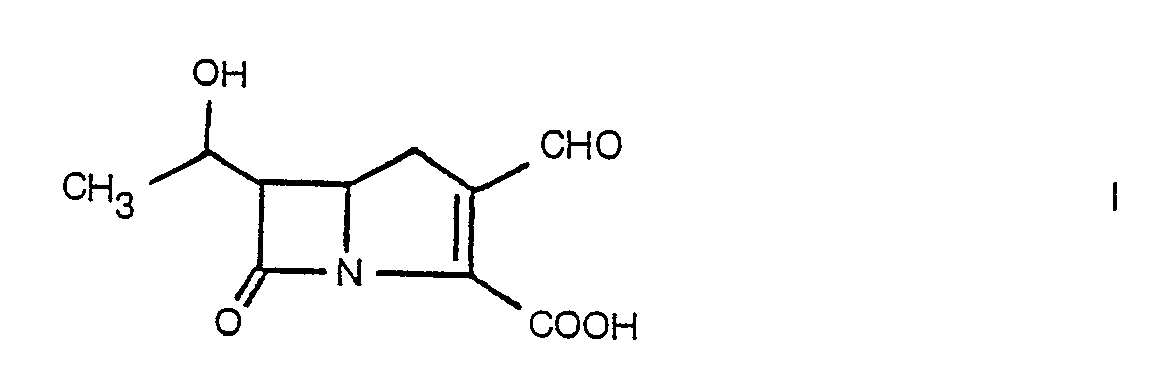
- the instant invention relates to novel chemical compounds classifiable in the field of organic chemistry as 1-carba-6-(1-hydroxyethyl)-2-penem-3-carboxylic acids and the pharmaceutically acceptable salts thereof. More particularly, the instant invention may be described as residing in the concept of such 1-carba-6-(1-hydroxyethyl)-2-penem-3-carboxylic acids characterized by having a carbonyl group at the 2-position, to a process for preparing such compounds and to antibiotic compositions containing such compounds as an essential active ingredient. In addition, the compounds of formula I, serve as valuable intermediates in the preparation of other active antibiotics.
- the instant invention may be described as residing in the concept of novel penems having the structure: and the pharmaceutically acceptable salts thereof.
- the instant invention is based on applicants' discovery that the compounds of formula I are active antibiotic agents which may be employed in antibiotic applications either alone or in combination with other antibiotic and antibacterial agents.
- the compounds of formula I are prepared according to the process of the instant invention by total synthesis from 4-iodomethyl-1-(t-butyldimethylsilyl)-2-azetidinone (II).
- the process is summarized by the following reaction diagram:
- Silyl protection typically is achieved by treating 4-iodomethylazetidin-2-one in a solvent, such as dimethylformamide, acetonitrile, hexamethylphosphoramide, tetrahydrofuran and the like, with a silylating agent, such as t-butyldimethylchlorosilane, t-butyldiphenylchlorosilane or triphenylchlorosilane, at a temperature of from -20 to 25°C for 0.5 to 24 hours in the presence of a base, such as triethylamine, diisopropylethylamine and imidazole.
- a solvent such as dimethylformamide, acetonitrile, hexamethylphosphoramide, tetrahydrofuran and the like
- silylating agent such as t-butyldimethylchlorosilane, t-butyldiphenylchlorosilane or triphenyl
- the transformation, II ⁇ III may be accomplished by treating II in a solvent, such as tetrahydrofuran, dimethylformamide or acetonitrile, with methyl 1,3-dithiane-2-carboxylate in the presence of a strong base such as n-butyllithium, t-butyllithium or phenyllithium at a temperature between -100 to -20°C.
- a strong base such as n-butyllithium, t-butyllithium or phenyllithium at a temperature between -100 to -20°C.
- the reaction is run under nitrogen and is complete in 0.5 to 4 hours.
- the dithiane carboxylate is treated with the strong base prior to the addition of II.
- the alkylation, III -+ IV is accomplished in the presence of a strong base with acetaldehyde for example by treating III in a solvent, such as tetrahydrofuran, dimethoxyethane or diethylether, at a temperature of from -100 to -20°C with a strong base, such as lithium diisopropylamine or lithium hexamethyldisilazide, followed by the addition of an equivalent to excess of acetaldehyde.
- the reaction usually is complete in from 0.5 to 2 hours.
- the reaction proceeds directly to give a mixture of isomers (trans-R, trans-S and cis-R) which may be separated by chromatography or by crystallization.
- the trans-R isomer is preferred.
- the transformation, IV -+ V is achieved by treating IV in methanol in the presence of a mixture of mercuric oxide and mercuric chloride.
- the reaction is carried out at reflux and usually is complete in 1 to 4 hours.
- the reduction, V ⁇ VI may be accomplished by treating V in a solvent, such as toluene, methylene chloride, tetrahydrofuran or diethylether, with a reducing agent, such as diisobutylaluminum hydride or sodium bis-(2-methoxyethoxy)aluminum hydride at a temperature of from -100 to -20°C.
- a solvent such as toluene, methylene chloride, tetrahydrofuran or diethylether
- a reducing agent such as diisobutylaluminum hydride or sodium bis-(2-methoxyethoxy)aluminum hydride
- VI ⁇ VII is carried out by treating VI with trimethylthioborane.
- VI is treated in a solvent, such as toluene, hexane, methylene chloride or tetrahydrofuran with an equivalent of trimethylthioborane.
- the reaction is carried out at a temperature between 40 to 70°C, desirably under nitrogen, and usually is complete in 2 to 5 hours.
- Establishment of the hydroxyl protecting group, VII ⁇ VIII may be achieved by treating VII in a solvent such as methylene chloride, dimethylformamide or acetonitrile with an aralkyloxycarbonyl chloride, such as o-nitrobenzyloxycarbonyl chloride and p-nitrobenzyloxycarbonyl chloride, preferably the o-nitrobenzyloxycarbonyl chloride, in the presence of a base, such as pyridine or 4-(N,N-dimethyl- amino)-pyridine.
- a base such as pyridine or 4-(N,N-dimethyl- amino)-pyridine.
- the reaction is run at 0 to 50°C, desirably under nitrogen, for 0.5 to 12 hours.
- the hydrolysis, VIII ⁇ IX is accomplished by hydrolyzing VIII with alcoholic hydrochloric acid.
- VIII is treated with concentrated hydrochloric acid in a loweralkanol, preferably methanol in the presence of water; the reaction proceeds at room temperature and usually is complete in 3 to 6 hours.
- the transformation, IX ⁇ X is carried out by reacting IX in a solvent, such as toluene, tetrahydrofuran, dimethylformamide, acetonitrile, and the like, with an aralkylglyoxalate, such as o-nitrobenzylglyoxalate and p-nitrobenzylglyoxalate, the o-nitrobenzylglyoxalate is preferred.
- the reaction is run at reflux, desirably under a Dean-Stark water separator, for 4 to 8 hours or in the presence of molecular sieves or a dehydrating agent such as MgS0 4 .
- the chlorination, X -+ XI may be achieved by treating X in a solvent, such as tetrahydrofuran, with a chlorinating agent, such as thionyl chloride, in the presence of a base such as thionyl chloride, in the presence of a base such as pyridine, diisopropylethylamine or triethylamine.
- a chlorinating agent such as thionyl chloride
- a base such as thionyl chloride
- a base such as pyridine, diisopropylethylamine or triethylamine.
- the chlorinated product, XI may be treated directly with triphenylphosphine to obtain intermediate, XII.
- the reaction is carried out at room temperature in a solvent such as dimethylformamide THF, or CH 2 Cl 2 and usually is complete in 1 to 4 hours.
- the cyclization, XII ⁇ XIII, is readily achieved by heating XII for example in a high boiling solvent, such as xylene, at a temperature of from 110 to 150°C. The reaction requires 1 to 3 hours for completion.
- a high boiling solvent such as xylene
- the transformation, Xlll -+ XIV may be carried out by treating XIII in a solvent, such as methanol, ethanol or isopropanol at reflux in the presence of mercuric oxide, mercuric chloride and water.
- a solvent such as methanol, ethanol or isopropanol at reflux in the presence of mercuric oxide, mercuric chloride and water.
- the reaction usually is complete in 0.1 to 1 hour.
- the final deblocking step, XIV -+ I may be carried out by conventional procedures such as hydrogenation.
- XIV in a solvent such as tetrahydrofuran-aqueous ethanol, is treated under a hydrogen pressure of from 20-50 psig in the presence of a catalyst, such as Pd/C or PdOH.
- the reaction is run at a temperature of from 25 to 50°C and usually is complete in from 0.5 to 4 hours.
- the reaction mixture is buffered at pH 7 with phosphate buffer and the product is isolated as the alkali metal salt.
- the products of this invention, I form a variety of pharmacologically acceptable salts.
- the salts of this invention are pharmacologically acceptable non-toxic derivatives which can be used as the active ingredient in suitable unit-dosage pharmaceutical forms. Also they may be combined with other drugs to provide compositions having a broad spectrum of activity.
- the novel compounds are valuable antibiotics active against various gram-positive and gram-negative bacteria and, accordingly, find utility in human and veterinary medicine.
- the compounds of this invention can therefore be used as antibacterial drugs for treating infections caused by gram-positive or gram-negative bacteria, for example, against Staphylococcus aureus, Escherichia coli, Klebsiella pneumoniae, Serratia, Salmonella typhosa, Pseudomonas and Bacterium proteus.
- the antibacterials of the invention may further be utilized as additives to animal feeding stuffs, for preserving foodstuffs and as disinfectants.
- compositions may be employed in aqueous compositions in concentrations ranging from 0.1 to 100 parts of antibiotic per million parts of solution in order to destroy and inhibit the growth of harmful bacteria on medical and dental equipment and as bactericides in industrial applications, for example, in waterbased paints and in the white water of paper mills to inhibit the growth of harmful bacteria.
- the products of this invention may be used alone or in combination as an active ingredient in any one of a variety of pharmaceutical preparations.
- These antibiotics and their corresponding salts may be employed in capsule form or as tablets, powders or liquid solutions or as suspensions or elixirs. They may be administered orally, intravenously or intramuscularly.
- compositions are preferably presented in a form suitable for absorption by the gastrointestinal tract.
- Tablets and capsules for oral administration may be in unit dose presentation form, and may contain conventional excipients such as binding agents, for example, syrup, acacia, gelatin, sorbitol, tragacanth, or polyvinylpyrrolidone; fillers for example, lactose, sugar, maizestarch, calcium phosphate, sorbitol or glycine; lubricants, for example, magnesium stearate, talc, polyethylene glycol, silica; disintegrants, for example potato starch or acceptable wetting agents such as sodium lauryl sulphate.
- the tablets may be coated according to methods well-known in the art.
- Oral liquid preparations may be in the form of aqueous or oily suspensions, solution, emulsions, syrups, elixirs, etc. or may be presented as a dry product, for reconstitution with water or other suitable vehicles before use.
- Such liquid preparations may contain conventional additives such as suspending agents, for example, sorbitol syrup, methyl cellulose, glucose/sugar syrup, gelatin, hydroxyethylcellulose, carboxymethyl cellulose, aluminum stearate gel or hydrogenated edible oils, for example almond oil, fractionated coconut oil, oily ester, propylene glycol, or ethyl alcohol; preservatives, for example, methyl or propyl p-hydroxybenzoates or sorbic acid.
- Suppositories will contain conventional suppository base, e.g., cocoa butter or other glyceride.
- compositions for injection may be presented in unit dose form in ampules, or in multidose containers with an added preservative.
- the compositions may take such forms as suspensions, solutions, or emulsions in oily or aqueous vehicles, and may contain formulatory agents such as suspending, stabilizing and/or dispersing agents.
- the active ingredient may be in powder form for reconstitution with a suitable vehicle, e.g., sterile, pyrogen-free water, before use.
- compositions may also be prepared in suitable forms for absorption through the mucous membranes of the nose and throat or bronchial tissues and may conveniently take the form of powder or liquid sprays or inhalants, lozenges, throat paints, etc.
- the preparations may be presented as individual capsules, in liquid or semi-solid form, or may be used as drops etc.
- Topical applications may be formulated in hydrophobic or hydrophilic bases as ointments, creams, lotions, paints, powders, etc.
- the instant compositions may include other ingedients such as stabilizers, binders, antioxidants, preservatives, lubricators, suspending agents, viscosity agents or flavoring agents or the like.
- ingedients such as stabilizers, binders, antioxidants, preservatives, lubricators, suspending agents, viscosity agents or flavoring agents or the like.
- composition may, for example, be formulated as an intramammary preparation in either long or quick-release bases.
- a daily oral dosage consists of from 2 to 600 mg of active ingredient per kg of body weight of the subject in one or more applications per day.
- a preferred daily dosage for adult humans lies in the range of from 15 to 150 mg of active ingredient per kg of body weight.
- compositions may be administered in several unit dosage forms as, for example, in solid or liquid orally ingestible dosage form.
- the compositions per unit dosage, whether liquid or solid may contain from 0.1% to 99% of active material, the preferred range being from 10-60%.
- the composition will generally contain from 15 mg to 1500 mg of the active ingredient; however, in general, it is preferable to employ a dosage amount in the range of from about 100 mg to 1000 mg.
- the unit dosage is usually the pure compound in a slightly acidified sterile water solution or in the form of a soluble powder intended for solution.
- Step B (3S, 4R)-1-(t-Butyldimethylsilyl)-3-(1 R)-hydroxyethyl-4-[2,2-(trimethylenedithia)-2-(methoxycarbonyl)ethyl]-azetidin-2-one (IV)
- Step C (3S, 4R)-1-(t-Butyldimethylsilyl)-3-(1 R)-hydroxyethyl-4-[2,2-(dimethoxy)-2-(methoxycarbonyl)-ethyl]-azetidin-2-one (V)
- Step D (3S, 4R)-1-(t-Butyldimethylsilyl)-3-(1 R)-hydroxyethyl-4-[2,2-(dimethoxy)-3-(oxo)propyl-azetidin-2-one (VI)
- Step E (3S, 4R)-1-(t-Butyldimethylsilyl)-3-(1 R)-hydroxyethyl-4-[2,2-(dimethoxy)-3,3-(dimethylthio)-propyl]-azetidin-2-one (VII)
- Step F (3S,4R)-1-(t-Butyldimethylsilyl)-3-(1 R)-o-nitrobenzyloxycarbonyloxyethyl-4-[2,2-(dimethoxy)-3,3-(dimethylthio)propyl]-azetidin-2-one (VIII)
- Step G (3S, 4R)-3-(1 R)-o-Nitrobenzyloxycarbonyloxyethyl-4-[2-oxo-3,3-(dimethylthio)-propyl]-azetidin-2-one (IX)
- Step H (3S, 4R)-1-(o-Nitrobenzyloxycarbonylhydroxy)methyl-3-(1 R)-o-nitrobenzyloxycarbonyloxyethyl-4-[2-oxo-3,3-(dimethylthio)-propyl]-azetidin-2-one
- X Dissolve 2.09 g (0.01 mole) of o-nitrobenzylglyoxalate in 40 ml of toluene and add 1.89 g (0.005 mole) of (3S, 4R) - 3 - (1 R) - o - nitrobenzyloxycarbonyloxyethyl - 4 - [2 - oxo - 3,3 - (dimethylthio) - propyl] - azetidin - 2 - one.
- Step l (3S, 4R)-1-(o-nitrobenzyloxycarbonylchloro)-methyl-3-(1R)-orthonitrobenzyloxycarbonyloxyethyl-4-[2-oxo-3,3-(dimethylthio)-propyl]-azetidin-2-one (XI) Treat 2.9 g (0.005 mole) of (3S, 4R) - 1 - (o - nitrobenzyloxycarbonylhydroxy) - methyl - 3 - (1 R) - o - nitrobenzyloxycarbonyloxyethyl - 4 - [2 - oxo - 3,3 - (dimethylthio) - propyl] - azetidin - 2 - one with 1.2 equimolar amounts of pyridine and SOCl 2 in 30 ml of tetrahydrofuran at ⁇ 20°C. Remove the cooling bath after 10 minutes and continue stirring for
- Step J (3S, 4R)-1-(o-Nitrobenzyloxycarbonyltriphenylphosphoranylmethyl)-3-(1 R)-o-nitrobenzyloxycarbonyloxyethyl-4-[2-oxo-3,3-(dimethylthio)-propyl]-azetidin-2-one (XII) Dissolve the (3S, 4R) - 1 - (o - nitrobenzyloxycarbonylchloromethyl) - 3 - (1 R) - (o - nitrobenzyloxycarbonyloxyethyl) - 4 - [2 - oxo - 3,3 - (dimethylthio)propyl]azetidin - 2 - one in 20 ml of dimethylformamide and add 0.005 mole of triphenylphosphine.
- Step K o-Nitrobenzyl (5R, 6S)-1-Carba-6-(1R)-o-nitrobenzyloxycarbonyloxyethyl-2-(dimethylthio)-methyl-2-penem-3-carboxylate (XIII)
- Step L o-Nitrobenzyl (5R, 6S)-1-Carba-6-(1-o-nitrobenzyloxycarbonyloxyethyl)-2-carbonyl-2-penem-3-carboxylate (XIV)
- Step M Sodium (5R, 6S1-1-Carba-6-(1-hydroxyethyl)-2-carbonyl-2-penem-3-carboxylate (I)
Landscapes
- Chemical & Material Sciences (AREA)
- Organic Chemistry (AREA)
- Health & Medical Sciences (AREA)
- General Health & Medical Sciences (AREA)
- Life Sciences & Earth Sciences (AREA)
- Molecular Biology (AREA)
- Biochemistry (AREA)
- Nuclear Medicine, Radiotherapy & Molecular Imaging (AREA)
- Oncology (AREA)
- Pharmacology & Pharmacy (AREA)
- Chemical Kinetics & Catalysis (AREA)
- Animal Behavior & Ethology (AREA)
- Communicable Diseases (AREA)
- Public Health (AREA)
- Veterinary Medicine (AREA)
- Medicinal Chemistry (AREA)
- General Chemical & Material Sciences (AREA)
- Nitrogen Condensed Heterocyclic Rings (AREA)
- Pharmaceuticals Containing Other Organic And Inorganic Compounds (AREA)
Claims (4)
- Ein Verfahren zur Herstellung einer Verbindung der Formel
 (a) die Umsetzung von 4 - Jodmethyl - 1 - (tert.butyldimethylsilyl) - 2 - azetidinon mit Methyl - 1,3 - dithian - 2 - carboxylat zur Gewinnung von 1 - (tert.Butyldimethylsilyl) - 4 - [2,2 - (trimethylendithia) - 2 - (methoxycarbonyl) - ethyl] - azetidin - 2 - on;(b) die Behandlung des Azetidin - 2 - ons von Stufe (a) in Gegenwart einer starken Base mit Acetaldehyd zur Gewinnung von 1 - (tert.Butyldimethylsilyl) - 3 - (1 - hydroxyethyl) - 4 - [2,2 - (trimethylendithia) - 2 - (methoxycarbonyl) - ethyl] - azetidin - 2 - on;(c) die Behandlung des Azetidin - 2 - ons von Stufe (b) mit einem Gemisch aus Mercurioxid und Mercurichlorid in Methanol zur Gewinnung von 1 - (tert.Butyldimethylsilyl) - 3 - (1 - hydroxyethyl) - 4 - [2,2 - (dimethoxy - 2 - methoxycarbonyl) - ethyl] - azetidin - 2 - on;(d) die Reduktion des Azetidin - 2 - ons von Stufe (c) zur Gewinnung von 1 - (tert.Butyldimethylsilyl) - 3 - (1 - - hydroxyethyl) - 4 - [2,2 - (dimethoxy) - 3 - (oxo) - propyl] - azetidin - 2 - on;(e) die Behandlung des Azetidin - 2 - ons von Stufe (d) mit Trimethylthioboron zur Gewinnung von 1 - (tert.Butyldimethylsilyl) - 3 - (1 - hydroxyethyl) - 4 - [2,2 - (dimethoxy - 3,3 - (dimethylthio) - propyl] - azetidin - 2 - on;(f) die Blockierung der Hydroxygruppe des Azetidin - 2. - ons von Stufe (e) mit einem Aralkyloxycarbonylchlorid in Gegenwart einer Base zur Gewinnung von 1 - (tert.Butyldimethylsilyl) - 3 - [1 - (aralkyoxycarbonyloxy)] - 4 - [2,2 - (dimethoxy) - 3,3 - (dimethylthio) - propyl] - azetidin - 2 - on;(g) das Hydrolysieren des Azetidin - 2 - ons von Stufe (f) mit alkoholischer Chlorwasserstoffsäure zur Gewinnung von 3 - (1 - Aralkyloxycarbonyloxyethyl) - 4 - [2 - oxo - 3,3 - (dimethylthio) - propyl] - azetidin - 2 - on;(h) die Behandlung des Azetidin - 2 - ons von Stufe (g) mit einem Aralkylglyoxalat in einem Lösungsmittel zur Gewinnung von 1 - (Aralkyloxycarbonylhydroxy) - methyl - 3 - (aralkyloxycarbonyloxyethyl) - 4 - [2 - oxo - 3,3 - (dimethylthio) - propyl] - azetidin - 2 - on;(i) die Chlorierung des Azetidin - 2 - ons von Stufe (h) zur Gewinnung von 1 - (Aralkyloxycarbonylchlor) - methyl - 3 - (1 - aralkyloxycarbonyloxyethyl) - 4 - [2 - oxo - 3,3 - (dimethylthio) - propyl] - azetidin - 2 - on;(j) die Behandlung des chlorierten Produktes von Stufe (i) mit Triphenylphosphin zur Gewinnnung von 1 - (Aralkyloxycarbonyltriphenylphosphoranylmethyl) - 3 - (1 - aralkyloxycarbonyloxyethyl) - 4 - [2 - oxo - 3,3 - (dimethylthio) - propyl] - azetidin - 2 - on;(k) die Cyclisierung des Azetidin - 2 - ons von Stufe (g) durch Erhitzen auf 1 10-150°C zur Gewinnung von Aralkyl - 1 - carba - 6 - (1 - aralkyloxycarbonyloxyethyl) - 2 - (dimethylthio) - methyl - 2 - penem - 3 - carboxylat;(I) die Behandlung des Penems aus Stufe (k), durch Erhitzen unter Rückfluß, in Gegenwart von Mercurioxid, Mercurichlorid und Wasser, zur Gewinnung von Aralkyl - 1 - carba - 6 - (1 - aralkyloxycarbonylethyl) - 2 - carbonyl - 2 - penem - 3 - carboxylat; und(m) die Entblockierung des Penems von Stufe (1) zur Gewinnung des gewünschten Produktes.
Priority Applications (1)
| Application Number | Priority Date | Filing Date | Title |
|---|---|---|---|
| AT81110740T ATE8400T1 (de) | 1980-12-24 | 1981-12-23 | 1-carba-6-(1-hydroxyethyl)-2-carbonyl-penem-3carbons[ure, verfahren zur herstellung und sie enthaltende pharmazeutische zusammensetzungen. |
Applications Claiming Priority (2)
| Application Number | Priority Date | Filing Date | Title |
|---|---|---|---|
| US06/219,629 US4321197A (en) | 1980-12-24 | 1980-12-24 | 1-Carba-6-(1-hydroxyethyl)-2-carbonyl-penem-3-carboxylic acid and preparation thereof |
| US219629 | 1980-12-24 |
Publications (2)
| Publication Number | Publication Date |
|---|---|
| EP0054971A1 EP0054971A1 (de) | 1982-06-30 |
| EP0054971B1 true EP0054971B1 (de) | 1984-07-11 |
Family
ID=22820065
Family Applications (1)
| Application Number | Title | Priority Date | Filing Date |
|---|---|---|---|
| EP81110740A Expired EP0054971B1 (de) | 1980-12-24 | 1981-12-23 | 1-Carba-6-(1-hydroxyethyl)-2-carbonyl-penem-3-Carbonsäure, Verfahren zur Herstellung und sie enthaltende pharmazeutische Zusammensetzungen |
Country Status (5)
| Country | Link |
|---|---|
| US (1) | US4321197A (de) |
| EP (1) | EP0054971B1 (de) |
| JP (1) | JPS57134484A (de) |
| AT (1) | ATE8400T1 (de) |
| DE (1) | DE3164780D1 (de) |
Families Citing this family (5)
| Publication number | Priority date | Publication date | Assignee | Title |
|---|---|---|---|---|
| JPS59106489A (ja) * | 1982-12-10 | 1984-06-20 | Sanraku Inc | 新規β−ラクタム誘導体及びその製造方法 |
| US5371215A (en) * | 1991-03-20 | 1994-12-06 | American Cyanamid Company | 4-substituted azetidinones as precursors to 2-substituted-3-carboxy carbapenem antibiotics and a method of producing them |
| US5455239A (en) * | 1993-08-05 | 1995-10-03 | Merck & Co. Inc. | 3-aryl of heteroaryl-7-heteroaralkylamido cephalosporin compounds, compositions and methods of use |
| US5498777A (en) * | 1994-07-20 | 1996-03-12 | Merck & Co., Inc. | 3-thioheteroaryl cephalosporin compounds, compositions and methods of use |
| US5565445A (en) * | 1995-02-22 | 1996-10-15 | Merck & Co., Inc. | 3-thioheteroaryl 1-carba-1-dethiacephalosporin compounds, compositions and methods of use |
Family Cites Families (1)
| Publication number | Priority date | Publication date | Assignee | Title |
|---|---|---|---|---|
| JPS55147284A (en) * | 1979-04-17 | 1980-11-17 | Sanraku Inc | Novel beta-lactam derivative and its preparation |
-
1980
- 1980-12-24 US US06/219,629 patent/US4321197A/en not_active Expired - Fee Related
-
1981
- 1981-12-23 EP EP81110740A patent/EP0054971B1/de not_active Expired
- 1981-12-23 DE DE8181110740T patent/DE3164780D1/de not_active Expired
- 1981-12-23 AT AT81110740T patent/ATE8400T1/de not_active IP Right Cessation
- 1981-12-24 JP JP56208274A patent/JPS57134484A/ja active Pending
Also Published As
| Publication number | Publication date |
|---|---|
| US4321197A (en) | 1982-03-23 |
| EP0054971A1 (de) | 1982-06-30 |
| DE3164780D1 (en) | 1984-08-16 |
| JPS57134484A (en) | 1982-08-19 |
| ATE8400T1 (de) | 1984-07-15 |
Similar Documents
| Publication | Publication Date | Title |
|---|---|---|
| US4465632A (en) | Process for preparing 1-6-and 2-substituted-1-carba-2-penem-3-carboxylic acids | |
| EP0010316B1 (de) | 1-, 6- und 2-substituierte 1-Carba-2-Penem-3-Carbonsäure, Verfahren zu ihrer Herstellung und sie enthaltende pharmazeutische Zusammensetzungen | |
| EP0071908B1 (de) | 1- und 1,1-disubstituierte, 6-substituierte, 2-carbamimidoyl-1-carbadethiapen-2-em-3-carbonsäuren, Verfahren zur Herstellung und diese enthaltende antibiotische Zusammensetzung | |
| US4312871A (en) | 6-, 1- And 2-substituted-1-carbadethiapen-2-em-3-carboxylic acids | |
| US4350631A (en) | 6- and 4-Substituted-1-azabicyclo[3.2.0]heptan-3,7-dione-2-carboxylates | |
| US4206219A (en) | 6- and 1-Substituted-1-carbadethiapen-2-em-3-carboxylic acid | |
| US4318912A (en) | 6-(1-Hydroxyethyl)-3-substituted-1-azabicyclo(3.2.0)-hept-2-en-7-one-2-carboxylic acid | |
| EP0030031B1 (de) | 1.1-Disubstituierte 6-(1-Hydroxyethyl)-2-(aminoethylthio)-1-carbadethiapen-2-emcarbonsäuren, Verfahren zu ihrer Herstellung, antibiotisch wirksame pharmazeutische Zusammensetzungen, die diese Verbindungen enthalten, Zwischenprodukte zu ihrer Herstellung und Verfahren zur Herstellung der in diesem Verfahren verwendbaren Zwischenprodukte | |
| US4262009A (en) | 6- And 1,1-disubstituted-1-carbadethiapen-2-em-3-carboxylic acid | |
| US4218459A (en) | 6-Amido-1-carba-2-penem-3-carboxylic acid | |
| JPH0419230B2 (de) | ||
| EP0037082B1 (de) | Verfahren zur Herstellung von 1-Carbapenem-Derivaten und von Zwischenprodukten via silyl-substituierter Dithioacetale | |
| US4218462A (en) | 6-(1-Hydroxyethyl)-2-(2-aminoethylthio)-1-substituted-1-carbade-thiapen-2-em-3-carboxylic acids | |
| US4203902A (en) | Process for preparing 6- and 2-substituted-1-carbadethiapen-2-em-3-carboxylic acids | |
| US4321197A (en) | 1-Carba-6-(1-hydroxyethyl)-2-carbonyl-penem-3-carboxylic acid and preparation thereof | |
| US4348320A (en) | Substituted azetidiones | |
| CA1226861A (en) | Process for the production of penem compounds | |
| EP0110280A1 (de) | Verfahren zur Herstellung von Penem-Verbindungen | |
| EP0030032B1 (de) | In 6-,1- und 2-Stellung substituierte 1-Carbadethiapen-2-em-carbonsäuren, Verfahren zu ihrer Herstellung, sie enthaltende pharmazeutische Zusammensetzungen und Zwischenprodukte | |
| US4600713A (en) | 1-, 6- and 2-substituted-1-carba-2-penem-3-carboxylic acids | |
| US4298741A (en) | 6-Amido-3-substituted-1-azabicyclo[3.2.0]-hept-2-en-7-one-2-carboxylic acid | |
| US4262011A (en) | 1-1-Disubstituted-pen-2-em-3-carboxylic acids | |
| NL8200217A (nl) | Bicyclische verbindingen, werkwijzen ter bereiding ervan, alsmede farmaceutische preparaten, die deze bicyclische verbindingen bevatten. | |
| US4565808A (en) | 3-Phosphonate carbapenems | |
| US4994568A (en) | 6- and 4-substituted-1-azabicyclo(3.2.0)heptan-3, 7-dione-2-carboxylates |
Legal Events
| Date | Code | Title | Description |
|---|---|---|---|
| PUAI | Public reference made under article 153(3) epc to a published international application that has entered the european phase |
Free format text: ORIGINAL CODE: 0009012 |
|
| AK | Designated contracting states |
Designated state(s): AT BE CH DE FR GB IT LU NL SE |
|
| ITCL | It: translation for ep claims filed |
Representative=s name: SOCIETA' ITALIANA BREVETTI S.P.A. |
|
| 17P | Request for examination filed |
Effective date: 19820818 |
|
| ITF | It: translation for a ep patent filed | ||
| GRAA | (expected) grant |
Free format text: ORIGINAL CODE: 0009210 |
|
| AK | Designated contracting states |
Designated state(s): AT BE CH DE FR GB IT LI LU NL SE |
|
| REF | Corresponds to: |
Ref document number: 8400 Country of ref document: AT Date of ref document: 19840715 Kind code of ref document: T |
|
| REF | Corresponds to: |
Ref document number: 3164780 Country of ref document: DE Date of ref document: 19840816 |
|
| ET | Fr: translation filed | ||
| PGFP | Annual fee paid to national office [announced via postgrant information from national office to epo] |
Ref country code: FR Payment date: 19840831 Year of fee payment: 4 |
|
| PGFP | Annual fee paid to national office [announced via postgrant information from national office to epo] |
Ref country code: BE Payment date: 19840930 Year of fee payment: 4 |
|
| PGFP | Annual fee paid to national office [announced via postgrant information from national office to epo] |
Ref country code: CH Payment date: 19841023 Year of fee payment: 4 |
|
| PG25 | Lapsed in a contracting state [announced via postgrant information from national office to epo] |
Ref country code: LU Free format text: LAPSE BECAUSE OF NON-PAYMENT OF DUE FEES Effective date: 19841231 |
|
| PGFP | Annual fee paid to national office [announced via postgrant information from national office to epo] |
Ref country code: SE Payment date: 19841231 Year of fee payment: 4 |
|
| PGFP | Annual fee paid to national office [announced via postgrant information from national office to epo] |
Ref country code: DE Payment date: 19850117 Year of fee payment: 4 |
|
| PLBE | No opposition filed within time limit |
Free format text: ORIGINAL CODE: 0009261 |
|
| STAA | Information on the status of an ep patent application or granted ep patent |
Free format text: STATUS: NO OPPOSITION FILED WITHIN TIME LIMIT |
|
| 26N | No opposition filed | ||
| PGFP | Annual fee paid to national office [announced via postgrant information from national office to epo] |
Ref country code: NL Payment date: 19851231 Year of fee payment: 5 |
|
| PGFP | Annual fee paid to national office [announced via postgrant information from national office to epo] |
Ref country code: AT Payment date: 19861002 Year of fee payment: 6 |
|
| PG25 | Lapsed in a contracting state [announced via postgrant information from national office to epo] |
Ref country code: NL Effective date: 19870701 |
|
| NLV4 | Nl: lapsed or anulled due to non-payment of the annual fee | ||
| PG25 | Lapsed in a contracting state [announced via postgrant information from national office to epo] |
Ref country code: AT Effective date: 19871223 |
|
| PG25 | Lapsed in a contracting state [announced via postgrant information from national office to epo] |
Ref country code: SE Effective date: 19871224 |
|
| PG25 | Lapsed in a contracting state [announced via postgrant information from national office to epo] |
Ref country code: LI Effective date: 19871231 Ref country code: CH Effective date: 19871231 Ref country code: BE Effective date: 19871231 |
|
| BERE | Be: lapsed |
Owner name: MERCK & CO. INC. Effective date: 19871231 |
|
| GBPC | Gb: european patent ceased through non-payment of renewal fee | ||
| PG25 | Lapsed in a contracting state [announced via postgrant information from national office to epo] |
Ref country code: FR Free format text: LAPSE BECAUSE OF NON-PAYMENT OF DUE FEES Effective date: 19880831 |
|
| REG | Reference to a national code |
Ref country code: CH Ref legal event code: PL |
|
| PG25 | Lapsed in a contracting state [announced via postgrant information from national office to epo] |
Ref country code: DE Effective date: 19880901 |
|
| REG | Reference to a national code |
Ref country code: FR Ref legal event code: ST |
|
| PG25 | Lapsed in a contracting state [announced via postgrant information from national office to epo] |
Ref country code: GB Free format text: LAPSE BECAUSE OF NON-PAYMENT OF DUE FEES Effective date: 19881121 |
|
| EUG | Se: european patent has lapsed |
Ref document number: 81110740.8 Effective date: 19880913 |