EP0053418B1 - Untertagvergasung von Stein- oder Braunkohle - Google Patents
Untertagvergasung von Stein- oder Braunkohle Download PDFInfo
- Publication number
- EP0053418B1 EP0053418B1 EP81201289A EP81201289A EP0053418B1 EP 0053418 B1 EP0053418 B1 EP 0053418B1 EP 81201289 A EP81201289 A EP 81201289A EP 81201289 A EP81201289 A EP 81201289A EP 0053418 B1 EP0053418 B1 EP 0053418B1
- Authority
- EP
- European Patent Office
- Prior art keywords
- cavity
- coal
- liquid
- boreholes
- borehole
- Prior art date
- Legal status (The legal status is an assumption and is not a legal conclusion. Google has not performed a legal analysis and makes no representation as to the accuracy of the status listed.)
- Expired
Links
- 239000003245 coal Substances 0.000 title claims description 35
- 238000000034 method Methods 0.000 title claims description 15
- 238000002309 gasification Methods 0.000 title claims description 14
- 239000003077 lignite Substances 0.000 title claims description 3
- 239000007789 gas Substances 0.000 claims description 37
- 239000000945 filler Substances 0.000 claims description 31
- 239000007788 liquid Substances 0.000 claims description 31
- XLYOFNOQVPJJNP-UHFFFAOYSA-N water Substances O XLYOFNOQVPJJNP-UHFFFAOYSA-N 0.000 claims description 30
- 239000000463 material Substances 0.000 claims description 17
- 238000002485 combustion reaction Methods 0.000 claims description 16
- 239000000725 suspension Substances 0.000 claims description 10
- 238000007254 oxidation reaction Methods 0.000 claims description 8
- QVGXLLKOCUKJST-UHFFFAOYSA-N atomic oxygen Chemical compound [O] QVGXLLKOCUKJST-UHFFFAOYSA-N 0.000 claims description 7
- 239000001301 oxygen Substances 0.000 claims description 7
- 229910052760 oxygen Inorganic materials 0.000 claims description 7
- 239000000567 combustion gas Substances 0.000 claims description 6
- 230000003647 oxidation Effects 0.000 claims description 6
- 238000007599 discharging Methods 0.000 claims description 5
- 239000012530 fluid Substances 0.000 claims description 4
- 239000002689 soil Substances 0.000 claims description 4
- 239000000126 substance Substances 0.000 claims description 4
- 238000004891 communication Methods 0.000 claims description 2
- 239000002244 precipitate Substances 0.000 claims description 2
- 238000001556 precipitation Methods 0.000 claims description 2
- 238000005728 strengthening Methods 0.000 claims description 2
- CURLTUGMZLYLDI-UHFFFAOYSA-N Carbon dioxide Chemical compound O=C=O CURLTUGMZLYLDI-UHFFFAOYSA-N 0.000 description 8
- 239000000203 mixture Substances 0.000 description 7
- 239000004576 sand Substances 0.000 description 6
- 238000002474 experimental method Methods 0.000 description 5
- 229910002092 carbon dioxide Inorganic materials 0.000 description 4
- 239000001569 carbon dioxide Substances 0.000 description 4
- 230000008021 deposition Effects 0.000 description 4
- 230000002349 favourable effect Effects 0.000 description 3
- 230000015572 biosynthetic process Effects 0.000 description 2
- 238000001704 evaporation Methods 0.000 description 2
- 238000011010 flushing procedure Methods 0.000 description 2
- 238000005755 formation reaction Methods 0.000 description 2
- VNWKTOKETHGBQD-UHFFFAOYSA-N methane Chemical compound C VNWKTOKETHGBQD-UHFFFAOYSA-N 0.000 description 2
- 230000001105 regulatory effect Effects 0.000 description 2
- OKTJSMMVPCPJKN-UHFFFAOYSA-N Carbon Chemical compound [C] OKTJSMMVPCPJKN-UHFFFAOYSA-N 0.000 description 1
- UGFAIRIUMAVXCW-UHFFFAOYSA-N Carbon monoxide Chemical compound [O+]#[C-] UGFAIRIUMAVXCW-UHFFFAOYSA-N 0.000 description 1
- UFHFLCQGNIYNRP-UHFFFAOYSA-N Hydrogen Chemical compound [H][H] UFHFLCQGNIYNRP-UHFFFAOYSA-N 0.000 description 1
- 238000013459 approach Methods 0.000 description 1
- 239000007900 aqueous suspension Substances 0.000 description 1
- 229910052799 carbon Inorganic materials 0.000 description 1
- 229910002091 carbon monoxide Inorganic materials 0.000 description 1
- 239000004568 cement Substances 0.000 description 1
- 230000001276 controlling effect Effects 0.000 description 1
- 238000011161 development Methods 0.000 description 1
- 230000018109 developmental process Effects 0.000 description 1
- 230000003628 erosive effect Effects 0.000 description 1
- 230000008020 evaporation Effects 0.000 description 1
- 239000008187 granular material Substances 0.000 description 1
- 239000001257 hydrogen Substances 0.000 description 1
- 229910052739 hydrogen Inorganic materials 0.000 description 1
- 230000001788 irregular Effects 0.000 description 1
- 239000006194 liquid suspension Substances 0.000 description 1
- 238000004062 sedimentation Methods 0.000 description 1
- 239000002002 slurry Substances 0.000 description 1
Images
Classifications
-
- E—FIXED CONSTRUCTIONS
- E21—EARTH OR ROCK DRILLING; MINING
- E21B—EARTH OR ROCK DRILLING; OBTAINING OIL, GAS, WATER, SOLUBLE OR MELTABLE MATERIALS OR A SLURRY OF MINERALS FROM WELLS
- E21B43/00—Methods or apparatus for obtaining oil, gas, water, soluble or meltable materials or a slurry of minerals from wells
- E21B43/295—Gasification of minerals, e.g. for producing mixtures of combustible gases
-
- E—FIXED CONSTRUCTIONS
- E21—EARTH OR ROCK DRILLING; MINING
- E21B—EARTH OR ROCK DRILLING; OBTAINING OIL, GAS, WATER, SOLUBLE OR MELTABLE MATERIALS OR A SLURRY OF MINERALS FROM WELLS
- E21B43/00—Methods or apparatus for obtaining oil, gas, water, soluble or meltable materials or a slurry of minerals from wells
- E21B43/16—Enhanced recovery methods for obtaining hydrocarbons
- E21B43/24—Enhanced recovery methods for obtaining hydrocarbons using heat, e.g. steam injection
- E21B43/243—Combustion in situ
- E21B43/247—Combustion in situ in association with fracturing processes or crevice forming processes
-
- E—FIXED CONSTRUCTIONS
- E21—EARTH OR ROCK DRILLING; MINING
- E21B—EARTH OR ROCK DRILLING; OBTAINING OIL, GAS, WATER, SOLUBLE OR MELTABLE MATERIALS OR A SLURRY OF MINERALS FROM WELLS
- E21B43/00—Methods or apparatus for obtaining oil, gas, water, soluble or meltable materials or a slurry of minerals from wells
- E21B43/25—Methods for stimulating production
- E21B43/26—Methods for stimulating production by forming crevices or fractures
- E21B43/267—Methods for stimulating production by forming crevices or fractures reinforcing fractures by propping
-
- E—FIXED CONSTRUCTIONS
- E21—EARTH OR ROCK DRILLING; MINING
- E21F—SAFETY DEVICES, TRANSPORT, FILLING-UP, RESCUE, VENTILATION, OR DRAINING IN OR OF MINES OR TUNNELS
- E21F15/00—Methods or devices for placing filling-up materials in underground workings
-
- Y—GENERAL TAGGING OF NEW TECHNOLOGICAL DEVELOPMENTS; GENERAL TAGGING OF CROSS-SECTIONAL TECHNOLOGIES SPANNING OVER SEVERAL SECTIONS OF THE IPC; TECHNICAL SUBJECTS COVERED BY FORMER USPC CROSS-REFERENCE ART COLLECTIONS [XRACs] AND DIGESTS
- Y10—TECHNICAL SUBJECTS COVERED BY FORMER USPC
- Y10S—TECHNICAL SUBJECTS COVERED BY FORMER USPC CROSS-REFERENCE ART COLLECTIONS [XRACs] AND DIGESTS
- Y10S48/00—Gas: heating and illuminating
- Y10S48/06—Underground gasification of coal
Definitions
- the invention relates to a method for underground gasification of coal or brown-coal in an inclined coal layer, in which two boreholes are drilled from the soil surface into the coal layer, which are continued downwards in the coal layer with the slope of this layer, and which are interconnected at their lower end, after which the coal is ignited, and, furthermore, the combustion and gasification front will begin to move upwards by supplying an oxygen containing gas through one of the boreholes and discharging the combustion gases through the other one, and care is taken that the boreholes remain in communication with the cavity behind the combustion front, and, finally, the cavity is intermittently filled with a filler supplied through one of the boreholes, the filler material being suspended in a carrier fluid, which suspension is led through the boreholes and the cavity, and this with such a concentration and flow velocity that the filler material, at the reduction of the flow velocity when entering the cavity, will precipitate from the suspension, the suspension flow being continued until the cavity has been completely filled with the filler material with the exception of a narrow channel at the upper side
- a problem met with when executing this method is that water which is present near the combustion cavity will be evaporated by the combustion heat, thus changing the gas composition, and, moreover, much heat will be withdrawn from the gasification front.
- This water will, generally, be the water used as a suspension fluid, but in some cases also water present in the surrounding formations under high pressure will tend to penetrate into the filler deposited in said cavity.
- a mixture of granular filler material and a liquid will behave as a liquid, in particular if the liquid content is high, which is, when a liquid suspension is introduced, advantageous as such to obtain a uniform filling of the cavity, thus maintaining a regular combustion front. In all these cases it is, therefore, advantageous to remove water from the surface region of the filler before restarting the combustion of the coal layer.
- the method according to the invention is characterised in that the filler is at least partly stripped of the liquid present therein by lowering an inner tube in at least one of the boreholes, the lower ends of this tube and of the boreholes in question extending to different depths, and thereafter supplying a pressurised gas to said cavity through said inner tube or through the annular passage surrounding that tube, the other borehole being closed, or through the other borehole, said inner tube or the surrounding passage being closed, and as a consequence thereof a liquid column will be pressed upwards in the not-closed passage, the height of said column corresponding to the pressure of the gas, reduced, as the case may be, with the pressure prevailing above said liquid column.
- the obtained channel will be too narrow for the flow conditions desired after filling. From experiments it has appeared that such a channel can be enlarged in a controlled manner by leading through a liquid, e.g. the pure carrier liquid, mixed or not with a gas. From experiments relationships between the gas velocity, the slope of the coal layer, the grain size and the density of the filler material, the character of the liquid, and the obtained passage cross-section have been deduced, enabling a sufficiently accurate control of the dimensions of the channel (see claim 6).
- a liquid e.g. the pure carrier liquid
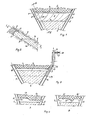
- Fig. 1 two boreholes 1 and 2 are shown which, as described in GB-A-2004297, extend in the direction of a coal layer 3, and can approach one another in the downward direction. It is assumed here that the coal layer 3 has been burned away to form a straight coal front 4, the underlying cavity 5 having been filled before by means of a filler 6 up to 7.
- a straight profile of the coal front 4 can be obtained by filling the initially formed cavity, which can have an irregular shape, with a heavy slurry or a solidifying or hardening mass such as cement, so that a straight filling surface is obtained which will remain straight also at later fillings. Since, initially, the bores 1 and 2 are situated very closely to one another and the cavity is accordingly small, filling it with such a mass will proceed without difficulties.
- the filling 6 can also consist of sand or similar granular material.
- the cavity 5 has become so large by burning away the coal layer 3 that the air or other oxygen containing gas supplied, for instance, through the borehole 1 begins to flow in a substantially laminar manner, and will, then, no longer completely contact the combustion region, the cavity 5 is to be filled again. The combustion is, then, to be interrupted.
- For filling the cavity 5 use is made of the boreholes 1 and 2, communicating with the cavity 5 by means of ports 8 and 9 resp. Ports situated at a lower level, possibly used during the preceding gasification steps, can be temporarily closed by means of suitable inner tubes, as far as said ports still communicate with the cavity.
- additional ports 8 and 9 have to be made of course. The manner in which this is done is known, so that no further description thereof is required.
- the port 9' can, for instance, be the discharge port for the combustion gases used during the preceding combustion step, and, again, as indicated above, a suitable tubing can be used for temporarily closing specific ports.
- the channel 11 thus obtained can, sometimes, be too narrow, i.e. will have a too large flow resistance, for obtaining an efficient gasification.
- the sedimentation of the granular filler material cannot always be controlled in such a manner that a wider channel is obtained.
- the channel 11 present at the end of the filling operation can be flushed with a suitable liquid, i.e. generally water.
- the present liquid is to be expelled from the channel and the boreholes, which can be done with the aid of a pressurised gas.
- the filling 6, extending up to the channel 11, consists of sand grains or the like, and the interstices between the grains are filled with a liquid, i.e. generally water.
- a liquid i.e. generally water.
- a disadvantage is that such a filling can behave as quicksand, and may be pressed away by the ground pressure acting on the surfaces 10, instead of taking up said pressure.
- Another disadvantage is that, when water is flowing inward from the surrounding ground layers, the channel will get filled so that the gasification becomes impossible. Even if this does not take place, the presence of water in the filling can be harmful, since the water will absorb relatively much heat, and will change the composition of the gas when evaporating. It is, therefore, necessary to remove the water at least partially from the filling.
- an inner tube 13 is arranged in one of the boreholes, in this case the discharge borehole 2, said tube extending to the eventually desired water level 14.
- the interspace 15 between the tube 13 and the wall of the borehole 2 is closed at 16 above the soil surface, and communicates, by means of a regulating valve 17, with a discharge tube 18. If, now, gas pressure is applied to the borehole 1 while the valve 17 is closed, the tube 13 will be filled with water until the length of the water column corresponds to the gas pressure. If the gas pressure is higher than corresponds to the length of the tube 13, water will flow from the tube 13 at the upper end until the water in the filling has reached the level 14.
- the tasks of the tube 13 and the interspace 15 can be interchanged, and it is also possible to close the borehole 1, and to apply the gas pressure through that part of the borehole 2 which is not used for the water column.
- the borehole 1 can then be used for discharging the produced combustion gas, and this hole can be provided with an adjustable valve to that end.
- this upper layer can be filled in one or more additional operations with a solidifying substance or with a substance mutually adhering the grains of the filler material, thus obtaining a surface which is insensitive for gas flows, so that no grains will be dragged away therefrom by the gas flow anymore, and this surface will remain straight under all circumstances. Furthermore no erosion will occur in the discharge borehole, and, moreover, evaporation of water from the underlying layers through the surface will be counteracted. As soon as the surface has been sufficiently sealed in this manner, the water level in the underlying layers can be raised if necessary.
- Fig. 4A it is indicated how the gasification takes place.
- the carbon dioxide produced will be reduced again thereafter to carbon monoxide by contact with the coal in the region 20, and the produced gases flow off through the borehole 2.
- the oxidation region 29 moves onward towards the discharge hole 2, the reduction region 20 will become shorter accordingly. If, however, this region becomes too short, the reduction will become insufficient, so that the discharged gas will contain more and more carbon dioxide, and also the temperature of the gas will become higher which can be harmful for the tubings present in the borehole 2.
Landscapes
- Engineering & Computer Science (AREA)
- Mining & Mineral Resources (AREA)
- Life Sciences & Earth Sciences (AREA)
- Geology (AREA)
- General Life Sciences & Earth Sciences (AREA)
- Geochemistry & Mineralogy (AREA)
- Physics & Mathematics (AREA)
- Environmental & Geological Engineering (AREA)
- Fluid Mechanics (AREA)
- Filling Or Discharging Of Gas Storage Vessels (AREA)
Claims (9)
Applications Claiming Priority (2)
| Application Number | Priority Date | Filing Date | Title |
|---|---|---|---|
| NL8006485 | 1980-11-28 | ||
| NL8006485A NL8006485A (nl) | 1980-11-28 | 1980-11-28 | Werkwijze voor het ondergronds vergassen van steen- of bruinkool. |
Publications (3)
| Publication Number | Publication Date |
|---|---|
| EP0053418A2 EP0053418A2 (de) | 1982-06-09 |
| EP0053418A3 EP0053418A3 (en) | 1982-08-11 |
| EP0053418B1 true EP0053418B1 (de) | 1985-04-03 |
Family
ID=19836258
Family Applications (1)
| Application Number | Title | Priority Date | Filing Date |
|---|---|---|---|
| EP81201289A Expired EP0053418B1 (de) | 1980-11-28 | 1981-11-20 | Untertagvergasung von Stein- oder Braunkohle |
Country Status (4)
| Country | Link |
|---|---|
| US (1) | US4441554A (de) |
| EP (1) | EP0053418B1 (de) |
| DE (1) | DE3169740D1 (de) |
| NL (1) | NL8006485A (de) |
Families Citing this family (11)
| Publication number | Priority date | Publication date | Assignee | Title |
|---|---|---|---|---|
| SU925094A1 (ru) * | 1980-02-21 | 1988-08-15 | Всесоюзный Научно-Исследовательский Институт Использования Газа В Народном Хозяйстве И Подземного Хранения Нефти,Нефтепродуктов И Сжиженных Газов | Способ подземной газификации угл |
| NL8201003A (nl) * | 1982-03-11 | 1983-10-03 | Ir Arnold Willem Josephus Grup | Werkwijze voor het ondergronds vergassen van steen- of bruinkool. |
| BE901892A (fr) * | 1985-03-07 | 1985-07-01 | Institution Pour Le Dev De La | Nouveau procede de retraction controlee du point d'injection des agents gazeifiants dans les chantiers de gazeification souterraine du charbon. |
| NL9000426A (nl) * | 1990-02-22 | 1991-09-16 | Maria Johanna Francien Voskamp | Werkwijze en stelsel voor ondergrondse vergassing van steen- of bruinkool. |
| CN101641496A (zh) * | 2007-03-28 | 2010-02-03 | 国际壳牌研究有限公司 | 使地下井孔互连的方法 |
| US8596356B2 (en) * | 2010-10-28 | 2013-12-03 | Baker Hughes Incorporated | Method of producing synthesis gas by the underground gasification of coal from a coal seam |
| CN103244178B (zh) * | 2013-05-20 | 2014-12-10 | 中国矿业大学(北京) | 一种控制地下气化残留污染物扩散与迁移的方法 |
| BG66748B1 (bg) * | 2013-11-12 | 2018-10-31 | Атанасов Ковачки Христо | Метод и устройство за моносондажна подземна газификация на фосилни горива |
| CN107218080B (zh) * | 2017-06-28 | 2019-03-19 | 中建市政工程有限公司 | 深长距离富水隧道地下水多级过滤排泄系统及施工方法 |
| CN109025951B (zh) * | 2018-10-19 | 2024-01-02 | 国氢能源科技有限公司 | 一种地下气化炉炉型及建炉和气化方法 |
| CN113882895B (zh) * | 2021-11-04 | 2023-02-10 | 安徽理工大学 | 一种带状充填煤炭地下气化开采方法 |
Family Cites Families (15)
| Publication number | Priority date | Publication date | Assignee | Title |
|---|---|---|---|---|
| US2710232A (en) * | 1950-06-14 | 1955-06-07 | Lawrence D Schmidt | Method for filling cavities with granular solids |
| FR1053378A (fr) * | 1951-04-09 | 1954-02-02 | Nat Res Dev | Perfectionnements apportés à la gazéification souterraine du charbon |
| GB716620A (en) * | 1951-08-30 | 1954-10-13 | Mini Of Fuel And Power | Improvements relating to the underground gasification of coal |
| DE1021312B (de) * | 1955-10-05 | 1957-12-27 | Hueser & Weber K G | Verfahren zum Verhindern der Staubentwicklung in Bergwerksbetrieben |
| US2994375A (en) * | 1957-12-23 | 1961-08-01 | Phillips Petroleum Co | Recovery of hydrocarbons by in situ combustion |
| US3331438A (en) * | 1964-09-30 | 1967-07-18 | Mobil Oil Corp | Method for in situ retorting of oil shale employing artificial barriers |
| US3440824A (en) * | 1967-05-16 | 1969-04-29 | Thomas J Doolin | Method and apparatus for backfilling and underpinning an underground coal or ore mine |
| US3566967A (en) * | 1969-06-19 | 1971-03-02 | Pan American Petroleum Corp | Thermal plugging with silicate solutions |
| SU572102A1 (ru) * | 1974-12-27 | 1988-08-23 | Всесоюзный Научно-Исследовательский Институт Использования Газа В Народном Хозяйстве,Подземного Хранения Нефти,Нефтепродуктов И Сжиженных Газов | Способ проработки угольных каналов |
| SU710245A1 (ru) * | 1975-04-02 | 1988-08-23 | Всесоюзный Научно-Исследовательский Институт Использования Газа В Народном Хозяйстве,Подземного Хранения Нефти,Нефтепродуктов И Сжиженных Газов | Способ подземной газификации угл |
| US3999607A (en) * | 1976-01-22 | 1976-12-28 | Exxon Research And Engineering Company | Recovery of hydrocarbons from coal |
| US4095650A (en) * | 1977-08-10 | 1978-06-20 | The United States Of America As Represented By The United States Department Of Energy | Method for increasing the calorific value of gas produced by the in situ combustion of coal |
| NL181941C (nl) * | 1977-09-16 | 1987-12-01 | Ir Arnold Willem Josephus Grup | Werkwijze voor het ondergronds vergassen van steenkool of bruinkool. |
| DE2846832B1 (de) * | 1978-10-27 | 1980-02-07 | Hoechst Ag | Spurenelementduengemittelpasten und Verfahren zu deren Herstellung |
| US4231617A (en) * | 1978-12-14 | 1980-11-04 | Gulf Oil Corporation | Consolidation of in-situ retort |
-
1980
- 1980-11-28 NL NL8006485A patent/NL8006485A/nl not_active Application Discontinuation
-
1981
- 1981-11-18 US US06/322,476 patent/US4441554A/en not_active Expired - Fee Related
- 1981-11-20 EP EP81201289A patent/EP0053418B1/de not_active Expired
- 1981-11-20 DE DE8181201289T patent/DE3169740D1/de not_active Expired
Also Published As
| Publication number | Publication date |
|---|---|
| US4441554A (en) | 1984-04-10 |
| NL8006485A (nl) | 1982-06-16 |
| DE3169740D1 (en) | 1985-05-09 |
| EP0053418A2 (de) | 1982-06-09 |
| EP0053418A3 (en) | 1982-08-11 |
Similar Documents
| Publication | Publication Date | Title |
|---|---|---|
| EP0053418B1 (de) | Untertagvergasung von Stein- oder Braunkohle | |
| CA1093958A (en) | Method for underground gasification of coal | |
| US4022280A (en) | Thermal recovery of hydrocarbons by washing an underground sand | |
| CA1061249A (en) | Subterranean drilling and slurry mining | |
| US2082329A (en) | Method of drilling and simultaneously exploring oil wells and the like | |
| US2434239A (en) | Method of producing oil | |
| UA82860C2 (en) | Method (variants) and system of pumping fluid substance by system of wells (variants) | |
| US4230368A (en) | Method for displacing large blocks of earth | |
| US1826371A (en) | Method of treating oil fields | |
| US3439953A (en) | Apparatus for and method of mining a subterranean ore deposit | |
| US3730592A (en) | Method of subterranean drilling and mining | |
| CN100507207C (zh) | 通过井生产油气混合物的方法和系统 | |
| US2597554A (en) | Gravel pack completion method | |
| WO2001025594A1 (en) | Method and plugging material for reducing formation fluid migration in wells | |
| JPS5849680B2 (ja) | 貫通孔の穿孔装置 | |
| CN111962515B (zh) | 一种自适应灌浆控制方法 | |
| US4881599A (en) | Mechanical system for diversion in the acidizing treatment of oil formations | |
| CA1067819A (en) | Mining and extracting process and apparatus | |
| US2126576A (en) | Apparatus for and method of boring into and treating earth material | |
| CA1231540A (en) | Underground storage chambers and methods therefore | |
| US5078212A (en) | Emplacement of filter packs and seals for groundwater monitoring | |
| US2137619A (en) | Process and apparatus for mining sulphur | |
| US2801715A (en) | Method of placing cement bridges or films in oil wells | |
| CN110344788B (zh) | 一种利用深部地层热水开采可燃冰天然气的方法和系统 | |
| US2372461A (en) | Apparatus for placing gravel in wells |
Legal Events
| Date | Code | Title | Description |
|---|---|---|---|
| PUAI | Public reference made under article 153(3) epc to a published international application that has entered the european phase |
Free format text: ORIGINAL CODE: 0009012 |
|
| AK | Designated contracting states |
Designated state(s): BE DE FR GB NL |
|
| PUAL | Search report despatched |
Free format text: ORIGINAL CODE: 0009013 |
|
| AK | Designated contracting states |
Designated state(s): BE DE FR GB NL |
|
| 17P | Request for examination filed |
Effective date: 19821123 |
|
| GRAA | (expected) grant |
Free format text: ORIGINAL CODE: 0009210 |
|
| AK | Designated contracting states |
Designated state(s): BE DE FR GB NL |
|
| REF | Corresponds to: |
Ref document number: 3169740 Country of ref document: DE Date of ref document: 19850509 |
|
| ET | Fr: translation filed | ||
| PLBE | No opposition filed within time limit |
Free format text: ORIGINAL CODE: 0009261 |
|
| STAA | Information on the status of an ep patent application or granted ep patent |
Free format text: STATUS: NO OPPOSITION FILED WITHIN TIME LIMIT |
|
| 26N | No opposition filed | ||
| PGFP | Annual fee paid to national office [announced via postgrant information from national office to epo] |
Ref country code: NL Payment date: 19871130 Year of fee payment: 7 |
|
| PG25 | Lapsed in a contracting state [announced via postgrant information from national office to epo] |
Ref country code: GB Effective date: 19891120 |
|
| PG25 | Lapsed in a contracting state [announced via postgrant information from national office to epo] |
Ref country code: BE Effective date: 19891130 |
|
| BERE | Be: lapsed |
Owner name: GRUPPING ARNOLD WILLEM JOSEPHUS Effective date: 19891130 |
|
| PG25 | Lapsed in a contracting state [announced via postgrant information from national office to epo] |
Ref country code: NL Effective date: 19900601 |
|
| NLV4 | Nl: lapsed or anulled due to non-payment of the annual fee | ||
| GBPC | Gb: european patent ceased through non-payment of renewal fee | ||
| PG25 | Lapsed in a contracting state [announced via postgrant information from national office to epo] |
Ref country code: FR Effective date: 19900731 |
|
| PG25 | Lapsed in a contracting state [announced via postgrant information from national office to epo] |
Ref country code: DE Effective date: 19900801 |
|
| REG | Reference to a national code |
Ref country code: FR Ref legal event code: ST |