EP0052800B2 - Acrylic-acid esters or methacrylic-acid esters of isocyanuric-acid derivatives that contain oh groups, method for their preparation, and their use as bonding agents - Google Patents
Acrylic-acid esters or methacrylic-acid esters of isocyanuric-acid derivatives that contain oh groups, method for their preparation, and their use as bonding agents Download PDFInfo
- Publication number
- EP0052800B2 EP0052800B2 EP81109209A EP81109209A EP0052800B2 EP 0052800 B2 EP0052800 B2 EP 0052800B2 EP 81109209 A EP81109209 A EP 81109209A EP 81109209 A EP81109209 A EP 81109209A EP 0052800 B2 EP0052800 B2 EP 0052800B2
- Authority
- EP
- European Patent Office
- Prior art keywords
- acid esters
- groups
- compounds
- acid
- methacrylic
- Prior art date
- Legal status (The legal status is an assumption and is not a legal conclusion. Google has not performed a legal analysis and makes no representation as to the accuracy of the status listed.)
- Expired
Links
- 150000007973 cyanuric acids Chemical class 0.000 title claims abstract description 9
- 238000000034 method Methods 0.000 title claims description 3
- 238000002360 preparation method Methods 0.000 title abstract description 4
- 125000005397 methacrylic acid ester group Chemical group 0.000 title description 3
- 125000005396 acrylic acid ester group Chemical group 0.000 title description 2
- 239000007767 bonding agent Substances 0.000 title 1
- 239000000853 adhesive Substances 0.000 claims abstract description 16
- 230000001070 adhesive effect Effects 0.000 claims abstract description 16
- 150000001875 compounds Chemical class 0.000 claims abstract description 14
- 239000000203 mixture Substances 0.000 claims description 9
- NIXOWILDQLNWCW-UHFFFAOYSA-N acrylic acid group Chemical group C(C=C)(=O)O NIXOWILDQLNWCW-UHFFFAOYSA-N 0.000 claims description 6
- 125000003178 carboxy group Chemical group [H]OC(*)=O 0.000 claims description 5
- 125000003055 glycidyl group Chemical group C(C1CO1)* 0.000 claims description 5
- 125000001495 ethyl group Chemical group [H]C([H])([H])C([H])([H])* 0.000 claims description 4
- 239000003999 initiator Substances 0.000 claims description 4
- FPYJFEHAWHCUMM-UHFFFAOYSA-N maleic anhydride Chemical compound O=C1OC(=O)C=C1 FPYJFEHAWHCUMM-UHFFFAOYSA-N 0.000 claims description 4
- JHPBZFOKBAGZBL-UHFFFAOYSA-N (3-hydroxy-2,2,4-trimethylpentyl) 2-methylprop-2-enoate Chemical group CC(C)C(O)C(C)(C)COC(=O)C(C)=C JHPBZFOKBAGZBL-UHFFFAOYSA-N 0.000 claims description 3
- NIXOWILDQLNWCW-UHFFFAOYSA-M Acrylate Chemical compound [O-]C(=O)C=C NIXOWILDQLNWCW-UHFFFAOYSA-M 0.000 claims description 3
- QVGXLLKOCUKJST-UHFFFAOYSA-N atomic oxygen Chemical compound [O] QVGXLLKOCUKJST-UHFFFAOYSA-N 0.000 claims description 3
- 239000000470 constituent Substances 0.000 claims description 3
- 125000004185 ester group Chemical group 0.000 claims description 3
- 125000002496 methyl group Chemical group [H]C([H])([H])* 0.000 claims description 3
- 239000001301 oxygen Substances 0.000 claims description 3
- 229910052760 oxygen Inorganic materials 0.000 claims description 3
- 150000002978 peroxides Chemical class 0.000 claims description 3
- 238000004519 manufacturing process Methods 0.000 claims description 2
- 238000007789 sealing Methods 0.000 claims description 2
- 150000002148 esters Chemical class 0.000 abstract description 10
- 125000002887 hydroxy group Chemical group [H]O* 0.000 abstract description 4
- 150000001252 acrylic acid derivatives Chemical class 0.000 abstract 1
- 150000002734 metacrylic acid derivatives Chemical class 0.000 abstract 1
- ZFSLODLOARCGLH-UHFFFAOYSA-N isocyanuric acid Chemical class OC1=NC(O)=NC(O)=N1 ZFSLODLOARCGLH-UHFFFAOYSA-N 0.000 description 10
- ZMXDDKWLCZADIW-UHFFFAOYSA-N N,N-Dimethylformamide Chemical compound CN(C)C=O ZMXDDKWLCZADIW-UHFFFAOYSA-N 0.000 description 9
- ZMANZCXQSJIPKH-UHFFFAOYSA-N Triethylamine Chemical compound CCN(CC)CC ZMANZCXQSJIPKH-UHFFFAOYSA-N 0.000 description 9
- 239000002253 acid Substances 0.000 description 9
- -1 acrylic ester Chemical class 0.000 description 8
- 239000000565 sealant Substances 0.000 description 6
- 239000002184 metal Substances 0.000 description 4
- 229910052751 metal Inorganic materials 0.000 description 4
- OUPZKGBUJRBPGC-UHFFFAOYSA-N 1,3,5-tris(oxiran-2-ylmethyl)-1,3,5-triazinane-2,4,6-trione Chemical compound O=C1N(CC2OC2)C(=O)N(CC2OC2)C(=O)N1CC1CO1 OUPZKGBUJRBPGC-UHFFFAOYSA-N 0.000 description 3
- YMWUJEATGCHHMB-UHFFFAOYSA-N Dichloromethane Chemical compound ClCCl YMWUJEATGCHHMB-UHFFFAOYSA-N 0.000 description 3
- CERQOIWHTDAKMF-UHFFFAOYSA-N Methacrylic acid Chemical compound CC(=C)C(O)=O CERQOIWHTDAKMF-UHFFFAOYSA-N 0.000 description 3
- 239000013466 adhesive and sealant Substances 0.000 description 3
- 238000010438 heat treatment Methods 0.000 description 3
- VHRYZQNGTZXDNX-UHFFFAOYSA-N methacryloyl chloride Chemical compound CC(=C)C(Cl)=O VHRYZQNGTZXDNX-UHFFFAOYSA-N 0.000 description 3
- 239000003381 stabilizer Substances 0.000 description 3
- AZQWKYJCGOJGHM-UHFFFAOYSA-N 1,4-benzoquinone Chemical compound O=C1C=CC(=O)C=C1 AZQWKYJCGOJGHM-UHFFFAOYSA-N 0.000 description 2
- HAUVRGZOEXGUJS-UHFFFAOYSA-N 2-methyl-4-(oxiran-2-yl)but-2-enoic acid Chemical compound OC(=O)C(C)=CCC1CO1 HAUVRGZOEXGUJS-UHFFFAOYSA-N 0.000 description 2
- FRIBMENBGGCKPD-UHFFFAOYSA-N 3-(2,3-dimethoxyphenyl)prop-2-enal Chemical compound COC1=CC=CC(C=CC=O)=C1OC FRIBMENBGGCKPD-UHFFFAOYSA-N 0.000 description 2
- ICGLPKIVTVWCFT-UHFFFAOYSA-N 4-methylbenzenesulfonohydrazide Chemical compound CC1=CC=C(S(=O)(=O)NN)C=C1 ICGLPKIVTVWCFT-UHFFFAOYSA-N 0.000 description 2
- VEXZGXHMUGYJMC-UHFFFAOYSA-M Chloride anion Chemical compound [Cl-] VEXZGXHMUGYJMC-UHFFFAOYSA-M 0.000 description 2
- UFHFLCQGNIYNRP-UHFFFAOYSA-N Hydrogen Chemical compound [H][H] UFHFLCQGNIYNRP-UHFFFAOYSA-N 0.000 description 2
- QIGBRXMKCJKVMJ-UHFFFAOYSA-N Hydroquinone Chemical compound OC1=CC=C(O)C=C1 QIGBRXMKCJKVMJ-UHFFFAOYSA-N 0.000 description 2
- 229910000831 Steel Inorganic materials 0.000 description 2
- 125000002947 alkylene group Chemical group 0.000 description 2
- IISBACLAFKSPIT-UHFFFAOYSA-N bisphenol A Chemical compound C=1C=C(O)C=CC=1C(C)(C)C1=CC=C(O)C=C1 IISBACLAFKSPIT-UHFFFAOYSA-N 0.000 description 2
- 230000006835 compression Effects 0.000 description 2
- 238000007906 compression Methods 0.000 description 2
- 125000003700 epoxy group Chemical group 0.000 description 2
- 239000001257 hydrogen Substances 0.000 description 2
- 229910052739 hydrogen Inorganic materials 0.000 description 2
- VZCYOOQTPOCHFL-UPHRSURJSA-N maleic acid Chemical compound OC(=O)\C=C/C(O)=O VZCYOOQTPOCHFL-UPHRSURJSA-N 0.000 description 2
- 150000002739 metals Chemical class 0.000 description 2
- 239000000178 monomer Substances 0.000 description 2
- 239000002904 solvent Substances 0.000 description 2
- 239000010959 steel Substances 0.000 description 2
- CIHOLLKRGTVIJN-UHFFFAOYSA-N tert‐butyl hydroperoxide Chemical compound CC(C)(C)OO CIHOLLKRGTVIJN-UHFFFAOYSA-N 0.000 description 2
- 239000002562 thickening agent Substances 0.000 description 2
- VZCYOOQTPOCHFL-UHFFFAOYSA-N trans-butenedioic acid Natural products OC(=O)C=CC(O)=O VZCYOOQTPOCHFL-UHFFFAOYSA-N 0.000 description 2
- 229920002818 (Hydroxyethyl)methacrylate Polymers 0.000 description 1
- DWHJJLTXBKSHJG-HWKANZROSA-N (e)-5-hydroxy-2-methylpent-2-enoic acid Chemical compound OC(=O)C(/C)=C/CCO DWHJJLTXBKSHJG-HWKANZROSA-N 0.000 description 1
- SMZOUWXMTYCWNB-UHFFFAOYSA-N 2-(2-methoxy-5-methylphenyl)ethanamine Chemical compound COC1=CC=C(C)C=C1CCN SMZOUWXMTYCWNB-UHFFFAOYSA-N 0.000 description 1
- HWSSEYVMGDIFMH-UHFFFAOYSA-N 2-[2-[2-(2-methylprop-2-enoyloxy)ethoxy]ethoxy]ethyl 2-methylprop-2-enoate Chemical compound CC(=C)C(=O)OCCOCCOCCOC(=O)C(C)=C HWSSEYVMGDIFMH-UHFFFAOYSA-N 0.000 description 1
- GNSFRPWPOGYVLO-UHFFFAOYSA-N 3-hydroxypropyl 2-methylprop-2-enoate Chemical compound CC(=C)C(=O)OCCCO GNSFRPWPOGYVLO-UHFFFAOYSA-N 0.000 description 1
- DBCAQXHNJOFNGC-UHFFFAOYSA-N 4-bromo-1,1,1-trifluorobutane Chemical compound FC(F)(F)CCCBr DBCAQXHNJOFNGC-UHFFFAOYSA-N 0.000 description 1
- MEJAPGGFIJZHEJ-UHFFFAOYSA-N 5-acetamido-1,3,4-thiadiazole-2-sulfonyl chloride Chemical compound CC(=O)NC1=NN=C(S(Cl)(=O)=O)S1 MEJAPGGFIJZHEJ-UHFFFAOYSA-N 0.000 description 1
- 239000004971 Cross linker Substances 0.000 description 1
- WOBHKFSMXKNTIM-UHFFFAOYSA-N Hydroxyethyl methacrylate Chemical compound CC(=C)C(=O)OCCO WOBHKFSMXKNTIM-UHFFFAOYSA-N 0.000 description 1
- CERQOIWHTDAKMF-UHFFFAOYSA-M Methacrylate Chemical compound CC(=C)C([O-])=O CERQOIWHTDAKMF-UHFFFAOYSA-M 0.000 description 1
- VVQNEPGJFQJSBK-UHFFFAOYSA-N Methyl methacrylate Chemical compound COC(=O)C(C)=C VVQNEPGJFQJSBK-UHFFFAOYSA-N 0.000 description 1
- 239000004698 Polyethylene Substances 0.000 description 1
- 239000002202 Polyethylene glycol Substances 0.000 description 1
- GOOHAUXETOMSMM-UHFFFAOYSA-N Propylene oxide Chemical compound CC1CO1 GOOHAUXETOMSMM-UHFFFAOYSA-N 0.000 description 1
- LCXXNKZQVOXMEH-UHFFFAOYSA-N Tetrahydrofurfuryl methacrylate Chemical compound CC(=C)C(=O)OCC1CCCO1 LCXXNKZQVOXMEH-UHFFFAOYSA-N 0.000 description 1
- 230000002378 acidificating effect Effects 0.000 description 1
- 239000000654 additive Substances 0.000 description 1
- 238000004026 adhesive bonding Methods 0.000 description 1
- 230000032683 aging Effects 0.000 description 1
- 230000015572 biosynthetic process Effects 0.000 description 1
- 150000001735 carboxylic acids Chemical class 0.000 description 1
- 239000007795 chemical reaction product Substances 0.000 description 1
- OIWOHHBRDFKZNC-UHFFFAOYSA-N cyclohexyl 2-methylprop-2-enoate Chemical compound CC(=C)C(=O)OC1CCCCC1 OIWOHHBRDFKZNC-UHFFFAOYSA-N 0.000 description 1
- 238000001035 drying Methods 0.000 description 1
- 239000000975 dye Substances 0.000 description 1
- 238000005516 engineering process Methods 0.000 description 1
- 239000003822 epoxy resin Substances 0.000 description 1
- STVZJERGLQHEKB-UHFFFAOYSA-N ethylene glycol dimethacrylate Substances CC(=C)C(=O)OCCOC(=O)C(C)=C STVZJERGLQHEKB-UHFFFAOYSA-N 0.000 description 1
- 238000001704 evaporation Methods 0.000 description 1
- 230000008020 evaporation Effects 0.000 description 1
- VOZRXNHHFUQHIL-UHFFFAOYSA-N glycidyl methacrylate Chemical compound CC(=C)C(=O)OCC1CO1 VOZRXNHHFUQHIL-UHFFFAOYSA-N 0.000 description 1
- LNEPOXFFQSENCJ-UHFFFAOYSA-N haloperidol Chemical compound C1CC(O)(C=2C=CC(Cl)=CC=2)CCN1CCCC(=O)C1=CC=C(F)C=C1 LNEPOXFFQSENCJ-UHFFFAOYSA-N 0.000 description 1
- 150000002432 hydroperoxides Chemical class 0.000 description 1
- 150000003949 imides Chemical class 0.000 description 1
- 238000005304 joining Methods 0.000 description 1
- 150000002605 large molecules Chemical class 0.000 description 1
- 239000000463 material Substances 0.000 description 1
- 238000002844 melting Methods 0.000 description 1
- 125000005395 methacrylic acid group Chemical group 0.000 description 1
- 238000002156 mixing Methods 0.000 description 1
- 238000000465 moulding Methods 0.000 description 1
- GYVGXEWAOAAJEU-UHFFFAOYSA-N n,n,4-trimethylaniline Chemical compound CN(C)C1=CC=C(C)C=C1 GYVGXEWAOAAJEU-UHFFFAOYSA-N 0.000 description 1
- KCAMXZBMXVIIQN-UHFFFAOYSA-N octan-3-yl 2-methylprop-2-enoate Chemical compound CCCCCC(CC)OC(=O)C(C)=C KCAMXZBMXVIIQN-UHFFFAOYSA-N 0.000 description 1
- RPQRDASANLAFCM-UHFFFAOYSA-N oxiran-2-ylmethyl prop-2-enoate Chemical compound C=CC(=O)OCC1CO1 RPQRDASANLAFCM-UHFFFAOYSA-N 0.000 description 1
- 239000004014 plasticizer Substances 0.000 description 1
- 229920000647 polyepoxide Polymers 0.000 description 1
- 229920000573 polyethylene Polymers 0.000 description 1
- 229920001223 polyethylene glycol Polymers 0.000 description 1
- 239000004848 polyfunctional curative Substances 0.000 description 1
- 229920000642 polymer Polymers 0.000 description 1
- 239000000047 product Substances 0.000 description 1
- CVHZOJJKTDOEJC-UHFFFAOYSA-N saccharin Chemical compound C1=CC=C2C(=O)NS(=O)(=O)C2=C1 CVHZOJJKTDOEJC-UHFFFAOYSA-N 0.000 description 1
- 238000003860 storage Methods 0.000 description 1
- 239000000126 substance Substances 0.000 description 1
- 238000005496 tempering Methods 0.000 description 1
- XLYOFNOQVPJJNP-UHFFFAOYSA-N water Substances O XLYOFNOQVPJJNP-UHFFFAOYSA-N 0.000 description 1
Classifications
-
- C—CHEMISTRY; METALLURGY
- C07—ORGANIC CHEMISTRY
- C07D—HETEROCYCLIC COMPOUNDS
- C07D251/00—Heterocyclic compounds containing 1,3,5-triazine rings
- C07D251/02—Heterocyclic compounds containing 1,3,5-triazine rings not condensed with other rings
- C07D251/12—Heterocyclic compounds containing 1,3,5-triazine rings not condensed with other rings having three double bonds between ring members or between ring members and non-ring members
- C07D251/26—Heterocyclic compounds containing 1,3,5-triazine rings not condensed with other rings having three double bonds between ring members or between ring members and non-ring members with only hetero atoms directly attached to ring carbon atoms
- C07D251/30—Only oxygen atoms
- C07D251/34—Cyanuric or isocyanuric esters
-
- C—CHEMISTRY; METALLURGY
- C09—DYES; PAINTS; POLISHES; NATURAL RESINS; ADHESIVES; COMPOSITIONS NOT OTHERWISE PROVIDED FOR; APPLICATIONS OF MATERIALS NOT OTHERWISE PROVIDED FOR
- C09J—ADHESIVES; NON-MECHANICAL ASPECTS OF ADHESIVE PROCESSES IN GENERAL; ADHESIVE PROCESSES NOT PROVIDED FOR ELSEWHERE; USE OF MATERIALS AS ADHESIVES
- C09J4/00—Adhesives based on organic non-macromolecular compounds having at least one polymerisable carbon-to-carbon unsaturated bond ; adhesives, based on monomers of macromolecular compounds of groups C09J183/00 - C09J183/16
Definitions
- the corresponding isocyanuric acid esters can easily be prepared from cyanuric acid and alkylene oxides, with a reactive hydroxyl group being formed in the alpha position:
- the radical R a can be different. In the present case it is either hydrogen or methyl or ethyl.
- the compounds according to the invention are therefore prepared from trihydroxyalkyl (C 2 -C 4 ) isocyanuric acid esters.
- either the OH groups can be esterified directly with methacrylic acid under the conditions known per se or the methacrylic acid residue can be introduced with methacrylic acid chloride in the presence of suitable solvents such as dimethylformamide or the like. If the acrylic acid residue is to be partially introduced, this can be done by appropriate replacement of methacrylic acid or its chloride with acrylic acid or its chloride.
- the OH groups can be converted with maleic anhydride into the free half-esters containing carboxyl groups. These are then reacted with glycidyl methacrylate, which can be replaced up to 1/3 by glycidyl acrylate, to the tri (meth) acrylic acid esters. If - calculated on molar ratios - up to 1/3 less glycidyl (meth) acrylate is used, then compounds containing free carboxyl groups are obtained which essentially consist of di (meth) acrylic ester derivatives of trihydroxyalkyl isocyanuric acid.
- the methacrylic acid esters according to the invention are monomers by means of known initiators can be converted into high molecular weight compounds. They can advantageously be used as a constituent of acrylic acid ester adhesives which harden when oxygen is excluded. When using the esters according to the invention, particularly heat-resistant bonds are obtained. They are clearly superior to adhesive mixtures based on dimethacrylic acid esters made from propoxylated diphenylol propane.
- the adhesives according to the invention can also contain up to 50% by weight of further polymerizable fractions, e.g. Monomethacrylates such as tetrahydrofurfuryl methacrylate, 5,6-dihydrodicyclopentadienyl methacrylate, cyclohexyl methacrylate, ethylhexyl methacrylate, hydroxyethyl methacrylate, hydroxypropyl methacrylate or dimethacrylates such as ethylene glycol dimethacrylate, triethylene glycol dimethacrylate, and polyethylene glycol dimethyl acrylate.
- Monomethacrylates such as tetrahydrofurfuryl methacrylate, 5,6-dihydrodicyclopentadienyl methacrylate, cyclohexyl methacrylate, ethylhexyl methacrylate, hydroxyethyl methacrylate, hydroxypropyl methacrylate or dimeth
- the adhesives and sealants contain peroxides, in particular hydroperoxides, such as cumene hydroperoxide or tert-butyl hydroperoxide, as initiators. These are generally added in amounts of 1 to 10% by weight to polymerizable fractions.
- stabilizers and accelerators are added to the adhesives and sealants.
- Suitable stabilizers are quinone or hydroquinone in concentrations of 100 to 1000, preferably 200 to 500 ppm, based on the polymerizable fraction.
- So-called imide accelerators such as benzoic acid sulfimide, but especially sulfohydrazide accelerators, such as p-toluenesulfonic acid hydrazide, in combination with a tert-amine, preferably N, N-dimethyl-p-toluidine, are suitable as accelerators.
- Accelerator and stabilizer must be added in coordinated proportions in order to achieve optimal properties of the adhesives or sealants. In general, they are used in amounts of 0.1 to 3% by weight, based on polymerizable fractions.
- these adhesives or sealants can contain additives to plasticizers, thickeners or dyes.
- Polymers of methyl methacrylate are particularly suitable as thickeners for increasing the viscosity.
- the adhesives or sealants are made by mixing the components at room temperature. In most cases, they are stable for years provided that they are stored in air-permeable containers such as polyethylene bottles. If the adhesives or sealants are placed between metal surfaces, they polymerize quickly, forming a firm bond between the surfaces.
- the advantages of the adhesives or sealants obtainable according to the invention can be seen, inter alia, in the fact that the parts to be connected can be bonded at room temperature and can be loaded after a short time.
- the adhesives according to the invention are particularly suitable for joining metals when high strength with good heat stability of the adhesive joint is required. They are therefore used in technology for gluing metal sheets or materials made of different metals, for fastening bearing shafts, for sealing pipe connections and the like. What is striking is the relatively weak drop in strength between 100 and 150 ° C.
- the half ester was prepared as described in Example 3.
- the methacryloylation was carried out at 80 ° C. with 425 g (3 mol) glycidyl methacrylic acid ester up to an acid number of 110 (calc. 101).
- the compressive shear strength was determined after 1 d over 3 h test specimens heated to 180 ° C. The heating took place in a heating cabinet during the specified time, the test immediately after removal from the heating cabinet.
Landscapes
- Chemical & Material Sciences (AREA)
- Organic Chemistry (AREA)
- Addition Polymer Or Copolymer, Post-Treatments, Or Chemical Modifications (AREA)
- Adhesives Or Adhesive Processes (AREA)
- Organic Low-Molecular-Weight Compounds And Preparation Thereof (AREA)
Abstract
Description
Es ist bekannt, dass man die reaktionsfähigen Epoxidgruppen des kristallisierten Triglycidylisocyanurats mit aciden Wasserstoff enthaltenden Verbindungen wie Carbonsäuren und dergleichen reagieren lassen kann. Dabei werden aus dem hochschmelzenden kristallisierten Triglycidylisocyanurat harzartige Verbindungen erhalten, die sich zusammen mit Härtern (Vernetzern) für Epoxidharze aufgrund des hohen Gehaltes an nicht umgesetzten Glycidylgruppen zu Formkörpern und ähnlichen verarbeiten lassen (DE-A Nr. 1695171).It is known that the reactive epoxy groups of the crystallized triglycidyl isocyanurate can be reacted with acidic hydrogen-containing compounds such as carboxylic acids and the like. Resin-like compounds are obtained from the high-melting crystallized triglycidyl isocyanurate which, together with hardeners (crosslinkers) for epoxy resins, can be processed into moldings and the like due to the high content of unreacted glycidyl groups (DE-A No. 1695171).
Aufgabe der vorliegenden Erfindung war es aber, neue definierte, polymerisationsfähige Isocyanuratverbindungen herzustellen, die frei sind von Epoxidgruppen und nicht aus Triglycidylisocyanurat hergestellt werden. Eine weitere Aufgabe bestand darin, eine Gruppe von Klebstoffen und Dichtungsmassen auf Basis neuartiger polymerisationsfähiger Verbindungen zu finden. Gegenstand der vorliegenden Erfindung ist die Verwendung der Verbindungen der allgemeinen Formel (I):


Es ist bekannt, dass man aus Cyanursäure und Alkylenoxiden leicht die entsprechenden Isocyanursäureester herstellen kann, wobei in alphaStellung eine reaktionsfähige Hydroxylgruppe entsteht:

Das Verfahren zur Herstellung der Substanzen geht von den im vorstehenden Formelbild wiedergegebenen Strukturen aus. Dazu werden Trihydroxyalkylisocyanursäureester
- a) in an sich bekannter Weise in (Meth)acrylester überführt, oder nach einer erfindungsgemässen Ausführungsform zur Herstellung der neuen Verbindungen gemäss Anspruch 2,
- b) mit Maleinsäureanhydrid in die freie Carboxylgruppen aufweisenden Halbester überführt und dann diese mit Glycidyl(meth)acrylat umgesetzt. Nach der erfindungsgemässen Verwendung nach Anspruch 1 können dabei gegebenenfalls bis 1/3, berechnet auf molare Verhältnisse, an Carboxylgruppen unverestert bleiben.
- a) converted into (meth) acrylic esters in a manner known per se, or according to an embodiment according to the invention for the preparation of the new compounds according to claim 2,
- b) converted into the free half-ester containing carboxyl groups with maleic anhydride and then reacted with glycidyl (meth) acrylate. According to the use according to the invention according to claim 1, up to 1/3 of the carboxyl groups, calculated on molar ratios, can remain unesterified.
Zur Verdeutlichung der notwendigen Reaktionsschritte wird zusätzlich noch im einzelnen das Folgende bemerkt.In order to clarify the necessary reaction steps, the following is additionally noted in detail.
Ausgehend von den vorstehend genannten Verbindungen kann man entweder die OH-Gruppen direkt mit Methacrylsäure unter den an sich bekannten Bedingungen verestern oder mit Methacrylsäurechlorid in Gegenwart geeigneter Lösungsmittel wie Dimethylformamid oder dergleichen den Methacrylsäurerest einführen. Wenn partiell der Acrylsäurerest eingeführt werden soll, kann dies durch entsprechenden Ersatz von Methacrylsäure beziehungsweise dessen Chlorid durch Acrylsäure beziehungsweise dessen Chlorid geschehen.Starting from the compounds mentioned above, either the OH groups can be esterified directly with methacrylic acid under the conditions known per se or the methacrylic acid residue can be introduced with methacrylic acid chloride in the presence of suitable solvents such as dimethylformamide or the like. If the acrylic acid residue is to be partially introduced, this can be done by appropriate replacement of methacrylic acid or its chloride with acrylic acid or its chloride.
Weiterhin kann man ausgehend von den vorstehend genannten Verbindungen die OH-Gruppen mit Maleinsäureanhydrid in die freie Carboxylgruppen aufweisenden Halbester überführen. Diese werden dann mit Glycidylmethacrylat, welches bis zu 1/3 durch Glycidylacrylat ersetzt sein kann, zu den Tri(meth)acrylsäureestern umgesetzt. Verwendet man - berechnet auf molare Verhältnisse - bis zu 1/3 weniger an Glycidyl(meth)acrylat, so erhält man noch freie Carboxylgruppen aufweisende Verbindungen, die im wesentlichen aus Di(meth)acrylsäureesterderi- vaten der Trihydroxyalkylisocyanursäure bestehen.Furthermore, starting from the compounds mentioned above, the OH groups can be converted with maleic anhydride into the free half-esters containing carboxyl groups. These are then reacted with glycidyl methacrylate, which can be replaced up to 1/3 by glycidyl acrylate, to the tri (meth) acrylic acid esters. If - calculated on molar ratios - up to 1/3 less glycidyl (meth) acrylate is used, then compounds containing free carboxyl groups are obtained which essentially consist of di (meth) acrylic ester derivatives of trihydroxyalkyl isocyanuric acid.
Die erfindungsgemässen Methacrylsäureester sind Monomere, die mittels bekannter Initiatoren in hochmolekulare Verbindungen überführt werden können. Sie können vorteilhaft verwendet werden als Bestandteil von bei Sauerstoffausschluss erhärtenden Acrylsäureesterklebstoffen. Bei Verwendung der erfindungsgemässen Ester werden besonders warmfeste Verklebungen erhalten. Sie sind Klebemischungen auf Basis von Dimethacrylsäureestern aus propoxyliertem Diphenylolpropan deutlich überlegen.The methacrylic acid esters according to the invention are monomers by means of known initiators can be converted into high molecular weight compounds. They can advantageously be used as a constituent of acrylic acid ester adhesives which harden when oxygen is excluded. When using the esters according to the invention, particularly heat-resistant bonds are obtained. They are clearly superior to adhesive mixtures based on dimethacrylic acid esters made from propoxylated diphenylol propane.
Die erfindungsgemässen Klebstoffe können auch bis zu 50 Gew.% weitere polymerisierbare Anteile, z.B. Monomethacrylate wie Tetrahydrofurfurylmethacrylat, 5,6-Dihydrodicyclopentadienylmethacrylat, Cyclohexylmethacrylat, Ethylhexylmethacrylat, Hydroxyethylmethacrylat, Hydroxypropylmethacrylat oder Dimethacrylate wie Ethylenglykoldimethacrylat, Triethylenglykoldimethacrylat, Polyethylenglykoldimethacrylat enthalten.The adhesives according to the invention can also contain up to 50% by weight of further polymerizable fractions, e.g. Monomethacrylates such as tetrahydrofurfuryl methacrylate, 5,6-dihydrodicyclopentadienyl methacrylate, cyclohexyl methacrylate, ethylhexyl methacrylate, hydroxyethyl methacrylate, hydroxypropyl methacrylate or dimethacrylates such as ethylene glycol dimethacrylate, triethylene glycol dimethacrylate, and polyethylene glycol dimethyl acrylate.
Als Initiator enthalten die Klebstoffe und Dichtungsmassen Peroxide, insbesondere Hydroperoxide, wie Cumolhydroperoxid oder tert.-Butylhydroperoxid. Diese werden in der Regel in Mengen von 1 bis 10 Gew.% auf polymerisierbare Anteile zugesetzt.The adhesives and sealants contain peroxides, in particular hydroperoxides, such as cumene hydroperoxide or tert-butyl hydroperoxide, as initiators. These are generally added in amounts of 1 to 10% by weight to polymerizable fractions.
Zweckmässigerweise werden den Klebstoffen und Dichtungsmitteln Stabilisatoren und Beschleuniger zugesetzt. Als Stabilisatoren eignen sich Chinon oder Hydrochinon in Konzentrationen von 100 bis 1000, vorzugsweise 200 bis 500 ppm, bezogen auf polymerisierbare Anteile. Als Beschleuniger sind sogenannte Imidbeschleuniger, wie Benzoesäuresulfimid, insbesondere aber Sulfohydrazidbeschleuniger, wie p-Toluolsulfonsäurehydrazid, in Kombination mit einem tert.-Amin, vorzugsweise N,N-Dimethyl-p-toluidin, geeignet. Beschleuniger und Stabilisator müssen in aufeinander abgestimmten Verhältnissen zugesetzt werden, um optimale Eigenschaften der Klebstoffe oder Dichtungsmittel zu erzielen. Im allgemeinen werden sie in Mengen von 0,1 bis 3 Gew.%, bezogen auf polymerisierbare Anteile, eingesetzt.Advantageously, stabilizers and accelerators are added to the adhesives and sealants. Suitable stabilizers are quinone or hydroquinone in concentrations of 100 to 1000, preferably 200 to 500 ppm, based on the polymerizable fraction. So-called imide accelerators, such as benzoic acid sulfimide, but especially sulfohydrazide accelerators, such as p-toluenesulfonic acid hydrazide, in combination with a tert-amine, preferably N, N-dimethyl-p-toluidine, are suitable as accelerators. Accelerator and stabilizer must be added in coordinated proportions in order to achieve optimal properties of the adhesives or sealants. In general, they are used in amounts of 0.1 to 3% by weight, based on polymerizable fractions.
Für bestimmte Anwendungszwecke können diese Klebstoffe oder Dichtungsmassen Zusätze an Weichmachern, Verdickungsmitteln oder Farbstoffen enthalten. Als Verdickungsmittel zur Erhöhung der Viskosität eignen sich insbesondere Polymerisate des Methacrylsäuremethylesters.For certain applications, these adhesives or sealants can contain additives to plasticizers, thickeners or dyes. Polymers of methyl methacrylate are particularly suitable as thickeners for increasing the viscosity.
Die Klebstoffe oder Dichtungsmassen werden durch Mischen der Komponenten bei Raumtemperatur hergestellt. Sie sind in den meisten Fällen jahrelang stabil, sofern sie in luftdurchlässigen Gefässen, wie Polyethylenflaschen, gelagert werden. Bringt man die Klebstoffe oder Dichtungsmittel zwischen Metalloberflächen, so polymerisieren sie rasch unter Bildung einer festen Verbindung der Flächen. Die Vorteile der erfindungsgemäss erhältlichen Klebstoffe oder Dichtungsmittel sind unter anderem darin zu sehen, dass die zu verbindenden Teile bei Raumtemperatur verklebbar und schon nach kurzer Zeit belastbar sind.The adhesives or sealants are made by mixing the components at room temperature. In most cases, they are stable for years provided that they are stored in air-permeable containers such as polyethylene bottles. If the adhesives or sealants are placed between metal surfaces, they polymerize quickly, forming a firm bond between the surfaces. The advantages of the adhesives or sealants obtainable according to the invention can be seen, inter alia, in the fact that the parts to be connected can be bonded at room temperature and can be loaded after a short time.
Die Wärmefestigkeit der Klebeverbindungen ist in der Regel hervorragend. Demnach sind die erfindungsgemässen Klebstoffe zum Verbinden von Metallen besonders dann geeignet, wenn hohe Festigkeit bei guter Wärmestabilität der Klebefuge gefordert wird. Sie finden daher in der Technik Anwendung zum Verkleben von Blechen beziehungsweise Werkstoffen aus verschiedenen Metallen, zur Befestigung von Lagerwellen, zum Abdichten von Rohrverbindungen und dergleichen mehr. Auffällig ist der relativ schwache Abfall der Festigkeit zwischen 100 und 150°C.The heat resistance of the adhesive bonds is usually excellent. Accordingly, the adhesives according to the invention are particularly suitable for joining metals when high strength with good heat stability of the adhesive joint is required. They are therefore used in technology for gluing metal sheets or materials made of different metals, for fastening bearing shafts, for sealing pipe connections and the like. What is striking is the relatively weak drop in strength between 100 and 150 ° C.
Selbst bei 200°C sind noch fast 50% des bei Zimmertemperatur gemessenen Drehkraftmoments zu beobachten.Even at 200 ° C, almost 50% of the torque measured at room temperature can still be observed.
175 g (0,67 mol) Trishydroxyethylisocyanursäureester wurden in 200 ml Dimethylformamid gelöst und in Gegenwart von 202 g (2 mol) Triethylamin mit 208 g (2 mol) Methacrylsäurechlorid bei ~5°C umgesetzt. Anschliessend wurde 1 h auf 50°C erwärmt. Der Ansatz wurde in Wasser gegossen und der Trimethacrylsäureester in Methylenchlorid aufgenommen. Nach dem Trocknen und Abdampfen des Lösungsmittels hinterblieb ein gelbbraunes viskoses Öl.
- Ausbeute: 250 g (81 % d.Th.)
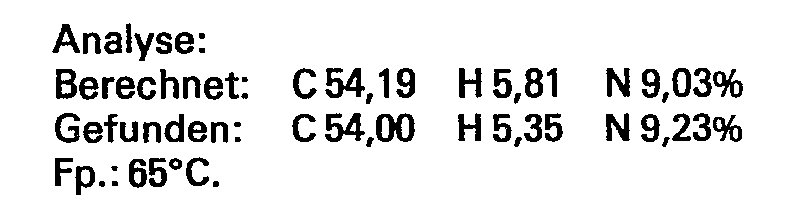
- Yield: 250 g (81% of theory)
175 g (0,67 mol) Trishydroxyethylisocyanursäureester wurden in 200 ml Dimethylformamid gelöst und in Gegenwartvon 131 g (1,3 mol) Triethylamin und 135 g (1,3 mol) Methacrylsäurechlorid bei -5°C umgesetzt. Die Aufarbeitung erfolgte wie im Beispiel 1 beschrieben.175 g (0.67 mol) of trishydroxyethyl isocyanuric acid ester was dissolved in 200 ml of dimethylformamide and reacted at -5 ° C in the presence of 131 g (1.3 mol) of triethylamine and 135 g (1.3 mol) of methacrylic acid chloride. Working up was carried out as described in Example 1.

392g (1,5 moi) Trishydroxyethylisocyanursäureester und 441 g (4,5 mol) Maleinsäureanhydrid wurden bei 100°C so lange zur Reaktion gebracht, bis die Säurezahl bei 315 (ber. 302) lag. Anschliessend wurde bei 80°C mit 639 g (4,5 mol) Glycidylmethacrylsäureester umgesetzt. Nach 10 h lag die Säurezahl bei 10.392g (1.5 moi) trishydroxyethyl isocyanuric acid ester and 441 g (4.5 mol) maleic anhydride were reacted at 100 ° C until the acid number was 315 (calc. 302). The reaction was then carried out at 80 ° C. with 639 g (4.5 mol) of glycidyl methacrylic acid ester. After 10 h the acid number was 10.
Ausbeute: 1472g (100% d.Th.)

Der Halbester wurde - wie im Beispiel 3 beschrieben - hergestellt. Die Methacryloylierung erfolgte bei 80°C mit 425 g (3 mol) Glycidylmethacrylsäureester bis zur Säurezahl von 110 (ber. 101).The half ester was prepared as described in Example 3. The methacryloylation was carried out at 80 ° C. with 425 g (3 mol) glycidyl methacrylic acid ester up to an acid number of 110 (calc. 101).
Ausbeute: 1258 g (100% d.Th.)Yield: 1258 g (100% of theory)

Je 50 Teile der Di- oder Trimethacrylsäureester der Beispiele 1 bis 4 wurden mit 20 g Hydroxyethylmethacrylsäureester und 20 g Triethylenglykoldimethacrylsäureester verdünnt. Diese Monomerengemische wurden mit 5 g Polymethylmethacrylsäureester, 1 g p-Toluolsulfonsäurehydrazid, 3 g Cumolhydroperoxid und 1 g Triethylamin versetzt. Die resultierenden anaeroben Klebstoffe wurden hinsichtlich ihrer Eigenschaften überprüft. Die Stabilität, gemessen im üblichen 80°C-Tempertest, lag bei allen Mischungen oberhalb von 30 min. Dazu wurde ein 10cm langes und 10 mm weites Reagenzglas zu 9/10 mit der Mischung gemäss Beispielen 1 bis 4 gefüllt, in ein auf 80°C gehaltenes Bad eingehängt und bis zur ersten Gelbildung beobachtet. Von einer Fortsetzung der beschleunigten Alterung wurde abgesehen, da diese Prüfung bedeutet, dass die Produkte bei Raumtemperatur etwa ein Jahr unverändert haltbar sind.50 parts each of the di- or trimethacrylic acid esters of Examples 1 to 4 were diluted with 20 g of hydroxyethyl methacrylic acid ester and 20 g of triethylene glycol dimethacrylic acid ester. These monomer mixtures were mixed with 5 g of polymethyl methacrylic acid ester, 1 g of p-toluenesulfonic acid hydrazide, 3 g of cumene hydroperoxide and 1 g of triethylamine. The properties of the resulting anaerobic adhesives were checked. The stability, measured in the usual 80 ° C. tempering test, was above 30 min for all mixtures. To this end, a 10 cm long and 10 mm wide test tube was filled 9/10 with the mixture according to Examples 1 to 4, suspended in a bath kept at 80 ° C. and observed until the first gel formation. Accelerated aging was not continued because this test means that the products can be kept unchanged at room temperature for about a year.
Zur Prüfung der Drehkraftmomente wurden Schrauben (M 10 x 30 DIN 933-8.8) und Muttern (M 10 DIN 934-5.6) verklebt und nach dreitägiger Aushärtung bei Raumtemperatur in einen Schraubstock eingespannt und mit einem Drehmomentschlüssel das Drehkraftmoment bestimmt. Die Druckscherfestigkeit wurde an verklebten Buchsen aus Stahl ST 50 K (Höhe 10 mm, Durchmesser 20 mm) und Bolzen aus Stahl ST 50 K (Höhe 10 mm, Durchmesser 19,85 mm) nach Lagerung (24 h) bei Raumtemperatur bestimmt (DIN-Entwurf 54452).To check the torque, screws (M 10 x 30 DIN 933-8.8) and nuts (M 10 DIN 934-5.6) were glued and, after three days of curing at room temperature, clamped in a vice and the torque was determined with a torque wrench. The compressive shear strength was determined on glued bushes made of steel ST 50 K (height 10 mm, diameter 20 mm) and bolts made of steel ST 50 K (height 10 mm, diameter 19.85 mm) after storage (24 h) at room temperature (DIN Draft 54452).
In einem weiteren Test wurde die Druckscherfestigkeit nach 1 d an 3 h auf 180°C erwärmten Prüfkörpern bestimmt. Das Aufheizen erfolgte in einem Wärmeschrank während der angegebenen Zeit, die Prüfung unmittelbar nach der Entnahme aus dem Wärmeschrank.In a further test, the compressive shear strength was determined after 1 d over 3 h test specimens heated to 180 ° C. The heating took place in a heating cabinet during the specified time, the test immediately after removal from the heating cabinet.
Alle Tests wurden 5mal durchgeführt und dann der Mittelwert der Prüfungsergebnisse angegeben. In der nachfolgenden Tabelle sind in Abhängigkeit von den Herstellungsbeispielen die ermittelten Werte wiedergegeben.

Der Dimethacrylsäureester des Umsetzungsprodukts von 2 mol Propylenoxid und 1 mol Diphenylolpropan wurde - wie in dem vorstehenden Beispiel 5 beschrieben - mit den angegebenen Hilfsstoffen versetzt. Dann wurden die dort beschriebenen Tests vorgenommen.
- Druckscherfestigkeit nach 24 h: 35 N/mm2
- Druckscherfestigkeit bei 180°C: 10 N/mm2.
- Compression shear strength after 24 h: 35 N / mm 2
- Compression shear strength at 180 ° C: 10 N / mm 2 .
Claims (3)


Priority Applications (1)
| Application Number | Priority Date | Filing Date | Title |
|---|---|---|---|
| AT81109209T ATE9092T1 (en) | 1980-11-25 | 1981-10-29 | ACRYLIC ACID ESTER OR. METHACRYLIC ACID ESTERS OF OH- GROUP CONTAINING ISOCYANURIC ACID DERIVATIVES, PROCESS FOR THEIR PRODUCTION AND THEIR USE AS AN ADHESIVE. |
Applications Claiming Priority (2)
| Application Number | Priority Date | Filing Date | Title |
|---|---|---|---|
| DE3044318 | 1980-11-25 | ||
| DE3044318A DE3044318C2 (en) | 1980-11-25 | 1980-11-25 | Use of acrylic acid esters of tris (2-hydroxy-alkyl) isocyanurates in adhesives and ring opening products of glycidyl acrylates with maleic acid half-esters of tris (2-hydroxy-alkyl) isocyanurates and processes for the preparation of these compounds |
Publications (3)
| Publication Number | Publication Date |
|---|---|
| EP0052800A1 EP0052800A1 (en) | 1982-06-02 |
| EP0052800B1 EP0052800B1 (en) | 1984-08-22 |
| EP0052800B2 true EP0052800B2 (en) | 1987-09-16 |
Family
ID=6117505
Family Applications (1)
| Application Number | Title | Priority Date | Filing Date |
|---|---|---|---|
| EP81109209A Expired EP0052800B2 (en) | 1980-11-25 | 1981-10-29 | Acrylic-acid esters or methacrylic-acid esters of isocyanuric-acid derivatives that contain oh groups, method for their preparation, and their use as bonding agents |
Country Status (6)
| Country | Link |
|---|---|
| US (1) | US4420597A (en) |
| EP (1) | EP0052800B2 (en) |
| JP (2) | JPS57116055A (en) |
| AT (1) | ATE9092T1 (en) |
| BR (1) | BR8107668A (en) |
| DE (2) | DE3044318C2 (en) |
Families Citing this family (11)
| Publication number | Priority date | Publication date | Assignee | Title |
|---|---|---|---|---|
| JPS5925840A (en) * | 1982-08-05 | 1984-02-09 | Mitsui Petrochem Ind Ltd | Curable resin composition for coating |
| FR2560874B1 (en) * | 1984-03-09 | 1986-09-05 | Charbonnages Ste Chimique | NEW DIALLYL DERIVATIVE OF CYANURIC ACID |
| JPS61231069A (en) * | 1985-04-04 | 1986-10-15 | Toyoda Gosei Co Ltd | Bondable composition |
| GB8429686D0 (en) * | 1984-11-23 | 1985-01-03 | Int Paint Plc | Dispersants |
| US5250591A (en) * | 1988-02-20 | 1993-10-05 | Somar Corporation | Curable adhesive composition |
| EP0330115B1 (en) * | 1988-02-20 | 1994-05-11 | Somar Corporation | Curable adhesive composition |
| US5189126A (en) * | 1989-08-14 | 1993-02-23 | Avery Dennison Corporation | Emulsion pressure-sensitive adhesive polymers exhibiting excellent guillotine performance |
| US5264532A (en) * | 1989-08-14 | 1993-11-23 | Avery Dennison Corporation | Emulsion pressure-sensitive adhesives |
| JP3723927B2 (en) * | 2000-07-11 | 2005-12-07 | 日本ライナー株式会社 | Method for curing epoxy resin in a short time and electromagnetic wave absorption method using cured epoxy resin obtained by the curing method |
| JP6071696B2 (en) * | 2013-03-27 | 2017-02-01 | デクセリアルズ株式会社 | Lipophilic laminate, method for producing the same, article, and method for producing the same |
| CN105503755B (en) * | 2016-01-10 | 2018-10-30 | 江苏博砚电子科技有限公司 | A kind of chromatic photoresist Sai Keji acrylates and preparation method thereof |
Family Cites Families (11)
| Publication number | Priority date | Publication date | Assignee | Title |
|---|---|---|---|---|
| US3061591A (en) * | 1959-11-27 | 1962-10-30 | American Cyanamid Co | Tris-p-vinyl benzyl isocyanurate and polymers thereof |
| US3297785A (en) * | 1963-09-30 | 1967-01-10 | George Co P D | Melamine-aldehyde resin modified polyester reaction products |
| US3293248A (en) * | 1964-12-04 | 1966-12-20 | Schenectady Chemical | Isocyanurate-trianhydride polymer |
| US3332946A (en) * | 1965-06-25 | 1967-07-25 | Allied Chem | 1-(2-hydroxyalkyl)-3, 5-diallyl isocyanurates |
| DE1695171C3 (en) * | 1966-11-30 | 1981-07-09 | Henkel KGaA, 4000 Düsseldorf | Process for the production of molded articles based on glycidyl isocyanurate |
| US3629255A (en) * | 1969-03-19 | 1971-12-21 | Allied Chem | Fluorocarbon esters of isocyanurate |
| US3658801A (en) * | 1969-06-10 | 1972-04-25 | Dart Ind Inc | Trisubstituted isocyanurates |
| FR2154836A5 (en) * | 1971-09-27 | 1973-05-18 | Allied Chem | Esters of tris(polyalkyleneoxy) isocyanurates - functional fluid and lubricant additives and resin plasticisers |
| JPS4840792A (en) * | 1971-10-08 | 1973-06-15 | ||
| JPS6029392B2 (en) * | 1976-04-20 | 1985-07-10 | 株式会社日本触媒 | Method for producing tris(2-hydroxyethyl)isocyanurate derivative |
| DE2633685A1 (en) * | 1976-07-27 | 1978-02-02 | Basf Ag | 1,3,5-TRIS- (2-CHLOROFORMYL- OXYAETHYL) -ISOCYANURATE |
-
1980
- 1980-11-25 DE DE3044318A patent/DE3044318C2/en not_active Expired
-
1981
- 1981-09-29 US US06/306,777 patent/US4420597A/en not_active Expired - Fee Related
- 1981-10-29 EP EP81109209A patent/EP0052800B2/en not_active Expired
- 1981-10-29 DE DE8181109209T patent/DE3165705D1/en not_active Expired
- 1981-10-29 AT AT81109209T patent/ATE9092T1/en not_active IP Right Cessation
- 1981-11-24 JP JP56187064A patent/JPS57116055A/en active Granted
- 1981-11-25 BR BR8107668A patent/BR8107668A/en unknown
-
1991
- 1991-01-17 JP JP3003836A patent/JPH04211484A/en active Pending
Also Published As
| Publication number | Publication date |
|---|---|
| JPS57116055A (en) | 1982-07-19 |
| DE3165705D1 (en) | 1984-09-27 |
| JPH0347267B2 (en) | 1991-07-18 |
| EP0052800A1 (en) | 1982-06-02 |
| DE3044318C2 (en) | 1983-06-09 |
| EP0052800B1 (en) | 1984-08-22 |
| BR8107668A (en) | 1982-08-24 |
| JPH04211484A (en) | 1992-08-03 |
| ATE9092T1 (en) | 1984-09-15 |
| DE3044318A1 (en) | 1982-06-03 |
| US4420597A (en) | 1983-12-13 |
Similar Documents
| Publication | Publication Date | Title |
|---|---|---|
| DE3444186C2 (en) | ||
| EP0052800B2 (en) | Acrylic-acid esters or methacrylic-acid esters of isocyanuric-acid derivatives that contain oh groups, method for their preparation, and their use as bonding agents | |
| DE2714538C3 (en) | Methacrylic acid esters of compounds based on tricyclic decanols | |
| EP0033001B1 (en) | Anaerobically hardening adhesives and sealants | |
| DE2607959A1 (en) | ADHESIVES AND SEALING COMPOUNDS THAT CONSTITUTE WITH OXYGEN | |
| DE1929698C3 (en) | Process for gluing surfaces using cyanoacrylate adhesives | |
| DE2048610A1 (en) | Anaerobic glue and adhesive | |
| DE2620775A1 (en) | ANAEROBIC ADHESIVES AND SEALANTS | |
| DE2441943C3 (en) | Anaerobic curing adhesives and sealants | |
| DE3149797C2 (en) | Reactive (meth) acrylate adhesives with acetoacetic ester structures | |
| DE3121119A1 (en) | ADHESIVES BASED ON CYANACRYLIC ACID ESTERS | |
| DE2649372C3 (en) | Anaerobically hardening compounds stable in the air and use of the same as adhesives and sealants | |
| EP0641846B1 (en) | Odorless (meth)acrylate preparation curable by radical polymerisation | |
| DE3021941C2 (en) | Dimethacrylic acid ester of dimethylol tetrahydrofuran, process for their preparation and adhesives or sealants containing these compounds | |
| CH615944A5 (en) | ||
| DE3111132C2 (en) | Adhesives and sealants | |
| DE2714537A1 (en) | Anaerobic adhesive or sealant contg. acrylate! or methacrylate! - prepd. from glycidyl ester and linear oligo:ester of ester diol and di:carboxylic acid anhydride | |
| DE3003437C2 (en) | Anaerobic curing adhesives and sealants | |
| CH628083A5 (en) | ADHESIVES OR SEALANTS WHEN EXCLUDING OXYGEN. | |
| DE2441919A1 (en) | ANAEROBIC CURING ADHESIVES AND SEALING COMPOUNDS | |
| DE2104700A1 (en) | One-component adhesives - contg vinyl monomers and peroxides, which set on exclusion of air | |
| DE2402427C3 (en) | Anaerobic hardening mass | |
| DE1594035A1 (en) | Adhesives or sealants that harden in the absence of oxygen | |
| EP0034709A2 (en) | Anaerobic curing adhesives and sealants | |
| DE3527717A1 (en) | NEW (METH) ACRYLIC ACID ESTERS AND THEIR USE |
Legal Events
| Date | Code | Title | Description |
|---|---|---|---|
| PUAI | Public reference made under article 153(3) epc to a published international application that has entered the european phase |
Free format text: ORIGINAL CODE: 0009012 |
|
| AK | Designated contracting states |
Designated state(s): AT BE CH DE FR GB IT LI NL SE |
|
| 17P | Request for examination filed |
Effective date: 19821008 |
|
| RBV | Designated contracting states (corrected) |
Designated state(s): AT BE CH DE FR GB IT LI NL SE |
|
| ITF | It: translation for a ep patent filed | ||
| GRAA | (expected) grant |
Free format text: ORIGINAL CODE: 0009210 |
|
| AK | Designated contracting states |
Designated state(s): AT BE CH DE FR GB IT LI NL SE |
|
| REF | Corresponds to: |
Ref document number: 9092 Country of ref document: AT Date of ref document: 19840915 Kind code of ref document: T |
|
| REF | Corresponds to: |
Ref document number: 3165705 Country of ref document: DE Date of ref document: 19840927 |
|
| ET | Fr: translation filed | ||
| PLBI | Opposition filed |
Free format text: ORIGINAL CODE: 0009260 |
|
| 26 | Opposition filed |
Opponent name: BASF AKTIENGESELLSCHAFT Effective date: 19850424 |
|
| NLR1 | Nl: opposition has been filed with the epo |
Opponent name: BASF AKTIENGESELLSCHAFT |
|
| PUAH | Patent maintained in amended form |
Free format text: ORIGINAL CODE: 0009272 |
|
| STAA | Information on the status of an ep patent application or granted ep patent |
Free format text: STATUS: PATENT MAINTAINED AS AMENDED |
|
| 27A | Patent maintained in amended form |
Effective date: 19870916 |
|
| AK | Designated contracting states |
Kind code of ref document: B2 Designated state(s): AT BE CH DE FR GB IT LI NL SE |
|
| ET3 | Fr: translation filed ** decision concerning opposition | ||
| NLR2 | Nl: decision of opposition | ||
| ITF | It: translation for a ep patent filed | ||
| NLR3 | Nl: receipt of modified translations in the netherlands language after an opposition procedure | ||
| PGFP | Annual fee paid to national office [announced via postgrant information from national office to epo] |
Ref country code: CH Payment date: 19900924 Year of fee payment: 10 |
|
| PGFP | Annual fee paid to national office [announced via postgrant information from national office to epo] |
Ref country code: DE Payment date: 19901004 Year of fee payment: 10 |
|
| PGFP | Annual fee paid to national office [announced via postgrant information from national office to epo] |
Ref country code: AT Payment date: 19901005 Year of fee payment: 10 |
|
| PGFP | Annual fee paid to national office [announced via postgrant information from national office to epo] |
Ref country code: SE Payment date: 19901012 Year of fee payment: 10 Ref country code: FR Payment date: 19901012 Year of fee payment: 10 |
|
| PGFP | Annual fee paid to national office [announced via postgrant information from national office to epo] |
Ref country code: GB Payment date: 19901019 Year of fee payment: 10 |
|
| ITTA | It: last paid annual fee | ||
| PGFP | Annual fee paid to national office [announced via postgrant information from national office to epo] |
Ref country code: NL Payment date: 19901031 Year of fee payment: 10 |
|
| PGFP | Annual fee paid to national office [announced via postgrant information from national office to epo] |
Ref country code: BE Payment date: 19901129 Year of fee payment: 10 |
|
| PG25 | Lapsed in a contracting state [announced via postgrant information from national office to epo] |
Ref country code: GB Effective date: 19911029 Ref country code: AT Effective date: 19911029 |
|
| PG25 | Lapsed in a contracting state [announced via postgrant information from national office to epo] |
Ref country code: SE Effective date: 19911030 |
|
| PG25 | Lapsed in a contracting state [announced via postgrant information from national office to epo] |
Ref country code: LI Effective date: 19911031 Ref country code: CH Effective date: 19911031 Ref country code: BE Effective date: 19911031 |
|
| BERE | Be: lapsed |
Owner name: HENKEL K.G.A.A. Effective date: 19911031 |
|
| PG25 | Lapsed in a contracting state [announced via postgrant information from national office to epo] |
Ref country code: NL Effective date: 19920501 |
|
| NLV4 | Nl: lapsed or anulled due to non-payment of the annual fee | ||
| GBPC | Gb: european patent ceased through non-payment of renewal fee | ||
| PG25 | Lapsed in a contracting state [announced via postgrant information from national office to epo] |
Ref country code: FR Effective date: 19920630 |
|
| REG | Reference to a national code |
Ref country code: CH Ref legal event code: PL |
|
| PG25 | Lapsed in a contracting state [announced via postgrant information from national office to epo] |
Ref country code: DE Effective date: 19920701 |
|
| REG | Reference to a national code |
Ref country code: FR Ref legal event code: ST |
|
| EUG | Se: european patent has lapsed |
Ref document number: 81109209.7 Effective date: 19920510 |