EP0042082B1 - Microprogram sequencer for microprogrammed control unit - Google Patents
Microprogram sequencer for microprogrammed control unit Download PDFInfo
- Publication number
- EP0042082B1 EP0042082B1 EP81103979A EP81103979A EP0042082B1 EP 0042082 B1 EP0042082 B1 EP 0042082B1 EP 81103979 A EP81103979 A EP 81103979A EP 81103979 A EP81103979 A EP 81103979A EP 0042082 B1 EP0042082 B1 EP 0042082B1
- Authority
- EP
- European Patent Office
- Prior art keywords
- address
- register
- outputs
- inputs
- multiplexer
- Prior art date
- Legal status (The legal status is an assumption and is not a legal conclusion. Google has not performed a legal analysis and makes no representation as to the accuracy of the status listed.)
- Expired
Links
Images


Classifications
-
- G—PHYSICS
- G06—COMPUTING OR CALCULATING; COUNTING
- G06F—ELECTRIC DIGITAL DATA PROCESSING
- G06F9/00—Arrangements for program control, e.g. control units
- G06F9/06—Arrangements for program control, e.g. control units using stored programs, i.e. using an internal store of processing equipment to receive or retain programs
- G06F9/22—Microcontrol or microprogram arrangements
- G06F9/26—Address formation of the next micro-instruction ; Microprogram storage or retrieval arrangements
- G06F9/262—Arrangements for next microinstruction selection
- G06F9/268—Microinstruction selection not based on processing results, e.g. interrupt, patch, first cycle store, diagnostic programs
Definitions
- the present invention relates to microprogram sequencers for microprogrammed control units of data processing systems as set out in the first portion of Claim 1.
- a microprogram sequencer is a set of circuits which determines the orderly read out of the microinstructions stored in a control memory, that is the orderly read out of the microprograms in a control unit of a data processing system capable of performing operations of internal computation, of information transfer with a working memory and, at the same time, capable of managing the operation of peripheral devices.
- data processing systems generally comprise a central unit, a main work memory and a plurality of peripheral units connected to the central unit by means of a plurality of input/output channels for the exchange of information.
- the data processing system job consists of processing some data according to well defined program instructions.
- the central unit comprises a control unit and an operative unit.
- microprograms that is microinstruction sequences that the control unit reads out from a control memory, one micro- instruction at a time.
- microprograms that is microinstruction sequences that the control unit reads out from a control memory, one micro- instruction at a time.
- a set of elementary commands, or microcommands is generated which cause the working of the several logic/electric networks of the central unit in the manner required by the several program instructions.
- the operative processes performed by the system may be internal, that is executed within the central unit with possible data exchange with the working memory, or external, that is requiring the intervention of peripheral units.
- the "interruptions" can be caused by interrupt requests coming from peripheral units.
- the central unit must interrupt the execution of an internal process in progress in order to execute the service required by the peripheral unit.
- interrupts are asynchronous events which may occur at any time and phase of the internal processes and which, generally, require the immediate interruption of the process in progress and the immediate execution of the required service; this is particularly true in case the interrupt requests come from fast peripheral units, such as disk units.
- microprogrammed central units this involves the interruption of microprograms in progress, through which the program instructions of the internal process are executed, and the start of microprograms executing the services required by the interruption.
- control unit of a data processing system comprises three microprogram address registers.
- a first register is used to store the addresses of the microprogram which performs the program instructions of the internal processes;
- a second register is used to store the addresses of the microprogram executing the services required by interruptions having a certain priority level;
- a third register is used to store the addresses of the microprogram executing services required by interruptions having another priority level.
- microprogram structures Such structure allows to save microprogram addresses which, otherwise, would be lost owing to the interruptions, but it is not effective for the "saving" of addresses which should be saved within the same program.
- microprogram structures It is known that the several program instructions of an operative process are executed by microprograms consisting of a set of microinstructions stored in a control memory.
- microinstructions are preferably arranged in sequence to form a microprogram.
- a microinstruction stored in a memory address n is followed by a micro- instruction stored in address n+1, and so on.
- the memory addressing operation may be carried out by a network which increments the preceding address by one unit.
- the network is particularly simple and unexpensive.
- microprograms each one allowing for the interpretation of a well determined program instruction, may contain portions formed by identical microinstruction sequences.
- microinstruction portions or sequences identical for several microprograms, are named "subroutines" and it is clear that, for all the microprograms which use them, possibly with the exception of one, the access to such subroutines cannot follow the general criterium of sequential addressing.
- a subroutine may also form an intermediate portion of a microprogram. It is therefore necessary, at the end of the subroutine, to return to the specific microprogram by which the subroutine has been called.
- the subroutine is not able by itself to specify to which of the several microprograms it has to go back and which must be the subsequent return address in the microprogram basic sequence.
- the address to be saved is the jump microinstruction address, which calls for the subroutine, incremented by one.
- the last microinstruction of the subroutine must contain a command information which controls the return, that is the addressing of the subsequent microinstruction by using the saved address.
- a subroutine may also contain, in its turn, microprogram portions common to other subroutines or microprograms, which will be considered subroutines of second level or of subsequent level. It will be therefore necessary to provide a number of address saving registers equal to the subroutine levels which are foreseen and an automatic mechanism of return, that is of selection of one of these registers.
- registers devoted to save the several return addresses form a stack where the output order of the information stored therein is opposite to the input order, that is information is handled on a last in, first out basis (LIFO).
- LIFO last in, first out basis
- the last recorded information is always the first one to be read out.
- microprogram sequencers of the type described in the mentioned US-A-3,909,797 which are now present on the market in form of integrated circuits, as for instance the circuits with code 2911 and 2910 manufactured by Advanced Micro Devices Inc.
- the mentioned integrated microprogram sequencers comprise the features set out in the first portion of Claim 1, e.g. a multiplexer which transmits to its output set one of several addresses present on its input sets and coming form:
- Such integrated sequencers may supply the addressing inputs of a control memory with a sequential address, a return address from subroutine and a jump address to subroutine.
- the jump address is generally provided in absolute way by a suitable field of the jump microinstruction in progress.
- Such jump address is therefore applied to the input set of the sequencer multiplexer devoted to receive information from the outside.
- the same input set of multiplexer may receive through control gates an external microprogram address provided by an interrupting unit of the system. In such way, if an interruption is enabled during the execution of a microinstruction of address N, in the following machine cycle the microinstruction addressed by the interruption address is executed and, at the same time, the saving of address N+1 into stack is performed. It is obvious that the interruption microprogram ends with a micro- instruction allowing the return to the interrupted microprogram.
- the described arrangement and particularly the multiplexer constitutes a real bottleneck for the simultaneous transfer of two different addresses, one to the stack for saving purpose, the other to the control memory for addressing of the first microinstruction of the interrupting microprogram.
- microprogrammed control unit sequencer of the present invention as set out in Claim 1 which, in addition to the integrated sequencer such as the mentioned AMD 2911, providing a looped communication path for the sequential increment of the addresses and stack for address saving, comprises a second looped communication path including a present address register (ROSPA) and a summing unit for non sequential address generation.
- ROSPA present address register
- the second communication path has in common with the first communication path a first address node, and is further provided with a second address node immediately upstream said present address register, through which node interrupt addresses are received.
- the first microinstruction of the interrupt microprogram must be a jump micro- instruction with saving of address, to provide, during its execution, the saving in the stack of the address contained in the microprogram counter register, and the generation of the next address through the second looped communication path.
- the saving function specified by a predetermined microinstruction bit, is only present in the jump microinstructions, where it may be necessary.
- microprogrammed control unit of fig. 1A and 1 B may be associated to central processing units having a different architecture and which are not described herein because they are beyond the scope of the present invention.
- fig. 1A and 1B of the present invention integrally replace the circuits shown in fig. 8a and 8b of the mentioned patent.
- the control unit substantially comprises (fig. 1 B):
- the content of register IR7 may be saved in such bank and from there the previously saved statuses may be read out and reloaded in the index register IR7.
- the outputs of index register IR7 are connected through a channel 10 to inputs 11 of register bank 9, and the outputs 12 of register bank 9 are connected, through channel 13, to a set of inputs of multiplexer 8 which may selectively transfer to index register 7 the statuses read out from bank 9 or the statuses which occur during a machine cycle.
- index register 7 The outputs of index register 7 are further connected, through a channel 14 and a group 15 of enabling AND gates, to decoder 4, and provide it with information which adds to the one obtained from the read out microinstruction.
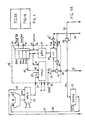
- the control unit sequencer that is the circuit set devoted to the control memory 1 addressing, comprises (Fig. 1A):
- the sequencing unit 16 substantially comprises:
- the sequencing unit 16 in the whole, has a set 27 of address inputs (by connecting in parallel a suitable number of integrated circuits AM 2911, any desired parallelism can be obtained), a set 28 of address outputs and a certain number of control inputs.
- Two pins So and S, are used to control multiplexer 23.
- Multiplexer 23 is provided with three sets of inputs and transfers the signals present on one of the three input sets to its output depending on the logical combination of the signals present on So, S 1 inputs.
- An input set 29 of multiplexer 23 is connected to input set 27.
- a second input set 30 is connected to outputs of register stack 20 and a third input set 31 is connected to the outputs of microprogram counter register ⁇ PCR21.
- Outputs of pPCR21 are further connected to the inputs of register stack 20.
- Outputs of multiplexer 23 are connected to inputs of AND gate set 25, the AND gates being enabled by a signal ZERO at logical level 1 applied to a control input 32.
- the outputs of AND set 25 are connected to the inputs of the tristate output set 24 and to the inputs of incrementer 22.
- the tristate output set 24 is enabled to the information transfer by a command signal applied to an input pin OE connected to the enabling inputs of tristates 24 through inverter 26.
- Incrementing counter 22 is controlled by a signal CN applied to input 33.
- the loading of register pPCR21 and of stack 20 is controlled by a timing signal CK applied to an input 34.
- register ⁇ PCP21 When CK signal rises from 0 to 1, register ⁇ PCP21 is loaded and, in case, stack 20 is enabled too.
- Stack 20 comprises 4 cascade connected registers 20A, 20B, 20C, 20D and its operation is controlled by two signals FILE EN and PUSH/POP applied to two control inputs 35 and 36 respectively.
- register 20A The information present, at this point, in register 20A is directly available on inputs 30 of multiplexer 23 through channel 37.
- Outputs 28 of sequencing unit 16 are connected, through channel 38, to the inputs of the memory addressing register 3 (ROSAR).
- ROSAR memory addressing register 3
- Such outputs are further connected, through channel 39, to the inputs of present address register 17 whose outputs are connected, through path 40, to a first input set A of summing network 18, which receives through path 41, on a second input set B a certain number of microinstruction bits read out from ROS memory 1.
- the outputs of summing network 18 are connected to a first input set of multiplexer 19, which receives on a second input set, through paths 41, 42, a certain number of bits read out from ROS memory 1.
- a third input set of multiplexer 19 receives a fixed binary addressing code: for instance OOOF.
- the outputs of multiplexer 19 are connected to inputs 27 of sequencing unit 16.
- the selection of the input set is determined by the logical level of the two signals on control inputs S 2 , S 3 .
- the sequencer is completed by some circuits for connection to a logical priority network intended to detect the interruptions coming from several channels connecting peripheral units.
- the logical priority network may be of the type described and shown in fig. 7 of the mentioned US-A-4.001.784.
- Such priority network emits on one of three output leads 99, 150, 154 an interrupt signal having high, low, intermediate priority respectively. On one of four leads 158, 159, 161, 162 it further emits a signal at logical level 1 which indicates which is the channel sending the interruption.
- a channel 1 is associated to lead 158, a channel 2 to lead 159 and so on.
- One or more peripheral units will be connected to each channel through a peripheral adapter or peripheral control unit.
- leads 99, 150, 154 are connected to the inputs of an OR gate 43, each one through an AND gate 47, 48, 49 having two, three, four inputs respectively.
- Or 43 output is connected to an input of a two input AND gate 44; AND gate 44 is controlled by a cyclical timing signal STINTA (INTERRUPTION STROBE) applied to its second input.
- STINTA INTERRUPTION STROBE
- the output of AND gate 44 is connected, through lead 50, to input OE of sequencing unit 16.
- Output of AND gate 44 is further connected to control input CN of sequencing unit 16 through a NOT 51 and to the control input of a tristate set 46.
- Tristate set 46 receives as an input an interruption vector (that is the first micro- instruction address of the microprogram called for by the interruption) and transfers such vector on channel 38 and on channel 39 when it is enabled by AND gate 44 with output at logical level 1.
- an interruption vector that is the first micro- instruction address of the microprogram called for by the interruption
- the interruption vector is generated by a logical network 45 (VECTOR GENERATOR) which suitably codes the input signals, constituted by the interruption signals at different priority level (received on leads 99, 150, 154, through AND 47, 48, 49) and by the interrupting channel signals received on leads 158, 159, 161, 162.
- VECTOR GENERATOR VECTOR GENERATOR
- circuital structure of logical network 45 is beyond the scope of the invention; this network is substantially a coding network which generates an address binary output code on channel 51 depending on the binary code received on its inputs (7 bits two of which at logical level 1).
- the interruption vector generator can be constituted by a coding network which generates an addressing binary output code which addresses, in its turn, an auxiliary memory where the interruption addresses are stored.
- the vector generator outputs are connected to the inputs of tristate set 46 through channel 51.
- AND gates 47, 48, 49 together with JK flip-flops 52, 53, 54 and with two AND gates 55, 56 provide suitably timing of interrupt signals and interrupt masking if a higher priority interruption was already in progress.
- Output of AND gate 47 is connected to J input of flip-flop 52; output of AND gate 48 to J input of flip-flop 53 and output of AND gate 49 to J input of flip-flop 54.
- the inverted output of flip-flop 53 is connected to an input of AND gates 48, 49.
- the inverted output of flip-flop 54 is connected to an input of AND gate 49.
- the inverted output of flip-flop 52 is further connected to an input of AND gates 55, 56 and the inverted output of flip-flop 53 is connected to an input of AND gate 56.
- a microcommand EOS (end of service) is applied to K input of flip-flop 52 through lead 57 and to an input of AND gates 55, 56 which have their outputs connected to K input of flip-flops 53, 54 respectively.
- Flip-flops 52, 53, 54 are set/reset according to the logical level on their J, K inputs, by the falling edge of a timing signal PH2 applied to their clock input.
- the set of such flip-flops determines the interruption level which is in progress.
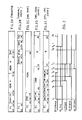
- Fig. 2 shows, in timing diagram, the signals produced by timing unit 5 which are useful for understanding the sequencer working.
- a machine cycle consists of a time interval, from time to to time t' o which is the beginning of the subsequent cycle.
- a machine cycle start is determined by a timing signal STRORA (diagram a) which rises to logical level 1 at time to and remains at logical level 1 up to time t 5 .
- the rising edge of PH2 is used as strobe signal for register stack 9, whilst the falling edge of PH2 is used as clock signal for flip-flops 52, 53, 54.
- a third signal STSNA (diagram c) rises to logical level 1 and remains at such level up to time t 7 .
- the rising edge of STSNA is used as timing signal applied to network 6.
- microcommands IR or S 4 When one of microcommands IR or S 4 is present, it produces a timed microcommand STSNA (IR+S 4 ) used as strobe signal for register 7. At an instant t 4 a fourth signal STINTA (diagram d) rises to logical level 1 and remains at such level up to a time t 7 . Such signal is used to enable AND gate 44.
- STSNA timed microcommand STSNA
- a fifth signal STCSSA (diagram e) rises to logical level 1 and remains at such level up to time t 9 .
- STCSSA rising edge of STCSSA is used as strobe signal for register 3, memory 1, register 17 and sequencing unit 16.
- Times to, t 2 ... t orderly follow in the time.
- microinstructions controlling during each machine cycle the operation of the sequencer, the control unit and the whole data processing central system.
- Fig. 3A, 3B, 3C, 3D, 3E show the format of the several basic types of microinstructions, that is the meaning assumed by the several bits forming each microinstruction.
- microinstructions are of two types: OPERATIVE microinstructions (fig. 3A, 3B) and JUMP microinstructions (fig. 3C, 3D, 3E).
- OPERATIVE microinstructions may be TRANSFER microinstructions (fig. 3A TRANSFER) or LOGIC/ARITHMETIC operative microinstructions (fig. 3B LOGICAL/ARITM).
- a transfer microinstruction comprises several fields of bits having a precise meaning.
- a first field (bits 0-3), named FC or FUNCTION CODE, characterizes the micro- instruction and assigns to the subsequent fields a determined meaning.
- Decoding network 4 (fig. 1 B) decodes such function code and, according to it, distributes subsequent bit levels, turned into electrical levels, to determined outputs of theirs.
- the electrical levels at such outputs control the several registers and the several gates constituting the system in order to perform the function defined by the microinstruction bits.
- a second field (bits 04-07), named BLOCK SEL or block selector, defines which are the system elements involved in the transfer.
- the transfer microinstruction can control the information transfer from a register of a bank to a register of another bank, or from the output register of the working memory to an output register of channel interface, etc. (Such considerations are referred to the specific architecture described in the already mentioned US ⁇ A ⁇ 4.001.784).
- a third field (bits 08-13), named ADDR A, defines the specific address of one of the registers involved in the transfer, for instance one of the registers of a bank or one of the output registers.
- ADDR B A fourth field (bits 14-21), named ADDR B, defines the specific address of the other register involved in the transfer.
- a fifth field (bit 22), named DIR, defines the transfer direction, that is if the transfer has to occur from the location defined by ADDR A to the one defined by ADDR B or viceversa.
- bits 23-31 are used for control functions and as parity check bits.
- Fig. 3B shows the format of a LOGIC/ARITHMETIC operative microinstruction.
- bits 0-3) with meaning of function code FC there is a field (bits 0-3) with meaning of function code FC, a field (bits 18-20) with meaning of address of the register (SOURCE) containing the operand (the operator may be stored in a fixed register), a field (bits 21-23) which defines the logic/arithmetic operation to be executed (OP SEL), a field (bit 24-26) which defines the address of the register where the operation result is to be stored, and a field IR (bit 29) which defines whether the index register is to be updated with the conditions of carry/over- flow/etc. which have occurred owing to the operation.
- microinstructions do not contain, contrarily to the jump ones, any useful information defining the subsequent microinstruction address.
- the subsequent microinstruction will be therefore called for by the sequencer through the increment by one unit of the previous operative microinstruction address.
- Fig. 3C shows the format of an absolute jump microinstruction (ABS. JUMP).
- Such kind of microinstruction specifies the address of the following microinstruction itself.
- a first field (bits 0-5) constitutes the function code.
- a second field defines whether the progressive address of the jump microinstruction in progress, incremented by one unit, must be saved into stack 20 in order to be called for later on; if bit 06 is at logical level 1, the saving operation occurs.
- a third field (bit 07-22), named ADDR, constitutes the absolute address of the subsequent microinstruction.
- Fig. 3D shows the format of a relative conditioned jump micro- instruction (REL. COND. JUMP).
- Such kind of microinstruction having a generical address N, defines that the subsequent microinstruction must be the one having address N+1 if a condition specified by the same microinstruction is not verified, and must be the one having address N+K if the condition specified by the same microinstruction is verified.
- the displacement K is provided by the same microinstruction.
- a first field (bit 0-5) defines the function code.
- a second field (bit 06), named SAVE, defines whether the progressive address of the jump microinstruction in progress, incremented by one unit, must be saved into stack 20 in order to be recalled later on.
- a third field (bit 07), named C DR, defines whether the condition to be verified is contained in a DIRECT REGISTER.
- a fourth field defines which is the condition COND to be verified.
- a fifth field (bit 17-29) defines the displacement K.
- Such microinstruction is typical for the start of a subroutine or of an interrupting microprogram and for the return from a subroutine or from an interrupting microprogram.
- a first field defines a function code and a second field (bit 06), named SAVE, indicates if the progressive address of the jump microinstruction in progress, or, more generally, the address present in register ROSPA, incremented or not by one unit, must be saved into stack 20 in order to be recalled later on.
- a third field (bit 07), named RD DR, defines if the content of a DIRECT REGISTER must be read out and transferred into register IR7.
- a fourth field (bit 08), named WR DR, defines if the content of register IR7 must be saved by writing it in a DIRECT REGISTER.
- a fifth field (bit 09), named RET, defines if the microinstruction is a microinstruction of return from a subroutine or from an interrupting microprogram; in this last case a pop operation of stack 20 is commanded and the subsequent microinstruction address is read out from stack 20.
- a sixth field (bits 10-13), named DR ADDR, defines which DIRECT REGISTER of stack 9 is interested in the transfer (read or write).
- PC PRIORITY CHANGE
- a start address 0 is forced on channels 38 and 39 and is applied to inputs of incrementer 22.
- Such address is loaded into registers 17 (ROSPA) and 3 (ROSAR) by the rising edge of signal STCSSA, while address +1 is loaded into counter ⁇ CPCR21.
- a read operation of ROS memory 1 starts, at the end of which the microinstruction of address 0 is available on the output of such memory.
- the read out microinstruction is loaded into register ROR 2 by the rising edge of timing signal STRORA, so that the microinstruction is available on inputs of decoder 4 and a set of microcommands is produced on the outputs of decoder 4.
- microcommands allow the micro- instruction execution during the cycle.
- Microcommands So and S 1 at logical level 0 are two of the microcommands generated by decoder 4 and they are available from time to.
- Such microcommands select input set 31 of multiplexer 23, so that the new address "1", present in register ⁇ PCR21, is transferred on channels 38 and 39 and applied to inputs of incrementer 22.
- the new address N+ is transferred by the rising edge of STCSSA from ⁇ PCR21 to channels 38, 39 through multiplexer 23, AND gates 25, tristate circuits 24, and then loaded into registers ROSPA and ROSAR.
- field IR may define, if at logical level 1, that register IR7 must be loaded with the conditions verified during the execution of such microinstruction.
- Such conditions coming from a condition check network, not shown, are transferred through multiplexer 8 (enabled by a microcommand S 4 ) to inputs of register 7 and loaded into it by the rising edge of a signal STSNA ⁇ !R which is obtained as a logical AND of microcommand IR with timing signal STSNA.
- Register IR7 is therefore loaded at time t 3 and its outputs are connected, through AND gates 15 enabled by STSNA ⁇ IR, to channel 14 which supplies decoding network 4.
- microcommands So S 1 assume a logical condition which selects input set 29 of multiplexer 23 and microcommands S 2 S 3 assume a logical level which selects inputs OOOF of multiplexer 19.
- Field 07-22 defines a new address NA to be used to address the subsequent micro- instruction: such bit field is transferred through channels 41, 42 to an input set of multiplexer 19.
- the microinstruction decoding produces a group of microcommands S 2 , S 3 at logical level such as to select the input set of multiplexer 19 connected to channel 42, as well as a set of microcommands S 0 , S 1 which select input set 29 of multiplexer 23.
- new address NA is loaded into registers ROSPA 16 and ROSAR 3, while address N+1 contained in ,uPCR21 is loaded into register 20A of stack 20.
- address NA+1 present on outputs of network 22 is loaded into register ,uPCR21.
- the new microinstruction which will be recalled, will therefore be the one of address NA, while the sequential address N+1 is saved into stack 20 and will be recalled later on.
- an address N is loaded into registers ROSPA 17 and ROSAR 3 and an address N+1 is loaded into register ⁇ PCR21.
- Field 17-29 defines a jump displacement K to be used to address the subsequent micro- instruction if a determined condition is verified.
- Such bit field is transferred, through channel 41, to input set B of summing network 18 which receives on its input set A the address N coming from ROSPA through channel 40.
- microinstruction bit 07 defines whether the condition to be examined is contained in a register DR of bank 9, whose address is expressed by the field of bits 10-13.
- addressing microcommands of bank 9 and a read microcommand RDR are generated by network 4.
- Timing signal PH2 therefore controls the reading of the selected register.
- the selected register content defines the condition to be examined and is transferred through multiplexer 8, controlled by microcommand S 4 at suitable logical level, to the inputs of register IR7.
- Such network selects in the contained information the condition to be verified and, if this last one is verified, it generates a set of microcommands S 2 , S 3 at a logical level such as to select the input set of multiplexer 19 which is connected to the output set of summing network 19, and a set of microcommands S 0 , S, which select input set 29.
- microcommands FILE EN at logical level 0 and PUSH/POP at logical level 1 are also generated.
- address N+K is loaded into ROSPA 17 and ROSAR 3
- address N+1 contained in ,uPCR21 is transferred to register 20A of stack 20 and address N+K+ is loaded into ⁇ PCR21.
- Such completely asynchronous event is considered at a suitable time of a machine cycle; it is recognized only if there are not interruption requests of higher priority or interruption requests in progress having the same priority level and is presented to the central unit in order to develop an interruption execution microprogram.
- such network provides leads 99, 154, 150, with signals indicating an interruption having high, mean, low priority and leads 158, 159, 161, 162 with signals indicating an interrupting channel.
- the number of such leads is variable and it depends on the number of priority levels that the system is able to consider and on the number of interface channels.
- Fig. 1B is considered and assumption is made that an intermediate priority interruption occurs on lead 154 during the initial phase of a machine cycle and that, at the same time, a signal of interrupting channel is applied to lead 158.
- flip-flops 52 and 53 are reset.
- the interruption is therefore transferred through AND 48, is applied to vector generator 45 and, through OR 43, is applied to an input of AND gate 44.
- the interruption is transferred to lead 50 by the rising edge of STINTA and it enables tristate circuits 46, while NOT 51' applies a logical level 0 to input CN.
- the interruption signal is present on lead 50 for a suitable portion of the cycle, that is from time t 4 (signal STINTA rising to 1) up to time t 7 , when signal STINTA falls to logical level 0.
- the several commands So, S 1 , S 2' S 3 enable multiplexers 19 and 23 to transfer address N+1 to output set 28 of sequencing unit 16 and to inputs of incrementer 22.
- address N+1 is not loaded into registers ROSPA and ROSAR by the rising edge of STCSSA.
- Microinstruction MI is therefore addressed and it is executed during the subsequent cycle.
- micro- instruction is a jump microinstruction and not an operative microinstruction and it allows to save the machine states existing before the interruption.
- microinstruction has the format shown in fig. 3E.
- a first field (bits 0-5) constitutes the function code.
- a second field (bit 06), named SAVE, in this case at logical level 1, defines that the preexistent microprogram address must be saved.
- a third field (bit 07), named RDR, is not used in this case and is at logical level 0.
- a fourth field (bit 08), named WDR, is at logical level 1 and determines that the information contained in register IR7 must be saved into a DIRECT REGISTER.
- a fifth field (bit 09), named RET, is in this case at logical level 0 and is not used.
- a sixth field (bit 10-13), named DR ADDR, determines the DIRECT REGISTER address to be used for the writing operation specified by bit 08.
- a seventh field (bit 14), named PC, is in this case at logical level 0 and is not used.
- An eighth field (bit 17-29), named K, defines the jump displacement K to be used to establish the subsequent microinstruction address.
- the called microinstruction of address MI contains the following useful information:
- DR ADDR information allows to select a register of bank 9.
- timing signal STCSSA address N+1 present in ⁇ PCR21 is saved by loading it into stack register 20A and address MI+1 is loaded into ROSPA 17 and ROSAR 3.
- a new address MI+2 which can be used for the following sequential addressing of the microprogram, is loaded into ⁇ PCR21.
- MI+2 which can be used for the following sequential addressing of the microprogram
- register ⁇ PCR21 contains address N+1.
- interrupting microinstruction is a jump micro- instruction (with saving) which does not use, for the address increment, network 22 and register jM PCR21 as temporary store, but it uses a path different from the first one.
- Such different path has only a section in common with the first path and is provided with summing network 18 and with temporary storing register of the addresses (ROSPA).
- register ⁇ PCR21 can be used as temporary register of the jump address which can therefore be saved.
- the unconditioned relative jump micro- instruction having the format shown in fig. 3E, is also used as return microinstruction both from interrupting microprogram and from subroutine.
- the last microinstruction of the microprogram is of the type shown in fig. 4E.
- Field 09 is at logical level 1 and commands, when decoded, a pop operation of stack 20: the address of the following micro- instruction is read out from stack 20.
- the flip-flops indicating the several priority levels are flip-flops 52, 53, 54.
- Fig. 1B shows that an high priority interruption INT HP is transferred through AND gate 47 only if flip-flop 52 was reset.
- interruption INT HP addresses the interruption treatment microprogram by means of signals STINTA (which enables AND gate 44) and by signal STCSSA.
- flip-flop 52 is set by the falling edge of PH2, because its J input is at logical level 1.
- the set of flip-flop 52 locks AND gate 47 and, from now onwards, interruption INT HP may be removed from lead 99.
- the set of flip-flop 52 also locks gates 48 and 49 so that the interruptions having lower priority level cannot be recognized too.
- an intermediate priority interruption if it is recognized, sets flip-flop 53, which inhibits, till it is set, that other subsequent interruptions having intermediate or low priority be recognized.
- a low priority interruption INT BP if recognized, sets flip-flop 54, which inhibits, till set, that other subsequent low priority interruptions be recognized.
- PC priority level
- Field 14 when it is decoded, generates a microcommand EOS which is applied to K input of flip-flop 52 through lead 57, and to K input of flip-flops 53, 54 through AND gates 55 and 56 respectively.
- sequencer is able to generate microprogram addresses with possibility of inserting subroutines at the same priority level and saving microprogram addresses, as well as with possibility of interrupting microprograms to jump to interrupting microprograms, and saving addresses and, finally, of returning from such subroutines or interrupting microprograms.
- a first loop is formed by multiplexer 23, by AND gate set 25, by incrementer 22, by register ,uPCR21 and by the connection between output set of juPCR21 and input set 31 of multiplexer 23.
- a second loop is formed by multiplexer 23, by gate sets 25 and 24, by channel 39, by register 17, by channel 40, by summing network 18, by multiplexer 19 and by the connection between the output set of multiplexer 19 and input set 29 of multiplexer 23.
- the use of two multiplexers 19 and 23 connected in cascade is arbitrary and is due to the advantage of using a component (sequencing unit 16) available on the market.
- multiplexers 19 and 23 may be included in one multiplexer 23A, as shown in fig. 4.
- the two address generation loops, essential for the sequencer working, are evidenced by a double line.
- Fig. 5 shows a second modified embodiment of the sequencer of fig. 1A; such modified embodiment uses two multiplexers and differs from fig. 1A only because multiplexer 19 is downstream of multiplexer 23. Also in this figure the elements corresponding to those of fig. 1 A are identified by the same reference numbers and the two address generation loops are evidenced by a double line.
Landscapes
- Engineering & Computer Science (AREA)
- Software Systems (AREA)
- Theoretical Computer Science (AREA)
- Physics & Mathematics (AREA)
- General Engineering & Computer Science (AREA)
- General Physics & Mathematics (AREA)
- Executing Machine-Instructions (AREA)
Applications Claiming Priority (2)
| Application Number | Priority Date | Filing Date | Title |
|---|---|---|---|
| IT22732/80A IT1149809B (it) | 1980-06-12 | 1980-06-12 | Sequenziatore per unita' di controllo microprogrammata |
| IT2273280 | 1980-06-12 |
Publications (2)
| Publication Number | Publication Date |
|---|---|
| EP0042082A1 EP0042082A1 (en) | 1981-12-23 |
| EP0042082B1 true EP0042082B1 (en) | 1984-05-16 |
Family
ID=11199784
Family Applications (1)
| Application Number | Title | Priority Date | Filing Date |
|---|---|---|---|
| EP81103979A Expired EP0042082B1 (en) | 1980-06-12 | 1981-05-23 | Microprogram sequencer for microprogrammed control unit |
Country Status (7)
| Country | Link |
|---|---|
| US (1) | US4429361A (cg-RX-API-DMAC7.html) |
| EP (1) | EP0042082B1 (cg-RX-API-DMAC7.html) |
| JP (1) | JPS5729151A (cg-RX-API-DMAC7.html) |
| AU (1) | AU535972B2 (cg-RX-API-DMAC7.html) |
| CA (1) | CA1158777A (cg-RX-API-DMAC7.html) |
| DE (1) | DE3163594D1 (cg-RX-API-DMAC7.html) |
| IT (1) | IT1149809B (cg-RX-API-DMAC7.html) |
Families Citing this family (16)
| Publication number | Priority date | Publication date | Assignee | Title |
|---|---|---|---|---|
| EP0309068A3 (en) * | 1982-11-15 | 1990-08-16 | Data General Corporation | Digital data processing system |
| JPS6054897U (ja) * | 1983-09-21 | 1985-04-17 | 株式会社東芝 | 壁掛形扇風機の取付装置 |
| DE3751287T2 (de) * | 1986-12-01 | 1995-11-16 | Nippon Electric Co | Während einer Instruktionsausführung eine Unterbrechungsanforderung empfangender Mikroprogrammkontrolleur. |
| US4821183A (en) * | 1986-12-04 | 1989-04-11 | International Business Machines Corporation | A microsequencer circuit with plural microprogrom instruction counters |
| US4910664A (en) * | 1987-11-27 | 1990-03-20 | Mitsubishi Denki Kabushiki Kaisha | Data processor with apparatus for reducing loop processing time |
| US5117498A (en) * | 1988-08-19 | 1992-05-26 | Motorola, Inc. | Processer with flexible return from subroutine |
| EP0374419A3 (en) * | 1988-12-21 | 1991-04-10 | International Business Machines Corporation | Method and apparatus for efficient loop constructs in hardware and microcode |
| US5134693A (en) * | 1989-01-18 | 1992-07-28 | Intel Corporation | System for handling occurrence of exceptions during execution of microinstructions while running floating point and non-floating point instructions in parallel |
| US5093917A (en) * | 1990-01-17 | 1992-03-03 | Ag Communication Systems Corporation | Method for passing data parameters between a calling program and a called subroutine in a command analysis table of a computer stored data base system |
| JPH0440700A (ja) * | 1990-06-06 | 1992-02-12 | Mitsubishi Electric Corp | カウンタ回路 |
| US5410660A (en) * | 1992-12-24 | 1995-04-25 | Motorola, Inc. | System and method for executing branch on bit set/clear instructions using microprogramming flow |
| AU6629894A (en) * | 1993-05-07 | 1994-12-12 | Apple Computer, Inc. | Method for decoding guest instructions for a host computer |
| WO1994027214A1 (en) * | 1993-05-07 | 1994-11-24 | Apple Computer, Inc. | Method for decoding sequences of guest instructions for a host computer |
| US5644741A (en) * | 1993-10-18 | 1997-07-01 | Cyrix Corporation | Processor with single clock decode architecture employing single microROM |
| US5794026A (en) * | 1993-10-18 | 1998-08-11 | National Semiconductor | Microprocessor having expedited execution of condition dependent instructions |
| US7401210B2 (en) * | 2005-03-30 | 2008-07-15 | Arm Limited | Selecting subroutine return mechanisms |
Family Cites Families (8)
| Publication number | Priority date | Publication date | Assignee | Title |
|---|---|---|---|---|
| US3939455A (en) * | 1971-10-01 | 1976-02-17 | Hitachi, Ltd. | Microprocessor having an interface for connection of external devices |
| US3909797A (en) * | 1973-12-13 | 1975-09-30 | Honeywell Inf Systems | Data processing system utilizing control store unit and push down stack for nested subroutines |
| US3938098A (en) * | 1973-12-26 | 1976-02-10 | Xerox Corporation | Input/output connection arrangement for microprogrammable computer |
| IT1002275B (it) * | 1973-12-27 | 1976-05-20 | Honeywell Inf Systems | Sistema di elaborazione dati a piu canali di ingresso uscita a risorse orientate per livelli di servizio distinti e interrompi bili |
| US4001788A (en) * | 1975-03-26 | 1977-01-04 | Honeywell Information Systems, Inc. | Pathfinder microprogram control system |
| US4075687A (en) * | 1976-03-01 | 1978-02-21 | Raytheon Company | Microprogram controlled digital computer |
| US4159520A (en) | 1977-01-03 | 1979-06-26 | Motorola, Inc. | Memory address control device with extender bus |
| US4179737A (en) * | 1977-12-23 | 1979-12-18 | Burroughs Corporation | Means and methods for providing greater speed and flexibility of microinstruction sequencing |
-
1980
- 1980-06-12 IT IT22732/80A patent/IT1149809B/it active
-
1981
- 1981-05-23 DE DE8181103979T patent/DE3163594D1/de not_active Expired
- 1981-05-23 EP EP81103979A patent/EP0042082B1/en not_active Expired
- 1981-06-03 AU AU71294/81A patent/AU535972B2/en not_active Ceased
- 1981-06-08 US US06/271,167 patent/US4429361A/en not_active Expired - Fee Related
- 1981-06-10 CA CA000379443A patent/CA1158777A/en not_active Expired
- 1981-06-12 JP JP9070581A patent/JPS5729151A/ja active Granted
Also Published As
| Publication number | Publication date |
|---|---|
| AU535972B2 (en) | 1984-04-12 |
| IT1149809B (it) | 1986-12-10 |
| IT8022732A0 (it) | 1980-06-12 |
| US4429361A (en) | 1984-01-31 |
| DE3163594D1 (de) | 1984-06-20 |
| JPS6338725B2 (cg-RX-API-DMAC7.html) | 1988-08-02 |
| AU7129481A (en) | 1981-12-17 |
| EP0042082A1 (en) | 1981-12-23 |
| JPS5729151A (en) | 1982-02-17 |
| CA1158777A (en) | 1983-12-13 |
Similar Documents
| Publication | Publication Date | Title |
|---|---|---|
| EP0042082B1 (en) | Microprogram sequencer for microprogrammed control unit | |
| US3735363A (en) | Information processing system employing stored microprogrammed processors and access free field memories | |
| US4724517A (en) | Microcomputer with prefixing functions | |
| US4432051A (en) | Process execution time accounting system | |
| US4369494A (en) | Apparatus and method for providing synchronization between processes and events occurring at different times in a data processing system | |
| US4395757A (en) | Process synchronization utilizing semaphores | |
| US4016545A (en) | Plural memory controller apparatus | |
| US4084228A (en) | Process management structures and hardware/firmware control | |
| US3886523A (en) | Micro program data processor having parallel instruction flow streams for plural levels of sub instruction sets | |
| US4868735A (en) | Interruptible structured microprogrammed sixteen-bit address sequence controller | |
| US3997895A (en) | Data processing system with a microprogrammed dispatcher for working either in native or non-native mode | |
| US4371925A (en) | Data processing system having unique bus control operation | |
| US4005391A (en) | Peripheral interrupt priority resolution in a micro program data processor having plural levels of subinstruction sets | |
| US4045782A (en) | Microprogrammed processor system having external memory | |
| GB1594014A (en) | Microprogramme system with fixed jump addressing | |
| EP0126125B1 (en) | Multiple control stores for a pipelined microcontroller | |
| EP0126124B1 (en) | Multiple control stores in a pipelined microcontroller for handling nested subroutines | |
| EP0035334A2 (en) | Data processing system with two level microprogramming | |
| US4225921A (en) | Transfer control technique between two units included in a data processing system | |
| US4432050A (en) | Data processing system write protection mechanism | |
| EP0010196B1 (en) | Control circuit and process for digital storage devices | |
| CA1272295A (en) | Multi-channel shared resource processor | |
| EP0010197A1 (en) | Data processing system for interfacing a main store with a control sectron and a data processing section | |
| US4217639A (en) | Logic for generating multiple clock pulses within a single clock cycle | |
| US5034879A (en) | Programmable data path width in a programmable unit having plural levels of subinstruction sets |
Legal Events
| Date | Code | Title | Description |
|---|---|---|---|
| PUAI | Public reference made under article 153(3) epc to a published international application that has entered the european phase |
Free format text: ORIGINAL CODE: 0009012 |
|
| AK | Designated contracting states |
Designated state(s): CH DE FR GB LI NL SE |
|
| 17P | Request for examination filed |
Effective date: 19820318 |
|
| RAP1 | Party data changed (applicant data changed or rights of an application transferred) |
Owner name: HONEYWELL INFORMATION SYSTEMS ITALIA S.P.A. |
|
| GRAA | (expected) grant |
Free format text: ORIGINAL CODE: 0009210 |
|
| AK | Designated contracting states |
Designated state(s): CH DE FR GB LI NL SE |
|
| REF | Corresponds to: |
Ref document number: 3163594 Country of ref document: DE Date of ref document: 19840620 |
|
| ET | Fr: translation filed | ||
| PLBE | No opposition filed within time limit |
Free format text: ORIGINAL CODE: 0009261 |
|
| STAA | Information on the status of an ep patent application or granted ep patent |
Free format text: STATUS: NO OPPOSITION FILED WITHIN TIME LIMIT |
|
| 26N | No opposition filed | ||
| PGFP | Annual fee paid to national office [announced via postgrant information from national office to epo] |
Ref country code: NL Payment date: 19870531 Year of fee payment: 7 |
|
| PG25 | Lapsed in a contracting state [announced via postgrant information from national office to epo] |
Ref country code: NL Effective date: 19891201 |
|
| NLV4 | Nl: lapsed or anulled due to non-payment of the annual fee | ||
| PGFP | Annual fee paid to national office [announced via postgrant information from national office to epo] |
Ref country code: DE Payment date: 19900420 Year of fee payment: 10 |
|
| PGFP | Annual fee paid to national office [announced via postgrant information from national office to epo] |
Ref country code: SE Payment date: 19910327 Year of fee payment: 11 |
|
| PGFP | Annual fee paid to national office [announced via postgrant information from national office to epo] |
Ref country code: GB Payment date: 19910513 Year of fee payment: 11 |
|
| PGFP | Annual fee paid to national office [announced via postgrant information from national office to epo] |
Ref country code: FR Payment date: 19910528 Year of fee payment: 11 |
|
| PGFP | Annual fee paid to national office [announced via postgrant information from national office to epo] |
Ref country code: CH Payment date: 19910826 Year of fee payment: 11 |
|
| PG25 | Lapsed in a contracting state [announced via postgrant information from national office to epo] |
Ref country code: DE Effective date: 19920303 |
|
| PG25 | Lapsed in a contracting state [announced via postgrant information from national office to epo] |
Ref country code: GB Effective date: 19920523 |
|
| PG25 | Lapsed in a contracting state [announced via postgrant information from national office to epo] |
Ref country code: SE Effective date: 19920524 |
|
| PG25 | Lapsed in a contracting state [announced via postgrant information from national office to epo] |
Ref country code: LI Effective date: 19920531 Ref country code: CH Effective date: 19920531 |
|
| GBPC | Gb: european patent ceased through non-payment of renewal fee |
Effective date: 19920523 |
|
| PG25 | Lapsed in a contracting state [announced via postgrant information from national office to epo] |
Ref country code: FR Effective date: 19930129 |
|
| REG | Reference to a national code |
Ref country code: CH Ref legal event code: PL |
|
| REG | Reference to a national code |
Ref country code: FR Ref legal event code: ST |
|
| EUG | Se: european patent has lapsed |
Ref document number: 81103979.1 Effective date: 19921204 |