EP0040904B1 - Planetary gear assembly and application thereof - Google Patents
Planetary gear assembly and application thereof Download PDFInfo
- Publication number
- EP0040904B1 EP0040904B1 EP81301468A EP81301468A EP0040904B1 EP 0040904 B1 EP0040904 B1 EP 0040904B1 EP 81301468 A EP81301468 A EP 81301468A EP 81301468 A EP81301468 A EP 81301468A EP 0040904 B1 EP0040904 B1 EP 0040904B1
- Authority
- EP
- European Patent Office
- Prior art keywords
- assembly
- gear
- transmission system
- planetary
- ring gear
- Prior art date
- Legal status (The legal status is an assumption and is not a legal conclusion. Google has not performed a legal analysis and makes no representation as to the accuracy of the status listed.)
- Expired
Links
- 230000005540 biological transmission Effects 0.000 claims description 34
- 230000000712 assembly Effects 0.000 claims description 20
- 238000000429 assembly Methods 0.000 claims description 20
- 230000008878 coupling Effects 0.000 claims description 13
- 238000010168 coupling process Methods 0.000 claims description 13
- 238000005859 coupling reaction Methods 0.000 claims description 13
- 239000000446 fuel Substances 0.000 claims description 10
- 230000002441 reversible effect Effects 0.000 claims description 10
- 238000002485 combustion reaction Methods 0.000 claims description 4
- 239000000969 carrier Substances 0.000 claims 1
- 230000001133 acceleration Effects 0.000 description 3
- 230000009977 dual effect Effects 0.000 description 3
- 230000008859 change Effects 0.000 description 2
- 230000000694 effects Effects 0.000 description 2
- 239000007787 solid Substances 0.000 description 2
- 238000013329 compounding Methods 0.000 description 1
- 230000010485 coping Effects 0.000 description 1
- 238000010586 diagram Methods 0.000 description 1
- 238000011038 discontinuous diafiltration by volume reduction Methods 0.000 description 1
- 239000012530 fluid Substances 0.000 description 1
- 230000009467 reduction Effects 0.000 description 1
- 230000004044 response Effects 0.000 description 1
Images


Classifications
-
- F—MECHANICAL ENGINEERING; LIGHTING; HEATING; WEAPONS; BLASTING
- F16—ENGINEERING ELEMENTS AND UNITS; GENERAL MEASURES FOR PRODUCING AND MAINTAINING EFFECTIVE FUNCTIONING OF MACHINES OR INSTALLATIONS; THERMAL INSULATION IN GENERAL
- F16H—GEARING
- F16H3/00—Toothed gearings for conveying rotary motion with variable gear ratio or for reversing rotary motion
- F16H3/44—Toothed gearings for conveying rotary motion with variable gear ratio or for reversing rotary motion using gears having orbital motion
- F16H3/62—Gearings having three or more central gears
- F16H3/66—Gearings having three or more central gears composed of a number of gear trains without drive passing from one train to another
-
- F—MECHANICAL ENGINEERING; LIGHTING; HEATING; WEAPONS; BLASTING
- F16—ENGINEERING ELEMENTS AND UNITS; GENERAL MEASURES FOR PRODUCING AND MAINTAINING EFFECTIVE FUNCTIONING OF MACHINES OR INSTALLATIONS; THERMAL INSULATION IN GENERAL
- F16H—GEARING
- F16H3/00—Toothed gearings for conveying rotary motion with variable gear ratio or for reversing rotary motion
- F16H3/44—Toothed gearings for conveying rotary motion with variable gear ratio or for reversing rotary motion using gears having orbital motion
- F16H3/72—Toothed gearings for conveying rotary motion with variable gear ratio or for reversing rotary motion using gears having orbital motion with a secondary drive, e.g. regulating motor, in order to vary speed continuously
-
- F—MECHANICAL ENGINEERING; LIGHTING; HEATING; WEAPONS; BLASTING
- F16—ENGINEERING ELEMENTS AND UNITS; GENERAL MEASURES FOR PRODUCING AND MAINTAINING EFFECTIVE FUNCTIONING OF MACHINES OR INSTALLATIONS; THERMAL INSULATION IN GENERAL
- F16H—GEARING
- F16H47/00—Combinations of mechanical gearing with fluid clutches or fluid gearing
- F16H47/06—Combinations of mechanical gearing with fluid clutches or fluid gearing the fluid gearing being of the hydrokinetic type
- F16H47/08—Combinations of mechanical gearing with fluid clutches or fluid gearing the fluid gearing being of the hydrokinetic type the mechanical gearing being of the type with members having orbital motion
- F16H47/085—Combinations of mechanical gearing with fluid clutches or fluid gearing the fluid gearing being of the hydrokinetic type the mechanical gearing being of the type with members having orbital motion with at least two mechanical connections between the hydrokinetic gearing and the mechanical gearing
Definitions
- the present invention relates to an apparatus for transmitting power from two sources of rotary power.
- the apparatus is especially adapted for use in motor vehicles but is applicable wherever engines are to be applied to a variable load or to a load which is to be subjected to acceleration.
- a transmission system having two discrete engines and which incorporates planetary gear assemblies is known from Swiss patent CH-A-452303. Here however the planetary gear assemblies are linked only by a single, common planetary carrier.
- a transmission system comprising a first source of rotary power having a first output coupling means, a second source of rotary power discrete from said first source and having a second output coupling means, and a pair of connected planetary gear assemblies each comprising at least one driving member, a driven follower member and a third member, characterised in that the two planetary gear assemblies are connected in tandem, and in that a primary driving member of the first assembly is coupled by the first coupling means to the first source of rotary power, two secondary driving members, one provided for each assembly, are connected together and are coupled by the second coupling means to the second source of rotary power, and the driven follower of the first assembly is coupled to the primary driving member of the second assembly.
- the features of the pre-characterising part of claim 1 are known from the aforesaid CH-A-452303.
- the primary and secondary driving members of the first assembly are preferably other than a combination of the ring gear and sun gear.
- the driven follower member of the second assembly is the planetary carrier cage and the ring gear and the sun gear of the first assembly, in combination, are a combination of the secondary driving and driven follower members of the first assembly
- the primary and secondary inputs to the first assembly are preferably other than a combination of the planetary carrier cage and sun gear, and other than a pair of tandem-connected assemblies in which the planetary carrier cage of the first assembly is coupled to that of the second assembly and the ring gear of the first assembly is coupled to the sun gear of the second assembly.
- the driven follower member of the second assembly may be constrained to rotate in only one direction.
- the first and second discrete sources of rotary power may, as an additional aspect of the invention, comprise first and second motors having respective first and second drive shafts.
- the absolute speeds of the motors and the speed of one of the motors relative to the other in this aspect are controlled by drive shaft velocity control means coupled to the motors.
- Translation gears are affixed to the drive shafts for translating rotary power motion therefrom to rotary motion of respective coaxial shafts coupled to respective primary and secondary driving members of the tandem-connected planetary gear assemblies.
- first and second motors By employing electric motors for the first and second motors one may, through controlling the electric power applied to the motors by drive shaft velocity control means, independently vary the respective speeds of rotation of the two driving members of the first planetary gear assembly. It is even possible to use motors which can be reversed and hence operate for any arrangement of tandem-connected assemblies either in a forward or a reverse mode.
- the first and second coupling means in such a case is extremely simple, consisting of only speed adjusting and translating gears.
- the primary driving, secondary driving and driven follower members of the tandem-connected planetary gear assemblies are the planetary carrier cage, ring gear and sun gear, respectively.
- the automatic transmission may have the primary driving, secondary driving and driven follower members coupled to the planetary carrier cage, ring and sun gears, respectively, of the first and second planetary gear sets.
- Such an arrangement produces an output which is extremely sensitive to changes in the relative input velocities and which can produce a zero output angular velocity with only a small change in either the velocity of the primary driving member with respect to the velocity of the secondary driving member of the first gear set or vice versa.
- the foregoing automatic transmission provides continuous adjustment of the torque to suit load acceleration requirements and because of the large gear-down available makes it possible to use smaller engines that are currently impractical for use with conventional automatic transmissions.
- FIG. 1 A dual motor driven embodiment of the invention utilizing a pair of internal combustion engines is illustrated in Figure 1.
- the two motors 70 and 72 are internal combustion engines powered by fuel which is delivered to manifolds 66 and 68 corresponding to the two engines 70 and 72, respectively.
- the overall fuel demand is set by a carburettor 60 having a throttle valve 61 and an air-fuel diversion valve 64.
- the latter valve 64 is adjusted by a calibration screw 62 which sets the relative amount of fuel delivered to each of the two manifolds 66 and 68.
- the output shaft 74 from the motor 70 is coupled to one plate of a clutch 78.
- the other plate of the latter clutch 78 is secured to a clutch shaft 77 rigidly fastened to a gear 80.
- the teeth of the gear 80 mesh with those of gear 84 which drives a hollow shaft 88.
- the output shaft 76 from the motor 72 drives a gear 82 whose teeth mesh with those of a second gear 86 coupled to an input shaft 90 which is coaxially contained within the hollow shaft 88.
- the coaxial shaft 88 drives one disc 42a of a pair of discs 42a and 42b of a planetary carrier cage 42 of a first planetary gear assembly 38.
- the solid shaft 90 drives a ring gear carrier 29 to which are affixed ring gears 40 and 48 corresponding to the first and second planetary gear assemblies 38 and 46, respectively.
- Journalled to the two discs 42a and 42b forming the planetary carrier cage 42 near their circumferential ends are a plurality of spaced planetary pinion axle shafts 43 to each of which is rigidly secured a planetary pinion gear 45.
- a planetary pinion gear 45 of the first gear assembly 38 meshes both with the ring gear 40 and with the sun gear 44 of the first gear assembly.
- the latter sun gear 44 is coupled to the first disc 50a of a pair of discs 50a and 50b of a planetary carrier cage 50 of the second gear assembly 46.
- Journalled to the two discs 50a and 50b forming the latter planetary carrier cage 50 near their outer peripheries are a plurality of spaced planetary pinion axle shafts 51 to each of which is secured a pinion gear 49.
- the teeth of the latter pinion gears 49 mesh with the teeth of ring gear 48 and with those of sun gear 52 of the second gear set 46.
- the sun gear 52 is coupled by means of a hollow shaft 53 and an attached output arm 59 to the output shaft 57.
- the hollow shaft 53 also is coupled to a one-way clutch 54 mounted in the transmission casing 55.
- the clutch 78 is released disconnecting drive shaft 74 from clutch shaft 77 and allowing the motor 70 to start without a load. Once the motor 70 has started, the clutch 78 connects the motor drive shaft 74 to the clutch shaft 77. Applying the vehicle brake (not shown) causes rotation through the planetary gear sets 38 and 46 of shaft 90, and, hence, rotation of drive shaft 76 coupled by gears 82 and 86 to the shaft 90. Ignition of the motor 72 will then result in its start-up. With both motors 70 and 72 in operation and coupled to the input shafts 88 and 90, respectively, the first and second planetary gear assemblies 38 and 46 operate as follows:
- n R and n A in the formula for n S2 are significantly greater than those for n S1 for the values of N R1 , N R2 , N S1 and N S2 generally employed.
- Rotation of the sun gear 52 of the second planetary gear assembly 46 drives the hollow shaft 53 coupled to the output shaft 57.
- the one-way clutch 54 prevents the output shaft 57 from undesirably reversing its direction of rotation.
- control of the relative speeds of the two input shafts 88 and 90 is obtained by controlling the relative amount of fuel entering manifolds 66 and 68 by adjusting the fuel diversion valve 64.
- a fixed setting of the air fuel diversion valve 64 will result in a fixed effective gear ratio being applied to output shaft 57.
- FIG. 2 An alternative embodiment to that of Figure 1 is seen in Figure 2.
- the embodiment of Figure 2 utilizes electric power and features a pair of electric motors 102 and 104 driven by a power apportioning device 100, the power apportioning device 100 receiving line voltage which it distributes to motors 102 and 104.
- the electric motor 102 drives a gear 110 whose teeth mesh with those of a gear 112, the latter driving a hollow shaft 114.
- the electric motor 104 drives a gear 106 whose teeth mesh with those of a gear 108 rigidly affixed to shaft 116.
- the hollow shaft 114 couples to the primary input and the solid shaft 116 couples to the secondary input of the first planetary gear assembly 38.
- the secondary input of the first planetary gear assembly 38 is directly coupled to the secondary input of the second planetary gear assembly 46.
- the driven output follower from the first planetary gear assembly is directly coupled to the primary input of the second planetary gear assembly 46.
- the output from the second planetary gear assembly 46 couples to the input of a one-way clutch 122.
- the other input of the one-way clutch 122 couples to the transmission casing (not shown).
- the output'of the one-way clutch 122 is coupled to a load (also not shown).
- Figures 3 to 15 illustrate thirteen different configurations of connecting a pair of planetary gear sets in tandem.
- like reference numbers indicate like parts so that, for example, the first planetary gear assembly 38 of Figure 3 is labelled with the same reference number as the first planetary gear assemblies of Figures 4 to 15.
- the three possible inputs R, C and S of the first planetary gear set 38 correspond to inputs which drive the ring gear 40, the planetary carrier cage 42 and the sun gear 44, respectively.
- the ring gear 40 of the first planetary gear assembly is coupled to the sun gear 52 of the second planetary gear assembly 46 and the planetary carrier cage 42 of the first gear assembly 38 is coupled to the carrier cage 50 of the second gear set 46.
- the output is taken from the ring gear 48 of the second gear assembly 46.
- Output speeds are given as a function of primary and secondary speeds, with all speeds being on a relative basis. Output speeds for the same ratios of gear teeth as in Table 3 for the same combination of inputs corresponding to Figures 4 to 15 are given in Tables 4 to 15, respectively.
- Table 15 corresponds to the configuration of Figure 1 for the input corresponding to C/R.
- the secondary input has an angular velocity of 10 RPM and that of the primary input is between 9 and 10 RPM (although the units of RPM are used, any units may be selected as the values indicated are relative ones).
- the value corresponding to a zero output of the primary input angular velocity is 9.1 RPM. Below 9.1 RPM the output changes direction going into rotation in a direction reverse to that of the driving angular velocities of the primary and secondary inputs.
- a one-way clutch would have to be mounted reverse to that of its mounting'for forward rotation and the driving speed of the first and second coupling means adjusted accordingly by speed adjusting gears if necessary.
- the biggest problem with rotary engines is the problem of the wear of the apex seal.
- the friction on the seals is a function of r.p.m. and of the radices of rotation of the rotors.
Landscapes
- Engineering & Computer Science (AREA)
- General Engineering & Computer Science (AREA)
- Mechanical Engineering (AREA)
- Structure Of Transmissions (AREA)
- Transmission Devices (AREA)
Description
- The present invention relates to an apparatus for transmitting power from two sources of rotary power. The apparatus is especially adapted for use in motor vehicles but is applicable wherever engines are to be applied to a variable load or to a load which is to be subjected to acceleration.
- In many applications, such as in the operation of automobiles, a high torque must be available for starting and accelerating the vehicle from a standstill or in coping with heavy loads, while at higher velocities, a correspondingly lower torque is acceptable. Traditional automatic transmissions employ a fixed number of discrete gear ratios between the engine output and the transmission output in order to cover the range of gear ratios corresponding to a minimum velocity (or maximum gearing down) up to a maximum operating velocity. Moreover, changing from one gear ratio to another requires mechanical switching of gears. Generally, conventional automatic transmissions depend on significant slippage in a torque converter to cope with zero load velocity. Such slippage is wasteful of energy and results in significant inefficiency. By being limited for practical purposes to gear ratios of about 4 to 1 or 5 to 1 in low gear, relatively large engines are required to deal with acceleration requirements from standstill. Such engine capacity is greater than that required for normal operating speeds and results in correspondingly higher fuel consumption than would be used by an engine with smaller capacity.
- A transmission system having two discrete engines and which incorporates planetary gear assemblies is known from Swiss patent CH-A-452303. Here however the planetary gear assemblies are linked only by a single, common planetary carrier.
- According to the present invention there is provided a transmission system comprising a first source of rotary power having a first output coupling means, a second source of rotary power discrete from said first source and having a second output coupling means, and a pair of connected planetary gear assemblies each comprising at least one driving member, a driven follower member and a third member, characterised in that the two planetary gear assemblies are connected in tandem, and in that a primary driving member of the first assembly is coupled by the first coupling means to the first source of rotary power, two secondary driving members, one provided for each assembly, are connected together and are coupled by the second coupling means to the second source of rotary power, and the driven follower of the first assembly is coupled to the primary driving member of the second assembly. The features of the pre-characterising part of claim 1 are known from the aforesaid CH-A-452303.
- When the driven follower member of the second assembly is a planetary carrier cage, then the primary and secondary driving members of the first assembly, in combination, are preferably other than a combination of the ring gear and sun gear. When the driven follower member of the second assembly is the planetary carrier cage and the ring gear and the sun gear of the first assembly, in combination, are a combination of the secondary driving and driven follower members of the first assembly, then the primary and secondary inputs to the first assembly, in combination, are preferably other than a combination of the planetary carrier cage and sun gear, and other than a pair of tandem-connected assemblies in which the planetary carrier cage of the first assembly is coupled to that of the second assembly and the ring gear of the first assembly is coupled to the sun gear of the second assembly. The driven follower member of the second assembly may be constrained to rotate in only one direction.
- The first and second discrete sources of rotary power may, as an additional aspect of the invention, comprise first and second motors having respective first and second drive shafts. The absolute speeds of the motors and the speed of one of the motors relative to the other in this aspect are controlled by drive shaft velocity control means coupled to the motors. Translation gears are affixed to the drive shafts for translating rotary power motion therefrom to rotary motion of respective coaxial shafts coupled to respective primary and secondary driving members of the tandem-connected planetary gear assemblies. With such an arrangement no reactive components such as fluid couplings need to be incorporated to cause variation in the speed of rotation of one driving member of the first planetary gear assembly relative to the other in response to either load changes or a speed change of an engine source of rotary power when both first and second discrete sources of rotary power are obtained from the latter.
- By employing electric motors for the first and second motors one may, through controlling the electric power applied to the motors by drive shaft velocity control means, independently vary the respective speeds of rotation of the two driving members of the first planetary gear assembly. It is even possible to use motors which can be reversed and hence operate for any arrangement of tandem-connected assemblies either in a forward or a reverse mode. The first and second coupling means in such a case is extremely simple, consisting of only speed adjusting and translating gears.
- Incorporating a one-way clutch to constrain the driven follower member of the second planetary gear assembly to rotation in only one direction, namely the direction of rotation of the driving members of the first planetary gear assembly, ensures that the driven follower member will not go into accidental reverse such as may occur, for example, on start-up. Of course, for particular configurations of tandem-connected planetary gear assemblies, it is possible to employ a reverse mode of operation wherein the driven follower of the second planetary gear set rotates in a direction opposite to that of the driving members of the first assembly, in which case the one-way clutch would constrain the driven follower member to rotation in only a direction opposite to that of the driving members of the first assembly.
- Preferably, the primary driving, secondary driving and driven follower members of the tandem-connected planetary gear assemblies are the planetary carrier cage, ring gear and sun gear, respectively.
- The automatic transmission may have the primary driving, secondary driving and driven follower members coupled to the planetary carrier cage, ring and sun gears, respectively, of the first and second planetary gear sets. Such an arrangement produces an output which is extremely sensitive to changes in the relative input velocities and which can produce a zero output angular velocity with only a small change in either the velocity of the primary driving member with respect to the velocity of the secondary driving member of the first gear set or vice versa.
- The foregoing automatic transmission provides continuous adjustment of the torque to suit load acceleration requirements and because of the large gear-down available makes it possible to use smaller engines that are currently impractical for use with conventional automatic transmissions.
-
- Figure 1 is an elevation view partly in section of a dual motor arrangement according to the invention utilizing internal combustion engines.
- Figure 2 is a block diagram representation of a dual motor arrangement utilizing electric motors.
- Figures 3 to 15 illustrate in schematic form thirteen different possible arrangements of the planetary gear sets of the automatic transmission.
- In the drawings like reference numbers in the different figures indicate like components.
- A dual motor driven embodiment of the invention utilizing a pair of internal combustion engines is illustrated in Figure 1. Here the two
motors manifolds engines carburettor 60 having athrottle valve 61 and an air-fuel diversion valve 64. The latter valve 64 is adjusted by acalibration screw 62 which sets the relative amount of fuel delivered to each of the twomanifolds motor 70 is coupled to one plate of aclutch 78. The other plate of thelatter clutch 78 is secured to a clutch shaft 77 rigidly fastened to agear 80. The teeth of thegear 80 mesh with those ofgear 84 which drives ahollow shaft 88. Theoutput shaft 76 from themotor 72 drives agear 82 whose teeth mesh with those of asecond gear 86 coupled to aninput shaft 90 which is coaxially contained within thehollow shaft 88. Thecoaxial shaft 88 drives one disc 42a of a pair ofdiscs 42a and 42b of aplanetary carrier cage 42 of a firstplanetary gear assembly 38. Thesolid shaft 90 drives aring gear carrier 29 to which are affixedring gears planetary gear assemblies discs 42a and 42b forming theplanetary carrier cage 42 near their circumferential ends are a plurality of spaced planetarypinion axle shafts 43 to each of which is rigidly secured aplanetary pinion gear 45. Aplanetary pinion gear 45 of thefirst gear assembly 38 meshes both with thering gear 40 and with thesun gear 44 of the first gear assembly. Thelatter sun gear 44 is coupled to the first disc 50a of a pair ofdiscs 50a and 50b of aplanetary carrier cage 50 of thesecond gear assembly 46. Journalled to the twodiscs 50a and 50b forming the latterplanetary carrier cage 50 near their outer peripheries are a plurality of spaced planetarypinion axle shafts 51 to each of which is secured apinion gear 49. The teeth of the latter pinion gears 49 mesh with the teeth ofring gear 48 and with those ofsun gear 52 of the second gear set 46. Thesun gear 52 is coupled by means of ahollow shaft 53 and an attachedoutput arm 59 to theoutput shaft 57. Thehollow shaft 53 also is coupled to a one-way clutch 54 mounted in thetransmission casing 55. - In operation the
clutch 78 is released disconnecting drive shaft 74 from clutch shaft 77 and allowing themotor 70 to start without a load. Once themotor 70 has started, theclutch 78 connects the motor drive shaft 74 to the clutch shaft 77. Applying the vehicle brake (not shown) causes rotation through theplanetary gear sets shaft 90, and, hence, rotation ofdrive shaft 76 coupled bygears shaft 90. Ignition of themotor 72 will then result in its start-up. With bothmotors input shafts planetary gear assemblies - The
sun gear 44 which is the driven follower member of the firstplanetary gear assembly 38 drives theplanetary carrier cage 50 of the second planetary gear set 46 at an angular velocity nS1 given by
ring gear 40 andsun gear 44, respectively of the firstplanetary gear set 38 and nR and nA are the angular velocities of the latter mentionedring gear 40 andplanetary carrier cage 42, respectively. As a result of thering gear 40 andplanetary carrier cage 42 driving the secondplanetary gear assembly 46, thesun gear 52 of the latter rotates at an angular velocity nS1 given by
ring gear 48 andsun gear 52, respectively, of the secondplanetary gear assembly 46. It can be seen that coefficients of nR and nA in the formula for nl2 will be- significantly greater than those for nS1 for the values for NS1, NR2, and NS2 generally employed. For example, if NR1=NR2=42 and NS1=NS2=18, then

- Relatively small changes in nR relative to nA for values of nR slightly greater than nA will result in large changes in n52. This effect occurs because the coefficients of nR and nA in the formula for nS2 are significantly greater than those for nS1 for the values of NR1, NR2, NS1 and NS2 generally employed.
- Rotation of the
sun gear 52 of the secondplanetary gear assembly 46 drives thehollow shaft 53 coupled to theoutput shaft 57. The one-way clutch 54 prevents theoutput shaft 57 from undesirably reversing its direction of rotation. - In the transmission of Figure 1, control of the relative speeds of the two
input shafts fuel entering manifolds output shaft 57. - An alternative embodiment to that of Figure 1 is seen in Figure 2. The embodiment of Figure 2 utilizes electric power and features a pair of
electric motors power apportioning device 100, thepower apportioning device 100 receiving line voltage which it distributes tomotors electric motor 102 drives agear 110 whose teeth mesh with those of agear 112, the latter driving ahollow shaft 114. Theelectric motor 104 drives agear 106 whose teeth mesh with those of agear 108 rigidly affixed toshaft 116. Thehollow shaft 114 couples to the primary input and thesolid shaft 116 couples to the secondary input of the firstplanetary gear assembly 38. The secondary input of the firstplanetary gear assembly 38 is directly coupled to the secondary input of the secondplanetary gear assembly 46. The driven output follower from the first planetary gear assembly is directly coupled to the primary input of the secondplanetary gear assembly 46. The output from the secondplanetary gear assembly 46 couples to the input of a one-way clutch 122. The other input of the one-way clutch 122 couples to the transmission casing (not shown). The output'of the one-way clutch 122 is coupled to a load (also not shown). - The operation of the embodiment of Figure 2 is similar to that of Figure 1 except that the
electric motors power apportioning device 100 which sets the absolute speeds of each of themotors - Moreover, in view of the absence of any ignition requirement of the electric motors, there is no clutch at the output of either of the
electric motors motor 70 of Figure 1. The operation of the embodiment of Figure 2 is otherwise identical to that as described for Figure 1. - Figures 3 to 15 illustrate thirteen different configurations of connecting a pair of planetary gear sets in tandem. In each of the Figures like reference numbers indicate like parts so that, for example, the first
planetary gear assembly 38 of Figure 3 is labelled with the same reference number as the first planetary gear assemblies of Figures 4 to 15. In Figure 3 the three possible inputs R, C and S of the first planetary gear set 38 correspond to inputs which drive thering gear 40, theplanetary carrier cage 42 and thesun gear 44, respectively. Thering gear 40 of the first planetary gear assembly is coupled to thesun gear 52 of the secondplanetary gear assembly 46 and theplanetary carrier cage 42 of thefirst gear assembly 38 is coupled to thecarrier cage 50 of the second gear set 46. The output is taken from thering gear 48 of thesecond gear assembly 46. - The interconnections of the planetary gear assemblies for Figures 4 to 15 in the light of the discussion of the interconnections of the gear sets illustrated in Figure 3 is self-evident. It is also obvious that there are three possible combinations of the three inputs R, C and S, one of which corresponds to the inputs being applied directly to the second assembly, bypassing the first. Table 3 below illustrates the output speed from the configuration of Figure 3 for the ratio of the number of teeth of the ring gear NR, planetary gears NA and sun gear NS of NR:NA:NS=42:18:12 and for each of these inputs where for example a combination of C and R, with C as the primary input and R as the secondary input, is denoted by C/R. Output speeds are given as a function of primary and secondary speeds, with all speeds being on a relative basis. Output speeds for the same ratios of gear teeth as in Table 3 for the same combination of inputs corresponding to Figures 4 to 15 are given in Tables 4 to 15, respectively.
- Tables 4 to 15, similar to Table 3, for the configurations of Figures 4 to 15 are also shown below.
- In Tables 4 to 15 inclusive, in addition to tabulations of output speeds for a given selection of the three possible inputs R, C and S as primary input and secondary input there is also recorded output speeds for values of the primary and secondary inputs listed being interchanged. For example, in Table 3, when the planetary carrier cage, C, of the
first assembly 38 is the secondary input and the sun gear, S, is the primary input, values with the secondary input-fixed at 10 and the primary ranging from -45 to 20 are given in the second column headed S/C. With the primary fixed at 10 and the secondary ranging from -45 to 20 values of the output are listed in the first column headed (S/C)r.


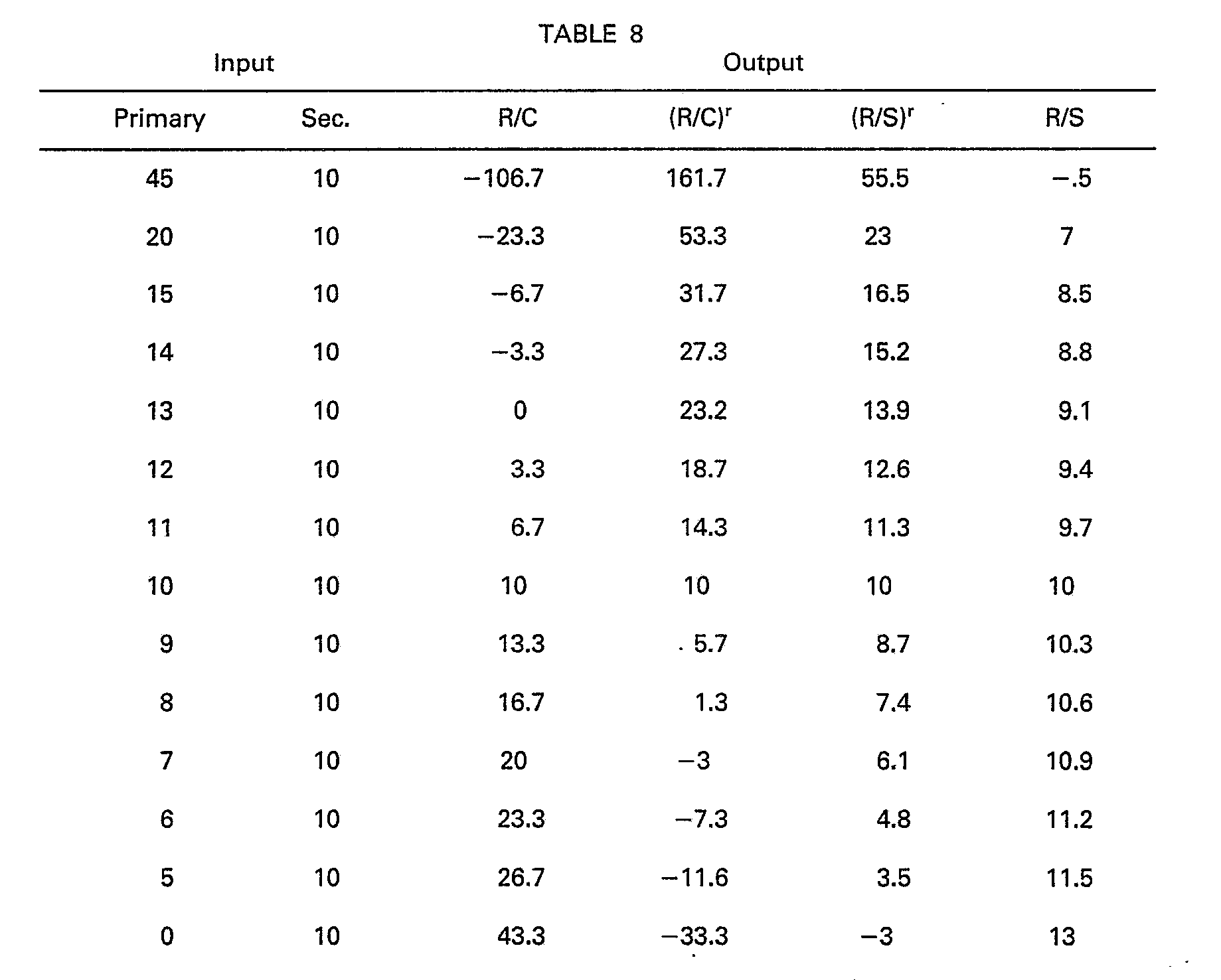


- It will be observed that Table 15 corresponds to the configuration of Figure 1 for the input corresponding to C/R. In the latter case in which the planetary carrier cage and the ring gear are the primary and secondary inputs, respectively, it is observed that there will be zero input when the secondary input has an angular velocity of 10 RPM and that of the primary input is between 9 and 10 RPM (although the units of RPM are used, any units may be selected as the values indicated are relative ones). In fact the value corresponding to a zero output of the primary input angular velocity is 9.1 RPM. Below 9.1 RPM the output changes direction going into rotation in a direction reverse to that of the driving angular velocities of the primary and secondary inputs. It will also be observed that at equal primary and secondary velocities the output velocity of the planetary gear arrangement is equal to that of each of the input velocities. It will also be observed that in the configuration of Figure 15 for C/R, actual operation of the automatic transmission takes place over only a very narrow part of the Table indicated, insofar as the relative velocity of primary and secondary inputs are concerned. The actual velocity range of the primary input relative to the secondary will probably be no more than .91 to 1.1 or 9.1 RPM to 11 RPM as seen in Table 15.
- All of the configurations in Figures 4 to 15 will function adequately provided the ratio of primary and secondary velocity is allowed to vary over a sufficiently large range. Obviously a requirement for adequate functioning is that a large enough variation of primary to secondary velocity will drive the output to zero without the need to reverse either of the primary or secondary velocities. However, it should be noted that even if a reversal of one of the inputs is required, a configuration of the planetary gear sets necessitating such a reversal could be made operative with the configurations illustrated in Figure 2, as one of the electric motors could easily be selected which could reverse its direction of rotation to accommodate such a requirement. It will be observed that some of the configurations do not have a marked gearing down effect as does the configuration'in Figure 15 previously discussed. In such cases additional gearing down may be obtained by compounding additional planetary gear assemblies after the second planetary gear assembly. However, the commercial practicality of such a solution in certain cases may be questionable.
- Based on the foregoing criteria for operability it will be observed that several of the embodiments illustrated in Figures 4 to 15 are inoperable. Consequently the configuration of Figure 3 is inoperable for each of the inputs tabulated in Table 3.
- The configurations of Figures 6, 7 and 13 are also inoperable when the two inputs are a combination of the ring gear and sun gear of the first planetary gear assembly.
- One may elect for certain configurations such as that of Figure 15 to operate in a reverse mode in which the output shaft from the tandem-connected planetary gear assemblies rotates in a direction reverse to that of the driving members of the first planetary gear assembly. In this case a one-way clutch would have to be mounted reverse to that of its mounting'for forward rotation and the driving speed of the first and second coupling means adjusted accordingly by speed adjusting gears if necessary.
- The advantages derived from using rotary gears are as follows. Since two engines are used, each can be half the size of the single engine they replace and still give equal power. However, since the transmission is capable of greater gear reduction solving the problem of lack of torque at low engine r.p.m., each of the two engines can again be reduced to half so the total volume reduction of the working chambers is to 1/4 size.
- The biggest problem with rotary engines is the problem of the wear of the apex seal. The friction on the seals is a function of r.p.m. and of the radices of rotation of the rotors. But the radius of rotation of the rotors varies with the cube of the volume approximately so if each of two engines are 1/4 size of the engine they replace, the radius of rotation is 31/1;=.631 approximately and the friction is automatically reduced by about 1/3 as compared to an ordinary rotary, thereby increasing the life expectancy of the apex seal.
Claims (20)
Priority Applications (1)
| Application Number | Priority Date | Filing Date | Title |
|---|---|---|---|
| DE8484201929T DE3177107D1 (en) | 1980-04-04 | 1981-04-03 | Planetary gear assembly |
Applications Claiming Priority (2)
| Application Number | Priority Date | Filing Date | Title |
|---|---|---|---|
| US13742880A | 1980-04-04 | 1980-04-04 | |
| US137428 | 1980-04-04 |
Related Child Applications (1)
| Application Number | Title | Priority Date | Filing Date |
|---|---|---|---|
| EP84201929.1 Division-Into | 1984-12-21 |
Publications (3)
| Publication Number | Publication Date |
|---|---|
| EP0040904A2 EP0040904A2 (en) | 1981-12-02 |
| EP0040904A3 EP0040904A3 (en) | 1982-10-13 |
| EP0040904B1 true EP0040904B1 (en) | 1987-01-28 |
Family
ID=22477393
Family Applications (2)
| Application Number | Title | Priority Date | Filing Date |
|---|---|---|---|
| EP81301468A Expired EP0040904B1 (en) | 1980-04-04 | 1981-04-03 | Planetary gear assembly and application thereof |
| EP84201929A Expired EP0181418B1 (en) | 1980-04-04 | 1981-04-03 | Planetary gear assembly |
Family Applications After (1)
| Application Number | Title | Priority Date | Filing Date |
|---|---|---|---|
| EP84201929A Expired EP0181418B1 (en) | 1980-04-04 | 1981-04-03 | Planetary gear assembly |
Country Status (4)
| Country | Link |
|---|---|
| EP (2) | EP0040904B1 (en) |
| JP (1) | JPS56150645A (en) |
| AU (1) | AU535090B2 (en) |
| DE (1) | DE3175879D1 (en) |
Cited By (2)
| Publication number | Priority date | Publication date | Assignee | Title |
|---|---|---|---|---|
| DE4019021A1 (en) * | 1990-06-14 | 1991-12-19 | Gardena Kress & Kastner Gmbh | Belt drive transmission for lawn mower - makes use of Bowden cable to give stepless control |
| DE4124479A1 (en) * | 1991-07-24 | 1993-01-28 | Bayerische Motoren Werke Ag | Hybrid drive esp. for motor vehicle including stepless gear box - connected across clutch consisting of electric machines and three shaft power distribution drive with electric motors working as generator as required |
Families Citing this family (5)
| Publication number | Priority date | Publication date | Assignee | Title |
|---|---|---|---|---|
| DE3607564A1 (en) * | 1986-03-07 | 1987-09-17 | Adolf Heinrich | Infinitely variable, automatic differential gearing for internal combustion engines |
| DE3916244C2 (en) * | 1988-05-21 | 1997-06-05 | Volkswagen Ag | Multi-speed, automatically switchable step change gear |
| IT1249901B (en) * | 1991-06-06 | 1995-03-30 | Iveco Fiat | DIESEL CYCLE INTERNAL COMBUSTION ENGINE WITH MECHANICALLY CONNECTED TURBOCHARGER. |
| KR100292325B1 (en) | 1998-12-31 | 2001-11-22 | 하태환 | Semi-automatic Transmission for Automobile |
| KR100352505B1 (en) | 2000-09-06 | 2002-09-16 | 하태환 | Break system of automobile have semi automatic transmission |
Citations (10)
| Publication number | Priority date | Publication date | Assignee | Title |
|---|---|---|---|---|
| US981689A (en) * | 1909-07-20 | 1911-01-17 | Universal Motor Company | Differential-speed mechanism. |
| AT130064B (en) * | 1930-04-02 | 1932-10-25 | Hermann Roemer | Planetary gear change transmission. |
| FR1060637A (en) * | 1952-07-28 | 1954-04-05 | Differential mechanism | |
| DE910371C (en) * | 1942-09-23 | 1954-05-03 | Hans Reichenbaecher Dr Ing | Power-dividing adjustable gear |
| US3049945A (en) * | 1958-11-28 | 1962-08-21 | Gen Motors Corp | Transmission |
| US3143898A (en) * | 1960-12-01 | 1964-08-11 | Gen Motors Corp | Transmission |
| CH452303A (en) * | 1966-10-19 | 1968-05-31 | Demag Zug Gmbh | Two-stage planetary gear for two-motor drive |
| FR1530736A (en) * | 1967-06-05 | 1968-06-28 | Nissan Motor | Torque split automatic transmission |
| FR1586747A (en) * | 1967-10-10 | 1970-02-27 | ||
| GB1304393A (en) * | 1969-04-10 | 1973-01-24 |
Family Cites Families (13)
| Publication number | Priority date | Publication date | Assignee | Title |
|---|---|---|---|---|
| US1203265A (en) * | 1914-03-14 | 1916-10-31 | Carlton R Radcliffe | Hydraulic power-transmitting apparatus. |
| US2985036A (en) * | 1953-04-01 | 1961-05-23 | Daimler Benz Ag | Motor vehicle transmission |
| US2878691A (en) * | 1954-05-03 | 1959-03-24 | Gen Motors Corp | Transmission and control system |
| US2896468A (en) * | 1954-09-23 | 1959-07-28 | Gen Motors Corp | Automatic plural step-ratio transmissions |
| US2893265A (en) * | 1956-04-06 | 1959-07-07 | Borg Warner | Power transmitting mechanism |
| FR1339300A (en) * | 1961-12-05 | 1963-10-04 | Demag Ag | Differential drive transmission |
| GB1101131A (en) * | 1964-02-07 | 1968-01-31 | Nat Res Dev | Improvements relating to gears |
| DE1259164B (en) * | 1965-07-03 | 1968-01-18 | Daimler Benz Ag | Drive arrangement with high speed control range, especially for test stands |
| US3400609A (en) * | 1965-10-23 | 1968-09-10 | Gen Motors Corp | Transmission |
| BE721928A (en) * | 1967-10-11 | 1969-03-14 | ||
| US3722323A (en) * | 1971-03-16 | 1973-03-27 | A Welch | Transmission |
| GB1436491A (en) * | 1973-07-06 | 1976-05-19 | Bhs Bayerische Berg | Epicyclic gear |
| US4014222A (en) * | 1975-01-08 | 1977-03-29 | Brandt James B | Variable speed and direction transmission prime mover system |
-
1981
- 1981-04-03 DE DE8181301468T patent/DE3175879D1/en not_active Expired
- 1981-04-03 JP JP4947881A patent/JPS56150645A/en active Pending
- 1981-04-03 AU AU69059/81A patent/AU535090B2/en not_active Ceased
- 1981-04-03 EP EP81301468A patent/EP0040904B1/en not_active Expired
- 1981-04-03 EP EP84201929A patent/EP0181418B1/en not_active Expired
Patent Citations (10)
| Publication number | Priority date | Publication date | Assignee | Title |
|---|---|---|---|---|
| US981689A (en) * | 1909-07-20 | 1911-01-17 | Universal Motor Company | Differential-speed mechanism. |
| AT130064B (en) * | 1930-04-02 | 1932-10-25 | Hermann Roemer | Planetary gear change transmission. |
| DE910371C (en) * | 1942-09-23 | 1954-05-03 | Hans Reichenbaecher Dr Ing | Power-dividing adjustable gear |
| FR1060637A (en) * | 1952-07-28 | 1954-04-05 | Differential mechanism | |
| US3049945A (en) * | 1958-11-28 | 1962-08-21 | Gen Motors Corp | Transmission |
| US3143898A (en) * | 1960-12-01 | 1964-08-11 | Gen Motors Corp | Transmission |
| CH452303A (en) * | 1966-10-19 | 1968-05-31 | Demag Zug Gmbh | Two-stage planetary gear for two-motor drive |
| FR1530736A (en) * | 1967-06-05 | 1968-06-28 | Nissan Motor | Torque split automatic transmission |
| FR1586747A (en) * | 1967-10-10 | 1970-02-27 | ||
| GB1304393A (en) * | 1969-04-10 | 1973-01-24 |
Non-Patent Citations (3)
| Title |
|---|
| Automatische Automobilgetriebe, J. Stüper, 1965, p. 185 * |
| Die Umlaufgetriebe, H.W. Müller, 1971, p. 209 * |
| SAE-Publication 720 724, sept. 1972, p. 1-12 * |
Cited By (3)
| Publication number | Priority date | Publication date | Assignee | Title |
|---|---|---|---|---|
| DE4019021A1 (en) * | 1990-06-14 | 1991-12-19 | Gardena Kress & Kastner Gmbh | Belt drive transmission for lawn mower - makes use of Bowden cable to give stepless control |
| DE4124479A1 (en) * | 1991-07-24 | 1993-01-28 | Bayerische Motoren Werke Ag | Hybrid drive esp. for motor vehicle including stepless gear box - connected across clutch consisting of electric machines and three shaft power distribution drive with electric motors working as generator as required |
| DE4124479C2 (en) * | 1991-07-24 | 2002-05-16 | Bayerische Motoren Werke Ag | Hybrid drive, especially for vehicles |
Also Published As
| Publication number | Publication date |
|---|---|
| JPS56150645A (en) | 1981-11-21 |
| AU535090B2 (en) | 1984-03-01 |
| EP0181418A1 (en) | 1986-05-21 |
| DE3175879D1 (en) | 1987-03-05 |
| EP0040904A3 (en) | 1982-10-13 |
| EP0040904A2 (en) | 1981-12-02 |
| EP0181418B1 (en) | 1989-09-27 |
| AU6905981A (en) | 1981-10-08 |
Similar Documents
| Publication | Publication Date | Title |
|---|---|---|
| US5730676A (en) | Three-mode, input-split hybrid transmission | |
| US4579019A (en) | Method and apparatus for power transmission from an engine | |
| US4304151A (en) | Stepless composite hydrostatic-mechanical transmission | |
| US4392393A (en) | Dual engine drive | |
| US4644820A (en) | Geared-neutral continuously variable transmission | |
| US4471668A (en) | Drive assembly with a prime mover and a flywheel | |
| US4563914A (en) | Continuously variable transmission with auxiliary drive | |
| US4976670A (en) | Power transmission | |
| EP0078124B1 (en) | Vehicle transmission | |
| US4774856A (en) | Planetary gear train | |
| US4662240A (en) | Continuously variable transmission | |
| US5865700A (en) | Hydro-mechanical transmission | |
| AU716755B2 (en) | Continuously variable transmission | |
| JPH03539B2 (en) | ||
| US5024633A (en) | Hydromechanical transmission with adjunct flywheel | |
| US4327604A (en) | Continuously variable transmission | |
| EP0040904B1 (en) | Planetary gear assembly and application thereof | |
| EP0766798B1 (en) | Continuously variable transmission apparatus | |
| US20060217227A1 (en) | Continuously adjustable gear | |
| US4928552A (en) | Method and apparatus for power transmission from an engine | |
| JPH0756275B2 (en) | Fluid pump | |
| US4825721A (en) | Method and apparatus for power transmission from an engine | |
| JPH019695Y2 (en) | ||
| US5328418A (en) | Stepless hydromechanical mechanism with multiple power-transmission paths, more particularly for motor vehicles | |
| US4074592A (en) | Direct drive transmission with hydraulically actuated forward and reverse clutches |
Legal Events
| Date | Code | Title | Description |
|---|---|---|---|
| PUAI | Public reference made under article 153(3) epc to a published international application that has entered the european phase |
Free format text: ORIGINAL CODE: 0009012 |
|
| AK | Designated contracting states |
Designated state(s): DE FR GB IT |
|
| PUAL | Search report despatched |
Free format text: ORIGINAL CODE: 0009013 |
|
| RHK1 | Main classification (correction) |
Ipc: F16H 3/72 |
|
| AK | Designated contracting states |
Designated state(s): DE FR GB IT |
|
| 17P | Request for examination filed |
Effective date: 19830309 |
|
| 17Q | First examination report despatched |
Effective date: 19860205 |
|
| GRAA | (expected) grant |
Free format text: ORIGINAL CODE: 0009210 |
|
| AK | Designated contracting states |
Kind code of ref document: B1 Designated state(s): DE FR GB IT |
|
| REF | Corresponds to: |
Ref document number: 3175879 Country of ref document: DE Date of ref document: 19870305 |
|
| ITF | It: translation for a ep patent filed | ||
| PLBE | No opposition filed within time limit |
Free format text: ORIGINAL CODE: 0009261 |
|
| STAA | Information on the status of an ep patent application or granted ep patent |
Free format text: STATUS: NO OPPOSITION FILED WITHIN TIME LIMIT |
|
| 26N | No opposition filed | ||
| PGFP | Annual fee paid to national office [announced via postgrant information from national office to epo] |
Ref country code: GB Payment date: 19900331 Year of fee payment: 10 |
|
| PGFP | Annual fee paid to national office [announced via postgrant information from national office to epo] |
Ref country code: FR Payment date: 19900415 Year of fee payment: 10 |
|
| ITTA | It: last paid annual fee | ||
| PGFP | Annual fee paid to national office [announced via postgrant information from national office to epo] |
Ref country code: DE Payment date: 19900531 Year of fee payment: 10 |
|
| PG25 | Lapsed in a contracting state [announced via postgrant information from national office to epo] |
Ref country code: GB Effective date: 19910403 |
|
| GBPC | Gb: european patent ceased through non-payment of renewal fee | ||
| PG25 | Lapsed in a contracting state [announced via postgrant information from national office to epo] |
Ref country code: FR Effective date: 19911230 |
|
| PG25 | Lapsed in a contracting state [announced via postgrant information from national office to epo] |
Ref country code: DE Effective date: 19920201 |
|
| REG | Reference to a national code |
Ref country code: FR Ref legal event code: ST |