EP0040002B1 - Water-dispersible energy curable heterocyclic group-containing polyesters - Google Patents
Water-dispersible energy curable heterocyclic group-containing polyesters Download PDFInfo
- Publication number
- EP0040002B1 EP0040002B1 EP81301614A EP81301614A EP0040002B1 EP 0040002 B1 EP0040002 B1 EP 0040002B1 EP 81301614 A EP81301614 A EP 81301614A EP 81301614 A EP81301614 A EP 81301614A EP 0040002 B1 EP0040002 B1 EP 0040002B1
- Authority
- EP
- European Patent Office
- Prior art keywords
- feature
- groups
- further characterized
- polyester
- carbon atoms
- Prior art date
- Legal status (The legal status is an assumption and is not a legal conclusion. Google has not performed a legal analysis and makes no representation as to the accuracy of the status listed.)
- Expired
Links
- 229920000728 polyester Polymers 0.000 title claims description 68
- 125000000623 heterocyclic group Chemical group 0.000 title claims description 14
- 229920000642 polymer Polymers 0.000 claims description 45
- 239000000203 mixture Substances 0.000 claims description 38
- 239000002253 acid Substances 0.000 claims description 17
- 125000004432 carbon atom Chemical group C* 0.000 claims description 15
- -1 carboxylic groups Chemical group 0.000 claims description 12
- 238000000034 method Methods 0.000 claims description 11
- 239000004593 Epoxy Substances 0.000 claims description 9
- 125000000217 alkyl group Chemical group 0.000 claims description 8
- 239000001257 hydrogen Substances 0.000 claims description 7
- 229910052739 hydrogen Inorganic materials 0.000 claims description 7
- 239000000463 material Substances 0.000 claims description 7
- 150000002391 heterocyclic compounds Chemical class 0.000 claims description 6
- FPYJFEHAWHCUMM-UHFFFAOYSA-N maleic anhydride Chemical compound O=C1OC(=O)C=C1 FPYJFEHAWHCUMM-UHFFFAOYSA-N 0.000 claims description 6
- 125000004435 hydrogen atom Chemical group [H]* 0.000 claims description 5
- 239000000178 monomer Substances 0.000 claims description 5
- QVGXLLKOCUKJST-UHFFFAOYSA-N atomic oxygen Chemical compound [O] QVGXLLKOCUKJST-UHFFFAOYSA-N 0.000 claims description 4
- 125000003178 carboxy group Chemical group [H]OC(*)=O 0.000 claims description 4
- 125000002843 carboxylic acid group Chemical group 0.000 claims description 4
- 150000001735 carboxylic acids Chemical class 0.000 claims description 4
- 125000003700 epoxy group Chemical group 0.000 claims description 4
- 239000003112 inhibitor Substances 0.000 claims description 4
- 239000001301 oxygen Substances 0.000 claims description 4
- 229910052760 oxygen Inorganic materials 0.000 claims description 4
- 239000002685 polymerization catalyst Substances 0.000 claims description 4
- 239000000758 substrate Substances 0.000 claims description 4
- FALRKNHUBBKYCC-UHFFFAOYSA-N 2-(chloromethyl)pyridine-3-carbonitrile Chemical compound ClCC1=NC=CC=C1C#N FALRKNHUBBKYCC-UHFFFAOYSA-N 0.000 claims description 3
- 125000001931 aliphatic group Chemical group 0.000 claims description 3
- 150000003254 radicals Chemical class 0.000 claims description 3
- 229940014800 succinic anhydride Drugs 0.000 claims description 3
- 238000012719 thermal polymerization Methods 0.000 claims description 3
- CGACJVBTDXJSDR-UHFFFAOYSA-N 1,3-bis(oxiran-2-ylmethyl)imidazolidine-2,4-dione Chemical compound O=C1N(CC2OC2)C(=O)CN1CC1CO1 CGACJVBTDXJSDR-UHFFFAOYSA-N 0.000 claims description 2
- 125000002373 5 membered heterocyclic group Chemical group 0.000 claims description 2
- 125000004070 6 membered heterocyclic group Chemical group 0.000 claims description 2
- UFHFLCQGNIYNRP-UHFFFAOYSA-N Hydrogen Chemical compound [H][H] UFHFLCQGNIYNRP-UHFFFAOYSA-N 0.000 claims description 2
- 125000003647 acryloyl group Chemical group O=C([*])C([H])=C([H])[H] 0.000 claims description 2
- 125000003342 alkenyl group Chemical group 0.000 claims description 2
- 125000002947 alkylene group Chemical group 0.000 claims description 2
- 125000001183 hydrocarbyl group Chemical group 0.000 claims description 2
- 150000002431 hydrogen Chemical group 0.000 claims description 2
- 125000002496 methyl group Chemical group [H]C([H])([H])* 0.000 claims description 2
- 125000004430 oxygen atom Chemical group O* 0.000 claims description 2
- 125000001997 phenyl group Chemical group [H]C1=C([H])C([H])=C(*)C([H])=C1[H] 0.000 claims description 2
- 150000003628 tricarboxylic acids Chemical class 0.000 claims description 2
- 239000007795 chemical reaction product Substances 0.000 claims 1
- 229920006037 cross link polymer Polymers 0.000 claims 1
- 230000000977 initiatory effect Effects 0.000 claims 1
- LFQSCWFLJHTTHZ-UHFFFAOYSA-N Ethanol Chemical compound CCO LFQSCWFLJHTTHZ-UHFFFAOYSA-N 0.000 description 25
- 238000006243 chemical reaction Methods 0.000 description 22
- XLYOFNOQVPJJNP-UHFFFAOYSA-N water Substances O XLYOFNOQVPJJNP-UHFFFAOYSA-N 0.000 description 19
- 230000005855 radiation Effects 0.000 description 17
- WYURNTSHIVDZCO-UHFFFAOYSA-N Tetrahydrofuran Chemical compound C1CCOC1 WYURNTSHIVDZCO-UHFFFAOYSA-N 0.000 description 16
- 239000002904 solvent Substances 0.000 description 15
- JAHNSTQSQJOJLO-UHFFFAOYSA-N 2-(3-fluorophenyl)-1h-imidazole Chemical compound FC1=CC=CC(C=2NC=CN=2)=C1 JAHNSTQSQJOJLO-UHFFFAOYSA-N 0.000 description 11
- 125000002887 hydroxy group Chemical group [H]O* 0.000 description 11
- LVHBHZANLOWSRM-UHFFFAOYSA-N methylenebutanedioic acid Natural products OC(=O)CC(=C)C(O)=O LVHBHZANLOWSRM-UHFFFAOYSA-N 0.000 description 11
- RYHBNJHYFVUHQT-UHFFFAOYSA-N 1,4-Dioxane Chemical compound C1COCCO1 RYHBNJHYFVUHQT-UHFFFAOYSA-N 0.000 description 10
- 150000002118 epoxides Chemical class 0.000 description 10
- ZMANZCXQSJIPKH-UHFFFAOYSA-N Triethylamine Chemical compound CCN(CC)CC ZMANZCXQSJIPKH-UHFFFAOYSA-N 0.000 description 9
- 150000001991 dicarboxylic acids Chemical class 0.000 description 9
- 238000006116 polymerization reaction Methods 0.000 description 9
- SMZOUWXMTYCWNB-UHFFFAOYSA-N 2-(2-methoxy-5-methylphenyl)ethanamine Chemical compound COC1=CC=C(C)C=C1CCN SMZOUWXMTYCWNB-UHFFFAOYSA-N 0.000 description 8
- OFOBLEOULBTSOW-UHFFFAOYSA-N Malonic acid Chemical compound OC(=O)CC(O)=O OFOBLEOULBTSOW-UHFFFAOYSA-N 0.000 description 8
- NIXOWILDQLNWCW-UHFFFAOYSA-N acrylic acid group Chemical group C(C=C)(=O)O NIXOWILDQLNWCW-UHFFFAOYSA-N 0.000 description 8
- RBQRWNWVPQDTJJ-UHFFFAOYSA-N methacryloyloxyethyl isocyanate Chemical compound CC(=C)C(=O)OCCN=C=O RBQRWNWVPQDTJJ-UHFFFAOYSA-N 0.000 description 8
- 239000000126 substance Substances 0.000 description 8
- YLQBMQCUIZJEEH-UHFFFAOYSA-N tetrahydrofuran Natural products C=1C=COC=1 YLQBMQCUIZJEEH-UHFFFAOYSA-N 0.000 description 8
- 229910052925 anhydrite Inorganic materials 0.000 description 7
- 238000013459 approach Methods 0.000 description 7
- 239000003795 chemical substances by application Substances 0.000 description 7
- 238000011161 development Methods 0.000 description 7
- 238000001035 drying Methods 0.000 description 7
- NWVVVBRKAWDGAB-UHFFFAOYSA-N p-methoxyphenol Chemical compound COC1=CC=C(O)C=C1 NWVVVBRKAWDGAB-UHFFFAOYSA-N 0.000 description 7
- 238000010992 reflux Methods 0.000 description 7
- RTZKZFJDLAIYFH-UHFFFAOYSA-N Diethyl ether Chemical compound CCOCC RTZKZFJDLAIYFH-UHFFFAOYSA-N 0.000 description 6
- 238000005299 abrasion Methods 0.000 description 6
- 150000001875 compounds Chemical class 0.000 description 6
- 238000001723 curing Methods 0.000 description 6
- WJRBRSLFGCUECM-UHFFFAOYSA-N hydantoin Chemical group O=C1CNC(=O)N1 WJRBRSLFGCUECM-UHFFFAOYSA-N 0.000 description 6
- 239000003054 catalyst Substances 0.000 description 5
- 239000003999 initiator Substances 0.000 description 5
- 239000012948 isocyanate Substances 0.000 description 5
- 150000002513 isocyanates Chemical class 0.000 description 5
- QSHDDOUJBYECFT-UHFFFAOYSA-N mercury Chemical compound [Hg] QSHDDOUJBYECFT-UHFFFAOYSA-N 0.000 description 5
- 229910052753 mercury Inorganic materials 0.000 description 5
- 238000004448 titration Methods 0.000 description 5
- KWVGIHKZDCUPEU-UHFFFAOYSA-N 2,2-dimethoxy-2-phenylacetophenone Chemical compound C=1C=CC=CC=1C(OC)(OC)C(=O)C1=CC=CC=C1 KWVGIHKZDCUPEU-UHFFFAOYSA-N 0.000 description 4
- 230000010933 acylation Effects 0.000 description 4
- 238000005917 acylation reaction Methods 0.000 description 4
- 238000004458 analytical method Methods 0.000 description 4
- 150000008064 anhydrides Chemical class 0.000 description 4
- 239000011248 coating agent Substances 0.000 description 4
- 238000000576 coating method Methods 0.000 description 4
- 238000004132 cross linking Methods 0.000 description 4
- JHIVVAPYMSGYDF-UHFFFAOYSA-N cyclohexanone Chemical compound O=C1CCCCC1 JHIVVAPYMSGYDF-UHFFFAOYSA-N 0.000 description 4
- 229920000647 polyepoxide Polymers 0.000 description 4
- 238000002360 preparation method Methods 0.000 description 4
- ILBBNQMSDGAAPF-UHFFFAOYSA-N 1-(6-hydroxy-6-methylcyclohexa-2,4-dien-1-yl)propan-1-one Chemical compound CCC(=O)C1C=CC=CC1(C)O ILBBNQMSDGAAPF-UHFFFAOYSA-N 0.000 description 3
- RZJKZTPKSRPUFJ-UHFFFAOYSA-N 5,5-dimethyl-1,3-bis(oxiran-2-ylmethyl)imidazolidine-2,4-dione Chemical compound O=C1N(CC2OC2)C(=O)C(C)(C)N1CC1CO1 RZJKZTPKSRPUFJ-UHFFFAOYSA-N 0.000 description 3
- CSCPPACGZOOCGX-UHFFFAOYSA-N Acetone Chemical compound CC(C)=O CSCPPACGZOOCGX-UHFFFAOYSA-N 0.000 description 3
- WEVYAHXRMPXWCK-UHFFFAOYSA-N Acetonitrile Chemical compound CC#N WEVYAHXRMPXWCK-UHFFFAOYSA-N 0.000 description 3
- OKKJLVBELUTLKV-UHFFFAOYSA-N Methanol Chemical compound OC OKKJLVBELUTLKV-UHFFFAOYSA-N 0.000 description 3
- VYPSYNLAJGMNEJ-UHFFFAOYSA-N Silicium dioxide Chemical compound O=[Si]=O VYPSYNLAJGMNEJ-UHFFFAOYSA-N 0.000 description 3
- NIXOWILDQLNWCW-UHFFFAOYSA-M acrylate group Chemical group C(C=C)(=O)[O-] NIXOWILDQLNWCW-UHFFFAOYSA-M 0.000 description 3
- 239000011230 binding agent Substances 0.000 description 3
- 230000015572 biosynthetic process Effects 0.000 description 3
- 150000001732 carboxylic acid derivatives Chemical class 0.000 description 3
- 239000011521 glass Substances 0.000 description 3
- 229940091173 hydantoin Drugs 0.000 description 3
- VZCYOOQTPOCHFL-UPHRSURJSA-N maleic acid Chemical compound OC(=O)\C=C/C(O)=O VZCYOOQTPOCHFL-UPHRSURJSA-N 0.000 description 3
- 239000011976 maleic acid Substances 0.000 description 3
- DGTNSSLYPYDJGL-UHFFFAOYSA-N phenyl isocyanate Chemical compound O=C=NC1=CC=CC=C1 DGTNSSLYPYDJGL-UHFFFAOYSA-N 0.000 description 3
- 229920000058 polyacrylate Polymers 0.000 description 3
- VZCYOOQTPOCHFL-UHFFFAOYSA-N trans-butenedioic acid Natural products OC(=O)C=CC(O)=O VZCYOOQTPOCHFL-UHFFFAOYSA-N 0.000 description 3
- 229940086542 triethylamine Drugs 0.000 description 3
- YYROPELSRYBVMQ-UHFFFAOYSA-N 4-toluenesulfonyl chloride Chemical compound CC1=CC=C(S(Cl)(=O)=O)C=C1 YYROPELSRYBVMQ-UHFFFAOYSA-N 0.000 description 2
- JBBURRWEMSTGIX-UHFFFAOYSA-N 5-ethyl-5-methyl-1,3-bis(oxiran-2-ylmethyl)imidazolidine-2,4-dione Chemical compound O=C1N(CC2OC2)C(=O)C(CC)(C)N1CC1CO1 JBBURRWEMSTGIX-UHFFFAOYSA-N 0.000 description 2
- KWOLFJPFCHCOCG-UHFFFAOYSA-N Acetophenone Chemical compound CC(=O)C1=CC=CC=C1 KWOLFJPFCHCOCG-UHFFFAOYSA-N 0.000 description 2
- GUUVPOWQJOLRAS-UHFFFAOYSA-N Diphenyl disulfide Chemical compound C=1C=CC=CC=1SSC1=CC=CC=C1 GUUVPOWQJOLRAS-UHFFFAOYSA-N 0.000 description 2
- CERQOIWHTDAKMF-UHFFFAOYSA-M Methacrylate Chemical compound CC(=C)C([O-])=O CERQOIWHTDAKMF-UHFFFAOYSA-M 0.000 description 2
- CERQOIWHTDAKMF-UHFFFAOYSA-N Methacrylic acid Chemical compound CC(=C)C(O)=O CERQOIWHTDAKMF-UHFFFAOYSA-N 0.000 description 2
- BAPJBEWLBFYGME-UHFFFAOYSA-N Methyl acrylate Chemical compound COC(=O)C=C BAPJBEWLBFYGME-UHFFFAOYSA-N 0.000 description 2
- 229920001744 Polyaldehyde Polymers 0.000 description 2
- 239000004952 Polyamide Substances 0.000 description 2
- PPBRXRYQALVLMV-UHFFFAOYSA-N Styrene Chemical compound C=CC1=CC=CC=C1 PPBRXRYQALVLMV-UHFFFAOYSA-N 0.000 description 2
- 150000007513 acids Chemical class 0.000 description 2
- 125000003118 aryl group Chemical group 0.000 description 2
- QMKYBPDZANOJGF-UHFFFAOYSA-N benzene-1,3,5-tricarboxylic acid Chemical compound OC(=O)C1=CC(C(O)=O)=CC(C(O)=O)=C1 QMKYBPDZANOJGF-UHFFFAOYSA-N 0.000 description 2
- ISAOCJYIOMOJEB-UHFFFAOYSA-N benzoin Chemical compound C=1C=CC=CC=1C(O)C(=O)C1=CC=CC=C1 ISAOCJYIOMOJEB-UHFFFAOYSA-N 0.000 description 2
- 239000003431 cross linking reagent Substances 0.000 description 2
- RWGFKTVRMDUZSP-UHFFFAOYSA-N cumene Chemical compound CC(C)C1=CC=CC=C1 RWGFKTVRMDUZSP-UHFFFAOYSA-N 0.000 description 2
- 230000007423 decrease Effects 0.000 description 2
- 238000007865 diluting Methods 0.000 description 2
- 239000003822 epoxy resin Substances 0.000 description 2
- 150000002148 esters Chemical class 0.000 description 2
- LNEPOXFFQSENCJ-UHFFFAOYSA-N haloperidol Chemical compound C1CC(O)(C=2C=CC(Cl)=CC=2)CCN1CCCC(=O)C1=CC=C(F)C=C1 LNEPOXFFQSENCJ-UHFFFAOYSA-N 0.000 description 2
- 238000003384 imaging method Methods 0.000 description 2
- 230000001976 improved effect Effects 0.000 description 2
- 238000004519 manufacturing process Methods 0.000 description 2
- 229910052751 metal Inorganic materials 0.000 description 2
- 239000002184 metal Substances 0.000 description 2
- 239000012038 nucleophile Substances 0.000 description 2
- 229920002647 polyamide Polymers 0.000 description 2
- 229920000570 polyether Polymers 0.000 description 2
- 239000003505 polymerization initiator Substances 0.000 description 2
- 239000011253 protective coating Substances 0.000 description 2
- 239000012763 reinforcing filler Substances 0.000 description 2
- WRIDQFICGBMAFQ-UHFFFAOYSA-N (E)-8-Octadecenoic acid Natural products CCCCCCCCCC=CCCCCCCC(O)=O WRIDQFICGBMAFQ-UHFFFAOYSA-N 0.000 description 1
- WOGITNXCNOTRLK-VOTSOKGWSA-N (e)-3-phenylprop-2-enoyl chloride Chemical compound ClC(=O)\C=C\C1=CC=CC=C1 WOGITNXCNOTRLK-VOTSOKGWSA-N 0.000 description 1
- RJUIDDKTATZJFE-NSCUHMNNSA-N (e)-but-2-enoyl chloride Chemical compound C\C=C\C(Cl)=O RJUIDDKTATZJFE-NSCUHMNNSA-N 0.000 description 1
- ODIGIKRIUKFKHP-UHFFFAOYSA-N (n-propan-2-yloxycarbonylanilino) acetate Chemical compound CC(C)OC(=O)N(OC(C)=O)C1=CC=CC=C1 ODIGIKRIUKFKHP-UHFFFAOYSA-N 0.000 description 1
- MYWOJODOMFBVCB-UHFFFAOYSA-N 1,2,6-trimethylphenanthrene Chemical compound CC1=CC=C2C3=CC(C)=CC=C3C=CC2=C1C MYWOJODOMFBVCB-UHFFFAOYSA-N 0.000 description 1
- MSAHTMIQULFMRG-UHFFFAOYSA-N 1,2-diphenyl-2-propan-2-yloxyethanone Chemical compound C=1C=CC=CC=1C(OC(C)C)C(=O)C1=CC=CC=C1 MSAHTMIQULFMRG-UHFFFAOYSA-N 0.000 description 1
- RUPVWWZJFYRFMV-UHFFFAOYSA-N 1,3-bis(oxiran-2-ylmethyl)-5-pentylimidazolidine-2,4-dione Chemical compound O=C1N(CC2OC2)C(=O)C(CCCCC)N1CC1CO1 RUPVWWZJFYRFMV-UHFFFAOYSA-N 0.000 description 1
- QDVZPCLHYXRBJB-UHFFFAOYSA-N 1,3-bis(oxiran-2-ylmethyl)pyrimidine-2,4-dione Chemical compound O=C1N(CC2OC2)C(=O)C=CN1CC1CO1 QDVZPCLHYXRBJB-UHFFFAOYSA-N 0.000 description 1
- DKEGCUDAFWNSSO-UHFFFAOYSA-N 1,8-dibromooctane Chemical compound BrCCCCCCCCBr DKEGCUDAFWNSSO-UHFFFAOYSA-N 0.000 description 1
- DEWQAJIFRYZMES-UHFFFAOYSA-N 1-(4-isocyanatophenyl)prop-2-en-1-one Chemical compound C=CC(=O)C1=CC=C(N=C=O)C=C1 DEWQAJIFRYZMES-UHFFFAOYSA-N 0.000 description 1
- ZEIXNMVAJQLPMA-UHFFFAOYSA-N 1-ethenyl-4-isocyanatobenzene Chemical compound C=CC1=CC=C(N=C=O)C=C1 ZEIXNMVAJQLPMA-UHFFFAOYSA-N 0.000 description 1
- VOBUAPTXJKMNCT-UHFFFAOYSA-N 1-prop-2-enoyloxyhexyl prop-2-enoate Chemical compound CCCCCC(OC(=O)C=C)OC(=O)C=C VOBUAPTXJKMNCT-UHFFFAOYSA-N 0.000 description 1
- PIZHFBODNLEQBL-UHFFFAOYSA-N 2,2-diethoxy-1-phenylethanone Chemical compound CCOC(OCC)C(=O)C1=CC=CC=C1 PIZHFBODNLEQBL-UHFFFAOYSA-N 0.000 description 1
- PUGOMSLRUSTQGV-UHFFFAOYSA-N 2,3-di(prop-2-enoyloxy)propyl prop-2-enoate Chemical compound C=CC(=O)OCC(OC(=O)C=C)COC(=O)C=C PUGOMSLRUSTQGV-UHFFFAOYSA-N 0.000 description 1
- OMNYXCUDBQKCMU-UHFFFAOYSA-N 2,4-dichloro-1-ethenylbenzene Chemical compound ClC1=CC=C(C=C)C(Cl)=C1 OMNYXCUDBQKCMU-UHFFFAOYSA-N 0.000 description 1
- CGJVJVBQENEISI-UHFFFAOYSA-N 2,4-dinitrobenzenesulfonyl bromide Chemical compound [O-][N+](=O)C1=CC=C(S(Br)(=O)=O)C([N+]([O-])=O)=C1 CGJVJVBQENEISI-UHFFFAOYSA-N 0.000 description 1
- RYXAJKPGHHNCSO-UHFFFAOYSA-N 2-(2,4-dichlorophenyl)acetyl chloride Chemical compound ClC(=O)CC1=CC=C(Cl)C=C1Cl RYXAJKPGHHNCSO-UHFFFAOYSA-N 0.000 description 1
- OZAIFHULBGXAKX-UHFFFAOYSA-N 2-(2-cyanopropan-2-yldiazenyl)-2-methylpropanenitrile Chemical compound N#CC(C)(C)N=NC(C)(C)C#N OZAIFHULBGXAKX-UHFFFAOYSA-N 0.000 description 1
- GOXQRTZXKQZDDN-UHFFFAOYSA-N 2-Ethylhexyl acrylate Chemical compound CCCCC(CC)COC(=O)C=C GOXQRTZXKQZDDN-UHFFFAOYSA-N 0.000 description 1
- FDSUVTROAWLVJA-UHFFFAOYSA-N 2-[[3-hydroxy-2,2-bis(hydroxymethyl)propoxy]methyl]-2-(hydroxymethyl)propane-1,3-diol;prop-2-enoic acid Chemical compound OC(=O)C=C.OC(=O)C=C.OC(=O)C=C.OC(=O)C=C.OC(=O)C=C.OCC(CO)(CO)COCC(CO)(CO)CO FDSUVTROAWLVJA-UHFFFAOYSA-N 0.000 description 1
- XOTUAMWIFRDGMZ-UHFFFAOYSA-N 2-chloroprop-2-enoyl chloride Chemical compound ClC(=C)C(Cl)=O XOTUAMWIFRDGMZ-UHFFFAOYSA-N 0.000 description 1
- ISRGONDNXBCDBM-UHFFFAOYSA-N 2-chlorostyrene Chemical compound ClC1=CC=CC=C1C=C ISRGONDNXBCDBM-UHFFFAOYSA-N 0.000 description 1
- HCUZVMHXDRSBKX-UHFFFAOYSA-N 2-decylpropanedioic acid Chemical compound CCCCCCCCCCC(C(O)=O)C(O)=O HCUZVMHXDRSBKX-UHFFFAOYSA-N 0.000 description 1
- KMNCBSZOIQAUFX-UHFFFAOYSA-N 2-ethoxy-1,2-diphenylethanone Chemical compound C=1C=CC=CC=1C(OCC)C(=O)C1=CC=CC=C1 KMNCBSZOIQAUFX-UHFFFAOYSA-N 0.000 description 1
- DPNXHTDWGGVXID-UHFFFAOYSA-N 2-isocyanatoethyl prop-2-enoate Chemical compound C=CC(=O)OCCN=C=O DPNXHTDWGGVXID-UHFFFAOYSA-N 0.000 description 1
- BQZJOQXSCSZQPS-UHFFFAOYSA-N 2-methoxy-1,2-diphenylethanone Chemical compound C=1C=CC=CC=1C(OC)C(=O)C1=CC=CC=C1 BQZJOQXSCSZQPS-UHFFFAOYSA-N 0.000 description 1
- MEAHFJBYWLCGDM-UHFFFAOYSA-N 2-pentadecylpropanedioic acid Chemical compound CCCCCCCCCCCCCCCC(C(O)=O)C(O)=O MEAHFJBYWLCGDM-UHFFFAOYSA-N 0.000 description 1
- VMZCDNSFRSVYKQ-UHFFFAOYSA-N 2-phenylacetyl chloride Chemical compound ClC(=O)CC1=CC=CC=C1 VMZCDNSFRSVYKQ-UHFFFAOYSA-N 0.000 description 1
- LQJBNNIYVWPHFW-UHFFFAOYSA-N 20:1omega9c fatty acid Natural products CCCCCCCCCCC=CCCCCCCCC(O)=O LQJBNNIYVWPHFW-UHFFFAOYSA-N 0.000 description 1
- BUZICZZQJDLXJN-UHFFFAOYSA-N 3-azaniumyl-4-hydroxybutanoate Chemical compound OCC(N)CC(O)=O BUZICZZQJDLXJN-UHFFFAOYSA-N 0.000 description 1
- UERPUZBSSSAZJE-UHFFFAOYSA-N 3-chlorophthalic anhydride Chemical compound ClC1=CC=CC2=C1C(=O)OC2=O UERPUZBSSSAZJE-UHFFFAOYSA-N 0.000 description 1
- MWKAGZWJHCTVJY-UHFFFAOYSA-N 3-hydroxyoctadecan-2-one Chemical compound CCCCCCCCCCCCCCCC(O)C(C)=O MWKAGZWJHCTVJY-UHFFFAOYSA-N 0.000 description 1
- OFNISBHGPNMTMS-UHFFFAOYSA-N 3-methylideneoxolane-2,5-dione Chemical compound C=C1CC(=O)OC1=O OFNISBHGPNMTMS-UHFFFAOYSA-N 0.000 description 1
- VVBLNCFGVYUYGU-UHFFFAOYSA-N 4,4'-Bis(dimethylamino)benzophenone Chemical compound C1=CC(N(C)C)=CC=C1C(=O)C1=CC=C(N(C)C)C=C1 VVBLNCFGVYUYGU-UHFFFAOYSA-N 0.000 description 1
- GRDXCFKBQWDAJH-UHFFFAOYSA-N 4-acetamidobenzenesulfonyl chloride Chemical compound CC(=O)NC1=CC=C(S(Cl)(=O)=O)C=C1 GRDXCFKBQWDAJH-UHFFFAOYSA-N 0.000 description 1
- FPMYOMFDJKFHBV-UHFFFAOYSA-N 4-isocyanatobutyl 2-methylprop-2-enoate Chemical compound CC(=C)C(=O)OCCCCN=C=O FPMYOMFDJKFHBV-UHFFFAOYSA-N 0.000 description 1
- VTQJLHYGQRZFAK-UHFFFAOYSA-N 5,5-dimethyl-1,3-bis(oxiran-2-ylmethyl)-1,3-diazinane-2,4-dione Chemical compound O=C1N(CC2OC2)C(=O)C(C)(C)CN1CC1CO1 VTQJLHYGQRZFAK-UHFFFAOYSA-N 0.000 description 1
- NRKHSPPIHMAZOO-UHFFFAOYSA-N 5,5-dimethyl-1,3-bis[2-(oxiran-2-ylmethoxy)ethyl]imidazolidine-2,4-dione Chemical compound O=C1N(CCOCC2OC2)C(=O)C(C)(C)N1CCOCC1CO1 NRKHSPPIHMAZOO-UHFFFAOYSA-N 0.000 description 1
- CGZXEDJCWKCTEK-UHFFFAOYSA-N 5,5-dimethyl-1,3-bis[3-(oxiran-2-ylmethoxy)propyl]imidazolidine-2,4-dione Chemical compound O=C1N(CCCOCC2OC2)C(=O)C(C)(C)N1CCCOCC1CO1 CGZXEDJCWKCTEK-UHFFFAOYSA-N 0.000 description 1
- PLPFTLXIQQYOMW-UHFFFAOYSA-N 5-chlorobenzene-1,3-dicarboxylic acid Chemical compound OC(=O)C1=CC(Cl)=CC(C(O)=O)=C1 PLPFTLXIQQYOMW-UHFFFAOYSA-N 0.000 description 1
- KDFVLBINXWCGRU-UHFFFAOYSA-N 5-ethyl-5-hexyl-1,3-bis(oxiran-2-ylmethyl)imidazolidine-2,4-dione Chemical compound O=C1N(CC2OC2)C(=O)C(CCCCCC)(CC)N1CC1CO1 KDFVLBINXWCGRU-UHFFFAOYSA-N 0.000 description 1
- GHDCATYVESSPMS-UHFFFAOYSA-N 5-hexyl-5-methyl-1,3-bis(oxiran-2-ylmethyl)imidazolidine-2,4-dione Chemical compound O=C1N(CC2OC2)C(=O)C(CCCCCC)(C)N1CC1CO1 GHDCATYVESSPMS-UHFFFAOYSA-N 0.000 description 1
- OBVXFZZKUALXES-UHFFFAOYSA-N 5-methyl-1,3-bis(oxiran-2-ylmethyl)imidazolidine-2,4-dione Chemical compound O=C1N(CC2OC2)C(=O)C(C)N1CC1CO1 OBVXFZZKUALXES-UHFFFAOYSA-N 0.000 description 1
- TUKZHLPNTNSYNS-UHFFFAOYSA-N 5-octyl-1,3-bis(oxiran-2-ylmethyl)imidazolidine-2,4-dione Chemical compound O=C1N(CC2OC2)C(=O)C(CCCCCCCC)N1CC1CO1 TUKZHLPNTNSYNS-UHFFFAOYSA-N 0.000 description 1
- AUZPKZGIOYCYNV-UHFFFAOYSA-N 6-chlorohexyl prop-2-enoate Chemical compound ClCCCCCCOC(=O)C=C AUZPKZGIOYCYNV-UHFFFAOYSA-N 0.000 description 1
- KHZPDWOVWFKYCU-UHFFFAOYSA-N 6-methyl-1,3-bis(oxiran-2-ylmethyl)pyrimidine-2,4-dione Chemical compound O=C1N(CC2OC2)C(C)=CC(=O)N1CC1CO1 KHZPDWOVWFKYCU-UHFFFAOYSA-N 0.000 description 1
- QSBYPNXLFMSGKH-UHFFFAOYSA-N 9-Heptadecensaeure Natural products CCCCCCCC=CCCCCCCCC(O)=O QSBYPNXLFMSGKH-UHFFFAOYSA-N 0.000 description 1
- AMOKUAKXKXBFIW-WJDWOHSUSA-N 9-[(z)-non-3-enyl]-10-octylnonadecanedioic acid Chemical compound OC(=O)CCCCCCCCC(CCCCCCCC)C(CCCCCCCC(O)=O)CC\C=C/CCCCC AMOKUAKXKXBFIW-WJDWOHSUSA-N 0.000 description 1
- HRPVXLWXLXDGHG-UHFFFAOYSA-N Acrylamide Chemical compound NC(=O)C=C HRPVXLWXLXDGHG-UHFFFAOYSA-N 0.000 description 1
- NLHHRLWOUZZQLW-UHFFFAOYSA-N Acrylonitrile Chemical compound C=CC#N NLHHRLWOUZZQLW-UHFFFAOYSA-N 0.000 description 1
- 239000004342 Benzoyl peroxide Substances 0.000 description 1
- OMPJBNCRMGITSC-UHFFFAOYSA-N Benzoylperoxide Chemical compound C=1C=CC=CC=1C(=O)OOC(=O)C1=CC=CC=C1 OMPJBNCRMGITSC-UHFFFAOYSA-N 0.000 description 1
- HMTKSAUNOFGNNX-UHFFFAOYSA-N CN(C)C([SH2]C(C1=CC=CC=C1)=O)=S Chemical compound CN(C)C([SH2]C(C1=CC=CC=C1)=O)=S HMTKSAUNOFGNNX-UHFFFAOYSA-N 0.000 description 1
- 0 CO[N+](*(N)N=O)[O-] Chemical compound CO[N+](*(N)N=O)[O-] 0.000 description 1
- OKTJSMMVPCPJKN-UHFFFAOYSA-N Carbon Chemical compound [C] OKTJSMMVPCPJKN-UHFFFAOYSA-N 0.000 description 1
- QSJXEFYPDANLFS-UHFFFAOYSA-N Diacetyl Chemical group CC(=O)C(C)=O QSJXEFYPDANLFS-UHFFFAOYSA-N 0.000 description 1
- 239000004641 Diallyl-phthalate Substances 0.000 description 1
- JIGUQPWFLRLWPJ-UHFFFAOYSA-N Ethyl acrylate Chemical compound CCOC(=O)C=C JIGUQPWFLRLWPJ-UHFFFAOYSA-N 0.000 description 1
- 206010073306 Exposure to radiation Diseases 0.000 description 1
- 239000005909 Kieselgur Substances 0.000 description 1
- OYHQOLUKZRVURQ-HZJYTTRNSA-N Linoleic acid Chemical compound CCCCC\C=C/C\C=C/CCCCCCCC(O)=O OYHQOLUKZRVURQ-HZJYTTRNSA-N 0.000 description 1
- VVQNEPGJFQJSBK-UHFFFAOYSA-N Methyl methacrylate Chemical compound COC(=O)C(C)=C VVQNEPGJFQJSBK-UHFFFAOYSA-N 0.000 description 1
- NMDUCIJWPTZYPV-UHFFFAOYSA-N N1(C(=O)NC(=O)C1)C(C(C(=O)O)=C)C(=O)O Chemical compound N1(C(=O)NC(=O)C1)C(C(C(=O)O)=C)C(=O)O NMDUCIJWPTZYPV-UHFFFAOYSA-N 0.000 description 1
- 239000005642 Oleic acid Substances 0.000 description 1
- ZQPPMHVWECSIRJ-UHFFFAOYSA-N Oleic acid Natural products CCCCCCCCC=CCCCCCCCC(O)=O ZQPPMHVWECSIRJ-UHFFFAOYSA-N 0.000 description 1
- LGRFSURHDFAFJT-UHFFFAOYSA-N Phthalic anhydride Natural products C1=CC=C2C(=O)OC(=O)C2=C1 LGRFSURHDFAFJT-UHFFFAOYSA-N 0.000 description 1
- 244000028419 Styrax benzoin Species 0.000 description 1
- 235000000126 Styrax benzoin Nutrition 0.000 description 1
- 235000008411 Sumatra benzointree Nutrition 0.000 description 1
- JUDXBRVLWDGRBC-UHFFFAOYSA-N [2-(hydroxymethyl)-3-(2-methylprop-2-enoyloxy)-2-(2-methylprop-2-enoyloxymethyl)propyl] 2-methylprop-2-enoate Chemical compound CC(=C)C(=O)OCC(CO)(COC(=O)C(C)=C)COC(=O)C(C)=C JUDXBRVLWDGRBC-UHFFFAOYSA-N 0.000 description 1
- HVVWZTWDBSEWIH-UHFFFAOYSA-N [2-(hydroxymethyl)-3-prop-2-enoyloxy-2-(prop-2-enoyloxymethyl)propyl] prop-2-enoate Chemical compound C=CC(=O)OCC(CO)(COC(=O)C=C)COC(=O)C=C HVVWZTWDBSEWIH-UHFFFAOYSA-N 0.000 description 1
- NBJBEHUZNVZREY-UHFFFAOYSA-N [3-(butylamino)-3-oxopropyl] 2-methylprop-2-enoate Chemical compound CCCCNC(=O)CCOC(=O)C(C)=C NBJBEHUZNVZREY-UHFFFAOYSA-N 0.000 description 1
- VQOPKTBMLKTOFU-UHFFFAOYSA-N [3-(ethylamino)-3-oxopropyl] 2-methylprop-2-enoate Chemical compound CCNC(=O)CCOC(=O)C(C)=C VQOPKTBMLKTOFU-UHFFFAOYSA-N 0.000 description 1
- WETWJCDKMRHUPV-UHFFFAOYSA-N acetyl chloride Chemical compound CC(Cl)=O WETWJCDKMRHUPV-UHFFFAOYSA-N 0.000 description 1
- 239000012346 acetyl chloride Substances 0.000 description 1
- HFBMWMNUJJDEQZ-UHFFFAOYSA-N acryloyl chloride Chemical compound ClC(=O)C=C HFBMWMNUJJDEQZ-UHFFFAOYSA-N 0.000 description 1
- 150000001266 acyl halides Chemical class 0.000 description 1
- 230000001464 adherent effect Effects 0.000 description 1
- 239000000853 adhesive Substances 0.000 description 1
- 230000001070 adhesive effect Effects 0.000 description 1
- 150000001408 amides Chemical group 0.000 description 1
- 239000003125 aqueous solvent Substances 0.000 description 1
- 239000010425 asbestos Substances 0.000 description 1
- UXJOGTJWTLQCMG-UHFFFAOYSA-N benzene-1,3,5-tricarboxylic acid 2-methylidenebutanedioic acid Chemical compound C(C1=CC(C(=O)O)=CC(C(=O)O)=C1)(=O)O.C(C(=C)CC(=O)O)(=O)O UXJOGTJWTLQCMG-UHFFFAOYSA-N 0.000 description 1
- WURBFLDFSFBTLW-UHFFFAOYSA-N benzil Chemical compound C=1C=CC=CC=1C(=O)C(=O)C1=CC=CC=C1 WURBFLDFSFBTLW-UHFFFAOYSA-N 0.000 description 1
- 229960002130 benzoin Drugs 0.000 description 1
- RWCCWEUUXYIKHB-UHFFFAOYSA-N benzophenone Chemical compound C=1C=CC=CC=1C(=O)C1=CC=CC=C1 RWCCWEUUXYIKHB-UHFFFAOYSA-N 0.000 description 1
- 239000012965 benzophenone Substances 0.000 description 1
- PASDCCFISLVPSO-UHFFFAOYSA-N benzoyl chloride Chemical compound ClC(=O)C1=CC=CC=C1 PASDCCFISLVPSO-UHFFFAOYSA-N 0.000 description 1
- 235000019400 benzoyl peroxide Nutrition 0.000 description 1
- QUDWYFHPNIMBFC-UHFFFAOYSA-N bis(prop-2-enyl) benzene-1,2-dicarboxylate Chemical compound C=CCOC(=O)C1=CC=CC=C1C(=O)OCC=C QUDWYFHPNIMBFC-UHFFFAOYSA-N 0.000 description 1
- JHIWVOJDXOSYLW-UHFFFAOYSA-N butyl 2,2-difluorocyclopropane-1-carboxylate Chemical compound CCCCOC(=O)C1CC1(F)F JHIWVOJDXOSYLW-UHFFFAOYSA-N 0.000 description 1
- CQEYYJKEWSMYFG-UHFFFAOYSA-N butyl acrylate Chemical compound CCCCOC(=O)C=C CQEYYJKEWSMYFG-UHFFFAOYSA-N 0.000 description 1
- 150000004657 carbamic acid derivatives Chemical group 0.000 description 1
- 229910052799 carbon Inorganic materials 0.000 description 1
- 238000005266 casting Methods 0.000 description 1
- 238000006555 catalytic reaction Methods 0.000 description 1
- 239000000919 ceramic Substances 0.000 description 1
- 150000001805 chlorine compounds Chemical class 0.000 description 1
- 239000008199 coating composition Substances 0.000 description 1
- 238000009833 condensation Methods 0.000 description 1
- 230000005494 condensation Effects 0.000 description 1
- 229920001577 copolymer Polymers 0.000 description 1
- QSAWQNUELGIYBC-UHFFFAOYSA-N cyclohexane-1,2-dicarboxylic acid Chemical compound OC(=O)C1CCCCC1C(O)=O QSAWQNUELGIYBC-UHFFFAOYSA-N 0.000 description 1
- PKAZBZIEOSJIDC-UHFFFAOYSA-N decylsulfanylbenzene Chemical compound CCCCCCCCCCSC1=CC=CC=C1 PKAZBZIEOSJIDC-UHFFFAOYSA-N 0.000 description 1
- 235000014113 dietary fatty acids Nutrition 0.000 description 1
- 125000005594 diketone group Chemical group 0.000 description 1
- 239000000539 dimer Substances 0.000 description 1
- XXBDWLFCJWSEKW-UHFFFAOYSA-N dimethylbenzylamine Chemical compound CN(C)CC1=CC=CC=C1 XXBDWLFCJWSEKW-UHFFFAOYSA-N 0.000 description 1
- LTYMSROWYAPPGB-UHFFFAOYSA-N diphenyl sulfide Chemical compound C=1C=CC=CC=1SC1=CC=CC=C1 LTYMSROWYAPPGB-UHFFFAOYSA-N 0.000 description 1
- 230000008034 disappearance Effects 0.000 description 1
- 239000012990 dithiocarbamate Substances 0.000 description 1
- NQGIJDNPUZEBRU-UHFFFAOYSA-N dodecanoyl chloride Chemical compound CCCCCCCCCCCC(Cl)=O NQGIJDNPUZEBRU-UHFFFAOYSA-N 0.000 description 1
- 239000000975 dye Substances 0.000 description 1
- 229920001971 elastomer Polymers 0.000 description 1
- 238000001227 electron beam curing Methods 0.000 description 1
- 238000010894 electron beam technology Methods 0.000 description 1
- 125000004185 ester group Chemical group 0.000 description 1
- 150000002170 ethers Chemical group 0.000 description 1
- WUDNUHPRLBTKOJ-UHFFFAOYSA-N ethyl isocyanate Chemical compound CCN=C=O WUDNUHPRLBTKOJ-UHFFFAOYSA-N 0.000 description 1
- STVZJERGLQHEKB-UHFFFAOYSA-N ethylene glycol dimethacrylate Chemical compound CC(=C)C(=O)OCCOC(=O)C(C)=C STVZJERGLQHEKB-UHFFFAOYSA-N 0.000 description 1
- 239000000194 fatty acid Substances 0.000 description 1
- 229930195729 fatty acid Natural products 0.000 description 1
- 150000004665 fatty acids Chemical class 0.000 description 1
- 239000011152 fibreglass Substances 0.000 description 1
- 239000000945 filler Substances 0.000 description 1
- 239000012530 fluid Substances 0.000 description 1
- 238000009472 formulation Methods 0.000 description 1
- 239000011953 free-radical catalyst Substances 0.000 description 1
- 235000019382 gum benzoic Nutrition 0.000 description 1
- 150000005826 halohydrocarbons Chemical group 0.000 description 1
- 238000010438 heat treatment Methods 0.000 description 1
- 150000001469 hydantoins Chemical class 0.000 description 1
- 150000002432 hydroperoxides Chemical class 0.000 description 1
- 230000002209 hydrophobic effect Effects 0.000 description 1
- RCGIUOVPEJGLGD-UHFFFAOYSA-N imidazolidine-2,4-dione;prop-2-enoic acid Chemical compound OC(=O)C=C.OC(=O)C=C.OC(=O)C=C.OC(=O)C=C.OC(=O)C=C.OC(=O)C=C.O=C1CNC(=O)N1 RCGIUOVPEJGLGD-UHFFFAOYSA-N 0.000 description 1
- 238000011065 in-situ storage Methods 0.000 description 1
- 238000010348 incorporation Methods 0.000 description 1
- 239000012442 inert solvent Substances 0.000 description 1
- 230000003993 interaction Effects 0.000 description 1
- 230000002452 interceptive effect Effects 0.000 description 1
- QXJSBBXBKPUZAA-UHFFFAOYSA-N isooleic acid Natural products CCCCCCCC=CCCCCCCCCC(O)=O QXJSBBXBKPUZAA-UHFFFAOYSA-N 0.000 description 1
- 235000020778 linoleic acid Nutrition 0.000 description 1
- OYHQOLUKZRVURQ-IXWMQOLASA-N linoleic acid Natural products CCCCC\C=C/C\C=C\CCCCCCCC(O)=O OYHQOLUKZRVURQ-IXWMQOLASA-N 0.000 description 1
- 238000001459 lithography Methods 0.000 description 1
- 239000000314 lubricant Substances 0.000 description 1
- MJIVRKPEXXHNJT-UHFFFAOYSA-N lutidinic acid Chemical compound OC(=O)C1=CC=NC(C(O)=O)=C1 MJIVRKPEXXHNJT-UHFFFAOYSA-N 0.000 description 1
- 229910044991 metal oxide Inorganic materials 0.000 description 1
- 150000004706 metal oxides Chemical class 0.000 description 1
- 150000002739 metals Chemical class 0.000 description 1
- VHRYZQNGTZXDNX-UHFFFAOYSA-N methacryloyl chloride Chemical compound CC(=C)C(Cl)=O VHRYZQNGTZXDNX-UHFFFAOYSA-N 0.000 description 1
- 229940086559 methyl benzoin Drugs 0.000 description 1
- HAMGRBXTJNITHG-UHFFFAOYSA-N methyl isocyanate Chemical compound CN=C=O HAMGRBXTJNITHG-UHFFFAOYSA-N 0.000 description 1
- 238000003801 milling Methods 0.000 description 1
- 238000002156 mixing Methods 0.000 description 1
- 230000004048 modification Effects 0.000 description 1
- 238000012986 modification Methods 0.000 description 1
- 150000002762 monocarboxylic acid derivatives Chemical class 0.000 description 1
- 150000002763 monocarboxylic acids Chemical class 0.000 description 1
- 238000000465 moulding Methods 0.000 description 1
- HNHVTXYLRVGMHD-UHFFFAOYSA-N n-butyl isocyanate Chemical compound CCCCN=C=O HNHVTXYLRVGMHD-UHFFFAOYSA-N 0.000 description 1
- ABMFBCRYHDZLRD-UHFFFAOYSA-N naphthalene-1,4-dicarboxylic acid Chemical compound C1=CC=C2C(C(=O)O)=CC=C(C(O)=O)C2=C1 ABMFBCRYHDZLRD-UHFFFAOYSA-N 0.000 description 1
- DASJFYAPNPUBGG-UHFFFAOYSA-N naphthalene-1-sulfonyl chloride Chemical compound C1=CC=C2C(S(=O)(=O)Cl)=CC=CC2=C1 DASJFYAPNPUBGG-UHFFFAOYSA-N 0.000 description 1
- OPECTNGATDYLSS-UHFFFAOYSA-N naphthalene-2-sulfonyl chloride Chemical compound C1=CC=CC2=CC(S(=O)(=O)Cl)=CC=C21 OPECTNGATDYLSS-UHFFFAOYSA-N 0.000 description 1
- SLCVBVWXLSEKPL-UHFFFAOYSA-N neopentyl glycol Chemical compound OCC(C)(C)CO SLCVBVWXLSEKPL-UHFFFAOYSA-N 0.000 description 1
- 229940117969 neopentyl glycol Drugs 0.000 description 1
- ZQPPMHVWECSIRJ-KTKRTIGZSA-N oleic acid Chemical compound CCCCCCCC\C=C/CCCCCCCC(O)=O ZQPPMHVWECSIRJ-KTKRTIGZSA-N 0.000 description 1
- 150000001451 organic peroxides Chemical class 0.000 description 1
- 239000000123 paper Substances 0.000 description 1
- XGISHOFUAFNYQF-UHFFFAOYSA-N pentanoyl chloride Chemical compound CCCCC(Cl)=O XGISHOFUAFNYQF-UHFFFAOYSA-N 0.000 description 1
- PNJWIWWMYCMZRO-UHFFFAOYSA-N pent‐4‐en‐2‐one Natural products CC(=O)CC=C PNJWIWWMYCMZRO-UHFFFAOYSA-N 0.000 description 1
- 125000000864 peroxy group Chemical group O(O*)* 0.000 description 1
- 238000005191 phase separation Methods 0.000 description 1
- 238000000016 photochemical curing Methods 0.000 description 1
- 239000000049 pigment Substances 0.000 description 1
- 239000004033 plastic Substances 0.000 description 1
- 229920003023 plastic Polymers 0.000 description 1
- 229920006267 polyester film Polymers 0.000 description 1
- 230000000379 polymerizing effect Effects 0.000 description 1
- 229920002635 polyurethane Polymers 0.000 description 1
- 239000004814 polyurethane Substances 0.000 description 1
- 238000004382 potting Methods 0.000 description 1
- 238000012545 processing Methods 0.000 description 1
- RZWZRACFZGVKFM-UHFFFAOYSA-N propanoyl chloride Chemical compound CCC(Cl)=O RZWZRACFZGVKFM-UHFFFAOYSA-N 0.000 description 1
- 238000010526 radical polymerization reaction Methods 0.000 description 1
- 229920005989 resin Polymers 0.000 description 1
- 239000011347 resin Substances 0.000 description 1
- 229910052895 riebeckite Inorganic materials 0.000 description 1
- 239000005060 rubber Substances 0.000 description 1
- 229920006395 saturated elastomer Polymers 0.000 description 1
- 238000007789 sealing Methods 0.000 description 1
- 239000000377 silicon dioxide Substances 0.000 description 1
- 238000000935 solvent evaporation Methods 0.000 description 1
- 230000003595 spectral effect Effects 0.000 description 1
- 239000003381 stabilizer Substances 0.000 description 1
- 150000003871 sulfonates Chemical group 0.000 description 1
- 125000000472 sulfonyl group Chemical group *S(*)(=O)=O 0.000 description 1
- 239000000454 talc Substances 0.000 description 1
- 229910052623 talc Inorganic materials 0.000 description 1
- GJBRNHKUVLOCEB-UHFFFAOYSA-N tert-butyl benzenecarboperoxoate Chemical compound CC(C)(C)OOC(=O)C1=CC=CC=C1 GJBRNHKUVLOCEB-UHFFFAOYSA-N 0.000 description 1
- ISXSCDLOGDJUNJ-UHFFFAOYSA-N tert-butyl prop-2-enoate Chemical compound CC(C)(C)OC(=O)C=C ISXSCDLOGDJUNJ-UHFFFAOYSA-N 0.000 description 1
- 150000003512 tertiary amines Chemical class 0.000 description 1
- 150000003568 thioethers Chemical class 0.000 description 1
- KQTIIICEAUMSDG-UHFFFAOYSA-N tricarballylic acid Chemical compound OC(=O)CC(C(O)=O)CC(O)=O KQTIIICEAUMSDG-UHFFFAOYSA-N 0.000 description 1
- UAXOELSVPTZZQG-UHFFFAOYSA-N trimethyl acrylic acid Chemical compound CC(C)=C(C)C(O)=O UAXOELSVPTZZQG-UHFFFAOYSA-N 0.000 description 1
- WFKWXMTUELFFGS-UHFFFAOYSA-N tungsten Chemical compound [W] WFKWXMTUELFFGS-UHFFFAOYSA-N 0.000 description 1
- 229910052721 tungsten Inorganic materials 0.000 description 1
- 239000010937 tungsten Substances 0.000 description 1
- 125000004417 unsaturated alkyl group Chemical group 0.000 description 1
- 239000002023 wood Substances 0.000 description 1
- 229910052724 xenon Inorganic materials 0.000 description 1
- FHNFHKCVQCLJFQ-UHFFFAOYSA-N xenon atom Chemical compound [Xe] FHNFHKCVQCLJFQ-UHFFFAOYSA-N 0.000 description 1
Classifications
-
- C—CHEMISTRY; METALLURGY
- C08—ORGANIC MACROMOLECULAR COMPOUNDS; THEIR PREPARATION OR CHEMICAL WORKING-UP; COMPOSITIONS BASED THEREON
- C08G—MACROMOLECULAR COMPOUNDS OBTAINED OTHERWISE THAN BY REACTIONS ONLY INVOLVING UNSATURATED CARBON-TO-CARBON BONDS
- C08G59/00—Polycondensates containing more than one epoxy group per molecule; Macromolecules obtained by polymerising compounds containing more than one epoxy group per molecule using curing agents or catalysts which react with the epoxy groups
- C08G59/18—Macromolecules obtained by polymerising compounds containing more than one epoxy group per molecule using curing agents or catalysts which react with the epoxy groups ; e.g. general methods of curing
- C08G59/20—Macromolecules obtained by polymerising compounds containing more than one epoxy group per molecule using curing agents or catalysts which react with the epoxy groups ; e.g. general methods of curing characterised by the epoxy compounds used
- C08G59/22—Di-epoxy compounds
- C08G59/26—Di-epoxy compounds heterocyclic
-
- C—CHEMISTRY; METALLURGY
- C08—ORGANIC MACROMOLECULAR COMPOUNDS; THEIR PREPARATION OR CHEMICAL WORKING-UP; COMPOSITIONS BASED THEREON
- C08G—MACROMOLECULAR COMPOUNDS OBTAINED OTHERWISE THAN BY REACTIONS ONLY INVOLVING UNSATURATED CARBON-TO-CARBON BONDS
- C08G18/00—Polymeric products of isocyanates or isothiocyanates
- C08G18/06—Polymeric products of isocyanates or isothiocyanates with compounds having active hydrogen
- C08G18/70—Polymeric products of isocyanates or isothiocyanates with compounds having active hydrogen characterised by the isocyanates or isothiocyanates used
- C08G18/71—Monoisocyanates or monoisothiocyanates
-
- C—CHEMISTRY; METALLURGY
- C08—ORGANIC MACROMOLECULAR COMPOUNDS; THEIR PREPARATION OR CHEMICAL WORKING-UP; COMPOSITIONS BASED THEREON
- C08G—MACROMOLECULAR COMPOUNDS OBTAINED OTHERWISE THAN BY REACTIONS ONLY INVOLVING UNSATURATED CARBON-TO-CARBON BONDS
- C08G18/00—Polymeric products of isocyanates or isothiocyanates
- C08G18/06—Polymeric products of isocyanates or isothiocyanates with compounds having active hydrogen
- C08G18/70—Polymeric products of isocyanates or isothiocyanates with compounds having active hydrogen characterised by the isocyanates or isothiocyanates used
- C08G18/81—Unsaturated isocyanates or isothiocyanates
- C08G18/8108—Unsaturated isocyanates or isothiocyanates having only one isocyanate or isothiocyanate group
-
- C—CHEMISTRY; METALLURGY
- C08—ORGANIC MACROMOLECULAR COMPOUNDS; THEIR PREPARATION OR CHEMICAL WORKING-UP; COMPOSITIONS BASED THEREON
- C08G—MACROMOLECULAR COMPOUNDS OBTAINED OTHERWISE THAN BY REACTIONS ONLY INVOLVING UNSATURATED CARBON-TO-CARBON BONDS
- C08G59/00—Polycondensates containing more than one epoxy group per molecule; Macromolecules obtained by polymerising compounds containing more than one epoxy group per molecule using curing agents or catalysts which react with the epoxy groups
- C08G59/14—Polycondensates modified by chemical after-treatment
-
- C—CHEMISTRY; METALLURGY
- C08—ORGANIC MACROMOLECULAR COMPOUNDS; THEIR PREPARATION OR CHEMICAL WORKING-UP; COMPOSITIONS BASED THEREON
- C08G—MACROMOLECULAR COMPOUNDS OBTAINED OTHERWISE THAN BY REACTIONS ONLY INVOLVING UNSATURATED CARBON-TO-CARBON BONDS
- C08G59/00—Polycondensates containing more than one epoxy group per molecule; Macromolecules obtained by polymerising compounds containing more than one epoxy group per molecule using curing agents or catalysts which react with the epoxy groups
- C08G59/14—Polycondensates modified by chemical after-treatment
- C08G59/1433—Polycondensates modified by chemical after-treatment with organic low-molecular-weight compounds
- C08G59/1438—Polycondensates modified by chemical after-treatment with organic low-molecular-weight compounds containing oxygen
- C08G59/1455—Monocarboxylic acids, anhydrides, halides, or low-molecular-weight esters thereof
- C08G59/1461—Unsaturated monoacids
- C08G59/1466—Acrylic or methacrylic acids
-
- C—CHEMISTRY; METALLURGY
- C08—ORGANIC MACROMOLECULAR COMPOUNDS; THEIR PREPARATION OR CHEMICAL WORKING-UP; COMPOSITIONS BASED THEREON
- C08G—MACROMOLECULAR COMPOUNDS OBTAINED OTHERWISE THAN BY REACTIONS ONLY INVOLVING UNSATURATED CARBON-TO-CARBON BONDS
- C08G59/00—Polycondensates containing more than one epoxy group per molecule; Macromolecules obtained by polymerising compounds containing more than one epoxy group per molecule using curing agents or catalysts which react with the epoxy groups
- C08G59/18—Macromolecules obtained by polymerising compounds containing more than one epoxy group per molecule using curing agents or catalysts which react with the epoxy groups ; e.g. general methods of curing
- C08G59/40—Macromolecules obtained by polymerising compounds containing more than one epoxy group per molecule using curing agents or catalysts which react with the epoxy groups ; e.g. general methods of curing characterised by the curing agents used
- C08G59/42—Polycarboxylic acids; Anhydrides, halides or low molecular weight esters thereof
-
- C—CHEMISTRY; METALLURGY
- C08—ORGANIC MACROMOLECULAR COMPOUNDS; THEIR PREPARATION OR CHEMICAL WORKING-UP; COMPOSITIONS BASED THEREON
- C08G—MACROMOLECULAR COMPOUNDS OBTAINED OTHERWISE THAN BY REACTIONS ONLY INVOLVING UNSATURATED CARBON-TO-CARBON BONDS
- C08G59/00—Polycondensates containing more than one epoxy group per molecule; Macromolecules obtained by polymerising compounds containing more than one epoxy group per molecule using curing agents or catalysts which react with the epoxy groups
- C08G59/18—Macromolecules obtained by polymerising compounds containing more than one epoxy group per molecule using curing agents or catalysts which react with the epoxy groups ; e.g. general methods of curing
- C08G59/40—Macromolecules obtained by polymerising compounds containing more than one epoxy group per molecule using curing agents or catalysts which react with the epoxy groups ; e.g. general methods of curing characterised by the curing agents used
- C08G59/42—Polycarboxylic acids; Anhydrides, halides or low molecular weight esters thereof
- C08G59/4207—Polycarboxylic acids; Anhydrides, halides or low molecular weight esters thereof aliphatic
-
- C—CHEMISTRY; METALLURGY
- C08—ORGANIC MACROMOLECULAR COMPOUNDS; THEIR PREPARATION OR CHEMICAL WORKING-UP; COMPOSITIONS BASED THEREON
- C08G—MACROMOLECULAR COMPOUNDS OBTAINED OTHERWISE THAN BY REACTIONS ONLY INVOLVING UNSATURATED CARBON-TO-CARBON BONDS
- C08G63/00—Macromolecular compounds obtained by reactions forming a carboxylic ester link in the main chain of the macromolecule
- C08G63/68—Polyesters containing atoms other than carbon, hydrogen and oxygen
- C08G63/685—Polyesters containing atoms other than carbon, hydrogen and oxygen containing nitrogen
- C08G63/6854—Polyesters containing atoms other than carbon, hydrogen and oxygen containing nitrogen derived from polycarboxylic acids and polyhydroxy compounds
- C08G63/6858—Polycarboxylic acids and polyhydroxy compounds in which at least one of the two components contains aliphatic unsaturation
-
- G—PHYSICS
- G03—PHOTOGRAPHY; CINEMATOGRAPHY; ANALOGOUS TECHNIQUES USING WAVES OTHER THAN OPTICAL WAVES; ELECTROGRAPHY; HOLOGRAPHY
- G03F—PHOTOMECHANICAL PRODUCTION OF TEXTURED OR PATTERNED SURFACES, e.g. FOR PRINTING, FOR PROCESSING OF SEMICONDUCTOR DEVICES; MATERIALS THEREFOR; ORIGINALS THEREFOR; APPARATUS SPECIALLY ADAPTED THEREFOR
- G03F7/00—Photomechanical, e.g. photolithographic, production of textured or patterned surfaces, e.g. printing surfaces; Materials therefor, e.g. comprising photoresists; Apparatus specially adapted therefor
- G03F7/004—Photosensitive materials
- G03F7/027—Non-macromolecular photopolymerisable compounds having carbon-to-carbon double bonds, e.g. ethylenic compounds
- G03F7/032—Non-macromolecular photopolymerisable compounds having carbon-to-carbon double bonds, e.g. ethylenic compounds with binders
-
- G—PHYSICS
- G03—PHOTOGRAPHY; CINEMATOGRAPHY; ANALOGOUS TECHNIQUES USING WAVES OTHER THAN OPTICAL WAVES; ELECTROGRAPHY; HOLOGRAPHY
- G03F—PHOTOMECHANICAL PRODUCTION OF TEXTURED OR PATTERNED SURFACES, e.g. FOR PRINTING, FOR PROCESSING OF SEMICONDUCTOR DEVICES; MATERIALS THEREFOR; ORIGINALS THEREFOR; APPARATUS SPECIALLY ADAPTED THEREFOR
- G03F7/00—Photomechanical, e.g. photolithographic, production of textured or patterned surfaces, e.g. printing surfaces; Materials therefor, e.g. comprising photoresists; Apparatus specially adapted therefor
- G03F7/004—Photosensitive materials
- G03F7/038—Macromolecular compounds which are rendered insoluble or differentially wettable
Definitions
- This invention relates to water-dispersible radiation curable polyesters containing hydantoin moieties and also containing backbone alpha-methylene groups.
- polymers having the utility as, for example, printing plates be form-stable, adherent, abrasion resistant and water dispersible so that when these polymers are imaged the unexposed areas may be water or water/alcohol developable.
- these polymers photo-cure by crosslinking to a nontacky state in the presence of air. Such crosslinking often involves free-radical polymerization.
- radical crosslinking of polymers has been effected by incorporating a high proportion (typically 50% by weight) of a polyethylenically unsaturated crosslinking agent in the polymer formation.
- a high proportion typically 50% by weight
- the polymer Upon application of light or heat to generate free radicals, the polymer becomes immobilized by entrapment in the crosslinked network derived from a crosslinking agent of via chemical bonding.
- An alternative approach involves direct attachment to the polymer of photosensitive functionality, usually ethylenic unsaturation. This approach utilizes only one component and alleviates many problems associated with two-component systems, such as incompatibility, phase separation, etc.
- a disadvantage to this approach is that polymers of molecular weight in excess of 50,000 generally fail to effectively cure to tightly crosslinked networks.
- Lower molecular weight polymers i.e. those of molecular weight equal to or less than 5,000 readily cure to give high crosslink densities and subsequently good solvent resistance and abrasion resistance.
- these polymers lack inherent toughness and flexibility and consequently are brittle and lack tear resistance.
- heterocyclic units into polymers including polyaldehydes, polyester, polyamides, polyurethanes and polyethers in order to introduce hydrophilic properties into the polymers is described in the patent art.
- Examples of such art include U.S. Patents 3,649,597 (polyaldehydes), 3,928,298 (polyethers), 3,893,979 (polyetherurethanes), 3,925,310 (polyamides), 3,928,289, 4,053,441 and 4,127,565. None of this art, however, teaches water-dispersible radiation-curable hydantoin unit-containing polyesters.
- Water-soluble photocurable polyacrylates containing hydantoin as a heterocyclic unit are described in U.S. Patent 3,808,226. These polyacrylates are prepared by condensation of unsymmetrical diglycidyl hydantoins with dicarboxylic acids to produce oligomers having a molecular weight of less than about 1400 that are then endcapped with acrylate functionality. Such heterocyclic unit-containing polyacrylates have only two acrylic groups per molecule. Also, their polymerization by exposure to radiation is relatively slow.
- U.S. Patents 3,920,732 (G.B. 1,400,978 is an equivalent), 3,804,735 and its division 3,856,744 (G.B. 1,400,979 is an equivalent), disclose photocurable compositions comprising mixtures of a beta-hydroxy ester and a polyitaconate.
- the beta-hydroxy ester is prepared by the reaction of an aliphatic aromatic or heterocyclic polyepoxide and ethylenically-unsaturated monocarboxylic acid.
- the polyitaconate is prepared by the reaction of about 0.8 to about 1 mole itaconic acid with about 1 to about 1.2 mole polyepoxide (preparation described in U.S. Patent 3,847,770).
- These patents are directed to the production of solvent-free fluid polyester compositions that are not water-soluble and can be cured to a hard polymer. There is no disclosure of form-stable water-dispersible polyesters that can be cured by radiation.
- U.S. Patent 4,108,803 discloses water-soluble photopolymerizable epoxy resins containing pendant unsaturated ester or amidomethyl groups. Included among the epoxy resins disclosed in this patent are resins prepared by the reaction in a first stage of a heterocyclic diepoxide and dicarboxylic acids followed by reaction in a second stage of the product of the first stage with an unsaturated compound (for example, acrylic acid). This second stage reaction produces a polyester having a plurality of ethylenically unsaturated groups but does not produce polyesters having a plurality of backbone alpha-methylene groups.
- an unsaturated compound for example, acrylic acid
- the heterocyclic group-containing polyesters of this invention display the hydrophilic properties of hydantoin polymers described in the prior art.
- the polymers of this invention further incorporate photoactive functionality into the backbone of the polymer as opposed to pendant functionality described in the existing art.
- the procedure for incorporating photoactive backbone sites into the polymer offers an easier synthetic approach and provides greater crosslink density without sacrificing hydrophilicity than is attainable via the "pendant" approach.
- the high crosslink density available from the "backbone” approach provides cured films with enhanced resistance to abrasion and solvents.
- the "pendant” approach generally reduces hydrophilicity by replacing a water-solubilizing functionality with an hydrophobic photoactive group.
- the heterocyclic group-containing polymers of this invention are different from the polyepoxide- itaconates described in the prior art.
- the prior art specifies the use of aromatic or aliphatic epoxides for the preparation of polyitaconates; consequently, these materials display no water solubility.
- This invention teaches the use of water-soluble heterocyclic epoxides which impart hydrophilic character to the polyitaconates. This property provides the ability to image these polymers and develop unexposed areas with water or water/alcohol developers.
- the polymers of this invention are form-stable, have enhanced adhesion to a variety of substrates and photocure readily to a nontacky state in the presence of air.
- One aspect of the present invention relates to water-dispersible polyesters which photocure to a nontacky state in the presence of air.
- the backbone structures of these novel polyesters contain hydantoin units and alpha-methylene groups.
- the present invention relates to a family of water-dispersible, form-stable polymers of intermediate molecular weight, (i.e., 3,000-30,000) which cure rapidly in the presence of air to highly crosslinked networks that are solvent resistant, tough, and abrasion resistant.
- intermediate molecular weight i.e., 3,000-30,000
- Another aspect of the present invention relates to a method of preparing these novel polyesters.
- a further aspect of this invention relates to radiation-sensitive, aqueous or aqueous/alcohol developable imageable elements containing the compositions disclosed herein.
- An additional aspect of the present invention relates to the solvent resistant energy crosslinked compositions produced when the novel polyesters disclosed herein are cured.
- water-dispersible form-stable polyesters having a number average molecular weight of about 3,000 to about 30,000 and a backbone containing alpha-methylene groups and heterocyclic moieties, and a process for preparing such polyesters are provided.
- energy crosslinked compositions comprising the polyesters and water or water/alcohol developable radiation-sensitive elements comprising the compositions.
- the polyesters of the invention have repeating units of the general formula: wherein
- polyesters of the invention allow the preparation of radiation-sensitive water or water/alcohol developable elements such as printing plates that do not require the use of binders that reduce curing speeds and cause development problems (e.g., cause formation of scum, etc.).
- the compounds of this invention generally can be prepared by the base catalyzed, preferably the tertiary amine catalyzed, reaction of one mole equivalent of a bis-(epoxy)heterocyclic compound and from about 0.8 to 1.2 mole equivalents of polycarboxylic acid (one or more dicarboxylic acids can be used) in accordance with the equation: wherein R, R 2 , Q, a, Z, and W are as defined before and b is a number having a value between about 5 and 60 sufficient to provide the polyester with a number average molecular weight between about 3,000 and about 30,000.
- the catalyzed reaction wherein a catalytically active amount of a base polymerization catalyst is utilized, can be performed in the presence of absence of solvent.
- the epoxide, polycarboxylic acid, catalyst, inhibitor for thermal polymerization, and solvent, if used, are heated from 50 to 120°C, preferably about 80 to 100°C, until the disappearance of the epoxy group as may be shown by chemical titration analysis, is observed. Heating for from 2 to 40 hours usually suffices to complete the reaction.
- hydroxyl groups present in compounds of formula I can be acylated by treatment with an acylating agent, preferably by an acyl halide, an acyl anhydride, or an isocyanate that may contain polymerizable ethylenically unsaturated groups.
- the terminal groups in the polyester can be controlled as is known in the addition polymer art.
- an excess (about 1 to 10%) of the bis-epoxide over the dicarboxylic acid gives polyesters having terminal epoxy groups and an excess (about 1 to 10%) of the dicarboxylic acid over the bis-epoxide gives polyesters having terminal carboxylic groups.
- Essentially equivalent amounts of bis-epoxide and dicarboxylic acid give polyesters having, on average, both carboxyl and epoxy terminal groups.
- the terminal groups of the polyester are epoxy, these terminal groups are readily converted to acryloyl, methacryloyl or mixtures thereof by reaction with acrylic or methacrylic acid as is known in the art.
- the bis-epoxyheterocyclic compounds for use in the practice of the present invention have the formula: wherein R, R 2 and W are as defined for formula I.
- suitable bis-(epoxy)heterocyclic compounds include:
- the preferred bis-(epoxy)heterocyclic compounds are the 1,3-diglycidylhydantoins such as 1,3- diglycidyl-5,5-dimethylhydantoin, 1,3-diglycidyl-5-ethyl-5-methylhydantoin, 1,3-diglycidyl-5-hexyl-5-methylhydantoin, and 1,3-di(3-glycidyloxypropyl)-5,5-dimethylhydantoin.
- 1,3-diglycidylhydantoins such as 1,3- diglycidyl-5,5-dimethylhydantoin, 1,3-diglycidyl-5-ethyl-5-methylhydantoin, 1,3-diglycidyl-5-hexyl-5-methylhydantoin, and 1,3-di(3-glycidyloxypropyl)-5,5-dimethylhydantoin.
- the polycarboxylic acids for use in the practice of this invention have the formula: where Q and a and Z are as defined for formula I.
- the polycarboxylic acids may be saturated or unsaturated, aliphatic, cycloaliphatic, aromatic, or heterocyclic and may be substituted optionally by non- interfering groups such as alkyls, unsaturated alkyls, heterocyclics, sulfonates, esters, ethers, halohydrocarbons, amides and carbamates.
- Suitable dicarboxylic acids include: oxalic, succinic, glutaric, adipic, suberic, sebacic, undecanedicarboxylic, hexadecanedicarboxylic, 1,2,3-propanetricarboxylic, tricarballylic, dimerized fatty acids (such as obtained by the polymerization of olefinically unsaturated monocarboxylic acids containing 16 to 20 carbon atoms such as oleic acid, linoleic acid and the like.
- the dimer acid of ' finoleic acid is described in U.S. Patent 3,753,463).
- dicarboxylic acids are diglycolic, dilactic, 3,3'-(ethylenedioxy)dipropionic, phthalic, isophthalic, terephthalic, 5-sulfonatoisophthalic, trimellitic, trimesic, diphenic, phenylenediacetic, benzylsuccinic, 1,4-naphthalenedicarboxylic, 5-chloro-1,3-benzenedicarboxylic, tetrachlorophthalic, 1,2-cyclohexanedicarboxylic, 2,4-pyridinedicarboxylic, 2,5-tetrahydrofuranedicarboxylic, maleic, but-2- enedioic, 1,5-pent-2-enedioic, itaconic, a-methyleneglutaric, a-methyleneadipic, a-methylitaconic, and a,a-dimethylitaconic.
- polyesters of the invention having 100 mole percent down to about 50 mole percent of alpha- methylene dicarboxylic acid and 0 to about 50 mole percent of dicarboxylic acid not having an alpha- methylene group are highly responsive to polymerization by actinic radiation even in the presence of oxygen. With a decrease of dicarboxylic acids having alpha-methylene content below about 50 mole percent, the rate of polymerization of the polyester decreases, so that below 10-20 mole percent alpha- methylene-containing dicarboxylic acids, curing on exposure to actinic radiation proceeds very slowly.
- the polyesters of the invention contain secondary hydroxyl groups which are formed on reaction of heterocyclic diepoxide with polycarboxylic acid as is shown in Equation II. These hydroxyls can be functionalized by reaction with an acylation group and thereby the polyester can be tailored to desirable properties such as increased solubility in a particular solvent, improved tensile strength and reduced flammability.
- R' of formula I is replaced by Exemplary acylation agents from which R' is derived include acid chlorides such as acetyl chloride, propionyl chloride, valeryl chloride, dodecanoyl chloride, acryloyl chloride, methacryloyl chloride, alpha- chloroacryloyl chloride, crotonoyl chloride, benzoyl chloride, phenylacetyl chloride, cinnamoyl chloride and 2,4-dichlorophenylacetyl chloride; the corresponding carboxylic acids and anhydrides; other anhydrides include the anhydrides of dicarboxylic acids such as maleic anhydride, succinic anhydride, methylenesuccinic anhydride, phthalic anhydride, and 3-chlorophthalic anhydride; and organic isocyanates such as methyl isocyanate, ethyl isocyanate, n-butyl isocyanate, phenyl
- Preferred acylating agents are the acryloyloxyalkyl isocyanates in which the alkyl group has 2 to 4 carbon atoms such as methacryloyloxyethyl isocyanate.
- Other preferred acylating agents are maleic anhydride and succinic anhydride.
- the acryloyloxyalkyl isocyanates are preferred for acylation because of the relative ease of reaction with the secondary hydroxyls of the polyester and because they provide an efficient procedure for increasing the ethylenic unsaturation of the polyester.
- the anhydrides of dicarboxylic acids are preferred acylating agents. When these agents are used to acylate the secondary hydroxyls of the polyester, carboxyl groups are introduced, thereby increasing the solubility of the polyester in aqueous solvents.
- the ethylenic unsaturation of polyesters having a low content of backbone alpha-methylene groups can be increased. This increase, of course, increases the rate of curing of the polyester on exposure to a given amount of energy.
- polyesters have been prepared using an excess of diepoxyheterocyclic compound, they contain terminal epoxy groups. These groups can be reacted with nucleophiles to open the epoxide ring and provide terminal ester groups. Where these nucleophiles are ethylenically substituted such as acrylic acid and methacrylic acid, the polyester becomes terminated with these groups.
- the radiation polymerizable compositions of the invention comprise the polyesters having backbone alpha-methylene groups and sufficient polymerization initiators for bringing about polymerization on subjection of the composition to actinic radiation.
- Polymerization initiators suitable for use in the crosslinkable compositions of the invention are those compounds which liberate or generate a free-radical on addition of energy.
- catalysts include peroxy, azo, and redox systems all of which are well known and are described frequently in polymerization art. Included among free-radical catalysts are the conventional heat activated catalysts such as organic peroxides and organic hydroperoxides; examples are benzoyl peroxide, tertiary-butyl perbenzoate, cumene hydroperoxde, azobis(isobutyronitrile) and the like.
- the preferred catalysts are photopolymerization initiators which facilitate polymerization when the composition is irradiated.
- acyloin and derivatives thereof such as benzoin, benzoin methyl ether, benzoin ethyl ether, benzoin isopropyl ether, benzoin isobutyl ether, and a-methylbenzoin, diketones such as benzil and diacetyl, etc.; organic sulfides such as diphenyl monosulfide, diphenyl disulfide, decyl phenyl sulfide, and tetramethylthiuram monosulfide; S-acyl dithiocarbamates, such as S-benzoyl-N,N-dimethyldithiocarbamate; phenones such as acetophenone, a,a,a-tribromocetophenone, a,a-diethoxyacetophenone, 2,2-dimethoxy-2-phenylacetophenone, o-nitro-a,a,a-tribromo
- the initiator is used in amounts ranging from about 0.01 to 5% by weight of the total polymerization composition. When the quantity is less than 0.01 % by weight, the polymerization rate becomes extremely low. If the initiator is used in excess of 5% by weight, no correspondingly improved effect can be expected. Thus, addition of such greater quantity is economically unjustified. Preferably, about 0.25 to 1.0.% of initiator is used in the polymerizable composition.
- the polyesters of the invention can, but do not have to be, formulated with ethylenically unsaturated monomers.
- Ethylenically unsaturated monomers suitable for formulation with the polyesters include methyl methacrylate, ethyl acrylate, 2-ethylhexyl acrylate, chlorohexyl acrylate, styrene, 2-chlorostyrene, 2,4-dichlorostyrene, acrylic acid, acrylamide, acrylonitrile, t-butyl acrylate, methyl acrylate, butylacrylate, 2-(N-butylcarbamyl)ethyl methacrylate and 2-(N-ethylcarbamyl)ethyl methacrylate.
- diluting monomers that can be incorporated into the composition of the invention include 1,4-butylene dimethylacrylate or acrylate, ethylene dimethacrylate, hexanediol diacrylate, or methacrylate, glyceryl diacrylate or methacrylate, glyceryl triacrylate or trimethylacrylate, pentaerythritol triacrylate or trimethacrylate, pentaerythritol tetraacrylate or tetramethylacrylate, diallyl phthalate, dipentaerythritol pentaacrylate, neopentylglycol triacrylate, 1,3,5-tri(2-methacryoyloxyethyl)-s-triazine, and polyacryloyl-hydantoins such as those described in U.S. Patents 3,808,226 and 3,852,302 and in assignee's EP-A-30969.
- compositions of the invention can also include a variety of addenda utilized for their known purpose, such as stabilizers, inhibitors, lubricants, flexibilizers, pigments, dyes, reinforcing fillers such as finely divided silica, non-reinforcing fillers such as diatomaceous earth, metal oxides, asbestos, fiberglass, glass bubbles, talc, etc.
- Addenda utilized for their known purpose, such as stabilizers, inhibitors, lubricants, flexibilizers, pigments, dyes, reinforcing fillers such as finely divided silica, non-reinforcing fillers such as diatomaceous earth, metal oxides, asbestos, fiberglass, glass bubbles, talc, etc.
- Thermal polymerization inhibitors are useful and may be present in amounts less than 200 ppm by weight of the reacting materials.
- Fillers can generally be used in proportions up to about 200 percent by weight of the curable composition but preferably are used up to about 50 percent by weight. Where the polymerizing energy is radiation
- compositions of the invention are prepared by simply mixing (under "safe light” conditions if the composition is to be sensitized to visible light) the polymerization catalyst and sensitizer (where used), the heterocyclic group-containing polyesters of the invention and, where used, the diluting monomers, binders and other addenda.
- Inert solvents may be employed if desired when effecting this mixture. Examples of suitable solvents are methanol, ethanol, acetone, acetonitrile and include any solvent which does not react with the components of the mixture.
- compositions of the invention can be used as adhesives, caulking and sealing compositions, casting and molding compositions, potting and encapsulating compositions, impregnating and coating compositions, binders, etc., depending on the particular combination of components.
- the polymerization catalyst is a photoinitiator
- the composition can be used for in situ curing processes because of this insensitivity to oxygen.
- the photopolymerizable compositions are particularly suitable for applications in the field of protective coatings and graphic arts because of their superior abrasion-resistance and adhesion to many rigid, resilient and flexible substrates such as metals, plastics, rubber, glass, paper, wood, and ceramics; their excellent resistance to most solvents and chemicals; and their capability for forming high resolution images.
- rigid, resilient and flexible substrates such as metals, plastics, rubber, glass, paper, wood, and ceramics
- their excellent resistance to most solvents and chemicals and their capability for forming high resolution images.
- water or water/alcohol developable resists for chemical milling, gravure images, offset plates, stencil making, screenless lithography, relief printing plates, printed circuits, radiation cured protective coatings for glass, metal surfaces and the like.
- the polyesters of the invention are form-stable, they do not flow at temperatures below about 30°C, and many are non-tacky at these temperatures.
- the photopolymerization of the compositions of the invention occurs on exposure of the compositions to any source of radiation emitting actinic radiation at a wavelength within the ultraviolet and visible spectral regions.
- Suitable sources of radiation include mercury, xenon, carbon arc and tungsten filament lamps, sunlight, etc.
- Exposures may be from less than about 1 second to 10 minutes or more depending upon the amounts of particular polymerizable materials, the photopolymerization catalyst being utilized and depending upon the radiation source and distance from the source and the thickness of the coating to be cured.
- the compositions may also be polymerized by exposure to electron beam irradiation. Generally speaking, the dosage necessary is from less than 1 megarad to 100 megarad or more.
- One of the major advantages with using electron beam curing is that highly pigmented compositions can be effectively cured at a faster rate than by mere exposure to actinic radiation.
- polyester and 2% by weight of 2,2-dimethoxy-2-phenyl acetophenone were coated from tetrahydrofuran onto 12 micrometer polyester film and dried to provide a 2.5 micrometer layer.
- a stencil was placed on the nontacky layer and the sample was exposed to a Hanovia 3D690 mercury arc lamp (140 watt) for 30 seconds. The sample was 6 cm from the irradiation source. The template was removed and the unexposed areas were washed away with a 10% aqueous ethanol developer to leave an image having excellent resolution.
- Polyesters having the various other ring structures noted in Formula I above, wherein W is as defined above, can be made by substantially the same synthetic procedure as used in this example
- a coating of the polymer was prepared and exposed for 60 seconds as described in Example 1. On development with 50% aqueous ethanol, an image of cured polymer having excellent resolution was obtained.
- a coating of the polymer and 2% by weight of 2,2-dimethoxy-2-phenyl acetophenone was exposed for 60 seconds as described for the polyester of Example 1. On development with aqueous alcohol, an image of cured polymer having excellent resolution was obtained.
- Polyester of 1:09 DGDMH and itaconic acid endcapped with acrylic acid
- a layer of this material was prepared and exposed for 30 seconds as described in Example 1. On development with aqueous alcohol, an image of cured polymer having excellent resolution was obtained.
- Polyester of 1:0.9 DGDMH and maleic acid encapped with acrylic acid Polyester of 1:0.9 DGDMH and maleic acid encapped with acrylic acid.
- a polymer was prepared similarly to that of Example 4 using 28.6 g of DGDMH mole epoxide equivalency), 19.28 g maleic acid (0.18 mole carboxylic acid equivalency), and 1.44 g acrylic acid (0.02 mole acid equivalency).
- a layer of this material was prepared and exposed for 45 seconds as described in Example 1. On development with aqueous alcohol, an image of cured polymer having excellent resolution was obtained.
- MEI 2-methacryloyloxyethyl isocyanate
- the polymer was coated and exposed for 15 seconds to a Hanovia 3D690 lamp as described in Example 1. Development was effected with aqueous ethanol. An image having excellent resolution was obtained.
- Polyester of DGDMH and itaconic acid having 75% of the secondary hydroxyl groups reacted with phenyl isocyanate Polyester of DGDMH and itaconic acid having 75% of the secondary hydroxyl groups reacted with phenyl isocyanate.
- This polymer was prepared in a manner similar to that of the polymer described in Example 6, except substituting phenyl isocyanate for 2-(methacryloyloxy)ethyl isocyanate.
- a solution of the polyester obtained was coated, dried and imaged in a manner similar to that of Example 1.
- This polymer can be imaged by a 90 second exposure to a 100 watt Hanovia 3D690 mercury arc lamp followed by developing with aqueous ethanol.
- Polyester of DGDMH and itaconic acid having 5% of the secondary hydroxyl groups esterified with maleic anhydride Polyester of DGDMH and itaconic acid having 5% of the secondary hydroxyl groups esterified with maleic anhydride.
- Hydantoin-itaconic acid polyester (18.5 g) prepared as described in Example 1 was dissolved in 40 ml paradioxane in a 250 ml three-necked round bottom flask equipped with mechanical stirrer, reflux condenser and CaS0 4 drying tube. There was added 0.50 g maleic anhydride and the solution was heated at 95°C for two hours. The reaction was returned to room temperature and the solvent was removed under vacuum.
- the resulting polymer is soluble in water, water/alcohol solutions and tetrahydrofuran (THF). Films of this material were prepared as described in Example 1. Imaging was performed by exposure to a 100 watt Hanovia 3D690 mercury arc lamp for 60 seconds followed by development with water.
- Polyester of DGDMH and itaconic acid having 30% of the secondary hydroxyls reacted with MEI and 10% esterified with maleic anhydride.
- Polyester prepared as described in Example 1 was reacted with 2-(methacryloyloxy)ethyl isocyanate as described in Example 6 to give a polyester having 30% instead of 50% of the secondary hydroxyls reacted.
- paradioxane was dissolved 18.5 g of this polymer in a 500 ml three-necked round bottom flask equipped with mechanical stirrer, reflux condenser and CaS0 4 drying tube. There was added 0.98 g maleic acid and the mixture was heated at 90°C for three hours. After this time the reaction was allowed to cool to room temperature and the polymer was precipitated from diethyl ether. This polymer is soluble in water, alcohol/water, and THF.
- Coating and imaging can be performed as described for the polymer of Example 1. Curing is effected in 60 seconds with a 100 watt Hanovia 3D690 mercury arc lamp.
Landscapes
- Chemical & Material Sciences (AREA)
- Health & Medical Sciences (AREA)
- Organic Chemistry (AREA)
- Chemical Kinetics & Catalysis (AREA)
- Medicinal Chemistry (AREA)
- Polymers & Plastics (AREA)
- Physics & Mathematics (AREA)
- General Chemical & Material Sciences (AREA)
- Spectroscopy & Molecular Physics (AREA)
- General Physics & Mathematics (AREA)
- Emergency Medicine (AREA)
- Polyesters Or Polycarbonates (AREA)
- Macromonomer-Based Addition Polymer (AREA)
Description
- This invention relates to water-dispersible radiation curable polyesters containing hydantoin moieties and also containing backbone alpha-methylene groups.
- In the field of graphic arts it is extremely useful that polymers having the utility as, for example, printing plates be form-stable, adherent, abrasion resistant and water dispersible so that when these polymers are imaged the unexposed areas may be water or water/alcohol developable. In addition, it is desirable that these polymers photo-cure by crosslinking to a nontacky state in the presence of air. Such crosslinking often involves free-radical polymerization.
- Historically, radical crosslinking of polymers has been effected by incorporating a high proportion (typically 50% by weight) of a polyethylenically unsaturated crosslinking agent in the polymer formation. Upon application of light or heat to generate free radicals, the polymer becomes immobilized by entrapment in the crosslinked network derived from a crosslinking agent of via chemical bonding. An alternative approach involves direct attachment to the polymer of photosensitive functionality, usually ethylenic unsaturation. This approach utilizes only one component and alleviates many problems associated with two-component systems, such as incompatibility, phase separation, etc. A disadvantage to this approach is that polymers of molecular weight in excess of 50,000 generally fail to effectively cure to tightly crosslinked networks. Consequently, desirable properties such as solvent resistance and abrasion resistance cannot be obtained. The presumed reason for the inefficient curing of polymers with molecular weight greater than 50,000 is that the higher molecular weight polymers have insufficient mobility (especially after several crosslinks have formed) for significant crosslinking interactions to occur.
- Lower molecular weight polymers, i.e. those of molecular weight equal to or less than 5,000 readily cure to give high crosslink densities and subsequently good solvent resistance and abrasion resistance. However, these polymers lack inherent toughness and flexibility and consequently are brittle and lack tear resistance.
- The incorporation of heterocyclic units into polymers including polyaldehydes, polyester, polyamides, polyurethanes and polyethers in order to introduce hydrophilic properties into the polymers is described in the patent art. Examples of such art include U.S. Patents 3,649,597 (polyaldehydes), 3,928,298 (polyethers), 3,893,979 (polyetherurethanes), 3,925,310 (polyamides), 3,928,289, 4,053,441 and 4,127,565. None of this art, however, teaches water-dispersible radiation-curable hydantoin unit-containing polyesters.
- Water-soluble photocurable polyacrylates containing hydantoin as a heterocyclic unit are described in U.S. Patent 3,808,226. These polyacrylates are prepared by condensation of unsymmetrical diglycidyl hydantoins with dicarboxylic acids to produce oligomers having a molecular weight of less than about 1400 that are then endcapped with acrylate functionality. Such heterocyclic unit-containing polyacrylates have only two acrylic groups per molecule. Also, their polymerization by exposure to radiation is relatively slow.
- U.S. Patents 3,920,732 (G.B. 1,400,978 is an equivalent), 3,804,735 and its division 3,856,744 (G.B. 1,400,979 is an equivalent), disclose photocurable compositions comprising mixtures of a beta-hydroxy ester and a polyitaconate. The beta-hydroxy ester is prepared by the reaction of an aliphatic aromatic or heterocyclic polyepoxide and ethylenically-unsaturated monocarboxylic acid. The polyitaconate is prepared by the reaction of about 0.8 to about 1 mole itaconic acid with about 1 to about 1.2 mole polyepoxide (preparation described in U.S. Patent 3,847,770). These patents are directed to the production of solvent-free fluid polyester compositions that are not water-soluble and can be cured to a hard polymer. There is no disclosure of form-stable water-dispersible polyesters that can be cured by radiation.
- U.S. Patent 4,108,803 discloses water-soluble photopolymerizable epoxy resins containing pendant unsaturated ester or amidomethyl groups. Included among the epoxy resins disclosed in this patent are resins prepared by the reaction in a first stage of a heterocyclic diepoxide and dicarboxylic acids followed by reaction in a second stage of the product of the first stage with an unsaturated compound (for example, acrylic acid). This second stage reaction produces a polyester having a plurality of ethylenically unsaturated groups but does not produce polyesters having a plurality of backbone alpha-methylene groups.
- The heterocyclic group-containing polyesters of this invention display the hydrophilic properties of hydantoin polymers described in the prior art. However, the polymers of this invention further incorporate photoactive functionality into the backbone of the polymer as opposed to pendant functionality described in the existing art. The procedure for incorporating photoactive backbone sites into the polymer offers an easier synthetic approach and provides greater crosslink density without sacrificing hydrophilicity than is attainable via the "pendant" approach. The high crosslink density available from the "backbone" approach provides cured films with enhanced resistance to abrasion and solvents. In addition to necessitating a second synthetic step to impart photoactivity to the polymer, the "pendant" approach generally reduces hydrophilicity by replacing a water-solubilizing functionality with an hydrophobic photoactive group.
- The heterocyclic group-containing polymers of this invention are different from the polyepoxide- itaconates described in the prior art. The prior art specifies the use of aromatic or aliphatic epoxides for the preparation of polyitaconates; consequently, these materials display no water solubility. This invention teaches the use of water-soluble heterocyclic epoxides which impart hydrophilic character to the polyitaconates. This property provides the ability to image these polymers and develop unexposed areas with water or water/alcohol developers. Furthermore, the polymers of this invention are form-stable, have enhanced adhesion to a variety of substrates and photocure readily to a nontacky state in the presence of air.
- One aspect of the present invention relates to water-dispersible polyesters which photocure to a nontacky state in the presence of air. The backbone structures of these novel polyesters contain hydantoin units and alpha-methylene groups.
- More particularly, the present invention relates to a family of water-dispersible, form-stable polymers of intermediate molecular weight, (i.e., 3,000-30,000) which cure rapidly in the presence of air to highly crosslinked networks that are solvent resistant, tough, and abrasion resistant.
- Another aspect of the present invention relates to a method of preparing these novel polyesters.
- A further aspect of this invention relates to radiation-sensitive, aqueous or aqueous/alcohol developable imageable elements containing the compositions disclosed herein.
- An additional aspect of the present invention relates to the solvent resistant energy crosslinked compositions produced when the novel polyesters disclosed herein are cured.
- In accordance with the invention, water-dispersible form-stable polyesters having a number average molecular weight of about 3,000 to about 30,000 and a backbone containing alpha-methylene groups and heterocyclic moieties, and a process for preparing such polyesters are provided. Also provided are energy crosslinked compositions comprising the polyesters and water or water/alcohol developable radiation-sensitive elements comprising the compositions. The polyesters of the invention have repeating units of the general formula:
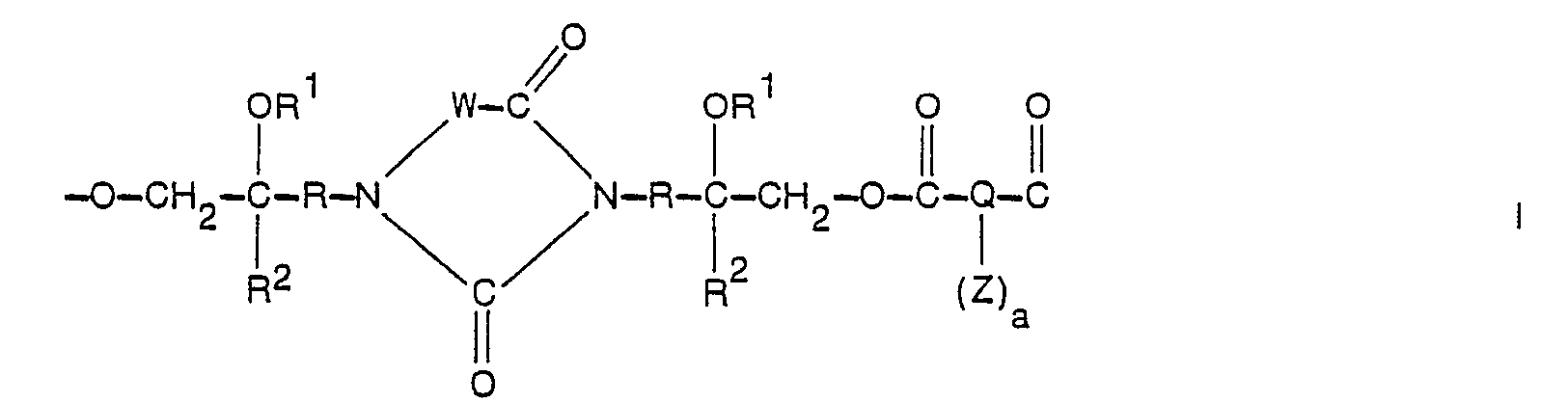
- R is a single bond or an alkylene group having 1 to 6 carbon atoms and optionally one catenary oxygen;
- R1 is hydrogen but can be

- R2 is hydrogen or methyl;
- W is a divalent group that is required to complete a 5- or 6-membered heterocyclic ring, preferably W is

- Q is the divalent or trivalent residue of hydrocarbyl di- or tri-carboxylic acids, said residue formed by the removal of active hydrogens from the carboxylic acid groups and containing up to 40 carbon atoms, preferably containing 4 to 12 carbon atoms, and optionally containing catenary oxygen atoms, of which carboxylic acids at least 10 mole percent have alpha-methylene groups;
- a is zero or one, but can be one for no more than 20 mole percent of the carboxylic acids; and
- Z is

- The polyesters of the invention allow the preparation of radiation-sensitive water or water/alcohol developable elements such as printing plates that do not require the use of binders that reduce curing speeds and cause development problems (e.g., cause formation of scum, etc.).
- The compounds of this invention generally can be prepared by the base catalyzed, preferably the tertiary amine catalyzed, reaction of one mole equivalent of a bis-(epoxy)heterocyclic compound and from about 0.8 to 1.2 mole equivalents of polycarboxylic acid (one or more dicarboxylic acids can be used) in accordance with the equation:
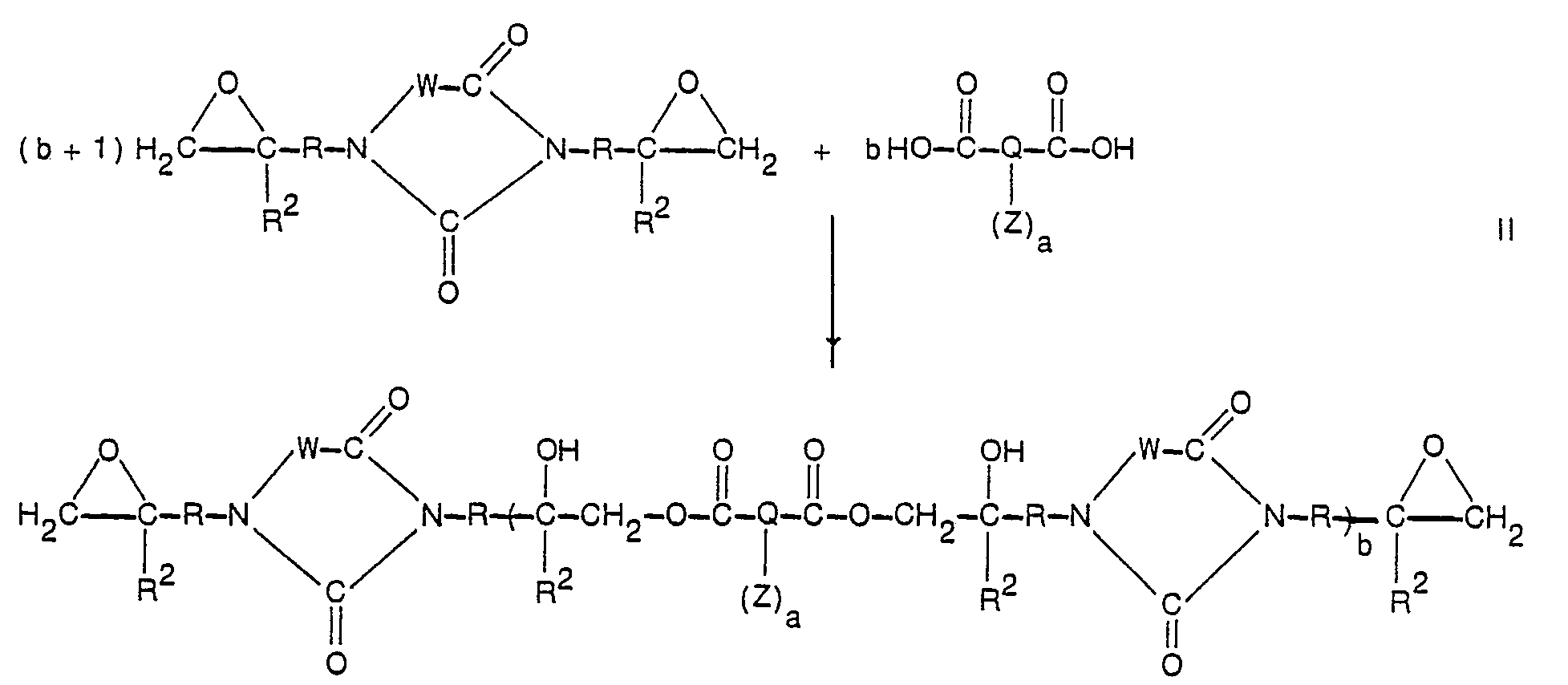
- The catalyzed reaction, wherein a catalytically active amount of a base polymerization catalyst is utilized, can be performed in the presence of absence of solvent. Generally, the epoxide, polycarboxylic acid, catalyst, inhibitor for thermal polymerization, and solvent, if used, are heated from 50 to 120°C, preferably about 80 to 100°C, until the disappearance of the epoxy group as may be shown by chemical titration analysis, is observed. Heating for from 2 to 40 hours usually suffices to complete the reaction.
- The hydroxyl groups present in compounds of formula I (i.e., where R1 is hydrogen) can be acylated by treatment with an acylating agent, preferably by an acyl halide, an acyl anhydride, or an isocyanate that may contain polymerizable ethylenically unsaturated groups.
- By adjustment of the ratio of bis-(epoxy)-heterocyclic compound to dicarboxylic acid, the terminal groups in the polyester can be controlled as is known in the addition polymer art. Thus, an excess (about 1 to 10%) of the bis-epoxide over the dicarboxylic acid gives polyesters having terminal epoxy groups and an excess (about 1 to 10%) of the dicarboxylic acid over the bis-epoxide gives polyesters having terminal carboxylic groups. Essentially equivalent amounts of bis-epoxide and dicarboxylic acid give polyesters having, on average, both carboxyl and epoxy terminal groups. When the terminal groups of the polyester are epoxy, these terminal groups are readily converted to acryloyl, methacryloyl or mixtures thereof by reaction with acrylic or methacrylic acid as is known in the art.
- The bis-epoxyheterocyclic compounds for use in the practice of the present invention have the formula:

- 1,3-diglycidylhydantoin
- 1,3-diglycidyl-5-amylhydantoin
- 1,3-diglycidyl-5-octylhydantoin
- 1,3-diglycidyl-5-methylhydantoin
- 1,3-diglycidyl-5,5-dimethylhydantoin
- 1,3-diglycidyl-5-ethyl-5-methylhydantoin
- 1,3-diglycidyl-5-ethyl-5-hexylhydantoin
- 1,3-di(2-glycidyloxyethyl)-5,5-dimethylhydantoin
- 1,3-dil3-glycidyloxypropyl)-5,5-dimethylhydantoin
- 1,3-diepoxyethyl-5,5-dimethylhydantoin
- 1,3-diglycidyluracil
- 1,3-diglycidyl-6-methyluracil
- 1,3-diglycidyl-5,5-dimethyl-5,6-dihydrouracil I
- 1,3-di((B-methylglycidyl)-5,5-dimethyl-5,6-dihydrouracil
- 1,3-diglycidylisocyanurate
- 1,3-diepoxyethylisocyanurate
- Other suitable bis-(epoxy)heterocyclic compounds are listed in U.S. Patents 3,808,226 and 4,137,139 which are incorporated into this application by reference.
- The preferred bis-(epoxy)heterocyclic compounds are the 1,3-diglycidylhydantoins such as 1,3- diglycidyl-5,5-dimethylhydantoin, 1,3-diglycidyl-5-ethyl-5-methylhydantoin, 1,3-diglycidyl-5-hexyl-5-methylhydantoin, and 1,3-di(3-glycidyloxypropyl)-5,5-dimethylhydantoin.
- The polycarboxylic acids for use in the practice of this invention have the formula:

- The polyesters of the invention having 100 mole percent down to about 50 mole percent of alpha- methylene dicarboxylic acid and 0 to about 50 mole percent of dicarboxylic acid not having an alpha- methylene group are highly responsive to polymerization by actinic radiation even in the presence of oxygen. With a decrease of dicarboxylic acids having alpha-methylene content below about 50 mole percent, the rate of polymerization of the polyester decreases, so that below 10-20 mole percent alpha- methylene-containing dicarboxylic acids, curing on exposure to actinic radiation proceeds very slowly.
- The polyesters of the invention contain secondary hydroxyl groups which are formed on reaction of heterocyclic diepoxide with polycarboxylic acid as is shown in Equation II. These hydroxyls can be functionalized by reaction with an acylation group and thereby the polyester can be tailored to desirable properties such as increased solubility in a particular solvent, improved tensile strength and reduced flammability. In this manner, R' of formula I is replaced by

- By reaction of the secondary hydroxyls of the polyester with ethylenically unsaturated acylation agents, the ethylenic unsaturation of polyesters having a low content of backbone alpha-methylene groups can be increased. This increase, of course, increases the rate of curing of the polyester on exposure to a given amount of energy.
- Where the polyesters have been prepared using an excess of diepoxyheterocyclic compound, they contain terminal epoxy groups. These groups can be reacted with nucleophiles to open the epoxide ring and provide terminal ester groups. Where these nucleophiles are ethylenically substituted such as acrylic acid and methacrylic acid, the polyester becomes terminated with these groups.
- The radiation polymerizable compositions of the invention comprise the polyesters having backbone alpha-methylene groups and sufficient polymerization initiators for bringing about polymerization on subjection of the composition to actinic radiation.
- Polymerization initiators suitable for use in the crosslinkable compositions of the invention are those compounds which liberate or generate a free-radical on addition of energy. Such catalysts include peroxy, azo, and redox systems all of which are well known and are described frequently in polymerization art. Included among free-radical catalysts are the conventional heat activated catalysts such as organic peroxides and organic hydroperoxides; examples are benzoyl peroxide, tertiary-butyl perbenzoate, cumene hydroperoxde, azobis(isobutyronitrile) and the like. The preferred catalysts are photopolymerization initiators which facilitate polymerization when the composition is irradiated. Included among such initiators are acyloin and derivatives thereof, such as benzoin, benzoin methyl ether, benzoin ethyl ether, benzoin isopropyl ether, benzoin isobutyl ether, and a-methylbenzoin, diketones such as benzil and diacetyl, etc.; organic sulfides such as diphenyl monosulfide, diphenyl disulfide, decyl phenyl sulfide, and tetramethylthiuram monosulfide; S-acyl dithiocarbamates, such as S-benzoyl-N,N-dimethyldithiocarbamate; phenones such as acetophenone, a,a,a-tribromocetophenone, a,a-diethoxyacetophenone, 2,2-dimethoxy-2-phenylacetophenone, o-nitro-a,a,a-tribromoacetophenone; benzophenone, and p,p'-tetramethyldiaminobenzophenone; sulfonyl haiides such as p-toluene sulfonyl chloride, 1-naphthalenesulfonyl chloride, 2-naphthalenesulfonyl chloride, 1,3-benzendisulfonyl chloride,2,4-dinitrobenzenesulfonyl bromide and p-acetamidobenzenesulfonyl chloride. Normally, the initiator is used in amounts ranging from about 0.01 to 5% by weight of the total polymerization composition. When the quantity is less than 0.01 % by weight, the polymerization rate becomes extremely low. If the initiator is used in excess of 5% by weight, no correspondingly improved effect can be expected. Thus, addition of such greater quantity is economically unjustified. Preferably, about 0.25 to 1.0.% of initiator is used in the polymerizable composition.
- The polyesters of the invention can, but do not have to be, formulated with ethylenically unsaturated monomers. Ethylenically unsaturated monomers suitable for formulation with the polyesters include methyl methacrylate, ethyl acrylate, 2-ethylhexyl acrylate, chlorohexyl acrylate, styrene, 2-chlorostyrene, 2,4-dichlorostyrene, acrylic acid, acrylamide, acrylonitrile, t-butyl acrylate, methyl acrylate, butylacrylate, 2-(N-butylcarbamyl)ethyl methacrylate and 2-(N-ethylcarbamyl)ethyl methacrylate. Other diluting monomers that can be incorporated into the composition of the invention include 1,4-butylene dimethylacrylate or acrylate, ethylene dimethacrylate, hexanediol diacrylate, or methacrylate, glyceryl diacrylate or methacrylate, glyceryl triacrylate or trimethylacrylate, pentaerythritol triacrylate or trimethacrylate, pentaerythritol tetraacrylate or tetramethylacrylate, diallyl phthalate, dipentaerythritol pentaacrylate, neopentylglycol triacrylate, 1,3,5-tri(2-methacryoyloxyethyl)-s-triazine, and polyacryloyl-hydantoins such as those described in U.S. Patents 3,808,226 and 3,852,302 and in assignee's EP-A-30969.
- The compositions of the invention can also include a variety of addenda utilized for their known purpose, such as stabilizers, inhibitors, lubricants, flexibilizers, pigments, dyes, reinforcing fillers such as finely divided silica, non-reinforcing fillers such as diatomaceous earth, metal oxides, asbestos, fiberglass, glass bubbles, talc, etc. Thermal polymerization inhibitors are useful and may be present in amounts less than 200 ppm by weight of the reacting materials. Fillers can generally be used in proportions up to about 200 percent by weight of the curable composition but preferably are used up to about 50 percent by weight. Where the polymerizing energy is radiation, it is desirable that the addenda be transparent to the radiation.
- The compositions of the invention are prepared by simply mixing (under "safe light" conditions if the composition is to be sensitized to visible light) the polymerization catalyst and sensitizer (where used), the heterocyclic group-containing polyesters of the invention and, where used, the diluting monomers, binders and other addenda. Inert solvents may be employed if desired when effecting this mixture. Examples of suitable solvents are methanol, ethanol, acetone, acetonitrile and include any solvent which does not react with the components of the mixture.
- The compositions of the invention can be used as adhesives, caulking and sealing compositions, casting and molding compositions, potting and encapsulating compositions, impregnating and coating compositions, binders, etc., depending on the particular combination of components. Where the polymerization catalyst is a photoinitiator, the composition can be used for in situ curing processes because of this insensitivity to oxygen.
- The photopolymerizable compositions are particularly suitable for applications in the field of protective coatings and graphic arts because of their superior abrasion-resistance and adhesion to many rigid, resilient and flexible substrates such as metals, plastics, rubber, glass, paper, wood, and ceramics; their excellent resistance to most solvents and chemicals; and their capability for forming high resolution images. Among such uses are water or water/alcohol developable resists for chemical milling, gravure images, offset plates, stencil making, screenless lithography, relief printing plates, printed circuits, radiation cured protective coatings for glass, metal surfaces and the like. Also, because the polyesters of the invention are form-stable, they do not flow at temperatures below about 30°C, and many are non-tacky at these temperatures.
- The photopolymerization of the compositions of the invention occurs on exposure of the compositions to any source of radiation emitting actinic radiation at a wavelength within the ultraviolet and visible spectral regions. Suitable sources of radiation include mercury, xenon, carbon arc and tungsten filament lamps, sunlight, etc. Exposures may be from less than about 1 second to 10 minutes or more depending upon the amounts of particular polymerizable materials, the photopolymerization catalyst being utilized and depending upon the radiation source and distance from the source and the thickness of the coating to be cured. The compositions may also be polymerized by exposure to electron beam irradiation. Generally speaking, the dosage necessary is from less than 1 megarad to 100 megarad or more. One of the major advantages with using electron beam curing is that highly pigmented compositions can be effectively cured at a faster rate than by mere exposure to actinic radiation.
- The instant invention will be better understood by referring to the following specific but nonlimiting examples. It is understood that the examples are merely illustrative and that modifications can be made without departing from the spirit and scope of the invention.
- There were dissolved 110.4 g of DGDMH (0.8 mole epoxide equivalency), 52.0 g itaconic acid (0.8 mole acid equivalency), 0.05 g 4-methoxyphenol, 0.76 g triethylamine, and 40 ml p-dioxane in a 250 ml three-necked round bottom flask equipped with mechanical stirrer, reflux condenser and CaS04 drying tube. The reaction flask temperature was maintained at 100°Cfbr 19.25 hours. At this time, chemical titration analysis showed that 99% of the epoxide and carboxylic acid groups had been consumed. The solvent can be removed at reduced pressure to yield a hard, glassy polyester which is soluble in tetrahydrofuran, p-dioxane, cyclohexanone and alcohol/water solutions.
- The polyester and 2% by weight of 2,2-dimethoxy-2-phenyl acetophenone were coated from tetrahydrofuran onto 12 micrometer polyester film and dried to provide a 2.5 micrometer layer. A stencil was placed on the nontacky layer and the sample was exposed to a Hanovia 3D690 mercury arc lamp (140 watt) for 30 seconds. The sample was 6 cm from the irradiation source. The template was removed and the unexposed areas were washed away with a 10% aqueous ethanol developer to leave an image having excellent resolution.
- Polyesters having the various other ring structures noted in Formula I above, wherein W is as defined above, can be made by substantially the same synthetic procedure as used in this example
- Assignee's EP-A-30969 (Wendling and Covington), is indicative of the known similarity of certain identifiable groups in giving similar reactions in the formation of derivative polymerizable groups.
- 29.4 g DGDMH (0.2 mole epoxide equivalency), 28.5 g C36 dimer acid (0.1 mole acid equivalency), 6.5 g itaconic acid (0.1 mole acid equivalency), 0.05 g 4-methoxyphenolr 0.36 g dimethyl benzylamine, and 30 ml p-dioxane were dissolved in a 250 ml three-necked round bottom flask equipped with mechanical stirrer, reflux condenser, and CaS04 drying tube. The reaction flask was heated to 90°C for 36.0 hours. At this time chemical titration analysis showed that greater than 95% of the epoxide and carboxylic acid groups had been consumed.
- A coating of the polymer was prepared and exposed for 60 seconds as described in Example 1. On development with 50% aqueous ethanol, an image of cured polymer having excellent resolution was obtained.
- There were dissolved 18.6 g DGDMH (0.2 mole equivalents epoxide), 11.3 g itaconic acid (0.175 mole equivalents acid), 2.62 g trimesic acid (.035 mole equivalents acid), 0.05 g 4-methoxyphenol and 0.36 g triethyl amine in 20 ml p-dioxane in a 250 ml three-necked flask equipped with mechanical stirrer, reflux condenser, and CaS04 drying tube. The reaction flask was heated to 90°C for 23.0 hours. At this time chemical titration of the epoxide groups showed the reaction to be 98.2% complete. The solvent was removed at reduced pressure to give a hard glassy polymer soluble in tetrahydrofuran and aqueous alcohol.
- A coating of the polymer and 2% by weight of 2,2-dimethoxy-2-phenyl acetophenone was exposed for 60 seconds as described for the polyester of Example 1. On development with aqueous alcohol, an image of cured polymer having excellent resolution was obtained.
- There were charged 43.84 g DGDMH (0.32 mole epoxide equivalents), 17.93 g (0.29 mole carboxylic acid equivalents), itaconic acid, 0.76 g 4-methoxy phenol, and 0.58 g triethylamine into a 250 ml three-necked round bottom flask equipped with a mechanical stirrer, reflux condense and CaS04 drying tube. The reaction flask temperature was raised to 95°C. After 6.0 hours 2.21 g (0.03 mole carboxylic acid equivalents) acrylic acid were added. After 17.75 total hours, chemical titration analysis showed that 99% of the epoxide groups had been consumed. The solvent was sparged off with dry air leaving a glassy polyester soluble in tetrahydrofuran and alcohol/water solution.
- A layer of this material was prepared and exposed for 30 seconds as described in Example 1. On development with aqueous alcohol, an image of cured polymer having excellent resolution was obtained.
- A polymer was prepared similarly to that of Example 4 using 28.6 g of DGDMH mole epoxide equivalency), 19.28 g maleic acid (0.18 mole carboxylic acid equivalency), and 1.44 g acrylic acid (0.02 mole acid equivalency).
- A layer of this material was prepared and exposed for 45 seconds as described in Example 1. On development with aqueous alcohol, an image of cured polymer having excellent resolution was obtained.
- There were dissolved 19.28 g of the copolymer of Example 1 in 40 ml cyclohexanone in a 250 ml three-necked round bottom flask equipped with a pressure equalizing dropping funnel, reflux condenser, mechanical stirrer and CaS04 drying tube. The reaction flask was heated to 55°C and 7.78 g (0.5 mole equivaleht isocyanate), 2-(methacryloyloxy)ethyl isocyanate was added dropwise over the course of ten minutes. The reaction was stirred for 3 hours at 55°C, cooled to room temperature and the polymer was precipitated from diethyl ether.
- The polymer was coated and exposed for 15 seconds to a Hanovia 3D690 lamp as described in Example 1. Development was effected with aqueous ethanol. An image having excellent resolution was obtained.
- This polymer was prepared in a manner similar to that of the polymer described in Example 6, except substituting phenyl isocyanate for 2-(methacryloyloxy)ethyl isocyanate.
- A solution of the polyester obtained was coated, dried and imaged in a manner similar to that of Example 1. This polymer can be imaged by a 90 second exposure to a 100 watt Hanovia 3D690 mercury arc lamp followed by developing with aqueous ethanol.
- Hydantoin-itaconic acid polyester (18.5 g) prepared as described in Example 1 was dissolved in 40 ml paradioxane in a 250 ml three-necked round bottom flask equipped with mechanical stirrer, reflux condenser and CaS04 drying tube. There was added 0.50 g maleic anhydride and the solution was heated at 95°C for two hours. The reaction was returned to room temperature and the solvent was removed under vacuum.
- The resulting polymer is soluble in water, water/alcohol solutions and tetrahydrofuran (THF). Films of this material were prepared as described in Example 1. Imaging was performed by exposure to a 100 watt Hanovia 3D690 mercury arc lamp for 60 seconds followed by development with water.
- Polyester prepared as described in Example 1 was reacted with 2-(methacryloyloxy)ethyl isocyanate as described in Example 6 to give a polyester having 30% instead of 50% of the secondary hydroxyls reacted. Into 50 ml paradioxane was dissolved 18.5 g of this polymer in a 500 ml three-necked round bottom flask equipped with mechanical stirrer, reflux condenser and CaS04 drying tube. There was added 0.98 g maleic acid and the mixture was heated at 90°C for three hours. After this time the reaction was allowed to cool to room temperature and the polymer was precipitated from diethyl ether. This polymer is soluble in water, alcohol/water, and THF.
- Coating and imaging can be performed as described for the polymer of Example 1. Curing is effected in 60 seconds with a 100 watt Hanovia 3D690 mercury arc lamp.
- A 2.5 micrometer thick film containing 68% of the polymer from Example 6 and 30% of the hydantoin hexaacrylate (described in assignee's copending patent application, Serial Number 51,876, filed June 25, 1979) and 2% by weight of 2,2-dimethoxy-2-phenyl acetophenone was cast onto 12 micrometer thick polyester from tetrahydrofuran. After solvent evaporation, the film was cured to an abrasion resistant surface in 15 seconds upon exposure to the Hanovia processing lamp described in Example 1. This film can also be imaged and developed as described in Example 1.
Claims (12)

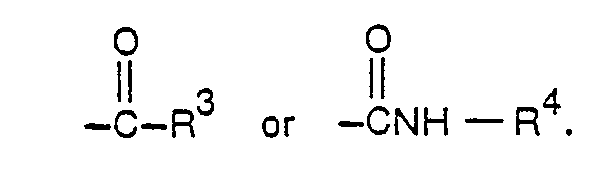

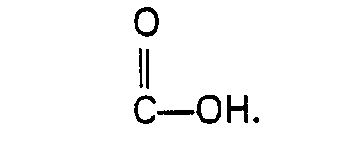

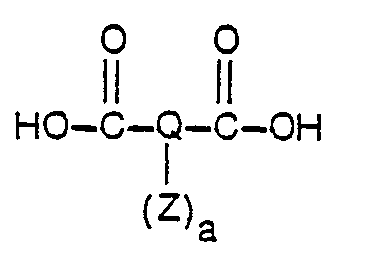
Applications Claiming Priority (2)
| Application Number | Priority Date | Filing Date | Title |
|---|---|---|---|
| US06/148,776 US4309529A (en) | 1980-05-12 | 1980-05-12 | Water-dispersible energy curable heterocyclic group-containing polyesters |
| US148776 | 1993-11-16 |
Publications (2)
| Publication Number | Publication Date |
|---|---|
| EP0040002A1 EP0040002A1 (en) | 1981-11-18 |
| EP0040002B1 true EP0040002B1 (en) | 1985-08-14 |
Family
ID=22527332
Family Applications (1)
| Application Number | Title | Priority Date | Filing Date |
|---|---|---|---|
| EP81301614A Expired EP0040002B1 (en) | 1980-05-12 | 1981-04-13 | Water-dispersible energy curable heterocyclic group-containing polyesters |
Country Status (5)
| Country | Link |
|---|---|
| US (1) | US4309529A (en) |
| EP (1) | EP0040002B1 (en) |
| JP (1) | JPS575720A (en) |
| CA (1) | CA1183639A (en) |
| DE (1) | DE3171781D1 (en) |
Families Citing this family (16)
| Publication number | Priority date | Publication date | Assignee | Title |
|---|---|---|---|---|
| DE3367781D1 (en) * | 1982-04-03 | 1987-01-08 | Ciba Geigy Ag | Process for preparing prepregs from fibres that contain cellulose using aqueous resin compositions |
| US4393181A (en) * | 1982-06-30 | 1983-07-12 | Shell Oil Company | Polyfunctional phenolic-melamine epoxy resin curing agents |
| US4394490A (en) * | 1982-09-28 | 1983-07-19 | The Goodyear Tire & Rubber Company | Water dispersible polyester compositions |
| US4436877A (en) | 1982-11-08 | 1984-03-13 | Polyplastics Co., Ltd. | Thermoplastic polyester composition |
| US4621122A (en) * | 1984-06-05 | 1986-11-04 | Minnesota Mining And Manufacturing Company | High-temperature resistant electrically insulating coating powder |
| US4654233A (en) * | 1984-11-21 | 1987-03-31 | Minnesota Mining And Manufacturing Company | Radiation-curable thermoplastic coating |
| US4567237A (en) * | 1984-11-21 | 1986-01-28 | Minnesota Mining And Manufacturing Company | Ethylenically unsaturated polyesters |
| US4600751A (en) * | 1984-12-18 | 1986-07-15 | Dow Corning Corporation | Hydrophilic silicone-organic copolymer elastomers |
| US4584337A (en) * | 1984-12-18 | 1986-04-22 | Dow Corning Corporation | Aqueous emulsions containing hydrophilic silicone-organic copolymers |
| US4833218A (en) * | 1984-12-18 | 1989-05-23 | Dow Corning Corporation | Hydrophilic silicone-organic copolymer elastomers containing bioactine agent |
| US4914165A (en) * | 1988-02-03 | 1990-04-03 | Minnesota Mining And Manufacturing Company | Radiation crosslinkable compositions |
| US8221965B2 (en) * | 2008-07-08 | 2012-07-17 | Az Electronic Materials Usa Corp. | Antireflective coating compositions |
| US8329387B2 (en) | 2008-07-08 | 2012-12-11 | Az Electronic Materials Usa Corp. | Antireflective coating compositions |
| US20100092894A1 (en) * | 2008-10-14 | 2010-04-15 | Weihong Liu | Bottom Antireflective Coating Compositions |
| US8551686B2 (en) * | 2009-10-30 | 2013-10-08 | Az Electronic Materials Usa Corp. | Antireflective composition for photoresists |
| US8507192B2 (en) * | 2010-02-18 | 2013-08-13 | Az Electronic Materials Usa Corp. | Antireflective compositions and methods of using same |
Family Cites Families (22)
| Publication number | Priority date | Publication date | Assignee | Title |
|---|---|---|---|---|
| CH471811A (en) * | 1966-06-23 | 1969-04-30 | Ciba Geigy | Process for the preparation of water-soluble N, N'-diglycidyl compounds |
| CH503759A (en) * | 1968-08-02 | 1971-02-28 | Ciba Geigy Ag | Process for the preparation of new N-heterocyclic N, N'-diglycidyl compounds and their use |
| US3649597A (en) * | 1968-10-17 | 1972-03-14 | Glyco Chemicals Inc | Dimethylhydantoin-formaldehyde-acetaldehyde terpolymers |
| US3948916A (en) * | 1970-04-20 | 1976-04-06 | Ciba-Geigy Ag | Diglycidyl compounds of N-heterocyclic compounds |
| CH556866A (en) * | 1970-04-20 | 1974-12-13 | Ciba Geigy Ag | METHOD FOR PRODUCING NEW DIGLYCIDYL COMPOUNDS FROM N-HETEROCYCLIC COMPOUNDS. |
| US3808226A (en) * | 1971-01-15 | 1974-04-30 | Ciba Geigy Corp | Polyacrylates of n-heterocyclic compounds |
| DE2142307A1 (en) * | 1971-08-24 | 1973-03-01 | Alfred Krueger | Polyepoxide/itaconic acid resins - hot/cold set solvent-free |
| SE403771B (en) | 1972-04-10 | 1978-09-04 | Continental Can Co | PROCEDURE FOR THE PREPARATION OF AN ETHENICLY UNSATATED BETA HYDROXIESTER BY REALTING A POLYEPOXIDE WITH AN UNSATATED CARBOXYLIC ACID |
| US3847770A (en) * | 1972-04-10 | 1974-11-12 | Continental Can Co | Photopolymerizable compositions prepared from beta hydroxy esters and polyitaconates |
| US3856744A (en) * | 1972-04-10 | 1974-12-24 | Continental Can Co | Ultraviolet polymerizable printing ink comprising vehicle prepared from beta-hydroxy esters and polyitaconates |
| US3804735A (en) * | 1972-04-10 | 1974-04-16 | Continental Can Co | Photopolymerizable compositions prepared from beta-hydroxy esters and polyitaconates |
| DE2245345A1 (en) * | 1972-09-15 | 1974-03-21 | Bayer Ag | POLYAETHERURETHANES CONTAINING HYDANTOIN RINGS AND THEIR USE AS ANTISTATICS |
| DE2245335A1 (en) * | 1972-09-15 | 1974-03-21 | Bayer Ag | SYNTHETIC FIBERS AND FILMS WITH PERMANENTLY ANTISTATIC PROPERTIES |
| US3920732A (en) * | 1972-11-13 | 1975-11-18 | Continental Can Co | Process for stabilized ethylenically unsaturated beta-hydroxy esters |
| US3925310A (en) * | 1973-05-18 | 1975-12-09 | Bayer Ag | High molecular weight copolyamides containing hydantoin units |
| US3928289A (en) * | 1973-12-26 | 1975-12-23 | Goodyear Tire & Rubber | Hydantoin produced polyurethane |
| US4180612A (en) * | 1974-03-04 | 1979-12-25 | General Electric Company | Hydantoin-polyester coating compositions |
| US4158731A (en) * | 1975-06-18 | 1979-06-19 | Ciba-Geigy Corporation | Crosslinkable polymeric compounds |
| US4108803A (en) * | 1976-03-23 | 1978-08-22 | Ciba-Geigy Corporation | Photopolymerizable epoxy resins containing pendant unsaturated ester or amidomethyl groups |
| US4053441A (en) * | 1976-11-29 | 1977-10-11 | Akzona Incorporated | Hydantoin polyamide-poly(oxyethylene) block copolymers as antistatic additives for polyamides |
| US4127565A (en) * | 1977-12-22 | 1978-11-28 | Monsanto Company | Process for making fiber-forming polyesters |
| US4224206A (en) * | 1978-07-31 | 1980-09-23 | Phelps Dodge Industries, Inc. | Water soluble essentially linear polymer having a plurality of amide, imide and ester groups therein, and a method of making the same and applying the same to substrates |
-
1980
- 1980-05-12 US US06/148,776 patent/US4309529A/en not_active Expired - Lifetime
-
1981
- 1981-04-01 CA CA000374409A patent/CA1183639A/en not_active Expired
- 1981-04-13 EP EP81301614A patent/EP0040002B1/en not_active Expired
- 1981-04-13 DE DE8181301614T patent/DE3171781D1/en not_active Expired
- 1981-05-11 JP JP7058081A patent/JPS575720A/en active Pending
Also Published As
| Publication number | Publication date |
|---|---|
| JPS575720A (en) | 1982-01-12 |
| US4309529A (en) | 1982-01-05 |
| EP0040002A1 (en) | 1981-11-18 |
| CA1183639A (en) | 1985-03-05 |
| DE3171781D1 (en) | 1985-09-19 |
Similar Documents
| Publication | Publication Date | Title |
|---|---|---|
| EP0040002B1 (en) | Water-dispersible energy curable heterocyclic group-containing polyesters | |
| US4249011A (en) | Poly(ethylenically unsaturated alkoxy) heterocyclic compounds | |
| US4262072A (en) | Poly(ethylenically unsaturated alkoxy) heterocyclic protective coatings | |
| EP2145880B1 (en) | Novel epoxy compound, alkali-developable resin composition, and alkali-developable photosensitive resin composition | |
| CA1109580A (en) | Radiation curable resin composition | |
| US4378411A (en) | Radiation-curable polymers | |
| US4316952A (en) | Energy sensitive element having crosslinkable polyester | |
| US6747101B2 (en) | Epoxy acrylates | |
| US4144283A (en) | Curable coating compositions | |
| US4475998A (en) | Modified epoxy (meth) acrylate resin and hardenable resin composition containing the same | |
| KR0173843B1 (en) | Energy-beam curable resin composition and its manufacturing method | |
| US6479596B1 (en) | Epoxy acrylates | |
| JP3659639B2 (en) | Vinyl ester resin, vinyl ester resin composition, and cured product thereof | |
| JPS60121444A (en) | Alkali-developable photosensitive resin composition | |
| US4281152A (en) | Acrylate monomers and photopolymerizable compositions containing same | |
| JP4258203B2 (en) | Alkali development type photosensitive resin composition | |
| US4140606A (en) | Process for preparing a polymerizable (meth) acrylate oligomer | |
| JP4253977B2 (en) | Active energy ray-curable composition | |
| JP5135659B2 (en) | Energy ray curable resin production method and energy ray curable resin composition | |
| JP2000256428A (en) | Curable resin and composition thereof | |
| AU543067B2 (en) | Poly(ethylenically unsaturated alkoxy) heterocyclic compoundsand crosslinked polymeric coatings | |
| JPS60142990A (en) | Novel acrylate and methacrylate esters | |
| JP3851973B2 (en) | Method for producing resin composition | |
| JP3158619B2 (en) | Photocurable resin composition | |
| JPH03143911A (en) | Photosensitive polymer composition |
Legal Events
| Date | Code | Title | Description |
|---|---|---|---|
| PUAI | Public reference made under article 153(3) epc to a published international application that has entered the european phase |
Free format text: ORIGINAL CODE: 0009012 |
|
| AK | Designated contracting states |
Designated state(s): CH DE FR GB IT NL |
|
| 17P | Request for examination filed |
Effective date: 19811023 |
|
| ITF | It: translation for a ep patent filed | ||
| GRAA | (expected) grant |
Free format text: ORIGINAL CODE: 0009210 |
|
| AK | Designated contracting states |
Designated state(s): CH DE FR GB IT LI NL |
|
| REF | Corresponds to: |
Ref document number: 3171781 Country of ref document: DE Date of ref document: 19850919 |
|
| ET | Fr: translation filed | ||
| PLBE | No opposition filed within time limit |
Free format text: ORIGINAL CODE: 0009261 |
|
| STAA | Information on the status of an ep patent application or granted ep patent |
Free format text: STATUS: NO OPPOSITION FILED WITHIN TIME LIMIT |
|
| 26N | No opposition filed | ||
| REG | Reference to a national code |
Ref country code: GB Ref legal event code: 732 |
|
| PGFP | Annual fee paid to national office [announced via postgrant information from national office to epo] |
Ref country code: CH Payment date: 19910313 Year of fee payment: 11 |
|
| PGFP | Annual fee paid to national office [announced via postgrant information from national office to epo] |
Ref country code: GB Payment date: 19910315 Year of fee payment: 11 |
|
| PGFP | Annual fee paid to national office [announced via postgrant information from national office to epo] |
Ref country code: FR Payment date: 19910325 Year of fee payment: 11 |
|
| PGFP | Annual fee paid to national office [announced via postgrant information from national office to epo] |
Ref country code: DE Payment date: 19910327 Year of fee payment: 11 |
|
| ITTA | It: last paid annual fee | ||
| PGFP | Annual fee paid to national office [announced via postgrant information from national office to epo] |
Ref country code: NL Payment date: 19910430 Year of fee payment: 11 |
|
| PG25 | Lapsed in a contracting state [announced via postgrant information from national office to epo] |
Ref country code: GB Effective date: 19920413 |
|
| PG25 | Lapsed in a contracting state [announced via postgrant information from national office to epo] |
Ref country code: LI Effective date: 19920430 Ref country code: CH Effective date: 19920430 |
|
| PG25 | Lapsed in a contracting state [announced via postgrant information from national office to epo] |
Ref country code: NL Effective date: 19921101 |
|
| GBPC | Gb: european patent ceased through non-payment of renewal fee | ||
| NLV4 | Nl: lapsed or anulled due to non-payment of the annual fee | ||
| PG25 | Lapsed in a contracting state [announced via postgrant information from national office to epo] |
Ref country code: FR Effective date: 19921230 |
|
| REG | Reference to a national code |
Ref country code: CH Ref legal event code: PL |
|
| PG25 | Lapsed in a contracting state [announced via postgrant information from national office to epo] |
Ref country code: DE Effective date: 19930101 |
|
| REG | Reference to a national code |
Ref country code: FR Ref legal event code: ST |