EP0039283B1 - Procédé de culture microbiologique - Google Patents
Procédé de culture microbiologique Download PDFInfo
- Publication number
- EP0039283B1 EP0039283B1 EP81400640A EP81400640A EP0039283B1 EP 0039283 B1 EP0039283 B1 EP 0039283B1 EP 81400640 A EP81400640 A EP 81400640A EP 81400640 A EP81400640 A EP 81400640A EP 0039283 B1 EP0039283 B1 EP 0039283B1
- Authority
- EP
- European Patent Office
- Prior art keywords
- filtration
- cake
- culture
- wort
- fact
- Prior art date
- Legal status (The legal status is an assumption and is not a legal conclusion. Google has not performed a legal analysis and makes no representation as to the accuracy of the status listed.)
- Expired
Links
- 238000000034 method Methods 0.000 title claims abstract description 25
- 238000009629 microbiological culture Methods 0.000 title 1
- 238000001914 filtration Methods 0.000 claims abstract description 35
- 239000012065 filter cake Substances 0.000 claims abstract description 18
- 239000003795 chemical substances by application Substances 0.000 claims abstract description 17
- 239000001963 growth medium Substances 0.000 claims abstract description 14
- 230000002906 microbiologic effect Effects 0.000 claims abstract description 12
- 208000035404 Autolysis Diseases 0.000 claims abstract description 10
- 206010057248 Cell death Diseases 0.000 claims abstract description 10
- 230000028043 self proteolysis Effects 0.000 claims abstract description 10
- 230000015556 catabolic process Effects 0.000 claims abstract description 9
- 238000006731 degradation reaction Methods 0.000 claims abstract description 9
- 244000005700 microbiome Species 0.000 claims abstract description 8
- 239000000126 substance Substances 0.000 claims abstract description 4
- 210000005056 cell body Anatomy 0.000 claims abstract description 3
- 239000007791 liquid phase Substances 0.000 claims abstract description 3
- 235000015097 nutrients Nutrition 0.000 claims abstract description 3
- 239000002245 particle Substances 0.000 claims abstract description 3
- 238000000855 fermentation Methods 0.000 claims description 8
- 230000004151 fermentation Effects 0.000 claims description 8
- 108090000790 Enzymes Proteins 0.000 claims description 7
- 102000004190 Enzymes Human genes 0.000 claims description 7
- 229940088598 enzyme Drugs 0.000 claims description 7
- 108010073178 Glucan 1,4-alpha-Glucosidase Proteins 0.000 claims description 6
- 102000013142 Amylases Human genes 0.000 claims description 5
- 108010065511 Amylases Proteins 0.000 claims description 5
- 235000019418 amylase Nutrition 0.000 claims description 5
- 229940025131 amylases Drugs 0.000 claims description 5
- 239000000470 constituent Substances 0.000 claims description 5
- 230000003301 hydrolyzing effect Effects 0.000 claims description 4
- 150000001413 amino acids Chemical class 0.000 claims description 3
- 229940088594 vitamin Drugs 0.000 claims description 3
- 235000013343 vitamin Nutrition 0.000 claims description 3
- 239000011782 vitamin Substances 0.000 claims description 3
- 229930003231 vitamin Natural products 0.000 claims description 3
- 239000004382 Amylase Substances 0.000 claims description 2
- 239000003242 anti bacterial agent Substances 0.000 claims description 2
- 229940088710 antibiotic agent Drugs 0.000 claims description 2
- 150000007524 organic acids Chemical class 0.000 claims description 2
- 235000005985 organic acids Nutrition 0.000 claims description 2
- 238000002360 preparation method Methods 0.000 claims description 2
- 229920002472 Starch Polymers 0.000 description 14
- 235000019698 starch Nutrition 0.000 description 14
- 239000008107 starch Substances 0.000 description 13
- 229920001592 potato starch Polymers 0.000 description 10
- XLYOFNOQVPJJNP-UHFFFAOYSA-N water Substances O XLYOFNOQVPJJNP-UHFFFAOYSA-N 0.000 description 10
- 239000002609 medium Substances 0.000 description 8
- 240000008042 Zea mays Species 0.000 description 7
- 235000005824 Zea mays ssp. parviglumis Nutrition 0.000 description 7
- 235000002017 Zea mays subsp mays Nutrition 0.000 description 7
- 235000005822 corn Nutrition 0.000 description 7
- 238000004519 manufacturing process Methods 0.000 description 7
- 230000002255 enzymatic effect Effects 0.000 description 6
- 239000000463 material Substances 0.000 description 5
- 229910052500 inorganic mineral Inorganic materials 0.000 description 4
- 238000009434 installation Methods 0.000 description 4
- 239000011707 mineral Substances 0.000 description 4
- 239000000203 mixture Substances 0.000 description 4
- WQZGKKKJIJFFOK-GASJEMHNSA-N Glucose Natural products OC[C@H]1OC(O)[C@H](O)[C@@H](O)[C@@H]1O WQZGKKKJIJFFOK-GASJEMHNSA-N 0.000 description 3
- 229930182555 Penicillin Natural products 0.000 description 3
- JGSARLDLIJGVTE-MBNYWOFBSA-N Penicillin G Chemical compound N([C@H]1[C@H]2SC([C@@H](N2C1=O)C(O)=O)(C)C)C(=O)CC1=CC=CC=C1 JGSARLDLIJGVTE-MBNYWOFBSA-N 0.000 description 3
- 102000004139 alpha-Amylases Human genes 0.000 description 3
- 108090000637 alpha-Amylases Proteins 0.000 description 3
- 229940024171 alpha-amylase Drugs 0.000 description 3
- 150000001720 carbohydrates Chemical class 0.000 description 3
- 235000014633 carbohydrates Nutrition 0.000 description 3
- 235000013312 flour Nutrition 0.000 description 3
- 230000007062 hydrolysis Effects 0.000 description 3
- 238000006460 hydrolysis reaction Methods 0.000 description 3
- 238000011534 incubation Methods 0.000 description 3
- 239000006166 lysate Substances 0.000 description 3
- 230000000813 microbial effect Effects 0.000 description 3
- 230000000050 nutritive effect Effects 0.000 description 3
- 229940049954 penicillin Drugs 0.000 description 3
- 239000000047 product Substances 0.000 description 3
- 238000003756 stirring Methods 0.000 description 3
- 241001513093 Aspergillus awamori Species 0.000 description 2
- 229920002245 Dextrose equivalent Polymers 0.000 description 2
- 239000005909 Kieselgur Substances 0.000 description 2
- 241000228150 Penicillium chrysogenum Species 0.000 description 2
- 240000004808 Saccharomyces cerevisiae Species 0.000 description 2
- VYPSYNLAJGMNEJ-UHFFFAOYSA-N Silicium dioxide Chemical compound O=[Si]=O VYPSYNLAJGMNEJ-UHFFFAOYSA-N 0.000 description 2
- 244000061456 Solanum tuberosum Species 0.000 description 2
- 235000002595 Solanum tuberosum Nutrition 0.000 description 2
- 241000187392 Streptomyces griseus Species 0.000 description 2
- 230000004071 biological effect Effects 0.000 description 2
- 210000004027 cell Anatomy 0.000 description 2
- 238000001035 drying Methods 0.000 description 2
- 230000000694 effects Effects 0.000 description 2
- 239000000706 filtrate Substances 0.000 description 2
- 239000008103 glucose Substances 0.000 description 2
- 238000000746 purification Methods 0.000 description 2
- 230000001954 sterilising effect Effects 0.000 description 2
- 238000004659 sterilization and disinfection Methods 0.000 description 2
- 238000000108 ultra-filtration Methods 0.000 description 2
- 241000283690 Bos taurus Species 0.000 description 1
- 229920002261 Corn starch Polymers 0.000 description 1
- 241000233866 Fungi Species 0.000 description 1
- 102100022624 Glucoamylase Human genes 0.000 description 1
- 239000005913 Maltodextrin Substances 0.000 description 1
- 240000003183 Manihot esculenta Species 0.000 description 1
- 235000016735 Manihot esculenta subsp esculenta Nutrition 0.000 description 1
- 241001465754 Metazoa Species 0.000 description 1
- 102000035195 Peptidases Human genes 0.000 description 1
- 108091005804 Peptidases Proteins 0.000 description 1
- 241000135309 Processus Species 0.000 description 1
- 239000004365 Protease Substances 0.000 description 1
- 229920001131 Pulp (paper) Polymers 0.000 description 1
- 241000187747 Streptomyces Species 0.000 description 1
- 239000004480 active ingredient Substances 0.000 description 1
- 239000002671 adjuvant Substances 0.000 description 1
- 238000005273 aeration Methods 0.000 description 1
- 238000013019 agitation Methods 0.000 description 1
- 229940024606 amino acid Drugs 0.000 description 1
- 239000010425 asbestos Substances 0.000 description 1
- 230000000721 bacterilogical effect Effects 0.000 description 1
- 230000009286 beneficial effect Effects 0.000 description 1
- 230000003115 biocidal effect Effects 0.000 description 1
- 230000015572 biosynthetic process Effects 0.000 description 1
- 238000001354 calcination Methods 0.000 description 1
- 230000001413 cellular effect Effects 0.000 description 1
- 239000008120 corn starch Substances 0.000 description 1
- 230000007797 corrosion Effects 0.000 description 1
- 238000005260 corrosion Methods 0.000 description 1
- 239000008121 dextrose Substances 0.000 description 1
- 239000003344 environmental pollutant Substances 0.000 description 1
- 230000007071 enzymatic hydrolysis Effects 0.000 description 1
- 238000006047 enzymatic hydrolysis reaction Methods 0.000 description 1
- 238000009950 felting Methods 0.000 description 1
- 239000006562 flour medium Substances 0.000 description 1
- 229940093915 gynecological organic acid Drugs 0.000 description 1
- 239000007788 liquid Substances 0.000 description 1
- 229940035034 maltodextrin Drugs 0.000 description 1
- 239000003471 mutagenic agent Substances 0.000 description 1
- 231100000707 mutagenic chemical Toxicity 0.000 description 1
- 230000035772 mutation Effects 0.000 description 1
- 238000010899 nucleation Methods 0.000 description 1
- 150000007523 nucleic acids Chemical class 0.000 description 1
- 102000039446 nucleic acids Human genes 0.000 description 1
- 108020004707 nucleic acids Proteins 0.000 description 1
- 235000019362 perlite Nutrition 0.000 description 1
- WLJVXDMOQOGPHL-UHFFFAOYSA-N phenylacetic acid Chemical compound OC(=O)CC1=CC=CC=C1 WLJVXDMOQOGPHL-UHFFFAOYSA-N 0.000 description 1
- 231100000719 pollutant Toxicity 0.000 description 1
- 239000002243 precursor Substances 0.000 description 1
- 102000004196 processed proteins & peptides Human genes 0.000 description 1
- 108090000765 processed proteins & peptides Proteins 0.000 description 1
- 238000004064 recycling Methods 0.000 description 1
- 230000000717 retained effect Effects 0.000 description 1
- 229910052895 riebeckite Inorganic materials 0.000 description 1
- 238000007873 sieving Methods 0.000 description 1
- 238000005063 solubilization Methods 0.000 description 1
- 230000007928 solubilization Effects 0.000 description 1
- 239000002195 soluble material Substances 0.000 description 1
- 235000000346 sugar Nutrition 0.000 description 1
- 150000008163 sugars Chemical class 0.000 description 1
- 239000000725 suspension Substances 0.000 description 1
- 238000005406 washing Methods 0.000 description 1
- 239000002699 waste material Substances 0.000 description 1
- 230000003313 weakening effect Effects 0.000 description 1
- 238000005303 weighing Methods 0.000 description 1
Images
Classifications
-
- C—CHEMISTRY; METALLURGY
- C12—BIOCHEMISTRY; BEER; SPIRITS; WINE; VINEGAR; MICROBIOLOGY; ENZYMOLOGY; MUTATION OR GENETIC ENGINEERING
- C12N—MICROORGANISMS OR ENZYMES; COMPOSITIONS THEREOF; PROPAGATING, PRESERVING, OR MAINTAINING MICROORGANISMS; MUTATION OR GENETIC ENGINEERING; CULTURE MEDIA
- C12N9/00—Enzymes; Proenzymes; Compositions thereof; Processes for preparing, activating, inhibiting, separating or purifying enzymes
- C12N9/14—Hydrolases (3)
- C12N9/24—Hydrolases (3) acting on glycosyl compounds (3.2)
- C12N9/2402—Hydrolases (3) acting on glycosyl compounds (3.2) hydrolysing O- and S- glycosyl compounds (3.2.1)
- C12N9/2405—Glucanases
- C12N9/2408—Glucanases acting on alpha -1,4-glucosidic bonds
- C12N9/2411—Amylases
- C12N9/2414—Alpha-amylase (3.2.1.1.)
- C12N9/2417—Alpha-amylase (3.2.1.1.) from microbiological source
-
- C—CHEMISTRY; METALLURGY
- C12—BIOCHEMISTRY; BEER; SPIRITS; WINE; VINEGAR; MICROBIOLOGY; ENZYMOLOGY; MUTATION OR GENETIC ENGINEERING
- C12N—MICROORGANISMS OR ENZYMES; COMPOSITIONS THEREOF; PROPAGATING, PRESERVING, OR MAINTAINING MICROORGANISMS; MUTATION OR GENETIC ENGINEERING; CULTURE MEDIA
- C12N9/00—Enzymes; Proenzymes; Compositions thereof; Processes for preparing, activating, inhibiting, separating or purifying enzymes
- C12N9/14—Hydrolases (3)
- C12N9/24—Hydrolases (3) acting on glycosyl compounds (3.2)
- C12N9/2402—Hydrolases (3) acting on glycosyl compounds (3.2) hydrolysing O- and S- glycosyl compounds (3.2.1)
- C12N9/2405—Glucanases
- C12N9/2408—Glucanases acting on alpha -1,4-glucosidic bonds
- C12N9/2411—Amylases
- C12N9/2428—Glucan 1,4-alpha-glucosidase (3.2.1.3), i.e. glucoamylase
-
- C—CHEMISTRY; METALLURGY
- C12—BIOCHEMISTRY; BEER; SPIRITS; WINE; VINEGAR; MICROBIOLOGY; ENZYMOLOGY; MUTATION OR GENETIC ENGINEERING
- C12P—FERMENTATION OR ENZYME-USING PROCESSES TO SYNTHESISE A DESIRED CHEMICAL COMPOUND OR COMPOSITION OR TO SEPARATE OPTICAL ISOMERS FROM A RACEMIC MIXTURE
- C12P1/00—Preparation of compounds or compositions, not provided for in groups C12P3/00 - C12P39/00, by using microorganisms or enzymes
-
- C—CHEMISTRY; METALLURGY
- C12—BIOCHEMISTRY; BEER; SPIRITS; WINE; VINEGAR; MICROBIOLOGY; ENZYMOLOGY; MUTATION OR GENETIC ENGINEERING
- C12P—FERMENTATION OR ENZYME-USING PROCESSES TO SYNTHESISE A DESIRED CHEMICAL COMPOUND OR COMPOSITION OR TO SEPARATE OPTICAL ISOMERS FROM A RACEMIC MIXTURE
- C12P37/00—Preparation of compounds having a 4-thia-1-azabicyclo [3.2.0] heptane ring system, e.g. penicillin
Definitions
- the subject of the invention is a microbiological process of the kind which includes a filtration step making it possible to separate, on the one hand, in particular the cell bodies of the microorganism used and various particles and substances, in particular colloidal, in suspension and , on the other hand, the liquid phase comprising the active ingredients resulting from the microbiological process.
- agents of a starchy nature such as potato starch
- starchy products have sometimes been used, in particular for the filtration of yeasts.
- starchy products has been and remains not widespread and remains very specific anyway.
- the commonly used filtration agents such as kieselguhrs or diatomaceous earth have a major drawback which resides in the eminently polluting nature of the filter cake, that is to say of the residue formed by the filter agent and the bodies microbial and colloidal retained.
- a more attractive solution would consist in generalizing the filtration of the culture musts using agents of starchy nature and in revalorizing the filter cake by using it for animal feed.
- this solution involves drying the filter cakes and on the other hand causes complications for companies specializing in the fermentation industries which rarely have outlets for feeding cattle.
- the invention aims, above all, to provide a particularly elegant solution to the problem of eliminating filter cakes, while allowing simple and advantageous upgrading.
- the Applicant Company has, in fact, had the merit of finding that the filter cakes which are based on a filtration agent constituted by a starchy product, were suitable for forming, in particular after autolysis, hydrolysis or other solubilization treatment or of degradation, a nutritive adjuvant of interest for the culture media used in microbiological processes of the genus in question.
- These filter cakes can therefore be recycled in particular in the main culture medium, at the very place of production.
- This way of doing things makes it possible to find an interesting revaluation of these pollutants on site and to save a non-negligible part of the nutritive materials which constitute the main culture medium, the re-use of autolysates or hydrolysates of the microorganism having in addition very often an effect. beneficial on the culture of this same microorganism.
- the improved microbiological process according to the invention is therefore characterized by the fact that, following the filtration of the must on a filtration agent of a starchy nature, the filter cake is recycled in the main culture medium, thus constituting part of the nutrients necessary for the latter, preferably after having been subjected to a degradation treatment, in particular an autolysis, during which the constituent elements of the cells are partially dissolved.
- filtration is carried out by using, as a filtration agent, a starchy product, in particular one or more native starches, preferably tubers, we recycle the filter cake to the main culture medium, preferably after having subjected it to a degradation treatment, in particular of autolysis.
- a starchy product in particular one or more native starches, preferably tubers
- the filter cake thus constitutes part of the nutritive materials necessary for the formation of said main culture medium.
- the degradation treatment makes it possible to make the constituents of the filter cake, whose humidity is generally around 80% or is brought to this value for incubation, more fermentable within the main medium. cake normally containing 25 to 50% by weight of starchy material on the dry matter.
- the cake is collected in vats, either as it is or diluted in water; brought to a pH of between 4.0 and 8.5 and at a temperature of 20 to 60 ° C., it then undergoes autolysis of the microbial bodies which can possibly be facilitated by the addition of additional enzymes, in particular amylases or proteases.
- additional enzymes in particular amylases or proteases.
- microbial bodies generally have sufficient enzymatic activity to directly cause, under these conditions, their own autolysis.
- the additional enzymes possibly added will therefore be essentially amylases, a-amylase and amyloglucosidase in particular, capable of hydrolyzing the starchy component of the filter cake.
- amylases act especially at the end of autolysis, by increasing the temperature beyond 60 ° C, the temperature at which the gelling of starchy agents such as potato or cassava starch begins.
- the starch native or liquefied with ⁇ -amylase will be suitable.
- the starch agent is hydrolyzed to amyloglucosidase.
- the quantity and the conditions of action of the enzyme will then be fixed, in a manner known per se, so that the hydrolysis of the starchy agent is practically complete.
- the final lysate is generally obtained after 8 to 24 hours of incubation. It is then recycled in the main culture medium.
- This lysate contains part of the carbohydrates from the filtering agent, amino acids or peptides, vitamins of group B, minerals, nucleic acids, i.e. the most adapted to the growth of cultivated microorganisms.
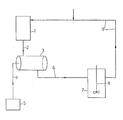
- the method according to the invention can be implemented by using an installation of the type schematically shown in the single figure.
- This installation comprises an enclosure 1 in which the so-called microbiological process takes place.
- the enclosure 1 is connected by a pipe 2 to a filter 3, for example of the rotary type (“Precoat”) as shown.
- a filter 3 for example of the rotary type (“Precoat”) as shown.
- the lysate is recycled to the tank 1 through a line 9.
- the culture medium consists of 10% corn flour, 2% potato starch and 4% C.S.L. 50% dry matter (Corn-Steep-Liquor or "corn steep water").
- the culture medium is prepared by suspending, in 12 liters of water, 2 kg of corn flour and 0.4 kg of potato starch. 90,000 International units of ⁇ -amylase are added and the corn starch and potato starch are liquefied while maintaining the medium at a temperature of 90 ° C for 15 minutes.
- the medium After sterilization at 120 ° C for approximately 30 minutes, the medium is seeded with 300 ml of a 24-hour culture of Aspergillus awamori (corn flour medium at 5% and 2% C.S.L.).
- the level of free reducing substances fell to less than 2 g / liter of glucose equivalent and the enzymatic activity measured by the standardized G.A.U. (Glucoamylase, Unit method of MILES LABORATORIES) is 25 units / ml.
- This cake is incubated as it is at a temperature of 50 ° C. and at a pH of 3.8 for 12 hours.
- the concentration of soluble matter after autolysis is greater than 100 g / liter.
- the enzymatic activity is 24 G.A.U./ml units; the filterability is still as good.
- Streptomyces was cultivated on a medium containing: * malto-dextrin: starch liquefied with ⁇ -amylase up to a dextrose-equivalent of 25.
- the biological activity of the culture must then reached its maximum value, this activity coinciding with the minimum glucose content in the must.
- the culture must was filtered on a rotary filter filled with potato starch.
- the filtration flow rate measured was 350 liters / m 2 / hour, which is a flow rate comparable to that obtained on diatomaceous earth.
- the washed filter cake had 83% moisture and had a starch content of 36% on dry materials.
- the enzymatic activity found after 72 hours is equal to that of the initial medium at the time of the first filtration.
- This operation could be repeated ten times without noticeably weakening the desired biological activity and filtration performance.
- the culture After a 4-day fermentation, the culture must is filtered on a rotary filter of the DORR OLIVER type filled with potato starch, the bacteriological quality of which is that of the starch used in brewery filtration or in the production of edible yeast.
- the filtration speed is 300 to 400 I / m 2 / hour.
- the mycelium thus separated from the medium at 35 ° C and washed on the filter looks like coarse paper pulp.
- the dry matter content of the filter cake is 17% and the starch cake content expressed on dry matter is 27%.
- the dry matter composition of the cake is:
- the cake thus collected (82 kg / m 3 of filtered wort) was adjusted to a pH of 5.0 and brought to 50 ° C. with gentle stirring, then maintained under these autolysis conditions for 12 hours.
- the autolysate was brought to 100 ° C to completely disperse the starch, then the temperature was brought back to 60 ° C and 100 units of amylo-glucosidase were added per liter.
- This operation could be repeated several times without a drop in antibiotic activity and. without lowering the filtration speed.
Landscapes
- Chemical & Material Sciences (AREA)
- Life Sciences & Earth Sciences (AREA)
- Organic Chemistry (AREA)
- Engineering & Computer Science (AREA)
- Health & Medical Sciences (AREA)
- Zoology (AREA)
- Wood Science & Technology (AREA)
- Genetics & Genomics (AREA)
- Bioinformatics & Cheminformatics (AREA)
- Biotechnology (AREA)
- General Health & Medical Sciences (AREA)
- Microbiology (AREA)
- Biochemistry (AREA)
- General Engineering & Computer Science (AREA)
- Biomedical Technology (AREA)
- Molecular Biology (AREA)
- General Chemical & Material Sciences (AREA)
- Chemical Kinetics & Catalysis (AREA)
- Medicinal Chemistry (AREA)
- Mycology (AREA)
- Micro-Organisms Or Cultivation Processes Thereof (AREA)
- Preparation Of Compounds By Using Micro-Organisms (AREA)
- Immobilizing And Processing Of Enzymes And Microorganisms (AREA)
Priority Applications (1)
| Application Number | Priority Date | Filing Date | Title |
|---|---|---|---|
| AT81400640T ATE3725T1 (de) | 1980-04-24 | 1981-04-23 | Verfahren zur mikroorganismenzucht. |
Applications Claiming Priority (2)
| Application Number | Priority Date | Filing Date | Title |
|---|---|---|---|
| FR8009287A FR2481317A1 (fr) | 1980-04-24 | 1980-04-24 | Procede microbiologique perfectionne |
| FR8009287 | 1980-04-24 |
Publications (2)
| Publication Number | Publication Date |
|---|---|
| EP0039283A1 EP0039283A1 (fr) | 1981-11-04 |
| EP0039283B1 true EP0039283B1 (fr) | 1983-06-08 |
Family
ID=9241333
Family Applications (1)
| Application Number | Title | Priority Date | Filing Date |
|---|---|---|---|
| EP81400640A Expired EP0039283B1 (fr) | 1980-04-24 | 1981-04-23 | Procédé de culture microbiologique |
Country Status (5)
| Country | Link |
|---|---|
| EP (1) | EP0039283B1 (cg-RX-API-DMAC7.html) |
| AT (1) | ATE3725T1 (cg-RX-API-DMAC7.html) |
| DE (1) | DE3160410D1 (cg-RX-API-DMAC7.html) |
| DK (1) | DK184181A (cg-RX-API-DMAC7.html) |
| FR (1) | FR2481317A1 (cg-RX-API-DMAC7.html) |
Families Citing this family (1)
| Publication number | Priority date | Publication date | Assignee | Title |
|---|---|---|---|---|
| WO2024092372A1 (en) * | 2022-11-04 | 2024-05-10 | Lite-1 Microbial Colour Ltd. | Process for production of biological colorants |
Family Cites Families (3)
| Publication number | Priority date | Publication date | Assignee | Title |
|---|---|---|---|---|
| GB1431544A (en) * | 1972-06-16 | 1976-04-07 | British Petroleum Co | Continuous fermentation processes for converting hydrocarbons into proteinaceous materials |
| US3886046A (en) * | 1973-06-28 | 1975-05-27 | Squibb & Sons Inc | Recycle fermentation process |
| CH621363A5 (cg-RX-API-DMAC7.html) * | 1976-05-18 | 1981-01-30 | Mueller Hans Dr Ing Fa |
-
1980
- 1980-04-24 FR FR8009287A patent/FR2481317A1/fr active Granted
-
1981
- 1981-04-23 DE DE8181400640T patent/DE3160410D1/de not_active Expired
- 1981-04-23 EP EP81400640A patent/EP0039283B1/fr not_active Expired
- 1981-04-23 AT AT81400640T patent/ATE3725T1/de not_active IP Right Cessation
- 1981-04-24 DK DK184181A patent/DK184181A/da unknown
Also Published As
| Publication number | Publication date |
|---|---|
| FR2481317A1 (fr) | 1981-10-30 |
| DE3160410D1 (en) | 1983-07-14 |
| FR2481317B1 (cg-RX-API-DMAC7.html) | 1984-02-24 |
| EP0039283A1 (fr) | 1981-11-04 |
| DK184181A (da) | 1981-10-25 |
| ATE3725T1 (de) | 1983-06-15 |
Similar Documents
| Publication | Publication Date | Title |
|---|---|---|
| EP0645456B1 (en) | Process and system for the production of ethanol from microalgae | |
| CA1282724C (en) | Enzymatic hydrolysis of granular starch directly to glucose | |
| US4514496A (en) | Process for producing alcohol by fermentation without cooking | |
| US4618579A (en) | Raw starch saccharification | |
| CA1143307A (en) | Method for producing ethanol in high concentration by using immobilized microorganism | |
| US20050239181A1 (en) | Continuous process for producing ethanol using raw starch | |
| FR2466504A1 (fr) | Procede pour produire de l'ethanol par fermentation continue de matieres premieres polysaccharidiques | |
| Suresh et al. | Production of ethanol by raw starch hydrolysis and fermentation of damaged grains of wheat and sorghum | |
| Vaija et al. | Citric acid production with alginate bead entrapped Aspergillus niger ATCC 9142 | |
| US4224410A (en) | Method for ethanol fermentation | |
| EP0039283B1 (fr) | Procédé de culture microbiologique | |
| Ertan et al. | Solid state fermentation for the production of α-amylase from Penicillium chrysogenum using mixed agricultural by-products as substrate | |
| US3734831A (en) | Production of cellulase | |
| SU1181555A3 (ru) | Способ получени этанола | |
| FR2490677A1 (fr) | Procede de preparation de jus sucres et de produits derives a partir de substrats vegetaux cellulosiques | |
| del Rosario et al. | Conversion of dextrinized cassava starch into ethanol using cultures of Aspergillus awamori and Saccharomyces cerevisiae | |
| JPH0787983A (ja) | 微細藻からのエタノール製造方法及び装置 | |
| Ivanova et al. | Biotransformation of furfural by yeast cells covalently bound to cellulose granules | |
| FR2633939A1 (fr) | Procede de production d'acide butyrique normal par fermentation a partir d'un substrat sucre en presence d'au moins une souche de l'espece clostridium | |
| JPH0787986A (ja) | 微細藻からのエタノールの製造方法 | |
| Pimentel et al. | Immobilized sucrose phosphorylase from Leuconostoc mesenteroides | |
| US4436814A (en) | Method for the recovery of enzymes after the treatment of starch-containing raw materials used for the production of fermentation alcohol | |
| BE838665A (fr) | Procede de fabrication d'alcool ethylique a partir d'algues vertes unicellulaires | |
| CA1073379A (en) | Method of obtaining ethanol by the utilization of unicellular green algae | |
| Odunfa et al. | Saccharification of cassava peels waste for microbial protein enrichment |
Legal Events
| Date | Code | Title | Description |
|---|---|---|---|
| PUAI | Public reference made under article 153(3) epc to a published international application that has entered the european phase |
Free format text: ORIGINAL CODE: 0009012 |
|
| AK | Designated contracting states |
Designated state(s): AT DE GB IT NL SE |
|
| 17P | Request for examination filed |
Effective date: 19811217 |
|
| ITF | It: translation for a ep patent filed | ||
| GRAA | (expected) grant |
Free format text: ORIGINAL CODE: 0009210 |
|
| AK | Designated contracting states |
Designated state(s): AT DE GB IT NL SE |
|
| REF | Corresponds to: |
Ref document number: 3725 Country of ref document: AT Date of ref document: 19830615 Kind code of ref document: T |
|
| REF | Corresponds to: |
Ref document number: 3160410 Country of ref document: DE Date of ref document: 19830714 |
|
| PLBE | No opposition filed within time limit |
Free format text: ORIGINAL CODE: 0009261 |
|
| STAA | Information on the status of an ep patent application or granted ep patent |
Free format text: STATUS: NO OPPOSITION FILED WITHIN TIME LIMIT |
|
| 26N | No opposition filed | ||
| PGFP | Annual fee paid to national office [announced via postgrant information from national office to epo] |
Ref country code: AT Payment date: 19900319 Year of fee payment: 10 |
|
| PGFP | Annual fee paid to national office [announced via postgrant information from national office to epo] |
Ref country code: GB Payment date: 19900417 Year of fee payment: 10 |
|
| PGFP | Annual fee paid to national office [announced via postgrant information from national office to epo] |
Ref country code: SE Payment date: 19900426 Year of fee payment: 10 |
|
| ITTA | It: last paid annual fee | ||
| PGFP | Annual fee paid to national office [announced via postgrant information from national office to epo] |
Ref country code: NL Payment date: 19900430 Year of fee payment: 10 |
|
| PGFP | Annual fee paid to national office [announced via postgrant information from national office to epo] |
Ref country code: DE Payment date: 19900618 Year of fee payment: 10 |
|
| PG25 | Lapsed in a contracting state [announced via postgrant information from national office to epo] |
Ref country code: GB Effective date: 19910423 Ref country code: AT Effective date: 19910423 |
|
| PG25 | Lapsed in a contracting state [announced via postgrant information from national office to epo] |
Ref country code: SE Effective date: 19910424 |
|
| PG25 | Lapsed in a contracting state [announced via postgrant information from national office to epo] |
Ref country code: NL Effective date: 19911101 |
|
| NLV4 | Nl: lapsed or anulled due to non-payment of the annual fee | ||
| GBPC | Gb: european patent ceased through non-payment of renewal fee | ||
| PG25 | Lapsed in a contracting state [announced via postgrant information from national office to epo] |
Ref country code: DE Effective date: 19920201 |
|
| EUG | Se: european patent has lapsed |
Ref document number: 81400640.9 Effective date: 19911108 |