EP0039136B1 - Electrode device, method for its preparation, and dispersion useful in the method - Google Patents
Electrode device, method for its preparation, and dispersion useful in the method Download PDFInfo
- Publication number
- EP0039136B1 EP0039136B1 EP81301299A EP81301299A EP0039136B1 EP 0039136 B1 EP0039136 B1 EP 0039136B1 EP 81301299 A EP81301299 A EP 81301299A EP 81301299 A EP81301299 A EP 81301299A EP 0039136 B1 EP0039136 B1 EP 0039136B1
- Authority
- EP
- European Patent Office
- Prior art keywords
- particles
- membrane
- electrode
- electrode device
- measuring
- Prior art date
- Legal status (The legal status is an assumption and is not a legal conclusion. Google has not performed a legal analysis and makes no representation as to the accuracy of the status listed.)
- Expired
Links
- 239000006185 dispersion Substances 0.000 title claims abstract description 34
- 238000000034 method Methods 0.000 title claims description 14
- 238000002360 preparation method Methods 0.000 title description 2
- 239000002245 particle Substances 0.000 claims abstract description 103
- 239000012528 membrane Substances 0.000 claims abstract description 80
- 239000003792 electrolyte Substances 0.000 claims abstract description 53
- 239000008151 electrolyte solution Substances 0.000 claims abstract description 17
- 239000007788 liquid Substances 0.000 claims abstract description 14
- 239000000203 mixture Substances 0.000 claims abstract description 14
- 238000002848 electrochemical method Methods 0.000 claims abstract description 6
- 239000002356 single layer Substances 0.000 claims description 18
- 229910010271 silicon carbide Inorganic materials 0.000 claims description 15
- 229920000936 Agarose Polymers 0.000 claims description 8
- 238000003860 storage Methods 0.000 claims description 6
- 239000011521 glass Substances 0.000 claims description 5
- BASFCYQUMIYNBI-UHFFFAOYSA-N platinum Chemical compound [Pt] BASFCYQUMIYNBI-UHFFFAOYSA-N 0.000 claims description 4
- 229920002134 Carboxymethyl cellulose Polymers 0.000 claims description 3
- 239000001768 carboxy methyl cellulose Substances 0.000 claims description 3
- 235000010948 carboxy methyl cellulose Nutrition 0.000 claims description 3
- 239000008112 carboxymethyl-cellulose Substances 0.000 claims description 3
- 238000009826 distribution Methods 0.000 claims description 3
- 239000003082 abrasive agent Substances 0.000 claims description 2
- 238000004519 manufacturing process Methods 0.000 claims description 2
- 239000006174 pH buffer Substances 0.000 claims description 2
- 229910052697 platinum Inorganic materials 0.000 claims description 2
- 239000002562 thickening agent Substances 0.000 claims 3
- 229920000642 polymer Polymers 0.000 claims 2
- 239000007789 gas Substances 0.000 description 25
- CURLTUGMZLYLDI-UHFFFAOYSA-N Carbon dioxide Chemical compound O=C=O CURLTUGMZLYLDI-UHFFFAOYSA-N 0.000 description 20
- 239000010410 layer Substances 0.000 description 14
- 229910002092 carbon dioxide Inorganic materials 0.000 description 13
- 125000006850 spacer group Chemical group 0.000 description 13
- 229960004424 carbon dioxide Drugs 0.000 description 10
- 239000001569 carbon dioxide Substances 0.000 description 10
- 229940021013 electrolyte solution Drugs 0.000 description 10
- 238000005259 measurement Methods 0.000 description 10
- -1 polypropylene Polymers 0.000 description 9
- XLYOFNOQVPJJNP-UHFFFAOYSA-N water Substances O XLYOFNOQVPJJNP-UHFFFAOYSA-N 0.000 description 9
- 239000000463 material Substances 0.000 description 8
- 239000008280 blood Substances 0.000 description 7
- 210000004369 blood Anatomy 0.000 description 7
- 238000002474 experimental method Methods 0.000 description 7
- 239000000243 solution Substances 0.000 description 7
- BQCADISMDOOEFD-UHFFFAOYSA-N Silver Chemical compound [Ag] BQCADISMDOOEFD-UHFFFAOYSA-N 0.000 description 6
- UIIMBOGNXHQVGW-UHFFFAOYSA-M Sodium bicarbonate Chemical compound [Na+].OC([O-])=O UIIMBOGNXHQVGW-UHFFFAOYSA-M 0.000 description 6
- 229910052709 silver Inorganic materials 0.000 description 6
- 239000004332 silver Substances 0.000 description 6
- 239000004743 Polypropylene Substances 0.000 description 5
- 229920001155 polypropylene Polymers 0.000 description 5
- QGZKDVFQNNGYKY-UHFFFAOYSA-N Ammonia Chemical compound N QGZKDVFQNNGYKY-UHFFFAOYSA-N 0.000 description 4
- 229910052751 metal Inorganic materials 0.000 description 4
- 239000002184 metal Substances 0.000 description 4
- 239000004677 Nylon Substances 0.000 description 3
- 229910021607 Silver chloride Inorganic materials 0.000 description 3
- 238000011067 equilibration Methods 0.000 description 3
- 239000003349 gelling agent Substances 0.000 description 3
- 238000002386 leaching Methods 0.000 description 3
- 229920001778 nylon Polymers 0.000 description 3
- HKZLPVFGJNLROG-UHFFFAOYSA-M silver monochloride Chemical compound [Cl-].[Ag+] HKZLPVFGJNLROG-UHFFFAOYSA-M 0.000 description 3
- 229910000030 sodium bicarbonate Inorganic materials 0.000 description 3
- 235000017557 sodium bicarbonate Nutrition 0.000 description 3
- NLXLAEXVIDQMFP-UHFFFAOYSA-N Ammonia chloride Chemical compound [NH4+].[Cl-] NLXLAEXVIDQMFP-UHFFFAOYSA-N 0.000 description 2
- 229910001369 Brass Inorganic materials 0.000 description 2
- 229920000298 Cellophane Polymers 0.000 description 2
- 229910019142 PO4 Inorganic materials 0.000 description 2
- FAPWRFPIFSIZLT-UHFFFAOYSA-M Sodium chloride Chemical compound [Na+].[Cl-] FAPWRFPIFSIZLT-UHFFFAOYSA-M 0.000 description 2
- 229920006362 Teflon® Polymers 0.000 description 2
- XECAHXYUAAWDEL-UHFFFAOYSA-N acrylonitrile butadiene styrene Chemical compound C=CC=C.C=CC#N.C=CC1=CC=CC=C1 XECAHXYUAAWDEL-UHFFFAOYSA-N 0.000 description 2
- 239000004676 acrylonitrile butadiene styrene Substances 0.000 description 2
- 229920000122 acrylonitrile butadiene styrene Polymers 0.000 description 2
- 229910021529 ammonia Inorganic materials 0.000 description 2
- QVGXLLKOCUKJST-UHFFFAOYSA-N atomic oxygen Chemical compound [O] QVGXLLKOCUKJST-UHFFFAOYSA-N 0.000 description 2
- 239000010951 brass Substances 0.000 description 2
- 238000000338 in vitro Methods 0.000 description 2
- 239000001301 oxygen Substances 0.000 description 2
- 229910052760 oxygen Inorganic materials 0.000 description 2
- 239000010452 phosphate Substances 0.000 description 2
- NBIIXXVUZAFLBC-UHFFFAOYSA-K phosphate Chemical compound [O-]P([O-])([O-])=O NBIIXXVUZAFLBC-UHFFFAOYSA-K 0.000 description 2
- 239000004033 plastic Substances 0.000 description 2
- 229920003023 plastic Polymers 0.000 description 2
- 229920000139 polyethylene terephthalate Polymers 0.000 description 2
- 239000005020 polyethylene terephthalate Substances 0.000 description 2
- 229920001343 polytetrafluoroethylene Polymers 0.000 description 2
- 239000004810 polytetrafluoroethylene Substances 0.000 description 2
- 229940058401 polytetrafluoroethylene Drugs 0.000 description 2
- 239000000843 powder Substances 0.000 description 2
- 229920006395 saturated elastomer Polymers 0.000 description 2
- 238000003756 stirring Methods 0.000 description 2
- MGSRCZKZVOBKFT-UHFFFAOYSA-N thymol Chemical compound CC(C)C1=CC=C(C)C=C1O MGSRCZKZVOBKFT-UHFFFAOYSA-N 0.000 description 2
- BVKZGUZCCUSVTD-UHFFFAOYSA-M Bicarbonate Chemical compound OC([O-])=O BVKZGUZCCUSVTD-UHFFFAOYSA-M 0.000 description 1
- OKTJSMMVPCPJKN-UHFFFAOYSA-N Carbon Chemical compound [C] OKTJSMMVPCPJKN-UHFFFAOYSA-N 0.000 description 1
- 239000004812 Fluorinated ethylene propylene Substances 0.000 description 1
- 239000004698 Polyethylene Substances 0.000 description 1
- 229920001328 Polyvinylidene chloride Polymers 0.000 description 1
- 239000005844 Thymol Substances 0.000 description 1
- VJHCJDRQFCCTHL-UHFFFAOYSA-N acetic acid 2,3,4,5,6-pentahydroxyhexanal Chemical compound CC(O)=O.OCC(O)C(O)C(O)C(O)C=O VJHCJDRQFCCTHL-UHFFFAOYSA-N 0.000 description 1
- 239000002313 adhesive film Substances 0.000 description 1
- 229910045601 alloy Inorganic materials 0.000 description 1
- 239000000956 alloy Substances 0.000 description 1
- 235000019270 ammonium chloride Nutrition 0.000 description 1
- QXJJQWWVWRCVQT-UHFFFAOYSA-K calcium;sodium;phosphate Chemical compound [Na+].[Ca+2].[O-]P([O-])([O-])=O QXJJQWWVWRCVQT-UHFFFAOYSA-K 0.000 description 1
- 229910052799 carbon Inorganic materials 0.000 description 1
- 229920002678 cellulose Polymers 0.000 description 1
- 239000001913 cellulose Substances 0.000 description 1
- 239000000470 constituent Substances 0.000 description 1
- ORTQZVOHEJQUHG-UHFFFAOYSA-L copper(II) chloride Chemical compound Cl[Cu]Cl ORTQZVOHEJQUHG-UHFFFAOYSA-L 0.000 description 1
- 238000010586 diagram Methods 0.000 description 1
- ZOMNIUBKTOKEHS-UHFFFAOYSA-L dimercury dichloride Chemical class Cl[Hg][Hg]Cl ZOMNIUBKTOKEHS-UHFFFAOYSA-L 0.000 description 1
- 230000000694 effects Effects 0.000 description 1
- 230000005489 elastic deformation Effects 0.000 description 1
- 239000012777 electrically insulating material Substances 0.000 description 1
- 239000003822 epoxy resin Substances 0.000 description 1
- HQQADJVZYDDRJT-UHFFFAOYSA-N ethene;prop-1-ene Chemical group C=C.CC=C HQQADJVZYDDRJT-UHFFFAOYSA-N 0.000 description 1
- 238000001704 evaporation Methods 0.000 description 1
- 230000008020 evaporation Effects 0.000 description 1
- 238000010438 heat treatment Methods 0.000 description 1
- 229910052500 inorganic mineral Inorganic materials 0.000 description 1
- 238000003780 insertion Methods 0.000 description 1
- 230000037431 insertion Effects 0.000 description 1
- 239000011810 insulating material Substances 0.000 description 1
- 239000006194 liquid suspension Substances 0.000 description 1
- 239000011707 mineral Substances 0.000 description 1
- 235000010755 mineral Nutrition 0.000 description 1
- 238000012856 packing Methods 0.000 description 1
- 229920009441 perflouroethylene propylene Polymers 0.000 description 1
- 229920000647 polyepoxide Polymers 0.000 description 1
- 229920000573 polyethylene Polymers 0.000 description 1
- 239000002861 polymer material Substances 0.000 description 1
- 239000005033 polyvinylidene chloride Substances 0.000 description 1
- 239000011148 porous material Substances 0.000 description 1
- 238000000926 separation method Methods 0.000 description 1
- 229920002379 silicone rubber Polymers 0.000 description 1
- 239000004945 silicone rubber Substances 0.000 description 1
- 239000011780 sodium chloride Substances 0.000 description 1
- 239000012798 spherical particle Substances 0.000 description 1
- 229960000790 thymol Drugs 0.000 description 1
Images

Classifications
-
- A—HUMAN NECESSITIES
- A61—MEDICAL OR VETERINARY SCIENCE; HYGIENE
- A61B—DIAGNOSIS; SURGERY; IDENTIFICATION
- A61B5/00—Measuring for diagnostic purposes; Identification of persons
- A61B5/145—Measuring characteristics of blood in vivo, e.g. gas concentration or pH-value ; Measuring characteristics of body fluids or tissues, e.g. interstitial fluid or cerebral tissue
- A61B5/14542—Measuring characteristics of blood in vivo, e.g. gas concentration or pH-value ; Measuring characteristics of body fluids or tissues, e.g. interstitial fluid or cerebral tissue for measuring blood gases
-
- A—HUMAN NECESSITIES
- A61—MEDICAL OR VETERINARY SCIENCE; HYGIENE
- A61B—DIAGNOSIS; SURGERY; IDENTIFICATION
- A61B5/00—Measuring for diagnostic purposes; Identification of persons
- A61B5/145—Measuring characteristics of blood in vivo, e.g. gas concentration or pH-value ; Measuring characteristics of body fluids or tissues, e.g. interstitial fluid or cerebral tissue
- A61B5/1468—Measuring characteristics of blood in vivo, e.g. gas concentration or pH-value ; Measuring characteristics of body fluids or tissues, e.g. interstitial fluid or cerebral tissue using chemical or electrochemical methods, e.g. by polarographic means
- A61B5/1477—Measuring characteristics of blood in vivo, e.g. gas concentration or pH-value ; Measuring characteristics of body fluids or tissues, e.g. interstitial fluid or cerebral tissue using chemical or electrochemical methods, e.g. by polarographic means non-invasive
-
- A—HUMAN NECESSITIES
- A61—MEDICAL OR VETERINARY SCIENCE; HYGIENE
- A61B—DIAGNOSIS; SURGERY; IDENTIFICATION
- A61B5/00—Measuring for diagnostic purposes; Identification of persons
- A61B5/145—Measuring characteristics of blood in vivo, e.g. gas concentration or pH-value ; Measuring characteristics of body fluids or tissues, e.g. interstitial fluid or cerebral tissue
- A61B5/1491—Heated applicators
-
- G—PHYSICS
- G01—MEASURING; TESTING
- G01N—INVESTIGATING OR ANALYSING MATERIALS BY DETERMINING THEIR CHEMICAL OR PHYSICAL PROPERTIES
- G01N27/00—Investigating or analysing materials by the use of electric, electrochemical, or magnetic means
- G01N27/26—Investigating or analysing materials by the use of electric, electrochemical, or magnetic means by investigating electrochemical variables; by using electrolysis or electrophoresis
- G01N27/403—Cells and electrode assemblies
- G01N27/404—Cells with anode, cathode and cell electrolyte on the same side of a permeable membrane which separates them from the sample fluid, e.g. Clark-type oxygen sensors
-
- G—PHYSICS
- G01—MEASURING; TESTING
- G01N—INVESTIGATING OR ANALYSING MATERIALS BY DETERMINING THEIR CHEMICAL OR PHYSICAL PROPERTIES
- G01N27/00—Investigating or analysing materials by the use of electric, electrochemical, or magnetic means
- G01N27/26—Investigating or analysing materials by the use of electric, electrochemical, or magnetic means by investigating electrochemical variables; by using electrolysis or electrophoresis
- G01N27/416—Systems
- G01N27/4162—Systems investigating the composition of gases, by the influence exerted on ionic conductivity in a liquid
Definitions
- the present invention relates to an electrode device for electrochemical measurement of the concentration or the partial pressure of a gas in a liquid or a gas mixture.
- the electrode device is of the kind which comprises a measuring surface constituted by or comprising the sensitive part of a measuring electrode and a membrane defining a volume of an electrolyte solution (in the following designated “electrolyte” for brevity) which is in contact with the measuring electrode; said membrane being placed in front of the measuring surface and being permeable to the gas which is to be determined.
- the gas diffuses through the membrane and is detected either directly at the measuring electrode such as is the case in the polarographic determination of the partial pressure of oxygen or reacts with the electrolyte to form a product which is detected such as is the-case, e.g., in the potentiometric determination of the partial pressure of carbon dioxide or ammonia by means of a pH-sensitive measuring electrode.
- the electrolyte layer which is placed between the permeable membrane and the measuring electrode is decisive to the function of the electrode device. If the electrolyte layer is thin, a desirably short response time of the electrode device is obtained, but at the same time there is a risk that the electrode device dries, if this device is not kept constantly moistened and a risk that due to evaporation of water a noticeable change of the electrolyte concentration may take place and thereby a drift of the measuring result of the electrode device. If the electrolyte layer is thick, the equilibration will become slow, and the response time will, therefore, be long, especially when the partial gas pressure to be measured is low.
- the electrolyte layer present between the membrane and the measuring electrode is well defined and, especially in view of the response time, as thin as possible.
- the thickness of the electrolyte layer is determined by a distance keeping means, a so-called "spacer", placed between the measuring electrode and the membrane.
- a distance keeping means a so-called "spacer” placed between the measuring electrode and the membrane.
- 16 23 064 discloses the insertion of an electrolyte-saturated film of for -example cellophane or an electrolyte-saturated - sheet of cellulose paper between the measuring electrode and the membrane in a membrane-covered electrode, and also states that a mesh having a thickness of 0.1 mm and a large pore volume may be inserted.
- spacers of paper By using spacers of paper, it is possible to provide an electrolyte layer having a thickness of about 20 microns when the paper is, e.g. hard, porous, non-compressible, electrochemically inactive Joseph paper, and with cuprophane film, which, however, is compressible, a liquid layer of the same order of magnitude may be obtained.
- mesh of, e.g. polyethylene terephthalate a liquid layer thinner than of the order of magnitude of 50 microns is hardly obtainable, and this is often too much as the response time of the electrode then will be too long.
- the present invention provides an electrode device which offers new possibilities for obtaining an effective adjustment of the thickness of the electrolyte layer in a satisfactory and practical manner and which makes it possible to maintain thinner electrolyte layers than hitherto.
- an electrode device for electrochemical measurement of the concentration or the partial pressure of a gas in a liquid or a gas mixture, comprising a measuring surface constituted by or comprising the sensitive part of a measuring electrode and a membrane which is placed in front of the measuring surface and limits a volume of an electrolyte solution which is in contact with the measuring electrode, said membrane being permeable to the gas species to be determined, characterized in that the electrode device comprises particles dispersed substantially in a monolayer in the electrolyte solution between the measuring surface and the membrane in a sufficient amount to keep the membrane in a distance from the measuring surface, the monolayer making- contact with both the measuring surface and the membrane, the particles having such small compressibility that they do not undergo any substantial change of dimensions at pressures occurring during storage, application and handling of the electrode device.
- a sufficiently well-defined distance between the membrane and the measuring surface is obtained, by the particles being, as already stated, substantially in a monolayer, i.e. there is essentially at no place throughout the measuring surface more than one layer of particles between the measuring surface and the membrane, that is to say, there are no lumps or "towers” of particles which at any place establish a greater distance between the measuring surface and the membrane than the one given by the size of the individual particles. It has been found that the monolayer does not have to be a "dense" monolayer (a "dense" monolayer of, e.g. spherical particles will correspond to dense packing of the particles in the monolayer).
- any material suitable for the purpose of the present invention will be a material which to a greater or lesser extent shows elasticity so that the particles, after mounting of the membrane, are in an equilibrium deformation. It is evident that it is most suitable when the elastic deformation of the particles is small.
- the particles to be used according to the present invention are preferably of a size of between 2 and 50 microns, especially of a size between 2 and 30 microns, as experiments have shown that particles of this size give an excellent combination of short response time and reproducible measuring results.
- the particles are substantially larger, the response time will become substantially longer, for which reason particles of such a large size are usually not preferred for most common purposes. It is especially of great interest that even with very small particle sizes in the range of 2-5 microns, both a short response . time and a spectacular reproducibility are obtained.
- the particles used according to the present invention should, of course, ideally be monodisperse, i.e. should all by and large be of the same size, which in accordance with the meaning of this term when used in the present context comprises, for example, a particle size distribution of 2-5 microns, whereas a particle size distribution comprising an appreciable part of particles of 2 microns as well as an appreciable part of particles of 15 microns cannot be considered as being monodisperse for the purpose of the present invention.
- the particles should be approximately spherical or at any rate have essentially equal dimensions in all directions, as particles having a considerably larger dimension in one direction could give rise to an uncertainty on the distance between the membrane and the measuring electrode, depending upon whether the longest dimension of the particles is perpendicular to or parallel with the membrane and the electrode surface. If the particles are very elongated, there is, furthermore, a risk that they may perforate the membrane.
- the particles used according to the present invention should to a great extent be chemically inert in relation to the materials with which they are in contact and in relation to the processes which take place during the use of the electrode.
- suitable materials are polymer materials such as nylon and mineral materials such as glass, for example in the form of glass spheres, particles of abrasives which are sharp edged, for example carborundum particles.
- the invention further provides a process for preparing an electrode device for electrochemical measurement of the partial pressure of a gas in a liquid or a gas mixture, said electrode device comprising a measuring surface constituted by or comprising the sensitive part of a measuring electrode and a membrane which is placed in front of the measuring surface and which limits a volume of an electrolyte solution which is in contact with the measuring electrode, said membrane being permeable to the gas to be determined, characterized by applying a dispersion of particles in the electrolyte solution which is to be used in the electrode device to the measuring surface and/or the membrane in an excess, and mounting the membrane ⁇ n the electrode device in such a manner that excess dispersion is pressed out so that the particles are substantially in a monolayer and make contact with both the measuring surface and the membrane thereby to keep the membrane at a distance from the measuring surface, the particles having such small compressibility that they do not undergo any substantial change of dimensions at pressures occurring during storage, application and handling of the electrode device.
- the dispersion has a gel-like consistency so that it is stable and easy to apply; which may be obtained in that the dispersion comprises a gelling agent.
- Suitable gelling agents are such which do not essentially influence the desired function of the electrolyte, e.g. carboxymethylcellulose, which, for example; may suitably be used in a concentration of 3 percent by weight, calculated on the electrolyte solution, or agarose, which may suitably be used in a concentration of about 0.4 percent by weight, calculated on the electrolyte solution.
- the volume concentration of the particles which, when mounting the membrane secures a suitable amount of particles for obtaining monolayer of particles between the membrane and the measuring electrode can easily be-ascertained by preliminary practical experiments. Thus, experiments have shown that it is usually sufficient when about 25% of the total area of the measuring surface is covered by particles, as the membrane is thereby kept stretched over the electrode.
- a coverage of about 25% of the total area of the measuring surface may be obtained by using a dispersion containing about 3 percent by weight of particles having a size of about 3 microns or about 5 percent by weight of particles having a size of about 10 microns.
- Suitable materials for use as membrane in the electrode device according to the present invention are, in principle, the same as are suitable for corresponding electrode devices using conventional spacers, for example polyethylene, polypropylene, polytetrafluoro ethylene, fluorinated ethylene propylene, polyethylene terephthalate, polyvinylidene chloride and silicone rubber.
- the membrane should have such a strength that it is not punctured by the particles used and that it resists the mounting operation during which excess dispersion is pressed out from the interspace between the measuring surface and the membrane.
- the thickness of the membrane will usually be in the range from about 10 to about 20 microns.
- Electrode devices according to the present invention for measuring the partial pressure of carbondioxide typically comprise, for example, a membrane of polytetrafluoroethylene having a thickness of about 12 microns and a bicarbonate solution as electrolyte; electrode devices according to the present invention for measuring the partial pressure of oxygen typically comprise, for example, a membrane of polypropylene having a thickness of about 20 microns and a phosphate solution as electrolyte; and electrode devices according to the present invention for measuring the partial pressure of ammonia typically comprise, for example, a microporous polypropylene membrane having a thickness of about 20 microns and an ammonium chloride solution as electrolyte.
- the electrode devices may be constructed in the same manner as corresponding known electrode devices using conventional spacers, and they may be adapted to their special application purpose in the same manner as the corresponding known electrode devices; they may, especially, be adapted for measuring a liquid sample, for example blood, or they may be adapted for the so-called- transcutaneous or non-invasive measurement of the partial pressure of a gas in the blood.
- the electrode devices according to the present invention are used in connection with a reference electrode such as a saturated calomel electrode or a silver/silver chloride electrode which optionally may be built together with the measuring electrode into a unit in a known manner.
- the utilization of the principle of the present invention will not only result in a well-defined small distance between the membrane and the measuring electrode and thereby a well-defined electrolyte layer, but will also ensure that the application of the particle system on the measuring surface is much easier than the application of known spacers, as it is very simple to apply a drop of the particle-containing liquid suspension when the electrode device is placed with the measuring surface upwards, and the particles in the dispersion distribute themselves when the membrane is thereafter quite simply stretched down over the electrode and fastened with suitable straining devices, for example an 0-ring, whereas it is associated with not insignificant difficulties to apply a spacer of the known kind upon a drop of liquid on the measuring electrode and, thereafter, to fasten the membrane, as, firstly, one has to work with small discrete pieces of spacer which flow on the drop and, hence, are difficult to keep in place, and, secondly, the separate application of the necessary electrolyte and the spacer requires two operations when using the known technique.
- the present invention also provides a dispersion of particles for use in keeping a membrane at a distance from a measuring surface in the electrode device of the invention or in the process of the invention, characterized in that it is a dispersion of particles which have a particle size in the range of 2 to 50 microns in an electrolyte solution which, with respect to its qualitative and quantitative composition, is suitable for use as an electrolyte in a membrane-covered electrode device for polarographic or potentiometric determination of the partial pressure of a gas in a liquid or a gas mixture, the particles having such small compressibility that they do not undergo any substantial change of dimensions at pressures occurring during storage, application and handling of the electrode device.
- the electrolyte solutions suitable for this purpose typically comprise, inter alia, a pH buffer (compare the above-mentioned solutions), and examples of such electrolyte solutions are the above-mentioned solutions.
- the particles are preferably particles having a size in the range from 2 to 30 microns, especially in the range from 2 to 20 microns, and are preferably present in the dispersion in a concentration which will lead to the desired concentration of particles in the final monolayer, compare the above explanation.
- a gelling agent for example of the above-mentioned kind, has been added to the dispersion in order to obtain a viscous consistency.
- Norwegian published specification No. 140,028 describes a process for the determination of properties of a metal object by measuring the potential difference between this object and another metal object, in which process an electrolyte paste, for example comprising copper chloride as electrolyte, and additionally comprising paste-forming constituents together with relatively large and non-compressible powder particles of insulating material, is applied to at least one surface of one of the objects, whereafter one surface of the other object, which, for example, in determining the properties of the objects of brass alloys may be a fresh-polished sample of brass, is brought into contact with the paste on the surface of the first object, thus connecting the two objects electrically through the electrolyte paste, whereafter the potential difference between the two objects is measured in a conventional manner by means of a voltmeter, the powder particles serving to keep the objects apart from each other.
- an electrolyte paste for example comprising copper chloride as electrolyte, and additionally comprising paste-forming constituents together with relatively large and non-compressible powder particles of insulating material
- the particle paste used in this case comprises, such as mentioned above, "relatively large” particles, and it is especially preferred that these are abrasive, as one then quite simply may rub the metal objects against each other to obtain a good contact between metal and electrolyte and to obtain an abrasive effect.
- FIGS 1 and 2 show an embodiment of an electrode device according to the present invention for transcutaneous Pco 2 -determination.
- a reference electrode 2 in the form of a hollow cylindrical body of silver is placed in a housing 1 of an electrically insulating material, for example ABS (acrylonitrile-butadiene-styrene).
- a measuring electrode 3 is positioned which is a pH-measuring electrode, the surface 4 of which is in contact with a sodium bicarbonate solution 5 which serves as electrolyte and is positioned in an electrolyte space which is outwardly delimited by a Teflon@ membrane 6.
- particles 7 are arranged as a monolayer in the electrolyte and contact both the membrane and the surface of the pH-measuring electrode.
- the membrane 6 is fixed by means of an O-ring 8.
- a groove 9 in the silver body serves as an electrolyte reservoir.
- a zener diode 10 serving as electrical heating means is mounted in the silver body, and a thermistor 11 is mounted as a temperature sensor.
- the housing 1 is closed at the back by a lid, and its interior cavity is filled with epoxy resin.
- the housing 1 may be equipped with a thread 12 for mounting a jacket (not shown) provided with a contact surface which may be supplied with double face adhesive film for applying the electrode against the skin and for eliminating contact between the atmosphere and the carbon dioxide-permeable membrane.
- FIG 3 shows an electrode device according to the present invention for measuring P 02 in a self-calibrating blood gas measuring equipment of the type Radiometer ABL.
- a silver anode 22 in the form of a band at the inner electrode tube is mounted in a housing 21 together with a platinum cathode 23, the measuring surface of which is in contact with a phosphate electrolyte 24, which is in an electrolyte space outwardly delimited by a polypropylene membrane 25.
- a monolayer of particles 7 Between the membrane and the surface of the measuring electrode is a monolayer of particles 7.
- the membrane 25 is fixed by means of an 0-ring 8.
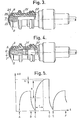
- FIG. 4 shows an electrode device according to the present invention for measuring P C02 in an ABL blood gas measuring equipment.
- a silver/ silver chloride reference electrode in the form of a band 32 is placed in a plastic housing 31.
- a pH-sensitive glass electrode is mounted having a sensitive surface 4 which is in contact with a sodium bicarbonate solution 5 serving as an electrolyte and being present in an electrolyte space which is outwardly delimited by a Teflon@ membrane 6.
- a monolayer of particles 7 Between the membrane and the surface of the pH-measuring electrode is a monolayer of particles 7.
- the membrane 6 is fixed by means of an O-ring 8.
- Figure 5 shows a section of the electrode potential/time-curve which was plotted in the experiment of the below Example 5.
- the electrode is brought into contact with water aerated with a gas mixture containing 4% carbon dioxide;
- B leaching out with water (0% carbon dioxide) begins;
- C the electrode is brought into contact with water aerated with a gas mixture containing 8% carbon dioxide;
- D leaching out with water (0% carbon dioxide) is started;
- E the electrode is brought into contact with water aerated with a gas mixture containing 4% carbon dioxide, and at F, leaching out with water (0% carbon dioxide) begins.
- An electrolyte is prepared from 12 g of stock electrolyte (S4054-electrolyte for Pco 2 -electrode, available from Radiometer A/S, Copenhagen, Denmark), said stock electrolyte comprising 1.17 g/kg of sodium chloride, 0.42 g/kg of sodium hydrogen carbonate together with silver chloride and thymol, 0.05 g of agarose and 0.372 g of carborundum 1200 having a particle size of 2-5 microns being added.
- the carborundum is added to the electrolyte with stirring with a magnetic stirrer, whereafter the agarose is added under stirring. Any air bubbles in the electrolyte dispersion prepared are then removed by evacuating the electrolyte in a desiccator at 10 mm Hg for 30 minutes.
- An electrolyte dispersion is prepared in the same manner as described in Example 1 from 12 g of stock electrolyte, 0.05 g of agarose and 0.377 g of carborundum 800 having a particle size of about 15 microns.
- An electrolyte dispersion is prepared in the manner described in Example 1 from 12 g of stock electrolyte, 0.05 g of agarose and 0.381 g of carborundum 400 having a particle size of 30-40 microns.
- the electrolyte dispersions prepared in Examples 1-3 are incorporated between the measuring electrode and the gas permeable membrane in an electrode device for determining P C02 in an ABL blood gas measuring equipment, whereby a monolayer of the carborundum particles is obtained, and measurements are carried out using the electrodes mounted in a measuring chamber in the ABL instrument.
- a corresponding electrode device equipped with a nylon spacer having a thickness of 50 microns is used.
- electrode 1 For each type of spacer, the determination is carried out using two electrodes which are termed electrode 1 and electrode 2.
- the response time is substantially reduced when the thickness of the spacer is reduced from about 50 microns (nylon) to about 30-40 microns (carborundum 400). Furthermore, it appears that the equilibration proceeds much faster than particles having a size of the order of 5-15 microns (carborundum 1200 or carborundum 800) are used, and further, it appears that this quick equilibration is not obtained at the expense of the reproducibility, as the individual measuring results (3 measurements per electrode per carbon dioxide level) do not deviate substantially from each other.
Landscapes
- Health & Medical Sciences (AREA)
- Life Sciences & Earth Sciences (AREA)
- Physics & Mathematics (AREA)
- Molecular Biology (AREA)
- Chemical & Material Sciences (AREA)
- Pathology (AREA)
- General Health & Medical Sciences (AREA)
- Public Health (AREA)
- Heart & Thoracic Surgery (AREA)
- Medical Informatics (AREA)
- Biomedical Technology (AREA)
- Surgery (AREA)
- Animal Behavior & Ethology (AREA)
- Engineering & Computer Science (AREA)
- Biophysics (AREA)
- Veterinary Medicine (AREA)
- Optics & Photonics (AREA)
- Chemical Kinetics & Catalysis (AREA)
- Electrochemistry (AREA)
- Analytical Chemistry (AREA)
- Biochemistry (AREA)
- General Physics & Mathematics (AREA)
- Immunology (AREA)
- General Chemical & Material Sciences (AREA)
- Colloid Chemistry (AREA)
- Inert Electrodes (AREA)
- Measurement Of The Respiration, Hearing Ability, Form, And Blood Characteristics Of Living Organisms (AREA)
- Ceramic Capacitors (AREA)
- Surgical Instruments (AREA)
- Coils Or Transformers For Communication (AREA)
Priority Applications (1)
| Application Number | Priority Date | Filing Date | Title |
|---|---|---|---|
| AT81301299T ATE16853T1 (de) | 1980-03-27 | 1981-03-26 | Elektrodensystem, verfahren zu dessen herstellung und fuer dieses verfahren brauchbare dispersion. |
Applications Claiming Priority (2)
| Application Number | Priority Date | Filing Date | Title |
|---|---|---|---|
| DK133280A DK133280A (da) | 1980-03-27 | 1980-03-27 | Elektrodeanordning |
| DK1332/80 | 1980-03-27 |
Publications (3)
| Publication Number | Publication Date |
|---|---|
| EP0039136A2 EP0039136A2 (en) | 1981-11-04 |
| EP0039136A3 EP0039136A3 (en) | 1982-01-20 |
| EP0039136B1 true EP0039136B1 (en) | 1985-12-04 |
Family
ID=8103674
Family Applications (1)
| Application Number | Title | Priority Date | Filing Date |
|---|---|---|---|
| EP81301299A Expired EP0039136B1 (en) | 1980-03-27 | 1981-03-26 | Electrode device, method for its preparation, and dispersion useful in the method |
Country Status (4)
| Country | Link |
|---|---|
| EP (1) | EP0039136B1 (da) |
| AT (1) | ATE16853T1 (da) |
| DE (1) | DE3173089D1 (da) |
| DK (1) | DK133280A (da) |
Families Citing this family (5)
| Publication number | Priority date | Publication date | Assignee | Title |
|---|---|---|---|---|
| DK155556C (da) * | 1981-03-20 | 1989-10-09 | Radiometer As | Termostateret elektrodeanordning |
| DK158167C (da) * | 1982-07-14 | 1990-09-17 | Radiometer As | Elektrokemisk maaleelektrodeindretning, membran til en elektrokemisk maaleelektrodeindretning og et membranmonteringssaet til montering af en membran paa en elektrokemisk maaleelektrodeindretning |
| CS231026B1 (en) * | 1982-09-27 | 1984-09-17 | Lubomir Serak | Method of voltmetric determination of oxygen and sensor to perform this method |
| US5158083A (en) * | 1989-10-23 | 1992-10-27 | Mountpelier Investments, S.A. | Miniature pco2 probe for in vivo biomedical applications |
| WO1996039624A1 (de) * | 1995-06-06 | 1996-12-12 | Forschungszentrum Jülich GmbH | Ph-sensitiver mikrosensor, sowie verfahren zu seiner herstellung |
Family Cites Families (5)
| Publication number | Priority date | Publication date | Assignee | Title |
|---|---|---|---|---|
| DE1523068A1 (de) * | 1964-07-30 | 1969-09-25 | Harth Dr Otto | Elektrode fuer Gasanalyse |
| GB1200595A (en) * | 1966-10-19 | 1970-07-29 | Mini Of Power | Improvements in or relating to membrane electrodes and cells |
| DE1623064B2 (de) * | 1966-12-17 | 1974-09-05 | Slevogt, Karl, Dr.Habil., 8120 Weilheim | Meßzelle zum Bestimmen von Gaskonzentrationen in Flüssigkeiten, insbesondere von Sauerstoff in Wasser |
| US3659586A (en) * | 1969-05-20 | 1972-05-02 | Univ Johns Hopkins | Percutaneous carbon dioxide sensor and process for measuring pulmonary efficiency |
| US4198280A (en) * | 1978-12-19 | 1980-04-15 | American Hospital Supply Corporation | Membrane support structure for electrochemical sensing probe |
-
1980
- 1980-03-27 DK DK133280A patent/DK133280A/da not_active Application Discontinuation
-
1981
- 1981-03-26 AT AT81301299T patent/ATE16853T1/de not_active IP Right Cessation
- 1981-03-26 EP EP81301299A patent/EP0039136B1/en not_active Expired
- 1981-03-26 DE DE8181301299T patent/DE3173089D1/de not_active Expired
Also Published As
| Publication number | Publication date |
|---|---|
| EP0039136A2 (en) | 1981-11-04 |
| ATE16853T1 (de) | 1985-12-15 |
| DK133280A (da) | 1981-09-28 |
| DE3173089D1 (en) | 1986-01-16 |
| EP0039136A3 (en) | 1982-01-20 |
Similar Documents
| Publication | Publication Date | Title |
|---|---|---|
| US5393391A (en) | Electrode arrangement for the electrochemical analysis of electrolytic components of a liquid | |
| US3000805A (en) | Electrode measuring device | |
| US4263115A (en) | Ion-selective electrode device for polarographic measurement of oxygen | |
| US4925544A (en) | Electrochemical sensor with solid phase electrolyte | |
| JPH0711505B2 (ja) | 電気化学分析の方法及び装置 | |
| US4614577A (en) | Apparatus for urea analysis | |
| US3223597A (en) | Method and means for oxygen analysis of gases | |
| AU531961B2 (en) | Measuring ph | |
| US3445369A (en) | Electrolytic sensor with improved membrane support | |
| EP0039136B1 (en) | Electrode device, method for its preparation, and dispersion useful in the method | |
| US5346605A (en) | Apparatus for quantitative determination of chemical oxidizing or reducing agents in a fluid environment | |
| EP0115884B1 (en) | Reference electrode asssembly | |
| US4666565A (en) | Gas sensor and method | |
| CA1240365A (en) | Gas analyzer comprising gas pervious/liquid impervious membrane | |
| Hahn | Techniques for measuring the partial pressures of gases in the blood. I. In vitro measurements | |
| Hiiro et al. | Perchlorate-selective electrodes with urushi as the membrane matrix | |
| USRE31299E (en) | Ion-selective electrode device for polarographic measurement of oxygen | |
| GB1319122A (en) | Galvanic cells | |
| US4874501A (en) | Membrane for an electrochemical measuring electrode device | |
| EP0321737B1 (en) | Miniaturized reference electrodes | |
| US4992738A (en) | Device for the measuring of gas, vapor or aerosol fractions of a measured gas | |
| WO1988008975A2 (en) | Electrochemical sensor with solid phase electrolyte | |
| GB2030706A (en) | Electrochemical sensor and method of calibration thereof | |
| Sutton et al. | Numerical simulation of the time-dependent current to membrane-covered oxygen sensors. Part IV. Experimental verification that the switch-on transient is non-Cottrellian for microdisc electrodes | |
| US3666650A (en) | Fluid sensor cap assembly |
Legal Events
| Date | Code | Title | Description |
|---|---|---|---|
| PUAI | Public reference made under article 153(3) epc to a published international application that has entered the european phase |
Free format text: ORIGINAL CODE: 0009012 |
|
| AK | Designated contracting states |
Designated state(s): AT BE CH DE FR GB IT LU NL SE |
|
| PUAL | Search report despatched |
Free format text: ORIGINAL CODE: 0009013 |
|
| AK | Designated contracting states |
Designated state(s): AT BE CH DE FR GB IT LU NL SE |
|
| 17P | Request for examination filed |
Effective date: 19820413 |
|
| GRAA | (expected) grant |
Free format text: ORIGINAL CODE: 0009210 |
|
| AK | Designated contracting states |
Designated state(s): AT BE CH DE FR GB IT LI LU NL SE |
|
| PG25 | Lapsed in a contracting state [announced via postgrant information from national office to epo] |
Ref country code: NL Effective date: 19851204 Ref country code: LI Effective date: 19851204 Ref country code: IT Free format text: LAPSE BECAUSE OF FAILURE TO SUBMIT A TRANSLATION OF THE DESCRIPTION OR TO PAY THE FEE WITHIN THE PRESCRIBED TIME-LIMIT;WARNING: LAPSES OF ITALIAN PATENTS WITH EFFECTIVE DATE BEFORE 2007 MAY HAVE OCCURRED AT ANY TIME BEFORE 2007. THE CORRECT EFFECTIVE DATE MAY BE DIFFERENT FROM THE ONE RECORDED. Effective date: 19851204 Ref country code: FR Free format text: THE PATENT HAS BEEN ANNULLED BY A DECISION OF A NATIONAL AUTHORITY Effective date: 19851204 Ref country code: CH Effective date: 19851204 Ref country code: BE Effective date: 19851204 Ref country code: AT Effective date: 19851204 |
|
| REF | Corresponds to: |
Ref document number: 16853 Country of ref document: AT Date of ref document: 19851215 Kind code of ref document: T |
|
| REF | Corresponds to: |
Ref document number: 3173089 Country of ref document: DE Date of ref document: 19860116 |
|
| PG25 | Lapsed in a contracting state [announced via postgrant information from national office to epo] |
Ref country code: SE Effective date: 19860131 |
|
| REG | Reference to a national code |
Ref country code: CH Ref legal event code: PL |
|
| PG25 | Lapsed in a contracting state [announced via postgrant information from national office to epo] |
Ref country code: LU Free format text: LAPSE BECAUSE OF NON-PAYMENT OF DUE FEES Effective date: 19860331 |
|
| EN | Fr: translation not filed | ||
| NLV1 | Nl: lapsed or annulled due to failure to fulfill the requirements of art. 29p and 29m of the patents act | ||
| PLBE | No opposition filed within time limit |
Free format text: ORIGINAL CODE: 0009261 |
|
| STAA | Information on the status of an ep patent application or granted ep patent |
Free format text: STATUS: NO OPPOSITION FILED WITHIN TIME LIMIT |
|
| 26N | No opposition filed | ||
| GBPC | Gb: european patent ceased through non-payment of renewal fee | ||
| PG25 | Lapsed in a contracting state [announced via postgrant information from national office to epo] |
Ref country code: DE Effective date: 19871201 |
|
| PG25 | Lapsed in a contracting state [announced via postgrant information from national office to epo] |
Ref country code: GB Effective date: 19881118 |