EP0035882A1 - Method for producing iodine-enriched eggs - Google Patents
Method for producing iodine-enriched eggs Download PDFInfo
- Publication number
- EP0035882A1 EP0035882A1 EP81300937A EP81300937A EP0035882A1 EP 0035882 A1 EP0035882 A1 EP 0035882A1 EP 81300937 A EP81300937 A EP 81300937A EP 81300937 A EP81300937 A EP 81300937A EP 0035882 A1 EP0035882 A1 EP 0035882A1
- Authority
- EP
- European Patent Office
- Prior art keywords
- iodine
- egg
- feed
- eggs
- enriched
- Prior art date
- Legal status (The legal status is an assumption and is not a legal conclusion. Google has not performed a legal analysis and makes no representation as to the accuracy of the status listed.)
- Granted
Links
Classifications
-
- A—HUMAN NECESSITIES
- A61—MEDICAL OR VETERINARY SCIENCE; HYGIENE
- A61K—PREPARATIONS FOR MEDICAL, DENTAL OR TOILETRY PURPOSES
- A61K35/00—Medicinal preparations containing materials or reaction products thereof with undetermined constitution
- A61K35/56—Materials from animals other than mammals
- A61K35/57—Birds; Materials from birds, e.g. eggs, feathers, egg white, egg yolk or endothelium corneum gigeriae galli
-
- A—HUMAN NECESSITIES
- A23—FOODS OR FOODSTUFFS; TREATMENT THEREOF, NOT COVERED BY OTHER CLASSES
- A23K—FODDER
- A23K20/00—Accessory food factors for animal feeding-stuffs
- A23K20/20—Inorganic substances, e.g. oligoelements
- A23K20/30—Oligoelements
-
- A—HUMAN NECESSITIES
- A23—FOODS OR FOODSTUFFS; TREATMENT THEREOF, NOT COVERED BY OTHER CLASSES
- A23K—FODDER
- A23K50/00—Feeding-stuffs specially adapted for particular animals
- A23K50/70—Feeding-stuffs specially adapted for particular animals for birds
-
- A—HUMAN NECESSITIES
- A23—FOODS OR FOODSTUFFS; TREATMENT THEREOF, NOT COVERED BY OTHER CLASSES
- A23L—FOODS, FOODSTUFFS OR NON-ALCOHOLIC BEVERAGES, NOT OTHERWISE PROVIDED FOR; PREPARATION OR TREATMENT THEREOF
- A23L15/00—Egg products; Preparation or treatment thereof
Definitions
- This invention relates to an iodine-enriched food product which has the effect of improving lipid metabolism by heightening lipoprotein lipase activity, by reducing glycogen consumption, and by improving the constitution ratio of high-density lipoptotein in the blood and which also has an anti-cancer effect.
- LDL low-density lipoprotein
- HDL high-density lipoprotein
- the iodine-enriched eggs may be obtained for example in the following manner:- an iodine compound, and/or a seaweed containing a high amount of iodine, or processed products thereof, is mixed in excess of the "normal" quantity into the feed of egg-laying birds ' e.go hens or quails. These birds having been fed or dosed with their feed then lay eggs which are high in iodine content.
- Iodine compounds which can be used are, for example, calcium iodate; potassium iodate; sodium iodate; potassium iodide; sodium iodide; cuprous iodide; thymol iodide; calcium iodobehemate; diiode salicylic acid; calcium periodate.
- seaweed are sea tangle and kelp.
- the iodine dosage varies according to the species of egg-laying bird. For hens, the dosage is from 5 to 250, preferably from 5 to 15, mg per day per head. For a hen which ingests approximately 100 g of feed per day, the iodine compound should be added to raise the-iodine content of the feed for example 5Q to 2,500 ppm, preferably 50 to 150 ppm. After approximately one week, the hen begins to produce eggs containing a high level of iodine.
- Ingesting a feed containing 50 ppm of iodine yields eggs containing approximately 300 ⁇ g iodine each and a feed containing 100 ppm of iodine yields eggs containing approximately 600-800 pg each.
- the iodine-enriched eggs may be used in their natural, non-processed formo They may also be used after being processed, e.go by heating, drying, concentrating, powdering, or granulating. They may be used for example in the form of granules tablets, or powder mixed with a bonding agent, or in the form of syrup or emulsion.
- Calcium inodate was added to a commercially available feed until its iodine content reached 100 ppm. The feed was fed to hens which has begun to lay eggs three months earlier. After ten days, eggs containing an average of 550 ⁇ g iodine per egg were produced.
- Calcium iodate was added to a commerically available feed until its iodine reached 2,000 ppm, and powdered sea tangle was added at the rate of 1%.
- the feed was fed to 100 hens which had begun to lay eggs seven months earlier.
- a total of 170 kg of eggs produced by this method were spray-dried, whereby 35 kg of dried egg were obtained.
- This powdered egg had an iodine content of 411 mg per kg.
- Calcium periodate was added to a commercially available feed to obtain an iodine content of 150 ppm, which resulted in eggs with an average iodine content of 1250 ⁇ g each.
- the eggs were broken and the contents were increased by 10% with the addition of dextrin and after adding water and blending thoroughly this mixture was spray-dried..
- Thymol iodate was added to a commercially available feed to obtain an iodine content of 75 ppm, which resulted in eggs with an average iodine content of 450 ⁇ g each which were freeze dried.
- Diiode salicylic acid was added to a commercially available feed to obtain an iodine content of 100 ppm, and powdered sea tangle was added at the rate of 1%. This feed resulted in eggs with an average iodine content of 700 ⁇ g each.
- Potassium iodate was added to a commercially available hen food so that the iodine content became 75 ppm, resulting in eggs containing on average 450 ⁇ g 'of iodine per egg by the same method as Example 2. The eggs were broken and then freeze-dried.
- Sodium'iodate was added to a commercially available hen food so that the iodine content became 100 ppm, and powdered seaweed was added at the rate of 0.5% resulting in eggs containing on average 650 ⁇ g of iodine per egg on feeding to egg-laying hens as in Example 2.
- Animals used 10 female rats, Wistar descent, weighing 100-110 g each.
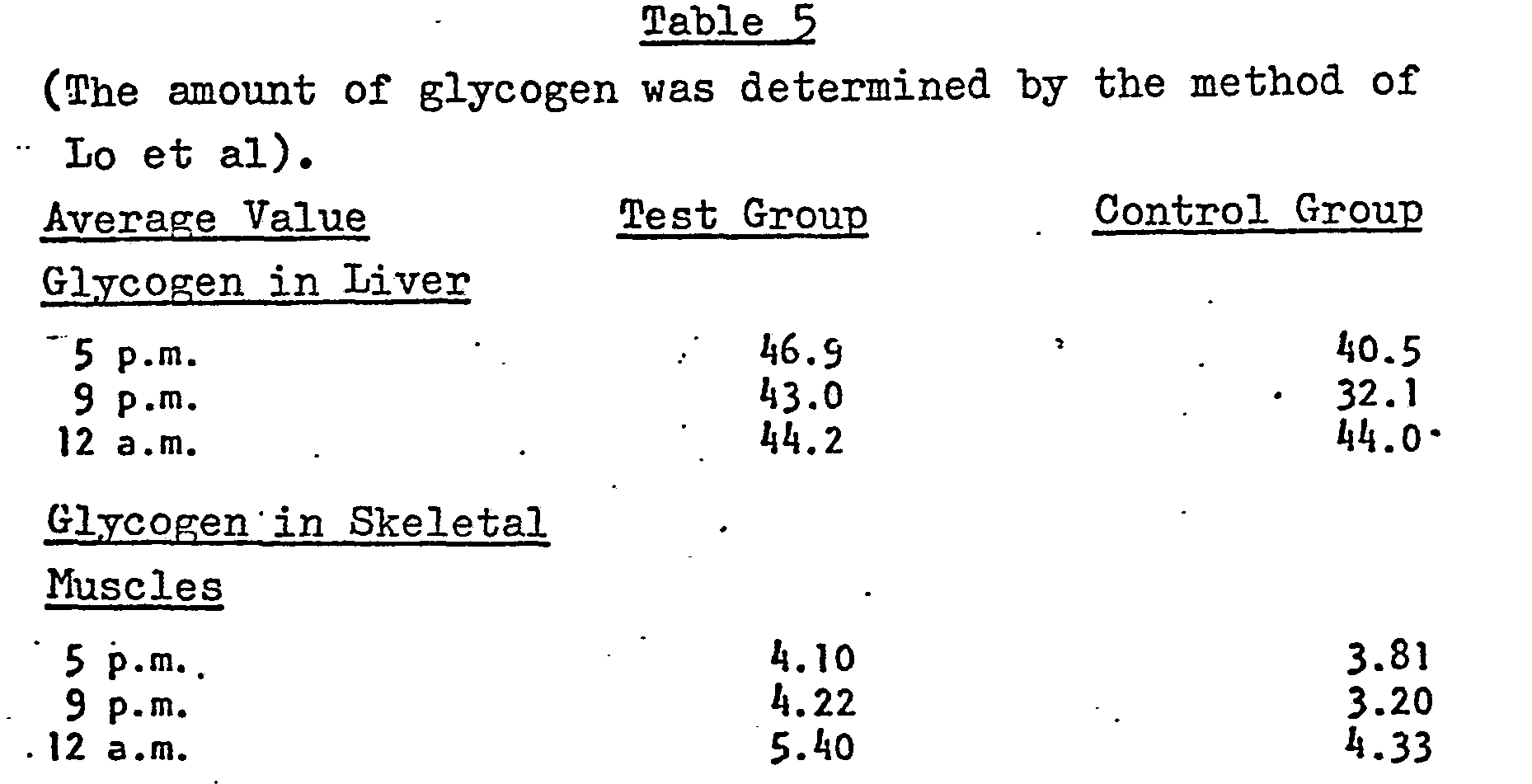
- mice used 30 male rats, SD descent. Three-week-old rats were placed in cages with a voluntary exercise apparatus. For 10 days they were fed a commercially available solid basic feed. They were fed twice a day between 8 and 9 a.m. and between 9 and 10 p.m. with a powdered basic feed made by Nihon Nosan Kogyo, K.K. until they were 7 weeks old. They were divided into two groups of 15 each, with the same average weight and performance of voluntary exercise. The first group, designated as the test group, was fed a test feed which had been prepared by adding 2% powdered iodine enriched egg of Example 2 to the powdered basic feed. The second group, designated as the control group, was fed a control feed which has been prepared by adding 2% powdered ordinary egg to the powdered basic feed. Tables 1 and 2 show the composition of egg powders and feed, respectively.
- each feeding cage was maintained at 25° ⁇ 2°C and humidity, between 50% and 80%.
- the amount of each feed ingested was measured for three days per week, and each rat was weighed twice per week.
- the rats were fed in this manner for 10 weeks and then were decapitated some at 5 p.m., some at 9 p.m., some at 12 a.m., or before, during and after feed ingestion to measure the following: lipoprotein lipase activity in the adipose tissue; lipoprotein lipase activity in the skeletal muscles; glycogen level in the liver; glycogen level in the skeletal muscles; total amount of whole blood cholesterol; amount of hematic high-density lipoprotein (HDL); and constitution ratio of hematic HDL.
- HDL hematic high-density lipoprotein
- Tables 4 and 5 show measurement of lipoprotein lipase (LPL) activity and the level of glycogen, respectively.
- HDL hematic high-density lipoprotein
- Animals used 26 male rats, SD descent.
- 3-week-old rats were fed in the same manner as in Experiment 1, but the cages had no voluntary exercise apparatus. Instead, the rats were compelled to exercise once a week with a compulsory swimming exercise apparatus so as to experience fatigue.
- the apparatus was set in 30°C water with approximately 40 m/min of current speed.
- the first group was composed of 14 rats, the second, 12.
- the total amount of whole cholesterol and the amount of hematic HDL of each group were determined as in Experiment 1. These measurements are shown in Table 7. It is apparent that the constitution ratio of hematic HDL was improved by the food product of the invention.
- a daily dose of 3 g of powdered iodine enriched egg of Example 2 was given over a period of 2 to 3 months to 10 outpatients with hypercholesterolemia. Both before and after dosage ingestion, the total amount of whole blood cholesterol, the level of hematic HDL, and the level of hematic LDL were measured (Table 8). The food product increased the amount of HDL while lowering that of LDL.
- mice Three week old mice were divided into two groups of 36 namely, a test group and a control group.
- the test group mice were fed with a feed, which was prepared by adding the iodine-enriched powdered egg of Example 1 to a powdered commercially available basic feed at the rate of 5%.
- the control group mice were fed with a feed, which was prepared by adding the ordinary powdered egg shown in the right column of Table 1 to the powdered basic feed at the rate of 5%.
- the mice of the test and control groups were fed up to six weeks old.
- the test group mice were divided into three minor groups of 12, and the control group mice were also divided into three minor groups of 12
- Sarcoma 180 of 5 x 10 2 / 0.2 ml was transplanted or grafted to the abdominal cavity of mice belonging to the first minor groups of the test and control groups.
- Sarcoma 180 of 5 x 10 3 / 0.2 ml was transplanted to the abdominal cavity of mice belonging to the second minor groups of the test and control groups, and Sarcoma 180 of 5 x 10 / 0.2 ml was also transplanted to the abdominal cavity of mice belonging to the third minor groups of the test and control groups.
- the mice of the test and control groups were fed with the respective feeds, and observed for 60 days. The result of such observation is shown in Table 9. The effect of life prolongation was proved with respect to the mice ingesting the feed to which the product of the present invention was added.
Landscapes
- Life Sciences & Earth Sciences (AREA)
- Chemical & Material Sciences (AREA)
- Polymers & Plastics (AREA)
- Health & Medical Sciences (AREA)
- Engineering & Computer Science (AREA)
- Food Science & Technology (AREA)
- Birds (AREA)
- Animal Husbandry (AREA)
- Zoology (AREA)
- Pharmacology & Pharmacy (AREA)
- Medicinal Chemistry (AREA)
- Epidemiology (AREA)
- Animal Behavior & Ethology (AREA)
- General Health & Medical Sciences (AREA)
- Public Health (AREA)
- Veterinary Medicine (AREA)
- Inorganic Chemistry (AREA)
- Nutrition Science (AREA)
- Medicines Containing Material From Animals Or Micro-Organisms (AREA)
- Fodder In General (AREA)
- Coloring Foods And Improving Nutritive Qualities (AREA)
Abstract
Description
- This invention relates to an iodine-enriched food product which has the effect of improving lipid metabolism by heightening lipoprotein lipase activity, by reducing glycogen consumption, and by improving the constitution ratio of high-density lipoptotein in the blood and which also has an anti-cancer effect.
- Americans, as well as Japanese, have been consuming fewer and fewer eggs in recent years. This trend seems to reflect a fear that eating too many eggs may cause heart trouble, a fear based on the theory that maintaining a diet high in cholesterol may increase the amount of serum or hematic cholesterol, which in turn may increase the incidence of coronary artery disease.
- This view seems to prevail despite reports that an ordinary diet with one to three eggs per day for several months makes no significant difference in the average level of blood cholesterol. (FEEDSTUFF, August 7, 14, 22 and 24, 1978). Limiting egg ingestion has never been proved to be an effective means of preventing heart disease but the nutritive value of eggs is well known.
- However, many recent studies argue that the problem of-blood cholesterol relates not as much to the overall quantity of cholesterol as to the kinds of cholesterol and their respective amounts in the blood. The generally-accepted view maintains that a high level of low-density lipoprotein (LDL) will tend to encourage the development and aggravation of heart disease, while a high level of high-density lipoprotein (HDL) will tend to discourage it.
- Increasing the level of HDL while lowering the level of LDL is desirable, Ingestion of ordinary egg yolk has been found to slightly increase the level of HDL but it also greatly increase the level of LDL. (Nihon University Medical Vepartment Bulletin #38, 1979).
- A number of diets (balancing polyunsaturated and .saturated fats, for example) have been devised to heighten the level of HDL in order to prevent hypercholesterolemia. However, many of these have not proved satisfactory because they require major and difficult changes in the patient's eating habits. The food product of this invention can be ingested easily as an ordinary food in a daily diet and can improve the constitution ratio of HDL in the blood. By "constitutor ratio" we mean the ratio of HDL cholesterol to total cholesterol.
- We have conducted numerous studies on how micro- nutrients, added to chicken feed, might influence the chemical composition of the egg. We have also studied the effects which different egg compositions have on human diseases e.g. cancer and on lipid metabolism and hematic cholesterol. We have found that ingestion of eggs containing a high amount of iodine has an anti-cancer effect and has the effect of heightening lipoprotein lipase activity, of reducing glycogen consumption, and of simultaneously improving the constitution ratio of high-density lipoprotein (HDL) in the blood.
- Our research has not disclosed any report that any food product containing a high amount of iodine or iodine itself demonstrates the above effects. Our invention, therefore, may be called a "pioneer invention".
- The iodine-enriched eggs may be obtained for example in the following manner:- an iodine compound, and/or a seaweed containing a high amount of iodine, or processed products thereof, is mixed in excess of the "normal" quantity into the feed of egg-laying birds 'e.go hens or quails. These birds having been fed or dosed with their feed then lay eggs which are high in iodine content. Iodine compounds which can be used are, for example, calcium iodate; potassium iodate; sodium iodate; potassium iodide; sodium iodide; cuprous iodide; thymol iodide; calcium iodobehemate; diiode salicylic acid; calcium periodate. Examples of seaweed are sea tangle and kelp.
- Our studies show that, having regard to the health of the bird, chemical stability, and rate of iodine transferability to the egg, calcium iodate is the most desirable iodine compoundo It is even more desirable when the seaweed is added to ito
- The iodine dosage varies according to the species of egg-laying bird. For hens, the dosage is from 5 to 250, preferably from 5 to 15, mg per day per head. For a hen which ingests approximately 100 g of feed per day, the iodine compound should be added to raise the-iodine content of the feed for example 5Q to 2,500 ppm, preferably 50 to 150 ppm. After approximately one week, the hen begins to produce eggs containing a high level of iodine. Ingesting a feed containing 50 ppm of iodine yields eggs containing approximately 300 µg iodine each and a feed containing 100 ppm of iodine yields eggs containing approximately 600-800 pg each.
- By contrast, ordinary egg production requires a feed with 0.30 to 0.35 mg of iodine per kg of feed. According to the American Egg Board, a commercially available feed which contains from 0.3 to 2.0 mg of iodine per kg will produce ordinary eggs containing approximately 6 µg of iodine each, or at most 30 µg each. In comparison, the eggs obtained by the methods of this invention contains a particularly high level of iodine.
- The iodine-enriched eggs may be used in their natural, non-processed formo They may also be used after being processed, e.go by heating, drying, concentrating, powdering, or granulating. They may be used for example in the form of granules tablets, or powder mixed with a bonding agent, or in the form of syrup or emulsion.
- The invention is illustrated by the following Examples.
- Calcium inodate was added to a commercially available feed until its iodine content reached 100 ppm. The feed was fed to hens which has begun to lay eggs three months earlier. After ten days, eggs containing an average of 550 µg iodine per egg were produced.
- Calcium iodate was added to a commerically available feed until its iodine reached 2,000 ppm, and powdered sea tangle was added at the rate of 1%. The feed was fed to 100 hens which had begun to lay eggs seven months earlier. A total of 170 kg of eggs produced by this method were spray-dried, whereby 35 kg of dried egg were obtained. This powdered egg had an iodine content of 411 mg per kg.
- Calcium periodate was added to a commercially available feed to obtain an iodine content of 150 ppm, which resulted in eggs with an average iodine content of 1250 µg each. The eggs were broken and the contents were increased by 10% with the addition of dextrin and after adding water and blending thoroughly this mixture was spray-dried..
- Thymol iodate was added to a commercially available feed to obtain an iodine content of 75 ppm, which resulted in eggs with an average iodine content of 450 µg each which were freeze dried.
- Diiode salicylic acid was added to a commercially available feed to obtain an iodine content of 100 ppm, and powdered sea tangle was added at the rate of 1%. This feed resulted in eggs with an average iodine content of 700 µg each.
- Potassium iodate was added to a commercially available hen food so that the iodine content became 75 ppm, resulting in eggs containing on average 450 µg 'of iodine per egg by the same method as Example 2. The eggs were broken and then freeze-dried.
- Sodium'iodate was added to a commercially available hen food so that the iodine content became 100 ppm, and powdered seaweed was added at the rate of 0.5% resulting in eggs containing on average 650 µg of iodine per egg on feeding to egg-laying hens as in Example 2.
- To ascertain the safety of the food product of the invention the following test was conducted.
- Animals used: 10 female rats, Wistar descent, weighing 100-110 g each.
- In this test, rats were fed iodine enriched powdered eggs in doses which were increased in.geometric ratio to the maximum of 50 mg of iodine per kg of the rat's weighto After seven days, none of the rats had died or lost weight. The product therefore had no acute virulenceo
- - The following animal experiments were then conducted to observe the effect of the food product of the invention in improving the constitution ratio of high-density lipprotein (HDL) in the blood and the anti-cancer effect of the food product.
- Animals used: 30 male rats, SD descent. Three-week-old rats were placed in cages with a voluntary exercise apparatus. For 10 days they were fed a commercially available solid basic feed. They were fed twice a day between 8 and 9 a.m. and between 9 and 10 p.m. with a powdered basic feed made by Nihon Nosan Kogyo, K.K. until they were 7 weeks old. They were divided into two groups of 15 each, with the same average weight and performance of voluntary exercise. The first group, designated as the test group, was fed a test feed which had been prepared by adding 2% powdered iodine enriched egg of Example 2 to the powdered basic feed. The second group, designated as the control group, was fed a control feed which has been prepared by adding 2% powdered ordinary egg to the powdered basic feed. Tables 1 and 2 show the composition of egg powders and feed, respectively.

- The temperature in each feeding cage was maintained at 25°± 2°C and humidity, between 50% and 80%. The amount of each feed ingested was measured for three days per week, and each rat was weighed twice per week. The rats were fed in this manner for 10 weeks and then were decapitated some at 5 p.m., some at 9 p.m., some at 12 a.m., or before, during and after feed ingestion to measure the following: lipoprotein lipase activity in the adipose tissue; lipoprotein lipase activity in the skeletal muscles; glycogen level in the liver; glycogen level in the skeletal muscles; total amount of whole blood cholesterol; amount of hematic high-density lipoprotein (HDL); and constitution ratio of hematic HDL.
- Although there was little difference between the test group and the control group with respect to the amount of feed ingestion and weight increase (Table 3), the amount of voluntary exercise of the test group was consistently higher than that of the control group.

- Tables 4 and 5 show measurement of lipoprotein lipase (LPL) activity and the level of glycogen, respectively.

-

- The measurements of the constitution ratio of hematic high-density lipoprotein (HDL) is shown in Table 6.

- Animals used: 26 male rats, SD descent.
- 3-week-old rats were fed in the same manner as in Experiment 1, but the cages had no voluntary exercise apparatus. Instead, the rats were compelled to exercise once a week with a compulsory swimming exercise apparatus so as to experience fatigue. The apparatus was set in 30°C water with approximately 40 m/min of current speed.
- The first group was composed of 14 rats, the second, 12. The total amount of whole cholesterol and the amount of hematic HDL of each group were determined as in Experiment 1. These measurements are shown in Table 7. It is apparent that the constitution ratio of hematic HDL was improved by the food product of the invention.

- After the safety of the food product and is effect in improving the constitution ratio of hematic HDL in animals had been ascertained, clinical tests were con- ductedo
- A daily dose of 3 g of powdered iodine enriched egg of Example 2 was given over a period of 2 to 3 months to 10 outpatients with hypercholesterolemia. Both before and after dosage ingestion, the total amount of whole blood cholesterol, the level of hematic HDL, and the level of hematic LDL were measured (Table 8). The food product increased the amount of HDL while lowering that of LDL.

- Both animal experiments and clinical tests indicate that the food product of the invention heightens lipoprotein lipase activity and reduces glycogen consumption, and improves the constitution ratio of hematic HDL.
- Although the precise cause of this has not yet been determined, it is theorized that the iodine transferred to eggs through the hen's living body combines chemically with the composition of the egg, and that this combination directly or indirectly acts on lipoprotein lipase activity to produce said effects.
- Continued ingestion of the food product is desirable because it does not produce immediate effects. The product does not cause any ill side-effects, and it is superior to ordinary eggs in its nutritive value.
- When one or two eggs with an iodine content of 300 to 1,000 pg per egg are ingested as a part of one's daily diet, the intended improvement begins to show in approximately one montho This is accomplished without abnormally upsetting the constitution ratio of the hematic lipoproteins.
- Animals used: Mice, ddy descent Sex: Male Number: 72 heads
- Three week old mice were divided into two groups of 36 namely, a test group and a control group. The test group mice were fed with a feed, which was prepared by adding the iodine-enriched powdered egg of Example 1 to a powdered commercially available basic feed at the rate of 5%. On the other hand, the control group mice were fed with a feed, which was prepared by adding the ordinary powdered egg shown in the right column of Table 1 to the powdered basic feed at the rate of 5%. The mice of the test and control groups were fed up to six weeks old. Thereafter, the test group mice were divided into three minor groups of 12, and the control group mice were also divided into three minor groups of 12 Sarcoma 180 of 5 x 10² / 0.2 ml was transplanted or grafted to the abdominal cavity of mice belonging to the first minor groups of the test and control groups. Sarcoma 180 of 5 x 10³ / 0.2 ml was transplanted to the abdominal cavity of mice belonging to the second minor groups of the test and control groups, and Sarcoma 180 of 5 x 10 / 0.2 ml was also transplanted to the abdominal cavity of mice belonging to the third minor groups of the test and control groups. After such transplantations, the mice of the test and control groups were fed with the respective feeds, and observed for 60 days. The result of such observation is shown in Table 9. The effect of life prolongation was proved with respect to the mice ingesting the feed to which the product of the present invention was added.

- Considering the above experiment result, it is apparent that the food product of the present invention has an anti-cancer effect.
- It is desirable to ingest the product of the invention continuously because, as stated above, it is slow acting.
Claims (16)
Priority Applications (1)
| Application Number | Priority Date | Filing Date | Title |
|---|---|---|---|
| AT81300937T ATE8195T1 (en) | 1980-03-07 | 1981-03-06 | PROCESS FOR PRODUCING IODINE-FORTIFIED EGGS. |
Applications Claiming Priority (4)
| Application Number | Priority Date | Filing Date | Title |
|---|---|---|---|
| JP28004/80 | 1980-03-07 | ||
| JP2800480A JPS56125314A (en) | 1980-03-07 | 1980-03-07 | Composition for improving constitutional ratio of lipoprotein with high specific gravity in blood |
| JP39054/80 | 1980-03-28 | ||
| JP3905480A JPS56138119A (en) | 1980-03-28 | 1980-03-28 | Composition having carcinostatic activity |
Publications (2)
| Publication Number | Publication Date |
|---|---|
| EP0035882A1 true EP0035882A1 (en) | 1981-09-16 |
| EP0035882B1 EP0035882B1 (en) | 1984-07-04 |
Family
ID=26366022
Family Applications (1)
| Application Number | Title | Priority Date | Filing Date |
|---|---|---|---|
| EP81300937A Expired EP0035882B1 (en) | 1980-03-07 | 1981-03-06 | Method for producing iodine-enriched eggs |
Country Status (2)
| Country | Link |
|---|---|
| EP (1) | EP0035882B1 (en) |
| DE (1) | DE3164511D1 (en) |
Cited By (13)
| Publication number | Priority date | Publication date | Assignee | Title |
|---|---|---|---|---|
| US4816255A (en) * | 1985-07-31 | 1989-03-28 | Ghent William R | Treatment of iodine deficiency breast syndrome |
| US4858560A (en) * | 1987-01-07 | 1989-08-22 | Toyo Jozo Co., Ltd. | Method of breeding poultry for food |
| WO1989012402A1 (en) * | 1988-06-15 | 1989-12-28 | Dieter Horsch | Poultry feed |
| EP0472003A1 (en) * | 1990-08-20 | 1992-02-26 | Nihon Nosan Kogyo K.K. | Anti-inflammatory composite containing iodine enriched eggs |
| US5250304A (en) * | 1985-07-31 | 1993-10-05 | Ghent William R | Treatment of iodine deficiency diseases |
| US5910318A (en) * | 1991-03-28 | 1999-06-08 | 943038 Ontario Inc. | Treatment of iodine deficiency diseases |
| CN1044553C (en) * | 1992-08-04 | 1999-08-11 | 霍继尧 | Preparation method of protein nutrient solution |
| US5955101A (en) * | 1991-03-28 | 1999-09-21 | 943038 Ontario Inc. | Dry starch-iodine pharmaceutical formulations |
| US6019970A (en) * | 1985-07-31 | 2000-02-01 | Ghent William R. | Treatment of iodine deficiency diseases |
| EP1308095A1 (en) * | 2001-10-31 | 2003-05-07 | Earl Moulin du Chatel | Feed for laying hens which produces eggs enriched in iodine and polyunsaturated fatty acids and corresponding feeding method |
| EP1344460A1 (en) * | 2002-03-15 | 2003-09-17 | Nosan Corporation | Egg having active oxygen eliminating ability and method of producing same |
| US6642202B2 (en) * | 2002-03-12 | 2003-11-04 | Nosan Corporation | Egg having active oxygen eliminating ability and method of producing same |
| WO2006045008A3 (en) * | 2004-10-19 | 2006-12-28 | Cargill Inc | Meat having increased level of hdl |
Citations (2)
| Publication number | Priority date | Publication date | Assignee | Title |
|---|---|---|---|---|
| DE1692489B2 (en) * | 1966-10-01 | 1978-07-13 | Sieverding, Louis, Monterey Park, Calif. (V.St.A.) | Drinker for chickens |
| CH621243A5 (en) * | 1976-08-16 | 1981-01-30 | Nihon Nosan Kogyo | Method for obtaining edible iodine-enriched eggs |
-
1981
- 1981-03-06 EP EP81300937A patent/EP0035882B1/en not_active Expired
- 1981-03-06 DE DE8181300937T patent/DE3164511D1/en not_active Expired
Patent Citations (2)
| Publication number | Priority date | Publication date | Assignee | Title |
|---|---|---|---|---|
| DE1692489B2 (en) * | 1966-10-01 | 1978-07-13 | Sieverding, Louis, Monterey Park, Calif. (V.St.A.) | Drinker for chickens |
| CH621243A5 (en) * | 1976-08-16 | 1981-01-30 | Nihon Nosan Kogyo | Method for obtaining edible iodine-enriched eggs |
Non-Patent Citations (4)
| Title |
|---|
| CHEMICAL ABSTRACTS, Vol. 52, No. 1, January 10, 1958 Abstract 522a Columbus, Ohio, USA I. SUNDE "Iodine Content of Eggs from Hens Fed with Seaweed Meal" & Intern. Seaweed Symposium 2nd, Trondheim 1955, 109-13 (publ. 1956) *Abstract* * |
| CHEMICAL ABSTRACTS, Vol. 52, No. 6, March 25, 1958, Abstract 4763b Columbus, Ohio, USA H. BERGNER "Influence of Feeding Iodine on Egg Production, Iodine Metabolism, and the Iodine Content of Hen Eggs" & Arch Tierernahr, 7, 284-320 (1957) *Abstract* * |
| CHEMICAL ABSTRACTS, Vol. 53. No. 19, October 10, 1959 Abstract 18211f Columbus, Ohio, USA J. VELTHUIZEN: "The Excretion of Iodine in the Hen Egg" & Arch. Geflugelk. 20, 97-106 (1956) *Abstract* * |
| CHEMICAL ABSTRACTS, Vol. 57, No. 7, October 1, 1962, Abstract 8987c Columbus, Ohio, USA G.P. GUREVICH : "Iodine Concentration in Eggs in Supplementary Feeding of Hens with Seaweeds and Fish Meal" & Vopr. Pitaniya, 18, No. 5, 66-77(1959) *Abstract* * |
Cited By (13)
| Publication number | Priority date | Publication date | Assignee | Title |
|---|---|---|---|---|
| US6019970A (en) * | 1985-07-31 | 2000-02-01 | Ghent William R. | Treatment of iodine deficiency diseases |
| US5250304A (en) * | 1985-07-31 | 1993-10-05 | Ghent William R | Treatment of iodine deficiency diseases |
| US4816255A (en) * | 1985-07-31 | 1989-03-28 | Ghent William R | Treatment of iodine deficiency breast syndrome |
| US4858560A (en) * | 1987-01-07 | 1989-08-22 | Toyo Jozo Co., Ltd. | Method of breeding poultry for food |
| WO1989012402A1 (en) * | 1988-06-15 | 1989-12-28 | Dieter Horsch | Poultry feed |
| EP0472003A1 (en) * | 1990-08-20 | 1992-02-26 | Nihon Nosan Kogyo K.K. | Anti-inflammatory composite containing iodine enriched eggs |
| US5910318A (en) * | 1991-03-28 | 1999-06-08 | 943038 Ontario Inc. | Treatment of iodine deficiency diseases |
| US5955101A (en) * | 1991-03-28 | 1999-09-21 | 943038 Ontario Inc. | Dry starch-iodine pharmaceutical formulations |
| CN1044553C (en) * | 1992-08-04 | 1999-08-11 | 霍继尧 | Preparation method of protein nutrient solution |
| EP1308095A1 (en) * | 2001-10-31 | 2003-05-07 | Earl Moulin du Chatel | Feed for laying hens which produces eggs enriched in iodine and polyunsaturated fatty acids and corresponding feeding method |
| US6642202B2 (en) * | 2002-03-12 | 2003-11-04 | Nosan Corporation | Egg having active oxygen eliminating ability and method of producing same |
| EP1344460A1 (en) * | 2002-03-15 | 2003-09-17 | Nosan Corporation | Egg having active oxygen eliminating ability and method of producing same |
| WO2006045008A3 (en) * | 2004-10-19 | 2006-12-28 | Cargill Inc | Meat having increased level of hdl |
Also Published As
| Publication number | Publication date |
|---|---|
| DE3164511D1 (en) | 1984-08-09 |
| EP0035882B1 (en) | 1984-07-04 |
Similar Documents
| Publication | Publication Date | Title |
|---|---|---|
| Hashim et al. | Medium chain triglyceride in early life: effects on growth of adipose tissue | |
| EP0035882B1 (en) | Method for producing iodine-enriched eggs | |
| US4338304A (en) | Composite for treating diabetes | |
| US4410541A (en) | Composite for improving lipid metabolism | |
| US5154925A (en) | Treatment of tibial dyschondroplasia | |
| US4394376A (en) | Method for preventing hypertriglyceridemia | |
| JPS5832867B2 (en) | Eggs containing high concentrations of lysozyme and iodine | |
| Norris et al. | Effect of quantity of dietary calcium on maintenance of bone integrity in mature White Leghorn male chickens | |
| Castro et al. | Incorporation of tributyrin and tricaproin into milk replacer on intake, growth, and health of Holstein calves | |
| Hurwitz et al. | The effect of dietary calcium carbonate on feed intake and conversion in laying hens | |
| DK1776956T3 (en) | An agent for the prevention and / or treatment of calcium deficiency | |
| Panigrahi et al. | Effects on dietary phosphorus of treating cottonseed meal with crystalline ferrous sulphate for the prevention of brown yolk discolouration | |
| Cunningham | Effects of epinephrine, norepinephrine and nicotine on growth and carcass composition of chicks | |
| CA1158983A (en) | Bird feed mixture to produce iodine enriched eggs | |
| Gershoff et al. | Effect of vitamin D and Ca: P ratios on chick gastrointestinal tract | |
| Thaxton et al. | Toxicity of mercury to young chickens: 2. Gross changes in organs | |
| Al-Janabi et al. | Effect of vitamin C administration on serum and egg-yolk cholesterol level of the chicken | |
| Harrand et al. | The effect of vitamin D in rats maintained on diets with different mineral content but with the same calcium to phosphorus ratio of unity | |
| KR830001810B1 (en) | Production method of high iodine-containing eggs with lipid metabolism improvement | |
| Bartov et al. | The effect of soy sterols in hypercholesterolemic chicks | |
| Steinborn et al. | Phosphate treatment of alumina gel weakness in young chicks | |
| JPS6332331B2 (en) | ||
| Koyanagi et al. | Effect of riboflavin, choline, pantothenic acid and vitamin A on the excretion of sodium in urine of rats | |
| WO2003011309A2 (en) | Pharmaceutical composition for treating hypercholesterolaemia | |
| Salem et al. | Calcium and phosphorus metabolism and egg shell formation in Egyptian birds |
Legal Events
| Date | Code | Title | Description |
|---|---|---|---|
| PUAI | Public reference made under article 153(3) epc to a published international application that has entered the european phase |
Free format text: ORIGINAL CODE: 0009012 |
|
| AK | Designated contracting states |
Designated state(s): AT BE CH DE FR GB IT LU NL SE |
|
| 17P | Request for examination filed |
Effective date: 19820310 |
|
| ITF | It: translation for a ep patent filed | ||
| GRAA | (expected) grant |
Free format text: ORIGINAL CODE: 0009210 |
|
| AK | Designated contracting states |
Designated state(s): AT BE CH DE FR GB IT LI LU NL SE |
|
| REF | Corresponds to: |
Ref document number: 8195 Country of ref document: AT Date of ref document: 19840715 Kind code of ref document: T |
|
| REF | Corresponds to: |
Ref document number: 3164511 Country of ref document: DE Date of ref document: 19840809 |
|
| ET | Fr: translation filed | ||
| PLBE | No opposition filed within time limit |
Free format text: ORIGINAL CODE: 0009261 |
|
| STAA | Information on the status of an ep patent application or granted ep patent |
Free format text: STATUS: NO OPPOSITION FILED WITHIN TIME LIMIT |
|
| 26N | No opposition filed | ||
| ITTA | It: last paid annual fee | ||
| EPTA | Lu: last paid annual fee | ||
| EAL | Se: european patent in force in sweden |
Ref document number: 81300937.0 |
|
| PGFP | Annual fee paid to national office [announced via postgrant information from national office to epo] |
Ref country code: GB Payment date: 19970225 Year of fee payment: 17 |
|
| PGFP | Annual fee paid to national office [announced via postgrant information from national office to epo] |
Ref country code: CH Payment date: 19970311 Year of fee payment: 17 |
|
| PGFP | Annual fee paid to national office [announced via postgrant information from national office to epo] |
Ref country code: FR Payment date: 19970313 Year of fee payment: 17 Ref country code: AT Payment date: 19970313 Year of fee payment: 17 |
|
| PGFP | Annual fee paid to national office [announced via postgrant information from national office to epo] |
Ref country code: DE Payment date: 19970314 Year of fee payment: 17 |
|
| PGFP | Annual fee paid to national office [announced via postgrant information from national office to epo] |
Ref country code: SE Payment date: 19970319 Year of fee payment: 17 |
|
| PGFP | Annual fee paid to national office [announced via postgrant information from national office to epo] |
Ref country code: NL Payment date: 19970327 Year of fee payment: 17 |
|
| PGFP | Annual fee paid to national office [announced via postgrant information from national office to epo] |
Ref country code: LU Payment date: 19970407 Year of fee payment: 17 |
|
| PGFP | Annual fee paid to national office [announced via postgrant information from national office to epo] |
Ref country code: BE Payment date: 19970521 Year of fee payment: 17 |
|
| PG25 | Lapsed in a contracting state [announced via postgrant information from national office to epo] |
Ref country code: LU Free format text: LAPSE BECAUSE OF NON-PAYMENT OF DUE FEES Effective date: 19980306 Ref country code: GB Free format text: LAPSE BECAUSE OF NON-PAYMENT OF DUE FEES Effective date: 19980306 Ref country code: AT Free format text: LAPSE BECAUSE OF NON-PAYMENT OF DUE FEES Effective date: 19980306 |
|
| PG25 | Lapsed in a contracting state [announced via postgrant information from national office to epo] |
Ref country code: SE Free format text: LAPSE BECAUSE OF NON-PAYMENT OF DUE FEES Effective date: 19980307 |
|
| PG25 | Lapsed in a contracting state [announced via postgrant information from national office to epo] |
Ref country code: LI Free format text: LAPSE BECAUSE OF NON-PAYMENT OF DUE FEES Effective date: 19980331 Ref country code: FR Free format text: THE PATENT HAS BEEN ANNULLED BY A DECISION OF A NATIONAL AUTHORITY Effective date: 19980331 Ref country code: CH Free format text: LAPSE BECAUSE OF NON-PAYMENT OF DUE FEES Effective date: 19980331 Ref country code: BE Free format text: LAPSE BECAUSE OF NON-PAYMENT OF DUE FEES Effective date: 19980331 |
|
| BERE | Be: lapsed |
Owner name: NIHON NOSAN KOGYO K.K. Effective date: 19980331 |
|
| PG25 | Lapsed in a contracting state [announced via postgrant information from national office to epo] |
Ref country code: NL Free format text: LAPSE BECAUSE OF NON-PAYMENT OF DUE FEES Effective date: 19981001 |
|
| GBPC | Gb: european patent ceased through non-payment of renewal fee |
Effective date: 19980306 |
|
| REG | Reference to a national code |
Ref country code: CH Ref legal event code: PL |
|
| NLV4 | Nl: lapsed or anulled due to non-payment of the annual fee |
Effective date: 19981001 |
|
| PG25 | Lapsed in a contracting state [announced via postgrant information from national office to epo] |
Ref country code: DE Free format text: LAPSE BECAUSE OF NON-PAYMENT OF DUE FEES Effective date: 19981201 |
|
| EUG | Se: european patent has lapsed |
Ref document number: 81300937.0 |
|
| REG | Reference to a national code |
Ref country code: FR Ref legal event code: ST |