EP0034489B1 - Novel method of storing processed fish and roe - Google Patents
Novel method of storing processed fish and roe Download PDFInfo
- Publication number
- EP0034489B1 EP0034489B1 EP81300616A EP81300616A EP0034489B1 EP 0034489 B1 EP0034489 B1 EP 0034489B1 EP 81300616 A EP81300616 A EP 81300616A EP 81300616 A EP81300616 A EP 81300616A EP 0034489 B1 EP0034489 B1 EP 0034489B1
- Authority
- EP
- European Patent Office
- Prior art keywords
- fish
- bag
- gas
- oxygen absorbent
- oxygen
- Prior art date
- Legal status (The legal status is an assumption and is not a legal conclusion. Google has not performed a legal analysis and makes no representation as to the accuracy of the status listed.)
- Expired
Links
- 241000251468 Actinopterygii Species 0.000 title claims description 49
- 238000000034 method Methods 0.000 title claims description 27
- 239000007789 gas Substances 0.000 claims description 39
- QVGXLLKOCUKJST-UHFFFAOYSA-N atomic oxygen Chemical compound [O] QVGXLLKOCUKJST-UHFFFAOYSA-N 0.000 claims description 29
- 239000001301 oxygen Substances 0.000 claims description 29
- 229910052760 oxygen Inorganic materials 0.000 claims description 29
- 239000002250 absorbent Substances 0.000 claims description 19
- 230000002745 absorbent Effects 0.000 claims description 19
- 239000000463 material Substances 0.000 claims description 12
- 238000012856 packing Methods 0.000 claims description 11
- 239000000203 mixture Substances 0.000 claims description 8
- 230000035699 permeability Effects 0.000 claims description 8
- XLYOFNOQVPJJNP-UHFFFAOYSA-N water Substances O XLYOFNOQVPJJNP-UHFFFAOYSA-N 0.000 claims description 8
- XEEYBQQBJWHFJM-UHFFFAOYSA-N Iron Chemical compound [Fe] XEEYBQQBJWHFJM-UHFFFAOYSA-N 0.000 claims description 6
- 238000004806 packaging method and process Methods 0.000 claims description 6
- 239000012267 brine Substances 0.000 claims description 5
- HPALAKNZSZLMCH-UHFFFAOYSA-M sodium;chloride;hydrate Chemical compound O.[Na+].[Cl-] HPALAKNZSZLMCH-UHFFFAOYSA-M 0.000 claims description 5
- 238000003475 lamination Methods 0.000 claims description 4
- 150000003839 salts Chemical class 0.000 claims description 4
- 210000001015 abdomen Anatomy 0.000 claims description 3
- 239000002985 plastic film Substances 0.000 claims description 3
- 229920006255 plastic film Polymers 0.000 claims description 3
- 239000007787 solid Substances 0.000 claims description 3
- 239000003638 chemical reducing agent Substances 0.000 claims description 2
- 239000004744 fabric Substances 0.000 claims description 2
- 239000004745 nonwoven fabric Substances 0.000 claims description 2
- 239000000123 paper Substances 0.000 claims description 2
- 150000008442 polyphenolic compounds Chemical class 0.000 claims description 2
- 235000013824 polyphenols Nutrition 0.000 claims description 2
- 235000000346 sugar Nutrition 0.000 claims description 2
- 150000005846 sugar alcohols Polymers 0.000 claims description 2
- 150000008163 sugars Chemical class 0.000 claims description 2
- FAPWRFPIFSIZLT-UHFFFAOYSA-M Sodium chloride Chemical compound [Na+].[Cl-] FAPWRFPIFSIZLT-UHFFFAOYSA-M 0.000 claims 2
- 239000011780 sodium chloride Substances 0.000 claims 1
- 235000019688 fish Nutrition 0.000 description 36
- 238000003860 storage Methods 0.000 description 13
- 239000000047 product Substances 0.000 description 6
- 150000002632 lipids Chemical class 0.000 description 5
- 239000000126 substance Substances 0.000 description 5
- CIWBSHSKHKDKBQ-JLAZNSOCSA-N Ascorbic acid Chemical compound OC[C@H](O)[C@H]1OC(=O)C(O)=C1O CIWBSHSKHKDKBQ-JLAZNSOCSA-N 0.000 description 3
- 108010028690 Fish Proteins Proteins 0.000 description 3
- 229920001328 Polyvinylidene chloride Polymers 0.000 description 3
- 239000003463 adsorbent Substances 0.000 description 3
- 238000007796 conventional method Methods 0.000 description 3
- 230000007547 defect Effects 0.000 description 3
- -1 glucose Chemical class 0.000 description 3
- 244000005700 microbiome Species 0.000 description 3
- 239000004033 plastic Substances 0.000 description 3
- 229920003023 plastic Polymers 0.000 description 3
- 239000005033 polyvinylidene chloride Substances 0.000 description 3
- QIGBRXMKCJKVMJ-UHFFFAOYSA-N Hydroquinone Chemical compound OC1=CC=C(O)C=C1 QIGBRXMKCJKVMJ-UHFFFAOYSA-N 0.000 description 2
- 229940123973 Oxygen scavenger Drugs 0.000 description 2
- 239000004698 Polyethylene Substances 0.000 description 2
- 241000269821 Scombridae Species 0.000 description 2
- 210000000988 bone and bone Anatomy 0.000 description 2
- YCIMNLLNPGFGHC-UHFFFAOYSA-N catechol Chemical compound OC1=CC=CC=C1O YCIMNLLNPGFGHC-UHFFFAOYSA-N 0.000 description 2
- 238000004925 denaturation Methods 0.000 description 2
- 230000036425 denaturation Effects 0.000 description 2
- 238000009826 distribution Methods 0.000 description 2
- 235000013305 food Nutrition 0.000 description 2
- 238000007710 freezing Methods 0.000 description 2
- 230000008014 freezing Effects 0.000 description 2
- LNTHITQWFMADLM-UHFFFAOYSA-N gallic acid Chemical compound OC(=O)C1=CC(O)=C(O)C(O)=C1 LNTHITQWFMADLM-UHFFFAOYSA-N 0.000 description 2
- 235000020640 mackerel Nutrition 0.000 description 2
- 229910001507 metal halide Inorganic materials 0.000 description 2
- 150000005309 metal halides Chemical class 0.000 description 2
- 229920000573 polyethylene Polymers 0.000 description 2
- 238000004321 preservation Methods 0.000 description 2
- 108090000623 proteins and genes Proteins 0.000 description 2
- 102000004169 proteins and genes Human genes 0.000 description 2
- WQGWDDDVZFFDIG-UHFFFAOYSA-N pyrogallol Chemical compound OC1=CC=CC(O)=C1O WQGWDDDVZFFDIG-UHFFFAOYSA-N 0.000 description 2
- 238000012360 testing method Methods 0.000 description 2
- 230000036962 time dependent Effects 0.000 description 2
- 210000001519 tissue Anatomy 0.000 description 2
- 241000252203 Clupea harengus Species 0.000 description 1
- CIWBSHSKHKDKBQ-DUZGATOHSA-N D-araboascorbic acid Natural products OC[C@@H](O)[C@H]1OC(=O)C(O)=C1O CIWBSHSKHKDKBQ-DUZGATOHSA-N 0.000 description 1
- 241000276438 Gadus morhua Species 0.000 description 1
- WQZGKKKJIJFFOK-GASJEMHNSA-N Glucose Natural products OC[C@H]1OC(O)[C@H](O)[C@@H](O)[C@@H]1O WQZGKKKJIJFFOK-GASJEMHNSA-N 0.000 description 1
- 241001356458 Gonorynchus greyi Species 0.000 description 1
- 241001442210 Pleurogrammus monopterygius Species 0.000 description 1
- 241000269978 Pleuronectiformes Species 0.000 description 1
- 241001098054 Pollachius pollachius Species 0.000 description 1
- 241000785681 Sander vitreus Species 0.000 description 1
- 241001125046 Sardina pilchardus Species 0.000 description 1
- 241000238371 Sepiidae Species 0.000 description 1
- LSNNMFCWUKXFEE-UHFFFAOYSA-N Sulfurous acid Chemical compound OS(O)=O LSNNMFCWUKXFEE-UHFFFAOYSA-N 0.000 description 1
- 241000656145 Thyrsites atun Species 0.000 description 1
- 241001504592 Trachurus trachurus Species 0.000 description 1
- 239000003963 antioxidant agent Substances 0.000 description 1
- 230000003078 antioxidant effect Effects 0.000 description 1
- 235000006708 antioxidants Nutrition 0.000 description 1
- 235000010323 ascorbic acid Nutrition 0.000 description 1
- 229960005070 ascorbic acid Drugs 0.000 description 1
- 239000011668 ascorbic acid Substances 0.000 description 1
- 230000015572 biosynthetic process Effects 0.000 description 1
- CZBZUDVBLSSABA-UHFFFAOYSA-N butylated hydroxyanisole Chemical compound COC1=CC=C(O)C(C(C)(C)C)=C1.COC1=CC=C(O)C=C1C(C)(C)C CZBZUDVBLSSABA-UHFFFAOYSA-N 0.000 description 1
- 229910001567 cementite Inorganic materials 0.000 description 1
- 235000019516 cod Nutrition 0.000 description 1
- 230000000052 comparative effect Effects 0.000 description 1
- 230000006866 deterioration Effects 0.000 description 1
- 230000002542 deteriorative effect Effects 0.000 description 1
- 238000007598 dipping method Methods 0.000 description 1
- GRWZHXKQBITJKP-UHFFFAOYSA-L dithionite(2-) Chemical compound [O-]S(=O)S([O-])=O GRWZHXKQBITJKP-UHFFFAOYSA-L 0.000 description 1
- 238000001035 drying Methods 0.000 description 1
- 239000003792 electrolyte Substances 0.000 description 1
- 235000010350 erythorbic acid Nutrition 0.000 description 1
- 239000004318 erythorbic acid Substances 0.000 description 1
- 239000012467 final product Substances 0.000 description 1
- 235000013332 fish product Nutrition 0.000 description 1
- 229940074391 gallic acid Drugs 0.000 description 1
- 235000004515 gallic acid Nutrition 0.000 description 1
- 239000008103 glucose Substances 0.000 description 1
- 235000019514 herring Nutrition 0.000 description 1
- 229910052742 iron Inorganic materials 0.000 description 1
- 229940026239 isoascorbic acid Drugs 0.000 description 1
- 238000012423 maintenance Methods 0.000 description 1
- 239000002184 metal Substances 0.000 description 1
- 229910052751 metal Inorganic materials 0.000 description 1
- 229920006284 nylon film Polymers 0.000 description 1
- 230000003647 oxidation Effects 0.000 description 1
- 238000007254 oxidation reaction Methods 0.000 description 1
- 239000002245 particle Substances 0.000 description 1
- 239000000843 powder Substances 0.000 description 1
- 238000002360 preparation method Methods 0.000 description 1
- 239000003755 preservative agent Substances 0.000 description 1
- 230000002335 preservative effect Effects 0.000 description 1
- 229940079877 pyrogallol Drugs 0.000 description 1
- 238000005057 refrigeration Methods 0.000 description 1
- 238000009938 salting Methods 0.000 description 1
- 235000019512 sardine Nutrition 0.000 description 1
- 235000015067 sauces Nutrition 0.000 description 1
- 238000007789 sealing Methods 0.000 description 1
- 238000009461 vacuum packaging Methods 0.000 description 1
Classifications
-
- A—HUMAN NECESSITIES
- A23—FOODS OR FOODSTUFFS; TREATMENT THEREOF, NOT COVERED BY OTHER CLASSES
- A23B—PRESERVATION OF FOODS, FOODSTUFFS OR NON-ALCOHOLIC BEVERAGES; CHEMICAL RIPENING OF FRUIT OR VEGETABLES
- A23B4/00—Preservation of meat, sausages, fish or fish products
- A23B4/03—Drying; Subsequent reconstitution
- A23B4/033—Drying; Subsequent reconstitution with addition of chemicals
-
- A—HUMAN NECESSITIES
- A23—FOODS OR FOODSTUFFS; TREATMENT THEREOF, NOT COVERED BY OTHER CLASSES
- A23B—PRESERVATION OF FOODS, FOODSTUFFS OR NON-ALCOHOLIC BEVERAGES; CHEMICAL RIPENING OF FRUIT OR VEGETABLES
- A23B4/00—Preservation of meat, sausages, fish or fish products
- A23B4/02—Preserving by means of inorganic salts
-
- A—HUMAN NECESSITIES
- A23—FOODS OR FOODSTUFFS; TREATMENT THEREOF, NOT COVERED BY OTHER CLASSES
- A23B—PRESERVATION OF FOODS, FOODSTUFFS OR NON-ALCOHOLIC BEVERAGES; CHEMICAL RIPENING OF FRUIT OR VEGETABLES
- A23B4/00—Preservation of meat, sausages, fish or fish products
- A23B4/06—Freezing; Subsequent thawing; Cooling
- A23B4/066—Freezing; Subsequent thawing; Cooling the materials not being transported through or in the apparatus with or without shaping, e.g. in the form of powder, granules or flakes
- A23B4/068—Freezing; Subsequent thawing; Cooling the materials not being transported through or in the apparatus with or without shaping, e.g. in the form of powder, granules or flakes with packages or with shaping in the form of blocks or portions
-
- A—HUMAN NECESSITIES
- A23—FOODS OR FOODSTUFFS; TREATMENT THEREOF, NOT COVERED BY OTHER CLASSES
- A23B—PRESERVATION OF FOODS, FOODSTUFFS OR NON-ALCOHOLIC BEVERAGES; CHEMICAL RIPENING OF FRUIT OR VEGETABLES
- A23B4/00—Preservation of meat, sausages, fish or fish products
- A23B4/14—Preserving with chemicals not covered by groups A23B4/02 or A23B4/12
- A23B4/16—Preserving with chemicals not covered by groups A23B4/02 or A23B4/12 in the form of gases, e.g. fumigation; Compositions or apparatus therefor
-
- Y—GENERAL TAGGING OF NEW TECHNOLOGICAL DEVELOPMENTS; GENERAL TAGGING OF CROSS-SECTIONAL TECHNOLOGIES SPANNING OVER SEVERAL SECTIONS OF THE IPC; TECHNICAL SUBJECTS COVERED BY FORMER USPC CROSS-REFERENCE ART COLLECTIONS [XRACs] AND DIGESTS
- Y02—TECHNOLOGIES OR APPLICATIONS FOR MITIGATION OR ADAPTATION AGAINST CLIMATE CHANGE
- Y02A—TECHNOLOGIES FOR ADAPTATION TO CLIMATE CHANGE
- Y02A40/00—Adaptation technologies in agriculture, forestry, livestock or agroalimentary production
- Y02A40/90—Adaptation technologies in agriculture, forestry, livestock or agroalimentary production in food processing or handling, e.g. food conservation
Definitions
- This invention relates to a novel method of storing processed fish.
- Freezing is an effective method of storing fish, but once frozen, fish does not return to the original state even when it is thawed, and instead, its tissues decolor and soften, and due to the attack of microorganisms, it is easily deteriorated or putrefied. For instance, eel is frozen for storage after it is grilled without dipping in sauce, but teriyaki having adequate flesh thickness cannot be made of the eel stored by this method, and because of the loss of lipid, the tissues become very loose. This is because fish protein is denatured upon storage in a frozen state.
- Vacuum packaging is another effective method for storing processed fish, but one of its defects is that air unavoidably enters the pack during storage. Teriyaki of eel is sometimes sold vacuum packed, but for one thing, this method requires expensive equipment and high maintenance cost, and for another, due to creation of vacuum in the pack, the product does not have the flesh thickness required for a good teriyaki. What is more, the quality of the packed product is reduced and the taste of teriyaki served hot is lost.
- this invention relates to a novel method of storing fish that is free from the defects of the conventional methods.
- US-3169068 describes a method for the preservation of certain kinds of foodstuffs including dried fish products wherein a specified composition employed as an oxygen scavenger is placed in a porous receptacle which is then located in a container containing the dehydrated foodstuff, the container being thereafter sealed.
- FR-2394988 likewise describes a method of storing foodstuffs including fish by enclosing an oxygen absorbent in a gas permeable bag and placing this in a sealed container with the foodstuff.
- a method of preserving fish by storing it in a gas impermeable packaging bag or an airtight container together with an oxygen absorbent characterised in that the fish is processed fish having a water content of 40 to 80% and a NaCi concentration of 2 to 10% and which has been obtained by immersing fresh fish in brine, splitting the back or belly or slicing the fish, and then dewatering the fish, and that the package comprising said processed fish and oxygen absorbent in the gas impermeable packaging bag or air-tight container is stored at a temperature between -20°C and +10°C.
- the oxygen absorbent as used in the specification and the claims is a reducing composition packed in a gas permeable bag. At least part of a material constituting the bag is suitably a material having Gurley gas permeability of 1,000 to 100,000 sec/100 ml air. The Gurley gas permeability is determined in terms of the time required for a given amount of air to pass through a film 1 inch square in accordance with JIS P 8117.
- the oxygen absorbent when packed together with an article to be stored, removes or absorbs the oxygen present in the atmosphere in the pack to a level lower than a predetermined level.
- a bag in which one side material of the bag is a material having a Gurley gas permeability of 1,000 to 100,000 sec/100 ml air, the other side material of the bag being a gas impermeable material may be used.
- the reducing composition is a solid substance which absorbs oxygen. It may contain as a main active component a reducing agent selected from metallic iron or iron carbide in the form of powder, chips or particles; reducing inorganic salts such as dithionite, sulfite or ferric salt; polyphenols such as hydroquinone, catechol, pyrogallol, gallic acid, butylhydroxyanisole; reducing sugars such as glucose, and polyhydric alcohols such as ascorbic acid or erythorbic acid.
- Those which contain iron powder as a main active component for example those which contain iron powder and an electrolyte such as a metal halide, are preferred.
- a material constituting a gas permeable bag may be a laminate of a foraminous plastic film with a gas permeable sheet selected from paper, cloth, non-woven fabric or a lamination thereof; a microporous film; and a lamination of a microporous film with a gas permeable sheet having a softening point that differs from that of the microporous film.
- a microporous film is used with advantage for preventing contact between moisture in the processed fish-packing system and the reducing composition.
- the fresh fish Prior to placing in the gas impermeable packaging bag or air-tight container, the fresh fish is processed by immersing it in brine, splitting it in the back or belly or slicing it, and then dewatering it.
- the fish is dewatered to a water content of 40 to 80%, preferably 65 to 75%.
- the brine in which it has been immersed preferably has a NaCI content of 10 to 30%.
- the final product has a low NaCI content in the range of from 2 to 10%.
- the product is stored at a temperature between -20 and 10°C.
- a temperature between 0 and 10°C is generally selected, and for extended storage, a temperature of -3 ⁇ 0.5°C is preferred.
- All kinds of fish that are usually salted and dried for storage can be processed in this manner, such as flying fish, horse mackerel, sardine, mackerel, walleye pollack, flatfish, Atka mackerel, saury-pike, sandfish, herring, cod, mackerel pike, and cuttlefish.
- the processed fish and an oxygen adsorbent are placed in a gas impermeable packing bag or airtight container for storage.
- the gas impermeable packing bag is generally made of a material which has an oxygen permeability of less than 50 ml/m 2 atm.d.
- Advantageous examples are polyvinylidene chloride film, or a film coated or laminated with polyvinylidene chloride.
- a biaxially oriented film or a lamination of biaxially oriented films is preferred because of high strength.
- the gas impermeable packing bag is generally provided with a hermetic enclosure by heat sealing, but other closing devices may be employed.
- the airtight container may be composed of a tray made of formable and heat-sealable plastic and a closure made of a gas impermeable film or sheet that is heat-sealed to the tray, or the container may be in the form of a plastic or metal can.
- the airtight container and the gas impermeable packing bag may have a separate section for receiving the oxygen absorbent in such a manner that it is not in contact with the processed fish.
- the processed fish For storage in the gas impermeable packing bag or airtight container, the processed fish may be put in a tray which is kept out of contact with the oxygen absorbent, or processed fish packed in a gas permeable bag may be packed in a gas impermeable bag with an oxygen absorbent, or a substance that adsorbs a drip from the fish may be also placed in the bag or container, or a thick film may be placed on the fish to prevent the formation of a pin hole due to a tiny sharp fish bone.
- the objects of this invention can be achieved by placing the processed fish in a hermetic enclosure together with the oxygen absorbent, and an oxygen indicator is preferably placed in the enclosure for maintaining the hermeticity of the enclosure and for confirming the performance of the oxygen adsorbent.
- an oxygen indicator is preferably placed in the enclosure for maintaining the hermeticity of the enclosure and for confirming the performance of the oxygen adsorbent.
- a solid oxygen indicator in a gas permeable packing bag or a perforated gas impermeable packing bag is put in the hermetic enclosure, or a printable indicator is printed on the surface of an oxygen adsorbent packing bag and placed in a transparent hermetic container, or an indicator is printed on the inner surface of a transparent hermetic container.
- the processed fish placed in a hermetic enclosure together with an oxygen absorbent is stored at a predetermined temperature. It is stored in a storage chamber, particularly a storage chamber that permits temperature control.
- a transportable container is preferably used for the sake of convenience in distribution on the market.
- This invention provides a method for storing processed fish over an extended period of time without deteriorating protein or lipid and offers to the consumer tasteful processed fish that have been impossible to produce by the conventional method.
- this invention permits storage of products containing little salt or products containing much water that have been impossible to store by the conventional technique.
- Fresh flying fish was washed with water, split on the back, immersed in 15% brine for 3 hours, drained, dried electrically for 4 hours to a water content of 70% and a NaCI concentration of 2 to 10% and all projecting bones were cut off with scissors.
- the dried fish was packed in a gas impermeable bag made of PVDC coated oriented nylon film (20p) laminated with polyethylene (80p), and an oxygen absorbent (commercially available from Mitsubishi Gas Chemical Company, Inc. as Ageless (Trade Mark) S-500), comprising a reducing composition consisting of iron powder and metal halide packed in a gas permeable material having Gurley gas permeability 4100 sec/100 ml air, was also put within the gas impermeable packing bag.
Landscapes
- Life Sciences & Earth Sciences (AREA)
- Engineering & Computer Science (AREA)
- Chemical & Material Sciences (AREA)
- Wood Science & Technology (AREA)
- Zoology (AREA)
- Food Science & Technology (AREA)
- Polymers & Plastics (AREA)
- Chemical Kinetics & Catalysis (AREA)
- General Chemical & Material Sciences (AREA)
- Meat, Egg Or Seafood Products (AREA)
- Packages (AREA)
- Packging For Living Organisms, Food Or Medicinal Products That Are Sensitive To Environmental Conditiond (AREA)
Description
- This invention relates to a novel method of storing processed fish.
- Containing much water, fish deteriorate very quickly, so they must be kept fresh until they reach the final outlets of the distribution market. Known methods of fish storage include refrigeration, freezing, drying, salting, etc. But each method has its own defects and is not completely satisfactory. In one method, salted fish is dried whole or open. But salted products are generally stored at a temperature lower than -20°C, so it becomes less tasteful due to protein denaturation or loss of freshness. In addition, they are contacted by air during storage and their quality is easily reduced by oxidation of fat. An attempt was made to prevent putrefaction with a preservative or to prevent lipid denaturation with an antioxidant, but the result was far from being satisfactory and it was impossible to keep salted and dried fish fresh and tasteful over an extended period of time. Addition of chemicals to prevent food deterioration is not a good method in view of food sanitation, and such method is not desirably taken in the future.
- Freezing is an effective method of storing fish, but once frozen, fish does not return to the original state even when it is thawed, and instead, its tissues decolor and soften, and due to the attack of microorganisms, it is easily deteriorated or putrefied. For instance, eel is frozen for storage after it is grilled without dipping in sauce, but teriyaki having adequate flesh thickness cannot be made of the eel stored by this method, and because of the loss of lipid, the tissues become very loose. This is because fish protein is denatured upon storage in a frozen state.
- Vacuum packaging is another effective method for storing processed fish, but one of its defects is that air unavoidably enters the pack during storage. Teriyaki of eel is sometimes sold vacuum packed, but for one thing, this method requires expensive equipment and high maintenance cost, and for another, due to creation of vacuum in the pack, the product does not have the flesh thickness required for a good teriyaki. What is more, the quality of the packed product is reduced and the taste of teriyaki served hot is lost.
- Therefore, this invention relates to a novel method of storing fish that is free from the defects of the conventional methods. US-3169068 describes a method for the preservation of certain kinds of foodstuffs including dried fish products wherein a specified composition employed as an oxygen scavenger is placed in a porous receptacle which is then located in a container containing the dehydrated foodstuff, the container being thereafter sealed.
- FR-2394988 likewise describes a method of storing foodstuffs including fish by enclosing an oxygen absorbent in a gas permeable bag and placing this in a sealed container with the foodstuff.
- Both these documents are concerned with the composition of the oxygen scavenger or absorbent and neither considers the preparation or form of the foodstuff to be preserved, or manner of preservation.
- According to the present invention, there is provided a method of preserving fish by storing it in a gas impermeable packaging bag or an airtight container together with an oxygen absorbent characterised in that the fish is processed fish having a water content of 40 to 80% and a NaCi concentration of 2 to 10% and which has been obtained by immersing fresh fish in brine, splitting the back or belly or slicing the fish, and then dewatering the fish, and that the package comprising said processed fish and oxygen absorbent in the gas impermeable packaging bag or air-tight container is stored at a temperature between -20°C and +10°C.
- The oxygen absorbent as used in the specification and the claims is a reducing composition packed in a gas permeable bag. At least part of a material constituting the bag is suitably a material having Gurley gas permeability of 1,000 to 100,000 sec/100 ml air. The Gurley gas permeability is determined in terms of the time required for a given amount of air to pass through a film 1 inch square in accordance with JIS P 8117. The oxygen absorbent, when packed together with an article to be stored, removes or absorbs the oxygen present in the atmosphere in the pack to a level lower than a predetermined level. A bag in which one side material of the bag is a material having a Gurley gas permeability of 1,000 to 100,000 sec/100 ml air, the other side material of the bag being a gas impermeable material may be used.
- The reducing composition is a solid substance which absorbs oxygen. It may contain as a main active component a reducing agent selected from metallic iron or iron carbide in the form of powder, chips or particles; reducing inorganic salts such as dithionite, sulfite or ferric salt; polyphenols such as hydroquinone, catechol, pyrogallol, gallic acid, butylhydroxyanisole; reducing sugars such as glucose, and polyhydric alcohols such as ascorbic acid or erythorbic acid. Those which contain iron powder as a main active component, for example those which contain iron powder and an electrolyte such as a metal halide, are preferred. A material constituting a gas permeable bag may be a laminate of a foraminous plastic film with a gas permeable sheet selected from paper, cloth, non-woven fabric or a lamination thereof; a microporous film; and a lamination of a microporous film with a gas permeable sheet having a softening point that differs from that of the microporous film. A microporous film is used with advantage for preventing contact between moisture in the processed fish-packing system and the reducing composition.
- Prior to placing in the gas impermeable packaging bag or air-tight container, the fresh fish is processed by immersing it in brine, splitting it in the back or belly or slicing it, and then dewatering it.
- The fish is dewatered to a water content of 40 to 80%, preferably 65 to 75%. The brine in which it has been immersed preferably has a NaCI content of 10 to 30%. The final product has a low NaCI content in the range of from 2 to 10%.
- The product is stored at a temperature between -20 and 10°C. For short storage, a temperature between 0 and 10°C, is generally selected, and for extended storage, a temperature of -3±0.5°C is preferred. All kinds of fish that are usually salted and dried for storage can be processed in this manner, such as flying fish, horse mackerel, sardine, mackerel, walleye pollack, flatfish, Atka mackerel, saury-pike, sandfish, herring, cod, mackerel pike, and cuttlefish.
- The processed fish and an oxygen adsorbent are placed in a gas impermeable packing bag or airtight container for storage. The gas impermeable packing bag is generally made of a material which has an oxygen permeability of less than 50 ml/m2 atm.d. Advantageous examples are polyvinylidene chloride film, or a film coated or laminated with polyvinylidene chloride. A biaxially oriented film or a lamination of biaxially oriented films is preferred because of high strength. The gas impermeable packing bag is generally provided with a hermetic enclosure by heat sealing, but other closing devices may be employed. The airtight container may be composed of a tray made of formable and heat-sealable plastic and a closure made of a gas impermeable film or sheet that is heat-sealed to the tray, or the container may be in the form of a plastic or metal can. The airtight container and the gas impermeable packing bag may have a separate section for receiving the oxygen absorbent in such a manner that it is not in contact with the processed fish. For storage in the gas impermeable packing bag or airtight container, the processed fish may be put in a tray which is kept out of contact with the oxygen absorbent, or processed fish packed in a gas permeable bag may be packed in a gas impermeable bag with an oxygen absorbent, or a substance that adsorbs a drip from the fish may be also placed in the bag or container, or a thick film may be placed on the fish to prevent the formation of a pin hole due to a tiny sharp fish bone.
- The objects of this invention can be achieved by placing the processed fish in a hermetic enclosure together with the oxygen absorbent, and an oxygen indicator is preferably placed in the enclosure for maintaining the hermeticity of the enclosure and for confirming the performance of the oxygen adsorbent. For these purposes, a solid oxygen indicator in a gas permeable packing bag or a perforated gas impermeable packing bag is put in the hermetic enclosure, or a printable indicator is printed on the surface of an oxygen adsorbent packing bag and placed in a transparent hermetic container, or an indicator is printed on the inner surface of a transparent hermetic container.
- According to this invention, the processed fish placed in a hermetic enclosure together with an oxygen absorbent is stored at a predetermined temperature. It is stored in a storage chamber, particularly a storage chamber that permits temperature control. A transportable container is preferably used for the sake of convenience in distribution on the market.
- This invention provides a method for storing processed fish over an extended period of time without deteriorating protein or lipid and offers to the consumer tasteful processed fish that have been impossible to produce by the conventional method. As a particular advantage, this invention permits storage of products containing little salt or products containing much water that have been impossible to store by the conventional technique.
- This invention is now described in greater detail by reference to the following example which is given here for illustrative purposes only and is by no means intended to limit the scope of the invention.
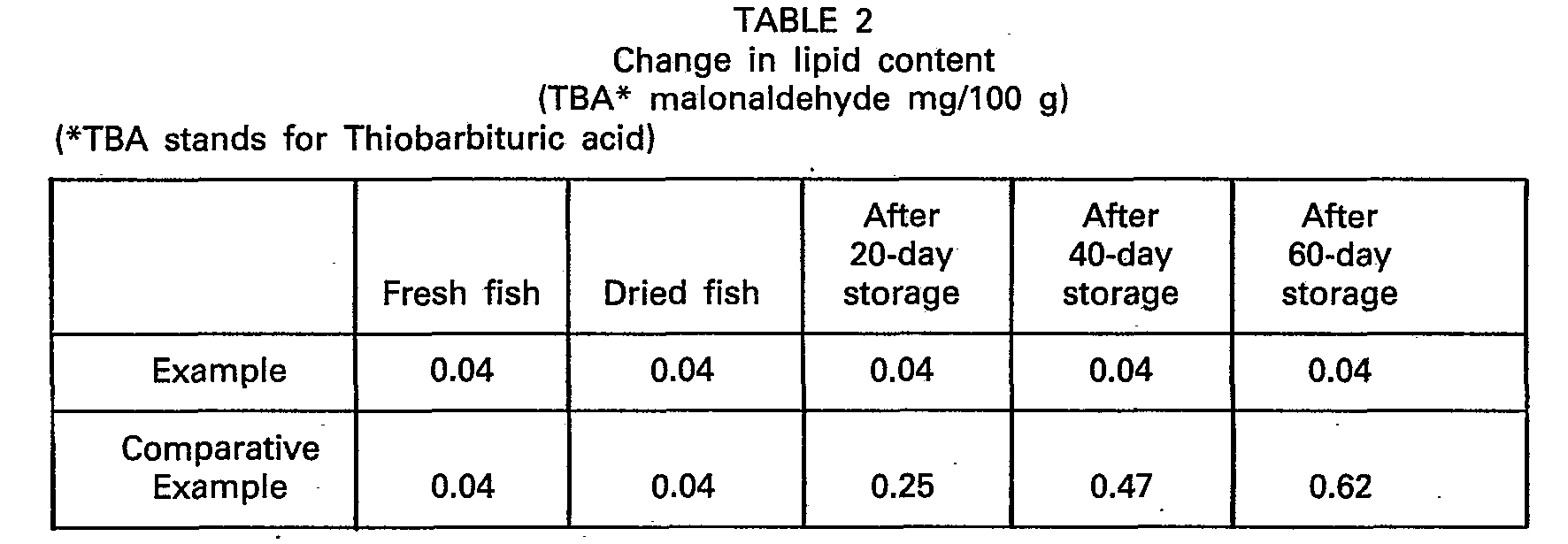
- Fresh flying fish was washed with water, split on the back, immersed in 15% brine for 3 hours, drained, dried electrically for 4 hours to a water content of 70% and a NaCI concentration of 2 to 10% and all projecting bones were cut off with scissors. The dried fish was packed in a gas impermeable bag made of PVDC coated oriented nylon film (20p) laminated with polyethylene (80p), and an oxygen absorbent (commercially available from Mitsubishi Gas Chemical Company, Inc. as Ageless (Trade Mark) S-500), comprising a reducing composition consisting of iron powder and metal halide packed in a gas permeable material having Gurley gas permeability 4100 sec/100 ml air, was also put within the gas impermeable packing bag. In the bag, the fish was placed in a plastic tray so that a drip would not contact the oxygen absorbent. An oxygen detector (Ageless Eye (Trade Mark) of Mitsubishi Gas Chemical Company, Inc.) was also put in the gas impermeable pack, which was heat-sealed and stored in a refrigerator at -3°C. Tables 1 to 4 show the time-dependent change in the number of micro-organism cells and the quality of lipid and fish protein, as well as the result of organoleptic test.
- The procedure of the first Example was repeated except that the processed flying fish was packed in a polyethylene bag and stored at 3°C in the absence of oxygen absorbent. The time-dependent change in the number of micro-organism cells and the quality of lipid and fish protein, as well as the result of organoleptic test are also shown in Tables 1 to 4.



Claims (10)
Applications Claiming Priority (6)
| Application Number | Priority Date | Filing Date | Title |
|---|---|---|---|
| JP1724680A JPS56113250A (en) | 1980-02-15 | 1980-02-15 | Storage of fish |
| JP17246/80 | 1980-02-15 | ||
| JP1988880A JPS56117746A (en) | 1980-02-20 | 1980-02-20 | Storage of grilled eel without seasoning |
| JP19888/80 | 1980-02-20 | ||
| JP20886/80 | 1980-02-21 | ||
| JP2088680A JPS56117747A (en) | 1980-02-21 | 1980-02-21 | Storage of grilled and seasoned eel |
Publications (3)
| Publication Number | Publication Date |
|---|---|
| EP0034489A2 EP0034489A2 (en) | 1981-08-26 |
| EP0034489A3 EP0034489A3 (en) | 1983-02-02 |
| EP0034489B1 true EP0034489B1 (en) | 1985-07-17 |
Family
ID=27281740
Family Applications (1)
| Application Number | Title | Priority Date | Filing Date |
|---|---|---|---|
| EP81300616A Expired EP0034489B1 (en) | 1980-02-15 | 1981-02-13 | Novel method of storing processed fish and roe |
Country Status (4)
| Country | Link |
|---|---|
| US (1) | US4399161A (en) |
| EP (1) | EP0034489B1 (en) |
| CA (1) | CA1174512A (en) |
| DE (1) | DE3171360D1 (en) |
Families Citing this family (16)
| Publication number | Priority date | Publication date | Assignee | Title |
|---|---|---|---|---|
| US4477476A (en) * | 1982-12-28 | 1984-10-16 | Taiyo Fishery Co., Ltd. | Method for processing salmon roe products |
| JPS60221031A (en) * | 1984-04-16 | 1985-11-05 | Mitsubishi Gas Chem Co Inc | Method for preserving raw meat |
| KR890002855B1 (en) * | 1985-06-26 | 1989-08-05 | 미쯔비시 가스 가가구 가부시기가이샤 | Sheet-type deoxide material |
| US4856650A (en) * | 1986-10-27 | 1989-08-15 | Mitsubishi Gas Chemical Co., Inc. | Oxygen absorbent package |
| JPS63214170A (en) * | 1987-03-02 | 1988-09-06 | Mitsubishi Gas Chem Co Inc | Oxygen absorber packaging bag |
| JPH085501B2 (en) * | 1987-04-27 | 1996-01-24 | 三菱瓦斯化学株式会社 | Partition film for storing freshness-retaining agent |
| US4840280A (en) * | 1988-01-28 | 1989-06-20 | American Air Liquide | Sealing cap for liquid food or beverage containers |
| US5415886A (en) * | 1992-05-27 | 1995-05-16 | Maruha Corporation | Method for processing Alaska pollack roe |
| US5364301A (en) * | 1993-11-22 | 1994-11-15 | Marine Machines, Inc. | Processing sea urchins for extracting gonads |
| US5464648A (en) * | 1993-12-09 | 1995-11-07 | Nishijima; Hideo | Process for preparing a cohesive mass of herring eggs |
| US5510133A (en) * | 1994-11-21 | 1996-04-23 | Keeping And Mackay Limited (K. & M.) | Process for preparing foodstuffs based on reformed and cured herring roe |
| CA2176912A1 (en) * | 1996-05-17 | 1997-11-18 | Hideo Nishijima | Food composite comprising herring eggs |
| FR2758441B1 (en) * | 1997-01-20 | 1999-03-05 | Neptune | PREPARATION OF FOODS MADE OF FISH AND / OR CRUSTACEAN MEAT, AND FOODS OBTAINED THEREBY |
| ES2231142T3 (en) * | 2000-04-24 | 2005-05-16 | Jon Manterola Herbozo | SUCEDANEO DE ANGULA AND ITS MANUFACTURING PROCEDURE. |
| US20060228449A1 (en) * | 2001-07-09 | 2006-10-12 | Gaurav Tewari | Apparatus and method for extending shelf-life and prevention of discoloration of meat |
| US20140170277A1 (en) * | 2011-07-26 | 2014-06-19 | Fernando Baeza Ortega | Procedure for the preservation of by-products from the meat industry and other food industries |
Family Cites Families (20)
| Publication number | Priority date | Publication date | Assignee | Title |
|---|---|---|---|---|
| US1679543A (en) * | 1922-10-10 | 1928-08-07 | Rector Tenney Company Inc | Preserved-food product and process |
| GB496935A (en) * | 1937-03-04 | 1938-12-05 | Henrik Tallgren | An improved method of preserving in closed containers foodstuffs or other organic substances |
| US2485566A (en) * | 1945-09-24 | 1949-10-25 | James D A Clark | Method and device for indicating spoilage |
| US2987404A (en) * | 1956-04-13 | 1961-06-06 | Beckmann Hans | Method of conserving fresh fish |
| US2825651A (en) * | 1957-07-01 | 1958-03-04 | Carnation Co | In-package oxygen remover |
| US2995452A (en) * | 1957-07-23 | 1961-08-08 | Armour & Co | Ground beef product and method of producing the same |
| US3206317A (en) * | 1961-06-15 | 1965-09-14 | Golber Leonard Mark | Food spoilage indicator |
| US3169068A (en) * | 1962-09-12 | 1965-02-09 | Bloch Felix | Preservative of oxygen-labile substances, e.g., foods |
| AR206791A1 (en) * | 1973-12-27 | 1976-08-23 | Fujishima S | OXYGEN-CONSUMING COMPOSITION TO EXTRACT OXYGEN FROM THE AIR IN A CLOSED SPACE |
| US4048361A (en) * | 1974-10-29 | 1977-09-13 | Valyi Emery I | Composite material |
| US4041209A (en) * | 1975-01-27 | 1977-08-09 | Scholle Corporation | Multiple wall packaging material containing sulfite compound |
| US4113652A (en) * | 1975-12-25 | 1978-09-12 | Mitsubishi Gas Chemical Company, Inc. | Oxygen absorbent |
| US4107362A (en) * | 1976-11-22 | 1978-08-15 | Valyi Emery I | Multilayered container |
| US4384972A (en) * | 1977-06-21 | 1983-05-24 | Toppan Printing Co., Ltd. | Foodstuff freshness keeping agents |
| JPS5435189A (en) * | 1977-08-24 | 1979-03-15 | Mitsubishi Gas Chem Co Inc | Oxygen absorber |
| DE2964337D1 (en) * | 1978-02-24 | 1983-01-27 | Teijin Ltd | Oxygen scavenger composition, heat-generating composition and structure, and their use as an oxygen scavenger or generator of heat |
| US4230595A (en) * | 1978-03-13 | 1980-10-28 | Teijin Limited | Oxygen scavenging and heat-generating compositions, and deoxygenating and heat-generating structures |
| JPS54154542A (en) * | 1978-05-25 | 1979-12-05 | Toppan Printing Co Ltd | Preserving of fresh food |
| US4299719A (en) * | 1978-10-23 | 1981-11-10 | Mitsubishi Chemical Ind., Ltd. | Deoxidizer |
| JPS55109444A (en) * | 1979-02-17 | 1980-08-22 | Daishiro Fujishima | Deoxidizing agent composition |
-
1981
- 1981-02-13 CA CA000370793A patent/CA1174512A/en not_active Expired
- 1981-02-13 DE DE8181300616T patent/DE3171360D1/en not_active Expired
- 1981-02-13 EP EP81300616A patent/EP0034489B1/en not_active Expired
- 1981-02-13 US US06/234,434 patent/US4399161A/en not_active Expired - Lifetime
Non-Patent Citations (1)
| Title |
|---|
| The Technology of Food Preservation", 4th Ed. Desrosier N.W., 1978, Avi Publishing Co. Ltd., Connecticut USA, pp. 351-353 * |
Also Published As
| Publication number | Publication date |
|---|---|
| DE3171360D1 (en) | 1985-08-22 |
| EP0034489A3 (en) | 1983-02-02 |
| US4399161A (en) | 1983-08-16 |
| CA1174512A (en) | 1984-09-18 |
| EP0034489A2 (en) | 1981-08-26 |
Similar Documents
| Publication | Publication Date | Title |
|---|---|---|
| US5989610A (en) | Chemical treatment and packaging process to improve the appearance and shelf life of fresh meat | |
| US3607312A (en) | Method of preparing and preserving ready-to-eat foods | |
| US5780085A (en) | Chemical treatment and packaging process to improve the appearance and shelf life of fresh pork | |
| Ščetar et al. | Trends in meat and meat products packaging–a review | |
| US4399161A (en) | Novel method of storing processed fish and roe | |
| EP0481730A2 (en) | Food packing body for heat and microwave treatment | |
| KR20010022745A (en) | Methods for preserving fresh fruit and product thereof | |
| RU97108970A (en) | METHOD FOR EXTENDING THE STORAGE TIME OF FRESH FOOD AND SHEETS FOR TURNING A PORTION OF FRESH FOOD | |
| PL182460B1 (en) | Method of and material for extending shelf life of fresh food | |
| WO1987005782A2 (en) | Method of preserving foodstuffs | |
| US5108649A (en) | Preserving agent, method and container for preserving fresh marine product | |
| EP3628174B1 (en) | Method for preserving shrimp | |
| RU2001576C1 (en) | Fish-canning method | |
| AU2141099A (en) | Chemical treatment and packaging system to improve the appearance and shelf life of fresh meat | |
| JPS58149636A (en) | Preservation process for fishes and shellfishes | |
| JPS58158129A (en) | How to preserve meat | |
| JPS6230734B2 (en) | ||
| KR860000363B1 (en) | Method for storaging fish | |
| JPS6241062B2 (en) | ||
| JPS6244896B2 (en) | ||
| JPS5934B2 (en) | Food dehydration salting method | |
| JPH0327242A (en) | Method for preserving food | |
| JP2005126095A (en) | Freshness keeping packaging bag and freshness keeping packaging body | |
| Harnkarnsujarit | Packaging materials and technologies for improving quality of frozen foods | |
| JPS62224233A (en) | Storage of meat food |
Legal Events
| Date | Code | Title | Description |
|---|---|---|---|
| PUAI | Public reference made under article 153(3) epc to a published international application that has entered the european phase |
Free format text: ORIGINAL CODE: 0009012 |
|
| 17P | Request for examination filed |
Effective date: 19810221 |
|
| AK | Designated contracting states |
Designated state(s): DE GB IT |
|
| PUAL | Search report despatched |
Free format text: ORIGINAL CODE: 0009013 |
|
| AK | Designated contracting states |
Designated state(s): DE GB IT |
|
| RHK1 | Main classification (correction) |
Ipc: A23B 4/14 |
|
| ITF | It: translation for a ep patent filed | ||
| GRAA | (expected) grant |
Free format text: ORIGINAL CODE: 0009210 |
|
| AK | Designated contracting states |
Designated state(s): DE GB IT |
|
| REF | Corresponds to: |
Ref document number: 3171360 Country of ref document: DE Date of ref document: 19850822 |
|
| PLBE | No opposition filed within time limit |
Free format text: ORIGINAL CODE: 0009261 |
|
| STAA | Information on the status of an ep patent application or granted ep patent |
Free format text: STATUS: NO OPPOSITION FILED WITHIN TIME LIMIT |
|
| 26N | No opposition filed | ||
| ITTA | It: last paid annual fee | ||
| PGFP | Annual fee paid to national office [announced via postgrant information from national office to epo] |
Ref country code: GB Payment date: 19950203 Year of fee payment: 15 |
|
| PGFP | Annual fee paid to national office [announced via postgrant information from national office to epo] |
Ref country code: DE Payment date: 19950209 Year of fee payment: 15 |
|
| PG25 | Lapsed in a contracting state [announced via postgrant information from national office to epo] |
Ref country code: GB Effective date: 19960213 |
|
| GBPC | Gb: european patent ceased through non-payment of renewal fee |
Effective date: 19960213 |
|
| PG25 | Lapsed in a contracting state [announced via postgrant information from national office to epo] |
Ref country code: DE Effective date: 19961101 |