EP0033899B1 - Verfahren zur Herstellung von Überzügen - Google Patents
Verfahren zur Herstellung von Überzügen Download PDFInfo
- Publication number
- EP0033899B1 EP0033899B1 EP81100586A EP81100586A EP0033899B1 EP 0033899 B1 EP0033899 B1 EP 0033899B1 EP 81100586 A EP81100586 A EP 81100586A EP 81100586 A EP81100586 A EP 81100586A EP 0033899 B1 EP0033899 B1 EP 0033899B1
- Authority
- EP
- European Patent Office
- Prior art keywords
- polyurethane
- parts
- weight
- anionic
- molecular weight
- Prior art date
- Legal status (The legal status is an assumption and is not a legal conclusion. Google has not performed a legal analysis and makes no representation as to the accuracy of the status listed.)
- Expired
Links
Classifications
-
- C—CHEMISTRY; METALLURGY
- C09—DYES; PAINTS; POLISHES; NATURAL RESINS; ADHESIVES; COMPOSITIONS NOT OTHERWISE PROVIDED FOR; APPLICATIONS OF MATERIALS NOT OTHERWISE PROVIDED FOR
- C09D—COATING COMPOSITIONS, e.g. PAINTS, VARNISHES OR LACQUERS; FILLING PASTES; CHEMICAL PAINT OR INK REMOVERS; INKS; CORRECTING FLUIDS; WOODSTAINS; PASTES OR SOLIDS FOR COLOURING OR PRINTING; USE OF MATERIALS THEREFOR
- C09D5/00—Coating compositions, e.g. paints, varnishes or lacquers, characterised by their physical nature or the effects produced; Filling pastes
- C09D5/44—Coating compositions, e.g. paints, varnishes or lacquers, characterised by their physical nature or the effects produced; Filling pastes for electrophoretic applications
- C09D5/4419—Coating compositions, e.g. paints, varnishes or lacquers, characterised by their physical nature or the effects produced; Filling pastes for electrophoretic applications with polymers obtained otherwise than by polymerisation reactions only involving carbon-to-carbon unsaturated bonds
- C09D5/4465—Polyurethanes
-
- C—CHEMISTRY; METALLURGY
- C08—ORGANIC MACROMOLECULAR COMPOUNDS; THEIR PREPARATION OR CHEMICAL WORKING-UP; COMPOSITIONS BASED THEREON
- C08G—MACROMOLECULAR COMPOUNDS OBTAINED OTHERWISE THAN BY REACTIONS ONLY INVOLVING UNSATURATED CARBON-TO-CARBON BONDS
- C08G18/00—Polymeric products of isocyanates or isothiocyanates
- C08G18/06—Polymeric products of isocyanates or isothiocyanates with compounds having active hydrogen
- C08G18/28—Polymeric products of isocyanates or isothiocyanates with compounds having active hydrogen characterised by the compounds used containing active hydrogen
- C08G18/67—Unsaturated compounds having active hydrogen
- C08G18/6705—Unsaturated polymers not provided for in the groups C08G18/671, C08G18/6795, C08G18/68 or C08G18/69
-
- C—CHEMISTRY; METALLURGY
- C08—ORGANIC MACROMOLECULAR COMPOUNDS; THEIR PREPARATION OR CHEMICAL WORKING-UP; COMPOSITIONS BASED THEREON
- C08G—MACROMOLECULAR COMPOUNDS OBTAINED OTHERWISE THAN BY REACTIONS ONLY INVOLVING UNSATURATED CARBON-TO-CARBON BONDS
- C08G18/00—Polymeric products of isocyanates or isothiocyanates
- C08G18/06—Polymeric products of isocyanates or isothiocyanates with compounds having active hydrogen
- C08G18/28—Polymeric products of isocyanates or isothiocyanates with compounds having active hydrogen characterised by the compounds used containing active hydrogen
- C08G18/67—Unsaturated compounds having active hydrogen
- C08G18/675—Low-molecular-weight compounds
-
- C—CHEMISTRY; METALLURGY
- C08—ORGANIC MACROMOLECULAR COMPOUNDS; THEIR PREPARATION OR CHEMICAL WORKING-UP; COMPOSITIONS BASED THEREON
- C08G—MACROMOLECULAR COMPOUNDS OBTAINED OTHERWISE THAN BY REACTIONS ONLY INVOLVING UNSATURATED CARBON-TO-CARBON BONDS
- C08G18/00—Polymeric products of isocyanates or isothiocyanates
- C08G18/06—Polymeric products of isocyanates or isothiocyanates with compounds having active hydrogen
- C08G18/83—Chemically modified polymers
- C08G18/834—Chemically modified polymers by compounds containing a thiol group
- C08G18/835—Unsaturated polymers modified by compounds containing a thiol group
Definitions
- the present invention relates to a process for the production of coatings on electrically conductive objects by electrophoretic deposition of anionic polyurethanes from aqueous dispersion onto the electrically conductive object connected as an anode and irradiation with UV or electron beams, addition products of mercaptocarboxylic acid salts with polyurethanes being used as anionic polyurethanes.
- Electrocoating is an environmentally friendly process in which paints are deposited onto electrically conductive substrates from an aqueous environment. The lacquer films are then generally crosslinked at elevated temperature. Radiation curing requires binders which consist of prepolymers containing olefinic groups together with polyfunctional and monofunctional monomers. There are environmental problems in the processing of these mixtures due to the vapor pressure of the monomers used. By combining both processes, it is possible to eliminate both the environmental problems of conventional radiation-curable coatings and to produce electro-dip coatings that do not have to be thermally crosslinked. This process can be used where it is important to coat metal surfaces evenly. Conventional application of radiation-curable lacquers to metals does not achieve the uniformity of the layer thickness that is possible with electro-dipping. The liability of the z. B. by spraying, dipping, brushing applied paint film on a metallic surface is bad. Electrophoretically deposited paint films adhere significantly better.
- DE-OS2207031 describes a lacquer structure which consists of an electro-dip primer and a radiation-curable lacquer applied thereon. Such a paint structure is also described in DE-AS 20 15 287 and JA-PS 73 04 446. With these multi-layer lacquers, in order to improve the adhesion between the two layers, they have to be baked at elevated temperature for some time.
- Paints which contain both the polar groups required for electrodeposition and the double bonds required for radiation curing are described in DE-AS 23 01 075.
- the binders used consist of unsaturated acidic resins and water-insoluble polyfunctional UV crosslinkers. Reaction products of epoxy resin and unsaturated fatty acids which are maleinized, fatty acid-modified unsaturated acidic alkyd resins and maleinized oils which are modified with styrene or (meth) acrylic ester are mentioned here as acidic resins. Resins containing ethylenically unsaturated double bonds and carboxyl groups for electrophoretic separation can also be found in US Pat. No. 4,040,925.
- the anionic polyurethanes to be used according to the invention can be deposited electrophoretically either on their own or in combination with water-insoluble crosslinking agents which have double bonds. If the deposited lacquer is then to be crosslinked by UV radiation, the electrodeposition bath advantageously contains 0.5 to 10%, preferably 1 to 4%, based on the polyurethane, of water-insoluble UV initiator.
- the anionic polyurethanes to be used according to the invention are obtained by adding mercaptocarboxylic acid salts to part of the CC double bonds of the acrylate groups of the polyurethanes via thioether bridges with incorporation of carboxylate groups, the NCO / OH ratio to be chosen for the structure of the polyurethane preferably being between 0.5: 1 and 1.2: 1, in particular between 0.6: 1 and 0.85 1.
- An excess of isocyanate can also be used in the production of the polyurethane, the NCO / OH ratio being between 1.15: and 1.3: 1 1, and the excess of isocyanate by reaction with water, alcohol, monoamine or hydroxyacrylates. is implemented.
- the polyurethanes to be used according to the invention generally have K values (according to Fikentscher, Cellulosechemie 13, 58 (1932)) between 10 and 30, preferably between 15 and 25.
- Suitable polyisocyanates are the customary compounds known from polyurethane chemistry, in particular diisocyanates.
- Aromatic as well as aliphatic or heterocyclic diisocyanates can be used, for example 4,4-diphenylmethane diisocyanate, dicyclohexylmethane diisocyanate, 1,5-naphthylene diisocyanate, 2,4- and 2,6-tolylene diisocyanate, hexamethylene diisocyanate, isophorone diisocyanate and trimethylhexamethylene diisocyanate methisocyanate and diisocyanate methylene diisocyanate.
- partially blocked polyisocyanates can also be used, which allow the formation of additional crosslinking polyurethanes, e.g. B. dimeric tolylene diisocyanate, or partially reacted with, for example, phenol, tert-butanol, phthalimide or caprolactam polyisocyanates.
- Suitable acrylic ester diols with molecular weights between 146 and 3,000 are reaction products of epoxy compounds with polymerizable olefinically unsaturated carboxylic acids, in particular acrylic and methacrylic acid, with one carboxyl group for each epoxy group, and reaction products of dicarboxylic acids with polymerizable olefinically unsaturated glycidyl compounds (glycidyl ( meth-) acrylate), such as. B. are described in DE-OS 21 64 386.
- unsaturated acrylic ester diol are reaction products from OH group-bearing monoepoxides such as glycidol with (meth) acrylic acid.
- the reaction products of the epoxy compounds with acrylic and / or methacrylic acid should, in the later reaction with diisocyanates, be largely bi- to trifunctional with respect to OH groups. If the OH functionality is> 3, there is otherwise a risk of networking.
- the reaction between the epoxy compounds and the polymerizable olefinically unsaturated acid monomers is a ring-opening esterification between the ester groups, the diepo- ! xid compounds and the carboxyl groups of polymerizable (meth) acrylic acid, which can be carried out in a known manner, approximately analogously to DE-OS 21 64 386.
- the aforementioned epoxy compounds and their reaction products can be used alone or in a mixture.
- Suitable components a) are preferably reaction products of bisphenol A diglycidyl ether (for example ®Epikote 828 from Shell) or glycidol with acrylic or methacrylic acid.
- the unsaturated polyurethanes are prepared by reacting diisocyanates with the (meth) acrylic ester diols thus obtained with a molecular weight of 146 to 3,000 a), dihydroxyl compounds with a molecular weight of 400 to 5,000 b) and optionally chain extenders c) in solution.
- Linear polyesters, polycarbonates, polylactones (eg polycaprolactone) and polyethers are essentially suitable as organic polyhydroxyl compounds with molecular weights between 400 and 5,000, preferably between 500 and 4,000, which differ from a). In addition to terminal hydroxyl groups, such compounds can also contain carboxyl, amino or mercapto groups.
- polyether such.
- B the polymerization products of ethylene oxide, propylene oxide, tetrahydrofuran, butylene oxide and their mixed or graft polymerization products and the condensates obtained by condensation of polyhydric alcohols or mixtures thereof or the products obtained by alkoxylation of polyhydric alcohols.
- Suitable polyesters b) are e.g. B. esterification products of adipic acid with C 2 -C 10 alkanediols or oxaalkanediols.
- Suitable polycarbonates are e.g. B. Hexanediol polycarbonates.
- Suitable chain extenders such as the customary saturated or unsaturated glycols, such as ethylene glycol or condensates of ethylene glycol, butanediol, 1,2-propanediol, propanediol, are suitable as optionally also used diols, diamines, amino alcohols or triols with molecular weights between 62 and 400 -1.3, neopentyl glycol, dioxethoxy hydroquinone, butenediol, dioxäthyldian, aliphatic, cycloaliphatic, aromatic or heterocyclic primary or secondary amines, such as N-methylethanolamine, N-butylethanolamine, N-oleylethanolamine, N-cyclohexyl-p-isopropanolamine, toluidine, N, N-dioxypropylnaphthylamine, polyethoxylated N-butyldiethanolamine, the aliphatic, cycloall
- Multifunctional alcohols such as trimethylolpropane, glycerin, etc. should be used in less than 15 equivalent%.
- Components a), b) and c) are generally used in amounts of 100: (10 to 400): (0 to 30), preferably 100: (20 to 300): (1 to 20).
- 0 mol to 5 mol bifunctional, 0 to 3 mol higher functional chain extenders and 1 to 30, preferably 5 to 25 mol, acrylic ester diol a) can be added to 1 mol polyol b).
- solvent any solvent which does not react with the polyurethane composition and the reactants can be used in the process according to the invention.
- Preferred solvents are optionally halogenated hydrocarbons, ketones, ethers, esters or nitriles, such as. B. acetone, methyl ethyl ketone, acetonitrile, ethyl acetate, methylene chloride, chloroform, carbon tetrachloride, dimethylformamide, dimethyl sulfoxide, tetrahydrofuran or dioxane. Mixtures of such solvents can of course also be used.
- polyurethane catalysts as are known from polyurethane chemistry.
- carboxylic acids which carry a mercapto group are suitable as mercapto carboxylic acids.
- Mercapto acids in which the mercapto group is in the ⁇ or ⁇ position to the acid group are particularly suitable.
- the mercaptocarboxylic acids can be aliphatic, cycloaliphatic, araliphatic or aromatic, for example mercaptoacetic acid, mercaptopropionic acid, mercaptobutyric acid, mercaptolinotic acid, mercaptotrimethylacetic acid, mercaptocyclohexanoic acid, mercaptophenylacetic acid, mercaptobenzoic acid, mercaptochlorobenzoic acid.
- Reaction products of mercaptoethanol with poly- or dicarboxylic acid anhydrides are also suitable.
- Mercaptoacetic acid is particularly preferred.
- Suitable compounds for converting the mercaptocarboxylic acids into their salt form are e.g. B.: organic bases such as monofunctional primary, secondary and tertiary amines such as methylamine, diethylamine, trimethylamine, triethylamine, ethylamine, tributylamine, pyridine, methylethylamine, Diethylmethylamine, aniline, toluidine, alkoxylated amines such as ethanolamine, diethanolamine, triethanolamine, diisopropanolamine, methylenediethanolamine, oleyldiethanolamine and polyfunctional amines, in which the individual amino groups may have different basicity such as, for. B.
- organic bases such as monofunctional primary, secondary and tertiary amines such as methylamine, diethylamine, trimethylamine, triethylamine, ethylamine, tributylamine, pyridine, methylethylamine, Diethy
- Amines such as B. trimethylamine or triethylamine are preferred and inorganic bases such as ammonia.
- Preferred compounds are diethanolamine, diisopropanolamine, triethylamine and triethanolamine.
- the polyurethane solution is reacted with such amounts of mercaptocarboxylic acid salt that the carboxylate group content of the addition product is 3 to 15, preferably 4 to 8,% by weight.
- the mercaptocarboxylic acid salts can be used in solid form or in solution for the addition of the SH groups. Use of the solution is preferred.
- the solvents should not prevent the addition of the SH group. In special cases, however, it can be advantageous if at least some of the solvent can react with the NCO groups that may still be present in the polyurethane, with chain extension or chain termination. Examples include halogenated hydrocarbons, ketones, alcohols, esters, water, ether and diol mono (meth) acrylates.
- the reactive solvents (reactive thinners) are expediently usually used only in minor amounts.
- the chain extenders described in the manufacture of polyurethane are suitable as reactive diluents.
- Acetone, methyl ethyl ketone, tetrahydrofuran, diethyl ether and toluene are particularly suitable as non-reactive solvents.
- the incorporation of the ionic groups by the addition of mercapto acid salts to double bonds of acrylates can be carried out even at low temperatures.
- the reaction is very quick.
- the attachment is e.g. B. finished in less than 10 minutes.
- the anionic polyurethanes to be used according to the invention contain 0.3 to 3, preferably 0.5 to 2, moles of acrylic ester double bonds per 1,000 g of polyurethane resin.
- polyfunctional polyisocyanates can be added before adding water.
- Suitable polyfunctional polyisocyanates are e.g. B. in the patents DE-PS 1090196, DE-PS 11 01 394, DE-PS 12 22 067 described.
- olefinically unsaturated organic compounds with molecular weights between 130 and 2000 are, for. B. suitable divinylbenzene, ethylene glycol diacrylate, (meth) acrylated polyesters, (meth) acrylated urethanes and polyurethanes, methacrylated polyethers and reaction products of epoxides with (meth) acrylic acid. Reaction products made from glycidyl ethers of phenols of the bisphenol A type with preferably a molecular weight of approximately 370 with (meth) acrylic acid in a molar ratio of 1: 2 are particularly preferred. These crosslinking agents can be used in amounts of up to 50 percent by weight of the anionic polyurethane .
- the properties of the coatings can be optimized in wide regions corresponding to the respective requirements when the polyurethane dispersions with mon o -, di- or polyfunctional unsaturated cross-linking agents are combined. It has proven to be advantageous if the z. B. in acetone dissolved polyurethane ionomers of the reactive crosslinker, then introduced the water and the solvent is distilled off.
- the anionic polyurethanes or their mixtures with at least two olefinically unsaturated organic compounds with molecular weights between 130 and 2000 are deposited electrophoretically, the deposited coating is then advantageously rinsed with demineralized water, blown dry with compressed air and z. B. dried at 50 to 120 ° C and then cured by means of UV rays or electron beams.
- Aqueous dispersions are used as the electrodeposition bath, which are adjusted to solids contents of 5 to 20, preferably 8 to 15 percent by weight by adding demineralized water.
- the pH of the electrodeposition baths is generally between 7.2 and 9.0, preferably 7.2 to 8.2, the deposition voltage between 50 and 300 V, the bath temperature between approximately 18 and 30 ° C. and the deposition time 15 seconds up to 3 minutes (see also W. Machu, electrocoating, p. 163 ff.).
- UV curing it is necessary to use one or more customary photoinitiators; preference is given to benzophenone and derivatives, benzoin, benzoin ether, benzil, benzil ketals, thioxanthones, etc.; benzil dimethyl ketal and methyl thioxanthone are particularly preferred.
- UV initiator If less than 0.5% by weight of UV initiator is used, adequate curing of the deposited film is not obtained after the UV irradiation. If more than 10% by weight is used, the mechanical properties of the deposited coating film deteriorate due to the softness very effective effect of the UV initiator. When using 1 to 5%, the best mechanical properties of the paints are obtained.
- Suitable radiation sources for UV curing are, for example, low-pressure mercury lamps, high-pressure mercury lamps, etc., for. B. described in "UV-Curing, Science and Technology •, by S. Peter Papas, technology marketing corporation, Stamford, USA (1978).
- UV initiators are not required when curing using electron beams.
- the Van de Graaff accelerator and linear accelerator e.g. described in DE-OS 20 49 715
- accelerated electrons with 150 to 350 keV and a dose of 10 to 100 joules / g can be used.
- Electron beam curing is generally carried out under a protective gas such as nitrogen.
- the coating agents to be used according to the invention can each be based on the customary pigments such as titanium dioxide, talc or carbon black or mixtures thereof in amounts of up to 60 parts, preferably up to 30 parts, and up to 45 parts of organic substances without CC double bonds are added to 100 parts by weight of binder.
- Leveling agents can also contain up to 10 parts, waxes to increase the scratch resistance up to 10 parts based on 100 parts of binder.
- Objects made of iron, steel and aluminum can be coated with the electrocoat materials of the invention.
- the cross-linked coatings have a high hardness, are very elastic and resistant to chemicals, especially against acetone, petrol and aromatic hydrocarbons. They are also characterized by good adhesive strength on the metallic base, good abrasion resistance and good corrosion protection.
- a mixture of 92 parts of 80% mercaptoacetic acid, 80 parts of triethylamine and 42 parts of acetone is then added dropwise within 5 minutes. After 1 hour at 60 ° C, enough water is added until a dispersion is formed.
- the solvent is removed in vacuo.
- the solids content of the dispersion is 32.6%.
- the preparation is carried out like dispersion (1), but with 200 parts of polytetrahydrofuran and 237.5 parts of 4,4'-diphenylrnethandiisocyanate.
- the solids content of the dispersion is 27.1%.
- the solvent is removed by vacuum distillation.
- the solids content of the dispersion is 40%.
- the diglycidyl ether of bisphenol A with an average molecular weight of 370 and an epoxide value of 0.51 to 0.54 was prepared according to the known prior art (see, for example, US Pat. No. 2,890,202, 3,373,075, 3,420,514, 3,535 403 and DE-OS 16 18 729) with acrylic acid in a molar ratio of 1: 2.
- the reaction product obtained is dissolved in acetone, so that a 50% solution is formed.
- a hydroxyl-containing polyester from one equivalent of adipic acid, 0.53 equivalent of phthalic anhydride, 1.81 equivalent of ethylene glycol and 0.78 equivalent of trimethylolpropane are according to the known prior art implemented with a molar excess of acrylic acid.
- the solvent and the unreacted acrylic acid are removed at 10 to 15 torr and elevated temperature.
- the triglycidyl ether of pentaerythritol is reacted with acrylic acid in a molar ratio of 1: 3 in accordance with the known prior art (eg DE-OS 23 17 523).
- the reaction is complete when the acid number is less than three.
- zinc-phosphated steel sheets are anodically coated for a deposition time of 2 minutes. These are rinsed with demineralized water, heated to 100 ° C for 8 minutes and, after cooling, passed a mercury high-pressure lamp (power consumption 80 W / cm arc length) at a distance of 10 cm at a belt speed of 6 m / min.
- the paint properties are given in Table 1.
- Example 258 parts of the polyurethane dispersion (2), 60 parts of the acrylated epoxy resin (1) (50%) and 4 parts of benzil dimethyl ketal are processed as described in Example 1 to form a 10% aqueous dispersion, the pH of which is 7.6 and its conductivity Is 920 ⁇ S / cm.
- zinc-phosphated sheets are anodically coated. After rinsing with demineralized water, these are heated to 100 ° C. for 1 min and the lacquer is then cured with UV rays as described in Example 1. the coating properties are shown in Table 1.
- the 10% electrodeposition paint contains 221 parts of the polyurethane dispersion (2), 80 parts of the acrylated epoxy resin (1) (50%) and 4 parts of the UV initiator.
- the pH of the dispersion is 7.8, the conductivity 780 ⁇ S / cm.
- the sheets are coated and hardened as described in Example 2.
- the 10% electrocoat contains 184.5 parts of the polyurethane dispersion (2), 100 parts of the acrylated epoxy resin (1) (50%) and 4 parts of the UV initiator.
- the pH of the dispersion is 7.2 and the conductivity is 686 ⁇ S / cm.
- the sheets are coated as described in Example 2, but the deposition voltage is 200 V.
- the curing is carried out as in Example 2 by means of UV rays.
- the 10% electrodeposition paint contains 369 parts of the polyurethane dispersion (2) and 4 parts of the UV initiator from Example 1.
- the pH of the bath is 7.5 and the conductivity is 1,560 ⁇ S / cm.
- a deposition voltage of 150 V metal sheets are anodically coated, then heated to 100 ° C. for 5 minutes and then hardened as described in Example 1.
- the 10% electrocoat contains 175 parts of the polyurethane dispersion (3), 60 parts of the acrylated epoxy resin (1) (50%) and 4 parts of the UV initiator from Example 1. Its pH is 7.5 and the conductivity is 1 217 ⁇ S / cm. The deposition voltage is 120 V. The metal sheets are heated to 100 ° C. for 2 minutes and the paints are cured as described in Example 1.
- the 10 % electrocoat contains 184 parts of the polyurethane dispersion (1), 40 parts of the acrylated polyester (2) and 3 parts of benzil dimethyl ketal. Its pH is 7.5 and the conductivity is 1 123 ⁇ S / cm. The deposition voltage is 150 V. The paints are cured as described in Example 2.
- the 10% electrodeposition paint contains 240 parts of the polyurethane dispersion (2), 35 parts of the acrylated epoxy resin (3) and 2 parts of benzil dimethyl ketal. Its pH is 7.7 and the conductivity is 998 ⁇ S / cm. The separation voltage is 120V. The paints are cured as described in Example 2.
- the electrocoat material from Example 7 is used, but without a UV initiator.
- the coated sheets are heated to 100 ° C. for 1 min and then passed at a belt speed of 15 m / min past an electron beam with an energy of 160 kV and a dose of 7.1 Mrad.
- the paint properties are shown in Table 2.
- Example 8 The electrocoat material from Example 8 is used, but without a UV initiator.
- the coated sheets are heated to 100 ° C. for 2 minutes.
- the paints are then cured as described in Example 9.
- Example 1 without UV initiator is used.
- the coated sheets are heated to 100 ° C. for 5 minutes and the paints are then cured with electron beams as described.
Landscapes
- Chemical & Material Sciences (AREA)
- Health & Medical Sciences (AREA)
- Chemical Kinetics & Catalysis (AREA)
- Organic Chemistry (AREA)
- Medicinal Chemistry (AREA)
- Polymers & Plastics (AREA)
- Life Sciences & Earth Sciences (AREA)
- Molecular Biology (AREA)
- Engineering & Computer Science (AREA)
- Materials Engineering (AREA)
- Wood Science & Technology (AREA)
- General Chemical & Material Sciences (AREA)
- Paints Or Removers (AREA)
- Polyurethanes Or Polyureas (AREA)
- Macromonomer-Based Addition Polymer (AREA)
Description
- Die vorliegende Erfindung betrifft ein Verfahren zur Herstellung von Überzügen auf elektrisch leitfähigen Gegenständen durch elektrophoretisches Abscheiden anionischer Polyurethane aus wäßriger Dispersion auf den als Anode geschalteten elektrisch leitfähigen Gegenstand und Bestrahlung mit UV-oder Elektronenstrahlen, wobei als anionische Polyurethane Additionsprodukte von Mercaptocarbonsäuresalzen an Polyurethane verwendet werden.
- Die Elektrotauchlackierung ist ein umweltfreundliches Verfahren, bei dem aus wäßrigem Milieu Lacke auf elektrisch leitende Träger abgeschieden werden. Danach werden die Lackfilme im allgemeinen bei erhöhter Temperatur vernetzt. Bei der Strahlungshärtung benötigt man Bindemittel, die aus olefinischen Gruppen enthaltenden Präpolymeren zusammen mit poly- und monofunktionellen Monomeren bestehen. Es gibt dabei Umweltschutzprobleme bei der Verarbeitung dieser Mischungen aufgrund des Dampfdrucks der eingesetzten Monomeren. Durch die Kombination beider Verfahren gelingt es, sowohl die Umweltschutzprobleme der konventionellen strahlungshärtbaren Lacke zu beseitigen, wie auch Elektrotauch-Lacke herzustellen, die nicht thermisch vernetzt werden, müssen. Anwendung kann dieses Verfahren dort finden, wo es gilt, Metalloberflächen gleichmäßig zu beschichten. Beim konventionellen Auftragen von strahlungshärtbaren Lacken auf Metalle erreicht man nicht die Gleichmäßigkeit in der Schichtdicke, die bei der Elektrotauchlackierung möglich ist. Auch die Haftung des z. B. durch Spritzen, Tauchen, Bestreichen aufgebrachten Lackfilms auf metallischem Untergrund ist schlecht. Elektrophoretisch abgeschiedene Lackfilme haften bedeutend besser.
- In der DE-OS2207031 wird ein Lackaufbau beschrieben, der aus einer Elektrotauch-Grundierung und einem darauf applizierten strahlungshärtbaren Lack besteht. Ein derartiger Lackaufbau wird auch in der DE-AS 20 15 287 und der JA-PS 73 04 446 beschrieben. Bei diesen Mehrschichtlacken muß, um die Haftung zwischen beiden Schichten zu verbessern, einige Zeit bei erhöhter Temperatur eingebrannt werden.
- Lacke, die sowohl die für die Elektrotauchabscheidung erforderlichen polaren Gruppen wie auch die für die Strahlungshärtung erforderlichen Doppelbindungen enthalten, werden in der DE-AS 23 01 075 beschrieben. Die verwendeten Bindemittel bestehen aus ungesättigten sauren Harzen und wasserunlöslichen polyfunktionellen UV-Vernetzern. Als saure Harze werden hier Umsetzungsprodukte aus Epoxidharz und ungesättigten Fettsäuren, die maleinisiert werden, fettsäuremodifizierte ungesättigte saure Alkydharze und maleinisierte Öle, welche mit Styrol oder (Meth)acrylester modifiziert sind, genannt. Harze, die äthylenisch ungesättigte Doppelbindungen und Carboxylgruppen für die elektrophoretische Ascheidung enthalten, sind auch der US-PS 4 040 925 zu entnehmen.
- Aufgabe der vorliegenden Erfindung ist es, ein Verfahren zur Herstellung von Überzügen auf elektrisch leitfähigen Gegenständen durch anodische Elektrotauchlackierung und Bestrahlung mit UV-oder Elektronenstrahlen aufzuzeigen, das gegenüber den bekannten vergleichbaren Verfahren sowohl verarbeitungstechnische Vorteile als auch Überzüge mit verbesserten Eigenschaften, insbesondere hinsichtlich Haftung, Korrosionsschutz, Verlauf und Elastizität aufweist.
- Überraschenderweise wurde gefunden, daß sich auch wäßrige, Acrylatdoppelbindungen enthaltende Dolyurethandispersionen als Elektrotauchlacke abscheiden lassen.
- Gegenstand der vorliegenden Erfindung ist ein Verfahren zur Herstellung von Überzügen auf elektrisch leitfähigen Gegenständen durch elektrophoretisches Abscheiden anionischer Polyurethane aus wäßriger Dispersion auf den als Anode geschalteten elektrisch leitfähigen Gegenstand und Bestrahlung mit UV- oder Elektronenstrahlen, das dadurch gekennzeichnet ist, daß als anionisches Polyurethan ein Additionsprodukt eines Salzes einer Mercaptocarbonsäure an ein Polyurethan verwendet wird, wobei das Polyurethan ein Umsetzungsprodukt von Polyisocyanaten mit einem Gemisch aus
- a) Acrylesterdiolen mit Molekulargewichten zwischen 146 und 3000,
- b) anderen von a) verschiedenen organischen Polyhydroxylverbindungen mit Molekulargewichten zwischen 400 und 5 000 sowie gegebenenfalls,
- c) von a) verschiedenen Diolen, Diaminen, Aminoalkoholen oder Triolen mit Molekulargewichten zwischen 62 und 400 oder Wasser,
- Die erfindungsgemäß zu verwendenden anionischen Polyurethane können entweder für sich allein oder in Kombination mit wasserunlöslichen, Doppelbindungen aufweisenden Vernetzern elektrophoretisch abgeschieden werden. Soll der abgeschiedene Lack anschließend durch UV-Strahlung vernetzt werden, enthält das Elektrotauchbad zweckmäßigerweise 0,5 bis 10 %, vorzugsweise 1 bis 4 %, bezogen auf das Polyurethan an wasserunlöslichem UV-Initiator.
- Das Elektrotauchbad enthält 5 bis 20 Gew.% Bindemittel, das aus
- 50 bis 100 Gew.% Polyurethan und
- 0 bis 50 Gew.% wasserunlöslichem polyfunktionellem Vernetzer besteht.
- Die erfindungsgemäß zu verwendenden anionischen Polyurethane werden durch Addition von Mercaptocarbonsäuresalzen an einen Teil der C-C-Doppelbindungen der Acrylatgruppen der Polyurethane über Thioätherbrücken unter Einbau von Carboxylatgruppen erhalten, wobei das zum Aufbau des Polyurethans zu wählende NCO/OH-Verhältnis vorzugsweise zwischen 0,5 : 1 und 1,2 : 1, insbesondere zwischen 0,6 : 1 und 0,85 1 betragen soll. Bei der Herstellung des Polyurethans kann auch mit einem Isocyanatüberschuß gearbeitet werden, wobei das NCO/OH-Verhältnis zwischen 1,15 : und 1,3:1 1 liegen kann, und der Isocyanatüberschuß durch Reaktion mit Wasser, Alkohol, Monoamin oder Hydroxyacrylate. umgesetzt wird.
- Die erfindungsgemäß zu verwendenden Polyurethane weisen im allgemeinen K-Werte (nach Fikentscher, Cellulosechemie 13, 58 (1932)) zwischen 10 und 30, vorzugsweise zwischen 15 und 25 auf.
- Zu den Aufbaukomponenten des erfindungsgemäß zu verwendenden anionischen Polyurethan ist im einzelnen folgendes auszuführen.
- Als Polyisocyanate eignen sich die üblichen, aus der Polyurethanchemie bekannten Verbindungen, insbesondere Diisocyanate. Es können sowohl aromatische als auch aliphatische oder heterocyclische Diisocyanate verwendet werden, beispielsweise 4,4-Diphenylmethandiisocyanat, Dicyclohexylmethandiisocyanat, 1,5-Naphthylendiisocyanat, 2,4- und 2,6-Toluylendiisocyanat, Hexamethylendiisocyanat, Isophorondiisocyanat und Trimethylhexamethylendiisocyanat und Dicyclohexylmethandiisocyanat.
- In einigen speziellen Fällen können auch teilweise verkappte Polyisocyanate verwendet werden, welche die Bildung zusätzlich vernetzender Polyurethane ermöglichen, z. B. dimeres Toluylendiisocyanat, oder mit beispielsweise Phenol, tert.-Butanol, Phthalimid oder Caprolactam partiell umgesetzte Polyisocyanate.
- a) Als Acrylesterdiole mit Molekulargewichten zwischen 146 und 3 000 eignen sich Reaktionsprodukte von Epoxidverbindungen mit polymerisierbaren olefinisch ungesättigten Carbonsäuren, insbesondere Acryl- und Methacrylsäure, wobei jeweils etwa auf jede Epoxidgruppe eine Carboxylgruppe kommt, sowie Reaktionsprodukte von Dicarbonsäuren mit polymerisierbaren olefinisch ungesättigten Glycidylverbindungen (Glycidyl(meth-) acrylat), wie sie z. B. in der DE-OS 21 64 386 beschrieben sind.
- Als ungesättigtes Acrylesterdiol eignen sich auch Umsetzungsprodukte aus OH-Gruppen-tragenden Monoepoxyden wie Glycidol mit (Meth)-Acrylsäure. Geeignete polymerisierbare Diole (Polyole) können z. B. aus Epoxiden mit zwei endständigen Epoxidgruppen gemäß der allgemeinen Formel
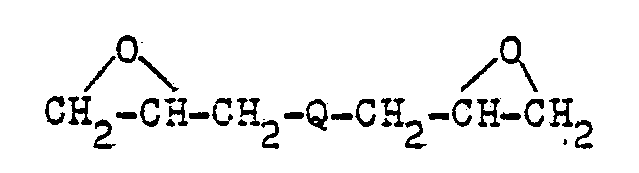


- Die Umsetzung zwischen den Epoxidverbindungen und den polymerisierbaren olefinisch ungesättigten Säuremonomeren ist eine ringöffnende Veresterung zwischen den Estergruppen, der Diepo- ! xidverbindungen und den Carboxylgruppen der polymerisierbaren (Meth)acrylsäure, die etwa analog der DE-OS 21 64 386 in bekannter Weise ausgeführt werden kann.
- Die vorgenannten Epoxidverbindungen und deren Umsetzungsprodukte können allein oder im Gemisch verwendet werden.
- Als Komponente a) eignen sich bevorzugt Umsetzungsprodukte aus Bisphenol A-Diglycidyläther (z. B.. ®Epikote 828 der Fa. Shell) oder Glycidol mit Acryl- oder Methacrylsäure.
- Die ungesättigten Polyurethane werden durch Umsetzen von Diisocyanaten mit den so erhaltenen (Meth-)acrylesterdiolen mit einem Molekulargewicht von 146 bis 3 000 a), Dihydroxylverbindungen mit einem Molekulargewicht von 400 bis 5 000 b) und ggf. Kettenverlängerungsmitteln c) in Lösung hergestellt.
- b) Als von a) verschiedene organische Polyhydroxylverbindungen mit Molekulargewichten zwischen 400 und 5 000, vorzugsweise zwischen 500 und 4 000, eignen sich im wesentlichen lineare Polyester, Polycarbonate, Polylactone (z. B. Polycaprolacton) und Polyäther. Außer endständigen Hydroxylgruppen können derartige Verbindungen auch Carboxyl-, Amino- oder Mercaptogruppen enthalten.
- Als Polyäther seien z. B. die Polymerisationsprodukte des Äthylenoxyds, Propylenoxyds, Tetrahydrofurans, Butylenoxyds sowie ihre Misch- oder Pfropfpolymerisationsprodukte sowie die durch Kondensation von mehrwertigen Alkoholen oder Mischungen derselben gewonnenen Kondensate oder die durch Alkoxylierung von mehrwertigen Alkoholen gewonnenen Produkte genannt.
- Geeignete Polyester b) sind z. B. Veresterungsprodukte von Adipinsäure mit C2-C10-Alkandiolen oder Oxaalkandiolen. Geeignete Polycarbonate sind z. B. Hexandiolpolycarbonate.
- c) Als gegebenenfalls mitzuverwendende, von a) verschiedene Diole, Diamine, Aminoalkohole oder Triole mit Molekulargewichten zwischen 62 und 400 eignen sich entsprechende Kettenverlängerungsmittel, wie die üblichen gesättigten oder ungesättigten Glykole, wie Äthylenglykol oder Kondensate des Äthylenglykols, Butandiol, Propandiol-1.2, Propandiol-1.3, Neopentylglykol, Dioxäthoxy-hydrochinon, Butendiol, Dioxäthyldian, aliphatische, cycloaliphatische, aromatische oder heterocyclische primäre oder sekundäre Amine, wie N-Methyläthanolamin, N-Butyläthanolamin, N-Oleyläthanolamin, N-Cyclohexylisopropanolamin, N,N-Dioxäthyl-p-toluidin, N,N-Dioxypropylnaphthylamin, polyäthoxyliertes N-Butyldi- äthanolamin, die aliphatischen, cycloallphathischen oder aromatischen Diamine, wie Äthylendiamin, Hexamethylendiamin, 2,4-Cyclohexylendiamin, Benzidin, Diaminodiphenylmethan, die Isomeren des Phenylendiamins oder Hydrazin, Aminoalkohole, wie Äthanolamin, Propanolamin oder Butanolamin. Gegebenenfalls kann auch Wasser als Kettenverlängerungsmittel verwendet oder mitverwendet werden.
- Mehrfunktionelle Alkohole wie Trimethylolpröpan, Glycerin usw. sollten in weniger als 15 Äquivalent % verwendet werden.
- Die Komponenten a), b) und c) werden im allgemeinen in Mengen von 100 : (10 bis 400) : (0 bis 30), vorzugsweise 100 : (20 bis 300) : (1 bis 20) eingesetzt.
- Beispielsweise können auf 1 Mol Polyol b) 0 bis 5 Mo: bifunktionelle, 0 bis 3 Mol höherfunktionelle Kettenverlängerer und 1 bis 30, vorzugsweise 5 bis 25 Mole Acrylesterdioie a) kommen.
- Bei der Wahl des Lösungsmittels ist zu beachten, daß bei der Herstellung der Polyurethanmasse kein Lösungsmittel verwendet wird, das unter den Reaktionsbedingungen mit Isocyanstgruppen reagierende funktionelle Gruppen besitzt. Im erfindungsgemäßen Verfahren kann jedes beliebige Lösungsmittel eingesetzt werden, das mit der Polyurethanmasse und den Reaktionspartnern nicht in Reaktion tritt. Bevorzugte Lösungsmittel sind gegebenenfalls halogenierte Kohlenwasserstoffe, Ketone, Äther, Ester oder Nitrile, wie z. B. Aceton, Methyläthylketon, Acetonitril, Äthylacetat, Methylenchlorid, Chloroform, Tetrachlorkohlenstoff, Dimethylformamid, Dimethylsulfoxyd, Tetrahydrofuran oder Dioxan. Selbstverständlich können auch Mischungen derartiger Lösungsmittel verwendet werden.
- Die Herstellung der Polyurethan-Lösungen kann auf üblichen Wegen erfolgen, z. B. :
- In Masse (im Kessel oder auf Bandanlagen). Bei einer Synthese auf der Bandanlage werden die Ausgangsprodukte mittels einer Zahnradpumpe flüssig über einen Intensiv-Mischer auf ein langes Band gegeben, welches eine beheizte und gekühlte Zone besitzt. Nachdem das noch nicht ausreagierte Polyurethan das Band verlassen hat, wird es bis zur Vollendung der Polyaddition in der Wärme gelagert und dann gelöst.
- Einstufenreaktion in Lösung :
- Alle Reaktionsteilnehmer werden 20 bis 90 %ig, vorwiegend 30 bis 70 %ig, in Lösungsmittel in das Reaktionsgefäß eingewogen und auf 20 bis 130 °C, vorwiegend auf 30 bis 90 °C erwärmt. Das Polymere ist fertig, wenn der gewünschte NCO-Wert erreicht ist (bei Uberschuß an Isocyanat) oder wenn alle NCO-Gruppen abreagiert sind (bei Überschuß an H-aktiven Verbindungen);
- Zweistufenreaktion in Lösung :
- Vorreaktion von Polyol und Diisocyanat wird in einem Teil des Lösungsmittels bei vorwiegend 30 bis 90 °C durchgeführt, dann wird mit einem Diol und Triol die Kette verlängert. Die weitere Fahrweise entspricht der Einstufenreaktion.
- Die Herstellung kann mit Polyurethankatalysatoren, wie sie aus der Polyurethanchemie bekannt sind, beschleunigt werden. Gebräuchliche Katalysatoren sina z. B. metallorganische Verbindungen, wie Dibutylzinndilaurat, tert.-Amine oder Triazine.
- Als Mercaptocarbonsäuren eignen sich alle Carbonsäuren, die eine Mercaptogruppe tragen. Besonders geeignet sind Mercaptosäuren, bei denen die Mercaptogruppe in α- oder β-Stellung zur Säuregruppe steht. Die Mercaptocarbonsäuren können aliphatisch, cycloaliphatisch, araliphatisch oder aromatisch sein, beispielsweise Mercaptoessigsäure, Mercaptopropionsäure, Mercaptobuttersäure, Mercaptolinotsäure, Mercaptotrimethylessigsäure Mercaptocyclohexansäure, Mercaptophenylessigsäure, Mercaptobenzoesäure, Mercaptochlorbenzoesäure. Ebenfalls geeignet sind Umsetzungsprodukte von Mercaptoäthanol mit Poly- oder Dicarbonsäureanhydriden z. B. mit Bernsteinsäureanhydrid, Maleinsäureanhydrid, Phthalsäureanhydrid oder Trimellithsäureanhydrid, wenn dadurch die SH-Gruppe frei bleibt. Besonders bevorzugt ist Mercaptoessigsäure.
- Zur Überführung der Mercaptocarbonsäuren in ihre Salzform geeignete Verbindungen sind z. B. : organische Basen wie monofunktionelle primäre, sekundäre und tert.-Amine wie beispielsweise Methylamin, Diäthylamin, Trimethylamin, Triäthylamin, Äthyiamin, Tributylamin, Pyridin, Methyläthylamin, Diäthylmethylamin, Anilin, Toluidin, alkoxylierte Amine wie Äthanolamin, Diäthanolamin, Triäthanolamin, Diisopropanolamin, Methylendiäthanolamin, Oleyldiäthanolamin sowie polyfunktionelle Amine, bei denen die einzelnen Aminogruppen gegebenenfalls unterschiedliche Basizität aufweisen können wie z. B. N,N-Dimethyläthylendiamin, α-Aminopyridin, N,N-Dimethylhydrazin, wobei Amine mit einem Siedepunkt unter 120°C und davon noch die tert. Amine wie z. B. Trimethylamin oder Triäthylamin bevorzugt sind sowie anorganische Basen, wie Ammoniak. Bevorzugte Verbindungen sind Diäthanolamin, Diisopropanolamin, Triäthylamin und Triäthanolamin.
- Die Polyurethanlösung wird mit solchen Mengen Mercaptocarbonsäuresalz umgesetzt, daß der Carboxylatgruppengehalt des Additionsproduktes 3 bis 15, vorzugsweise 4 bis 8 Gew.% beträgt.
- Für die Addition der SH-Gruppen können die Mercaptocarbonsäuresalze in fester Form oder in Lösung verwendet werden. Die Verwendung der Lösung ist bevorzugt. Die Lösungsmittel sollten die Addition der SH-Gruppe nicht verhindern. In speziellen Fällen kann es jedoch günstig sein, wenn zumindest ein Teil des Lösungsmittels mit den gegebenenfalls noch im Polyurethan vorhandenen NCO-Gruppen unter Kettenverlängerung oder Kettenabbruch reagieren können. Beispielsweise seien genannt halogenierte Kohlenwasserstoffe, Ketone, Alkohole, Ester, Wasser, Äther, und Diolmono(meth-)acrylate. Zweckmäßigerweise verwendet man die reaktiven Lösungsmittel (reaktiven Verdünner) meist nur in untergeordneten Mengen. Als reaktive Verdünner eignen sich die bei der Polyurethanherstellung beschriebenen Kettenverlängerungsmittel.
- Als nicht reaktive Lösungsmittel besonders geeignet sind Aceton, Methyläthylketon, Tetrahydrofuran, Diäthyläther und Toluol.
- Der Einbau der ionischen Gruppen durch Anlagerung von Mercaptosäuresalzen an Doppelbindungen von Acrylaten kann schon bei niedrigen Temperaturen durchgeführt werden. Die Reaktion verläuft sehr schnell. Bei 35 °C ist die Anlagerung z. B. in weniger als 10 Minuten beendet.
- Die Reaktivität der SH-Gruppe in Mercaptosäuresalz ist gegenüber der Acryldoppelbindung wesentlich höher als gegenüber NCO-Gruppen:
- Für die Umsetzung wird der Acrylat-gruppenhaltige Polyurethanlösung bei Temperaturen von 0°C bis 120°C vorwiegend zwischen 0 und 60 °C die Mercaptosäuresalzlösung zugegeben. Die Zulaufzeit kann beliebig gewählt werden. Da die Reaktion jedoch sehr schnell beendet ist, sind Zulaufzeiten von kleiner als 10 Minuten ja sogar von 1 Minute möglich.
- Die erfindungsgemäß zu verwendenden anionischen Polyurethane enthalten auf 1 000 g Polyurethanharz 0,3 bis 3, vorzugsweise 0,5 bis 2 Mole Acryiesterdoppeibindungen.
- Zur Modifizierung der Eigenschaften (z. B. Erhöhung der Thermostabilität und Härte) können vor der Wasserzugabe noch mehrfunktionelle Polyisocyanate zugesetzt werden. Geeignete mehrfunktionelle Polyisocyanate sind z. B. in den Patenten DE-PS 1090196, DE-PS 11 01 394, DE-PS 12 22 067 beschrieben.
- Nach Wasserzugabe wird das Lösungsmittel abdestilliert, wobei eine gleichmäßige Dispersion entsteht.
- Als mindestens zweifach olefinisch ungesättigte organische Verbindungen mit Molekulargewichten zwischen 130 und 2000 sind z. B. geeignet Divinylbenzol, Äthylenglykoldiacrylat, (meth)acrylierte Polyester, (meth)acrylierte Urethane und Polyurethane, methacrylierte Polyether und Umsetzungsprodukte von Epoxiden mit (Meth)acrylsäure. Besonders bevorzugt sind Umsetzungsprodukte aus Glycid- äthern von Phenolen des Bisphenol A-Typs mit vorzugsweise einem Molekulargewicht von ca. 370 mit (Meth)acrylsäure im Molverhältnis 1 : 2. Diese « Vernetzer können in Mengen von bis zu 50 Gewichtsprozent des anionischen Polyurethans mitverwendet werden.
- Es hat sich gezeigt, daß die Eigenschaften der Überzüge den jeweiligen Anforderungen entsprechend in breiten Bereichen optimiert werden können, wenn die Polyurethandispersionen mit mono-, di- oder polyfunktionellen ungesättigten Vernetzern kombiniert werden. Dabei hat es sich als vorteilhaft erwiesen, wenn dem z. B. in Aceton gelösten Polyurethanionomeren der reaktive Vernetzer zugegeben, dann das Wasser eingebracht und das Lösungsmittel abdestilliert wird.
- Erfindungsgemäß werden die anionischen Polyurethane bzw. deren Gemische mit mindestens zweifach olefinisch ungesättigten organischen Verbindungen mit Molekulargewichten zwischen 130 und 2000 (Vernetzer) elektrophoretisch abgeschieden, der abgeschiedene Überzug anschließend zweckmäßigerweise mit VE-Wasser abgespült, durch Preßluft trockengeblasen und z. B. bei 50 bis 120°C getrocknet und dann mittels UV-Strahlen oder Elektronenstrahlen ausgehärtet.
- Als Elektrotauchbad werden wäßrige Dispersionen verwendet, die durch Zusatz von vollentsalztem Wasser auf Feststoffgehalte von 5 bis 20, vorzugsweise 8 bis 15 Gewichtsprozent eingestellt werden. Der pH-Wert der Elektrotauchbäder liegt im allgemeinen zwischen 7,2 und 9,0, vorzugsweise 7,2 bis 8,2, die Abscheidungsspannung zwischen 50 und 300 V, die Badtemperatur zwischen etwa 18 und 30 °C und die Abscheidezeit bei 15 Sekunden bis 3 Minuten (vgl. auch W. Machu, Elektrotauchlackierung, S. 163 ff.).
- Für die UV-Härtung ist die Mitverwendung eines oder mehrerer üblicher Photoinitiatoren nötig, bevorzugt sind Benzophenon und Derivate, Benzoin, Benzoinäther, Benzil, Benzilketale, Thioxanthone usw. ; besonders bevorzugt sind Benzildimethylketal und Methylthioxanthon.
- Verwendet man weniger als 0,5 Gew.% UV-Initiator, erhält man keine ausreichende Durchhärtung des abgeschiedenen Films nach der UV-Bestrahlung. Bei der Verwendung von mehr als 10 Gew.% verschlechtern sich die mechanischen Eigenschaften des abgeschiedenen Lackfilms aufgrund der Weichmacherwirkung des UV-Initiators sehr. Bei der Verwendung von 1 bis 5 % erhält man die besten mechanischen Eigenschaften der Lacke. Geeignete Strahlungsquellen für die UV-Härtung sind beispielsweise Niederdruck-Quecksilber-Lampen, Hochdruck-Quecksilber-Lampen usw., z. B. beschrieben in « UV-Curing, Science and Technology •, by S. Peter Papas, technology marketing corporation, Stamford, USA (1978).
- Bei Härtung mittels Elektronenstrahlen benötigt man keine UV-Initiatoren. Als Elektronenstrahlenquellen können beispielsweise der Van de Graaff-Beschleuniger und Linearbeschleuniger (z. B. beschrieben in DE-OS 20 49 715) verwendet werden. Im allgemeinen kommen beschleunigte Elektronen mit 150 bis 350 keV sowie eine Dosis von 10 bis 100 Joule/g in Frage. Die Elektronenstrahlhärtung erfolgt im allgemeinen unter einem Schutzgas, wie Stickstoff.
- Außer dem Bindemittel können den erfindungsgemäß zu verwendenden Überzugsmittein die üblichen Pigmente wie Titandioxid, Talkum oder Ruß oder dessen Mischungen in Mengen von bis zu 60 Teilen, vorzugsweise von bis zu 30 Teilen, sowie bis zu 45 Teilen organischer Substanzen ohne C-C-Doppelbindungen, jeweils bezogen auf 100 Gewichtsteile Bindemittel zugesetzt werden. Außerdem können Verlaufsmittel bis zu 10 Teilen, Wachse zur Erhöhung der Kratzfestigkeit bis zu 10 Teilen bezogen auf 100 Teile Bindemittel enthalten sein.
- Mit den erfindungsgemäßen Elektrotauchlacken lassen sich vor allem Gegenstände aus Eisen, Stahl und Aluminium beschichten. Die vernetzten Überzüge weisen eine hohe Härte auf, sind sehr elastisch und chemikalienbeständig, besonders gegen Aceton, Benzin und aromatische Kohlenwasserstoffe. Sie zeichnen sich weiterhin durch gute Haftfestigkeit auf der metallischen Unterlage aus, besitzen eine gute Abriebfestigkeit und guten Korrosionsschutz.
- Die in den Beispielen angegebenen Teile und Prozente sind, soweit nicht anders angegeben, Gewichtsteile und Gewichtsprozente.
- In 873 Teilen Tetrahydrofuran werden 100 Teile Polytetrahydrofuran (MG 2000), 4,47 Teile Trimethylolpropan, 544 Teile des acrylierten Epoxidharzes (1) (= Epikote 828-diacrylat) und 225 Teile 4,4-Diphenylmethandiisocyanat gelöst.
- Nach Zugabe von 0,2 Teilen Dibutylzinndilaurat und 0,2Teilen Dibutylzinnoktoat wird solange bei 60 °C gerührt, bis der NCO-Gehalt 0 % beträgt.
- Nun wird innerhalb von 5 Minuten eine Mischung aus 92 Teilen 80 %iger Merkaptoessigsäure, 80, STeilen Triäthylamin und 42 Teile Aceton zugetropft. Nach 1 Stunde bei 60 °C wird soviel Wasser zugegeben, bis eine Dispersion entsteht.
- Das Lösungsmittel wird im Vakuum abgezogen. Der Feststoffgehalt der Dispersion beträgt 32.6 %.
- Die Herstellung erfolgt wie Dispersion (1), jedoch mit 200 Teilen Polytetrahydrofuran und 237, 5 Teilen 4,4'-Diphenylrnethandiisocyanat. Der Feststoffgehalt der Dispersion beträgt 27,1 %.
- In 689 Teilen Tetrahydrofuran werden 200 Teile Polytetrahydrofuran (MG 2000), 8,94 Teile Trimethylolpropan und 200 Teile 4,4'-Diphenylmethandiisocyanat gelöst. Nach Zugabe von 0,1 Teilen Dibutylzinndilaurat und 0,2 Teiler Dibutylzinnoktoat wird 15 Minuten bei 60 °C gerührt.
- Dann werden 808 Teile einer 67 %igen, acetonischen Lösung von Epikote 828-diacrylat zugegeben.
- Es wird dann solange bei 60 °C gerührt, bis der NCO-Gehalt 0% beträgt. Nun wird innerhalb von 5 Minuten eine Mischung aus 92 Teilen 80 %iger Merkaptoessigsäure, 80,8 Teilen Triäthylamin und 42 Teilen Aceton zugegeben.
- Anschließend läßt man nach einer Stunde soviel Wasser zulaufen, bis eine Dispersion entsteht.
- Das Lösungsmittel wird durch Vakuumdestillation abgezogen. Der Feststoffgehalt der Dispersion beträgt 40 %.
- Herstellung der Vemetzer (= mindestens zweifach olefinisch ungesättigte organische Verbindung mit Molekulargewicht zwischen 130 und 2 000).
- Der Diglycidäther des Bisphenols A mit einem mittleren Molekulargewicht von 370 und einem Epoxidwert von 0,51 bis 0,54 wurde gemäß dem bekannten Stand der Technik (s. z. B. US-PS 2 890 202, 3 373 075, 3 420 514, 3 535 403 und DE-OS 16 18 729) mit Acrylsäure im Molverhältnis 1 : 2 umgesetzt. Das erhaltene Umsetzungsprodukt wird in Aceton gelöst, so daß eine 50 %ige Lösung entsteht.
- Ein hydroxylgruppenhaltiger Polyester aus einem Äquivalent Adipinsäure, 0,53 Äquivalent Phthalsäureanhydrid, 1,81 Äquivalent Äthylenglykol und 0,78 Äquivalent Trimethylolpropan werden gemäß dem bekannten Stand der Technik mit einem molaren Überschuß an Acrylsäure umgesetzt. Nach beendeter Umsetzung wird bei 10 bis 15 torr und erhöhter Temperatur das Lösungsmittel und die nicht umgesetzte Acrylsäure entfernt.
- Der Triglycidyläther des Pentaerythrits wird gemäß dem bekannten Stand der Technik (z. B. DE-OS 23 17 523) mit Acrylsäure im Molverhältnis 1 : 3 umgesetzt. Die Reaktion ist bei einer Säurezahl kleiner als drei beendet.
- 184 Teile der Polyurethandispersion (1), 80 Teile einer 50 %igen Lösung des acrylierten Epoxidharzes (1) in Aceton und 4 Teile Benzildimethylketal wurden durch intensives Rühren miteinander vermischt. Es wird so lange vollentsalztes Wasser hinzugegeben, bis der Feststoffgehalt der Dispersion 10% beträgt. Die Dispersion wird 12 Stunden bei 40°C gealtert, um das organische Lösungsmittel zu entfernen und dann auf Zimmertemperatur abgekühlt. Der pH-Wert der Dispersion beträgt 8,1 und die spezifische Leitfähigkeit 874 µS/cm.
- Bei einer Abscheidespannung von 200 V werden während einer Abscheidezeit von 2 Minuten zinkphosphatierte Stahlbleche anodisch beschichtet. Diese werden mit VE-Wasser gespült, 8 Minuten auf 100 °C erwärmt und nach dem Abkühlen mit einer Bandgeschwindigkeit von 6 m/min an einen Quecksilber-Hochdruckstrahler (Leistungsaufnahme 80 W/cm Bogenlänge) in einem Abstand von 10 cm vorbeigeführt. Die Lackeigenschaften sind in Tabelle 1 angegeben.
- 258 Teile der Polyurethandispersion (2), 60 Teile des acrylierten Epoxidharzes (1) (50 %ig) und 4 Teile Benzildimethylketal werden wie bei Beispiel 1 beschrieben zu einer 10 %igen wäßrigen Dispersion verarbeitet, deren pH-Wert 7,6 und deren Leitfähigkeit 920 µS/cm beträgt. Bei 250 V werden zinkphosphatierte Bleche anodisch beschichtet. Diese werden nach dem Abspülen mit vollentsalztem Wasser 1 min auf 100 °C erwärmt und der lack wird dann mit UV-Strahlen wie in Beispiel 1 beschrieben gehärtet. die Lackeigenschaften gibt Tabelle 1 wieder.
- Der 10 %ige Elektrotauchlack enthält 221 Teile der Polyurethandispersion (2), 80 Teile des acrylierten Epoxidharzes (1) (50 %ig) und 4 Teile des UV-Initiators. Der pH-Wert der Dispersion beträgt 7,8, die Leitfähigkeit 780 µS/cm. Die Bleche werden wie in Beispiel 2 beschrieben beschichtet und gehärtet.
- Der 10 %ige Elektrotauchlack enthält 184,5 Teile der Polyurethandispersion (2), 100 Teile des acrylierten Epoxidharzes (1) (50 %ig) unf 4 Teile des UV-Initiators. Der pH-Wert der Dispersion beträgt 7,2, die Leitfähigkeit 686 µS/cm. Die Bleche werden wie in Beispiel 2 beschrieben beschichtet, die Abscheidespannung beträgt jedoch 200 V. Die Härtung erfolgt wie in Beispiel 2 mittels UV-Strahlen.
- Der 10 %ige Elektrotauchlack enthält 369 Teile der Polyurethandispersion (2) und 4 Teile des UV-Initiators von Beispiel 1. Der pH-Wert des Bades beträgt 7;5 und die Leitfähigkeit 1 560 µS/cm. Bei einer Abscheidungsspannung von 150 V werden Bleche anodisch beschichtet, anschließend 5 min auf 100 °C erwärmt und dann wie in Beispiel 1 beschrieben gehärtet.
- Der 10 %ige Elektrotauchlack enthält 175 Teile der Polyurethandispersion (3), 60 Teile des acrylierten Epoxidharzes (1) (50 %ig) und 4 Teile des UV-Initiators aus Beispiel 1. Sein pH-Wert beträgt 7,5 und die Leitfähigkeit 1 217 µS/cm. Die Abscheidespannung beträgt 120 V. Die Bleche werden 2 Minuten auf 100 °C erwärmt und die Lacke wie in Beispiel 1 beschrieben gehärtet.
- Der 10 %ige Elektrotauchlack enthält 184 Teile der Polyurethandispersion (1), 40 Teile des acrylierten Polyesters (2) und 3 Teile Benzildimethylketal. Sein pH-Wert beträgt 7,5 und die Leitfähigkeit 1 123 µS/cm. Die Abscheidespannung beträgt 150 V. Die Lacke werden wie in Beispiel 2 beschrieben gehärtet.
- Der 10 %ige Elektrotauchlack enthält 240 Teile der Polyurethandispersion (2), 35 Teile des acrylierten Epoxidharzes (3) und 2Teile Benzildimethylketal. Sein pH-Wert beträgt 7,7 und die Leitfähigkeit 998 µS/cm. Die Abscheidespannung beträgt 120V. Die Lacke werden wie in Beispiel 2 beschrieben gehärtet.
- Es wird der Elektrotauchlack von Beispiel 7 verwendet, jedoch ohne UV-Initiator. Die beschichteten Bleche werden 1 min auf 100 °C erwärmt und dann mit einer Bandgeschwindigkeit von 15 m/min an einem Elektronenstrahl mit einer Energie von 160 kV und einer Dosis von 7,1 Mrad vorbeigeführt. Die Lackeigenschaften gibt Tabelle 2 wieder.
- Es wird der Elektrotauchlack von Beispiel 8 verwendet, jedoch ohne UV-Initiator. Die beschichteten Bleche werden 2 min auf 100 °C erwärmt. Dann werden die Lacke wie in Beispiel 9 beschrieben gehärtet.
- Es wird der Elektrotauchlack von Beispiel 1 ohne UV-Initiator verwendet. die beschichteten Bleche werden 5 min auf 100 °C erwärmt und die Lacke dann wie beschrieben mit Elektronenstrahlen gehärtet.
- 231 Teile der Polyurethandispersion (2), 124,4 Teile des acrylierten Epoxidharzes (1) (50 %ig) werden durch starkes Rühren vermischt, es wird vollentsalztes Wasser hinzu gegeben und 25 Teile Titandioxid vom Rutiltyp, das durch eine Naßmahlung dispergiert wird. Der Elektrotauchlack hat einen Feststoffgehalt von 15%, einen pH-Wert von 8,3 und eine Leitfähigkeit von 750 µS/cm. Mit 150 V werden zinkphosphatierte Bleche beschichtet. Die Lacke werden dann wie beschrieben mit Elektronenstrahlen gehärtet.
- 160 Teile der Polyurethandispersion (2) und 58-Teile des acrylierten Epoxidharzes (1) werden durch starkes Rühren vermischt. Es wird vollentsalztes Wasser zugegeben und 28 Teile Titandioxid vom Rutiltyp, welches durch Naßmahlung dispergiert wird. Der Elektrotauchlack hat einen Feststoffgehalt von 10 %, einen pH-Wert von 8,4 und eine Leitfähigkeit von 630 µS/cm. Mit 90 V werden zinkphosphatierte Bleche beschichtet. Die Lacke werden dann wie beschrieben mit Elektronenstrahlen gehärtet.
- 170 Teile der Polyurethandispersion (2) und 62 g des acrylierten Epoxidharzes (1) (50 %ig) werden durch starkes Rühren vermischt. Es werden vollentsalztes Wasser, 21 Teile Titandioxid vom Rutiltyp und 2 Teile Ruß zugegeben. Die Pigmente werden durch eine Naßmahlung dispergiert. Der Elektrotauchlack hat einen Feststoffgehalt von 10 %, einen pH-Wert von 8,1 und eine Leitfähigkeit von 811 µS/cm. Mit 50 V werden zinkphosphatierte Bleche beschichtet und dann wie beschrieben mit Elektronenstranlen gehärtet.


im NCO/OH-Verhältnis von 0,4: bis 1,3: 1 ist und das Additionsprodukt des Salzes der Mercaptocarbonsäure an das Polyurethan 3 bis 15 Gewichtsprozent Carboxylatgruppen enthält.
Claims (7)
im NCO/OH-Verhältnis von 0,4: 1 bis 1,3 : 1 ist und das Additionsprodukt des Salzes der Mercaptocarbonsäure an das Polyurethan 3 bis 15 Gewichtsprozent Carboxylatgruppen enthält.
Applications Claiming Priority (2)
| Application Number | Priority Date | Filing Date | Title |
|---|---|---|---|
| DE19803005034 DE3005034A1 (de) | 1980-02-11 | 1980-02-11 | Verfahren zur herstellung von ueberzuegen |
| DE3005034 | 1980-02-11 |
Publications (2)
| Publication Number | Publication Date |
|---|---|
| EP0033899A1 EP0033899A1 (de) | 1981-08-19 |
| EP0033899B1 true EP0033899B1 (de) | 1983-03-30 |
Family
ID=6094315
Family Applications (1)
| Application Number | Title | Priority Date | Filing Date |
|---|---|---|---|
| EP81100586A Expired EP0033899B1 (de) | 1980-02-11 | 1981-01-28 | Verfahren zur Herstellung von Überzügen |
Country Status (3)
| Country | Link |
|---|---|
| US (1) | US4357221A (de) |
| EP (1) | EP0033899B1 (de) |
| DE (2) | DE3005034A1 (de) |
Cited By (1)
| Publication number | Priority date | Publication date | Assignee | Title |
|---|---|---|---|---|
| US6893687B2 (en) | 2000-09-25 | 2005-05-17 | Chemetall Gmbh | Method for coating metallic surfaces |
Families Citing this family (15)
| Publication number | Priority date | Publication date | Assignee | Title |
|---|---|---|---|---|
| US4592816A (en) * | 1984-09-26 | 1986-06-03 | Rohm And Haas Company | Electrophoretic deposition process |
| US4777190A (en) * | 1985-05-13 | 1988-10-11 | Mitsubishi Rayon Company Limited | Photopolymerizable composition based on a vinyl compound, a sulfur-containing compound and an α-diketone |
| DE4122266A1 (de) * | 1991-07-05 | 1993-01-07 | Hoechst Ag | Polyurethan-dispersionen |
| DE4122265A1 (de) * | 1991-07-05 | 1993-01-07 | Hoechst Ag | Polyurethan-dispersionen |
| TW213474B (de) * | 1991-07-17 | 1993-09-21 | Cargill Inc | |
| DE4344063C1 (de) * | 1993-12-23 | 1995-06-08 | Herberts Gmbh | Wäßrige Bindemitteldispersion für physikalisch trocknende Überzugsmittel und deren Verwendung |
| US5779938A (en) * | 1995-08-24 | 1998-07-14 | Champion Technologies, Inc. | Compositions and methods for inhibiting corrosion |
| EP0849300A1 (de) * | 1996-12-19 | 1998-06-24 | Basf Aktiengesellschaft | Polyurethane mit kovalent gebundenen Photoinitiatoreinheiten |
| DE19810793A1 (de) | 1998-03-12 | 1999-09-16 | Basf Ag | Härtbares Polyurethanpolymerisat, Dispersion auf Basis dieses Polymerisats, Verfahren zu ihrer Herstellung und ihre Verwendung |
| DE19933012A1 (de) | 1999-07-14 | 2001-01-18 | Basf Ag | Härtbares Polyurethanpolymerisat |
| DE10022352A1 (de) * | 2000-05-08 | 2001-11-22 | Georg Gros | Verfahren zur Beschichtung von elektrolytisch- oder feuerverzinkten Blechen |
| WO2002024344A2 (de) * | 2000-09-25 | 2002-03-28 | Chemetall Gmbh | Verfahren zur vorbehandlung und beschichtung von metallischen oberflächen vor der umformung mit einem lackähnlichen überzug und verwendung der derart beschichteten substrate |
| DE102016219050A1 (de) | 2016-09-30 | 2018-04-05 | Thyssenkrupp Ag | Kantenschutz |
| CN112175586B (zh) * | 2020-09-28 | 2021-12-07 | 杭州应星新材料有限公司 | 一种uv固化丙烯酸导热组合物、导热片及其制备方法 |
| CN114316660A (zh) * | 2021-12-17 | 2022-04-12 | 广东工业大学 | 一种水性紫外光固化阴极电泳涂料及其制备方法 |
Family Cites Families (3)
| Publication number | Priority date | Publication date | Assignee | Title |
|---|---|---|---|---|
| US3501391A (en) * | 1966-10-03 | 1970-03-17 | Ford Motor Co | Electrocoatacure process and paint binders therefor |
| US3928667A (en) * | 1973-12-20 | 1975-12-23 | Celanese Coatings Co | Aqueous thermoset coatings utilizing titanium chelate curing agents |
| US4066591A (en) * | 1975-06-02 | 1978-01-03 | Ppg Industries, Inc. | Water-reduced urethane coating compositions |
-
1980
- 1980-02-11 DE DE19803005034 patent/DE3005034A1/de not_active Withdrawn
-
1981
- 1981-01-28 EP EP81100586A patent/EP0033899B1/de not_active Expired
- 1981-01-28 DE DE8181100586T patent/DE3160132D1/de not_active Expired
- 1981-02-05 US US06/231,719 patent/US4357221A/en not_active Expired - Fee Related
Cited By (1)
| Publication number | Priority date | Publication date | Assignee | Title |
|---|---|---|---|---|
| US6893687B2 (en) | 2000-09-25 | 2005-05-17 | Chemetall Gmbh | Method for coating metallic surfaces |
Also Published As
| Publication number | Publication date |
|---|---|
| US4357221A (en) | 1982-11-02 |
| DE3005034A1 (de) | 1981-08-20 |
| DE3160132D1 (en) | 1983-05-05 |
| EP0033899A1 (de) | 1981-08-19 |
Similar Documents
| Publication | Publication Date | Title |
|---|---|---|
| EP0033896B1 (de) | Strahlungshärtbare wässrige Bindemitteldispersionen, Verfahren zu ihrer Herstellung und ihre Verwendung | |
| EP0123880B1 (de) | Hitzehärtbare Überzugsmittel und ihre Verwendung | |
| EP0012339B1 (de) | Strahlungshärtbare wässrige Bindemitteldispersionen, Verfahren zu deren Herstellung sowie deren Verwendung | |
| EP0120466B2 (de) | Hitzehärtbare Überzugsmittel und deren Verwendung | |
| EP0033899A1 (de) | Verfahren zur Herstellung von Überzügen | |
| EP0125438A1 (de) | Hitzehärtbare Überzugsmittel und deren Verwendung | |
| DE2749776A1 (de) | Verfahren zur herstellung von bindemitteln fuer die elektrotauchlackierung | |
| EP0121837A1 (de) | In der Hitze selbstvernetzende Lackbindemittel, ihre Herstellung und Verwendung | |
| EP0137459B2 (de) | Kathodisch abscheidbares wässriges Elektrotauchlack-Überzugsmittel und dessen Verwendung | |
| EP1106633A2 (de) | Polyurethan-Emulsionen | |
| EP1144520B1 (de) | Wässrige elektrotauchlacke, deren herstellung und verwendung | |
| EP0033897A1 (de) | Verfahren zur Herstellung von polymerisierbaren Polyurethanelastomeren | |
| EP0093241A1 (de) | Selbstvernetzendes, hitzehärtbares Bindemittel | |
| DE3628119A1 (de) | Fremdvernetzende bindemittelkombination, diese enthaltende waessriges ueberzugsmittel und dessen verwendung | |
| EP0586880B1 (de) | Als Bindemittel geeignete Polymere | |
| DE2940528A1 (de) | Verbund-schichtkoerper, insbesondere druckplatte | |
| DE4446439A1 (de) | Polymer-Dispersionen auf Basis eines kationischen Polyurethans | |
| EP0123879B1 (de) | Verfahren zur Herstellung von Harnstoffkondensationsprodukten und deren Verwendung | |
| EP1248810B1 (de) | Wässrige elektrotauchlacke, deren herstellung und verwendung | |
| DE2452322C2 (de) | Strahlungshärtbare Überzugsmassen | |
| EP0220440A1 (de) | Verfahren zur Herstellung selbstvernetzender kationischer Lackbindemittel | |
| WO1994021736A1 (de) | Bindemittelsysteme für die elektrotauchlackierung | |
| AT383138B (de) | Verfahren zur herstellung kationischer, imidgruppen aufweisender kunstharze | |
| EP0179273B1 (de) | Verfahren zur Herstellung von Harnstoffkondensationsprodukten und deren Verwendung | |
| DE3614435C2 (de) |
Legal Events
| Date | Code | Title | Description |
|---|---|---|---|
| PUAI | Public reference made under article 153(3) epc to a published international application that has entered the european phase |
Free format text: ORIGINAL CODE: 0009012 |
|
| AK | Designated contracting states |
Designated state(s): BE DE FR GB NL |
|
| 17P | Request for examination filed |
Effective date: 19810819 |
|
| GRAA | (expected) grant |
Free format text: ORIGINAL CODE: 0009210 |
|
| AK | Designated contracting states |
Designated state(s): BE DE FR GB NL |
|
| REF | Corresponds to: |
Ref document number: 3160132 Country of ref document: DE Date of ref document: 19830505 |
|
| ET | Fr: translation filed | ||
| PGFP | Annual fee paid to national office [announced via postgrant information from national office to epo] |
Ref country code: FR Payment date: 19911218 Year of fee payment: 12 |
|
| PGFP | Annual fee paid to national office [announced via postgrant information from national office to epo] |
Ref country code: GB Payment date: 19920116 Year of fee payment: 12 Ref country code: DE Payment date: 19920116 Year of fee payment: 12 |
|
| PGFP | Annual fee paid to national office [announced via postgrant information from national office to epo] |
Ref country code: BE Payment date: 19920124 Year of fee payment: 12 |
|
| PGFP | Annual fee paid to national office [announced via postgrant information from national office to epo] |
Ref country code: NL Payment date: 19920131 Year of fee payment: 12 |
|
| PG25 | Lapsed in a contracting state [announced via postgrant information from national office to epo] |
Ref country code: GB Effective date: 19930128 Ref country code: DE Effective date: 19930128 |
|
| PG25 | Lapsed in a contracting state [announced via postgrant information from national office to epo] |
Ref country code: BE Effective date: 19930131 |
|
| BERE | Be: lapsed |
Owner name: BASF A.G. Effective date: 19930131 |
|
| PG25 | Lapsed in a contracting state [announced via postgrant information from national office to epo] |
Ref country code: NL Effective date: 19930801 |
|
| NLV4 | Nl: lapsed or anulled due to non-payment of the annual fee | ||
| GBPC | Gb: european patent ceased through non-payment of renewal fee |
Effective date: 19930128 |
|
| PG25 | Lapsed in a contracting state [announced via postgrant information from national office to epo] |
Ref country code: FR Effective date: 19930930 |
|
| REG | Reference to a national code |
Ref country code: FR Ref legal event code: ST |
|
| PLBE | No opposition filed within time limit |
Free format text: ORIGINAL CODE: 0009261 |
|
| STAA | Information on the status of an ep patent application or granted ep patent |
Free format text: STATUS: NO OPPOSITION FILED WITHIN TIME LIMIT |