EP0032007B1 - Verfahren zur Regenerierung von Säure bei der Herstellung regenerierter Cellulose - Google Patents
Verfahren zur Regenerierung von Säure bei der Herstellung regenerierter Cellulose Download PDFInfo
- Publication number
- EP0032007B1 EP0032007B1 EP80304454A EP80304454A EP0032007B1 EP 0032007 B1 EP0032007 B1 EP 0032007B1 EP 80304454 A EP80304454 A EP 80304454A EP 80304454 A EP80304454 A EP 80304454A EP 0032007 B1 EP0032007 B1 EP 0032007B1
- Authority
- EP
- European Patent Office
- Prior art keywords
- solution
- cell
- acid
- cellulose
- regenerated cellulose
- Prior art date
- Legal status (The legal status is an assumption and is not a legal conclusion. Google has not performed a legal analysis and makes no representation as to the accuracy of the status listed.)
- Expired
Links
Images

Classifications
-
- D—TEXTILES; PAPER
- D01—NATURAL OR MAN-MADE THREADS OR FIBRES; SPINNING
- D01F—CHEMICAL FEATURES IN THE MANUFACTURE OF ARTIFICIAL FILAMENTS, THREADS, FIBRES, BRISTLES OR RIBBONS; APPARATUS SPECIALLY ADAPTED FOR THE MANUFACTURE OF CARBON FILAMENTS
- D01F13/00—Recovery of starting material, waste material or solvents during the manufacture of artificial filaments or the like
- D01F13/02—Recovery of starting material, waste material or solvents during the manufacture of artificial filaments or the like of cellulose, cellulose derivatives or proteins
-
- C—CHEMISTRY; METALLURGY
- C08—ORGANIC MACROMOLECULAR COMPOUNDS; THEIR PREPARATION OR CHEMICAL WORKING-UP; COMPOSITIONS BASED THEREON
- C08B—POLYSACCHARIDES; DERIVATIVES THEREOF
- C08B16/00—Regeneration of cellulose
-
- Y—GENERAL TAGGING OF NEW TECHNOLOGICAL DEVELOPMENTS; GENERAL TAGGING OF CROSS-SECTIONAL TECHNOLOGIES SPANNING OVER SEVERAL SECTIONS OF THE IPC; TECHNICAL SUBJECTS COVERED BY FORMER USPC CROSS-REFERENCE ART COLLECTIONS [XRACs] AND DIGESTS
- Y02—TECHNOLOGIES OR APPLICATIONS FOR MITIGATION OR ADAPTATION AGAINST CLIMATE CHANGE
- Y02P—CLIMATE CHANGE MITIGATION TECHNOLOGIES IN THE PRODUCTION OR PROCESSING OF GOODS
- Y02P70/00—Climate change mitigation technologies in the production process for final industrial or consumer products
- Y02P70/50—Manufacturing or production processes characterised by the final manufactured product
- Y02P70/62—Manufacturing or production processes characterised by the final manufactured product related technologies for production or treatment of textile or flexible materials or products thereof, including footwear
Definitions
- This invention relates to the production of regenerated cellulose by the acidification of an alkaline cellulose solution.
- regenerated cellulose In the industrial production of regenerated cellulose, pure cellulose is reacted with sodium hydroxide, and, in the xanthate process, with carbon disulfide, to produce a viscous solution known as viscose, or xanthate.
- the viscous solution is then reconstituted, either as a transparent film or as a fibre (commonly known as rayon), by introducing the solution into a bath of an aqueous acid solution.
- the cellulose, thus regenerated is passed through the aqueous acid solution to remove residual alkali therefrom.
- it In general, in order to complete this process, it is passed through further acid baths (usually two further acid baths i.e. three in all) after which it is washed by a countercurrent of washing water to produce the final product.
- This invention provides a method of producing regenerated cellulose which method comprises regenerating cellulose by acidifying an alkaline cellulose solution, passing the regenerated cellulose through at least one acid bath to remove residual alkali therefrom, washing the regenerated cellulose with a countercurrent of washing water, passing an acidified solution of sodium sulphate from an acid bath through the anode compartment of an electrolytic cell, and also passing washing water comprising an acidified solution of sodium sulphate through a cathode compartment of the said cell, wherein the said cell is provided with an ion-selective membrane which is substantially impermeable to sulphate ions, which membrane divides the cell to define the anode and the cathode compartments, and electrolysing the solution in the cell to generate sulphuric acid in the anode compartment and to produce sodium hydroxide in the cathode compartment by transport of sodium ions across the said membrane whereby sulphuric acid in the catholyte compartment is neutralized, wherein an approximately neutral
- a viscose solution is acidified, to produce regenerated cellulose: This is generally done by spinning or extruding the solution into aqueous acid.
- the regenerated cellulose thus produced is passed through the acid solution, and preferably through a number of other acid baths. During passage through the acid baths, acid is carried over by the cellulose, and the successive baths are decreasingly acidic.
- the acid solution which is passed through the anode compartment of the electrolytic cell is taken from the final or penultimate acid bath, i.e. the ones containing the least strong acid.
- the electrolysis in this cell is carried out in such a a way as to lower the acidity of the acidic effluent (i.e. the washing water), so as to make it more nearly neutral, and to increase the acidity of the anolyte, in order to produce more usable acid.
- the regenerated acid from the anode compartment is preferably recycled to the acid bath, and used as feedstock for the process.
- the ion-selective membrane may be any of the various cation, anion, or bipolar membranes which are commercially available, and which can be used for the electrolysis of water, so as to generate acid and base.
- Cation selective membranes are generally the most favourable, and such materials generally contain either sulphonic or carboxylic acid groups, attached to a fluorocarbon or hydrocarbon base chain.
- the electrolysis reaction also produces hydrogen at the cathode, and oxygen at the anode.
- the hydrogen evolved at the cathode is a useful bonus, as its tends to remove dissolved hydrogen sulphide from the solution, and as a consequence the plant effluent will be reduced in hydrogen sulphide.
- the oxygen evolved at the anode may be simply allowed to escape to atmosphere, or may be utilised in the plant or elsewhere, for example, in conjunction with an activated sludge bed for further effluent treatment.
- the hydrogen evolved at the cathode may be allowed to escape to atmosphere, or may be put to further use, for example as a fuel in a low-pressure burner.
- the cell should be one of a bipolar stack of cells, of alternate anode and cathode compartments, as is well known in the art.
- the anolyte and catholyte are preferably pumped continuously through the respective compartments, so as to provide rapid movement over the electrodes, and minimise the effect of ion depletion at the electrodes.
- the cathode material may be any acid resistant conductive material, and we have found that stainless steel is quite suitable.
- the anode material may be any material suitable for oxygen evolution in acidic solution, for example anodised lead, platinum, iridium, or platinum/iridium-coated titanium.
- the cell itself may be constructed of any electrically insulating acid-resistant material, for example polyethylene, polypropylene, polyvinylfluoride, or polyester.
- Suitable apparatus for carrying out the method of the invention comprises a bath for containing an aqueous acid solution, means for introducing an aqueous alkaline cellulose solution into an aqueous acid solution to produce regenerated cellulose in the required form, means for passing the regenerated cellulose through an aqueous acid solution in the said bath, an acid washing bath for the regenerated cellulose, means for passing the regenerated cellulose through washing water in the washing bath, an electrolytic cell having a cell divider which is an ion-selective membrane, and which defines cathode and anode compartments in the cell, means for passing acid from the acid bath through the anode compartment of the cell, and washing water from the washing bath through the cathode compartment of the cell, and means for supplying a D.C. voltage to the cell to lower the pH of the anolyte and raise that of the catholyte.
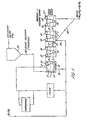
- an alkaline solution of cellulose (viscose) is fed from a container 12 to an acid bath 1, wherein it is acidified by aqueous H 2 SO 4 5, typically containing approximately 180 g/L H 2 SO 4 and 250 g/L Na 2 S0 4 .
- H 2 SO 4 is continuously introduced into the acid bath 1, by the conduit system shown.
- the regenerated cellulose in this case in the form of a film 9, passes through the acid bath 1 over rollers 13, and into a second acid bath 2, over rollers 14.
- Acid 5 from bath 1 is carried over hy the film into bath 2 and from thence to bath 3, and this results in a continuous flow of acid through the bath.
- the acid 6 in bath 2 is in communication by conduit 17 with the acid 7 in bath 3, through which the film 9 passes over rollers 15, after passage through bath 2.
- Baths 1, 2 and 3 are progressively less acidic, acid solution being carried by the film from bath 1 to bath 2 and thence to bath 3.
- Typical concentrations for solutions 6 and 7 are 90 g/I H Z SO Q and 210 g/I Na 2 SO 4
- bath 3 After passage through bath 3, the film passes over rollers 16 through bath 4, which contains washing water 8.
- bath 4 contains washing water 8.
- washing baths are normally used, and the film passes through each bath sequentially, in countercurrent fashion to the washing water. Acid is carried over from bath 3 into bath 4 by the moving film, and thus the washing water 8 in bath 4 is more acidic than that in the next bath, and so on down the line.
- a proportion of the excess acid solution produced in the neutralisation process is recycled through conduits 18 and 19, and is mixed with the H 2 SO 4 feedstock.
- the mixture is filtered and treated in an evaporator, to ensure that the concentration supplied to bath 1 is appropriate.
- the greater part of the acid from bath 3 is supplied to waste via conduit 20, together with waste washing water from bath 4.
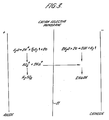
- Figure 3 illustrates the overall reaction taking place in the electrolytic cell when a D.C. current is passed between the electrodes.
- the membrane is relatively impermeable to sulphate ions, and the species mostly responsible for current transfer across the membrane is the sodium ion.
- sodium ions cross the membrane from anolyte to catholyte, and water discharges at the cathode to give hydrogen gas and OH-.
- Hydrogen ions produced at the anode stoichiometrically balance the sulphate ions remaining in the anode compartment, to give a net production of sulphuric acid.
- the sodium ion concentration in the catholyte is maintained not greater than twice that in the anolyte.
- the cell system shown is particularly appropriate for the cellulose process, as the sulphuric acid produced contains sodium sulphate, which although a disadvantage for other applications is an advantage if the solution is to be used for cellulose production.
Landscapes
- Chemical & Material Sciences (AREA)
- Engineering & Computer Science (AREA)
- Chemical Kinetics & Catalysis (AREA)
- Biochemistry (AREA)
- Textile Engineering (AREA)
- Life Sciences & Earth Sciences (AREA)
- General Chemical & Material Sciences (AREA)
- Materials Engineering (AREA)
- Health & Medical Sciences (AREA)
- Medicinal Chemistry (AREA)
- Polymers & Plastics (AREA)
- Organic Chemistry (AREA)
- Polysaccharides And Polysaccharide Derivatives (AREA)
- Electrolytic Production Of Non-Metals, Compounds, Apparatuses Therefor (AREA)
- Separation Using Semi-Permeable Membranes (AREA)
Claims (4)
Priority Applications (1)
| Application Number | Priority Date | Filing Date | Title |
|---|---|---|---|
| AT80304454T ATE12243T1 (de) | 1979-12-11 | 1980-12-10 | Verfahren zur regenerierung von saeure bei der herstellung regenerierter cellulose. |
Applications Claiming Priority (2)
| Application Number | Priority Date | Filing Date | Title |
|---|---|---|---|
| GB7942661A GB2065702B (en) | 1979-12-11 | 1979-12-11 | Electrolytic acid regveneration in regenerated cellulose manufacture |
| GB7942661 | 1979-12-11 |
Publications (3)
| Publication Number | Publication Date |
|---|---|
| EP0032007A2 EP0032007A2 (de) | 1981-07-15 |
| EP0032007A3 EP0032007A3 (en) | 1981-11-04 |
| EP0032007B1 true EP0032007B1 (de) | 1985-03-20 |
Family
ID=10509766
Family Applications (1)
| Application Number | Title | Priority Date | Filing Date |
|---|---|---|---|
| EP80304454A Expired EP0032007B1 (de) | 1979-12-11 | 1980-12-10 | Verfahren zur Regenerierung von Säure bei der Herstellung regenerierter Cellulose |
Country Status (4)
| Country | Link |
|---|---|
| EP (1) | EP0032007B1 (de) |
| AT (1) | ATE12243T1 (de) |
| DE (1) | DE3070350D1 (de) |
| GB (1) | GB2065702B (de) |
Cited By (1)
| Publication number | Priority date | Publication date | Assignee | Title |
|---|---|---|---|---|
| EP4136282A4 (de) * | 2020-04-17 | 2024-10-02 | TreeToTextile AB | Verfahren zur rückgewinnung und wiederverwendung von chemikalien in einem verfahren mit regenerierter cellulosefaser |
Families Citing this family (3)
| Publication number | Priority date | Publication date | Assignee | Title |
|---|---|---|---|---|
| US4504373A (en) * | 1982-06-01 | 1985-03-12 | Allied Corporation | Electrodialytic water splitting process and apparatus for conversion of alkali metal sulfate values derived from spent rayon spin baths |
| DE3315626A1 (de) * | 1983-04-29 | 1984-10-31 | Hoechst Ag, 6230 Frankfurt | Verfahren zur anreicherung von schwefelsaeure |
| CN110578178A (zh) * | 2019-10-11 | 2019-12-17 | 振德医疗用品股份有限公司 | 一种低温水洗聚乙烯醇纤维的装置及其方法 |
Family Cites Families (3)
| Publication number | Priority date | Publication date | Assignee | Title |
|---|---|---|---|---|
| GB215851A (en) * | 1923-02-20 | 1924-05-20 | Carlo Moriondi | Improvements in and in connexion with the manufacture of viscose silk |
| NL63419C (de) * | 1942-04-04 | 1900-01-01 | ||
| FR1015558A (fr) * | 1948-03-24 | 1952-10-15 | Procédé de séparation de l'eau et du sulfate de sodium des bains de filage et des solutions de lavage dans la fabrication des fils et des pellicules de viscose |
-
1979
- 1979-12-11 GB GB7942661A patent/GB2065702B/en not_active Expired
-
1980
- 1980-12-10 AT AT80304454T patent/ATE12243T1/de not_active IP Right Cessation
- 1980-12-10 DE DE8080304454T patent/DE3070350D1/de not_active Expired
- 1980-12-10 EP EP80304454A patent/EP0032007B1/de not_active Expired
Cited By (1)
| Publication number | Priority date | Publication date | Assignee | Title |
|---|---|---|---|---|
| EP4136282A4 (de) * | 2020-04-17 | 2024-10-02 | TreeToTextile AB | Verfahren zur rückgewinnung und wiederverwendung von chemikalien in einem verfahren mit regenerierter cellulosefaser |
Also Published As
| Publication number | Publication date |
|---|---|
| EP0032007A3 (en) | 1981-11-04 |
| GB2065702A (en) | 1981-07-01 |
| ATE12243T1 (de) | 1985-04-15 |
| EP0032007A2 (de) | 1981-07-15 |
| GB2065702B (en) | 1983-06-08 |
| DE3070350D1 (en) | 1985-04-25 |
Similar Documents
| Publication | Publication Date | Title |
|---|---|---|
| DE3118795C2 (de) | Verfahren und Vorrichtung zur kontinuierlichen Herstellung von Chlordioxid durch Elektrolyse | |
| AU653049B2 (en) | Electrochemical process and cell for the production of sulphuric acid and sodium hydroxide | |
| RU2084557C1 (ru) | Способ получения двуокиси хлора | |
| JP2864168B2 (ja) | 硫化物を含有する白液の電解による多硫化物の製造 | |
| US5198080A (en) | Electrochemical processing of aqueous solutions | |
| US5423959A (en) | Process and apparatus for the production of sulphuric acid and alkali metal hydroxide | |
| US4613416A (en) | Process for the concentration of sulfuric acid | |
| US2796395A (en) | Electrolytic desalting of saline solutions | |
| US3423300A (en) | Electrolytic regeneration of reduced chromium compounds | |
| DE10101494A1 (de) | Tetramethylammoniumhydroxid-Synthese | |
| EP0140226B1 (de) | Verfahren zur Gewinnung von Lignin aus alkalischen Lignin-Lösungen | |
| RU2108413C1 (ru) | Способ получения водного подкисленного раствора, содержащего хлоратные ионы, способ электрохимической обработки водного раствора смеси солей щелочных металлов, способ получения двуокиси хлора | |
| US3347761A (en) | Electropurification of salt solutions | |
| EP0032007A2 (de) | Verfahren zur Regenerierung von Säure bei der Herstellung regenerierter Cellulose | |
| US3454478A (en) | Electrolytically reducing halide impurity content of alkali metal dichromate solutions | |
| JPH09503551A (ja) | 酸性にされたプロセス流の製造方法 | |
| DE2006660A1 (de) | Verfahren zum Elektrolysieren einer wässrigen Elektrolytlösung | |
| CN1143050A (zh) | 处理液体的方法 | |
| DE10031018A1 (de) | Chloralkalielektrolyse-Verfahren in Membranzellen unter Elektrolyse von ungereinigtem Siedesalz | |
| JP3098422B2 (ja) | 電気化学方法 | |
| DE2456058A1 (de) | Verfahren und anordnung zum mit dem eisenbeizen verbundenen im kreislauf oder chargenweise durchgefuehrten aufarbeiten von beizendloesungen | |
| US5112452A (en) | Removal of thiosulfate from hydrosulfite solutions | |
| EP0039745A1 (de) | Verfahren zur gleichzeitigen Herstellung von Wasserstoff und Schwefelsäure oder Sulfaten aus Schwefel und Wasser | |
| CA1044637A (en) | Electrolysis of alkali metal chloride | |
| JPS6057516B2 (ja) | 食塩電解方法 |
Legal Events
| Date | Code | Title | Description |
|---|---|---|---|
| PUAI | Public reference made under article 153(3) epc to a published international application that has entered the european phase |
Free format text: ORIGINAL CODE: 0009012 |
|
| AK | Designated contracting states |
Designated state(s): AT BE CH DE FR IT LU NL SE |
|
| PUAL | Search report despatched |
Free format text: ORIGINAL CODE: 0009013 |
|
| AK | Designated contracting states |
Designated state(s): AT BE CH DE FR IT LU NL SE |
|
| 17P | Request for examination filed |
Effective date: 19820222 |
|
| GRAA | (expected) grant |
Free format text: ORIGINAL CODE: 0009210 |
|
| AK | Designated contracting states |
Designated state(s): AT BE CH DE FR IT LI LU NL SE |
|
| PG25 | Lapsed in a contracting state [announced via postgrant information from national office to epo] |
Ref country code: SE Effective date: 19850320 Ref country code: NL Effective date: 19850320 Ref country code: LI Effective date: 19850320 Ref country code: IT Free format text: LAPSE BECAUSE OF FAILURE TO SUBMIT A TRANSLATION OF THE DESCRIPTION OR TO PAY THE FEE WITHIN THE PRESCRIBED TIME-LIMIT;WARNING: LAPSES OF ITALIAN PATENTS WITH EFFECTIVE DATE BEFORE 2007 MAY HAVE OCCURRED AT ANY TIME BEFORE 2007. THE CORRECT EFFECTIVE DATE MAY BE DIFFERENT FROM THE ONE RECORDED. Effective date: 19850320 Ref country code: FR Free format text: THE PATENT HAS BEEN ANNULLED BY A DECISION OF A NATIONAL AUTHORITY Effective date: 19850320 Ref country code: CH Effective date: 19850320 Ref country code: BE Effective date: 19850320 Ref country code: AT Effective date: 19850320 |
|
| REF | Corresponds to: |
Ref document number: 12243 Country of ref document: AT Date of ref document: 19850415 Kind code of ref document: T |
|
| REF | Corresponds to: |
Ref document number: 3070350 Country of ref document: DE Date of ref document: 19850425 |
|
| REG | Reference to a national code |
Ref country code: CH Ref legal event code: PL |
|
| NLV1 | Nl: lapsed or annulled due to failure to fulfill the requirements of art. 29p and 29m of the patents act | ||
| PG25 | Lapsed in a contracting state [announced via postgrant information from national office to epo] |
Ref country code: DE Effective date: 19850902 |
|
| EN | Fr: translation not filed | ||
| PG25 | Lapsed in a contracting state [announced via postgrant information from national office to epo] |
Ref country code: LU Free format text: LAPSE BECAUSE OF NON-PAYMENT OF DUE FEES Effective date: 19851231 |
|
| PLBE | No opposition filed within time limit |
Free format text: ORIGINAL CODE: 0009261 |
|
| STAA | Information on the status of an ep patent application or granted ep patent |
Free format text: STATUS: NO OPPOSITION FILED WITHIN TIME LIMIT |
|
| 26N | No opposition filed |