EP0032007A2 - Method for the regeneration of acid in the manufacture of regenerated cellulose - Google Patents
Method for the regeneration of acid in the manufacture of regenerated cellulose Download PDFInfo
- Publication number
- EP0032007A2 EP0032007A2 EP80304454A EP80304454A EP0032007A2 EP 0032007 A2 EP0032007 A2 EP 0032007A2 EP 80304454 A EP80304454 A EP 80304454A EP 80304454 A EP80304454 A EP 80304454A EP 0032007 A2 EP0032007 A2 EP 0032007A2
- Authority
- EP
- European Patent Office
- Prior art keywords
- acid
- cell
- bath
- regenerated cellulose
- washing
- Prior art date
- Legal status (The legal status is an assumption and is not a legal conclusion. Google has not performed a legal analysis and makes no representation as to the accuracy of the status listed.)
- Granted
Links
- 239000002253 acid Substances 0.000 title claims abstract description 49
- 239000004627 regenerated cellulose Substances 0.000 title claims abstract description 31
- 238000000034 method Methods 0.000 title claims abstract description 23
- 238000004519 manufacturing process Methods 0.000 title description 10
- 230000008929 regeneration Effects 0.000 title 1
- 238000011069 regeneration method Methods 0.000 title 1
- 238000005406 washing Methods 0.000 claims abstract description 37
- XLYOFNOQVPJJNP-UHFFFAOYSA-N water Substances O XLYOFNOQVPJJNP-UHFFFAOYSA-N 0.000 claims abstract description 26
- 229920002678 cellulose Polymers 0.000 claims abstract description 17
- 239000001913 cellulose Substances 0.000 claims abstract description 17
- 239000012528 membrane Substances 0.000 claims abstract description 16
- 230000002378 acidificating effect Effects 0.000 claims abstract description 8
- 239000003513 alkali Substances 0.000 claims abstract description 5
- 239000007788 liquid Substances 0.000 claims abstract description 5
- 230000001172 regenerating effect Effects 0.000 claims abstract description 3
- 239000011260 aqueous acid Substances 0.000 claims description 8
- 150000002500 ions Chemical class 0.000 claims description 7
- 239000002699 waste material Substances 0.000 claims description 5
- 229910001415 sodium ion Inorganic materials 0.000 claims description 4
- 230000007935 neutral effect Effects 0.000 claims description 3
- 230000020477 pH reduction Effects 0.000 claims description 2
- 238000007599 discharging Methods 0.000 claims 1
- 239000000243 solution Substances 0.000 description 21
- HEMHJVSKTPXQMS-UHFFFAOYSA-M Sodium hydroxide Chemical compound [OH-].[Na+] HEMHJVSKTPXQMS-UHFFFAOYSA-M 0.000 description 9
- QAOWNCQODCNURD-UHFFFAOYSA-N Sulfuric acid Chemical compound OS(O)(=O)=O QAOWNCQODCNURD-UHFFFAOYSA-N 0.000 description 7
- PMZURENOXWZQFD-UHFFFAOYSA-L Sodium Sulfate Chemical compound [Na+].[Na+].[O-]S([O-])(=O)=O PMZURENOXWZQFD-UHFFFAOYSA-L 0.000 description 6
- -1 polyethylene Polymers 0.000 description 5
- UFHFLCQGNIYNRP-UHFFFAOYSA-N Hydrogen Chemical compound [H][H] UFHFLCQGNIYNRP-UHFFFAOYSA-N 0.000 description 4
- 229920000297 Rayon Polymers 0.000 description 4
- 150000001768 cations Chemical class 0.000 description 4
- 239000001257 hydrogen Substances 0.000 description 4
- 229910052739 hydrogen Inorganic materials 0.000 description 4
- BASFCYQUMIYNBI-UHFFFAOYSA-N platinum Chemical compound [Pt] BASFCYQUMIYNBI-UHFFFAOYSA-N 0.000 description 4
- 229910052938 sodium sulfate Inorganic materials 0.000 description 4
- QVGXLLKOCUKJST-UHFFFAOYSA-N atomic oxygen Chemical compound [O] QVGXLLKOCUKJST-UHFFFAOYSA-N 0.000 description 3
- 238000005868 electrolysis reaction Methods 0.000 description 3
- 239000001301 oxygen Substances 0.000 description 3
- 229910052760 oxygen Inorganic materials 0.000 description 3
- RWSOTUBLDIXVET-UHFFFAOYSA-N Dihydrogen sulfide Chemical compound S RWSOTUBLDIXVET-UHFFFAOYSA-N 0.000 description 2
- 239000007832 Na2SO4 Substances 0.000 description 2
- 229920000557 Nafion® Polymers 0.000 description 2
- FKNQFGJONOIPTF-UHFFFAOYSA-N Sodium cation Chemical compound [Na+] FKNQFGJONOIPTF-UHFFFAOYSA-N 0.000 description 2
- 239000002585 base Substances 0.000 description 2
- 238000010586 diagram Methods 0.000 description 2
- ZOOODBUHSVUZEM-UHFFFAOYSA-N ethoxymethanedithioic acid Chemical compound CCOC(S)=S ZOOODBUHSVUZEM-UHFFFAOYSA-N 0.000 description 2
- 239000000463 material Substances 0.000 description 2
- 229910052697 platinum Inorganic materials 0.000 description 2
- 235000011152 sodium sulphate Nutrition 0.000 description 2
- 229910001220 stainless steel Inorganic materials 0.000 description 2
- 239000010935 stainless steel Substances 0.000 description 2
- 229910021653 sulphate ion Inorganic materials 0.000 description 2
- 239000001117 sulphuric acid Substances 0.000 description 2
- 235000011149 sulphuric acid Nutrition 0.000 description 2
- 239000012991 xanthate Substances 0.000 description 2
- 239000004215 Carbon black (E152) Substances 0.000 description 1
- 239000004698 Polyethylene Substances 0.000 description 1
- 239000004743 Polypropylene Substances 0.000 description 1
- RTAQQCXQSZGOHL-UHFFFAOYSA-N Titanium Chemical compound [Ti] RTAQQCXQSZGOHL-UHFFFAOYSA-N 0.000 description 1
- 239000004063 acid-resistant material Substances 0.000 description 1
- 239000003929 acidic solution Substances 0.000 description 1
- 239000012670 alkaline solution Substances 0.000 description 1
- 150000001450 anions Chemical class 0.000 description 1
- 239000010405 anode material Substances 0.000 description 1
- 238000004380 ashing Methods 0.000 description 1
- QGJOPFRUJISHPQ-NJFSPNSNSA-N carbon disulfide-14c Chemical compound S=[14C]=S QGJOPFRUJISHPQ-NJFSPNSNSA-N 0.000 description 1
- 125000002843 carboxylic acid group Chemical group 0.000 description 1
- 239000010406 cathode material Substances 0.000 description 1
- 238000006243 chemical reaction Methods 0.000 description 1
- 239000004020 conductor Substances 0.000 description 1
- 230000000694 effects Effects 0.000 description 1
- 230000002349 favourable effect Effects 0.000 description 1
- 239000000835 fiber Substances 0.000 description 1
- 239000012467 final product Substances 0.000 description 1
- NBVXSUQYWXRMNV-UHFFFAOYSA-N fluoromethane Chemical compound FC NBVXSUQYWXRMNV-UHFFFAOYSA-N 0.000 description 1
- 239000000446 fuel Substances 0.000 description 1
- 229930195733 hydrocarbon Natural products 0.000 description 1
- 150000002430 hydrocarbons Chemical class 0.000 description 1
- 238000009776 industrial production Methods 0.000 description 1
- 239000000203 mixture Substances 0.000 description 1
- 238000006386 neutralization reaction Methods 0.000 description 1
- 229920000728 polyester Polymers 0.000 description 1
- 229920000573 polyethylene Polymers 0.000 description 1
- 229920001155 polypropylene Polymers 0.000 description 1
- 229920002620 polyvinyl fluoride Polymers 0.000 description 1
- 239000002964 rayon Substances 0.000 description 1
- 239000010802 sludge Substances 0.000 description 1
- 238000009987 spinning Methods 0.000 description 1
- BDHFUVZGWQCTTF-UHFFFAOYSA-N sulfonic acid Chemical compound OS(=O)=O BDHFUVZGWQCTTF-UHFFFAOYSA-N 0.000 description 1
- 229910052719 titanium Inorganic materials 0.000 description 1
- 239000010936 titanium Substances 0.000 description 1
Images
Classifications
-
- D—TEXTILES; PAPER
- D01—NATURAL OR MAN-MADE THREADS OR FIBRES; SPINNING
- D01F—CHEMICAL FEATURES IN THE MANUFACTURE OF ARTIFICIAL FILAMENTS, THREADS, FIBRES, BRISTLES OR RIBBONS; APPARATUS SPECIALLY ADAPTED FOR THE MANUFACTURE OF CARBON FILAMENTS
- D01F13/00—Recovery of starting material, waste material or solvents during the manufacture of artificial filaments or the like
- D01F13/02—Recovery of starting material, waste material or solvents during the manufacture of artificial filaments or the like of cellulose, cellulose derivatives or proteins
-
- C—CHEMISTRY; METALLURGY
- C08—ORGANIC MACROMOLECULAR COMPOUNDS; THEIR PREPARATION OR CHEMICAL WORKING-UP; COMPOSITIONS BASED THEREON
- C08B—POLYSACCHARIDES; DERIVATIVES THEREOF
- C08B16/00—Regeneration of cellulose
-
- Y—GENERAL TAGGING OF NEW TECHNOLOGICAL DEVELOPMENTS; GENERAL TAGGING OF CROSS-SECTIONAL TECHNOLOGIES SPANNING OVER SEVERAL SECTIONS OF THE IPC; TECHNICAL SUBJECTS COVERED BY FORMER USPC CROSS-REFERENCE ART COLLECTIONS [XRACs] AND DIGESTS
- Y02—TECHNOLOGIES OR APPLICATIONS FOR MITIGATION OR ADAPTATION AGAINST CLIMATE CHANGE
- Y02P—CLIMATE CHANGE MITIGATION TECHNOLOGIES IN THE PRODUCTION OR PROCESSING OF GOODS
- Y02P70/00—Climate change mitigation technologies in the production process for final industrial or consumer products
- Y02P70/50—Manufacturing or production processes characterised by the final manufactured product
- Y02P70/62—Manufacturing or production processes characterised by the final manufactured product related technologies for production or treatment of textile or flexible materials or products thereof, including footwear
Definitions
- This invention relates to the production of regenerated cellulose by the acidification of an alkaline cellulose solution.
- regenerated cellulose In the industrial production of regenerated cellulose, pure cellulose is reacted with sodium hydroxide, and, in the xanthate process, with carbon disulfide, to produce a viscous solution known as viscose, or xanthate.
- the viscous solution is then reconstituted, either as a transparent film or as a fibre (commonly known as rayon), by introducing the solution into a bath of an aqueous acid solution.
- the cellulose, thus regenerated is passed through the aqueous acid solution to remove residual alkali therefrom,
- it In general, in order to complete this process, it is passed through further acid baths (usually two further acid baths i.e. three in all) after which it is washed by a countercurrent of washing water to produce the final product.
- This invention provides a method of producing regenerated cellulose comprising regenerating cellulose by acidifying an alkaline cellulose solution, passing the regenerated cellulose through an acid bath to remove residual alkali therefrom,washing the regenerated cellulose with a countercurrent of washing water, passing liquid from the acid bath through the anode compartment of an electrolytic cell, and the washing water through the cathode compartment of the said cell, the said cell being provided with an ion-selective membrane cell divider to define the said anode and cathode compartments, and electrolysing the solution in the cell to raise the acidity of the anolyte and lower that of the catholyte, to produce a less acidic aqueous effluent.
- a viscose solution is acidified, to produce regenerated cellulose. This is generally done by spinning or extruding the solution into aqueous acid.
- the regenerated cellulose thus produced is passed through the acid solution, and preferably through a number of other acid baths. During passage through the acid baths, acid is carried over by the cellulose, and the successive baths are decreasingly acidic.
- the acid solution which is passed through the anode compartment of the electrolytic cell is taken from the final or penultimate acid bath, i.e. the ones containing the least strong acid.
- the electrolysis in this cell is carried out in such a way as to lower the acidity of the acidic effluent (i.e. the washing water), so as to make it more nearly neutral, and to increase the acidity of the anolyte, in order to produce more usable acid.
- the regenerated acid from the anode compartment is preferably recycled to the acid bath, and used as feedstock for the process.
- the ion-selective membrane may be any of the various cation, anion, or bipolar membranes which are commercially available, and which can be used for the electrolysis of water, so as to generate acid and base.
- Cation selective membranes are generally the most favourable, and such materials generally contain either sulphonic or carboxylic acid groups, attached to a fluorocarbon or hydrocarbon base chain.
- the electrolysis reaction also produces hydrogen at the cathode, and oxygen at the anode.
- the hydrogen evolved at the cathode is a useful bonus, as it tends to remove dissolved hydrogen sulphide from the solution, and as a consequence the plant effluent will be reduced in hydrogen sulphide.
- the oxygen evolved at the anode may be simply allowed to escape to atmosphere, or may be utilised in the plant or elsewhere, for example, in conjunction with an activated sludge bed for further effluent treatment.
- the hydrogen evolved at the cathode may be allowed to escape to atmosphere, or may be put to further use, for example as a fuel in a low-pressure burner.
- the cell should be one of a bipolar stack of cells, of alternate anode and cathode compartments, as is well known in the art.
- the anolyte and catholyte are preferably pumped continuously through the respective compartments, so as to provide rapid movement over the electrodes, and minimise the effect of ion depletion at the electrodes.
- the cathode material may be any acid resistant conductive material, and we have found that stainless steel is quite suitable.
- the anode material may be any material suitable for oxygen evolution in acidic solution, for example anodised lead, platinum, irridium, or platinum/irridium-coated titanium.
- the cell itself may be constructed of any electrically insulating acid-resistant material, for example polyethylene , polypropylene, polyvinylfluoride, or polyester.
- Suitable apparatus for carrying out the method of the invention comprises a bath for containing an aqueous acid solution, means for introducing an aqueous alkaline cellulose solution into an aqueous acid solution to produce regenerated cellulose in the required form, means for passing the regenerated cellulose through an aqueous acid solution in the said bath, an acid washing bath for the regenerated cellulose, means for passing the regenerated cellulose through washing water in the washing bath, an electrolytic cell having a cell divider which is an ion-selective membrane, and which defines cathode and anode compartments in the cell, means for passing acid from the acid bath through the anode compartment of the cell, and washing water from the washing bath through the cathode compartment of the cell, and means for supplying a D.C. voltage to the cell to lower the pH of the anolyte and raise that of the catholyte.
- an alkaline solution of cellulose (viscose) is fed from a container 12 to an acid bath 1, wherein it is acidified by aqueous H 2 SO 4 5, typically containing approximately 180 g/L H 2 SO 4 and 250 g/L Na 2 SO 4 .H 2 SO 4 is continuously introduced into the acid bath 1, by the conduit system shown.
- the regenerated cellulose in this case in the form of a film 9, passes through the acid bath 1 over rollers 13, and into a second acid bath 2, over rollers 14, Acid 5 from bath 1 is carried over by the film into bath 2 and from thence to bath 3, and this results in a continuous flow of acid through the bath.
- the acid 6 in bath 2 is in communication by conduit 17 with the acid 7 in bath 3, through which the film 9 passes over rollers 15, after passage through bath 2.
- Bath s l, 2 and 3 are progressively less acidic, acid solution being carried by the film from bath 1 to bath 2 and thence to bath 3.
- Typical concentrations for solutions 6 and 7 are 90 g/L H 2 S0 4 and 210 g/L Na 2 SO 4 .
- bath 3 After passage through bath 3, the film passes over rollers 16 through bath 4, which contains v'ashing water 8.
- bath 4 contains v'ashing water 8.
- Several such washing baths are normally used, and the film passes through each bath sequentially, in countercurrent fashion to the washing water. Acid is carried over from bath 3 into bath 4 by the moving film, and thus the washing water 8 in bath 4 is more acidic than that in the next bath, and so on down the line.
- a proportion of the excess acid produced in the neutralisation process is recycled through conduits 18 and 19, and is mixed with the H 2 S0 4 feedstock.
- the mixture is filtered and treated in an evaporator, to ensure that the concentration supplied to bath 1 is appropriate.
- the greater part of the acid from bath 3 is supplied to waste via conduit 20, together with waste washing water from bath 4.
- Figure 3 illustrates the overall reaction taking place in the electrolytic cell when a D.C. current is passed between the electrodes.
- the membrane is relatively impermeable to sulphate ions, and the species mostly responsible for current transfer across the membrane is the sodium ion.
- sodium ions cross the membrane from anolyte to catholyte, and water discharges at the cathode to give hydrogen gas and OH .
- Hydrogen ions produced at the anode stoichiometrically balance the sulphate ions remaining in the anode compartment, to give a net production of sulphuric acid.
- the sodium ion concentration in the catholyte is preferably maintained not greater than twice that in the anolyte.
- the cell system shown is particularly appropriate for the cellulose process, as the sulphuric acid produced contains sodium sulphate, which although a disadvantage for other applications is an advantage if the solution is to be used for cellulose production.
Landscapes
- Chemical & Material Sciences (AREA)
- Engineering & Computer Science (AREA)
- Chemical Kinetics & Catalysis (AREA)
- Biochemistry (AREA)
- Textile Engineering (AREA)
- Life Sciences & Earth Sciences (AREA)
- General Chemical & Material Sciences (AREA)
- Materials Engineering (AREA)
- Health & Medical Sciences (AREA)
- Medicinal Chemistry (AREA)
- Polymers & Plastics (AREA)
- Organic Chemistry (AREA)
- Polysaccharides And Polysaccharide Derivatives (AREA)
- Electrolytic Production Of Non-Metals, Compounds, Apparatuses Therefor (AREA)
- Separation Using Semi-Permeable Membranes (AREA)
Abstract
Description
- This invention relates to the production of regenerated cellulose by the acidification of an alkaline cellulose solution.
- In the industrial production of regenerated cellulose, pure cellulose is reacted with sodium hydroxide, and, in the xanthate process, with carbon disulfide, to produce a viscous solution known as viscose, or xanthate. The viscous solution is then reconstituted, either as a transparent film or as a fibre (commonly known as rayon), by introducing the solution into a bath of an aqueous acid solution. The cellulose, thus regenerated, is passed through the aqueous acid solution to remove residual alkali therefrom, In general, in order to complete this process, it is passed through further acid baths (usually two further acid baths i.e. three in all) after which it is washed by a countercurrent of washing water to produce the final product.
- Because the solution in which the cellulose is regenerated must at all times be kept acid, the overall acid demand of the manufacturing plant is in excess of that which would theoretically be required to neutralise the alkali used.
- This results furthermore in the production of washing water effluent which is quite strongly acidic, and which may require treatment before it is possible to discharge it into the sewerage system.
- This invention provides a method of producing regenerated cellulose comprising regenerating cellulose by acidifying an alkaline cellulose solution, passing the regenerated cellulose through an acid bath to remove residual alkali therefrom,washing the regenerated cellulose with a countercurrent of washing water, passing liquid from the acid bath through the anode compartment of an electrolytic cell, and the washing water through the cathode compartment of the said cell, the said cell being provided with an ion-selective membrane cell divider to define the said anode and cathode compartments, and electrolysing the solution in the cell to raise the acidity of the anolyte and lower that of the catholyte, to produce a less acidic aqueous effluent.
- In the process of the invention, a viscose solution is acidified, to produce regenerated cellulose. This is generally done by spinning or extruding the solution into aqueous acid. The regenerated cellulose thus produced is passed through the acid solution, and preferably through a number of other acid baths. During passage through the acid baths, acid is carried over by the cellulose, and the successive baths are decreasingly acidic.
- In the process of the invention it is generally preferable that the acid solution which is passed through the anode compartment of the electrolytic cell is taken from the final or penultimate acid bath, i.e. the ones containing the least strong acid.
- The electrolysis in this cell is carried out in such a way as to lower the acidity of the acidic effluent (i.e. the washing water), so as to make it more nearly neutral, and to increase the acidity of the anolyte, in order to produce more usable acid. The regenerated acid from the anode compartment is preferably recycled to the acid bath, and used as feedstock for the process.
- The ion-selective membrane may be any of the various cation, anion, or bipolar membranes which are commercially available, and which can be used for the electrolysis of water, so as to generate acid and base. Cation selective membranes are generally the most favourable, and such materials generally contain either sulphonic or carboxylic acid groups, attached to a fluorocarbon or hydrocarbon base chain.
- The electrolysis reaction also produces hydrogen at the cathode, and oxygen at the anode. The hydrogen evolved at the cathode is a useful bonus, as it tends to remove dissolved hydrogen sulphide from the solution, and as a consequence the plant effluent will be reduced in hydrogen sulphide. The oxygen evolved at the anode may be simply allowed to escape to atmosphere, or may be utilised in the plant or elsewhere, for example, in conjunction with an activated sludge bed for further effluent treatment. Similarly, the hydrogen evolved at the cathode may be allowed to escape to atmosphere, or may be put to further use, for example as a fuel in a low-pressure burner.
- Although a simple electrolytic cell may be used in the process of the invention, it is preferable that the cell should be one of a bipolar stack of cells, of alternate anode and cathode compartments, as is well known in the art. The anolyte and catholyte are preferably pumped continuously through the respective compartments, so as to provide rapid movement over the electrodes, and minimise the effect of ion depletion at the electrodes.
- The cathode material may be any acid resistant conductive material, and we have found that stainless steel is quite suitable.
- The anode material may be any material suitable for oxygen evolution in acidic solution, for example anodised lead, platinum, irridium, or platinum/irridium-coated titanium. The cell itself may be constructed of any electrically insulating acid-resistant material, for example polyethylene , polypropylene, polyvinylfluoride, or polyester.
- Suitable apparatus for carrying out the method of the invention comprises a bath for containing an aqueous acid solution, means for introducing an aqueous alkaline cellulose solution into an aqueous acid solution to produce regenerated cellulose in the required form, means for passing the regenerated cellulose through an aqueous acid solution in the said bath, an acid washing bath for the regenerated cellulose, means for passing the regenerated cellulose through washing water in the washing bath, an electrolytic cell having a cell divider which is an ion-selective membrane, and which defines cathode and anode compartments in the cell, means for passing acid from the acid bath through the anode compartment of the cell, and washing water from the washing bath through the cathode compartment of the cell, and means for supplying a D.C. voltage to the cell to lower the pH of the anolyte and raise that of the catholyte.
- A particular embodiment of the invention will now be described in detail with reference to the accompanying drawings, in which:-
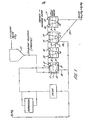
- Figure 1 is a schematic diagram of a conventional production line for regenerated cellulose film,
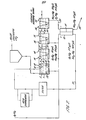
- Figure 2 shows a similar production line modified to operate according to the method of the invention, and
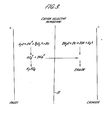
- Figure 3 is a schematic diagram of an electrolytic cell as used in the method of the invention.
- In the conventional production line shown in Figure 1, an alkaline solution of cellulose (viscose) is fed from a
container 12 to an acid bath 1, wherein it is acidified by aqueous H2SO4 5, typically containing approximately 180 g/L H2SO4 and 250 g/L Na2SO4.H2SO4 is continuously introduced into the acid bath 1, by the conduit system shown. - The regenerated cellulose, in this case in the form of a
film 9, passes through the acid bath 1 overrollers 13, and into a second acid bath 2, overrollers 14, Acid 5 from bath 1 is carried over by the film into bath 2 and from thence to bath 3, and this results in a continuous flow of acid through the bath. The acid 6 in bath 2 is in communication byconduit 17 with the acid 7 in bath 3, through which thefilm 9 passes overrollers 15, after passage through bath 2. - Bathsl, 2 and 3 are progressively less acidic, acid solution being carried by the film from bath 1 to bath 2 and thence to bath 3. Typical concentrations for solutions 6 and 7 are 90 g/L H2S04 and 210 g/L Na2SO4.
- After passage through bath 3, the film passes over
rollers 16 through bath 4, which contains v'ashing water 8. Several such washing baths are normally used, and the film passes through each bath
sequentially, in countercurrent fashion to the washing water. Acid is carried over from bath 3 into bath 4 by the moving film, and thus the washing water 8 in bath 4 is more acidic than that in the next bath, and so on down the line. - A proportion of the excess acid produced in the neutralisation process is recycled through
conduits conduit 20, together with waste washing water from bath 4. - In Figure 2, the same plant has been modified to operate in accordance with the invention, by the provision of an electrolytic cell 10, which is shown schematically with its
membrane 11 which is a commercially available cation selective membrane (nafion). The acid effluent from bath 3 which would otherwise have been allowed to go to waste is passed through the anode compartment of cell 10, from where it is returned to the filter and acid evaporator throughconduit 21. Wash water 8 from bath 4 is fed viaconduit 22 to the cathode compartment of the electrolytic cell 10. - Figure 3 illustrates the overall reaction taking place in the electrolytic cell when a D.C. current is passed between the electrodes. The membrane is relatively impermeable to sulphate ions, and the species mostly responsible for current transfer across the membrane is the sodium ion. Thus sodium ions cross the membrane from anolyte to catholyte, and water discharges at the cathode to give hydrogen gas and OH . This results in a net production in the cathode compartment of sodium hydroxide, which neutralises the H2S04 in the washing water from bath 4, to produce an approximately neutral effluent, containing approximately 60 g/L of sodium sulphate. Hydrogen ions produced at the anode stoichiometrically balance the sulphate ions remaining in the anode compartment, to give a net production of sulphuric acid. In order to maintain the potential required at a suitably low level, the sodium ion concentration in the catholyte is preferably maintained not greater than twice that in the anolyte. The cell system shown is particularly appropriate for the cellulose process, as the sulphuric acid produced contains sodium sulphate, which although a disadvantage for other applications is an advantage if the solution is to be used for cellulose production.
- Good results have been obtained using a cell with a preanodised lead anode, a stainless steel cathode, and a "NAFION" cation selctive membrane, At a mean cell potential of 60 volts for 19.4 hours with such a cell, a current of 250 amps produced the equivalent of 6 kg of H2SO4 in the anode compartment and 4.92 kg of NaOH in the cathode compartment (equivalent to approximately 4.87 kwh. per kg of H2SO4).
Claims (13)
Priority Applications (1)
| Application Number | Priority Date | Filing Date | Title |
|---|---|---|---|
| AT80304454T ATE12243T1 (en) | 1979-12-11 | 1980-12-10 | ACID REGENERATION PROCESSES IN THE MANUFACTURE OF REGENERATED CELLULOSE. |
Applications Claiming Priority (2)
| Application Number | Priority Date | Filing Date | Title |
|---|---|---|---|
| GB7942661 | 1979-12-11 | ||
| GB7942661A GB2065702B (en) | 1979-12-11 | 1979-12-11 | Electrolytic acid regveneration in regenerated cellulose manufacture |
Publications (3)
| Publication Number | Publication Date |
|---|---|
| EP0032007A2 true EP0032007A2 (en) | 1981-07-15 |
| EP0032007A3 EP0032007A3 (en) | 1981-11-04 |
| EP0032007B1 EP0032007B1 (en) | 1985-03-20 |
Family
ID=10509766
Family Applications (1)
| Application Number | Title | Priority Date | Filing Date |
|---|---|---|---|
| EP80304454A Expired EP0032007B1 (en) | 1979-12-11 | 1980-12-10 | Method for the regeneration of acid in the manufacture of regenerated cellulose |
Country Status (4)
| Country | Link |
|---|---|
| EP (1) | EP0032007B1 (en) |
| AT (1) | ATE12243T1 (en) |
| DE (1) | DE3070350D1 (en) |
| GB (1) | GB2065702B (en) |
Cited By (3)
| Publication number | Priority date | Publication date | Assignee | Title |
|---|---|---|---|---|
| EP0096239A3 (en) * | 1982-06-01 | 1985-10-30 | Allied Corporation | Electrodialytic water splitting process for conversion of alkali metal sulfate values derived from spent rayon spin baths |
| US4613416A (en) * | 1983-04-29 | 1986-09-23 | Hoechst Aktiengesellschaft | Process for the concentration of sulfuric acid |
| CN110578178A (en) * | 2019-10-11 | 2019-12-17 | 振德医疗用品股份有限公司 | A device and method for washing polyvinyl alcohol fibers with low temperature water |
Families Citing this family (1)
| Publication number | Priority date | Publication date | Assignee | Title |
|---|---|---|---|---|
| EP4136282A4 (en) * | 2020-04-17 | 2024-10-02 | TreeToTextile AB | Process for the recovery and recycle of chemicals in a regenerated cellulose fiber process |
Family Cites Families (3)
| Publication number | Priority date | Publication date | Assignee | Title |
|---|---|---|---|---|
| GB215851A (en) * | 1923-02-20 | 1924-05-20 | Carlo Moriondi | Improvements in and in connexion with the manufacture of viscose silk |
| BE449964A (en) * | 1942-04-04 | 1900-01-01 | ||
| FR1015558A (en) * | 1948-03-24 | 1952-10-15 | Process for the separation of water and sodium sulfate from spinning baths and washing solutions in the manufacture of viscose yarns and films |
-
1979
- 1979-12-11 GB GB7942661A patent/GB2065702B/en not_active Expired
-
1980
- 1980-12-10 EP EP80304454A patent/EP0032007B1/en not_active Expired
- 1980-12-10 DE DE8080304454T patent/DE3070350D1/en not_active Expired
- 1980-12-10 AT AT80304454T patent/ATE12243T1/en not_active IP Right Cessation
Cited By (3)
| Publication number | Priority date | Publication date | Assignee | Title |
|---|---|---|---|---|
| EP0096239A3 (en) * | 1982-06-01 | 1985-10-30 | Allied Corporation | Electrodialytic water splitting process for conversion of alkali metal sulfate values derived from spent rayon spin baths |
| US4613416A (en) * | 1983-04-29 | 1986-09-23 | Hoechst Aktiengesellschaft | Process for the concentration of sulfuric acid |
| CN110578178A (en) * | 2019-10-11 | 2019-12-17 | 振德医疗用品股份有限公司 | A device and method for washing polyvinyl alcohol fibers with low temperature water |
Also Published As
| Publication number | Publication date |
|---|---|
| EP0032007A3 (en) | 1981-11-04 |
| GB2065702B (en) | 1983-06-08 |
| ATE12243T1 (en) | 1985-04-15 |
| GB2065702A (en) | 1981-07-01 |
| DE3070350D1 (en) | 1985-04-25 |
| EP0032007B1 (en) | 1985-03-20 |
Similar Documents
| Publication | Publication Date | Title |
|---|---|---|
| DE3118795C2 (en) | Process and apparatus for the continuous production of chlorine dioxide by electrolysis | |
| AU653049B2 (en) | Electrochemical process and cell for the production of sulphuric acid and sodium hydroxide | |
| US4798715A (en) | Producing chlorine dioxide from chlorate salt | |
| EP1121970B1 (en) | Method and apparatus for the simultaneous production of high purity acids and bases | |
| RU2084557C1 (en) | Method of producing chlorine dioxide | |
| JP2864168B2 (en) | Production of polysulfide by electrolysis of sulfide-containing white liquor. | |
| US5423959A (en) | Process and apparatus for the production of sulphuric acid and alkali metal hydroxide | |
| US4613416A (en) | Process for the concentration of sulfuric acid | |
| DE1916491A1 (en) | Process for the extraction of acidic gases from exhaust gases | |
| US3423300A (en) | Electrolytic regeneration of reduced chromium compounds | |
| US2796395A (en) | Electrolytic desalting of saline solutions | |
| DE10101494A1 (en) | Tetramethylammonium hydroxide synthesis | |
| DE3637939A1 (en) | METHOD FOR PRODUCING ALKALINE HYDROXIDE, CHLORINE AND HYDROGEN BY ELECTROLYSIS OF AN AQUEOUS ALKALICHLORIDE SOLUTION IN A MEMBRANE CELL | |
| EP0140226B1 (en) | Method of obtaining lignin from alcaline lignin solutions | |
| EP0032007B1 (en) | Method for the regeneration of acid in the manufacture of regenerated cellulose | |
| US3347761A (en) | Electropurification of salt solutions | |
| RU2108413C1 (en) | Method for production of aqueous acidified solution containing chlorate ions, method for electrochemical treatment of aqueous solution of mixture of salts of alkali metals, method for production of chlorine dioxide | |
| Bramer et al. | Electrolytic Regeneration of Spent Pickling Solutions | |
| US5294316A (en) | Process and apparatus for electrodialysis of an alkali sulfate containing aqueous solution | |
| US3454478A (en) | Electrolytically reducing halide impurity content of alkali metal dichromate solutions | |
| JPH09503551A (en) | Method for producing acidified process stream | |
| DE2006660A1 (en) | Method for electrolyzing an aqueous electrolyte solution | |
| DE4219758A1 (en) | Process for the electrochemical production of dicarboxylic acids | |
| EP0426649B1 (en) | Process for the stepwise electrodialysis of alkali sulfate-containing aqueous solutions and apparatus for carrying out the process | |
| DE2456058C2 (en) | Process and arrangement for the recycle or batch processing of final pickling solutions associated with iron pickling |
Legal Events
| Date | Code | Title | Description |
|---|---|---|---|
| PUAI | Public reference made under article 153(3) epc to a published international application that has entered the european phase |
Free format text: ORIGINAL CODE: 0009012 |
|
| AK | Designated contracting states |
Designated state(s): AT BE CH DE FR IT LU NL SE |
|
| PUAL | Search report despatched |
Free format text: ORIGINAL CODE: 0009013 |
|
| AK | Designated contracting states |
Designated state(s): AT BE CH DE FR IT LU NL SE |
|
| 17P | Request for examination filed |
Effective date: 19820222 |
|
| GRAA | (expected) grant |
Free format text: ORIGINAL CODE: 0009210 |
|
| AK | Designated contracting states |
Designated state(s): AT BE CH DE FR IT LI LU NL SE |
|
| PG25 | Lapsed in a contracting state [announced via postgrant information from national office to epo] |
Ref country code: SE Effective date: 19850320 Ref country code: NL Effective date: 19850320 Ref country code: LI Effective date: 19850320 Ref country code: IT Free format text: LAPSE BECAUSE OF FAILURE TO SUBMIT A TRANSLATION OF THE DESCRIPTION OR TO PAY THE FEE WITHIN THE PRESCRIBED TIME-LIMIT;WARNING: LAPSES OF ITALIAN PATENTS WITH EFFECTIVE DATE BEFORE 2007 MAY HAVE OCCURRED AT ANY TIME BEFORE 2007. THE CORRECT EFFECTIVE DATE MAY BE DIFFERENT FROM THE ONE RECORDED. Effective date: 19850320 Ref country code: FR Free format text: THE PATENT HAS BEEN ANNULLED BY A DECISION OF A NATIONAL AUTHORITY Effective date: 19850320 Ref country code: CH Effective date: 19850320 Ref country code: BE Effective date: 19850320 Ref country code: AT Effective date: 19850320 |
|
| REF | Corresponds to: |
Ref document number: 12243 Country of ref document: AT Date of ref document: 19850415 Kind code of ref document: T |
|
| REF | Corresponds to: |
Ref document number: 3070350 Country of ref document: DE Date of ref document: 19850425 |
|
| REG | Reference to a national code |
Ref country code: CH Ref legal event code: PL |
|
| NLV1 | Nl: lapsed or annulled due to failure to fulfill the requirements of art. 29p and 29m of the patents act | ||
| PG25 | Lapsed in a contracting state [announced via postgrant information from national office to epo] |
Ref country code: DE Effective date: 19850902 |
|
| EN | Fr: translation not filed | ||
| PG25 | Lapsed in a contracting state [announced via postgrant information from national office to epo] |
Ref country code: LU Free format text: LAPSE BECAUSE OF NON-PAYMENT OF DUE FEES Effective date: 19851231 |
|
| PLBE | No opposition filed within time limit |
Free format text: ORIGINAL CODE: 0009261 |
|
| STAA | Information on the status of an ep patent application or granted ep patent |
Free format text: STATUS: NO OPPOSITION FILED WITHIN TIME LIMIT |
|
| 26N | No opposition filed |