EP0031964A2 - Sequential emulsion polymerization process for structured particle latex products - Google Patents
Sequential emulsion polymerization process for structured particle latex products Download PDFInfo
- Publication number
- EP0031964A2 EP0031964A2 EP80108226A EP80108226A EP0031964A2 EP 0031964 A2 EP0031964 A2 EP 0031964A2 EP 80108226 A EP80108226 A EP 80108226A EP 80108226 A EP80108226 A EP 80108226A EP 0031964 A2 EP0031964 A2 EP 0031964A2
- Authority
- EP
- European Patent Office
- Prior art keywords
- monomer
- weight
- weight percent
- carboxylic acid
- monomer charge
- Prior art date
- Legal status (The legal status is an assumption and is not a legal conclusion. Google has not performed a legal analysis and makes no representation as to the accuracy of the status listed.)
- Granted
Links
Classifications
-
- D—TEXTILES; PAPER
- D21—PAPER-MAKING; PRODUCTION OF CELLULOSE
- D21H—PULP COMPOSITIONS; PREPARATION THEREOF NOT COVERED BY SUBCLASSES D21C OR D21D; IMPREGNATING OR COATING OF PAPER; TREATMENT OF FINISHED PAPER NOT COVERED BY CLASS B31 OR SUBCLASS D21G; PAPER NOT OTHERWISE PROVIDED FOR
- D21H19/00—Coated paper; Coating material
- D21H19/36—Coatings with pigments
- D21H19/44—Coatings with pigments characterised by the other ingredients, e.g. the binder or dispersing agent
- D21H19/56—Macromolecular organic compounds or oligomers thereof obtained by reactions only involving carbon-to-carbon unsaturated bonds
- D21H19/58—Polymers or oligomers of diolefins, aromatic vinyl monomers or unsaturated acids or derivatives thereof
-
- C—CHEMISTRY; METALLURGY
- C08—ORGANIC MACROMOLECULAR COMPOUNDS; THEIR PREPARATION OR CHEMICAL WORKING-UP; COMPOSITIONS BASED THEREON
- C08F—MACROMOLECULAR COMPOUNDS OBTAINED BY REACTIONS ONLY INVOLVING CARBON-TO-CARBON UNSATURATED BONDS
- C08F263/00—Macromolecular compounds obtained by polymerising monomers on to polymers of esters of unsaturated alcohols with saturated acids as defined in group C08F18/00
- C08F263/02—Macromolecular compounds obtained by polymerising monomers on to polymers of esters of unsaturated alcohols with saturated acids as defined in group C08F18/00 on to polymers of vinyl esters with monocarboxylic acids
-
- C—CHEMISTRY; METALLURGY
- C08—ORGANIC MACROMOLECULAR COMPOUNDS; THEIR PREPARATION OR CHEMICAL WORKING-UP; COMPOSITIONS BASED THEREON
- C08F—MACROMOLECULAR COMPOUNDS OBTAINED BY REACTIONS ONLY INVOLVING CARBON-TO-CARBON UNSATURATED BONDS
- C08F265/00—Macromolecular compounds obtained by polymerising monomers on to polymers of unsaturated monocarboxylic acids or derivatives thereof as defined in group C08F20/00
- C08F265/04—Macromolecular compounds obtained by polymerising monomers on to polymers of unsaturated monocarboxylic acids or derivatives thereof as defined in group C08F20/00 on to polymers of esters
-
- Y—GENERAL TAGGING OF NEW TECHNOLOGICAL DEVELOPMENTS; GENERAL TAGGING OF CROSS-SECTIONAL TECHNOLOGIES SPANNING OVER SEVERAL SECTIONS OF THE IPC; TECHNICAL SUBJECTS COVERED BY FORMER USPC CROSS-REFERENCE ART COLLECTIONS [XRACs] AND DIGESTS
- Y10—TECHNICAL SUBJECTS COVERED BY FORMER USPC
- Y10T—TECHNICAL SUBJECTS COVERED BY FORMER US CLASSIFICATION
- Y10T428/00—Stock material or miscellaneous articles
- Y10T428/31504—Composite [nonstructural laminate]
- Y10T428/31855—Of addition polymer from unsaturated monomers
- Y10T428/3188—Next to cellulosic
- Y10T428/31895—Paper or wood
-
- Y—GENERAL TAGGING OF NEW TECHNOLOGICAL DEVELOPMENTS; GENERAL TAGGING OF CROSS-SECTIONAL TECHNOLOGIES SPANNING OVER SEVERAL SECTIONS OF THE IPC; TECHNICAL SUBJECTS COVERED BY FORMER USPC CROSS-REFERENCE ART COLLECTIONS [XRACs] AND DIGESTS
- Y10—TECHNICAL SUBJECTS COVERED BY FORMER USPC
- Y10T—TECHNICAL SUBJECTS COVERED BY FORMER US CLASSIFICATION
- Y10T428/00—Stock material or miscellaneous articles
- Y10T428/31504—Composite [nonstructural laminate]
- Y10T428/31855—Of addition polymer from unsaturated monomers
- Y10T428/3188—Next to cellulosic
- Y10T428/31895—Paper or wood
- Y10T428/31906—Ester, halide or nitrile of addition polymer
Definitions
- This invention relates to a process for the preparation of stable, aqueous synthetic copolymer latexes and to the aqueous copolymer latexes produced thereby.
- an improved process which comprises (A) first preparing an initial aqueous latex of a substantially linear hydrophilic polymer by emulsion polymerizing at a pH of from about 2 to 6 an initial monomer charge comprising (1) one or more vinyl esters of a non-addition polymerizable carboxylic acid and/or one or more esters of an addition polymerizable carboxylic acid and (2) a relatively hydropnilic copolymerizable comonomer in an amount sufficient to render the copolymer of said initial latex sufficiently hydrophilic that it ultimately becomes preferentially oriented toward the outer surface of the finished copolymer'particles of the final copolymer latex product, said relatively hydrophilic comonomer having a solubility in water of at least about 3 weight percent at 25° C , with the proviso that when the monomer component A (1) is exclusively vinyl acetate, comonomer (2) can be eliminated; and (B) thereafter emulsion polymerizing
- This process is particularly advantageous for preparing aqueous polymer latexes composed of otherwise incompatible monomeric ingredients. Also it provides exceptional flexibility in the design and manufacture of synthetic polymer latex having diverse chemical and/or mechanical properties using conventional emulsion polymerization techniques.
- the dispersed polymer particles of the latex are broadly characterized as generally heterogeneous and structured, having a relatively hydrophobic polymer domain and one or more relatively hydrophilic polymer domains.
- domain refers to discrete regions within the dispersed polymer particle of either the hydrophobic polymer or hydrophilic polymer.
- the distribution of the hydrophilic and hydrophobic polymer domains within the dispersed polymer particles is generally such that the particle has a relatively hydrophobic central portion or core and one or more relatively hydrophilic portions preferentially oriented toward the outer surface.
- Such particles can be conveniently envisioned as being composed of a generally spheroidal, hydrophobic core portion which is either totally or partially surrounded or encapsulated by an encompassing shell of the hydrophilic polymer or which has several discrete regions of such hydrophilic polymer on the surface thereof.
- the size of the dispersed polymer particles can vary. However, such particles generally have an average diameter of from 0.08 to 0.5, preferably from 0.1 to 0.3, micrometer.
- an initial latex of a substantially linear hydrophilic polymer is first prepared via emulsion polymerization techniques and thereafter a major proportion (e.g., from 50 to 95, preferably from 75 to 95, and most preferably from 80 to 90, parts by weight) of a relatively hydrophobic monomer charge is emulsion polymerized in the presence of a minor portion (e.g., from 5 to 50, preferably from 5 to 25, and most preferably from 10 to 20, parts by weight on a polymer solids basis) of such initial hydrophilic polymer latex.
- a major proportion e.g., from 50 to 95, preferably from 75 to 95, and most preferably from 80 to 90, parts by weight
- a relatively hydrophobic monomer charge is emulsion polymerized in the presence of a minor portion (e.g., from 5 to 50, preferably from 5 to 25, and most preferably from 10 to 20, parts by weight on a polymer solids basis) of such initial hydrophilic polymer latex.
- Monomeric ingredients advantageously employed in the preparation of the initial hydrophilic polymer latexes include (1) one or more vinyl esters of a-non- addition polymerizable carboxylic acid and/or one or more esters of an addition polymerizable carboxylic acid and (2) optionally in the case of vinyl acetate but otherwise as a necessary and required feature, at least one relatively hydrophilic monomer which is addition copolymerizable therewith.
- suitable initial hydrophilic polymer latexes for use in the present invention include (a) emulsion copolymerization products of one or more relatively hydrophilic monomers such as monoethylenically unsaturated carboxylic acid and/or the various amide-, aldehyde-, glycidyl-, hydroxyalkyl-containing derivatives thereof with one or more vinyl esters of a non- addition polymerizable carboxylic acid and/or with one or more saturated aliphatic esters of a monoethylenically unsaturated carboxylic acid as well as (b) homopolymerized polyvinyl acetate.
- relatively hydrophilic monomers such as monoethylenically unsaturated carboxylic acid and/or the various amide-, aldehyde-, glycidyl-, hydroxyalkyl-containing derivatives thereof with one or more vinyl esters of a non- addition polymerizable carboxylic acid and/or with one or more saturated aliphatic est
- Suitable vinyl esters for use in the aforementioned hydrophilic polymer latexes are those which do not impart substantial cross-linking to the resulting hydrophilic polymer.
- the vinyl ester monomers typically employed are those vinyl esters in which the acid component is not readily addition polymerizable and such vinyl esters thus include those of aromatic and saturated aliphatic (e.g., alkanoic) carboxylic acids.
- Vinyl esters of particular interest in the practice of this invention are those of saturated aliphatic or aromatic acids which contain 2 to 8 carbon atoms such as, for example, vinyl acetate, vinyl propionate, vinyl butyrate, vinyl-2-ethylhexoate, and vinyl benzoate. Vinyl acetate and vinyl propionate are especially desirable.
- the amount of vinyl ester monomer employed in the hydrophilic polymer latex can vary somewhat depending upon the intended end-use of the final polymer latex.
- vinyl acetate when employed as the vinyl ester component, it can generally be employed in amounts ranging from 0 to 100 (preferably 0 to 99) weight percent based upon the total weight of the monomer charge employed to prepare the hydrophilic polymer latex.
- the amount employed is generally in the range of 0 to 99 (preferably 0 to 97) weight percent based upon the total monomer charge for such hydrophilic polymer latex. It is sometimes preferable (for in certain end-use applications such as adhesives and paper coating compositions) that the vinyl ester constitutes from 20 to 85 (especially from 20 to 60) weight percent of the monomer charge for the hydrophilic copolymer latex.
- esters of addition polymerizable carboxylic acids for use in the hydropfuilic latexes are those which do not impart substantial cross-linking to the resulting hydrophilic polymer.
- esters of an addition polymerizable carboxylic acid such as an ester of a mono- or polyhydric aromatic or aliphatic alcohol and a monoethylenically unsaturated carboxylic acid.
- C 2 to C 4 hydroxyalkyl and Ci to C 8 alkyl esters of addition polymerizable monoethylenically unsaturated carboxylic acids such as 2-hydroxyethyl acrylate, 3-hydroxypropyl acrylate, methyl acrylate, methyl methacrylate, ethyl acrylate, ethyl methacrylate, 2-chloroethyl methacrylate, propyl acrylate or methacrylate, n-butyl acrylate or methacrylate, and 2-ethylhexyl acrylate.
- the amount of ester employed in preparing the hydrophilic copolymer latex is not critical so long as it does not prevent the resulting hydrophilic polymer from becoming preferentially oriented toward the outer surface of the dispersed latex polymer particle.
- relatively soft and hydrophilic monomers such as methyl, ethyl or propyl acrylate
- such monomers are suitably employed in amounts ranging from 0 to 99 weight percent based upon the total weight of the monomer charge.
- the maximum amount is somewhat lower than 99 weight percent figure.
- the amount employed in preparing the initial hydrophilic polymer latex is typically from 0 to 85 weight percent of the initial monomer charge.
- a more hydrophobic monomer such as n-butyl acrylate, or 2-ethylhexyl acrylate
- the amount is advantageously in the range of from 0 to 90 or 95 weight percent of the monomer charge.
- hydrophilic polymer latex is prepared by emulsion copolymerizing at least one vinyl ester or addition polymerizable carboxylic acid ester monomer with at least one hydrophilic monomer which has a solubility in water of at least about 3 weight percent at 25°C.
- such hydrophilic monomer is a monoethylenically unsaturated carboxylic acid, especially a monobasic, monoethylenically unsaturated carboxylic acid containing from 3 to 10 carbon atoms such as, acrylic acid, methacrylic acid, crotonic acid, haloacrylic acids 2-chloroacrylic acid, 2-bromoacrylic acid, 3-chloroacrylic acid, 2,3-dichloroacrylic acid, 3,3-dichloroacrylic acid, 2-phenylacrylic acid, 3-phenylacrylic acid, vinyl benzoic acid, and isopropenyl benzoic acid.
- a monoethylenically unsaturated carboxylic acid especially a monobasic, monoethylenically unsaturated carboxylic acid containing from 3 to 10 carbon atoms such as, acrylic acid, methacrylic acid, crotonic acid, haloacrylic acids 2-chloroacrylic acid, 2-bromoacrylic acid, 3-chloroacrylic
- relatively hydrophilic e.g., amide-, aldehyde-, glycidyl-, hydroxy alkyl-, etc., containing
- suitable hydrophilic derivatives include acrylamide, methacrylamide, acrolein, methacrolein, glycidyl acrylate and methacrylate, and hydroxyethyl acrylate.
- monoethylenically unsaturated dicarboxylic acids such as fumaric, itaconic, or maleic acid can also be beneficially employed as the hydrophilic monomer component, particularly in combination with one or more monobasic carboxylic acid monomers.
- the preferred acid monomers are those having from 3 to 5 carbon atoms, most preferably acrylic or methacrylic acid.
- the amount of relatively hydrophilic monomer employed is not critical provided that it is (a) enough to render the first stage polymer suitably hydrophilic to be ultimately located at or near the outer surface of the dispersed latex polymer particles, but (b) not enough to cause the resulting polymer to be completely soluble in aqueous medium under acidic or neutral conditions. Accordingly, the actual content will depend largely upon the particular comonomer, or combination of comonomers, selected as well as the identity of the hydrophilic monomer itself.
- the hydrophilic monomer When the hydrophilic monomer is primarily vinyl acetate, then it will generally constitute from 0 to 30 (typically from 0 to 10, and preferably from 1 to 10, in the case of a binary vinyl acetate/carboxylic acid copolymer) weight percent of the hydrophilic stage monomer charge. However, when substantial portions of a more hydrophobic or harder comonomer is employed, then larger quantities are generally employed. For example, when ethyl acrylate or vinyl propionate is employed in the first stage hydrophilic copolymer latex, the amount of hydrophilic monomer employed typically constitutes from about 3 to 30 weight percent of the monomer charge thereof.
- hydrophilic monomer component With more hydrophobic acrylate or methacrylate esters (e.g., n-butyl acrylate, 2-ethylhexyl acrylate, etc.) the hydrophilic monomer component will generally constitute from 5 to 50 weight percent of the first hydrophilic copolymer. Similarly, when substantial amounts of a relatively hard. comonomer such as methyl methacrylate, styrene, or acrylonitrile are employed, the hydrophilic comonomer component will generally constitute from 10 or 15 to 50 weight percent of the first stage latex monomer charge.
- a relatively hard. comonomer such as methyl methacrylate, styrene, or acrylonitrile
- the monomer charge employed to form the hydrophilic first stage polymer latex can also optionally contain one or more other addition copolymerizable monomers.
- optional monomers include nitriles of the monoethylenically unsaturated carboxylic acids such as acrylonitrile and methacrylonitrile as well as monovinylidene aromatic monomers and vinylidene halide monomers.
- the amount of such optional monomers is not critical so long as the first stage latex is not too hydrophilic or too hydrophobic in terms of required solubility and orientation parameters noted above.
- the total amount of optional monomers may range from 0 to 50 weight percent, it is generally preferable to employ.from 0 to about 20 and especially 0 to 10 weight percent based upon the total weight of the monomer charge for the first stage hydrophilic polymer latex.
- the dispersed latex polymer particles also have incorporated therein certain reactive or functional modifying monomers to render the final polymer latex reactive or curable. Accordingly, there may optionally also be employed a minor portion (e.g., from 0 to 20, preferably from 0.5 to 20, and most preferably from 5 to 15, weight percent based on the monomer charge for such first stage latex) of one or more addition polymerizable modifying monomers such as N-alkylol acrylamide or methacrylamide (e.g., N-methyloyl acrylamide or methacrylamide); N-alkyloxyalkyl acrylamide or methacrylamide (e.g., N-isobutoxymethyl acrylamide or methacrylamide); glycidyl acrylate or methacrylate; acrolein or methacrolein; and isopropenyl oxazoline.
- N-alkylol acrylamide or methacrylamide e.g., N-methyloyl acryl
- modifying monomers are relatively hydrophilic in character (e.g., N-alkylol acrylamide or methacrylamide, N-alkyloxyalkyl acrylamide or methacrylamide, glycidyl acrylate or methacrylate, acrolein or methacrolein, etc.), they can serve the dual purpose of providing the requisite hydrophilicity to the first stage polymer latex as well as imparting reactive or functional character.
- the preparation of the first stage hydrophilic copolymer latexes is conveniently by emulsion polymerization in acidic aqueous medium.
- the monomer charge is dispersed in an acidic aqueous medium with about 0.5 to 5 weight percent (based upon the monomer charge) of a conventional anionic and/or nonionic emulsifier such as potassium n-dodecyl sulfonate, sodium isooctylbenzene sulfonate, sodium laurate, or a nonylphenol ether of polyethylene glycol and thereafter polymerized at a temperature of about 50° to 110°C, preferably about 70° to 90°C, and a pH of about 2 to 6, preferably 2 to 5, and especially from 2 to 4.
- a conventional anionic and/or nonionic emulsifier such as potassium n-dodecyl sulfonate, sodium isooctylbenzene sulfonate, sodium laurate, or
- emulsion polymerization catalysts can be employed including peroxides, persulfates, and azo compounds such as sodium persulfate, potassium persulfate, ammonium persulfate, hydrogen peroxide, t-butyl hydroperoxide, cumene hydroperoxide, azodiiso- butyric diamide as well as redox catalysts activated in the water phase by a water-soluble reducing agent.
- redox catalysts activated in the water phase by a water-soluble reducing agent.
- such catalysts are employed in an amount ranging from 0.01 to 5 weight percent based upon the monomer weight.
- chain transfer agents such as n-dodecyl mercaptan, bromoform, and carbon tetrachloride can also be employed in the normal fashion to regulate the molecular weight of the polymer.
- chain transfer agents are used in amounts ranging from 0.01 to 5 preferably from 0.1 to 1) weight percent based on the weight of the monomer in the first stage polymerization.
- a second polymerization stage is conducted in which a major portion, e.g., from about 50 to 95, preferably from about 75 to 95 and most preferably from about 80 to 90, parts by weight of a relatively hydrophobic monomer charge is emulsion polymerized in the presence of a minor proportion, e.g., from about 5 to 50, preferably from about 5 to 25 and most preferably from about 10 to 20, parts by weight on a polymer solids basis of the initial hydrophilic polymer latex.
- a major portion e.g., from about 50 to 95, preferably from about 75 to 95 and most preferably from about 80 to 90, parts by weight of a relatively hydrophobic monomer charge is emulsion polymerized in the presence of a minor proportion, e.g., from about 5 to 50, preferably from about 5 to 25 and most preferably from about 10 to 20, parts by weight on a polymer solids basis of the initial hydrophilic polymer latex.
- Monomers advantageously employed in the relatively hydrophobic, second stage monomer charge include aliphatic conjugated diene monomers, monovinylidene aromatic monomers, and vinylidene halides and mixtures thereof.
- Typical aliphatic conjugated diene monomers contain from 4 to 9 carbon atoms and include such monomers as 1,3-butadiene, 2-methyl-1,3-butadiene, 2,3-dimethyl--1,3-butadiene, pentadiene, 2-neopentyl-1,3-butadiene and other hydrocarbon analogs of 1,3-butadiene, and, in addition, substituted 1,3-butadienes such as 2-chloro--1,3-butadiene, and 2-cyano-1,3-butadiene; substituted straight conjugated pentadienes; straight and branched chain conjugated hexadienes; and mixtures thereof.
- the 1,3-butadiene monomers provide polymers having particularly desirable properties and are therefore preferred.
- Monovinylidene aromatic monomers useful in the second stage hydrophobic monomer charge include those monomers wherein a radical of the formula: where R is hydrogen or a C 1 - C 4 alkyl group, is attached directly to an aromatic nucleus containing from 6 to 10 carbon atoms, including those with alkyl or halogen substituents.
- Typical of these monomers are styrene; a-methylstyrene; ortho-, meta-and para-methylstyrene; ortho-, meta- and para-ethylstyrene; o,p-dimethylstyrene; o,p-diethylstyrene; isopropylstyrene; o-methyl-p-isopropylstyrene; p-chlorostyrene; p-bromostyrene; o,p-dichlorostyrene; o,p-dibromostyrene; vinylnaphthalene; diverse vinylalkyl- naphthalenes and vinylhalonaphthalenes and mixtures thereof.
- Styrene and vinyltoluene are preferred and styrene is especially preferred as the monovinylidene aromatic monomer.
- the second stage monomer charge can also optionally contain minor proportions of other addition copolymerizable monomers such as from 0 to about 20 weight percent of vinyl halide monomers such as vinyl chloride, etc.; acrylonitrile or methacrylonitrile C 1 to C 8 alkyl or C2 to C 4 hydroxyalkyl esters of a C 3 - C 10 monoethylenically unsaturated carboxylic acids.
- vinyl halide monomers such as vinyl chloride, etc.
- acrylonitrile or methacrylonitrile C 1 to C 8 alkyl or C2 to C 4 hydroxyalkyl esters of a C 3 - C 10 monoethylenically unsaturated carboxylic acids is particularly desirable is from 0 to 10, and more preferably from 0 to 5, weight percent of a C 2 to C 4 hydroxyalkyl ester and/or from 0 to 10 and preferably from 0 to 5 weight percent of the C 3 - C 10 monoethylenically unsaturated carb
- the second stage hydrophobic monomer charge are those comprising from about 20 to 100 and especially from about 20 to 75 weight percent of the monovinylidene aromatic or vinylidene halide monomer (especially the monovinylidene aromatic monomer) and/or from about 25 to 100 and especially from about 25 to 80 weight percent of the aliphatic conjugated diene monomer and from 0 to 10 and especially from 0 to 5 weight percent of the monoethylenically unsaturated carboxylic acid monomer.
- the polymerization of the relatively hydrophobic second stage monomer charge is also conveniently conducted by conventional emulsion polymerization techniques in the presence of the dispersed hydrophilic first stage copolymer particles.
- the second stage hydrophobic monomer charge is typically dispersed, with agitation and about 0.5 to 5 weight percent based on monomer charge of the conventional anionic and/or nonionic emulsifier, in an acidic aqueous medium containing the first stage, relatively hydrophilic polymer latex. It is thereafter polymerized at a temperature from about 50° to 110°C, preferably from 70° to 90°C at a pH of from 2 to about 6, preferably from 2 to 5 and especially from 2 to 4 using conventional emulsion polymerization catalysts and chain transfer agents typically in an amount ranging from about 0.01 to 5, especially 0.1 to 1 weight percent based upon the weight of the second stage monomer charge.
- the solids content of the resulting copolymer latex can be adjusted to the level desired by adding or removing water. Generally, however, the desired polymer solids content will be from about 20 to 65 and preferably from 30 to about 60 weight percent on a total weight basis. Such solids content can usually be obtained directly without further adjustment.
- the resulting two stage latexes can be advantageously employed in a wide variety.of end-use applications, e.g., in coating formulations such as paints and pigmented paper coating compositions; in adhesive compositions; and as impregnants.
- an initial 90/10 weight ratio ethyl acrylate (EA)/methacrylic acid (MAA) copolymer latex is first prepared via emulsion polymerization and thereafter 80 parts of a 60/40 weight ratio styrene/butadiene monomer mixture is emulsion polymerized in the presence of 20 parts (on a polymer solids basis) of such EA/MAA copolymer latex.
- the 90/10 weight ratio EA/MAA comonomer charge is continuously added, with stirring and over a two--hour period, to about 150 parts by weight (per 100 parts by weight of the comonomer charge) of an initial aqueous medium containing 0.02 part by weight of the pentasodium salt of diethylenetriaminepentaacetic acid and 1 part by weight of sodium dodecyldiphenyl ether disulfonate.
- the EA/MAA polymerization is conducted at 80°C during the course of the aforementioned 2 1/2--hour aqueous stream addition and for an additional 1-hour "cookdown" period thereafter. Upon completion of such cookdown period, the resulting EA/MAA copolymer latex is found to have a total solids content of about 35 weight percent, a pH of about 3.6, an average particle size of about 0.1 micron at pH 4.0 and the degree of conversion monomer to polymer is found to be approximately 99 percent.
- the indicated 80 parts of 60/40 weight ratio styrene/butadiene comonomer charge is continuously added with stirring over a 4-hour period to an aqueous medium containing (1) about 85 parts water, (b) 20 parts (polymer solids basis) of the above-described EA/MAA copolymer latex, (c) 0.01 part of the pentasodium salt of diethylenetriaminepentaacetic acid and (d) 0.1 part of sodium dodecyldiphenyl ether disulfonate.
- an aqueous stream containing 40 parts of deionized water, 0.7 part of sodium dodecyldiphenyl ether disulfonate, 0.7 part of sodium persulfate and 0.15 part of sodium hydroxide is also added over a 5-hour period commencing at the same time as the start of the styrene/butadiene monomer feed and continuing for an additional hour following completion of such monomer feed.
- the styrene/butadiene polymerization is conducted at 90°C over a 6-hour period including a 5-hour aqueous feed period and an additional 1-hour "cookdown" period.
- the resulting polymer latex is found to have a polymer solids content of about 45 weight percent, a pH of about 5.0, an average particle size of about 0.16 micron and a minimum film-forming temperature of 56°C.
- the EA/MAA first stage copolymer is confirmed to be preferentially oriented toward the surface of the resulting polymer latex particle as evidenced by (a) the relatively high minimum film-forming temperature exhibited thereby, (b) the presence of acid functionality at the surface of the particles therein as determined by potentiometric titration thereof, (c) the free-film tensile strength and elongation performance thereof, (d) the pH effect under alkaline conditions on the viscosity of such latex (i.e., substantially higher viscosity at pH 8.5 than at pH 4.0) and (e) the electron micrographs of osmium tetraoxide-stained particle cross-sections.
- Example 1 is repeated except that, in the EA/MAA polymerization step, 1 part bromoform (per 100 parts of the EA/MAA monomer charge) is added along with the EA/MAA monomer charge as a chain transfer agent in order to lower the molecular weight of the EA/MAA copolymer produced therein.
- the resulting two stage latex ultimately produced generally resembles that of Example 1 except that it has (a) a relatively lower minimum film-forming temperature (i.e., 36°C versus 56°C for Example 1), (b) a somewhat larger apparent particle size than the latex of Example 1 by virtue of somewhat higher degree of swelling for the lower molecular weight outer EA/MAA copolymer layer and (c) lower tensile strength (1316 lb/in 2 ; 92.5 kg/cm 2 ) and higher elongation (423 percent) for the free films formed therefrom relative to the corresponding tensile strength of 1569 lb/in 2 (110.3 kg/cm 2 ) and elongation of 227 percent for free films of the Example 1 latex having a relatively higher molecular weight first stage EA/MAA copolymer employed therein.
- a series of polymerizations are conducted in which a styrene/butadiene or styrene/butadiene/acrylic acid monomer charge is emulsion polymerized in the presence of one of the three different 49/49/2 weight ratio vinyl acetate/ethyl acrylate/acrylic acid (i.e., VAc/EA/AA) copolymer latexes identified in Table I below.
- VAc/EA/AA vinyl acetate/ethyl acrylate/acrylic acid
- a monomer charge containing 49 parts vinyl acetate, 49 parts ethyl acrylate and 2 parts acrylic acid (as well as either 0 or 0.5 part of C HBr 3 ) is continuously added over a 3-hour period to an initial aqueous medium containing, per 100 parts monomer charge, about 150 parts water; either 1 or 2 parts of sodium dodecyldiphenyl ether disulfonate; and 0.02 part of the pentasodium salt of diethylenetriaminepentaacetic acid and is polymerized therein at a temperature of 80°C for a total time period of 4 1/2 hours.
- an aqueous stream containing, per 100 parts monomer, 40 parts deionized water, 0.1 part sodium hydroxide, 0.5 part sodium persulfate and 0.5 part sodium dodecyldiphenyl ether disulfonate is continuously added over the first 3 1/2 hours of the total 4 1/2-hour polymerization-period.
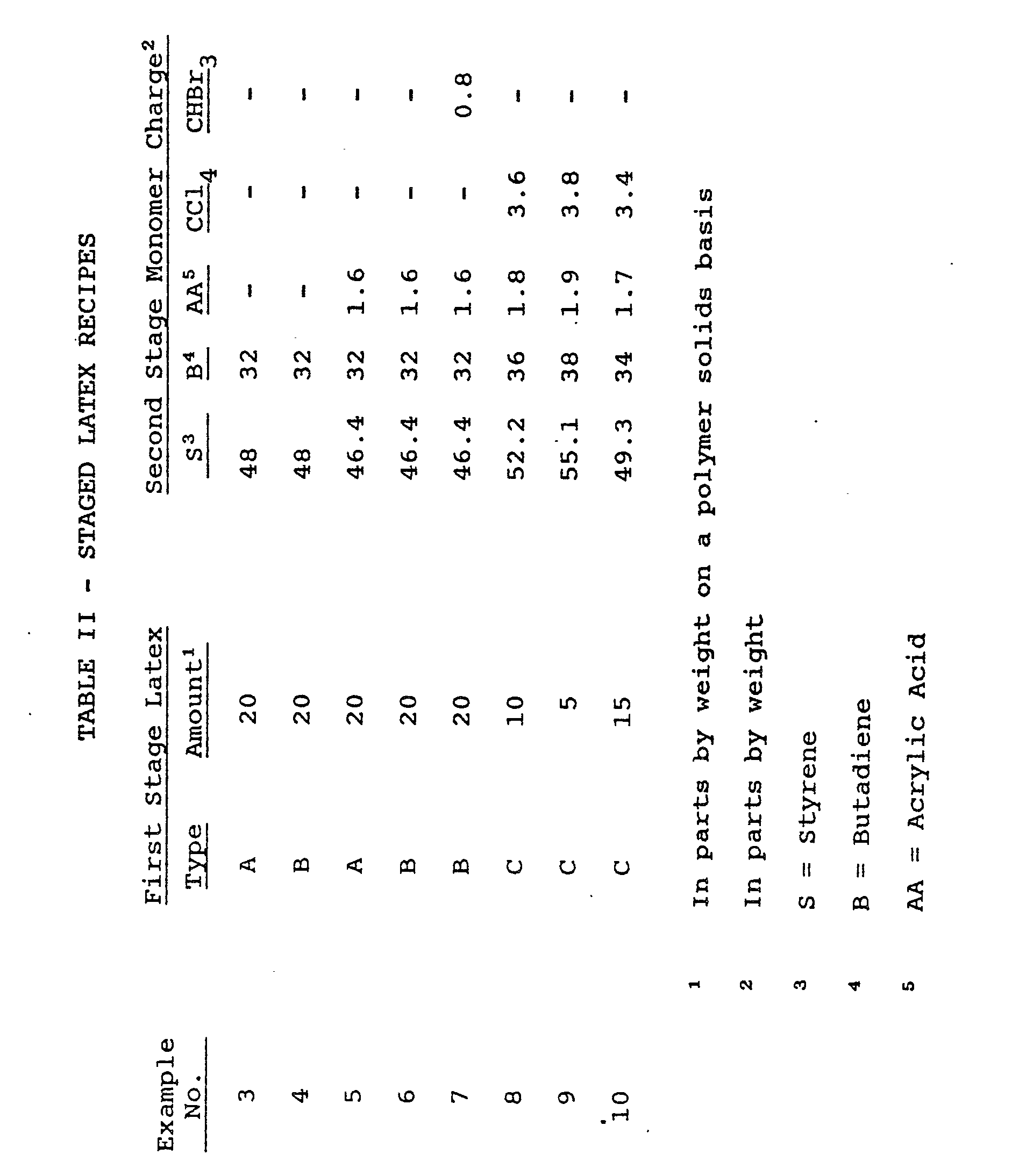
- 80, 85, 90 or 95 parts of a monomer charge of styrene and butadiene or styrene, butadiene and acrylic acid (and, in some cases, also containing CC1 4 or cHBr 3 as a chain transfer agent) is emulsion polymerized in an aqueous medium containing, respectively, 20, 15, 10 or 5 parts (polymer solids basis) of one of the above-identified first stage latexes (i.e., Latexes A, B or C above) as indicated in Table II below.
- Example 1 the general procedure of the second stage polymerization in Example 1 above is employed except that (a) the water content of the initial aqueous medium is about 112 parts (exclusive of the water content of the first stage latex included therein) instead of 85 parts, (b) the continuously added aqueous stream contains 0.1 part NaOH in Examples 4-10 and 0.05 part NaOH in Example 3 rather than the 0.15 part of Example 1 and (c) naturally the types and amounts of (1) the first stage latex, (2) the second stage monomer charge and (3) the chain transfer agent are as indicated in Table II below rather than as indicated in Example 1 above.
- a series of four latexes are prepared as indicated in Table VII below by emulsion polymerizing a 60/40 weight ratio styrene/butadiene second stage monomer charge in the presence of a first stage copolymer latex of ethyl acrylate (or ethyl acrylate and acrylic acid) and a curable (i.e., cross-linkable) monomer species selected from N-methylolacrylamide, glycidyl methacrylate or acrolein.
- a curable (i.e., cross-linkable) monomer species selected from N-methylolacrylamide, glycidyl methacrylate or acrolein.
- the resulting latexes are employed to form free films under various drying/curing conditions and the films thereby obtained are evaluated in terms of the tensile strength and elongation thereof.
- the properties of the resulting films are summarized in Table VIII below.
Landscapes
- Chemical & Material Sciences (AREA)
- Chemical Kinetics & Catalysis (AREA)
- Health & Medical Sciences (AREA)
- Medicinal Chemistry (AREA)
- Polymers & Plastics (AREA)
- Organic Chemistry (AREA)
- Polymerisation Methods In General (AREA)
- Addition Polymer Or Copolymer, Post-Treatments, Or Chemical Modifications (AREA)
- Graft Or Block Polymers (AREA)
- Paper (AREA)
Abstract
Description
- This invention relates to a process for the preparation of stable, aqueous synthetic copolymer latexes and to the aqueous copolymer latexes produced thereby.
- A wide variety of latexes including styrene--butadiene copolymers, acrylic homopolymers and copolymers, vinylidene chloride homopolymers and copolymers, etc. have been developed for uses as coatings, adhesives, and impregnants. However, many desirable characteristics have not been attained because of incompatibility between monomers materials and wide divergency of reactivity.
- In accordance with the present invention, an improved process is provided which comprises (A) first preparing an initial aqueous latex of a substantially linear hydrophilic polymer by emulsion polymerizing at a pH of from about 2 to 6 an initial monomer charge comprising (1) one or more vinyl esters of a non-addition polymerizable carboxylic acid and/or one or more esters of an addition polymerizable carboxylic acid and (2) a relatively hydropnilic copolymerizable comonomer in an amount sufficient to render the copolymer of said initial latex sufficiently hydrophilic that it ultimately becomes preferentially oriented toward the outer surface of the finished copolymer'particles of the final copolymer latex product, said relatively hydrophilic comonomer having a solubility in water of at least about 3 weight percent at 25°C, with the proviso that when the monomer component A (1) is exclusively vinyl acetate, comonomer (2) can be eliminated; and (B) thereafter emulsion polymerizing, in the presence of from 5 to 50 parts by weight on a polymer solids basis of the initial hydrophilic polymer latex of step A and at a pH of from about 2 to about 6; from about 50 to 95 parts by weight of a second monomer charge comprising (1) an aliphatic conjugated diene and/or an addition polymerizable monovinylidene monomer selected from the group consisting of monovinylidene aromatic monomers and vinylidene halide monomers and (2) from 0 to about 10 weight percent based upon the weight of such second monomer charge of a monoethylenically unsaturated carboxylic acid monomer.
- This process is particularly advantageous for preparing aqueous polymer latexes composed of otherwise incompatible monomeric ingredients. Also it provides exceptional flexibility in the design and manufacture of synthetic polymer latex having diverse chemical and/or mechanical properties using conventional emulsion polymerization techniques.
- The dispersed polymer particles of the latex are broadly characterized as generally heterogeneous and structured, having a relatively hydrophobic polymer domain and one or more relatively hydrophilic polymer domains.
- As used herein, the term "domain" refers to discrete regions within the dispersed polymer particle of either the hydrophobic polymer or hydrophilic polymer.
- The distribution of the hydrophilic and hydrophobic polymer domains within the dispersed polymer particles is generally such that the particle has a relatively hydrophobic central portion or core and one or more relatively hydrophilic portions preferentially oriented toward the outer surface. Such particles can be conveniently envisioned as being composed of a generally spheroidal, hydrophobic core portion which is either totally or partially surrounded or encapsulated by an encompassing shell of the hydrophilic polymer or which has several discrete regions of such hydrophilic polymer on the surface thereof.
- The size of the dispersed polymer particles can vary. However, such particles generally have an average diameter of from 0.08 to 0.5, preferably from 0.1 to 0.3, micrometer.
- In preparing the aqueous polymer latexes of the invention, an initial latex of a substantially linear hydrophilic polymer is first prepared via emulsion polymerization techniques and thereafter a major proportion (e.g., from 50 to 95, preferably from 75 to 95, and most preferably from 80 to 90, parts by weight) of a relatively hydrophobic monomer charge is emulsion polymerized in the presence of a minor portion (e.g., from 5 to 50, preferably from 5 to 25, and most preferably from 10 to 20, parts by weight on a polymer solids basis) of such initial hydrophilic polymer latex.
- Monomeric ingredients advantageously employed in the preparation of the initial hydrophilic polymer latexes include (1) one or more vinyl esters of a-non- addition polymerizable carboxylic acid and/or one or more esters of an addition polymerizable carboxylic acid and (2) optionally in the case of vinyl acetate but otherwise as a necessary and required feature, at least one relatively hydrophilic monomer which is addition copolymerizable therewith. Thus, for example, suitable initial hydrophilic polymer latexes for use in the present invention include (a) emulsion copolymerization products of one or more relatively hydrophilic monomers such as monoethylenically unsaturated carboxylic acid and/or the various amide-, aldehyde-, glycidyl-, hydroxyalkyl-containing derivatives thereof with one or more vinyl esters of a non- addition polymerizable carboxylic acid and/or with one or more saturated aliphatic esters of a monoethylenically unsaturated carboxylic acid as well as (b) homopolymerized polyvinyl acetate.
- Suitable vinyl esters for use in the aforementioned hydrophilic polymer latexes are those which do not impart substantial cross-linking to the resulting hydrophilic polymer. Accordingly, the vinyl ester monomers typically employed are those vinyl esters in which the acid component is not readily addition polymerizable and such vinyl esters thus include those of aromatic and saturated aliphatic (e.g., alkanoic) carboxylic acids. Vinyl esters of particular interest in the practice of this invention are those of saturated aliphatic or aromatic acids which contain 2 to 8 carbon atoms such as, for example, vinyl acetate, vinyl propionate, vinyl butyrate, vinyl-2-ethylhexoate, and vinyl benzoate. Vinyl acetate and vinyl propionate are especially desirable.
- The amount of vinyl ester monomer employed in the hydrophilic polymer latex can vary somewhat depending upon the intended end-use of the final polymer latex. Thus, for example, when vinyl acetate is employed as the vinyl ester component, it can generally be employed in amounts ranging from 0 to 100 (preferably 0 to 99) weight percent based upon the total weight of the monomer charge employed to prepare the hydrophilic polymer latex. However, with other vinyl ester monomers, the amount employed is generally in the range of 0 to 99 (preferably 0 to 97) weight percent based upon the total monomer charge for such hydrophilic polymer latex. It is sometimes preferable (for in certain end-use applications such as adhesives and paper coating compositions) that the vinyl ester constitutes from 20 to 85 (especially from 20 to 60) weight percent of the monomer charge for the hydrophilic copolymer latex.
- Suitable esters of addition polymerizable carboxylic acids for use in the hydropfuilic latexes are those which do not impart substantial cross-linking to the resulting hydrophilic polymer. Typical are esters of an addition polymerizable carboxylic acid such as an ester of a mono- or polyhydric aromatic or aliphatic alcohol and a monoethylenically unsaturated carboxylic acid. Of particular interest are C2 to C4 hydroxyalkyl and Ci to C8 alkyl esters of addition polymerizable monoethylenically unsaturated carboxylic acids such as 2-hydroxyethyl acrylate, 3-hydroxypropyl acrylate, methyl acrylate, methyl methacrylate, ethyl acrylate, ethyl methacrylate, 2-chloroethyl methacrylate, propyl acrylate or methacrylate, n-butyl acrylate or methacrylate, and 2-ethylhexyl acrylate.
- The amount of ester employed in preparing the hydrophilic copolymer latex is not critical so long as it does not prevent the resulting hydrophilic polymer from becoming preferentially oriented toward the outer surface of the dispersed latex polymer particle. With relatively soft and hydrophilic monomers such as methyl, ethyl or propyl acrylate, such monomers are suitably employed in amounts ranging from 0 to 99 weight percent based upon the total weight of the monomer charge. However, for less hydrophilic, harder monomers the maximum amount is somewhat lower than 99 weight percent figure. For example, with methyl methacrylate, the amount employed in preparing the initial hydrophilic polymer latex is typically from 0 to 85 weight percent of the initial monomer charge. Similarly, for a more hydrophobic monomer such as n-butyl acrylate, or 2-ethylhexyl acrylate, the amount is advantageously in the range of from 0 to 90 or 95 weight percent of the monomer charge.
- As is indicated above the hydrophilic polymer latex is prepared by emulsion copolymerizing at least one vinyl ester or addition polymerizable carboxylic acid ester monomer with at least one hydrophilic monomer which has a solubility in water of at least about 3 weight percent at 25°C. Preferably, such hydrophilic monomer is a monoethylenically unsaturated carboxylic acid, especially a monobasic, monoethylenically unsaturated carboxylic acid containing from 3 to 10 carbon atoms such as, acrylic acid, methacrylic acid, crotonic acid, haloacrylic acids 2-chloroacrylic acid, 2-bromoacrylic acid, 3-chloroacrylic acid, 2,3-dichloroacrylic acid, 3,3-dichloroacrylic acid, 2-phenylacrylic acid, 3-phenylacrylic acid, vinyl benzoic acid, and isopropenyl benzoic acid. However, relatively hydrophilic (e.g., amide-, aldehyde-, glycidyl-, hydroxy alkyl-, etc., containing) derivatives of such monoethylenically unsaturated carboxylic acids can also be suitably employed. Examples of such suitable hydrophilic derivatives include acrylamide, methacrylamide, acrolein, methacrolein, glycidyl acrylate and methacrylate, and hydroxyethyl acrylate. Similarly, monoethylenically unsaturated dicarboxylic acids such as fumaric, itaconic, or maleic acid can also be beneficially employed as the hydrophilic monomer component, particularly in combination with one or more monobasic carboxylic acid monomers. The preferred acid monomers are those having from 3 to 5 carbon atoms, most preferably acrylic or methacrylic acid.
- The amount of relatively hydrophilic monomer employed is not critical provided that it is (a) enough to render the first stage polymer suitably hydrophilic to be ultimately located at or near the outer surface of the dispersed latex polymer particles, but (b) not enough to cause the resulting polymer to be completely soluble in aqueous medium under acidic or neutral conditions. Accordingly, the actual content will depend largely upon the particular comonomer, or combination of comonomers, selected as well as the identity of the hydrophilic monomer itself. When the hydrophilic monomer is primarily vinyl acetate, then it will generally constitute from 0 to 30 (typically from 0 to 10, and preferably from 1 to 10, in the case of a binary vinyl acetate/carboxylic acid copolymer) weight percent of the hydrophilic stage monomer charge. However, when substantial portions of a more hydrophobic or harder comonomer is employed, then larger quantities are generally employed. For example, when ethyl acrylate or vinyl propionate is employed in the first stage hydrophilic copolymer latex, the amount of hydrophilic monomer employed typically constitutes from about 3 to 30 weight percent of the monomer charge thereof. With more hydrophobic acrylate or methacrylate esters (e.g., n-butyl acrylate, 2-ethylhexyl acrylate, etc.) the hydrophilic monomer component will generally constitute from 5 to 50 weight percent of the first hydrophilic copolymer. Similarly, when substantial amounts of a relatively hard. comonomer such as methyl methacrylate, styrene, or acrylonitrile are employed, the hydrophilic comonomer component will generally constitute from 10 or 15 to 50 weight percent of the first stage latex monomer charge.
- In addition the monomer charge employed to form the hydrophilic first stage polymer latex can also optionally contain one or more other addition copolymerizable monomers. Examples of such optional monomers include nitriles of the monoethylenically unsaturated carboxylic acids such as acrylonitrile and methacrylonitrile as well as monovinylidene aromatic monomers and vinylidene halide monomers. The amount of such optional monomers is not critical so long as the first stage latex is not too hydrophilic or too hydrophobic in terms of required solubility and orientation parameters noted above. Thus, while the total amount of optional monomers may range from 0 to 50 weight percent, it is generally preferable to employ.from 0 to about 20 and especially 0 to 10 weight percent based upon the total weight of the monomer charge for the first stage hydrophilic polymer latex.
- In a preferred embodiment of the present invention, the dispersed latex polymer particles also have incorporated therein certain reactive or functional modifying monomers to render the final polymer latex reactive or curable. Accordingly, there may optionally also be employed a minor portion (e.g., from 0 to 20, preferably from 0.5 to 20, and most preferably from 5 to 15, weight percent based on the monomer charge for such first stage latex) of one or more addition polymerizable modifying monomers such as N-alkylol acrylamide or methacrylamide (e.g., N-methyloyl acrylamide or methacrylamide); N-alkyloxyalkyl acrylamide or methacrylamide (e.g., N-isobutoxymethyl acrylamide or methacrylamide); glycidyl acrylate or methacrylate; acrolein or methacrolein; and isopropenyl oxazoline. When such modifying monomers are relatively hydrophilic in character (e.g., N-alkylol acrylamide or methacrylamide, N-alkyloxyalkyl acrylamide or methacrylamide, glycidyl acrylate or methacrylate, acrolein or methacrolein, etc.), they can serve the dual purpose of providing the requisite hydrophilicity to the first stage polymer latex as well as imparting reactive or functional character.
- The preparation of the first stage hydrophilic copolymer latexes is conveniently by emulsion polymerization in acidic aqueous medium. Thus, for example, the monomer charge is dispersed in an acidic aqueous medium with about 0.5 to 5 weight percent (based upon the monomer charge) of a conventional anionic and/or nonionic emulsifier such as potassium n-dodecyl sulfonate, sodium isooctylbenzene sulfonate, sodium laurate, or a nonylphenol ether of polyethylene glycol and thereafter polymerized at a temperature of about 50° to 110°C, preferably about 70° to 90°C, and a pH of about 2 to 6, preferably 2 to 5, and especially from 2 to 4.
- Conventional emulsion polymerization catalysts can be employed including peroxides, persulfates, and azo compounds such as sodium persulfate, potassium persulfate, ammonium persulfate, hydrogen peroxide, t-butyl hydroperoxide, cumene hydroperoxide, azodiiso- butyric diamide as well as redox catalysts activated in the water phase by a water-soluble reducing agent. Typically, such catalysts are employed in an amount ranging from 0.01 to 5 weight percent based upon the monomer weight.
- Similarly, conventional chain transfer agents such as n-dodecyl mercaptan, bromoform, and carbon tetrachloride can also be employed in the normal fashion to regulate the molecular weight of the polymer. Typically, such chain transfer agents are used in amounts ranging from 0.01 to 5 preferably from 0.1 to 1) weight percent based on the weight of the monomer in the first stage polymerization.
- Following the initial polymerization stage in which the hydrophilic polymer latex is prepared, a second polymerization stage is conducted in which a major portion, e.g., from about 50 to 95, preferably from about 75 to 95 and most preferably from about 80 to 90, parts by weight of a relatively hydrophobic monomer charge is emulsion polymerized in the presence of a minor proportion, e.g., from about 5 to 50, preferably from about 5 to 25 and most preferably from about 10 to 20, parts by weight on a polymer solids basis of the initial hydrophilic polymer latex.
- Monomers advantageously employed in the relatively hydrophobic, second stage monomer charge include aliphatic conjugated diene monomers, monovinylidene aromatic monomers, and vinylidene halides and mixtures thereof.
- Typical aliphatic conjugated diene monomers contain from 4 to 9 carbon atoms and include such monomers as 1,3-butadiene, 2-methyl-1,3-butadiene, 2,3-dimethyl--1,3-butadiene, pentadiene, 2-neopentyl-1,3-butadiene and other hydrocarbon analogs of 1,3-butadiene, and, in addition, substituted 1,3-butadienes such as 2-chloro--1,3-butadiene, and 2-cyano-1,3-butadiene; substituted straight conjugated pentadienes; straight and branched chain conjugated hexadienes; and mixtures thereof. The 1,3-butadiene monomers provide polymers having particularly desirable properties and are therefore preferred.
- Monovinylidene aromatic monomers useful in the second stage hydrophobic monomer charge include those monomers wherein a radical of the formula:

- In addition the second stage monomer charge can also optionally contain minor proportions of other addition copolymerizable monomers such as from 0 to about 20 weight percent of vinyl halide monomers such as vinyl chloride, etc.; acrylonitrile or methacrylonitrile C1 to C8 alkyl or C2 to C4 hydroxyalkyl esters of a C3 - C10 monoethylenically unsaturated carboxylic acids. Especially desirable is from 0 to 10, and more preferably from 0 to 5, weight percent of a C2 to C4 hydroxyalkyl ester and/or from 0 to 10 and preferably from 0 to 5 weight percent of the C3 - C10 monoethylenically unsaturated carboxylic acid itself.
- Of particular interest as the second stage hydrophobic monomer charge are those comprising from about 20 to 100 and especially from about 20 to 75 weight percent of the monovinylidene aromatic or vinylidene halide monomer (especially the monovinylidene aromatic monomer) and/or from about 25 to 100 and especially from about 25 to 80 weight percent of the aliphatic conjugated diene monomer and from 0 to 10 and especially from 0 to 5 weight percent of the monoethylenically unsaturated carboxylic acid monomer.
- The polymerization of the relatively hydrophobic second stage monomer charge is also conveniently conducted by conventional emulsion polymerization techniques in the presence of the dispersed hydrophilic first stage copolymer particles.
- Thus the second stage hydrophobic monomer charge is typically dispersed, with agitation and about 0.5 to 5 weight percent based on monomer charge of the conventional anionic and/or nonionic emulsifier, in an acidic aqueous medium containing the first stage, relatively hydrophilic polymer latex. It is thereafter polymerized at a temperature from about 50° to 110°C, preferably from 70° to 90°C at a pH of from 2 to about 6, preferably from 2 to 5 and especially from 2 to 4 using conventional emulsion polymerization catalysts and chain transfer agents typically in an amount ranging from about 0.01 to 5, especially 0.1 to 1 weight percent based upon the weight of the second stage monomer charge.
- Following completion of the second stage polymerization, the solids content of the resulting copolymer latex can be adjusted to the level desired by adding or removing water. Generally, however, the desired polymer solids content will be from about 20 to 65 and preferably from 30 to about 60 weight percent on a total weight basis. Such solids content can usually be obtained directly without further adjustment.
- The resulting two stage latexes can be advantageously employed in a wide variety.of end-use applications, e.g., in coating formulations such as paints and pigmented paper coating compositions; in adhesive compositions; and as impregnants.
- To further illustrate the present invention, the following examples are presented. All parts and percentages are on a weight basis unless otherwise specified.
- Styrene/Butadiene Monomer Mixture (60/40 Ratio) Emulsion Polymerized in the Presence of a 90/10 Ethyl Acrvlate/Methacrylic Acid Copolymer Latex
- In this example, an initial 90/10 weight ratio ethyl acrylate (EA)/methacrylic acid (MAA) copolymer latex is first prepared via emulsion polymerization and thereafter 80 parts of a 60/40 weight ratio styrene/butadiene monomer mixture is emulsion polymerized in the presence of 20 parts (on a polymer solids basis) of such EA/MAA copolymer latex.
- A. In the preparation of the EA/MAA copolymer latex, the 90/10 weight ratio EA/MAA comonomer charge is continuously added, with stirring and over a two--hour period, to about 150 parts by weight (per 100 parts by weight of the comonomer charge) of an initial aqueous medium containing 0.02 part by weight of the pentasodium salt of diethylenetriaminepentaacetic acid and 1 part by weight of sodium dodecyldiphenyl ether disulfonate. In addition, an aqueous stream containing (based upon 100 parts by weight of the EA/MAA comonomer charge) 40 parts of deionized water, 0.5 part of sodium dodecyldiphenyl ether disulfonate, 0.5 part sodium persulfate and 0.1 part sodium hydroxide is added over a 2 1/2-hour period commencing 1/4 hour earlier than the start of the indicated EA/MAA monomer charge.
- The EA/MAA polymerization is conducted at 80°C during the course of the aforementioned 2 1/2--hour aqueous stream addition and for an additional 1-hour "cookdown" period thereafter. Upon completion of such cookdown period, the resulting EA/MAA copolymer latex is found to have a total solids content of about 35 weight percent, a pH of about 3.6, an average particle size of about 0.1 micron at pH 4.0 and the degree of conversion monomer to polymer is found to be approximately 99 percent.
- -B. Following the EA/MAA polymerization, 80 parts by weight of a 60/40 weight ratio styrene/ butadiene monomer charge is emulsion polymerized in a second polymerization stage in the presence of 20 parts by weight, on a polymer solids basis, of the 90/10 EA/MAA copolymer latex. In such second stage polymerization, the indicated 80 parts of 60/40 weight ratio styrene/butadiene comonomer charge is continuously added with stirring over a 4-hour period to an aqueous medium containing (1) about 85 parts water, (b) 20 parts (polymer solids basis) of the above-described EA/MAA copolymer latex, (c) 0.01 part of the pentasodium salt of diethylenetriaminepentaacetic acid and (d) 0.1 part of sodium dodecyldiphenyl ether disulfonate. In addition, an aqueous stream containing 40 parts of deionized water, 0.7 part of sodium dodecyldiphenyl ether disulfonate, 0.7 part of sodium persulfate and 0.15 part of sodium hydroxide is also added over a 5-hour period commencing at the same time as the start of the styrene/butadiene monomer feed and continuing for an additional hour following completion of such monomer feed.
- The styrene/butadiene polymerization is conducted at 90°C over a 6-hour period including a 5-hour aqueous feed period and an additional 1-hour "cookdown" period. The resulting polymer latex is found to have a polymer solids content of about 45 weight percent, a pH of about 5.0, an average particle size of about 0.16 micron and a minimum film-forming temperature of 56°C. In addition, the EA/MAA first stage copolymer is confirmed to be preferentially oriented toward the surface of the resulting polymer latex particle as evidenced by (a) the relatively high minimum film-forming temperature exhibited thereby, (b) the presence of acid functionality at the surface of the particles therein as determined by potentiometric titration thereof, (c) the free-film tensile strength and elongation performance thereof, (d) the pH effect under alkaline conditions on the viscosity of such latex (i.e., substantially higher viscosity at pH 8.5 than at pH 4.0) and (e) the electron micrographs of osmium tetraoxide-stained particle cross-sections.
- Example 1 is repeated except that, in the EA/MAA polymerization step, 1 part bromoform (per 100 parts of the EA/MAA monomer charge) is added along with the EA/MAA monomer charge as a chain transfer agent in order to lower the molecular weight of the EA/MAA copolymer produced therein.
- The resulting two stage latex ultimately produced generally resembles that of Example 1 except that it has (a) a relatively lower minimum film-forming temperature (i.e., 36°C versus 56°C for Example 1), (b) a somewhat larger apparent particle size than the latex of Example 1 by virtue of somewhat higher degree of swelling for the lower molecular weight outer EA/MAA copolymer layer and (c) lower tensile strength (1316 lb/in2; 92.5 kg/cm2) and higher elongation (423 percent) for the free films formed therefrom relative to the corresponding tensile strength of 1569 lb/in2 (110.3 kg/cm2) and elongation of 227 percent for free films of the Example 1 latex having a relatively higher molecular weight first stage EA/MAA copolymer employed therein.
- In these examples a series of polymerizations are conducted in which a styrene/butadiene or styrene/butadiene/acrylic acid monomer charge is emulsion polymerized in the presence of one of the three different 49/49/2 weight ratio vinyl acetate/ethyl acrylate/acrylic acid (i.e., VAc/EA/AA) copolymer latexes identified in Table I below.
- In the preparation of the above-noted VAc/EA/AA copolymer latexes, a monomer charge containing 49 parts vinyl acetate, 49 parts ethyl acrylate and 2 parts acrylic acid (as well as either 0 or 0.5 part of CHBr3) is continuously added over a 3-hour period to an initial aqueous medium containing, per 100 parts monomer charge, about 150 parts water; either 1 or 2 parts of sodium dodecyldiphenyl ether disulfonate; and 0.02 part of the pentasodium salt of diethylenetriaminepentaacetic acid and is polymerized therein at a temperature of 80°C for a total time period of 4 1/2 hours. In addition, an aqueous stream containing, per 100 parts monomer, 40 parts deionized water, 0.1 part sodium hydroxide, 0.5 part sodium persulfate and 0.5 part sodium dodecyldiphenyl ether disulfonate is continuously added over the first 3 1/2 hours of the total 4 1/2-hour polymerization-period.

- In the second polymerization stage of the instant examples, 80, 85, 90 or 95 parts of a monomer charge of styrene and butadiene or styrene, butadiene and acrylic acid (and, in some cases, also containing CC14 or cHBr3 as a chain transfer agent) is emulsion polymerized in an aqueous medium containing, respectively, 20, 15, 10 or 5 parts (polymer solids basis) of one of the above-identified first stage latexes (i.e., Latexes A, B or C above) as indicated in Table II below. In such second stage polymerization, the general procedure of the second stage polymerization in Example 1 above is employed except that (a) the water content of the initial aqueous medium is about 112 parts (exclusive of the water content of the first stage latex included therein) instead of 85 parts, (b) the continuously added aqueous stream contains 0.1 part NaOH in Examples 4-10 and 0.05 part NaOH in Example 3 rather than the 0.15 part of Example 1 and (c) naturally the types and amounts of (1) the first stage latex, (2) the second stage monomer charge and (3) the chain transfer agent are as indicated in Table II below rather than as indicated in Example 1 above.
- The properties of the latexes resulting from the foregoing polymerizations (and of free films formed therefrom) are summarized in Table III below.

- Four staged latexes having the recipes set forth in Table IV below are prepared pursuant to the polymerization procedure of Examples 3-10 above except that (a) the first stage monomer addition and polymerization is conducted over a shortened period of only 1/2 hour and (b) the addition of the second stage monomer charge is commenced immediately at the end of such 1/2-hour period (i.e., without any intermediate "cookdown" for the first stage polymer) and is accomplished over a 4 1/2- (rather than 5-) hour period. In addition, only a single sodium persulfate-containing aqueous stream is employed (i.e., rather than one such addition for each polymerization stage) and the addition thereof is continuous (and at a uniform rate) over the entire 6-hour polymerization period employed (i.e., 1/2 hour for the first stage polymerization, 4 1/2 hours for the second stage monomer addition and polymerization plus a one-hour "cookdown" period at the end of the second stage monomer addition).
- The properties of the latexes resulting from the foregoing polymerization (and of free films formed therefrom) are summarized in Table V below.


- Twenty parts (polymer solids basis) of each of the above-described latexes of Examples 5-10 and 11-13 are admixed with 100 parts of No. 1 clay to form a paper coating composition and the pH thereof is adjusted to a value of 8 with sodium hydroxide. Thereafter, the viscosity of the resulting paper coating compositions is determined at various total solids levels. In addition, the paper coating performance of the resulting compositions is evaluated by coating a general purpose base-stock therewith using a conventional laboratory scale bench blade coater; calendering the resulting coated paper for four nips at 1200 pounds per linear inch and 150°C and thereafter determining the 75° gloss, brightness and K&N ink receptivity thereof in the usual fashion.
- The results of the aforementioned paper coating composition evaluations are summarized in Table VI below. In addition, the aforementioned coated papers are also evaluated for coating smoothness in terms of the Heliotest printability thereof and are found to possess very good coating smoothness pursuant thereto.
-

- A series of four latexes are prepared as indicated in Table VII below by emulsion polymerizing a 60/40 weight ratio styrene/butadiene second stage monomer charge in the presence of a first stage copolymer latex of ethyl acrylate (or ethyl acrylate and acrylic acid) and a curable (i.e., cross-linkable) monomer species selected from N-methylolacrylamide, glycidyl methacrylate or acrolein. In such fashion, copolymer latexes composed predominantly of styrene and butadiene are provided which are modified with functional or curable monomers which are not readily copolymerizable with styrene and butadiene.
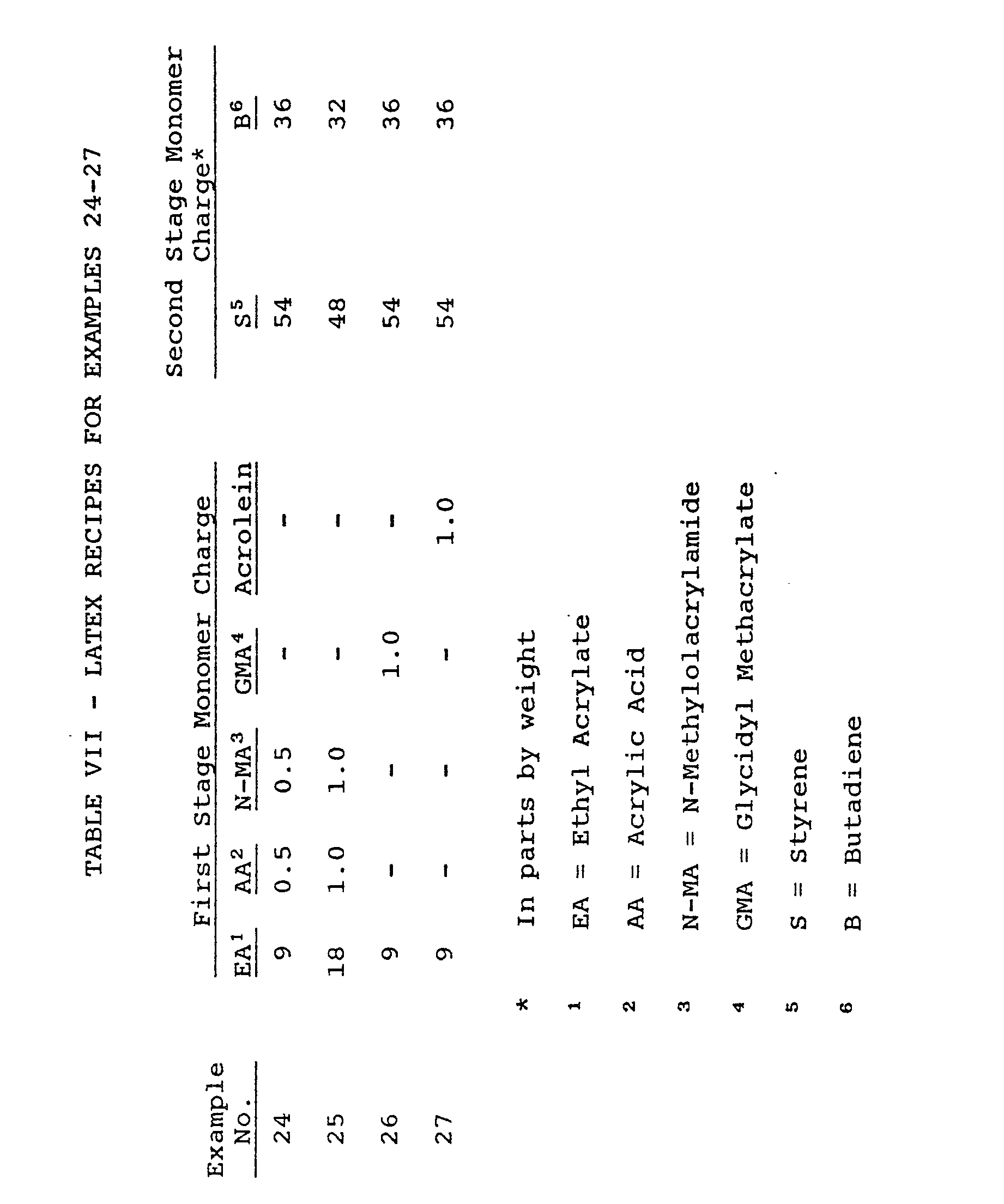
- In the preparation of the foregoing latexes, the general procedure of Examples 11-14 above is employed except that (a) the first stage monomer feed and polymerization period is 45 minutes rather than 1/2 hour, (b) the second stage monomer charge is continuously added over a 3.6- (rather than 4.5-) hour period, (c) the continuously added aqueous stream contains about 0.6 part NaHc03 (rather than 0.1 part NaOH) for pH control, (d) the polymerization is conducted at a temperature of 80°C (rather than 90°C) and the "cookdown" period following completion of the aqueous stream is 1 1/2 hours (rather than 1 hour) and (e) the initial aqueous sodium contains about 150 (rather than 112) parts water and 0.02 (rather than 0.01) part of the pentasodium salt of diethylenetriaminepentaacetic acid.
- Following their preparation in the foregoing fashion, the resulting latexes are employed to form free films under various drying/curing conditions and the films thereby obtained are evaluated in terms of the tensile strength and elongation thereof. The properties of the resulting films are summarized in Table VIII below.


Claims (11)
Applications Claiming Priority (2)
| Application Number | Priority Date | Filing Date | Title |
|---|---|---|---|
| US06/108,973 US4325856A (en) | 1980-01-02 | 1980-01-02 | Sequential emulsion polymerization process |
| US108973 | 1980-01-02 |
Publications (3)
| Publication Number | Publication Date |
|---|---|
| EP0031964A2 true EP0031964A2 (en) | 1981-07-15 |
| EP0031964A3 EP0031964A3 (en) | 1982-02-03 |
| EP0031964B1 EP0031964B1 (en) | 1986-03-05 |
Family
ID=22325127
Family Applications (1)
| Application Number | Title | Priority Date | Filing Date |
|---|---|---|---|
| EP80108226A Expired EP0031964B1 (en) | 1980-01-02 | 1980-12-27 | Sequential emulsion polymerization process for structured particle latex products |
Country Status (9)
| Country | Link |
|---|---|
| US (1) | US4325856A (en) |
| EP (1) | EP0031964B1 (en) |
| JP (1) | JPS56103212A (en) |
| AU (1) | AU545315B2 (en) |
| BR (2) | BR8009042A (en) |
| CA (1) | CA1153484A (en) |
| DE (1) | DE3071476D1 (en) |
| ES (1) | ES498365A0 (en) |
| NZ (1) | NZ195911A (en) |
Cited By (15)
| Publication number | Priority date | Publication date | Assignee | Title |
|---|---|---|---|---|
| FR2601374A1 (en) * | 1986-07-14 | 1988-01-15 | Rohm & Haas | SEQUENTIALLY PRODUCED POLYMER PARTICLES, AQUEOUS DISPERSIONS OF SEQUENTIALLY PRODUCED POLYMER PARTICLES, PROCESSES FOR THE PREPARATION OF SEQUENTIALLY PRODUCED POLYMER PARTICLES, AND USES OF SEQUENTIALLY PRODUCED POLYMER PARTICLES |
| FR2618790A1 (en) * | 1987-07-30 | 1989-02-03 | Tioxide Group Plc | CORE POLYMER PARTICLES AND ENVELOPE AND PROCESS FOR THEIR PREPARATION |
| DE3731760A1 (en) * | 1987-09-22 | 1989-03-30 | Texaco Ag | WAESSED PLASTIC DISPERSION |
| FR2624869A1 (en) * | 1987-12-17 | 1989-06-23 | Tioxide Group Plc | VESICULAR PARTICLES OF POLYMER AND THEIR PREPARATION |
| US4880842A (en) * | 1988-05-20 | 1989-11-14 | Rohm & Haas Company | Multi-stage opacifying polymer particles containing non-polymeric acid absorbed therein |
| US4970241A (en) * | 1988-05-20 | 1990-11-13 | Rohm And Haas Company | Multi-stage opacifying polymer particles containing non-polymeric acid absorbed therein |
| EP0338486A3 (en) * | 1988-04-21 | 1991-08-28 | S.C. Johnson & Son, Inc. | Stable emulsion polymers and methods of preparing same |
| EP0343833A3 (en) * | 1988-05-16 | 1991-09-11 | MITSUI TOATSU CHEMICALS, Inc. | Fine-particle aggregate emulsion, process for producing such an emulsion, thermal recording media, coated paper and paint incorporating such an emulsion |
| US5053448A (en) * | 1989-07-21 | 1991-10-01 | S. C. Johnson & Son, Inc. | Polymeric thickener and methods of producing the same |
| US5229209A (en) * | 1990-03-30 | 1993-07-20 | Tioxide Group Plc | Preparation of vesiculated core/shell polymeric particles |
| EP0696602A1 (en) * | 1994-08-12 | 1996-02-14 | Rohm And Haas Company | Encapsulated hydrophilic polymers and their preparation |
| EP0709412A1 (en) * | 1994-09-30 | 1996-05-01 | The Goodyear Tire & Rubber Company | Latex for high performance masking tape |
| AU758223B2 (en) * | 1999-02-05 | 2003-03-20 | Rohm And Haas Company | A method of improving an adhesive article |
| WO2010028123A1 (en) * | 2008-09-04 | 2010-03-11 | E. I. Du Pont De Nemours And Company | Aqueous coating composition |
| WO2012171575A1 (en) * | 2011-06-17 | 2012-12-20 | Evonik Röhm Gmbh | Coating composition suitable for pharmaceutical or nutraceutical dosage forms |
Families Citing this family (150)
| Publication number | Priority date | Publication date | Assignee | Title |
|---|---|---|---|---|
| JPS57153011A (en) * | 1981-03-19 | 1982-09-21 | Sumitomo Naugatuck Co Ltd | Production of copolymer latex |
| FR2515657B1 (en) * | 1981-11-03 | 1987-07-17 | Kendall & Co | EMULSION POLYMERIZATION PROCESS AND PRODUCT OBTAINED |
| US4416945A (en) * | 1982-02-03 | 1983-11-22 | The Dow Chemical Company | Magnetic imbiber polymers and method for the preparation thereof |
| US4460029A (en) * | 1982-12-01 | 1984-07-17 | The Dow Chemical Company | Oxazoline latex for tire cord adhesion |
| US4707221A (en) * | 1982-12-23 | 1987-11-17 | The Dow Chemical Company | Sheets having improved stiffness from fiber, latex and coalescing agent |
| US4508869A (en) * | 1983-06-14 | 1985-04-02 | The Dow Chemical Company | Latexes of polymers having pendant coreactive and oxazoline groups |
| US4474923A (en) * | 1983-06-14 | 1984-10-02 | The Dow Chemical Company | Self-curable latex compositions |
| US4569964A (en) * | 1983-10-27 | 1986-02-11 | The Dow Chemical Company | Heat/light stable interpenetrating polymer network latexes |
| US4582663A (en) * | 1983-11-21 | 1986-04-15 | The Dow Chemical Company | Amphoteric latexes containing pH independent and pH dependent bound charges |
| US4544697A (en) * | 1983-11-21 | 1985-10-01 | The Dow Chemical Company | Amphoteric latexes containing pH independent and pH dependent bound charges |
| US4916171A (en) * | 1984-07-25 | 1990-04-10 | Rohm And Haas Company | Polymers comprising alkali-insoluble core/alkali-soluble shell and copositions thereof |
| US4559374A (en) * | 1984-09-19 | 1985-12-17 | The Goodyear Tire & Rubber Company | Continuous emulsion polymerization process for preparation of flame-retardant latex |
| JPS6187734A (en) * | 1984-10-03 | 1986-05-06 | Japan Synthetic Rubber Co Ltd | Production of hollow polymer particle |
| US4602064A (en) * | 1984-11-30 | 1986-07-22 | The Dow Chemical Company | Grafted rubber concentrates for use in impact resistant polymers |
| US5187221A (en) * | 1984-12-28 | 1993-02-16 | Chemische Werke Huels Aktiengesellschaft | Styrene/butadiene graft copolymer latex and heat-vulcanizable composition, containing the latter as reinforcing latex, for the production of latex foam |
| US4686260A (en) * | 1985-07-10 | 1987-08-11 | Sun Chemical Corporation | Printing ink composition |
| US5177128A (en) * | 1985-07-10 | 1993-01-05 | Sequa Chemicals, Inc. | Paper coating composition |
| US4616057A (en) * | 1985-07-10 | 1986-10-07 | Sun Chemical Corporation | Polymer emulsion containing an interpenetrating polymer network |
| US5169884A (en) * | 1985-07-10 | 1992-12-08 | Sequa Chemicals, Inc. | Coating compositions |
| US5190997A (en) * | 1985-07-10 | 1993-03-02 | Sequa Chemicals, Inc. | Adhesive composition |
| US4785030A (en) * | 1986-12-18 | 1988-11-15 | The Procter & Gamble Company | Cationic latex compositions capable of producing elastomers with hydrophilic surfaces |
| US4734445A (en) * | 1986-12-18 | 1988-03-29 | The Procter & Gamble Company | Latex compositions capable of producing elastomers with hydrophilic surfaces |
| US4835211A (en) * | 1986-12-18 | 1989-05-30 | The Procter & Gamble Company | Cationic latex compositions capable of producing elastomers with hydrophilic surfaces |
| US5236991A (en) * | 1987-01-14 | 1993-08-17 | The Dow Chemical Company | In-situ tackified structured latex composition |
| US4968740A (en) * | 1987-01-20 | 1990-11-06 | The Dow Chemical Company | Latex based adhesive prepared by emulsion polymerization |
| US4889765A (en) * | 1987-12-22 | 1989-12-26 | W. R. Grace & Co. | Ink-receptive, water-based, coatings |
| US5200037A (en) * | 1988-05-23 | 1993-04-06 | The Procter & Gamble Company | Absorbent structures from mixed furnishes |
| AT395244B (en) * | 1989-05-31 | 1992-10-27 | Hoffenreich Ludwig & Sohn | Process for preparing aqueous polymer dispersions, their use, and a curable mixture |
| US5391624A (en) * | 1992-02-10 | 1995-02-21 | S. C. Johnson & Son, Inc. | Thermosettable compositions |
| US5328952A (en) * | 1992-02-14 | 1994-07-12 | Rohm And Haas Company | Multi-stage polymer latex cement modifier and process of making |
| US5334655A (en) * | 1993-12-09 | 1994-08-02 | Rohm And Haas Company | Method for reducing microfoam in a spray-applied waterborne composition |
| US5427899A (en) * | 1994-01-31 | 1995-06-27 | Polaroid Corporation | Two-phase acidic aqueous compositions |
| GB9408725D0 (en) * | 1994-05-03 | 1994-06-22 | Zeneca Resins Bv | Production of aqueous polymer compositions |
| US5486576A (en) | 1994-07-01 | 1996-01-23 | Rohm And Haas Company | Method for reducing microfoam in a spray-applied waterborne thermoset composition |
| US5770303A (en) * | 1994-07-06 | 1998-06-23 | Gencorp Inc. | Occluded composite-particle latex |
| US5623085A (en) | 1994-09-23 | 1997-04-22 | Rohm And Haas Company | Method for reducing microfoam in a spray-applied waterborne composition |
| US5506282A (en) * | 1994-12-06 | 1996-04-09 | Rohm And Haas Company | Method for providing maximum coating film gloss |
| US5612397A (en) * | 1994-12-19 | 1997-03-18 | Rohm And Haas Company | Composition having wet state clarity |
| US5569687A (en) * | 1995-03-16 | 1996-10-29 | Rohm And Haas Company | Waterborne zinc-rich primer compositions |
| US5635248A (en) * | 1995-06-07 | 1997-06-03 | Rohm And Haas Company | Method of producing coating on reconstituted wood substrate |
| CA2245146C (en) * | 1996-01-31 | 2003-04-08 | Eastman Chemical Company | Small particle size polyester/acrylic hybrid latexes |
| US6153690A (en) * | 1996-05-29 | 2000-11-28 | Rohm And Haas Company | Method of producing isocyanate-modified latex polymer |
| US5948833A (en) * | 1996-06-04 | 1999-09-07 | Rohm And Haas Company | Method of reducing yellowing of water-borne road marking paints and composition used therein |
| KR100566336B1 (en) * | 1998-06-04 | 2006-03-31 | 가오가부시끼가이샤 | Polymer emulsions and their preparation |
| AU771383B2 (en) * | 1998-12-08 | 2004-03-18 | Rohm And Haas Company | Dirt pickup resistant coating binder and coatings |
| US6290866B1 (en) * | 1999-01-25 | 2001-09-18 | Rohm And Haas Company | Leather coating binder and coated leather having good embossability and wet-flex endurance |
| US20030224184A1 (en) | 2002-05-07 | 2003-12-04 | Hermes Ann Robertson | Method of producing wear resistant traffic markings |
| US20040102568A1 (en) * | 2002-11-22 | 2004-05-27 | Bridgewater Brian Michael | Aqueous coating composition |
| GB0302790D0 (en) * | 2003-02-07 | 2003-03-12 | Eastman Kodak Co | Material and manufacturing method thereof |
| US7235603B2 (en) * | 2003-04-07 | 2007-06-26 | Rohm And Haas Company | Ambient curable polymer |
| TWI256416B (en) * | 2003-06-02 | 2006-06-11 | Rohm & Haas | Aqueous leather treatment composition and method of use |
| US20050136272A1 (en) * | 2003-12-23 | 2005-06-23 | Vanrheenen Paul | Gloss reducing polymer composition |
| WO2006006994A2 (en) * | 2004-06-22 | 2006-01-19 | Lexmark International, Inc. | Inkjet ink composition |
| US7381753B2 (en) | 2004-06-29 | 2008-06-03 | Lexmark International, Inc. | Inkjet ink composition |
| TWI321554B (en) * | 2004-08-25 | 2010-03-11 | Rohm & Haas | Composition for forming a composite material |
| US7700703B2 (en) | 2004-12-23 | 2010-04-20 | Rohm And Haas Company | Polymer additives and adhesive compositions including them |
| US20060167135A1 (en) * | 2005-01-25 | 2006-07-27 | Lexmark International, Inc. | Inkjet ink binder and inkjet ink composition |
| US7598303B2 (en) * | 2005-02-17 | 2009-10-06 | Rohm And Haas Company | Process for making an aqueous dispersion |
| US7589158B2 (en) * | 2005-11-30 | 2009-09-15 | Columbia Insurance Company | Polymers with improved shelf stability |
| EP1944342B1 (en) | 2006-03-15 | 2011-02-23 | Rohm and Haas Company | Aqueous compositions comprising polymeric duller particles |
| US20070286833A1 (en) * | 2006-06-13 | 2007-12-13 | Keller Kathleen V | Multistage polymer composition and method of use |
| US20080058473A1 (en) * | 2006-08-31 | 2008-03-06 | Yakov Freidzon | Latex for low VOC paint having improved block resistance, open time and water-softening resistance |
| US7695770B2 (en) * | 2006-09-21 | 2010-04-13 | Rohm And Haas Company | Coating binder polymer and coatings |
| US8877852B2 (en) | 2006-12-15 | 2014-11-04 | Rohm And Haas Company | Phosphorous-containing organic polymer and compositions and processes including same |
| JP5765869B2 (en) | 2006-12-20 | 2015-08-19 | ローム アンド ハース カンパニーRohm And Haas Company | Liquid applied sound damping material |
| EP1935862A1 (en) * | 2006-12-22 | 2008-06-25 | Rohm and Haas France SAS | Method for treating concrete |
| EP1942086B1 (en) | 2006-12-22 | 2009-07-08 | Rohm and Haas Company | Method for treating concrete |
| US20080206469A1 (en) | 2007-02-23 | 2008-08-28 | Arnold Stan Brownell | Aqueous compositions and processes including fluorocarbons |
| JP2008297421A (en) * | 2007-05-31 | 2008-12-11 | Nippon A & L Kk | Aspherical copolymer latex and copolymer latex made from it for coating paper |
| JP2009001776A (en) | 2007-06-11 | 2009-01-08 | Rohm & Haas Co | Aqueous emulsion polymer associative thickener |
| EP2058364B1 (en) | 2007-11-08 | 2013-05-01 | Rohm and Haas Company | Liquid-Applied Sound Damping |
| NO20084094L (en) | 2007-11-29 | 2009-06-02 | Rohm & Haas | Compositions comprising aqueous emulsion copolymer |
| AU2008261115B2 (en) * | 2008-01-02 | 2014-10-09 | Rohm And Haas Company | Scrub and stain-resistant coating |
| EP2141181B1 (en) | 2008-07-03 | 2012-05-02 | Rohm and Haas Company | Leather Coating Compositions Having Improved Embossability |
| EP2159235B1 (en) | 2008-08-05 | 2010-12-29 | Rohm and Haas Company | Aqueous polymeric dispersion and method for providing improved adhesion |
| EP2172517B1 (en) | 2008-10-06 | 2018-11-21 | Rohm and Haas Company | Composite particles |
| EP2454289A1 (en) * | 2009-07-14 | 2012-05-23 | The Sherwin-Williams Company | Starch hybrid polymers |
| WO2011017388A2 (en) | 2009-08-07 | 2011-02-10 | Lubrizol Advanced Materials, Inc. | Emulsion copolymers for heat seal adhesive |
| CN102040794B (en) | 2009-10-21 | 2014-10-08 | 罗门哈斯公司 | Solidifiable aqueous composition |
| EP2333022B1 (en) | 2009-12-09 | 2012-06-27 | Rohm and Haas Company | High PVC fast-drying aqueous binder compositions with small particle binders and traffic markings made therewith |
| CN102101929B (en) | 2009-12-18 | 2013-10-16 | 罗门哈斯公司 | Curable aqueous composition |
| CN102108232B (en) | 2009-12-25 | 2014-03-12 | 罗门哈斯公司 | Multiplayer coating system without titanium dioxide |
| JP2011168045A (en) | 2010-01-11 | 2011-09-01 | Rohm & Haas Co | Recording material |
| CN102206394B (en) | 2010-03-31 | 2014-02-12 | 罗门哈斯公司 | Water-containing copolymer dispersant and paint composition |
| EP2371870B1 (en) | 2010-04-01 | 2012-07-11 | Rohm and Haas Company | Multistage emulsion polymer and coatings formed therefrom |
| US9062233B2 (en) | 2010-06-11 | 2015-06-23 | Basf Se | Multistage preparation of aqueous polymer dispersions for producing composite films |
| EP2580254B1 (en) * | 2010-06-11 | 2016-08-10 | Basf Se | Multistage preparation of aqueous polymer dispersions for producing composite films |
| CA2743794C (en) | 2010-06-25 | 2013-09-10 | Dow Global Technologies Llc | Coalescent for aqueous compositions |
| US8440766B2 (en) * | 2010-07-28 | 2013-05-14 | Celanese Emulsions Gmbh | Heterogeneous vinyl acetate based copolymers as binder for paints |
| CA2747190A1 (en) | 2010-08-30 | 2012-02-29 | Dow Global Technologies Llc | Coalescent for aqueous compositions |
| ES2440797T5 (en) | 2010-09-03 | 2017-10-31 | Rohm And Haas Company | Multi-stage emulsion polymer and improved pigment efficiency |
| CN102453447B (en) | 2010-10-26 | 2014-02-26 | 罗门哈斯公司 | Removable gluing plaster |
| JP5241901B2 (en) | 2010-10-28 | 2013-07-17 | ローム アンド ハース カンパニー | Aqueous nonwoven binder and treated nonwoven made therefrom |
| CN102464932B (en) | 2010-11-16 | 2016-03-30 | 罗门哈斯公司 | Infrared reflective coating composition |
| EP2471881B1 (en) | 2010-12-28 | 2014-06-18 | Rohm and Haas Company | Aqueous coating composition, method for providing a coating and cementitous substrate coated therewith |
| ITVA20110008A1 (en) | 2011-03-25 | 2012-09-26 | Lamberti Spa | DETERGENT COMPOSITIONS |
| CN102746601B (en) | 2011-04-18 | 2014-11-26 | 罗门哈斯公司 | Water whitening resistance copolymer dispersion for coating material |
| CA2771572C (en) | 2011-04-29 | 2014-06-03 | Rohm And Haas Company | Aqueous compositions comprising ion exchange resins that deliver paint and primer properties in a coating |
| CA2771763C (en) | 2011-04-29 | 2014-08-05 | Rohm And Haas Company | Stabilized aqueous compositions comprising cationic polymers that deliver paint and primer properties in a coating |
| AU2012262259B2 (en) | 2011-06-03 | 2015-07-16 | Rohm And Haas Company | Aqueous coating compositions |
| AU2012207027B2 (en) | 2011-08-25 | 2013-04-18 | Rohm And Haas Company | Clear matte coating |
| CN102952462B (en) | 2011-08-25 | 2016-06-29 | 罗门哈斯公司 | Basecoat/clearcoat layers coating |
| KR101886395B1 (en) | 2011-10-21 | 2018-08-07 | 롬 앤드 하스 캄파니 | New and stable aqueous hybrid binder |
| TWI477521B (en) * | 2011-10-28 | 2015-03-21 | Rohm & Haas | Network polymers useful for suspending particles |
| ITVA20110030A1 (en) | 2011-11-11 | 2013-05-12 | Lamberti Spa | AQUEOUS COMPOSITION OF POLYMERS FOR PAPER PATINATION |
| TWI494396B (en) | 2012-04-11 | 2015-08-01 | Rohm & Haas | Dispersible nonwoven |
| KR102080361B1 (en) | 2012-06-19 | 2020-02-21 | 다우 글로벌 테크놀로지스 엘엘씨 | Aqueous based blend composition and method of producing the same |
| EP2861664B1 (en) | 2012-06-19 | 2016-11-16 | Dow Global Technologies LLC | Aqueous based blend composition and method of producing the same |
| TWI521032B (en) | 2012-06-28 | 2016-02-11 | 羅門哈斯公司 | Wet glue |
| EP2698212B1 (en) | 2012-08-17 | 2017-10-11 | Rohm and Haas Company | Substrate marking system |
| JP6247492B2 (en) | 2012-11-06 | 2017-12-13 | ダウ グローバル テクノロジーズ エルエルシー | Aqueous leather coating composition and method for coating leather |
| US9862856B2 (en) | 2013-05-30 | 2018-01-09 | Dow Global Technologies Llc | Wood coating composition |
| RU2699465C2 (en) | 2014-08-20 | 2019-09-05 | Дау Глоубл Текнолоджиз Ллк | Fast disintegrating nonwoven binding agent |
| EP3240923B1 (en) | 2014-12-30 | 2019-03-06 | Rohm and Haas Company | Lotion for nonwoven binder |
| MX2017012612A (en) | 2015-03-31 | 2018-01-24 | Rohm & Haas | Methods of making pressure sensitive adhesive compositions. |
| CN107429138A (en) | 2015-03-31 | 2017-12-01 | 罗门哈斯公司 | The method for preparing pressure sensitive adhesive composition |
| AU2016202331B2 (en) | 2015-04-30 | 2020-08-13 | Rohm And Haas Company | Durable aqueous compositions for use in making traffic markings having good dirt pickup resistance and traffic markings made therewith |
| EP3298091B1 (en) | 2015-05-19 | 2022-12-28 | Rohm and Haas Company | Curable aqueous composition |
| TWI705114B (en) | 2015-08-31 | 2020-09-21 | 美商羅門哈斯公司 | Aqueous multi-stage copolymer compositions for use in leather topcoats |
| EP3356425B1 (en) | 2015-09-30 | 2021-09-15 | Dow Global Technologies LLC | Multistage copolymer compositions for use in elastomeric construction caulks and sealants |
| CA3007188A1 (en) | 2015-12-02 | 2017-06-08 | Arkema Inc. | Emulsion polymers and low voc coating compositions made therefrom |
| MX2018006530A (en) | 2015-12-02 | 2018-08-15 | Arkema Inc | Emulsion polymers and stain resistant coating compositions made therefrom. |
| EP3390474B1 (en) | 2015-12-18 | 2020-11-04 | Rohm and Haas Company | Thermoplastic compositions containing multi-stage copolymers as melt strength process aids with lubrication properties |
| CA3008679C (en) | 2015-12-21 | 2023-03-21 | Dow Global Technologies Llc | Multistage aqueous emulsion polymer and aqueous coating composition formed therefrom |
| RU2738125C2 (en) | 2015-12-29 | 2020-12-08 | Ром Энд Хаас Компани | Curable composition without formaldehyde |
| CN108473741B (en) | 2016-01-26 | 2021-10-15 | 罗门哈斯公司 | Thermoplastic composition containing acrylic copolymer as processing aid for melt strength and clarity |
| CA2960100C (en) | 2016-03-28 | 2025-10-14 | Dow Global Technologies Llc | AQUEOUS COMPOSITIONS CONTAINING POLYALCOXYLATE SALTS INTENDED FOR IMPROVING OPEN TIME |
| CA2960249A1 (en) | 2016-03-28 | 2017-09-28 | Dow Global Technologies Llc | Aqueous compositions having polyalkoxylates for improved open time |
| CN108884333B (en) | 2016-03-31 | 2021-05-28 | 罗门哈斯公司 | Durable aqueous composition for making traffic markings with good stain resistance and traffic markings made therefrom |
| US10647843B2 (en) | 2016-04-20 | 2020-05-12 | Rohm And Haas Company | Polyvinyl chloride pipe |
| TWI753895B (en) | 2016-04-20 | 2022-02-01 | 美商羅門哈斯公司 | Method for preparing oriented polyvinyl chloride |
| TWI744304B (en) | 2016-04-20 | 2021-11-01 | 美商羅門哈斯公司 | Process aids for oriented polyvinyl chloride |
| CN110023426B (en) | 2016-10-14 | 2022-09-23 | 陶氏环球技术有限责任公司 | Aqueous matt coating composition |
| EP3565849A4 (en) | 2016-11-30 | 2021-01-13 | Basf Se | AQUEOUS POLYMERIC EMULSIONS FOR SOUND DAMPING APPLICATIONS |
| JP2020515667A (en) | 2017-03-30 | 2020-05-28 | ローム アンド ハース カンパニーRohm And Haas Company | Formaldehyde-free curable composition |
| EP3456695B1 (en) | 2017-09-13 | 2020-11-11 | Dow Global Technologies LLC | Waterborne coating composition |
| US10640581B2 (en) | 2017-10-11 | 2020-05-05 | Dow Global Technologies Llc | Waterborne damping composition |
| US11155685B2 (en) | 2017-10-12 | 2021-10-26 | Miwon North America Incorporated | Acrylic emulsions modified with functional (meth)acrylates to enable crosslinking |
| JP2021510755A (en) | 2018-01-12 | 2021-04-30 | シラス・インコーポレイテッド | Emulsion polymer crosslinked with a compound containing two or more dicarbonyl substituted 1 alkene units |
| WO2019173154A1 (en) | 2018-03-05 | 2019-09-12 | Rohm And Haas Company | (meth)acrylate copolymer compositions and use thereof as pour point depressants for crude oil |
| EP3856702A1 (en) | 2018-09-27 | 2021-08-04 | Dow Global Technologies LLC | Coating composition for controlling efflorescence |
| EP3856701A1 (en) | 2018-09-27 | 2021-08-04 | Dow Global Technologies LLC | Coating composition for pourous construction materials |
| WO2020091992A1 (en) | 2018-10-30 | 2020-05-07 | Dow Global Technologies Llc | Sealant composition |
| WO2020167621A1 (en) | 2019-02-14 | 2020-08-20 | Sirrus, Inc. | Particles encapsulated with dicarbonyl-substituted-1- alkenes |
| CN113423262B (en) | 2019-02-28 | 2023-09-26 | 陶氏环球技术有限责任公司 | Flowable concentrated compositions for agricultural seeds |
| IT201900003841A1 (en) | 2019-03-15 | 2020-09-15 | Lamberti Spa | COMPOSITIONS FOR PERSONAL CARE |
| CN113518803B (en) | 2019-03-22 | 2023-09-15 | 罗门哈斯公司 | Water resistance of organic facades |
| US11964912B2 (en) | 2019-04-16 | 2024-04-23 | Dow Global Technologies Llc | Freeze-thaw stable quick-set additive |
| IT202100008414A1 (en) | 2021-04-02 | 2022-10-02 | Lamberti Spa | ASSOCIATIVE THICKENERS |
| WO2023215254A1 (en) | 2022-05-02 | 2023-11-09 | Dow Silicones Corporation | Coating composition and use thereof |
Family Cites Families (39)
| Publication number | Priority date | Publication date | Assignee | Title |
|---|---|---|---|---|
| US2566251A (en) * | 1946-06-17 | 1951-08-28 | Du Pont | Homogeneous copolymers of aliphatic conjugated diolefin hydrocarbons with polymerizable vinyl carboxylates |
| US2741650A (en) * | 1951-11-08 | 1956-04-10 | Shawinigan Resins Corp | Styrene-modified polyvinyl acetate resins |
| GB860677A (en) * | 1957-05-23 | 1961-02-08 | Revertex Ltd | Emulsions of vinyl ester copolymers and methods of preparing the same |
| US3041309A (en) * | 1959-04-24 | 1962-06-26 | Monsanto Chemicals | Blend of styrene copolymer with a graft-copolymer of an alkyl methacrylate upon an alkyl acrylate polymer |
| GB928251A (en) * | 1960-08-29 | |||
| US3281385A (en) * | 1960-12-21 | 1966-10-25 | Dow Chemical Co | Coating compositions of graft copolymers of ammonium salts of unsaturated aliphatic carboxylic acids and butadiene-styrene copolymers and method of making the same |
| NL133104C (en) * | 1961-09-22 | |||
| US3297621A (en) * | 1965-01-04 | 1967-01-10 | Archer Daniels Midland Co | Two step polymerization of tetrapolymer |
| US3404114A (en) * | 1965-06-18 | 1968-10-01 | Dow Chemical Co | Method for preparing latexes having improved adhesive properties |
| US3448173A (en) * | 1965-08-25 | 1969-06-03 | Rohm & Haas | Acrylic modifiers which impart impact resistance and transparency to vinyl chloride polymers |
| NL6706898A (en) * | 1966-05-20 | 1967-11-21 | ||
| US3689308A (en) * | 1970-12-21 | 1972-09-05 | Ford Motor Co | Unsaturated polyester-hydroxy functional,graded-rubber paint and process |
| JPS497078B1 (en) * | 1970-12-29 | 1974-02-18 | ||
| JPS4826285A (en) * | 1971-08-09 | 1973-04-06 | ||
| US3801523A (en) * | 1971-08-18 | 1974-04-02 | Japan Synthetic Rubber Co Ltd | Process for preparing synthetic latex |
| JPS5510718B2 (en) * | 1971-09-06 | 1980-03-18 | ||
| US3992485A (en) * | 1972-01-27 | 1976-11-16 | Kanegafuchi Kagaku Kogyo Kabushiki Kaisha | Process for preparation of weather resistant and impact resistant resins |
| US3803264A (en) * | 1972-02-25 | 1974-04-09 | Standard Oil Co | Manufacture of impact-resistant olefinic-nitrile copolymers |
| US3784498A (en) * | 1972-04-21 | 1974-01-08 | Sinclair Koppers Co | Process for preparing low emulsifier synthetic latex |
| US3803265A (en) * | 1972-05-10 | 1974-04-09 | Standard Oil Co | Manufacture of impact-resistant methyl methacrylate polymers |
| JPS548193B2 (en) * | 1972-06-15 | 1979-04-13 | ||
| US3793244A (en) * | 1972-08-17 | 1974-02-19 | J Megee | Water-retaining latexes of styrene-butadiene-itaconic acid terpolymers |
| DE2348153B2 (en) * | 1972-09-26 | 1976-11-11 | Dai Nippon Toryo Co. Ltd., Osaka (Japan) | METHOD FOR PRODUCING A POWDER-SHAPED POLYMERIZATE WITH A CORE COMPONENT AND A COATING COMPONENT |
| US4002801A (en) * | 1973-03-16 | 1977-01-11 | The B. F. Goodrich Company | Heat sealable articles treated with vinyl halide polymer latices |
| JPS523667B2 (en) * | 1973-04-09 | 1977-01-29 | ||
| DE2418419C3 (en) * | 1974-04-17 | 1987-07-09 | Bayer Ag, 5090 Leverkusen | Process for the preparation of latexes containing carboxyl groups |
| FR2270268B1 (en) * | 1974-05-07 | 1978-04-21 | Anvar | |
| JPS599565B2 (en) * | 1974-05-13 | 1984-03-03 | 株式会社クラレ | Novel medical hydrogel |
| US3985703A (en) * | 1975-06-24 | 1976-10-12 | Rohm And Haas Company | Process for manufacture of acrylic core/shell polymers |
| US4064087A (en) * | 1976-01-05 | 1977-12-20 | Ppg Industries, Inc. | Method for preparing polymers in aqueous medium |
| CA1117677A (en) * | 1977-03-17 | 1982-02-02 | David R. Gehman | Internally plasticized polymer latex |
| US4134872A (en) * | 1977-05-20 | 1979-01-16 | The Dow Chemical Company | Heterogeneous polymer particles comprising an interpolymer domain of a monovinylidene aromatic monomer, an open chain aliphatic conjugated diene and a monoethylenically unsaturated acid |
| DE2722752C3 (en) * | 1977-05-20 | 1987-10-22 | Röhm GmbH, 6100 Darmstadt | Plastisols based on methyl methacrylate copolymers |
| US4151143A (en) * | 1977-08-19 | 1979-04-24 | American Cyanamid Company | Surfactant-free polymer emulsion coating composition and method for preparing same |
| JPS5433584A (en) * | 1977-08-19 | 1979-03-12 | Japan Synthetic Rubber Co Ltd | Preparation of polymer latex |
| JPS5434798A (en) * | 1977-08-24 | 1979-03-14 | Nippon Douro Koudan | Automotive identification system |
| JPS54103498A (en) * | 1978-02-02 | 1979-08-14 | Agency Of Ind Science & Technol | Preparation of ultra-fine polymer latex by emulsion polymerization |
| JPS54131013A (en) * | 1978-03-30 | 1979-10-11 | Asahi Dow Ltd | Paper coating composition |
| JPS5643361A (en) * | 1979-09-19 | 1981-04-22 | Sumitomo Naugatuck Co Ltd | Paper coating composition |
-
1980
- 1980-01-02 US US06/108,973 patent/US4325856A/en not_active Expired - Lifetime
- 1980-12-22 NZ NZ19591180A patent/NZ195911A/en unknown
- 1980-12-23 CA CA000367433A patent/CA1153484A/en not_active Expired
- 1980-12-23 AU AU65689/80A patent/AU545315B2/en not_active Ceased
- 1980-12-27 DE DE8080108226T patent/DE3071476D1/en not_active Expired
- 1980-12-27 EP EP80108226A patent/EP0031964B1/en not_active Expired
- 1980-12-29 JP JP18946680A patent/JPS56103212A/en active Granted
- 1980-12-30 BR BR8009042A patent/BR8009042A/en unknown
-
1981
- 1981-01-02 ES ES498365A patent/ES498365A0/en active Granted
- 1981-01-05 BR BR8100014A patent/BR8100014A/en unknown
Cited By (34)
| Publication number | Priority date | Publication date | Assignee | Title |
|---|---|---|---|---|
| EP0254467A3 (en) * | 1986-07-14 | 1990-12-12 | Rohm And Haas Company | Sequentially-produced polymer particles, aqueous dispersions of sequentially-produced polymer particles, processes for preparing sequentially-produced polymer particles, and uses of sequentially-produced polymer particles |
| GB2194543A (en) * | 1986-07-14 | 1988-03-09 | Rohm & Haas | Sequentially-produced polymer particles, aqueous dispersions thereof, processes for preparing them, and uses thereof |
| BE1002557A5 (en) * | 1986-07-14 | 1991-03-26 | Rohm & Haas | SEQUENTIALLY PRODUCED POLYMER PARTICLES, AQUEOUS DISPERSIONS OF SEQUENTIALLY PRODUCED POLYMER PARTICLES, PROCESSES FOR THE PREPARATION OF SEQUENTIALLY PRODUCED POLYMER PARTICLES, AND USES OF SEQUENTIALLY PRODUCED POLYMER PARTICLES. |
| FR2601374A1 (en) * | 1986-07-14 | 1988-01-15 | Rohm & Haas | SEQUENTIALLY PRODUCED POLYMER PARTICLES, AQUEOUS DISPERSIONS OF SEQUENTIALLY PRODUCED POLYMER PARTICLES, PROCESSES FOR THE PREPARATION OF SEQUENTIALLY PRODUCED POLYMER PARTICLES, AND USES OF SEQUENTIALLY PRODUCED POLYMER PARTICLES |
| GB2194543B (en) * | 1986-07-14 | 1990-03-21 | Rohm & Haas | Sequentially-produced polymer particles, aqueous dispersions thereof, processes for preparing them, and uses thereof |
| US4863973A (en) * | 1987-07-30 | 1989-09-05 | Tioxide Group Plc | Polymeric particles and their preparation |
| GB2207680B (en) * | 1987-07-30 | 1992-01-02 | Tioxide Group Plc | Polymeric particles and their preparation |
| US4920160A (en) * | 1987-07-30 | 1990-04-24 | Tioxide Group Plc | Polymeric particles and their preparation |
| GB2207680A (en) * | 1987-07-30 | 1989-02-08 | Tioxide Group Plc | Polymeric particles and their preparation |
| EP0301880A3 (en) * | 1987-07-30 | 1990-05-16 | Tioxide Group Plc | Polymeric particles and their preparation |
| FR2618790A1 (en) * | 1987-07-30 | 1989-02-03 | Tioxide Group Plc | CORE POLYMER PARTICLES AND ENVELOPE AND PROCESS FOR THEIR PREPARATION |
| EP0308735A3 (en) * | 1987-09-22 | 1991-08-07 | RWE-DEA Aktiengesellschaft für Mineraloel und Chemie | Aqueous dispersion of plastics |
| DE3731760A1 (en) * | 1987-09-22 | 1989-03-30 | Texaco Ag | WAESSED PLASTIC DISPERSION |
| US5036109A (en) * | 1987-12-17 | 1991-07-30 | Tioxide Group Plc | Polymeric particles and their preparation |
| FR2624869A1 (en) * | 1987-12-17 | 1989-06-23 | Tioxide Group Plc | VESICULAR PARTICLES OF POLYMER AND THEIR PREPARATION |
| EP0321096A3 (en) * | 1987-12-17 | 1990-05-09 | Tioxide Group Plc | Polymer particles and their preparation |
| US4985469A (en) * | 1987-12-17 | 1991-01-15 | Tioxide Group | Polymeric particles and their preparation |
| EP0338486A3 (en) * | 1988-04-21 | 1991-08-28 | S.C. Johnson & Son, Inc. | Stable emulsion polymers and methods of preparing same |
| EP0343833A3 (en) * | 1988-05-16 | 1991-09-11 | MITSUI TOATSU CHEMICALS, Inc. | Fine-particle aggregate emulsion, process for producing such an emulsion, thermal recording media, coated paper and paint incorporating such an emulsion |
| US4970241A (en) * | 1988-05-20 | 1990-11-13 | Rohm And Haas Company | Multi-stage opacifying polymer particles containing non-polymeric acid absorbed therein |
| US4880842A (en) * | 1988-05-20 | 1989-11-14 | Rohm & Haas Company | Multi-stage opacifying polymer particles containing non-polymeric acid absorbed therein |
| US5053448A (en) * | 1989-07-21 | 1991-10-01 | S. C. Johnson & Son, Inc. | Polymeric thickener and methods of producing the same |
| US5229209A (en) * | 1990-03-30 | 1993-07-20 | Tioxide Group Plc | Preparation of vesiculated core/shell polymeric particles |
| EP0696602A1 (en) * | 1994-08-12 | 1996-02-14 | Rohm And Haas Company | Encapsulated hydrophilic polymers and their preparation |
| CN1079799C (en) * | 1994-08-12 | 2002-02-27 | 罗姆和哈斯公司 | Encapsulated hydrophilic polymers and their preparation |
| US5545695A (en) * | 1994-08-12 | 1996-08-13 | Rohm And Haas Company | Encapsulated hydrophilic polymers and their preparation |
| AU706410B2 (en) * | 1994-08-12 | 1999-06-17 | Rohm And Haas Company | Encapsulated hydrophilic polymers and their preparation |
| EP0709412A1 (en) * | 1994-09-30 | 1996-05-01 | The Goodyear Tire & Rubber Company | Latex for high performance masking tape |
| AU758223B2 (en) * | 1999-02-05 | 2003-03-20 | Rohm And Haas Company | A method of improving an adhesive article |
| WO2010028123A1 (en) * | 2008-09-04 | 2010-03-11 | E. I. Du Pont De Nemours And Company | Aqueous coating composition |
| CN102144008A (en) * | 2008-09-04 | 2011-08-03 | 纳幕尔杜邦公司 | Aqueous coating composition |
| WO2012171575A1 (en) * | 2011-06-17 | 2012-12-20 | Evonik Röhm Gmbh | Coating composition suitable for pharmaceutical or nutraceutical dosage forms |
| CN103608001A (en) * | 2011-06-17 | 2014-02-26 | 赢创罗姆有限公司 | Coating composition suitable for pharmaceutical or nutraceutical dosage forms |
| US9844511B2 (en) | 2011-06-17 | 2017-12-19 | Evonik Roehm Gmbh | Coating composition suitable for pharmaceutical or nutraceutical dosage forms |
Also Published As
| Publication number | Publication date |
|---|---|
| AU545315B2 (en) | 1985-07-11 |
| EP0031964A3 (en) | 1982-02-03 |
| ES8301249A1 (en) | 1982-12-01 |
| NZ195911A (en) | 1983-03-15 |
| JPS56103212A (en) | 1981-08-18 |
| AU6568980A (en) | 1981-07-09 |
| JPS6334884B2 (en) | 1988-07-12 |
| BR8100014A (en) | 1981-07-21 |
| BR8009042A (en) | 1982-10-13 |
| ES498365A0 (en) | 1982-12-01 |
| EP0031964B1 (en) | 1986-03-05 |
| CA1153484A (en) | 1983-09-06 |
| DE3071476D1 (en) | 1986-04-10 |
| US4325856A (en) | 1982-04-20 |
Similar Documents
| Publication | Publication Date | Title |
|---|---|---|
| EP0031964B1 (en) | Sequential emulsion polymerization process for structured particle latex products | |
| EP0073529B1 (en) | Preparation of sequential polymers and use thereof in coating compositions and as thickening agents | |
| US3365410A (en) | Binders for paper coating compositions | |
| US3424706A (en) | Vinylidene chloride copolymerization in presence of preformed seed latex | |
| CA1339325C (en) | Stable emulsion polymers and methods of preparing same | |
| AU662816B2 (en) | Aqueous polymer dispersion | |
| US4073779A (en) | Hydrolysis-resistant, film-forming copolymer dispersions | |
| EP0176609B1 (en) | Process for preparing latexes of polymers having pendant coreactive and oxazoline groups | |
| US3575913A (en) | Stable latex for paper coating compositions | |
| US3819557A (en) | Polymeric pigments and method for preparation thereof | |
| US3513120A (en) | Production of dispersions of polymers of styrene and esters of acrylic or methacrylic acid | |
| EP0040419B1 (en) | Heterogeneous polymer latex of relatively hard and relatively soft interpolymers of a monovinylidene aromatic monomer and an aliphatic conjugated diene monomer and paper coating compositions containing said latexes | |
| AU662817B2 (en) | Aqueous polymer dispersion | |
| AU662818B2 (en) | Aqueous polymer dispersion | |
| US3810859A (en) | Thickenable alkyl acrylate latices | |
| EP0185741B1 (en) | Structured latex particles which are film forming and a process for their preparation | |
| US4515914A (en) | Crosslinked latexes encapsulated with linear polymers | |
| US4156669A (en) | Latexes of encapsulated vinylidene chloride copolymer particles | |
| CA2331420C (en) | Starch degradation/graft polymerization composition, process, and uses thereof | |
| GB2099833A (en) | Stable polymer emulsions | |
| CA2013318A1 (en) | Very fine-sized aqueous polymeric microemulsions | |
| US4544697A (en) | Amphoteric latexes containing pH independent and pH dependent bound charges | |
| JPS6344879B2 (en) | ||
| US3637432A (en) | Preparation of inherently colloidally stable interpolymer latexes by a continuous addition polymerization technique and articles coated therewith | |
| US7358297B2 (en) | Preparation of multimodal polymer dispersions using polymeric stabilizer, and use thereof |
Legal Events
| Date | Code | Title | Description |
|---|---|---|---|
| PUAI | Public reference made under article 153(3) epc to a published international application that has entered the european phase |
Free format text: ORIGINAL CODE: 0009012 |
|
| AK | Designated contracting states |
Designated state(s): DE FR GB IT NL |
|
| PUAL | Search report despatched |
Free format text: ORIGINAL CODE: 0009013 |
|
| AK | Designated contracting states |
Designated state(s): DE FR GB IT NL |
|
| 17P | Request for examination filed |
Effective date: 19820917 |
|
| GRAA | (expected) grant |
Free format text: ORIGINAL CODE: 0009210 |
|
| AK | Designated contracting states |
Kind code of ref document: B1 Designated state(s): DE FR GB IT NL |
|
| ET | Fr: translation filed | ||
| REF | Corresponds to: |
Ref document number: 3071476 Country of ref document: DE Date of ref document: 19860410 |
|
| ITF | It: translation for a ep patent filed | ||
| PLBI | Opposition filed |
Free format text: ORIGINAL CODE: 0009260 |
|
| 26 | Opposition filed |
Opponent name: WACKER-CHEMIE GMBH Effective date: 19860901 |
|
| NLR1 | Nl: opposition has been filed with the epo |
Opponent name: WACKER-CHEMIE GMBH |
|
| PLBI | Opposition filed |
Free format text: ORIGINAL CODE: 0009260 |
|
| PLBI | Opposition filed |
Free format text: ORIGINAL CODE: 0009260 |
|
| 26 | Opposition filed |
Opponent name: ROEHM GMBH CHEMISCHE FABRIK Effective date: 19861120 |
|
| NLR1 | Nl: opposition has been filed with the epo |
Opponent name: ROEHM GMBH CHEMISCHE FABRIK |
|
| 26 | Opposition filed |
Opponent name: RHONE-POULENC CHIMIE DE BASE Effective date: 19861126 |
|
| NLR1 | Nl: opposition has been filed with the epo |
Opponent name: RHONE-POULENC CHIMIE DE BASE |
|
| PGFP | Annual fee paid to national office [announced via postgrant information from national office to epo] |
Ref country code: DE Payment date: 19890921 Year of fee payment: 10 |
|
| PGFP | Annual fee paid to national office [announced via postgrant information from national office to epo] |
Ref country code: FR Payment date: 19900906 Year of fee payment: 11 |
|
| PGFP | Annual fee paid to national office [announced via postgrant information from national office to epo] |
Ref country code: GB Payment date: 19901001 Year of fee payment: 11 |
|
| RDAG | Patent revoked |
Free format text: ORIGINAL CODE: 0009271 |
|
| STAA | Information on the status of an ep patent application or granted ep patent |
Free format text: STATUS: PATENT REVOKED |
|
| ITTA | It: last paid annual fee | ||
| PGFP | Annual fee paid to national office [announced via postgrant information from national office to epo] |
Ref country code: NL Payment date: 19901231 Year of fee payment: 11 |
|
| 27W | Patent revoked |
Effective date: 19900722 |
|
| GBPR | Gb: patent revoked under art. 102 of the ep convention designating the uk as contracting state | ||
| NLR2 | Nl: decision of opposition | ||
| APAH | Appeal reference modified |
Free format text: ORIGINAL CODE: EPIDOSCREFNO |