EP0030940B1 - Production of metal castings - Google Patents
Production of metal castings Download PDFInfo
- Publication number
- EP0030940B1 EP0030940B1 EP80900667A EP80900667A EP0030940B1 EP 0030940 B1 EP0030940 B1 EP 0030940B1 EP 80900667 A EP80900667 A EP 80900667A EP 80900667 A EP80900667 A EP 80900667A EP 0030940 B1 EP0030940 B1 EP 0030940B1
- Authority
- EP
- European Patent Office
- Prior art keywords
- composition
- aluminium
- pads
- mould
- casting
- Prior art date
- Legal status (The legal status is an assumption and is not a legal conclusion. Google has not performed a legal analysis and makes no representation as to the accuracy of the status listed.)
- Expired
Links
- 238000004519 manufacturing process Methods 0.000 title claims description 10
- 238000005058 metal casting Methods 0.000 title description 9
- 239000000203 mixture Substances 0.000 claims abstract description 56
- 238000005266 casting Methods 0.000 claims abstract description 43
- 239000004411 aluminium Substances 0.000 claims abstract description 27
- 229910052782 aluminium Inorganic materials 0.000 claims abstract description 27
- XAGFODPZIPBFFR-UHFFFAOYSA-N aluminium Chemical compound [Al] XAGFODPZIPBFFR-UHFFFAOYSA-N 0.000 claims abstract description 27
- 239000011819 refractory material Substances 0.000 claims abstract description 17
- 238000007711 solidification Methods 0.000 claims abstract description 15
- 230000008023 solidification Effects 0.000 claims abstract description 15
- 239000011230 binding agent Substances 0.000 claims abstract description 12
- 239000007800 oxidant agent Substances 0.000 claims abstract description 11
- 150000004673 fluoride salts Chemical class 0.000 claims abstract description 10
- 229910052751 metal Inorganic materials 0.000 claims description 28
- 239000002184 metal Substances 0.000 claims description 28
- 239000000463 material Substances 0.000 claims description 20
- 239000004576 sand Substances 0.000 claims description 15
- 238000000034 method Methods 0.000 claims description 11
- 230000008569 process Effects 0.000 claims description 9
- 230000000750 progressive effect Effects 0.000 claims description 9
- 238000000465 moulding Methods 0.000 claims description 2
- VYPSYNLAJGMNEJ-UHFFFAOYSA-N Silicium dioxide Chemical compound O=[Si]=O VYPSYNLAJGMNEJ-UHFFFAOYSA-N 0.000 description 12
- 229910000831 Steel Inorganic materials 0.000 description 6
- 239000010959 steel Substances 0.000 description 6
- 238000006243 chemical reaction Methods 0.000 description 5
- 239000000126 substance Substances 0.000 description 5
- UQSXHKLRYXJYBZ-UHFFFAOYSA-N Iron oxide Chemical compound [Fe]=O UQSXHKLRYXJYBZ-UHFFFAOYSA-N 0.000 description 4
- 229910001963 alkali metal nitrate Inorganic materials 0.000 description 4
- 239000007789 gas Substances 0.000 description 4
- AMWRITDGCCNYAT-UHFFFAOYSA-L hydroxy(oxo)manganese;manganese Chemical compound [Mn].O[Mn]=O.O[Mn]=O AMWRITDGCCNYAT-UHFFFAOYSA-L 0.000 description 4
- KRHYYFGTRYWZRS-UHFFFAOYSA-M Fluoride anion Chemical compound [F-] KRHYYFGTRYWZRS-UHFFFAOYSA-M 0.000 description 3
- 229920002472 Starch Polymers 0.000 description 3
- 239000012670 alkaline solution Substances 0.000 description 3
- PNEYBMLMFCGWSK-UHFFFAOYSA-N aluminium oxide Inorganic materials [O-2].[O-2].[O-2].[Al+3].[Al+3] PNEYBMLMFCGWSK-UHFFFAOYSA-N 0.000 description 3
- 239000000835 fiber Substances 0.000 description 3
- 239000000945 filler Substances 0.000 description 3
- 239000012535 impurity Substances 0.000 description 3
- 239000004615 ingredient Substances 0.000 description 3
- 239000011490 mineral wool Substances 0.000 description 3
- 239000002002 slurry Substances 0.000 description 3
- 239000008107 starch Substances 0.000 description 3
- 235000019698 starch Nutrition 0.000 description 3
- XLYOFNOQVPJJNP-UHFFFAOYSA-N water Substances O XLYOFNOQVPJJNP-UHFFFAOYSA-N 0.000 description 3
- KXGFMDJXCMQABM-UHFFFAOYSA-N 2-methoxy-6-methylphenol Chemical compound [CH]OC1=CC=CC([CH])=C1O KXGFMDJXCMQABM-UHFFFAOYSA-N 0.000 description 2
- 244000215068 Acacia senegal Species 0.000 description 2
- KLZUFWVZNOTSEM-UHFFFAOYSA-K Aluminium flouride Chemical compound F[Al](F)F KLZUFWVZNOTSEM-UHFFFAOYSA-K 0.000 description 2
- 229920001353 Dextrin Polymers 0.000 description 2
- 239000004375 Dextrin Substances 0.000 description 2
- 229920000084 Gum arabic Polymers 0.000 description 2
- DGAQECJNVWCQMB-PUAWFVPOSA-M Ilexoside XXIX Chemical compound C[C@@H]1CC[C@@]2(CC[C@@]3(C(=CC[C@H]4[C@]3(CC[C@@H]5[C@@]4(CC[C@@H](C5(C)C)OS(=O)(=O)[O-])C)C)[C@@H]2[C@]1(C)O)C)C(=O)O[C@H]6[C@@H]([C@H]([C@@H]([C@H](O6)CO)O)O)O.[Na+] DGAQECJNVWCQMB-PUAWFVPOSA-M 0.000 description 2
- 235000010489 acacia gum Nutrition 0.000 description 2
- 239000000205 acacia gum Substances 0.000 description 2
- 150000001340 alkali metals Chemical class 0.000 description 2
- 229910001964 alkaline earth metal nitrate Inorganic materials 0.000 description 2
- 229910045601 alloy Inorganic materials 0.000 description 2
- 239000000956 alloy Substances 0.000 description 2
- 230000004075 alteration Effects 0.000 description 2
- 229910000323 aluminium silicate Inorganic materials 0.000 description 2
- 239000007864 aqueous solution Substances 0.000 description 2
- WUKWITHWXAAZEY-UHFFFAOYSA-L calcium difluoride Chemical compound [F-].[F-].[Ca+2] WUKWITHWXAAZEY-UHFFFAOYSA-L 0.000 description 2
- 229910001634 calcium fluoride Inorganic materials 0.000 description 2
- 239000000378 calcium silicate Substances 0.000 description 2
- 229910052918 calcium silicate Inorganic materials 0.000 description 2
- OYACROKNLOSFPA-UHFFFAOYSA-N calcium;dioxido(oxo)silane Chemical compound [Ca+2].[O-][Si]([O-])=O OYACROKNLOSFPA-UHFFFAOYSA-N 0.000 description 2
- 238000005520 cutting process Methods 0.000 description 2
- 230000007423 decrease Effects 0.000 description 2
- 230000007547 defect Effects 0.000 description 2
- 235000019425 dextrin Nutrition 0.000 description 2
- HNPSIPDUKPIQMN-UHFFFAOYSA-N dioxosilane;oxo(oxoalumanyloxy)alumane Chemical compound O=[Si]=O.O=[Al]O[Al]=O HNPSIPDUKPIQMN-UHFFFAOYSA-N 0.000 description 2
- 239000006185 dispersion Substances 0.000 description 2
- 239000008131 herbal destillate Substances 0.000 description 2
- 238000009413 insulation Methods 0.000 description 2
- 229910001338 liquidmetal Inorganic materials 0.000 description 2
- 238000003754 machining Methods 0.000 description 2
- 229920001568 phenolic resin Polymers 0.000 description 2
- 230000002028 premature Effects 0.000 description 2
- 230000001737 promoting effect Effects 0.000 description 2
- 229920005989 resin Polymers 0.000 description 2
- 239000011347 resin Substances 0.000 description 2
- 229910052851 sillimanite Inorganic materials 0.000 description 2
- 229910052708 sodium Inorganic materials 0.000 description 2
- 239000011734 sodium Substances 0.000 description 2
- PUZPDOWCWNUUKD-UHFFFAOYSA-M sodium fluoride Chemical compound [F-].[Na+] PUZPDOWCWNUUKD-UHFFFAOYSA-M 0.000 description 2
- HEMHJVSKTPXQMS-UHFFFAOYSA-M sodium hydroxide Substances [OH-].[Na+] HEMHJVSKTPXQMS-UHFFFAOYSA-M 0.000 description 2
- LSNNMFCWUKXFEE-UHFFFAOYSA-L sulfite Chemical compound [O-]S([O-])=O LSNNMFCWUKXFEE-UHFFFAOYSA-L 0.000 description 2
- 239000005995 Aluminium silicate Substances 0.000 description 1
- 229910002651 NO3 Inorganic materials 0.000 description 1
- NHNBFGGVMKEFGY-UHFFFAOYSA-N Nitrate Chemical compound [O-][N+]([O-])=O NHNBFGGVMKEFGY-UHFFFAOYSA-N 0.000 description 1
- BPQQTUXANYXVAA-UHFFFAOYSA-N Orthosilicate Chemical compound [O-][Si]([O-])([O-])[O-] BPQQTUXANYXVAA-UHFFFAOYSA-N 0.000 description 1
- 240000007594 Oryza sativa Species 0.000 description 1
- 235000007164 Oryza sativa Nutrition 0.000 description 1
- ZLMJMSJWJFRBEC-UHFFFAOYSA-N Potassium Chemical compound [K] ZLMJMSJWJFRBEC-UHFFFAOYSA-N 0.000 description 1
- 229920000297 Rayon Polymers 0.000 description 1
- XUIMIQQOPSSXEZ-UHFFFAOYSA-N Silicon Chemical compound [Si] XUIMIQQOPSSXEZ-UHFFFAOYSA-N 0.000 description 1
- 239000004115 Sodium Silicate Substances 0.000 description 1
- 230000009471 action Effects 0.000 description 1
- 229910052783 alkali metal Inorganic materials 0.000 description 1
- 229910001485 alkali metal perchlorate Inorganic materials 0.000 description 1
- 229910052910 alkali metal silicate Inorganic materials 0.000 description 1
- 150000004645 aluminates Chemical class 0.000 description 1
- 235000012211 aluminium silicate Nutrition 0.000 description 1
- 239000001164 aluminium sulphate Substances 0.000 description 1
- 235000011128 aluminium sulphate Nutrition 0.000 description 1
- 239000010427 ball clay Substances 0.000 description 1
- KGBXLFKZBHKPEV-UHFFFAOYSA-N boric acid Chemical compound OB(O)O KGBXLFKZBHKPEV-UHFFFAOYSA-N 0.000 description 1
- 239000004327 boric acid Substances 0.000 description 1
- 150000004649 carbonic acid derivatives Chemical class 0.000 description 1
- 230000008859 change Effects 0.000 description 1
- 239000003795 chemical substances by application Substances 0.000 description 1
- 239000004927 clay Substances 0.000 description 1
- 239000011248 coating agent Substances 0.000 description 1
- 238000000576 coating method Methods 0.000 description 1
- 239000000571 coke Substances 0.000 description 1
- 150000001875 compounds Chemical class 0.000 description 1
- 238000011109 contamination Methods 0.000 description 1
- 230000008602 contraction Effects 0.000 description 1
- 229910001610 cryolite Inorganic materials 0.000 description 1
- BUACSMWVFUNQET-UHFFFAOYSA-H dialuminum;trisulfate;hydrate Chemical compound O.[Al+3].[Al+3].[O-]S([O-])(=O)=O.[O-]S([O-])(=O)=O.[O-]S([O-])(=O)=O BUACSMWVFUNQET-UHFFFAOYSA-H 0.000 description 1
- KZHJGOXRZJKJNY-UHFFFAOYSA-N dioxosilane;oxo(oxoalumanyloxy)alumane Chemical compound O=[Si]=O.O=[Si]=O.O=[Al]O[Al]=O.O=[Al]O[Al]=O.O=[Al]O[Al]=O KZHJGOXRZJKJNY-UHFFFAOYSA-N 0.000 description 1
- 239000002657 fibrous material Substances 0.000 description 1
- 238000000227 grinding Methods 0.000 description 1
- 239000010903 husk Substances 0.000 description 1
- 150000004679 hydroxides Chemical class 0.000 description 1
- 229910052500 inorganic mineral Inorganic materials 0.000 description 1
- NLYAJNPCOHFWQQ-UHFFFAOYSA-N kaolin Chemical compound O.O.O=[Al]O[Si](=O)O[Si](=O)O[Al]=O NLYAJNPCOHFWQQ-UHFFFAOYSA-N 0.000 description 1
- 238000002844 melting Methods 0.000 description 1
- 230000008018 melting Effects 0.000 description 1
- 239000011707 mineral Substances 0.000 description 1
- 235000010755 mineral Nutrition 0.000 description 1
- 238000002156 mixing Methods 0.000 description 1
- 229910052863 mullite Inorganic materials 0.000 description 1
- VLTRZXGMWDSKGL-UHFFFAOYSA-M perchlorate Inorganic materials [O-]Cl(=O)(=O)=O VLTRZXGMWDSKGL-UHFFFAOYSA-M 0.000 description 1
- VLTRZXGMWDSKGL-UHFFFAOYSA-N perchloric acid Chemical compound OCl(=O)(=O)=O VLTRZXGMWDSKGL-UHFFFAOYSA-N 0.000 description 1
- 239000010451 perlite Substances 0.000 description 1
- 235000019362 perlite Nutrition 0.000 description 1
- 229910052700 potassium Inorganic materials 0.000 description 1
- 239000011591 potassium Substances 0.000 description 1
- 239000002964 rayon Substances 0.000 description 1
- 210000003660 reticulum Anatomy 0.000 description 1
- 235000009566 rice Nutrition 0.000 description 1
- 239000010703 silicon Substances 0.000 description 1
- 229910052710 silicon Inorganic materials 0.000 description 1
- 239000000377 silicon dioxide Substances 0.000 description 1
- 239000011775 sodium fluoride Substances 0.000 description 1
- 235000013024 sodium fluoride Nutrition 0.000 description 1
- 229910052911 sodium silicate Inorganic materials 0.000 description 1
- NTHWMYGWWRZVTN-UHFFFAOYSA-N sodium silicate Chemical compound [Na+].[Na+].[O-][Si]([O-])=O NTHWMYGWWRZVTN-UHFFFAOYSA-N 0.000 description 1
- 230000008719 thickening Effects 0.000 description 1
- 239000010455 vermiculite Substances 0.000 description 1
- 229910052902 vermiculite Inorganic materials 0.000 description 1
- 235000019354 vermiculite Nutrition 0.000 description 1
Images
Classifications
-
- B—PERFORMING OPERATIONS; TRANSPORTING
- B22—CASTING; POWDER METALLURGY
- B22D—CASTING OF METALS; CASTING OF OTHER SUBSTANCES BY THE SAME PROCESSES OR DEVICES
- B22D27/00—Treating the metal in the mould while it is molten or ductile ; Pressure or vacuum casting
- B22D27/04—Influencing the temperature of the metal, e.g. by heating or cooling the mould
-
- B—PERFORMING OPERATIONS; TRANSPORTING
- B22—CASTING; POWDER METALLURGY
- B22C—FOUNDRY MOULDING
- B22C9/00—Moulds or cores; Moulding processes
- B22C9/08—Features with respect to supply of molten metal, e.g. ingates, circular gates, skim gates
-
- B—PERFORMING OPERATIONS; TRANSPORTING
- B22—CASTING; POWDER METALLURGY
- B22D—CASTING OF METALS; CASTING OF OTHER SUBSTANCES BY THE SAME PROCESSES OR DEVICES
- B22D7/00—Casting ingots, e.g. from ferrous metals
- B22D7/06—Ingot moulds or their manufacture
- B22D7/10—Hot tops therefor
- B22D7/104—Hot tops therefor from exothermic material only
Definitions
- This invention relates to the production of metal castings, particularly steel castings, in sand or like moulds.
- the metal contained in the feeder solidifies at least at the same time or preferably after the last part of the casting to solidify and that there is a path for liquid metal from the feeder to all parts of the casting to compensate for the shrinkage contraction which occurs when liquid metals or alloys solidify. It is therefore, a requirement of sound castings production to promote progressive directional solidification from the point most remote from the feeder towards the feeder so that the feeder is the last section of the casting to solidify. Unfortunately, the required shape of many castings is such that without change to the design, directional solidification cannot be achieved.
- the desired shape of many steel castings has to be altered in order to provide feed metal to those parts of the casting which are remote from feeder heads.
- the alteration generally takes the form of thickening up the metal at those casting sections where premature solidification would otherwise occur and thereby cause shrinkage cavities in isolated hot spots.
- This alteration in casting shape by the addition of extra metal is known as metal padding.
- Typical of the types of casting which must be padded with metal in order to obviate internal shrinkage are gear wheel blanks, valve bodies and bonnets, H-arm wheels, idler wheels, pistons, rolls and turbine casings.
- gear wheel blanks In the basic shape of these and other castings there are heavy sections which are isolated from sources of feed metal. Metal pads are therefore positioned in such a way that they promote directional solidification throughout the casting.
- the added metal padding must be removed after the casting and feeder have solidified.
- the removal of the metal pad can involve one or more of the following operations: flame cutting, sawing, grinding and machining. These are lengthy and expensive processes and often create bottlenecks in foundry production. Padding removal therefore is uneconomic in itself and metal padding involves melting additional quantities of metal to that required for the metal castings themselves.
- Alumino-thermic compositions which have been used for this purpose are well known and are described for example in British Patent Specification Nos. 971 749 and 808 400. They generally consist of finely divided aluminium, one or more oxidising agents for the aluminium such as an alkali metal or alkaline earth metal nitrate or perchlorate, iron oxide or manganese oxide, a fluoride such as calcium fluoride or sodium aluminium fluoride to initiate and control the exothermic reaction, one or more particulate refractory fillers such as sand, alumina, grog, chamotte or other refractory silicate known per se, and one or more binders such as starch, dextrin, sulphite lye, gum arabic, resins such as phenol formaldehyde resin, sodium silicate and clays.
- the quantity of oxidising agent is usually stoichiometrically insufficient to oxidise all the aluminium present.
- pads of such exothermic compositions if correctly applied promote progressive directional solidification, their use in its turn produces new problems. Due to the exothermic reaction, gases are evolved from the exothermic composition and these must be vented to the atmosphere outside the mould to avoid casting defects such as blow holes or pinhole porosity. Sometimes, because of the location of the exothermic pad in the mould it is difficult if not impossible to find a path from the pad to the atmosphere for the escape of gases evolved during the exothermic reaction.
- Such materials generally comprise a refractory mineral fibre of, for example, alumino-silicate or calcium silicate, a particulate refractory filler as previously described and a binder system such as colloidal oxide hydrosols and/or starch and/or phenol formaldehyde resin.
- a refractory mineral fibre of, for example, alumino-silicate or calcium silicate, a particulate refractory filler as previously described and a binder system such as colloidal oxide hydrosols and/or starch and/or phenol formaldehyde resin.
- a process for the casting of molten metal in a sand or like mould in which there are provided at one or more locations in the mould where it is desirable to promote progressive directional solidification, lining pads located either to constitute or to support the metal contacting surface of the sand mould and to provide with the remainder of the sand mould a cavity of the desired shape and dimensions, the pads being formed of a composition comprising particulate refractory material, finely divided aluminium, an oxidising agent for the aluminium and a binder, characterised in that the composition is substantially free of fluoride salts and contains a fibrous refractory material known per se and the pads have a density of 0.3 to 1.1 g/cm3.
- a padding composition comprising particulate refractory material, finely divided aluminium, an oxidising agent for the aluminium and a binder is applied to those portions of a pattern at which it is desired to promote progressive directional solidification in a casting of the shape of the pattern, moulding sand is applied around the pattern and the composition, the composition is hardened to produce pads, and the resulting mould and pads are stripped from the pattern, characterised in that the composition is substantially free of fluoride salts and contains a fibrous refractory material known per se and the pads have a density of 0.3 to 1.1 g/cm 3 .
- a padding material comprising particulate refractory material, finely divided aluminium, an oxidising agent for the aluminium and a binder, for promoting progressive directional solidification in a metal casting, characterised in that the material is substantially free of fluoride salts, contains a fibrous refractory material known per se and has a density in the range of 0.3 to 1.1 g/cm3.
- the pads may be preformed and dried before being located in a mould or next to a pattern or they may be produced from a composition in the form of a flexible mat which can be placed in position in a mould or around a pattern or in the form of a mouldable mixture which can be rammed into position around a pattern or into a cavity in a mould.
- the flexible mat or the mouldable mixture may be dried by the action of heat or hardened by chemical means.
- a flexible mat or mouldable mixture which can be hardened chemically is preferred.
- Suitable fibrous refractory materials include alumina fibres, alumino-silicate fibres and calcium silicate fibres such as slag wool, rock wool or mineral wool.
- Suitable particulate refractory materials include alumina, mullite, sillimanite, chamotte, grog, calcined fireclay, calcined flint clay, silica expanded vermiculite, expanded perlite, calcined rice husks and crushed coke. It is important that the particulate refractory material contains no more than traces of fluoride salts otherwise metal castings produced using the pads are likely to be contaminated with aluminium.
- Suitable oxidising agents include alkali metal nitrates, alkaline earth metal nitrates, alkali metal perchlorates, iron oxide and manganese oxide.
- Suitable binders include organic binders such as resins dextrin, starch, sulphite lye, gum arabic and/or inorganic binders such as alkali metal silicates, colloidal oxide hydrosols and clays such as kaolin clays or ball clays.
- the composition may also contain a small proportion of organic fibre, such as rayon fibre, particularly when the composition is to be used in the form of a flexible mat.
- the preferred pad compositions are (percentages by weight):-
- the density of the pads is as low as possible and in practice pads having a density of 0.3-1.1 glcni3 are satisfactory. Within this range the optimum density for a particular material will depend on the composition of the material because with most compositions refractoriness also decreases as density decreases.
- the pads according to the invention may be manufactured and used in one of a number of ways.
- the individual ingredients may be mixed in one of a number of suitable mixing machines and moistened with water until a rammable consistency is achieved.
- the mixture may than be rammed into a cavity in a sand mould or core or laid against a casting pattern or compacted in a core box and hardened chemically or dried by the application of heat in, for example, an oven or by gentle application of a gas flame.
- the ingredients may be mixed with water into a slurry which is then dewatered by connecting to vacuum a suitable shape mesh former immersed in the slurry in order to produce the required shape, in general as taught by British Patent Specification No. 1 204 742. It may be desirable to include a dispersion agent such as aluminium sulphate to aid in the dispersion of the ingredients in the slurry.
- the green shape may be dried in, for example, an oven or hardened chemically either separately or as an integral part of a core or mould. Pads made by the manufacturing method described, have a density when dried in the range 0.3 to 1.1 g/cm 3 and usually in the range 0.45 to 0.95 g/cm 3 .
- the preferred method is to apply an alkaline substance to a few points on the surface of the mat or moulded mixture as described in British Patents 775 380 and 808 400.
- Suitable alkaline materials include hydroxides, carbonates and aluminates of alkali metals such as sodium and the materials are preferably applied to the pads as aqueous solutions.
- a water-soluble nitrate such as an alkali metal nitrate is essential.
- the alkali metal nitrate may be dissolved in the aqueous solution of the alkaline material or included in the composition of the flexible mat or mouldable mixture as at least a proportion of the oxidising agent present in the composition.
- the casting 1 produced using the pad 9 was sound and was not contaminated by aluminium.
- Figure 5 illustrates the use of a pad formed from a mouldable mixture according to the invention.
- a composition was produced as follows:
- the composition of the alkaline solution was:
- the density of each of the pads was recorded and casting soundness and aluminium pick-up in the casting face in contact with the pad were determined.
- the pad according to the invention made from composition 3 was sufficiently exothermic even in the absence of fluoride and had sufficiently good heat insulation properties to produce a sound casting and did not cause the casting to pick up aluminium.
Landscapes
- Engineering & Computer Science (AREA)
- Mechanical Engineering (AREA)
- Mold Materials And Core Materials (AREA)
- Curing Cements, Concrete, And Artificial Stone (AREA)
Abstract
Description
- This invention relates to the production of metal castings, particularly steel castings, in sand or like moulds.
- In order to produce a sound casting in any metal or alloy it is essential that the metal contained in the feeder solidifies at least at the same time or preferably after the last part of the casting to solidify and that there is a path for liquid metal from the feeder to all parts of the casting to compensate for the shrinkage contraction which occurs when liquid metals or alloys solidify. It is therefore, a requirement of sound castings production to promote progressive directional solidification from the point most remote from the feeder towards the feeder so that the feeder is the last section of the casting to solidify. Unfortunately, the required shape of many castings is such that without change to the design, directional solidification cannot be achieved.
- As a result, the desired shape of many steel castings has to be altered in order to provide feed metal to those parts of the casting which are remote from feeder heads. The alteration generally takes the form of thickening up the metal at those casting sections where premature solidification would otherwise occur and thereby cause shrinkage cavities in isolated hot spots. This alteration in casting shape by the addition of extra metal is known as metal padding.
- Typical of the types of casting which must be padded with metal in order to obviate internal shrinkage are gear wheel blanks, valve bodies and bonnets, H-arm wheels, idler wheels, pistons, rolls and turbine casings. In the basic shape of these and other castings there are heavy sections which are isolated from sources of feed metal. Metal pads are therefore positioned in such a way that they promote directional solidification throughout the casting.
- In order to regain the casting shape originally required, the added metal padding must be removed after the casting and feeder have solidified. The removal of the metal pad can involve one or more of the following operations: flame cutting, sawing, grinding and machining. These are lengthy and expensive processes and often create bottlenecks in foundry production. Padding removal therefore is uneconomic in itself and metal padding involves melting additional quantities of metal to that required for the metal castings themselves.
- The promotion of progressive directional solidification has already been achieved to some extent by replacing metal pads with pads of exothermic composition which, when located in the mould cavity in appropriate positions, ignite on contact with the molten metal and supply sufficient heat to prevent premature solidification of the casting sections with which the exothermic materials are in contact, and hence there use promotes the required directional solidification.
- Alumino-thermic compositions which have been used for this purpose are well known and are described for example in British Patent Specification Nos. 971 749 and 808 400. They generally consist of finely divided aluminium, one or more oxidising agents for the aluminium such as an alkali metal or alkaline earth metal nitrate or perchlorate, iron oxide or manganese oxide, a fluoride such as calcium fluoride or sodium aluminium fluoride to initiate and control the exothermic reaction, one or more particulate refractory fillers such as sand, alumina, grog, chamotte or other refractory silicate known per se, and one or more binders such as starch, dextrin, sulphite lye, gum arabic, resins such as phenol formaldehyde resin, sodium silicate and clays. The quantity of oxidising agent is usually stoichiometrically insufficient to oxidise all the aluminium present.
- Although pads of such exothermic compositions if correctly applied promote progressive directional solidification, their use in its turn produces new problems. Due to the exothermic reaction, gases are evolved from the exothermic composition and these must be vented to the atmosphere outside the mould to avoid casting defects such as blow holes or pinhole porosity. Sometimes, because of the location of the exothermic pad in the mould it is difficult if not impossible to find a path from the pad to the atmosphere for the escape of gases evolved during the exothermic reaction.
- It has also been observed when using exothermic padding materials that the surface of the metal casting in contact with the exothermic pad is rough and/or has been contaminated by undesirable impurities such as aluminium and silicon originating from the exothermic pad itself. Such roughness and contamination is undesirable and whilst it may be reduced by the extra application of an inert' mould coating, it cannot always be eliminated. As a result, although exothermic padding materials are well known their commercial application has been restricted because of the problems described above.
- It has been proposed to overcome the problems associated with aluminothermic or other exothermic padding compositions by the use of heat insulating pads of refractory fibrous material. British Patent Specification No. 1 240 301 described the use of such padding material in the production of metal castings.
- Such materials generally comprise a refractory mineral fibre of, for example, alumino-silicate or calcium silicate, a particulate refractory filler as previously described and a binder system such as colloidal oxide hydrosols and/or starch and/or phenol formaldehyde resin.
- However, although these padding materials do not contaminate the metal casting with undesirable impurities and do not cause gas defects, such as blowholes and pinholes porosity, they are not as efficient thermally as exothermic padding materials in promoting progressive directional solidification, and furthermore the surface finish of that part of the casting which comes into contact with the heat insulating pad is noticeably poorer than that in contact with the rest of the mould. Heat insulating pads therefore have only a limited application in commercial castings production.
- It has now been found that the merits of both types of padding material can be combined in a single padding composition which is sufficiently exothermic to overcome the thermal inefficiency of a purely heat insulating padding composition but which surprisingly does not contaminate the metal casting with undesirable impurities such as aluminium, providing that the padding composition does not contain any fluoride salts and is within certain limits of density.
- According to the present invention there is provided a process for the casting of molten metal in a sand or like mould in which there are provided at one or more locations in the mould where it is desirable to promote progressive directional solidification, lining pads located either to constitute or to support the metal contacting surface of the sand mould and to provide with the remainder of the sand mould a cavity of the desired shape and dimensions, the pads being formed of a composition comprising particulate refractory material, finely divided aluminium, an oxidising agent for the aluminium and a binder, characterised in that the composition is substantially free of fluoride salts and contains a fibrous refractory material known per se and the pads have a density of 0.3 to 1.1 g/cm3.
- According to a further feature of the invention there is provided a process for the production of a sand or like mould for casting molten metal in accordance with the above process in which a padding composition comprising particulate refractory material, finely divided aluminium, an oxidising agent for the aluminium and a binder is applied to those portions of a pattern at which it is desired to promote progressive directional solidification in a casting of the shape of the pattern, moulding sand is applied around the pattern and the composition, the composition is hardened to produce pads, and the resulting mould and pads are stripped from the pattern, characterised in that the composition is substantially free of fluoride salts and contains a fibrous refractory material known per se and the pads have a density of 0.3 to 1.1 g/cm3.
- According to a further feature of the invention there is provided a padding material, comprising particulate refractory material, finely divided aluminium, an oxidising agent for the aluminium and a binder, for promoting progressive directional solidification in a metal casting, characterised in that the material is substantially free of fluoride salts, contains a fibrous refractory material known per se and has a density in the range of 0.3 to 1.1 g/cm3.
- The pads may be preformed and dried before being located in a mould or next to a pattern or they may be produced from a composition in the form of a flexible mat which can be placed in position in a mould or around a pattern or in the form of a mouldable mixture which can be rammed into position around a pattern or into a cavity in a mould. The flexible mat or the mouldable mixture may be dried by the action of heat or hardened by chemical means. A flexible mat or mouldable mixture which can be hardened chemically is preferred.
- Suitable fibrous refractory materials include alumina fibres, alumino-silicate fibres and calcium silicate fibres such as slag wool, rock wool or mineral wool.
- Suitable particulate refractory materials include alumina, mullite, sillimanite, chamotte, grog, calcined fireclay, calcined flint clay, silica expanded vermiculite, expanded perlite, calcined rice husks and crushed coke. It is important that the particulate refractory material contains no more than traces of fluoride salts otherwise metal castings produced using the pads are likely to be contaminated with aluminium.
- Suitable oxidising agents include alkali metal nitrates, alkaline earth metal nitrates, alkali metal perchlorates, iron oxide and manganese oxide.
- Suitable binders include organic binders such as resins dextrin, starch, sulphite lye, gum arabic and/or inorganic binders such as alkali metal silicates, colloidal oxide hydrosols and clays such as kaolin clays or ball clays.
- The composition may also contain a small proportion of organic fibre, such as rayon fibre, particularly when the composition is to be used in the form of a flexible mat.
- The preferred pad compositions are (percentages by weight):-

- In order to achieve good thermal insulation properties it is desirable that the density of the pads is as low as possible and in practice pads having a density of 0.3-1.1 glcni3 are satisfactory. Within this range the optimum density for a particular material will depend on the composition of the material because with most compositions refractoriness also decreases as density decreases.
- As mentioned earlier the pads according to the invention may be manufactured and used in one of a number of ways. For example, the individual ingredients may be mixed in one of a number of suitable mixing machines and moistened with water until a rammable consistency is achieved. The mixture may than be rammed into a cavity in a sand mould or core or laid against a casting pattern or compacted in a core box and hardened chemically or dried by the application of heat in, for example, an oven or by gentle application of a gas flame.
- Alternatively, the ingredients may be mixed with water into a slurry which is then dewatered by connecting to vacuum a suitable shape mesh former immersed in the slurry in order to produce the required shape, in general as taught by British Patent Specification No. 1 204 742. It may be desirable to include a dispersion agent such as aluminium sulphate to aid in the dispersion of the ingredients in the slurry. The green shape may be dried in, for example, an oven or hardened chemically either separately or as an integral part of a core or mould. Pads made by the manufacturing method described, have a density when dried in the range 0.3 to 1.1 g/cm3 and usually in the range 0.45 to 0.95 g/cm3.
- When pads are produced from a flexible mat or a mouldable mixture by chemical hardening the preferred method is to apply an alkaline substance to a few points on the surface of the mat or moulded mixture as described in British Patents 775 380 and 808 400. Suitable alkaline materials include hydroxides, carbonates and aluminates of alkali metals such as sodium and the materials are preferably applied to the pads as aqueous solutions. For the chemical hardening process to take place the presence of a water-soluble nitrate such as an alkali metal nitrate is essential. The alkali metal nitrate may be dissolved in the aqueous solution of the alkaline material or included in the composition of the flexible mat or mouldable mixture as at least a proportion of the oxidising agent present in the composition.
- In order to delay commencement of the chemical hardening reaction it may be desirable to include in the composition forming the flexible mat or mouldable material a small proportion of a compound such as boric acid which will passivate the aluminium as described in British Patent 775 380.
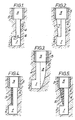
- The invention is illustrated by way of example with reference to the accompanying drawings in which Figures 1 to 3 are each a sectional view of a casting mould according to known practice and Figures 4 and 5 are according to the invention.
- Referring to the drawings:
- In Figure 1 a
steel casting 1 having dimensions 110 mmx110 mmx110 mm is produced in asand mould 2. Thecasting 1 is separated from acylindrical feeder casting 1 is unsound in the area 6. - Figure 2 illustrates the traditional steel foundry practice of utilising metal padding and the portion 7 of the plate 4 indicates the minimum possible additional metal needed to make
casting 1 sound. The dotted lines indicate the amount of cutting and machining which would be needed to produce the required casting shape. The use of metal padding also requires an increase in the diameter of thefeeder 3 from 100 mm to 125 mm. - Figure 3 illustrates an alternative prior art method of applying metal padding and the portion 8 of the plate 4 indicates the minimum metal needed in order to make casting 1 sound. Again it is necessary to increase the diameter of the feeder from 100 mm to 125 mm, and to remove a considerable quantity of metal in order to produce a casting of the required shape.
- Figure 4 illustrates the use of a preformed and dried pad according to the invention. In the production of the mould 2 a preformed and dried pad 9 was placed against the pattern in the position indicated. The comDosition of the pad was:and the pad had a density of 0.47 g/cm3.

- The casting 1 produced using the pad 9 was sound and was not contaminated by aluminium.
- Figure 5 illustrates the use of a pad formed from a mouldable mixture according to the invention.
- A composition was produced as follows:

- 60 parts by weight of water were added to 100 parts by weight of the composition to produce a mouldable mixture, and the mixture was rammed into a cavity in the
mould 2 at the position indicated 10. After removal of the pattern a few spots of an alkaline solution were applied to the exposed face of the moulded mixture. The composition of the alkaline solution was:
- As a result of the ensuing chemical reaction the moulded mixture hardened to form a pad. Previous tests using the same composition had produced pads having a density of 0.90 g/cm3. Two hours after application of the alkaline solution molten steel was poured into the
mould 2 and the resulting steel casting 1 was sound and was not contaminated by aluminium. - As a further illustration of the invention the following compositions were compared using preformed pads and sand moulds as shown in Figure 4.
-
- (1) An exothermic composition according to British Patent No. 971749 containing sillimanite as refractory filler, 1% by weight potassium cryolite and 1% by weight sodium fluoride.
- (2) An exothermic/heat-insulating composition consisting of 97.0% by weight of the composition shown on page 10 and 3.0% by weight calcium fluoride.
- (3) A composition exactly as stated on page 5, i.e. containing no fluoride salts.
- The density of each of the pads was recorded and casting soundness and aluminium pick-up in the casting face in contact with the pad were determined.
- The following results were obtained:

- As the table shows the pad according to the invention made from
composition 3 was sufficiently exothermic even in the absence of fluoride and had sufficiently good heat insulation properties to produce a sound casting and did not cause the casting to pick up aluminium. In contrast the use of theexothermic composition 1 and the exothermic/heat-insulatingcomposition 2, both of which contained fluoride, resulted in aluminium pick-up by the casting.
Claims (4)

Applications Claiming Priority (2)
| Application Number | Priority Date | Filing Date | Title |
|---|---|---|---|
| GB7920757 | 1979-06-14 | ||
| GB7920757 | 1979-06-14 |
Publications (2)
| Publication Number | Publication Date |
|---|---|
| EP0030940A1 EP0030940A1 (en) | 1981-07-01 |
| EP0030940B1 true EP0030940B1 (en) | 1984-01-11 |
Family
ID=10505851
Family Applications (1)
| Application Number | Title | Priority Date | Filing Date |
|---|---|---|---|
| EP80900667A Expired EP0030940B1 (en) | 1979-06-14 | 1980-12-30 | Production of metal castings |
Country Status (10)
| Country | Link |
|---|---|
| EP (1) | EP0030940B1 (en) |
| JP (1) | JPS56500681A (en) |
| KR (1) | KR840000602B1 (en) |
| BR (1) | BR8008710A (en) |
| CA (1) | CA1128255A (en) |
| ES (1) | ES492411A0 (en) |
| GB (1) | GB2063126B (en) |
| IT (1) | IT8067928A0 (en) |
| WO (1) | WO1980002811A1 (en) |
| ZA (1) | ZA802394B (en) |
Cited By (1)
| Publication number | Priority date | Publication date | Assignee | Title |
|---|---|---|---|---|
| DE19953402A1 (en) * | 1999-11-06 | 2001-05-10 | Wagner Heinrich Sinto Masch | Method and device for producing and casting a casting mold consisting of two mold halves |
Families Citing this family (10)
| Publication number | Priority date | Publication date | Assignee | Title |
|---|---|---|---|---|
| DE3122597C2 (en) * | 1981-06-06 | 1987-04-30 | Mannesmann Rexroth GmbH, 8770 Lohr | Feeder model for a casting |
| GB9522741D0 (en) * | 1995-11-07 | 1996-01-10 | Firth Vickers Centrispinning L | Making a metal shape by casting |
| GB9618216D0 (en) * | 1996-08-30 | 1996-10-09 | Triplex Lloyd Plc | Method of making fine grained castings |
| US6298900B1 (en) | 1998-07-06 | 2001-10-09 | Ford Global Technologies, Inc. | Method of integrating wear plates into a spray formed rapid tool |
| DE19920570B4 (en) * | 1999-05-04 | 2008-01-10 | Chemex Gmbh | Moldable exothermic compositions and feed therefrom |
| DE19925167A1 (en) | 1999-06-01 | 2000-12-14 | Luengen Gmbh & Co Kg As | Exothermic feeder mass |
| US9180511B2 (en) | 2012-04-12 | 2015-11-10 | Rel, Inc. | Thermal isolation for casting articles |
| JP5347077B1 (en) * | 2013-03-19 | 2013-11-20 | テクノメタル株式会社 | Sand mold casting method |
| RU2691826C1 (en) * | 2018-03-26 | 2019-06-18 | Федеральное государственное автономное образовательное учреждение высшего образования "Национальный исследовательский Томский государственный университет" (НИ ТГУ) | Method of producing casts from dispersed-hard alloys based on aluminum or magnesium |
| AU2022256785A1 (en) * | 2021-04-16 | 2023-10-26 | Foseco International Limited | Refractory article and composition |
Family Cites Families (4)
| Publication number | Priority date | Publication date | Assignee | Title |
|---|---|---|---|---|
| DE1084449B (en) * | 1953-08-05 | 1960-06-30 | Fachanstalt Fuer Giessereiwese | Heat-developing, moldable and hardenable compound for risers and funnels of molds and for block heads |
| GB769719A (en) * | 1954-01-26 | 1957-03-13 | Georges Lemoine | Improvements in or relating to exothermic mixtures |
| GB880868A (en) * | 1958-11-28 | 1961-10-25 | Foundry Services Int Ltd | Improvements in or relating to heat producing compositions |
| US3025153A (en) * | 1959-01-21 | 1962-03-13 | Foundry Services Int Ltd | Heat-producing mixtures |
-
1980
- 1980-04-18 JP JP50076880A patent/JPS56500681A/ja active Pending
- 1980-04-18 GB GB8040649A patent/GB2063126B/en not_active Expired
- 1980-04-18 BR BR8008710A patent/BR8008710A/en unknown
- 1980-04-18 WO PCT/GB1980/000067 patent/WO1980002811A1/en not_active Ceased
- 1980-04-21 ZA ZA00802394A patent/ZA802394B/en unknown
- 1980-04-23 CA CA350,480A patent/CA1128255A/en not_active Expired
- 1980-06-11 KR KR1019800002292A patent/KR840000602B1/en not_active Expired
- 1980-06-13 ES ES492411A patent/ES492411A0/en active Granted
- 1980-06-13 IT IT8067928A patent/IT8067928A0/en unknown
- 1980-12-30 EP EP80900667A patent/EP0030940B1/en not_active Expired
Cited By (1)
| Publication number | Priority date | Publication date | Assignee | Title |
|---|---|---|---|---|
| DE19953402A1 (en) * | 1999-11-06 | 2001-05-10 | Wagner Heinrich Sinto Masch | Method and device for producing and casting a casting mold consisting of two mold halves |
Also Published As
| Publication number | Publication date |
|---|---|
| CA1128255A (en) | 1982-07-27 |
| KR840000602B1 (en) | 1984-04-28 |
| ES8101943A1 (en) | 1980-12-16 |
| ZA802394B (en) | 1981-04-29 |
| GB2063126B (en) | 1983-01-26 |
| WO1980002811A1 (en) | 1980-12-24 |
| EP0030940A1 (en) | 1981-07-01 |
| ES492411A0 (en) | 1980-12-16 |
| KR830002549A (en) | 1983-05-30 |
| JPS56500681A (en) | 1981-05-21 |
| IT8067928A0 (en) | 1980-06-13 |
| BR8008710A (en) | 1981-04-28 |
| GB2063126A (en) | 1981-06-03 |
Similar Documents
| Publication | Publication Date | Title |
|---|---|---|
| US5632326A (en) | Mould and a method for the casting of metals and refractory compositions for use therein | |
| US4352390A (en) | Precision silica cones for sand casting of steel and iron alloys | |
| CA1286085C (en) | Exothermic compositions | |
| US4236568A (en) | Method of casting steel and iron alloys with precision cristobalite cores | |
| EP0993889B1 (en) | Foundry exothermic assembly | |
| EP1351785B1 (en) | Mould for metal casting | |
| US3558591A (en) | Heat insulators for use in the casting of molten metal | |
| EP0675862B1 (en) | Refractory compositions | |
| AU2002210754A1 (en) | Mould for metal casting | |
| CA1128255A (en) | Production of metal castings | |
| US5180759A (en) | Exothermic compositions | |
| US3567667A (en) | Mould linings composition comprising ball mill dust and calcium silicate,aluminum silicate or calcium alumino silicate fibrous refractory material | |
| US3934637A (en) | Casting of molten metals | |
| JPH0235621B2 (en) | ||
| US4036282A (en) | Process of ingot casting | |
| US3848655A (en) | Method of making a steel ingot | |
| US3876420A (en) | Thermal insulation molten metal | |
| US4040469A (en) | Casting of molten metals | |
| CA1046262A (en) | Heat-insulating agent for molten metal | |
| WO1981001971A1 (en) | Self drying aluminium-containing compositions | |
| GB2147531A (en) | Facilitating the division of a feeder heat from an article cast in a mould | |
| GB2171625A (en) | Duct for molten metal | |
| MX2008002893A (en) | Borosilicate glass-containing molding material mixtures |
Legal Events
| Date | Code | Title | Description |
|---|---|---|---|
| PUAI | Public reference made under article 153(3) epc to a published international application that has entered the european phase |
Free format text: ORIGINAL CODE: 0009012 |
|
| AK | Designated contracting states |
Designated state(s): FR |
|
| 17P | Request for examination filed |
Effective date: 19810317 |
|
| GRAA | (expected) grant |
Free format text: ORIGINAL CODE: 0009210 |
|
| AK | Designated contracting states |
Designated state(s): FR |
|
| PGFP | Annual fee paid to national office [announced via postgrant information from national office to epo] |
Ref country code: FR Payment date: 19840315 Year of fee payment: 5 |
|
| ET | Fr: translation filed | ||
| PLBE | No opposition filed within time limit |
Free format text: ORIGINAL CODE: 0009261 |
|
| STAA | Information on the status of an ep patent application or granted ep patent |
Free format text: STATUS: NO OPPOSITION FILED WITHIN TIME LIMIT |
|
| 26N | No opposition filed | ||
| PG25 | Lapsed in a contracting state [announced via postgrant information from national office to epo] |
Ref country code: FR Free format text: LAPSE BECAUSE OF NON-PAYMENT OF DUE FEES Effective date: 19861231 |
|
| REG | Reference to a national code |
Ref country code: FR Ref legal event code: ST |