EP0030181B1 - Composition pulvérulente et procédé de fabrication d'une pièce réfractaire à partir de cette composition - Google Patents
Composition pulvérulente et procédé de fabrication d'une pièce réfractaire à partir de cette composition Download PDFInfo
- Publication number
- EP0030181B1 EP0030181B1 EP80401648A EP80401648A EP0030181B1 EP 0030181 B1 EP0030181 B1 EP 0030181B1 EP 80401648 A EP80401648 A EP 80401648A EP 80401648 A EP80401648 A EP 80401648A EP 0030181 B1 EP0030181 B1 EP 0030181B1
- Authority
- EP
- European Patent Office
- Prior art keywords
- weight
- composition
- particles
- products
- alkaline earth
- Prior art date
- Legal status (The legal status is an assumption and is not a legal conclusion. Google has not performed a legal analysis and makes no representation as to the accuracy of the status listed.)
- Expired
Links
- 239000000203 mixture Substances 0.000 title claims abstract description 37
- 238000000034 method Methods 0.000 title description 6
- 238000004519 manufacturing process Methods 0.000 title description 2
- VYPSYNLAJGMNEJ-UHFFFAOYSA-N Silicium dioxide Chemical compound O=[Si]=O VYPSYNLAJGMNEJ-UHFFFAOYSA-N 0.000 claims abstract description 42
- 239000002245 particle Substances 0.000 claims abstract description 20
- XLYOFNOQVPJJNP-UHFFFAOYSA-N water Substances O XLYOFNOQVPJJNP-UHFFFAOYSA-N 0.000 claims abstract description 14
- 229910000287 alkaline earth metal oxide Inorganic materials 0.000 claims abstract description 11
- 150000001875 compounds Chemical class 0.000 claims abstract description 10
- 239000011449 brick Substances 0.000 claims abstract description 4
- 238000010276 construction Methods 0.000 claims abstract description 4
- 239000011230 binding agent Substances 0.000 claims description 7
- 239000003795 chemical substances by application Substances 0.000 claims description 6
- 238000002156 mixing Methods 0.000 claims description 2
- 239000000377 silicon dioxide Substances 0.000 abstract description 17
- 239000002270 dispersing agent Substances 0.000 abstract 1
- 239000000047 product Substances 0.000 description 32
- 239000004568 cement Substances 0.000 description 18
- 239000000499 gel Substances 0.000 description 12
- 235000008733 Citrus aurantifolia Nutrition 0.000 description 10
- 235000011941 Tilia x europaea Nutrition 0.000 description 10
- 239000004571 lime Substances 0.000 description 10
- 230000000694 effects Effects 0.000 description 9
- 238000003825 pressing Methods 0.000 description 9
- 238000010411 cooking Methods 0.000 description 8
- 239000004567 concrete Substances 0.000 description 5
- 238000009826 distribution Methods 0.000 description 5
- 238000007493 shaping process Methods 0.000 description 5
- 230000008901 benefit Effects 0.000 description 4
- 238000001035 drying Methods 0.000 description 4
- 230000007062 hydrolysis Effects 0.000 description 4
- 238000006460 hydrolysis reaction Methods 0.000 description 4
- 230000015572 biosynthetic process Effects 0.000 description 3
- 239000000470 constituent Substances 0.000 description 3
- 150000002500 ions Chemical class 0.000 description 3
- 239000000126 substance Substances 0.000 description 3
- 230000000930 thermomechanical effect Effects 0.000 description 3
- PNEYBMLMFCGWSK-UHFFFAOYSA-N aluminium oxide Inorganic materials [O-2].[O-2].[O-2].[Al+3].[Al+3] PNEYBMLMFCGWSK-UHFFFAOYSA-N 0.000 description 2
- 238000005266 casting Methods 0.000 description 2
- 238000000280 densification Methods 0.000 description 2
- 239000010419 fine particle Substances 0.000 description 2
- 230000036571 hydration Effects 0.000 description 2
- 238000006703 hydration reaction Methods 0.000 description 2
- 238000001935 peptisation Methods 0.000 description 2
- 230000007928 solubilization Effects 0.000 description 2
- 238000005063 solubilization Methods 0.000 description 2
- 239000011882 ultra-fine particle Substances 0.000 description 2
- UDHXJZHVNHGCEC-UHFFFAOYSA-N Chlorophacinone Chemical compound C1=CC(Cl)=CC=C1C(C=1C=CC=CC=1)C(=O)C1C(=O)C2=CC=CC=C2C1=O UDHXJZHVNHGCEC-UHFFFAOYSA-N 0.000 description 1
- BPQQTUXANYXVAA-UHFFFAOYSA-N Orthosilicate Chemical compound [O-][Si]([O-])([O-])[O-] BPQQTUXANYXVAA-UHFFFAOYSA-N 0.000 description 1
- 239000011398 Portland cement Substances 0.000 description 1
- 230000004913 activation Effects 0.000 description 1
- 239000011149 active material Substances 0.000 description 1
- 239000000920 calcium hydroxide Substances 0.000 description 1
- 235000011116 calcium hydroxide Nutrition 0.000 description 1
- 239000000919 ceramic Substances 0.000 description 1
- 238000006243 chemical reaction Methods 0.000 description 1
- 238000005056 compaction Methods 0.000 description 1
- 230000000295 complement effect Effects 0.000 description 1
- 238000007596 consolidation process Methods 0.000 description 1
- 230000007423 decrease Effects 0.000 description 1
- 230000002349 favourable effect Effects 0.000 description 1
- 239000000945 filler Substances 0.000 description 1
- 238000010304 firing Methods 0.000 description 1
- 238000005243 fluidization Methods 0.000 description 1
- 229910052500 inorganic mineral Inorganic materials 0.000 description 1
- 238000003475 lamination Methods 0.000 description 1
- 230000001050 lubricating effect Effects 0.000 description 1
- 239000011707 mineral Substances 0.000 description 1
- 235000010755 mineral Nutrition 0.000 description 1
- 239000000843 powder Substances 0.000 description 1
- 239000002244 precipitate Substances 0.000 description 1
- 238000001556 precipitation Methods 0.000 description 1
- 238000002360 preparation method Methods 0.000 description 1
- 230000001737 promoting effect Effects 0.000 description 1
- 230000003252 repetitive effect Effects 0.000 description 1
- 150000004760 silicates Chemical class 0.000 description 1
- 238000005245 sintering Methods 0.000 description 1
- 239000002689 soil Substances 0.000 description 1
- 230000006641 stabilisation Effects 0.000 description 1
- 238000011105 stabilization Methods 0.000 description 1
- 238000003860 storage Methods 0.000 description 1
- 239000012749 thinning agent Substances 0.000 description 1
Images
Classifications
-
- C—CHEMISTRY; METALLURGY
- C04—CEMENTS; CONCRETE; ARTIFICIAL STONE; CERAMICS; REFRACTORIES
- C04B—LIME, MAGNESIA; SLAG; CEMENTS; COMPOSITIONS THEREOF, e.g. MORTARS, CONCRETE OR LIKE BUILDING MATERIALS; ARTIFICIAL STONE; CERAMICS; REFRACTORIES; TREATMENT OF NATURAL STONE
- C04B35/00—Shaped ceramic products characterised by their composition; Ceramics compositions; Processing powders of inorganic compounds preparatory to the manufacturing of ceramic products
- C04B35/66—Monolithic refractories or refractory mortars, including those whether or not containing clay
-
- C—CHEMISTRY; METALLURGY
- C04—CEMENTS; CONCRETE; ARTIFICIAL STONE; CERAMICS; REFRACTORIES
- C04B—LIME, MAGNESIA; SLAG; CEMENTS; COMPOSITIONS THEREOF, e.g. MORTARS, CONCRETE OR LIKE BUILDING MATERIALS; ARTIFICIAL STONE; CERAMICS; REFRACTORIES; TREATMENT OF NATURAL STONE
- C04B28/00—Compositions of mortars, concrete or artificial stone, containing inorganic binders or the reaction product of an inorganic and an organic binder, e.g. polycarboxylate cements
- C04B28/02—Compositions of mortars, concrete or artificial stone, containing inorganic binders or the reaction product of an inorganic and an organic binder, e.g. polycarboxylate cements containing hydraulic cements other than calcium sulfates
-
- C—CHEMISTRY; METALLURGY
- C04—CEMENTS; CONCRETE; ARTIFICIAL STONE; CERAMICS; REFRACTORIES
- C04B—LIME, MAGNESIA; SLAG; CEMENTS; COMPOSITIONS THEREOF, e.g. MORTARS, CONCRETE OR LIKE BUILDING MATERIALS; ARTIFICIAL STONE; CERAMICS; REFRACTORIES; TREATMENT OF NATURAL STONE
- C04B35/00—Shaped ceramic products characterised by their composition; Ceramics compositions; Processing powders of inorganic compounds preparatory to the manufacturing of ceramic products
- C04B35/01—Shaped ceramic products characterised by their composition; Ceramics compositions; Processing powders of inorganic compounds preparatory to the manufacturing of ceramic products based on oxide ceramics
- C04B35/10—Shaped ceramic products characterised by their composition; Ceramics compositions; Processing powders of inorganic compounds preparatory to the manufacturing of ceramic products based on oxide ceramics based on aluminium oxide
- C04B35/101—Refractories from grain sized mixtures
-
- C—CHEMISTRY; METALLURGY
- C04—CEMENTS; CONCRETE; ARTIFICIAL STONE; CERAMICS; REFRACTORIES
- C04B—LIME, MAGNESIA; SLAG; CEMENTS; COMPOSITIONS THEREOF, e.g. MORTARS, CONCRETE OR LIKE BUILDING MATERIALS; ARTIFICIAL STONE; CERAMICS; REFRACTORIES; TREATMENT OF NATURAL STONE
- C04B35/00—Shaped ceramic products characterised by their composition; Ceramics compositions; Processing powders of inorganic compounds preparatory to the manufacturing of ceramic products
- C04B35/622—Forming processes; Processing powders of inorganic compounds preparatory to the manufacturing of ceramic products
- C04B35/626—Preparing or treating the powders individually or as batches ; preparing or treating macroscopic reinforcing agents for ceramic products, e.g. fibres; mechanical aspects section B
- C04B35/63—Preparing or treating the powders individually or as batches ; preparing or treating macroscopic reinforcing agents for ceramic products, e.g. fibres; mechanical aspects section B using additives specially adapted for forming the products, e.g.. binder binders
- C04B35/6303—Inorganic additives
- C04B35/6316—Binders based on silicon compounds
-
- C—CHEMISTRY; METALLURGY
- C04—CEMENTS; CONCRETE; ARTIFICIAL STONE; CERAMICS; REFRACTORIES
- C04B—LIME, MAGNESIA; SLAG; CEMENTS; COMPOSITIONS THEREOF, e.g. MORTARS, CONCRETE OR LIKE BUILDING MATERIALS; ARTIFICIAL STONE; CERAMICS; REFRACTORIES; TREATMENT OF NATURAL STONE
- C04B2235/00—Aspects relating to ceramic starting mixtures or sintered ceramic products
- C04B2235/02—Composition of constituents of the starting material or of secondary phases of the final product
- C04B2235/30—Constituents and secondary phases not being of a fibrous nature
- C04B2235/34—Non-metal oxides, non-metal mixed oxides, or salts thereof that form the non-metal oxides upon heating, e.g. carbonates, nitrates, (oxy)hydroxides, chlorides
- C04B2235/3418—Silicon oxide, silicic acids or oxide forming salts thereof, e.g. silica sol, fused silica, silica fume, cristobalite, quartz or flint
Definitions
- the present invention relates to a shaped refractory product which, without it being essential to bake it, has physical, thermo-mechanical and thermo-chemical characteristics at least equivalent to those of baked shaped refractory products known to date.
- the invention makes it possible to eliminate the drawbacks which are in particular the expenditure of energy, the slowness of manufacture and a certain imprecision of the dimensions coming from deformations due to cooking.
- a mixture of granular powder and water is prepared and placed in a mold to give it the desired shape.
- the products thus obtained are stabilized by firing at a temperature generally close to the service temperature in order to give the components a ceramic bond and to stabilize the products in size.
- Another known method for obtaining refractory products consists in using mixtures of hydraulic concrete types. These mixtures (pulverulent composition and water) are molded by casting and vibration and give products which have advantageous characteristics for certain applications. But the proportion of hydraulic binder based on alkaline earth oxides which they must contain remains relatively high, even if it could have been reduced significantly, and thereby reduces the qualities of the products such as their thermo-mechanical characteristics. .
- shaping by casting and vibration excludes shaping at high flow in a single mold due to the time required for the hydraulic setting of the concrete before demolding.
- French patent 2,390,400 which describes a cement for concrete.
- This cement has effects quite different from that of the present application because the pouring of a concrete into a mold and then its vibration, as indicated in this French patent page 3 lines 5 to 7 for example, causes a arrangement of the particles according to a simple juxtaposition and not according to a tangle as is explained below in particular on page 8 lines 30 to 33.
- Pressing provides, effectively, an effect by which the grains are somehow "broken” which favors this entanglement and which results in the creation of a kind of "skeleton". This gives the piece itself a clean, immediately obtained hold, since the demolding operation does not require more than 10 to 20 seconds while pouring concrete into a mold requires setting time. at least half an hour and more frequently three hours, since the arrangement of the particles in a simple juxtaposition does not give this "skeleton" effect, hence the need to wait relatively long until the mixture has set in a mold.
- This operation can be neither mechanized nor automated unlike industrial pressing which can be carried out by means of machines with repetitive cycle and high efficiency.
- the composition intended to be mixed with an aggregate comprises only two components and a fluidizing agent, one of these components having to have a fine particle size but not strictly enclosed within a precise range.
- silica / cement ratio has a value between 0.5 and 5.4 in French patent 2,390,400 (calculation resulting from claim 1) whereas according to the present invention, this same ratio has a value which ranges from 24 to 2.33 according to the calculations which result from the precise indications of claim 1.
- Japanese patent 79 / 113,617 is also known (summary published in Chemical Abstracts) which relates to a composition which must necessarily be cooked while that which results from the invention is especially intended to be used in the raw state, cooking not being only a favorable complement, certainly, but not essential.
- the Japanese patent provides for silica at a rate of 4% whereas, according to the present application, this silica is present in a proportion which ranges from 1.4 to 19.2.
- the proportions between silica and cement are exactly opposite to those of the invention.
- there is 4% of silica and 8% of aluminous cement that is to say a ratio of 0.5 whereas according to the present application the quantities of silica (1.4 to 19.2) and the quantities of cement (0.1 to 1), as a compound providing alkaline earth oxides, give ratios of 24 to 2.33 (see claim 1).
- a compound providing alkaline earth oxides such as a cement must be present in a minimum amount, which materializes in the proportion 0.08 to (2%, preferably 0.1 to 1% , and which is incompatible with the amount as large as 8% described in the Japanese patent.
- the composition according to the invention consists of two very precise products and a fluidizing agent with a view to mixing them with an aggregate and a small amount of water, to obtain a gel which is formed in place.
- the use of pressing provides ready-to-use parts in a very short time, allowing the use of a mechanized, automatic and industrial system, the composition of these products not making their stabilization by cooking essential.
- the invention relates to a pulverulent composition to be mixed with a refractory aggregate and with water with a view to obtaining by pressing refractory pieces such as bricks, for the construction of thermal chambers, characterized in what it only comprises three constituents which are, on the one hand, 70 to 96% by weight of silica, either vitreous or amorphous, the particles of which have a diameter of less than 1 ⁇ m, and on the other hand 4 to 30% by weight of a compound providing 1 to 20% by weight of alkaline earth oxides and, on the third hand, 0.5 to 3% by weight of a fluidizing agent.
- This silica is solubilized by activation using water and the resulting hydrolysis leads, by drying, to the precipitation of the gel formed.
- the silica associated with a small part of elements promoting its solubilization constitutes a binder for refractory aggregate.
- alkaline earth ions are advantageously used, preferably provided by a cement.
- This set contains a fluidifying or "dispersing" agent allowing the deflocculation of the fine and ultrafine fraction of the constituents to facilitate the homogeneous distribution of all the particles, which makes it possible to limit the amount of binder relative to the set.
- Deflocculation generates, moreover, a lubricating action which makes it possible to reduce the quantity of water theoretically necessary for the arrangement of the particles by compaction.
- a pulverulent composition as defined above, to use binder is mixed with a refractory aggregate of which 5% by weight at least consists of particles of diameter less than 20 m M, the aggregate representing 80 to 98% of the total weight of the whole and this mixture thus containing either vitreous or amorphous silica, the particles of which have a diameter less than 1 ⁇ m at a rate of 1.4 to 19.2% by weight, a compound providing alkaline earth oxides in an amount of 0.08 to 2% by weight and a thinning agent in an amount of 0.01 to 0.6% by weight.
- the invention relates more precisely to such a composition which contains 0.1 to 1% by weight of a compound providing alkaline earth oxides and according to a variant, 4 to 10% by weight of silica, either vitreous or amorphous.
- the binder and the refractory aggregate perfectly mixed are added with water, as said above, and the assembly is compacted in a mold under a pressure of 300 to 500 bars reached quickly and maintained for a short time in order to obtain a refractory piece such as a brick for the construction of thermal enclosures.
- a particular bond is obtained by the hydrolysis of ultra-fine silica (or amorphous), distributed homogeneously between the particles of the aggregate, in the presence of a small amount of alkaline earth ions. This hydrolysis leads to the formation of a gel which precipitates during drying by cementing the particles.
- the alkaline earth ions are preferably provided by a cement which may only be present in an extremely small quantity (less than 1% by weight of the binder-aggregate assembly).
- the pozzolanic effect can be conventional, that is to say obtained by fixing, in the form of lime silicate, by the fine silica of Portlandite resulting from the hydration of a Portland cement or obtained by hydration in the presence of fine silica in large quantities of an aluminous cement (refractory) in the form of hydrated pseudo- Fromite.
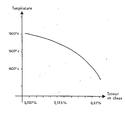
- This phenomenon is illustrated, by way of indication, by the single figure in the appended drawing.
- This drawing represents a curve of variation in subsidence temperature under load (on the ordinate) of refractory products obtained with compositions in accordance with the invention and produced with the same aggregate, as a function of the lime content (on the abscissa) of these compositions.
- the temperature indicated is that at which a collapse of 0.5% occurs under a load of 2 daN cm- 2 , measured by the differential method (AFNOR NFB 49-105 standard and ISO R 1893 standard).
- the lime content indicated is that which results from the use of an aluminous cement containing approximately 70% of alumina and 27% of lime.
- This cement is, here, that known under the name of "SECAR 71".
- silica gels The binding by silica gels is well known to those skilled in the art. However, the invention cannot be assimilated to the prior art. Indeed, known silica gels contain a large amount of water and a low concentration of active material. Consequently, their use provides a large amount of water which is very unfavorable since it gives the products a high porosity and a low mechanical cohesion.
- the gel is formed in place, with the same and same water as that which is necessary for the humidification of the mixture.
- the invention provides raw products whose thermo-mechanical characteristics are at least equal to those of cooked products of the cone technique.
- the invention provides an additional advantage over known products with respect to density and porosity.
- the raw products in accordance with the invention can have porosities of the order of 10%. These same products if cooked, can see their porosity fall to 5% without shrinkage greater than 1%, which represents a very good performance.
- refractory aggregate is identical to that usually used and chosen according to the application envisaged, as is well known to those skilled in the art.
- a characteristic of the invention is that, to ensure the good particle size distribution of the particles, the aggregate contains a substantial fraction of ultra-fine particles (diameter less than 20 ⁇ m). Depending on the binder content, the result is generally achieved with a proportion of between 5 and 25% of the total weight of the aggregate.
- cement cited is an aluminous cement containing 70% alumina and 27% lime sold by the company LAFARGE FONDU INTERNATIONAL.
- the products according to the invention after sufficient storage to allow setting are dried to remove the free water. They can, incidentally of course, be cooked, which can further improve their characteristics but cooking does not offer any major benefit and considerably increases the cost.
Landscapes
- Chemical & Material Sciences (AREA)
- Engineering & Computer Science (AREA)
- Ceramic Engineering (AREA)
- Manufacturing & Machinery (AREA)
- Materials Engineering (AREA)
- Structural Engineering (AREA)
- Organic Chemistry (AREA)
- Inorganic Chemistry (AREA)
- Chemical Kinetics & Catalysis (AREA)
- Compositions Of Oxide Ceramics (AREA)
- Curing Cements, Concrete, And Artificial Stone (AREA)
- Ceramic Products (AREA)
- Manufacturing Of Micro-Capsules (AREA)
- Polyurethanes Or Polyureas (AREA)
- Furnace Housings, Linings, Walls, And Ceilings (AREA)
- Devices For Post-Treatments, Processing, Supply, Discharge, And Other Processes (AREA)
Description
- La présente invention concerne un produit réfractaire façonné qui, sans qu'il soit indispensable de le cuire, présente des caractéristiques physiques, thermo-mécaniques et thermo-chimiques au moins équivalentes à celles des produits réfractaire façonnés cuits connus jusqu'à ce jour.
- En évitant la cuisson, l'invention permet d'en éliminer les inconvénients qui sont notamment la dépense d'énergie, la lenteur de fabrication et une certaine imprécision des cotes provenant de déformations dues à la cuisson.
- Selon l'état actuel de la technique, on prépare un mélange constitué d'une poudre granuleuse et d'eau et on le place dans un moule pour lui donner la forme voulue. Les produits ainsi obtenus sont stabilisés par cuisson à une température en général proche de la température de service afin de donner aux composants une liaison céramique et de stabiliser les produits en dimensions.
- La mise en forme du mélange dans un moule implique un pressage. Or, il est bien connu de l'homme de métier qu'il est difficile d'obtenir par des moyens industriels de pressage à grand débit, une porosité inférieure à 15% alors qu'il est du plus grand intérét d'obtenir une porosité minimale puisqu'elle conditionne, pour une grande part, les qualités des produits réfractaires.
- Mais pour obtenir cette porosité inférieure à 15%, on ne dispose que de mélanges dont la répartition granulaire est difficilement compatible avec les moyens industriels de pressage.
- En effet, cette répartition granulaire entraîne:
- - soit un feuilletage important des produits en raison de l'air emprisonné au moment du pressage;
- - soit un retrait lors de la cuisson qui atteint des valeurs intolérables;
- - soit ces deux défauts à la fois.
- C'est pourquoi les mélanges industriels connus ne sont qu'un compromis entre leur aptitude au façonnage industriel et les qualités des produits cuits c'est-à-dire principalement leur porosité.
- Une autre méthode connue pour l'obtention de produits réfractaires, consiste à utiliser des mélanges de types béton hydraulique. Ces mélanges (composition pulvérulente et eau) sont moulés par coulage et vibration et donnent des produits qui ont des caractéristiques intéressantes pour certaines applications. Mais la proportion de liant hydraulique à base d'oxydes alcalino-terreux qu'ils doivent contenir reste relativement élevée, même si elle a pu être réduite de façon sensible, et amenuise de ce fait les qualités des produits telles que leurs caractéristiques thermo-mécaniques.
- En outre, la mise en forme par coulage et vibration exclut de façonnage à grand débit dans un moule unique en raison due temps nécessaire à la prise hydraulique du béton avant démoulage.
- Ainsi, on connaît par exemple le brevet français 2.390.400 qui décrit un ciment pour béton. Ce ciment a des effets tout-à-fait différents de celui de la présente demande car le coulage d'un béton dans un moule puis sa vibration, comme cela est indiqué dans ce brevet français page 3 lignes 5 à 7 par exemple, provoque un arrangement des particules selon une simple juxtaposition et non pas selon un enchevêtrement comme cela est expliqué ci-après notamment page 8 lignes 30 à 33.
- Le pressage procure, effectivement, un effet par lequel les grains sont en quelque sorte "cassés" ce qui favorise cet enchevêtrement et ce qui aboutit à la création d'une sorte de "squelette". Celui-ci donne à la pièce elle-même une tenue propre et obtenue immédiatement, puis-que l'opération de démoulage ne demande pas plus de 10 à 20 secondes alors que le coulage d'un béton dans un moule demande un temps de prise d'au minimum une demi heure et plus fréquemment de trois heures, du fait que l'arrangement des particules selon une simple juxtaposition ne donne pas cet effet de "squelette" d'où la nécessité d'attendre relativement longtemps que le mélange ait pris dans un moule.
- Cette opération ne peut être ni mécanisée ni automatisée contrairement au pressage industriel qui peut être effectué au moyen de machines à cycle répétitif et de grand rendement.
- Ces différences viennent de la composition elle-même comme cela ressort des explications données dans le brevet français 2.390.400, page 1 lignes 15 à 24 où il est précisé, sans équivoque, que la granulométrie recherchée empêche la formation de gels ou de sols, cette précision étant répétée page 3, lignes 27 et 28.
- Ceci est contraire aux caractéristiques de l'invention telles qu'elles sont données ci-après page 8 lignes 6 à 9 et lignes 13 à 23.
- Cette différence profonde dans la nature des deux inventions provient des compositions qui sont tout-à-fait différentes.
- En effet, selon le brevet 2.390.400, il est indispensable d'associer deux constituants minéraux, dont la nature est peu importante, dans deux plages de granulométrie extrêmement précise. L'invention décrite dans ce brevet impose la présence dans le ciment non mélangé à un agrégat, d'une charge inerte.
- Selon l'invention, au contraire, la composition destinée à être mélangée à un agrégat ne comprend que deux composants et un agent fluidifiant, l'un de ces composants devant avoir une granulométrie fine mais non rigoureusement enfermée dans une fourchette précise.
- Il faut également noter que le rapport silice/ciment a une valeur comprise entre 0,5 et 5,4 dans le brevet français 2.390.400 (calcul résultant de la revendication 1) alors que selon la présente invention, ce même rapport a une valeur qui va de 24 à 2,33 selon les calculs qui résultent des indications précises de la revendication 1.
- On connaît également le brevet japonais 79/113.617 (resumé publié dans Chemical Abstracts) qui concerne une composition devant obligatoirement être cuite alors que celle qui résulte de l'invention est surtout destinée à être utilisée à l'état cru, la cuisson n'étant qu'un complément favorable, certes, mais non indispensable.
- Le résultat atteint à l'égard de la porosité n'est que de 15% après cuisson alors que selon l'invention on obtient 13,5 de porosité avec un simple étuvage à 110°. Cela résulte d'une différence de composition puisque dans le brevet japonais un ciment alumineux est présent à raison de 8% alors que selon la présente demande un ciment alumineux, en tant que composé apportant des oxydes alcalino-terreux, n'est présent que dans la proportions de 0,1 à 1 % ce qui montre une différence complète dans la nature même des compositions en cause et des phénomènes physico-chimiques mis en jeu.
- Le brevet japonais prévoit de la silice à raison de 4% alors que selon la présente demande cette silice est présente dans une proportion qui va de 1,4 à 19,2. Dans ce brevet, les proportions entre la silice et le ciment sont exactement inverses de celles de l'invention. En effet, selon le brevet japonais, il y a 4% de silice et 8% de ciment alumineux, soit un rapport de 0,5 alors que selon la présente demande les quantités de silice (1,4 à 19,2) et les quantités de ciment (0,1 à 1 ), en taut que composé apportant des oxydes alcalino-terreux, donnent des rapports de 24 à 2,33 (voir revendication 1 ).
- Selon l'invention un composé apportant des oxydes alcalino-terreux, tel qu'un ciment doit être présente dans une quantité minimum, ce qui se matérialise dans la proportion 0,08 à (2%, de préférence 0,1 à à 1 %, et ce qui est incompatible avec la quantité aussi importante que 8% décrite dans le brevet japonais.
- La composition selon l'invention consiste en deux produits très précis et un agent fluidifiant en vue de leur mélange à un agrégat et à une faible quantité d'eau, pour l'obtention d'un gel qui est formé en place. L'utilisation du pressage procure des pièces prêtes à l'emploi en un temps très court, permettant l'utilisation d'un système mécanisé, automatique et industriel, la composition de ces produits ne rendant pas indispensable leur stabilisation par cuisson.
- A cet effet, l'invention concerne une composition pulvérulente devant être mélangée à un agrégat réfractaire et à de l'eau en vue de l'obtention par pressage de pièces réfractaires telles que des briques, pour la construction d'enceintes thermiques, caractérisée en ce qu'elle ne comprend que trois constituants qui sont d'une première part 70 à 96% en poids de silice soit vitreuse soit amorphe dont les particules ont un diamètre inférieur à 1 µm, d'une deuxième part 4 à 30% en poids d'un composé apportant 1 à 20% en poids d'oxydes alcalino-terreux et, d'une troisième part, 0,5 à 3% en poids d'un agent fluidifiant.
- On solubilise cette silice par activation au moyen d'eau et l'hydrolyse qui en résulte conduit, par séchage, à la précipitation du gel formé.
- La silice associée à une petite part d'éléments favorisant sa solubilisation constitue un liant pour agrégat réfractaire.
- Parmi les éléments favorisant la solubilisation de la silice on utilise, avantageusement, des ions alcalino-terreux apportés, de préférence, par un ciment.
- Cet ensemble contient un agent fluidifiant ou "dispersant" permettant la défloculation de la fraction fine et ultrafine des constituants pour faciliter la répartition homogène de toutes les particules, ce qui permet de limiter la quantité de liant par rapport à l'ensemble.
- La défloculation génère, en outre, une action lubrifiante qui permet de diminuer la quantité d'eau théoriquement nécessaire à l'arrangement des particules par compactage.
- Selon une caractéristique de l'invention, une composition pulvérulente telle que définie ci-dessus, à usage de liant, est mélangée à un agrégat réfractaire dont 5% en poids au moins sont constitués de particules de diamètre inférieur à 20 Mm, cet agrégat représentant 80 à 98% du poids total de l'ensemble et ce mélange contenant ainsi de la silice soit vitreuse soit amorphe dont les particules ont un diamètre inférieur à 1 ,um à raison de 1,4 à 19,2% en poids, un composé apportant des oxydes alcalino-terreux à raison de 0,08 à 2% en poids et un agent fluidifiant à raison de 0,01 à 0,6% en poids.
- L'invention concerne plus précisément une telle composition qui contient 0,1 à 1 % en poids d'un composé apportant des oxydes alcalino-terreux et selon une variante, 4 à 10% en poids de silice soit vitreuse soit amorphe.
- Le liant et l'agrégat réfractaire parfaitement mélangés sont additionnés d'eau, comme dit ci-dessus, et l'ensemble est compacté dans un moule sous une pression de de 300 à 500 bars atteinte rapidement et maintenue pendant un temps court afin d'obtenir une pièce réfractaire telle qu'une brique pour la construction d'enceintes thermiques.
- On obtient une liaison particulière par l'hydrolyse de la silice vitreuse (ou amorphe) ultra-fine, répartie de façon homogène entre les particules de l'agrégat, en présence d'une faible quantité d'ions alcalino-terreux. Cette hydrolyse conduit à la formation d'un gel qui précipite au cours du séchage en cimentant les particules.
- Les ions alcalino-terreux sont de préférence apportés par un ciment qui peut n'être présent qu'en quantité extrêment faible (moins de 1% en poids de l'ensemble liant-agrégat).
- En effect, l'action d'hydrolyse avec formation de gel puis consolidation par séchage, décroît lorsque la teneur en alcalino-terreux croît.
- Inversement, lorsque la teneur en alcalino-terreux croît, une réaction du type pouzzolanique apparaît.
- Ici, l'effet pouzzolanique peut être classique, c'est-à-dire obtenu par fixation, sous forme de silicate de chaux, par la silice fine de la Portlandite résultant de l'hydratation d'un ciment Portland ou obtenu par l'hydratation en présence de silice fine en grande quantité d'un ciment alumineux (réfractaire) sous forme de pseudo-géhlénite hydratée.
- La présence de ces silicates de chaux ou silico-aluminate de chaux est défavorable à la réfractarité des produits et doit être réduite autant que faire se peut. Cet abaissement de réfractarité se traduit notamment par un abaissement sensible de la température d'affaissement sous charge, caractéristique essentielle des produits réfractaires en rapport avec la température limite d'emploi.
- Ce phénomène est illustré, à titre indicatif, par la figure unique du dessin annexé. Ce dessin représente une courbe de variation de température d'affaissement sous charge (en ordonnée) de produits réfractaires obtenus avec des compositions conformes à l'invention et réalisées avec un même agrégat, en fonction de la teneur en chaux (en abscisse) de ces compositions.
- La température indiquée est celle à laquelle se produit un affaissement de 0,5% sous une charge de 2 daN cm-2, mesuré par la méthode différentielle (norme AFNOR NFB 49-105 et norme ISO R 1893).
- La teneur en chaux indiquée est celle qui résulte de l'emploi d'un ciment alumineux contenant environ 70% d'alumine et 27% de chaux. Ce ciment est, ici, celui connu sous le nom de "SECAR 71 ".
- Comme le montre cette courbe, il suffit de très peu de chaux pour provoquer un abaissement sensible de la température d'affaissement sous charge.
- En effet, lorsque la teneur en chaux passe de 0,027% à 0,135%, la température d'affaissement sous charge tombe de 50°C. Lorsqu'elle passe de 0.135% à 0,270% cette température tombe de 150°C.
- En d'autres termes, plus la teneur en chaux d'une composition est élevée, plus les performances des produits réfractaires obtenus sont faiblès .
- Certaines caractéristiques (cohésion à froid après séchage, par exemple) des produits conformes à l'invention peuvent être obtenues de deux façons.
- - en profitant de la liaison par gel, c'est-à-dire en fixant la composition dans la zone à teneur faible en alcalino-terreux, cette liaison étant associée à une bonne densification du produit;
- - en profitant inversement de l'effet pouzzolanique en n'utilisant que la quantité de ciment strictement nécessaire au développement sensible de cet effet.
- La liaison par des gels de silice est bien connue de l'homme de métier. Mais l'invention ne peut pas être assimilée à la technique antérieure. En effet, les gels de silice connus contiennent une grande quantité d'eau et un faible concentration en matière active. En conséquence, leur emploi apporte une grande quantité d'eau qui est très défavorable puisqu'elle donne aux produits une porosité élevée et une faible cohésion mécanique.
- Selon l'invention, le gel est formé en place, avec la seule et même eau que celle qui est nécessaire à l'humidification du mélange.
- Pour obtenir les meilleurs résultats de l'invention, il s'avère important de combiner:
- - la bonne répartition granulométrique jusqu'aux particules ultra-fines;
- - la fluidification des composants pour l'obtention d'une bonne homogénéité malgré un faible apport d'eau;
- - le pressage du mélange à valeur suffisante pour provoquer la liaison des particules par rapprochement, voire enchevêtrement et pour cimenter, par le gel formé, les fines particules.
- L'invention procure des produits crus dont les caractérisques thermo-mécaniques sont au moins égales à celles des produits cuits de la technique conne.
- En outre, l'invention procure un avantage supplémentaire par rapport aux produits connus à l'égard de la densité et de la porosité.
- Les faibles porosités qu'il est possible d'obtenir selon la technique connue proviennent de l'effet de frittage des particules entre elles et cet effet se traduit par de forts retraits lors de la cuisson, ce qui a pour conséquence une grande difficulté à respecter rigoureusement les cotes prévues et à éviter les déformations.
- Les produits crus conformes à l'invention peuvent avoir des porosités de l'ordre de 10%. Ces mêmes produits si on les cuit, peuvent voir leur porosité tomber à 5% sans retrait supérieur à 1 %, ce qui représente une très bonne performance.
- Les proportions des composants conformes à l'invention sont les suivantes:

- La nature de l'agrégat réfractaire est identique à celle habituellement utilisée et choisie en fonction de l'application envisagée, ainsi que cela est bien connu de l'homme de métier.
- Une caractéristique de l'invention est que, pour assurer la bonne répartition granulométrique des particules, l'agrégat contienne une fraction sensible de particules ultra-fines (diamètre inférieur à 20 µm). En fonction de la teneur en liant, le résultat est en général atteint avec une proportion comprise entre 5 et 25% du poids total de l'agrégat.
- On va maintenant donner trois exemples chiffrés. Le ciment "SECAR" 71" cité est un ciment alumineux à 70% d'alumine et 27% de chaux commercialisé par la Société LAFARGE FONDU INTERNATIONAL.
-

- Ces différents composants sous introduits dans un mélangeur de tout type connu et le mélange obtenu est placé, selon la technique connue, dans un moule subissant l'action d'une presse hydraulique ou mécanique à grand débit sous une pression de 400 bars.
- Les produits obtenus ont les caractéristiques suivantes:

-

- Après préparation comme dans l'exemple 1 et façonnage à 400 bars, les produits obtenus ont les caractéristiques suivantes:

-


-

- Comme on peut le constater sur le tableau ci-dessus, les caractéristiques essentielles des produits crus à 95% AI203 sont identiques, voire supérieures, à celles des produits classiques cuits. Les propriétés des produits conformes à l'invention cuits à 1500°C sont nettement supérieures, à tous les niveaux, à celles des produits équivalents de la technique antérieure.
- Les produits conformes à l'invention après stockage suffisant pour permettre la prise, sont séchés pour éliminer l'eau libre. Ils peuvent, accessoirement bien entendu, être cuits, ce qui peut encore améliorer leurs caractéristiques mais la cuisson n'offre pas intérêt majeur et augmente considérablement le coût.
- L'invention n'est pas limitée aux seuls modes de réalisation décrits mais en embrasse, au contraire, toutes les variantes.
Claims (4)
Priority Applications (1)
| Application Number | Priority Date | Filing Date | Title |
|---|---|---|---|
| AT80401648T ATE8126T1 (de) | 1979-11-19 | 1980-11-18 | Pulverfoermige zusammensetzung und verfahren zur herstellung eines feuerfesten formkoerpers mittels dieser zusammensetzung. |
Applications Claiming Priority (2)
| Application Number | Priority Date | Filing Date | Title |
|---|---|---|---|
| FR7928418 | 1979-11-19 | ||
| FR7928418A FR2470104A1 (fr) | 1979-11-19 | 1979-11-19 | Composition pulverulente et piece refractaire obtenue a partir de cette composition |
Publications (2)
| Publication Number | Publication Date |
|---|---|
| EP0030181A1 EP0030181A1 (fr) | 1981-06-10 |
| EP0030181B1 true EP0030181B1 (fr) | 1984-06-27 |
Family
ID=9231813
Family Applications (1)
| Application Number | Title | Priority Date | Filing Date |
|---|---|---|---|
| EP80401648A Expired EP0030181B1 (fr) | 1979-11-19 | 1980-11-18 | Composition pulvérulente et procédé de fabrication d'une pièce réfractaire à partir de cette composition |
Country Status (12)
| Country | Link |
|---|---|
| US (1) | US4346177A (fr) |
| EP (1) | EP0030181B1 (fr) |
| JP (1) | JPS5857389B2 (fr) |
| AT (1) | ATE8126T1 (fr) |
| AU (1) | AU530387B2 (fr) |
| BR (1) | BR8007503A (fr) |
| CA (1) | CA1189879A (fr) |
| DE (1) | DE3068377D1 (fr) |
| ES (1) | ES496987A0 (fr) |
| FR (1) | FR2470104A1 (fr) |
| MX (1) | MX156499A (fr) |
| ZA (1) | ZA807136B (fr) |
Families Citing this family (12)
| Publication number | Priority date | Publication date | Assignee | Title |
|---|---|---|---|---|
| FR2523572B1 (fr) * | 1982-03-19 | 1986-07-25 | Ags Bmp Argiles Mineraux | Composition pour beton |
| US4486545A (en) * | 1982-04-02 | 1984-12-04 | Shinagawa Refractories, Co., Ltd. | SIO2 -CaO Based low cubically expansive flame-spraying material |
| JPS5988365A (ja) * | 1982-11-11 | 1984-05-22 | 信越化学工業株式会社 | タイル用組成物 |
| LU85107A1 (fr) * | 1983-11-28 | 1985-07-17 | Tunjet A G | Composition de beton refractaire et application en metallurgie |
| JPS60152376A (ja) * | 1984-01-18 | 1985-08-10 | Nippon Alum Mfg Co Ltd:The | クラツド材の溶接方法 |
| DE3440252A1 (de) * | 1984-11-03 | 1986-05-15 | Hoechst Ag, 6230 Frankfurt | Formkoerper aus silikatischem material, verfahren zu ihrer herstellung und verwendung |
| NZ212330A (en) * | 1985-06-07 | 1989-01-06 | Nz Silicon Supplies Ltd | Ceramic-like material; mineral material in vitreous matrix |
| US4656146A (en) * | 1985-06-24 | 1987-04-07 | Exxon Research & Eng. Co. | Abrasion resistant refractory composition |
| DE3801130A1 (de) * | 1988-01-16 | 1989-07-27 | Didier Werke Ag | Verfahren zur herstellung eines feuerleichtsteines und nach dem verfahren hergestellte feuerleichtsteine |
| AU660205B2 (en) | 1991-12-23 | 1995-06-15 | Virbac, Inc | Systemic control of parasites |
| US5439924A (en) * | 1991-12-23 | 1995-08-08 | Virbac, Inc. | Systemic control of parasites |
| FR2914300B1 (fr) | 2007-03-26 | 2011-03-04 | Saint Gobain Ct Recherches | Bloc de beton refractaire tempere a deformation controlee. |
Family Cites Families (5)
| Publication number | Priority date | Publication date | Assignee | Title |
|---|---|---|---|---|
| FR2062039A5 (fr) * | 1969-10-08 | 1971-06-25 | Prost | |
| FR2243163B1 (fr) * | 1973-09-07 | 1977-05-13 | Efsi | |
| FR2390400A2 (fr) * | 1977-05-13 | 1978-12-08 | Produits Refractaires | Ciment a faible teneur en chaux et betons formes a partir de ce ciment |
| JPS54113617A (en) * | 1978-02-24 | 1979-09-05 | Harima Refractories Co Ltd | Nonshaped refractory having high strength and high fire resistance |
| JPS5580774A (en) * | 1978-12-07 | 1980-06-18 | Asahi Glass Co Ltd | Aluminum titanate molded body |
-
1979
- 1979-11-19 FR FR7928418A patent/FR2470104A1/fr active Granted
-
1980
- 1980-09-18 MX MX184818A patent/MX156499A/es unknown
- 1980-11-17 ZA ZA00807136A patent/ZA807136B/xx unknown
- 1980-11-18 CA CA000364884A patent/CA1189879A/fr not_active Expired
- 1980-11-18 BR BR8007503A patent/BR8007503A/pt unknown
- 1980-11-18 DE DE8080401648T patent/DE3068377D1/de not_active Expired
- 1980-11-18 AU AU64464/80A patent/AU530387B2/en not_active Ceased
- 1980-11-18 JP JP55162528A patent/JPS5857389B2/ja not_active Expired
- 1980-11-18 AT AT80401648T patent/ATE8126T1/de not_active IP Right Cessation
- 1980-11-18 EP EP80401648A patent/EP0030181B1/fr not_active Expired
- 1980-11-18 US US06/208,023 patent/US4346177A/en not_active Expired - Lifetime
- 1980-11-19 ES ES496987A patent/ES496987A0/es active Granted
Also Published As
| Publication number | Publication date |
|---|---|
| JPS5857389B2 (ja) | 1983-12-20 |
| CA1189879A (fr) | 1985-07-02 |
| DE3068377D1 (en) | 1984-08-02 |
| JPS5678469A (en) | 1981-06-27 |
| MX156499A (es) | 1988-09-02 |
| BR8007503A (pt) | 1981-06-02 |
| ATE8126T1 (de) | 1984-07-15 |
| ZA807136B (en) | 1981-10-28 |
| FR2470104A1 (fr) | 1981-05-29 |
| EP0030181A1 (fr) | 1981-06-10 |
| ES8205188A1 (es) | 1982-06-01 |
| AU6446480A (en) | 1981-05-28 |
| AU530387B2 (en) | 1983-07-14 |
| ES496987A0 (es) | 1982-06-01 |
| US4346177A (en) | 1982-08-24 |
| FR2470104B1 (fr) | 1985-05-17 |
Similar Documents
| Publication | Publication Date | Title |
|---|---|---|
| EP0418108B1 (fr) | Procédé et produits obtenus par mélange de ciment et de fibres de renfort | |
| EP0030181A1 (fr) | Composition pulvérulente et procédé de fabrication d'une pièce réfractaire à partir de cette composition | |
| JP4568430B2 (ja) | ポンピング可能な調合物を調製する方法及び廃棄物フォームを形成する方法 | |
| EP0934915B2 (fr) | Béton très haute performance, autonivelant, son procédé de preparation et son utilisation | |
| WO1992002469A1 (fr) | Ciment complemente melange a des granulats selectionnes | |
| EP2502890A1 (fr) | Composition de béton activé par un alcali et utilisation de la composition dans des éléments préfabriqués en béton | |
| FR2519625A1 (fr) | Composition ceramique a base d'alumine et substrat obtenu a l'aide de cette composition | |
| EP1289907A1 (fr) | Nouveau liant hydraulique phosphomagnesien, et mortier obtenu a partir de ce liant | |
| CA2305486C (fr) | Suspension aqueuse a base de polysulfate d'aluminium alcalin, son procede de preparation et son utilisation dans le domaine des materiaux de construction | |
| EP1968912B1 (fr) | Melange refractaire autocoulable | |
| FR2499974A1 (fr) | Element de construction composite refractaire comprenant un profile lie a une couche isolante de compensation contenant des fibres ceramiques, de l'argile, et/ou a l'etat finement divise al2o3, sio2 des hydroxydes d'aluminium, ou de magnesie, du dioxyde de titane ou de l'oxyde de chrome; et son procede de fabrication | |
| FR2499975A1 (fr) | Profiles avec une stabilite mecanique elevee aux hautes temperatures, leur procede de fabrication et leur utilisation | |
| JP2002512935A (ja) | セメント状混合物 | |
| WO1984000747A1 (fr) | Composition refractaire | |
| RU2151125C1 (ru) | Способ приготовления огнеупорной массы | |
| BE1005913A5 (fr) | Procede de fabrication d'un materiau ceramique refractaire, a base de carbone | |
| CN1062247C (zh) | 一种用于炼钢中间包的衬板及其制造方法 | |
| EP1966109B1 (fr) | Produit ceramique fritte a matrice azotee aux proprietes de surface ameliorees | |
| FR2688211A1 (fr) | Agent liant et plastifiant pour la fabrication des materiaux a base de carbone, ceramiques, refractaires et materiau realise avec cet agent. | |
| EP0322007A1 (fr) | Procédé pour la production de composants céramiques | |
| EP0215997A1 (fr) | Produit réfractaire fabriqué sans cuisson, à haute résistance | |
| FR2785604A1 (fr) | Composition de beton pret a l'emploi resistant a une temperature de 1 000°c | |
| FR2717469A1 (fr) | Matériau isolant thermique à base de fibres d'alumine et sa fabrication. | |
| AU2012101258A4 (en) | Filter used for filtering molten metal and preparation method thereof | |
| JP2979445B2 (ja) | セラミックスの鋳込み成形方法 |
Legal Events
| Date | Code | Title | Description |
|---|---|---|---|
| PUAI | Public reference made under article 153(3) epc to a published international application that has entered the european phase |
Free format text: ORIGINAL CODE: 0009012 |
|
| AK | Designated contracting states |
Designated state(s): AT BE CH DE GB IT LI LU NL SE |
|
| 17P | Request for examination filed |
Effective date: 19810807 |
|
| ITF | It: translation for a ep patent filed | ||
| RAP1 | Party data changed (applicant data changed or rights of an application transferred) |
Owner name: LAFARGE REFRACTAIRES SOCIETE ANONYME |
|
| GRAA | (expected) grant |
Free format text: ORIGINAL CODE: 0009210 |
|
| AK | Designated contracting states |
Designated state(s): AT BE CH DE GB IT LI LU NL SE |
|
| REF | Corresponds to: |
Ref document number: 8126 Country of ref document: AT Date of ref document: 19840715 Kind code of ref document: T |
|
| REF | Corresponds to: |
Ref document number: 3068377 Country of ref document: DE Date of ref document: 19840802 |
|
| PLBI | Opposition filed |
Free format text: ORIGINAL CODE: 0009260 |
|
| 26 | Opposition filed |
Opponent name: DIDIER-WERKE AG Effective date: 19850326 |
|
| NLR1 | Nl: opposition has been filed with the epo |
Opponent name: DIDIER-WERKE AG. |
|
| PLBN | Opposition rejected |
Free format text: ORIGINAL CODE: 0009273 |
|
| STAA | Information on the status of an ep patent application or granted ep patent |
Free format text: STATUS: OPPOSITION REJECTED |
|
| 27O | Opposition rejected |
Effective date: 19870227 |
|
| NLR2 | Nl: decision of opposition | ||
| REG | Reference to a national code |
Ref country code: CH Ref legal event code: PUE Owner name: LAFARGE REFRACTAIRES MONOLITHIQUES S.A. |
|
| ITPR | It: changes in ownership of a european patent |
Owner name: CESSIONE;LAFARGE REFRACTAIRES MONOLITHIQUES |
|
| REG | Reference to a national code |
Ref country code: GB Ref legal event code: 732 |
|
| NLS | Nl: assignments of ep-patents |
Owner name: LAFARGE REFRACTAIRES MONOLITHIQUES TE MONTROUGE, F |
|
| ITTA | It: last paid annual fee | ||
| EPTA | Lu: last paid annual fee | ||
| PGFP | Annual fee paid to national office [announced via postgrant information from national office to epo] |
Ref country code: LU Payment date: 19941001 Year of fee payment: 15 |
|
| PGFP | Annual fee paid to national office [announced via postgrant information from national office to epo] |
Ref country code: CH Payment date: 19941011 Year of fee payment: 15 |
|
| PGFP | Annual fee paid to national office [announced via postgrant information from national office to epo] |
Ref country code: AT Payment date: 19941013 Year of fee payment: 15 |
|
| PGFP | Annual fee paid to national office [announced via postgrant information from national office to epo] |
Ref country code: SE Payment date: 19941027 Year of fee payment: 15 |
|
| PGFP | Annual fee paid to national office [announced via postgrant information from national office to epo] |
Ref country code: BE Payment date: 19941103 Year of fee payment: 15 |
|
| PGFP | Annual fee paid to national office [announced via postgrant information from national office to epo] |
Ref country code: GB Payment date: 19941114 Year of fee payment: 15 |
|
| PGFP | Annual fee paid to national office [announced via postgrant information from national office to epo] |
Ref country code: NL Payment date: 19941130 Year of fee payment: 15 |
|
| EAL | Se: european patent in force in sweden |
Ref document number: 80401648.3 |
|
| PGFP | Annual fee paid to national office [announced via postgrant information from national office to epo] |
Ref country code: DE Payment date: 19950131 Year of fee payment: 15 |
|
| PG25 | Lapsed in a contracting state [announced via postgrant information from national office to epo] |
Ref country code: LU Free format text: LAPSE BECAUSE OF NON-PAYMENT OF DUE FEES Effective date: 19951118 Ref country code: GB Effective date: 19951118 Ref country code: AT Effective date: 19951118 |
|
| PG25 | Lapsed in a contracting state [announced via postgrant information from national office to epo] |
Ref country code: SE Effective date: 19951119 |
|
| PG25 | Lapsed in a contracting state [announced via postgrant information from national office to epo] |
Ref country code: LI Effective date: 19951130 Ref country code: CH Effective date: 19951130 Ref country code: BE Effective date: 19951130 |
|
| BERE | Be: lapsed |
Owner name: LAFARGE REFRACTAIRES MONOLITHIQUES S.A. Effective date: 19951130 |
|
| PG25 | Lapsed in a contracting state [announced via postgrant information from national office to epo] |
Ref country code: NL Effective date: 19960601 |
|
| REG | Reference to a national code |
Ref country code: CH Ref legal event code: PL |
|
| GBPC | Gb: european patent ceased through non-payment of renewal fee |
Effective date: 19951118 |
|
| NLV4 | Nl: lapsed or anulled due to non-payment of the annual fee |
Effective date: 19960601 |
|
| PG25 | Lapsed in a contracting state [announced via postgrant information from national office to epo] |
Ref country code: DE Effective date: 19960801 |
|
| EUG | Se: european patent has lapsed |
Ref document number: 80401648.3 |
|
| APAH | Appeal reference modified |
Free format text: ORIGINAL CODE: EPIDOSCREFNO |