EP0028665B1 - Process for the production of diaralkyldichlorosilanes and their use in manufacture of polysiloxane - Google Patents
Process for the production of diaralkyldichlorosilanes and their use in manufacture of polysiloxane Download PDFInfo
- Publication number
- EP0028665B1 EP0028665B1 EP19790302423 EP79302423A EP0028665B1 EP 0028665 B1 EP0028665 B1 EP 0028665B1 EP 19790302423 EP19790302423 EP 19790302423 EP 79302423 A EP79302423 A EP 79302423A EP 0028665 B1 EP0028665 B1 EP 0028665B1
- Authority
- EP
- European Patent Office
- Prior art keywords
- styrene
- carbon atoms
- alkyl group
- pph
- mol
- Prior art date
- Legal status (The legal status is an assumption and is not a legal conclusion. Google has not performed a legal analysis and makes no representation as to the accuracy of the status listed.)
- Expired
Links
- -1 polysiloxane Polymers 0.000 title claims description 27
- 238000000034 method Methods 0.000 title claims description 9
- 229920001296 polysiloxane Polymers 0.000 title claims description 6
- 238000004519 manufacturing process Methods 0.000 title description 4
- PPBRXRYQALVLMV-UHFFFAOYSA-N Styrene Natural products C=CC1=CC=CC=C1 PPBRXRYQALVLMV-UHFFFAOYSA-N 0.000 claims description 14
- 125000000217 alkyl group Chemical group 0.000 claims description 11
- MROCJMGDEKINLD-UHFFFAOYSA-N dichlorosilane Chemical compound Cl[SiH2]Cl MROCJMGDEKINLD-UHFFFAOYSA-N 0.000 claims description 8
- XYFCBTPGUUZFHI-UHFFFAOYSA-N Phosphine Natural products P XYFCBTPGUUZFHI-UHFFFAOYSA-N 0.000 claims description 7
- 239000002253 acid Substances 0.000 claims description 6
- 229910000073 phosphorus hydride Inorganic materials 0.000 claims description 6
- 239000003054 catalyst Substances 0.000 claims description 5
- 150000003440 styrenes Chemical class 0.000 claims description 5
- 238000007259 addition reaction Methods 0.000 claims description 4
- 229910052703 rhodium Inorganic materials 0.000 claims description 4
- 239000010948 rhodium Substances 0.000 claims description 4
- MHOVAHRLVXNVSD-UHFFFAOYSA-N rhodium atom Chemical compound [Rh] MHOVAHRLVXNVSD-UHFFFAOYSA-N 0.000 claims description 4
- 125000004435 hydrogen atom Chemical group [H]* 0.000 claims description 3
- 150000001369 organodichlorosilanes Chemical class 0.000 claims description 2
- 125000004432 carbon atom Chemical group C* 0.000 claims 4
- 230000003301 hydrolyzing effect Effects 0.000 claims 1
- 238000006068 polycondensation reaction Methods 0.000 claims 1
- YXFVVABEGXRONW-UHFFFAOYSA-N Toluene Chemical compound CC1=CC=CC=C1 YXFVVABEGXRONW-UHFFFAOYSA-N 0.000 description 19
- RIOQSEWOXXDEQQ-UHFFFAOYSA-N triphenylphosphine Chemical compound C1=CC=CC=C1P(C=1C=CC=CC=1)C1=CC=CC=C1 RIOQSEWOXXDEQQ-UHFFFAOYSA-N 0.000 description 16
- 150000001875 compounds Chemical class 0.000 description 10
- 238000006243 chemical reaction Methods 0.000 description 8
- XLYOFNOQVPJJNP-UHFFFAOYSA-N water Substances O XLYOFNOQVPJJNP-UHFFFAOYSA-N 0.000 description 8
- 238000003756 stirring Methods 0.000 description 7
- RTZKZFJDLAIYFH-UHFFFAOYSA-N Diethyl ether Chemical compound CCOCC RTZKZFJDLAIYFH-UHFFFAOYSA-N 0.000 description 6
- 239000012295 chemical reaction liquid Substances 0.000 description 6
- 239000000243 solution Substances 0.000 description 5
- 0 CC(*)C1=CCC(*(C)(C)C)C=C1 Chemical compound CC(*)C1=CCC(*(C)(C)C)C=C1 0.000 description 4
- XYLMUPLGERFSHI-UHFFFAOYSA-N alpha-Methylstyrene Chemical compound CC(=C)C1=CC=CC=C1 XYLMUPLGERFSHI-UHFFFAOYSA-N 0.000 description 4
- 125000002496 methyl group Chemical group [H]C([H])([H])* 0.000 description 4
- 238000000655 nuclear magnetic resonance spectrum Methods 0.000 description 4
- 150000003961 organosilicon compounds Chemical class 0.000 description 4
- 125000001997 phenyl group Chemical group [H]C1=C([H])C([H])=C(*)C([H])=C1[H] 0.000 description 4
- BASFCYQUMIYNBI-UHFFFAOYSA-N platinum Chemical compound [Pt] BASFCYQUMIYNBI-UHFFFAOYSA-N 0.000 description 4
- 239000000203 mixture Substances 0.000 description 3
- 229910001220 stainless steel Inorganic materials 0.000 description 3
- 239000010935 stainless steel Substances 0.000 description 3
- GUSPMMRBFSIHDG-UHFFFAOYSA-N Cl[SiH](Cl)CCC1=CC=CC=C1 Chemical compound Cl[SiH](Cl)CCC1=CC=CC=C1 GUSPMMRBFSIHDG-UHFFFAOYSA-N 0.000 description 2
- KFZMGEQAYNKOFK-UHFFFAOYSA-N Isopropanol Chemical compound CC(C)O KFZMGEQAYNKOFK-UHFFFAOYSA-N 0.000 description 2
- PXHVJJICTQNCMI-UHFFFAOYSA-N Nickel Chemical compound [Ni] PXHVJJICTQNCMI-UHFFFAOYSA-N 0.000 description 2
- 239000007864 aqueous solution Substances 0.000 description 2
- 125000003710 aryl alkyl group Chemical group 0.000 description 2
- 238000009835 boiling Methods 0.000 description 2
- CHRJASBZZXDMBW-UHFFFAOYSA-N dichloro(2-phenylpropyl)silane Chemical compound Cl[SiH](Cl)CC(C)C1=CC=CC=C1 CHRJASBZZXDMBW-UHFFFAOYSA-N 0.000 description 2
- COHMKHHPCFCFPA-UHFFFAOYSA-N dichloro-bis(2-phenylethyl)silane Chemical compound C=1C=CC=CC=1CC[Si](Cl)(Cl)CCC1=CC=CC=C1 COHMKHHPCFCFPA-UHFFFAOYSA-N 0.000 description 2
- 125000001495 ethyl group Chemical group [H]C([H])([H])C([H])([H])* 0.000 description 2
- 238000010438 heat treatment Methods 0.000 description 2
- 239000000178 monomer Substances 0.000 description 2
- 239000003921 oil Substances 0.000 description 2
- 229910052697 platinum Inorganic materials 0.000 description 2
- SYKXNRFLNZUGAJ-UHFFFAOYSA-N platinum;triphenylphosphane Chemical compound [Pt].C1=CC=CC=C1P(C=1C=CC=CC=1)C1=CC=CC=C1.C1=CC=CC=C1P(C=1C=CC=CC=1)C1=CC=CC=C1.C1=CC=CC=C1P(C=1C=CC=CC=1)C1=CC=CC=C1.C1=CC=CC=C1P(C=1C=CC=CC=1)C1=CC=CC=C1 SYKXNRFLNZUGAJ-UHFFFAOYSA-N 0.000 description 2
- QROGIFZRVHSFLM-UHFFFAOYSA-N prop-1-enylbenzene Chemical class CC=CC1=CC=CC=C1 QROGIFZRVHSFLM-UHFFFAOYSA-N 0.000 description 2
- 150000004819 silanols Chemical class 0.000 description 2
- WGTYBPLFGIVFAS-UHFFFAOYSA-M tetramethylammonium hydroxide Chemical compound [OH-].C[N+](C)(C)C WGTYBPLFGIVFAS-UHFFFAOYSA-M 0.000 description 2
- 229910052723 transition metal Inorganic materials 0.000 description 2
- YJTKZCDBKVTVBY-UHFFFAOYSA-N 1,3-Diphenylbenzene Chemical group C1=CC=CC=C1C1=CC=CC(C=2C=CC=CC=2)=C1 YJTKZCDBKVTVBY-UHFFFAOYSA-N 0.000 description 1
- UUFQTNFCRMXOAE-UHFFFAOYSA-N 1-methylmethylene Chemical compound C[CH] UUFQTNFCRMXOAE-UHFFFAOYSA-N 0.000 description 1
- 125000000094 2-phenylethyl group Chemical group [H]C1=C([H])C([H])=C(C([H])=C1[H])C([H])([H])C([H])([H])* 0.000 description 1
- XGRDIVPGJTYKHN-UHFFFAOYSA-N 2-propan-2-yloxypropane;hydrate Chemical compound O.CC(C)OC(C)C XGRDIVPGJTYKHN-UHFFFAOYSA-N 0.000 description 1
- JLBJTVDPSNHSKJ-UHFFFAOYSA-N 4-Methylstyrene Chemical compound CC1=CC=C(C=C)C=C1 JLBJTVDPSNHSKJ-UHFFFAOYSA-N 0.000 description 1
- UQRONKZLYKUEMO-UHFFFAOYSA-N 4-methyl-1-(2,4,6-trimethylphenyl)pent-4-en-2-one Chemical group CC(=C)CC(=O)Cc1c(C)cc(C)cc1C UQRONKZLYKUEMO-UHFFFAOYSA-N 0.000 description 1
- IJGRMHOSHXDMSA-UHFFFAOYSA-N Atomic nitrogen Chemical compound N#N IJGRMHOSHXDMSA-UHFFFAOYSA-N 0.000 description 1
- KIHPDGGDZZCYBT-UHFFFAOYSA-N CC1C=CC=C(C)C1 Chemical compound CC1C=CC=C(C)C1 KIHPDGGDZZCYBT-UHFFFAOYSA-N 0.000 description 1
- HXGKHRNEYGJFPR-UHFFFAOYSA-N CCCCC(=CC)C1=CC=CC=C1 Chemical class CCCCC(=CC)C1=CC=CC=C1 HXGKHRNEYGJFPR-UHFFFAOYSA-N 0.000 description 1
- UGFAIRIUMAVXCW-UHFFFAOYSA-N Carbon monoxide Chemical compound [O+]#[C-] UGFAIRIUMAVXCW-UHFFFAOYSA-N 0.000 description 1
- ZAFNJMIOTHYJRJ-UHFFFAOYSA-N Diisopropyl ether Chemical compound CC(C)OC(C)C ZAFNJMIOTHYJRJ-UHFFFAOYSA-N 0.000 description 1
- 229910003594 H2PtCl6.6H2O Inorganic materials 0.000 description 1
- KJTLSVCANCCWHF-UHFFFAOYSA-N Ruthenium Chemical compound [Ru] KJTLSVCANCCWHF-UHFFFAOYSA-N 0.000 description 1
- 238000010521 absorption reaction Methods 0.000 description 1
- 238000000862 absorption spectrum Methods 0.000 description 1
- 239000008346 aqueous phase Substances 0.000 description 1
- 150000004945 aromatic hydrocarbons Chemical class 0.000 description 1
- 125000003118 aryl group Chemical group 0.000 description 1
- 230000001588 bifunctional effect Effects 0.000 description 1
- 238000007664 blowing Methods 0.000 description 1
- SQHOHKQMTHROSF-UHFFFAOYSA-N but-1-en-2-ylbenzene Chemical compound CCC(=C)C1=CC=CC=C1 SQHOHKQMTHROSF-UHFFFAOYSA-N 0.000 description 1
- OEERIBPGRSLGEK-UHFFFAOYSA-N carbon dioxide;methanol Chemical compound OC.O=C=O OEERIBPGRSLGEK-UHFFFAOYSA-N 0.000 description 1
- 229910002091 carbon monoxide Inorganic materials 0.000 description 1
- IETKMTGYQIVLRF-UHFFFAOYSA-N carbon monoxide;rhodium;triphenylphosphane Chemical compound [Rh].[O+]#[C-].C1=CC=CC=C1P(C=1C=CC=CC=1)C1=CC=CC=C1.C1=CC=CC=C1P(C=1C=CC=CC=1)C1=CC=CC=C1.C1=CC=CC=C1P(C=1C=CC=CC=1)C1=CC=CC=C1 IETKMTGYQIVLRF-UHFFFAOYSA-N 0.000 description 1
- 230000003197 catalytic effect Effects 0.000 description 1
- 239000003795 chemical substances by application Substances 0.000 description 1
- HIGHHSNPFSMLCS-UHFFFAOYSA-M chloro(hydrido)ruthenium;triphenylphosphane Chemical compound [RuH]Cl.C1=CC=CC=C1P(C=1C=CC=CC=1)C1=CC=CC=C1.C1=CC=CC=C1P(C=1C=CC=CC=1)C1=CC=CC=C1.C1=CC=CC=C1P(C=1C=CC=CC=1)C1=CC=CC=C1 HIGHHSNPFSMLCS-UHFFFAOYSA-M 0.000 description 1
- 230000000052 comparative effect Effects 0.000 description 1
- OSXYHAQZDCICNX-UHFFFAOYSA-N dichloro(diphenyl)silane Chemical class C=1C=CC=CC=1[Si](Cl)(Cl)C1=CC=CC=C1 OSXYHAQZDCICNX-UHFFFAOYSA-N 0.000 description 1
- WIWBLJMBLGWSIN-UHFFFAOYSA-L dichlorotris(triphenylphosphine)ruthenium(ii) Chemical compound [Cl-].[Cl-].[Ru+2].C1=CC=CC=C1P(C=1C=CC=CC=1)C1=CC=CC=C1.C1=CC=CC=C1P(C=1C=CC=CC=1)C1=CC=CC=C1.C1=CC=CC=C1P(C=1C=CC=CC=1)C1=CC=CC=C1 WIWBLJMBLGWSIN-UHFFFAOYSA-L 0.000 description 1
- 229910001873 dinitrogen Inorganic materials 0.000 description 1
- 229910052736 halogen Inorganic materials 0.000 description 1
- 150000002367 halogens Chemical class 0.000 description 1
- UQEAIHBTYFGYIE-UHFFFAOYSA-N hexamethyldisiloxane Chemical compound C[Si](C)(C)O[Si](C)(C)C UQEAIHBTYFGYIE-UHFFFAOYSA-N 0.000 description 1
- 229910052739 hydrogen Inorganic materials 0.000 description 1
- 239000001257 hydrogen Substances 0.000 description 1
- 238000002329 infrared spectrum Methods 0.000 description 1
- 239000011810 insulating material Substances 0.000 description 1
- 239000000543 intermediate Substances 0.000 description 1
- 239000004922 lacquer Substances 0.000 description 1
- 239000010687 lubricating oil Substances 0.000 description 1
- 229910052751 metal Inorganic materials 0.000 description 1
- 239000002184 metal Substances 0.000 description 1
- 230000007935 neutral effect Effects 0.000 description 1
- 229910052759 nickel Inorganic materials 0.000 description 1
- ZBRJXVVKPBZPAN-UHFFFAOYSA-L nickel(2+);triphenylphosphane;dichloride Chemical compound [Cl-].[Cl-].[Ni+2].C1=CC=CC=C1P(C=1C=CC=CC=1)C1=CC=CC=C1.C1=CC=CC=C1P(C=1C=CC=CC=1)C1=CC=CC=C1 ZBRJXVVKPBZPAN-UHFFFAOYSA-L 0.000 description 1
- 239000003973 paint Substances 0.000 description 1
- ANGVCCXFJKHNDS-UHFFFAOYSA-N pent-1-en-2-ylbenzene Chemical compound CCCC(=C)C1=CC=CC=C1 ANGVCCXFJKHNDS-UHFFFAOYSA-N 0.000 description 1
- WSZVSPSKVZOVQE-UHFFFAOYSA-N pent-2-en-3-ylbenzene Chemical class CCC(=CC)C1=CC=CC=C1 WSZVSPSKVZOVQE-UHFFFAOYSA-N 0.000 description 1
- 230000000737 periodic effect Effects 0.000 description 1
- 229920000642 polymer Polymers 0.000 description 1
- 238000002360 preparation method Methods 0.000 description 1
- HJWLCRVIBGQPNF-UHFFFAOYSA-N prop-2-enylbenzene Chemical class C=CCC1=CC=CC=C1 HJWLCRVIBGQPNF-UHFFFAOYSA-N 0.000 description 1
- QBERHIJABFXGRZ-UHFFFAOYSA-M rhodium;triphenylphosphane;chloride Chemical compound [Cl-].[Rh].C1=CC=CC=C1P(C=1C=CC=CC=1)C1=CC=CC=C1.C1=CC=CC=C1P(C=1C=CC=CC=1)C1=CC=CC=C1.C1=CC=CC=C1P(C=1C=CC=CC=1)C1=CC=CC=C1 QBERHIJABFXGRZ-UHFFFAOYSA-M 0.000 description 1
- 229910052707 ruthenium Inorganic materials 0.000 description 1
- RXFATFKBDIQXLS-UHFFFAOYSA-N ruthenium dihydride;triphenylphosphane Chemical compound [RuH2].C1=CC=CC=C1P(C=1C=CC=CC=1)C1=CC=CC=C1.C1=CC=CC=C1P(C=1C=CC=CC=1)C1=CC=CC=C1.C1=CC=CC=C1P(C=1C=CC=CC=1)C1=CC=CC=C1.C1=CC=CC=C1P(C=1C=CC=CC=1)C1=CC=CC=C1 RXFATFKBDIQXLS-UHFFFAOYSA-N 0.000 description 1
- 229920002545 silicone oil Polymers 0.000 description 1
- 229920002050 silicone resin Polymers 0.000 description 1
- 125000001424 substituent group Chemical group 0.000 description 1
- 230000002194 synthesizing effect Effects 0.000 description 1
- 150000003624 transition metals Chemical class 0.000 description 1
- 238000009834 vaporization Methods 0.000 description 1
- 230000008016 vaporization Effects 0.000 description 1
- 239000002966 varnish Substances 0.000 description 1
- 125000005023 xylyl group Chemical group 0.000 description 1
Images




Classifications
-
- C—CHEMISTRY; METALLURGY
- C08—ORGANIC MACROMOLECULAR COMPOUNDS; THEIR PREPARATION OR CHEMICAL WORKING-UP; COMPOSITIONS BASED THEREON
- C08G—MACROMOLECULAR COMPOUNDS OBTAINED OTHERWISE THAN BY REACTIONS ONLY INVOLVING UNSATURATED CARBON-TO-CARBON BONDS
- C08G77/00—Macromolecular compounds obtained by reactions forming a linkage containing silicon with or without sulfur, nitrogen, oxygen or carbon in the main chain of the macromolecule
- C08G77/04—Polysiloxanes
- C08G77/06—Preparatory processes
-
- C—CHEMISTRY; METALLURGY
- C07—ORGANIC CHEMISTRY
- C07F—ACYCLIC, CARBOCYCLIC OR HETEROCYCLIC COMPOUNDS CONTAINING ELEMENTS OTHER THAN CARBON, HYDROGEN, HALOGEN, OXYGEN, NITROGEN, SULFUR, SELENIUM OR TELLURIUM
- C07F7/00—Compounds containing elements of Groups 4 or 14 of the Periodic Table
- C07F7/02—Silicon compounds
- C07F7/08—Compounds having one or more C—Si linkages
- C07F7/12—Organo silicon halides
- C07F7/14—Preparation thereof from optionally substituted halogenated silanes and hydrocarbons hydrosilylation reactions
Definitions
- the present invention relates to novel organosilicon compounds, and in particular to the production of diaralkyldichlorosilanes.
- diorganodichlorosilanes are very important compounds for use as bifunctional monomers in manufacturing polysiloxanes.
- Dialkyldichlorosilanes and diphenyldichloro- silanes have heretofore been generally known, but less has been reported on diaralkyldichlorosilanes.
- Dichlorosilanes having one aralkyl group are found, for example, in US Patent No 2 618 646, though in recent years, along with the development of the silicone resin industry, a need for novel organosilicon compounds with modified properties has arisen.
- dichlorosilane derivatives including diphenethyldichlorosilane.
- Such compounds are produced by reacting a mono-substituted dichlorosilane RHSiCI 2 (where R is C 3 ⁇ C 20 alkyl or phenethyl) at a temperature of 30 to 200°C with styrene using a catalytic complex of platinum and a phosphine compound.
- the present inventors have now discovered a process for the preparation of alkylated derivatives of diphenethyldichlorosilane.
- the compounds prepared by the present invention are diaralkyldichlorosilanes expressed by the general formula R' represents hydrogen or C, to C 4 alkyl, R 2 represents C, to C 4 alkyl, p and q are the same or different and each represents 0, 1, 2 or 3, when p or q is 1 then R 3 or R 4 is C 1 to C 4 alkyl and when p or q is 2 or 3 then each R 3 or R 4 is the same or different and is C 1 to C 4 alkyl.
- the compounds are thus alkyl substituted diphenethyldichlorosilanes..
- the preferred ones are those wherein p and q are both 0, i.e. di- ⁇ -phenylalkyldichlorosilanes (wherein the alkyls may be the same or different but not both ethyl); those wherein p and q are both 1, i.e. di- ⁇ -tolylalkyldichlorosilanes, and those wherein one of p and q is 0 and the other is 1, i.e. ⁇ -phenylalkyl, ⁇ -tolylalkyldichlorosilanes.
- the compounds are not restricted to those wherein p and q are selected from 0 and 1.
- the possible aralkyl substituents of compounds of the invention further include xylyl, e.g. 2,3-xylyl, where there are two methyl groups on the phenyl ring, and mesityl where there are three methyl groups on the phenyl ring.
- R 3 and R 4 need not be confined to methyl groups.
- the possible aralkyl substituents further include cumyl.
- the present invention provides a process for producing the compounds of the general formula (I). The process is carried out as shown in the following equations (A) and (B):
- dichlorosilane (II) is subjected to an addition reaction with a styrene compound (III) which is styrene itself or a styrene derivative, at a temperature of 30 to 200°C in the presence of a catalyst which is a complex of rhodium and a phosphine compound, to form a monoaralkyldichlorosilane (IV), as shown in the above equation (A).
- this monoaralkyldichlorosilane (IV) is subjected to an addition reaction with a styrene compound (V) which is a styrene derivative, at a temperature of 10 to 200°C in the presence of a catalyst which is chloroplatinic acid to form a diaralkyldichlorosilane (I), as shown in the equation (B).
- styrene derivatives include ⁇ -methylstyrene, ⁇ -ethylstyrene, ⁇ -propylstyrene, a-butylstyrene, methylstyrenes (vinyltoluenes), a-methyl-methylstyrenes, ⁇ -ethyl- methylstyrenes, a-propyl-methylstyrenes, ⁇ -butyl-methylstyrenes, etc.
- methylstyrene and the methylstyrene derivatives the ortho- meta- or para-compounds or mixtures thereof can be used.
- the complex of a transition metal of group VIII of the Periodic Table and a phosphine compound is preferably a complex represented by the general formula of MX n (PR 0 3 ) m wherein R° is phenyl (hereinafter abbreviated to Ph), aryl, alkyl or aralkyl; M is a metal selected from ruthenium, rhodium, nickel and platinum; X is a covalently bound halogen or hydrogen atom, a covalently bound substituted siiyl group, or a non-covalently bound carbon monoxide molecule or aromatic hydrocarbon compound; n is an integer of 0 to 4 and m is an integer of 2 to 4, provided that 3 ⁇ (n+m) ⁇ 7.
- the transition metal phosphine compound complex can be, for instance, RhH(PPh 3 ) 4 , RhH(CO)(PPh 3 ) 3 , RhCl(CO)(PPh 3 ) 2 , RhCl(PPh 3 ) 3 , RuCl 2 (PPh 3 ) 3 , RuHCl(PPh 3 ) 3 [C 6 H 6 ], RuHCl(PPh 3 ) 3 -[C 6 H 5 CH 3 ], RuH 3 (PPh 3 ) 3 [Si(OCH 3 ) 3 J, RuH 3 (PPh 3 ) 3 [Si(OCH 3 ) 2 Ph], RuH(PPh 3 ) 3 [Si(C 2 H 5 ) 2 Cl], RuH 2 (PPh 3 ) 4 , NiCl 2 (PPh 3 ) 2 or Pt(PPh 3 ) 4 .
- the diaralkyldichlorosilanes of the present invention are novel compounds and useful as monomers for polysiloxanes for use in improving the properties of silicone oils and varnishes employed for electrical insulating materials, lubricating oils, water repellants, paints and lacquers, release agents, etc. Further it is possible to utilize them as intermediates for synthesizing novel organosilicon compounds.
- Diaralkyldichlorosilanes of the present invention when heated with water, form silanols and/or cyclic siloxanes, which in turn, when heated in the presence of an acid or a base as a catalyst, are polycondensed to form polymers. Further, it is also possible to hydrolyze at least one diaralkyldichlorosilane of the present invention together with at least one other organodichlorosilane and then copolycondense the resulting silanols and/or cyclic siloxanes.
- ⁇ -Methylstyrene 154 g 1.3 mol
- chlorotris(triphenylphosphine)rhodium [RhCl(PPh 3 ) 3 ] 0.9 g 1.0 x 10- 3 mol
- the reactor was cooled in a dry ice-methanol bath, and dichlorosilane (101 g 1.0 mol) was introduced through an introduction tube and the reactor sealed. Reaction was carried out with stirring at 70°C for 7 hours.
- the resulting reaction liquid was distilled in vacuo to obtain 192 g of a product having a boiling point of 103°C/9.5 mmHg.
- the IR spectra of the product showed an absorption specific to Si-H at 2,205 cm-', and the NMR spectra proton signals of Si-H, -CH2-Si, -CH- and CH 3 C 5 H 5 at 5.28, 1.54, 3.13, 1.35 and 7.19 8 (ppm) respectively.
- the product was mono- ⁇ -phenylpropyldichlorosilane [CH 3 CH(C 6 H 5 )CH 2 SiHCl 2 ].
- the mono- ⁇ -phenylethyldichlorosilane (41 g, 0.2 mol), chloroplatinic acid (0.02 g, 4 x 10- 5 mol) and a-methylstyrene (47.3 g, 0.4 mol) were fed into a flask to carry out reaction at 20-30°C for 5 hours to obtain ⁇ -phenylethyl. ⁇ -phenylpropyldichlorosilane.
- Di- ⁇ -phenylpropyldichlorosilane (145 g) as obtained in Example 1 was dropwise added with stirring to 200 g of a water-diisopropyl ether mixture (water 165 g and diisopropyl ether 40 g) maintained at 60°C, over one hour, and after the addition, reaction was carried out with stirring for 4 hours. The aqueous phase portion of the resulting reaction liquid was removed, and the ether solution of the resulting product was washed five times with 50 ml of water.
- a water-diisopropyl ether mixture water 165 g and diisopropyl ether 40 g
Landscapes
- Chemical & Material Sciences (AREA)
- Organic Chemistry (AREA)
- Chemical Kinetics & Catalysis (AREA)
- Health & Medical Sciences (AREA)
- Medicinal Chemistry (AREA)
- Polymers & Plastics (AREA)
Description
- The present invention relates to novel organosilicon compounds, and in particular to the production of diaralkyldichlorosilanes.
- Of the organosilicon compounds, diorganodichlorosilanes are very important compounds for use as bifunctional monomers in manufacturing polysiloxanes. Dialkyldichlorosilanes and diphenyldichloro- silanes have heretofore been generally known, but less has been reported on diaralkyldichlorosilanes. Dichlorosilanes having one aralkyl group are found, for example, in US
Patent No 2 618 646, though in recent years, along with the development of the silicone resin industry, a need for novel organosilicon compounds with modified properties has arisen. - In specification publication No 614 of our European patent application No 78300045.8, we have described new dichlorosilane derivatives, including diphenethyldichlorosilane. Such compounds are produced by reacting a mono-substituted dichlorosilane RHSiCI2 (where R is C3―C20 alkyl or phenethyl) at a temperature of 30 to 200°C with styrene using a catalytic complex of platinum and a phosphine compound.
- The present inventors have now discovered a process for the preparation of alkylated derivatives of diphenethyldichlorosilane.
- The compounds prepared by the present invention are diaralkyldichlorosilanes expressed by the general formula
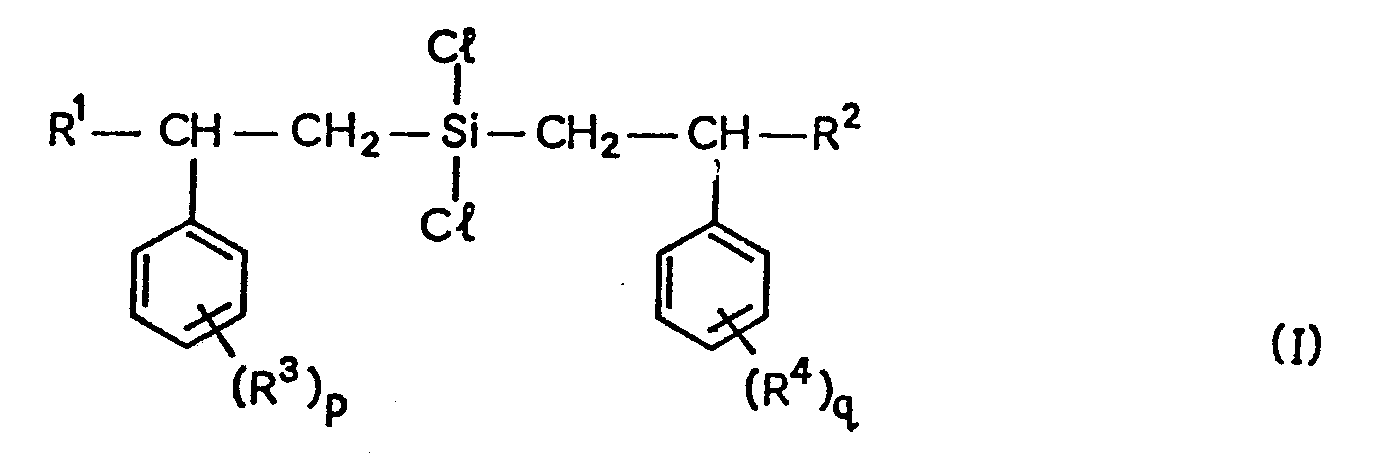
- Of the compounds expressed by the general formula (I), the preferred ones are those wherein p and q are both 0, i.e. di-β-phenylalkyldichlorosilanes (wherein the alkyls may be the same or different but not both ethyl); those wherein p and q are both 1, i.e. di-β-tolylalkyldichlorosilanes, and those wherein one of p and q is 0 and the other is 1, i.e. β-phenylalkyl, β-tolylalkyldichlorosilanes.
- Concrete examples of the compounds prepared by the present invention include:
- di-β-phenylpropyldichlorosilane
- di-β-phenylbutyldichlorosilane
- di-β-phenylpentyldichlorosilane
- di-β-phenylhexyldichlorosilane
- di-β-tolylethyldichlorosilane
- di-β-tolylpropyldichlorosilane
- di-β-tolylbutyldichlorosilane
- di-β-tolylhexyldichlorosilane
- β-tolylethyl.β-tolylpropyldichlorosilane
- β-tolylethyl.β-tolylbutyldichiorosilane
- β-tolylpropyl.β-tolylbutyldichlorosilane
- β-phenylethyl.β-tolylethyldichlorosilane, and
- β-phenylethyl.β-tolylpropyldichlorosilane.
- The compounds are not restricted to those wherein p and q are selected from 0 and 1. For example the possible aralkyl substituents of compounds of the invention further include xylyl, e.g. 2,3-xylyl, where there are two methyl groups on the phenyl ring, and mesityl where there are three methyl groups on the phenyl ring.
- Moreover, R3 and R4 need not be confined to methyl groups. For instance, the possible aralkyl substituents further include cumyl.
- The present invention provides a process for producing the compounds of the general formula (I). The process is carried out as shown in the following equations (A) and (B):
- Equation (A)

- Equation (B)

- Firstly, dichlorosilane (II) is subjected to an addition reaction with a styrene compound (III) which is styrene itself or a styrene derivative, at a temperature of 30 to 200°C in the presence of a catalyst which is a complex of rhodium and a phosphine compound, to form a monoaralkyldichlorosilane (IV), as shown in the above equation (A).
- Next, this monoaralkyldichlorosilane (IV) is subjected to an addition reaction with a styrene compound (V) which is a styrene derivative, at a temperature of 10 to 200°C in the presence of a catalyst which is chloroplatinic acid to form a diaralkyldichlorosilane (I), as shown in the equation (B).
- Concrete examples of the styrene derivatives include α-methylstyrene, α-ethylstyrene, α-propylstyrene, a-butylstyrene, methylstyrenes (vinyltoluenes), a-methyl-methylstyrenes, α-ethyl- methylstyrenes, a-propyl-methylstyrenes, α-butyl-methylstyrenes, etc. For methylstyrene and the methylstyrene derivatives, the ortho- meta- or para-compounds or mixtures thereof can be used.
- The complex of a transition metal of group VIII of the Periodic Table and a phosphine compound is preferably a complex represented by the general formula of MXn(PR0 3)m wherein R° is phenyl (hereinafter abbreviated to Ph), aryl, alkyl or aralkyl; M is a metal selected from ruthenium, rhodium, nickel and platinum; X is a covalently bound halogen or hydrogen atom, a covalently bound substituted siiyl group, or a non-covalently bound carbon monoxide molecule or aromatic hydrocarbon compound; n is an integer of 0 to 4 and m is an integer of 2 to 4, provided that 3≦(n+m)≦7.
- The transition metal phosphine compound complex can be, for instance, RhH(PPh3)4, RhH(CO)(PPh3)3, RhCl(CO)(PPh3)2, RhCl(PPh3)3, RuCl2(PPh3)3, RuHCl(PPh3)3[C6H6], RuHCl(PPh3)3-[C6H5CH3], RuH3(PPh3)3[Si(OCH3)3J, RuH3(PPh3)3[Si(OCH3)2Ph], RuH(PPh3)3[Si(C2H5)2Cl], RuH2(PPh3)4, NiCl2(PPh3)2 or Pt(PPh3)4.
- Particularly when the styrene derivatives has no substituent at the α-position, the use of Pt(PPh3)4 is preferable.
- The diaralkyldichlorosilanes of the present invention are novel compounds and useful as monomers for polysiloxanes for use in improving the properties of silicone oils and varnishes employed for electrical insulating materials, lubricating oils, water repellants, paints and lacquers, release agents, etc. Further it is possible to utilize them as intermediates for synthesizing novel organosilicon compounds.
- Diaralkyldichlorosilanes of the present invention, when heated with water, form silanols and/or cyclic siloxanes, which in turn, when heated in the presence of an acid or a base as a catalyst, are polycondensed to form polymers. Further, it is also possible to hydrolyze at least one diaralkyldichlorosilane of the present invention together with at least one other organodichlorosilane and then copolycondense the resulting silanols and/or cyclic siloxanes.
- The present invention is illustrated by the following non-limiting examples. Reference is made in Example 1 to the accompanying drawings, in which:
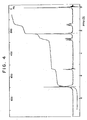
- Figure 1 shows the infrared ray absorption spectra (abbreviated to IR) of the product of Example 1, di-β-phenylpropyldichiorosilane; and
- Figure 2 shows the nuclear magnetic resonance spectra (NMR) of the product of example 1.
- α-Methylstyrene (154 g 1.3 mol) and chlorotris(triphenylphosphine)rhodium [RhCl(PPh3)3] (0.9 g 1.0 x 10⁻³ mol) were introduced into a 500 ml stainless steel pressure reactor, which was then closed. The reactor was cooled in a dry ice-methanol bath, and dichlorosilane (101 g 1.0 mol) was introduced through an introduction tube and the reactor sealed. Reaction was carried out with stirring at 70°C for 7 hours. The resulting reaction liquid was distilled in vacuo to obtain 192 g of a product having a boiling point of 103°C/9.5 mmHg. The IR spectra of the product showed an absorption specific to Si-H at 2,205 cm-', and the NMR spectra proton signals of Si-H, -CH2-Si, -CH- and CH3C5H5 at 5.28, 1.54, 3.13, 1.35 and 7.19 8 (ppm) respectively. Thus it was confirmed that the product was mono-β-phenylpropyldichlorosilane [CH3CH(C6H5)CH2SiHCl2].
- The β-phenylpropyldichlorosilane (66 g 0.3 mol), chloroplatinic acid (0.031 g, 6 x 10⁻⁵ mol) and a-methylstyrene (71 g, 0.6 mol) were fed into a flask to carry out reaction at 20-30°C for 5 hours. The reaction liquid was distilled in vacuo to obtain 85 g of a product having a boiling point of 160-161 °C/2.5 mmHg. This product had an

- Dichlorosilane (31.7 g, 314 millimols), styrene (56.3 g, 541 millimols) and chlorotris(triphenyll phosphine)rhodium (0.2182 g, 2.36 x 10⁻⁴ mol) were introduced into a 200 ml stainless steel reactor, which was then closed. Reaction was carried out with stirring on heating in an oil bath at 150°C for 20 hours. The resulting reaction liquid was distilled in vacuo to obtain 45.7 g of mono-β-phenylethyldichlorosilane.
- The mono-β-phenylethyldichlorosilane (41 g, 0.2 mol), chloroplatinic acid (0.02 g, 4 x 10⁻⁵ mol) and a-methylstyrene (47.3 g, 0.4 mol) were fed into a flask to carry out reaction at 20-30°C for 5 hours to obtain β-phenylethyl.β-phenylpropyldichlorosilane.
- Dichlorosilane (30.9 g, 0.3 mol), styrene (56.5 g, 0.543 mol) and an isopropanol solution (50 ml) of chloroplatinic acid [H2PtCl6.6H2O] (4.83 x 10⁻⁶ mol) were introduced into a 200 ml stainless steel reactor. Reaction was carried out with stirring on heating in an oil bath at 50°C for 15 hours. The resulting reaction liquid resinified.
- Di-β-phenylpropyldichlorosilane (145 g) as obtained in Example 1 was dropwise added with stirring to 200 g of a water-diisopropyl ether mixture (water 165 g and diisopropyl ether 40 g) maintained at 60°C, over one hour, and after the addition, reaction was carried out with stirring for 4 hours. The aqueous phase portion of the resulting reaction liquid was removed, and the ether solution of the resulting product was washed five times with 50 ml of water. After the washed water became alkaline, 50 ml of toluene was added to the ether solution, and toluene, ether and water were removed by vaporization at 100°C in vacuo to obtain 105 g of a product.
- To this product (96 g) were added 3.0 g of hexamethyldisiloxane, and further, with stirring, 1 mi of a 10% aqueous solution of tetramethylammonium hydroxide [(CH3)QNOH] and 10 ml of toluene, and the mixture was heated up to 80°C. The water of the 10% aqueous solution was distilled off by blowing nitrogen gas into the reaction liquid, followed by reaction with stirring at 80°C for 10 hours. After the reaction, 75 ml of toluene was added to obtain a toluene solution, which was then washed three times, with 80 ml of water. After the solution became neutral, toluene was distilled off at 100°C to obtain 93.0 g of a polysiloxane.
Claims (3)


Priority Applications (2)
| Application Number | Priority Date | Filing Date | Title |
|---|---|---|---|
| DE7979302423T DE2965462D1 (en) | 1979-11-02 | 1979-11-02 | Process for the production of diaralkyldichlorosilanes and their use in manufacture of polysiloxane |
| EP19790302423 EP0028665B1 (en) | 1979-11-02 | 1979-11-02 | Process for the production of diaralkyldichlorosilanes and their use in manufacture of polysiloxane |
Applications Claiming Priority (1)
| Application Number | Priority Date | Filing Date | Title |
|---|---|---|---|
| EP19790302423 EP0028665B1 (en) | 1979-11-02 | 1979-11-02 | Process for the production of diaralkyldichlorosilanes and their use in manufacture of polysiloxane |
Publications (2)
| Publication Number | Publication Date |
|---|---|
| EP0028665A1 EP0028665A1 (en) | 1981-05-20 |
| EP0028665B1 true EP0028665B1 (en) | 1983-05-18 |
Family
ID=8186456
Family Applications (1)
| Application Number | Title | Priority Date | Filing Date |
|---|---|---|---|
| EP19790302423 Expired EP0028665B1 (en) | 1979-11-02 | 1979-11-02 | Process for the production of diaralkyldichlorosilanes and their use in manufacture of polysiloxane |
Country Status (2)
| Country | Link |
|---|---|
| EP (1) | EP0028665B1 (en) |
| DE (1) | DE2965462D1 (en) |
Families Citing this family (2)
| Publication number | Priority date | Publication date | Assignee | Title |
|---|---|---|---|---|
| FI845161A0 (en) * | 1984-12-28 | 1984-12-28 | Ksv Chemicals Oy | YTBEHANDLINGSMEDEL. |
| US5710301A (en) * | 1993-02-23 | 1998-01-20 | Nippon Telegraph & Telephone | Organosilicon compounds |
Family Cites Families (3)
| Publication number | Priority date | Publication date | Assignee | Title |
|---|---|---|---|---|
| US2954390A (en) * | 1957-12-05 | 1960-09-27 | Union Carbide Corp | Process for preparing beta-phenylethylchlorosilanes |
| DE2810032C2 (en) * | 1977-03-23 | 1983-03-24 | Chisso Corp., Osaka | Process for the preparation of monosubstituted dichlorosilanes |
| DE2861341D1 (en) * | 1977-06-17 | 1982-01-28 | Chisso Corp | Production of dichlorosilane derivatives |
-
1979
- 1979-11-02 EP EP19790302423 patent/EP0028665B1/en not_active Expired
- 1979-11-02 DE DE7979302423T patent/DE2965462D1/en not_active Expired
Also Published As
| Publication number | Publication date |
|---|---|
| EP0028665A1 (en) | 1981-05-20 |
| DE2965462D1 (en) | 1983-07-07 |
Similar Documents
| Publication | Publication Date | Title |
|---|---|---|
| CN107108663B (en) | Hydrosilylation process using an organocatalyst derived from germanene | |
| EP0529547A1 (en) | Method of making organo-silicon polymers having mono- and tetra-functional siloxane units | |
| EP0385732B1 (en) | Hydroxyphenyl-containing group siloxane compounds | |
| US5892084A (en) | Aminoorganofunctionalsiloxanes | |
| US4269993A (en) | Diaralkyldichlorosilanes | |
| US5059707A (en) | Hydroxyl group-containing organosilicon compound | |
| Tamao et al. | Synthesis, structure, and reactivity of trisilanes containing the 8-(dimethylamino)-1-naphthyl group at the central silicon atom. A novel nickel-or palladium-catalyzed degradation of trisilane to disilane and silylene species | |
| US4242272A (en) | Substituted phenethyldichlorosilanes and method for producing same | |
| US4604477A (en) | Method for making silylaroylhalides and reaction products | |
| EP0568318A1 (en) | Trifunctional siloxane hydride fluids | |
| EP0028665A1 (en) | Process for the production of diaralkyldichlorosilanes and their use in manufacture of polysiloxane | |
| US4297499A (en) | Novel disubstituted dichlorosilane and method for producing same | |
| US3808248A (en) | Silyl maleates and polysiloxane maleates | |
| US3773817A (en) | Polysiloxane maleates | |
| US3334122A (en) | Method of preparing arylsilanes | |
| US5998649A (en) | Organosilicon compounds and method for preparation | |
| US3655711A (en) | Preparation of cyclic nitrogen-containing organosilicon compounds | |
| JP3644703B2 (en) | Method for producing cyclic dimethylpolysiloxane | |
| US3780080A (en) | Silyl maleates and polysiloxane maleates | |
| EP0000614B1 (en) | Production of dichlorosilane derivatives | |
| JP4265117B2 (en) | Method for producing novel silsesquioxane having protected catechol group | |
| US3806532A (en) | Silyl maleates and polysiloxane maleates | |
| KR20230053668A (en) | Siloxane production method | |
| US6087521A (en) | Silicon compounds containing silamethylene bonds and method for their preparation | |
| US3778459A (en) | Silyl maleates and polysiloxane maleates |
Legal Events
| Date | Code | Title | Description |
|---|---|---|---|
| PUAI | Public reference made under article 153(3) epc to a published international application that has entered the european phase |
Free format text: ORIGINAL CODE: 0009012 |
|
| AK | Designated contracting states |
Designated state(s): CH DE FR GB |
|
| 17P | Request for examination filed |
Effective date: 19810622 |
|
| GRAA | (expected) grant |
Free format text: ORIGINAL CODE: 0009210 |
|
| AK | Designated contracting states |
Designated state(s): CH DE FR GB |
|
| REF | Corresponds to: |
Ref document number: 2965462 Country of ref document: DE Date of ref document: 19830707 |
|
| ET | Fr: translation filed | ||
| PGFP | Annual fee paid to national office [announced via postgrant information from national office to epo] |
Ref country code: CH Payment date: 19831123 Year of fee payment: 5 |
|
| PLBE | No opposition filed within time limit |
Free format text: ORIGINAL CODE: 0009261 |
|
| STAA | Information on the status of an ep patent application or granted ep patent |
Free format text: STATUS: NO OPPOSITION FILED WITHIN TIME LIMIT |
|
| 26N | No opposition filed | ||
| PGFP | Annual fee paid to national office [announced via postgrant information from national office to epo] |
Ref country code: FR Payment date: 19841108 Year of fee payment: 6 |
|
| PGFP | Annual fee paid to national office [announced via postgrant information from national office to epo] |
Ref country code: DE Payment date: 19841116 Year of fee payment: 6 |
|
| PG25 | Lapsed in a contracting state [announced via postgrant information from national office to epo] |
Ref country code: CH Effective date: 19841130 |
|
| REG | Reference to a national code |
Ref country code: CH Ref legal event code: PL |
|
| GBPC | Gb: european patent ceased through non-payment of renewal fee | ||
| PG25 | Lapsed in a contracting state [announced via postgrant information from national office to epo] |
Ref country code: FR Free format text: LAPSE BECAUSE OF NON-PAYMENT OF DUE FEES Effective date: 19860731 |
|
| PG25 | Lapsed in a contracting state [announced via postgrant information from national office to epo] |
Ref country code: DE Effective date: 19860801 |
|
| REG | Reference to a national code |
Ref country code: FR Ref legal event code: ST |
|
| PG25 | Lapsed in a contracting state [announced via postgrant information from national office to epo] |
Ref country code: GB Effective date: 19881118 |