EP0025293B1 - Alkali metal ionization detector with in-situ calibration capability - Google Patents
Alkali metal ionization detector with in-situ calibration capability Download PDFInfo
- Publication number
- EP0025293B1 EP0025293B1 EP80302850A EP80302850A EP0025293B1 EP 0025293 B1 EP0025293 B1 EP 0025293B1 EP 80302850 A EP80302850 A EP 80302850A EP 80302850 A EP80302850 A EP 80302850A EP 0025293 B1 EP0025293 B1 EP 0025293B1
- Authority
- EP
- European Patent Office
- Prior art keywords
- alkali metal
- calibration
- filament
- detector
- sodium
- Prior art date
- Legal status (The legal status is an assumption and is not a legal conclusion. Google has not performed a legal analysis and makes no representation as to the accuracy of the status listed.)
- Expired
Links
Images
Classifications
-
- G—PHYSICS
- G01—MEASURING; TESTING
- G01N—INVESTIGATING OR ANALYSING MATERIALS BY DETERMINING THEIR CHEMICAL OR PHYSICAL PROPERTIES
- G01N33/00—Investigating or analysing materials by specific methods not covered by groups G01N1/00 - G01N31/00
- G01N33/0004—Gaseous mixtures, e.g. polluted air
- G01N33/0006—Calibrating gas analysers
-
- G—PHYSICS
- G01—MEASURING; TESTING
- G01N—INVESTIGATING OR ANALYSING MATERIALS BY DETERMINING THEIR CHEMICAL OR PHYSICAL PROPERTIES
- G01N27/00—Investigating or analysing materials by the use of electric, electrochemical, or magnetic means
- G01N27/62—Investigating or analysing materials by the use of electric, electrochemical, or magnetic means by investigating the ionisation of gases, e.g. aerosols; by investigating electric discharges, e.g. emission of cathode
Definitions
- This invention relates to an improved alkali metal ionization detector with in-situ calibration capability.
- the detectors are monitored in a control room which is remote from the breaker reactor facility.
- the detectors require removal from the reactor facility for periodic maintenance and calibration.
- the efficient use of the detectors could be significantly enhanced if a technique were provided for the in-situ calibration of the detector.
- the invention resides in an alkali metal ionization detector (D) having a heated filament electrode (2) for thermally ionizing alkali metal atoms or alkali metal-containing particles in a monitored gas environment to form positive ions, a source (4, 8) of electrical potential connected to a collector electrode (1) to attract the positive ions and establish an ion current flow which is indicative of the concentration of the alkali metal atoms or alkali metal-containing particles, characterized in that the detector includes a calibration filament element (3) including the alkali metal of interest, said element (3) being positioned adjacent to said heated filament electrode (2), and a calibration electrical excitation means (9, 10) connected to said calibration filament element (3) to cause said calibration filament element (3) to generate alkali metal atoms by thermal volatilization, said heated filament electrode (2) responding to said alkali metal atoms by producing positive ions by positive surface ionization, said positive ions being attracted to said collector electrode (1) and establishing a calibration ion current flow in said detector (D) thereby providing the in
- a calibration filament is included in combination with the detector sensing filament and ion collector plate.
- the calibration filament contains a sodium-bearing compound that thermally volatizes the sodium as neutral sodium atoms in response to periodically applied electrical potential.
- the atoms thus generated deposit on the sensor filament and undergo the normal sequential operation of positive surface ionization consistent with the operation of the above-identified Westinghouse ionization detector.
- the ions are then attracted to the negatively charged collector plate thus resulting in a measurable current flow representative of the sodium generated by the calibrator filament.
- the calibrator filament may typically be operated with negative bias potential to suppress the emission of positive sodium ions which could produce a signal even if the sensor filament was not operative.
- the detector employs a heated sensor filament, or thermal ionizer electrode, which responds to impinging sodium atoms or sodium containing atoms (vapor or aerosol) to form positive sodium ions which are attracted to an ion collector plate electrode via an electric field to produce an ion current which is an indication of the sodium concentration of the environment to which the heated sensor filament is exposed.
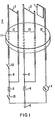
- an alkali metal ionization detector D is illustrated as consisting of a heated cathode sensor filament 2, also herein functionally referred to as a thermal ionizer electrode, an ion collector plate anode electrode 1, a filament transformer 16 for coupling the sensor filament voltage supply 8 to heat the sensor filament 2, an ion current meter 7 to indicate the ion current flow between the sensor filament 2 and the ion collector plate 1 which is maintained by an electric field produced by the voltage supply 4 which is connected between the sensor filament 2 and the ground terminal 6.
- a heated cathode sensor filament 2 also herein functionally referred to as a thermal ionizer electrode
- an ion collector plate anode electrode 1
- a filament transformer 16 for coupling the sensor filament voltage supply 8 to heat the sensor filament 2
- an ion current meter 7 to indicate the ion current flow between the sensor filament 2 and the ion collector plate 1 which is maintained by an electric field produced by the voltage supply 4 which is connected between the sensor filament 2 and the ground terminal 6.
- Sodium particles, whether contained in a vapor, aerosol or sodium compound, transported by a carrier gas such as flowing air to the vicinity of the detector D are converted to free sodium ions at the surface of the heated sensor filament 2 which functions as a thermal ionizer. These ions are then collected by the ion collector plate 1 which is maintained at a negative potential relative to the heated sensor filament 2 by the voltage source 4.
- the flow of ions thus established produces an ion current which is measured by the ion current meter 7 as an indication of the concentration of sodium ions present in the environment adjacent to the heated sensor filament 2.
- the process by which the sodium particles are converted to free sodium ions can be thought of as occurring in the following steps:
- the free sodium ions thus generated contribute to the ion current monitored by the ion current meter 7.
- a calibration filament 3 which is supported within the detector D at a location adjacent to the sensor filament 2.
- a calibration filament power supply 9 is connected across the calibration filament 3 and a bias voltage source 5 is connected between the calibration filament 3 and the ground terminal 6.
- the periodic activation of the calibration filament 3 is operator controlled via a calibration switch 10 which is typically located in a remote control room.
- the filament power supply 9 functions to heat the calibration filament 3 such that upon activation of the calibration filament 3, which contains or is coated with a material comprising sodium bearing compounds, results in the volatilization of sodium atoms from the heated calibration filament 3 which migrate to the sensor filament 2.
- Suitable sodium-bearing compounds for the calibration filament 3 would be sodium silicate or sodium aluminosilicate.
- the sodium atoms thus generated by the calibration filament 3 strike the heated sensor filament 2 and are converted to positively charged sodium ions. These ions are then attracted to the adjacent ion collector plate 1 which, relative to the filament 2, is at a negative potential and the resulting current flow is a measure of the sodium controllably released by the calibration filament 3.
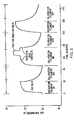
- Section A of the curve was obtained with a negative bias voltage applied to the calibration filament 3.
- Section B of the curve depicts the response of the detector D to an initial negative bias of the calibration filament 3 with a polarity change to a positive bias and then back again to a negative bias.
- Section C of the curve illustrates the detector D signal response to the sodium signal of the calibration filament 3 with no bias potential being applied by the bias voltage source 5.
- the connection and disconnection of the bias voltage source 5 to the calibration filament 3 is illustrated as being achieved by switch 13.
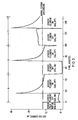
- the waveform illustrations of Figure 3 simulate a calibration procedure with a simultaneous failure of the sensor filament 2.
- Section A of the waveform illustrates the response of the detector D with no bias potential being applied to the calibration filament 3.
- Section B of the curve depicts the essentially zero signal response of the detector D with an inoperative sensor filament 2 when the calibration filament 3 is subjective to a negative bias.
- Section C of the curve illustrates the undesirable condition of an apparent operationally acceptable detector D when the calibration filament 3 has a positive bias potential and the sensor filament 2 is inoperative. This last condition, as illustrated in Section C of the waveform of Figure 3, of positive bias potential being applied to the calibration filament 3 should therefore be avoided.
- the loss of negative bias to the collector filament 3 is not as critical however, since, with no bias potential applied to the calibration of filament 3 the generated ion current signal is still below the operating background value of the detector D.
- the activation of the calibration filament 3 has been simply illustrated as being effected by the operation of a switch 10 in a remote control room, the activation of the calibration filament 3 can be controlled by a timed cycle circuit which would avoid inadvertent continuous operation of the calibration filament resulting in reduced operating life of the filament 3.
Landscapes
- Chemical & Material Sciences (AREA)
- Health & Medical Sciences (AREA)
- Life Sciences & Earth Sciences (AREA)
- General Health & Medical Sciences (AREA)
- Immunology (AREA)
- Engineering & Computer Science (AREA)
- Analytical Chemistry (AREA)
- Biochemistry (AREA)
- Pathology (AREA)
- General Physics & Mathematics (AREA)
- Physics & Mathematics (AREA)
- Chemical Kinetics & Catalysis (AREA)
- Electrochemistry (AREA)
- Combustion & Propulsion (AREA)
- Food Science & Technology (AREA)
- Medicinal Chemistry (AREA)
- Other Investigation Or Analysis Of Materials By Electrical Means (AREA)
- Monitoring And Testing Of Nuclear Reactors (AREA)
Applications Claiming Priority (2)
| Application Number | Priority Date | Filing Date | Title |
|---|---|---|---|
| US73827 | 1979-09-10 | ||
| US06/073,827 US4325029A (en) | 1979-09-10 | 1979-09-10 | Alkali ionization detector |
Publications (2)
| Publication Number | Publication Date |
|---|---|
| EP0025293A1 EP0025293A1 (en) | 1981-03-18 |
| EP0025293B1 true EP0025293B1 (en) | 1983-09-07 |
Family
ID=22116044
Family Applications (1)
| Application Number | Title | Priority Date | Filing Date |
|---|---|---|---|
| EP80302850A Expired EP0025293B1 (en) | 1979-09-10 | 1980-08-18 | Alkali metal ionization detector with in-situ calibration capability |
Country Status (4)
| Country | Link |
|---|---|
| US (1) | US4325029A (cg-RX-API-DMAC7.html) |
| EP (1) | EP0025293B1 (cg-RX-API-DMAC7.html) |
| JP (1) | JPS5640751A (cg-RX-API-DMAC7.html) |
| DE (1) | DE3064759D1 (cg-RX-API-DMAC7.html) |
Families Citing this family (7)
| Publication number | Priority date | Publication date | Assignee | Title |
|---|---|---|---|---|
| RU2141657C1 (ru) * | 1997-06-10 | 1999-11-20 | ЗАО Бюро аналитического приборостроения "Хромдет-экология" | Электронозахватный детектор |
| US6252756B1 (en) * | 1998-09-18 | 2001-06-26 | Illinois Tool Works Inc. | Low voltage modular room ionization system |
| EP4235693A3 (en) | 2016-03-08 | 2023-10-11 | TerraPower LLC | Fission product getter |
| US9921184B2 (en) | 2016-05-20 | 2018-03-20 | Terrapower, Llc | Sodium-cesium ionization detector |
| WO2018044370A2 (en) | 2016-05-20 | 2018-03-08 | Terrapower, Llc | Sodium-cesium vapor trap system and method |
| CN207038182U (zh) | 2017-03-29 | 2018-02-23 | 泰拉能源有限责任公司 | 铯收集器 |
| US11626213B2 (en) | 2019-08-23 | 2023-04-11 | Terrapower, Llc | Sodium vaporizer and methods |
Family Cites Families (7)
| Publication number | Priority date | Publication date | Assignee | Title |
|---|---|---|---|---|
| US3495437A (en) * | 1968-05-09 | 1970-02-17 | United States Steel Corp | Method and apparatus for zero-setting and calibrating vapor-responsive detectors |
| US4117396A (en) * | 1974-01-21 | 1978-09-26 | Westinghouse Electric Corp. | Sensor for thermally ionizable particles and/or vapors |
| US4162404A (en) * | 1974-04-29 | 1979-07-24 | Extranuclear Laboratories, Inc. | Method and apparatus for surface ionization monitor for particulates |
| US4047101A (en) * | 1976-01-08 | 1977-09-06 | Westinghouse Electric Corporation | Filament for alkali metal ionization detector |
| US4095171A (en) * | 1976-04-07 | 1978-06-13 | Westinghouse Electric Corp. | Alkali metal ionization detector |
| DE2755990A1 (de) * | 1977-12-15 | 1979-06-21 | Siemens Ag | Thermoionischer detektor |
| US4129418A (en) * | 1978-02-21 | 1978-12-12 | General Electric Company | Discriminating halogen sensor |
-
1979
- 1979-09-10 US US06/073,827 patent/US4325029A/en not_active Expired - Lifetime
-
1980
- 1980-06-27 JP JP8673780A patent/JPS5640751A/ja active Granted
- 1980-08-18 EP EP80302850A patent/EP0025293B1/en not_active Expired
- 1980-08-18 DE DE8080302850T patent/DE3064759D1/de not_active Expired
Also Published As
| Publication number | Publication date |
|---|---|
| US4325029A (en) | 1982-04-13 |
| EP0025293A1 (en) | 1981-03-18 |
| JPS5640751A (en) | 1981-04-17 |
| JPS639181B2 (cg-RX-API-DMAC7.html) | 1988-02-26 |
| DE3064759D1 (en) | 1983-10-13 |
Similar Documents
| Publication | Publication Date | Title |
|---|---|---|
| Martone et al. | The 14 MeV frascati neutron generator | |
| US2408230A (en) | Measuring apparatus | |
| Aleksandrov et al. | Temperature and density effects on the properties of a long positive streamer in air | |
| EP0025293B1 (en) | Alkali metal ionization detector with in-situ calibration capability | |
| GB2090050A (en) | Hydrogen sensor | |
| CA1077569A (en) | Filament for alkali metal ionization detector | |
| US4095171A (en) | Alkali metal ionization detector | |
| US3909815A (en) | Detector for fumes and combustion gases | |
| WO2019117172A1 (ja) | X線管およびx線発生装置 | |
| US3271756A (en) | Method and apparatus for detecting a hazardous condition | |
| US3751969A (en) | Detection system | |
| US3056123A (en) | Radiation alarm or the like | |
| JP4220015B2 (ja) | 電離放射線検出装置 | |
| US3881111A (en) | Method and apparatus for the detection of nitric oxide | |
| GB2301222A (en) | Surface radioactivity monitor | |
| Schuler et al. | Absolute Measurement of Cyclotron Beam Currents for Radiation‐Chemical Studies | |
| US2595622A (en) | Fission indicator | |
| US2502331A (en) | Geiger-muller counter for radioactive emission | |
| GB2102194A (en) | Lithium metal detector | |
| Miyamoto et al. | An aging study of semiconductive microstrip gas chambers and a gas electron multiplier | |
| US3346806A (en) | Pressure monitoring with a plurality of ionization gauges controlled at a central location | |
| Skala | The New Generator Condition Monitor and its Application to the Protection of Turbine Generators | |
| US4308458A (en) | Fire detectors utilizing an ionization chamber not subject to condensation of water vapor during variations of temperature | |
| Hurley | Some effects of conditioning and anode replacement on pre-breakdown currents in vacuum | |
| Down et al. | Lithium metal detector |
Legal Events
| Date | Code | Title | Description |
|---|---|---|---|
| PUAI | Public reference made under article 153(3) epc to a published international application that has entered the european phase |
Free format text: ORIGINAL CODE: 0009012 |
|
| AK | Designated contracting states |
Designated state(s): DE FR GB IT |
|
| 17P | Request for examination filed |
Effective date: 19810916 |
|
| ITF | It: translation for a ep patent filed | ||
| GRAA | (expected) grant |
Free format text: ORIGINAL CODE: 0009210 |
|
| AK | Designated contracting states |
Designated state(s): DE FR GB IT |
|
| REF | Corresponds to: |
Ref document number: 3064759 Country of ref document: DE Date of ref document: 19831013 |
|
| ET | Fr: translation filed | ||
| PLBE | No opposition filed within time limit |
Free format text: ORIGINAL CODE: 0009261 |
|
| STAA | Information on the status of an ep patent application or granted ep patent |
Free format text: STATUS: NO OPPOSITION FILED WITHIN TIME LIMIT |
|
| 26N | No opposition filed | ||
| PG25 | Lapsed in a contracting state [announced via postgrant information from national office to epo] |
Ref country code: FR Free format text: LAPSE BECAUSE OF NON-PAYMENT OF DUE FEES Effective date: 19850430 |
|
| PG25 | Lapsed in a contracting state [announced via postgrant information from national office to epo] |
Ref country code: DE Effective date: 19850501 |
|
| GBPC | Gb: european patent ceased through non-payment of renewal fee | ||
| REG | Reference to a national code |
Ref country code: FR Ref legal event code: ST |
|
| PG25 | Lapsed in a contracting state [announced via postgrant information from national office to epo] |
Ref country code: GB Effective date: 19881118 |