EP0024924B1 - Sydnonimines, their preparation and pharmaceutical compositions containing them - Google Patents
Sydnonimines, their preparation and pharmaceutical compositions containing them Download PDFInfo
- Publication number
- EP0024924B1 EP0024924B1 EP80302983A EP80302983A EP0024924B1 EP 0024924 B1 EP0024924 B1 EP 0024924B1 EP 80302983 A EP80302983 A EP 80302983A EP 80302983 A EP80302983 A EP 80302983A EP 0024924 B1 EP0024924 B1 EP 0024924B1
- Authority
- EP
- European Patent Office
- Prior art keywords
- hydroxy
- hydrogen
- compound
- formula
- phenylethyl
- Prior art date
- Legal status (The legal status is an assumption and is not a legal conclusion. Google has not performed a legal analysis and makes no representation as to the accuracy of the status listed.)
- Expired
Links
- 239000008194 pharmaceutical composition Substances 0.000 title claims description 4
- 238000002360 preparation method Methods 0.000 title description 3
- -1 sydnone imine Chemical class 0.000 claims description 44
- 150000001875 compounds Chemical class 0.000 claims description 33
- 229910052739 hydrogen Inorganic materials 0.000 claims description 25
- 239000001257 hydrogen Substances 0.000 claims description 25
- 125000004432 carbon atom Chemical group C* 0.000 claims description 16
- 125000002915 carbonyl group Chemical group [*:2]C([*:1])=O 0.000 claims description 16
- 239000002253 acid Substances 0.000 claims description 13
- 125000001475 halogen functional group Chemical group 0.000 claims description 12
- 125000002924 primary amino group Chemical group [H]N([H])* 0.000 claims description 12
- 150000002431 hydrogen Chemical class 0.000 claims description 11
- 239000000203 mixture Substances 0.000 claims description 11
- 231100000252 nontoxic Toxicity 0.000 claims description 10
- 230000003000 nontoxic effect Effects 0.000 claims description 10
- 150000003839 salts Chemical class 0.000 claims description 10
- 125000004435 hydrogen atom Chemical group [H]* 0.000 claims description 9
- 125000002490 anilino group Chemical group [H]N(*)C1=C([H])C([H])=C([H])C([H])=C1[H] 0.000 claims description 8
- 125000000449 nitro group Chemical group [O-][N+](*)=O 0.000 claims description 8
- 125000002496 methyl group Chemical group [H]C([H])([H])* 0.000 claims description 7
- UFHFLCQGNIYNRP-UHFFFAOYSA-N Hydrogen Chemical compound [H][H] UFHFLCQGNIYNRP-UHFFFAOYSA-N 0.000 claims description 5
- 125000000217 alkyl group Chemical group 0.000 claims description 4
- 239000012948 isocyanate Substances 0.000 claims description 4
- 125000003854 p-chlorophenyl group Chemical group [H]C1=C([H])C(*)=C([H])C([H])=C1Cl 0.000 claims description 4
- 125000005010 perfluoroalkyl group Chemical group 0.000 claims description 4
- 150000002513 isocyanates Chemical class 0.000 claims description 3
- 125000001424 substituent group Chemical group 0.000 claims description 3
- 125000004189 3,4-dichlorophenyl group Chemical group [H]C1=C([H])C(Cl)=C(Cl)C([H])=C1* 0.000 claims description 2
- 125000001255 4-fluorophenyl group Chemical group [H]C1=C([H])C(*)=C([H])C([H])=C1F 0.000 claims description 2
- 125000003545 alkoxy group Chemical group 0.000 claims description 2
- 125000004453 alkoxycarbonyl group Chemical group 0.000 claims description 2
- 150000001412 amines Chemical class 0.000 claims description 2
- 239000003937 drug carrier Substances 0.000 claims description 2
- 238000004519 manufacturing process Methods 0.000 claims description 2
- 125000002252 acyl group Chemical group 0.000 claims 4
- RTZKZFJDLAIYFH-UHFFFAOYSA-N Diethyl ether Chemical compound CCOCC RTZKZFJDLAIYFH-UHFFFAOYSA-N 0.000 description 45
- 238000003756 stirring Methods 0.000 description 44
- KFZMGEQAYNKOFK-UHFFFAOYSA-N Isopropanol Chemical compound CC(C)O KFZMGEQAYNKOFK-UHFFFAOYSA-N 0.000 description 30
- OKKJLVBELUTLKV-UHFFFAOYSA-N Methanol Chemical compound OC OKKJLVBELUTLKV-UHFFFAOYSA-N 0.000 description 30
- 230000000694 effects Effects 0.000 description 26
- 239000000047 product Substances 0.000 description 23
- WEVYAHXRMPXWCK-UHFFFAOYSA-N Acetonitrile Chemical compound CC#N WEVYAHXRMPXWCK-UHFFFAOYSA-N 0.000 description 21
- XEKOWRVHYACXOJ-UHFFFAOYSA-N Ethyl acetate Chemical compound CCOC(C)=O XEKOWRVHYACXOJ-UHFFFAOYSA-N 0.000 description 21
- XLYOFNOQVPJJNP-UHFFFAOYSA-N water Substances O XLYOFNOQVPJJNP-UHFFFAOYSA-N 0.000 description 21
- 239000007787 solid Substances 0.000 description 20
- 239000002904 solvent Substances 0.000 description 18
- 239000000243 solution Substances 0.000 description 17
- 239000003921 oil Substances 0.000 description 14
- OWFUPROYPKGHMH-UHFFFAOYSA-N n-phenyl-n'-[3-(1-phenylpropan-2-yl)oxadiazol-3-ium-5-yl]carbamimidate Chemical compound C1=C(N=C([O-])NC=2C=CC=CC=2)ON=[N+]1C(C)CC1=CC=CC=C1 OWFUPROYPKGHMH-UHFFFAOYSA-N 0.000 description 13
- YXFVVABEGXRONW-UHFFFAOYSA-N Toluene Chemical compound CC1=CC=CC=C1 YXFVVABEGXRONW-UHFFFAOYSA-N 0.000 description 12
- LPXPTNMVRIOKMN-UHFFFAOYSA-M sodium nitrite Chemical compound [Na+].[O-]N=O LPXPTNMVRIOKMN-UHFFFAOYSA-M 0.000 description 12
- 238000009835 boiling Methods 0.000 description 10
- 239000003610 charcoal Substances 0.000 description 10
- YMWUJEATGCHHMB-UHFFFAOYSA-N Dichloromethane Chemical compound ClCCl YMWUJEATGCHHMB-UHFFFAOYSA-N 0.000 description 9
- ZMANZCXQSJIPKH-UHFFFAOYSA-N Triethylamine Chemical compound CCN(CC)CC ZMANZCXQSJIPKH-UHFFFAOYSA-N 0.000 description 9
- KWTSXDURSIMDCE-QMMMGPOBSA-N (S)-amphetamine Chemical compound C[C@H](N)CC1=CC=CC=C1 KWTSXDURSIMDCE-QMMMGPOBSA-N 0.000 description 8
- 229940025084 amphetamine Drugs 0.000 description 8
- 229940079593 drug Drugs 0.000 description 8
- 239000003814 drug Substances 0.000 description 8
- 238000006243 chemical reaction Methods 0.000 description 7
- 239000000543 intermediate Substances 0.000 description 7
- BGCWIJAYDXRUSG-UHFFFAOYSA-N oxadiazol-3-ium;chloride Chemical compound Cl.C1=CON=N1 BGCWIJAYDXRUSG-UHFFFAOYSA-N 0.000 description 7
- ULSIYEODSMZIPX-UHFFFAOYSA-N phenylethanolamine Chemical compound NCC(O)C1=CC=CC=C1 ULSIYEODSMZIPX-UHFFFAOYSA-N 0.000 description 7
- CSCPPACGZOOCGX-UHFFFAOYSA-N Acetone Chemical compound CC(C)=O CSCPPACGZOOCGX-UHFFFAOYSA-N 0.000 description 6
- 0 CC[C@@]1*C=CC1 Chemical compound CC[C@@]1*C=CC1 0.000 description 6
- LFQSCWFLJHTTHZ-UHFFFAOYSA-N Ethanol Chemical compound CCO LFQSCWFLJHTTHZ-UHFFFAOYSA-N 0.000 description 6
- VMHLLURERBWHNL-UHFFFAOYSA-M Sodium acetate Chemical compound [Na+].CC([O-])=O VMHLLURERBWHNL-UHFFFAOYSA-M 0.000 description 6
- 239000002269 analeptic agent Substances 0.000 description 6
- 238000001816 cooling Methods 0.000 description 6
- 230000003226 decolorizating effect Effects 0.000 description 6
- WGLUMOCWFMKWIL-UHFFFAOYSA-N dichloromethane;methanol Chemical compound OC.ClCCl WGLUMOCWFMKWIL-UHFFFAOYSA-N 0.000 description 6
- HFLCEELTJROKMJ-UHFFFAOYSA-N feprosidnine Chemical compound C1=C([NH-])ON=[N+]1C(C)CC1=CC=CC=C1 HFLCEELTJROKMJ-UHFFFAOYSA-N 0.000 description 6
- DGTNSSLYPYDJGL-UHFFFAOYSA-N phenyl isocyanate Chemical compound O=C=NC1=CC=CC=C1 DGTNSSLYPYDJGL-UHFFFAOYSA-N 0.000 description 6
- 239000000376 reactant Substances 0.000 description 6
- 235000010288 sodium nitrite Nutrition 0.000 description 6
- WSFSSNUMVMOOMR-UHFFFAOYSA-N Formaldehyde Chemical compound O=C WSFSSNUMVMOOMR-UHFFFAOYSA-N 0.000 description 5
- VEXZGXHMUGYJMC-UHFFFAOYSA-N Hydrochloric acid Chemical compound Cl VEXZGXHMUGYJMC-UHFFFAOYSA-N 0.000 description 5
- 241001465754 Metazoa Species 0.000 description 5
- 241000699670 Mus sp. Species 0.000 description 5
- ZMXDDKWLCZADIW-UHFFFAOYSA-N N,N-Dimethylformamide Chemical compound CN(C)C=O ZMXDDKWLCZADIW-UHFFFAOYSA-N 0.000 description 5
- 210000003169 central nervous system Anatomy 0.000 description 5
- 239000012043 crude product Substances 0.000 description 5
- 239000008098 formaldehyde solution Substances 0.000 description 5
- NNFCIKHAZHQZJG-UHFFFAOYSA-N potassium cyanide Chemical compound [K+].N#[C-] NNFCIKHAZHQZJG-UHFFFAOYSA-N 0.000 description 5
- 230000004936 stimulating effect Effects 0.000 description 5
- IJGRMHOSHXDMSA-UHFFFAOYSA-N Atomic nitrogen Chemical compound N#N IJGRMHOSHXDMSA-UHFFFAOYSA-N 0.000 description 4
- 229940040526 anhydrous sodium acetate Drugs 0.000 description 4
- 239000012267 brine Substances 0.000 description 4
- 238000002844 melting Methods 0.000 description 4
- 230000008018 melting Effects 0.000 description 4
- 238000000034 method Methods 0.000 description 4
- HPALAKNZSZLMCH-UHFFFAOYSA-M sodium;chloride;hydrate Chemical compound O.[Na+].[Cl-] HPALAKNZSZLMCH-UHFFFAOYSA-M 0.000 description 4
- ADAKRBAJFHTIEW-UHFFFAOYSA-N 1-chloro-4-isocyanatobenzene Chemical compound ClC1=CC=C(N=C=O)C=C1 ADAKRBAJFHTIEW-UHFFFAOYSA-N 0.000 description 3
- QTBSBXVTEAMEQO-UHFFFAOYSA-N Acetic acid Natural products CC(O)=O QTBSBXVTEAMEQO-UHFFFAOYSA-N 0.000 description 3
- OKTJSMMVPCPJKN-UHFFFAOYSA-N Carbon Chemical compound [C] OKTJSMMVPCPJKN-UHFFFAOYSA-N 0.000 description 3
- MUBZPKHOEPUJKR-UHFFFAOYSA-N Oxalic acid Natural products OC(=O)C(O)=O MUBZPKHOEPUJKR-UHFFFAOYSA-N 0.000 description 3
- 239000002585 base Substances 0.000 description 3
- 229910052799 carbon Inorganic materials 0.000 description 3
- 125000001997 phenyl group Chemical group [H]C1=C([H])C([H])=C(*)C([H])=C1[H] 0.000 description 3
- 229950006768 phenylethanolamine Drugs 0.000 description 3
- 229920000136 polysorbate Polymers 0.000 description 3
- PLQCMXBTMLGGKM-UHFFFAOYSA-N 2-(5-imino-1-oxa-3-azonia-2-azanidacyclopent-3-en-3-yl)-1-phenylethanol Chemical class C=1C=CC=CC=1C(O)C[N+]1=CC(=N)O[N-]1 PLQCMXBTMLGGKM-UHFFFAOYSA-N 0.000 description 2
- XDWUTSFDSTZARW-UHFFFAOYSA-N 2-(5-imino-1-oxa-3-azonia-2-azanidacyclopent-3-en-3-yl)-1-phenylpropan-1-ol Chemical compound C=1C(=N)O[N-][N+]=1C(C)C(O)C1=CC=CC=C1 XDWUTSFDSTZARW-UHFFFAOYSA-N 0.000 description 2
- VHYFNPMBLIVWCW-UHFFFAOYSA-N 4-Dimethylaminopyridine Chemical compound CN(C)C1=CC=NC=C1 VHYFNPMBLIVWCW-UHFFFAOYSA-N 0.000 description 2
- HEDRZPFGACZZDS-UHFFFAOYSA-N Chloroform Chemical compound ClC(Cl)Cl HEDRZPFGACZZDS-UHFFFAOYSA-N 0.000 description 2
- XDTMQSROBMDMFD-UHFFFAOYSA-N Cyclohexane Chemical compound C1CCCCC1 XDTMQSROBMDMFD-UHFFFAOYSA-N 0.000 description 2
- NBIIXXVUZAFLBC-UHFFFAOYSA-N Phosphoric acid Chemical compound OP(O)(O)=O NBIIXXVUZAFLBC-UHFFFAOYSA-N 0.000 description 2
- UIIMBOGNXHQVGW-UHFFFAOYSA-M Sodium bicarbonate Chemical class [Na+].OC([O-])=O UIIMBOGNXHQVGW-UHFFFAOYSA-M 0.000 description 2
- QAOWNCQODCNURD-UHFFFAOYSA-N Sulfuric acid Chemical compound OS(O)(=O)=O QAOWNCQODCNURD-UHFFFAOYSA-N 0.000 description 2
- DFNYGALUNNFWKJ-UHFFFAOYSA-N aminoacetonitrile Chemical compound NCC#N DFNYGALUNNFWKJ-UHFFFAOYSA-N 0.000 description 2
- 125000001589 carboacyl group Chemical group 0.000 description 2
- 238000007796 conventional method Methods 0.000 description 2
- 238000002425 crystallisation Methods 0.000 description 2
- 230000008025 crystallization Effects 0.000 description 2
- XBDQKXXYIPTUBI-UHFFFAOYSA-N dimethylselenoniopropionate Natural products CCC(O)=O XBDQKXXYIPTUBI-UHFFFAOYSA-N 0.000 description 2
- 238000001704 evaporation Methods 0.000 description 2
- 239000000706 filtrate Substances 0.000 description 2
- 229910052757 nitrogen Inorganic materials 0.000 description 2
- GSKDBLIBBOYOFU-UHFFFAOYSA-N oxadiazol-5-amine Chemical compound NC1=CN=NO1 GSKDBLIBBOYOFU-UHFFFAOYSA-N 0.000 description 2
- 239000011541 reaction mixture Substances 0.000 description 2
- 239000001632 sodium acetate Substances 0.000 description 2
- 235000017281 sodium acetate Nutrition 0.000 description 2
- 238000010998 test method Methods 0.000 description 2
- 238000012360 testing method Methods 0.000 description 2
- HFVMEOPYDLEHBR-UHFFFAOYSA-N (2-fluorophenyl)-phenylmethanol Chemical compound C=1C=CC=C(F)C=1C(O)C1=CC=CC=C1 HFVMEOPYDLEHBR-UHFFFAOYSA-N 0.000 description 1
- FMCAFXHLMUOIGG-JTJHWIPRSA-N (2s)-2-[[(2r)-2-[[(2s)-2-[[(2r)-2-formamido-3-sulfanylpropanoyl]amino]-3-methylbutanoyl]amino]-3-(4-hydroxy-2,5-dimethylphenyl)propanoyl]amino]-4-methylsulfanylbutanoic acid Chemical compound O=CN[C@@H](CS)C(=O)N[C@@H](C(C)C)C(=O)N[C@@H](C(=O)N[C@@H](CCSC)C(O)=O)CC1=CC(C)=C(O)C=C1C FMCAFXHLMUOIGG-JTJHWIPRSA-N 0.000 description 1
- 125000004343 1-phenylethyl group Chemical group [H]C1=C([H])C([H])=C(C([H])=C1[H])C([H])(*)C([H])([H])[H] 0.000 description 1
- 125000000094 2-phenylethyl group Chemical group [H]C1=C([H])C([H])=C(C([H])=C1[H])C([H])([H])C([H])([H])* 0.000 description 1
- DCIXOTAQFURIBC-UHFFFAOYSA-N 3-(5-imino-1-oxa-3-azonia-2-azanidacyclopent-3-en-3-yl)-2-phenylbutan-2-ol Chemical class C=1C=CC=CC=1C(C)(O)C(C)[N+]1=CC(=N)O[N-]1 DCIXOTAQFURIBC-UHFFFAOYSA-N 0.000 description 1
- BMYNFMYTOJXKLE-UHFFFAOYSA-N 3-azaniumyl-2-hydroxypropanoate Chemical compound NCC(O)C(O)=O BMYNFMYTOJXKLE-UHFFFAOYSA-N 0.000 description 1
- ZCYVEMRRCGMTRW-UHFFFAOYSA-N 7553-56-2 Chemical compound [I] ZCYVEMRRCGMTRW-UHFFFAOYSA-N 0.000 description 1
- WKBOTKDWSSQWDR-UHFFFAOYSA-N Bromine atom Chemical compound [Br] WKBOTKDWSSQWDR-UHFFFAOYSA-N 0.000 description 1
- LFRMJOHTTQXWNU-UHFFFAOYSA-N CN(C1)NOC1=N Chemical compound CN(C1)NOC1=N LFRMJOHTTQXWNU-UHFFFAOYSA-N 0.000 description 1
- VEXZGXHMUGYJMC-UHFFFAOYSA-M Chloride anion Chemical compound [Cl-] VEXZGXHMUGYJMC-UHFFFAOYSA-M 0.000 description 1
- ZAMOUSCENKQFHK-UHFFFAOYSA-N Chlorine atom Chemical compound [Cl] ZAMOUSCENKQFHK-UHFFFAOYSA-N 0.000 description 1
- 241001539473 Euphoria Species 0.000 description 1
- 206010015535 Euphoric mood Diseases 0.000 description 1
- PXGOKWXKJXAPGV-UHFFFAOYSA-N Fluorine Chemical compound FF PXGOKWXKJXAPGV-UHFFFAOYSA-N 0.000 description 1
- OFOBLEOULBTSOW-UHFFFAOYSA-N Propanedioic acid Natural products OC(=O)CC(O)=O OFOBLEOULBTSOW-UHFFFAOYSA-N 0.000 description 1
- 208000032140 Sleepiness Diseases 0.000 description 1
- 206010041349 Somnolence Diseases 0.000 description 1
- KDYFGRWQOYBRFD-UHFFFAOYSA-N Succinic acid Natural products OC(=O)CCC(O)=O KDYFGRWQOYBRFD-UHFFFAOYSA-N 0.000 description 1
- 150000007513 acids Chemical class 0.000 description 1
- 230000001476 alcoholic effect Effects 0.000 description 1
- 125000003118 aryl group Chemical group 0.000 description 1
- GDTBXPJZTBHREO-UHFFFAOYSA-N bromine Substances BrBr GDTBXPJZTBHREO-UHFFFAOYSA-N 0.000 description 1
- 229910052794 bromium Inorganic materials 0.000 description 1
- 239000000969 carrier Substances 0.000 description 1
- NVRSPIKUPKOSIY-UHFFFAOYSA-N chembl1743348 Chemical compound CC=1N=NOC=1O NVRSPIKUPKOSIY-UHFFFAOYSA-N 0.000 description 1
- 229910052801 chlorine Inorganic materials 0.000 description 1
- 239000000460 chlorine Substances 0.000 description 1
- WORJEOGGNQDSOE-UHFFFAOYSA-N chloroform;methanol Chemical compound OC.ClC(Cl)Cl WORJEOGGNQDSOE-UHFFFAOYSA-N 0.000 description 1
- OAIVIYSBZFEOIU-UHFFFAOYSA-N chloroform;propan-2-one Chemical compound CC(C)=O.ClC(Cl)Cl OAIVIYSBZFEOIU-UHFFFAOYSA-N 0.000 description 1
- 238000003776 cleavage reaction Methods 0.000 description 1
- PFXOLUYGXYEFOR-UHFFFAOYSA-N cyanomethyl 4-methylbenzenesulfonate Chemical compound CC1=CC=C(S(=O)(=O)OCC#N)C=C1 PFXOLUYGXYEFOR-UHFFFAOYSA-N 0.000 description 1
- 238000006215 cyanomethylation reaction Methods 0.000 description 1
- 230000003413 degradative effect Effects 0.000 description 1
- 238000013461 design Methods 0.000 description 1
- PXSFGMATQMURKO-UHFFFAOYSA-N dichloromethane;methanol;propan-2-one Chemical compound OC.ClCCl.CC(C)=O PXSFGMATQMURKO-UHFFFAOYSA-N 0.000 description 1
- 208000037265 diseases, disorders, signs and symptoms Diseases 0.000 description 1
- 208000035475 disorder Diseases 0.000 description 1
- DLNKOYKMWOXYQA-UHFFFAOYSA-N dl-pseudophenylpropanolamine Natural products CC(N)C(O)C1=CC=CC=C1 DLNKOYKMWOXYQA-UHFFFAOYSA-N 0.000 description 1
- 239000002552 dosage form Substances 0.000 description 1
- 231100000673 dose–response relationship Toxicity 0.000 description 1
- YKWNUSJLICDQEO-UHFFFAOYSA-N ethoxyethane;propan-2-ol Chemical compound CC(C)O.CCOCC YKWNUSJLICDQEO-UHFFFAOYSA-N 0.000 description 1
- 125000001495 ethyl group Chemical group [H]C([H])([H])C([H])([H])* 0.000 description 1
- 230000008020 evaporation Effects 0.000 description 1
- 238000002474 experimental method Methods 0.000 description 1
- 238000001914 filtration Methods 0.000 description 1
- 239000012467 final product Substances 0.000 description 1
- 229910052731 fluorine Inorganic materials 0.000 description 1
- 239000011737 fluorine Substances 0.000 description 1
- 239000012458 free base Substances 0.000 description 1
- 229910052736 halogen Inorganic materials 0.000 description 1
- 150000002367 halogens Chemical class 0.000 description 1
- 125000000623 heterocyclic group Chemical group 0.000 description 1
- 230000003301 hydrolyzing effect Effects 0.000 description 1
- 230000033444 hydroxylation Effects 0.000 description 1
- 238000005805 hydroxylation reaction Methods 0.000 description 1
- 229910052500 inorganic mineral Inorganic materials 0.000 description 1
- 229910052740 iodine Inorganic materials 0.000 description 1
- 239000011630 iodine Substances 0.000 description 1
- 125000003253 isopropoxy group Chemical group [H]C([H])([H])C([H])(O*)C([H])([H])[H] 0.000 description 1
- 125000001449 isopropyl group Chemical group [H]C([H])([H])C([H])(*)C([H])([H])[H] 0.000 description 1
- 231100001231 less toxic Toxicity 0.000 description 1
- VZCYOOQTPOCHFL-UPHRSURJSA-N maleic acid Chemical compound OC(=O)\C=C/C(O)=O VZCYOOQTPOCHFL-UPHRSURJSA-N 0.000 description 1
- 239000011976 maleic acid Substances 0.000 description 1
- 230000002503 metabolic effect Effects 0.000 description 1
- 239000011707 mineral Substances 0.000 description 1
- 235000010755 mineral Nutrition 0.000 description 1
- 230000037023 motor activity Effects 0.000 description 1
- 201000003631 narcolepsy Diseases 0.000 description 1
- 230000009935 nitrosation Effects 0.000 description 1
- 238000007034 nitrosation reaction Methods 0.000 description 1
- 238000005935 nucleophilic addition reaction Methods 0.000 description 1
- 125000000636 p-nitrophenyl group Chemical group [H]C1=C([H])C(=C([H])C([H])=C1*)[N+]([O-])=O 0.000 description 1
- 230000000144 pharmacologic effect Effects 0.000 description 1
- DLNKOYKMWOXYQA-APPZFPTMSA-N phenylpropanolamine Chemical compound C[C@@H](N)[C@H](O)C1=CC=CC=C1 DLNKOYKMWOXYQA-APPZFPTMSA-N 0.000 description 1
- 229960000395 phenylpropanolamine Drugs 0.000 description 1
- 239000002243 precursor Substances 0.000 description 1
- 125000001436 propyl group Chemical group [H]C([*])([H])C([H])([H])C([H])([H])[H] 0.000 description 1
- 230000002582 psychostimulating effect Effects 0.000 description 1
- 238000000746 purification Methods 0.000 description 1
- IUVKMZGDUIUOCP-BTNSXGMBSA-N quinbolone Chemical compound O([C@H]1CC[C@H]2[C@H]3[C@@H]([C@]4(C=CC(=O)C=C4CC3)C)CC[C@@]21C)C1=CCCC1 IUVKMZGDUIUOCP-BTNSXGMBSA-N 0.000 description 1
- 238000006798 ring closing metathesis reaction Methods 0.000 description 1
- 238000007142 ring opening reaction Methods 0.000 description 1
- 230000007017 scission Effects 0.000 description 1
- 230000037321 sleepiness Effects 0.000 description 1
- 239000001384 succinic acid Substances 0.000 description 1
- 239000000725 suspension Substances 0.000 description 1
- 125000002088 tosyl group Chemical group [H]C1=C([H])C(=C([H])C([H])=C1C([H])([H])[H])S(*)(=O)=O 0.000 description 1
- VZCYOOQTPOCHFL-UHFFFAOYSA-N trans-butenedioic acid Natural products OC(=O)C=CC(O)=O VZCYOOQTPOCHFL-UHFFFAOYSA-N 0.000 description 1
- 238000010792 warming Methods 0.000 description 1
- 238000005303 weighing Methods 0.000 description 1
Classifications
-
- C—CHEMISTRY; METALLURGY
- C07—ORGANIC CHEMISTRY
- C07D—HETEROCYCLIC COMPOUNDS
- C07D271/00—Heterocyclic compounds containing five-membered rings having two nitrogen atoms and one oxygen atom as the only ring hetero atoms
- C07D271/02—Heterocyclic compounds containing five-membered rings having two nitrogen atoms and one oxygen atom as the only ring hetero atoms not condensed with other rings
- C07D271/04—1,2,3-Oxadiazoles; Hydrogenated 1,2,3-oxadiazoles
Definitions
- This invention relates to sydnonimines which are CNS stimulants, to processes for their preparation, and to pharmaceutical compositions containing them.
- 3-benzyl sydnonimines are disclosed in US 3,277,108.
- Other variously substituted 3-aralkyl sydnonimines are disclosed by Olovyanishinkiva et al., Khim. Geterotsikl Soedin, 2 170-175 (1978) and 9 1198-1203 (1975).
- Sydnocarb is conventionally produced by cyanomethylation of amphetamine followed by nitrosation and ring closure with a mineral acid to yield sydnophen as an acid halide salt which is reacted with phenylisocyanate under mildly basic conditions to introduce the N-phenylcarbamoyl group.
- amphetamine may be employed as the initial reactant as the racemic d,l-mixture or as the pure d or /-isomer to yield racemic or optically active sydnophen and ultimately sydnocarb.
- Sydnocarb The metabolites of Sydnocarb have been studied by several groups, L. E. Kholodov and E. T. Lilin, Mater. Resp. Rasshir. Konf. Farmacol. Gruz. 2nd 1977, 84-5 report finding hydroxylation of Sydnocarb at the beta carbon of the phenylisopropyl substituent and at the phenyl ring of the phenylcarbamoyl group, hydrolytic cleavage of the phenylcarbamoyl group and ring opening of the heterocyclic nucleus. They report that the psychostimulating activity of Sydnocarb is a property of that compound and not its metabolities. Polgar et al. Acta. Pharm.
- the halo substituent be chlorine, bromine or fluorine although iodine is acceptable.
- the alkyl and alkoxy substituents be relatively small, the methyl, ethyl, propyl, isopropyl, methoxy, ethoxy, propoxy and isopropoxy groups being preferred.
- the R 3 substituent in 4 position when R 4 is hydrogen influences potency to a greater extent than R', R 2 and R 4 and is preferably a halogen.
- Examples of compounds of formula I are those where R 2 is hydrogen, R' is a para substituent and R 4 is hydrogen or halo.
- R 5 is hydrogen
- other examples are the /-enantiomorph of formula I where R' and R 2 are hydrogen and R 4 is hydrogen or halo in position 3.
- R 5 is methyl
- examples are the /- threo enantiomorph of formula I wherein R 1 , R 2 , R 4 and R 6 are hydrogen.
- the non-toxic acid addition salts of the compounds of this invention are produced by conventional methods e.g. from any of the acids disclosed in U.S. 3,277,108.
- the adduct products are preferably formed with hydrochloric, hydrobromic, sulfuric, phosphoric, acetic, propionic, oxalic, succinic or maleic acid.
- the 3-(2-hydroxy-2-phenylethyl)sydnonimine compounds of this invention contain a chiral centre at the benzylic carbon atoms and can appear as the racemic d,l-mixture which is resolvable into the pure d- and /-isomers.
- the /-isomer possesses substantially all of the CNS stimulatory activity and is preferred over the racemic mixture for that reason.
- the compounds of this invention are derived from a phenylethanolamine or a phenylpropanolamine through the intermediate 3-(2-hydroxy-2-phenylethyl)sydnonimine or 3-((2-hydroxy-1-methyl-2-phenylethyl)sydnonimine, none of which demonstrate any meaningful central nervous system stimulatory activity.
- the compounds of this invention do not share with Sydnocarb the potential problem of degradative reversion or metabolic conversion back to a precursor which is itself active with a different pharmacological profile.
- handling of the inactive reactants and/or intermediates involved in this invention poses no problem for the production chemist.
- the 3-[(2-hydroxy-1-methyl-2-phenylethyl)]sydnonimines and the 3-[(2-hydroxy-2-methyl-1-methyl-2-phenylethyl)]sydnonimines of this invention contain two chiral centres and provide two racemic mixtures of product. Of the four optically active isomers only the /-threo isomer is meaningfully active as a central nervous system stimulant.
- the activity profile of the compounds of this invention is similar to that of amphetamine in some aspects while being devoid of other activities of amphetamine. For example, like amphetamine the compounds of this invention increase motor activity. However, the compounds of this invention are much less toxic than amphetamine, providing a slower onset of activity (which indicates less euphoria and abuse potential).
- the compounds of this invention were shown to possess central nervous system stimulant activity by subjecting them to the following standard test procedure:
- mice Six Columbus Instrument Company activity chambers are employed. Three mice given identical treatment are placed in each chamber for all tests. During each run, control animals (1 % Tween® only) occupy 3 chambers; the other 3 chambers measure activity of drug treated animals. For each dose of a given drug the experiment is run two times in a counterbalanced design so that each specific activity chamber records the activity of control animals during one run, and the activity of drug animals on the other run. Thus at each dose level 18 mice are used in the drug group and 18 mice in the control group.
- Activity counts are recorded every ten minutes for a period of 2 hours.
- the data are analyzed using Students "t" test comparing the means of the control and drug groups for each 10 minute period.
- the drug treated group is compared graphically with the control group in regard to duration of action and dose response at peak drug activity.
- the compounds of this invention are useful in the treatment of anergic disorders (such as sleepiness and fatigue) including related types of depression and narcolepsy.
- anergic disorders such as sleepiness and fatigue
- the dose contemplated for use in the 70 kilogram human would vary from about 35-700 milligrams administered orally once or twice per day under the guidance of a physician.
- the dosage regimen as well as the route of administration, oral or parenteral will vary with the condition of the patient relative to age, severity of depression, etc.
- This invention also provides processes for preparing compounds of formula I.
- the compounds of this invention are prepared by conventional techniques analogous to those employed in the preparation of Sydnocarb.
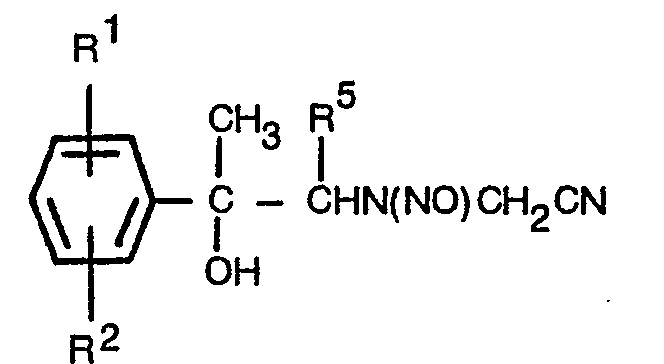
- a properly substituted phenylethanolamine is cyanomethylated with a reactant XCH 2 CN where X may be -OH, -Br, -CI, tosyl, and the like to form the intermediate which is nitrosated with an excess of NaN0 2 in aqueous HCI to yield which upon treatment with HCI (anhydrous or in an alkanol, preferably isopropanol) yields the sydnonimine salt which when reacted as an alcoholic suspension (methanol, ethanol, isopropanol, etc.) with in the presence of a mild base such as sodium acetate yields the desired 3-(2-hydroxy-2-phenylethyl)-N-[(phenylamino)carbonyll-sydnonimine derivatives.
- the mild base releases the reactive sydnone free base which readily undergoes nucleophilic addition to the isocyanate reactant.
- the compounds of this invention, where R 6 is other than hydrogen may be prepared directly by reaction of the appropriate nitroso-nitrile with an appropriately substituted aryl isocyanate in the presence of an organic amine base, such as triethylamine, 4-dimethylaminopyridine, and the like, following the procedure disclosed in German Offenlegungsschrift 2,738,022.
- a further aspect of this invention provides a pharmaceutical composition
- a pharmaceutical composition comprising a compound of formula I or a non-toxic acid addition salt thereof and a pharmaceutically acceptable carrier. Suitable carriers will be apparent to those skilled in the art.
- the composition is in unit dosage form.
- the title compound, prepared as an oil in the preceding example may be prepared as a solid as follows:
Landscapes
- Chemical & Material Sciences (AREA)
- Organic Chemistry (AREA)
- Organic Low-Molecular-Weight Compounds And Preparation Thereof (AREA)
- Acyclic And Carbocyclic Compounds In Medicinal Compositions (AREA)
- Heterocyclic Carbon Compounds Containing A Hetero Ring Having Nitrogen And Oxygen As The Only Ring Hetero Atoms (AREA)
Description
- This invention relates to sydnonimines which are CNS stimulants, to processes for their preparation, and to pharmaceutical compositions containing them.
- After the discovery of the central nervous system stimulatory properties of 3-( 1-methyl-2-phenylethyl)-N-(phenylcarbamoyl)sydnone imine (Sydnocarb; USSR 329,890 and German Offenlegungsschrift 2,028,880) various analogues have been reported. USSR 222,370 and German Offenlegungsschrift 2,738,022 disclose sydnone imines which contain phenyl, 1- or 2-phenylethyl and the phenylisopropyl groups in 3-position as well as N-meta- and para-chlorophenyl and N-phenyl carbamoyl groups. Variations of 3-benzyl sydnonimines are disclosed in US 3,277,108. Other variously substituted 3-aralkyl sydnonimines are disclosed by Olovyanishinkiva et al., Khim. Geterotsikl Soedin, 2 170-175 (1978) and 9 1198-1203 (1975).
- Sydnocarb is conventionally produced by cyanomethylation of amphetamine followed by nitrosation and ring closure with a mineral acid to yield sydnophen as an acid halide salt which is reacted with phenylisocyanate under mildly basic conditions to introduce the N-phenylcarbamoyl group. As an asymmetric compound, amphetamine may be employed as the initial reactant as the racemic d,l-mixture or as the pure d or /-isomer to yield racemic or optically active sydnophen and ultimately sydnocarb.
- Yashunskii et al., J.Med.Chem., 14 1013-1015 (1971) disclose the marked CNS-stimulatory effect of 3-(1-methyl-2-phenylethyll sydnonimine (Sydnophen). The relative activities of a large number of alkyl, aryl and aralkylsydnonimines are presented in Table 1 on page 1014. Most of them, including compound XVIII (2-hydroxy-1-methyl-2-phenylethyl-sydnonimine), were essentially inactive central nervous system stimulants relative to compound XIII (Sydnophen), demonstrating the criticality of the structure of the 3-substituent in the Sydnocarb series of compounds as far as CNS stimulatory activity is concerned. Thus, although the activity profile of Sydnocarb is not identical to that of amphetamine, or for that matter Sydnophen, CNS stimulatory activity is a common property of the initial reactant amphetamine, the intermediate Sydnophen and the final product Sydnocarb.
- The metabolites of Sydnocarb have been studied by several groups, L. E. Kholodov and E. T. Lilin, Mater. Resp. Rasshir. Konf. Farmacol. Gruz. 2nd 1977, 84-5 report finding hydroxylation of Sydnocarb at the beta carbon of the phenylisopropyl substituent and at the phenyl ring of the phenylcarbamoyl group, hydrolytic cleavage of the phenylcarbamoyl group and ring opening of the heterocyclic nucleus. They report that the psychostimulating activity of Sydnocarb is a property of that compound and not its metabolities. Polgar et al. Acta. Pharm. Hung., 48, Suppl. 23-24 (1978) and Xenobiotica 9, No. 8, 511-520 (1979) report several hydroxylated'metabolities and conjugates, but does not report finding beta-hydroxysydnocarb as an entity.
- In accordance with this invention there is provided a group of central nervous system stimulants which are 3-(2=hydroxy-2-phenylethyl)-N-[(phenylamino)-carbonyl]sydnonimines optionally substituted in either or both phenyl rings, of the formula:

- R' and R2 are, independently, hydrogen, alkyl of 1 to 6 carbon atoms, halo, perfluoroalkyl of 1 to 3 carbon atoms, nitro, alkoxy of 1 to 6 carbon atoms, alkanoyl of 2 to 4 carbon atoms, or alkoxycarbonyl of 2 to 4 carbon atoms;
- R3 is hydrogen, halo, nitro or alkanoyl of 2 to 4 carbon atoms;
- R4 is hydrogen, halo, nitro or perfluoroalkyl of 1 to 3 carbon atoms;
- R5 and R6 are, independently, hydrogen or methyl; or a non-toxic acid addition salt thereof.
- It is generally preferred that the halo substituent be chlorine, bromine or fluorine although iodine is acceptable. Likewise, it is preferred that the alkyl and alkoxy substituents be relatively small, the methyl, ethyl, propyl, isopropyl, methoxy, ethoxy, propoxy and isopropoxy groups being preferred. The R3 substituent in 4 position when R4 is hydrogen influences potency to a greater extent than R', R2 and R4 and is preferably a halogen.
- Examples of compounds of formula I are those where R2 is hydrogen, R' is a para substituent and R4 is hydrogen or halo. When R5 is hydrogen other examples are the /-enantiomorph of formula I where R' and R2 are hydrogen and R4 is hydrogen or halo in position 3. When R5 is methyl examples are the /- threo enantiomorph of formula I wherein R1, R2, R4 and R6 are hydrogen. The non-toxic acid addition salts of the compounds of this invention are produced by conventional methods e.g. from any of the acids disclosed in U.S. 3,277,108. The adduct products are preferably formed with hydrochloric, hydrobromic, sulfuric, phosphoric, acetic, propionic, oxalic, succinic or maleic acid.
- The 3-(2-hydroxy-2-phenylethyl)sydnonimine compounds of this invention contain a chiral centre at the benzylic carbon atoms and can appear as the racemic d,l-mixture which is resolvable into the pure d- and /-isomers. The /-isomer possesses substantially all of the CNS stimulatory activity and is preferred over the racemic mixture for that reason. Unlike Sydnocarb, the compounds of this invention are derived from a phenylethanolamine or a phenylpropanolamine through the intermediate 3-(2-hydroxy-2-phenylethyl)sydnonimine or 3-((2-hydroxy-1-methyl-2-phenylethyl)sydnonimine, none of which demonstrate any meaningful central nervous system stimulatory activity. Being derived from reactants and through intermediates which are substantially devoid of activity, the compounds of this invention do not share with Sydnocarb the potential problem of degradative reversion or metabolic conversion back to a precursor which is itself active with a different pharmacological profile. Furthermore, handling of the inactive reactants and/or intermediates involved in this invention poses no problem for the production chemist.
- The 3-[(2-hydroxy-1-methyl-2-phenylethyl)]sydnonimines and the 3-[(2-hydroxy-2-methyl-1-methyl-2-phenylethyl)]sydnonimines of this invention contain two chiral centres and provide two racemic mixtures of product. Of the four optically active isomers only the /-threo isomer is meaningfully active as a central nervous system stimulant.
- The activity profile of the compounds of this invention is similar to that of amphetamine in some aspects while being devoid of other activities of amphetamine. For example, like amphetamine the compounds of this invention increase motor activity. However, the compounds of this invention are much less toxic than amphetamine, providing a slower onset of activity (which indicates less euphoria and abuse potential).
- The compounds of this invention were shown to possess central nervous system stimulant activity by subjecting them to the following standard test procedure:
- Male mice weighing 17 to 25 gms. are injected orally with drug solubilized or suspended in 1% Tween® 80. Control animals are injected with 1% Tween@ 80.
- Six Columbus Instrument Company activity chambers are employed. Three mice given identical treatment are placed in each chamber for all tests. During each run, control animals (1 % Tween® only) occupy 3 chambers; the other 3 chambers measure activity of drug treated animals. For each dose of a given drug the experiment is run two times in a counterbalanced design so that each specific activity chamber records the activity of control animals during one run, and the activity of drug animals on the other run. Thus at each dose level 18 mice are used in the drug group and 18 mice in the control group.
- Activity counts are recorded every ten minutes for a period of 2 hours. The data are analyzed using Students "t" test comparing the means of the control and drug groups for each 10 minute period. The drug treated group is compared graphically with the control group in regard to duration of action and dose response at peak drug activity.
- As central nervous system stimulants with unique activity profiles, the compounds of this invention are useful in the treatment of anergic disorders (such as sleepiness and fatigue) including related types of depression and narcolepsy. Based upon the potency of the compounds of this invention in use in mice, the dose contemplated for use in the 70 kilogram human would vary from about 35-700 milligrams administered orally once or twice per day under the guidance of a physician. Of course, the dosage regimen as well as the route of administration, oral or parenteral, will vary with the condition of the patient relative to age, severity of depression, etc.
- This invention also provides processes for preparing compounds of formula I. The compounds of this invention are prepared by conventional techniques analogous to those employed in the preparation of Sydnocarb. Thus, a properly substituted phenylethanolamine is cyanomethylated with a reactant XCH2CN where X may be -OH, -Br, -CI, tosyl, and the like to form the intermediate


- The mild base releases the reactive sydnone free base

- A further aspect of this invention provides a pharmaceutical composition comprising a compound of formula I or a non-toxic acid addition salt thereof and a pharmaceutically acceptable carrier. Suitable carriers will be apparent to those skilled in the art. Preferably the composition is in unit dosage form.
- The following examples illustrate this invention. Where the intermediate cyanomethylated product of phenylethanolamine and the N-nitroso derivative thereof are isolated as oils, no attempt was made to obtain the purified intermediate. The activity counts presented at the end of each example represent the difference from control based upon the test procedure disclosed, supra. Sydnocarb itself demonstrated a difference from control of 939 activity counts at 10 mg/kg. p.o.
- A. Dissolve dl-2-amino-1-phenylethanol (5.49 g.; 0.04 moles) in ethyl acetate, (25 ml) then add a solution of cyanomethyl p-toluenesulfonate (4.22 g.; 0.02 moles) in ethyl acetate (25 ml). Allow the reaction to stand at room temperature overnight then filter and evaporate the solvent from the filtrate in vacuo. Dissolve the resulting oil in hot diethyl ether, treat with decolorizing charcoal, filter and evaporate the ether in vacuo. Dissolve the oil in ethyl acetate and add an excess of 5N isopropanolic-HCI solution (i.e. more than 4 ml), scratch to initiate crystallization and let stand to complete crystallization. Filter to obtain 3.08 g. of the title product, m.p. = 143-145°C.

- B. Combine d/-2-amino-1-phenylethanol (5.49 g.; 0.04 moles) with water (60 ml) and 5N aqueous HCI (8 ml; 0.04 moles) then stir until clear. Add 37% aqueous formaldehyde solution (4 ml), then with stirring drip in a solution of potassium cyanide (2.61 g.; 0.04 moles) in water (20 ml). Stir a further 3 hours at room temperature then add diethyl ether and let stand overnight. Extract with diethyl ether, wash, dry and evaporate the solvent in vacuo. Purify the resulting oil and convert to the HCI salt as in the preceding paragraph to obtain 4.10 g. of the title product, m.p. = 146-148°C.
- Cover d/-[(2-hydroxy-2-phenylethyl)amino]acetonitrile, hydrochloride (10.63 g.; 0.05 moles) with water (15 ml), add 5N aqueous HCI (30 ml; 0.15 mole) and ethanol (45 ml) and stir until clear. Cool the reaction to below 0°C. then with stirring drip in a solution of sodium nitrite (6.90 g.; 0.10 moles) in water (35 ml). Let stir, warming to room temperature for 3 hours. Add brine and extract with diethyl ether. Wash, dry and evaporate the extract in vacuo. Treat the resulting oil in diethyl ether with decolourising charcoal, filter and remove the solvent in vacuo to obtain d/-N-nitroso-N-(2-hydroxy-2-phenylethyl) amino acetonitrile as an oil. Dissolve the oil in ethyl acetate and add excess 5N-isopropanolic-HCI (over 10 ml). Filter the resulting crystalline solid to obtain 8.94 g. of title product, m.p. = 165-170°C. (dec.) Dissolve the solid in boiling methylene chloride-methanol and replace the solvents with isopropanol by boiling on the steam-bath, the isopropanol being added gradually as the lower boiling solvents are driven off, without taking to dryness. Cool and let crystallise, then filter to obtain 5.42 g. of pure title product, m.p. = 171-174°C (dec.).

- Stir d/-5-amino-3-(2-hydroxy-2-phenylethyl)-1,2,3-oxadiazolinium chloride (4.24 -g.; 0.0176) moles) and isopropanol (15 mi), cool to -10°C. and add anhydrous sodium acetate (1.45 g.; 0.0176 mole). Stir for 20 minutes then drip in phenyl isocyanate (2.0 ml) over 15 minutes. Stir for 3 hours allowing the reaction to warm to room temperature. Filter the resulting solid, dissolve it in methylene chloride-methanol, treat with decolourising charcoal then filter and replace the solvents with isopropanol by boiling on the steam-bath in the manner described in Example 2. Let stand to crystallise then filter to obtain 3.15 g. of the pure title product, m.p. = 187-189°C. (dec.).

- A. Dissolve d/-2-hydroxy-2-phenyl-propylamine, hydrochloride (9.4 g) in water (20 ml), stir and cool under nitrogen with an ice-bath. Add 37% aqueous formaldehyde solution (8.1 g), stir for 2 hour, then add a solution of potassium cyanide (3.3 g) in water (80 ml) dropwise. Stir and cool a further 1 hour, then add 5N aqueous HCI (10 ml) followed by dropwise addition of a solution of sodium nitrite (3.45 g) in water (30 ml). Add another 20 ml of 5N aqueous HCI solution followed by dropwise addition of a solution of sodium nitrite (3.45 g) in water (40 ml). Stir at 0°C for 45 minutes then extract the reaction mixture with methylene chloride. Wash the extract with saturated sodium bicarbonate solution, brine and dry. Evaporate the solvents in vacuo to obtain 10.1 g of dl-[(2-hydroxy-2-phenylpropyl)nitrosamino]acetonitrile, m.p. 89-90°C.
- B. Mix dl-[(2-hydroxy-2-phenylpropyl)nitrosamino]acetonitrile (5.0 g) with toluene (30 ml), add phenyl isocyanate (2.8 g) and triethylamine (2.3 g) using toluene rinses. Heat the reaction with stirring to 50-600C. for 5 hours, then let cool and stand overnight. Filter the crude product to obtain 4.85 g; m.p. 164-165°C. Dissolve the solid in acetone, treat the solution with decolourising carbon, filter, then replace the solvent with isopropanol by boiling in the steam bath in the manner described in Example 2. Let cool to crystallise then filter to obtain 3.26 g of the pure title product; m.p. 167-168°C.

- Mix d/ [2-hydroxy-2-phenylpropyl)nitrosamino]acetonitrile (4.5 g) prepared in Example 4 with toluene (46 ml) followed by 4-chlorophenylisocyanate (3.13 g) and triethylamine (2.02 g) and swirl, then heat the mixture with stirring to 50-60°C. for 6 hours. Cool and stir at room temperature overnight. Filter the crude product to obtain 3.71 g. Suspend the solid (3.2 g) in ethyl acetate, add 5N-lsopropanolic-HCI (5.0 ml), stir to give a white solid. Filter and dry to obtain 1.00 g of the title product: m.p. 166°C (dec.).

- Cover 1-2-amino-1-phenylethanol (20.17 g; 0.147 moles obtained as described in United Kingdom Patent No. 1.097,074) with water (240 ml), stir and cool then add 5N aqueous HCI (30 ml; 0.15 mole) and continue stirring until clear. Continue cooling and add 37% aqueous formaldehyde solution (15 ml) and follow by dripping in a solution of potassium cyanide (9.58 g.; 0.147 mole) in water (80 ml). add diethyl ether to aid stirring, remove the cold-bath and continue stirring at room temperature for 3 hours. Let stand overnight then extract with diethyl ether. Wash, dry and evaporate the solvent in vacuo. Dissolve the resulting oil in diethyl ether, treat with decolourising charcoal, filter and evaporate the ether in vacuo to obtain l-[2-hydroxy-2-phenylethyl)amino]acetonitrile as an oil. Dissolve the oil in water (100 ml) containing 5N aqueous HCI (118 ml; 0.59 moles) and stir with cooling to -10°C. Drip in a solution of sodium nitrite (20.29 g.; 0.294 moles) in water (100 ml) with stirring and cooling. Stir a further 3 hours at room temperature, add brine and extract with diethyl ether. Wash, dry and evaporate the extract in vacuo. Dissolve the residue in diethyl ether, treat with charcoal, filter and evaporate the ether in vacuo to obtain /-N-nitroso-N-(2-hydroxy-2-phenylethyl)amino acetonitrile as an oil. Dissolve the oil in ethyl acetate, add excess 5N-isopropanolic HCI (30 ml). Filter the resulting solid to get 11.8 g. of title product, m.p. = 192-199°C. (dec.).
- Dissolve 4.50 g. of the solid in methylene chloride-methanol, treat with decolourising charcoal, filter and replace the solvents with isopropanol by boiling on the steam-bath in the manner described in Example 2. Cool and let stand to crystallise then filter to obtain 3.10 g. of the pure title product, m.p.=202-206°C. (dec.): [α]D 26=-101.6° (1.075% in methanol).

- The title compound, prepared as an oil in the preceding example may be prepared as a solid as follows:
- Dissolve /-2-hydroxy-2-phenylethylamine, hydrochloride (44.2 g) in water (300 ml), cool with an ice-bath then stir under nitrogen and add 37% aqueous formaldehyde solution (26 ml). Stir for 10 minutes then add a solution of potassium cyanide (16.6 g) in water (80 ml) dropwise with stirring. Stir a further 3 hours at room temperature then let stand overnight. Cool the reaction mixture with an ice-salt bath to 0-5°C, then add 5N aqueous HCI dropwise (153 ml) with stirring. Continue cooling and stirring and add a solution of sodium nitrite (35.2 g) in water (100 ml) dropwise. Remove the ice-bath and continue stirring at room temperature for 3 hours. Add ether and let stand overnight.
- Extract the mixture well with methylene chloride then wash the extract with water, saturated sodium bicarbonate solution, brine and dry. Evaporate the solvent in vacuo and pump to get 42.0 g of the oily title product which crystallizes on standing. The product is sufficiently pure at this stage to use for subsequent reactions.
- Remove a sample of the crude product (3.419 g) and triturate with cyclohexane containing a little ether. Decant, then triturate the solid with toluene and filter to obtain 0.991 g; m.p. 60-62°C. Dissolve the solid in methylene chloride, treat with decolorizing carbon, filter and evaporate the solvent in vacuo. Triturate the crystalline solid with cyclohexane and filter to obtain 0.923 g of the pure title product; m.p. 61-63°C; [α]D 25=-49.07° (1.00% in methanol).

- Stir l-5-amino-3-(2-hydroxy-2-phenylethyl)-1,2,3-oxadiazolium chloride, prepared in Example 6, (6.04 g.; 0.025 moles) with isopropanol (40 ml) then cool with an ice-bath. Add anhydrous sodium acetate (2.05 g.; 0.025 moles) then with stirring and cooling drip in phenylisocyanate (2.72 ml). Continue stirring at room temperature for 5 hours then let stand overnight. Filter to obtain 6.7 g. of crude title product. Dissolve the solid in methylene chloride-methanol, treat with decolorizing charcoal, filter and replace the solvent with isopropanol by boiling on the steam bath. Let cool then filter to obtain 4.43 g. of the title product, m.p. = 157-161 °C. Repeat the purification by dissolving the solid in chloroform-acetone, treating with decolorizing charcoal then filtering and evaporating the solvents in vacuo. Crystallize from isopropanol-diethyl ether and filter to obtain 2.76 g. of the pure title product, m.p. 158-160°C., [α]D 25.50 = -129.58° (0.885% in methanol).

- Stir 1-5-amino-3-(2-hydroxy-2-phenylethyl)-1,2,3-oxadiazolium chloride (15.5 g) with isopropanol (150 ml), cool with an ice-salt bath then add anhydrous, powdered sodium acetate (5.79 g) followed by 4-chlorophenyl-isocyanate (10.83 g). Stir cold for 3 hours, then at room temperature for 2 hours. Filter and dry to obtain 18.1 g of crude product. Stir the solid with water (150 ml) for 2 hours, then filter and dry to obtain 13.99 g. Boil the solid with methylene chloride-methanol-acetone until nearly clear, filter then replace the solvent with isopropanol by boiling on the steam-bath in the manner described in Example 2. Let cool, reduce the volume further by evaporation in vacuo, then filter to obtain 11.17 g of pure title product; m.p. 191-194°C (dec.); [α]D 25 =-73.06° (1..085% in DMF).

- Dissolve /-threo-norpseudoephedrine hydrochloride (37.5 g.) in water (300 ml), cool then add 5N aqueous HCI (40 ml) and 37% aqueous formaldehyde solution (20 ml). With stirring and cooling add a solution of potassium cyanide (13.0 g) in water (100 ml) dropwise. Stir cold 30 min. then drip in a solution of sodium nitrite (22.1 g) in water (100 ml) keeping the temperature below 6°C. Stir a further 10 min. then add diethyl ether then wash, dry and evaporate the extract in vacuo. Dissolve the remaining oil in ethyl acetate, add 5N isopropanolic-HCI (32 ml) and allow to stand. Filter to obtain 18.7 g. of title product, m.p. 213-215°C. [α]D 25=-138.07° (1% in methanol).

- Stir l-threo-5-amino-3-(2-hydroxy-1-methyl-2-phenylethyl)-1,2,3-oxadiazolium chloride (5.114 g; 0.02 mole) with isopropanol (35 ml), cool and add anhydrous sodium acetate (1.64 g; 0.02 mole) followed in 15 min. by phenylisocyanate (2.38 g; 2.17 ml; 0.02 mole). Stir at room temperature for 3 hours. Filter to obtain 6.006 g. of crude title product, m.p. 167-169°C. (dec). Dissolve the solid in methylene chloride-methanol, treat with charcoal, filter then replace the solvents with isopropanol by boiling in the manner described in Example 2. Let stand then filter to obtain 2.918 g. of pure title product, m.p. 188-190°C. (dec); [(α]D 25=-218.52° (1.045% in methanol).

- Stir l-threo-5-amino-3-(2-Hydroxy-1-methyl-2-phenylethyll-1,2,3-oxadiazolium chloride (3.84 g) with methanol (30 ml), cool and add anhydrous sodium acetate (1.23 g) followed in 10 minutes by 4-chlorophenylisocyanate (2.30 g). Stir at room temperature for 3 hours. Evaporate the solvent in vacuo and triturate the solid with water and ether and filter to get 2.17 g. of crude product. Boil the solid with a mixture of chloroform and acetone, filter and evaporate the filtrate in vacuo. Treat the resulting solid in methylene chloride-methanol with decolourising charcoal, filter and replace the solvents with isopropanol by boiling in the manner described in Example 2. Let cool to crystallise then filter to obtain 0.978 g. of pure title product, m.p. = 186-188°C, [α]D 26=-240.56° (1.52% in methanol).

- The compounds in the following examples were prepared following the procedure of Example 9 with the exception that the appropriately substituted phenylisocyanate was employed.
- Melting point 181-183°C; [α]D2.25= -120.52 (1.005% in methanol)

- Melting point 185-185.5°C (dec); [α]D 22.5=-104.97° (1.05% in 1:1 chloroform-methanol).

- Melting point 214.5-216.5°C (dec); [α]D 25 =-77.89° (0.97% in dimethylformamide).

- Melting point 182-184°C; [a]D =-131.2° (1.01% in methanol).

Claims (12)


or a non-toxic acid addition salt thereof.



Priority Applications (1)
| Application Number | Priority Date | Filing Date | Title |
|---|---|---|---|
| AT80302983T ATE4540T1 (en) | 1979-08-31 | 1980-08-28 | SYDNONIMINE, THEIR PREPARATION AND PHARMACEUTICAL COMPOSITIONS CONTAINING THEM. |
Applications Claiming Priority (4)
| Application Number | Priority Date | Filing Date | Title |
|---|---|---|---|
| US7160679A | 1979-08-31 | 1979-08-31 | |
| US71606 | 1979-08-31 | ||
| US171423 | 1980-07-29 | ||
| US06/171,423 US4277609A (en) | 1979-08-31 | 1980-07-29 | Sydnone imines |
Publications (3)
| Publication Number | Publication Date |
|---|---|
| EP0024924A2 EP0024924A2 (en) | 1981-03-11 |
| EP0024924A3 EP0024924A3 (en) | 1981-03-18 |
| EP0024924B1 true EP0024924B1 (en) | 1983-08-31 |
Family
ID=26752423
Family Applications (1)
| Application Number | Title | Priority Date | Filing Date |
|---|---|---|---|
| EP80302983A Expired EP0024924B1 (en) | 1979-08-31 | 1980-08-28 | Sydnonimines, their preparation and pharmaceutical compositions containing them |
Country Status (10)
| Country | Link |
|---|---|
| US (1) | US4277609A (en) |
| EP (1) | EP0024924B1 (en) |
| JP (1) | JPS56501088A (en) |
| AU (1) | AU533086B2 (en) |
| CA (1) | CA1145756A (en) |
| DE (1) | DE3064707D1 (en) |
| DK (1) | DK190781A (en) |
| GB (1) | GB2058064B (en) |
| IE (1) | IE50230B1 (en) |
| WO (1) | WO1981000567A1 (en) |
Cited By (2)
| Publication number | Priority date | Publication date | Assignee | Title |
|---|---|---|---|---|
| EP0049604A1 (en) * | 1980-10-02 | 1982-04-14 | American Home Products Corporation | CNS stimulants |
| EP0210474A1 (en) * | 1985-07-20 | 1987-02-04 | CASSELLA Aktiengesellschaft | Substituted 3-amino-sydnone imines, method for their preparation, their use and pharmaceutical compositions containing these compounds |
Families Citing this family (6)
| Publication number | Priority date | Publication date | Assignee | Title |
|---|---|---|---|---|
| US4371539A (en) * | 1981-04-27 | 1983-02-01 | American Home Products Corporation | CNS Stimulants |
| DE3732174A1 (en) * | 1987-09-24 | 1989-04-06 | Cassella Ag | SUBSTITUTED 3-AMINO-DYNONOMINES, PROCESS FOR THEIR PREPARATION AND THEIR USE |
| ES2582660T3 (en) * | 2007-03-14 | 2016-09-14 | Caliper Life Sciences, Inc. | Sidnonimines - specific dopamine reuptake inhibitors and their use in the treatment of dopamine-related disorders |
| US8691853B2 (en) | 2007-03-14 | 2014-04-08 | Caliper Life Sciences, Inc. | Method of using dopamine reuptake inhibitors and their analogs for treating autoimmune conditions and delaying or preventing autoimmune related pathologic progressions |
| CN102791134B (en) | 2009-12-04 | 2015-04-22 | 魄金莱默有限公司 | Method of using dopamine reuptake inhibitors and their analogs for treating diabetes symptoms and delaying or preventing diabetes-associated pathologic conditions |
| KR20210113429A (en) * | 2013-03-15 | 2021-09-15 | 멜리어 파마슈티칼스 투, 엘엘씨. | A pharmaceutical composition comprising sydnocarb or a pharmaceutically acceptable salt thereof and method of treating sleep disorders |
Family Cites Families (4)
| Publication number | Priority date | Publication date | Assignee | Title |
|---|---|---|---|---|
| BE618822A (en) * | 1961-06-13 | |||
| SU222370A1 (en) | 1966-09-21 | 1973-05-15 | Р. А. Альтшуллер, Д. Машковский, Л. Е. Холодов , В. Г. Яшунский | METHOD OF OBTAINING N-ARILKARBAMOILSIDNONYMINS |
| DE2028880C3 (en) | 1970-06-11 | 1979-03-08 | Vsesojuznyj Nautschno-Issledovatelskij Chimiko-Farmacevtitscheskij Institut Imeni Sergo Ordschonikidze, Moskau | N-Phenylcarbamoyl-3- (ßphenylisopropyl) sydnonunine, process for its preparation and pharmaceuticals |
| CA1097659A (en) * | 1976-11-25 | 1981-03-17 | Roald A. Altshuler | Sydnonimine n-acylderivatives and method for preparing same |
-
1980
- 1980-07-29 US US06/171,423 patent/US4277609A/en not_active Expired - Lifetime
- 1980-08-15 WO PCT/US1980/001067 patent/WO1981000567A1/en not_active Ceased
- 1980-08-15 JP JP50214580A patent/JPS56501088A/ja active Pending
- 1980-08-18 CA CA000358484A patent/CA1145756A/en not_active Expired
- 1980-08-27 AU AU61799/80A patent/AU533086B2/en not_active Withdrawn - After Issue
- 1980-08-28 EP EP80302983A patent/EP0024924B1/en not_active Expired
- 1980-08-28 DE DE8080302983T patent/DE3064707D1/en not_active Expired
- 1980-08-28 IE IE1809/80A patent/IE50230B1/en unknown
- 1980-08-28 GB GB8027890A patent/GB2058064B/en not_active Expired
-
1981
- 1981-04-29 DK DK190781A patent/DK190781A/en not_active Application Discontinuation
Cited By (2)
| Publication number | Priority date | Publication date | Assignee | Title |
|---|---|---|---|---|
| EP0049604A1 (en) * | 1980-10-02 | 1982-04-14 | American Home Products Corporation | CNS stimulants |
| EP0210474A1 (en) * | 1985-07-20 | 1987-02-04 | CASSELLA Aktiengesellschaft | Substituted 3-amino-sydnone imines, method for their preparation, their use and pharmaceutical compositions containing these compounds |
Also Published As
| Publication number | Publication date |
|---|---|
| GB2058064A (en) | 1981-04-08 |
| US4277609A (en) | 1981-07-07 |
| GB2058064B (en) | 1983-05-18 |
| DK190781A (en) | 1981-04-29 |
| DE3064707D1 (en) | 1983-10-06 |
| EP0024924A3 (en) | 1981-03-18 |
| EP0024924A2 (en) | 1981-03-11 |
| JPS56501088A (en) | 1981-08-06 |
| IE50230B1 (en) | 1986-03-05 |
| AU533086B2 (en) | 1983-10-27 |
| WO1981000567A1 (en) | 1981-03-05 |
| IE801809L (en) | 1981-02-28 |
| AU6179980A (en) | 1981-03-05 |
| CA1145756A (en) | 1983-05-03 |
Similar Documents
| Publication | Publication Date | Title |
|---|---|---|
| US4064125A (en) | Substituted amides having antiinflammatory activity | |
| HUT58062A (en) | Process for producing (aminometyl)-oxooxazolidinyl arylbenzene derivatives and pharmaceutical compositions comprising such compounds | |
| WO2012031298A2 (en) | Ethynylbenzene derivatives | |
| EP0137242A2 (en) | (Substituted) Phenyl-aliphatic-isoxazoles useful as antiviral agents and preparation thereof | |
| CA2091897A1 (en) | Isoxazole compound, pharmaceutically acceptable salt thereof, and medicinal use thereof | |
| FR2514004A1 (en) | ANTIBIOTICS OF DIOXIMINO-CEPHALOSPORINS | |
| US4277609A (en) | Sydnone imines | |
| JP2003528073A (en) | Propene carboxylic acid amidoxime derivative, process for producing the same, and pharmaceutical composition containing this derivative | |
| US5100910A (en) | Aryl substituted tetrazole derivatives, and application thereof in therapeutics | |
| CN1322193A (en) | Unsaturated hydroximic acid derivatives as PARP inhibitors | |
| US4301285A (en) | Sydnonimine CNS stimulants | |
| BE1004906A3 (en) | NOVEL SUBSTITUTED DERIVATIVES OF STYRENE, PROCESS FOR THEIR PREPARATION AND PHARMACEUTICAL COMPOSITIONS CONTAINING THEM. | |
| HU191586B (en) | Process for preparing new derivatives of pyridazine and pyrimidine | |
| HU217969B (en) | Thiazolidinone and oxazolidinone derivatives, pharmaceutical compositions containing such compounds, and methods for preparing the compounds. | |
| US4371697A (en) | 3-[1-(Hydroxymethyl)-2-phenylethyl]-N-[(phenylamino)-carbonyl]sydnone imine | |
| US4446322A (en) | Hydroxyl protected 3-(2-hydroxy-2-phenylethyl)-N-[(phenylamino)carbonyl]sydnone imine intermediates | |
| US5202351A (en) | 1-phenylalkyl-3-phenylurea derivative | |
| US4289885A (en) | 3-[2-(Dimethylamino)-2-phenylethyl]N-[phenylamino)carbonyl]sydnone imine, a new central nervous system stimulant | |
| US4371539A (en) | CNS Stimulants | |
| JPH0140027B2 (en) | ||
| EP0050916A2 (en) | CNS stimulants and antihypertensive agents | |
| EP0502110B1 (en) | (hetero) 4-arylmethoxy phenyl diazole derivatives, method for preparing same, and their therapeutical applications | |
| US4065485A (en) | Cyclitolamines | |
| US4224317A (en) | Substituted 1-oxa-4-aza-2,6-disilacyclohexanes and use thereof | |
| US4374779A (en) | Nitrosoamino-actonitriles |
Legal Events
| Date | Code | Title | Description |
|---|---|---|---|
| PUAI | Public reference made under article 153(3) epc to a published international application that has entered the european phase |
Free format text: ORIGINAL CODE: 0009012 |
|
| PUAL | Search report despatched |
Free format text: ORIGINAL CODE: 0009013 |
|
| AK | Designated contracting states |
Designated state(s): AT BE CH DE FR IT LU NL SE |
|
| AK | Designated contracting states |
Designated state(s): AT BE CH DE FR IT LU NL SE |
|
| 17P | Request for examination filed |
Effective date: 19810824 |
|
| ITF | It: translation for a ep patent filed | ||
| GRAA | (expected) grant |
Free format text: ORIGINAL CODE: 0009210 |
|
| AK | Designated contracting states |
Designated state(s): AT BE CH DE FR IT LI LU NL SE |
|
| REF | Corresponds to: |
Ref document number: 4540 Country of ref document: AT Date of ref document: 19830915 Kind code of ref document: T |
|
| REF | Corresponds to: |
Ref document number: 3064707 Country of ref document: DE Date of ref document: 19831006 |
|
| ET | Fr: translation filed | ||
| PLBE | No opposition filed within time limit |
Free format text: ORIGINAL CODE: 0009261 |
|
| STAA | Information on the status of an ep patent application or granted ep patent |
Free format text: STATUS: NO OPPOSITION FILED WITHIN TIME LIMIT |
|
| PG25 | Lapsed in a contracting state [announced via postgrant information from national office to epo] |
Ref country code: AT Effective date: 19840828 |
|
| PG25 | Lapsed in a contracting state [announced via postgrant information from national office to epo] |
Ref country code: SE Effective date: 19840829 |
|
| PG25 | Lapsed in a contracting state [announced via postgrant information from national office to epo] |
Ref country code: LU Free format text: LAPSE BECAUSE OF NON-PAYMENT OF DUE FEES Effective date: 19840831 Ref country code: LI Effective date: 19840831 Ref country code: CH Effective date: 19840831 |
|
| 26N | No opposition filed | ||
| BERE | Be: lapsed |
Owner name: AMERICAN HOME PRODUCTS CORP. Effective date: 19840828 |
|
| PG25 | Lapsed in a contracting state [announced via postgrant information from national office to epo] |
Ref country code: NL Effective date: 19850301 |
|
| NLV4 | Nl: lapsed or anulled due to non-payment of the annual fee | ||
| PG25 | Lapsed in a contracting state [announced via postgrant information from national office to epo] |
Ref country code: FR Free format text: LAPSE BECAUSE OF NON-PAYMENT OF DUE FEES Effective date: 19850430 |
|
| REG | Reference to a national code |
Ref country code: CH Ref legal event code: PL |
|
| PG25 | Lapsed in a contracting state [announced via postgrant information from national office to epo] |
Ref country code: DE Effective date: 19850501 |
|
| REG | Reference to a national code |
Ref country code: FR Ref legal event code: ST |
|
| PG25 | Lapsed in a contracting state [announced via postgrant information from national office to epo] |
Ref country code: BE Effective date: 19890831 |
|
| PGFP | Annual fee paid to national office [announced via postgrant information from national office to epo] |
Ref country code: FR Payment date: 19900525 Year of fee payment: 4 |
|
| EUG | Se: european patent has lapsed |
Ref document number: 80302983.4 Effective date: 19850612 |