EP0024182B1 - Thermo-stable micro-organism and proteolytic enzyme prepared therefrom, and processes for the preparation of the micro-organism and the proteolytic enzyme - Google Patents
Thermo-stable micro-organism and proteolytic enzyme prepared therefrom, and processes for the preparation of the micro-organism and the proteolytic enzyme Download PDFInfo
- Publication number
- EP0024182B1 EP0024182B1 EP80302743A EP80302743A EP0024182B1 EP 0024182 B1 EP0024182 B1 EP 0024182B1 EP 80302743 A EP80302743 A EP 80302743A EP 80302743 A EP80302743 A EP 80302743A EP 0024182 B1 EP0024182 B1 EP 0024182B1
- Authority
- EP
- European Patent Office
- Prior art keywords
- process according
- culture
- organism
- caldolysin
- micro
- Prior art date
- Legal status (The legal status is an assumption and is not a legal conclusion. Google has not performed a legal analysis and makes no representation as to the accuracy of the status listed.)
- Expired
Links
Classifications
-
- C—CHEMISTRY; METALLURGY
- C12—BIOCHEMISTRY; BEER; SPIRITS; WINE; VINEGAR; MICROBIOLOGY; ENZYMOLOGY; MUTATION OR GENETIC ENGINEERING
- C12N—MICROORGANISMS OR ENZYMES; COMPOSITIONS THEREOF; PROPAGATING, PRESERVING, OR MAINTAINING MICROORGANISMS; MUTATION OR GENETIC ENGINEERING; CULTURE MEDIA
- C12N1/00—Microorganisms; Compositions thereof; Processes of propagating, maintaining or preserving microorganisms or compositions thereof; Processes of preparing or isolating a composition containing a microorganism; Culture media therefor
- C12N1/20—Bacteria; Culture media therefor
- C12N1/205—Bacterial isolates
-
- C—CHEMISTRY; METALLURGY
- C12—BIOCHEMISTRY; BEER; SPIRITS; WINE; VINEGAR; MICROBIOLOGY; ENZYMOLOGY; MUTATION OR GENETIC ENGINEERING
- C12N—MICROORGANISMS OR ENZYMES; COMPOSITIONS THEREOF; PROPAGATING, PRESERVING, OR MAINTAINING MICROORGANISMS; MUTATION OR GENETIC ENGINEERING; CULTURE MEDIA
- C12N11/00—Carrier-bound or immobilised enzymes; Carrier-bound or immobilised microbial cells; Preparation thereof
- C12N11/02—Enzymes or microbial cells immobilised on or in an organic carrier
- C12N11/10—Enzymes or microbial cells immobilised on or in an organic carrier the carrier being a carbohydrate
-
- C—CHEMISTRY; METALLURGY
- C12—BIOCHEMISTRY; BEER; SPIRITS; WINE; VINEGAR; MICROBIOLOGY; ENZYMOLOGY; MUTATION OR GENETIC ENGINEERING
- C12N—MICROORGANISMS OR ENZYMES; COMPOSITIONS THEREOF; PROPAGATING, PRESERVING, OR MAINTAINING MICROORGANISMS; MUTATION OR GENETIC ENGINEERING; CULTURE MEDIA
- C12N11/00—Carrier-bound or immobilised enzymes; Carrier-bound or immobilised microbial cells; Preparation thereof
- C12N11/14—Enzymes or microbial cells immobilised on or in an inorganic carrier
-
- C—CHEMISTRY; METALLURGY
- C12—BIOCHEMISTRY; BEER; SPIRITS; WINE; VINEGAR; MICROBIOLOGY; ENZYMOLOGY; MUTATION OR GENETIC ENGINEERING
- C12N—MICROORGANISMS OR ENZYMES; COMPOSITIONS THEREOF; PROPAGATING, PRESERVING, OR MAINTAINING MICROORGANISMS; MUTATION OR GENETIC ENGINEERING; CULTURE MEDIA
- C12N9/00—Enzymes; Proenzymes; Compositions thereof; Processes for preparing, activating, inhibiting, separating or purifying enzymes
- C12N9/14—Hydrolases (3)
- C12N9/48—Hydrolases (3) acting on peptide bonds (3.4)
- C12N9/50—Proteinases, e.g. Endopeptidases (3.4.21-3.4.25)
- C12N9/52—Proteinases, e.g. Endopeptidases (3.4.21-3.4.25) derived from bacteria or Archaea
-
- C—CHEMISTRY; METALLURGY
- C12—BIOCHEMISTRY; BEER; SPIRITS; WINE; VINEGAR; MICROBIOLOGY; ENZYMOLOGY; MUTATION OR GENETIC ENGINEERING
- C12R—INDEXING SCHEME ASSOCIATED WITH SUBCLASSES C12C - C12Q, RELATING TO MICROORGANISMS
- C12R2001/00—Microorganisms ; Processes using microorganisms
- C12R2001/01—Bacteria or Actinomycetales ; using bacteria or Actinomycetales
-
- Y—GENERAL TAGGING OF NEW TECHNOLOGICAL DEVELOPMENTS; GENERAL TAGGING OF CROSS-SECTIONAL TECHNOLOGIES SPANNING OVER SEVERAL SECTIONS OF THE IPC; TECHNICAL SUBJECTS COVERED BY FORMER USPC CROSS-REFERENCE ART COLLECTIONS [XRACs] AND DIGESTS
- Y10—TECHNICAL SUBJECTS COVERED BY FORMER USPC
- Y10S—TECHNICAL SUBJECTS COVERED BY FORMER USPC CROSS-REFERENCE ART COLLECTIONS [XRACs] AND DIGESTS
- Y10S435/00—Chemistry: molecular biology and microbiology
- Y10S435/814—Enzyme separation or purification
- Y10S435/815—Enzyme separation or purification by sorption
-
- Y—GENERAL TAGGING OF NEW TECHNOLOGICAL DEVELOPMENTS; GENERAL TAGGING OF CROSS-SECTIONAL TECHNOLOGIES SPANNING OVER SEVERAL SECTIONS OF THE IPC; TECHNICAL SUBJECTS COVERED BY FORMER USPC CROSS-REFERENCE ART COLLECTIONS [XRACs] AND DIGESTS
- Y10—TECHNICAL SUBJECTS COVERED BY FORMER USPC
- Y10S—TECHNICAL SUBJECTS COVERED BY FORMER USPC CROSS-REFERENCE ART COLLECTIONS [XRACs] AND DIGESTS
- Y10S435/00—Chemistry: molecular biology and microbiology
- Y10S435/8215—Microorganisms
- Y10S435/822—Microorganisms using bacteria or actinomycetales
Definitions
- This invention relates to a novel micro-organism capable of producing a thermostable extracellular proteolytic enzyme called CALDOLYSlN. It also relates to the method of preparing the proteolytic enzyme and to the proteolytic enzyme itself.
- thermostable proteolytic enzymes in the food, fermentation, animal feed and pharmaceutical industries which is not being entirely met. It is an object of this invention to provide a starting material capable of producing a thermostable proteolytic enzyme and to provide a proteolytic enzyme which goes some way towards meeting the aforementioned demand or at least provides the public with a useful choice.
- the inventors have succeeded in isolating a microorganism from a hot pool in the thermal area of Rotorua, New Zealand, which organism is capable of producing a thermostable proteolytic enzyme.
- a sample of this micro-organism designated THERMUS AQUATlCUS (Variety T-351), has been deposited with the American Type Culture Collection, 12301 Parklawn Drive, Rockville, Maryland 20852, United States of America, under number 31674 deposited on 30 July 1980.
- the micro-organism isolated grew poorly below 60°C. It was obligately aerobic. The cells were Gram negative, non-motile, non-sporulating rods. It is similar to THERMUS AQUATICUS (Brock et al., J. Bacteriol 98, 289-287; Degryse et al., Archives of Microbiology 117, 18) but the inventors have noted a significant difference in cytochrome composition of between THERMUS AQUA TICUS (Variety T-351) and THERMUS AQUATICUS mentioned above. The product exhibits optimal activity at 70 to 80°C and negligible activity below 40°C. Other properties of this micro-organism are set out below and are also described in Hickey and Daniel, J. of Gen. Microbiology (1979), 114, 195-200 (published September 1979), the text of which is hereby incorporated by reference.
- Hot Pool No. 351 The micro-organism was isolated from Hot Pool No. 351 as marked on the map of "Whakarewarewa Hot Springs", 1:2000, 1st Edition by New Zealand Geological Survey (Bibliographic reference-Lloyd, E. F. 1974, Geology of Whakarewarewa hot springs, DSIR information series No. 104 DSIR, Wellington, N.Z.).
- a hot pool is a body of water found in nature having an ambient temperature of at least 65°C.
- the Hot Pool No. 351 was at 79° ⁇ 4°C, was low in sulphide, at pH 7.5 to 7.8.
- the sulphide content of Hot Pool No. 351 is less than 20 micrograms per millilitre. Accordingly, any sulphide content no greater than 20 ⁇ g/ml will be understood to be included in the term "low in sulphide”.
- the present invention provides a process for isolating a micro-organism of the species THERMUS AQUA TICUS capable of producing the thermostable proteolytic enzyme (called CALDOLYSIN as herein defined, which comprises isolating a sample of solution from a Rotorua hot pool at 79° ⁇ 4°C low in sulphide at a pH in the range of from 7.5 to 7.8, preferably at a pH of substantially 7.8, containing said micro-organism, preparing a culture from said sample and maintaining said culture at a temperature (e.g. 65°C to 85°C) and a pH (e.g. from 7.2 to 8.2) and for a time sufficient to produce an adequate yield and isolating the above micro-organism from said culture, preferably during the late log phase thereof.
- CALDOLYSIN thermostable proteolytic enzyme
- the present invention also provides a micro-organism of the species THERMUS AQUATICUS isolated from nature, capable of producing the thermostable proteolytic enzyme (called CALDOLYSIN) as herein defined.
- the invention further provides a process for propagating THERMUS AQUATICUS T-351 or a spontaneous or physically- or chemically-induced mutant or a recombinant thereof, capable of producing the thermostable proteolytic enzyme (called CALDOLYSIN) as herein defined, or any micro-organism of the species THERMUS AQUATICUS capable of producing the thermostable proteolytic enzyme (called CALDOLYSIN) as herein defined, which comprises maintaining a culture of said micro-organism at a temperature in the range of from 65 to 85°C and a pH in the range of from 7.2 to 8.2 and isolating said micro-organism from said culture during the late log phase thereof.
- CALDOLYSIN thermostable proteolytic enzyme
- the invention further provides CALDOL YSIN (as herein defined). This is preferably in a substantially pure form.
- CALDOLYSIN is a proteolytic enzyme producible by THERMUS AQUATICUS (Variety T-351) and isolatable by the process described below. As will be readily understood by those skilled in the art, CALDOLYSIN may be obtained not only from THERMUS AQUATICUS (Variety T-351) but also from its spontaneous and chemically- and physically-induced mutants and recombinants which produce CALDOL YSIN.
- CALDOLYSIN is a protease having molecular weight 20,000 ⁇ 3,000. It has an isoelectric point of approximately 8.5 and its enzymatic activity is described below. This enzyme is stable at temperatures of 75°C and below, in the presence of divalent cations, particularly calcium ions. It is stable at pH values from 4 to 12 in the presence of calcium ions. Other properties and the method of preparation of this product are set out herein below.
- the invention also provides a method of preparing CALDOLYSIN which comprises centrifuging a culture of THERMUS AQUATICUS (Variety T-351) or a spontaneous or chemically- or physically-induced mutant or recombinant thereof which produces CALDOLYSIN, or any micro-organism of the species THERMUS AQUA TICUS capable of producing CALDOLYSIN, subjecting the supernatant from said centrifugation to affinity chromatography on a suitable activated affinity chromatography gel and eluting the CALDOLYSIN from said gel-with a suitable buffer.
- a method of preparing CALDOLYSIN which comprises centrifuging a culture of THERMUS AQUATICUS (Variety T-351) or a spontaneous or chemically- or physically-induced mutant or recombinant thereof which produces CALDOLYSIN, or any micro-organism of the species THERMUS AQUA TICUS capable of producing CALDOLYSIN, subjecting the supern
- the invention provides CALDOLYSIN immobilised on a suitable substrate, e.g. an activated agarose affinity matrix or carboxymethyl-cellulose.
- the isolation of the micro-organism may, for example, comprise repeated subculturing of the sample from the hot pool, each time in half strength nutrient broth compared with the original broth, at pH 8.0, the broth volume being substantially ten times the sample volume, at 75°C.
- the culture may comprise, for example, a liquid medium containing Allen's salts with 0.1 to 0.3% w/v trypticase at a pH of 7.5 and, for example, the pH may be raised to 8.2 and the medium autoclaved prior to inoculation with the culture.
- the culture may, for example, be harvested for use at the end of the culturing period; alternatively, it may be used to inoculate a fermentation process.
- the culture of the micro-organism may contain, for example, 0.1 to 0.3% w/v yeast extract and 0.1 to 0.3% w/v trypticase extract, peptone and Allen's salts, and culturing is, for example, at 75°C for up to 18 hours.
- the culture is centrifuged, for example by continuous flow centrifugation conducted at up to 30,000 g, and the supernatant from the centrifugation is advantageously passed through a suitable ion exchange gel, for example a cationic ion exchanger comprising dextran cross-linked with epichlorohydrin and having sulphopropyl functional groups attached by ether linkages to glucose units of the dextran chains, and subsequently subjected to ultrafiltration prior to the affinity chromatography step.
- a suitable ion exchange gel for example a cationic ion exchanger comprising dextran cross-linked with epichlorohydrin and having sulphopropyl functional groups attached by ether linkages to glucose units of the dextran chains, and subsequently subjected to ultrafiltration prior to the affinity chromatography step.
- the affinity chromatography gel may be, for example, agarose activated with cyanogen bromide.
- the ultrafiltration prior to the affinity chromatography step is advantageously conducted on a medium scale millipore ultrafiltration unit having a molecular weight 1000 nominal cut-off membrane and continued for a time sufficient to concentrate the solution ten times.
- the solution subjected to affinity chromatography may be adjusted to pH 8 prior to being so subjected, and the affinity gel may be, for example, the product obtained by sequential reaction of agarose with cyanogen bromide, trimethylene tetramine, carbobenzoxy-D-phenylalanine and 1-ethyl-3-(3-dimethylaminopropyl)carbodiimide, the affinity gel suitably being eluted with a 0.1M acetic acid at pH 2.7 containing 10 mM Ca 2+ .
- the product of the affinity chromatography may then be concentrated by ultrafiltration and subsequent separation by passing through a beaded dextran gel crosslinked with epichlorohydrin and having a bead size from 10 to 40 mm diameter in a gel column at pH 8.1, the solution containing 10 mM Ca 2+ eluting buffer.
- Oxygen uptake was measured polarographically using a Rank electrode (Rank Brothers, Bottisham, Cambridge, England).
- the reaction mixture consisted of 0.1 M KH 2 PO 4 /Na 2 HPO 4 buffer pH 7.0, a suitable amount of membrane particle protein, 50 pmol of substrate (except in the case of NADH where 5 ⁇ mol were used), in a final volume of 2.5 ml.
- Buffers were equilibrated at the desired temperature with sparged air for 30 minutes.
- Particles were equilibrated in the electrode for 2 minutes prior to measurement of oxygen uptake. Rates were measured over the first minute.
- cytochrome o-CO 417-429
- EmM 170 mM -1 cm -1
- a-type cytochrome 602-630 and 613-630
- EmM 24 mM -1 cm -1 (Van Galder, (Biochim, et Biophys. Acta 118, 36 ⁇ 46).
- Washed membrane particles were able to oxidise other substrates including glutamate and malate [>0.05 ⁇ mol O2 min -1 (mg protein) -1 ], and lactate, citrate, fumerate, glycerol and glucose [0.005-0.02 pmol 0 2 min -1 (mg protein) -1 ]. Except in the case of succinate and lactate, activities were enhanced by added supernatant and by NADH. Acetate, sucrose, mannitol and ethanol were not oxidised.
- NADH and succinate oxidases had maximum activity at pH 7.0, and at a phosphate buffer molarity of 0.1 M, as determined at 75°C.
- NADH and succinate oxidases were determined after 2 minutes preincubation at temperatures between 40°C and 95°C. Each was highest at 75°C in cell free extract and in large and small particles.
- the NADH oxidase rate in respiratory particles was particularly temperature sensitive, the rates at 70°C and 80°C being about half that at 75°C. In all cases activity at 75°C was at least 10-fold greater than that at 40°C.
- thermostability of the NADH oxidase activity of respiratory particles at 90°C over a 15 minute period was unaffected by phosphate buffer concentration (0.01 M to 2.0 M), 1.0 M-MgS0 4 or by 10 mgml -1 casein. Stability was enhanced about 2-fold by 50% (v/v) glycerol, 2.0 M ⁇ (NH 4 )SO 4 , and 10 mgml -1 NADH. Rates were determined at 75°C.
- Cytochrome concentrations [pmol cytochrome (g. protein) -1 ] in respiratory particles were a-602, 0.03; a-613, 0.06; total b-type, 0.89; o-0.21; total c-type 0.64: In the supernatant, c-type 0.79; CO-reactive cytochrome c, 0.02. These concentrations are fairly typical of these found in other aerobes.
- the culture fluid treated according to the flow scheme set up hereinabove comes from Example 1b.
- the centrifugation is conducted in a continuous flow centrifuge at 27,000 g.
- the pH of the Supernatant was adjusted to pH 8 prior to its being passed through the affinity gel.
- the ultrafiltration step concentrated the eluate (2) ten times.
- the retentate (3) subjected to affinity chromatography was adjusted to pH 8.
- the absorbate 4 was eluted as a single peak with pH 2.7 0.1 M acetic acid containing 10 mM Ca2+.
- the enzyme concentrate (5) was eluted from the G75 gel column using an eluting buffer at pH 8.1 and 10 mM Ca 2+ .
- CALDOLYSIN hydrolyses a range of high molecular weight protein substrates (Table 4) and some low molecular weight peptide substrates (Table 5). However, a number of common peptide analogues (protease substrates) are not hydrolysed (Table 5).
- CALDOLYSIN lyses a broad range of heat-killed Gram-negative bacteria, but few gram-positive microorganisms (Table 6).
- CALDOLYSIN was dialysed in the presence of 1.0 mM EDTA to remove any metal ion cofactors. Standard metal ion solutions were added to aliquots of the "apoenzyme" to give 10 mM concentration, after which the thermostability of the enzyme was determined.
- CALDOLYSIN in the presence of divalent cations, calcium being most useful
- CALDOLYSIN in the presence of divalent cations, calcium being most useful
- Stabilities in the presence of various denaturing agents are shown in Table 9.
- CALDOLYSIN is stable to concentration by lyophilisation (freeze-drying) and rotary evaporation (reduced pressure at 37°C) as shown in Table 10.
- Optimum pH for activity on azocasein occurs at 8.5 ⁇ 0.5, (at 75°C). At pH 6.0-pH 9.5, more than 80% of optimal activity is retained.
- NB Although % activity is low at normal temperatures (20°-40°C), sufficient activity for effective proteolysis can be obtained simply by using larger quantities of enzyme. However, its usefulness is clearly maximal at 65°C-85°C.
- CALDOLYSIN was immobilised on non-porous glass beads by the silane glutaraldehyde-coupling method described by Stolzenbach & Kaplan [(1976). Methods in Enzymology 44, 926]. 10 g of glass beads (Corning glass, 100 mesh) was washed in an excess of 5% HN0 3 at 100°C for 30 minutes. The acid-washed glass was filtered and rinsed, then added to a 10% aqueous solution of y-aminopropyl triethoxysilane (adjusted to pH 3.5 with HN0 3 ). The suspension was incubated at 75°C for approximately three hours to permit silanization to occur.
- silanized glass was added to a 20 ml volume of 5% glutaraldehyde in 0.01 M, pH 7, phosphate buffer. This was reacted in vacuo for two hours at room temperature, and finally washed exhaustively with distilled water.
- the immobilised complex was assayed by a modification of the Kunitz method. 14 mg samples of the enzyme-bead complex were placed in reaction tubes, mixed with 2 ml of 0.5% casein substrate, and incubated at 75°C with continual shaking. The proteolytic activities of the original enzyme solution, the immobilised preparation, and the washings (non-immobilised enzyme) were calculated (Table 11).
- CALDOLYSIN was either inactivated during the attempt to cross-link it to the silanized glass, or was bound in such an orientation that steric hindrance prevented access of the protein substrate to the catalytic site.
- Sepharose 4B (Pharmacia) was activated with cyanogen bromide as described by Fujiwara & Tsuru [(1977) International Journal of Peptide and Protein Research, 9, 18]. During activation, the Sepharose suspension was maintained at 25°C, and at pH 10 to 11 by dropwise addition of 4N NaOH. The activated gel was washed and stored at 4°C.
- thermostabilities were compared with those, of the free enzyme. Since the residual activity of the glass-bead immobilised enzyme was extremely low, no further study of this complex was carried out.
- thermostabilities of the immobilised CALDOLYSIN preparations were determined at different temperatures and calcium concentrations. Volumes of immobilised enzyme were suspended in 0.1 M Tris acetic acid buffer, pH 8.1, containing known concentrations of calcium. The suspensions were incubated at the desired temperature, and aliquots removed at intervals for assay after agitation of the suspension to ensure homogeneity. Immobilised apoenzyme suspensions were obtained by eluting the insoluble complex (held in a Pharmacia K12 glass column) with 10 mm EDTA for several hours, and final washing with distilled water. (The term "apoenzyme" is subject to the conditions discussed previously: it is possible that in the immobilised state, tightly bound calcium ions might not be removed by such treatment). Thermostability data is presented in Table 14.
- the immobilization of CALDOLYSIN on Sepharose results in an increase in thermostability of 3 to 4-fold over a number of different temperatures and conditions, while a thermostability increase of approximately 2-fold results from covalent linkage to CM-cellulose.
- the decrease in stability of the holo-enzyme Sepharose complex when incubated in a calcium-free buffer suggests that the stabilisation by high calcium concentrations is as significant a factor in the immobilised state as in the free enzyme, while the decreased stability of the Sepharose-immobilised enzyme after EDTA treatment ("apoenzyme”) indicates that immobilisation does not prevent the removal of at least some of the calcium-conferred stabilisation.
Landscapes
- Health & Medical Sciences (AREA)
- Life Sciences & Earth Sciences (AREA)
- Chemical & Material Sciences (AREA)
- Engineering & Computer Science (AREA)
- Organic Chemistry (AREA)
- Zoology (AREA)
- Bioinformatics & Cheminformatics (AREA)
- Wood Science & Technology (AREA)
- Genetics & Genomics (AREA)
- Biotechnology (AREA)
- Microbiology (AREA)
- Biomedical Technology (AREA)
- Biochemistry (AREA)
- General Engineering & Computer Science (AREA)
- General Health & Medical Sciences (AREA)
- Molecular Biology (AREA)
- Medicinal Chemistry (AREA)
- Tropical Medicine & Parasitology (AREA)
- Virology (AREA)
- Inorganic Chemistry (AREA)
- Enzymes And Modification Thereof (AREA)
- Micro-Organisms Or Cultivation Processes Thereof (AREA)
- Immobilizing And Processing Of Enzymes And Microorganisms (AREA)
Description
- This invention relates to a novel micro-organism capable of producing a thermostable extracellular proteolytic enzyme called CALDOLYSlN. It also relates to the method of preparing the proteolytic enzyme and to the proteolytic enzyme itself.
- It is recognised that there is a demand for thermostable proteolytic enzymes in the food, fermentation, animal feed and pharmaceutical industries which is not being entirely met. It is an object of this invention to provide a starting material capable of producing a thermostable proteolytic enzyme and to provide a proteolytic enzyme which goes some way towards meeting the aforementioned demand or at least provides the public with a useful choice.
- The inventors have succeeded in isolating a microorganism from a hot pool in the thermal area of Rotorua, New Zealand, which organism is capable of producing a thermostable proteolytic enzyme. A sample of this micro-organism, designated THERMUS AQUATlCUS (Variety T-351), has been deposited with the American Type Culture Collection, 12301 Parklawn Drive, Rockville, Maryland 20852, United States of America, under number 31674 deposited on 30 July 1980.
- Accordingly the present invention provides THERMUS AQUATICUS T-351 (=ATCC 31674) or a spontaneous or physically- or chemically-induced mutant or a recombinant thereof, capable of producing the thermostable proteolytic enzyme (called CALDOLYSIN) as herein defined.
- The micro-organism isolated grew poorly below 60°C. It was obligately aerobic. The cells were Gram negative, non-motile, non-sporulating rods. It is similar to THERMUS AQUATICUS (Brock et al., J. Bacteriol 98, 289-287; Degryse et al., Archives of Microbiology 117, 18) but the inventors have noted a significant difference in cytochrome composition of between THERMUS AQUA TICUS (Variety T-351) and THERMUS AQUATICUS mentioned above. The product exhibits optimal activity at 70 to 80°C and negligible activity below 40°C. Other properties of this micro-organism are set out below and are also described in Hickey and Daniel, J. of Gen. Microbiology (1979), 114, 195-200 (published September 1979), the text of which is hereby incorporated by reference.
- The micro-organism was isolated from Hot Pool No. 351 as marked on the map of "Whakarewarewa Hot Springs", 1:2000, 1st Edition by New Zealand Geological Survey (Bibliographic reference-Lloyd, E. F. 1974, Geology of Whakarewarewa hot springs, DSIR information series No. 104 DSIR, Wellington, N.Z.). A hot pool is a body of water found in nature having an ambient temperature of at least 65°C. The Hot Pool No. 351 was at 79°±4°C, was low in sulphide, at pH 7.5 to 7.8. The sulphide content of Hot Pool No. 351 is less than 20 micrograms per millilitre. Accordingly, any sulphide content no greater than 20 µg/ml will be understood to be included in the term "low in sulphide".
- Accordingly, the present invention provides a process for isolating a micro-organism of the species THERMUS AQUA TICUS capable of producing the thermostable proteolytic enzyme (called CALDOLYSIN as herein defined, which comprises isolating a sample of solution from a Rotorua hot pool at 79°±4°C low in sulphide at a pH in the range of from 7.5 to 7.8, preferably at a pH of substantially 7.8, containing said micro-organism, preparing a culture from said sample and maintaining said culture at a temperature (e.g. 65°C to 85°C) and a pH (e.g. from 7.2 to 8.2) and for a time sufficient to produce an adequate yield and isolating the above micro-organism from said culture, preferably during the late log phase thereof.
- The present invention also provides a micro-organism of the species THERMUS AQUATICUS isolated from nature, capable of producing the thermostable proteolytic enzyme (called CALDOLYSIN) as herein defined.
- The invention further provides a process for propagating THERMUS AQUATICUS T-351 or a spontaneous or physically- or chemically-induced mutant or a recombinant thereof, capable of producing the thermostable proteolytic enzyme (called CALDOLYSIN) as herein defined, or any micro-organism of the species THERMUS AQUATICUS capable of producing the thermostable proteolytic enzyme (called CALDOLYSIN) as herein defined, which comprises maintaining a culture of said micro-organism at a temperature in the range of from 65 to 85°C and a pH in the range of from 7.2 to 8.2 and isolating said micro-organism from said culture during the late log phase thereof.
- The invention further provides CALDOL YSIN (as herein defined). This is preferably in a substantially pure form.
- CALDOLYSIN is a proteolytic enzyme producible by THERMUS AQUATICUS (Variety T-351) and isolatable by the process described below. As will be readily understood by those skilled in the art, CALDOLYSIN may be obtained not only from THERMUS AQUATICUS (Variety T-351) but also from its spontaneous and chemically- and physically-induced mutants and recombinants which produce CALDOL YSIN.
- CALDOLYSIN is a protease having molecular weight 20,000±3,000. It has an isoelectric point of approximately 8.5 and its enzymatic activity is described below. This enzyme is stable at temperatures of 75°C and below, in the presence of divalent cations, particularly calcium ions. It is stable at pH values from 4 to 12 in the presence of calcium ions. Other properties and the method of preparation of this product are set out herein below.
- In another aspect the invention also provides a method of preparing CALDOLYSIN which comprises centrifuging a culture of THERMUS AQUATICUS (Variety T-351) or a spontaneous or chemically- or physically-induced mutant or recombinant thereof which produces CALDOLYSIN, or any micro-organism of the species THERMUS AQUA TICUS capable of producing CALDOLYSIN, subjecting the supernatant from said centrifugation to affinity chromatography on a suitable activated affinity chromatography gel and eluting the CALDOLYSIN from said gel-with a suitable buffer.
- In another aspect the invention provides CALDOLYSIN immobilised on a suitable substrate, e.g. an activated agarose affinity matrix or carboxymethyl-cellulose.
- The isolation of the micro-organism may, for example, comprise repeated subculturing of the sample from the hot pool, each time in half strength nutrient broth compared with the original broth, at pH 8.0, the broth volume being substantially ten times the sample volume, at 75°C. The culture may comprise, for example, a liquid medium containing Allen's salts with 0.1 to 0.3% w/v trypticase at a pH of 7.5 and, for example, the pH may be raised to 8.2 and the medium autoclaved prior to inoculation with the culture. The culture may, for example, be harvested for use at the end of the culturing period; alternatively, it may be used to inoculate a fermentation process.
- In the preparation of CALDOLYSIN, the culture of the micro-organism may contain, for example, 0.1 to 0.3% w/v yeast extract and 0.1 to 0.3% w/v trypticase extract, peptone and Allen's salts, and culturing is, for example, at 75°C for up to 18 hours. The culture is centrifuged, for example by continuous flow centrifugation conducted at up to 30,000 g, and the supernatant from the centrifugation is advantageously passed through a suitable ion exchange gel, for example a cationic ion exchanger comprising dextran cross-linked with epichlorohydrin and having sulphopropyl functional groups attached by ether linkages to glucose units of the dextran chains, and subsequently subjected to ultrafiltration prior to the affinity chromatography step. The affinity chromatography gel may be, for example, agarose activated with cyanogen bromide. The ultrafiltration prior to the affinity chromatography step is advantageously conducted on a medium scale millipore ultrafiltration unit having a molecular weight 1000 nominal cut-off membrane and continued for a time sufficient to concentrate the solution ten times. The solution subjected to affinity chromatography may be adjusted to pH 8 prior to being so subjected, and the affinity gel may be, for example, the product obtained by sequential reaction of agarose with cyanogen bromide, trimethylene tetramine, carbobenzoxy-D-phenylalanine and 1-ethyl-3-(3-dimethylaminopropyl)carbodiimide, the affinity gel suitably being eluted with a 0.1M acetic acid at pH 2.7 containing 10 mM Ca2+. The product of the affinity chromatography may then be concentrated by ultrafiltration and subsequent separation by passing through a beaded dextran gel crosslinked with epichlorohydrin and having a bead size from 10 to 40 mm diameter in a gel column at pH 8.1, the solution containing 10 mM Ca2+ eluting buffer.
- The following Examples illustrate the invention.
- Samples were taken from the Hot Pool No. 351 identified above. Isolation was carried out by repeated sub-culturing at 75°C of the organisms contained in a 1 ml sample from the hot pool, in 10 ml of half strength nutrient broth; pH 8.0: This was followed by growth in the medium described in Example 1 b (i).
-
- (i) Cultures were maintained on a medium consisting of Allen's salts, (Jackson et al., Archiv, für Mikrobiol 88,127-133), with 0.1 % w/v yeast extract (BBL) and 0.1 % w/v trypticase (BBL) in liquid culture at 75°C. The medium was adjusted to pH 8.2 prior to autoclaving. The final pH was 7.5.
- (ii) The organism was grown at 75°C on a similar medium but with 0.3% yeast extract and 0.3% trypticase. 500 ml batches were grown in 2 I Erlenmeyer flasks in an orbital incubator, and either harvested for use, or used to inoculate a 20 I fermentor. The organism grow well at 75°C under the conditions (i) and (ii) and poorly below 60°C. Cells were harvested during late log phase (10-12 hours after inoculation) at an absorbance of about 1.4 at 650 nm (about 2.5x10' cells ml-1)
- Cell fractions were prepared as described by Daniel (Biochim et Biophys Acta 216, 328-341) except that the sedimentation of small particles was carried out at 250,000 g for 1 hour.
- Oxygen uptake was measured polarographically using a Rank electrode (Rank Brothers, Bottisham, Cambridge, England). The reaction mixture consisted of 0.1 M KH2PO4/Na2HPO4 buffer pH 7.0, a suitable amount of membrane particle protein, 50 pmol of substrate (except in the case of NADH where 5 µmol were used), in a final volume of 2.5 ml.
- Buffers were equilibrated at the desired temperature with sparged air for 30 minutes.
- Particles were equilibrated in the electrode for 2 minutes prior to measurement of oxygen uptake. Rates were measured over the first minute.
- Difference spectra were obtained at room temperature with a Cary model 17 recording spectrophotometer.
- The concentration of individual cytochromes was determined from the dithionite-reduced minus oxidised difference spectra, and for cytochrome from the reduced minus reduced+CO difference spectra, using the following wavelength pairs and extinction coefficients: c-type cytochrome, 553-540, εmM=19 mM-1cm-1 (Chance et al J. Bio. Chem. 217 439―451) total b-type cytochrome, 569-575 nm, εmM=17.5 mM-1cm-1 (Deeb & Hanger (J. Bio. Chem. 239, 1024-1031); cytochrome o-CO, 417-429, EmM=170 mM-1cm-1 (Daniel, (Biochim et Biophys. Acta 216, 328-341); a-type cytochrome, 602-630 and 613-630 EmM=24 mM-1cm-1 (Van Galder, (Biochim, et Biophys. Acta 118, 36―46).
- Washed membrane particles were able to oxidise other substrates including glutamate and malate [>0.05 µmol O2 min-1 (mg protein)-1], and lactate, citrate, fumerate, glycerol and glucose [0.005-0.02 pmol 02 min-1 (mg protein)-1]. Except in the case of succinate and lactate, activities were enhanced by added supernatant and by NADH. Acetate, sucrose, mannitol and ethanol were not oxidised.
- Both NADH and succinate oxidases had maximum activity at pH 7.0, and at a phosphate buffer molarity of 0.1 M, as determined at 75°C.
- The activities of NADH and succinate oxidases were determined after 2 minutes preincubation at temperatures between 40°C and 95°C. Each was highest at 75°C in cell free extract and in large and small particles. The NADH oxidase rate in respiratory particles was particularly temperature sensitive, the rates at 70°C and 80°C being about half that at 75°C. In all cases activity at 75°C was at least 10-fold greater than that at 40°C.
- At 75°C, apart from an initial partial loss of activity the respiratory chain in whole cells, cell free extracts and respiratory particles was relatively stable, but there was a substantial short term increase in succinate respiration of whole cells and endogenous respiration followed a similar pattern. At 90°C this was found for whole cells and cell free extracts, but not washed respiratory particles. At 90°C the succinate oxidase of whole cells and the NADH oxides of washed respiratory particles were substantially less stable than the oxidase activities of cell free extract.
- These stabilities are appreciably greater than those reported for NADH oxadase from Bacillus stearothermophilus protoplasts (Wisdom & Walker, (J. Bacteriol, 114 1336-1345).
- The thermostability of the NADH oxidase activity of respiratory particles at 90°C over a 15 minute period was unaffected by phosphate buffer concentration (0.01 M to 2.0 M), 1.0 M-MgS04 or by 10 mgml-1 casein. Stability was enhanced about 2-fold by 50% (v/v) glycerol, 2.0 M―(NH4)SO4, and 10 mgml-1 NADH. Rates were determined at 75°C.
- Absorption peaks of a, b, and c-type cytochromes in washed respiratory particles at 613 and 602, 559 and 555 nm respectively were recorded. The major a-type cytochrome had an absorption peak at 613 nm, which is unusual: the troughs at 615 and 444 nm in the carbon monoxide spectra suggest that at least one of the a-type cytochromes is a terminal oxidase. The trough at 561 nm and the peak at 417 nm indicate the presence of cytochrome o, and the trough at 550 nm suggests that there was some CO-reactive c-type cytochrome in the respiratory particles. The high speed supernatant contained at least two soluble c-type cytochromes since the ratio of the peaks at 420 and 426 nm varies somewhat between preparations, and at least one of these was CO-reactive.
- b and c-type cytochromes in the THERMUS NH have been reported by Pask-Hughes & Williams (Scientific Progress at Oxford 62, 373-393) and a-605 and b and c-type cytochromes in a THERMUS AQUATICUS type organism by McFetters and Ulrich (J. Bacterial 110(2), 777-779).
- Cytochrome concentrations [pmol cytochrome (g. protein)-1] in respiratory particles were a-602, 0.03; a-613, 0.06; total b-type, 0.89; o-0.21; total c-type 0.64: In the supernatant, c-type 0.79; CO-reactive cytochrome c, 0.02. These concentrations are fairly typical of these found in other aerobes.
- All inhibitors tested produced levels of inhibition within the range of those found in other bacteria and there was no evidence that active sites were less exposed than in non-thermophiles. Terminal oxidase inhibitors affected NADH and succinate oxidases equally, as did amytal. Rotenone had more effect on the NADH oxidase, while Bathophenanthroline 2-heptyl-4-hydroxyquinoline-N-oxide and antimycin A were all more effective inhibitors of succinate oxidase.
-

- The culture fluid treated according to the flow scheme set up hereinabove comes from Example 1b. The centrifugation is conducted in a continuous flow centrifuge at 27,000 g. The pH of the Supernatant was adjusted to pH 8 prior to its being passed through the affinity gel.

- The overall reaction scheme is set out in the following flow sheet.

- The majority of the details are set out on the accompanying flow sheet. However the ultrafiltration step concentrated the eluate (2) ten times. The retentate (3) subjected to affinity chromatography was adjusted to pH 8. The absorbate 4 was eluted as a single peak with pH 2.7 0.1 M acetic acid containing 10 mM Ca2+.
- The enzyme concentrate (5) was eluted from the G75 gel column using an eluting buffer at pH 8.1 and 10 mM Ca2+.
- The data of the various steps in the reaction scheme are set out herein below in Table 2.

-
- (1) A Molecular weight of 20,000±3,000 was determined by gel chromatography, SDS electrophoresis, and Gradipore electrophoresis.
- (2) Isoelectric point, 8.5±0.5.
- (3) Response to inhibitors (Table 3) and enzymatic specificity indicate that CALDOLYSIN is a metal-chelator-sensitive serine protease (see Morihara (1974): "Comparative Specificity of Microbial Proteases", Advances in Enzymology 41, 179) with an active site serine residue.
- CALDOLYSIN hydrolyses a range of high molecular weight protein substrates (Table 4) and some low molecular weight peptide substrates (Table 5). However, a number of common peptide analogues (protease substrates) are not hydrolysed (Table 5).
- CALDOLYSIN lyses a broad range of heat-killed Gram-negative bacteria, but few gram-positive microorganisms (Table 6).
- In the presence of 10 mM Ca2+, 100% activity is retained at temperatures of 75°C and below for an extended period (no loss over 170 hours). Removal of Ca2+ markedly reduces thermostability. Half-life data at temperatures from 75°C to 95°C are shown in Table 7, together with published data on other thermophilic proteases.
- CALDOLYSIN is stable (in the presence of calcium ions at 20°C) for protracted periods at pH values of 4.0 to 12.0. At pH 3.0 T½=2 hours.
- At high and low pH values (for example pH 4 and pH 10), incubation at elevated temperatures results in a marked reduction in stability.

- Although the reasons are not fully understood and we do not wish to be bound by any one theory, the apparent inhibition of CALDOLYSIN by EDTA and EGTA is likely as the result of destabilisation caused by calcium removal, and the subsequent loss of enzyme activity as the result of autolysis.


- Table 8 shows influence of metal ions on the stability of CALDOL YSIN at 85°C. (12 µg ml-1 enzyme, pH 8.1 Tris acetic acid, 1=0.3 MI-1). CALDOLYSIN was dialysed in the presence of 1.0 mM EDTA to remove any metal ion cofactors. Standard metal ion solutions were added to aliquots of the "apoenzyme" to give 10 mM concentration, after which the thermostability of the enzyme was determined.

- CALDOLYSIN (in the presence of divalent cations, calcium being most useful) has been found to be stable and active in the presence of a variety of denaturing agents. Stabilities in the presence of various denaturing agents are shown in Table 9.

- CALDOLYSIN is stable to concentration by lyophilisation (freeze-drying) and rotary evaporation (reduced pressure at 37°C) as shown in Table 10.

- Optimum pH for activity on azocasein occurs at 8.5±0.5, (at 75°C). At pH 6.0-pH 9.5, more than 80% of optimal activity is retained.
- Below 40°C enzyme activity is low (less than 6% of activity at 80°C). Activity rises almost linearly between 45°C and 80°C.
- NB: Although % activity is low at normal temperatures (20°-40°C), sufficient activity for effective proteolysis can be obtained simply by using larger quantities of enzyme. However, its usefulness is clearly maximal at 65°C-85°C.
- Optimum production of CALDOLYSIN was achieved when THERMUS T-351 was grown on peptone media containing Allen's salts at peptone concentrations of 0.6% to 1%, (Cell division time ~2 hours). Concentrations of peptones greater than 1% inhibited production. THERMUS AQUA TICUS (Variety T-351 grew poorly on salts/casein or salts/albumin media, and excreted little protease. However, yields of extracellular protease could be increased significantly by addition of protein substrates to 0.6% peptone media. At 75°C, optimum yield of CALDOLYSIN occurred within 18 hours (19% inoculum, aeration=media vol./min.).
- Yield: 0.12 PU/ml culture medium: where 1 PU=1 mg tyr released/min at 75°C; substrate=0.5% casein.
- CALDOLYSIN was immobilised on non-porous glass beads by the silane glutaraldehyde-coupling method described by Stolzenbach & Kaplan [(1976). Methods in Enzymology 44, 926]. 10 g of glass beads (Corning glass, 100 mesh) was washed in an excess of 5% HN03 at 100°C for 30 minutes. The acid-washed glass was filtered and rinsed, then added to a 10% aqueous solution of y-aminopropyl triethoxysilane (adjusted to pH 3.5 with HN03). The suspension was incubated at 75°C for approximately three hours to permit silanization to occur. After filtering, the silanized glass was added to a 20 ml volume of 5% glutaraldehyde in 0.01 M, pH 7, phosphate buffer. This was reacted in vacuo for two hours at room temperature, and finally washed exhaustively with distilled water.
- 17 ml of a solution of CALDOLYSIN (25 µg ml-1) of known activity was added to the prepared ceramic substrate. The suspension was stirred at room temperature for 18 hours to complete glutaraldehyde crosslinking. The immobilised enzyme was subsequently filtered, washed with 100 ml H20, 100 ml 1M NaCI, and a further 500 ml H20. The filtrate and washings were assayed by the Kunitz method.
- The immobilised complex was assayed by a modification of the Kunitz method. 14 mg samples of the enzyme-bead complex were placed in reaction tubes, mixed with 2 ml of 0.5% casein substrate, and incubated at 75°C with continual shaking. The proteolytic activities of the original enzyme solution, the immobilised preparation, and the washings (non-immobilised enzyme) were calculated (Table 11).

- It is concluded that CALDOLYSIN was either inactivated during the attempt to cross-link it to the silanized glass, or was bound in such an orientation that steric hindrance prevented access of the protein substrate to the catalytic site.
- Sepharose 4B (Pharmacia) was activated with cyanogen bromide as described by Fujiwara & Tsuru [(1977) International Journal of Peptide and Protein Research, 9, 18]. During activation, the Sepharose suspension was maintained at 25°C, and at pH 10 to 11 by dropwise addition of 4N NaOH. The activated gel was washed and stored at 4°C.
- 15 ml of a CALDOLSYIN solution (25 µg ml-1 in 0.1 M CH3COONa, pH 7.2) was adjusted to pH 9.7 and added to 40 ml of settled activated Sepharose 4B. The mixture was incubated at 4°C for 72 hours. Subsequently, the CALDOLYSIN-Sepharose complex was filtered and washed with distilled water., Assay results for the free enzyme, immobilised enzyme and gel washings are presented in Table 12.

- The Curtius azide method, first described by Michael & Ewers [(1949) Makromolekular Chemie 3, 200] modified by Mitz & Summaria [(1961) Nature 189, 576] and detailed by Crook et al, [ (1970) Methods in Enzymology 19, 963] and Lilly [(1976) Methods in Enzymology 44, 46] was used to immobilise CALDOLYSIN to CM-cellulose. 5 g of CM-cellulose (Pharmacia) was treated with methanol in acid, hydrazine hydrochloride, and sodium nitrite in acid, as described in the papers cited above.
- To the activated cellulose was added 77 ml of CALDOLYSIN (61.5 pg ml-1 in pH 9.2 buffer). The substrate-enzyme coupling reaction was accompanied by a decrease in pH, which was readjusted to 8.7 by addition of saturated sodium borate solution during the 60 minute duration of reaction. The complex was subsequently washed with aliquots of distilled water, NaCI, acetic acid, and sodium bicarbonate solutions. The immobilised complex and all solutions were assayed as previously described. Activity data are presented in Table 13.
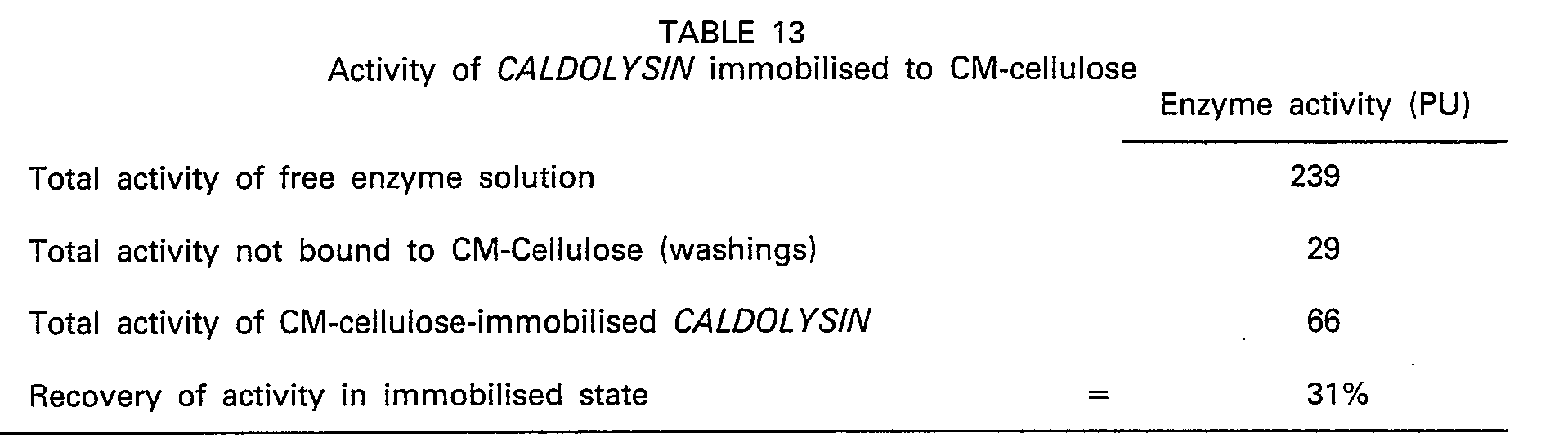
- It has been shown in Examples 5 to 7 that the immobilisation of CALDOL YSIN to various insoluble substrates occurs with considerable differences in the recovery of active immobilised enzyme (i.e. 1 % for glass beads, 31% for CM-cellulose, and 73% for Sepharose 4B). This may be due to loss of activity by denaturation, or differences in inhibition due to the site of the enzyme-matrix covalent linkage.
- The activity retained after immobilisation of CALDOLYSIN to Sepharose (73%) was high when compared to other published data. In binding a range of proteases to Dowex MWA-1 anion exchange resin, Ohmiya et al [(1978) Biotechnology and Bioengineering 20, 1], found activity yields ranging from 3% to 39%. Mason et al. [(1975) Biotechnology and Bioengineering 17, 1019] obtained activity yields of 41.4% and 57.7% on coupling B. subtilis neutral protease to glass by the azo- and glutaraldehyde methods, respectively.
- A range of characteristics of the immobilised CALDOLYSIN preparations, including thermostabilities, pH activity profiles, and Michaelis-Menten kinetics, were compared with those, of the free enzyme. Since the residual activity of the glass-bead immobilised enzyme was extremely low, no further study of this complex was carried out.
- The thermostabilities of the immobilised CALDOLYSIN preparations were determined at different temperatures and calcium concentrations. Volumes of immobilised enzyme were suspended in 0.1 M Tris acetic acid buffer, pH 8.1, containing known concentrations of calcium. The suspensions were incubated at the desired temperature, and aliquots removed at intervals for assay after agitation of the suspension to ensure homogeneity. Immobilised apoenzyme suspensions were obtained by eluting the insoluble complex (held in a Pharmacia K12 glass column) with 10 mm EDTA for several hours, and final washing with distilled water. (The term "apoenzyme" is subject to the conditions discussed previously: it is possible that in the immobilised state, tightly bound calcium ions might not be removed by such treatment). Thermostability data is presented in Table 14.

- The immobilization of CALDOLYSIN on Sepharose results in an increase in thermostability of 3 to 4-fold over a number of different temperatures and conditions, while a thermostability increase of approximately 2-fold results from covalent linkage to CM-cellulose. The decrease in stability of the holo-enzyme Sepharose complex when incubated in a calcium-free buffer suggests that the stabilisation by high calcium concentrations is as significant a factor in the immobilised state as in the free enzyme, while the decreased stability of the Sepharose-immobilised enzyme after EDTA treatment ("apoenzyme") indicates that immobilisation does not prevent the removal of at least some of the calcium-conferred stabilisation.
- The half-lives of CALDOL YSIN in the presence of different concentrations of calcium ions is presented in Table 15. The CALDOLYSIN and ion solutions were prepared as in Example 3(C) (3) above.

Claims (34)
Applications Claiming Priority (2)
| Application Number | Priority Date | Filing Date | Title |
|---|---|---|---|
| NZ19124679 | 1979-08-08 | ||
| NZ191246 | 1979-08-08 |
Publications (3)
| Publication Number | Publication Date |
|---|---|
| EP0024182A2 EP0024182A2 (en) | 1981-02-25 |
| EP0024182A3 EP0024182A3 (en) | 1981-04-22 |
| EP0024182B1 true EP0024182B1 (en) | 1986-05-07 |
Family
ID=19918876
Family Applications (1)
| Application Number | Title | Priority Date | Filing Date |
|---|---|---|---|
| EP80302743A Expired EP0024182B1 (en) | 1979-08-08 | 1980-08-08 | Thermo-stable micro-organism and proteolytic enzyme prepared therefrom, and processes for the preparation of the micro-organism and the proteolytic enzyme |
Country Status (13)
| Country | Link |
|---|---|
| US (2) | US4480036A (en) |
| EP (1) | EP0024182B1 (en) |
| JP (1) | JPS5664786A (en) |
| AU (1) | AU541968B2 (en) |
| CA (1) | CA1177766A (en) |
| DE (1) | DE3071593D1 (en) |
| DK (1) | DK149867C (en) |
| ES (1) | ES8106015A1 (en) |
| GB (1) | GB2055850B (en) |
| IE (1) | IE51742B1 (en) |
| IL (1) | IL60787A (en) |
| IS (1) | IS1191B6 (en) |
| ZA (1) | ZA804833B (en) |
Families Citing this family (22)
| Publication number | Priority date | Publication date | Assignee | Title |
|---|---|---|---|---|
| US4879235A (en) * | 1985-11-29 | 1989-11-07 | The Japanese Research And Development Association For Bioreactor System | Process for producing protease by cultivating a protease-producing mold in a liquid medium |
| US5192677A (en) * | 1986-05-08 | 1993-03-09 | Cornell Research Foundation Inc. | Alkali and heat stable protease from thermomonospora fusca |
| US5283189A (en) * | 1987-02-09 | 1994-02-01 | Research Development Corporation Of Japan | β-galactosidase from Thermus sp |
| DE3834550A1 (en) * | 1988-10-11 | 1990-04-19 | Basf Ag | PROTEOLYTIC ENZYME, ITS MANUFACTURE AND USE |
| US5215907A (en) * | 1989-02-24 | 1993-06-01 | Oklahoma Medical Research Foundation | Thermostable acid protease from sulfolobus acidocaldarius |
| US5173403A (en) * | 1989-02-24 | 1992-12-22 | Oklahoma Medical Research Foundation | Thermostable acid protease from sulfolobus acidocaldarius and gene |
| DK145990D0 (en) * | 1990-06-15 | 1990-06-15 | Novo Nordisk As | THERMOSTABLE PROTEASE |
| US5643777A (en) * | 1990-06-15 | 1997-07-01 | Novo Nordisk A/S | Thermostable protease from thermococcus |
| DK146090D0 (en) * | 1990-06-15 | 1990-06-15 | Novo Nordisk As | THERMOSTABLE PROTEASE |
| DK145890D0 (en) * | 1990-06-15 | 1990-06-15 | Novo Nordisk As | THERMOSTABLE PROTEASE |
| DE4228776A1 (en) * | 1992-08-28 | 1994-03-03 | Bosch Siemens Hausgeraete | Device for enriching water with CO¶2¶ gas to produce carbonated water |
| AU7524994A (en) * | 1993-08-12 | 1995-03-14 | University Of Maryland | Thermostable alkaline metalloprotease produced by a hyphomonas, and preparation thereof |
| WO1998046770A2 (en) * | 1997-04-11 | 1998-10-22 | Thermogen, Inc. | Stable biocatalysts for ester hydrolysis |
| NZ511680A (en) * | 2001-05-14 | 2004-07-30 | Univ Waikato | Method for preparing nucleic acid or DNA samples and a DNA extraction process using thermophilic proteases |
| US7148049B2 (en) | 2002-04-02 | 2006-12-12 | Roche Molecular Systems, Inc. | Thermostable or thermoactive DNA polymerase molecules with attenuated 3′-5′ exonuclease activity |
| ATE532875T1 (en) * | 2004-06-17 | 2011-11-15 | Zygem Corp Ltd | CLEANING METHODS AND THEIR USES |
| NL1028064C2 (en) * | 2005-01-18 | 2006-07-19 | Vhp Ugchelen Bv | Authentication method and system for authenticating security documents and security document. |
| US8815315B2 (en) * | 2007-04-10 | 2014-08-26 | Kemin Industries, Inc. | Use of a multi-protease system to improve the protein digestibility of animal feeds containing vegetable meals |
| WO2010019898A1 (en) * | 2008-08-14 | 2010-02-18 | Zygem Corporation Limited | Temperature controlled nucleic-acid detection method suitable for practice in a closed-system |
| US8968687B2 (en) | 2012-05-29 | 2015-03-03 | Industrial Technology Research Institute | Method for recycling metals |
| US8828238B2 (en) | 2012-05-29 | 2014-09-09 | Industrial Technology Research Instiute | Thermophilic bacterium and uses of extracellular proteins therefrom |
| US10281374B2 (en) * | 2015-11-04 | 2019-05-07 | Diagnostic Biosystems | Method of pretreatment of biological samples for an analyte-staining assay method |
Family Cites Families (7)
| Publication number | Priority date | Publication date | Assignee | Title |
|---|---|---|---|---|
| US3713983A (en) * | 1970-07-06 | 1973-01-30 | Kikkoman Shoyu Co Ltd | Method for preparing a thermostable and alkali-stable protease |
| JPS5345395B2 (en) * | 1972-03-18 | 1978-12-06 | ||
| US3796635A (en) * | 1972-12-26 | 1974-03-12 | Monsanto Co | Process for the preparation of heat resistant neutral protease enzyme |
| DE2434672A1 (en) * | 1973-07-26 | 1975-04-30 | Kreidl Chemico Physical Kg | METHOD AND DEVICE FOR PRODUCING ENZYMATIC REPRODUCTION PRODUCTS OF LOW MOLECULAR SUBSTANCES, IN PARTICULAR FOR DETERMINING THE CONCENTRATION OF LOW MOLECULAR BIOLOGICAL SUBSTANCES BY ENZYMATIC REPRODUCTION |
| SU644796A1 (en) * | 1976-06-09 | 1979-01-30 | Всесоюзный научно-исследовательский институт генетики и селекции промышленных микроорганизмов | Method of purifying proteolytic ferments |
| JPS5413295A (en) * | 1977-06-30 | 1979-01-31 | Matsushita Electric Works Ltd | Display unit |
| JPS54132295A (en) * | 1978-04-05 | 1979-10-15 | Mitsubishi Chem Ind Ltd | Preparation of phosphofructokinase |
-
1980
- 1980-08-07 DK DK339680A patent/DK149867C/en not_active IP Right Cessation
- 1980-08-08 US US06/176,527 patent/US4480036A/en not_active Expired - Lifetime
- 1980-08-08 ES ES494778A patent/ES8106015A1/en not_active Expired
- 1980-08-08 US US06/176,528 patent/US4442214A/en not_active Expired - Lifetime
- 1980-08-08 GB GB8025872A patent/GB2055850B/en not_active Expired
- 1980-08-08 ZA ZA00804833A patent/ZA804833B/en unknown
- 1980-08-08 JP JP10910880A patent/JPS5664786A/en active Pending
- 1980-08-08 EP EP80302743A patent/EP0024182B1/en not_active Expired
- 1980-08-08 CA CA000357832A patent/CA1177766A/en not_active Expired
- 1980-08-08 IE IE1679/80A patent/IE51742B1/en unknown
- 1980-08-08 DE DE8080302743T patent/DE3071593D1/en not_active Expired
- 1980-08-08 IS IS2577A patent/IS1191B6/en unknown
- 1980-08-08 AU AU61200/80A patent/AU541968B2/en not_active Ceased
- 1980-08-08 IL IL60787A patent/IL60787A/en unknown
Also Published As
| Publication number | Publication date |
|---|---|
| US4442214A (en) | 1984-04-10 |
| IL60787A0 (en) | 1980-10-26 |
| US4480036A (en) | 1984-10-30 |
| IL60787A (en) | 1984-08-31 |
| GB2055850A (en) | 1981-03-11 |
| DE3071593D1 (en) | 1986-06-12 |
| GB2055850B (en) | 1983-08-24 |
| CA1177766A (en) | 1984-11-13 |
| AU541968B2 (en) | 1985-01-31 |
| AU6120080A (en) | 1981-02-12 |
| EP0024182A2 (en) | 1981-02-25 |
| ES494778A0 (en) | 1981-07-16 |
| ES8106015A1 (en) | 1981-07-16 |
| JPS5664786A (en) | 1981-06-02 |
| DK339680A (en) | 1981-02-09 |
| ZA804833B (en) | 1981-08-26 |
| DK149867B (en) | 1986-10-13 |
| IS2577A7 (en) | 1981-02-09 |
| IS1191B6 (en) | 1985-06-18 |
| DK149867C (en) | 1987-04-06 |
| IE801679L (en) | 1981-02-08 |
| IE51742B1 (en) | 1987-03-18 |
| EP0024182A3 (en) | 1981-04-22 |
Similar Documents
| Publication | Publication Date | Title |
|---|---|---|
| US4480036A (en) | Proteolytic enzyme | |
| US4628028A (en) | Novel thermostable pullulanase enzyme and method for its production | |
| EP0184019B1 (en) | Thermostable alpha-amylase-producing, thermophilic anaerobic bacteria, thermostable alpha-amylase and process for producing the same | |
| EP0298641B1 (en) | Acid urease and production thereof | |
| US4315988A (en) | Thermophilic collagenases, thermophilic bacteria capable of producing thermophilic collagenases, and process for producing said collagenases | |
| US4420562A (en) | Method for producing creatinase | |
| US5281527A (en) | Process for producing pullalanase | |
| JPS611384A (en) | Preparation of n-acetylneuraminic lyase | |
| CA1219827A (en) | Thermo-stable micro-organism | |
| US5811277A (en) | Method for recovery and purification of isoamylase by adsorption on raw starch | |
| KR830002800B1 (en) | Preparation of heat stable glucoamylase | |
| JPH0364107B2 (en) | ||
| JP3055041B2 (en) | α-1,2-mannosidase, method for producing the same, and bacteria producing the same | |
| JP3027449B2 (en) | Novel cyclomaltodextrinase, method for producing the same, and microorganism producing the enzyme | |
| JPS6248380A (en) | Production of cephalosporin c acylase | |
| JPS6123994B2 (en) | ||
| KR960007741B1 (en) | Novel(alpha)-1,6-glucosidase and process for producing the same | |
| JPS6331195B2 (en) | ||
| JP2903886B2 (en) | Novel amylase and method for producing the same | |
| JPH04211369A (en) | Halophilic alkali amylase and production thereof | |
| JPH0616704B2 (en) | Bacterial catalase resistant to fluoride ions and Micrococcus sp. KWI-5 strain | |
| JPH0757188B2 (en) | Novel thermostable β-galactosidase and method for producing the same | |
| JPH06141854A (en) | Alkali-resistant pyranose oxidase and method for producing the same | |
| Kit et al. | Patents and literature | |
| JPH0458313B2 (en) |
Legal Events
| Date | Code | Title | Description |
|---|---|---|---|
| PUAI | Public reference made under article 153(3) epc to a published international application that has entered the european phase |
Free format text: ORIGINAL CODE: 0009012 |
|
| PUAL | Search report despatched |
Free format text: ORIGINAL CODE: 0009013 |
|
| AK | Designated contracting states |
Designated state(s): CH DE FR GB IT SE |
|
| AK | Designated contracting states |
Designated state(s): CH DE FR GB IT SE |
|
| 17P | Request for examination filed |
Effective date: 19810925 |
|
| ITF | It: translation for a ep patent filed | ||
| GRAA | (expected) grant |
Free format text: ORIGINAL CODE: 0009210 |
|
| AK | Designated contracting states |
Kind code of ref document: B1 Designated state(s): CH DE FR GB IT LI SE |
|
| REF | Corresponds to: |
Ref document number: 3071593 Country of ref document: DE Date of ref document: 19860612 |
|
| ET | Fr: translation filed | ||
| PLBE | No opposition filed within time limit |
Free format text: ORIGINAL CODE: 0009261 |
|
| STAA | Information on the status of an ep patent application or granted ep patent |
Free format text: STATUS: NO OPPOSITION FILED WITHIN TIME LIMIT |
|
| 26N | No opposition filed | ||
| PG25 | Lapsed in a contracting state [announced via postgrant information from national office to epo] |
Ref country code: GB Free format text: LAPSE BECAUSE OF NON-PAYMENT OF DUE FEES Effective date: 19880808 |
|
| PG25 | Lapsed in a contracting state [announced via postgrant information from national office to epo] |
Ref country code: SE Effective date: 19880809 |
|
| PG25 | Lapsed in a contracting state [announced via postgrant information from national office to epo] |
Ref country code: LI Effective date: 19880831 Ref country code: CH Effective date: 19880831 |
|
| PG25 | Lapsed in a contracting state [announced via postgrant information from national office to epo] |
Ref country code: FR Free format text: LAPSE BECAUSE OF NON-PAYMENT OF DUE FEES Effective date: 19890428 |
|
| REG | Reference to a national code |
Ref country code: CH Ref legal event code: PL |
|
| PG25 | Lapsed in a contracting state [announced via postgrant information from national office to epo] |
Ref country code: DE Effective date: 19890503 |
|
| GBPC | Gb: european patent ceased through non-payment of renewal fee | ||
| REG | Reference to a national code |
Ref country code: FR Ref legal event code: ST |
|
| EUG | Se: european patent has lapsed |
Ref document number: 80302743.2 Effective date: 19890510 |