EP0022634B1 - Acylated indole derivatives, processes for their preparation and pharmaceutical compositions and drugs comprising them - Google Patents
Acylated indole derivatives, processes for their preparation and pharmaceutical compositions and drugs comprising them Download PDFInfo
- Publication number
- EP0022634B1 EP0022634B1 EP19800302180 EP80302180A EP0022634B1 EP 0022634 B1 EP0022634 B1 EP 0022634B1 EP 19800302180 EP19800302180 EP 19800302180 EP 80302180 A EP80302180 A EP 80302180A EP 0022634 B1 EP0022634 B1 EP 0022634B1
- Authority
- EP
- European Patent Office
- Prior art keywords
- formula
- compound
- benzoyl
- methylindole
- group
- Prior art date
- Legal status (The legal status is an assumption and is not a legal conclusion. Google has not performed a legal analysis and makes no representation as to the accuracy of the status listed.)
- Expired
Links
- 150000002475 indoles Chemical class 0.000 title claims description 89
- 238000000034 method Methods 0.000 title claims description 25
- 229940079593 drug Drugs 0.000 title claims description 18
- 239000003814 drug Substances 0.000 title claims description 18
- 239000008194 pharmaceutical composition Substances 0.000 title claims description 6
- 238000002360 preparation method Methods 0.000 title description 20
- 150000001875 compounds Chemical class 0.000 claims description 320
- -1 organic disulfide compound Chemical class 0.000 claims description 64
- 125000000217 alkyl group Chemical group 0.000 claims description 53
- 125000004432 carbon atom Chemical group C* 0.000 claims description 52
- 125000001997 phenyl group Chemical group [H]C1=C([H])C([H])=C(*)C([H])=C1[H] 0.000 claims description 42
- 125000004435 hydrogen atom Chemical group [H]* 0.000 claims description 38
- 229910052739 hydrogen Inorganic materials 0.000 claims description 35
- 125000002252 acyl group Chemical group 0.000 claims description 29
- 208000010110 spontaneous platelet aggregation Diseases 0.000 claims description 29
- 125000003884 phenylalkyl group Chemical group 0.000 claims description 28
- 150000008065 acid anhydrides Chemical class 0.000 claims description 24
- 239000001257 hydrogen Substances 0.000 claims description 24
- XMBWDFGMSWQBCA-UHFFFAOYSA-N hydrogen iodide Chemical compound I XMBWDFGMSWQBCA-UHFFFAOYSA-N 0.000 claims description 24
- 125000002887 hydroxy group Chemical group [H]O* 0.000 claims description 21
- 125000002496 methyl group Chemical group [H]C([H])([H])* 0.000 claims description 21
- 125000001113 thiadiazolyl group Chemical group 0.000 claims description 21
- 125000002883 imidazolyl group Chemical group 0.000 claims description 19
- 125000004076 pyridyl group Chemical group 0.000 claims description 18
- 150000007514 bases Chemical class 0.000 claims description 17
- FRUWMYWEARDNTC-UHFFFAOYSA-N 2,3,3a,4-tetrahydro-1h-indole Chemical class C1C=CC=C2NCCC21 FRUWMYWEARDNTC-UHFFFAOYSA-N 0.000 claims description 16
- 229910000043 hydrogen iodide Inorganic materials 0.000 claims description 16
- 125000005843 halogen group Chemical group 0.000 claims description 14
- 125000001544 thienyl group Chemical group 0.000 claims description 14
- 150000003839 salts Chemical class 0.000 claims description 13
- 238000006356 dehydrogenation reaction Methods 0.000 claims description 12
- 125000001424 substituent group Chemical group 0.000 claims description 12
- 230000005764 inhibitory process Effects 0.000 claims description 10
- 125000003545 alkoxy group Chemical group 0.000 claims description 9
- 229910052801 chlorine Inorganic materials 0.000 claims description 9
- 150000002366 halogen compounds Chemical class 0.000 claims description 9
- 230000003301 hydrolyzing effect Effects 0.000 claims description 8
- 125000000956 methoxy group Chemical group [H]C([H])([H])O* 0.000 claims description 6
- UMGDCJDMYOKAJW-UHFFFAOYSA-N thiourea Chemical compound NC(N)=S UMGDCJDMYOKAJW-UHFFFAOYSA-N 0.000 claims description 6
- 229910052783 alkali metal Inorganic materials 0.000 claims description 5
- 239000003937 drug carrier Substances 0.000 claims description 5
- 229910052736 halogen Inorganic materials 0.000 claims description 5
- 150000002367 halogens Chemical group 0.000 claims description 5
- XSQUKJJJFZCRTK-UHFFFAOYSA-N Urea Natural products NC(N)=O XSQUKJJJFZCRTK-UHFFFAOYSA-N 0.000 claims description 3
- 150000001340 alkali metals Chemical class 0.000 claims description 3
- 125000001309 chloro group Chemical group Cl* 0.000 claims description 3
- 230000001590 oxidative effect Effects 0.000 claims description 3
- 125000003739 carbamimidoyl group Chemical group C(N)(=N)* 0.000 claims description 2
- 150000003566 thiocarboxylic acids Chemical class 0.000 claims description 2
- XYFCBTPGUUZFHI-UHFFFAOYSA-N Phosphine Natural products P XYFCBTPGUUZFHI-UHFFFAOYSA-N 0.000 claims 1
- 229910000073 phosphorus hydride Inorganic materials 0.000 claims 1
- 238000006243 chemical reaction Methods 0.000 description 229
- SIKJAQJRHWYJAI-UHFFFAOYSA-N benzopyrrole Natural products C1=CC=C2NC=CC2=C1 SIKJAQJRHWYJAI-UHFFFAOYSA-N 0.000 description 124
- XEKOWRVHYACXOJ-UHFFFAOYSA-N Ethyl acetate Chemical compound CCOC(C)=O XEKOWRVHYACXOJ-UHFFFAOYSA-N 0.000 description 117
- HEDRZPFGACZZDS-MICDWDOJSA-N Trichloro(2H)methane Chemical compound [2H]C(Cl)(Cl)Cl HEDRZPFGACZZDS-MICDWDOJSA-N 0.000 description 113
- HEDRZPFGACZZDS-UHFFFAOYSA-N Chloroform Chemical compound ClC(Cl)Cl HEDRZPFGACZZDS-UHFFFAOYSA-N 0.000 description 109
- UHOVQNZJYSORNB-UHFFFAOYSA-N Benzene Chemical compound C1=CC=CC=C1 UHOVQNZJYSORNB-UHFFFAOYSA-N 0.000 description 96
- 230000015572 biosynthetic process Effects 0.000 description 82
- 238000003786 synthesis reaction Methods 0.000 description 76
- PZOUSPYUWWUPPK-UHFFFAOYSA-N indole Natural products CC1=CC=CC2=C1C=CN2 PZOUSPYUWWUPPK-UHFFFAOYSA-N 0.000 description 70
- RKJUIXBNRJVNHR-UHFFFAOYSA-N indolenine Natural products C1=CC=C2CC=NC2=C1 RKJUIXBNRJVNHR-UHFFFAOYSA-N 0.000 description 70
- 239000000047 product Substances 0.000 description 58
- 239000000203 mixture Substances 0.000 description 54
- 239000000243 solution Substances 0.000 description 51
- OKKJLVBELUTLKV-UHFFFAOYSA-N Methanol Chemical compound OC OKKJLVBELUTLKV-UHFFFAOYSA-N 0.000 description 48
- RTZKZFJDLAIYFH-UHFFFAOYSA-N ether Substances CCOCC RTZKZFJDLAIYFH-UHFFFAOYSA-N 0.000 description 41
- XLYOFNOQVPJJNP-UHFFFAOYSA-N water Substances O XLYOFNOQVPJJNP-UHFFFAOYSA-N 0.000 description 41
- 239000007864 aqueous solution Substances 0.000 description 39
- JUJWROOIHBZHMG-UHFFFAOYSA-N Pyridine Chemical compound C1=CC=NC=C1 JUJWROOIHBZHMG-UHFFFAOYSA-N 0.000 description 36
- 230000002829 reductive effect Effects 0.000 description 34
- YMWUJEATGCHHMB-UHFFFAOYSA-N Dichloromethane Chemical compound ClCCl YMWUJEATGCHHMB-UHFFFAOYSA-N 0.000 description 30
- HEMHJVSKTPXQMS-UHFFFAOYSA-M Sodium hydroxide Chemical compound [OH-].[Na+] HEMHJVSKTPXQMS-UHFFFAOYSA-M 0.000 description 30
- WYURNTSHIVDZCO-UHFFFAOYSA-N Tetrahydrofuran Chemical compound C1CCOC1 WYURNTSHIVDZCO-UHFFFAOYSA-N 0.000 description 30
- 239000011541 reaction mixture Substances 0.000 description 30
- FAPWRFPIFSIZLT-UHFFFAOYSA-M Sodium chloride Chemical compound [Na+].[Cl-] FAPWRFPIFSIZLT-UHFFFAOYSA-M 0.000 description 28
- 239000003960 organic solvent Substances 0.000 description 28
- QTBSBXVTEAMEQO-UHFFFAOYSA-N Acetic acid Chemical compound CC(O)=O QTBSBXVTEAMEQO-UHFFFAOYSA-N 0.000 description 27
- WFDIJRYMOXRFFG-UHFFFAOYSA-N Acetic anhydride Chemical compound CC(=O)OC(C)=O WFDIJRYMOXRFFG-UHFFFAOYSA-N 0.000 description 27
- ZMXDDKWLCZADIW-UHFFFAOYSA-N N,N-Dimethylformamide Chemical compound CN(C)C=O ZMXDDKWLCZADIW-UHFFFAOYSA-N 0.000 description 27
- VLKZOEOYAKHREP-UHFFFAOYSA-N n-Hexane Chemical compound CCCCCC VLKZOEOYAKHREP-UHFFFAOYSA-N 0.000 description 27
- 238000005917 acylation reaction Methods 0.000 description 26
- VYPSYNLAJGMNEJ-UHFFFAOYSA-N Silicium dioxide Chemical compound O=[Si]=O VYPSYNLAJGMNEJ-UHFFFAOYSA-N 0.000 description 25
- 239000000741 silica gel Substances 0.000 description 24
- 229910002027 silica gel Inorganic materials 0.000 description 24
- 239000003480 eluent Substances 0.000 description 23
- 238000006460 hydrolysis reaction Methods 0.000 description 23
- 229920006395 saturated elastomer Polymers 0.000 description 23
- 239000002904 solvent Substances 0.000 description 23
- LFQSCWFLJHTTHZ-UHFFFAOYSA-N Ethanol Chemical compound CCO LFQSCWFLJHTTHZ-UHFFFAOYSA-N 0.000 description 21
- 0 *c1c(C(C2C=CC=NC2)=O)c(cccc2)c2[n]1* Chemical compound *c1c(C(C2C=CC=NC2)=O)c(cccc2)c2[n]1* 0.000 description 20
- 238000004519 manufacturing process Methods 0.000 description 20
- IJGRMHOSHXDMSA-UHFFFAOYSA-N Atomic nitrogen Chemical compound N#N IJGRMHOSHXDMSA-UHFFFAOYSA-N 0.000 description 18
- YXFVVABEGXRONW-UHFFFAOYSA-N Toluene Chemical compound CC1=CC=CC=C1 YXFVVABEGXRONW-UHFFFAOYSA-N 0.000 description 18
- UMJSCPRVCHMLSP-UHFFFAOYSA-N pyridine Natural products COC1=CC=CN=C1 UMJSCPRVCHMLSP-UHFFFAOYSA-N 0.000 description 18
- 238000012360 testing method Methods 0.000 description 18
- 239000012043 crude product Substances 0.000 description 17
- UIIMBOGNXHQVGW-UHFFFAOYSA-M Sodium bicarbonate Chemical compound [Na+].OC([O-])=O UIIMBOGNXHQVGW-UHFFFAOYSA-M 0.000 description 16
- 230000002401 inhibitory effect Effects 0.000 description 16
- DNIAPMSPPWPWGF-UHFFFAOYSA-N Propylene glycol Chemical compound CC(O)CO DNIAPMSPPWPWGF-UHFFFAOYSA-N 0.000 description 15
- PMZURENOXWZQFD-UHFFFAOYSA-L Sodium Sulfate Chemical compound [Na+].[Na+].[O-]S([O-])(=O)=O PMZURENOXWZQFD-UHFFFAOYSA-L 0.000 description 15
- 230000007062 hydrolysis Effects 0.000 description 15
- YLQBMQCUIZJEEH-UHFFFAOYSA-N tetrahydrofuran Natural products C=1C=COC=1 YLQBMQCUIZJEEH-UHFFFAOYSA-N 0.000 description 15
- 238000010992 reflux Methods 0.000 description 14
- 239000011780 sodium chloride Substances 0.000 description 14
- 238000003756 stirring Methods 0.000 description 14
- CSNNHWWHGAXBCP-UHFFFAOYSA-L Magnesium sulfate Chemical compound [Mg+2].[O-][S+2]([O-])([O-])[O-] CSNNHWWHGAXBCP-UHFFFAOYSA-L 0.000 description 13
- KEAYESYHFKHZAL-UHFFFAOYSA-N Sodium Chemical compound [Na] KEAYESYHFKHZAL-UHFFFAOYSA-N 0.000 description 13
- 229910052799 carbon Inorganic materials 0.000 description 13
- 239000012312 sodium hydride Substances 0.000 description 13
- 229910000104 sodium hydride Inorganic materials 0.000 description 13
- BHNHHSOHWZKFOX-UHFFFAOYSA-N 2-methyl-1H-indole Chemical compound C1=CC=C2NC(C)=CC2=C1 BHNHHSOHWZKFOX-UHFFFAOYSA-N 0.000 description 12
- XTHFKEDIFFGKHM-UHFFFAOYSA-N Dimethoxyethane Chemical compound COCCOC XTHFKEDIFFGKHM-UHFFFAOYSA-N 0.000 description 12
- IAZDPXIOMUYVGZ-UHFFFAOYSA-N Dimethylsulphoxide Chemical compound CS(C)=O IAZDPXIOMUYVGZ-UHFFFAOYSA-N 0.000 description 12
- INQOMBQAUSQDDS-UHFFFAOYSA-N iodomethane Chemical compound IC INQOMBQAUSQDDS-UHFFFAOYSA-N 0.000 description 12
- 239000007788 liquid Substances 0.000 description 12
- RYHBNJHYFVUHQT-UHFFFAOYSA-N 1,4-Dioxane Chemical compound C1COCCO1 RYHBNJHYFVUHQT-UHFFFAOYSA-N 0.000 description 10
- NOGFHTGYPKWWRX-UHFFFAOYSA-N 2,2,6,6-tetramethyloxan-4-one Chemical compound CC1(C)CC(=O)CC(C)(C)O1 NOGFHTGYPKWWRX-UHFFFAOYSA-N 0.000 description 10
- 238000004220 aggregation Methods 0.000 description 10
- 230000002776 aggregation Effects 0.000 description 10
- 239000003795 chemical substances by application Substances 0.000 description 10
- 239000012280 lithium aluminium hydride Substances 0.000 description 10
- 229910052757 nitrogen Inorganic materials 0.000 description 10
- 125000004430 oxygen atom Chemical group O* 0.000 description 10
- ZMANZCXQSJIPKH-UHFFFAOYSA-N Triethylamine Chemical compound CCN(CC)CC ZMANZCXQSJIPKH-UHFFFAOYSA-N 0.000 description 9
- 235000011054 acetic acid Nutrition 0.000 description 9
- 239000002253 acid Substances 0.000 description 9
- 239000008280 blood Substances 0.000 description 9
- 210000004369 blood Anatomy 0.000 description 9
- GDTBXPJZTBHREO-UHFFFAOYSA-N bromine Substances BrBr GDTBXPJZTBHREO-UHFFFAOYSA-N 0.000 description 9
- 238000001816 cooling Methods 0.000 description 9
- 210000002784 stomach Anatomy 0.000 description 9
- GUUVPOWQJOLRAS-UHFFFAOYSA-N Diphenyl disulfide Chemical compound C=1C=CC=CC=1SSC1=CC=CC=C1 GUUVPOWQJOLRAS-UHFFFAOYSA-N 0.000 description 8
- 241000700159 Rattus Species 0.000 description 8
- 125000001495 ethyl group Chemical group [H]C([H])([H])C([H])([H])* 0.000 description 8
- HVTICUPFWKNHNG-UHFFFAOYSA-N iodoethane Chemical compound CCI HVTICUPFWKNHNG-UHFFFAOYSA-N 0.000 description 8
- 229910000030 sodium bicarbonate Inorganic materials 0.000 description 8
- DDMGAAYEUNWXSI-XVSDJDOKSA-M sodium;(5z,8z,11z,14z)-icosa-5,8,11,14-tetraenoate Chemical compound [Na+].CCCCC\C=C/C\C=C/C\C=C/C\C=C/CCCC([O-])=O DDMGAAYEUNWXSI-XVSDJDOKSA-M 0.000 description 8
- 239000007787 solid Substances 0.000 description 8
- VEXZGXHMUGYJMC-UHFFFAOYSA-N Hydrochloric acid Chemical compound Cl VEXZGXHMUGYJMC-UHFFFAOYSA-N 0.000 description 7
- 239000004480 active ingredient Substances 0.000 description 7
- HAXFWIACAGNFHA-UHFFFAOYSA-N aldrithiol Chemical compound C=1C=CC=NC=1SSC1=CC=CC=N1 HAXFWIACAGNFHA-UHFFFAOYSA-N 0.000 description 7
- 229910052794 bromium Inorganic materials 0.000 description 7
- 239000000460 chlorine Substances 0.000 description 7
- 125000001041 indolyl group Chemical group 0.000 description 7
- CSCPPACGZOOCGX-UHFFFAOYSA-N Acetone Chemical compound CC(C)=O CSCPPACGZOOCGX-UHFFFAOYSA-N 0.000 description 6
- 229920000858 Cyclodextrin Polymers 0.000 description 6
- CTQNGGLPUBDAKN-UHFFFAOYSA-N O-Xylene Chemical compound CC1=CC=CC=C1C CTQNGGLPUBDAKN-UHFFFAOYSA-N 0.000 description 6
- MUBZPKHOEPUJKR-UHFFFAOYSA-N Oxalic acid Chemical compound OC(=O)C(O)=O MUBZPKHOEPUJKR-UHFFFAOYSA-N 0.000 description 6
- KWYUFKZDYYNOTN-UHFFFAOYSA-M Potassium hydroxide Chemical compound [OH-].[K+] KWYUFKZDYYNOTN-UHFFFAOYSA-M 0.000 description 6
- 208000025865 Ulcer Diseases 0.000 description 6
- 230000004931 aggregating effect Effects 0.000 description 6
- 239000007795 chemical reaction product Substances 0.000 description 6
- 238000006482 condensation reaction Methods 0.000 description 6
- LJSQFQKUNVCTIA-UHFFFAOYSA-N diethyl sulfide Chemical compound CCSCC LJSQFQKUNVCTIA-UHFFFAOYSA-N 0.000 description 6
- 238000006266 etherification reaction Methods 0.000 description 6
- GNOIPBMMFNIUFM-UHFFFAOYSA-N hexamethylphosphoric triamide Chemical compound CN(C)P(=O)(N(C)C)N(C)C GNOIPBMMFNIUFM-UHFFFAOYSA-N 0.000 description 6
- 125000001449 isopropyl group Chemical group [H]C([H])([H])C([H])(*)C([H])([H])[H] 0.000 description 6
- HQKMJHAJHXVSDF-UHFFFAOYSA-L magnesium stearate Chemical compound [Mg+2].CCCCCCCCCCCCCCCCCC([O-])=O.CCCCCCCCCCCCCCCCCC([O-])=O HQKMJHAJHXVSDF-UHFFFAOYSA-L 0.000 description 6
- 229910052943 magnesium sulfate Inorganic materials 0.000 description 6
- 235000019341 magnesium sulphate Nutrition 0.000 description 6
- 239000002504 physiological saline solution Substances 0.000 description 6
- 235000017557 sodium bicarbonate Nutrition 0.000 description 6
- 239000003826 tablet Substances 0.000 description 6
- 231100000397 ulcer Toxicity 0.000 description 6
- 239000008096 xylene Substances 0.000 description 6
- HZNVUJQVZSTENZ-UHFFFAOYSA-N 2,3-dichloro-5,6-dicyano-1,4-benzoquinone Chemical compound ClC1=C(Cl)C(=O)C(C#N)=C(C#N)C1=O HZNVUJQVZSTENZ-UHFFFAOYSA-N 0.000 description 5
- 125000000175 2-thienyl group Chemical group S1C([*])=C([H])C([H])=C1[H] 0.000 description 5
- ZCYVEMRRCGMTRW-UHFFFAOYSA-N 7553-56-2 Chemical compound [I] ZCYVEMRRCGMTRW-UHFFFAOYSA-N 0.000 description 5
- WKBOTKDWSSQWDR-UHFFFAOYSA-N Bromine atom Chemical compound [Br] WKBOTKDWSSQWDR-UHFFFAOYSA-N 0.000 description 5
- ZAMOUSCENKQFHK-UHFFFAOYSA-N Chlorine atom Chemical compound [Cl] ZAMOUSCENKQFHK-UHFFFAOYSA-N 0.000 description 5
- WSFSSNUMVMOOMR-UHFFFAOYSA-N Formaldehyde Chemical compound O=C WSFSSNUMVMOOMR-UHFFFAOYSA-N 0.000 description 5
- 241001465754 Metazoa Species 0.000 description 5
- UIIMBOGNXHQVGW-DEQYMQKBSA-M Sodium bicarbonate-14C Chemical compound [Na+].O[14C]([O-])=O UIIMBOGNXHQVGW-DEQYMQKBSA-M 0.000 description 5
- 239000007810 chemical reaction solvent Substances 0.000 description 5
- 239000012467 final product Substances 0.000 description 5
- CGIGDMFJXJATDK-UHFFFAOYSA-N indomethacin Chemical compound CC1=C(CC(O)=O)C2=CC(OC)=CC=C2N1C(=O)C1=CC=C(Cl)C=C1 CGIGDMFJXJATDK-UHFFFAOYSA-N 0.000 description 5
- 239000010410 layer Substances 0.000 description 5
- 125000004123 n-propyl group Chemical group [H]C([H])([H])C([H])([H])C([H])([H])* 0.000 description 5
- 239000012044 organic layer Substances 0.000 description 5
- HFHDHCJBZVLPGP-UHFFFAOYSA-N schardinger α-dextrin Chemical compound O1C(C(C2O)O)C(CO)OC2OC(C(C2O)O)C(CO)OC2OC(C(C2O)O)C(CO)OC2OC(C(O)C2O)C(CO)OC2OC(C(C2O)O)C(CO)OC2OC2C(O)C(O)C1OC2CO HFHDHCJBZVLPGP-UHFFFAOYSA-N 0.000 description 5
- 230000003595 spectral effect Effects 0.000 description 5
- 239000000725 suspension Substances 0.000 description 5
- GSKSRSDEWXVQKG-UHFFFAOYSA-N 2-(3-benzoyl-5-methoxy-2-methylindol-1-yl)propyl acetate Chemical compound C12=CC(OC)=CC=C2N(C(C)COC(C)=O)C(C)=C1C(=O)C1=CC=CC=C1 GSKSRSDEWXVQKG-UHFFFAOYSA-N 0.000 description 4
- UHBAPGWWRFVTFS-UHFFFAOYSA-N 4,4'-dipyridyl disulfide Chemical compound C=1C=NC=CC=1SSC1=CC=NC=C1 UHBAPGWWRFVTFS-UHFFFAOYSA-N 0.000 description 4
- 241000700198 Cavia Species 0.000 description 4
- UFHFLCQGNIYNRP-UHFFFAOYSA-N Hydrogen Chemical compound [H][H] UFHFLCQGNIYNRP-UHFFFAOYSA-N 0.000 description 4
- JRNVZBWKYDBUCA-UHFFFAOYSA-N N-chlorosuccinimide Chemical compound ClN1C(=O)CCC1=O JRNVZBWKYDBUCA-UHFFFAOYSA-N 0.000 description 4
- WQDUMFSSJAZKTM-UHFFFAOYSA-N Sodium methoxide Chemical compound [Na+].[O-]C WQDUMFSSJAZKTM-UHFFFAOYSA-N 0.000 description 4
- QAOWNCQODCNURD-UHFFFAOYSA-N Sulfuric acid Chemical compound OS(O)(=O)=O QAOWNCQODCNURD-UHFFFAOYSA-N 0.000 description 4
- 125000001797 benzyl group Chemical group [H]C1=C([H])C([H])=C(C([H])=C1[H])C([H])([H])* 0.000 description 4
- 239000002775 capsule Substances 0.000 description 4
- 239000003054 catalyst Substances 0.000 description 4
- MVPPADPHJFYWMZ-UHFFFAOYSA-N chlorobenzene Chemical compound ClC1=CC=CC=C1 MVPPADPHJFYWMZ-UHFFFAOYSA-N 0.000 description 4
- 238000001914 filtration Methods 0.000 description 4
- 239000008187 granular material Substances 0.000 description 4
- 125000000623 heterocyclic group Chemical group 0.000 description 4
- BNSOYWDFFBDEFB-UHFFFAOYSA-L hydroxy-(hydroxy(dioxo)chromio)oxy-dioxochromium;pyridine Chemical compound C1=CC=NC=C1.O[Cr](=O)(=O)O[Cr](O)(=O)=O BNSOYWDFFBDEFB-UHFFFAOYSA-L 0.000 description 4
- 229910052740 iodine Inorganic materials 0.000 description 4
- 125000000959 isobutyl group Chemical group [H]C([H])([H])C([H])(C([H])([H])[H])C([H])([H])* 0.000 description 4
- JVTAAEKCZFNVCJ-UHFFFAOYSA-N lactic acid Chemical compound CC(O)C(O)=O JVTAAEKCZFNVCJ-UHFFFAOYSA-N 0.000 description 4
- 238000002844 melting Methods 0.000 description 4
- 230000008018 melting Effects 0.000 description 4
- LQNUZADURLCDLV-UHFFFAOYSA-N nitrobenzene Chemical compound [O-][N+](=O)C1=CC=CC=C1 LQNUZADURLCDLV-UHFFFAOYSA-N 0.000 description 4
- 239000003921 oil Substances 0.000 description 4
- 235000019198 oils Nutrition 0.000 description 4
- BWHMMNNQKKPAPP-UHFFFAOYSA-L potassium carbonate Substances [K+].[K+].[O-]C([O-])=O BWHMMNNQKKPAPP-UHFFFAOYSA-L 0.000 description 4
- 229910000105 potassium hydride Inorganic materials 0.000 description 4
- NTTOTNSKUYCDAV-UHFFFAOYSA-N potassium hydride Chemical compound [KH] NTTOTNSKUYCDAV-UHFFFAOYSA-N 0.000 description 4
- 150000003141 primary amines Chemical class 0.000 description 4
- JQWHASGSAFIOCM-UHFFFAOYSA-M sodium periodate Chemical compound [Na+].[O-]I(=O)(=O)=O JQWHASGSAFIOCM-UHFFFAOYSA-M 0.000 description 4
- 229910052938 sodium sulfate Inorganic materials 0.000 description 4
- 235000011152 sodium sulphate Nutrition 0.000 description 4
- 239000007858 starting material Substances 0.000 description 4
- HJUGFYREWKUQJT-UHFFFAOYSA-N tetrabromomethane Chemical compound BrC(Br)(Br)Br HJUGFYREWKUQJT-UHFFFAOYSA-N 0.000 description 4
- VZGDMQKNWNREIO-UHFFFAOYSA-N tetrachloromethane Chemical compound ClC(Cl)(Cl)Cl VZGDMQKNWNREIO-UHFFFAOYSA-N 0.000 description 4
- FYSNRJHAOHDILO-UHFFFAOYSA-N thionyl chloride Chemical compound ClS(Cl)=O FYSNRJHAOHDILO-UHFFFAOYSA-N 0.000 description 4
- RIOQSEWOXXDEQQ-UHFFFAOYSA-N triphenylphosphine Chemical compound C1=CC=CC=C1P(C=1C=CC=CC=1)C1=CC=CC=C1 RIOQSEWOXXDEQQ-UHFFFAOYSA-N 0.000 description 4
- FXHZZMQCBGDNSC-UHFFFAOYSA-N (1-butan-2-yl-2-methylindol-3-yl)-phenylmethanone Chemical compound C12=CC=CC=C2N(C(C)CC)C(C)=C1C(=O)C1=CC=CC=C1 FXHZZMQCBGDNSC-UHFFFAOYSA-N 0.000 description 3
- OIWGYVOWFWHZGT-UHFFFAOYSA-N 3-(2-methylindol-1-yl)butan-1-ol Chemical compound C1=CC=C2N(C(CCO)C)C(C)=CC2=C1 OIWGYVOWFWHZGT-UHFFFAOYSA-N 0.000 description 3
- YLOQFCAWHKQBIQ-UHFFFAOYSA-N 3-(2-methylindol-1-yl)butyl acetate Chemical compound C1=CC=C2N(C(CCOC(C)=O)C)C(C)=CC2=C1 YLOQFCAWHKQBIQ-UHFFFAOYSA-N 0.000 description 3
- BWGNESOTFCXPMA-UHFFFAOYSA-N Dihydrogen disulfide Chemical compound SS BWGNESOTFCXPMA-UHFFFAOYSA-N 0.000 description 3
- QMMFVYPAHWMCMS-UHFFFAOYSA-N Dimethyl sulfide Chemical compound CSC QMMFVYPAHWMCMS-UHFFFAOYSA-N 0.000 description 3
- 239000007818 Grignard reagent Substances 0.000 description 3
- WHXSMMKQMYFTQS-UHFFFAOYSA-N Lithium Chemical compound [Li] WHXSMMKQMYFTQS-UHFFFAOYSA-N 0.000 description 3
- FYYHWMGAXLPEAU-UHFFFAOYSA-N Magnesium Chemical compound [Mg] FYYHWMGAXLPEAU-UHFFFAOYSA-N 0.000 description 3
- UASWGMVKNGKLBK-UHFFFAOYSA-N [2-methyl-1-(4-phenylsulfanylbutan-2-yl)indol-3-yl]-phenylmethanone Chemical compound CC1=C(C(=O)C=2C=CC=CC=2)C2=CC=CC=C2N1C(C)CCSC1=CC=CC=C1 UASWGMVKNGKLBK-UHFFFAOYSA-N 0.000 description 3
- 150000007513 acids Chemical class 0.000 description 3
- 230000010933 acylation Effects 0.000 description 3
- 150000001350 alkyl halides Chemical class 0.000 description 3
- HFHDHCJBZVLPGP-RWMJIURBSA-N alpha-cyclodextrin Chemical compound OC[C@H]([C@H]([C@@H]([C@H]1O)O)O[C@H]2O[C@@H]([C@@H](O[C@H]3O[C@H](CO)[C@H]([C@@H]([C@H]3O)O)O[C@H]3O[C@H](CO)[C@H]([C@@H]([C@H]3O)O)O[C@H]3O[C@H](CO)[C@H]([C@@H]([C@H]3O)O)O3)[C@H](O)[C@H]2O)CO)O[C@@H]1O[C@H]1[C@H](O)[C@@H](O)[C@@H]3O[C@@H]1CO HFHDHCJBZVLPGP-RWMJIURBSA-N 0.000 description 3
- YNQLUTRBYVCPMQ-UHFFFAOYSA-N alpha-methyl toluene Natural products CCC1=CC=CC=C1 YNQLUTRBYVCPMQ-UHFFFAOYSA-N 0.000 description 3
- 229940054051 antipsychotic indole derivative Drugs 0.000 description 3
- 230000037396 body weight Effects 0.000 description 3
- 238000010511 deprotection reaction Methods 0.000 description 3
- MTHSVFCYNBDYFN-UHFFFAOYSA-N diethylene glycol Chemical compound OCCOCCO MTHSVFCYNBDYFN-UHFFFAOYSA-N 0.000 description 3
- 150000002019 disulfides Chemical class 0.000 description 3
- 239000002552 dosage form Substances 0.000 description 3
- 238000001035 drying Methods 0.000 description 3
- 230000000694 effects Effects 0.000 description 3
- ARFLASKVLJTEJD-UHFFFAOYSA-N ethyl 2-bromopropanoate Chemical compound CCOC(=O)C(C)Br ARFLASKVLJTEJD-UHFFFAOYSA-N 0.000 description 3
- 239000000706 filtrate Substances 0.000 description 3
- 150000004795 grignard reagents Chemical class 0.000 description 3
- 230000002140 halogenating effect Effects 0.000 description 3
- 238000000338 in vitro Methods 0.000 description 3
- 239000012442 inert solvent Substances 0.000 description 3
- 239000011777 magnesium Substances 0.000 description 3
- 229910052749 magnesium Inorganic materials 0.000 description 3
- 235000019359 magnesium stearate Nutrition 0.000 description 3
- 150000002762 monocarboxylic acid derivatives Chemical class 0.000 description 3
- 125000000740 n-pentyl group Chemical group [H]C([H])([H])C([H])([H])C([H])([H])C([H])([H])C([H])([H])* 0.000 description 3
- 210000000056 organ Anatomy 0.000 description 3
- 230000000144 pharmacologic effect Effects 0.000 description 3
- 230000002265 prevention Effects 0.000 description 3
- 239000011734 sodium Substances 0.000 description 3
- 229910052708 sodium Inorganic materials 0.000 description 3
- 229910052717 sulfur Inorganic materials 0.000 description 3
- 238000004809 thin layer chromatography Methods 0.000 description 3
- DJESRHQVJWDIBL-UHFFFAOYSA-N (1-heptan-2-yl-2-methylindol-3-yl)-phenylmethanone Chemical compound C12=CC=CC=C2N(C(C)CCCCC)C(C)=C1C(=O)C1=CC=CC=C1 DJESRHQVJWDIBL-UHFFFAOYSA-N 0.000 description 2
- XHYBBTHIUVFTSQ-UHFFFAOYSA-N (1-hexan-2-yl-2-methylindol-3-yl)-phenylmethanone Chemical compound C12=CC=CC=C2N(C(C)CCCC)C(C)=C1C(=O)C1=CC=CC=C1 XHYBBTHIUVFTSQ-UHFFFAOYSA-N 0.000 description 2
- GLVIAFGRLVTIAV-UHFFFAOYSA-N (2-fluorophenyl)-[1-(4-hydroxybutan-2-yl)-2-methylindol-3-yl]methanone Chemical compound C12=CC=CC=C2N(C(CCO)C)C(C)=C1C(=O)C1=CC=CC=C1F GLVIAFGRLVTIAV-UHFFFAOYSA-N 0.000 description 2
- YGPMGBZGMRZWOV-UHFFFAOYSA-N (2-methyl-1-pentan-2-ylindol-3-yl)-phenylmethanone Chemical compound C12=CC=CC=C2N(C(C)CCC)C(C)=C1C(=O)C1=CC=CC=C1 YGPMGBZGMRZWOV-UHFFFAOYSA-N 0.000 description 2
- CNUDXZIIVQXZPC-UHFFFAOYSA-N (2-methyl-1h-indol-3-yl)-phenylmethanone Chemical compound CC=1NC2=CC=CC=C2C=1C(=O)C1=CC=CC=C1 CNUDXZIIVQXZPC-UHFFFAOYSA-N 0.000 description 2
- QPFMBZIOSGYJDE-UHFFFAOYSA-N 1,1,2,2-tetrachloroethane Chemical compound ClC(Cl)C(Cl)Cl QPFMBZIOSGYJDE-UHFFFAOYSA-N 0.000 description 2
- FRTKZCWANAWRDS-UHFFFAOYSA-N 1-(1-methoxypropan-2-yl)-2-methylindole Chemical compound C1=CC=C2N(C(C)COC)C(C)=CC2=C1 FRTKZCWANAWRDS-UHFFFAOYSA-N 0.000 description 2
- NPILITGRALTFFF-UHFFFAOYSA-N 1-(4-bromobutan-2-yl)-2-methylindole Chemical compound C1=CC=C2N(C(CCBr)C)C(C)=CC2=C1 NPILITGRALTFFF-UHFFFAOYSA-N 0.000 description 2
- DLXVNGZACIGLPR-UHFFFAOYSA-N 1-hexan-2-yl-2-methylindole Chemical compound C1=CC=C2N(C(C)CCCC)C(C)=CC2=C1 DLXVNGZACIGLPR-UHFFFAOYSA-N 0.000 description 2
- OVSKIKFHRZPJSS-UHFFFAOYSA-N 2,4-D Chemical compound OC(=O)COC1=CC=C(Cl)C=C1Cl OVSKIKFHRZPJSS-UHFFFAOYSA-N 0.000 description 2
- ZFLFWZRPMDXJCW-UHFFFAOYSA-N 2,5-dimethyl-1h-indole Chemical compound CC1=CC=C2NC(C)=CC2=C1 ZFLFWZRPMDXJCW-UHFFFAOYSA-N 0.000 description 2
- JFCYODMCSKQPJP-UHFFFAOYSA-N 2-(2,3,3a,4-tetrahydroindol-1-yl)ethanol Chemical compound C1C=CC=C2N(CCO)CCC21 JFCYODMCSKQPJP-UHFFFAOYSA-N 0.000 description 2
- ZZJRBNKPYHGXCS-UHFFFAOYSA-N 2-(2-methyl-4,5,6,7-tetrahydroindol-1-yl)propyl acetate Chemical compound C1CCCC2=C1C=C(C)N2C(COC(C)=O)C ZZJRBNKPYHGXCS-UHFFFAOYSA-N 0.000 description 2
- TXKSXIJMZJJYEI-UHFFFAOYSA-N 2-(2-methylindol-1-yl)propyl acetate Chemical compound C1=CC=C2N(C(COC(C)=O)C)C(C)=CC2=C1 TXKSXIJMZJJYEI-UHFFFAOYSA-N 0.000 description 2
- JFUGPQXKINTUFC-UHFFFAOYSA-N 2-(3-benzoyl-2-methyl-4,5,6,7-tetrahydroindol-1-yl)propyl acetate Chemical compound C1=2CCCCC=2N(C(COC(C)=O)C)C(C)=C1C(=O)C1=CC=CC=C1 JFUGPQXKINTUFC-UHFFFAOYSA-N 0.000 description 2
- OTSCWEHQTFRQSR-UHFFFAOYSA-N 2-(3-benzoyl-2-methylindol-1-yl)hexyl acetate Chemical compound C12=CC=CC=C2N(C(COC(C)=O)CCCC)C(C)=C1C(=O)C1=CC=CC=C1 OTSCWEHQTFRQSR-UHFFFAOYSA-N 0.000 description 2
- XSYQQCNNQCZKLV-UHFFFAOYSA-N 2-(3-benzoyl-2-methylindol-1-yl)octyl acetate Chemical compound C12=CC=CC=C2N(C(COC(C)=O)CCCCCC)C(C)=C1C(=O)C1=CC=CC=C1 XSYQQCNNQCZKLV-UHFFFAOYSA-N 0.000 description 2
- CJWQWJAUMQHKCR-UHFFFAOYSA-N 2-(3-benzoyl-2-methylindol-1-yl)propyl acetate Chemical compound C12=CC=CC=C2N(C(COC(C)=O)C)C(C)=C1C(=O)C1=CC=CC=C1 CJWQWJAUMQHKCR-UHFFFAOYSA-N 0.000 description 2
- JKFIHNCDODMBKE-UHFFFAOYSA-N 2-(3-benzoylindol-1-yl)propyl acetate Chemical compound C12=CC=CC=C2N(C(COC(C)=O)C)C=C1C(=O)C1=CC=CC=C1 JKFIHNCDODMBKE-UHFFFAOYSA-N 0.000 description 2
- NWPBDBZSRAXKBY-SFHVURJKSA-N 2-[[(2s)-5-(diaminomethylideneamino)-2-[(6,7-dimethoxynaphthalen-2-yl)sulfonylamino]pentanoyl]-(2-methoxyethyl)amino]acetic acid Chemical compound C1=C(OC)C(OC)=CC2=CC(S(=O)(=O)N[C@@H](CCCN=C(N)N)C(=O)N(CC(O)=O)CCOC)=CC=C21 NWPBDBZSRAXKBY-SFHVURJKSA-N 0.000 description 2
- NAMYKGVDVNBCFQ-UHFFFAOYSA-N 2-bromopropane Chemical compound CC(C)Br NAMYKGVDVNBCFQ-UHFFFAOYSA-N 0.000 description 2
- XYLYYSLTPSMHJR-UHFFFAOYSA-N 3-(3-benzoyl-2-methylindol-1-yl)butan-2-one Chemical compound C12=CC=CC=C2N(C(C(C)=O)C)C(C)=C1C(=O)C1=CC=CC=C1 XYLYYSLTPSMHJR-UHFFFAOYSA-N 0.000 description 2
- HYOASYHFEZRBMX-UHFFFAOYSA-N 3-(3-benzoyl-2-methylindol-1-yl)butanal Chemical compound C12=CC=CC=C2N(C(CC=O)C)C(C)=C1C(=O)C1=CC=CC=C1 HYOASYHFEZRBMX-UHFFFAOYSA-N 0.000 description 2
- ZLOONXVJFLKIQN-UHFFFAOYSA-N 3-(3-benzoyl-2-methylindol-1-yl)butyl acetate Chemical compound C12=CC=CC=C2N(C(CCOC(C)=O)C)C(C)=C1C(=O)C1=CC=CC=C1 ZLOONXVJFLKIQN-UHFFFAOYSA-N 0.000 description 2
- QEIXFZDYVNGTHR-UHFFFAOYSA-N 3-(3-benzoyl-2-methylindol-1-yl)pentyl acetate Chemical compound C12=CC=CC=C2N(C(CCOC(C)=O)CC)C(C)=C1C(=O)C1=CC=CC=C1 QEIXFZDYVNGTHR-UHFFFAOYSA-N 0.000 description 2
- BMYNFMYTOJXKLE-UHFFFAOYSA-N 3-azaniumyl-2-hydroxypropanoate Chemical compound NCC(O)C(O)=O BMYNFMYTOJXKLE-UHFFFAOYSA-N 0.000 description 2
- LULAYUGMBFYYEX-UHFFFAOYSA-N 3-chlorobenzoic acid Chemical compound OC(=O)C1=CC=CC(Cl)=C1 LULAYUGMBFYYEX-UHFFFAOYSA-N 0.000 description 2
- NHQDETIJWKXCTC-UHFFFAOYSA-N 3-chloroperbenzoic acid Chemical compound OOC(=O)C1=CC=CC(Cl)=C1 NHQDETIJWKXCTC-UHFFFAOYSA-N 0.000 description 2
- YQUQWHNMBPIWGK-UHFFFAOYSA-N 4-isopropylphenol Chemical compound CC(C)C1=CC=C(O)C=C1 YQUQWHNMBPIWGK-UHFFFAOYSA-N 0.000 description 2
- QGWAWQUVDCEPDN-UHFFFAOYSA-N 6-(2-methylindol-1-yl)heptan-1-ol Chemical compound C1=CC=C2N(C(CCCCCO)C)C(C)=CC2=C1 QGWAWQUVDCEPDN-UHFFFAOYSA-N 0.000 description 2
- QTBSBXVTEAMEQO-UHFFFAOYSA-M Acetate Chemical compound CC([O-])=O QTBSBXVTEAMEQO-UHFFFAOYSA-M 0.000 description 2
- QGZKDVFQNNGYKY-UHFFFAOYSA-N Ammonia Chemical compound N QGZKDVFQNNGYKY-UHFFFAOYSA-N 0.000 description 2
- AYIIALIERCDLPX-UHFFFAOYSA-O CC(COC)[S+](C=C1)C(C)=C1C(C1=CC2=CC=CC=C2N1)=O Chemical compound CC(COC)[S+](C=C1)C(C)=C1C(C1=CC2=CC=CC=C2N1)=O AYIIALIERCDLPX-UHFFFAOYSA-O 0.000 description 2
- VTYYLEPIZMXCLO-UHFFFAOYSA-L Calcium carbonate Chemical compound [Ca+2].[O-]C([O-])=O VTYYLEPIZMXCLO-UHFFFAOYSA-L 0.000 description 2
- 102000008186 Collagen Human genes 0.000 description 2
- 108010035532 Collagen Proteins 0.000 description 2
- CETBSQOFQKLHHZ-UHFFFAOYSA-N Diethyl disulfide Chemical compound CCSSCC CETBSQOFQKLHHZ-UHFFFAOYSA-N 0.000 description 2
- IAZDPXIOMUYVGZ-WFGJKAKNSA-N Dimethyl sulfoxide Chemical compound [2H]C([2H])([2H])S(=O)C([2H])([2H])[2H] IAZDPXIOMUYVGZ-WFGJKAKNSA-N 0.000 description 2
- ROSDSFDQCJNGOL-UHFFFAOYSA-N Dimethylamine Chemical compound CNC ROSDSFDQCJNGOL-UHFFFAOYSA-N 0.000 description 2
- QUSNBJAOOMFDIB-UHFFFAOYSA-N Ethylamine Chemical compound CCN QUSNBJAOOMFDIB-UHFFFAOYSA-N 0.000 description 2
- VZCYOOQTPOCHFL-OWOJBTEDSA-N Fumaric acid Chemical compound OC(=O)\C=C\C(O)=O VZCYOOQTPOCHFL-OWOJBTEDSA-N 0.000 description 2
- 238000003747 Grignard reaction Methods 0.000 description 2
- MHAJPDPJQMAIIY-UHFFFAOYSA-N Hydrogen peroxide Chemical compound OO MHAJPDPJQMAIIY-UHFFFAOYSA-N 0.000 description 2
- DGAQECJNVWCQMB-PUAWFVPOSA-M Ilexoside XXIX Chemical compound C[C@@H]1CC[C@@]2(CC[C@@]3(C(=CC[C@H]4[C@]3(CC[C@@H]5[C@@]4(CC[C@@H](C5(C)C)OS(=O)(=O)[O-])C)C)[C@@H]2[C@]1(C)O)C)C(=O)O[C@H]6[C@@H]([C@H]([C@@H]([C@H](O6)CO)O)O)O.[Na+] DGAQECJNVWCQMB-PUAWFVPOSA-M 0.000 description 2
- AFVFQIVMOAPDHO-UHFFFAOYSA-N Methanesulfonic acid Chemical compound CS(O)(=O)=O AFVFQIVMOAPDHO-UHFFFAOYSA-N 0.000 description 2
- BAVYZALUXZFZLV-UHFFFAOYSA-N Methylamine Chemical compound NC BAVYZALUXZFZLV-UHFFFAOYSA-N 0.000 description 2
- 229920000168 Microcrystalline cellulose Polymers 0.000 description 2
- UFWIBTONFRDIAS-UHFFFAOYSA-N Naphthalene Chemical compound C1=CC=CC2=CC=CC=C21 UFWIBTONFRDIAS-UHFFFAOYSA-N 0.000 description 2
- KDLHZDBZIXYQEI-UHFFFAOYSA-N Palladium Chemical compound [Pd] KDLHZDBZIXYQEI-UHFFFAOYSA-N 0.000 description 2
- KFSLWBXXFJQRDL-UHFFFAOYSA-N Peracetic acid Chemical compound CC(=O)OO KFSLWBXXFJQRDL-UHFFFAOYSA-N 0.000 description 2
- ISWSIDIOOBJBQZ-UHFFFAOYSA-N Phenol Chemical compound OC1=CC=CC=C1 ISWSIDIOOBJBQZ-UHFFFAOYSA-N 0.000 description 2
- NBIIXXVUZAFLBC-UHFFFAOYSA-N Phosphoric acid Chemical compound OP(O)(O)=O NBIIXXVUZAFLBC-UHFFFAOYSA-N 0.000 description 2
- 241000593806 Phyllis Species 0.000 description 2
- 206010050661 Platelet aggregation inhibition Diseases 0.000 description 2
- 239000002202 Polyethylene glycol Substances 0.000 description 2
- ZLMJMSJWJFRBEC-UHFFFAOYSA-N Potassium Chemical compound [K] ZLMJMSJWJFRBEC-UHFFFAOYSA-N 0.000 description 2
- SMWDFEZZVXVKRB-UHFFFAOYSA-N Quinoline Chemical compound N1=CC=CC2=CC=CC=C21 SMWDFEZZVXVKRB-UHFFFAOYSA-N 0.000 description 2
- CDBYLPFSWZWCQE-UHFFFAOYSA-L Sodium Carbonate Chemical compound [Na+].[Na+].[O-]C([O-])=O CDBYLPFSWZWCQE-UHFFFAOYSA-L 0.000 description 2
- VMHLLURERBWHNL-UHFFFAOYSA-M Sodium acetate Chemical compound [Na+].CC([O-])=O VMHLLURERBWHNL-UHFFFAOYSA-M 0.000 description 2
- CJWQWJAUMQHKCR-CQSZACIVSA-N [(2r)-2-(3-benzoyl-2-methylindol-1-yl)propyl] acetate Chemical compound C12=CC=CC=C2N([C@@H](COC(C)=O)C)C(C)=C1C(=O)C1=CC=CC=C1 CJWQWJAUMQHKCR-CQSZACIVSA-N 0.000 description 2
- CJWQWJAUMQHKCR-AWEZNQCLSA-N [(2s)-2-(3-benzoyl-2-methylindol-1-yl)propyl] acetate Chemical compound C12=CC=CC=C2N([C@H](COC(C)=O)C)C(C)=C1C(=O)C1=CC=CC=C1 CJWQWJAUMQHKCR-AWEZNQCLSA-N 0.000 description 2
- ZCVUBGHYNRHBNR-UHFFFAOYSA-N [1-(1-ethoxybutan-2-yl)-2-methylindol-3-yl]-phenylmethanone Chemical compound C12=CC=CC=C2N(C(CC)COCC)C(C)=C1C(=O)C1=CC=CC=C1 ZCVUBGHYNRHBNR-UHFFFAOYSA-N 0.000 description 2
- VDYYOWLVAAXTMQ-UHFFFAOYSA-N [1-(1-ethoxyoctan-2-yl)-2-methylindol-3-yl]-phenylmethanone Chemical compound C12=CC=CC=C2N(C(COCC)CCCCCC)C(C)=C1C(=O)C1=CC=CC=C1 VDYYOWLVAAXTMQ-UHFFFAOYSA-N 0.000 description 2
- IUKVAJFGBCHBLY-UHFFFAOYSA-N [1-(1-ethoxypentan-3-yl)-2-methylindol-3-yl]-phenylmethanone Chemical compound C12=CC=CC=C2N(C(CC)CCOCC)C(C)=C1C(=O)C1=CC=CC=C1 IUKVAJFGBCHBLY-UHFFFAOYSA-N 0.000 description 2
- ZZHFGUKEUYKLDX-UHFFFAOYSA-N [1-(1-ethoxypropan-2-yl)-2-methylindol-3-yl]-phenylmethanone Chemical compound C12=CC=CC=C2N(C(C)COCC)C(C)=C1C(=O)C1=CC=CC=C1 ZZHFGUKEUYKLDX-UHFFFAOYSA-N 0.000 description 2
- VAJSBNQZWHRSIS-UHFFFAOYSA-N [1-(1-ethylsulfanylbutan-2-yl)-2-methylindol-3-yl]-phenylmethanone Chemical compound C12=CC=CC=C2N(C(CC)CSCC)C(C)=C1C(=O)C1=CC=CC=C1 VAJSBNQZWHRSIS-UHFFFAOYSA-N 0.000 description 2
- QLSZVVSOABPOSU-UHFFFAOYSA-N [1-(1-ethylsulfanylpropan-2-yl)-2-methylindol-3-yl]-phenylmethanone Chemical compound C12=CC=CC=C2N(C(C)CSCC)C(C)=C1C(=O)C1=CC=CC=C1 QLSZVVSOABPOSU-UHFFFAOYSA-N 0.000 description 2
- DJONKKPRCYGJFY-UHFFFAOYSA-N [1-(1-heptoxypropan-2-yl)-2-methylindol-3-yl]-phenylmethanone Chemical compound C12=CC=CC=C2N(C(C)COCCCCCCC)C(C)=C1C(=O)C1=CC=CC=C1 DJONKKPRCYGJFY-UHFFFAOYSA-N 0.000 description 2
- BKYXHOUUGVLNOW-UHFFFAOYSA-N [1-(1-hydroxyhexan-2-yl)-2-methylindol-3-yl]-phenylmethanone Chemical compound C12=CC=CC=C2N(C(CO)CCCC)C(C)=C1C(=O)C1=CC=CC=C1 BKYXHOUUGVLNOW-UHFFFAOYSA-N 0.000 description 2
- NPPWYSHMTOYUDJ-UHFFFAOYSA-N [1-(1-hydroxypentan-3-yl)-2-methylindol-3-yl]-phenylmethanone Chemical compound C12=CC=CC=C2N(C(CCO)CC)C(C)=C1C(=O)C1=CC=CC=C1 NPPWYSHMTOYUDJ-UHFFFAOYSA-N 0.000 description 2
- LNTNWDMLEQDQRM-UHFFFAOYSA-N [1-(1-hydroxypropan-2-yl)-2,5-dimethylindol-3-yl]-phenylmethanone Chemical compound C12=CC(C)=CC=C2N(C(CO)C)C(C)=C1C(=O)C1=CC=CC=C1 LNTNWDMLEQDQRM-UHFFFAOYSA-N 0.000 description 2
- WGWXERSTOIITIQ-UHFFFAOYSA-N [1-(1-hydroxypropan-2-yl)-2-methylindol-3-yl]-phenylmethanone Chemical compound C12=CC=CC=C2N(C(CO)C)C(C)=C1C(=O)C1=CC=CC=C1 WGWXERSTOIITIQ-UHFFFAOYSA-N 0.000 description 2
- WDNYLYILSILEJE-UHFFFAOYSA-N [1-(1-hydroxypropan-2-yl)-5-methoxy-2-methylindol-3-yl]-phenylmethanone Chemical compound C12=CC(OC)=CC=C2N(C(C)CO)C(C)=C1C(=O)C1=CC=CC=C1 WDNYLYILSILEJE-UHFFFAOYSA-N 0.000 description 2
- RNOIDXRVDBHIGA-UHFFFAOYSA-N [1-(1-hydroxypropan-2-yl)indol-3-yl]-phenylmethanone Chemical compound C12=CC=CC=C2N(C(CO)C)C=C1C(=O)C1=CC=CC=C1 RNOIDXRVDBHIGA-UHFFFAOYSA-N 0.000 description 2
- ROJOODGCXGERIF-UHFFFAOYSA-N [1-(1-methoxybutan-2-yl)-2-methylindol-3-yl]-phenylmethanone Chemical compound C12=CC=CC=C2N(C(COC)CC)C(C)=C1C(=O)C1=CC=CC=C1 ROJOODGCXGERIF-UHFFFAOYSA-N 0.000 description 2
- CISFSFLOTIFJEL-UHFFFAOYSA-N [1-(1-methoxyhexan-2-yl)-2-methylindol-3-yl]-phenylmethanone Chemical compound C12=CC=CC=C2N(C(COC)CCCC)C(C)=C1C(=O)C1=CC=CC=C1 CISFSFLOTIFJEL-UHFFFAOYSA-N 0.000 description 2
- PSTDBQJEPGFEJW-UHFFFAOYSA-N [1-(1-methoxyoctan-2-yl)-2-methylindol-3-yl]-phenylmethanone Chemical compound C12=CC=CC=C2N(C(COC)CCCCCC)C(C)=C1C(=O)C1=CC=CC=C1 PSTDBQJEPGFEJW-UHFFFAOYSA-N 0.000 description 2
- VPMLUHQCGPAVDY-UHFFFAOYSA-N [1-(1-methoxypentan-3-yl)-2-methylindol-3-yl]-phenylmethanone Chemical compound C12=CC=CC=C2N(C(CCOC)CC)C(C)=C1C(=O)C1=CC=CC=C1 VPMLUHQCGPAVDY-UHFFFAOYSA-N 0.000 description 2
- NXUPMJYDJLTZCZ-UHFFFAOYSA-N [1-(1-methoxypropan-2-yl)-2-methylindol-3-yl]-phenylmethanone Chemical compound C12=CC=CC=C2N(C(C)COC)C(C)=C1C(=O)C1=CC=CC=C1 NXUPMJYDJLTZCZ-UHFFFAOYSA-N 0.000 description 2
- CESZCZCTIOQSSH-UHFFFAOYSA-N [1-(1-methoxypropan-2-yl)-2-propan-2-ylindol-3-yl]-phenylmethanone Chemical compound C12=CC=CC=C2N(C(C)COC)C(C(C)C)=C1C(=O)C1=CC=CC=C1 CESZCZCTIOQSSH-UHFFFAOYSA-N 0.000 description 2
- DFWMVQDWJLALNA-UHFFFAOYSA-N [1-(11-ethoxyundecan-2-yl)-2-methylindol-3-yl]-phenylmethanone Chemical compound C12=CC=CC=C2N(C(C)CCCCCCCCCOCC)C(C)=C1C(=O)C1=CC=CC=C1 DFWMVQDWJLALNA-UHFFFAOYSA-N 0.000 description 2
- WQXKLZUTKNVSFN-UHFFFAOYSA-N [1-(4-ethoxybutan-2-yl)-2-methylindol-3-yl]-phenylmethanone Chemical compound C12=CC=CC=C2N(C(C)CCOCC)C(C)=C1C(=O)C1=CC=CC=C1 WQXKLZUTKNVSFN-UHFFFAOYSA-N 0.000 description 2
- XZXSCOLQVIFVEE-UHFFFAOYSA-N [1-(4-ethylsulfanylbutan-2-yl)-2-methylindol-3-yl]-phenylmethanone Chemical compound C12=CC=CC=C2N(C(C)CCSCC)C(C)=C1C(=O)C1=CC=CC=C1 XZXSCOLQVIFVEE-UHFFFAOYSA-N 0.000 description 2
- LOUFHETVNUXFMG-UHFFFAOYSA-N [1-(4-hydroxybutan-2-yl)-2,5-dimethylindol-3-yl]-phenylmethanone Chemical compound C12=CC(C)=CC=C2N(C(CCO)C)C(C)=C1C(=O)C1=CC=CC=C1 LOUFHETVNUXFMG-UHFFFAOYSA-N 0.000 description 2
- VHARHRGNEBFCEO-UHFFFAOYSA-N [1-(4-methoxybutan-2-yl)-2-methylindol-3-yl]-phenylmethanone Chemical compound C12=CC=CC=C2N(C(C)CCOC)C(C)=C1C(=O)C1=CC=CC=C1 VHARHRGNEBFCEO-UHFFFAOYSA-N 0.000 description 2
- RVOCKRUDKQLJMU-UHFFFAOYSA-N [1-(7-ethoxyheptan-2-yl)-2-methylindol-3-yl]-phenylmethanone Chemical compound C12=CC=CC=C2N(C(C)CCCCCOCC)C(C)=C1C(=O)C1=CC=CC=C1 RVOCKRUDKQLJMU-UHFFFAOYSA-N 0.000 description 2
- KRZPMVCUEGISMV-UHFFFAOYSA-N [1-(7-hydroxyheptan-2-yl)-2-methylindol-3-yl]-phenylmethanone Chemical compound C12=CC=CC=C2N(C(CCCCCO)C)C(C)=C1C(=O)C1=CC=CC=C1 KRZPMVCUEGISMV-UHFFFAOYSA-N 0.000 description 2
- WGWXERSTOIITIQ-CYBMUJFWSA-N [1-[(2r)-1-hydroxypropan-2-yl]-2-methylindol-3-yl]-phenylmethanone Chemical compound C12=CC=CC=C2N([C@@H](CO)C)C(C)=C1C(=O)C1=CC=CC=C1 WGWXERSTOIITIQ-CYBMUJFWSA-N 0.000 description 2
- NXUPMJYDJLTZCZ-CQSZACIVSA-N [1-[(2r)-1-methoxypropan-2-yl]-2-methylindol-3-yl]-phenylmethanone Chemical compound C12=CC=CC=C2N([C@H](C)COC)C(C)=C1C(=O)C1=CC=CC=C1 NXUPMJYDJLTZCZ-CQSZACIVSA-N 0.000 description 2
- WGWXERSTOIITIQ-ZDUSSCGKSA-N [1-[(2s)-1-hydroxypropan-2-yl]-2-methylindol-3-yl]-phenylmethanone Chemical compound C12=CC=CC=C2N([C@H](CO)C)C(C)=C1C(=O)C1=CC=CC=C1 WGWXERSTOIITIQ-ZDUSSCGKSA-N 0.000 description 2
- NXUPMJYDJLTZCZ-AWEZNQCLSA-N [1-[(2s)-1-methoxypropan-2-yl]-2-methylindol-3-yl]-phenylmethanone Chemical compound C12=CC=CC=C2N([C@@H](C)COC)C(C)=C1C(=O)C1=CC=CC=C1 NXUPMJYDJLTZCZ-AWEZNQCLSA-N 0.000 description 2
- MANAPQVJICYNCY-UHFFFAOYSA-N [1-[1-(benzenesulfinyl)propan-2-yl]-2-methylindol-3-yl]-phenylmethanone Chemical compound CC1=C(C(=O)C=2C=CC=CC=2)C2=CC=CC=C2N1C(C)CS(=O)C1=CC=CC=C1 MANAPQVJICYNCY-UHFFFAOYSA-N 0.000 description 2
- NKMFOTCKMODGQK-UHFFFAOYSA-N [1-[1-(benzenesulfonyl)propan-2-yl]-2-methylindol-3-yl]-phenylmethanone Chemical compound CC1=C(C(=O)C=2C=CC=CC=2)C2=CC=CC=C2N1C(C)CS(=O)(=O)C1=CC=CC=C1 NKMFOTCKMODGQK-UHFFFAOYSA-N 0.000 description 2
- VBWBKZCLHDJXIU-UHFFFAOYSA-N [1-[4-(benzenesulfinyl)butan-2-yl]-2-methylindol-3-yl]-phenylmethanone Chemical compound CC1=C(C(=O)C=2C=CC=CC=2)C2=CC=CC=C2N1C(C)CCS(=O)C1=CC=CC=C1 VBWBKZCLHDJXIU-UHFFFAOYSA-N 0.000 description 2
- POYHXFJYHSRORO-UHFFFAOYSA-N [1-[4-(benzenesulfonyl)butan-2-yl]-2-methylindol-3-yl]-phenylmethanone Chemical compound CC1=C(C(=O)C=2C=CC=CC=2)C2=CC=CC=C2N1C(C)CCS(=O)(=O)C1=CC=CC=C1 POYHXFJYHSRORO-UHFFFAOYSA-N 0.000 description 2
- XBACPXPMXCEHBM-UHFFFAOYSA-N [2-methyl-1-(1-methylsulfanylpropan-2-yl)indol-3-yl]-phenylmethanone Chemical compound C12=CC=CC=C2N(C(C)CSC)C(C)=C1C(=O)C1=CC=CC=C1 XBACPXPMXCEHBM-UHFFFAOYSA-N 0.000 description 2
- OVBIEMMARZNTPG-UHFFFAOYSA-N [2-methyl-1-(1-methylsulfinylpropan-2-yl)indol-3-yl]-phenylmethanone Chemical compound C12=CC=CC=C2N(C(CS(C)=O)C)C(C)=C1C(=O)C1=CC=CC=C1 OVBIEMMARZNTPG-UHFFFAOYSA-N 0.000 description 2
- QUTCQKCPMNRHQV-UHFFFAOYSA-N [2-methyl-1-(1-phenylsulfanylpropan-2-yl)indol-3-yl]-phenylmethanone Chemical compound CC1=C(C(=O)C=2C=CC=CC=2)C2=CC=CC=C2N1C(C)CSC1=CC=CC=C1 QUTCQKCPMNRHQV-UHFFFAOYSA-N 0.000 description 2
- IHMQTFINTSEHJN-UHFFFAOYSA-N [2-methyl-1-(1-propan-2-yloxypropan-2-yl)indol-3-yl]-phenylmethanone Chemical compound C12=CC=CC=C2N(C(C)COC(C)C)C(C)=C1C(=O)C1=CC=CC=C1 IHMQTFINTSEHJN-UHFFFAOYSA-N 0.000 description 2
- QKAHETSXLJOOGP-UHFFFAOYSA-N [2-methyl-1-(1-pyridin-2-ylsulfonylbutan-2-yl)indol-3-yl]-phenylmethanone Chemical compound CC1=C(C(=O)C=2C=CC=CC=2)C2=CC=CC=C2N1C(CC)CS(=O)(=O)C1=CC=CC=N1 QKAHETSXLJOOGP-UHFFFAOYSA-N 0.000 description 2
- NANLBXCMEWFGPC-UHFFFAOYSA-N [2-methyl-1-(1-pyridin-4-ylsulfanylbutan-2-yl)indol-3-yl]-phenylmethanone Chemical compound CC1=C(C(=O)C=2C=CC=CC=2)C2=CC=CC=C2N1C(CC)CSC1=CC=NC=C1 NANLBXCMEWFGPC-UHFFFAOYSA-N 0.000 description 2
- GGEMAFREUDUFPO-UHFFFAOYSA-N [2-methyl-1-(4-pyridin-4-ylsulfanylbutan-2-yl)indol-3-yl]-phenylmethanone Chemical compound CC1=C(C(=O)C=2C=CC=CC=2)C2=CC=CC=C2N1C(C)CCSC1=CC=NC=C1 GGEMAFREUDUFPO-UHFFFAOYSA-N 0.000 description 2
- QTQPJUCEPHGMPK-UHFFFAOYSA-N [2-methyl-1-(4-sulfanylbutan-2-yl)indol-3-yl]-phenylmethanone Chemical compound C12=CC=CC=C2N(C(CCS)C)C(C)=C1C(=O)C1=CC=CC=C1 QTQPJUCEPHGMPK-UHFFFAOYSA-N 0.000 description 2
- FKEGVTANWVAIRF-UHFFFAOYSA-N [5-chloro-1-(1-hydroxypropan-2-yl)-2-methylindol-3-yl]-phenylmethanone Chemical compound C12=CC(Cl)=CC=C2N(C(CO)C)C(C)=C1C(=O)C1=CC=CC=C1 FKEGVTANWVAIRF-UHFFFAOYSA-N 0.000 description 2
- BFAQUGNWLOGZLR-UHFFFAOYSA-N [5-hydroxy-1-(1-hydroxypropan-2-yl)-2-methylindol-3-yl]-phenylmethanone Chemical compound C12=CC(O)=CC=C2N(C(CO)C)C(C)=C1C(=O)C1=CC=CC=C1 BFAQUGNWLOGZLR-UHFFFAOYSA-N 0.000 description 2
- ZTMXFOFHLSENMZ-UHFFFAOYSA-N [5-methoxy-1-(1-methoxypropan-2-yl)-2-methylindol-3-yl]-phenylmethanone Chemical compound C12=CC(OC)=CC=C2N(C(C)COC)C(C)=C1C(=O)C1=CC=CC=C1 ZTMXFOFHLSENMZ-UHFFFAOYSA-N 0.000 description 2
- 125000002777 acetyl group Chemical group [H]C([H])([H])C(*)=O 0.000 description 2
- 239000013543 active substance Substances 0.000 description 2
- 125000005041 acyloxyalkyl group Chemical group 0.000 description 2
- 239000000654 additive Substances 0.000 description 2
- 229910000102 alkali metal hydride Inorganic materials 0.000 description 2
- 150000008046 alkali metal hydrides Chemical class 0.000 description 2
- 235000008206 alpha-amino acids Nutrition 0.000 description 2
- 150000001408 amides Chemical class 0.000 description 2
- 230000002421 anti-septic effect Effects 0.000 description 2
- 229940064004 antiseptic throat preparations Drugs 0.000 description 2
- YZXBAPSDXZZRGB-DOFZRALJSA-N arachidonic acid Chemical compound CCCCC\C=C/C\C=C/C\C=C/C\C=C/CCCC(O)=O YZXBAPSDXZZRGB-DOFZRALJSA-N 0.000 description 2
- 150000004945 aromatic hydrocarbons Chemical class 0.000 description 2
- 239000012752 auxiliary agent Substances 0.000 description 2
- 239000002585 base Substances 0.000 description 2
- RDHPKYGYEGBMSE-UHFFFAOYSA-N bromoethane Chemical compound CCBr RDHPKYGYEGBMSE-UHFFFAOYSA-N 0.000 description 2
- HQABUPZFAYXKJW-UHFFFAOYSA-N butan-1-amine Chemical compound CCCCN HQABUPZFAYXKJW-UHFFFAOYSA-N 0.000 description 2
- 125000003178 carboxy group Chemical group [H]OC(*)=O 0.000 description 2
- 150000001732 carboxylic acid derivatives Chemical class 0.000 description 2
- 238000012754 cardiac puncture Methods 0.000 description 2
- 229920001436 collagen Polymers 0.000 description 2
- 239000007859 condensation product Substances 0.000 description 2
- YSQZSPCQDXHJDJ-UHFFFAOYSA-N di-n-pentyl disulfide Natural products CCCCCSSCCCCC YSQZSPCQDXHJDJ-UHFFFAOYSA-N 0.000 description 2
- GVPWHKZIJBODOX-UHFFFAOYSA-N dibenzyl disulfide Chemical compound C=1C=CC=CC=1CSSCC1=CC=CC=C1 GVPWHKZIJBODOX-UHFFFAOYSA-N 0.000 description 2
- WQOXQRCZOLPYPM-UHFFFAOYSA-N dimethyl disulfide Chemical compound CSSC WQOXQRCZOLPYPM-UHFFFAOYSA-N 0.000 description 2
- XBDQKXXYIPTUBI-UHFFFAOYSA-N dimethylselenoniopropionate Natural products CCC(O)=O XBDQKXXYIPTUBI-UHFFFAOYSA-N 0.000 description 2
- ALVPFGSHPUPROW-UHFFFAOYSA-N dipropyl disulfide Chemical compound CCCSSCCC ALVPFGSHPUPROW-UHFFFAOYSA-N 0.000 description 2
- 239000000839 emulsion Substances 0.000 description 2
- IJMFNYBSFQAWMB-UHFFFAOYSA-N ethyl 2-(2-methyl-4,5,6,7-tetrahydroindol-1-yl)propanoate Chemical compound C1CCCC2=C1C=C(C)N2C(C)C(=O)OCC IJMFNYBSFQAWMB-UHFFFAOYSA-N 0.000 description 2
- 239000012530 fluid Substances 0.000 description 2
- 238000005658 halogenation reaction Methods 0.000 description 2
- 238000011597 hartley guinea pig Methods 0.000 description 2
- HBMCQTHGYMTCOF-UHFFFAOYSA-N hydroquinone monoacetate Natural products CC(=O)OC1=CC=C(O)C=C1 HBMCQTHGYMTCOF-UHFFFAOYSA-N 0.000 description 2
- 125000002768 hydroxyalkyl group Chemical group 0.000 description 2
- CBOIHMRHGLHBPB-UHFFFAOYSA-N hydroxymethyl Chemical compound O[CH2] CBOIHMRHGLHBPB-UHFFFAOYSA-N 0.000 description 2
- 229960000905 indomethacin Drugs 0.000 description 2
- 239000003701 inert diluent Substances 0.000 description 2
- 229910052500 inorganic mineral Inorganic materials 0.000 description 2
- 239000002198 insoluble material Substances 0.000 description 2
- PNDPGZBMCMUPRI-UHFFFAOYSA-N iodine Chemical compound II PNDPGZBMCMUPRI-UHFFFAOYSA-N 0.000 description 2
- 239000011630 iodine Substances 0.000 description 2
- 238000002955 isolation Methods 0.000 description 2
- 238000004898 kneading Methods 0.000 description 2
- 239000004310 lactic acid Substances 0.000 description 2
- 235000014655 lactic acid Nutrition 0.000 description 2
- 229910000103 lithium hydride Inorganic materials 0.000 description 2
- RLSSMJSEOOYNOY-UHFFFAOYSA-N m-cresol Chemical compound CC1=CC=CC(O)=C1 RLSSMJSEOOYNOY-UHFFFAOYSA-N 0.000 description 2
- MCVVUJPXSBQTRZ-ONEGZZNKSA-N methyl (e)-but-2-enoate Chemical compound COC(=O)\C=C\C MCVVUJPXSBQTRZ-ONEGZZNKSA-N 0.000 description 2
- 125000001570 methylene group Chemical group [H]C([H])([*:1])[*:2] 0.000 description 2
- 235000019813 microcrystalline cellulose Nutrition 0.000 description 2
- 239000008108 microcrystalline cellulose Substances 0.000 description 2
- 229940016286 microcrystalline cellulose Drugs 0.000 description 2
- 235000010755 mineral Nutrition 0.000 description 2
- 239000011707 mineral Substances 0.000 description 2
- 210000004400 mucous membrane Anatomy 0.000 description 2
- 125000004108 n-butyl group Chemical group [H]C([H])([H])C([H])([H])C([H])([H])C([H])([H])* 0.000 description 2
- 125000001280 n-hexyl group Chemical group C(CCCCC)* 0.000 description 2
- 235000006408 oxalic acid Nutrition 0.000 description 2
- CTSLXHKWHWQRSH-UHFFFAOYSA-N oxalyl chloride Chemical compound ClC(=O)C(Cl)=O CTSLXHKWHWQRSH-UHFFFAOYSA-N 0.000 description 2
- 239000007800 oxidant agent Substances 0.000 description 2
- 125000001037 p-tolyl group Chemical group [H]C1=C([H])C(=C([H])C([H])=C1*)C([H])([H])[H] 0.000 description 2
- 238000007911 parenteral administration Methods 0.000 description 2
- 230000010412 perfusion Effects 0.000 description 2
- BASFCYQUMIYNBI-UHFFFAOYSA-N platinum Chemical compound [Pt] BASFCYQUMIYNBI-UHFFFAOYSA-N 0.000 description 2
- 229920001223 polyethylene glycol Polymers 0.000 description 2
- 239000011591 potassium Substances 0.000 description 2
- 229910052700 potassium Inorganic materials 0.000 description 2
- 229960003975 potassium Drugs 0.000 description 2
- SCVFZCLFOSHCOH-UHFFFAOYSA-M potassium acetate Chemical compound [K+].CC([O-])=O SCVFZCLFOSHCOH-UHFFFAOYSA-M 0.000 description 2
- 229910000027 potassium carbonate Inorganic materials 0.000 description 2
- 235000011181 potassium carbonates Nutrition 0.000 description 2
- 229920001592 potato starch Polymers 0.000 description 2
- 239000012264 purified product Substances 0.000 description 2
- LEHBURLTIWGHEM-UHFFFAOYSA-N pyridinium chlorochromate Chemical compound [O-][Cr](Cl)(=O)=O.C1=CC=[NH+]C=C1 LEHBURLTIWGHEM-UHFFFAOYSA-N 0.000 description 2
- 125000002914 sec-butyl group Chemical group [H]C([H])([H])C([H])([H])C([H])(*)C([H])([H])[H] 0.000 description 2
- 239000001632 sodium acetate Substances 0.000 description 2
- 235000017281 sodium acetate Nutrition 0.000 description 2
- ODZPKZBBUMBTMG-UHFFFAOYSA-N sodium amide Chemical compound [NH2-].[Na+] ODZPKZBBUMBTMG-UHFFFAOYSA-N 0.000 description 2
- QDRKDTQENPPHOJ-UHFFFAOYSA-N sodium ethoxide Chemical compound [Na+].CC[O-] QDRKDTQENPPHOJ-UHFFFAOYSA-N 0.000 description 2
- 159000000000 sodium salts Chemical class 0.000 description 2
- 125000000547 substituted alkyl group Chemical group 0.000 description 2
- 125000004434 sulfur atom Chemical group 0.000 description 2
- 239000006188 syrup Substances 0.000 description 2
- 235000020357 syrup Nutrition 0.000 description 2
- UGNWTBMOAKPKBL-UHFFFAOYSA-N tetrachloro-1,4-benzoquinone Chemical compound ClC1=C(Cl)C(=O)C(Cl)=C(Cl)C1=O UGNWTBMOAKPKBL-UHFFFAOYSA-N 0.000 description 2
- WGTYBPLFGIVFAS-UHFFFAOYSA-M tetramethylammonium hydroxide Chemical compound [OH-].C[N+](C)(C)C WGTYBPLFGIVFAS-UHFFFAOYSA-M 0.000 description 2
- JOXIMZWYDAKGHI-UHFFFAOYSA-N toluene-4-sulfonic acid Chemical compound CC1=CC=C(S(O)(=O)=O)C=C1 JOXIMZWYDAKGHI-UHFFFAOYSA-N 0.000 description 2
- VZCYOOQTPOCHFL-UHFFFAOYSA-N trans-butenedioic acid Natural products OC(=O)C=CC(O)=O VZCYOOQTPOCHFL-UHFFFAOYSA-N 0.000 description 2
- TUQOTMZNTHZOKS-UHFFFAOYSA-N tributylphosphine Chemical compound CCCCP(CCCC)CCCC TUQOTMZNTHZOKS-UHFFFAOYSA-N 0.000 description 2
- 239000000080 wetting agent Substances 0.000 description 2
- ABJSOROVZZKJGI-OCYUSGCXSA-N (1r,2r,4r)-2-(4-bromophenyl)-n-[(4-chlorophenyl)-(2-fluoropyridin-4-yl)methyl]-4-morpholin-4-ylcyclohexane-1-carboxamide Chemical compound C1=NC(F)=CC(C(NC(=O)[C@H]2[C@@H](C[C@@H](CC2)N2CCOCC2)C=2C=CC(Br)=CC=2)C=2C=CC(Cl)=CC=2)=C1 ABJSOROVZZKJGI-OCYUSGCXSA-N 0.000 description 1
- ODSYFYNYRYSQEO-UHFFFAOYSA-N (2-chlorophenyl)-[1-(4-hydroxybutan-2-yl)-2-methylindol-3-yl]methanone Chemical compound C12=CC=CC=C2N(C(CCO)C)C(C)=C1C(=O)C1=CC=CC=C1Cl ODSYFYNYRYSQEO-UHFFFAOYSA-N 0.000 description 1
- MTNJNQUXUOTLJP-UHFFFAOYSA-N (2-chlorophenyl)-[1-(4-methoxybutan-2-yl)-2-methylindol-3-yl]methanone Chemical compound C12=CC=CC=C2N(C(C)CCOC)C(C)=C1C(=O)C1=CC=CC=C1Cl MTNJNQUXUOTLJP-UHFFFAOYSA-N 0.000 description 1
- PBLUKJJZYDTALO-UHFFFAOYSA-N (2-ethoxycarbonyl-3-bicyclo[2.2.1]hept-5-enyl)azanium;chloride Chemical compound Cl.C1C2C(C(=O)OCC)C(N)C1C=C2 PBLUKJJZYDTALO-UHFFFAOYSA-N 0.000 description 1
- DOLQDXNPTUQBQL-UHFFFAOYSA-N (2-fluorobenzoyl) 2-fluorobenzoate Chemical compound FC1=CC=CC=C1C(=O)OC(=O)C1=CC=CC=C1F DOLQDXNPTUQBQL-UHFFFAOYSA-N 0.000 description 1
- GZHPVBCQMFSXRH-UHFFFAOYSA-N (2-methyl-1-octan-2-ylindol-3-yl)-phenylmethanone Chemical compound C12=CC=CC=C2N(C(C)CCCCCC)C(C)=C1C(=O)C1=CC=CC=C1 GZHPVBCQMFSXRH-UHFFFAOYSA-N 0.000 description 1
- HLTIIZMNWWSKIV-UHFFFAOYSA-N (2-methyl-1-pentan-3-ylindol-3-yl)-phenylmethanone Chemical compound C12=CC=CC=C2N(C(CC)CC)C(C)=C1C(=O)C1=CC=CC=C1 HLTIIZMNWWSKIV-UHFFFAOYSA-N 0.000 description 1
- DLBFLXHWMNUVTH-UHFFFAOYSA-N (2-methyl-1-propan-2-ylindol-3-yl)-phenylmethanone Chemical compound C12=CC=CC=C2N(C(C)C)C(C)=C1C(=O)C1=CC=CC=C1 DLBFLXHWMNUVTH-UHFFFAOYSA-N 0.000 description 1
- QRYJTSYHKJBCMJ-UHFFFAOYSA-N (2-methyl-1-undecan-2-ylindol-3-yl)-phenylmethanone Chemical compound C12=CC=CC=C2N(C(C)CCCCCCCCC)C(C)=C1C(=O)C1=CC=CC=C1 QRYJTSYHKJBCMJ-UHFFFAOYSA-N 0.000 description 1
- YLBSXJWDERHYFY-UHFFFAOYSA-N (2-methylbenzoyl) 2-methylbenzoate Chemical compound CC1=CC=CC=C1C(=O)OC(=O)C1=CC=CC=C1C YLBSXJWDERHYFY-UHFFFAOYSA-N 0.000 description 1
- QBYIENPQHBMVBV-HFEGYEGKSA-N (2R)-2-hydroxy-2-phenylacetic acid Chemical compound O[C@@H](C(O)=O)c1ccccc1.O[C@@H](C(O)=O)c1ccccc1 QBYIENPQHBMVBV-HFEGYEGKSA-N 0.000 description 1
- IUSARDYWEPUTPN-OZBXUNDUSA-N (2r)-n-[(2s,3r)-4-[[(4s)-6-(2,2-dimethylpropyl)spiro[3,4-dihydropyrano[2,3-b]pyridine-2,1'-cyclobutane]-4-yl]amino]-3-hydroxy-1-[3-(1,3-thiazol-2-yl)phenyl]butan-2-yl]-2-methoxypropanamide Chemical compound C([C@H](NC(=O)[C@@H](C)OC)[C@H](O)CN[C@@H]1C2=CC(CC(C)(C)C)=CN=C2OC2(CCC2)C1)C(C=1)=CC=CC=1C1=NC=CS1 IUSARDYWEPUTPN-OZBXUNDUSA-N 0.000 description 1
- STBLNCCBQMHSRC-BATDWUPUSA-N (2s)-n-[(3s,4s)-5-acetyl-7-cyano-4-methyl-1-[(2-methylnaphthalen-1-yl)methyl]-2-oxo-3,4-dihydro-1,5-benzodiazepin-3-yl]-2-(methylamino)propanamide Chemical compound O=C1[C@@H](NC(=O)[C@H](C)NC)[C@H](C)N(C(C)=O)C2=CC(C#N)=CC=C2N1CC1=C(C)C=CC2=CC=CC=C12 STBLNCCBQMHSRC-BATDWUPUSA-N 0.000 description 1
- ZCVSYYJAYWCNIS-UHFFFAOYSA-N (3-fluorophenyl)-[1-(1-hydroxypropan-2-yl)-2-methylindol-3-yl]methanone Chemical compound C12=CC=CC=C2N(C(CO)C)C(C)=C1C(=O)C1=CC=CC(F)=C1 ZCVSYYJAYWCNIS-UHFFFAOYSA-N 0.000 description 1
- LABTWGUMFABVFG-ONEGZZNKSA-N (3E)-pent-3-en-2-one Chemical compound C\C=C\C(C)=O LABTWGUMFABVFG-ONEGZZNKSA-N 0.000 description 1
- MWUSAETYTBNPDG-UHFFFAOYSA-N (4-chlorobenzoyl) 4-chlorobenzoate Chemical compound C1=CC(Cl)=CC=C1C(=O)OC(=O)C1=CC=C(Cl)C=C1 MWUSAETYTBNPDG-UHFFFAOYSA-N 0.000 description 1
- GASNSVWSUKGCBW-UHFFFAOYSA-N (4-chlorophenyl)-[1-(1-hydroxypropan-2-yl)-2-methylindol-3-yl]methanone Chemical compound C12=CC=CC=C2N(C(CO)C)C(C)=C1C(=O)C1=CC=C(Cl)C=C1 GASNSVWSUKGCBW-UHFFFAOYSA-N 0.000 description 1
- WHZJNJOTAJBXDJ-UHFFFAOYSA-N (4-chlorophenyl)-[1-(1-methoxybutan-2-yl)-2-methylindol-3-yl]methanone Chemical compound C12=CC=CC=C2N(C(COC)CC)C(C)=C1C(=O)C1=CC=C(Cl)C=C1 WHZJNJOTAJBXDJ-UHFFFAOYSA-N 0.000 description 1
- DLERSMSVIUGNJO-UHFFFAOYSA-N (4-chlorophenyl)-[1-(1-methoxypropan-2-yl)-2-methylindol-3-yl]methanone Chemical compound C12=CC=CC=C2N(C(C)COC)C(C)=C1C(=O)C1=CC=C(Cl)C=C1 DLERSMSVIUGNJO-UHFFFAOYSA-N 0.000 description 1
- UWSZMWWGPAUUJK-UHFFFAOYSA-N (4-chlorothiophen-2-yl)-[1-(1-hydroxypropan-2-yl)-2-methylindol-3-yl]methanone Chemical compound C12=CC=CC=C2N(C(CO)C)C(C)=C1C(=O)C1=CC(Cl)=CS1 UWSZMWWGPAUUJK-UHFFFAOYSA-N 0.000 description 1
- CGPYDGXEAHBJPT-UHFFFAOYSA-N (4-methoxyphenyl)-[1-(1-methoxypropan-2-yl)-2-methylindol-3-yl]methanone Chemical compound C12=CC=CC=C2N(C(C)COC)C(C)=C1C(=O)C1=CC=C(OC)C=C1 CGPYDGXEAHBJPT-UHFFFAOYSA-N 0.000 description 1
- WSLDOOZREJYCGB-UHFFFAOYSA-N 1,2-Dichloroethane Chemical compound ClCCCl WSLDOOZREJYCGB-UHFFFAOYSA-N 0.000 description 1
- AHLBFVQYYQHXJX-UHFFFAOYSA-N 1-(1-methoxypropan-2-yl)-2-propan-2-ylindole Chemical compound C1=CC=C2N(C(C)COC)C(C(C)C)=CC2=C1 AHLBFVQYYQHXJX-UHFFFAOYSA-N 0.000 description 1
- GJPDBURPGLWRPW-UHFFFAOYSA-N 1-(hexyldisulfanyl)hexane Chemical compound CCCCCCSSCCCCCC GJPDBURPGLWRPW-UHFFFAOYSA-N 0.000 description 1
- MPPPKRYCTPRNTB-UHFFFAOYSA-N 1-bromobutane Chemical compound CCCCBr MPPPKRYCTPRNTB-UHFFFAOYSA-N 0.000 description 1
- LSXKDWGTSHCFPP-UHFFFAOYSA-N 1-bromoheptane Chemical compound CCCCCCCBr LSXKDWGTSHCFPP-UHFFFAOYSA-N 0.000 description 1
- MNDIARAMWBIKFW-UHFFFAOYSA-N 1-bromohexane Chemical compound CCCCCCBr MNDIARAMWBIKFW-UHFFFAOYSA-N 0.000 description 1
- YZWKKMVJZFACSU-UHFFFAOYSA-N 1-bromopentane Chemical compound CCCCCBr YZWKKMVJZFACSU-UHFFFAOYSA-N 0.000 description 1
- BWQDMWBRBLELTF-UHFFFAOYSA-N 1-butan-2-yl-2-methylindole Chemical compound C1=CC=C2N(C(C)CC)C(C)=CC2=C1 BWQDMWBRBLELTF-UHFFFAOYSA-N 0.000 description 1
- NSMBMAITDCNBLF-UHFFFAOYSA-N 1-chloro-2-[[(2-chlorophenyl)methyldisulfanyl]methyl]benzene Chemical compound ClC1=CC=CC=C1CSSCC1=CC=CC=C1Cl NSMBMAITDCNBLF-UHFFFAOYSA-N 0.000 description 1
- JQZAEUFPPSRDOP-UHFFFAOYSA-N 1-chloro-4-(chloromethyl)benzene Chemical compound ClCC1=CC=C(Cl)C=C1 JQZAEUFPPSRDOP-UHFFFAOYSA-N 0.000 description 1
- ZIXXRXGPBFMPFD-UHFFFAOYSA-N 1-chloro-4-[(4-chlorophenyl)disulfanyl]benzene Chemical compound C1=CC(Cl)=CC=C1SSC1=CC=C(Cl)C=C1 ZIXXRXGPBFMPFD-UHFFFAOYSA-N 0.000 description 1
- RRQYJINTUHWNHW-UHFFFAOYSA-N 1-ethoxy-2-(2-ethoxyethoxy)ethane Chemical compound CCOCCOCCOCC RRQYJINTUHWNHW-UHFFFAOYSA-N 0.000 description 1
- FUHWWEDRJKHMKK-UHFFFAOYSA-N 1-hydroperoxy-2-methylpropane Chemical compound CC(C)COO FUHWWEDRJKHMKK-UHFFFAOYSA-N 0.000 description 1
- USHOSLIEBCEAIY-UHFFFAOYSA-N 1-methoxy-2-[(2-methoxyphenyl)disulfanyl]benzene Chemical compound COC1=CC=CC=C1SSC1=CC=CC=C1OC USHOSLIEBCEAIY-UHFFFAOYSA-N 0.000 description 1
- OZOPOGMBTVJZSY-UHFFFAOYSA-N 1-methoxy-4-[2-[2-(4-methoxyphenyl)ethyldisulfanyl]ethyl]benzene Chemical compound C1=CC(OC)=CC=C1CCSSCCC1=CC=C(OC)C=C1 OZOPOGMBTVJZSY-UHFFFAOYSA-N 0.000 description 1
- LNAZHVACIOCJFA-UHFFFAOYSA-N 1-methoxy-4-[[(4-methoxyphenyl)methyldisulfanyl]methyl]benzene Chemical compound C1=CC(OC)=CC=C1CSSCC1=CC=C(OC)C=C1 LNAZHVACIOCJFA-UHFFFAOYSA-N 0.000 description 1
- TZOVOULUMXXLOJ-UHFFFAOYSA-N 1-methyl-4-[(4-methylphenyl)disulfanyl]benzene Chemical compound C1=CC(C)=CC=C1SSC1=CC=C(C)C=C1 TZOVOULUMXXLOJ-UHFFFAOYSA-N 0.000 description 1
- XEZNGIUYQVAUSS-UHFFFAOYSA-N 18-crown-6 Chemical compound C1COCCOCCOCCOCCOCCO1 XEZNGIUYQVAUSS-UHFFFAOYSA-N 0.000 description 1
- BWZVCCNYKMEVEX-UHFFFAOYSA-N 2,4,6-Trimethylpyridine Chemical compound CC1=CC(C)=NC(C)=C1 BWZVCCNYKMEVEX-UHFFFAOYSA-N 0.000 description 1
- UIOKLEZTPFZUMQ-UHFFFAOYSA-N 2-(1h-imidazol-2-yldisulfanyl)-1h-imidazole Chemical compound N=1C=CNC=1SSC1=NC=CN1 UIOKLEZTPFZUMQ-UHFFFAOYSA-N 0.000 description 1
- XCRDRUFLFPQNOK-UHFFFAOYSA-N 2-(2-methylindol-1-yl)hexan-1-ol Chemical compound C1=CC=C2N(C(CO)CCCC)C(C)=CC2=C1 XCRDRUFLFPQNOK-UHFFFAOYSA-N 0.000 description 1
- LLEVHGXXZZKVMH-UHFFFAOYSA-N 2-(2-methylindol-1-yl)hexyl acetate Chemical compound C1=CC=C2N(C(COC(C)=O)CCCC)C(C)=CC2=C1 LLEVHGXXZZKVMH-UHFFFAOYSA-N 0.000 description 1
- ZBEKDHUCMTXKAO-UHFFFAOYSA-N 2-(2-oxopropyl)cyclohexan-1-one Chemical compound CC(=O)CC1CCCCC1=O ZBEKDHUCMTXKAO-UHFFFAOYSA-N 0.000 description 1
- AVODPFQYOUXLPL-UHFFFAOYSA-N 2-(2-phenylethyldisulfanyl)ethylbenzene Chemical compound C=1C=CC=CC=1CCSSCCC1=CC=CC=C1 AVODPFQYOUXLPL-UHFFFAOYSA-N 0.000 description 1
- HIXDQWDOVZUNNA-UHFFFAOYSA-N 2-(3,4-dimethoxyphenyl)-5-hydroxy-7-methoxychromen-4-one Chemical compound C=1C(OC)=CC(O)=C(C(C=2)=O)C=1OC=2C1=CC=C(OC)C(OC)=C1 HIXDQWDOVZUNNA-UHFFFAOYSA-N 0.000 description 1
- BYNWXWOOZPIORK-UHFFFAOYSA-N 2-(3-benzoyl-2-methylindol-1-yl)butanal Chemical compound C12=CC=CC=C2N(C(C=O)CC)C(C)=C1C(=O)C1=CC=CC=C1 BYNWXWOOZPIORK-UHFFFAOYSA-N 0.000 description 1
- YPHKRUPBMLRFAZ-UHFFFAOYSA-N 2-(3-benzoyl-2-methylindol-1-yl)butyl acetate Chemical compound C12=CC=CC=C2N(C(COC(C)=O)CC)C(C)=C1C(=O)C1=CC=CC=C1 YPHKRUPBMLRFAZ-UHFFFAOYSA-N 0.000 description 1
- YHTONBBHVKWUEG-UHFFFAOYSA-N 2-(3-benzoyl-2-methylindol-1-yl)pentan-3-one Chemical compound C12=CC=CC=C2N(C(C)C(=O)CC)C(C)=C1C(=O)C1=CC=CC=C1 YHTONBBHVKWUEG-UHFFFAOYSA-N 0.000 description 1
- WKNFJGSNEONITA-UHFFFAOYSA-N 2-(3-benzoyl-2-methylindol-1-yl)propanal Chemical compound C12=CC=CC=C2N(C(C=O)C)C(C)=C1C(=O)C1=CC=CC=C1 WKNFJGSNEONITA-UHFFFAOYSA-N 0.000 description 1
- FABNJEHHXFPZQB-UHFFFAOYSA-N 2-(3-benzoyl-2-methylindol-1-yl)propyl formate Chemical compound C12=CC=CC=C2N(C(COC=O)C)C(C)=C1C(=O)C1=CC=CC=C1 FABNJEHHXFPZQB-UHFFFAOYSA-N 0.000 description 1
- CDOZOMDKQYSBDL-UHFFFAOYSA-N 2-(3-benzoyl-5-chloro-2-methylindol-1-yl)propyl acetate Chemical compound C12=CC(Cl)=CC=C2N(C(COC(C)=O)C)C(C)=C1C(=O)C1=CC=CC=C1 CDOZOMDKQYSBDL-UHFFFAOYSA-N 0.000 description 1
- NLSNXXKPCKSRAZ-UHFFFAOYSA-N 2-(3-benzoyl-5-hydroxy-2-methyl-1h-indol-4-yl)propyl acetate Chemical compound C1=2C(C(COC(C)=O)C)=C(O)C=CC=2NC(C)=C1C(=O)C1=CC=CC=C1 NLSNXXKPCKSRAZ-UHFFFAOYSA-N 0.000 description 1
- GIROEDQMVRGOFE-UHFFFAOYSA-N 2-(5-methoxy-2-methylindol-1-yl)propyl acetate Chemical compound COC1=CC=C2N(C(C)COC(C)=O)C(C)=CC2=C1 GIROEDQMVRGOFE-UHFFFAOYSA-N 0.000 description 1
- IJYBSQFJCPBQEG-UHFFFAOYSA-N 2-(7-bromoheptoxy)oxane Chemical compound BrCCCCCCCOC1CCCCO1 IJYBSQFJCPBQEG-UHFFFAOYSA-N 0.000 description 1
- QRJRWWZZGYLGNV-UHFFFAOYSA-N 2-[2-methyl-3-(2-methylphenyl)indol-1-yl]propan-1-ol Chemical compound C12=CC=CC=C2N(C(CO)C)C(C)=C1C1=CC=CC=C1C QRJRWWZZGYLGNV-UHFFFAOYSA-N 0.000 description 1
- INGWBIARWJHWFY-UHFFFAOYSA-N 2-[3-(4-chlorobenzoyl)-5-methoxy-2-methylindol-1-yl]propyl acetate Chemical compound C12=CC(OC)=CC=C2N(C(C)COC(C)=O)C(C)=C1C(=O)C1=CC=C(Cl)C=C1 INGWBIARWJHWFY-UHFFFAOYSA-N 0.000 description 1
- RSQCBWABXPEXFQ-UHFFFAOYSA-N 2-[5-chloro-2-methyl-3-(4-methylbenzoyl)indol-1-yl]propyl acetate Chemical compound C12=CC(Cl)=CC=C2N(C(COC(C)=O)C)C(C)=C1C(=O)C1=CC=C(C)C=C1 RSQCBWABXPEXFQ-UHFFFAOYSA-N 0.000 description 1
- HLAUCEOFCOXKNF-UHFFFAOYSA-N 2-bromoheptane Chemical compound CCCCCC(C)Br HLAUCEOFCOXKNF-UHFFFAOYSA-N 0.000 description 1
- NEBYCXAKZCQWAW-UHFFFAOYSA-N 2-bromohexane Chemical compound CCCCC(C)Br NEBYCXAKZCQWAW-UHFFFAOYSA-N 0.000 description 1
- LGAJYTCRJPCZRJ-UHFFFAOYSA-N 2-bromopentane Chemical compound CCCC(C)Br LGAJYTCRJPCZRJ-UHFFFAOYSA-N 0.000 description 1
- ISPYQTSUDJAMAB-UHFFFAOYSA-N 2-chlorophenol Chemical compound OC1=CC=CC=C1Cl ISPYQTSUDJAMAB-UHFFFAOYSA-N 0.000 description 1
- 125000004182 2-chlorophenyl group Chemical group [H]C1=C([H])C(Cl)=C(*)C([H])=C1[H] 0.000 description 1
- 125000004198 2-fluorophenyl group Chemical group [H]C1=C([H])C(F)=C(*)C([H])=C1[H] 0.000 description 1
- SPQMVUPFYWDFCB-UHFFFAOYSA-N 2-hydroperoxybutane Chemical compound CCC(C)OO SPQMVUPFYWDFCB-UHFFFAOYSA-N 0.000 description 1
- 125000000954 2-hydroxyethyl group Chemical group [H]C([*])([H])C([H])([H])O[H] 0.000 description 1
- MWUVMGYIPOWLAH-UHFFFAOYSA-N 2-indol-1-ylethanol Chemical compound C1=CC=C2N(CCO)C=CC2=C1 MWUVMGYIPOWLAH-UHFFFAOYSA-N 0.000 description 1
- FRSPYKPPUVOBIT-UHFFFAOYSA-N 2-indol-1-ylpropyl acetate Chemical compound C1=CC=C2N(C(COC(C)=O)C)C=CC2=C1 FRSPYKPPUVOBIT-UHFFFAOYSA-N 0.000 description 1
- WMPPDTMATNBGJN-UHFFFAOYSA-N 2-phenylethylbromide Chemical compound BrCCC1=CC=CC=C1 WMPPDTMATNBGJN-UHFFFAOYSA-N 0.000 description 1
- VRGCYEIGVVTZCC-UHFFFAOYSA-N 3,4,5,6-tetrachlorocyclohexa-3,5-diene-1,2-dione Chemical compound ClC1=C(Cl)C(=O)C(=O)C(Cl)=C1Cl VRGCYEIGVVTZCC-UHFFFAOYSA-N 0.000 description 1
- LJGHYPLBDBRCRZ-UHFFFAOYSA-N 3-(3-aminophenyl)sulfonylaniline Chemical compound NC1=CC=CC(S(=O)(=O)C=2C=C(N)C=CC=2)=C1 LJGHYPLBDBRCRZ-UHFFFAOYSA-N 0.000 description 1
- CSSRRULHHMVFON-UHFFFAOYSA-N 3-(3-benzoyl-2,5-dimethylindol-1-yl)butyl acetate Chemical compound C12=CC(C)=CC=C2N(C(CCOC(C)=O)C)C(C)=C1C(=O)C1=CC=CC=C1 CSSRRULHHMVFON-UHFFFAOYSA-N 0.000 description 1
- RLMFBILJTSONES-UHFFFAOYSA-N 3-(3-benzoyl-2-propan-2-ylindol-1-yl)butyl acetate Chemical compound C12=CC=CC=C2N(C(C)CCOC(C)=O)C(C(C)C)=C1C(=O)C1=CC=CC=C1 RLMFBILJTSONES-UHFFFAOYSA-N 0.000 description 1
- RWLSYQLCZUEKHL-UHFFFAOYSA-N 3-(3-benzoyl-5-methoxy-2-methylindol-1-yl)butyl acetate Chemical compound C12=CC(OC)=CC=C2N(C(C)CCOC(C)=O)C(C)=C1C(=O)C1=CC=CC=C1 RWLSYQLCZUEKHL-UHFFFAOYSA-N 0.000 description 1
- YNJSNEKCXVFDKW-UHFFFAOYSA-N 3-(5-amino-1h-indol-3-yl)-2-azaniumylpropanoate Chemical compound C1=C(N)C=C2C(CC(N)C(O)=O)=CNC2=C1 YNJSNEKCXVFDKW-UHFFFAOYSA-N 0.000 description 1
- RQFUZUMFPRMVDX-UHFFFAOYSA-N 3-Bromo-1-propanol Chemical compound OCCCBr RQFUZUMFPRMVDX-UHFFFAOYSA-N 0.000 description 1
- BRWSIDKFXRIHIK-UHFFFAOYSA-N 3-benzyl-2-methyl-1-(1-pyridin-4-ylsulfanylpropan-2-yl)indole Chemical compound CC1=C(CC=2C=CC=CC=2)C2=CC=CC=C2N1C(C)CSC1=CC=NC=C1 BRWSIDKFXRIHIK-UHFFFAOYSA-N 0.000 description 1
- OIMRLHCSLQUXLL-UHFFFAOYSA-N 3-chlorobutan-2-one Chemical compound CC(Cl)C(C)=O OIMRLHCSLQUXLL-UHFFFAOYSA-N 0.000 description 1
- 125000004179 3-chlorophenyl group Chemical group [H]C1=C([H])C(*)=C([H])C(Cl)=C1[H] 0.000 description 1
- BOXDPPLUKGIQLV-UHFFFAOYSA-N 3-indol-1-ylpropan-1-ol Chemical compound C1=CC=C2N(CCCO)C=CC2=C1 BOXDPPLUKGIQLV-UHFFFAOYSA-N 0.000 description 1
- NHTZQEIYHQTEPM-UHFFFAOYSA-N 4-(3-benzoyl-2-methylindol-1-yl)hexan-2-one Chemical compound C12=CC=CC=C2N(C(CC(C)=O)CC)C(C)=C1C(=O)C1=CC=CC=C1 NHTZQEIYHQTEPM-UHFFFAOYSA-N 0.000 description 1
- FGLDFNDFMFHNFT-UHFFFAOYSA-N 4-(3-benzoyl-2-methylindol-1-yl)pentan-2-one Chemical compound C12=CC=CC=C2N(C(CC(C)=O)C)C(C)=C1C(=O)C1=CC=CC=C1 FGLDFNDFMFHNFT-UHFFFAOYSA-N 0.000 description 1
- JDPUMWHWZRLFRA-UHFFFAOYSA-N 4-(3-benzoyl-2-methylindol-2-yl)pentan-2-one Chemical compound CC(=O)CC(C)C1(C)N=C2C=CC=CC2=C1C(=O)C1=CC=CC=C1 JDPUMWHWZRLFRA-UHFFFAOYSA-N 0.000 description 1
- 125000001255 4-fluorophenyl group Chemical group [H]C1=C([H])C(*)=C([H])C([H])=C1F 0.000 description 1
- GCNTZFIIOFTKIY-UHFFFAOYSA-N 4-hydroxypyridine Chemical compound OC1=CC=NC=C1 GCNTZFIIOFTKIY-UHFFFAOYSA-N 0.000 description 1
- 125000004172 4-methoxyphenyl group Chemical group [H]C1=C([H])C(OC([H])([H])[H])=C([H])C([H])=C1* 0.000 description 1
- 125000002373 5 membered heterocyclic group Chemical group 0.000 description 1
- MWEBJGCQVFUVQL-UHFFFAOYSA-N 5-chloro-3-methyl-1h-indole Chemical compound C1=C(Cl)C=C2C(C)=CNC2=C1 MWEBJGCQVFUVQL-UHFFFAOYSA-N 0.000 description 1
- SXDUWECMZFSTGU-UHFFFAOYSA-N 5-methoxy-1-(1-methoxypropan-2-yl)-2-methylindole Chemical compound COC1=CC=C2N(C(C)COC)C(C)=CC2=C1 SXDUWECMZFSTGU-UHFFFAOYSA-N 0.000 description 1
- VSWGLJOQFUMFOQ-UHFFFAOYSA-N 5-methoxy-2-methyl-1h-indole Chemical compound COC1=CC=C2NC(C)=CC2=C1 VSWGLJOQFUMFOQ-UHFFFAOYSA-N 0.000 description 1
- FPVUWZFFEGYCGB-UHFFFAOYSA-N 5-methyl-3h-1,3,4-thiadiazole-2-thione Chemical compound CC1=NN=C(S)S1 FPVUWZFFEGYCGB-UHFFFAOYSA-N 0.000 description 1
- 125000004070 6 membered heterocyclic group Chemical group 0.000 description 1
- WSPNJVOKBVJFBZ-UHFFFAOYSA-N 6-(3-benzoyl-2-methylindol-1-yl)heptan-3-one Chemical compound C12=CC=CC=C2N(C(C)CCC(=O)CC)C(C)=C1C(=O)C1=CC=CC=C1 WSPNJVOKBVJFBZ-UHFFFAOYSA-N 0.000 description 1
- XVMSFILGAMDHEY-UHFFFAOYSA-N 6-(4-aminophenyl)sulfonylpyridin-3-amine Chemical compound C1=CC(N)=CC=C1S(=O)(=O)C1=CC=C(N)C=N1 XVMSFILGAMDHEY-UHFFFAOYSA-N 0.000 description 1
- 206010003210 Arteriosclerosis Diseases 0.000 description 1
- 201000001320 Atherosclerosis Diseases 0.000 description 1
- 201000006474 Brain Ischemia Diseases 0.000 description 1
- RAEKCXZEDYVEST-UHFFFAOYSA-O CC(COC(C)=O)[S+](C=C1)C(C)=C1C(C1=CC2=CC=CC=C2N1)=O Chemical compound CC(COC(C)=O)[S+](C=C1)C(C)=C1C(C1=CC2=CC=CC=C2N1)=O RAEKCXZEDYVEST-UHFFFAOYSA-O 0.000 description 1
- COXVTLYNGOIATD-HVMBLDELSA-N CC1=C(C=CC(=C1)C1=CC(C)=C(C=C1)\N=N\C1=C(O)C2=C(N)C(=CC(=C2C=C1)S(O)(=O)=O)S(O)(=O)=O)\N=N\C1=CC=C2C(=CC(=C(N)C2=C1O)S(O)(=O)=O)S(O)(=O)=O Chemical compound CC1=C(C=CC(=C1)C1=CC(C)=C(C=C1)\N=N\C1=C(O)C2=C(N)C(=CC(=C2C=C1)S(O)(=O)=O)S(O)(=O)=O)\N=N\C1=CC=C2C(=CC(=C(N)C2=C1O)S(O)(=O)=O)S(O)(=O)=O COXVTLYNGOIATD-HVMBLDELSA-N 0.000 description 1
- OYPRJOBELJOOCE-UHFFFAOYSA-N Calcium Chemical compound [Ca] OYPRJOBELJOOCE-UHFFFAOYSA-N 0.000 description 1
- 206010008120 Cerebral ischaemia Diseases 0.000 description 1
- KZBUYRJDOAKODT-UHFFFAOYSA-N Chlorine Chemical compound ClCl KZBUYRJDOAKODT-UHFFFAOYSA-N 0.000 description 1
- 229910021595 Copper(I) iodide Inorganic materials 0.000 description 1
- VMQMZMRVKUZKQL-UHFFFAOYSA-N Cu+ Chemical compound [Cu+] VMQMZMRVKUZKQL-UHFFFAOYSA-N 0.000 description 1
- XDTMQSROBMDMFD-UHFFFAOYSA-N Cyclohexane Chemical compound C1CCCCC1 XDTMQSROBMDMFD-UHFFFAOYSA-N 0.000 description 1
- CUDSBWGCGSUXDB-UHFFFAOYSA-N Dibutyl disulfide Chemical compound CCCCSSCCCC CUDSBWGCGSUXDB-UHFFFAOYSA-N 0.000 description 1
- QOSSAOTZNIDXMA-UHFFFAOYSA-N Dicylcohexylcarbodiimide Chemical compound C1CCCCC1N=C=NC1CCCCC1 QOSSAOTZNIDXMA-UHFFFAOYSA-N 0.000 description 1
- LZAZXBXPKRULLB-UHFFFAOYSA-N Diisopropyl disulfide Chemical compound CC(C)SSC(C)C LZAZXBXPKRULLB-UHFFFAOYSA-N 0.000 description 1
- MYMOFIZGZYHOMD-UHFFFAOYSA-N Dioxygen Chemical compound O=O MYMOFIZGZYHOMD-UHFFFAOYSA-N 0.000 description 1
- LVGKNOAMLMIIKO-UHFFFAOYSA-N Elaidinsaeure-aethylester Natural products CCCCCCCCC=CCCCCCCCC(=O)OCC LVGKNOAMLMIIKO-UHFFFAOYSA-N 0.000 description 1
- PXGOKWXKJXAPGV-UHFFFAOYSA-N Fluorine Chemical compound FF PXGOKWXKJXAPGV-UHFFFAOYSA-N 0.000 description 1
- 108010010803 Gelatin Proteins 0.000 description 1
- WHUUTDBJXJRKMK-UHFFFAOYSA-N Glutamic acid Natural products OC(=O)C(N)CCC(O)=O WHUUTDBJXJRKMK-UHFFFAOYSA-N 0.000 description 1
- CPELXLSAUQHCOX-UHFFFAOYSA-N Hydrogen bromide Chemical compound Br CPELXLSAUQHCOX-UHFFFAOYSA-N 0.000 description 1
- 206010061216 Infarction Diseases 0.000 description 1
- QNAYBMKLOCPYGJ-REOHCLBHSA-N L-alanine Chemical compound C[C@H](N)C(O)=O QNAYBMKLOCPYGJ-REOHCLBHSA-N 0.000 description 1
- WHUUTDBJXJRKMK-VKHMYHEASA-N L-glutamic acid Chemical compound OC(=O)[C@@H](N)CCC(O)=O WHUUTDBJXJRKMK-VKHMYHEASA-N 0.000 description 1
- GUBGYTABKSRVRQ-QKKXKWKRSA-N Lactose Natural products OC[C@H]1O[C@@H](O[C@H]2[C@H](O)[C@@H](O)C(O)O[C@@H]2CO)[C@H](O)[C@@H](O)[C@H]1O GUBGYTABKSRVRQ-QKKXKWKRSA-N 0.000 description 1
- 239000012359 Methanesulfonyl chloride Substances 0.000 description 1
- PHSPJQZRQAJPPF-UHFFFAOYSA-N N-alpha-Methylhistamine Chemical compound CNCCC1=CN=CN1 PHSPJQZRQAJPPF-UHFFFAOYSA-N 0.000 description 1
- PCLIMKBDDGJMGD-UHFFFAOYSA-N N-bromosuccinimide Chemical compound BrN1C(=O)CCC1=O PCLIMKBDDGJMGD-UHFFFAOYSA-N 0.000 description 1
- XTUVJUMINZSXGF-UHFFFAOYSA-N N-methylcyclohexylamine Chemical compound CNC1CCCCC1 XTUVJUMINZSXGF-UHFFFAOYSA-N 0.000 description 1
- 206010050902 Postoperative thrombosis Diseases 0.000 description 1
- OFOBLEOULBTSOW-UHFFFAOYSA-N Propanedioic acid Natural products OC(=O)CC(O)=O OFOBLEOULBTSOW-UHFFFAOYSA-N 0.000 description 1
- IWYDHOAUDWTVEP-UHFFFAOYSA-N R-2-phenyl-2-hydroxyacetic acid Natural products OC(=O)C(O)C1=CC=CC=C1 IWYDHOAUDWTVEP-UHFFFAOYSA-N 0.000 description 1
- 229910006080 SO2X Inorganic materials 0.000 description 1
- BUGBHKTXTAQXES-UHFFFAOYSA-N Selenium Chemical compound [Se] BUGBHKTXTAQXES-UHFFFAOYSA-N 0.000 description 1
- 229920002472 Starch Polymers 0.000 description 1
- QAOWNCQODCNURD-UHFFFAOYSA-L Sulfate Chemical compound [O-]S([O-])(=O)=O QAOWNCQODCNURD-UHFFFAOYSA-L 0.000 description 1
- NINIDFKCEFEMDL-UHFFFAOYSA-N Sulfur Chemical compound [S] NINIDFKCEFEMDL-UHFFFAOYSA-N 0.000 description 1
- 208000007536 Thrombosis Diseases 0.000 description 1
- QLEWRTFNRIBNEN-UHFFFAOYSA-N [1-(1-benzylsulfanylpropan-2-yl)-2-methylindol-3-yl]-phenylmethanone Chemical compound CC1=C(C(=O)C=2C=CC=CC=2)C2=CC=CC=C2N1C(C)CSCC1=CC=CC=C1 QLEWRTFNRIBNEN-UHFFFAOYSA-N 0.000 description 1
- FNLCOGPKAHLMDK-UHFFFAOYSA-N [1-(1-butoxypentan-2-yl)-2-methylindol-3-yl]-phenylmethanone Chemical compound C12=CC=CC=C2N(C(CCC)COCCCC)C(C)=C1C(=O)C1=CC=CC=C1 FNLCOGPKAHLMDK-UHFFFAOYSA-N 0.000 description 1
- HWIKMIOSAURALN-UHFFFAOYSA-N [1-(1-ethoxyhexan-2-yl)-2-methylindol-3-yl]-phenylmethanone Chemical compound C12=CC=CC=C2N(C(COCC)CCCC)C(C)=C1C(=O)C1=CC=CC=C1 HWIKMIOSAURALN-UHFFFAOYSA-N 0.000 description 1
- RCWXDASIKHTYBN-UHFFFAOYSA-N [1-(1-ethoxypentan-2-yl)-5-hydroxy-2-methylindol-3-yl]-phenylmethanone Chemical compound C12=CC(O)=CC=C2N(C(COCC)CCC)C(C)=C1C(=O)C1=CC=CC=C1 RCWXDASIKHTYBN-UHFFFAOYSA-N 0.000 description 1
- URLKCTFKDMBGCG-UHFFFAOYSA-N [1-(1-ethoxypropan-2-yl)-2,5-dimethylindol-3-yl]-phenylmethanone Chemical compound C12=CC(C)=CC=C2N(C(C)COCC)C(C)=C1C(=O)C1=CC=CC=C1 URLKCTFKDMBGCG-UHFFFAOYSA-N 0.000 description 1
- SNFVZNHAAQTRHF-UHFFFAOYSA-N [1-(1-ethylsulfanylpentan-3-yl)-2-methylindol-3-yl]-phenylmethanone Chemical compound C12=CC=CC=C2N(C(CC)CCSCC)C(C)=C1C(=O)C1=CC=CC=C1 SNFVZNHAAQTRHF-UHFFFAOYSA-N 0.000 description 1
- QEELLVXOHXSUCP-UHFFFAOYSA-N [1-(1-ethylsulfinylbutan-2-yl)-2-methylindol-3-yl]-phenylmethanone Chemical compound C12=CC=CC=C2N(C(CS(=O)CC)CC)C(C)=C1C(=O)C1=CC=CC=C1 QEELLVXOHXSUCP-UHFFFAOYSA-N 0.000 description 1
- VKFBDGOYKSQXMZ-UHFFFAOYSA-N [1-(1-ethylsulfinylpropan-2-yl)-2-methylindol-3-yl]-phenylmethanone Chemical compound C12=CC=CC=C2N(C(C)CS(=O)CC)C(C)=C1C(=O)C1=CC=CC=C1 VKFBDGOYKSQXMZ-UHFFFAOYSA-N 0.000 description 1
- KSVRQXOEEHMOSN-UHFFFAOYSA-N [1-(1-ethylsulfonylbutan-2-yl)-2-methylindol-3-yl]-phenylmethanone Chemical compound C12=CC=CC=C2N(C(CS(=O)(=O)CC)CC)C(C)=C1C(=O)C1=CC=CC=C1 KSVRQXOEEHMOSN-UHFFFAOYSA-N 0.000 description 1
- GZRUEWRVZYGPQS-UHFFFAOYSA-N [1-(1-ethylsulfonylpropan-2-yl)-2-methylindol-3-yl]-phenylmethanone Chemical compound C12=CC=CC=C2N(C(C)CS(=O)(=O)CC)C(C)=C1C(=O)C1=CC=CC=C1 GZRUEWRVZYGPQS-UHFFFAOYSA-N 0.000 description 1
- LWKQAAIWDCONLG-UHFFFAOYSA-N [1-(1-hydroxybutan-2-yl)-2-methylindol-3-yl]-phenylmethanone Chemical compound C12=CC=CC=C2N(C(CO)CC)C(C)=C1C(=O)C1=CC=CC=C1 LWKQAAIWDCONLG-UHFFFAOYSA-N 0.000 description 1
- ARBCIBTZJLBLOL-UHFFFAOYSA-N [1-(1-hydroxyoctan-2-yl)-2-methylindol-3-yl]-phenylmethanone Chemical compound C12=CC=CC=C2N(C(CO)CCCCCC)C(C)=C1C(=O)C1=CC=CC=C1 ARBCIBTZJLBLOL-UHFFFAOYSA-N 0.000 description 1
- HKPPKYHGWQJUSU-UHFFFAOYSA-N [1-(1-hydroxypropan-2-yl)-2-methylindol-3-yl]-thiophen-2-ylmethanone Chemical compound C12=CC=CC=C2N(C(CO)C)C(C)=C1C(=O)C1=CC=CS1 HKPPKYHGWQJUSU-UHFFFAOYSA-N 0.000 description 1
- XZWSVHDTTSJGAY-UHFFFAOYSA-N [1-(1-hydroxypropan-2-yl)-2-propan-2-ylindol-3-yl]-phenylmethanone Chemical compound C12=CC=CC=C2N(C(C)CO)C(C(C)C)=C1C(=O)C1=CC=CC=C1 XZWSVHDTTSJGAY-UHFFFAOYSA-N 0.000 description 1
- RFKXCIYZERCRNY-UHFFFAOYSA-N [1-(1-methoxypropan-2-yl)-2,5-dimethylindol-3-yl]-phenylmethanone Chemical compound C12=CC(C)=CC=C2N(C(C)COC)C(C)=C1C(=O)C1=CC=CC=C1 RFKXCIYZERCRNY-UHFFFAOYSA-N 0.000 description 1
- MDRXGIYPXNGXOM-UHFFFAOYSA-N [1-(1-methoxypropan-2-yl)indol-3-yl]-phenylmethanone Chemical compound C12=CC=CC=C2N(C(C)COC)C=C1C(=O)C1=CC=CC=C1 MDRXGIYPXNGXOM-UHFFFAOYSA-N 0.000 description 1
- KOTOFGBNQSIJRU-UHFFFAOYSA-N [1-(11-hydroxyundecan-2-yl)-2-methylindol-3-yl]-phenylmethanone Chemical compound C12=CC=CC=C2N(C(CCCCCCCCCO)C)C(C)=C1C(=O)C1=CC=CC=C1 KOTOFGBNQSIJRU-UHFFFAOYSA-N 0.000 description 1
- LGGMNQDZHVVNPS-UHFFFAOYSA-N [1-(11-methoxyundecan-2-yl)-2-methylindol-3-yl]-phenylmethanone Chemical compound C12=CC=CC=C2N(C(C)CCCCCCCCCOC)C(C)=C1C(=O)C1=CC=CC=C1 LGGMNQDZHVVNPS-UHFFFAOYSA-N 0.000 description 1
- VUVJJIYOKFRFPG-UHFFFAOYSA-N [1-(3-hydroxybutan-2-yl)-2-methylindol-3-yl]-phenylmethanone Chemical compound C12=CC=CC=C2N(C(C)C(O)C)C(C)=C1C(=O)C1=CC=CC=C1 VUVJJIYOKFRFPG-UHFFFAOYSA-N 0.000 description 1
- NPHPWCJGXJZNOY-UHFFFAOYSA-N [1-(4-bromobutan-2-yl)-2-methylindol-3-yl]-phenylmethanone Chemical compound C12=CC=CC=C2N(C(CCBr)C)C(C)=C1C(=O)C1=CC=CC=C1 NPHPWCJGXJZNOY-UHFFFAOYSA-N 0.000 description 1
- NFDYLRJYQVFGRM-UHFFFAOYSA-N [1-(4-butylsulfanylbutan-2-yl)-2-methylindol-3-yl]-phenylmethanone Chemical compound C12=CC=CC=C2N(C(C)CCSCCCC)C(C)=C1C(=O)C1=CC=CC=C1 NFDYLRJYQVFGRM-UHFFFAOYSA-N 0.000 description 1
- YWKIEOSYUAMERB-UHFFFAOYSA-N [1-(4-ethoxybutan-2-yl)-2-methylindol-3-yl]-(4-methylphenyl)methanone Chemical compound C12=CC=CC=C2N(C(C)CCOCC)C(C)=C1C(=O)C1=CC=C(C)C=C1 YWKIEOSYUAMERB-UHFFFAOYSA-N 0.000 description 1
- SDPGGRXHSAFQHY-UHFFFAOYSA-N [1-(4-ethoxybutan-2-yl)-5-fluoro-2-methylindol-3-yl]-phenylmethanone Chemical compound C12=CC(F)=CC=C2N(C(C)CCOCC)C(C)=C1C(=O)C1=CC=CC=C1 SDPGGRXHSAFQHY-UHFFFAOYSA-N 0.000 description 1
- KNFVIPDMTLVOFR-UHFFFAOYSA-N [1-(4-ethoxybutan-2-yl)-5-methoxy-2-methylindol-3-yl]-phenylmethanone Chemical compound C12=CC(OC)=CC=C2N(C(C)CCOCC)C(C)=C1C(=O)C1=CC=CC=C1 KNFVIPDMTLVOFR-UHFFFAOYSA-N 0.000 description 1
- IYEJGKFQHZHIMZ-UHFFFAOYSA-N [1-(4-ethylsulfanylbutan-2-yl)-5-methoxy-2-methylindol-3-yl]-phenylmethanone Chemical compound C12=CC(OC)=CC=C2N(C(C)CCSCC)C(C)=C1C(=O)C1=CC=CC=C1 IYEJGKFQHZHIMZ-UHFFFAOYSA-N 0.000 description 1
- OMXRHSRYFFQBQR-UHFFFAOYSA-N [1-(4-ethylsulfinylbutan-2-yl)-2-methylindol-3-yl]-phenylmethanone Chemical compound C12=CC=CC=C2N(C(C)CCS(=O)CC)C(C)=C1C(=O)C1=CC=CC=C1 OMXRHSRYFFQBQR-UHFFFAOYSA-N 0.000 description 1
- QSMYDZVCMJROTI-UHFFFAOYSA-N [1-(4-ethylsulfonylbutan-2-yl)-2-methylindol-3-yl]-phenylmethanone Chemical compound C12=CC=CC=C2N(C(C)CCS(=O)(=O)CC)C(C)=C1C(=O)C1=CC=CC=C1 QSMYDZVCMJROTI-UHFFFAOYSA-N 0.000 description 1
- RDYGZFJWOXJWLG-UHFFFAOYSA-N [1-(4-hexoxybutan-2-yl)-2-methylindol-3-yl]-phenylmethanone Chemical compound C12=CC=CC=C2N(C(C)CCOCCCCCC)C(C)=C1C(=O)C1=CC=CC=C1 RDYGZFJWOXJWLG-UHFFFAOYSA-N 0.000 description 1
- QGEYTVPGKQKBHJ-UHFFFAOYSA-N [1-(4-hydroxybutan-2-yl)-2-methylindol-3-yl]-(3-methylphenyl)methanone Chemical compound C12=CC=CC=C2N(C(CCO)C)C(C)=C1C(=O)C1=CC=CC(C)=C1 QGEYTVPGKQKBHJ-UHFFFAOYSA-N 0.000 description 1
- TUDZOQJNHOXUJA-UHFFFAOYSA-N [1-(4-hydroxybutan-2-yl)-2-methylindol-3-yl]-phenylmethanone Chemical compound C12=CC=CC=C2N(C(CCO)C)C(C)=C1C(=O)C1=CC=CC=C1 TUDZOQJNHOXUJA-UHFFFAOYSA-N 0.000 description 1
- UGYAJFMRCCRNCV-UHFFFAOYSA-N [1-(4-hydroxybutan-2-yl)-5-methyl-2-propan-2-ylindol-3-yl]-phenylmethanone Chemical compound C12=CC(C)=CC=C2N(C(C)CCO)C(C(C)C)=C1C(=O)C1=CC=CC=C1 UGYAJFMRCCRNCV-UHFFFAOYSA-N 0.000 description 1
- YPYVBVQKJUHKFS-UHFFFAOYSA-N [1-(4-hydroxybutan-2-yl)indol-3-yl]-phenylmethanone Chemical compound C12=CC=CC=C2N(C(CCO)C)C=C1C(=O)C1=CC=CC=C1 YPYVBVQKJUHKFS-UHFFFAOYSA-N 0.000 description 1
- JOYPWEKXIBCWQS-UHFFFAOYSA-N [1-(4-methoxybutan-2-yl)-2,5-dimethylindol-3-yl]-phenylmethanone Chemical compound C12=CC(C)=CC=C2N(C(C)CCOC)C(C)=C1C(=O)C1=CC=CC=C1 JOYPWEKXIBCWQS-UHFFFAOYSA-N 0.000 description 1
- OMJVYSJYFAUPFP-UHFFFAOYSA-N [1-(6-hydroxyhexan-2-yl)-2-methylindol-3-yl]-phenylmethanone Chemical compound C12=CC=CC=C2N(C(CCCCO)C)C(C)=C1C(=O)C1=CC=CC=C1 OMJVYSJYFAUPFP-UHFFFAOYSA-N 0.000 description 1
- HXQGPCHNCSGRBA-UHFFFAOYSA-N [1-(6-hydroxyhexan-2-yl)-2-propan-2-ylindol-3-yl]-phenylmethanone Chemical compound C12=CC=CC=C2N(C(C)CCCCO)C(C(C)C)=C1C(=O)C1=CC=CC=C1 HXQGPCHNCSGRBA-UHFFFAOYSA-N 0.000 description 1
- XKPJFNRRONAHRS-UHFFFAOYSA-N [1-(7-methoxyheptan-2-yl)-2-methylindol-3-yl]-phenylmethanone Chemical compound C12=CC=CC=C2N(C(C)CCCCCOC)C(C)=C1C(=O)C1=CC=CC=C1 XKPJFNRRONAHRS-UHFFFAOYSA-N 0.000 description 1
- IJVQMNZXSSMNSV-UHFFFAOYSA-N [1-(9-hydroxynonan-2-yl)-2-methylindol-3-yl]-phenylmethanone Chemical compound C12=CC=CC=C2N(C(CCCCCCCO)C)C(C)=C1C(=O)C1=CC=CC=C1 IJVQMNZXSSMNSV-UHFFFAOYSA-N 0.000 description 1
- UQBMMBLNOUGTMB-UHFFFAOYSA-N [1-[1-(4-chlorophenoxy)butan-2-yl]-2-methylindol-3-yl]-phenylmethanone Chemical compound CC1=C(C(=O)C=2C=CC=CC=2)C2=CC=CC=C2N1C(CC)COC1=CC=C(Cl)C=C1 UQBMMBLNOUGTMB-UHFFFAOYSA-N 0.000 description 1
- MYUVFNZHBMTWBT-UHFFFAOYSA-N [1-[1-(benzenesulfinyl)butan-2-yl]-2-methylindol-3-yl]-phenylmethanone Chemical compound CC1=C(C(=O)C=2C=CC=CC=2)C2=CC=CC=C2N1C(CC)CS(=O)C1=CC=CC=C1 MYUVFNZHBMTWBT-UHFFFAOYSA-N 0.000 description 1
- ZQRDJCJNBUBGHD-UHFFFAOYSA-N [1-[1-(benzenesulfonyl)butan-2-yl]-2-methylindol-3-yl]-phenylmethanone Chemical compound CC1=C(C(=O)C=2C=CC=CC=2)C2=CC=CC=C2N1C(CC)CS(=O)(=O)C1=CC=CC=C1 ZQRDJCJNBUBGHD-UHFFFAOYSA-N 0.000 description 1
- VLSFXHIKMCOVPR-UHFFFAOYSA-N [1-[1-[(2-chlorophenyl)methoxy]propan-2-yl]-2-methylindol-3-yl]-phenylmethanone Chemical compound CC1=C(C(=O)C=2C=CC=CC=2)C2=CC=CC=C2N1C(C)COCC1=CC=CC=C1Cl VLSFXHIKMCOVPR-UHFFFAOYSA-N 0.000 description 1
- QPYVIDAKLDOCRM-UHFFFAOYSA-N [2-methyl-1-(1-methylsulfanylbutan-2-yl)indol-3-yl]-phenylmethanone Chemical compound C12=CC=CC=C2N(C(CSC)CC)C(C)=C1C(=O)C1=CC=CC=C1 QPYVIDAKLDOCRM-UHFFFAOYSA-N 0.000 description 1
- NILZGFGHANEUST-UHFFFAOYSA-N [2-methyl-1-(1-methylsulfinylbutan-2-yl)indol-3-yl]-phenylmethanone Chemical compound C12=CC=CC=C2N(C(CS(C)=O)CC)C(C)=C1C(=O)C1=CC=CC=C1 NILZGFGHANEUST-UHFFFAOYSA-N 0.000 description 1
- MCWCWNCPNGUWIX-UHFFFAOYSA-N [2-methyl-1-(1-methylsulfonylbutan-2-yl)indol-3-yl]-phenylmethanone Chemical compound C12=CC=CC=C2N(C(CS(C)(=O)=O)CC)C(C)=C1C(=O)C1=CC=CC=C1 MCWCWNCPNGUWIX-UHFFFAOYSA-N 0.000 description 1
- XQEZGLUKVUGIQM-UHFFFAOYSA-N [2-methyl-1-(1-phenoxypropan-2-yl)indol-3-yl]-phenylmethanone Chemical compound CC1=C(C(=O)C=2C=CC=CC=2)C2=CC=CC=C2N1C(C)COC1=CC=CC=C1 XQEZGLUKVUGIQM-UHFFFAOYSA-N 0.000 description 1
- YPSBHHIYMDEIFA-UHFFFAOYSA-N [2-methyl-1-(1-phenylmethoxybutan-2-yl)indol-3-yl]-phenylmethanone Chemical compound CC1=C(C(=O)C=2C=CC=CC=2)C2=CC=CC=C2N1C(CC)COCC1=CC=CC=C1 YPSBHHIYMDEIFA-UHFFFAOYSA-N 0.000 description 1
- OOYOXMUJNHQCLD-UHFFFAOYSA-N [2-methyl-1-(1-propan-2-ylsulfanylpropan-2-yl)indol-3-yl]-phenylmethanone Chemical compound C12=CC=CC=C2N(C(C)CSC(C)C)C(C)=C1C(=O)C1=CC=CC=C1 OOYOXMUJNHQCLD-UHFFFAOYSA-N 0.000 description 1
- ASVDOBPMNQRFRA-UHFFFAOYSA-N [2-methyl-1-(1-propoxyoctan-2-yl)indol-3-yl]-phenylmethanone Chemical compound C12=CC=CC=C2N(C(COCCC)CCCCCC)C(C)=C1C(=O)C1=CC=CC=C1 ASVDOBPMNQRFRA-UHFFFAOYSA-N 0.000 description 1
- SUGXRFREUYXBDI-UHFFFAOYSA-N [2-methyl-1-(1-pyridin-2-ylsulfanylbutan-2-yl)indol-3-yl]-phenylmethanone Chemical compound CC1=C(C(=O)C=2C=CC=CC=2)C2=CC=CC=C2N1C(CC)CSC1=CC=CC=N1 SUGXRFREUYXBDI-UHFFFAOYSA-N 0.000 description 1
- JQCASZRFRZSMHP-UHFFFAOYSA-N [2-methyl-1-(1-pyridin-2-ylsulfanylpropan-2-yl)indol-3-yl]-phenylmethanone Chemical compound CC1=C(C(=O)C=2C=CC=CC=2)C2=CC=CC=C2N1C(C)CSC1=CC=CC=N1 JQCASZRFRZSMHP-UHFFFAOYSA-N 0.000 description 1
- UAQUKLRIVORZNX-UHFFFAOYSA-N [2-methyl-1-(1-pyridin-2-ylsulfinylpropan-2-yl)indol-3-yl]-phenylmethanone Chemical compound CC1=C(C(=O)C=2C=CC=CC=2)C2=CC=CC=C2N1C(C)CS(=O)C1=CC=CC=N1 UAQUKLRIVORZNX-UHFFFAOYSA-N 0.000 description 1
- VYLCTCLSLYYILH-UHFFFAOYSA-N [2-methyl-1-(1-pyridin-4-ylsulfinylpropan-2-yl)indol-3-yl]-phenylmethanone Chemical compound CC1=C(C(=O)C=2C=CC=CC=2)C2=CC=CC=C2N1C(C)CS(=O)C1=CC=NC=C1 VYLCTCLSLYYILH-UHFFFAOYSA-N 0.000 description 1
- MYTQJTNQDDDJQE-UHFFFAOYSA-N [2-methyl-1-(1-pyridin-4-ylsulfonylbutan-2-yl)indol-3-yl]-phenylmethanone Chemical compound CC1=C(C(=O)C=2C=CC=CC=2)C2=CC=CC=C2N1C(CC)CS(=O)(=O)C1=CC=NC=C1 MYTQJTNQDDDJQE-UHFFFAOYSA-N 0.000 description 1
- RIAKBFUMOIPXIE-UHFFFAOYSA-N [2-methyl-1-(1-pyridin-4-ylsulfonylpropan-2-yl)indol-3-yl]-phenylmethanone Chemical compound CC1=C(C(=O)C=2C=CC=CC=2)C2=CC=CC=C2N1C(C)CS(=O)(=O)C1=CC=NC=C1 RIAKBFUMOIPXIE-UHFFFAOYSA-N 0.000 description 1
- YLMCDPUSUPORDQ-UHFFFAOYSA-N [2-methyl-1-(1-sulfanylbutan-2-yl)indol-3-yl]-phenylmethanone Chemical compound C12=CC=CC=C2N(C(CS)CC)C(C)=C1C(=O)C1=CC=CC=C1 YLMCDPUSUPORDQ-UHFFFAOYSA-N 0.000 description 1
- VFFUSEBKJVMCDH-UHFFFAOYSA-N [2-methyl-1-(1-sulfanylpropan-2-yl)indol-3-yl]-phenylmethanone Chemical compound C12=CC=CC=C2N(C(CS)C)C(C)=C1C(=O)C1=CC=CC=C1 VFFUSEBKJVMCDH-UHFFFAOYSA-N 0.000 description 1
- YMIZEQVYJYOFLI-UHFFFAOYSA-N [2-methyl-1-(11-phenylmethoxyundecan-2-yl)indol-3-yl]-phenylmethanone Chemical compound CC1=C(C(=O)C=2C=CC=CC=2)C2=CC=CC=C2N1C(C)CCCCCCCCCOCC1=CC=CC=C1 YMIZEQVYJYOFLI-UHFFFAOYSA-N 0.000 description 1
- ITRKPAOGXKCVDY-UHFFFAOYSA-N [2-methyl-1-(2-phenylheptan-4-yl)indol-3-yl]-phenylmethanone Chemical compound C(C1=CC=CC=C1)(=O)C1=C(N(C2=CC=CC=C12)C(CC(C)C1=CC=CC=C1)CCC)C ITRKPAOGXKCVDY-UHFFFAOYSA-N 0.000 description 1
- ADFRRJPOLAFVDE-UHFFFAOYSA-N [2-methyl-1-(4-methylsulfanylbutan-2-yl)indol-3-yl]-phenylmethanone Chemical compound C12=CC=CC=C2N(C(C)CCSC)C(C)=C1C(=O)C1=CC=CC=C1 ADFRRJPOLAFVDE-UHFFFAOYSA-N 0.000 description 1
- NPORUDXAACTDOH-UHFFFAOYSA-N [2-methyl-1-(4-methylsulfinylbutan-2-yl)indol-3-yl]-phenylmethanone Chemical compound C12=CC=CC=C2N(C(CCS(C)=O)C)C(C)=C1C(=O)C1=CC=CC=C1 NPORUDXAACTDOH-UHFFFAOYSA-N 0.000 description 1
- CPANHXASWPSYGP-UHFFFAOYSA-N [2-methyl-1-(4-methylsulfonylbutan-2-yl)indol-3-yl]-phenylmethanone Chemical compound C12=CC=CC=C2N(C(CCS(C)(=O)=O)C)C(C)=C1C(=O)C1=CC=CC=C1 CPANHXASWPSYGP-UHFFFAOYSA-N 0.000 description 1
- LONTZOZGLJXWIA-UHFFFAOYSA-N [2-methyl-1-(4-phenoxybutan-2-yl)indol-3-yl]-phenylmethanone Chemical compound CC1=C(C(=O)C=2C=CC=CC=2)C2=CC=CC=C2N1C(C)CCOC1=CC=CC=C1 LONTZOZGLJXWIA-UHFFFAOYSA-N 0.000 description 1
- ZJIXFYGSBZIXAY-UHFFFAOYSA-N [2-methyl-1-(4-pyridin-2-ylsulfinylbutan-2-yl)indol-3-yl]-phenylmethanone Chemical compound CC1=C(C(=O)C=2C=CC=CC=2)C2=CC=CC=C2N1C(C)CCS(=O)C1=CC=CC=N1 ZJIXFYGSBZIXAY-UHFFFAOYSA-N 0.000 description 1
- SMMYIZXGQCLXKP-UHFFFAOYSA-N [2-methyl-1-(4-pyridin-2-ylsulfonylbutan-2-yl)indol-3-yl]-phenylmethanone Chemical compound CC1=C(C(=O)C=2C=CC=CC=2)C2=CC=CC=C2N1C(C)CCS(=O)(=O)C1=CC=CC=N1 SMMYIZXGQCLXKP-UHFFFAOYSA-N 0.000 description 1
- QPINPGKVRVWFBY-UHFFFAOYSA-N [2-methyl-1-(4-pyridin-4-ylsulfinylbutan-2-yl)indol-3-yl]-phenylmethanone Chemical compound CC1=C(C(=O)C=2C=CC=CC=2)C2=CC=CC=C2N1C(C)CCS(=O)C1=CC=NC=C1 QPINPGKVRVWFBY-UHFFFAOYSA-N 0.000 description 1
- HENMJONNDAYTDS-UHFFFAOYSA-N [2-methyl-1-(4-pyridin-4-ylsulfonylbutan-2-yl)indol-3-yl]-phenylmethanone Chemical compound CC1=C(C(=O)C=2C=CC=CC=2)C2=CC=CC=C2N1C(C)CCS(=O)(=O)C1=CC=NC=C1 HENMJONNDAYTDS-UHFFFAOYSA-N 0.000 description 1
- LUTRIGZGAASYAV-UHFFFAOYSA-N [2-methyl-1-(7-phenylsulfanylheptan-2-yl)indol-3-yl]-phenylmethanone Chemical compound CC1=C(C(=O)C=2C=CC=CC=2)C2=CC=CC=C2N1C(C)CCCCCSC1=CC=CC=C1 LUTRIGZGAASYAV-UHFFFAOYSA-N 0.000 description 1
- PGEIOMJWSFEWAE-UHFFFAOYSA-N [2-methyl-1-(7-propoxyheptan-2-yl)indol-3-yl]-phenylmethanone Chemical compound C12=CC=CC=C2N(C(C)CCCCCOCCC)C(C)=C1C(=O)C1=CC=CC=C1 PGEIOMJWSFEWAE-UHFFFAOYSA-N 0.000 description 1
- NAFCVFYQQYFDLL-UHFFFAOYSA-N [2-methyl-1-[1-[(2-methyl-5h-1,2,4-thiadiazol-5-yl)sulfanyl]propyl]indol-3-yl]-phenylmethanone Chemical compound CC1=C(C(=O)C=2C=CC=CC=2)C2=CC=CC=C2N1C(CC)SC1SN(C)C=N1 NAFCVFYQQYFDLL-UHFFFAOYSA-N 0.000 description 1
- CQZDNWPEXKXQLQ-UHFFFAOYSA-N [4-(11-hydroxyundecan-2-yl)-2-methyl-1h-indol-3-yl]-phenylmethanone Chemical compound C1=2C(C(CCCCCCCCCO)C)=CC=CC=2NC(C)=C1C(=O)C1=CC=CC=C1 CQZDNWPEXKXQLQ-UHFFFAOYSA-N 0.000 description 1
- ARPLIOFLXNMZAV-UHFFFAOYSA-N [4-(4-hydroxybutan-2-yl)-5-methoxy-2-methyl-1h-indol-3-yl]-phenylmethanone Chemical compound C12=C(C(C)CCO)C(OC)=CC=C2NC(C)=C1C(=O)C1=CC=CC=C1 ARPLIOFLXNMZAV-UHFFFAOYSA-N 0.000 description 1
- LLTBVDNNDKRNJJ-UHFFFAOYSA-N [5-bromo-1-(1-ethoxypropan-2-yl)-2-methylindol-3-yl]-phenylmethanone Chemical compound C12=CC(Br)=CC=C2N(C(C)COCC)C(C)=C1C(=O)C1=CC=CC=C1 LLTBVDNNDKRNJJ-UHFFFAOYSA-N 0.000 description 1
- METXXVSBXLQYKX-UHFFFAOYSA-N [5-bromo-1-(1-hydroxypropan-2-yl)-2-methylindol-3-yl]-phenylmethanone Chemical compound C12=CC(Br)=CC=C2N(C(CO)C)C(C)=C1C(=O)C1=CC=CC=C1 METXXVSBXLQYKX-UHFFFAOYSA-N 0.000 description 1
- HDZGTUPPKGGSMZ-UHFFFAOYSA-N [5-chloro-1-(1-hydroxypropan-2-yl)-2-methylindol-3-yl]-(4-fluorophenyl)methanone Chemical compound C12=CC(Cl)=CC=C2N(C(CO)C)C(C)=C1C(=O)C1=CC=C(F)C=C1 HDZGTUPPKGGSMZ-UHFFFAOYSA-N 0.000 description 1
- ONLYDPWVCVHJET-UHFFFAOYSA-N [5-chloro-1-(1-hydroxypropan-2-yl)-2-methylindol-3-yl]-thiophen-2-ylmethanone Chemical compound C12=CC(Cl)=CC=C2N(C(CO)C)C(C)=C1C(=O)C1=CC=CS1 ONLYDPWVCVHJET-UHFFFAOYSA-N 0.000 description 1
- SBONBXNNADDIBR-UHFFFAOYSA-N [5-chloro-1-(1-hydroxypropan-2-yl)indol-3-yl]-phenylmethanone Chemical compound C12=CC(Cl)=CC=C2N(C(CO)C)C=C1C(=O)C1=CC=CC=C1 SBONBXNNADDIBR-UHFFFAOYSA-N 0.000 description 1
- NSZCAYCMXUADLQ-UHFFFAOYSA-N [5-chloro-1-(1-methoxyhexan-2-yl)-2-methylindol-3-yl]-phenylmethanone Chemical compound C12=CC(Cl)=CC=C2N(C(COC)CCCC)C(C)=C1C(=O)C1=CC=CC=C1 NSZCAYCMXUADLQ-UHFFFAOYSA-N 0.000 description 1
- RVQLYPQKVGNLCQ-UHFFFAOYSA-N [5-chloro-1-(1-methoxypentan-3-yl)-2-methylindol-3-yl]-phenylmethanone Chemical compound C12=CC(Cl)=CC=C2N(C(CCOC)CC)C(C)=C1C(=O)C1=CC=CC=C1 RVQLYPQKVGNLCQ-UHFFFAOYSA-N 0.000 description 1
- DNWFXHPDBJRQTA-UHFFFAOYSA-N [5-chloro-1-(1-methoxypropan-2-yl)-2-methylindol-3-yl]-phenylmethanone Chemical compound C12=CC(Cl)=CC=C2N(C(C)COC)C(C)=C1C(=O)C1=CC=CC=C1 DNWFXHPDBJRQTA-UHFFFAOYSA-N 0.000 description 1
- GDBRMOJIPJBWHA-UHFFFAOYSA-N [5-chloro-1-(4-hydroxybutan-2-yl)-2-methylindol-3-yl]-phenylmethanone Chemical compound C12=CC(Cl)=CC=C2N(C(CCO)C)C(C)=C1C(=O)C1=CC=CC=C1 GDBRMOJIPJBWHA-UHFFFAOYSA-N 0.000 description 1
- CBXHHQQAXGHPQV-UHFFFAOYSA-N [5-chloro-2-methyl-1-(1-methylsulfanylpropan-2-yl)indol-3-yl]-phenylmethanone Chemical compound C12=CC(Cl)=CC=C2N(C(C)CSC)C(C)=C1C(=O)C1=CC=CC=C1 CBXHHQQAXGHPQV-UHFFFAOYSA-N 0.000 description 1
- PUEFDAKQQZBDED-UHFFFAOYSA-N [5-fluoro-1-(4-hydroxybutan-2-yl)-2-methylindol-3-yl]-phenylmethanone Chemical compound C12=CC(F)=CC=C2N(C(CCO)C)C(C)=C1C(=O)C1=CC=CC=C1 PUEFDAKQQZBDED-UHFFFAOYSA-N 0.000 description 1
- ACEXVJVTFDOHGF-UHFFFAOYSA-N [5-methoxy-1-(1-methoxybutan-2-yl)-2-methylindol-3-yl]-phenylmethanone Chemical compound C12=CC(OC)=CC=C2N(C(COC)CC)C(C)=C1C(=O)C1=CC=CC=C1 ACEXVJVTFDOHGF-UHFFFAOYSA-N 0.000 description 1
- 239000002250 absorbent Substances 0.000 description 1
- 230000002745 absorbent Effects 0.000 description 1
- 238000010521 absorption reaction Methods 0.000 description 1
- WETWJCDKMRHUPV-UHFFFAOYSA-N acetyl chloride Chemical compound CC(Cl)=O WETWJCDKMRHUPV-UHFFFAOYSA-N 0.000 description 1
- 239000012346 acetyl chloride Substances 0.000 description 1
- 238000005903 acid hydrolysis reaction Methods 0.000 description 1
- 125000004423 acyloxy group Chemical group 0.000 description 1
- 238000007259 addition reaction Methods 0.000 description 1
- 230000000996 additive effect Effects 0.000 description 1
- 229960003767 alanine Drugs 0.000 description 1
- 235000004279 alanine Nutrition 0.000 description 1
- 239000000783 alginic acid Substances 0.000 description 1
- 235000010443 alginic acid Nutrition 0.000 description 1
- 229920000615 alginic acid Polymers 0.000 description 1
- 229960001126 alginic acid Drugs 0.000 description 1
- 150000004781 alginic acids Chemical class 0.000 description 1
- 239000003513 alkali Substances 0.000 description 1
- 229910052784 alkaline earth metal Inorganic materials 0.000 description 1
- 150000001342 alkaline earth metals Chemical class 0.000 description 1
- 150000001370 alpha-amino acid derivatives Chemical class 0.000 description 1
- 229910052782 aluminium Inorganic materials 0.000 description 1
- 229910000147 aluminium phosphate Inorganic materials 0.000 description 1
- 229940024606 amino acid Drugs 0.000 description 1
- 229910021529 ammonia Inorganic materials 0.000 description 1
- 235000011114 ammonium hydroxide Nutrition 0.000 description 1
- BFNBIHQBYMNNAN-UHFFFAOYSA-N ammonium sulfate Chemical compound N.N.OS(O)(=O)=O BFNBIHQBYMNNAN-UHFFFAOYSA-N 0.000 description 1
- 229910052921 ammonium sulfate Inorganic materials 0.000 description 1
- 235000011130 ammonium sulphate Nutrition 0.000 description 1
- 150000008064 anhydrides Chemical class 0.000 description 1
- 230000003110 anti-inflammatory effect Effects 0.000 description 1
- 239000003125 aqueous solvent Substances 0.000 description 1
- 229940114079 arachidonic acid Drugs 0.000 description 1
- 235000021342 arachidonic acid Nutrition 0.000 description 1
- 235000019568 aromas Nutrition 0.000 description 1
- 208000011775 arteriosclerosis disease Diseases 0.000 description 1
- 239000012298 atmosphere Substances 0.000 description 1
- SRSXLGNVWSONIS-UHFFFAOYSA-N benzenesulfonic acid Chemical compound OS(=O)(=O)C1=CC=CC=C1 SRSXLGNVWSONIS-UHFFFAOYSA-N 0.000 description 1
- 229940092714 benzenesulfonic acid Drugs 0.000 description 1
- 125000003236 benzoyl group Chemical group [H]C1=C([H])C([H])=C(C([H])=C1[H])C(*)=O 0.000 description 1
- 125000001231 benzoyloxy group Chemical group C(C1=CC=CC=C1)(=O)O* 0.000 description 1
- AGEZXYOZHKGVCM-UHFFFAOYSA-N benzyl bromide Chemical compound BrCC1=CC=CC=C1 AGEZXYOZHKGVCM-UHFFFAOYSA-N 0.000 description 1
- KCXMKQUNVWSEMD-UHFFFAOYSA-N benzyl chloride Chemical compound ClCC1=CC=CC=C1 KCXMKQUNVWSEMD-UHFFFAOYSA-N 0.000 description 1
- 229940073608 benzyl chloride Drugs 0.000 description 1
- 239000011230 binding agent Substances 0.000 description 1
- 230000004071 biological effect Effects 0.000 description 1
- 239000010836 blood and blood product Substances 0.000 description 1
- 229940125691 blood product Drugs 0.000 description 1
- 150000001649 bromium compounds Chemical class 0.000 description 1
- 239000006227 byproduct Substances 0.000 description 1
- 239000011575 calcium Substances 0.000 description 1
- 229910052791 calcium Inorganic materials 0.000 description 1
- 229910000019 calcium carbonate Inorganic materials 0.000 description 1
- BVKZGUZCCUSVTD-UHFFFAOYSA-N carbonic acid Chemical class OC(O)=O BVKZGUZCCUSVTD-UHFFFAOYSA-N 0.000 description 1
- 150000004649 carbonic acid derivatives Chemical class 0.000 description 1
- 150000001735 carboxylic acids Chemical class 0.000 description 1
- 125000002057 carboxymethyl group Chemical group [H]OC(=O)C([H])([H])[*] 0.000 description 1
- 229940084030 carboxymethylcellulose calcium Drugs 0.000 description 1
- 210000000748 cardiovascular system Anatomy 0.000 description 1
- 206010008118 cerebral infarction Diseases 0.000 description 1
- DGMZLCLHHVYDIS-UHFFFAOYSA-N clometacin Chemical compound CC=1N(CC(O)=O)C2=CC(OC)=CC=C2C=1C(=O)C1=CC=C(Cl)C=C1 DGMZLCLHHVYDIS-UHFFFAOYSA-N 0.000 description 1
- 229950001647 clometacin Drugs 0.000 description 1
- 238000000975 co-precipitation Methods 0.000 description 1
- 239000003086 colorant Substances 0.000 description 1
- 238000004440 column chromatography Methods 0.000 description 1
- 229940125878 compound 36 Drugs 0.000 description 1
- 229940125807 compound 37 Drugs 0.000 description 1
- 229940127573 compound 38 Drugs 0.000 description 1
- LSXDOTMGLUJQCM-UHFFFAOYSA-M copper(i) iodide Chemical compound I[Cu] LSXDOTMGLUJQCM-UHFFFAOYSA-M 0.000 description 1
- 125000000113 cyclohexyl group Chemical group [H]C1([H])C([H])([H])C([H])([H])C([H])(*)C([H])([H])C1([H])[H] 0.000 description 1
- HPNMFZURTQLUMO-UHFFFAOYSA-N diethylamine Chemical compound CCNCC HPNMFZURTQLUMO-UHFFFAOYSA-N 0.000 description 1
- 229940019778 diethylene glycol diethyl ether Drugs 0.000 description 1
- SBZXBUIDTXKZTM-UHFFFAOYSA-N diglyme Chemical compound COCCOCCOC SBZXBUIDTXKZTM-UHFFFAOYSA-N 0.000 description 1
- NKRNGKIEDAVMHL-UHFFFAOYSA-L dihydroxy(dioxo)chromium;pyridine Chemical compound O[Cr](O)(=O)=O.C1=CC=NC=C1 NKRNGKIEDAVMHL-UHFFFAOYSA-L 0.000 description 1
- 239000003085 diluting agent Substances 0.000 description 1
- 238000010790 dilution Methods 0.000 description 1
- 239000012895 dilution Substances 0.000 description 1
- 201000010099 disease Diseases 0.000 description 1
- 208000037265 diseases, disorders, signs and symptoms Diseases 0.000 description 1
- 239000002270 dispersing agent Substances 0.000 description 1
- 239000003995 emulsifying agent Substances 0.000 description 1
- 150000002148 esters Chemical class 0.000 description 1
- CCIVGXIOQKPBKL-UHFFFAOYSA-M ethanesulfonate Chemical compound CCS([O-])(=O)=O CCIVGXIOQKPBKL-UHFFFAOYSA-M 0.000 description 1
- 150000002170 ethers Chemical class 0.000 description 1
- LBAQSKZHMLAFHH-UHFFFAOYSA-N ethoxyethane;hydron;chloride Chemical compound Cl.CCOCC LBAQSKZHMLAFHH-UHFFFAOYSA-N 0.000 description 1
- 125000005448 ethoxyethyl group Chemical group [H]C([H])([H])C([H])([H])OC([H])([H])C([H])([H])* 0.000 description 1
- JCXLZWMDXJFOOI-PGMHMLKASA-N ethyl (2r)-2-aminopropanoate;hydrochloride Chemical compound Cl.CCOC(=O)[C@@H](C)N JCXLZWMDXJFOOI-PGMHMLKASA-N 0.000 description 1
- JCXLZWMDXJFOOI-WCCKRBBISA-N ethyl (2s)-2-aminopropanoate;hydrochloride Chemical compound Cl.CCOC(=O)[C@H](C)N JCXLZWMDXJFOOI-WCCKRBBISA-N 0.000 description 1
- XIMFCGSNSKXPBO-UHFFFAOYSA-N ethyl 2-bromobutanoate Chemical compound CCOC(=O)C(Br)CC XIMFCGSNSKXPBO-UHFFFAOYSA-N 0.000 description 1
- JIQJOKSCSVMZAN-UHFFFAOYSA-N ethyl 2-bromooctanoate Chemical compound CCCCCCC(Br)C(=O)OCC JIQJOKSCSVMZAN-UHFFFAOYSA-N 0.000 description 1
- FYCWDFQQAZYIFZ-UHFFFAOYSA-N ethyl 2-indol-1-ylpropanoate Chemical compound C1=CC=C2N(C(C)C(=O)OCC)C=CC2=C1 FYCWDFQQAZYIFZ-UHFFFAOYSA-N 0.000 description 1
- LVGKNOAMLMIIKO-QXMHVHEDSA-N ethyl oleate Chemical compound CCCCCCCC\C=C/CCCCCCCC(=O)OCC LVGKNOAMLMIIKO-QXMHVHEDSA-N 0.000 description 1
- 229940093471 ethyl oleate Drugs 0.000 description 1
- 229960003699 evans blue Drugs 0.000 description 1
- 238000001704 evaporation Methods 0.000 description 1
- 230000003480 fibrinolytic effect Effects 0.000 description 1
- 238000011049 filling Methods 0.000 description 1
- 239000000796 flavoring agent Substances 0.000 description 1
- 229910052731 fluorine Inorganic materials 0.000 description 1
- 239000011737 fluorine Substances 0.000 description 1
- 235000013355 food flavoring agent Nutrition 0.000 description 1
- 125000002485 formyl group Chemical group [H]C(*)=O 0.000 description 1
- 239000001530 fumaric acid Substances 0.000 description 1
- 235000011087 fumaric acid Nutrition 0.000 description 1
- 239000008273 gelatin Substances 0.000 description 1
- 229920000159 gelatin Polymers 0.000 description 1
- 239000007903 gelatin capsule Substances 0.000 description 1
- 235000019322 gelatine Nutrition 0.000 description 1
- 235000011852 gelatine desserts Nutrition 0.000 description 1
- 238000001879 gelation Methods 0.000 description 1
- 230000002070 germicidal effect Effects 0.000 description 1
- 230000000762 glandular Effects 0.000 description 1
- 239000004220 glutamic acid Substances 0.000 description 1
- 235000013922 glutamic acid Nutrition 0.000 description 1
- 238000000227 grinding Methods 0.000 description 1
- 230000026030 halogenation Effects 0.000 description 1
- 238000010438 heat treatment Methods 0.000 description 1
- 229940088597 hormone Drugs 0.000 description 1
- 239000005556 hormone Substances 0.000 description 1
- 150000004679 hydroxides Chemical class 0.000 description 1
- 238000010348 incorporation Methods 0.000 description 1
- 230000001939 inductive effect Effects 0.000 description 1
- 230000007574 infarction Effects 0.000 description 1
- 238000002347 injection Methods 0.000 description 1
- 239000007924 injection Substances 0.000 description 1
- 238000011835 investigation Methods 0.000 description 1
- 150000004694 iodide salts Chemical class 0.000 description 1
- 150000002576 ketones Chemical class 0.000 description 1
- 230000002147 killing effect Effects 0.000 description 1
- 239000008101 lactose Substances 0.000 description 1
- 230000003902 lesion Effects 0.000 description 1
- 229940057995 liquid paraffin Drugs 0.000 description 1
- 229910052744 lithium Inorganic materials 0.000 description 1
- 239000000314 lubricant Substances 0.000 description 1
- 125000000040 m-tolyl group Chemical group [H]C1=C([H])C(*)=C([H])C(=C1[H])C([H])([H])[H] 0.000 description 1
- UEGPKNKPLBYCNK-UHFFFAOYSA-L magnesium acetate Chemical compound [Mg+2].CC([O-])=O.CC([O-])=O UEGPKNKPLBYCNK-UHFFFAOYSA-L 0.000 description 1
- 239000011654 magnesium acetate Substances 0.000 description 1
- 235000011285 magnesium acetate Nutrition 0.000 description 1
- 229940069446 magnesium acetate Drugs 0.000 description 1
- VZCYOOQTPOCHFL-UPHRSURJSA-N maleic acid Chemical compound OC(=O)\C=C/C(O)=O VZCYOOQTPOCHFL-UPHRSURJSA-N 0.000 description 1
- 239000011976 maleic acid Substances 0.000 description 1
- 229960002510 mandelic acid Drugs 0.000 description 1
- 239000000463 material Substances 0.000 description 1
- 238000005259 measurement Methods 0.000 description 1
- 229940098779 methanesulfonic acid Drugs 0.000 description 1
- QARBMVPHQWIHKH-UHFFFAOYSA-N methanesulfonyl chloride Chemical compound CS(Cl)(=O)=O QARBMVPHQWIHKH-UHFFFAOYSA-N 0.000 description 1
- 125000004184 methoxymethyl group Chemical group [H]C([H])([H])OC([H])([H])* 0.000 description 1
- MBAHGFJTIVZLFB-SNAWJCMRSA-N methyl (e)-pent-2-enoate Chemical compound CC\C=C\C(=O)OC MBAHGFJTIVZLFB-SNAWJCMRSA-N 0.000 description 1
- AQTFEGTWVUIFDR-UHFFFAOYSA-N methyl 2-(2-methylindol-1-yl)hexanoate Chemical compound C1=CC=C2N(C(C(=O)OC)CCCC)C(C)=CC2=C1 AQTFEGTWVUIFDR-UHFFFAOYSA-N 0.000 description 1
- ACEONLNNWKIPTM-UHFFFAOYSA-N methyl 2-bromopropanoate Chemical compound COC(=O)C(C)Br ACEONLNNWKIPTM-UHFFFAOYSA-N 0.000 description 1
- 239000002480 mineral oil Substances 0.000 description 1
- 235000010446 mineral oil Nutrition 0.000 description 1
- 239000003607 modifier Substances 0.000 description 1
- 239000004570 mortar (masonry) Substances 0.000 description 1
- 208000010125 myocardial infarction Diseases 0.000 description 1
- 125000001298 n-hexoxy group Chemical group [H]C([H])([H])C([H])([H])C([H])([H])C([H])([H])C([H])([H])C([H])([H])O* 0.000 description 1
- PVWOIHVRPOBWPI-UHFFFAOYSA-N n-propyl iodide Chemical compound CCCI PVWOIHVRPOBWPI-UHFFFAOYSA-N 0.000 description 1
- 239000012299 nitrogen atmosphere Substances 0.000 description 1
- 125000004433 nitrogen atom Chemical group N* 0.000 description 1
- QJGQUHMNIGDVPM-UHFFFAOYSA-N nitrogen group Chemical group [N] QJGQUHMNIGDVPM-UHFFFAOYSA-N 0.000 description 1
- 238000006902 nitrogenation reaction Methods 0.000 description 1
- 239000012457 nonaqueous media Substances 0.000 description 1
- 125000003261 o-tolyl group Chemical group [H]C1=C([H])C(*)=C(C([H])=C1[H])C([H])([H])[H] 0.000 description 1
- 239000004006 olive oil Substances 0.000 description 1
- PIDFDZJZLOTZTM-KHVQSSSXSA-N ombitasvir Chemical compound COC(=O)N[C@@H](C(C)C)C(=O)N1CCC[C@H]1C(=O)NC1=CC=C([C@H]2N([C@@H](CC2)C=2C=CC(NC(=O)[C@H]3N(CCC3)C(=O)[C@@H](NC(=O)OC)C(C)C)=CC=2)C=2C=CC(=CC=2)C(C)(C)C)C=C1 PIDFDZJZLOTZTM-KHVQSSSXSA-N 0.000 description 1
- 150000002895 organic esters Chemical class 0.000 description 1
- XSXHWVKGUXMUQE-UHFFFAOYSA-N osmium dioxide Inorganic materials O=[Os]=O XSXHWVKGUXMUQE-UHFFFAOYSA-N 0.000 description 1
- 238000007254 oxidation reaction Methods 0.000 description 1
- 229910052760 oxygen Inorganic materials 0.000 description 1
- 239000001301 oxygen Substances 0.000 description 1
- 125000003854 p-chlorophenyl group Chemical group [H]C1=C([H])C(*)=C([H])C([H])=C1Cl 0.000 description 1
- NWVVVBRKAWDGAB-UHFFFAOYSA-N p-methoxyphenol Chemical compound COC1=CC=C(O)C=C1 NWVVVBRKAWDGAB-UHFFFAOYSA-N 0.000 description 1
- PNJWIWWMYCMZRO-UHFFFAOYSA-N pent‐4‐en‐2‐one Natural products CC(=O)CC=C PNJWIWWMYCMZRO-UHFFFAOYSA-N 0.000 description 1
- 239000000546 pharmaceutical excipient Substances 0.000 description 1
- 239000006187 pill Substances 0.000 description 1
- 229910052697 platinum Inorganic materials 0.000 description 1
- 239000001267 polyvinylpyrrolidone Substances 0.000 description 1
- 229920000036 polyvinylpyrrolidone Polymers 0.000 description 1
- 235000013855 polyvinylpyrrolidone Nutrition 0.000 description 1
- 235000011056 potassium acetate Nutrition 0.000 description 1
- 229910000028 potassium bicarbonate Inorganic materials 0.000 description 1
- 239000011736 potassium bicarbonate Substances 0.000 description 1
- 235000015497 potassium bicarbonate Nutrition 0.000 description 1
- CHKVPAROMQMJNQ-UHFFFAOYSA-M potassium bisulfate Chemical compound [K+].OS([O-])(=O)=O CHKVPAROMQMJNQ-UHFFFAOYSA-M 0.000 description 1
- 229910000343 potassium bisulfate Inorganic materials 0.000 description 1
- TYJJADVDDVDEDZ-UHFFFAOYSA-M potassium hydrogencarbonate Chemical compound [K+].OC([O-])=O TYJJADVDDVDEDZ-UHFFFAOYSA-M 0.000 description 1
- 229940086066 potassium hydrogencarbonate Drugs 0.000 description 1
- LPNYRYFBWFDTMA-UHFFFAOYSA-N potassium tert-butoxide Chemical compound [K+].CC(C)(C)[O-] LPNYRYFBWFDTMA-UHFFFAOYSA-N 0.000 description 1
- 239000000843 powder Substances 0.000 description 1
- 235000019260 propionic acid Nutrition 0.000 description 1
- 125000001501 propionyl group Chemical group O=C([*])C([H])([H])C([H])([H])[H] 0.000 description 1
- 125000001436 propyl group Chemical group [H]C([*])([H])C([H])([H])C([H])([H])[H] 0.000 description 1
- 125000006239 protecting group Chemical group 0.000 description 1
- 238000000746 purification Methods 0.000 description 1
- NPRDHMWYZHSAHR-UHFFFAOYSA-N pyridine;trioxochromium Chemical compound O=[Cr](=O)=O.C1=CC=NC=C1.C1=CC=NC=C1 NPRDHMWYZHSAHR-UHFFFAOYSA-N 0.000 description 1
- 125000005400 pyridylcarbonyl group Chemical group N1=C(C=CC=C1)C(=O)* 0.000 description 1
- 125000001453 quaternary ammonium group Chemical group 0.000 description 1
- IUVKMZGDUIUOCP-BTNSXGMBSA-N quinbolone Chemical compound O([C@H]1CC[C@H]2[C@H]3[C@@H]([C@]4(C=CC(=O)C=C4CC3)C)CC[C@@]21C)C1=CCCC1 IUVKMZGDUIUOCP-BTNSXGMBSA-N 0.000 description 1
- 238000011160 research Methods 0.000 description 1
- 229910052703 rhodium Inorganic materials 0.000 description 1
- 239000010948 rhodium Substances 0.000 description 1
- MHOVAHRLVXNVSD-UHFFFAOYSA-N rhodium atom Chemical compound [Rh] MHOVAHRLVXNVSD-UHFFFAOYSA-N 0.000 description 1
- HZCVQQXBULSHGP-UHFFFAOYSA-N s-[3-(3-benzoyl-2-methylindol-1-yl)butyl] ethanethioate Chemical compound C12=CC=CC=C2N(C(CCSC(C)=O)C)C(C)=C1C(=O)C1=CC=CC=C1 HZCVQQXBULSHGP-UHFFFAOYSA-N 0.000 description 1
- 239000012266 salt solution Substances 0.000 description 1
- 150000003335 secondary amines Chemical class 0.000 description 1
- 229910052711 selenium Inorganic materials 0.000 description 1
- 239000011669 selenium Substances 0.000 description 1
- 238000000926 separation method Methods 0.000 description 1
- 239000002002 slurry Substances 0.000 description 1
- 229910000029 sodium carbonate Inorganic materials 0.000 description 1
- 235000017550 sodium carbonate Nutrition 0.000 description 1
- 239000001509 sodium citrate Substances 0.000 description 1
- NLJMYIDDQXHKNR-UHFFFAOYSA-K sodium citrate Chemical compound O.O.[Na+].[Na+].[Na+].[O-]C(=O)CC(O)(CC([O-])=O)C([O-])=O NLJMYIDDQXHKNR-UHFFFAOYSA-K 0.000 description 1
- BAZAXWOYCMUHIX-UHFFFAOYSA-M sodium perchlorate Chemical compound [Na+].[O-]Cl(=O)(=O)=O BAZAXWOYCMUHIX-UHFFFAOYSA-M 0.000 description 1
- 229910001488 sodium perchlorate Inorganic materials 0.000 description 1
- 239000008107 starch Substances 0.000 description 1
- 235000019698 starch Nutrition 0.000 description 1
- 230000001954 sterilising effect Effects 0.000 description 1
- 238000004659 sterilization and disinfection Methods 0.000 description 1
- 239000000126 substance Substances 0.000 description 1
- 150000003460 sulfonic acids Chemical class 0.000 description 1
- 150000003461 sulfonyl halides Chemical class 0.000 description 1
- 239000011593 sulfur Substances 0.000 description 1
- 239000006228 supernatant Substances 0.000 description 1
- 239000000829 suppository Substances 0.000 description 1
- 239000000375 suspending agent Substances 0.000 description 1
- 230000002194 synthesizing effect Effects 0.000 description 1
- ILMRJRBKQSSXGY-UHFFFAOYSA-N tert-butyl(dimethyl)silicon Chemical group C[Si](C)C(C)(C)C ILMRJRBKQSSXGY-UHFFFAOYSA-N 0.000 description 1
- 150000003512 tertiary amines Chemical class 0.000 description 1
- CIHOLLKRGTVIJN-UHFFFAOYSA-N tert‐butyl hydroperoxide Chemical compound CC(C)(C)OO CIHOLLKRGTVIJN-UHFFFAOYSA-N 0.000 description 1
- 125000001412 tetrahydropyranyl group Chemical group 0.000 description 1
- 125000004001 thioalkyl group Chemical group 0.000 description 1
- HFRXJVQOXRXOPP-UHFFFAOYSA-N thionyl bromide Chemical compound BrS(Br)=O HFRXJVQOXRXOPP-UHFFFAOYSA-N 0.000 description 1
- BKBCDDYQJQGMNX-UHFFFAOYSA-N thiophene-2-carbonyl thiophene-2-carboxylate Chemical compound C=1C=CSC=1C(=O)OC(=O)C1=CC=CS1 BKBCDDYQJQGMNX-UHFFFAOYSA-N 0.000 description 1
- 231100000419 toxicity Toxicity 0.000 description 1
- 230000001988 toxicity Effects 0.000 description 1
- 238000002054 transplantation Methods 0.000 description 1
- RXJKFRMDXUJTEX-UHFFFAOYSA-N triethylphosphine Chemical compound CCP(CC)CC RXJKFRMDXUJTEX-UHFFFAOYSA-N 0.000 description 1
- FPZZZGJWXOHLDJ-UHFFFAOYSA-N trihexylphosphane Chemical compound CCCCCCP(CCCCCC)CCCCCC FPZZZGJWXOHLDJ-UHFFFAOYSA-N 0.000 description 1
- 230000002792 vascular Effects 0.000 description 1
- 235000015112 vegetable and seed oil Nutrition 0.000 description 1
- 239000008158 vegetable oil Substances 0.000 description 1
- 125000000391 vinyl group Chemical group [H]C([*])=C([H])[H] 0.000 description 1
- 229920002554 vinyl polymer Polymers 0.000 description 1
- 238000005406 washing Methods 0.000 description 1
- 238000005303 weighing Methods 0.000 description 1
- 150000007934 α,β-unsaturated carboxylic acids Chemical class 0.000 description 1
Classifications
-
- C—CHEMISTRY; METALLURGY
- C07—ORGANIC CHEMISTRY
- C07D—HETEROCYCLIC COMPOUNDS
- C07D209/00—Heterocyclic compounds containing five-membered rings, condensed with other rings, with one nitrogen atom as the only ring hetero atom
- C07D209/02—Heterocyclic compounds containing five-membered rings, condensed with other rings, with one nitrogen atom as the only ring hetero atom condensed with one carbocyclic ring
- C07D209/04—Indoles; Hydrogenated indoles
- C07D209/08—Indoles; Hydrogenated indoles with only hydrogen atoms or radicals containing only hydrogen and carbon atoms, directly attached to carbon atoms of the hetero ring
-
- C—CHEMISTRY; METALLURGY
- C07—ORGANIC CHEMISTRY
- C07D—HETEROCYCLIC COMPOUNDS
- C07D209/00—Heterocyclic compounds containing five-membered rings, condensed with other rings, with one nitrogen atom as the only ring hetero atom
- C07D209/02—Heterocyclic compounds containing five-membered rings, condensed with other rings, with one nitrogen atom as the only ring hetero atom condensed with one carbocyclic ring
- C07D209/04—Indoles; Hydrogenated indoles
- C07D209/10—Indoles; Hydrogenated indoles with substituted hydrocarbon radicals attached to carbon atoms of the hetero ring
- C07D209/12—Radicals substituted by oxygen atoms
Definitions
- This invention relates to acylated indole derivatives, a process for production thereof, and to a pharmaceutical composition containing such an acylated indole derivative as an active ingredient.
- indomethacin of the following formula and clomethacin of the formula have been well known as compounds having anti-inflammatory activities. It is well known on the other hand that these compounds have a strong tendency to induce ulcer formation, and should still be improved.
- US-A-3505354 discloses acylated indole derivatives in which the 1-position of the indole skeleton * is substituted by an alkyl group having a terminal carboxyl group, and the ⁇ -carbon atom of the 1-position substituent is either primary or secondary.
- compounds having a carboxyl terminated substituent group in the 1-position have low activity in the inhibition of platelet aggregation (see Table 1, Example 78, Comparison 1 below).
- This invention provides novel acylated indole derivatives wherein the 3-position of the indole skeleton is substituted by a substituted or unsubstituted phenyl or thienyl group and the 1-position is substituted by an alkyl or substituted alkyl group having a secondary a-carbon atom.
- the invention also provides a pharmaceutical composition having the ability to inhibit platelet aggregation comprising such a novel acylated indole derivative.
- the pharmaceutical composition has the ability to inhibit platelet aggregation with a reduced tendency to induce ulcer formation, and even more preferably has the ability to inhibit platelet aggregation with a biologically acceptable low level of various side-effects such as toxicity in single and continual administration, influences on the components which make up the blood, influences on various organs, and tendency toward ulcer formation.
- acylated indole derivatives of the general formula wherein R 1 represents hydrogen or alkyl of 1 to 6 carbon atoms, R 2 represents alkyl of 1 to 6 carbon atoms, R 3 represents hydrogen or alkyl of 1 to 6 carbon atoms, R 4 represents hydrogen, hydroxyl, halogen, alkyl of 1 to 6 carbon atoms, or alkoxy of 1 to 6 carbon atoms, Z represents phenyl or thienyl optionally substituted by the group R 4 , Y represents a bond, --0-, -S-, -SO-, or ⁇ SO 2 ⁇ , A represents hydrogen, alkyl of 1 to 6 carbon atoms, acyl of 1 to 6 carbon atoms, phenyl, phenylalkyl, pyridinyl, imidazolyl or thiadiazolyl, or phenyl, phenylalkyl, pyridinyl, imidazolyl or thiadiazolyl
- acylated indole derivatives of formula [I] provided by the present invention are structurally characterized by the fact that the 3-position of the indole skeleton is substituted by a substituted or unsubstituted benzoyl or thenoyl group and the 1-position is substituted by an unsubstituted or substituted alkyl group branched at the a-carbon atom.
- Alkyl groups represented by R', R 2 , R 3 and R 4 have 1 to 6 carbon atoms. These alkyl groups may be linear or branched, and include, for example, methyl, ethyl, n-propyl, isopropyl, n-butyl, iso-butyl, sec-butyl, n-pentyl, and n-hexyl.
- the halogen atoms for R 4 are fluorine, chlorine, bromine, and iodine.
- Alkoxy groups represented by R 4 have 1 to 6 carbon atoms, preferably 1 to 4 carbon atoms. Examples include methoxy, ethoxy, n-propoxy, iso-propoxy, n-butoxy, n-pentoxy, and n-hexoxy.
- R 1 is preferably hydrogen, methyl, ethyl, n-propyl, or iso-propyl, especially methyl.
- R 2 is preferably an alkyl group having 1 to 3 carbon atoms, i.e. methyl, ethyl, n-propyl or iso- propyl, especially methyl, ethyl or n-propyl.
- R 3 is preferably hydrogen or methyl, especially hydrogen.
- R 4 is preferably hydrogen, hydroxyl, chloro, methyl or methoxy.
- Z in formula [I] represents a phenyl or thienyl group optionally substituted by R 4.
- thienyl or substituted thienyl group 2-thienyl or substituted 2-thienyl are preferred.
- substituted phenyl or substituted thienyl mono-substituted phenyl or thienyl is preferred.
- Examples of the group Z include phenyl, 2-thienyl, o-fluorophenyl, p-fluorophenyl, o-chlorophenyl, m-chlorophenyl, p-chlorophenyl, o-tolyl, m-tolyl, p-tolyl, o-methoxyphenyl, p-methoxyphenyl, p-hydroxyphenyl, 3-chloro-2-thienyl, 4-fluoro-2-thienyl, 5-methyl-2-thienyl, and 4-methoxy-2-thienyl.
- Preferred groups Z are phenyl, 2-thienyl and substituted phenyl. Phenyl and 2-thienyl are especially preferred, and phenyl is most preferred.
- Y represents a bond, -0-, -S-, -SO- or -SO 2- .
- a in formula [I] represents hydrogen atom, a lower alkyl group, lower acyl group, phenyl group, a phenylalkyl group, a 5- or 6-membered heterocyclic group containing an oxygen, sulfur or nitrogen atom, or a phenyl, phenylalkyl or 5- or 6-membered 0-, S- or N - containing heterocyclic group substituted by the group R 4 .
- Alkyl groups represented by A in formula [I] are as defined and exemplified hereinabove with regard to R' to R 4 .
- Acyl groups represented by A have 1 to 6 carbon atoms, preferably 1 to 3 carbon atoms, and include, for example, formyl, acetyl, n-propanoyl, n-butanoyl, iso-butanoyl, n-pentanoyl, and n-hexanoyl.
- phenylalkyl group examples include benzyl, ⁇ -phenethyl, ⁇ -phenethyl, and y-phenylpropyl. Benzyl and ⁇ -phenethyl are preferred.
- phenyl, phenylalkyl, pyridinyl, imidazolyl thiadiazolyl group may be substituted by the group R 4 defined hereinabove.
- n represents zero or an integer of 1 to 10, preferably zero or an integer of 1 to 3, provided that n is zero only when Y represents a bond and A represents acyl.
- R 21 represents an alkyl group having 1 to 3 carbon atoms
- two groups R 4 are identical or different and each represents hydrogen, hydroxyl, halogen, alkyl or alkoxy
- Y represents a bond, -0-, -S-, -SO- or ⁇ SO 2 ⁇
- A represents hydrogen, alkyl, acyl, phenyl, phenylalkyl, pyridinyl, imidazolyl or thiadiazolyl, or phenyl, phenylalkyl, pyridinyl, imidazolyl or thiadiazolyl substituted by the group R 4
- m is zero or an integer of 1 to 3 provided that when m is zero, Y represents a bond and A represents acyl, and the optically active isomers or salts thereof; especially those of the following formula wherein R 41 represents a hydrogen atom, a
- the substituent at the 1 -position is branched at the a-position, and therefore when the group R 2 (or R 21 or CH 3 ) differs from the group the carbon atom at the a-position becomes an asymmetric carbon atom. Accordingly, the above formula [I] also encompasses optically active isomers with respect to the carbon atom at the a-position.
- the acylated indole derivatives of formula [I] including formulae [11-1 and [I]-2 can form salts with basic compounds when the substituent R 4 is a hydroxyl group, and can form acid addition salts with acids when the substituent A is a nitrogen-containing heterocyclic group such as pyridyl.
- Examples of such basic compounds include hydroxides, carbonates and hydrogen carbonates of alkali metals such as lithium, sodium and potassium or alkaline earth metals such as calcium and magnesium. They also include ammonia, primary, secondary or tertiary amines such as methylamine, ethylamine, butylamine, dimethylamine, diethylamine, cyclohexylmethylamine, triethylamine and pyridine, and quaternary ammonium hydroxides such as tetramethyl ammonium hydroxide.
- acids examples include mineral acids such as hydrochloric acid, hydrobromic acid, sulfuric acid and phosphoric acid, organic carboxylic acids such as acetic acid, propionic acid, oxalic acid, mandelic acid, maleic acid, fumaric acid, lactic acid and glutamic acid, and organic sulfonic acids such as methanesulfonic acid, ethanesulfonic acid, benzenesulfonic acid, p-toluenesulfonic acid, and cumylsulfonic acid.
- mineral acids such as hydrochloric acid, hydrobromic acid, sulfuric acid and phosphoric acid
- organic carboxylic acids such as acetic acid, propionic acid, oxalic acid, mandelic acid, maleic acid, fumaric acid, lactic acid and glutamic acid
- organic sulfonic acids such as methanesulfonic acid, ethanesulfonic acid, benzenesulfonic acid, p-to
- the compounds of general formula [I] wherein Y is an oxygen atom and A is acyl (21, 31 35, 46) can be produced by condensing the corresponding 1-( ⁇ -acyloxyalkyl)-3-unsubstituted indoles (20, 30) with acid anhydrides of formula [III] in the presence of hydrogen iodine (Reaction Schemes 1 and 2); or condensing the corresponding 1-( ⁇ -acyloxyalkyl)-3-unsubstituted tetrahydroindoles (35, 46) with the acid anhydrides of formula [III] in the presence of hydrogen iodide, and then dehydrogenating the condensation product (Reaction Schemes 3 and 4).
- the compounds of general formula [I] wherein Y is an oxygen atom and A is a hydrogen atom are produced by hydrolyzing the compounds (21, 31, 35, 46) produced by the aforesaid acylation reaction using the acid anhydrides.
- the acylation reaction using acid anhydrides is carried out by condensing a 1-( ⁇ -acyloxyalkyl)-3-unsubstituted indole of the following formula 20 wherein R 1 represents a hydrogen atom or alkyl group, R 2 represents alkyl, R 3 represents a hydrogen atom or alkyl group, R 42 represents a hydrogen atom, a halogen atom, alkyl group or alkoxy group, and n is an integer of 1 to 10, with an acid anhydride of the following formula [III] wherein Z 1 represents a phenyl or thienyl group or a phenyl or thienyl group, substituted by R 42 or a protected hydroxyl group, in the presence of hydrogen iodide to give a 3-acyl-1-(w-lower acyloxyalkyl)-indole of the following formula 21 wherein R', R 2 , R 3 , n and Z 1 are as defined above, and R
- the condensation reaction is carried out by heating 1 mole of the 1-(w-acyloxyalkyl)-3- unsubstituted indole of formula 20 and 0.5 to 10 moles, preferably 1 to 5 moles, of the acid anhydride of formula [III] in the presence or absence of an inert organic solvent in the presence of 0.001 to 2 moles, preferably 0.01 to 0.5 mole, of hydrogen iodide at a temperature of 50 to 180°C, preferably 80°C to 150°C.
- the inert organic solvent is generally not absolutely required. From the standpoint of after-treatment, such a solvent should better be not used in such a case.
- Suitable solvents are aprotic inert organic solvents, for example haloalkanes such as carbon tetrachloride, chloroform, and tetrachloroethane, and aromatic hydrocarbon solvents such as nitrobenzene, chlorobenzene, toluene and xylene.
- the reaction can usually be monitored by thin-layer chromatography.
- the reaction is completed usually in 10 minutes to 24 hours. In most cases, it comes to an end in about 20 minutes to about 3 hours.
- the 3-position of the indole skeleton of the compound of formula 20 is acylated, and when the group R 42 in the starting compound of formula 20 is alkoxy, a reaction may sometimes take place which induces the conversion of the group R 42 into a hydroxyl group by the effect of hydrogen iodide.
- the final desired product can be isolated from the resulting reaction mixture and purified usually by dissolving it in a water-insoluble, good solvent for the final product, such as ethyl acetate, ether, chloroform, methylene chloride or benzene, then washing the solution successively with water, a saturated aqueous solution of sodium bicarbonate, water, and a saturated aqueous solution of sodium chloride, drying the washed product over anhydrous sodium sulfate, concentrating the product and chromatographing the resulting crude product on a column of silica gel carrier.
- a water-insoluble, good solvent for the final product such as ethyl acetate, ether, chloroform, methylene chloride or benzene
- the 3-acyl-1-( ⁇ -acyloxyalkyl)indole of formula 21 obtained by the above-described acylation reaction may be hydrolyzed to give a 3-acyl-1-(w-hydroxyalkyl)indole of the following formula 22 wherein R', R 2 , R 3 , R 4 and n are as defined above and Z represents phenyl or thienyl optionally substituted by R 4 .
- This hydrolysis reaction can be applied to the reaction mixture obtained by the above acylation reaction, the crude product obtained by treating it, or to the final purified product.
- the reaction mixture When it is to be applied to the reaction mixture, the reaction mixture is dissolved in an organic solvent such as ethanol, methanol, tetrahydrofuran or dioxane (when the reaction mixture contains a reaction solvent, the solvent is distilled off as much as possible beforehand). Then, an aqueous alkali solution such an aqueous solution or sodium hydroxide or potassium hydroxide is added in an amount slightly excessive with respect to a protective group to be removed by hydrolysis, the remaining acid anhydride and a carboxylic acid formed as a by-product in the reaction. The mixture then stirred at room temperature or optionally at an elevated temperature for 1 to several hours.
- an organic solvent such as ethanol, methanol, tetrahydrofuran or dioxane (when the reaction mixture contains a reaction solvent, the solvent is distilled off as much as possible beforehand).
- an aqueous alkali solution such an aqueous solution or sodium hydroxide or potassium hydroxide is added in an amount slightly excessive with respect to
- the solvent in the reaction system is distilled off, and the residue is subjected to the same isolation and purifying procedure as described above for the 3-acyl-1-( ⁇ -acyloxyalkyl)indole to obtain the 3-acyl-1-( ⁇ -hydroxyalkyl)indole of formula 22 in pure form.
- the acyl group in the co-acyloxyalkyl group is removed, and when the substituent which may be at Z' is a protected hydroxyl group, i.e. an acyloxy group such as acetyloxy, formyloxy or benzoyloxy, this acyl group is usually removed together. Accordingly, the compound of formula 22 is prepared from the compound of formula 21.
- 3-acylated indole derivatives of formulae 21 and 22 which fall within the formula [I] can be obtained which are structurally characterized by the fact that a carbon atom directly bonded to the a-carbon atom in the substituent at the 1-position, i.e. the A-carbon atom, forms a methylene group ( ⁇ CH 2 ⁇ ) having two hydrogen atoms.
- the 1-(w-acyloxyalkyl)-3-unsubstituted indole (20) used in the acylation reaction in Reaction Scheme 1 can be produced in the following manner.
- a l-(alkoxycarbonylmethyl)indole of formula 12 is prepared by reacting an indole 10 (commercially available, or can be prepared by the Fisher's indole synthesizing method; in formula 10, R' and R 42 are as defined hereinabove) with an a-halocarboxylic acid ester 11 (wherein X represents a halogen atom such as chlorine, bromine or iodine, R 5 represents a lower alkyl group having 1 to 4 carbon atoms, and R 2 is as defined hereinabove) in the presence of an acid acceptor such as sodium hydride or potassium hydride in an inert organic solvent at a temperature between -20°C and the refluxing temperature of the reaction system.
- an acid acceptor such as sodium hydride or potassium hydride
- Suitable inert organic solvents used in the above condensation reaction are benzene, toluene, xylene, ethylene glycol dimethyl ether, diether, dioxane, tetrahydrofuran (THF), dimethylformamide (DMF), dimethylsulfoxide (DMSO), and hexamethylphosphoramide (HMPA).
- the resulting compound of formula 12 is then reduced with lithium aluminum hydride in an inert solvent to form a 1-(hydroxyethyl)-indole.
- Diethyl ether and THF are preferred as the inert solvent.
- the reaction is carried out for 10 minutes to several hours at a temperature between -20°C and the refluxing temperature of the reaction system.
- the resulting compound of formula 13 is directly reacted with a halogenating agent such as phosphorus tribromide, thionyl chloride, thionyl bromide or hydrobromic acid, or with carbon tetrabromide in the presence of triphenylphosphine to produce a 1-(haloethyl)indole of formula 14.
- a halogenating agent such as phosphorus tribromide, thionyl chloride, thionyl bromide or hydrobromic acid, or with carbon tetrabromide in the presence of triphenylphosphine to produce a 1-(haloethyl)indole of formula 14.
- a halogenating agent such as phosphorus tribromide, thionyl chloride, thionyl bromide or hydrobromic acid, or with carbon tetrabromide in the presence of triphenylphosphine to produce a 1-(haloethyl)in
- the resulting compound of formula 14 is then converted to a Grignard reagent, and then reacted with a protected derivative of an ⁇ -hydroxyalkyl halide of formula 16 (wherein R 6 is a group capable of being easily removed by acid hydrolysis, such as tetrahydropyranyl, ethoxyethyl, methoxymethyl or t-butyldimethylsilyl) in the presence of a cuprous ion in a solvent such as diethyl ether or THF at -78°C to room temperature for 1 to 24 hours.
- the compound of formula 14 is reacted with a Grignard reagent of formula 17 under the same reaction conditions as above.
- a 1-( ⁇ -protected hydroxyalkyl)indole of formula 18 is obtained.
- the resulting compound of formula 18 is then deprotected by an acid such as hydrochloric acid, sulfuric acid, acetic acid or oxalic acid to be converted to a 1-(w-hydroxyalkyl)indole of formula 19.
- an acid such as hydrochloric acid, sulfuric acid, acetic acid or oxalic acid to be converted to a 1-(w-hydroxyalkyl)indole of formula 19.
- the resulting l-(hydroxyethyl)indole of formula 13 or 1-(w-hydroxyalkyl)indole of formula 19 is condensed with a monocarboxylic acid anhydride in pyridine to form a 1-(acyloxyethyl)indole from the compound of formula 13, and a 1-( ⁇ -acyloxyalkyl) indole from the comoun compound of formula 19.
- These products are inclusively represented by formula 20.
- the acylation reaction using the acid anhydride [III] which constitutes one aspect of this invention is carried out by condensing a 1-(co-acyloxyalkyl)-3- unsubstituted indole expressed by the following formula 30 wherein R', R 2 , R 3 , R 42 and n are as defined hereinabove, with the acid anhydride of formula [III] in the presence of hydrogen iodide to give a 3-acyl-1-( ⁇ -acyloxyalkyl)-indole of the following formula 31 wherein all symbols are as defined above.
- This acylation reaction is carried out under the same reaction conditions as described hereinabove with respect to Reaction Scheme 1, and the final product is obtained by the same isolating and purifying operation as described hereinabove.
- the 1-( ⁇ -acyloxyalkyl)-3-unsubstituted indole (30) used in the acylation in Reaction Scheme 2 can be prepared in the following manner.
- the indole 10 is reacted with an ⁇ , ⁇ -unsaturated carboxylic acid ester of formula 23 (wherein R 2 , R 3 and R 5 are as defined above) in an inert organic solvent in the presence of, as a catalyst, a basic compound such as sodium hydride, sodium methoxide, sodium ethoxide, potassium hydride, potassium t-butoxide, or potassium carbonate at a temperature of from -20°C to the refluxing temperature of the reaction system to give a 1-(alkoxycarbonylethyl)indole of formula 24.
- This reaction is known as the Michael's addition reaction.
- the same solvent as used in the reaction of the compounds of formula 10 and 11 above can be used as the inert solvent in this reaction.
- the resulting compound of formula 24 is then reduced with lithium aluminum hydride to give a 1-(hydroxypropyl)indole of formula 25.
- the compound of formula 25 is halogenated to a compound of formula 26 which is then converted to a compound of formula 27 with or without going through a compound of formula 28 by the Grignard reaction. Deprotection of the compound of formula 27 gives a 1-( ⁇ -hydroxyalkyl)indole of formula 29.
- the resulting compound of formula 25 or 29 is then condensed with a monocarboxylic acid anhydride in pyridine to give a 1-(acyloxypropyl)indole from the compound of formula 25 or a 1-( ⁇ -acyloxyalkyl)indole from the compound of formula 29.
- These products are inclusively represented by formula 30.
- the acylation reaction using the acid anhydride [III] which constitutes one aspect of this invention is carried out by condensing a tetrahydroindole derivative of the following formula 35 wherein R', R 2 , R 3 , R 42 and n are as defined hereinabove, with the acid anhydride of formula [III] in the presence of hydrogen iodide to give a 3-acyl-1-( ⁇ -acyloxyalkyl)-tetrahydroindole of the following formula 36 wherein R', R 2 , R 3 , R 4 , n and Z' are as defined hereinabove.
- This acylation reaction is performed under the same conditions for the acylation of 1-( ⁇ -acyloxyalkyl)-3-unsubstituted indoles described hereinabove with regard to Reaction Scheme 1, and the final product of formula 36 is obtained by the same isolating and purifying operation.
- the isolated compound of formula 36 is then dehydrogenated to give a 3-acyl-1-( ⁇ -acyloxyalkyl)indole of the following formula 37 wherein R', R 2 , R 3 , R 4 , n and Z 1 are as defined hereinabove.
- This dehydrogenation reaction is carried out in an inert organic solvent usually at a temperature of 0°C to the refluxing temperature of the reaction system usually for 30 minutes to 72 hours using 2 to 10 moles of a dehydrogenating agent such as 2,3-dichloro-5,6-dicyano-p-benzoquinone (DDQ), 2,3,5,6-tetrachloro-p-benzoquinone (Chloranil) or 3,5,4,6-tetrachloro-o-benzoquinone per mole of the compound of formula 36.
- DDQ 2,3-dichloro-5,6-dicyano-p-benzoquinone
- Chloranil 2,3,5,6-tetrachloro-p-benzoquinone
- 3,5,4,6-tetrachloro-o-benzoquinone per mole of the compound of formula 36.
- This dehydrogenation reaction is likewise carried out in an inert organic solvent at a temperature of usually about 0°C to the refluxing temperature of the reaction system for a period of usually 30 minutes to 72 hours using 0.1 to 10 moles of a dehydrogenating catalyst such as selenium, palladium/carbon, platinum, or rhodium per mole of the compound of formula 36.
- a dehydrogenating catalyst such as selenium, palladium/carbon, platinum, or rhodium per mole of the compound of formula 36.
- Suitable inert organic solvents are aprotic inert organic solvents examples of which include ethers such as THF, dioxane, 1,2-dimethoxyethane, diethyleneglycol dimethyl ether, diethylene glycol diethyl ether, and diethylene glycol dibutyleter, and aromatic hydrocarbons such as benzene, toluene, xylene, chlorobenzene, nitrobenzene, naphthalene and quinoline.
- ethers such as THF, dioxane, 1,2-dimethoxyethane, diethyleneglycol dimethyl ether, diethylene glycol diethyl ether, and diethylene glycol dibutyleter
- aromatic hydrocarbons such as benzene, toluene, xylene, chlorobenzene, nitrobenzene, naphthalene and quinoline.
- reaction can be monitored by thin-layer chromatography.
- Isolation of the final product (37) from the reaction mixture and the purification can be performed usually by removing insoluble materials (e.g., 2,3-dichloro-5,6-dicyano-p-dihydroquinone, or the remaining inert palladium/carbon catalyst, etc.) from the reaction mixture by filtration, distilling off the reaction solvent under reduced pressure, and then subjecting the residue to the same treating operation as described in Reaction Scheme 1.
- insoluble materials e.g., 2,3-dichloro-5,6-dicyano-p-dihydroquinone, or the remaining inert palladium/carbon catalyst, etc.
- the 1-( ⁇ -acyloxyalkyl)-tetrahydroindole (35) used in the acylation reaction according to Reaction Scheme 3 is prepared by condensing 1 mole of a 1,4-diketone of formula 33 (wherein R' and R 42 are defined hereinabove) with 0.5 to 5 moles of a primary amine of formula 34 (wherein R 2 , R 3 and n are as defined hereinabove) in the presence of acetic acid and in the presence or absence of an inert organic solvent at a temperature of 0°C to the refluxing temperature of the reaction system.
- Suitable inert organic solvents are, for example, benzene, toluene, xylene and dioxane.
- the acylation reaction using an acid anhydride which constitutes one aspect of the present invention is carried out by condensing a 1-( ⁇ -acyloxyalkyl)-tetrahydroindole of the following formula 46 wherein all symbols are as defined hereabove, with the acid anhydride of formula [III] in the presence of hydrogen iodide to give a 3-acyl-1-( ⁇ -acyloxyalkyl)tetrahydroindole of the following formula 47 wherein all symbols are defined hereinabove.
- This acylation reaction is carried out under the same conditions as described hereinabove with regard to Reaction Scheme 1, and the final desired product can be obtained by the same isolating and purifying operation.
- the 1-(co-acyloxyalkyl)-tetrahydroindole (46) used in the acylation reaction according to Reaction Scheme 4 can be prepared in the following manner.
- One mole of the 1,4-diketone (33) is condensed with 1 to 2 moles of a mineral acid salt (such as a hydrochloride, hydrobromide or sulfate) of an ⁇ -amino acid ester of formula 39 (wherein R 2 and R 5 are as defined hereinabove) in the presence of 1 to 3 moles of an acid acceptor such as sodium acetate, potassium acetate, sodium carbonate, potassium carbonate, sodium hydrogen carbonate or potassium hydrogen carbonate in acetic acid or an inert organic solvent containing acetic acid at a temperature of 0°C to the refluxing temperature of the reaction system.
- Suitable inert organic solvents are, for example, benzene, toluene, xylene and dioxane.
- the 1-(alkyloxycarbonylmethyl)tetrahydroindole of formula 40 (wherein R 42 is as defined hereinabove) thus obtained is reduced with lithium aluminum hydride to give a 1-(hydroxyethyl)tetrahydroindole of formula 41, which is converted to a 1-(haloethyl)tetrahydroindole of formula 42 by halogenation.
- the compound of formula 42 is then subjected to a Grignard reaction to convert it to a 1-(w-protected hydroxyalkyl)tetrahydroindole of formula 44 through or not through an intermediate of formula 43. Deprotection of the compound of formula 44 gives a 1-( ⁇ -hydroxyalkyl)tetrahydroindole of formula 45.
- a series of reactions for production of the compound of formula 46 from the compound of formula 40 are carried out under the same conditions as in a series of the corresponding reactions in Reaction Scheme 1.
- a 3-acyl-1-( ⁇ -hydroxyalkyl)indole of the following formula 48 wherein R', R 2 , R 3 , R 42 and n are as defined hereinabove, and Z 1 represents a phenyl or thienyl group optionally substituted by R 42 or a protected hydroxyl group, is condensed with a halogen compound of the following formula [V] wherein Q represents an alkyl group, a phenylalkyl group, or a phenylalkyl group substituted by R 42 , and X represents a halogen atom, in the presence of a basic compound to give a 3-acyl-1-(oxaalkyl)indole of the following formula 49 wherein all symbols are as defined above.
- the condensation reaction (etherification reaction) is carried out by treating 1 mole of the compound of formula 48 with 1 to 10 moles of the halogen compound in an inert organic solvent in the presence of 1 to 5 moles of the basic compound at a temperature of -78°C to the refluxing temperature of the reaction system.
- examples of the group Q are linear or branched alkyl groups having 1 to 6 carbon atoms such as methyl, ethyl, n-propyl, iso-propyl, n-butyl, sec-butyl, iso-butyl, n-pentyl and n-hexyl, phenylalkyl groups with the alkyl group having 1 or 2 carbon atoms, such as benzyl, ⁇ -phenethyl and A-phenethyl and such phenylalkyl groups substituted by the group R 4 .
- X is preferably a chlorine, bromine or iodine atom.
- Iodides and bromides are desirable as the halogen compounds of formula [V] in view of their respectivity.
- Examples include methyl iodide, ethyl iodide, ethyl bromide, n-propyl iodide, iso-propyl bromide, n-butyl bromide, n-pentyl bromide, n-hexyl bromide, benzyl bromide, a-phenethyl bromide, ⁇ -phenethyl bromide, benzyl chloride, a-phenethyl chloride, p-methoxy-a-phenethyl bromide, and p-chlorobenzyl chloride. These are merely exemplification of preferred compounds of formula [V].
- Examples of preferred basic compounds are alkali metal hydrides or amides, such as sodium hydride, potassium hydride, sodium amide and lithium hydride.
- Preferred reaction solvents are aprotic inert organic solvents such as diethyl ether, THF, dioxane, 1,2-dimethoxyethane, ethylene glycol dimethyl ether, benzene, toluene, xylene, DMF, DMSO and HMPA.
- aprotic inert organic solvents such as diethyl ether, THF, dioxane, 1,2-dimethoxyethane, ethylene glycol dimethyl ether, benzene, toluene, xylene, DMF, DMSO and HMPA.
- the compound of formula 49 is, if desired, subjected to hydrolysis to form the compound of formula [I]-e.
- the compound of formula 48 overlap the compound of formula 38 prepared by Reaction Scheme 3.
- a compound of formula 38 in which R 4 is R 42 and Z is Z' is the compound of formula 48.
- a 3-acyl-1-(oxaalkyl)-indole of the following formula 52 wherein all symbols are as defined hereinabove is obtained by condensing a 1-( ⁇ -hydroxyalkyl)-3-unsubstituted indole of the following formula 50 wherein all symbols are as defined hereinabove, with the halogen compound of formula [V] in the presence of a basic compound, and then reacting the condensate further with the acid anhydride of formula [III] in the presence of hydrogen iodide.
- the above etherification reaction can be performed under the same reaction conditions as described above with respect to Reaction Scheme 5.
- the above acylation reaction can be performed under the same reaction conditions as described with regard to the acylation reaction involving use of the acid anhydride of formula [III] in Reaction Scheme 1.
- the compound of formula 50 can be prepared by dehydrogenating the compound of formula 45 in Reaction Scheme 3 under the same dehydrogenation reaction conditions for the compound 36, and then hydrolyzing the product.
- the same compound of 49 as obtained in Reaction Scheme 7 can be obtained by condensing a 3-acyl-1-( ⁇ -hydroxyalkyl) tetrahydroindole of the following formula 54 wherein all symbols are as defined hereinabove, with the halogen compound of formula [V] in the presence of a basic compound, and then dehydrogenating the resulting 3-acyl-I-(oxaalkyl)tetrahydroindole of the following formula 55 wherein all symbols are as defined hereinabove.
- This etherification reaction can be performed under the same conditions as described hereinabove with regard to Reaction Scheme 5, and the dehydrogenation reaction can be performed under the same conditions as in the dehydrogenation reaction of the compound of formula 36 in Reaction Scheme 3.
- the compound of formula 54 overlaps some of the compounds of formula 36 in Reaction Scheme 3.
- a 1-( ⁇ -hydroxyalkyl)-tetrahydroindole of the following formula 56 wherein all symbols are as defined hereinabove with the halogen compound of formula [V] in the presence of a basic compound to form a 1-(oxaalkyl)tetrahydroindole of the following formula 57 wherein all symbols are as defined hereinabove, then acylating the compound of formula 57 with the acid anhydride of formul [III] in the presence of hydrogen iodide to form a 3-acyl-1-(oxaalkyl)tetrahydroindole of the following formula 58 wherein all symbols are as defined hereinabove, and dehydrogenating the compound of formula 58 to form the 3-acyl-1-(oxaalkyl)indole of formula 52. Hydrolysis of the compound of formula 52 gives the compound of formula 53.
- the compound of formula 56 is obtained by hydrolysis of the compound 35 in Reaction Scheme 3.
- a 3-acyl-1-( ⁇ -aryloxyalkyl)indole of the following formula 60 wherein Ar' represents a phenyl pyridinyl imidazolyl or thiadiazolyl group optionally substituted by R 42 or a protected hydroxyl group is prepared by condensing a 3-acyl-1-( ⁇ -haloalkyl)indole expressed by the following formula 59 wherein R', H 2 , R 3 , R 42 , n and Z' are as defined hereinabove, and X represents a halogen atom, with an aromatic hydroxy compound of the formula [VI] wherein Ar' is the same as defined hereinabove, in the presence of a basic compound in an inert organic solvent.
- This condensation reaction (etherification reaction) can be performed by using 1 mole of the halogen compound of formula 59 and 1 to 2 moles of the aromatic hydroxy compound of formula [VI] in the presence of 1 to 3 moles of the basic compound at a temperature of -78°C to the refluxing temperature of the reaction system.
- halogen atom X Chrlorine, bromine and iodine atoms are preferred as the halogen atom X in formula 59.
- the compound of formula 59 is prepared by halogenating some of the compounds of formula 38 in Reaction Scheme 3 (performed under the same conditions as in the halogenation reaction of preparing the compound of formula 14 from the compound of formula 13 in Reaction Scheme 1).
- aromatic hydroxy compounds of formula [VI] are phenol, p-acetoxyphenol, p-methoxyphenol, o-chlorophenol, m-cresol, p-isopropylphenol, 3-allyl alcohol, and 4-hydroxypyridine.
- Preferred basic compounds include, for example, alkali metal hydrides or amides such as sodium hydride, potassium hydride, lithium hydride and sodium amide.
- R 1 , R 2 , R 3 , R 42 , n and Z are as defined hereinabove,
- Ar represents a phenyl pyridinyl, imidazolyl or thiadiazolyl group optionally substituted by R 42 or a hydroxyl group.
- a 1-alkyl-3-unsubstituted indole having an alkyl group of the desired number of carbon atoms at the 1-position and represented by the following formula 63 wherein R 1 , R 2 , R 3 , R 42 and n are as defined hereinabove. is condensed with the acid anhydride of formula [III] in the presence of hydrogen iodide to give a 3-cyano-1-alylindole of the following formula 64 having the alkyl group with the desired number of carbon atoms at the 1-position wherein all symbols are as defined above.
- Hydrolysis of the compound of formula 64 gives a compound of the following formula 65 having the alkyl group of the desired number of carbon atoms at the 1-position wherein all symbols are as defined hereinabove.
- 3-acyl-1-alkylindoles of formulae 64 and 65 can be produced as follows:
- the compound of formula 78 is hydrolyzed to give a 3-acyl-1-( ⁇ -mercaptoalkyl)indole of the following formula 79 wherein R', R 2 , R 3 , R 42 , n and Z are defined hereinabove.
- the reaction between the compound of formula 76 and the compound of formula 77 is usually carried out in an inert organic solvent such as DMF, DMSO, HMPA, methanol, ethanol, acetone, ether, or THF at a temperature of about 0°C to the refluxing temperature of the reaction system for 30 minutes to 48 hours.
- an inert organic solvent such as DMF, DMSO, HMPA, methanol, ethanol, acetone, ether, or THF
- a compound of formula 78 in which T 2 is an acyl group is embraced by formula [I] and constitutes part of the acyl indole derivatives of the present invention.
- the compound of formula 78 is hydrolyzed under the same conditions as described hereinabove to form the compound of formula 79 which is one of the acylated indole derivative of this invention within formula [I].
- a compound of formula 76 in which T' is a halogen atom can be prepared from the compound of formula 75 in the same way as in the production of the compound of formula 14 from the compound of formula 13 in accordance with Reaction Scheme 1.
- a compound of formula 76 in which T' is -OSO 2 CH 3 or can be produced from the compound of formula 75 in the same way as in the production of the compound of formula 74 from the compound of formula 50 in Reaction Scheme 14.
- the 3-acyl-1-( ⁇ -mercaptoalkyl)indole of formula 79 (obtained in accordance with Reaction Scheme 15) is condensed with a halogen compound of formula [V] wherein Q represents an alkyl group, a phenylalkyl group, or a phenylalkyl group substituted by R 42 , or X represents a halogen atom, in the presence of a basic compound to give a 3-acyl-1-( ⁇ -thiaalkyl)indole of the following formula 80 wherein R', R 2 , R 3 , R 42 , n, Z 1 and Q are as defined hereinabove.
- acylated indole derivatives of this invention in which the 1-position is replaced by an ⁇ -alkylthioalkyl group or an ⁇ -substituted or unsubstituted phenylthioalkyl or phenylalkylthioalkyl group, as shown by formula 80.
- the 3-acyl-1-( ⁇ -halogeno- or sulfonyloxy-alkyl)indole of formula 76 (obtained in Reaction Scheme 15) is condensed with the aromatic thiol compound of formula [VI] in the presence of a basic compound in an inert organic solvent to afford a 3-acyl-1-( ⁇ -arylthiaalkyl)indole of the following formula 81 wherein all symbols are as defined hereinabove.
- the condensing reaction can be performed under the same conditions as described with regard to Reaction Scheme 9.
- pyridine and sodium alkoxides such as sodium methoxide and sodium ethoxide can also be used as the basic compound.
- acylated indole derivatives of this invention in which the 1- position is substituted by an arylthiaalkyl group, as shown by formula 81, can be obtained.
- the 3-acyl-1-( ⁇ -hydroxyalkyllindofe of formula [I]-a (the compound of formula 38 obtained by Reaction Scheme 3) is condensed with a disulfide compound of the following formula [IV] wherein A represents an alkyl group, or a phenyl, phenylalkyl pyridinyl, imidazolyl or thiadiazolyl group, optionally substituted by R 42 , in pyridine in the presence of a trialkylphosphine to give a 3-acyl-l-thiaalkylindole of the following formula 82 wherein all symbols are as defined hereinabove.
- the condensation reaction is carried out by contacting 1 mole of the compound of formula [I]-a 1 with 1 to 10 moles of the disulfide compound in the presence of 1 to 10 moles of the trialkylphosphine at a temperature of 0°C to 80°C.
- disulfide compound examples include di-alkyl disulfides such as dimethyl disulfide, diethyl disulfide, di-n-propyl disulfide, diisopropyl disulfide, di-n-butyl disulfide, di-n-pentyl disulfide and di-n-hexyl disulfide; di(substituted or unsubstituted phenyl) disulfides such as diphenyl disulfide, bis(p-chlorophenyl) disulfide, bis (o-methoxyphenyl) disulfide and di(p-tolyl)disulfide; di(substituted or unsubstituted phenylalkyl) disulfides such as dibenzyl disulfide, bis(p-methoxybenzyl) disulfide, bis(o-chlorobenzyl) disulfide, bis(p-chlorobenzyl
- Preferred trialkylphosphines are those having alkyl groups with 1 to 6 carbon atoms, such as trimethylpophoephoine, triethylphosphine, tri-n-butylphoephine and tri-n-hexylphosphine. Of these, tri-n-butylphosphine is especially preferred.
- the reaction is carried out in pyridine as a solvent, and is completed usually in 1 hour to 72 hours.
- condensation product is hydrolyzed.
- compounds of formula 82 in which the group Z and the group A 2 are protected hydroxyl groups can be converted to the corresponding compounds in which these groups are converted to hydroxyl groups.
- acylated indole derivatives of this invention can be produced in which the 1-position is substituted by an ⁇ -alkylthioalkyl group, an ⁇ -substituted or unsubstituted phenylthioalkyl or phenylalkylthioalkyl group, or an ⁇ -substituted or unsubstituted heterocyclic thioalkyl group, as shown by formula 82.
- the 3-acyl-1-4-thiaalkylindole of formula 82 (obtained in accordance with Reaction Scheme 18) is reacted with sodium perchlorate or sodium periodate in a solvent such as water, methanol, ethanol, THF or dioxane at a temperature of -50°C to +50°C for a period of 30 minutes to 24 hours (first reaction), or by reacting 1 mole of the compound of formula 82 with about 1 mole 0.9 to 1.2 moles) of an oxidizing agent such as hydrogen peroxide, peracetic acid, performic acid, perbenzoic acid, m-chloroperbenzoic acid, isobutyl hydroperoxide, sec-butyl hydroperoxide, t-butyl hydroperoxide, N-bromosuccinimide (NBS) or N-chlorosuccinimide (NCS) in a solvent such as acetic acid, methylene chloride, chloroform, 1,2-dichloroe
- a solvent
- 3-acyl-1-dioxythiaalkylindole derivatives exemplified by compounds (600) to (614) given hereinabove, which come within the acylated indole derivatives of formula [I] of this invention, can be advantageously produced.
- the compound of formula 86 is then acylated with the anhydride [III] in the same way as in Reaction Scheme 1, and if desired, hydrolyzed to afford a 3-acyl-l-acylmethylindole of the following formula 87 wherein all symbols are as defined hereinabove or the hydrolysis product of the compound of formula 87 which is expressed by the following formula 88 wherein all symbols are as defined hereinabove.
- the indole of formula 10 is reacted with an ⁇ , ⁇ -unsaturated ketone of formula 89 (wherein R 2 , R 3 and R 7 are as defined hereinabove) under the same conditions as in the production of the compound of formula 24 from the compounds of formulae 10 and 23 in Reaction Scheme 2, to afford 1-acylethylindole of the following formula 90 wherein all symbols are defined hereinabove.
- the compound of formula 90 is then acylated with the acid anhydride [III] in the same way as in Reaction Scheme 2, and then hydrolyzed to give a 3-acyl-1-acylethylindole of the following formula 91 wherein all symbols are as defined above, or the hydrolysis product of the compound of formula 91, which is expressed by the following formula 92 wherein all symbols are as defined hereinabove.
- a 3-acyl-1-( ⁇ -acylalkyl)indole of the following formula 94 wherein all symbols are as defined hereinabove can be produced either by oxidizing a 3-acyl-1-( ⁇ -hydroxyalkyl)indole of the following formula 93 wherein all symbols are as defined hereinabove, with a chromic acid-type complex such as chromic acid-pyridine complex (Collin's reagent), pyridine-dichromate (PDC) or pyridinium chlorochromate (PDC) in an inert organic solvent such as ether, THF, methylene chloride, chloroform, carbon tetrachloride or acetone at a temperature of 0°C to 50°C, or by oxidizing the compound of formula 93 with dimethylsulfoxide in the presence of one of dicyclohexylcarbodiimide, oxalyl chloride, thionyl chloride and acetyl
- the compound of formula 93 a starting material in Reaction Scheme 23, can be prepared in the same way as in Reaction Scheme 3 from a compound of formula 34 in which n is changed to n + 1.
- a 1-(w-hydroxyalkyl)-3-unsubstituted indole of the following formula 95 wherein all symbols are as defined hereinabove is oxidized under the same conditions as in the production of the compound of formula 94 from the compound of formula 93 in Reaction Scheme 23, to give a 1-( ⁇ -acylalkyl)indole of the following formula 96 wherein all symbols are as defined hereinabove.
- the compound of formula 96 is reacted with the acid anhydride of formula [III] in the presence of hydrogen iodide under the same conditions as in the production of the compound of formula 21 from the compound of formula 20 to give a compound of formula 97. Hydrolysis of the compound 97 gives a compound of formula 98.
- acylated indole derivatives of formula [I] provided by the present invention have a characteristic pharmacoligical action in that they have excellent ability to inhibit platelet aggregation with reduced tendency toward inducing ulcer formation.
- a composition having the ability to inhibit platelet aggregation comprising a pharmaceutically effective amount of a acylated indole derivative of the following formula [I]-a wherein R 21 represents an alkyl group having 1 to 3 carbon atoms, two groups R 4 are identical or different and each represents hydrogen, hydroxyl, halogen, alkyl or alkoxy, Y represents a bond, -0-, -S-, -SO- or ⁇ SO 2 , A represents hydrogen, alkyl, acyl, phenyl, phenylalkyl, pyridinyl, imidazolyl or thiadiazolyl, or phenyl, phenylalkyl, pyridinyl, imidazolyl or thiadiazolyl substituted by R 4 , and m is zero or an integer of 1 to 3 provided that when m is 0, Y represents a bond and A represents acyl or an optically active isomer or salt thereof
- the present invention also provides a composition having the ability to inhibit platelet aggregation comprising a pharmaceutically effective amount of an acylated indole derivative of the following formula [I]-b wherein R 41 represents hydrogen, hydroxyl, chlorine, methyl or methoxy, Y is as defined in formula (1)-1, A' represents hydrogen, alkyl of 1 to 4 carbon atoms, acyl, of 1 to 4 carbon atoms, phenyl, pyridinyl, imidazolyl or thiadiazolyl, and I is 0, 1 or 2 provided that when I is 0, Y represents a bond and A' represents acyl. or an optically active isomer or salt thereof, and a pharmaceutically acceptable carrier, or said composition in unit dosage form.
- R 41 represents hydrogen, hydroxyl, chlorine, methyl or methoxy
- Y is as defined in formula (1)-1
- A' represents hydrogen, alkyl of 1 to 4 carbon atoms, acyl, of 1 to 4 carbon atoms, phenyl,
- the acylated indole derivative of this invention is administered perorally or parenterally (e.g., intrarectally, subcutaneously, intramuscularly, etc.) as the aforesaid composition or a drug in unit dosage form composed of the aforesaid composition.
- perorally or parenterally e.g., intrarectally, subcutaneously, intramuscularly, etc.
- it is administered peroally or intrarectally, and this is convenient to patients.
- the composition is formulated into a solid or liquid preparation.
- the solid preparation are tablets, pills, powders or granules.
- at least one active substance acylated indole derivative of the invention
- at least one inert diluent such as calcium carbonate, potato starch, alginic acid or lactic acid.
- the mixture is formulated in a customary manner.
- liquid preparation for oral administration examples include an emulsion, a solution, a suspension, a syrup and an alixir. These liquid preparations contain common inert diluents such as water or liquid paraffin.
- liquid preparations may also contain other auxiliary agents such as wetting agents, suspending aids, sweetenings, flavoring agents, aromas, and antiseptics.
- the liquid preparations may be made into capsules using an absorbent substance such as gelatin.
- a solid preparation for intrarectal administration may, for example, be suppository containing at least one active substance and prepared by a method known per se.
- Preparations for parenteral administration are, for example, aseptic aqueous or non-aqueous solutions, suspensions, and emulsions.
- Vegetable oils such as olive oils, propylene glycol, polyethylene glycol, and injectable organic esters such as ethyl oleate may, for example, be used as a non-aqueous solvent or suspending agent.
- These preparations for parenteral administration may also contain auxiliary agents such as antiseptics, wetting agents, emulsifiers and dispersing agents. They can be sterilized by, for example, filtration on a bacterial-holding filter, incorporation of a germicides, or by irradiation. Or an aseptic solid preparation may be produced and immediately before use, may be dissolved in aseptic water or aseptic solvents for injection.
- the acylated indole derivative of this invention can be converted into an inclusion compound with cyclodextrin.
- an inclusion compound has the advantage that a solid prepration containing such an inclusion compound, when administered orally to a warm-blooded animal, has increased dispersibility in the stomach and increased absorption, and that the inclusion compound is easy to form into a solid preparation.
- the cyclodextrin includes a-, A- and ⁇ -cyclodextrins, and the fl-cydodextrin is preferred.
- the inclusion compound of the acylated indole derivative of this invention with cyclodextrin can be prepared, or for example, by a co-precipitation method which comprises forming an aqueous solution of A-cyclodextrin, adding the acylated indole derivative, stirring the mixture, and if required cooling the mixture to precipitate an inclusion compound; a solvent evaporating method which comprises adding a solution of the acylated indole derivative in an organic solvent such as ethyl ether to an aqueous solution of a-cyclodextrin, stirring the mixture, and then distilling off the organic solvent; or a kneading method which comprises forming an aqueous slurry of A-cyclodextrin, adding the acylated indole derivative or a solution of it in an organic solvent, and kneading the mixture by a ball mill, grinding machine, etc.
- a co-precipitation method which comprises forming an
- the resulting inclusion compound can be directly used as a powdery drug. Or it can be formulated into tablets, granules, capsules, syrups, etc. by adding required amounts of excipients, binders, disintegrating agents, luster-imparting agents, corrigents, smell modifiers, coloring agents, etc.
- the acylated indole derivative of this invention have the excellent pharmacological activities, it can be administered to warm-blooded animals including man when it is desired to inhibit platelet aggregation or inhibit or prevent thrombus formation.
- the acylated indole derivatives of this invention are useful for prevention of infarction of a cardiovascular system, prevention of post-operative thrombosis, promotion of patency of a vascular prosthesis after surgical operation, and for prevention and treatment of atherosclerosis and arteriosclerosis.
- the present invention also provides a method for inhibiting platelet aggregation of a warm-blooded animal, which comprises administering an amount effective for inhibition of platelet aggregation of the acylated indole derivative of formula [I]-a or an optionally active isomer or salt thereof to said warm-blooded animals.
- the dosage of the acylated indole derivative of this invention is 0.0005 to 20 mg, preferably 0.01 to 10 mg, per kg of body weight per day.
- the dosage is affected by the condition, body weight and age of a patient and the route of administration.
- the acylated indole derivative of this invention may also be used as an additive for fluids used in artificial circulation and perfusion outside the body of the blood, blood products, substitute blood, or those in separated parts of a body (for example, limbs or organs either adhering to the parent body, stored after separation, or provided for transplantation, or adhering to a new body). Platelets clotted in such a circulating or perfusing fluids tend to clog vessels and circulating organs. This clogging can be avoided by the presence of the acylated indole derivative of this invention.
- the acylated indole derivative may be added gradually or at a time or in several portions to the circulating blood, the blood of a donor animal, parts of the body under perfusion (separated from or adhering to the recipient), or to two or all of these.
- the ethereal layer was washed with a saturated aqueous solution of sodium chloride, and dried over anhydrous sodium sulfate.
- the solvent was distilled off under reduced pressure.
- the resulting oily product was dissolved in 10 ml of acetic anhydride and 10 ml of pyridine, and the mixture was stirred at room temperature for 18 hours.
- the pyridine and acetic anhydride were distilled off under reduced pressure, and the reaction product was dissolved in 400 ml of ether.
- the ethereal layer was washed successively with 100 ml of 1 N hydrochloric acid, 100 ml of a saturated aqueous solution of sodium bicarbonate, 100 ml of water, and 100 ml of a saturated aqueous solution of sodium chloride.
- 1 - (1 - acetoxy - 2 - propyl) - 4,5,6,7 - tetrahydro - 2 - methylindole (yield 91 %) was obtained.
- the solution was washed successively with 100 ml of 1N aqueous sodium hydroxide solution, 100 ml of water and 100 ml of a saturated aqueous solution of sodium chloride.
- the organic layer was dried over anhydrous sodium sulfate, and and the solvent was distilled off under reduced pressure.
- the filtrate was washed with 200 ml of water, 100 ml of 1 N aqueous sodium hydroxide solution, 200 ml of water and 100 ml of a saturated aqueous solution of sodium chloride, followed by drying over anhydrous magnesium sulfate.
- the solvent was distilled off under reduced pressure.
- the resulting blackish brown oily product was chromatographed on a column of silica gel using benzene/acetic acid (20/1) as an eluent to afford 1.44 g (yield 52%) of the desired compound (No. 200) as an oil.
- Example 2 447 mg of the compound (No. 100) obtained in Example 2 was dissolved in 20 ml of dimethoxyethane. While the solution was cooled with ice with stirring, 90 mg (1.2 equivalents) of sodium hydride was added, followed by addition of 0.5 ml of ethyl bromide. The mixture was stirred overnight. The dimethoxyethane was distilled off under reduced pressure, and the reaction product was dissolved in 50 ml of ethyl acetate. The solution was washed first with 50 ml of water and then with 50 ml of a saturated aqueous solution of sodium chloride, followed by drying over anhydrous sodium sulfate.
- Example 2 The compound (No. 100) obtained in Example 2 was reacted with methyl iodide in the same way as in Example 3 to afford the desired compound (No. 300).
- Example 2 The compound (No. 100) obtained in Example 2 was reacted with 2-bromopropane in the same way as in Example 3 to afford the desired compound (No. 305) in a yield of 90%.
- Example 2 The compound (No. 100) obtained in Example 2 was reacted with n-heptyl bromide in the same way as in Example 3 to afford the desired compound (No. 325) in a yield of 42%.
- Example 8 The compound (No. 218) obtained in Example 8 was hydrolyzed to afford the desired compound (No. 136).
- Example 13 The same reaction as in Example 13 was performed using 5-chloro-3-methylindole and ethyl ⁇ -bromopropionate to afford the desired compound (No. 113).
- Example 14 The compound (No. 113) obtained in Example 14 was reacted with methyl iodide to afford the desired compound (No. 304).
- Example 13 The same reaction as in Example 13 was carried out using 2,5-dimethylindole and ethyl ⁇ -bromopropionate to afford the desired compound (No. 114).
- Example 16 The compound (No. 114) obtained in Example 16 was reacted with ethyl iodide to afford the desired compound (No. 348).
- Example 2 The same reaction as in Example 1 was carried out using 2-methylindole and methyl ⁇ -bromopropionate to afford 1-(1-acetoxy-2-propyl)-2-methylindole.
- the product was hydrolyzed with sodium hydroxide, and then reacted with methyl iodide to form 1-(1-methoxy-2-propyl)-2-methylindole.
- the product was then reacted with thiophenecarboxylic anhydride in 52% hydriodic acid to afford the desired compound (No. 315).
- Example 18 The 1-(1-acetoxy-2-propyl)-2-methylindole obtained in Example 18 was acylated with o-methylbenzoic anhydride, and then hydrolyzed to form the desired compound (No. 126).
- 5-Methoxy-2-methylindole was reacted with ethyl a-bromopropionate in the same way as in Example 13 to form 1 -(1-acetoxy - 2 - propyl) - 5 - methoxy - 2 - methylindole.
- the resulting product was reacted with benzoic anhydride to obtain 1 - (1 - acetoxy - 2 - propyl) - 3 - benzoyl - 5 - methoxy - 2 - methylindole (No.
- Example 13 The same reaction as in Example 13 was carried out using methyl 2-pentenoate and 2-methylindole to afford the desired compound (No. 106).
- Example 24 The compound (No. 106) obtained in Example 24 was reacted with methyl iodide to afford the desired compound (No. 319).
- Example 24 The compound (No. 106) obtained in Example 24 was reacted with ethyl iodide to afford the desired compound (No. 320) in a yield of 58%.
- Example 24 The compound (No. 106) obtained in Example 24 was acetylated to afford the desired compound (No. 204) in a yield of 76%.
- Example 13 The same reaction as in Example 13 was carried out using ethyl ⁇ -bromobutyrate to afford the desired compounds (No. 104) and (No. 205).
- Example 28 The compound (No. 104) obtained in Example 28 was reacted with methyl iodide to afford the desired compound (No. 311).
- Example 28 The compound (No. 104) obtained in Example 28 was reacted with ethyl iodide to afford the desired compound (No. 312).
- the resulting ester (7.64 g) was dissolved in 40 ml of ether. With stirring under ice cooling, 1.0 g of lithium aluminum hydride was added. With ice cooling, the mixture was stirred at room temperature for 30 minutes, and treated with a saturated aqueous solution of sodium sulfate. The resulting oily product was chromatographed on a silica gel column using benzene as an eluent to afford 3.Og of 1-(1-hydroxy-2-hexyl)-2-methylindole.
- Example 31 The same reaction as in Example 31 was carried out using 2-methylindole and ethyl ⁇ -bromo- caprylate to afford the desired compound (No. 103).
- Example 34 The compound (No. 103) obtained in Example 34 was acetylated to afford the desired compound (No. 207) in a yield of 98%.
- Example 34 The compound (No. 103) obtained in Example 34 was reacted with methyl iodide to afford the desired compound (No. 335).
- Example 34 The compound (No. 103) obtained in Example 34 was reacted with ethyl iodide to afford the desired compound (No. 336) in a yield of 80%.
- Acetic anhydride (20 ml) and 15 ml of pyridine were added to 2.26 g (7.36 millimoles) of the compound (No. 105) obtained in Example 38, and the mixture was stirred at room temperature for 1 hour to decompose the acetic anhydride.
- the product was concentrated under reduced pressure.
- the crude product was dissolved in ethyl acetate and was washed successively with an aqueous solution of potassium hydrogen sulfate, an aqueous solution of sodium chloride and an aqueous solution of sodium hydrogen carbonate, dried over magnesium sulfate and concentrated to afford 2.70 g of the crude product.
- Example 38 The compound (No. 105) obtained in Example 38 (1.50 g; 4.89 millimoles) was reacted with 367 mg (7.35 millimoles) of sodium hydride and 5 ml of methyl iodide in 8 ml of dimethoxyethane at room temperature for 20 hours.
- the reaction mixture was worked up to afford 1.514 g of a crude product.
- the crude product was chromatographed on a silica gel column using hexane/ethyl acetate (3/1) as an eluent to afford 1.301 g (4.05 millimoles; yield 82.9%) of the desired compound (No. 306).
- Example 38 The compound (No. 105) obtained in Example 38 (1.50 g; 4.89 millimoles) was reacted with 367 mg (7.34 millimoles) of sodium hydride and 5 ml of ethyl iodide in 18 ml of dimethoxyethane at room temperature for 20 hours.
- the reaction mixture was worked up, and the crude product was chromatographed on a silica gel column using hexane/ethyl acetate (3/1) as an eluent to afford 1.359 g (4.06 millimoles; 83.0%) of the desired compound (No. 307).
- Example 38 The 1-(1-acetoxy-3-butyl)-2-methylindole obtained in Example 38 was reacted with o-fluorobenzoic anhydride, and the reaction product was hydrolyzed to afford the desired compound (No. 125).
- Example 38 The same reaction as in Example 38 was carried out using 2,5-dimethylindole and methyl crotonate to afford the desired compound (No. 137).
- Example 43 The compound (No. 137) obtained in Example 43 was reacted with methyl iodide to afford the desired compound (No. 310).
- reaction mixture was extracted with ether, washed with a saturated aqueous solution of sodium hydrogen carbonate and a saturated aqueous solution of sodium chloride, dried over sodium sulfate, and concentrated under reduced pressure to afford 4.2 g of an oily product.
- Example 45 The compound (No. 108) obtained in Example 45 was reacted with ethyl iodide to afford the desired compound (No. 328) in a yield of 16.9%.
- Example 45 The same reaction as in Example 45 was carried out using 1-(4-bromo-2-butyl)-2-methylindole and 7-bromoheptanol tetrahydropyranyl ether to afford the desired compound (No. 110).
- Example 48 The compound (No. 110) obtained in Example 48 was reacted with ethyl iodide to afford the compound (No. 330).
- the ethyl acetate layer was dried over magnesium sulfate, and the ethyl acetate was distilled off under reduced pressure to afford an oily product.
- the oily product was chromatographed on a silica gel column using benzene as an eluent to afford 519 mg (yield 77%) of the desired compound (No. 400).
- Example 49 The same reaction as in Example 49 was carried out using the compound (No. 104) obtained in Example 28 and diethyl sulfide to afford the desired compound (No. 417) in a yield of 75%.
- Example 49 The same reaction as in Example 49 was carried out at room temperature for 16 hours using the compound (No. 104) obtained in Example 28 and diphenyl disulfide to afford the desired compound (No. 418) in a yield of 69%.
- Example 49 The same reaction as in Example 49 was carried out using dimethyl sulfide to afford the desired compound (No. 402) in a yield of 54%.
- Example 49 The same reaction as in Example 49 was carried out at room temperature for 16 hours using 2,2'-dithiodipyridine to afford the desired compound (No. 405) in a yield of 99%.
- Example 49 The same reaction as in Example 49 was carried out using the compound (No. 105) obtained in Example 38 and diethyl sulfide to afford the desired compound (No. 409) in a yield of 74%.
- Example 51 The same reaction as in Example 51 was carried out using 2,2'-dithiodipyridine at room temperature for 16 hours to afford the desired compound (No. 421) in a yield of 68%.
- Example 49 The same reaction as in Example 49 was carried out at room temperature for 16 hours using 4,4'-dithiodipyridine to afford the desired compound (No. 404) in a yield of 58%.
- Example 49 The same reaction as in Example 49 was carried out at room temperature for 16 hours using the compound (No. 105) obtained in Example 38 and 4,4'-dithiodipyridine to afford the desired compound (No. 413) in a yield of 75%.
- Example 51 The same reaction as in Example 51 was carried out using 4,4'-dithiodipyridine to afford the desired compound (No. 420) in a yield of 78%.
- Example 8 The same reaction as in Example 8 was carried out using 2,2'-dithiodipyridine to afford the desired compound (No. 414) in a yield of 74%.
- Example 4 The same reaction as in Example 1 was carried out using the compound (No. 105) obtained in Example 38 and diphenyl disulfide to afford the compound (No. 410) in a yield of 79%.
- Example 63 The same reaction as in Example 63 was carried out using the compound (No. 402) obtained in Example 53 to afford the desired compound (No. 502) in a yield of 71%.
- Example 63 The same reaction as in Example 63 was carried out using the compound (No. 410) obtained in Example 61 to afford the desired compound (No. 507) in a yield of 79%.
- Example 67 The same reaction as in Example 67 was carried out using the compound (No. 410) obtained in Example 61 to afford the desired compound (No. 607) in a yield of 40%.
- Example 67 The same reaction as in Example 67 was carried out using the compound (No. 402) obtained in Example 53 to afford the desired compound (No. 614) in a yield of 26%.
- Example 70 The same reaction as in Example 70 was carried out using 2-bromoheptane to afford the desired compound (No. 706) in a yield of 72.6%.
- the mesylated compound was reduced with 0.5 g of lithium aluminum hydride, and chromatographed on a silica gel column using hexane/benzene (3/1) as an eluent to afford 1.74 g of 1-(2-butyl)-2-methylindole.
- the compound was acylated using 4.21 g (18.6 millimoles) of benzoic anhydride and 0.15 ml of 52% hydriodic acid. After the reaction, the reaction mixture was chromatographed on a silica gel column using benzene/ethyl acetate (25/1) as an eluent to afford the desired compound (No. 701).
- Example 73 The same reaction as in Example 73 was carried out using a-phenethyl bromide to afford the compound (No. 709) in a yield of 85%.
- Example 38 The same reaction as in Example 38 was performed using 3-penten-2-one to afford the desired compound (No. 801) in a yield of 23%.
- the platelet aggregation inhibiting activities in vitro of test drugs including the acylated indole derivatives of this invention were assayed using guinea pigs PRP.
- Citrated blood (consisting of 1 part by volume of 3.8% sodium citrate solution and 9 parts by volume of blood) was taken by cardiac puncture from male Hartley guinea pigs weighing 350 to 600 g.
- the citrated blood was centrifuged at 1000 rpm for 10 minutes at room temperature, and the supernatant liqud (PRP) was separated.
- the resulting PRP was stored at room temperature, and used as early as possible. PRP stored for more than 4 hours was not used.
- Each test drug was dissolved in dimethlsulfoxide generally in a concentration of 10 mg/ml.
- the solution was diluted with physiological saline to prepare 1 ml each of solutions having a concentration of 2500 g/ml, 1000 ⁇ g/ml, 750 ⁇ g/ml, 5000 ⁇ g,/ml, 250 ⁇ g/ml, and 100 ug/mi, respectively.
- the solution was similarly diluted with physiological saline to prepare a solution of a test drug.
- the drug completely inhibited platelet aggregation even when the concentration was 100 ⁇ g/ml (10 ug/ml calculated as the final concentration)
- the drug solution was further diluted with physiological saline (75 ,ug/ml, 50 ⁇ g/ml, 25 ⁇ g/ml and 10 ⁇ g/ml), and the platelet aggregation inhibition test was performed further on these dilutions.
- Arachidonic acid (99% pure) made by Sigma Company was dissolved in 0.1 M NaHCO 3 to prepare a 3.3mM solution of sodium arachidonate. The solution was diluted with physiological saline to form a 1 mM solution which was used in the test. The solution having a concentration of 3.3mM was stored as a base solution in a refrigerator, and the 1 mM solution was newly prepared from this base solution every time it was used for the test.
- the collagent floating solution made by Hormone Company of West Germany was dilusted with physiological saline to a concentration of 100,ug/ml for use in the test.
- the inhibiting rate of a system having added thereto 250 ,ug/ml of Ibprofen is at least 50%, and the inhibiting rate of a system having added thereto 100 ⁇ g/ml of Ibprofen is not more than 50%. If these inhibiting rates are not attained, the concentration of the solution of sodium arachidonate is not suitable, and therefore, its concentration should be readjusted, and the test shall be performed again.
- the drugs were used dissolved in propylene glycol to a concentration of 1 mg/ml (when the dosage was 1 mg/kg), 10 mg/ml (when the dosage was 10 mg/kg), and 30 mg/ml (when the dosage was 30 mg/kg).
- the drugs were administered orally to male Hartley guinea pigs (three in a group) having a body weight of 300 to 350 g.
- Propylene glycol was administered to a control group.
- citrated blood was taken out from the subject by cardiac puncture.
- the guinea pigs were caused to fast overnight before use.
- the inhibiting rate of the test drugs was measured as follows:
- aggregating agent 0.03 mM (final concentration sodium arachidonate and 5 ,ug/ml (final concentration) collagen floating solution were used.
- Example 81 Forty parts by weight of microcrystalline cellulose, 5 parts by weight of carboxymethyl cellulose calcium and 0.5 part by weight of magnesium stearate were added to 40 parts by weight of the inclusion compound of the compound (No. 300) obtained in Example 81, and they were well mixed. The mixture was formed into tablets in a customary manner.
- Example 81 Four parts by weight of 3% starch paste was added to 4 parts by weight of the inclusion compound of the compound (No. 300) obtained in Example 81. The mixture was extruded by a granulator to form granules.
- Tablets were prepared each of which had the following composition.
- the active ingredient, lactose and potato starch were mixed, and the mixture was equally wetted with a 20% ethanol solution of polyvinyl pyrrolidone. It was passed through a sieve having a mesh opening of 2.0 mm and dried at 45°C. The dried product was again passed through a sieve having a mesh opening of 1.5 mm. The resulting granules were mixed with magnesium stearate, and compressed into tablets.
- Polyethylene glycol and the active ingredient were dissolved in water under nitrogen atmosphere, and boiled. They were cooled under nitrogen, and distilled. Pre-treated water was added to the solution to adjust the total volume to 5.0 ml, and the solution was filtered in an aseptic condition. Production of the solution in this Example was carried out under scattering light.
- Hard gelation capsules were prepared each of which had the following composition.
- the finely divided active ingredient, the microcrystalline cellulose and the unpressed amorphous silica were fully mixed, and packed into hard gelatin capsules.
Landscapes
- Chemical & Material Sciences (AREA)
- Organic Chemistry (AREA)
- Indole Compounds (AREA)
- Plural Heterocyclic Compounds (AREA)
Description
- This invention relates to acylated indole derivatives, a process for production thereof, and to a pharmaceutical composition containing such an acylated indole derivative as an active ingredient.
- As acylated indole derivatives having pharmacological activities, indomethacin of the following formula


- Henri Invon et al. reported that acylated indole compounds of the following formula
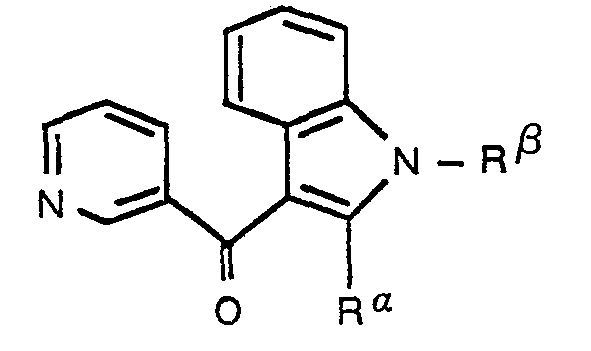
have fibrinolytic activity (see Eur. J. Med. Chem.- Chimica Therapeutica, May-June 1975-10, No. 3, pp. 276-285). - Ryszard J. Grgglewiski et al. reported that a compound of the following formula

- Investigations of the present inventors have shown that the compound reported by Ryszart J. Grgglewski et al. in which the 3-position of the indole skeleton is substituted by a pyridylcarbonyl group and its 1-position does not have a substituent, certainly has an action of inhibiting platelet aggregation, but on the other hand, has an unnegligible tendency to induce ulcer formation.
- US-A-3505354 discloses acylated indole derivatives in which the 1-position of the indole skeleton*is substituted by an alkyl group having a terminal carboxyl group, and the α-carbon atom of the 1-position substituent is either primary or secondary. However, compounds having a carboxyl terminated substituent group in the 1-position have low activity in the inhibition of platelet aggregation (see Table 1, Example 78, Comparison 1 below).
- This invention provides novel acylated indole derivatives wherein the 3-position of the indole skeleton is substituted by a substituted or unsubstituted phenyl or thienyl group and the 1-position is substituted by an alkyl or substituted alkyl group having a secondary a-carbon atom.
- The invention also provides a pharmaceutical composition having the ability to inhibit platelet aggregation comprising such a novel acylated indole derivative. Preferably the pharmaceutical composition has the ability to inhibit platelet aggregation with a reduced tendency to induce ulcer formation, and even more preferably has the ability to inhibit platelet aggregation with a biologically acceptable low level of various side-effects such as toxicity in single and continual administration, influences on the components which make up the blood, influences on various organs, and tendency toward ulcer formation.
- According to this invention there are provided acylated indole derivatives of the general formula

or an optically active isomer thereor or a salt thereof. - The acylated indole derivatives of formula [I] provided by the present invention are structurally characterized by the fact that the 3-position of the indole skeleton is substituted by a substituted or unsubstituted benzoyl or thenoyl group and the 1-position is substituted by an unsubstituted or substituted alkyl group branched at the a-carbon atom.
- Alkyl groups represented by R', R2, R3 and R4 have 1 to 6 carbon atoms. These alkyl groups may be linear or branched, and include, for example, methyl, ethyl, n-propyl, isopropyl, n-butyl, iso-butyl, sec-butyl, n-pentyl, and n-hexyl.
- The halogen atoms for R4 are fluorine, chlorine, bromine, and iodine.
- Alkoxy groups represented by R4 have 1 to 6 carbon atoms, preferably 1 to 4 carbon atoms. Examples include methoxy, ethoxy, n-propoxy, iso-propoxy, n-butoxy, n-pentoxy, and n-hexoxy.
- R1 is preferably hydrogen, methyl, ethyl, n-propyl, or iso-propyl, especially methyl.
- R2 is preferably an alkyl group having 1 to 3 carbon atoms, i.e. methyl, ethyl, n-propyl or iso- propyl, especially methyl, ethyl or n-propyl.
- R3 is preferably hydrogen or methyl, especially hydrogen.
- R4 is preferably hydrogen, hydroxyl, chloro, methyl or methoxy.
- Z in formula [I] represents a phenyl or thienyl group optionally substituted by R4. As the thienyl or substituted thienyl group, 2-thienyl or substituted 2-thienyl are preferred. As the substituted phenyl or substituted thienyl, mono-substituted phenyl or thienyl is preferred.
- Examples of the group Z include phenyl, 2-thienyl, o-fluorophenyl, p-fluorophenyl, o-chlorophenyl, m-chlorophenyl, p-chlorophenyl, o-tolyl, m-tolyl, p-tolyl, o-methoxyphenyl, p-methoxyphenyl, p-hydroxyphenyl, 3-chloro-2-thienyl, 4-fluoro-2-thienyl, 5-methyl-2-thienyl, and 4-methoxy-2-thienyl.
- Preferred groups Z are phenyl, 2-thienyl and substituted phenyl. Phenyl and 2-thienyl are especially preferred, and phenyl is most preferred.
- In formula [I], Y represents a bond, -0-, -S-, -SO- or -SO2-.
- A in formula [I] represents hydrogen atom, a lower alkyl group, lower acyl group, phenyl group, a phenylalkyl group, a 5- or 6-membered heterocyclic group containing an oxygen, sulfur or nitrogen atom, or a phenyl, phenylalkyl or 5- or 6-membered 0-, S- or N-containing heterocyclic group substituted by the group R4.
- Alkyl groups represented by A in formula [I] are as defined and exemplified hereinabove with regard to R' to R4.
- Acyl groups represented by A have 1 to 6 carbon atoms, preferably 1 to 3 carbon atoms, and include, for example, formyl, acetyl, n-propanoyl, n-butanoyl, iso-butanoyl, n-pentanoyl, and n-hexanoyl.
- Examples of the phenylalkyl group are benzyl, α-phenethyl, β-phenethyl, and y-phenylpropyl. Benzyl and β-phenethyl are preferred.
- The phenyl, phenylalkyl, pyridinyl, imidazolyl thiadiazolyl group may be substituted by the group R4 defined hereinabove.
- In formula [I], n represents zero or an integer of 1 to 10, preferably zero or an integer of 1 to 3, provided that n is zero only when Y represents a bond and A represents acyl.
- Examples of the acylated indole derivatives of formula [I] are given below. For convenience, they are classified by the definition of Y in formula [I].
-
- (100) 3-Benzoyl-1-(1-hydroxy-2-propyl)-2-methylindole
- (101) 3-Benzoyl-1-(1-hydroxy-2-butyl)-2-methylindole
- (102) 3-Benzoyl-1-(1-hydroxy-2-hexyl)-2-methylindole
- (103) 3-Benzoyl-1-(1-hydroxy-2-octyl)-2-methyiindote
- (104) 3-Benzoyl-1-(3-hydroxy-2-butyl)-2-methylindole
- (105) 3-Benzoyl-1-(4-hydroxy-2-butyl)-2-methylindole
- (106) 3-Benzoyl-1-(1-hydroxy-3-pentyl)-2-methylindole
- (107) 3-Benzoyl-1-(6-hydroxy-2-hexyl)-2-methylindole
- (108) 3-Benzoyl-1-(7-hydroxy-2-heptyl)-2-methylindole
- (109) 3-Benzoyl-1-(9-hydroxy-2-nonyl)-2-methylindole
- (110) 3-Benzoyl-1-(11-hydroxy-2-undecyl)-2-methylindole
- (111) 3-Benzoyl-1-(1-hydroxy-2-propyl)indole
- (112) 3-Benzoyl-1-(4-hydroxy-2-butyl)indole
- (113) 3-Benzoyl-5-chloro-1-(1-hydroxy-2-propyl)-2-methylindole
- (114) 3-Benzoyl-1-(1-hydroxy-2-propyl)-2,5-dimethylindole
- (115) 3-Benzoyl-5-chloro-1-(4-hydroxy-2-butyl)-2-methylindole
- (116) 3-Benzoyl-1-(1-hydroxy-2-propyl)-5-methoxy-2-methylindole
- (117) 3-Benzoyl-5-hydroxy-1-(1-hydroxy-2-propyl)-2-methylindole
- (118) 3-Benzoyl-(4-hydroxy-2-butyl)-5-methoxy-2-methylindole
- (119) 3-Benzoyl-1-( -hydroxy-2-propyl)-2-isopropylindole
- (120) 3-Benzoyl-1-(6-hydroxy-2-hexyl)-2-isopropylindole
- (121) 3-Benzoyl-5-chloro-1-(1-hydroxy-2-propyl)indole
- (122) 3-Benzoyl-1-(4-hydroxy-2-butyl)-2-isopropyl-5-methylindole
- (123) 3-(p-Chlorobenzoyl)-1-(1-hydroxy-2-propyl)-2-methylindole
- (124) 3-(o-Chlorobenzoyl)-1-(4-hydroxy-2-butyl)-2-methylindole
- (125) 3-(o-Fluorobenzoyl)-1-(4-hydroxy-2-butyl)-2-methylindole
- (126) 1-(1-Hydroxy-2-propyl)-2-methyl-3-(o-tolyl)indole
- (127) 1-(1-Hydroxy-2-propyl)-2-methyl-3-(2-thenoyl)indole
- (128) 5-Chloro-1-(1-hydroxy-2-propyl)-2-methyl-3-(2-thenoyl)indole
- (129) 3-(4-Chloro-2-thenoyl)-1-(1-hydroxy-2-propyl)-2-methylindole
- (130) 5-Chloro-3-(p-fluorobenzoyl)-1-(1-hydroxy-2-propyl)-2-methylindole
- (131) 3-Benzoyl-5-bromo-1-(1-hydroxy-2-propyl)-2-methylindole
- (132) 3-Benzoyl-5-fluoro-1-(4-hydroxy-2-butyl)-2-methylindole
- (133) 1-(4-Hydroxy-2-butyl)-2-methyl-3-(m-tolylcarbonyl)indole
- (134) 3-(m-Fluorobenzoyl)-1-(1-hydroxy-2-propyl)-2-methylindole
- (135) 3-Benzoyl-1-[1-hydroxy-2(R)-propyl]-2-methylindole
- (136) 3-Benzoyl-1-[1-hydroxy-2(S)-propyl]-2-methylindole
- (137) 3-Benzoyl-1-(4-hydroxy-2-butyl)-2,5-dimethylindole
- (200) 1-(1-Acetoxy-2-propyl)-3-benzoyl-2-methylindole
- (201) 1-(4-Acetoxy-2-butyl)-3-benzoyl-2-methylindole
- (202) 1-(1-Acetoxy-2-propyl)-3-benzoylindole
- (203) 1-(4-Acetoxy-2-butyl)-3-benzoyl-2-isopropylindole
- (204) 1-(1-Acetoxy-3-pentyl)-3-benzoyl-2-methylindole
- (205) 1-(1-Acetoxy-2-(butyl)-3-benzyl-2-methylindole
- (206) 1-(1-Acetoxy-2-hexyl)-3-benzoyl-2-methylindole
- (207) 1-(1-Acetoxy-2-octyl)-3-benzoyl-2-methylindole
- (208) 1-(1-Acetoxy-2-propyl)-2-methyl-3-thenoylindole
- (209) 3-Benzoyl-1-(1-formyloxy-2-propyl)-2-methylindole
- (210) 3-Benzoyl-2-methyl-1-(4-propanoyl-2-butyl)indole
- (211) 1-(1-Acetoxy-2-propyl)-3-benzoyl-5-chloro-2-methylindole
- (212) 1-(4-Acetoxy-2-butyl)-3-benzoyl-2,5-dimethylindole
- (213) 1-(1-Acetoxy-2-propyl)-5-chloro-2-methyl-3-(p-tolylcarbonyl)indole
- (214) 1-(4-Acetoxy-2-butyl)-3-benzoyl-5-methoxy-2-methylindole
- (215) 1-(1-Acetoxy-2-propyl)-3-benzoyl-5-methoxy-2-methylindole
- (216) 1-(1-Acetoxy-2-propyl)-3-(p-chlorobenzoyl)-5-methoxy-2-methylindole
- (217) 1-[1-Acetoxy-2-(R)-propyl]-3-benzoyl-2-methylindole
- (218) 1-[1-Acetoxy-2(S)-propyl]-3-benzoyl-2-methylindole
- (219) 1-(1-Acetoxy-2-propyl)-3-benzoyl-5-methoxy-2-methylindole
- (300) 3-Benzoyl-1-(1-methoxy-2-propyl)-2-methylindole
- (301) 3-Benzoyl-1-(1-methoxy-2-propyl)indole
- (302) 3-Benzoyl-1-(1-ethoxy-2-propyl)-2-methylindole
- (303) 3-Benzoyl-1-( -methoxy-2-propyl)-2-isopropylindole
- (304) 3-Benzoy)-5-chtor-1-(1-methoxy-2-propyl)-2-methylindole
- (305) 3-Benzoyl-1-(1-isopropoxy-2-propyl)-2-methylindole
- (306) 3-Benzoyl-1-(4-methoxy-2-butyl)-2-methylindole
- (307) 3-Benzoyl-1-(4-ethoxy-2-butyl)-2-methylindole
- (308) 3-Benzoyl-1-(4-ethoxy-2-butyl)-5-methoxy-2-methylindole
- (309) 1-(4-Ethoxy-2-butyl)-2-methyl-3-(p-tolylcarbonyl)indole
- (310) 3-Benzoyl-1-(4-methoxy-2-butyl-2,5-dimethyindole
- (311) 3-Benzoyl-1-(1-methoxy-2-butyl)-2-methylindole
- (312) 3-Benzoyl-1-( 1-ethoxy-2-butyl)-2-methylindole
- (313) 3-Benzoyl-1-(1-benzyloxy-2-butyl)-2-methylindole
- (314) 3-Benzoyl-5-methoxy-1-(1-methoxy-2-butyl)-2-methylindole
- (315) 1-(1-Methoxy-2-propyl)-2-methyl-3-thenoylindole
- (316) 3-(p-Chlorobenzoyl)-1-(1-methoxy-2-butyl)-2-methylindole
- (317) 3-(p-Chlorobenzoyl)-1-(1-methoxy-2-propyl)-2-methylindole
- (318) 3-Benzoyl-5-methoxy-1-(1-methoxy-2-propyl)-2-methylindole
- (319) 3-Benzoyl-1-(1-methoxy-3-pentyl)-2-methylindole
- (320) 3-Benzoyl-1-( 1-ethoxy-3-pentyl)-2-methylindole
- (321) 3-Benzoyl-5-chloro-1-( 1-methoxy-3-pentyl)-2-methylindole
- (322) 3-Benzoyl-2-methyl-1-(1-α-phenethyl-2-pentyl)indole
- (323) 3-Benzoyl-1-(1-ethoxy-2-pentyl)-5-hydroxy-2-methylindole
- (324) 3-Benzoyl-1-(1-butoxy-2-pentyl)-2-methylindole
- (325) 3-Benzoyl-1-(1-heptyloxy-2-propyl)-2-methylindole
- (326) 3-Benzoyl-1-(4-hexyloxy-2-butyl)-2-methylindole
- (327) 3-Benzoyl-1-(7-methoxy-2-heptyl)-2-methylindole
- (328) 3-Benzoyl-1-(7-ethoxy-2-heptyl)-2-methylindole
- (329) 3-Benzoyl-1-(11-methoxy-2-undecyl)-2-methylindole
- (330) 3-Benzoyl-1-(11-ethoxy-2-undecyl)-2-methylindole
- (331) 3-Benzoyl-2-methyl-1-(7-propoxy-2-heptyl)indole
- (332) 1-(11-Benzyloxy-2-undecyl)-3-benzoyl-2-methylindole
- (333) 3-Benzoyl-1-(1-ethoxy-2-hexyl)-2-methylindole
- (334) 3-Benzoyl-1-(1-methoxy-2-hexyl)-2-methylindole
- (335) 3-Benzoyl-1-(1-methoxy-2-octyl)-2-methylindole
- (336) 3-Benzoyl-1-(1-ethoxy-2-octyl)-2-methylindole
- (337) 3-Benzoyl-2-methyl-1-(1-propoxy-2-octyl)indole
- (338) 3-Benzoyl-5-chloro-1-(1-methoxy-2-hexyl)-2-methylindole
- (339) 3-Benzoyl-1-(1-methoxy-2-propyl)-2,5-dimethylindole
- (340) 3-(Benzoyl-1-(4-ethoxy-2-butyl)-2,5-dimethylindole
- (341) 3-Benzoyl-5-bromo-1-(1-ethoxy-2-propyl)-2-methylindole
- (342) 3-(p-Methoxybenzoyl)-1-(1-methoxy-2-propyl)-2-methylindole
- (343) 3-Benzoyl-1-[1-(o-chlorobenzyloxy)-2-propyl]-2-methylindole
- (344) 3-Benzoyl-1-(4-ethoxy-2-butyl)-5-fluoro-2-methylindole
- (345) 3-(o-Chlorobenzoyl)-1-(4-methoxy-2-butyl)-2-methylindole
- (346) 3-Benzoyl-1-[1-methoxy-2(R)-propyl]-2-methylindole
- (347) 3-Benzoyl-1-[1-methoxy-2(S)-propyl]-2-methylindole
- (348) 3-Benzoyl-2-methyl-1-(1-phenoxy-2-propyl)indole
- (349) 3-Benzoyl-2-methyl-1-(4-phenoxy-2-butyl)indole
- (350) 3-Benzoyl-1-[1-(p-chlorophenoxy)-2-butyl]-2-methylindole
- (351) 3-Benzoyl-1-[1-(p-methoxyphenoxy)-2-propyl]-2-methylindote
- (352) 3-Benzoyl-5-methoxy-1-[1-(p-methoxyphenoxyl-2-propyl]-2-methylindole
-
- (400) 3-Benzoyl-1-(1-ethylthio-2-propyl)-2-methylindole
- (401) 3-Benzoyl-2-methyl-1-(1-phenylthio-2-propyl)indole
- (402) 3-Benzoyl-2-methyl-1-(1-methylthio-2-propyl)indole
- (403) 3-Benzoyl-1-(1-isopropylthio-2-propyl)-2-methylindole
- (404) 3-Benzoyl-2-methyl-1-[1-(3-pyridylthiol-2-propyl]indole
- (405) 3-Benzoy)-2-methy)-1-[1-(2-pyridytthio)-2-propy)]indoie
- (406) 1-(1-Benzylthio-2-propyl)-3-benzoyl-2-methylindole
- (407) 3-Benzoyl-2-methyt-1-[1-(5-methyl-1,3,5-thiadiazol-2-ylthio)propyllindble
- (408) 3-Benzoyl-1-[1-(2-imidazolylthio)propyl]-2-methylindofe
- (409) 3-Benzoyl-1-(4-ethylthio-2-butyl)-2-methylindole
- (410) 3-Benzoyl-2-methyl-1-(4-phenylthio-2-butyl)-indole
- (411) 3-Benzoyl-2-methyl-1-(4-methylthio-2-butyl)-indole
- (412) 3-Benzoyl-1-(4-butylthio-2-butyl)-2-methylindole
- (413) 3-Benzoyl-2-methyl-1-[4-(4-pyridylthio)-2-butyl]indole
- (414) 3-Benzoyl-2-methy-1-[4-(2-pyridylthio)-2-butyl]indole
- (415) 3-Benzoyl-2-methyl-2-methyl-1-[4-(α-phenethylthiol-2-butyl]-indole
- (416) 1-(4-Acetylthio-2-butyl)-3-benzoyl-2-methylindole
- (417) 3-Benzoyl-1-(1-ethylthio-2-butyl)-2-methylindole
- (418) 3-Benzoyl-2-methyl-1-(phenylthio-2-butyl)indole
- (419) 3-Benzoyl-2-methyl-1-(1-methylthio-2-butyl)indole
- (420) 3-Benzoyl-2-methyl-1-[1-(4-pyridylthio)-2-butyl]indole
- (421) 3-Benzoyl-2-methyl-1-(1-(2-pyridylthio)-2-butyl]indole
- (422) 3-Benzoyl-1-(1-mercapto-2-propyl)-2-methylindole
- (423) 3-Benzoyl-1-(4-mercapto-2-butyl)-2-methylindole
- (424) 3-Benzoyl-1-(1-mercapto-2-butyl)-2-methylindole
- (425) 3-Benzoyl-1-(1-ethylthio-3-pentyl)-2-methylindole
- (426) 3-Benzoyl-2-methyl-1-(7-phenylthio-2-heptyl)indole
- (427) 3-Benzoyl-5-chloro-2-methyl-1-(1-methylthio-2-propyl)indole
- (428) 3-Benzoyl-1-(4-ethylthio-2-butyl)-5-methoxy-2-methylindole
- (500) 3-Benzoyl-1-(1-ethanesulfinyl-2-propyl)-2-methylindole
- (501) 1-(1-Benzenesulfinyl-2-propyl)-3-benzoyl-2-methylindole
- (502) 3-Benzoyl-1-(1-methanesulfinyl-2-propyl)-2-methylindole
- (503) 3-Benzoyl-2-methyl-1-[1-(4-pyridinesulfinyl)-2-propyl]indole
- (504) 3-Benzoyl-2-methyl-1-[1-(2-pyridinesulfinyl)-2-propyl]indole
- (505) 3-Benzoyl-1-(4-ethanesulfinyl-2-butyl)-2-methylindole
- (506) 3-Benzoyl-1-(4-methanesulfinyl-2-butyl)-2-methylindole
- (507) 1-(4-Benzenesulfinyl-2-butyl)-3-benzoyl-2-methylindole
- (508) 3-Benzoyl-2-methyl-1-[4-(4-pyridinesulfinyl)-2-butyl]indole
- (509) 3-Benzoyl-2-methyl-1-[4-(2-pyridinesulfinyl)-2-butyl]indole
- (510) 3-Benzoyl-1-(1-ethanesulfinyl-2-butyl)-2-methylindole
- (511) 1-(1-Benzenesulfinyl-2-butyl)-3-benzoyl-2-methylindole
- (512) 3-Benzoyl-2-methyl-1-[1-(4-pyridinesulfinyl)-2-butyl)indole
- (513) 3-Benzoyl-2-methyl-1-[1-(2-pyridinesulfonyl)-2-butyl]indole
- (514) 3-Benzoyl-1-(1-methanesulfinyl-2-butyl)-2-methylindole
- (600) 3-Benzoyi-1-(1-ethanesulfonyl-2-propyl)-2-methylindole
- (601) 1-(1-Benzenesulfonyl-2-propyl)-3-benzoyl-2-methylindole
- (602) 3-Benzoyl-1-(1-ethanesulfonyl-2-propyl)-2-methylindole
- (603) 3-Benzoyl-2-methyl-1-[1-(4-pyridinesulfonyl)-2-propyl]indole
- (604) 3-Benzoyl-2-methyl-1-[1-(2-pyridinesulfonyl)-2-propyl]iridole
- (605) 3-Benzoyl-1-(4-ethanesulfonyl-2-butyl)-2-methylindole
- (606) 3-Benzoyl-1-(4-methanesulfonyl-2-butyl)-2-methylindole
- (607) 1-(4-Benzenesulfonyl-2-butyl)-3-benzoyl-2-methylindole
- (608) 3-Benzoyl-2-methyl-1-[4-(4-pyridinesulfonyl)-2-butyl]indole
- (609) 3-Benzoyl-2-methyl-1-[4-(2-pyridinesulfonyl)-2-butyl]indole
- (610) 3-Benzoyl-1 -(1-ethanesulfonyl-2-butyl)-2-methylindole
- (611) 1-(1 -Benzenesulfonyl-2-butyl)-3-benzoyl-2-methylindole
- (612) 3-Benzoyl-2-methyl-1-[1-(4-pyridinesulfonyl)-2-butyl]indole
- (613) 3-Benzoyl-2-methyl-1-[1-(2-pyridinesulfonyl)-2-butyl]indole
- (614) 3-Benzoyl-1-(1-methanesulfonyl-2-butyl)-2-methylindole
-
- (700) 3-Benzoyl-1-isopropyl-2-methylindole
- (701) 3-Benzoyl-1-(2-butyl)-2-methylindole
- (702) 3-Benzoyl-2-methyl-1-(1-methyl-2-propyl)indole
- (703) 3-Benzoyl-2-methyl-1-(2-pentyl)indole
- (704) 3-Benzoyl-2-methyl-1-(3-pentyl)indole
- (705) 3-Benzoyl-1-(2-hexyl)-2-methylindole
- (706) 3-Benzoyl-1-(2-heptyl)-2-methylindole
- (707) 3-Benzoyl-2-methyl-1-(2-octyl)indole
- (708) 3-Benzoyl-2-methyl-1-(2-undecyl)indole
- (709) 3-Benzoy-1-(α-phenethyl)-2-methylindole
- (800) 3-Benzoyl-2-methyl-1-(3-oxo-2-butyl)indole
- (801) 3-Benzoyl-2-methyl-2-(4-oxo-2-pentyl)indole
- (802) 3-Benzoyl-2-methyl-1-(3-oxo-2-pentyl)indole
- (804) 3-Benzoyl-2-methyl-1-(5-oxo-3-hexyl)indole
- (805) 3-Benzoyl-1-(1-formyl-1-ethyl)-2-methylindole
- (806) 3-Benzoyl-1-(1-formyl-2-propyl)-2-methylindole
- (807) 3-Benzoyl-1-( 1-formylpropyl)-2-methylindole
- (808) 3-Benzoyl-1-11-formyl-2-butyl)-2-methylindole
- Of the 3-acylated indole derivatives of formula [I], provided by this invention, those of the following formula

and the optically active isomers or salts thereof; especially those of the following formula
and the optically active isomers or salts thereof have biological activities, particularly the ability to inhibit platelet aggregation, and therefore, are provided by this invention as preferred compounds. - In the acylated indole derivatives of formula [I] including formulae [I]-1 and [1]-2, the substituent at the 1 -position is branched at the a-position, and therefore when the group R2 (or R21 or CH3) differs from the group

- The acylated indole derivatives of formula [I] including formulae [11-1 and [I]-2 can form salts with basic compounds when the substituent R4 is a hydroxyl group, and can form acid addition salts with acids when the substituent A is a nitrogen-containing heterocyclic group such as pyridyl.
- Examples of such basic compounds include hydroxides, carbonates and hydrogen carbonates of alkali metals such as lithium, sodium and potassium or alkaline earth metals such as calcium and magnesium. They also include ammonia, primary, secondary or tertiary amines such as methylamine, ethylamine, butylamine, dimethylamine, diethylamine, cyclohexylmethylamine, triethylamine and pyridine, and quaternary ammonium hydroxides such as tetramethyl ammonium hydroxide.
- Examples of the acids include mineral acids such as hydrochloric acid, hydrobromic acid, sulfuric acid and phosphoric acid, organic carboxylic acids such as acetic acid, propionic acid, oxalic acid, mandelic acid, maleic acid, fumaric acid, lactic acid and glutamic acid, and organic sulfonic acids such as methanesulfonic acid, ethanesulfonic acid, benzenesulfonic acid, p-toluenesulfonic acid, and cumylsulfonic acid.
- According to this invention, compounds of formula [I] can be produced in the following manner. [A] Compounds of formula [I] wherein Y is an oxygen atom:-
- (a) Compounds of general formula [I] wherein Y is an oxygen atom and A is a hydrogen atom or acyl can be produced in accordance with Reaction Schemes 1 to 4 below.
- (b) Compounds of general formula [I] wherein Y is an oxygen atom, A is alkyl, a phenylalkyl group or a phenylalkyl group substituted by R4 can be produced in accordance with Reaction Schemes 5 to 8 below.
- (c) Compounds of general formula [I] wherein Y is an oxygen atom, and A is phenyl, phenyl substituted by R4, or pyridinyl, imidazolyl or thiadiazolyl optionally substituted by R4 can be produced in accordance with Reaction Scheme 9 below.
- These reactions are described below.
- (a) Production of compounds of general formula [I] wherein Y is an oxygen atom and A is a hydrogen atom or acyl group in accordance with Reaction Schemes 1 to 4:-


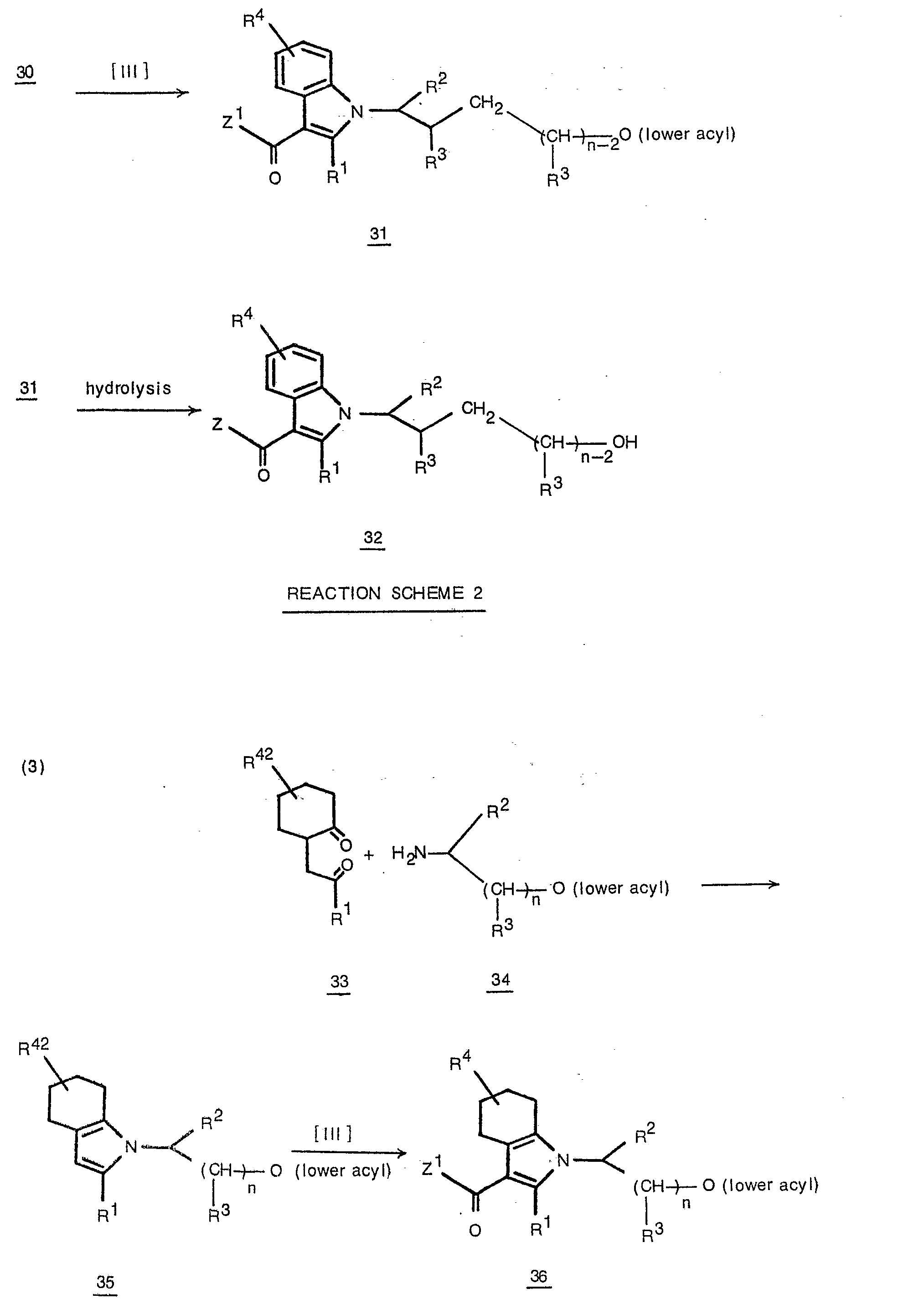


- As shown in the above Reaction Schemes 1 to 4, the compounds of general formula [I] wherein Y is an oxygen atom and A is acyl (21, 31 35, 46) can be produced by condensing the corresponding 1-(ω-acyloxyalkyl)-3-unsubstituted indoles (20, 30) with acid anhydrides of formula [III] in the presence of hydrogen iodine (Reaction Schemes 1 and 2); or condensing the corresponding 1-(ω-acyloxyalkyl)-3-unsubstituted tetrahydroindoles (35, 46) with the acid anhydrides of formula [III] in the presence of hydrogen iodide, and then dehydrogenating the condensation product (Reaction Schemes 3 and 4).
- The compounds of general formula [I] wherein Y is an oxygen atom and A is a hydrogen atom (22, 32, 36, 47) are produced by hydrolyzing the compounds (21, 31, 35, 46) produced by the aforesaid acylation reaction using the acid anhydrides.
- The acylation reaction with the acid anhydrides of formula [III] constitutes one aspect of the process of this invention.
- According to Reaction Scheme 1, the acylation reaction using acid anhydrides is carried out by condensing a 1-(ω-acyloxyalkyl)-3-unsubstituted indole of the following formula 20

with an acid anhydride of the following formula [III]
in the presence of hydrogen iodide to give a 3-acyl-1-(w-lower acyloxyalkyl)-indole of the following formula 21
- Usually, the condensation reaction is carried out by heating 1 mole of the 1-(w-acyloxyalkyl)-3- unsubstituted indole of formula 20 and 0.5 to 10 moles, preferably 1 to 5 moles, of the acid anhydride of formula [III] in the presence or absence of an inert organic solvent in the presence of 0.001 to 2 moles, preferably 0.01 to 0.5 mole, of hydrogen iodide at a temperature of 50 to 180°C, preferably 80°C to 150°C.
- When the starting compounds are melted at the reaction temperature, the inert organic solvent is generally not absolutely required. From the standpoint of after-treatment, such a solvent should better be not used in such a case. Suitable solvents are aprotic inert organic solvents, for example haloalkanes such as carbon tetrachloride, chloroform, and tetrachloroethane, and aromatic hydrocarbon solvents such as nitrobenzene, chlorobenzene, toluene and xylene.
- The reaction can usually be monitored by thin-layer chromatography. The reaction is completed usually in 10 minutes to 24 hours. In most cases, it comes to an end in about 20 minutes to about 3 hours.
- According to the acylation reaction, the 3-position of the indole skeleton of the compound of formula 20 is acylated, and when the group R42 in the starting compound of formula 20 is alkoxy, a reaction may sometimes take place which induces the conversion of the group R42 into a hydroxyl group by the effect of hydrogen iodide.
- The final desired product can be isolated from the resulting reaction mixture and purified usually by dissolving it in a water-insoluble, good solvent for the final product, such as ethyl acetate, ether, chloroform, methylene chloride or benzene, then washing the solution successively with water, a saturated aqueous solution of sodium bicarbonate, water, and a saturated aqueous solution of sodium chloride, drying the washed product over anhydrous sodium sulfate, concentrating the product and chromatographing the resulting crude product on a column of silica gel carrier. Thus, the 3-acyl-1-(ω-lower acyloxyalkyl)indole, of formula 21 is isolated in pure form.
- According to Reaction Scheme 1, the 3-acyl-1-(ω-acyloxyalkyl)indole of formula 21 obtained by the above-described acylation reaction may be hydrolyzed to give a 3-acyl-1-(w-hydroxyalkyl)indole of the following formula 22

- This hydrolysis reaction can be applied to the reaction mixture obtained by the above acylation reaction, the crude product obtained by treating it, or to the final purified product.
- When it is to be applied to the reaction mixture, the reaction mixture is dissolved in an organic solvent such as ethanol, methanol, tetrahydrofuran or dioxane (when the reaction mixture contains a reaction solvent, the solvent is distilled off as much as possible beforehand). Then, an aqueous alkali solution such an aqueous solution or sodium hydroxide or potassium hydroxide is added in an amount slightly excessive with respect to a protective group to be removed by hydrolysis, the remaining acid anhydride and a carboxylic acid formed as a by-product in the reaction. The mixture then stirred at room temperature or optionally at an elevated temperature for 1 to several hours.
- After performing the hydrolysis in the above manner, the solvent in the reaction system is distilled off, and the residue is subjected to the same isolation and purifying procedure as described above for the 3-acyl-1-(ω-acyloxyalkyl)indole to obtain the 3-acyl-1-(ω-hydroxyalkyl)indole of formula 22 in pure form.
- When the hydrolysis reaction is to be applied to the crude product or purified product, the operation of removing the reaction solvent is omitted, and otherwise, the same operation as above can be performed.
- According to the above hydrolysis reaction, the acyl group in the co-acyloxyalkyl group is removed, and when the substituent which may be at Z' is a protected hydroxyl group, i.e. an acyloxy group such as acetyloxy, formyloxy or benzoyloxy, this acyl group is usually removed together. Accordingly, the compound of formula 22 is prepared from the compound of formula 21.
- Thus, according to Reaction Scheme 1, 3-acylated indole derivatives of formulae 21 and 22 which fall within the formula [I] can be obtained which are structurally characterized by the fact that a carbon atom directly bonded to the a-carbon atom in the substituent at the 1-position, i.e. the A-carbon atom, forms a methylene group (―CH2―) having two hydrogen atoms.
- The 1-(w-acyloxyalkyl)-3-unsubstituted indole (20) used in the acylation reaction in Reaction Scheme 1 can be produced in the following manner.
- A l-(alkoxycarbonylmethyl)indole of formula 12 is prepared by reacting an indole 10 (commercially available, or can be prepared by the Fisher's indole synthesizing method; in formula 10, R' and R42 are as defined hereinabove) with an a-halocarboxylic acid ester 11 (wherein X represents a halogen atom such as chlorine, bromine or iodine, R5 represents a lower alkyl group having 1 to 4 carbon atoms, and R2 is as defined hereinabove) in the presence of an acid acceptor such as sodium hydride or potassium hydride in an inert organic solvent at a temperature between -20°C and the refluxing temperature of the reaction system. Examples of suitable inert organic solvents used in the above condensation reaction are benzene, toluene, xylene, ethylene glycol dimethyl ether, diether, dioxane, tetrahydrofuran (THF), dimethylformamide (DMF), dimethylsulfoxide (DMSO), and hexamethylphosphoramide (HMPA).
- The resulting compound of formula 12 is then reduced with lithium aluminum hydride in an inert solvent to form a 1-(hydroxyethyl)-indole. Diethyl ether and THF are preferred as the inert solvent. The reaction is carried out for 10 minutes to several hours at a temperature between -20°C and the refluxing temperature of the reaction system.
- The resulting compound of formula 13 is directly reacted with a halogenating agent such as phosphorus tribromide, thionyl chloride, thionyl bromide or hydrobromic acid, or with carbon tetrabromide in the presence of triphenylphosphine to produce a 1-(haloethyl)indole of formula 14. Each of these reactions is carried out in an inert organic solvent such as diethyl ether, THF, benzene, dichloromethane or chlorform, and is terminated in 30 minutes to 24 hours by performing it at the same temperature as used in the aforesaid reducing reaction.
- The resulting compound of formula 14 is then converted to a Grignard reagent, and then reacted with a protected derivative of an ω-hydroxyalkyl halide of formula 16 (wherein R6 is a group capable of being easily removed by acid hydrolysis, such as tetrahydropyranyl, ethoxyethyl, methoxymethyl or t-butyldimethylsilyl) in the presence of a cuprous ion in a solvent such as diethyl ether or THF at -78°C to room temperature for 1 to 24 hours. Or the compound of formula 14 is reacted with a Grignard reagent of formula 17 under the same reaction conditions as above. As a result, a 1-(ω-protected hydroxyalkyl)indole of formula 18 is obtained.
- The resulting compound of formula 18 is then deprotected by an acid such as hydrochloric acid, sulfuric acid, acetic acid or oxalic acid to be converted to a 1-(w-hydroxyalkyl)indole of formula 19. Such a deprotection itself is well known.
- The resulting l-(hydroxyethyl)indole of formula 13 or 1-(w-hydroxyalkyl)indole of formula 19 is condensed with a monocarboxylic acid anhydride in pyridine to form a 1-(acyloxyethyl)indole from the compound of formula 13, and a 1-(ω-acyloxyalkyl) indole from the comoun compound of formula 19. These products are inclusively represented by formula 20.
- According to Reaction Scheme 2, the acylation reaction using the acid anhydride [III] which constitutes one aspect of this invention is carried out by condensing a 1-(co-acyloxyalkyl)-3- unsubstituted indole expressed by the following formula 30

with the acid anhydride of formula [III] in the presence of hydrogen iodide to give a 3-acyl-1-(ω-acyloxyalkyl)-indole of the following formula 31
- This acylation reaction is carried out under the same reaction conditions as described hereinabove with respect to Reaction Scheme 1, and the final product is obtained by the same isolating and purifying operation as described hereinabove.
- According to Reaction Scheme 2, hydrolysis of the compound of formula 31 obtained by the aforesaid acylation reaction gives a 3-acyl-1-(w-hydroxyalkyl)-indole of the following formula 32

- This hydrolysis reaction is carried out under the same reaction conditions as described above in regard to Reaction Scheme I, and the final product is obtained by the same isolating and purifying operation.
- According to Reaction Scheme 2, 3-acylated indole derivatives of formula 31 or 32 which is embraced within formula [I] are obtained which are structurally characterized by the fact the carbon atom at the y-position in the substituent at the 1-position is a methylene group.
- The 1-(ω-acyloxyalkyl)-3-unsubstituted indole (30) used in the acylation in Reaction Scheme 2 can be prepared in the following manner.
- The indole 10 is reacted with an α,β-unsaturated carboxylic acid ester of formula 23 (wherein R2, R3 and R5 are as defined above) in an inert organic solvent in the presence of, as a catalyst, a basic compound such as sodium hydride, sodium methoxide, sodium ethoxide, potassium hydride, potassium t-butoxide, or potassium carbonate at a temperature of from -20°C to the refluxing temperature of the reaction system to give a 1-(alkoxycarbonylethyl)indole of formula 24. This reaction is known as the Michael's addition reaction. The same solvent as used in the reaction of the compounds of formula 10 and 11 above can be used as the inert solvent in this reaction.
- The resulting compound of formula 24 is then reduced with lithium aluminum hydride to give a 1-(hydroxypropyl)indole of formula 25. The compound of formula 25 is halogenated to a compound of formula 26 which is then converted to a compound of formula 27 with or without going through a compound of formula 28 by the Grignard reaction. Deprotection of the compound of formula 27 gives a 1-(ω-hydroxyalkyl)indole of formula 29.
- The resulting compound of formula 25 or 29 is then condensed with a monocarboxylic acid anhydride in pyridine to give a 1-(acyloxypropyl)indole from the compound of formula 25 or a 1-(ω-acyloxyalkyl)indole from the compound of formula 29. These products are inclusively represented by formula 30.
- A series of the above reactions for preparing the compound of formula 30 from the compound of formula 24 are performed under the same conditions as in a series of the corresponding reactions described with regard to Reaction Scheme 1.
- According to Reaction Scheme 3, the acylation reaction using the acid anhydride [III] which constitutes one aspect of this invention is carried out by condensing a tetrahydroindole derivative of the following formula 35

with the acid anhydride of formula [III] in the presence of hydrogen iodide to give a 3-acyl-1-(ω-acyloxyalkyl)-tetrahydroindole of the following formula 36
- This acylation reaction is performed under the same conditions for the acylation of 1-(ω-acyloxyalkyl)-3-unsubstituted indoles described hereinabove with regard to Reaction Scheme 1, and the final product of formula 36 is obtained by the same isolating and purifying operation.
- According to Reaction Scheme 3, the isolated compound of formula 36 is then dehydrogenated to give a 3-acyl-1-(ω-acyloxyalkyl)indole of the following formula 37

- This dehydrogenation reaction is carried out in an inert organic solvent usually at a temperature of 0°C to the refluxing temperature of the reaction system usually for 30 minutes to 72 hours using 2 to 10 moles of a dehydrogenating agent such as 2,3-dichloro-5,6-dicyano-p-benzoquinone (DDQ), 2,3,5,6-tetrachloro-p-benzoquinone (Chloranil) or 3,5,4,6-tetrachloro-o-benzoquinone per mole of the compound of formula 36.
- This dehydrogenation reaction is likewise carried out in an inert organic solvent at a temperature of usually about 0°C to the refluxing temperature of the reaction system for a period of usually 30 minutes to 72 hours using 0.1 to 10 moles of a dehydrogenating catalyst such as selenium, palladium/carbon, platinum, or rhodium per mole of the compound of formula 36.
- Suitable inert organic solvents are aprotic inert organic solvents examples of which include ethers such as THF, dioxane, 1,2-dimethoxyethane, diethyleneglycol dimethyl ether, diethylene glycol diethyl ether, and diethylene glycol dibutyleter, and aromatic hydrocarbons such as benzene, toluene, xylene, chlorobenzene, nitrobenzene, naphthalene and quinoline.
- Usually, the reaction can be monitored by thin-layer chromatography.
- Isolation of the final product (37) from the reaction mixture and the purification can be performed usually by removing insoluble materials (e.g., 2,3-dichloro-5,6-dicyano-p-dihydroquinone, or the remaining inert palladium/carbon catalyst, etc.) from the reaction mixture by filtration, distilling off the reaction solvent under reduced pressure, and then subjecting the residue to the same treating operation as described in Reaction Scheme 1.
- According to Reaction Scheme 3, hydrolysis of the 3-acyl-1-(co-acyloxyalkyl)indole of formula 37 formed by the above acylation reaction and the subsequent dehydrogenation gives a 3-acyl-1-(ω-hydroxyalkyl)indole of the following formula 38

- This hydrolysis reaction is carried out under the same conditions as described with regard to Reaction Scheme 1, and the final desired product can be obtained by the same isolating and purifying operation.
- According to Reaction Scheme 3, there can be thus produced not only acylated indole derivatives of this invention included within formula [I] in which the a-carbon atom and/or A-carbon atom in the substituent at the 1-position, but also those in which all carbon atoms including these a- and A-carbon atoms are substituted by an alkyl group (R3).
- The 1-(ω-acyloxyalkyl)-tetrahydroindole (35) used in the acylation reaction according to Reaction Scheme 3 is prepared by condensing 1 mole of a 1,4-diketone of formula 33 (wherein R' and R42 are defined hereinabove) with 0.5 to 5 moles of a primary amine of formula 34 (wherein R2, R3 and n are as defined hereinabove) in the presence of acetic acid and in the presence or absence of an inert organic solvent at a temperature of 0°C to the refluxing temperature of the reaction system.
- Suitable inert organic solvents are, for example, benzene, toluene, xylene and dioxane.
- According to Reaction Scheme 4, the acylation reaction using an acid anhydride which constitutes one aspect of the present invention is carried out by condensing a 1-(ω-acyloxyalkyl)-tetrahydroindole of the following formula 46

with the acid anhydride of formula [III] in the presence of hydrogen iodide to give a 3-acyl-1-(ω-acyloxyalkyl)tetrahydroindole of the following formula 47
- This acylation reaction is carried out under the same conditions as described hereinabove with regard to Reaction Scheme 1, and the final desired product can be obtained by the same isolating and purifying operation.
- According to Reaction Scheme 4, dehydrogenation of the product (47) obtained by the acylation reaction gives the compound (21) mentioned above, and hydrolysis of the compound (21) gives the compound (22) described above. The dehydrogenation and hydrolysis reactions are carried out in the same way as described with regard to Reaction Scheme 3.
- The 1-(co-acyloxyalkyl)-tetrahydroindole (46) used in the acylation reaction according to Reaction Scheme 4 can be prepared in the following manner.
- One mole of the 1,4-diketone (33) is condensed with 1 to 2 moles of a mineral acid salt (such as a hydrochloride, hydrobromide or sulfate) of an α-amino acid ester of formula 39 (wherein R2 and R5 are as defined hereinabove) in the presence of 1 to 3 moles of an acid acceptor such as sodium acetate, potassium acetate, sodium carbonate, potassium carbonate, sodium hydrogen carbonate or potassium hydrogen carbonate in acetic acid or an inert organic solvent containing acetic acid at a temperature of 0°C to the refluxing temperature of the reaction system. Suitable inert organic solvents are, for example, benzene, toluene, xylene and dioxane.
- The 1-(alkyloxycarbonylmethyl)tetrahydroindole of formula 40 (wherein R42 is as defined hereinabove) thus obtained is reduced with lithium aluminum hydride to give a 1-(hydroxyethyl)tetrahydroindole of formula 41, which is converted to a 1-(haloethyl)tetrahydroindole of formula 42 by halogenation. The compound of formula 42 is then subjected to a Grignard reaction to convert it to a 1-(w-protected hydroxyalkyl)tetrahydroindole of formula 44 through or not through an intermediate of formula 43. Deprotection of the compound of formula 44 gives a 1-(ω-hydroxyalkyl)tetrahydroindole of formula 45.
- The resulting 1 - (hydroxyethyl)tetrahydroindole of formula 41 and 1 - (ω - hydroxyalkyl)tetrahydroindole of formula 44 are each condensed with a monocarboxylic acid anhydride in pyridine to give a 1-(acyloxyethyl)tetrahydroindole from the compound of formula 41, and a 1-(ω-acyloxyalkyl)tetrahydroindole from the compound of formula 44. These products are inclusively represented by formula 46.
- A series of reactions for production of the compound of formula 46 from the compound of formula 40 are carried out under the same conditions as in a series of the corresponding reactions in Reaction Scheme 1.
- As can be understood from the above description, when an optically active α-amino acid is used as the a-amino acid in formula 39 in the reaction of Reaction Scheme 4, there can be obtained acylated indole derivatives of formula [I] expressed by formula 21 or 22 which are optically active at the a-carbon atom of the substituent at the 1-position.
- According to Reaction Schemes 1 to 4, there can be advantageously produced 3-acyl-1-(ω-hydroxyalkyl)indole derivatives exemplified by compounds (100) to (137) given hereinabove, or 3-acyl-1-(ω-acyloxyalkyl)indole derivatives exemplified by compounds (200) to (219) given hereinabove.
- (b) Production of compounds of general formula [I] wherein Y is an oxygen atom, A is an alkyl group or a phenyl group optionally substituted by R4 in accordance with Reaction Schemes 5 to 8:-


- According to Reaction Scheme 5, a 3-acyl-1-(ω-hydroxyalkyl)indole of the following formula 48

is condensed with a halogen compound of the following formula [V]
in the presence of a basic compound to give a 3-acyl-1-(oxaalkyl)indole of the following formula 49
- The condensation reaction (etherification reaction) is carried out by treating 1 mole of the compound of formula 48 with 1 to 10 moles of the halogen compound in an inert organic solvent in the presence of 1 to 5 moles of the basic compound at a temperature of -78°C to the refluxing temperature of the reaction system.
- In formula [V], examples of the group Q are linear or branched alkyl groups having 1 to 6 carbon atoms such as methyl, ethyl, n-propyl, iso-propyl, n-butyl, sec-butyl, iso-butyl, n-pentyl and n-hexyl, phenylalkyl groups with the alkyl group having 1 or 2 carbon atoms, such as benzyl, α-phenethyl and A-phenethyl and such phenylalkyl groups substituted by the group R4. X is preferably a chlorine, bromine or iodine atom.
- Iodides and bromides are desirable as the halogen compounds of formula [V] in view of their respectivity. Examples include methyl iodide, ethyl iodide, ethyl bromide, n-propyl iodide, iso-propyl bromide, n-butyl bromide, n-pentyl bromide, n-hexyl bromide, benzyl bromide, a-phenethyl bromide, β-phenethyl bromide, benzyl chloride, a-phenethyl chloride, p-methoxy-a-phenethyl bromide, and p-chlorobenzyl chloride. These are merely exemplification of preferred compounds of formula [V].
- Examples of preferred basic compounds are alkali metal hydrides or amides, such as sodium hydride, potassium hydride, sodium amide and lithium hydride.
- Preferred reaction solvents are aprotic inert organic solvents such as diethyl ether, THF, dioxane, 1,2-dimethoxyethane, ethylene glycol dimethyl ether, benzene, toluene, xylene, DMF, DMSO and HMPA.
- The compound of formula 49 is, if desired, subjected to hydrolysis to form the compound of formula [I]-e.
- The compound of formula 48 overlap the compound of formula 38 prepared by Reaction Scheme 3. In other words, a compound of formula 38 in which R4 is R42 and Z is Z' is the compound of formula 48.
- According to Reaction Scheme 6, a 3-acyl-1-(oxaalkyl)-indole of the following formula 52


with the halogen compound of formula [V] in the presence of a basic compound, and then reacting the condensate further with the acid anhydride of formula [III] in the presence of hydrogen iodide. - The above etherification reaction can be performed under the same reaction conditions as described above with respect to Reaction Scheme 5. The above acylation reaction can be performed under the same reaction conditions as described with regard to the acylation reaction involving use of the acid anhydride of formula [III] in Reaction Scheme 1.
- According to Reaction Scheme 6, hydrolysis of the compound of formula 52 under the same conditions as in Reaction Scheme 1 gives a compound of the following formula 53

- The compound of formula 50 can be prepared by dehydrogenating the compound of formula 45 in Reaction Scheme 3 under the same dehydrogenation reaction conditions for the compound 36, and then hydrolyzing the product.
- According to Reaction Scheme 7, the same compound of 49 as obtained in Reaction Scheme 7 can be obtained by condensing a 3-acyl-1-(ω-hydroxyalkyl) tetrahydroindole of the following formula 54

with the halogen compound of formula [V] in the presence of a basic compound, and then dehydrogenating the resulting 3-acyl-I-(oxaalkyl)tetrahydroindole of the following formula 55
- This etherification reaction can be performed under the same conditions as described hereinabove with regard to Reaction Scheme 5, and the dehydrogenation reaction can be performed under the same conditions as in the dehydrogenation reaction of the compound of formula 36 in Reaction Scheme 3.
- The compound of formula 54 overlaps some of the compounds of formula 36 in Reaction Scheme 3.
- According to Reaction Scheme 8, a 1-(ω-hydroxyalkyl)-tetrahydroindole of the following formula 56

with the halogen compound of formula [V] in the presence of a basic compound to form a 1-(oxaalkyl)tetrahydroindole of the following formula 57
then acylating the compound of formula 57 with the acid anhydride of formul [III] in the presence of hydrogen iodide to form a 3-acyl-1-(oxaalkyl)tetrahydroindole of the following formula 58
and dehydrogenating the compound of formula 58 to form the 3-acyl-1-(oxaalkyl)indole of formula 52. Hydrolysis of the compound of formula 52 gives the compound of formula 53. - The above etherification reaction and dehydrogenation reaction can be performed under the same conditions as in Reaction Scheme 7. The acylation reaction and hydrolysis reaction can be performed under the same conditions as in Reaction Scheme 6.
- The compound of formula 56 is obtained by hydrolysis of the compound 35 in Reaction Scheme 3.
- According to Reaction Schemes 5 to 8, there can be advantageously prepared 3-acyl-1-(w-alkyl or substituted or unsubstituted phenylalkyl-oxyalkyl)indole derivatives exemplified by compounds (300) to (347) exemplified hereinabove.
- (c) Production of compounds of general formula [I] wherein Y is an oxygen atom, and A is a phenyl pyridinyl, imidazolyl or thiadiazolyl group optionally substituted by the group R4:-
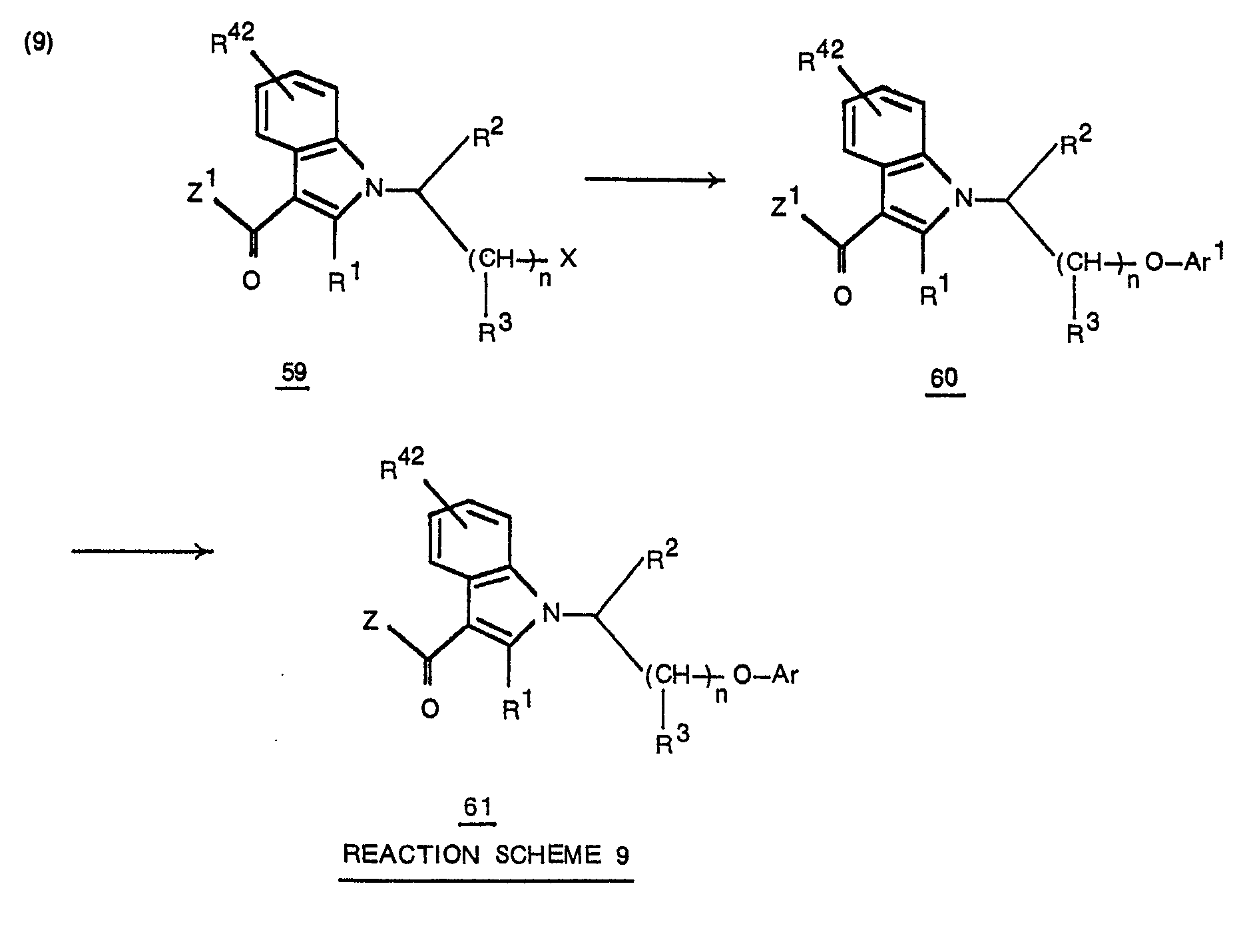
- According to Reaction Scheme 9, a 3-acyl-1-(ω-aryloxyalkyl)indole of the following formula 60

is prepared by condensing a 3-acyl-1-(ω-haloalkyl)indole expressed by the following formula 59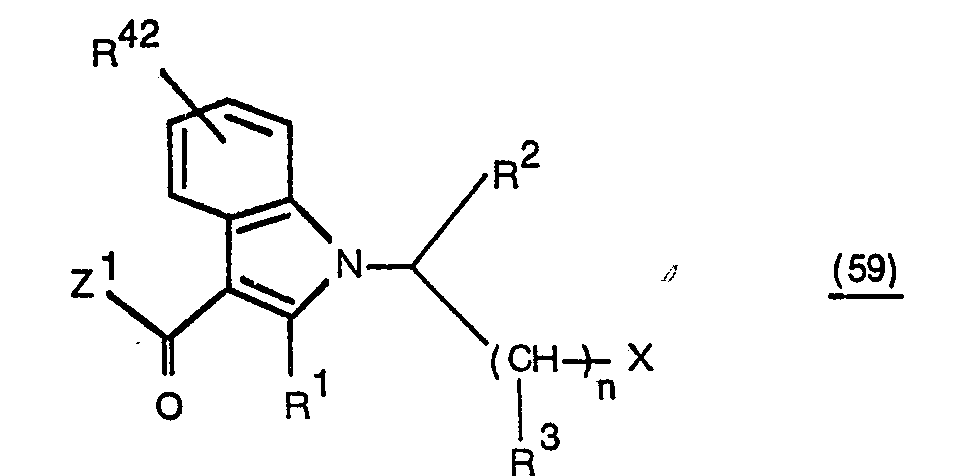

in the presence of a basic compound in an inert organic solvent. - This condensation reaction (etherification reaction) can be performed by using 1 mole of the halogen compound of formula 59 and 1 to 2 moles of the aromatic hydroxy compound of formula [VI] in the presence of 1 to 3 moles of the basic compound at a temperature of -78°C to the refluxing temperature of the reaction system.
- Chrlorine, bromine and iodine atoms are preferred as the halogen atom X in formula 59. The compound of formula 59 is prepared by halogenating some of the compounds of formula 38 in Reaction Scheme 3 (performed under the same conditions as in the halogenation reaction of preparing the compound of formula 14 from the compound of formula 13 in Reaction Scheme 1).
- Examples of the aromatic hydroxy compounds of formula [VI] are phenol, p-acetoxyphenol, p-methoxyphenol, o-chlorophenol, m-cresol, p-isopropylphenol, 3-allyl alcohol, and 4-hydroxypyridine.
- Preferred basic compounds include, for example, alkali metal hydrides or amides such as sodium hydride, potassium hydride, lithium hydride and sodium amide.
- The same aprotic inert organic solvents as used in the etherification reaction in Reaction Scheme 5 are preferred as the reaction solvent in the above reaction.
- According to Reaction Scheme 9, hydrolysis of the compound of formula 60 obtained by the above reaction under the same conditions as in the hydrolysis of the compound of formula 52 in Reaction Scheme 6 gives a compound of the following formula 61

- R1, R2, R3, R42, n and Z are as defined hereinabove, Ar represents a phenyl pyridinyl, imidazolyl or thiadiazolyl group optionally substituted by R42 or a hydroxyl group.
- According to Reaction Scheme 9, there can be prepared 3-acyl-1-(ω-substituted or unsubstituted phenyl or heterocyclicoxyalkyl)indole derivatives exemplified by compounds (348) to (352) given hereinabove which come within the definition of formula [I] of this invention.
- These compounds can be produced in accordance with Reaction Schemes 10 to 13 below.


- According to Reaction Schems 10 and 12 to 14, a 1-alkyl-3-unsubstituted indole having an alkyl group of the desired number of carbon atoms at the 1-position and represented by the following formula 63

is condensed with the acid anhydride of formula [III] in the presence of hydrogen iodide to give a 3-cyano-1-alylindole of the following formula 64 having the alkyl group with the desired number of carbon atoms at the 1-position
Hydrolysis of the compound of formula 64 gives a compound of the following formula 65 having the alkyl group of the desired number of carbon atoms at the 1-position
- The above acylation reaction and hydrolysis reaction are carried out under the same conditions as described hereinabove with regard to Reaction Scheme 1.
- The 1-alkyl-3-unsubstituted indole of formula 63 which gives the 3-acylindole derivatives of formulae 64 and 65 which fall within the definition of formula [I] can be produced
- (i) in accordance with Reaction Scheme 10 by reaction 1 mole of the indole of formula 10 with 1 to 5 moles of an alkyl halide of formula 62 (wherein R2, R3, X and n are as defined hereinabove) in the presence of a basic catalyst in an inert organic solvent at a temperature of 0°C to the refluxing temperature of the reaction system;
- (ii) in accordance with Reaction Scheme 12 by halogenating a 1-(ω-hydroxyalkyl)-3- unsubstituted indole of formula 69 (wherein R', R2, R3 and R42 are as defined hereinabove, n is 1 to 10, r is 1 to 9, and n minus r is 1 to 9) under the same reaction conditions as in the production of the compound of formula 14 from the compound of formula 13 in Reaction Scheme 1, and condensing the resulting 1-(ω-haloalkyl)-3-unsubstituted indole of formula 70 (wherein R', R2, R3, R42, n and r are as defined in formula 69, and X represents a halogen atom such as chlorine or bromine) with a Grignard reagent of formula 71 (wherein R3, X and r are as defined hereinabove) under the same conditions as in the production of the compound of formula 18 from the compounds of formulae 14 and 17 in Reaction Scheme 1;
- (iii) in accordance with Reaction Scheme 13 by reacting the compound of formula 69 with metallic magnesium under the conditions as in the production of the compound of formula 15 from the compound of formula 14 in Reaction Scheme 1 to form a compound of formula 72 (wherein R', R2, R3, R42, X, n and r are as defined above), and condensing the compound of formula 72 with an alkyl halide of formula 73 (wherein R3, X and r are as defined hereinabove) under the same conditions as in the production of the compound of formula 18 from the compounds of formulae 15 and 16 in Reaction Scheme 1; or
- (iv) in accordance with Reaction Scheme 14 by condensing 1 mole of 1-(w-hydroxyalkyl)-3-unsubstituted indole of formula 50 with 1 to 3 moles of a sulfonyl halide of the formula
R6SO2X
wherein R6 represents a methyl group or p-tolyl group and X represents a halogen atom such as chlorine or bromine, - According to Reaction Scheme 11, 3-acyl-1-alkylindoles of formulae 64 and 65 can be produced as follows:
- The 1,4-diketone of formula 33 is condensed with the primary amine of formula 66 (wherein R2, R3 and n are as defined hereinabove) under the same conditions as in the production of the compound of formula 35 from the compounds of formulae 33 and 34 in Reaction Scheme 3 to afford a 1-alkyl-3-unsubstituted-tetrahydroindole of formula 67 (wherein R', R2, R3, R42 and n are as defined as above) which is then converted to the compound of formula 64 through the compound of formula 68 under the same conditions as in the production of the compound 37 by dehydrogenation of the compound of formula 36 formed by acylation of the compound of formula 35 in Reaction Scheme 3 (the acylation reaction and dehydrogenation reaction).
- According to Reaction Schemes 11 to 14, 3-acyl-1-alkylindole derivatives exemplified by compounds (700) to (709) exemplified hereinabove which come within the acylated indole derivatives [I] of this invention can be advantageously produced.
- These compounds can be produced in accordance with Reaction Scheme 15 below.

- According to Reaction Scheme 15, a 3-acyl-1-(w-halogeno or sulfonyloxyalkyl)indole of the following formula 76


to form a 3-acyl-1-(ω-acylthio or amidinothioalkyl)indole of the following formula 78
If desired, the compound of formula 78 is hydrolyzed to give a 3-acyl-1-(ω-mercaptoalkyl)indole of the following formula 79
- The reaction between the compound of formula 76 and the compound of formula 77 is usually carried out in an inert organic solvent such as DMF, DMSO, HMPA, methanol, ethanol, acetone, ether, or THF at a temperature of about 0°C to the refluxing temperature of the reaction system for 30 minutes to 48 hours.
- In this reaction, 1 to 10 moles of the compound of formula 77 can be used per mole of the compound of formula 76.
- A compound of formula 78 in which T2 is an acyl group is embraced by formula [I] and constitutes part of the acyl indole derivatives of the present invention.
- If required, the compound of formula 78 is hydrolyzed under the same conditions as described hereinabove to form the compound of formula 79 which is one of the acylated indole derivative of this invention within formula [I].
- The 3-acyl-1-(ω-hydroxyalkyl)indole of formula 75, a starting compound for production of the compound of formula 76, is included within the compound 38 of Reaction Scheme 3.
- A compound of formula 76 in which T' is a halogen atom can be prepared from the compound of formula 75 in the same way as in the production of the compound of formula 14 from the compound of formula 13 in accordance with Reaction Scheme 1. A compound of formula 76 in which T' is -OSO2CH3 or

- According to Reaction Scheme 15, 3-acyf-1-(w-mercapto- or acylthio-alkyl)indole derivatives exemplified by compounds (416) and (422) to (424) given hereinabove, which fall into the acylated indole derivatives of formula [I] of this invention, can be advantageously produced.
- These compounds can be produced in accordance with Reaction Schemes 16 to 18.


- According to Reaction Scheme 16, the 3-acyl-1-(ω-mercaptoalkyl)indole of formula 79 (obtained in accordance with Reaction Scheme 15) is condensed with a halogen compound of formula [V]

in the presence of a basic compound to give a 3-acyl-1-(ω-thiaalkyl)indole of the following formula 80
- The above condensation reaction can be performed under the same conditions as described above with regard to Reaction Scheme 5.
- According to Reaction Scheme 16, there can be produced acylated indole derivatives of this invention in which the 1-position is replaced by an ω-alkylthioalkyl group or an ω-substituted or unsubstituted phenylthioalkyl or phenylalkylthioalkyl group, as shown by formula 80.
- According to Reaction Scheme 17, the 3-acyl-1-(ω-halogeno- or sulfonyloxy-alkyl)indole of formula 76 (obtained in Reaction Scheme 15) is condensed with the aromatic thiol compound of formula [VI]


- The condensing reaction can be performed under the same conditions as described with regard to Reaction Scheme 9. In this case, however, pyridine and sodium alkoxides such as sodium methoxide and sodium ethoxide can also be used as the basic compound.
- According to Reaction Scheme 17, acylated indole derivatives of this invention in which the 1- position is substituted by an arylthiaalkyl group, as shown by formula 81, can be obtained.
- According to Reaction Scheme 18, the 3-acyl-1-(ω-hydroxyalkyllindofe of formula [I]-a, (the compound of formula 38 obtained by Reaction Scheme 3) is condensed with a disulfide compound of the following formula [IV]


- The condensation reaction is carried out by contacting 1 mole of the compound of formula [I]-a1 with 1 to 10 moles of the disulfide compound in the presence of 1 to 10 moles of the trialkylphosphine at a temperature of 0°C to 80°C.
- Examples of the disulfide compound include di-alkyl disulfides such as dimethyl disulfide, diethyl disulfide, di-n-propyl disulfide, diisopropyl disulfide, di-n-butyl disulfide, di-n-pentyl disulfide and di-n-hexyl disulfide; di(substituted or unsubstituted phenyl) disulfides such as diphenyl disulfide, bis(p-chlorophenyl) disulfide, bis (o-methoxyphenyl) disulfide and di(p-tolyl)disulfide; di(substituted or unsubstituted phenylalkyl) disulfides such as dibenzyl disulfide, bis(p-methoxybenzyl) disulfide, bis(o-chlorobenzyl) disulfide, bis(p-chlorobenzyl) disulfide, di(a-phenethyl) disulfide, bis(p-chloro-IY- phenethyl) disulfide, di(β-phenethyl) disulfide and bis(p-methoxy-β-phenethyl) disulfide; and di(substituted or unsubstituted heterocyclic group) disulfides such as di(4-pyridyl) disulfide, di(2-pyridyl) disulfide and di(2-imidazolyl) disulfide.
- Preferred trialkylphosphines are those having alkyl groups with 1 to 6 carbon atoms, such as trimethylpophoephoine, triethylphosphine, tri-n-butylphoephine and tri-n-hexylphosphine. Of these, tri-n-butylphosphine is especially preferred.
- The reaction is carried out in pyridine as a solvent, and is completed usually in 1 hour to 72 hours.
- If desired, the condensation product is hydrolyzed. Thus, compounds of formula 82 in which the group Z and the group A2 are protected hydroxyl groups can be converted to the corresponding compounds in which these groups are converted to hydroxyl groups.
- According to Reaction Scheme 18, acylated indole derivatives of this invention can be produced in which the 1-position is substituted by an ω-alkylthioalkyl group, an ω-substituted or unsubstituted phenylthioalkyl or phenylalkylthioalkyl group, or an ω-substituted or unsubstituted heterocyclic thioalkyl group, as shown by formula 82.
- According to Reaction Schemes 16 to 18, 3-acyl-1-thiaalkyl indole derivatives exemplified by compounds (400) to (428) exemplified hereinabove which come within the acylated indole derivatives of formula [I] can be advantageously produced.
- These compounds can be produced in accordance with Reaction Schemes 19 and 20.


- According to Reaction Scheme 19, the 3-acyl-1-4-thiaalkylindole of formula 82 (obtained in accordance with Reaction Scheme 18) is reacted with sodium perchlorate or sodium periodate in a solvent such as water, methanol, ethanol, THF or dioxane at a temperature of -50°C to +50°C for a period of 30 minutes to 24 hours (first reaction), or by reacting 1 mole of the compound of formula 82 with about 1 mole 0.9 to 1.2 moles) of an oxidizing agent such as hydrogen peroxide, peracetic acid, performic acid, perbenzoic acid, m-chloroperbenzoic acid, isobutyl hydroperoxide, sec-butyl hydroperoxide, t-butyl hydroperoxide, N-bromosuccinimide (NBS) or N-chlorosuccinimide (NCS) in a solvent such as acetic acid, methylene chloride, chloroform, 1,2-dichloroethane or benzene at a temperature of -50°C to +50°C for 30 minutes to 24 hours (second reaction), to give a 3-acyl- 1-o×y-thiaalkylindole of the following formula 83

According to Reaction Scheme 19, 3-acyl-1-oxythiaalkylindole derivatives exemplified by compounds (500) to (514) given hereinabove, which come within the definition of the acylated indole derivatives of formula [I] of this invention, can be advantageously produced. - According to Reaction Scheme 20, 1 mole of the 3-acyl-1-thialkylindole of formula 82 is reacted with at least 2 moles, preferably 2 to 3 moles of the oxidizing agent used in the first reaction of Reaction Scheme 19 under the same conditions as in the second reaction of Reaction Scheme 18 to afford a 3-acyl-l-dioxythiaalkylindole of the following formula 84

- According to Reaction Scheme 20, 3-acyl-1-dioxythiaalkylindole derivatives exemplified by compounds (600) to (614) given hereinabove, which come within the acylated indole derivatives of formula [I] of this invention, can be advantageously produced.
- These compounds can be produced in accordance with Reaction Schemes 21 to 23 below.


- According to Reaction Scheme 21. The indole of formula 10 is reacted with an α-haloketone of formula 85 (wherein R2 is as defined hereinabove, and R7 represents an alkyl group having 1 to 6 carbon atoms) under the same conditions as in the production of the compound of formula 12 from the compounds of formulae 10 and 11 in Reaction Scheme 1 to give a 1-lower acylmethylindole of the following formula 86

- The compound of formula 86 is then acylated with the anhydride [III] in the same way as in Reaction Scheme 1, and if desired, hydrolyzed to afford a 3-acyl-l-acylmethylindole of the following formula 87

or the hydrolysis product of the compound of formula 87 which is expressed by the following formula 88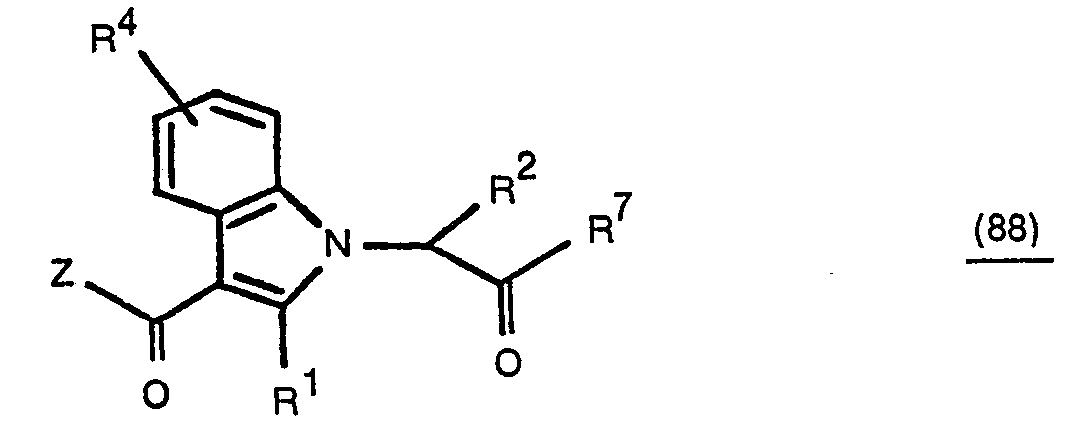
- According to Reaction Scheme 22, the indole of formula 10 is reacted with an α,β-unsaturated ketone of formula 89 (wherein R2, R3 and R7 are as defined hereinabove) under the same conditions as in the production of the compound of formula 24 from the compounds of formulae 10 and 23 in Reaction Scheme 2, to afford 1-acylethylindole of the following formula 90

- The compound of formula 90 is then acylated with the acid anhydride [III] in the same way as in Reaction Scheme 2, and then hydrolyzed to give a 3-acyl-1-acylethylindole of the following formula 91
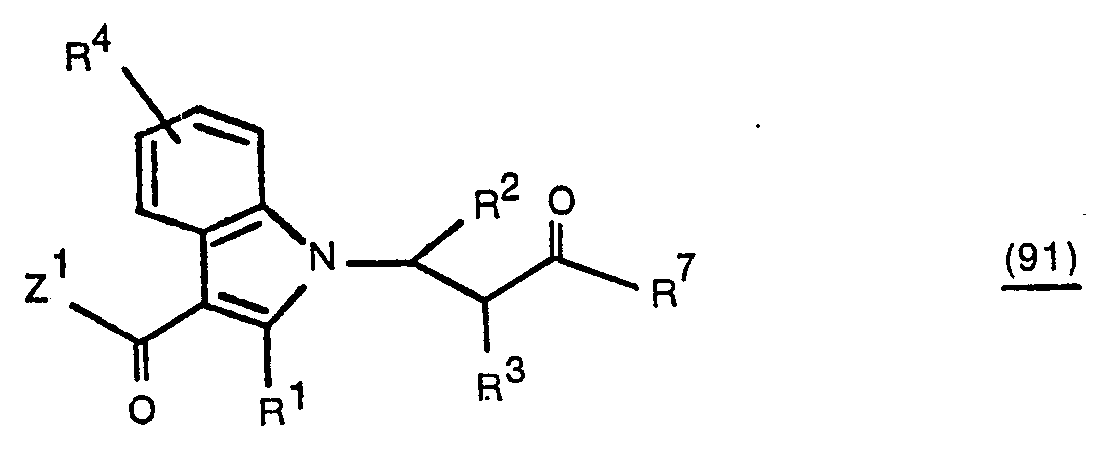

- According to Reaction Scheme 23, a 3-acyl-1-(ω-acylalkyl)indole of the following formula 94

can be produced either by oxidizing a 3-acyl-1-(ω-hydroxyalkyl)indole of the following formula 93
- The compound of formula 93, a starting material in Reaction Scheme 23, can be prepared in the same way as in Reaction Scheme 3 from a compound of formula 34 in which n is changed to n + 1.
- According to Reaction Scheme 24, a 1-(w-hydroxyalkyl)-3-unsubstituted indole of the following formula 95


- The compound of formula 96 is reacted with the acid anhydride of formula [III] in the presence of hydrogen iodide under the same conditions as in the production of the compound of formula 21 from the compound of formula 20 to give a compound of formula 97. Hydrolysis of the compound 97 gives a compound of formula 98.
- According to Reaction Schemes 21 to 24, 3-acyl-1-(ω-acylalkyl)indole derivatives exemplified by compounds (800) to (808) given hereinabove, which come within the definition of the acylated indole derivatives of formula [I] of this invention, can be advantageously produced.
- The acylated indole derivatives of formula [I] provided by the present invention have a characteristic pharmacoligical action in that they have excellent ability to inhibit platelet aggregation with reduced tendency toward inducing ulcer formation.
- Thus, according to this invention, there is provided a composition having the ability to inhibit platelet aggregation comprising a pharmaceutically effective amount of a acylated indole derivative of the following formula [I]-a

or an optically active isomer or salt thereof, and a pharmaceutically acceptable carrier, or said composition in unit dosage form. - In a preferred aspect, the present invention also provides a composition having the ability to inhibit platelet aggregation comprising a pharmaceutically effective amount of an acylated indole derivative of the following formula [I]-b

- Usually, the acylated indole derivative of this invention is administered perorally or parenterally (e.g., intrarectally, subcutaneously, intramuscularly, etc.) as the aforesaid composition or a drug in unit dosage form composed of the aforesaid composition. Preferably, it is administered peroally or intrarectally, and this is convenient to patients.
- For oral administration, the composition is formulated into a solid or liquid preparation. Examples of the solid preparation are tablets, pills, powders or granules. In such a solid preparation, at least one active substance (acylated indole derivative of the invention) is mixed with at least one inert diluent such as calcium carbonate, potato starch, alginic acid or lactic acid. The mixture is formulated in a customary manner. Additives other than diluents, such as lubricants (e.g., magnesium stearate), may also be incorporated.
- Examples of the liquid preparation for oral administration are an emulsion, a solution, a suspension, a syrup and an alixir. These liquid preparations contain common inert diluents such as water or liquid paraffin.
- These liquid preparations may also contain other auxiliary agents such as wetting agents, suspending aids, sweetenings, flavoring agents, aromas, and antiseptics.
- The liquid preparations may be made into capsules using an absorbent substance such as gelatin.
- A solid preparation for intrarectal administration may, for example, be suppository containing at least one active substance and prepared by a method known per se.
- Preparations for parenteral administration are, for example, aseptic aqueous or non-aqueous solutions, suspensions, and emulsions. Vegetable oils such as olive oils, propylene glycol, polyethylene glycol, and injectable organic esters such as ethyl oleate may, for example, be used as a non-aqueous solvent or suspending agent. These preparations for parenteral administration may also contain auxiliary agents such as antiseptics, wetting agents, emulsifiers and dispersing agents. They can be sterilized by, for example, filtration on a bacterial-holding filter, incorporation of a germicides, or by irradiation. Or an aseptic solid preparation may be produced and immediately before use, may be dissolved in aseptic water or aseptic solvents for injection.
- The acylated indole derivative of this invention can be converted into an inclusion compound with cyclodextrin. Such an inclusion compound has the advantage that a solid prepration containing such an inclusion compound, when administered orally to a warm-blooded animal, has increased dispersibility in the stomach and increased absorption, and that the inclusion compound is easy to form into a solid preparation.
- The cyclodextrin includes a-, A- and γ-cyclodextrins, and the fl-cydodextrin is preferred.
- The inclusion compound of the acylated indole derivative of this invention with cyclodextrin can be prepared, or for example, by a co-precipitation method which comprises forming an aqueous solution of A-cyclodextrin, adding the acylated indole derivative, stirring the mixture, and if required cooling the mixture to precipitate an inclusion compound; a solvent evaporating method which comprises adding a solution of the acylated indole derivative in an organic solvent such as ethyl ether to an aqueous solution of a-cyclodextrin, stirring the mixture, and then distilling off the organic solvent; or a kneading method which comprises forming an aqueous slurry of A-cyclodextrin, adding the acylated indole derivative or a solution of it in an organic solvent, and kneading the mixture by a ball mill, grinding machine, etc.
- The resulting inclusion compound can be directly used as a powdery drug. Or it can be formulated into tablets, granules, capsules, syrups, etc. by adding required amounts of excipients, binders, disintegrating agents, luster-imparting agents, corrigents, smell modifiers, coloring agents, etc.
- Since the acylated indole derivative of this invention have the excellent pharmacological activities, it can be administered to warm-blooded animals including man when it is desired to inhibit platelet aggregation or inhibit or prevent thrombus formation.
- For example, the acylated indole derivatives of this invention are useful for prevention of infarction of a cardiovascular system, prevention of post-operative thrombosis, promotion of patency of a vascular prosthesis after surgical operation, and for prevention and treatment of atherosclerosis and arteriosclerosis.
- They are also used to prevent onset of cerebral ischemia in patients of senile diseases, and to prevent or treat myocardial infarction and a poplexy for a long period of time after their seizure.
- The present invention also provides a method for inhibiting platelet aggregation of a warm-blooded animal, which comprises administering an amount effective for inhibition of platelet aggregation of the acylated indole derivative of formula [I]-a or an optionally active isomer or salt thereof to said warm-blooded animals.
- The dosage of the acylated indole derivative of this invention is 0.0005 to 20 mg, preferably 0.01 to 10 mg, per kg of body weight per day. The dosage, however, is affected by the condition, body weight and age of a patient and the route of administration.
- The acylated indole derivative of this invention may also be used as an additive for fluids used in artificial circulation and perfusion outside the body of the blood, blood products, substitute blood, or those in separated parts of a body (for example, limbs or organs either adhering to the parent body, stored after separation, or provided for transplantation, or adhering to a new body). Platelets clotted in such a circulating or perfusing fluids tend to clog vessels and circulating organs. This clogging can be avoided by the presence of the acylated indole derivative of this invention. For this purpose, the acylated indole derivative may be added gradually or at a time or in several portions to the circulating blood, the blood of a donor animal, parts of the body under perfusion (separated from or adhering to the recipient), or to two or all of these.
- The following Examples illustrate the present invention more specifically.
- (1) 2-Acetonylcyclohexanone (4.62 g; 30 millimoles), 4.60 g (30 millimoles) of alanine ethyl ether hydrochloride and 2.46 g (30 millimoles) of sodium acetate were suspended in 20 ml of acetic acid, and the suspension was heated under reflux for 3 hours. After the reaction, the acetic acid was distilled off under reduced pressure. The resulting reaction product was dissolved in 200 ml of ethyl acetate, and washed with 100 ml of a saturated aqueous solution of sodium bicarbonate twice, 100 ml of water and then 100 ml of a saturated aqueous solution of sodium chloride. The organic layer was dried over anhydrous sodium sulfate, and the solvent was distilled off under reduced pressure. The resulting oily product was chromatographed on a silica gel column using benzene as an eluent to afford 3.0 g (yield 42%) of ethyl 2-(4,5,6,7-tetrahydro-2-methylindol-1-yl)propionate.
- NMR(CDCI3, 8 (ppm)
- 1.19 (3H, t, J=7 Hz), 1.55 (3H, d, J=7 Hz), 1.6 (4H, m), 2.13 (3H, s), 2.4'(4H, m), 4.17 (2H, q, J=7 Hz), 4.73 (1 H, q, J=7Hz), 5.65 (1 H, s).
- (2) A solution of 3.50 g (14.9 millimoles) of the ethyl 2-(4,5,6,7-tetrahydro-2-methylindol-1-yl)-propionate obtained in (1) above in 20 ml of anhydrous ether was added dropwise to a stirred suspension of 566 mg (14.9 millimoles) of lithium aluminum hydride in 30 ml of anhydrous ether. The mixture was stirred at room temperature for 16 hours, and a saturated aqueous solution of anhydrous sodium sulfate was added to decompose the excess of lithium aluminum hydride and the resulting aluminum compound. The ethereal layer was washed with a saturated aqueous solution of sodium chloride, and dried over anhydrous sodium sulfate. The solvent was distilled off under reduced pressure. The resulting oily product was dissolved in 10 ml of acetic anhydride and 10 ml of pyridine, and the mixture was stirred at room temperature for 18 hours. The pyridine and acetic anhydride were distilled off under reduced pressure, and the reaction product was dissolved in 400 ml of ether. The ethereal layer was washed successively with 100 ml of 1 N hydrochloric acid, 100 ml of a saturated aqueous solution of sodium bicarbonate, 100 ml of water, and 100 ml of a saturated aqueous solution of sodium chloride. On distilling off the solvent under reduced pressure, 1 - (1 - acetoxy - 2 - propyl) - 4,5,6,7 - tetrahydro - 2 - methylindole (yield 91 %) was obtained.
- NMR(CDC13, 8 (ppm)):
- 1.48 (2H, d, J=7Hz), 1.75 (4H, m), 1.97 (3H, s), 2.20 (3H, s), 2.55 (4H, m), 4.3 (3H, m), 5.62 (1 H, s).
- (3) A mixture of 23.2 g (0.099 mole) of the 1 - (1 - acetoxy - 2 - propyl) - 4,5,6,7 - tetrahydro - 2 - methylindole obtained in (2) above, 44.8 g (0.198 mole) of benzoic anhydride and 1 ml of 52% hydriodic acid was stirred at 145°C for 2 hours in a stream of nitrogen with stirring. The reaction mixture was allowed to cool to room temperature, and dissolved in 300 ml of ethyl acetate. The solution was washed successively with 100 ml of 1N aqueous sodium hydroxide solution, 100 ml of water and 100 ml of a saturated aqueous solution of sodium chloride. The organic layer was dried over anhydrous sodium sulfate, and and the solvent was distilled off under reduced pressure. The resulting blackish brown oily product was chromatographed on a silica gel column using benzene/ethyl acetate (19/1) as an eluent to afford 29.6 g (yield 88%) of 1 - (1 - acetoxy - 2 - propyl) - 3 - benzoyl - 4,5,6,7 - tetrahydro - 2 - methylindole as an oil.
- NMR(CDCl3, δ (ppm) ):
- 1.45 (3H, d, J=8Hz), 1.6 (4H, m), 1.94 (3H, s), 2.2 (2H, m), 2.24 (3H, s), 2.6 (2H, m), 4.2-4.7 (3H, m), 7.3-7.6 (3H, m), 7.6-7.8 (2H, m).
- (4) 2.69 g (7.9 millimoles) of the 1 - (1 - acetoxy - 2 - propyl) - 3 - benzoyl - 4,5,6,7 - tetrahydro - 2 - methylindole obtained in (3) above, and 4.32 g (18.9 millimoles) of 2,3 - dichloro- - 5,6 - dicyanobenzo - 1,4 - quinone were dissolved in 50 ml of dioxane, and the solution was heated under reflux for 4 hours. The dioxane was distilled off under reduced pressure, and 400 ml of ethyl acetate was added to the residue to dissolve the reaction product. The solution was filtered. The filtrate was washed with 200 ml of water, 100 ml of 1 N aqueous sodium hydroxide solution, 200 ml of water and 100 ml of a saturated aqueous solution of sodium chloride, followed by drying over anhydrous magnesium sulfate. The solvent was distilled off under reduced pressure. The resulting blackish brown oily product was chromatographed on a column of silica gel using benzene/acetic acid (20/1) as an eluent to afford 1.44 g (yield 52%) of the desired compound (No. 200) as an oil.
- IR(CHCl3)cm-1:
- 1736, 1625, 1521, 1461, 1613, 1382, 1230, 1174, 1050.
- NMR(CDCI3m δ (ppm)):
- 1.63 (3H, d, J=8Hz), 1.87 (3H, s), 2.52 (3H, s), 4.3-4.6 (2H, m), 4.6-5.2 (1 H, m), 6.8-7.8 (9H, m).
- In a mixture of 10 ml of methanol and 5 ml of a 1 N aqueous solution of sodium hydroxide was dissolved 597 mg (1.78 millimoles) of the compound (No. 200) obtained in Example 1. The solution was stirred at room temperature for 3 hours. Methanol was distilled off under reduced pressure, and the residue was dissolved in 50 ml of ethyl acetate. The solution was washed with 50 ml of water and 50 ml of a saturated aqueous solution of sodium chloride. The product was dried over anhydrous sodium sulfate, and the solvent was distilled off under reduced pressure to afford 520 mg (yield 100%) of the desired compound (No. 100) as an oil.
- IR(CHCl3)cm-1:
- 3400, 1620, 1576, 1513, 1462, 1412, 1390, 1273, 1230, 1163, 1056, 1131, 899.
- NMR(CDCI3, δ (ppm)):
- 1.60 (3H, d, J=8Hz), 2.47 (3H, s), 2.60 (1 H, br), 3.6-4.2 (2H, m), 4.2-4.8 (1 H, m), 6.9-7.8 (9H, m).
- 447 mg of the compound (No. 100) obtained in Example 2 was dissolved in 20 ml of dimethoxyethane. While the solution was cooled with ice with stirring, 90 mg (1.2 equivalents) of sodium hydride was added, followed by addition of 0.5 ml of ethyl bromide. The mixture was stirred overnight. The dimethoxyethane was distilled off under reduced pressure, and the reaction product was dissolved in 50 ml of ethyl acetate. The solution was washed first with 50 ml of water and then with 50 ml of a saturated aqueous solution of sodium chloride, followed by drying over anhydrous sodium sulfate. The solvent was distilled under reduced pressure, and the resulting oily product was chromatographed on a silica gel column using benzene/ethyl acetate (20/1) as an eluent to afford 270 mg (yield 56%) of the desired compound (No. 302) as an oil.
- IR(CHCl3)cm-1:
- 2960, 2850, 1620, 1572, 1516, 1459, 1445, 1407, 1381, 1254, 1268, 1210-1230, 1168,1100,1070,1025,896,696.
- NMR(CDCI3, 8 (ppm)):
- 1.03 (3H, t, J=6.5), 1.60 (3H, d, J=7), 253 (3H, s), 3.1-3.6 (2H, m), 3.7-4.2 (2H, m), 4.67 (1 H, sextet), 6.9-7.9 (9H, m).
- The compound (No. 100) obtained in Example 2 was reacted with methyl iodide in the same way as in Example 3 to afford the desired compound (No. 300).
- IR(CHCl3)cm-1:
- 2950, 2900, 1620, 1572, 1515, 1450, 1403, 1374, 1267, 1225, 1200, 1165, 1108, 1036, 895, 744.
- NMR(CDCl3, δ (ppm)):
- 1.60 (3H, d, J=7 Hz), 2.55 (3H, s), 3.23 (3H, s), 3.6-4.1 (2H, m), 4.5-5.1 (1 H, m), 6.9-7.9 (9H, m).
- The compound (No. 100) obtained in Example 2 was reacted with 2-bromopropane in the same way as in Example 3 to afford the desired compound (No. 305) in a yield of 90%.
- NMR(CDCI3, ó (ppm)):
- 0.92 (3H, d, J=6 Hz), 1.04 (3H, d, J=6 Hz), 1.61 (3H, d, J=6 Hz), 2.51 (3H, s), 3.37 (1 H, sextet, J=6 Hz), 3.82 (2H, bd, J=6 Hz), 4.68 (1 H, sextet, J=6 Hz), 6.8--7.6 (7H, m), 7.6-7.9 (2H, m).
- IR(CHCl3)cm-1:
- 2960, 1620, 1515, 1450, 1405, 1220, 1160, 1070, 1025, 920, 890, 740.
- The compound (No. 100) obtained in Example 2 was reacted with n-heptyl bromide in the same way as in Example 3 to afford the desired compound (No. 325) in a yield of 42%.
- NMR(CDCl3, δ (ppm)):
- 0.83 (br, t), 1.0-1.5 (10H, br, s), 1.67 (3H, d, J=7 Hz), 2.58 (3H, s), 3.2-3.5 (2H, m), 3.8-4.1 (2H, m), 4.75 (lH, sextet, J=7 Hz), 7.0-7.95 (9H, m).
- IR(CHCl3)cm-1:
- 2950,2900,1620,1405,900.
- The same reaction as in Example 1 was performed using D-alanine ethyl ester hydrochloride

-

- The same reaction as in Example 1 was performed using L-alanine ethyl ester hydrochloride

-
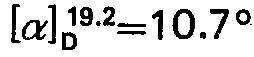
- The compound (No. 217) obtained in Example 7 was hydrolyzed to afford the desired compound (No. 135).
-

- IR(KBr)cm-1:
- 3420, 1598, 1585, 1563, 1548, 1415, 1167, 1062, 867.
- NMR(CDCl3, δ (ppm)):
- 1.60 (3H, d, J=7Hz), 2.51 (3H, s), 3.6-4.3 (2H, m), 4.3-4.9 (1 H, m), 6.9-7.8 (9H, m).
- The compound (No. 218) obtained in Example 8 was hydrolyzed to afford the desired compound (No. 136).
-

- IR(KBr)cm-1:
- 3425, 1600, 1584, 1563, 1530, 1416, 1168, 1063, 863.
- NMR(CDCl3, δ (ppm)):
- 1.60 (3H, d, J=7 Hz), 2.51 (3H, s), 3.6-4.3 (2H, m), 4.3-4.9 (1 H, m), 6.9-7.8 (9H, m).
- The compound (No. 135) obtained in Example 9 was reacted with methyl iodide to afford the desired compound (No. 346).
-

- IR(liquid film)cm-1:
- 3000, 1620, 1520, 1460, 1405, 1170, 1105, 900.
- NMR(CDCl3 δ (ppm)):
- 1.62 (3H, d, J=7 Hz), 2.51 (3H, s), 3.21 (3H, s), 3.3-4.0 (2H, m), 4.5-5.0 (1 H, m), 6.8-7.9 (9H, m).
- The compound (No. 136) obtained in Example 10 was reacted with methyl iodide to afford the desired compound (No. 347).
-

- IR(CHCl3)cm-1:
- 3000, 1620, 1520, 1460, 1405, 1105, 900.
- NMR(CDCl3, δ (ppm)):
- 1.60 (3H, d, J=6 Hz), 2.51 (3H, s), 3.21 (3H, s), 3.3-3.9 (2H, m), 4.5-5.0 (1 H, m), 6.9-7.9 (9H, m).
- (1) 0.6 g of sodium hydride (50%, mineral oil) was suspended in 5 ml of dimethylformamide. A solution of 1.17 g (10 millimoles) of indole in 10 ml of dimethylformamide was added dropwise to the suspension. After generation of hydrogen ceased, 1.6 ml of ethyl α-bromopropionate was added dropwise, and reacted at room temperature for 5 hours. After the reaction, 100 ml of water was added to the reaction mixture, and the mixture was extracted with 100 ml of ethyl acetate. The organic layer was washed three times with 100 ml of water, and dried over anhydrous sodium sulfate. The solvent was distilled off under reduced pressure to afford an oily product.
- NMR(CDCl3, δ (ppm):
- 1.12 (3H, t, J=7 Hz), 1.72 (3H, d, J=7 Hz), 4.13 (2H, q, J=7 Hz), 5.05 (1 H, q, J=7 Hz), 4.87 (1 H, d, J=3 Hz), 6.95-7.40 (4H, m), 7.55-7.75 (1H, m).
- (2) The resulting product ethyl 2-(indol-1-yl)propionate was reduced with 0.4 g of lithium aluminum hydride in anhydrous ether. The product was acetylated with 5 ml of acetic anhydride and 10 ml of pyridine to afford 1.69 g (yield 77%) of 1-(1-acetoxy-2-propyl)indole.
- NMR(CDCl3, δ (ppm)):
- 1.50 (3H, d, J=7 Hz), 1.85 (3H, s), 4.08 (2H, m), 4.77 (1 H, sextet, J=7 Hz), 6.52 (1 H, d, J=3 Hz), 6.9-7.4 (4H, m), 7.5-7.75 (1 H, m).
- (3) A mixture of 1.51 (7 millimoles) of the product obtained in (2) above, 3.14 g (14 millimoles) of benzoic anhydride and 0.2 ml of 52% hydriodic acid was stirred at 140°C for 1.5 hours. After the reaction, the reaction mixture was dissolved in 100 ml of ethyl acetate, and successively washed with 100 ml of a saturated aqueous solution of sodium bicarbonate, 100 ml of water and 100 ml of a saturated aqueous solution of sodium chloride. The product was dried over anhydrous sodium sulfate, and the solvent was distilled off under reduced pressure. The resulting oily product was chromatographed on a silica gel column using benzene/ethyl acetate (25/1) as an eluent to afford 0.8 g (yield 37%) of 1-(1-acetoxy-2-propyl)-3-benzoylindole (No. 202).
- NMR(CDCl3, δ (ppm)):
- 1.50 (3H, d, J=7 Hz), 1.83 (3H, s), 4.0-4.4 (2H, m), 4.4-5.1 (1H, m), 7.2-7.8 (9H, m), 8.35-8.6 (1 H, m).
- (4) 0.8 g (2.5 millimoles) of the product obtained in (3) above was hydrolyzed with 5 ml of a 1 N aqueous solution of sodium hydroxide in 10 ml of methanol to afford the desired compound (No. 111) in an amount of 595 mg (yield 85%).
- IR(CHCl3)cm-1:
- 3360, 2970, 1605, 1570, 1481, 1460, 1407, 1382, 1306, 1230-1210, 1177, 1049, 875.
- NMR(CDCl3, 6 (ppm)):
- 1.43 (3H, d, J=7Hz), 3.2 (1 H, brs), 3.73 (2H, br, s), 4.3-4.7 (1 H, m), 7.1-7.8 (9H, m), 8.1-8.4 (1 H, m).
- The same reaction as in Example 13 was performed using 5-chloro-3-methylindole and ethyl α-bromopropionate to afford the desired compound (No. 113).
- Melting point: 173-175°C (ethanol)
- NMR(CDCl3, δ (ppm)):
- 1.60 (3H, d, J=7 Hz), 2.44 (3H, s), 3.7-4.2 (2H, m), 4.5-4.95 (2H, m), 7.10 (1 H, dd, J=2, 9 Hz), 7.4-7.9 (7H, m).
- IR(KBr)cm-1:
- 3455, 1602, 1572, 1520, 1450, 1410, 1358, 1230, 1216, 1164, 1078, 1048, 1008, 890, 878, 802, 798, 752, 722, 702.
- The compound (No. 113) obtained in Example 14 was reacted with methyl iodide to afford the desired compound (No. 304).
- NMR(CDCI3, δ (ppm)):
- 1.59 (3H, d, J=7 Hz), 2.47 (3H, s), 3.21 (3H, s), 3.5-4.1 (2H, m), 4.67 (1 H, m), 7.05 (1 H, dd, J=2, 9 Hz), 7.25-7.9 (7H, m).
- IR(CHCl3)cm-1:
- 1626, 1600, 1580, 1522, 1452, 1412, 1168, 1114, 1068, 1014, 940, 898.
- The same reaction as in Example 13 was carried out using 2,5-dimethylindole and ethyl α-bromopropionate to afford the desired compound (No. 114).
- NMR(CDCl3, δ (ppm)):
- 1.38 (3H, d, J=6.5 Hz), 1.88 (1 H, dd, J=4.8 Hz, disappeared in D20), 2.27 (3H, s), 2.35 (3H, s), 3.2-4.55 (3H, m), 6.02 (1 H, s), 6.82 (1 H, dd, J=1.9 Hz), 7.06-7.34 (2H, m).
- IR(KBr)cm-1:
- 3370, 1600, 1582, 1562, 1516, 1402, 1236, 1180, 1158, 1052, 1016, 912, 888, 808, 794, 762, 732.
- The compound (No. 114) obtained in Example 16 was reacted with ethyl iodide to afford the desired compound (No. 348).
- Melting point: 84-85°C (cyclohexane).
- NMR(CDCl3, δ (ppm)):
- 1.06 (3H, t, J=7 Hz), 1.61 (3H, d, J=7 Hz), 2.27 (3H, s), 2.47 (3H, s), 3.1-3.6 (2H, m), 3.82 (2H, dd, J=2, 7 Hz), 4.4-4.93 (1 H, m), 6.82-7.9 (8H, m).
- IR(KBr)cm-1:
- 1628, 1600, 1580, 1520, 1486, 1470, 1444, 1410, 1386, 1376, 1360, 1274, 1238, 1194, 1176, 1110, 1078, 1050, 900, 878, 792, 736, 708.
- The same reaction as in Example 1 was carried out using 2-methylindole and methyl α-bromopropionate to afford 1-(1-acetoxy-2-propyl)-2-methylindole. The product was hydrolyzed with sodium hydroxide, and then reacted with methyl iodide to form 1-(1-methoxy-2-propyl)-2-methylindole. The product was then reacted with thiophenecarboxylic anhydride in 52% hydriodic acid to afford the desired compound (No. 315).
- IR(CHCl3)cm-1:
- 1605, 1514, 1460, 1413, 1390, 1351, 1267, 1220, 1165, 1106, 1082, 834.
- NMR(CDCl3, δ (ppm)):
- 1.60 (3H, d, J=6 Hz), 2.55 (3H, s), 3,18 (3H, s), 3.5-4.1 (2H, m), 4.70 (1 H, sextet, J=6 Hz), 6.9-7.75 (7H, m).
- The 1-(1-acetoxy-2-propyl)-2-methylindole obtained in Example 18 was acylated with o-methylbenzoic anhydride, and then hydrolyzed to form the desired compound (No. 126).
- NMR(CDCl3, δ (ppm)):
- 1.46 (3H, d, J=7 Hz), 2.21 (3H, s), 2.40 (3H, s), 3.33 (1 H, bs), 3.45-4.20 (2H, m).
- IR(CHCl3)cm-1:
- 3400, 3040, 2920, 1600, 1565, 1510, 1480, 1455, 1400, 1260, 1225, 1165, 1050, 920, 895, 760, 740.
- 5-Methoxy-2-methylindole was reacted with ethyl a-bromopropionate in the same way as in Example 13 to form 1 -(1-acetoxy - 2 - propyl) - 5 - methoxy - 2 - methylindole. The resulting product was reacted with benzoic anhydride to obtain 1 - (1 - acetoxy - 2 - propyl) - 3 - benzoyl - 5 - methoxy - 2 - methylindole (No. 219) and (1 - acetoxy - 2 - propyl)- 3 - benzoyl - 5 - hydroxy - 2 - methylindole which were then hydrolyzed with sodium hydroxide to form the desired compounds (No. 116) and (No. 117), respectively.
- Spectral data of the compound (No. 219)
- IR(CHCl3)cm-1:
- 2940, 1734, 1600, 1460, 1250―1210, 860.
- NMR(CDCl3, δ (ppm)):
- 1.60 (3H, d, J=7 Hz), 1.89 (3H, s), 2.47 (3H, s), 3.59 (3H, s), 4.3-5.0 (3H, m), 6.63-6.87 (2H, m), 7.25-7.80 (6H, m).
- IR(CHCl3)cm-1:
- Spectral data of the compound (No. 116)
- IR(CHCl3)cm-1:
- 3320, 2930, 2200, 1600, 1470, 1400, 1270, 1150, 900, 685.
- NMR(CDC13, 8 (ppm)):
- 1.57 (3H, d, J=7 Hz), 2.41 (3H, s), 2.7 (1 H, br, s), 3.57 (3H, s), 3.7-4.8 (3H, m), 6.57-6.83 2H, m), 7.20-7.75 (6H, m).
- IR(CHCl3)cm-1:
- Spectral data of the compound (No. 117)
- IR(KBr)cm-1:
- 3300, 3150, 1620, 1600, 1590, 1565, 1520, 1475, 1425, 1255, 1055, 880, 760.
- NMR(DMSO-d6, δ (ppm):
- 1.63 (3H, d, J=7 Hz), 2.52 (3H, s), 3.9 (3H, m), 4.5-4.9 (1 H, m), 6.6-6.9 (2H, m), 7.4-7.8 (6H, m), 8.90 (1H, br, s).
- IR(KBr)cm-1:
- A mixture of 0.85 g (3.2 millimoles) of 5 - methoxy - 1 - (1 - methoxy - 2 - propyl) - 2 - methylindole, 1.47 g (6.4 millimoles) of benzoic anhydride and 0.2 ml of 52% hydriodic acid was heated at 140°C for 2 hours in a stream of nitrogen with stirring. The reaction mixture was worked up to separate 0.46 g (yield 43%) of the desired compound (No. 318).
- IR(CHCl3)cm-1:
- 2960,2900, 1610, 1572, 1506, 1474, 1440, 1410, 1388, 1275, 1160, 1144, 1106, 1032, 905.
- NMR(CDCl3, 8 (ppm)):
- 1.57 (3H, d, J=7Hz), 2.47 (3H, s), 3.20 (3H, s), 3.59 (3H, s), 3.60 (2H, m), 4.63 (1 H, sextet, J=7Hz), 6.6-6.9 (2H, m), 7.2-7.8 (6H, m).
- A mixture of 1.15 g (5 millimoles) of 2 - isopropyl - 1 - (1 - methoxy - 2 - propyl)indole, 2.26 g (10 millimoles) of benzoic anhydride and 0.3 ml of 52% hydriodic acid was heated at 140°C for 2 hours in a stream of nitrogen with stirring. The reaction mixture was worked up to separate 1.03 g (yield 62%) of the desired compound (No. 303).
- IR(CHCl3)CM-1:
- 3000, 2940, 1623, 1508, 1460, 1410, 1240―1205, 1103.
- NMR(CDCl3, δ (ppm)):
- 1.40 (3H, d, J=7 Hz), 1.43 (3H, d, J=7 Hz), 1.60 (3H, d, J=7 Hz), 3.23 (3H, s), 3.67 (1 H, m), 3.80 (2H, d, J=7 Hz), 4.83 (1 H, sextet, J=7 Hz), 6.8-7.9 (9H, m).
- A mixture of 0.8 g (4 millimoles) of 1-(1-methoxy-2-propyl)-2-methylindole, 3.48 g (11.8 millimoles) of p-chlorobenzoic anhydride and 0.25 ml of 52% hydriodic acid was heated at 140°C for 2.5 hours in a stream of nitrogen with stirring. The reaction mixture was worked up to separate 810 mg (yield 66%) of the desired compound (No. 317).
- IR(liquid film)cm-1:
- 2850, 1618, 1593, 1460, 1408, 1105, 1089, 898, 837.
- NMR(CDCI3, δ (ppm)):
- 1.62 (3H, d, J=7Hz), 2.58 (3H, s), 3.26 (3H, s), 3.8 (2H, m), 4.76 (1 H, sextet, J=7Hz), 6.9-7.8 (8H, m).
- The same reaction as in Example 13 was carried out using methyl 2-pentenoate and 2-methylindole to afford the desired compound (No. 106).
- IR(CHCl3)cm-1:
- 3610, 3550, 3000, 2400, 1600, 1400, 1040, 900, 870.
- NMR(CDCl3, δ (ppm)):
- 0.75 (3H, t, J=7Hz), 1.7-2.8 (4H, m), 2.52 (3H, s), 2.9-3.8 (2H, m), 4.3-4.9 (1 H, m), 6.8-8.0 (9H, m).
- The compound (No. 106) obtained in Example 24 was reacted with methyl iodide to afford the desired compound (No. 319).
- IR(KBr)cm-1:
- 2945,1617,1520,1410,1233,1105,1077,1052,895.
- NMR(CDCI3, 8 (ppm)):
- 0.77 (3H, t, J=7Hz), 1.6-3.5 (6H, m), 2.51 (3H, s), 3.20 (3H, s), 4.2-4.8 (1 H, m) 6.9-7.9 (9H, m).
- The compound (No. 106) obtained in Example 24 was reacted with ethyl iodide to afford the desired compound (No. 320) in a yield of 58%.
- IR(KBr)cm-1:
- 2980, 2880, 1618, 1526, 1417, 1 166, 1 121, 861, 750.
- NMR(CDCl3, 8 (ppm)):
- 0.76 (3H, t, J=7Hz), 1.13 (3H, t, J=7Hz), 1.6-3.1 (6H, m), 2.53 (3H, s), 3.1-3.6 (2H, m), 4.3-4.9 (1 H, m), 6.9-7.9 (9H, m).
- The compound (No. 106) obtained in Example 24 was acetylated to afford the desired compound (No. 204) in a yield of 76%.
- IR(CHCl3)cm-1:
- 3480, 3000, 2900, 2400, 1900, 1740, 1620, 1580, 1520, 1460, 1410, 1 170, 1100, 1040, 900, 670.
- NMR(CDCI3, 8 (ppm)):
- 0.77 (3H, t, J=7Hz), 1.6-2.8 (4H, m), 1.90 (3H, s), 2.52 (3H, s), 3.4―4.7 (3H, m), 6.8-7.9 (9H, m).
- Synthesis of 3-benzoyyl-1-(1-hydroxy-2-butyl)-2-methylindole (No. 104), and 1-(1-acetoxy-2-butyl)-3-benzoyl-2-methylindole (No. 205):-
- The same reaction as in Example 13 was carried out using ethyl α-bromobutyrate to afford the desired compounds (No. 104) and (No. 205).
- Spectral data of the compound (No. 104)
- IR(CHCl3)cm-1:
- 3370, 1613m 1573,1512,1460,1448,1410,1390,1230―1195.1053.
- NMR(CDCI3, 8 (ppm)):
- 0.72 (3H, t, J=7 Hz), 1.7-2.5 (2H, m), 2.38 (3H, s), 3.0 (3H, br), 3.6-4.5 (3H, m), 7.8-8.75 (9H, m).
- IR(CHCl3)cm-1:
- Spectral data of the compound (No. 205)
- IR(CHCl3)cm-1:
- 1733,1620,1517,1458,1447,1410,1387,1365,1250,1200,1040.
- NMR(CDCI3, 8 (ppm)):
- 0.80 (3H, t, J=7Hz), 1.88 (3H, s), 1.8-2.3 (2H, m), 2.55 (3H, s), 4.35-4.7 (3H, m), 6.8-7.9 (9H, m).
- IR(CHCl3)cm-1:
- The compound (No. 104) obtained in Example 28 was reacted with methyl iodide to afford the desired compound (No. 311).
- IR(CHCl3)cm-1:
- 1613, 1576, 1510, 1460, 1450, 1409, 1390, 1358, 1230―1210,1168, 1005.
- NMR(CDCl3, δ (ppm));
- 0.77 (3H, t, J=7Hz), 2.32 (quintet, J=7Hz), 2.53 (3H, s), 3.18 (3H, s), 3.55-4.1 (2H, m), 4.15―4.75 (1H, m), 6.9-7.9 (9H, m).
- The compound (No. 104) obtained in Example 28 was reacted with ethyl iodide to afford the desired compound (No. 312).
- IR(CHCl3)cm-1:
- 1616,1513,1460,1448,1410,1230―1200,1122,1106.
- NMR(CDC13, δ (ppm)):
- 0.77 (3H, t, J=7Hz) 1.02 (3H, t, J=7 Hz), 1.8-2.4 (2H, m), 2.52 (3H, s), 3.05-3.7 (2H, m), 3.7-4.1 (2H, m), 4.2-4.7 (1 H, m), 6.85-7.8 (9H, m).
- 2-Methylindole (6.5 g; 0.05 millimole) was dissolved in 30 ml of dimethylformamide, and with stirring under ice cooling, 2.5 g of sodium hydride (50%) was added. After generation of hydrogen ceased, 10.5 g of methyl α-bromocaproate was added dropwise, and reacted at room temperature for 3 days. Water (200 ml) was added to the reaction mixture to stop the reaction. The mixture was then extracted with 200 ml of ethyl acetate, washed with water and an aqueous solution of sodium chloride, and then dried over anhydrous sodium sulfate. The dried product was concentrated under reduced pressure. The resulting oily product was chromatographed on a silica gel column using hexane/ethyl acetate (15/1) as an eluent to afford 7.64 g (yield 59%) of methyl 2-(2methylindol-1-yl)caproate.
- The resulting ester (7.64 g) was dissolved in 40 ml of ether. With stirring under ice cooling, 1.0 g of lithium aluminum hydride was added. With ice cooling, the mixture was stirred at room temperature for 30 minutes, and treated with a saturated aqueous solution of sodium sulfate. The resulting oily product was chromatographed on a silica gel column using benzene as an eluent to afford 3.Og of 1-(1-hydroxy-2-hexyl)-2-methylindole.
- The resulting product (3.0 g) was reacted with 5 ml of acetic anhydride and 5 ml of pyridine to afford 3.25 g of 1-(1-acetoxy-2-hexyl)-2-methylindole.
- The resulting acetate (3.25 g; 11.9 millimoles) was benzoylated using 5.40 g (24 millimoles) of benzoic anhydride and then hydrolyzed to afford 2.05 g (yield 51 % based on the acetate) of the desired compound (No. 102).
- NMR(CDC13, δ (ppm)):
- 0.78 (3H, s), 0.9-1.4 (4H, m), 1.6-2.1 (2H, m), 2.43 (3H, s), 3.3 (1 H, br), 3.5-4.4 (3H, br, m), 7.0-7.85 (9H, m).
- IR(CHCl3)cm-1:
- 3430, 2950, 2880, 1620, 1570, 1520, 1460, 1400, 1260, 1160, 890.
- 500 mg of the compound (No. 102) obtained in Example 31 was reacted with 2 ml of acetic anhydride and 2 ml of pyridine to afford 560 mg (yield 100%) of the desired compound (No. 206).
- NMR(CDCI3, δ (ppm)):
- 0.79 (3H, brt, J=6 Hz), 1.0-1.5 (4H, m), 1.88 (3H, s), 1.55-2.0 (2H, m), 2.58 (3H, s), 4.4-4.8 (3H, m), 7.0-7.95 (9H, m).
- IR(CHCl3)cm-1:
- 2930,1740,1620,1404,890.
- 853 mg (2.5 millimoles) of the compound (No. 102) obtained in Example 31 was dissolved in 5 ml of dimethylformamide and with stirring under ice cooling, 124 mg (1.1 equivalents) of sodium hydride (52.9%) was added to form the corresponding sodium salt. Then, 1 ml of methyl iodide was added, and the mixture was maintained at room temperature for 12 hours. The reaction mixture was worked up to separate the desired compound (No. 334) in a yield of 85%.
- NMR(CDCl3, δ (ppm)):
- 0.82 (3H, brt, J=6 Hz), 1.0-1.5 (4H, m), 1.8-2.4 (2H, m), 2.56 (3H, s), 3.22 (3H, s), 3.6―4.15 (2H, m, ABX), 4.25-4.9 (1 H, m), 7.0-8.95 (9H, m). IR(CHCl3)cm-1:
- 2950, 1628, 1533, 1418, 1385, 1110, 895, 755.
- The same reaction as in Example 31 was carried out using 2-methylindole and ethyl α-bromo- caprylate to afford the desired compound (No. 103).
- NMR(CDCI3, δ (ppm)):
- 0.81 (3H, brt, J=6 Hz), 1.0-1.4 (8H, m), 1.7-2.1 (2H, m), 1.05 (3H, t, J=7 Hz), 3.32 (2H, q, J=7Hz), 2.45 (3H, s), 3.80 (2H, m), 4.2-4.7 (1 H, m), 7.0-7.9 (9H, m).
- IR(KBr)cm-1:
- 3300, 2950, 1630, 1527, 1462, 1418, 1215, 1065, 748.
- The compound (No. 103) obtained in Example 34 was acetylated to afford the desired compound (No. 207) in a yield of 98%.
- IR (liquid film)cm-1:
- 3030, 2950, 2900, 1740, 1630, 1580, 1520, 1460, 1420, 1170, 1040, 900.
- NMR(CDCl3, δ (ppm)):
- 0.5-2.5 (13H, m), 1.91 (3H, s), 2.52 (3H, s), 4.3-4.8 (3H, m), 6.9-8.0 (9H, m).
- The compound (No. 103) obtained in Example 34 was reacted with methyl iodide to afford the desired compound (No. 335).
- IR(KBr)cm-1:
- 2950, 2900, 2870, 1630, 1600, 1530, 1460, 1420, 1220, 1120, 1080, 900, 800, 740.
- NMR(CDCl3, δ (ppm)):
- 0.6-2.3 (13H, m), 2.53 (3H, s), 3.55 (3H, s), 3.5-4.0 (2H, m), 4.2-4.8 (1 H, m), 6.9-7.9 (9H, m).
- The compound (No. 103) obtained in Example 34 was reacted with ethyl iodide to afford the desired compound (No. 336) in a yield of 80%.
- NMR(CDCl3, δ (ppm)):
- 0.81 (3H, brt, J=6 Hz), 1.0-1.4 (8H, m), 1.7-2.1 (2H, m), 1.05 (3H, t, J=7 Hz), 3.32 (2H, q, J=7 Hz), 2.45 (3H, s), 3.80 (2H, m), 4.2-4.7 (1 H, m), 7.0-7.9 (9H, ni).
- IR(CHCl3)cm-1:
- 2930,2850,1620,1408,1110,890.
- (1) 2-Methylindole (13.1 g; 0.1 millimole) was reacted with 23.6 g (0.236 mole) of methyl crotonate in 80 ml of dimethyl formamide in the presence of 0.6 g (0.012 mole) of sodium hydride at room temperature for 20 hours. After the reaction, water was added, and the reaction mixture was extracted with ethyl acetate. The organic layer was dried over anhydrous magnesium acetate, and concentrated to afford 34 g of a crude product. The crude product was reduced with 9.5 g (0.25 mole) of lithium aluminum hydride in 250 ml of ether at room temperature for 18 hours with stirring. After the reaction, the reaction mixture was worked up with a saturated aqueous solution of sodium sulfate, washed with ether, dried over magnesium sulfate, and concentrated to afford 22.8 g of a crude product.
- The. product was chromatographed on a silica gel column using hexane/ethyl acetate (2/1) as an eluent to afford 8.00 g (39.4 millimoles; yield 39.4%) of 1 -(1- hydroxy - 3 - butyl) - 2 - methylindole.
- NMR(CDCl3, δ (ppm)):
- 1.30 (br, 1 H, OH), 1.57 (d, 3H, J=7Hz, NCHCH3), 1.7-2.3 (m, 2H, CH2CH2OH), 2.40 (s, 3H, CH3), 2.8-3.7 (m, 2H, CH2OH), 4.4-5.0 (m, 1 H, NCH), 6.16 (s, 1H, proton at the 3-position of indole) 6.8-7.6 (m, 4H, proton on the indole ring).
- IR(liquid film)cm-1:
- 3300, 3000, 2900, 2850, 1600, 1540, 1450, 1405, 1355, 1335, 1300,1230,1160, 1140, 1100,1035,985,950,915,840,760,740,730.
- (2) 8.00 g of 1-(1-hydroxy-3-butyl)-2-methylindole was reacted with 30 ml of acetic anhydride and 25 ml of pyridine for 20 hours to afford 9.0 g (36.7 millimoles; yield 93.2%) of 1-(1-acetoxy-3-butyl)-2-methylindole.
- NMR(CDCl3, δ (ppm)):
- 1.57 (d, 3H, J=7 Hz, NCHCH3), 1.92 (s, 3H, OCOCH3), 1.9-2.6 (m, 2H, NCHCH2), 2.38 (s, 3H, CH3), 3.6-4.2 (m, 2H, CH20CO), 4.3-4.9 (m, 1 H, NCH), 6.26 (s, 1 H, proton at the 3-position of indole), 7.0-7.7 (m, 4H, proton on the indole ring).
- (3) 9.0 g of 1-(1-acetoxy-3-butyl)-2-methylindole was reacted with 20.7 g (91.8 millimoles) of benzoic anhydride and 0.5 ml of hydriodic acid in an atmosphere of nitrogen at 140°C for 1.5 hours. After cooling, ethanol, water and sodium hydroxide were added to the reaction mixture. The mixture was stirred at room temperature for 3 hours to hydrolyze the reaction product. The product was concentrated under reduced pressure, extracted with ethyl acetate, washed with an aqueous solution of sodium hydrogen carbonate, dried and concentrated. The crude product was chromatographed on a silica gel column using hexane/ethyl acetate (1/1) as an eluent to afford 6.69 g (21.8 millimoles; yield 59.4%) of the desired compound (No. 105).
- NMR(CDCI3, δ (ppm)):
- 1.63 (d, 3H, J=6.5Hz, NCHCH ), 1.9-2.5 (m, 2H, NCHCH2), 2.53 (s, 3H, CH3), 2.75 (bs, 1 H, OH, 3.1-3.7 (m, 2H, CH2OH), 4.5-5.2 (m, 1H, NCH), 7.0-7.95 (m, 9H, protons on the 'indole and benzene rings).
- IR(KBr)cm-1:
- 3350, 3000, 2880, 2830, 1600, 1565, 1505, 1450, 1435, 1400, 1350, 1295, 1260, 1220, 1160, 1150, 1075, 1050, 1030, 920, 890, 860, 790, 735, 705, 685.
- Acetic anhydride (20 ml) and 15 ml of pyridine were added to 2.26 g (7.36 millimoles) of the compound (No. 105) obtained in Example 38, and the mixture was stirred at room temperature for 1 hour to decompose the acetic anhydride. The product was concentrated under reduced pressure. The crude product was dissolved in ethyl acetate and was washed successively with an aqueous solution of potassium hydrogen sulfate, an aqueous solution of sodium chloride and an aqueous solution of sodium hydrogen carbonate, dried over magnesium sulfate and concentrated to afford 2.70 g of the crude product. The crude product was chromatographed on a silica gel column using hexane/ethyl acetate (2/1) as an eluent to afford 2.29 g (6.56 millimoles; yield 89.2%) of the desired compound (No. 201).
- NMR(CDCl3, δ (ppm)):
- 1.67 (d, 3H, J=7Hz, NCHCH3), 1.93 (s, 3H, OCOCH3), 2.1-2.6 (m, 2H, NCHCH2), 2.57 (s, 3H, CH3), 3.8-4.4 (m, 2H, CH2OCO), 4.5-5.1 (m, 1H, NCH), 7.03-8.0 (m, 4H, protons on the indole and benzene rings).
- IR (liquid flim)cm-1:
- 3010, 2949, 1730, 1615, 1570, 1510, 1450, 1405, 1380, 1360, 1300, 1230, 1165, 1130, 1100, 1050, 1030, 920, 890, 870, 795, 740, 715, 690.
- The compound (No. 105) obtained in Example 38 (1.50 g; 4.89 millimoles) was reacted with 367 mg (7.35 millimoles) of sodium hydride and 5 ml of methyl iodide in 8 ml of dimethoxyethane at room temperature for 20 hours. The reaction mixture was worked up to afford 1.514 g of a crude product. The crude product was chromatographed on a silica gel column using hexane/ethyl acetate (3/1) as an eluent to afford 1.301 g (4.05 millimoles; yield 82.9%) of the desired compound (No. 306).
- Melting point: 91-93°C
- NMR(CDCl3, δ (ppm)):
- 1.65 (d, 3H, J=7Hz, NCHCH3), 1.8-2.5 (m, 2H, NCHCH2), 2.56 (s, 3H, CH3), 3.23 (s, 3H, OCH3), 3.30 (t, 2H, J=6Hz, CH2O), 4.6-5.1 (m, 1 H, NCH), 7.0―8.0 (m, 9H, protons on the indole and benzene rings).
- IR(KBr)cm-1:
- 3020, 2940, 2890, 2840, 1620, 1600, 1570, 1515, 1455, 1440, 1410, 1380, 1350, 1310, 1295, 1265, 1230, 1185, 1165, 1110, 1090, 1040, 1020, 920, 890, 865, 795, 740, 715, 690.
- The compound (No. 105) obtained in Example 38 (1.50 g; 4.89 millimoles) was reacted with 367 mg (7.34 millimoles) of sodium hydride and 5 ml of ethyl iodide in 18 ml of dimethoxyethane at room temperature for 20 hours. The reaction mixture was worked up, and the crude product was chromatographed on a silica gel column using hexane/ethyl acetate (3/1) as an eluent to afford 1.359 g (4.06 millimoles; 83.0%) of the desired compound (No. 307).
- Melting point: 74 to 76°C
- NMR(CDCl3 δ (ppm)):
- 1.10 (t, 3H, J=7Hz, OCH2CH3), 1.60 (d, 3H, J=7Hz, NCHCH3), 1.9-2.8 (m, 2H, NCHCH2), 2.57 (s, 3H, CH3), 3.0-3.55 (m, 4H, CH2OCH2), 4.6-5.1 (m, 1 H, NCH), 7.0-8.0 (m, 4H, protons on the indole and benzene rings).
- IR(KBr)cm-1:
- 3020, 2950, 2900, 2840, 1610, 1600, 1570, 1520, 1475, 1450, 1440, 1410, 1380, 1350, 1310, 1300, 1260, 1230, 1165, 1135, 1115, 1095, 1070, 1045, 1020, 1010, 985, 960, 920, 895, 870, 855, 815, 795, 760, 740, 720, 690.
- The 1-(1-acetoxy-3-butyl)-2-methylindole obtained in Example 38 was reacted with o-fluorobenzoic anhydride, and the reaction product was hydrolyzed to afford the desired compound (No. 125).
- NMR(CDCl3, δ (ppm)):
- 1.55 (3H, d, J=6Hz), 1.9-2.4 (2H, m), 3.03 (1 H, bs), 3.1-3.6 (2H, m), 4.5-5.1 (1 H, m).
- IR(CHC13)cm-1:
- 3450, 3050, 2970, 2930, 2870, 1605, 1570, 1510, 1480, 1460, 1450, 1410, 1360, 1215, 1100, 930, 755, 630.
- The same reaction as in Example 38 was carried out using 2,5-dimethylindole and methyl crotonate to afford the desired compound (No. 137).
- NMR(CDCl3, δ (ppm)):
- 1.61 (3H, d, J=7 Hz), 1.8-2.8 (3H, m), 2.25 (3H, s), 2.48 (3H, s), 3.1-3.8 (2H, m), 4.5-5.15 (1H, m), 6.8-7.9 (8H, m).
- IR(KBr)cm-1:
- 3370, 1584, 1562, 1516, 1404, 1234, 1180, 1158, 1052, 1016, 912, 888, 808, 794, 762, 730, 702, 696.
- The compound (No. 137) obtained in Example 43 was reacted with methyl iodide to afford the desired compound (No. 310).
- NMR(CDCl3, δ (ppm)
- 1.63 (3H, d, J=7Hz), 2.29 (3H, s), 2.49 (3H, s), 3.23 (3H, s), 1.8-3.5 (4H, m), 4.45-5.1 (1 H, m), 6.85-8.0 (8H, m).
- IR(KBr)cm-1:
- 1620, 1600, 1580, 1522, 1418.
- (1) A solution (10 ml) of 2.5 g of 1-(4-bromo-2-butyl)-2-methylindole in tetrahydrofuran was added to a mixture of 228 mg (9.4 millimoles) of metallic magnesium and a trace of iodine, and the mixture was stirred at room temperature for 2 hours. Then, 100 mg of cuprous iodide and 5 ml of a tetrahydrofuran solution of 3.14 g (14.1 millimoles) of a tetrahydrofuran protected product of 3-bromo-1-propanol were added. The mixture was stirred at room temperature for 2 hours. After the reaction, the reaction mixture was extracted with ether, washed with a saturated aqueous solution of sodium hydrogen carbonate and a saturated aqueous solution of sodium chloride, dried over sodium sulfate, and concentrated under reduced pressure to afford 4.2 g of an oily product.
- The oily product was deprotected with 37% HC104 in 40 ml of methanol to afford 1.404 g of 1-(7-hydroxy-2-heptyl)-2-methylindole.
- NMR(CDCI3, δ (ppm)):
- 1.51 (3H, d, J=7Hz), 2.34 (3H, s), 3.43 (3H, t, J=6Hz), 6.14 (1 H, bs), 6.8-7.6 (4H, m). (2) 1.372 g of the 1-(7-hydroxy-2-heptyl)-2-methylindole obtained in (1) above was acetylated with acetic anhydride and pyridine to afford 1.448 g of the corresponding acetyl compound. (3) 1.448 g of the acetyl compound was reacted with 1.88 ml (10 millimoles) of benzoic anhydride and then hydrolyzed to afford the desired compound (No. 108).
- IR(CHCl3)cm-1:
- 3700-3200, 2950, 1620, 1522, 1415, 1235, 1168, 545.
- The compound (No. 108) obtained in Example 45 was reacted with ethyl iodide to afford the desired compound (No. 328) in a yield of 16.9%.
- NMR(CDCl3, δ (ppm)):
- 0.83-2.4 (8H, m), 1.11 (3H, t, J=7 Hz), 1.63 (3H, d, J=7 Hz), 2.57 (3H, s), 3.30 (2H, q, J=7Hz), 3.31 (2H, t, J=7 Hz), 4.28-4.8 (1H, m), 6.93-7.93 (9H, m).
- IR(CHCl3)cm-1:
- 3000, 2950, 2900, 1620, 1520, 1460, 1410, 1110, 900, 860.
- The same reaction as in Example 45 was carried out using 1-(4-bromo-2-butyl)-2-methylindole and 7-bromoheptanol tetrahydropyranyl ether to afford the desired compound (No. 110).
- IR(liquid film)cm-1:
- 3700-3200, 2950, 1625, 1418, 548.
- NMR(CDCl3, δ (ppm)):
- 0.9―1.5 (16H, br), 1.59 (3H, d, J=7 Hz), 2.53 (3H, s), 3.53 (2H, t, J=6 Hz), 4.52 (1 H, br. sextet, J=7 Hz), 6.8-7.8 (9H, m).
- IR(CHCl3)cm-1:
- 3025, 2950, 2880, 1620, 1520, 1460, 1410, 1270, 1170, 1020, 900, 870.
- The compound (No. 110) obtained in Example 48 was reacted with ethyl iodide to afford the compound (No. 330).
- NMR(CDCl3, δ (ppm)):
- 0.9-2.33 (19H, m), 1.62 (3H, d, J=7 Hz), 2.56 (3H, s), 3.36 (2H, t, J=7 Hz), 3.39 (2H, q, J=7 Hz), 4.3-4.8 (1 H, m), 6.9-7.9 (9H, m).
- IR(CHCl3)cm-1:
- 3000, 2950, 2900, 1620, 1520, 1460, 1410, 1270, 1170, 1110, 900.
- 586 mg (2 mmoles) of the compound (No. 100) obtained in Example 2, 732 mg (6 millimoles) of diethyl sulfide and 1.5 ml (6 millimoles) of tributylphosphine were dissolved in 1 ml of anhydrous pyridine. The solution was stirred at room temperature for 16 hours and then at 50°C for 8 hours. After the reaction, the reaction mixture was dissolved in 50 ml of ethyl acetate, and washed successively with 25 ml of 1 N HCI, 20 ml of a saturated aqueous solution of sodium bicarbonate, 20 ml of water and 20 ml of a saturated aqueous solution of sodium chloride. The ethyl acetate layer was dried over magnesium sulfate, and the ethyl acetate was distilled off under reduced pressure to afford an oily product. The oily product was chromatographed on a silica gel column using benzene as an eluent to afford 519 mg (yield 77%) of the desired compound (No. 400).
- NMR(CDCl3, δ (ppm)):
- 1.08 (3H, t, J=7 Hz), 1.71 (3H, d, J=7 Hz), 2.28 (2H, q, J=7 Hz), 2.60 (3H, s), 3.18 (2H, m), 4.75 (1H, m), 7.0-8.0 (9H, m).
- IR(CHCl3)cm-1 :
- 3000,2945,1620,1522,1460,1415,1267,1166,897.
- The same reaction as in Example 49 was carried out at room temperature for 16 hours using diphenyl disulfide to afford the desired compound (No. 401).
- NMR(CDCl3, b (ppm)):
- 1.67 (3H, d, J=7Hz), 2.32 (3H, s), 3.50 (2H, m), 4.67 (1 H, m), 7.0-8.0 (14H, m).
- IR(CHCl3)cm-1:
- 3050,1618,1520,1457,1405,1223,1163,735.
- The same reaction as in Example 49 was carried out using the compound (No. 104) obtained in Example 28 and diethyl sulfide to afford the desired compound (No. 417) in a yield of 75%.
- NMR(CDCI3, b (ppm)):
- 0.79 (3H, t, J=7 Hz), 1.07 (3H, t, J=7 Hz), 1.85-2.50 (4H, m), 2.60 (3H, s), 3.18 (2H, m), 4.16-4.60 (1 H, m), 6.86-8.00 (9H, m).
- IR(CHCl3)cm-1:
- 2950, 2895, 1620, 1520, 1458, 1405, 1270, 1167, 908.
- The same reaction as in Example 49 was carried out at room temperature for 16 hours using the compound (No. 104) obtained in Example 28 and diphenyl disulfide to afford the desired compound (No. 418) in a yield of 69%.
- NMR(CDCl3, b (ppm)):
- 0.77 (3H, t, J=7 Hz), 1.85-2.70 (2H, m), 2.33 (3H, s), 3.45-3.75 (2H, m), 4.15―4.60 (1 H, m), 7.0-8.0 (14H, m).
- IR(CHCl3)cm-1:
- 1620,1458,1408,902.
- The same reaction as in Example 49 was carried out using dimethyl sulfide to afford the desired compound (No. 402) in a yield of 54%.
- NMR(CDCl3, δ (ppm)):
- 1.62 (3H, d, J=7 Hz), 1.68 (3H, s), 2.53 (3H, s), 2.83-3.23 (2H, m), 4.4-4.87 (1 H, m), 6.8-7.9 (9H, m).
- IR(CHCl3)cm-1:
- 3020,2945,1622,1525,1460,1409,1270,1168,1057,900.
- The same reaction as in Example 49 was carried out at room temperature for 16 hours using 2,2'-dithiodipyridine to afford the desired compound (No. 405) in a yield of 99%.
- NMR(CDCl3, δ (ppm)):
- 1.77 (3H, d, J=7 Hz), 2.47 (3H, s), 3.82 (2H, d, J=7 Hz), 4.95 (1 H, sextet, J=7 Hz) 6.9-8.0 (12H, m), 8.4-8.6 (1H, m).
- IR(CHCl3)cm-1:
- 3000, 1618, 1577, 1455, 1408, 1163, 1122, 895.
- The same reaction as in Example 49 was carried out using the compound (No. 105) obtained in Example 38 and diethyl sulfide to afford the desired compound (No. 409) in a yield of 74%.
- NMR(CDCl3, δ (ppm)):
- 1.12 (3H, t, J=7 Hz), 1.60 (3H, d, J=7Hz), 2.2-2.6 (6H, m), 2.60 (3H, s), 4.8 (1 H, m), 7.0-8.0 (9H, m).
- IR(CHCl3)cm-1:
- 2980,2945,1619,1520,1458,1407,1262,1167,895.
- The same reaction as in Example 51 was carried out using 2,2'-dithiodipyridine at room temperature for 16 hours to afford the desired compound (No. 421) in a yield of 68%.
- NMR(CDCl3, δ (ppm)):
- 0.79 (3H, t, J=7 Hz), 2.40 (3H, s), 1.90-2.40 (2H, m), 3.86 (2H, d, J=8 Hz), 4.50-5.00 (1 H, m), 6.80-8.57 (13H, m).
- IR(CHCl3)cm-1:
- 2980,1620,1580,1520,1455,1407,1126.
- The same reaction as in Example 49 was carried out at room temperature for 16 hours using 4,4'-dithiodipyridine to afford the desired compound (No. 404) in a yield of 58%.
- NMR(CDCl3, δ (ppm)):
- 1.77 (3H, d, J=7 Hz), 2.41 (3H, s), 3.4-3.8 (2H, m), 4.4-5.1 (1 H, m), 6.8-7.9 (1 1 H, m), 8.0-8.33 (2H, m).
- IR(CHCl3)cm-1:
- 3005,1625,1577,1525,1460,1408,1268,1167,898.
- The same reaction as in Example 49 was carried out at room temperature for 16 hours using the compound (No. 105) obtained in Example 38 and 4,4'-dithiodipyridine to afford the desired compound (No. 413) in a yield of 75%.
- IR(CHCl3)cm-1:
- 3000,2450,2400,1620,1580,1400,1260,1020,910.
- The same reaction as in Example 51 was carried out using 4,4'-dithiodipyridine to afford the desired compound (No. 420) in a yield of 78%.
- NMR(CDCI3, 0 (ppm)):
- 0.80 (3H, t, J=7Hz), 2.40 (3H, s), 1.9-2.9 (2H, m), 3.2-4.1 (2H, m), 4.2-4.8 (1H, m), 6.8-7.9 (11H, m), 8.1-8.5 (2H, m)
- IR(CHCl3)cm-1:
- 2990, 1710, 1625, 1580, 1530, 1460, 1410, 1270, 1165, 905.
- The same reaction as in Example 8 was carried out using 2,2'-dithiodipyridine to afford the desired compound (No. 414) in a yield of 74%.
- IR(CHCl3)cm-1:
- 3000, 1620, 1580, 1520, 1460, 1405, 1260, 1120, 900.
- NMR(CDCl3, 8 (ppm)):
- 1.65 (3H, d, J=7Hz), 2.0-3.0 (4H, m), 2.53 (3H, s), 4.5-5.1 (1H, m), 6.7-7.9 (11H, m), 8.1-8.5 (2H, m).
- The same reaction as in Example 1 was carried out using the compound (No. 105) obtained in Example 38 and diphenyl disulfide to afford the compound (No. 410) in a yield of 79%.
- NMR(CDCl3, δ (ppm)):
- 1.60 (3H, d, J=7Hz), 2.1-2.9 (4H, m), 2.58 (3H, s), 4.8 (1H, m), 7.0-8.0 (14H, m).
- IR(CHCl3)cm-1:
- 3025, 1620, 1580, 1520, 1460, 1410, 1270, 1170, 1030, 900.
- 2.62 g (0.02 mole) of 2-mercapto-5-methyl-1,3,4-thiadiazole was dissolved in 50 ml of methylene chloride. While the solution was cooled with ice with stirring, a solution of 4.46 g (1.1 equivalents) of 85% m-chloroperbenzoic acid in 20 ml of methylene chloride was added dropwise and reacted for 1 hour. After the reaction, the reaction mixture was washed with a saturated aqueous solution of sodium bicarbonate, water and an aqueous solution of sodium chloride, dried over magnesium sulfate, and then distilled under reduced pressure to afford 2.3 g (8.8 millimoles) of a disulfide compound. Using the resulting disulfide and the compound (No. 100) obtained in Example 2, the same reaction as in Example 49 was performed to afford the desired compound (No. 407) in a yield of 57%.
- NMR(CDCI3, 0 (ppm) ):
- 1.77 (3H, d, J=6Hz), 2.43 (3H, s), 2.63 (3H, s), 3.90 (2H, d, J=6Hz), 5.20 (1 H, sextet, J=6Hz), 7.0-7.9 (9H, m).
- IR(CHCl3)cm-1:
- 3000, 1620, 1520, 1460, 1410, 1380, 1270, 1165, 1070, 900.
- 570 mg (1.54 millimoles) of the compound (No. 401) obtained in Example 50 was dissolved in 50 ml of methanol, and an aqueous solution of 414 mg (1.93 millimoles) of sodium metaperiodate in 30 ml of water was added. The mixture was stirred at room temperature for 2 hours in a stream of nitrogen. After the reaction, the reaction mixture was dissolved in 50 ml of ethyl acetate, and washed with 30 ml of water. The ethyl acetate layer was dried over sodium sulfate, and the ethyl acetate was distilled off under reduced pressure to form an oily product. The oily product was chromatographed on a silica gel column using a mixture composed of 67% of benzene and 33% of hexane as an eluent to afford 280 mg (yield 47%) of the desired compound (No. 501).
- NMR(CDCl3, 0 (ppm)):
- 1.70 (1.5H, d, J=7Hz), 1.80 (1.5H, d, J=7Hz), 2.42 (1.5H, s), 2.65 (1.5H, s), 2.9-3.8 (2H, m), 4.9-5.5 (1H, m), 6.6-8.3 (14H, m).
- IR(KBr)cm-':
- 1622, 1525, 1410, 1030, 742.
- The same reaction as in Example 63 was carried out using the compound (No. 402) obtained in Example 53 to afford the desired compound (No. 502) in a yield of 71%.
- NMR(CDC13, 8 (ppm)):
- 1.77 (3H, d, J=7Hz), 2.45 (3H, s), 2.57 (3H, s), 2.8-4.0 (2H, m), 4.8-5.5 (1 H, m), 6.9-7.9 (9H, m).
- IR(KBr)cm-1:
- 1621, 1520, 1462, 1405, 1273, 1232, 1165, 1058, 1035, 900, 745.
- 1.00 g (3.26 millimoles) of the compound (No. 105) obtained in Example 38 and 1.75 g (6.52 millimoles) of triphenylphosphine were dissolved in 30 ml of ether, and 2.21 g (6.52 millimoles) of tetrabromomethane was added. The reaction was performed at room temperature for 12 hours. Then, the reaction mixture was worked up in a customary manner to afford 1.30 g of a crude product. The crude product was chromatographed on a silica gel column using benzene as an eluent to afford 1.17 g (yield 97%) of 3 - benzoyl - 1 - (4 - bromo - 2 - butyl) - 2 - methylindole. 1.17 g of the resulting bromo-substituted product and 241 mg (3.16 millimoles) of thiourea were dissolved in 5 ml of dimethylsulfoxide and reacted at room temperature for 12 hours. After the reaction, the reaction mixture was poured into 20 ml of a 10% aqueous solution of sodium hydroxide. Then, a saturated aqueous solution of ammonium sulfate was added, and the mixture was extracted with ethyl acetate. The organic layer was washed, dried and concentrated to afford 873 mg of a crude product. The crude product was subjected to thin-layer chromatography (benzene:ethyl acetate=97:3) to afford 350 mg (yield 34%) of the desired compound (No. 423).
- NMR(CDCI3, 8 (ppm)): 1.58 (3H, d, J=7Hz), 2.57 (3H, s), 4.8 (1H, m), 6.95-7.9 (9H).
- IR(CHCl3)cm-1:
- 2550.
- The same reaction as in Example 63 was carried out using the compound (No. 410) obtained in Example 61 to afford the desired compound (No. 507) in a yield of 79%.
- NMR(CDCI3, 8 (ppm)):
- 1.62 (3H, s), 2.47 (1.5H, s), 2.50 (1.5H, s), 1.9-3.3 (4H, m), 4.3-5.2 (1 H, m), 6.6-8.15 (14H, m).
- IR(KBr)cm-':
- 3060, 2990, 2950, 1623, 1523, 1460, 1443, 1410, 1040, 745.
- 529 mg (1.54 millimoles) of the compound (No. 401) obtained in Example 50 was dissolved in 25 ml of methylene chloride, and 520 mg (3.00 millimoles) of metachlorobenzoic acid was added. The mixture was stirred at room temperature for 16 hours. After the reaction, the reaction mixture was washed successively once with 30 ml of a saturated aqueous solution of sodium bicarbonate and three times with 30 ml of water. The methylene chloride layer was dried over magnesium sulfate, and the methylene chloride was distilled off under reduced pressure to afford an oily product. The oily product was chromatographed on a silica gel column using a mixture of 95% of benzene and 5% of ethyl acetate as an eluent to afford 382 mg (yield 60%) of the desired compound (No. 601).
- NMR(CDCI3, 8 (ppm)):
- 1.70 (3H, d, J=7Hz), 2.51 (3H, s), 3.3-4.2 (2H, m), 4.9-5.4 (1 H, m), 6.7-7.9 (14H, m).
- IR(KBr)cm-1:
- 3060, 2990, 2940, 1623, 1525, 1460, 1445, 1413, 1302, 1146, 742.
- The same reaction as in Example 67 was carried out using the compound (No. 410) obtained in Example 61 to afford the desired compound (No. 607) in a yield of 40%.
- NMR(CDCl3, δ (ppm)):
- 1.62 (3H, d, J=7Hz), 2.48 (3H, s), 2.2-3.1 (4H, m), 4.3-5.0 (1H, m), 6.8-7.9 (14H, m).
- IR(KBr)cm-1:
- 1622, 1523, 1468, 1442, 1410, 1302, 1143, 740.
- The same reaction as in Example 67 was carried out using the compound (No. 402) obtained in Example 53 to afford the desired compound (No. 614) in a yield of 26%.
- NMR(CDCI3, 8 (ppm)):
- 1.75 (3H, d, J=7Hz), 2.20 (3H, s), 2.55 (3H, s), 3.1-4.4 (2H, m), 5.0-5.5 (1 H, m), 6.9-7.8 (9H, m).
- IR(Kbr)cm-1:
- 3000, 2930, 1620, 1524, 1458, 1407, 1295, 1133, 865, 742.
-
- (1) 39.4 g (0.30 mole) of 2-methylindole, 19.9 g (0.30 mole) of potassium hydroxide and 2.5 g (0.01 mole) of 18-crown-6 were dissolved in 200 ml of benzene, and the solution was refluxed for 2 hours. Then, 80 ml of benzene having dissolved therein 48.0 g (0.29 mole) of 2-hexylbromide was added, and the mixture was refluxed for 7.5 hours. Materials insoluble in benzene were removed by filtration. Ethyl acetate was added to the filtrate, and the mixture was washed with water. The product was dried over magnesium sulfate, and concentrated to form an oily product. The oily product was purified by column chromatography to afford 5.90 g (yield 9.5%) of 1-(2-hexyl)-2-methylindole.
- (2) The 1-(2-hexyl)-2-methylindole (5.90 g; 27.4 millimoles), 13.0 g (57.6 millimoles of benzoic anhydride and 0.3 ml of a 52% aqueous solution of hydrogen iodide were reacted at 145°C for 1.5 hours in a stream of nitrogen. After the reaction, ethanol and an aqueous solution of sodium hydroxide were added. The mixture was stirred for 2 hours, extracted with ethyl acetate, washed with water, dried and concentrated to afford an oily product. The oily product was chromatographed on a silica gel column using hexane/benzene (1/1) as an eluent to afford 6.56 g (yield 75.0%) of the desired product (No. 705).
- NMR(CDC13, 6 (ppm)):
- 0.83 (3H, br, t), 1.0-1.4 (4H, m), 1.60 (3H, d, J=7Hz), 1.8-2.3 (2H, m), 2.57 (3H, s), 4.53 (1H, sextet, J=7Hz), 7.0-7.96 (9H, m).
- IR(CHCl3)cm-1:
- 3070, 2950, 2900, 1620, 1580, 1520, 1460, 1270, 1170, 1105, 1060, 1020, 910, 900.
- NMR(CDC13, 6 (ppm)):
- The same reaction as in Example 70 was carried out using 2-bromoheptane to afford the desired compound (No. 706) in a yield of 72.6%.
- NMR(CDC13, δ (ppm)):
- 0.83 (3H, br, t), 1.0-1.45 (6H, m), 1.60 (3H, d, J=7Hz), 1.6-2.1 (2H, m), 2.57 (3H, s), 4.50 (1 H, m), 7.0-7.95 (9H, m).
- IR(liquid film)cm-1:
- 3070, 3020, 2950, 2900, 1620, 1580, 1520, 1460, 1410, 1380, 1320, 1270, 1170, 1020, 900.
- 2.25 g (11.08 millimoles) of 1-(4-hydroxy-2-butyl)-2-methylindole, 10 ml of pyridine and 0.86 ml of methane-sulfonyl chloride were reacted at 0°C for 2 hours. After the reaction, the reaction mixture was extracted with ether, washed, dried, and chromatographed on a silica gel column using ethyl acetate/benzene (1/9) as an eluent to obtain a mesylated compound. The mesylated compound was reduced with 0.5 g of lithium aluminum hydride, and chromatographed on a silica gel column using hexane/benzene (3/1) as an eluent to afford 1.74 g of 1-(2-butyl)-2-methylindole. The compound was acylated using 4.21 g (18.6 millimoles) of benzoic anhydride and 0.15 ml of 52% hydriodic acid. After the reaction, the reaction mixture was chromatographed on a silica gel column using benzene/ethyl acetate (25/1) as an eluent to afford the desired compound (No. 701).
- IR(CHCl3)cm-1:
- 3000, 2950, 2900, 1620, 1570, 1520, 1460, 1410, 1380, 1360, 1270, 1100, 1020,900.
- NMR(CDCl3, δ (ppm)):
- 0.76 (3H, t, J=7Hz), 1.58 (3H, d, J=7Hz), 1.66-2.4 (2H, m), 2.50 (3H, s), 4.4 (1 H, m), 6.73-7.8 (9H, m).
- 1.09 g (4.63 millimoles) of 3-benzoyl-2-methylindole was dissolved in 5 ml of hexamethylphosphoramide, and while cooling the solution, 278 mg (5.79 millimoles) of sodium hydride (50%) was added. Under ice cooling, the mixture was stirred for 30 minutes. Then, 1.13 ml (9.26 millimoles) of 2-bromopentane was added, and the mixture was stirred at 90°C for 20 hours. After the reaction, 75 ml of water was added, and the mixture was extracted with ethyl acetate, washed with water, dried and concentrated under reduced pressure to afford an oily product. The oily product was chromatographed on a silica gel column using ethyl acetate/benzene (1/50) as an eluent to afford 118 mg (yield 8%) of the desired compound (No. 703).
- NMR(CDCl3, δ (ppm)):
- 1.60 (3H, d, J=7Hz), 2.57 (3H, s), 4.55 (1 H, br. sextet, J=7Hz), 6.8-7.6 (7H, m), 7.6-7.9 (2H, m).
- IR(CHCl3)cm-1:
- 2960, 1622, 1515, 1458, 1408, 1227, 1168, 745.
- The same reaction as in Example 73 was carried out using a-phenethyl bromide to afford the compound (No. 709) in a yield of 85%.
- IR(KBr)cm-1:
- 3080, 3000, 1610, 1600, 1540, 1460, 1400, 1350, 1230, 1160, 1060, 1020, 920, 880, 750.
- NMR(CDCI3, 8 (ppm)):
- 2.00 (3H, d, J=7Hz), 2.60 (3H, s), 5.90 (1H, q, J=7Hz), 6.85-8.0 (14H, m).
- 402 mg (1.3 millimoles) of the compound (No. 100) obtained in Example 2 was dissolved in 10 ml of methylene chloride, and 328 mg (2.6 millimoles) of pyridine dichromate was added. The reaction was performed at room temperature for 18 hours. Ether (50 ml) was added to the reaction mixture, and insoluble materials were removed by filtration. The filtrate was concentrated under reduced pressure to afford an oily product. The oily product was chromatographed on a silica gel column using benzene/ethyl acetate (9/1) as an eluent to afford 402 mg (yield 100%) of the desired compound (No. 806).
- NMR(CDCI3, 8 (ppm)):
- 1.60 (3H, d, J=7Hz), 2.60 (3H, s), 2.8-3.73 (2H, ABX), 3.26 (1 H, sextet, J=7Hz), 7.0-8.0 (9H, m), 9.76 (1 H, s).
- IR(CHCl3)cm-1:
- 3000, 1730, 1620, 1410, 1170, 900.
- 400 mg (1.7 millimoles) of 3-benzoyl-2-methylindole was dissolved in 10 ml of hexamethylphosphoramide, and with stirring under ice cooling, 50 mg (0.6 equivalent) of sodium hydride was added. After generation of hydrogen ceased, 0.318 g (2.9 millimoles) of 3-chloro-2-butanone was added dropwise, and the mixture was stirred at room temperature for 1 hour. Ethyl acetate (50 ml) was added, and the mixture was washed twice with 50 ml of water, and dried over anhydrous sodium sulfate. The solvent was distilled off under reduced pressure. The resulting oily product was chromatographed on a silica gel column using ethyl acetate/benzene (1/20) as an eluent to afford 120 mg (yield 25%) of the desired compound (No. 800).
- IR(CHCl3)cm-1.
- 1720, 1623, 1600, 1510, 1458, 1400, 1366, 1260, 1220, 1169, 1060, 1021, 893, 696.
- NMR(CDCl3, δ (ppm)):
- 1.66 (3H, d, J=7Hz), 1.93 (3H, s), 2.60 (3H, s). 5.00 (1H, q, J=7Hz), 7.0-7.8 (9H, m).
- The same reaction as in Example 38 was performed using 3-penten-2-one to afford the desired compound (No. 801) in a yield of 23%.
- NMR(CDCl3, δ (ppm)):
- 1.63 (3H, d, J=7Hz), 2.07 (3H, s), 2.64 (3H, s), 3.2-3.4 (2H; m), 5.1-5.5 (1 H, m), 7.0-8.0 (9H, m).
- IR(CHCl3)cm-1:
- 3010,1720,1620,1522,1460,1408,1167,1074,900.
- The platelet aggregation inhibiting activities in vitro of test drugs including the acylated indole derivatives of this invention were assayed using guinea pigs PRP.
- The results are shown in terms of the concentration of a test drug which provided a 50% inhibition of platelet aggregation. As an aggregating agent, sodium arachidonate having a final concentration of 0.1 millimole was used. The results are shown in Table 1.
- Citrated blood (consisting of 1 part by volume of 3.8% sodium citrate solution and 9 parts by volume of blood) was taken by cardiac puncture from male Hartley guinea pigs weighing 350 to 600 g.
- The citrated blood was centrifuged at 1000 rpm for 10 minutes at room temperature, and the supernatant liqud (PRP) was separated.
- The resulting PRP was stored at room temperature, and used as early as possible. PRP stored for more than 4 hours was not used.
- Each test drug was dissolved in dimethlsulfoxide generally in a concentration of 10 mg/ml. The solution was diluted with physiological saline to prepare 1 ml each of solutions having a concentration of 2500 g/ml, 1000 µg/ml, 750 µg/ml, 5000 µg,/ml, 250 µg/ml, and 100 ug/mi, respectively. A compound having a free carboxylic acid as a residue, such as Indomethacin and Ibprofen, was dissolved in 0.1 M NaHCO3 to provide a sodium salt solution having a concentration of 10 mg/ml. The solution was similarly diluted with physiological saline to prepare a solution of a test drug.
- When as a result of the platelet aggregation inhibiting test, the drug completely inhibited platelet aggregation even when the concentration was 100µg/ml (10 ug/ml calculated as the final concentration), the drug solution was further diluted with physiological saline (75 ,ug/ml, 50 µg/ml, 25 µg/ml and 10 µg/ml), and the platelet aggregation inhibition test was performed further on these dilutions.
- Arachidonic acid (99% pure) made by Sigma Company was dissolved in 0.1 M NaHCO3 to prepare a 3.3mM solution of sodium arachidonate. The solution was diluted with physiological saline to form a 1 mM solution which was used in the test. The solution having a concentration of 3.3mM was stored as a base solution in a refrigerator, and the 1 mM solution was newly prepared from this base solution every time it was used for the test.
- The collagent floating solution made by Hormone Company of West Germany was dilusted with physiological saline to a concentration of 100,ug/ml for use in the test.
- 50 µl of physiological saline and 50 µl of the aggregating agent solution were added to 400 µl of PRP which had been warmed in cuvette at 37°C in an aggregometer to aggregate the platelet. The aggregation curved was recorded for 3 minutes by an aggregometer (a product of Bryston Company). The maximum degree of aggregation in this platelet aggregation was defined as the maximum degree of aggregation in the blank.
- (2) Adjustment of the intensity of aggregation by sodium arachidonate (by measurement of the rate of platelet aggregation inhibition of a control compound)
- 50 µl of an Ibprofen solution (250 µg/ml or 100 µg/ml) was added to 400 ,ul of PRP, and the mixture was pre-incuvated in a cuvette of the aggregometer with stirring for 2 minutes in the same way as in (1) above. Then, 50 µl of a 1 mM solution of sodium arachidonate was added, and the platelet aggregation curve was recorded in the same way as in (1) above. From the curve, the maximum degree of aggregation was calculated, and the inhibiting rate was calculated in accordance with the following equation.

- At this time, it is necessary to confirm that the inhibiting rate of a system having added thereto 250 ,ug/ml of Ibprofen is at least 50%, and the inhibiting rate of a system having added thereto 100 µg/ml of Ibprofen is not more than 50%. If these inhibiting rates are not attained, the concentration of the solution of sodium arachidonate is not suitable, and therefore, its concentration should be readjusted, and the test shall be performed again.
- 50 µl of the test compound solution was added to 400 µl of PRP, and the mixture was preincubated in the same way as in (2) above. Then, 50 ,ul of the solution of sodium arachidonate having its concentration adjusted in (2) was added, and the aggregation curve was recorded for 3 minutes. The maximum degree of aggregation of platelet within this period was measured, and the rate of inhibition was calculated from the following equation. The minimum concentration (expressed as final concentration) of the drug whose inhibiting rate exceeded 50% was shown as an IC50 value.

- For details of the in vitro platelet aggretation inhibiting test, see H. M. Davis, J. Phyllis, K. Paul and W. Terry: Thromb. Res. 11, 217-226 (1977) and R. E. Anderson and J. G. Foulks: Thromb. Haemos. 36, 343-359 (1976).


- The drugs were used dissolved in propylene glycol to a concentration of 1 mg/ml (when the dosage was 1 mg/kg), 10 mg/ml (when the dosage was 10 mg/kg), and 30 mg/ml (when the dosage was 30 mg/kg). The drugs were administered orally to male Hartley guinea pigs (three in a group) having a body weight of 300 to 350 g. Propylene glycol was administered to a control group.
- One hour, or 4 hours after the administration, citrated blood was taken out from the subject by cardiac puncture.
- The guinea pigs were caused to fast overnight before use.
- The inhibiting rate of the test drugs was measured as follows:
- 450 µl of PRP was put into a cuvette of an aggregometer, and then 50 µl of the aggregating agent was added. The aggregation curve was recorded for 3 minutes, and the maximum degree of aggregation was measured. As a blank, the maximum degree of aggregation of PRP of the group of guinea pigs to which propylene glycol had been administered was measured. The rate of inhibition was calculated from the following equation.

- As the aggregating agent, 0.03 mM (final concentration sodium arachidonate and 5 ,ug/ml (final concentration) collagen floating solution were used.
- The results are shown in Table 2.
- For details of the extra vivo platelet aggregation inhibiting test, see Davis. H. M., Phyllis, J., Paul, K and Terry, W.: Thromb. Res. 11, 217-226 (1977) and Anderson R. E. and Foulks J. G. : Thromb, Haemos. 36, 343-359 (1976).


- Male S.D. rats (7 weeks old) were caused to fast for 24 hours while allowing them to drink water freely. A test compound dissolved in propylene glycol was orally administered to these rates, and these rats were kept while causing them to fast. Then, the rats were knocked out to death, and lesions generated in the stomach were measured in the following manner.
- Ten minutes before killing the rats, 1 % Evans blue was intravenously injected to the rats in a dose of 0.5 ml/rat to stain their body. Then, the rats were knocked out to death, and the stomach was taken out from each rat. 12 ml of 1 % formalin was injected into the stomach to inflate it. The stomach was then dipped for more than 10 minutes in a 1% formalin solution, and fixed. After fixing, the stomach was incised along the glandular portion, and the length of a dye-leaked portion that occurred in the stomach was measured under a solid microscope, and defined as the ulcer index (mm). The results are shown in Table 3.
- For details of the test on the action of causing trouble to the mucous membrane of the stomach, see. E. Adami, E. Marazzi-Uberti, and C. Turba, Arch, int. Pharmacadyn., 147 (1964).

- Ten grams of the compound (No. 300) of this invention and 55.41 g [1.5 moles per mole of the compound (No. 300)] were mixed well in a mortar. Then 25 ml of water was added, and the mixture was stirred for 30 minutes. The mixture was then air-dried, finely pulverized and sieved to form an inclusion compound of the compound (No. 300).
- In the same way as above, inclusion compounds of the compounds Nos. (105). (302), (307). (312) with cyclodextrin.
- Forty parts by weight of microcrystalline cellulose, 5 parts by weight of carboxymethyl cellulose calcium and 0.5 part by weight of magnesium stearate were added to 40 parts by weight of the inclusion compound of the compound (No. 300) obtained in Example 81, and they were well mixed. The mixture was formed into tablets in a customary manner.
- Four parts by weight of 3% starch paste was added to 4 parts by weight of the inclusion compound of the compound (No. 300) obtained in Example 81. The mixture was extruded by a granulator to form granules.
- Tablets were prepared each of which had the following composition.

- The active ingredient, lactose and potato starch were mixed, and the mixture was equally wetted with a 20% ethanol solution of polyvinyl pyrrolidone. It was passed through a sieve having a mesh opening of 2.0 mm and dried at 45°C. The dried product was again passed through a sieve having a mesh opening of 1.5 mm. The resulting granules were mixed with magnesium stearate, and compressed into tablets.
- Compounds (No. 300) and (No. 302) were used as typical examples of the active ingredient.
- Ampoules each of which had a capacity of 5 ml and the following composition were prepared.

- Polyethylene glycol and the active ingredient were dissolved in water under nitrogen atmosphere, and boiled. They were cooled under nitrogen, and distilled. Pre-treated water was added to the solution to adjust the total volume to 5.0 ml, and the solution was filtered in an aseptic condition. Production of the solution in this Example was carried out under scattering light.
- Filling of the solution into ampoules was carried out in a stream of nitrogen, and sterilization was carried out at 121°C for 20 minutes.
- Compounds (No. 400) and (No. 402) were used as the active ingredients.
- Hard gelation capsules were prepared each of which had the following composition.

- The finely divided active ingredient, the microcrystalline cellulose and the unpressed amorphous silica were fully mixed, and packed into hard gelatin capsules.
- Compounds (No. 300) and (No. 302) were used typically as the active ingredient. No experimental trouble occurred during the production.
in the presence of a basic compound such as triethylamine or pyridine at a temperature of 0°C to 50°C to form a 1-(ω-organic sulfonyloxyalkyl)-3-unsubstituted indole of formula 74 (wherein R', R2, R3, R42, R6 and n are as defined hereinabove), and treating the compound of formula 74 with lithium aluminum hydride in an inert organic solvent such as diethyl ether, tetrahydrofuran or dioxane at a temperature of 0°C to the refluxing temperature of the reaction system to remove the organic sulfonyloxy group.
Claims (18)
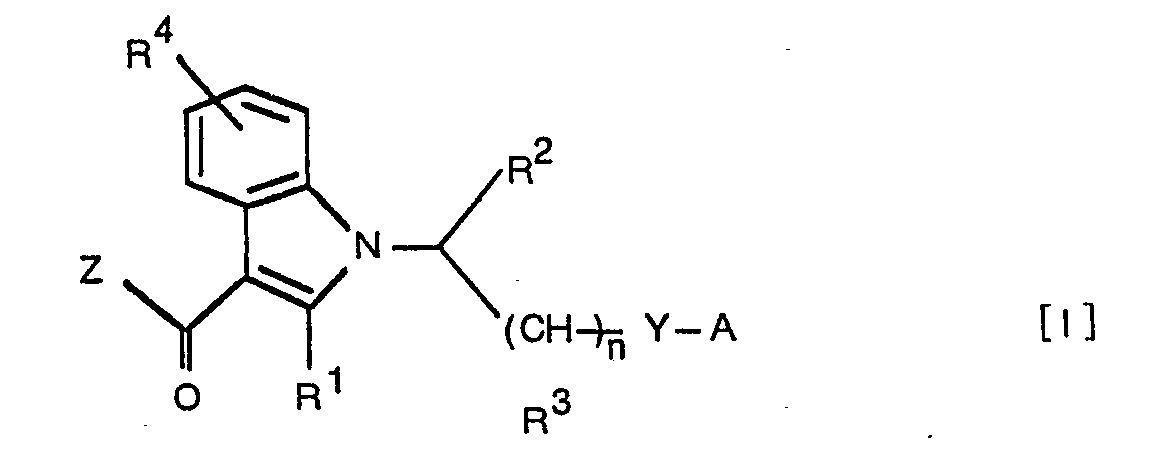
or an optically active isomer thereof or a salt thereof.


with an acid anhydride of the formula

in the presence of hydrogen iodide, and if desired, hydrolyzing the resulting product.


in the presence of hydrogen iodide, and if desired, hydrolyzing the resulting product.


in the presence of hydrogen iodide, and if desired, hydrolyzing the resulting product.


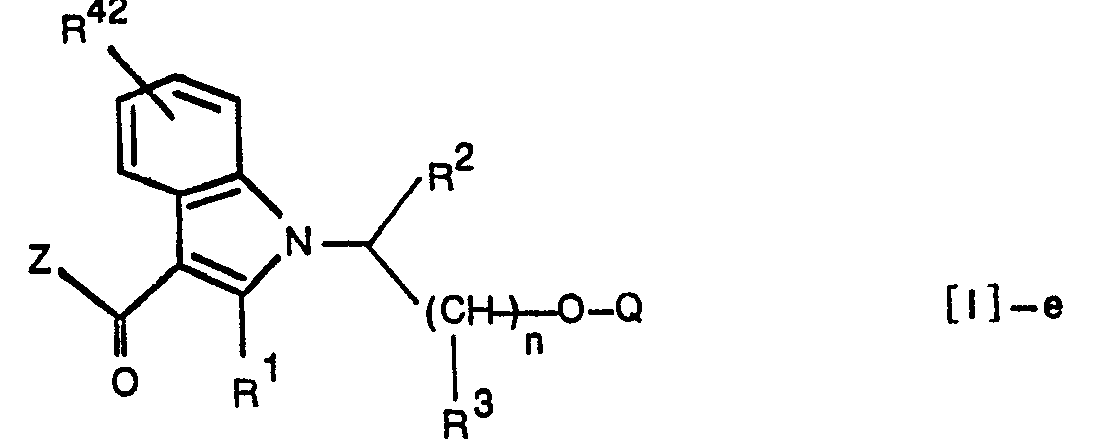
which process comprises condensing an N-(hydroxyalkyl) acylated indole derivative of the formula

with a halogen compound of the formula


which process comprises condensing a tetrahydroindole derivative of the formula


in the presence of hydrogen iodide to form an acylated tetrahydroindole derivative of the following formula


which process comprises reacting an N-(halo- or sulfonyloxyalkyl) acylated indole derivative of the formula

and T' represents a halogen atom,


which process comprises oxidizing an acylated indole derivative of the formula

Applications Claiming Priority (10)
| Application Number | Priority Date | Filing Date | Title |
|---|---|---|---|
| JP8080279A JPS567762A (en) | 1979-06-28 | 1979-06-28 | Acylated indole derivative, its preparation, and platelet coagulation inhibiting agent containing the same |
| JP80802/79 | 1979-06-28 | ||
| JP11275579A JPS5639068A (en) | 1979-09-05 | 1979-09-05 | Acylated indole derivative and blood platelet coagulation inhibitor containing the same as effective component |
| JP112755/79 | 1979-09-05 | ||
| JP12672579A JPS5651452A (en) | 1979-10-03 | 1979-10-03 | Derivative of acylated indole, its preparation and blood platelet coagulation suppressing agent containing said compound as effective component |
| JP126725/79 | 1979-10-03 | ||
| JP138644/79 | 1979-10-29 | ||
| JP13864479A JPS5663960A (en) | 1979-10-29 | 1979-10-29 | Acylated indole derivative and platelet coagulation inhibitor containing the same as active constituent |
| JP835480A JPS56108765A (en) | 1980-01-29 | 1980-01-29 | Acylated indole derivative, its preparation, and blood platelet coagulation inhibitor containing said derivative as effective component |
| JP8354/80 | 1980-01-29 |
Publications (2)
| Publication Number | Publication Date |
|---|---|
| EP0022634A1 EP0022634A1 (en) | 1981-01-21 |
| EP0022634B1 true EP0022634B1 (en) | 1983-04-06 |
Family
ID=27518933
Family Applications (1)
| Application Number | Title | Priority Date | Filing Date |
|---|---|---|---|
| EP19800302180 Expired EP0022634B1 (en) | 1979-06-28 | 1980-06-27 | Acylated indole derivatives, processes for their preparation and pharmaceutical compositions and drugs comprising them |
Country Status (2)
| Country | Link |
|---|---|
| EP (1) | EP0022634B1 (en) |
| DE (1) | DE3062613D1 (en) |
Families Citing this family (2)
| Publication number | Priority date | Publication date | Assignee | Title |
|---|---|---|---|---|
| DK425384A (en) * | 1983-09-28 | 1985-03-29 | Nippon Zoki Pharmaceutical Co | ACYLINDOL DERIVATIVES, PROCEDURES FOR PREPARING THEREOF AND PHARMACEUTICAL PREPARATIONS CONTAINING THEM |
| EP4397653A4 (en) * | 2021-09-03 | 2024-12-25 | Shenzhen 01 Life Science and Technology Co., Ltd. | INDOLE COMPOUND AND PRODUCTION PROCESS THEREOF AND USE THEREOF |
Family Cites Families (2)
| Publication number | Priority date | Publication date | Assignee | Title |
|---|---|---|---|---|
| GB869775A (en) * | 1958-09-24 | 1961-06-07 | Upjohn Co | 3-indolyl ketones |
| US3505354A (en) * | 1967-05-18 | 1970-04-07 | Geigy Chem Corp | 2-methyl-3-p-halobenzoylindole-n-aliphatic acids |
-
1980
- 1980-06-27 EP EP19800302180 patent/EP0022634B1/en not_active Expired
- 1980-06-27 DE DE8080302180T patent/DE3062613D1/en not_active Expired
Also Published As
| Publication number | Publication date |
|---|---|
| DE3062613D1 (en) | 1983-05-11 |
| EP0022634A1 (en) | 1981-01-21 |
Similar Documents
| Publication | Publication Date | Title |
|---|---|---|
| US6147105A (en) | 2-phenylindoles as antiestrogenic pharmaceutical agents | |
| JP4077317B2 (en) | Phenylethenyl or phenylethynyl derivatives as glutamate receptor antagonists | |
| MC1805A1 (en) | TOLUNITRILES SUBSTITUTED BY X-HETEROCYCLES | |
| HU212103B (en) | Process for preparing 4-hydroxy-tetrahydro-pyrane-2-one derivatives and their dihydroxy carboxylic acid derivatives and pharmaceutical preparations containing them | |
| NO300458B1 (en) | Analogous Process for the Preparation of Therapeutically Active Benzyl Substituted Rhodanine Derivatives | |
| EP0621255B1 (en) | Substituted phenoxy-isobutyric acids and esters | |
| US4402960A (en) | Antiinflammatory imidazole derivatives | |
| EP1507758B1 (en) | Indole derivatives and their use as ligands for cb2 receptors | |
| US4391814A (en) | Derivatives of antiphlogistically effective carboxylic acids, their preparation and medicinal use | |
| US5571825A (en) | Method of selectively inhibiting prostaglandin G/H synthase-2 | |
| HUT71126A (en) | Indole derivatives having steroid-5-alpha-reductase inhibitor activity, pharmaceutical compositions containing them and process for their preparation | |
| EP0109866A1 (en) | Sulfonyl urea derivatives, process for their preparation and pharmaceutical compositions containing them | |
| EP0533827B1 (en) | Novel oxazole derivatives, a preparation method therefor and pharmaceutical compositions containing same | |
| FR2521992A1 (en) | NOVEL PYRIDINE COMPOUNDS USEFUL AS MEDICAMENTS | |
| RU2067576C1 (en) | Derivatives of 4-phenylmethyl-1h-indole as enantiomers, racemates or diastereoisomers or as acid-additive salts showing antiarrhythmic and anticalcium activity | |
| US4233309A (en) | Novel 1-substituted-3-acylpyrrole derivatives, platelet aggregation inhibitors containing them, as active ingredients, and processes for production of said derivatives | |
| EP0022634A1 (en) | Acylated indole derivatives, processes for their preparation and pharmaceutical compositions and drugs comprising them | |
| AU645929B1 (en) | Method for inhibiting aromatase | |
| JP2001504118A (en) | COX-2 Indene Inhibitor | |
| EP0149419A1 (en) | Acylindole derivatives and pharmaceutical compositions containing them | |
| JP3694774B2 (en) | Phenylcarboxylic acid derivatives | |
| CA2202169A1 (en) | Metallocenic diarylethylene derivatives, methods for their preparation and pharmaceutical compositions containing same | |
| JPH02275846A (en) | Carboxylic acid derivative | |
| EP1042329A1 (en) | Novel farnesyl transferase inhibitors, preparation, pharmaceutical, compositions containing them and use for preparing medicines | |
| FI113864B (en) | Process for the preparation of indole derivatives useful as inhibitors of steroidal alpha reductase |
Legal Events
| Date | Code | Title | Description |
|---|---|---|---|
| PUAI | Public reference made under article 153(3) epc to a published international application that has entered the european phase |
Free format text: ORIGINAL CODE: 0009012 |
|
| AK | Designated contracting states |
Designated state(s): DE FR GB IT SE |
|
| 17P | Request for examination filed |
Effective date: 19810406 |
|
| ITF | It: translation for a ep patent filed | ||
| GRAA | (expected) grant |
Free format text: ORIGINAL CODE: 0009210 |
|
| AK | Designated contracting states |
Designated state(s): DE FR GB IT SE |
|
| PG25 | Lapsed in a contracting state [announced via postgrant information from national office to epo] |
Ref country code: SE Free format text: THE PATENT HAS BEEN ANNULLED BY A DECISION OF A NATIONAL AUTHORITY Effective date: 19830406 |
|
| ET | Fr: translation filed | ||
| REF | Corresponds to: |
Ref document number: 3062613 Country of ref document: DE Date of ref document: 19830511 |
|
| PGFP | Annual fee paid to national office [announced via postgrant information from national office to epo] |
Ref country code: FR Payment date: 19840321 Year of fee payment: 5 Ref country code: DE Payment date: 19840321 Year of fee payment: 5 |
|
| PG25 | Lapsed in a contracting state [announced via postgrant information from national office to epo] |
Ref country code: FR Free format text: LAPSE BECAUSE OF NON-PAYMENT OF DUE FEES Effective date: 19880226 |
|
| PG25 | Lapsed in a contracting state [announced via postgrant information from national office to epo] |
Ref country code: DE Effective date: 19880301 |
|
| GBPC | Gb: european patent ceased through non-payment of renewal fee | ||
| REG | Reference to a national code |
Ref country code: FR Ref legal event code: ST |
|
| PG25 | Lapsed in a contracting state [announced via postgrant information from national office to epo] |
Ref country code: GB Effective date: 19881118 |
|
| ITTA | It: last paid annual fee | ||
| PLBE | No opposition filed within time limit |
Free format text: ORIGINAL CODE: 0009261 |
|
| STAA | Information on the status of an ep patent application or granted ep patent |
Free format text: STATUS: NO OPPOSITION FILED WITHIN TIME LIMIT |