EP0020273B1 - Protection thermique pour propulseurs à poudre, exempte d'amiante - Google Patents
Protection thermique pour propulseurs à poudre, exempte d'amiante Download PDFInfo
- Publication number
- EP0020273B1 EP0020273B1 EP80400766A EP80400766A EP0020273B1 EP 0020273 B1 EP0020273 B1 EP 0020273B1 EP 80400766 A EP80400766 A EP 80400766A EP 80400766 A EP80400766 A EP 80400766A EP 0020273 B1 EP0020273 B1 EP 0020273B1
- Authority
- EP
- European Patent Office
- Prior art keywords
- asbestos
- parts
- weight
- heat shield
- thermal protection
- Prior art date
- Legal status (The legal status is an assumption and is not a legal conclusion. Google has not performed a legal analysis and makes no representation as to the accuracy of the status listed.)
- Expired
Links
- 239000000843 powder Substances 0.000 title claims description 8
- 230000004224 protection Effects 0.000 title description 11
- VYPSYNLAJGMNEJ-UHFFFAOYSA-N Silicium dioxide Chemical compound O=[Si]=O VYPSYNLAJGMNEJ-UHFFFAOYSA-N 0.000 claims description 20
- 239000000463 material Substances 0.000 claims description 15
- 239000000377 silicon dioxide Substances 0.000 claims description 10
- 229920003051 synthetic elastomer Polymers 0.000 claims description 10
- 239000005061 synthetic rubber Substances 0.000 claims description 10
- 239000004760 aramid Substances 0.000 claims description 8
- 229920003235 aromatic polyamide Polymers 0.000 claims description 8
- 239000000945 filler Substances 0.000 claims description 7
- 150000001875 compounds Chemical class 0.000 claims description 4
- 238000000354 decomposition reaction Methods 0.000 claims description 3
- 239000000835 fiber Substances 0.000 description 14
- 239000003380 propellant Substances 0.000 description 9
- 239000010425 asbestos Substances 0.000 description 7
- 229910052895 riebeckite Inorganic materials 0.000 description 7
- 239000000203 mixture Substances 0.000 description 5
- OKTJSMMVPCPJKN-UHFFFAOYSA-N Carbon Chemical compound [C] OKTJSMMVPCPJKN-UHFFFAOYSA-N 0.000 description 4
- 229910052799 carbon Inorganic materials 0.000 description 4
- 238000002679 ablation Methods 0.000 description 3
- 229920001971 elastomer Polymers 0.000 description 3
- 238000009472 formulation Methods 0.000 description 3
- 239000005060 rubber Substances 0.000 description 3
- KAKZBPTYRLMSJV-UHFFFAOYSA-N Butadiene Chemical compound C=CC=C KAKZBPTYRLMSJV-UHFFFAOYSA-N 0.000 description 2
- 239000000567 combustion gas Substances 0.000 description 2
- 239000007789 gas Substances 0.000 description 2
- 238000004073 vulcanization Methods 0.000 description 2
- 239000004215 Carbon black (E152) Substances 0.000 description 1
- 239000000853 adhesive Substances 0.000 description 1
- 230000001070 adhesive effect Effects 0.000 description 1
- WNROFYMDJYEPJX-UHFFFAOYSA-K aluminium hydroxide Chemical compound [OH-].[OH-].[OH-].[Al+3] WNROFYMDJYEPJX-UHFFFAOYSA-K 0.000 description 1
- 239000011230 binding agent Substances 0.000 description 1
- AXCZMVOFGPJBDE-UHFFFAOYSA-L calcium dihydroxide Chemical compound [OH-].[OH-].[Ca+2] AXCZMVOFGPJBDE-UHFFFAOYSA-L 0.000 description 1
- 239000000920 calcium hydroxide Substances 0.000 description 1
- 229910001861 calcium hydroxide Inorganic materials 0.000 description 1
- QXDMQSPYEZFLGF-UHFFFAOYSA-L calcium oxalate Chemical compound [Ca+2].[O-]C(=O)C([O-])=O QXDMQSPYEZFLGF-UHFFFAOYSA-L 0.000 description 1
- 239000003610 charcoal Substances 0.000 description 1
- 238000002485 combustion reaction Methods 0.000 description 1
- 239000002131 composite material Substances 0.000 description 1
- 239000000470 constituent Substances 0.000 description 1
- 230000000694 effects Effects 0.000 description 1
- 238000005516 engineering process Methods 0.000 description 1
- -1 ethylene, propylene Chemical group 0.000 description 1
- 238000010304 firing Methods 0.000 description 1
- 229930195733 hydrocarbon Natural products 0.000 description 1
- 150000002430 hydrocarbons Chemical class 0.000 description 1
- 239000003112 inhibitor Substances 0.000 description 1
- 238000004898 kneading Methods 0.000 description 1
- 239000007788 liquid Substances 0.000 description 1
- 229910052751 metal Inorganic materials 0.000 description 1
- 239000002184 metal Substances 0.000 description 1
- 238000000465 moulding Methods 0.000 description 1
- 229920001084 poly(chloroprene) Polymers 0.000 description 1
- 229920000642 polymer Polymers 0.000 description 1
- 229920001296 polysiloxane Polymers 0.000 description 1
- 229920003225 polyurethane elastomer Polymers 0.000 description 1
- 229920000915 polyvinyl chloride Polymers 0.000 description 1
- 239000004800 polyvinyl chloride Substances 0.000 description 1
- 239000013589 supplement Substances 0.000 description 1
- 229920001897 terpolymer Polymers 0.000 description 1
- 238000011144 upstream manufacturing Methods 0.000 description 1
Classifications
-
- F—MECHANICAL ENGINEERING; LIGHTING; HEATING; WEAPONS; BLASTING
- F42—AMMUNITION; BLASTING
- F42B—EXPLOSIVE CHARGES, e.g. FOR BLASTING, FIREWORKS, AMMUNITION
- F42B5/00—Cartridge ammunition, e.g. separately-loaded propellant charges
- F42B5/02—Cartridges, i.e. cases with charge and missile
- F42B5/18—Caseless ammunition; Cartridges having combustible cases
- F42B5/192—Cartridge cases characterised by the material of the casing wall
- F42B5/196—Coatings
-
- C—CHEMISTRY; METALLURGY
- C08—ORGANIC MACROMOLECULAR COMPOUNDS; THEIR PREPARATION OR CHEMICAL WORKING-UP; COMPOSITIONS BASED THEREON
- C08K—Use of inorganic or non-macromolecular organic substances as compounding ingredients
- C08K7/00—Use of ingredients characterised by shape
- C08K7/02—Fibres or whiskers
-
- C—CHEMISTRY; METALLURGY
- C08—ORGANIC MACROMOLECULAR COMPOUNDS; THEIR PREPARATION OR CHEMICAL WORKING-UP; COMPOSITIONS BASED THEREON
- C08L—COMPOSITIONS OF MACROMOLECULAR COMPOUNDS
- C08L11/00—Compositions of homopolymers or copolymers of chloroprene
-
- C—CHEMISTRY; METALLURGY
- C08—ORGANIC MACROMOLECULAR COMPOUNDS; THEIR PREPARATION OR CHEMICAL WORKING-UP; COMPOSITIONS BASED THEREON
- C08L—COMPOSITIONS OF MACROMOLECULAR COMPOUNDS
- C08L21/00—Compositions of unspecified rubbers
-
- C—CHEMISTRY; METALLURGY
- C08—ORGANIC MACROMOLECULAR COMPOUNDS; THEIR PREPARATION OR CHEMICAL WORKING-UP; COMPOSITIONS BASED THEREON
- C08L—COMPOSITIONS OF MACROMOLECULAR COMPOUNDS
- C08L77/00—Compositions of polyamides obtained by reactions forming a carboxylic amide link in the main chain; Compositions of derivatives of such polymers
- C08L77/10—Polyamides derived from aromatically bound amino and carboxyl groups of amino-carboxylic acids or of polyamines and polycarboxylic acids
-
- F—MECHANICAL ENGINEERING; LIGHTING; HEATING; WEAPONS; BLASTING
- F02—COMBUSTION ENGINES; HOT-GAS OR COMBUSTION-PRODUCT ENGINE PLANTS
- F02K—JET-PROPULSION PLANTS
- F02K9/00—Rocket-engine plants, i.e. plants carrying both fuel and oxidant therefor; Control thereof
- F02K9/08—Rocket-engine plants, i.e. plants carrying both fuel and oxidant therefor; Control thereof using solid propellants
- F02K9/32—Constructional parts; Details not otherwise provided for
- F02K9/34—Casings; Combustion chambers; Liners thereof
- F02K9/346—Liners, e.g. inhibitors
Definitions
- the invention relates to an asbestos-free thermal protection intended to protect the internal walls of powder propellants during the emission of hot gases produced by the combustion of propellant blocks.
- Thermal protections comprise, in addition to a synthetic rubber serving as a binder, a greater or lesser proportion of asbestos in fiber and, possibly, refractory fillers and chemical compounds with endothermic decomposition.
- asbestos plays the essential role of allowing the attachment of material which is being transformed into carbon on the surface of the virgin material, thus achieving a porous and charcoal crust. necessary for deep protection of the material.
- the organic fibers are in fact transformed into carbon under the effect of hot gases and therefore cannot ensure the bonding of the synthetic rubber which is being transformed into carbon.
- the object of the invention is therefore to provide a thermal protection free of asbestos and which nevertheless has substantially the same qualities of resistance to ablation as thermal protection comprising asbestos.
- the Applicant has found that it was possible to obtain this result by using a filler material based on silica and a particular organic fiber.
- the asbestos-free thermal protection used in powder propellants consists essentially of 100 parts by weight of synthetic rubber and from 50 to 150 parts by weight of a filler material and is characterized in that the filler material is based on silica and aromatic polyamide fibers and in that it contains at least 15 parts by weight of said fibers.
- the invention is not limited to a particular type of synthetic rubber. It is however necessary that these rubbers are in the form of a rubber and not in the liquid state.
- hydrocarbon terpolymers based on ethylene, propylene and butadiene for example, or silicones or neoprenes.
- silicones or neoprenes are described in the patents GB 1 030 155 and 1 176 349.
- aromatic polyamide fibers according to the invention are described in "Encyclopedia of Polymer Science and Technology", Supplement vol. 2, pages 84 to 86.
- an amount of aromatic polyamide fibers of between 18 and 22 parts by weight is used per 100 parts of synthetic rubber.
- a silica content of less than 90 parts by weight per 100 parts of synthetic rubber will advantageously be used and, in a preferred mode, an amount between 45 and 55 parts by weight.
- the silica can be either in the form of fiber or in powder since the silica fibers are transformed into powder during processing. For practical reasons, it is therefore preferable, but not necessary, to use silica directly in powder form.
- the aromatic polyamide fibers which can be used are of variable length. This length is however limited by the processing difficulties presented by the use of excessively long fibers. In the examples which will be found below, fibers of 6 mm and 13 mm were used.
- thermal protection formulations according to the invention are given below.
- the various constituents are mixed in a known manner.
- the mixture is then molded into a mold according to the desired shape.
- the vulcanization is carried out for 1 hour at 150 ° C.
- propellant blocks between - 40 ° C and + 60 ° C and can be used for all powder propellants fitted with composite propellants or homogeneous propellants.
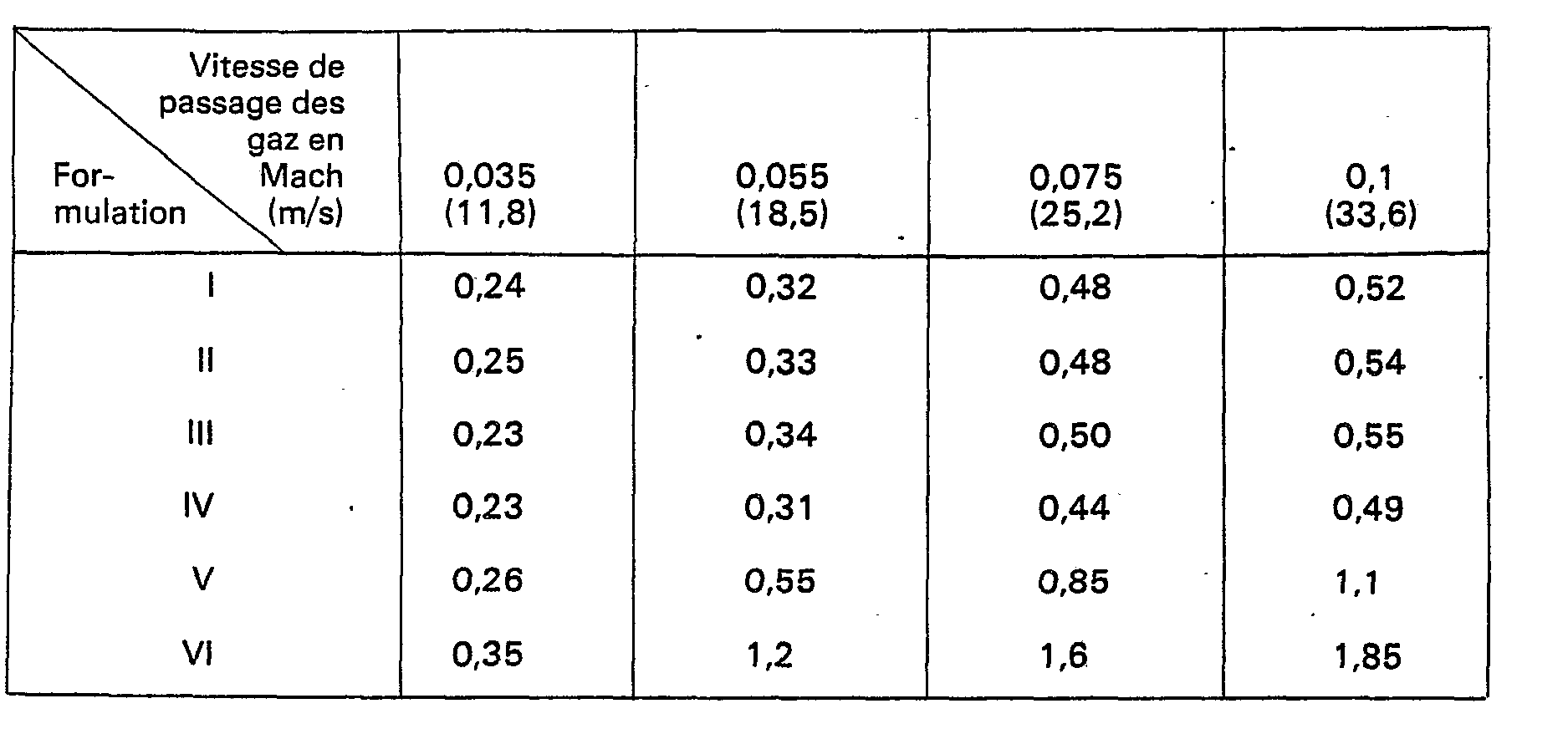
- the ablation resistance of thermal protections was tested in a nozzle convergent with variable hexagonal section, by passage of the combustion gases generated by a block of propellant, placed upstream of the convergent, after that they have been glued to the interior metal walls of the nozzle converging.
- the shooting conditions are as follows:
- the results obtained during the shots are expressed in ablated thickness per second (ablation speed).
- ablated thickness when it has formed a carbon crust, it is removed until the healthy material is obtained.
Landscapes
- Chemical & Material Sciences (AREA)
- Engineering & Computer Science (AREA)
- Health & Medical Sciences (AREA)
- Chemical Kinetics & Catalysis (AREA)
- Medicinal Chemistry (AREA)
- Polymers & Plastics (AREA)
- Organic Chemistry (AREA)
- General Engineering & Computer Science (AREA)
- Combustion & Propulsion (AREA)
- Mechanical Engineering (AREA)
- Compositions Of Macromolecular Compounds (AREA)
Description
- L'invention concerne une protection thermique exempte d'amiante destinée à protéger les parois internes des propulseurs à poudre lors de l'émisson des gaz chauds produits par la combustion des blocs de propergols.
- On connaît les protections thermiques qui comportent, en plus d'un caoutchouc synthétique servant de liant, une proportion plus ou moins importante d'amiante en fibre et, éventuellement, des charges réfractaires et des composés chimiques à décomposition endothermique.
- Dans le cas de vitesse de passage des gaz de combustion élevée, l'amiante joue le rôle essentiel de permettre l'accrochage de matériau qui est en train de se transformer en carbone à la surface du matériau vierge, réalisant ainsi une croute poreuse et charbonneuse nécessaire à la protection en profondeur du matériau.
- Les avantages procurés par l'amiante vis à vis d'autres matériaux de charge, et notamment vis à vis des fibres organiques, sont bien illustrés par le brevet US 3 347 047.
- Les fibres orgnaniques sont en effet transformées en carbone sous l'effet des gaz chauds et ne peuvent donc assurer l'accrochage du caoutchouc synthétique qui est en train de se transformer en carbone.
- Toutefois, on connaît les graves dangers que peut faire courir l'amiante aux personnes qui sont appelées à le manipuler.
- Le but de l'invention est donc de fournir une protection thermique exempte d'amiante et qui présente, néanmoins, sensiblement les mêmes qualités de résistance a l'ablation que les protections thermiques comportant de l'amiante.
- De manière surprenante la demanderesse a trouvé qu'il était possible d'obtenir ce résultat en utilisant un matériau de charge à base de silice et d'une fibre organique particulière.
- Selon la présente invention, la protection thermique exempte d'amiante utilisée dans les propulseurs à poudre est constituée essentiellement de 100 parties en poids de caoutchouc synthétique et de 50 à 150 parties en poids d'un matériau de charge et est caractérisée en ce que le matériau de charge est à base de silice et de fibres de polyamide aromatique et en ce qu'elle contient au moins 15 parties en poids desdites fibres.
- L'invention n'est pas limitée à un type de caoutchouc synthétique particulier. Il est toutefois nécessaire que ces caoutchouc soient forme de gomme et non à l'état liquide.
- On peut citer à titre indicatif les terpolyméres hydrocarbonés à base d'éthylène, de propyléne et de butadiène, par exemple, ou les silicones ou les Néoprènes. De nombreux caoutchoucs synthétiques convenant pour la présente invention sont décrits dans les brevets GB 1 030 155et 1 176 349.
- Les fibres de polyamide aromatique selon l'invention soit décrites dans "Encyclopedia of Polymer Science and Technology", Supplement vol. 2, pages 84 à 86.
- Pour des raisons de facilité de mise en oeuvre, notamment au niveau du malaxage, il est préférable de ne pas utiliser plus de 35 parties en poids de fibres de polyamide aromatique pour 100 parties de caoutchouc synthétique.
- On utilisera avantageusement une quantité de fibres de polyamide aromatique comprise entre 18 et 22 parties en poids pour 100 parties de caoutchouc synthétique.
- Pour les mêmes raisons de facilité de mise en oeuvre on emploiera avantageusement un taux de silice inférieur à 90 parties en poids pour 100 parties de caoutchouc synthétique et, dans un mode préférentiel, une quantité comprise entre 45 et 55 parties en poids.
- La silice peut être indifféremment sous forme de fibre ou en poudre étant donné que les fibres de silice sont transformées en poudre lors de la mise en oeuvre. Pour des raisons pratiques, il est donc préférable mais non nécessaire, d'utiliser directement la silice sous forme de poudre.
- Les fibres de polyamide aromatique qui peuvent être utilisées sont de longueur variable. Cette longueur est toutefois limitée par les difficultés de mise en oeuvre que présente l'emploi de fibres trop longues. Dans les exemples que l'on trouvera ci-aprés, des fibres de 6 mm et de 13 mm ont été utilisées.
- Afin d'améliorer la tenue thermique de la protection, il est avantageux d'adjounter une quantité pouvant aller jusqu'à 100 parties en poids, pour 100 parties de caoutchouc synthétique, d'un composé chimique à décomposition endothermique.
- Parmi ces composés chimiques, on peut citer à titre indicatif l'oxalate de calcium, l'hydroxyde d'aluminium ou l'hydroxyde de calcium.
- Des exemples de formulations de protection thermique selon l'invention sont donnés ci-dessous.
- On donne à titre de comparaisons trois autres formulations comportant comme matériau de charge respectivement de l'amiante, du chlorure de polyvinyle et de la silice uniquement.


- Pour réaliser ces matériaux, on effectue le mélange des différents constituants de manière connue. On moule ensuite le mélange dans un moule selon la forme désirée.
- La vulcanisation est effectuée pendant 1 h à 150°C.
- Bien évidemment, les conditions de moulage et de vulcanisation devront être adaptées aux mélanges utilisés dans chaque cas particulier.
- On donne ci-aprés les caractéristiques de certains des matériaux ainsi obtenus à 20°C.

- Ces matériaux sont compatibles avec les blocs de propergol entre - 40°C et + 60°C et sont utilisables pour tous les propulseurs à poudre munis de propergols composites ou de propergols homogènes.
- Afin de renforcer l'adhésion du bloc de propergol à la protection thermique, il est nécessaire d'utiliser un inhibiteur ou un caoutchouc de liaison. Ces adhésifs sont bien connus de l'homme de métier. On peut citer par exemple les élastomères de polyuréthanne.
- La résistance à l'ablation des protections thermiques dont les formulations sont décrites ci-dessus a été testé dans un convergent de tuyère à section hexagonale variable, par passage des gaz de combustion générés par un bloc de propergol, placé en amont du convergent, après qu'elles aient été collées sur les parois métalliques intérieures du convergent de la tuyére.
Les conditions de tir sont les suivantes:
- Les résultats obtenus au cours des tirs sont exprimés en épaisseur ablatée par seconde (vitesse d'ablation).
- On appelle épaisseur ablatée la différence entre l'épaisseur initiale du mateiau et l'épaisseur du matériau sain après tir (dans le cas où il a formation d'une croute charbonneuse, on l'enlève jusqu'a obtenir le matériau sain).
Claims (6)
Applications Claiming Priority (2)
| Application Number | Priority Date | Filing Date | Title |
|---|---|---|---|
| FR7914262A FR2458687A1 (fr) | 1979-06-05 | 1979-06-05 | Protection thermique pour propulseurs a poudre, exempte d'amiante |
| FR7914262 | 1979-06-05 |
Publications (2)
| Publication Number | Publication Date |
|---|---|
| EP0020273A1 EP0020273A1 (fr) | 1980-12-10 |
| EP0020273B1 true EP0020273B1 (fr) | 1982-12-22 |
Family
ID=9226204
Family Applications (1)
| Application Number | Title | Priority Date | Filing Date |
|---|---|---|---|
| EP80400766A Expired EP0020273B1 (fr) | 1979-06-05 | 1980-05-30 | Protection thermique pour propulseurs à poudre, exempte d'amiante |
Country Status (3)
| Country | Link |
|---|---|
| EP (1) | EP0020273B1 (fr) |
| DE (1) | DE3061414D1 (fr) |
| FR (1) | FR2458687A1 (fr) |
Families Citing this family (5)
| Publication number | Priority date | Publication date | Assignee | Title |
|---|---|---|---|---|
| US4492779A (en) * | 1981-12-07 | 1985-01-08 | Thiokol Corporation | Aramid polymer and powder filler reinforced elastomeric composition for use as a rocket motor insulation |
| US4501841A (en) * | 1983-02-03 | 1985-02-26 | Hercules Incorporated | Elastomeric insulating materials for rocket motors |
| US4504532A (en) * | 1983-02-03 | 1985-03-12 | Hercules Incorporated | Phenolic blast tube insulators for rocket motors |
| US4514541A (en) * | 1984-05-21 | 1985-04-30 | E. I. Du Pont De Nemours And Company | Fiber containing particulate elastomeric composition |
| FR2743860B1 (fr) * | 1996-01-23 | 1998-02-13 | Protac | Dispositif de liaison mecanique a compartiment modifiable |
Family Cites Families (2)
| Publication number | Priority date | Publication date | Assignee | Title |
|---|---|---|---|---|
| FR2136979A1 (en) * | 1971-05-11 | 1972-12-29 | France Etat | Refractory elastomer paste - for coating inside walls of projectiles |
| AU3348578A (en) * | 1977-04-18 | 1979-08-30 | Goodrich Co B F | Aramid fiber loaded elastomeric compound |
-
1979
- 1979-06-05 FR FR7914262A patent/FR2458687A1/fr active Granted
-
1980
- 1980-05-30 EP EP80400766A patent/EP0020273B1/fr not_active Expired
- 1980-05-30 DE DE8080400766T patent/DE3061414D1/de not_active Expired
Also Published As
| Publication number | Publication date |
|---|---|
| FR2458687B1 (fr) | 1982-07-09 |
| EP0020273A1 (fr) | 1980-12-10 |
| FR2458687A1 (fr) | 1981-01-02 |
| DE3061414D1 (en) | 1983-01-27 |
Similar Documents
| Publication | Publication Date | Title |
|---|---|---|
| US6455630B1 (en) | Polyolefin composition suited for metal coating by flame spraying | |
| EP0380824A2 (fr) | Matériaux composites comprenant une couche à base de polypropylène et de polyamide | |
| US5821284A (en) | Durable motor insulation | |
| DE58906187D1 (de) | Durch Magnesiumhydroxid flammhemmend eingestellte faserverstärkte thermoplastisch verarbeitbare Polyamidformmasse, Verfahren zu ihrer Herstellung und ihre Verwendung. | |
| FR2700773A1 (fr) | Revêtements de protection des matériaux contre les réactions avec l'atmosphère à haute température. | |
| EP0326658A1 (fr) | Revêtement résistant à l'érosion | |
| EP0020273A1 (fr) | Protection thermique pour propulseurs à poudre, exempte d'amiante | |
| FR2894252A1 (fr) | Composition reticulee comprenant un copolymere coeur ecorce, son procede d'obtention et ses utilisations | |
| EP0116795A1 (fr) | Nouveaux inhibiteurs de combustion à base d'élastomère polyuréthanne oxygéné comportant des fibres pour propergols double base | |
| US5762746A (en) | Method of internally insulating a propellant combustion chamber | |
| FR2564457A1 (fr) | Inhibiteur de combustion a base d'elastomere polyurethanne aliphatique pour propergol, et bloc revetu par cet inhibiteur | |
| EP0617077A1 (fr) | Composition comprenant un élastomère insaturé et un plastifiant de la famille des polyphénylméthanes | |
| FR2552494A1 (fr) | Procede de preparation de corps de propulseurs fusees | |
| US6953823B2 (en) | Elastomeric insulating composition for a solid propellant rocket motor | |
| CA2020101A1 (fr) | Composition organopolysiloxane monocomposante a stabilite au stockage amelioree | |
| FR2554114A1 (fr) | Materiaux d'isolation elastomeres exempts d'amiante pour les parois internes des moteurs-fusees | |
| EP0659860B1 (fr) | Matrice élastomère adhésive et utilisations | |
| WO2007048208A2 (fr) | Composition resistante au feu | |
| EP0015236B1 (fr) | Composition de liant adhésif, incombustible à base de silicate alcalin, procédé pour sa fabrication et application | |
| EP0116583A1 (fr) | Composition refractaire. | |
| FR2586016A1 (fr) | Masse isolante pour une couche isolante sur une charge propulsive solide pour fusee | |
| FR2495133A1 (fr) | Revetement inhibiteur pour propergols solides a combustion frontale comportant des charges organiques gazeifiables, bloc de propergol solide revetu dudit inhibiteur et procede d'obtention | |
| EP0061125A1 (fr) | Matériau polymère ignifuge | |
| EP1496036A2 (fr) | Composition pyrotechnique génératrice de gaz destinée à la sécurité automobile et brûlant à des températures de combustion inférieurs à 2200 degrés K | |
| FR2803844A1 (fr) | Inhibiteur pour propergol composite a combustion frontale a base d'une composition polyurethanne reticulable a temperature ambiante, bloc de propergol composite revetu dudit inhibiteur |
Legal Events
| Date | Code | Title | Description |
|---|---|---|---|
| PUAI | Public reference made under article 153(3) epc to a published international application that has entered the european phase |
Free format text: ORIGINAL CODE: 0009012 |
|
| AK | Designated contracting states |
Designated state(s): DE GB IT |
|
| 17P | Request for examination filed |
Effective date: 19810102 |
|
| ITF | It: translation for a ep patent filed | ||
| GRAA | (expected) grant |
Free format text: ORIGINAL CODE: 0009210 |
|
| AK | Designated contracting states |
Designated state(s): DE GB IT |
|
| REF | Corresponds to: |
Ref document number: 3061414 Country of ref document: DE Date of ref document: 19830127 |
|
| ITTA | It: last paid annual fee | ||
| PGFP | Annual fee paid to national office [announced via postgrant information from national office to epo] |
Ref country code: GB Payment date: 19990526 Year of fee payment: 20 |
|
| PGFP | Annual fee paid to national office [announced via postgrant information from national office to epo] |
Ref country code: DE Payment date: 19990730 Year of fee payment: 20 |
|
| PG25 | Lapsed in a contracting state [announced via postgrant information from national office to epo] |
Ref country code: GB Free format text: LAPSE BECAUSE OF EXPIRATION OF PROTECTION Effective date: 20000529 |
|
| REG | Reference to a national code |
Ref country code: GB Ref legal event code: PE20 Effective date: 20000529 |
|
| PLBE | No opposition filed within time limit |
Free format text: ORIGINAL CODE: 0009261 |
|
| STAA | Information on the status of an ep patent application or granted ep patent |
Free format text: STATUS: NO OPPOSITION FILED WITHIN TIME LIMIT |