EP0017841A1 - Polyazo dyestuffs and their use in dyeing fibrous materials containing nitrogen - Google Patents
Polyazo dyestuffs and their use in dyeing fibrous materials containing nitrogen Download PDFInfo
- Publication number
- EP0017841A1 EP0017841A1 EP80101728A EP80101728A EP0017841A1 EP 0017841 A1 EP0017841 A1 EP 0017841A1 EP 80101728 A EP80101728 A EP 80101728A EP 80101728 A EP80101728 A EP 80101728A EP 0017841 A1 EP0017841 A1 EP 0017841A1
- Authority
- EP
- European Patent Office
- Prior art keywords
- oder
- gegebenenfalls
- further substituted
- optionally further
- alkyl
- Prior art date
- Legal status (The legal status is an assumption and is not a legal conclusion. Google has not performed a legal analysis and makes no representation as to the accuracy of the status listed.)
- Granted
Links
- 0 CC(CC=C1)C(C=C2)=C1C=C*2S(O)(=O)=O Chemical compound CC(CC=C1)C(C=C2)=C1C=C*2S(O)(=O)=O 0.000 description 1
Classifications
-
- C—CHEMISTRY; METALLURGY
- C09—DYES; PAINTS; POLISHES; NATURAL RESINS; ADHESIVES; COMPOSITIONS NOT OTHERWISE PROVIDED FOR; APPLICATIONS OF MATERIALS NOT OTHERWISE PROVIDED FOR
- C09B—ORGANIC DYES OR CLOSELY-RELATED COMPOUNDS FOR PRODUCING DYES, e.g. PIGMENTS; MORDANTS; LAKES
- C09B31/00—Disazo and polyazo dyes of the type A->B->C, A->B->C->D, or the like, prepared by diazotising and coupling
- C09B31/16—Trisazo dyes
-
- C—CHEMISTRY; METALLURGY
- C09—DYES; PAINTS; POLISHES; NATURAL RESINS; ADHESIVES; COMPOSITIONS NOT OTHERWISE PROVIDED FOR; APPLICATIONS OF MATERIALS NOT OTHERWISE PROVIDED FOR
- C09B—ORGANIC DYES OR CLOSELY-RELATED COMPOUNDS FOR PRODUCING DYES, e.g. PIGMENTS; MORDANTS; LAKES
- C09B31/00—Disazo and polyazo dyes of the type A->B->C, A->B->C->D, or the like, prepared by diazotising and coupling
- C09B31/30—Other polyazo dyes
Definitions
- Suitable substituents for A, B and C are, for example, halogen such as Cl and Br, alkyl, in particular optionally substituted C 1 -C 4 alkyl, such as methyl, ethyl, hydroxyethyl, cyanoethyl, alkoxy, in particular optionally substituted C 1 -C 4 alkoxy, such as methoxy, ethoxy, methoxyethoxy; Nitro, cyano, alkylsulfonyl, especially optionally substituted C 1 -C 4 -alkylsulfonyl, optionally N-mono- or disubstituted carbamoyl, sulfamoyl, such as N-mono- and N, N-di-alkylcarbamoyl, N-mono- and N, N-di-alkylsulfamoyl, C 1 -C 4 alkylcarbonylamino, carboxy, ureido, C 1 -
- the alkyl and alkoxy groups are preferably those with 1-4 C atoms, which can be further substituted, in particular by halogen, hydroxy, C 1 -C 4 alkoxy, cyano or acyloxy.
- Acyl radicals are in particular alkyl or arylcarbonyl or sulfonyl radicals, such as acetyl, propionyl, methylsulfonyl, benzenesulfonyl, p-toluenesulfonyl.
- alkoxy groups are methoxy, ethoxy, methoxyethoxy.
- Preferred radicals A are 2-, 3- or 4-sulfophenyl 2,4- or 2,5-disulfophenyl 2-methoxy, 5-sulfophenyl 4 (4'-sulfophenylazo) phenyl 2,4'-disulfo-4-phenylazo-phenyl 4-nitro-2-sulfo-phenyl 2-, 3-, 4-, 5-, 6-, 7- or 8-sulfonaphthyl (1) 2,4-, 3,6-, 3,7-, 3,8-, 4,6-, 4,7-, 4,8-, 5,7- or 6,8-disulfonaphthyl (1) 2,4,6-, 2,4,7-, 3,6,8- or 4,6,8-trisulfonaphthyl (1) 1-, 5-, 6-, 7- or 8-sulfonaphthyl (2) 3,6-, 3,7 -, 4,8-, 5,7- or 6,8-disulfonaphthyl (2) or 1,5
- the sulfonic acid residue is preferably in the 6- or 7-position.
- Technical mixtures of 6- and 7-sulfonic acid are also particularly suitable.
- K is derived from an acetoacetic arylide
- preferred residues of these are Aniline-, To understand o, m- or p-toluidine or o-, m- or p-anisidine acetoacetates and their sulfonic acids.
- K is derived from aminopyrazoles, these are preferably residues of To understand 5-amino, 3-methyl, 1-phenyl-pyrazole or its 3 'or 4'Sulfonic acid.
- pyridone series are the residues of 1,4-Dialkyl (such as methyl or ethyl), 5-cyan, 2-hydroxypyridone (6) is preferred for K.
- Preferred radicals K are also 2,4,6-trihydroxypyrimidinyl (5) and 2,6-dihydroxy, 4-carboxypyridyl (5), which are derived from barbituric acid and citrazinic acid, respectively.
- Dyes of the formula I are preferably obtained by diazotization and coupling reactions, the sequence of the linkage, as is known in azochemistry, often being variable.
- One of the ways of producing dyes of the formula I starts from the diazonium salt of the amine V. in particular which is coupled to a naphthylamine VI, in particular
- the monoazo dye thus obtained is further diazotized and reacted with an amine VII. in particular After diazotization, the final clutch on VIII.
- the dyes obtainable by the (or similar) processes described above can be subjected to further reactions customary in dyes, for example by diazotizing primary aromatic amino groups and reacting them with further coupling components or by reacting dyes with sites capable of coupling with diazonium salts.
- the order of the reactions can be varied widely, as is known in azochemistry.
- Metallizable dyes of the formula I can be treated with metal-donating agents, in particular with chromium, cobalt, copper, iron or nickel salts, possibly with the addition of oxidizing agents. Dyes which have reducible, in particular nitro groups, can be reduced.
- Dyes which contain acylatable or alkylatable groups, for example hydroxyl or amino groups in K can be acylated or alkylated and Dyes that can be sulfonated can be sulfonated with chlorosulfonic acid, oleum or sulfur trioxide.
- the new dyes are suitable for dyeing nitrogen-containing fiber materials such as wool and polyamide and for dyeing leather.
- the monoazo dye is mixed with 500 g of ice and 140 ml of 28% hydrochloric acid. In 10-15 min. is diazotized with 230 ml of 4.35 normal sodium nitrite solution. After about 0.5 h, the excess nitrite is destroyed with sulfamic acid.
- the diazonium salt is mixed with 500 g of ice and in 15 min. mixed with 1 mol of m-toluidine.
- a pH of 3 is set in about 2 hours with 80 ml of 20% sodium hydroxide solution.
- the dye in the form of the free acid of the formula colors wool, polyamide and leather in brilliant reddish brown shades.
Landscapes
- Chemical & Material Sciences (AREA)
- Organic Chemistry (AREA)
- Coloring (AREA)
Abstract
Wasserlösliche Farbstoffe der Formel

- A = gegebenenfalls weitersubstituiertes Sulfophenyl- oder Sulfonaphthyl,
- B = gegebenenfalls weitersubstituiertes Sulfonaphthylen--1,4,
- C = gegebenenfalls weitersubstituiertes Phenylen-1,4 oder Naphthylen-1,4,
- K = Rest einer gegebenenfalls funktionell abgewandelten Kupplungskomponente der Hydroxybenzol-, Aminobenzol-, Aminopyrazol, - Pyridon - oder Acetessigarylidreihe oder der Barbitursäure oder Citrazinsäure,
und ihre Verwendung zum Färben stickstoffhaltiger Fasermaterialien, wie Wolle und Polyamid, sowie zum Färben von Leder.Water soluble dyes of the formula
- A = optionally further substituted sulfophenyl- or sulfonaphthyl,
- B = optionally further substituted sulfonaphthylene - 1,4,
- C = optionally further substituted phenylene-1,4 or naphthylene-1,4,
- K = residue of an optionally functionally modified coupling component of the hydroxybenzene, aminobenzene, aminopyrazole, pyridone or acetoacetic arylide series or the barbituric acid or citrazinic acid,
and their use for dyeing nitrogen-containing fiber materials, such as wool and polyamide, and for dyeing leather.
Description
Die vorliegende Erfindung betrifft wasserlösliche Farbstoffe der Formel

- A = gegebenenfalls weitersubstituiertes Sulfophenyl-oder Sulfonaphthyl,
- B = gegebenenfalls weitersubstituiertes Sulfo-naphthylen-1,4,
- C = gegebenenfalls weitersubstituiertes Phenylen-1,4 oder Naphthylen-1,4,
- K = Rest einer gegebenenfalls funktionell abgewandelten Kupplungskomponente der Hydroxybenzol-, Aminobenzol-, Aminopyrazol, - Pyridon - oder Acetessigarylidreihe oder der Barbitursäure oder Citrazinsäure.
- A = optionally further substituted sulfophenyl- or sulfonaphthyl,
- B = optionally further substituted sulfonaphthylene-1,4,
- C = optionally further substituted phenylene-1,4 or naphthylene-1,4,
- K = residue of an optionally functionally modified coupling component of the hydroxybenzene, aminobenzene, aminopyrazole, pyridone or acetoacetic arylide series or barbituric acid or citrazinic acid.
Geeignete Substituenten für A, B und C sind beispielsweise Halogen wie Cl und Br, Alkyl insbesondere gegebenenfalls substituiertes C1-C4-Alkyl, wie Methyl, Ethyl, Hydroxyethyl, Cyanethyl, Alkoxy, insbesondere gegebenenfalls substituiertes C1-C4-Alkoxy, wie Methoxy, Ethoxy, Methoxyethoxy; Nitro, Cyan, Alkylsulfonyl, insbesondere gegebenenfalls substituiertes C1-C4-Alkylsulfonyl, gegebenenfalls N-mono- oder-disubstituiertes Carbamoyl, Sulfamoyl, wie N-Mono- und N,N-Di-alkylcarb- amoyl, N-Mono- und N,N-Di-alkylsulfamoyl, C1-C4-Alkyl- carbonylamino, Carboxy, Ureido, C1-C4-Alkoxycarbonyl, gegebenenfalls substituiertes Phenyl- oder Naphthylazo; Sulfo.Suitable substituents for A, B and C are, for example, halogen such as Cl and Br, alkyl, in particular optionally substituted C 1 -C 4 alkyl, such as methyl, ethyl, hydroxyethyl, cyanoethyl, alkoxy, in particular optionally substituted C 1 -C 4 alkoxy, such as methoxy, ethoxy, methoxyethoxy; Nitro, cyano, alkylsulfonyl, especially optionally substituted C 1 -C 4 -alkylsulfonyl, optionally N-mono- or disubstituted carbamoyl, sulfamoyl, such as N-mono- and N, N-di-alkylcarbamoyl, N-mono- and N, N-di-alkylsulfamoyl, C 1 -C 4 alkylcarbonylamino, carboxy, ureido, C 1 -C 4 alkoxycarbonyl, optionally substituted phenyl- or naphthylazo; Sulfo.
Die Alkyl- und Alkoxygruppen sind bevorzugt solche mit 1 - 4 C-Atome, die weitersubstituiert sein können, insbesondere durch Halogen, Hydroxy, C1-C4-Alkoxy, Cyan oder Acyloxy.The alkyl and alkoxy groups are preferably those with 1-4 C atoms, which can be further substituted, in particular by halogen, hydroxy, C 1 -C 4 alkoxy, cyano or acyloxy.
Acylreste sind insbesondere Alkyl- oder Arylcarbonyl- bzw. -sulfonylreste wie Acetyl, Propionyl, Methylsulfonyl, Benzolsulfonyl, p-Toluolsulfonyl.Acyl radicals are in particular alkyl or arylcarbonyl or sulfonyl radicals, such as acetyl, propionyl, methylsulfonyl, benzenesulfonyl, p-toluenesulfonyl.
Besonders bevorzugte Alkoxygruppen sind Methoxy, Ethoxy, Methoxyethoxy.Particularly preferred alkoxy groups are methoxy, ethoxy, methoxyethoxy.
Bevorzugte Reste A sind
2-, 3- oder 4-Sulfophenyl 2,4- oder 2,5-Disulfophenyl 2-Methoxy, 5-Sulfophenyl 4(4'-Sulfophenylazo)-phenyl 2,4'-Disulfo- 4-phenylazo-phenyl 4-Nitro- 2-Sulfo-phenyl 2-, 3-, 4-, 5-, 6-, 7- oder 8-Sulfonaphthyl(1) 2,4-, 3,6-, 3,7-, 3,8-, 4,6-, 4,7-, 4,8-, 5,7- oder 6,8-Disulfonaphthyl(1) 2,4,6-, 2,4,7-, 3,6,8- oder 4,6,8- Trisulfonaphthyl(1) 1-, 5-, 6-, 7- oder 8-Sulfonaphthyl(2) 3,6-, 3,7-, 4,8-, 5,7- oder 6,8-Disulfonaphthyl(2) oder 1,5,7-, 3,6,8- oder 4,6,8-Trisulfonaphthyl(2).Preferred radicals A are
2-, 3- or 4-sulfophenyl 2,4- or 2,5-disulfophenyl 2-methoxy, 5-sulfophenyl 4 (4'-sulfophenylazo) phenyl 2,4'-disulfo-4-phenylazo-phenyl 4-nitro-2-sulfo-phenyl 2-, 3-, 4-, 5-, 6-, 7- or 8-sulfonaphthyl (1) 2,4-, 3,6-, 3,7-, 3,8-, 4,6-, 4,7-, 4,8-, 5,7- or 6,8-disulfonaphthyl (1) 2,4,6-, 2,4,7-, 3,6,8- or 4,6,8-trisulfonaphthyl (1) 1-, 5-, 6-, 7- or 8-sulfonaphthyl (2) 3,6-, 3,7 -, 4,8-, 5,7- or 6,8-disulfonaphthyl (2) or 1,5,7-, 3,6,8- or 4,6,8-trisulfonaphthyl (2).
Im Naphthylenring B der Formel I steht der Sulfonsäurerest bevorzugt in der 6- oder 7-Stellung. Auch technische Gemische der 6- und der 7-Sulfonsäure sind besonders geeignet.In the naphthylene ring B of the formula I, the sulfonic acid residue is preferably in the 6- or 7-position. Technical mixtures of 6- and 7-sulfonic acid are also particularly suitable.
Bevorzugte Phenylen- bzw. Naphthylenreste C sind:
- 1,4-Phenylen
- 2-Methyl-phenylen(1,4)
- 2-Acetamino-phenylen(1,4)
- 2-Acetamino, 5-methoxy-phenylen(1,4)
- 2-Methyl-5-methoxy-phenylen(1,4) Naphthylen(1,4) oder
- 6- oder 7-Sulfo-naphthylen(1,4). K steht bevorzugt für
- 4-Hydroxy-phenyl,
- 4-Hydroxy-3-carboxy-phenyl
- 2-Hydroxy-5-methyl-phenyl,
- 2,4- bzw. 2,6-Dihydroxyphenyl,
- 2-Hydroxy, 4-phenylamino-phenyl
- [Di-alkyl(insbesondere Methyl- oder Ethyl)amin27- phenyl.
- [4-Diethylamino]2-Acetylamino-phenyl.
- 1,4-phenylene
- 2-methylphenylene (1.4)
- 2-acetaminophenylene (1.4)
- 2-acetamino, 5-methoxyphenylene (1,4)
- 2-methyl-5-methoxy-phenylene (1,4) naphthylene (1,4) or
- 6- or 7-sulfonaphthylene (1,4). K preferably stands for
- 4-hydroxyphenyl,
- 4-hydroxy-3-carboxyphenyl
- 2-hydroxy-5-methylphenyl,
- 2,4- or 2,6-dihydroxyphenyl,
- 2-hydroxy, 4-phenylamino-phenyl
- [Di-alkyl (especially methyl or ethyl) amine 27 - phenyl.
- [4-diethylamino] 2-acetylamino-phenyl.
Leitet sich K von einem Acetessigarylid ab, so sind hierunter bevorzugt Reste der
Anilin-,
o, m- oder p- Toluidin- oder o-, m- oder p- Anisidin-acetoacetate und deren Sulfonsäuren zu verstehen.If K is derived from an acetoacetic arylide, preferred residues of these are
Aniline-,
To understand o, m- or p-toluidine or o-, m- or p-anisidine acetoacetates and their sulfonic acids.
Leitet sich K von Aminopyrazolen ab, so sind hierunter bevorzugt Reste von
5-Amino, 3-methyl, 1-phenyl-pyrazol bzw. dessen 3' oder 4'Sulfonsäure zu verstehen.If K is derived from aminopyrazoles, these are preferably residues of
To understand 5-amino, 3-methyl, 1-phenyl-pyrazole or its 3 'or 4'Sulfonic acid.
In der Pyridonreihe sind die Reste des
1,4-Dialkyl (wie Methyl- bzw. Ethyl-), 5-cyan, 2-hydroxypyridon(6) für K bevorzugt.In the pyridone series are the residues of
1,4-Dialkyl (such as methyl or ethyl), 5-cyan, 2-hydroxypyridone (6) is preferred for K.
Bevorzugte Reste K sind desweiteren 2,4,6-Trihydroxypyrimidinyl(5) und 2,6-Dihydroxy, 4-carboxy-pyridyl(5), die sich von Barbitur- bzw. Citrazinsäure ableiten.Preferred radicals K are also 2,4,6-trihydroxypyrimidinyl (5) and 2,6-dihydroxy, 4-carboxypyridyl (5), which are derived from barbituric acid and citrazinic acid, respectively.
Bevorzugte Farbstoffe sind solche der Formel

- n = 1,2 oder 3
- R1 = H, C1-C4-Alkyl, C1-C4-Alkoxy, Acylamino,
- R2 = H, C1-C4-Alkyl, C1-C4-Alkoxy,
- R 3 = H, C1-C4-Alkyl, Hydroxy, Acylamino,
- R 4 = H, C1-C4-Alkyl, C1-C4-Alkoxy, Carboxy,
- R5 = H, Hydroxy, Mono-C1-C4-Alkylamino, Di- C1-C4-Alkylamino, Mono-arylamino,
wobei Alkyl und Alkoxy auch übliche Substituenten aufweisen, bevorzugt aber unsubstituiert sind und Acylamino vorzugsweise für C1-C4-Alkylcarbonylamino, C1-C4-Alkylsulfonylamino oder für gegebenenfalls substituiertes Phenylcarbonylamino oder Phenylsulfonylamino stehen.Preferred dyes are those of the formula
- n = 1, 2 or 3
- R 1 = H, C 1 -C 4 alkyl, C 1 -C 4 alkoxy, acylamino,
- R 2 = H, C 1 -C 4 alkyl, C 1 -C 4 alkoxy,
- R 3 = H, C 1 -C 4 alkyl, hydroxy, acylamino,
- R 4 = H, C 1 -C 4 alkyl, C 1 -C 4 alkoxy, carboxy,
- R 5 = H, H y droxy, mono-C 1 -C 4 -alkylamino, di- C 1 -C 4 -alkylamino, mono-arylamino,
where alkyl and alkoxy also have customary substituents, but are preferably unsubstituted and acylamino is preferably C 1 -C 4 -alkylcarbonylamino, C 1 -C 4 -alkylsulfonylamino or optionally substituted phenylcarbonylamino or phenylsulfonylamino.
Besonders bevorzugte Farbstoffe sind solche der Formeln
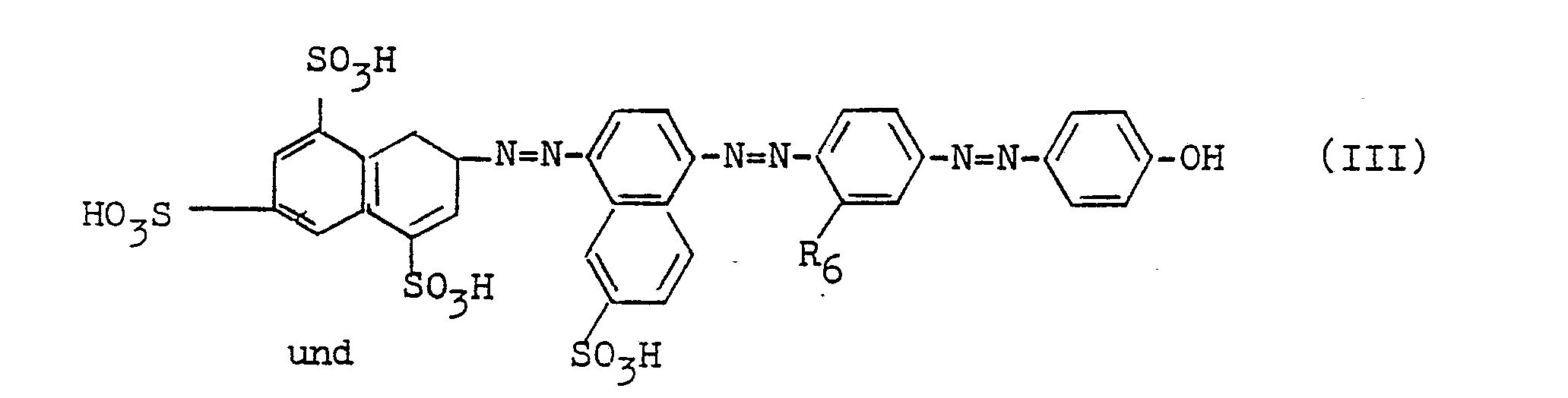
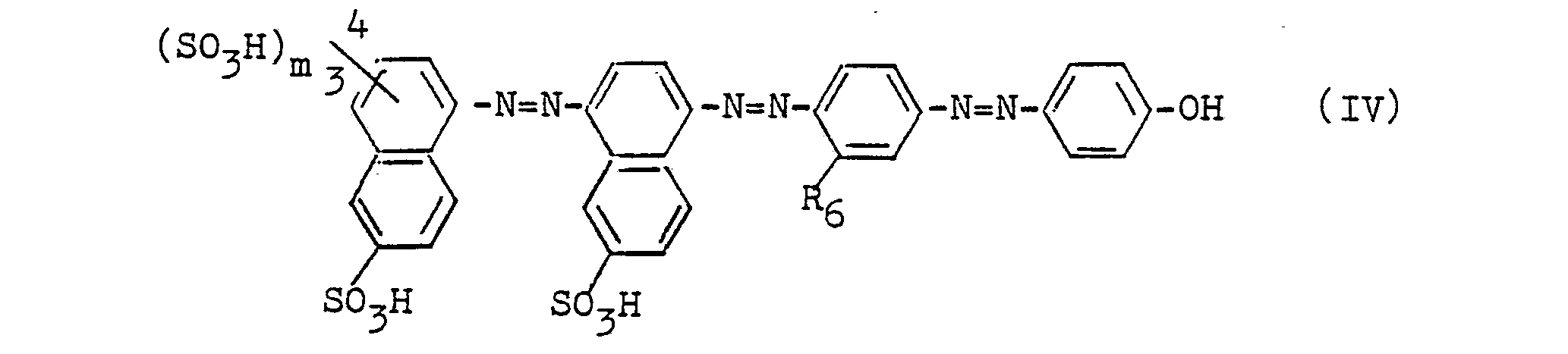
- m = 0 oder 1
- R6 = H, CH3, NHCOCH3.
- m = 0 or 1
- R 6 = H, CH 3 , NHCOCH 3 .
Farbstoffe der Formel I erhält man bevorzugt durch Diazotierungs- und Kupplungsreaktionen, wobei die Reihenfolge der Verknüpfung wie in der Azochemie bekannt häufig variierbar ist. Einer der Wege, Farbstoffe der Formel I herzustellen geht vom Diazoniumsalz des Amins V aus


Der so erhaltene Monoazofarbstoff wird weiterdiazotiert und mit einem Amin VII zur Reaktion gebracht.

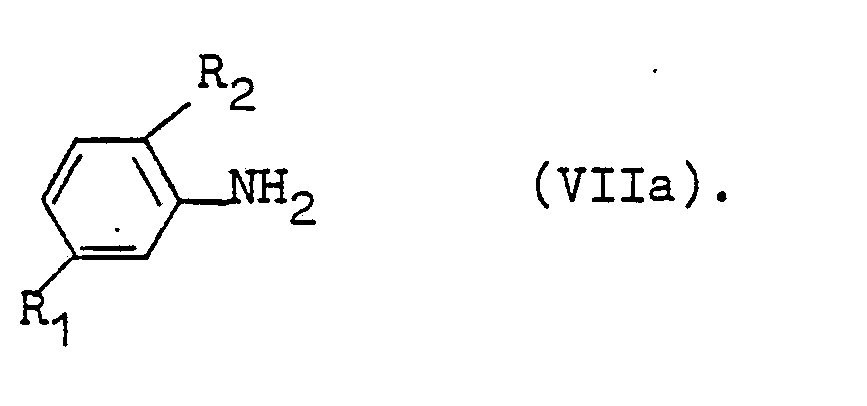

Die nach den vorstehend beschriebenen (oder ähnlichen) Verfahren erhältlichen Farbstoffe können weiteren an Farbstoffen üblichen Umsetzungen unterzogen werden, beispielsweise, indem man primäre aromatische Aminogruppen diazotiert und mit weiteren Kupplungskomponenten umsetzt oder indem man Farbstoffe mit kupplungsfähigen Stellen mit Diazoniumsalzen zur Reaktion bringt. Man erhält so Tris-, Tetrakis- oder Poly-azo-Farbstoffe der Formel I, die formal Azobenzol-, Benzolazonaphthalin-oder Naphthalin-azonaphthalin-Substituenten tragen. Die Reihenfolge der Umsetzungen ist in weitem Rahmen, wie in der Azochemie bekannt, variierbar.The dyes obtainable by the (or similar) processes described above can be subjected to further reactions customary in dyes, for example by diazotizing primary aromatic amino groups and reacting them with further coupling components or by reacting dyes with sites capable of coupling with diazonium salts. This gives tris, tetrakis or poly-azo dyes of the formula I which formally carry azobenzene, benzolazonaphthalene or naphthalene-azonaphthalene substituents. The order of the reactions can be varied widely, as is known in azochemistry.
Metallisierbare Farbstoffe der Formel I können mit metallabgebenden Mitteln, insbesondere mit Chrom-, Kobalt-, Kupfer-, Eisen- oder Nickel-Salzen, evtl. unter Zusatz von Oxidationsmitteln, behandelt werden. Farbstoffe, die reduzierbare, insbesondere Nitrogruppen, aufweisen, können reduziert werden.Metallizable dyes of the formula I can be treated with metal-donating agents, in particular with chromium, cobalt, copper, iron or nickel salts, possibly with the addition of oxidizing agents. Dyes which have reducible, in particular nitro groups, can be reduced.
Farbstoffe, welche acylierbare oder alkylierbare Gruppen enthalten, z.B. Hydroxy- oder Aminogruppen in K können acyliert bzw. alkyliert und
Farbstoffe, die sulfonierbar sind, können mit Chlorsulfonsäure, Oleum oder Schwefeltrioxyd sulfoniert werden.Dyes which contain acylatable or alkylatable groups, for example hydroxyl or amino groups in K, can be acylated or alkylated and
Dyes that can be sulfonated can be sulfonated with chlorosulfonic acid, oleum or sulfur trioxide.
Die neuen Farbstoffe eignen sich zum Färben stickstoffhaltiger Fasermaterialien wie Wolle und Polyamid sowie zum Färben von Leder.The new dyes are suitable for dyeing nitrogen-containing fiber materials such as wool and polyamide and for dyeing leather.
1 Mol 2-Aminonaphthalin-4,6,8-trisulfosäure wird in 1600 ml Eis/Wasser suspendiert mit 230 ml 4,35 normaler Na-nitrit-Lösung diazotiert. Man rührt 0,5 h nach und zerstört dann den Nitritüberschuß mit wenig Amidosulfonsäure-Lösung.1 mol of 2-aminonaphthalene-4,6,8-trisulfonic acid is suspended in 1600 ml of ice / water with 230 ml of 4.35 normal sodium nitrite solution. The mixture is stirred for a further 0.5 h and then the excess nitrite is destroyed with a little amidosulfonic acid solution.
In die Suspension des Diazoniumsalzes gibt man 750 g Eis und 1 Mol 1-Aminonaphthalin-6-sulfonsäure. Mit 630 ml 20 %iger Natronlauge wird in etwa 40 min. auf pH 2 gestellt und 30 min. nachgerührt.750 g of ice and 1 mol of 1-aminonaphthalene-6-sulfonic acid are added to the suspension of the diazonium salt. With 630 ml of 20% sodium hydroxide solution in about 40 min. adjusted to pH 2 and 30 min. stirred.
Der Monoazofarbstoff wird mit 500 g Eis und'140 ml 28 %iger Salzsäure versetzt. In 10 - 15 min. diazotiert man mit 230 ml 4,35 normaler Na-nitrit-Lösung. Nach etwa 0,5 h wird der Nitritüberschuß mit Amidosulfonsäure zerstört.The monoazo dye is mixed with 500 g of ice and 140 ml of 28% hydrochloric acid. In 10-15 min. is diazotized with 230 ml of 4.35 normal sodium nitrite solution. After about 0.5 h, the excess nitrite is destroyed with sulfamic acid.
Das Diazoniumsalz wird mit 500 g Eis und in 15 min. mit 1 Mol m-Toluidin versetzt. Mit 80 ml 20%iger Natronlauge wird in ca. 2 h ein pH-Wert von 3 eingestellt.The diazonium salt is mixed with 500 g of ice and in 15 min. mixed with 1 mol of m-toluidine. A pH of 3 is set in about 2 hours with 80 ml of 20% sodium hydroxide solution.
Man gibt 1,5 kg Eis und 210 ml 28%ige Salzsäure zu und diazotiert mit 230 ml 4,35 normaler Na-nitrit-Lösung. Nach 0,5 h nimmt man mit wenig Amidosulfonsäure den Nitritüberschuß weg.1.5 kg of ice and 210 ml of 28% hydrochloric acid are added, and the mixture is diazotized with 230 ml of 4.35 normal sodium nitrite solution. After 0.5 h, the excess nitrite is removed with a little amidosulfonic acid.
Nach Zugabe von 1 Mol Phenol wird in 0,5 h mit (ca. 400 ml) 20%iger Natronlauge pH 8 eingestellt und 3 h gehalten. Nach Aussalzen und Filtrieren wird u.V. getrocknet.After adding 1 mol of phenol, the pH is adjusted to 8 with 0.5% (about 400 ml) 20% sodium hydroxide solution in 0.5 h and held for 3 h. After salting out and filtering, u.V. dried.
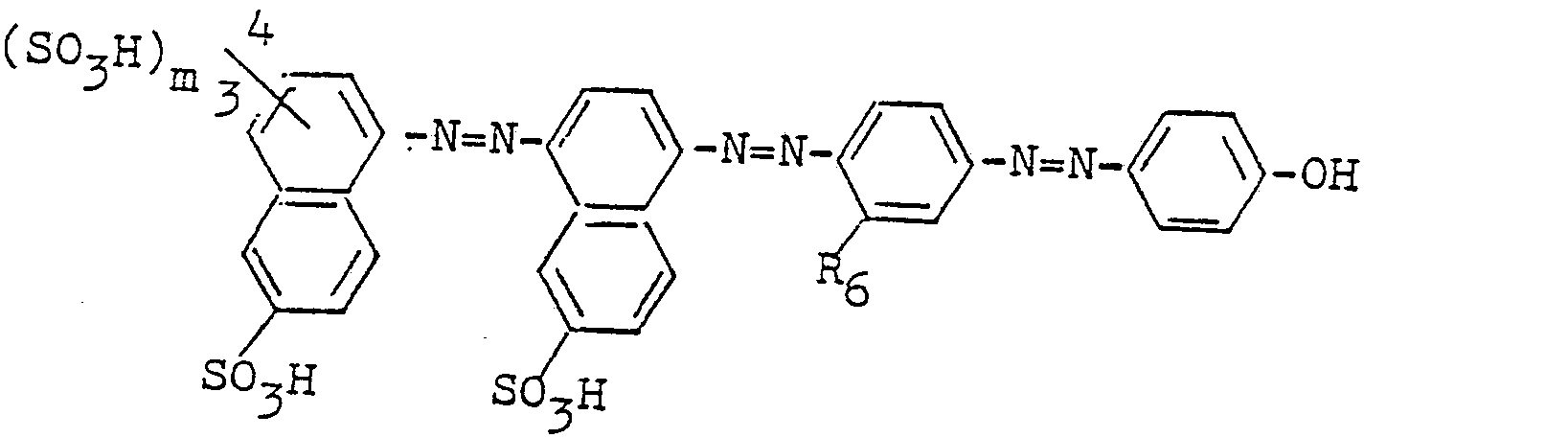
Der Farbstoff, der in Form der freien Säure der Formel

Weitere wertvolle Braunfarbstoffe für Wolle, Polyamid und Leder der Formel I erhält man, wenn im Beispiel 1 2-Aminonaphthalin-4, 6,8-sulfonsäure durch A, 1-Aminonaphthalin-6-sulfonsäure durch B, m-Toluidin durch C und Phenol durch K der folgenden Tabelle ersetzt.


Claims (4)


Applications Claiming Priority (2)
| Application Number | Priority Date | Filing Date | Title |
|---|---|---|---|
| DE2915214 | 1979-04-14 | ||
| DE19792915214 DE2915214A1 (en) | 1979-04-14 | 1979-04-14 | POLYAZO DYES |
Publications (2)
| Publication Number | Publication Date |
|---|---|
| EP0017841A1 true EP0017841A1 (en) | 1980-10-29 |
| EP0017841B1 EP0017841B1 (en) | 1983-01-12 |
Family
ID=6068344
Family Applications (1)
| Application Number | Title | Priority Date | Filing Date |
|---|---|---|---|
| EP80101728A Expired EP0017841B1 (en) | 1979-04-14 | 1980-04-01 | Polyazo dyestuffs and their use in dyeing fibrous materials containing nitrogen |
Country Status (7)
| Country | Link |
|---|---|
| US (1) | US4670548A (en) |
| EP (1) | EP0017841B1 (en) |
| JP (1) | JPS55139456A (en) |
| BR (1) | BR8002281A (en) |
| DE (2) | DE2915214A1 (en) |
| ES (1) | ES490483A0 (en) |
| IN (1) | IN153815B (en) |
Families Citing this family (2)
| Publication number | Priority date | Publication date | Assignee | Title |
|---|---|---|---|---|
| JP2801411B2 (en) * | 1990-02-09 | 1998-09-21 | キヤノン株式会社 | Ink, inkjet recording method and apparatus using the same |
| US5167703A (en) * | 1990-11-30 | 1992-12-01 | Canon Kabushiki Kaisha | Ink, ink-jet recording process and instrument making use of the ink |
Citations (4)
| Publication number | Priority date | Publication date | Assignee | Title |
|---|---|---|---|---|
| FR395960A (en) * | 1908-02-11 | 1909-03-25 | Farbenfab Vorm Bayer F & Co | Production of azo dyestuffs pulling directly onto cotton |
| FR793459A (en) * | 1934-07-26 | 1936-01-25 | Ste Ind Chim Bale | New azo dyes |
| CH202735A (en) * | 1937-06-14 | 1939-01-31 | Geigy Ag J R | Process for the preparation of an azo dye. |
| CH202734A (en) * | 1937-06-14 | 1939-01-31 | Geigy Ag J R | Process for the preparation of an azo dye. |
Family Cites Families (17)
| Publication number | Priority date | Publication date | Assignee | Title |
|---|---|---|---|---|
| US648623A (en) * | 1900-01-13 | 1900-05-01 | Farbenfabriken Of Elberfeld Company | Blue trisazo dye. |
| GB190303654A (en) * | 1903-02-16 | 1903-12-17 | Robert Bolton Ransford | Improvements in the Manufacture of Polyazo Bodies and Dyestuffs. |
| US920151A (en) * | 1909-01-28 | 1909-05-04 | Farbenfab Vorm Bayer F & Co | Trisazo dye. |
| US1014633A (en) * | 1910-07-28 | 1912-01-16 | Farbenfab Vorm Bayer F & Co | New dye. |
| US1010433A (en) * | 1911-01-04 | 1911-12-05 | Farbenfab Vorm Bayer F & Co | Blue trisazo dye. |
| US1180985A (en) * | 1915-11-02 | 1916-04-25 | Agfa Ag | Blue tetrakisazo dyes. |
| US1602991A (en) * | 1924-06-13 | 1926-10-12 | Grasselli Dyestuff Corp | Trisazo dyestuff |
| US1856211A (en) * | 1929-09-11 | 1932-05-03 | Gen Aniline Works Inc | New secondary trisazodyestuffs |
| US2169152A (en) * | 1937-01-26 | 1939-08-08 | Soc Of Chemical Ind | Azo dyestuffs and process of making same |
| US2182721A (en) * | 1937-06-14 | 1939-12-05 | Geigy Ag J R | Azo dyestuffs and their manufacture |
| US2171364A (en) * | 1937-07-08 | 1939-08-29 | Du Pont | Azo dyes |
| US2252824A (en) * | 1938-07-23 | 1941-08-19 | Gen Aniline & Film Corp | Production of trisazo dyestuffs |
| DE741468C (en) * | 1939-07-22 | 1943-11-16 | Ig Farbenindustrie Ag | Process for the preparation of polyazo dyes |
| US2435356A (en) * | 1942-04-02 | 1948-02-03 | Soc Of Chemical Ind | Trisazo urea dyestuffs |
| US2421553A (en) * | 1944-03-15 | 1947-06-03 | Chem Ind Basel | Azo dyes from 2, 6 dihalo 4 nitraniline |
| CH263529A (en) * | 1948-03-04 | 1949-08-31 | Ciba Geigy | Process for the preparation of a trisazo dye containing acylamino groups. |
| NL210466A (en) * | 1955-09-15 |
-
1979
- 1979-04-14 DE DE19792915214 patent/DE2915214A1/en not_active Withdrawn
-
1980
- 1980-03-10 IN IN171/DEL/80A patent/IN153815B/en unknown
- 1980-03-24 US US06/133,072 patent/US4670548A/en not_active Expired - Lifetime
- 1980-04-01 EP EP80101728A patent/EP0017841B1/en not_active Expired
- 1980-04-01 DE DE8080101728T patent/DE3061574D1/en not_active Expired
- 1980-04-11 JP JP4698880A patent/JPS55139456A/en active Pending
- 1980-04-11 ES ES490483A patent/ES490483A0/en active Granted
- 1980-04-11 BR BR8002281A patent/BR8002281A/en unknown
Patent Citations (4)
| Publication number | Priority date | Publication date | Assignee | Title |
|---|---|---|---|---|
| FR395960A (en) * | 1908-02-11 | 1909-03-25 | Farbenfab Vorm Bayer F & Co | Production of azo dyestuffs pulling directly onto cotton |
| FR793459A (en) * | 1934-07-26 | 1936-01-25 | Ste Ind Chim Bale | New azo dyes |
| CH202735A (en) * | 1937-06-14 | 1939-01-31 | Geigy Ag J R | Process for the preparation of an azo dye. |
| CH202734A (en) * | 1937-06-14 | 1939-01-31 | Geigy Ag J R | Process for the preparation of an azo dye. |
Also Published As
| Publication number | Publication date |
|---|---|
| ES8101104A1 (en) | 1980-12-01 |
| BR8002281A (en) | 1980-12-02 |
| DE2915214A1 (en) | 1980-10-23 |
| DE3061574D1 (en) | 1983-02-17 |
| EP0017841B1 (en) | 1983-01-12 |
| JPS55139456A (en) | 1980-10-31 |
| IN153815B (en) | 1984-08-18 |
| US4670548A (en) | 1987-06-02 |
| ES490483A0 (en) | 1980-12-01 |
Similar Documents
| Publication | Publication Date | Title |
|---|---|---|
| CH622818A5 (en) | Process for the preparation of novel reactive dyestuffs | |
| EP0292825B1 (en) | Reactive dyes | |
| DE1289930B (en) | Process for the production of azo dyes and their metal complex compounds | |
| CH312963A (en) | Process for the production of azo dyes | |
| KR840001579B1 (en) | Method for preparing water-soluble chromium complex compound anionic dye | |
| EP0078007B1 (en) | Metallised polyazo dyestuffs | |
| EP0021837A1 (en) | Metallisable trisazo black dyestuffs and mixtures thereof, their preparation and use in dyeing cellulosic fibres | |
| EP0068245B1 (en) | Dyestuffs containing sulphonic acid groups | |
| DE2915214A1 (en) | POLYAZO DYES | |
| EP0016975A2 (en) | Polyazo dyestuffs and their use in dyeing fibre-materials and leather containing amino- and hydroxyl groups | |
| EP0073387B1 (en) | Water-soluble polyazo dyestuffs, their preparation and their use | |
| EP0014882B1 (en) | Azodyestuffs and their use in dyeing and printing nitrogen-containing materials and leather | |
| EP0012350B1 (en) | Azo dyestuffs, their preparation and their use in the dyeing of n-containing materials | |
| DE2716503A1 (en) | AZO DYE INTERMEDIATE | |
| EP0177978B1 (en) | Naphthol amine derivatives | |
| AT220742B (en) | Process for the production of new azo dyes | |
| DE1644132A1 (en) | New monoazo dyes, processes for their preparation and use | |
| EP0065130B1 (en) | Tris-azo dyestuffs | |
| DE930770C (en) | Process for the production of water-soluble, copper-containing dis- and polyazo dyes | |
| DE3222726A1 (en) | REACTIVE DYES, THEIR PRODUCTION AND USE | |
| AT259712B (en) | Process for the production of new azo dyes and their metal complex compounds | |
| DE957151C (en) | Process for the preparation of disazo dyes | |
| DE1644087C3 (en) | Process for the production of water-soluble organic reactive dyes | |
| DE270831C (en) | ||
| DE3529250A1 (en) | POLYAZO DYES |
Legal Events
| Date | Code | Title | Description |
|---|---|---|---|
| PUAI | Public reference made under article 153(3) epc to a published international application that has entered the european phase |
Free format text: ORIGINAL CODE: 0009012 |
|
| 17P | Request for examination filed | ||
| AK | Designated contracting states |
Designated state(s): BE CH DE FR GB IT |
|
| ITF | It: translation for a ep patent filed | ||
| GRAA | (expected) grant |
Free format text: ORIGINAL CODE: 0009210 |
|
| AK | Designated contracting states |
Designated state(s): BE CH DE FR GB IT LI |
|
| REF | Corresponds to: |
Ref document number: 3061574 Country of ref document: DE Date of ref document: 19830217 |
|
| ET | Fr: translation filed | ||
| PGFP | Annual fee paid to national office [announced via postgrant information from national office to epo] |
Ref country code: BE Payment date: 19840331 Year of fee payment: 5 |
|
| PG25 | Lapsed in a contracting state [announced via postgrant information from national office to epo] |
Ref country code: BE Effective date: 19850430 |
|
| BERE | Be: lapsed |
Owner name: BAYER A.G. Effective date: 19850401 |
|
| PGFP | Annual fee paid to national office [announced via postgrant information from national office to epo] |
Ref country code: FR Payment date: 19910415 Year of fee payment: 12 |
|
| ITTA | It: last paid annual fee | ||
| PG25 | Lapsed in a contracting state [announced via postgrant information from national office to epo] |
Ref country code: FR Effective date: 19921230 |
|
| REG | Reference to a national code |
Ref country code: FR Ref legal event code: ST |
|
| PGFP | Annual fee paid to national office [announced via postgrant information from national office to epo] |
Ref country code: GB Payment date: 19930326 Year of fee payment: 14 |
|
| PGFP | Annual fee paid to national office [announced via postgrant information from national office to epo] |
Ref country code: CH Payment date: 19930430 Year of fee payment: 14 |
|
| PGFP | Annual fee paid to national office [announced via postgrant information from national office to epo] |
Ref country code: DE Payment date: 19940314 Year of fee payment: 15 |
|
| PG25 | Lapsed in a contracting state [announced via postgrant information from national office to epo] |
Ref country code: GB Effective date: 19940401 |
|
| PG25 | Lapsed in a contracting state [announced via postgrant information from national office to epo] |
Ref country code: LI Effective date: 19940430 Ref country code: CH Effective date: 19940430 |
|
| GBPC | Gb: european patent ceased through non-payment of renewal fee |
Effective date: 19940401 |
|
| REG | Reference to a national code |
Ref country code: CH Ref legal event code: PL |
|
| PG25 | Lapsed in a contracting state [announced via postgrant information from national office to epo] |
Ref country code: DE Effective date: 19960201 |
|
| PLBE | No opposition filed within time limit |
Free format text: ORIGINAL CODE: 0009261 |
|
| STAA | Information on the status of an ep patent application or granted ep patent |
Free format text: STATUS: NO OPPOSITION FILED WITHIN TIME LIMIT |