EP0012751B1 - Preparation of trichloro-s-triazine activated supports - Google Patents
Preparation of trichloro-s-triazine activated supports Download PDFInfo
- Publication number
- EP0012751B1 EP0012751B1 EP79900239A EP79900239A EP0012751B1 EP 0012751 B1 EP0012751 B1 EP 0012751B1 EP 79900239 A EP79900239 A EP 79900239A EP 79900239 A EP79900239 A EP 79900239A EP 0012751 B1 EP0012751 B1 EP 0012751B1
- Authority
- EP
- European Patent Office
- Prior art keywords
- triazine
- support
- organic solvent
- activated
- tst
- Prior art date
- Legal status (The legal status is an assumption and is not a legal conclusion. Google has not performed a legal analysis and makes no representation as to the accuracy of the status listed.)
- Expired
Links
- MGNCLNQXLYJVJD-UHFFFAOYSA-N cyanuric chloride Chemical compound ClC1=NC(Cl)=NC(Cl)=N1 MGNCLNQXLYJVJD-UHFFFAOYSA-N 0.000 title claims abstract description 42
- 238000002360 preparation method Methods 0.000 title claims description 5
- 238000006243 chemical reaction Methods 0.000 claims abstract description 35
- 102000004169 proteins and genes Human genes 0.000 claims abstract description 24
- 108090000623 proteins and genes Proteins 0.000 claims abstract description 24
- 238000005859 coupling reaction Methods 0.000 claims abstract description 22
- 230000008878 coupling Effects 0.000 claims abstract description 20
- 238000010168 coupling process Methods 0.000 claims abstract description 20
- 239000012038 nucleophile Substances 0.000 claims abstract description 16
- 239000003960 organic solvent Substances 0.000 claims abstract description 16
- 239000003446 ligand Substances 0.000 claims abstract description 14
- JYEUMXHLPRZUAT-UHFFFAOYSA-N 1,2,3-triazine Chemical group C1=CN=NN=C1 JYEUMXHLPRZUAT-UHFFFAOYSA-N 0.000 claims abstract description 13
- 239000007790 solid phase Substances 0.000 claims abstract description 11
- 125000001309 chloro group Chemical group Cl* 0.000 claims abstract description 10
- 238000005406 washing Methods 0.000 claims abstract description 6
- 150000003512 tertiary amines Chemical class 0.000 claims abstract description 5
- 230000003472 neutralizing effect Effects 0.000 claims abstract description 3
- 239000007787 solid Substances 0.000 claims abstract 4
- 238000000034 method Methods 0.000 claims description 27
- XLYOFNOQVPJJNP-UHFFFAOYSA-N water Substances O XLYOFNOQVPJJNP-UHFFFAOYSA-N 0.000 claims description 11
- JGFZNNIVVJXRND-UHFFFAOYSA-N N,N-Diisopropylethylamine (DIPEA) Chemical group CCN(C(C)C)C(C)C JGFZNNIVVJXRND-UHFFFAOYSA-N 0.000 claims description 10
- 239000000463 material Substances 0.000 claims description 9
- 229910052801 chlorine Inorganic materials 0.000 claims description 8
- OMRXVBREYFZQHU-UHFFFAOYSA-N 2,4-dichloro-1,3,5-triazine Chemical compound ClC1=NC=NC(Cl)=N1 OMRXVBREYFZQHU-UHFFFAOYSA-N 0.000 claims description 7
- PAYRUJLWNCNPSJ-UHFFFAOYSA-N N-phenyl amine Natural products NC1=CC=CC=C1 PAYRUJLWNCNPSJ-UHFFFAOYSA-N 0.000 claims description 7
- WEVYAHXRMPXWCK-UHFFFAOYSA-N Acetonitrile Chemical compound CC#N WEVYAHXRMPXWCK-UHFFFAOYSA-N 0.000 claims description 6
- JLTDJTHDQAWBAV-UHFFFAOYSA-N N,N-dimethylaniline Chemical compound CN(C)C1=CC=CC=C1 JLTDJTHDQAWBAV-UHFFFAOYSA-N 0.000 claims description 6
- 239000000126 substance Substances 0.000 claims description 6
- 239000002904 solvent Substances 0.000 claims description 5
- HTSVYUUXJSMGQC-UHFFFAOYSA-N 2-chloro-1,3,5-triazine Chemical compound ClC1=NC=NC=N1 HTSVYUUXJSMGQC-UHFFFAOYSA-N 0.000 claims description 4
- 239000003463 adsorbent Substances 0.000 claims description 4
- 239000003054 catalyst Substances 0.000 claims description 4
- -1 aliphatic amines Chemical class 0.000 claims description 3
- 150000004982 aromatic amines Chemical class 0.000 claims description 2
- 238000001035 drying Methods 0.000 claims description 2
- 238000004519 manufacturing process Methods 0.000 claims description 2
- 125000002490 anilino group Chemical group [H]N(*)C1=C([H])C([H])=C([H])C([H])=C1[H] 0.000 claims 1
- 125000000532 dioxanyl group Chemical group 0.000 claims 1
- 150000002989 phenols Chemical class 0.000 claims 1
- 238000003860 storage Methods 0.000 claims 1
- 239000011347 resin Substances 0.000 description 43
- 229920005989 resin Polymers 0.000 description 43
- RYHBNJHYFVUHQT-UHFFFAOYSA-N 1,4-Dioxane Chemical compound C1COCCO1 RYHBNJHYFVUHQT-UHFFFAOYSA-N 0.000 description 26
- UHOVQNZJYSORNB-UHFFFAOYSA-N Benzene Chemical compound C1=CC=CC=C1 UHOVQNZJYSORNB-UHFFFAOYSA-N 0.000 description 21
- 229920002684 Sepharose Polymers 0.000 description 20
- 239000003153 chemical reaction reagent Substances 0.000 description 12
- 235000017168 chlorine Nutrition 0.000 description 10
- ATDGTVJJHBUTRL-UHFFFAOYSA-N cyanogen bromide Chemical compound BrC#N ATDGTVJJHBUTRL-UHFFFAOYSA-N 0.000 description 10
- 238000007086 side reaction Methods 0.000 description 8
- 230000007062 hydrolysis Effects 0.000 description 7
- 238000006460 hydrolysis reaction Methods 0.000 description 7
- 239000012074 organic phase Substances 0.000 description 7
- 229920001223 polyethylene glycol Polymers 0.000 description 7
- ZAMOUSCENKQFHK-UHFFFAOYSA-N Chlorine atom Chemical compound [Cl] ZAMOUSCENKQFHK-UHFFFAOYSA-N 0.000 description 6
- 239000002202 Polyethylene glycol Substances 0.000 description 6
- 230000004913 activation Effects 0.000 description 6
- 239000000460 chlorine Substances 0.000 description 6
- 230000000694 effects Effects 0.000 description 6
- 229940098773 bovine serum albumin Drugs 0.000 description 5
- 239000011521 glass Substances 0.000 description 5
- 229920000936 Agarose Polymers 0.000 description 4
- 108090000790 Enzymes Proteins 0.000 description 4
- 102000004190 Enzymes Human genes 0.000 description 4
- 239000008346 aqueous phase Substances 0.000 description 4
- 150000007530 organic bases Chemical class 0.000 description 4
- 239000011734 sodium Substances 0.000 description 4
- 229910000029 sodium carbonate Inorganic materials 0.000 description 4
- 239000000243 solution Substances 0.000 description 4
- BTBUEUYNUDRHOZ-UHFFFAOYSA-N Borate Chemical compound [O-]B([O-])[O-] BTBUEUYNUDRHOZ-UHFFFAOYSA-N 0.000 description 3
- 108091003079 Bovine Serum Albumin Proteins 0.000 description 3
- LFQSCWFLJHTTHZ-UHFFFAOYSA-N Ethanol Chemical compound CCO LFQSCWFLJHTTHZ-UHFFFAOYSA-N 0.000 description 3
- ZMANZCXQSJIPKH-UHFFFAOYSA-N Triethylamine Chemical compound CCN(CC)CC ZMANZCXQSJIPKH-UHFFFAOYSA-N 0.000 description 3
- 239000000872 buffer Substances 0.000 description 3
- 239000001913 cellulose Substances 0.000 description 3
- 229920002678 cellulose Polymers 0.000 description 3
- 150000001875 compounds Chemical class 0.000 description 3
- 239000000047 product Substances 0.000 description 3
- 239000000725 suspension Substances 0.000 description 3
- RNHDAKUGFHSZEV-UHFFFAOYSA-N 1,4-dioxane;hydrate Chemical class O.C1COCCO1 RNHDAKUGFHSZEV-UHFFFAOYSA-N 0.000 description 2
- OISVCGZHLKNMSJ-UHFFFAOYSA-N 2,6-dimethylpyridine Chemical compound CC1=CC=CC(C)=N1 OISVCGZHLKNMSJ-UHFFFAOYSA-N 0.000 description 2
- SLXKOJJOQWFEFD-UHFFFAOYSA-N 6-aminohexanoic acid Chemical compound NCCCCCC(O)=O SLXKOJJOQWFEFD-UHFFFAOYSA-N 0.000 description 2
- JUJWROOIHBZHMG-UHFFFAOYSA-N Pyridine Chemical compound C1=CC=NC=C1 JUJWROOIHBZHMG-UHFFFAOYSA-N 0.000 description 2
- CDBYLPFSWZWCQE-UHFFFAOYSA-L Sodium Carbonate Chemical compound [Na+].[Na+].[O-]C([O-])=O CDBYLPFSWZWCQE-UHFFFAOYSA-L 0.000 description 2
- 150000003973 alkyl amines Chemical class 0.000 description 2
- 150000001412 amines Chemical class 0.000 description 2
- 229960002684 aminocaproic acid Drugs 0.000 description 2
- 239000012736 aqueous medium Substances 0.000 description 2
- 239000007864 aqueous solution Substances 0.000 description 2
- 239000007900 aqueous suspension Substances 0.000 description 2
- 229910021538 borax Inorganic materials 0.000 description 2
- 230000002860 competitive effect Effects 0.000 description 2
- 150000004985 diamines Chemical class 0.000 description 2
- 239000000975 dye Substances 0.000 description 2
- 230000003301 hydrolyzing effect Effects 0.000 description 2
- 229920001477 hydrophilic polymer Polymers 0.000 description 2
- 238000010348 incorporation Methods 0.000 description 2
- 239000007788 liquid Substances 0.000 description 2
- 238000002156 mixing Methods 0.000 description 2
- 238000006386 neutralization reaction Methods 0.000 description 2
- 230000000269 nucleophilic effect Effects 0.000 description 2
- 229920005862 polyol Polymers 0.000 description 2
- 150000003077 polyols Chemical class 0.000 description 2
- 239000012475 sodium chloride buffer Substances 0.000 description 2
- 235000010339 sodium tetraborate Nutrition 0.000 description 2
- 239000006228 supernatant Substances 0.000 description 2
- BSVBQGMMJUBVOD-UHFFFAOYSA-N trisodium borate Chemical compound [Na+].[Na+].[Na+].[O-]B([O-])[O-] BSVBQGMMJUBVOD-UHFFFAOYSA-N 0.000 description 2
- DNIAPMSPPWPWGF-GSVOUGTGSA-N (R)-(-)-Propylene glycol Chemical compound C[C@@H](O)CO DNIAPMSPPWPWGF-GSVOUGTGSA-N 0.000 description 1
- MCLXKFUCPVGZEN-UHFFFAOYSA-N 4,6-dichloro-1,3,5-triazin-2-amine Chemical compound NC1=NC(Cl)=NC(Cl)=N1 MCLXKFUCPVGZEN-UHFFFAOYSA-N 0.000 description 1
- HVCNXQOWACZAFN-UHFFFAOYSA-N 4-ethylmorpholine Chemical compound CCN1CCOCC1 HVCNXQOWACZAFN-UHFFFAOYSA-N 0.000 description 1
- 108010088751 Albumins Proteins 0.000 description 1
- 102000009027 Albumins Human genes 0.000 description 1
- 239000004382 Amylase Substances 0.000 description 1
- 239000004375 Dextrin Substances 0.000 description 1
- 229920001353 Dextrin Polymers 0.000 description 1
- PIICEJLVQHRZGT-UHFFFAOYSA-N Ethylenediamine Chemical compound NCCN PIICEJLVQHRZGT-UHFFFAOYSA-N 0.000 description 1
- WQZGKKKJIJFFOK-GASJEMHNSA-N Glucose Natural products OC[C@H]1OC(O)[C@H](O)[C@@H](O)[C@@H]1O WQZGKKKJIJFFOK-GASJEMHNSA-N 0.000 description 1
- 108010093096 Immobilized Enzymes Proteins 0.000 description 1
- 229910019142 PO4 Inorganic materials 0.000 description 1
- 239000004372 Polyvinyl alcohol Substances 0.000 description 1
- 229920002472 Starch Polymers 0.000 description 1
- 150000001263 acyl chlorides Chemical class 0.000 description 1
- 230000000274 adsorptive effect Effects 0.000 description 1
- 230000002411 adverse Effects 0.000 description 1
- 239000012670 alkaline solution Substances 0.000 description 1
- 150000001348 alkyl chlorides Chemical class 0.000 description 1
- 230000001580 bacterial effect Effects 0.000 description 1
- 125000003636 chemical group Chemical group 0.000 description 1
- 239000003795 chemical substances by application Substances 0.000 description 1
- 239000000356 contaminant Substances 0.000 description 1
- 239000007822 coupling agent Substances 0.000 description 1
- 230000003247 decreasing effect Effects 0.000 description 1
- 230000001419 dependent effect Effects 0.000 description 1
- 235000019425 dextrin Nutrition 0.000 description 1
- HPYNZHMRTTWQTB-UHFFFAOYSA-N dimethylpyridine Natural products CC1=CC=CN=C1C HPYNZHMRTTWQTB-UHFFFAOYSA-N 0.000 description 1
- 238000001914 filtration Methods 0.000 description 1
- 239000012530 fluid Substances 0.000 description 1
- 238000004108 freeze drying Methods 0.000 description 1
- 239000008103 glucose Substances 0.000 description 1
- 238000010438 heat treatment Methods 0.000 description 1
- 150000002391 heterocyclic compounds Chemical class 0.000 description 1
- 239000003112 inhibitor Substances 0.000 description 1
- 238000002955 isolation Methods 0.000 description 1
- 229920002521 macromolecule Polymers 0.000 description 1
- 239000011159 matrix material Substances 0.000 description 1
- 239000002609 medium Substances 0.000 description 1
- RTWNYYOXLSILQN-UHFFFAOYSA-N methanediamine Chemical compound NCN RTWNYYOXLSILQN-UHFFFAOYSA-N 0.000 description 1
- 239000000203 mixture Substances 0.000 description 1
- 238000003541 multi-stage reaction Methods 0.000 description 1
- 230000007935 neutral effect Effects 0.000 description 1
- 239000012457 nonaqueous media Substances 0.000 description 1
- 239000012071 phase Substances 0.000 description 1
- NBIIXXVUZAFLBC-UHFFFAOYSA-K phosphate Chemical compound [O-]P([O-])([O-])=O NBIIXXVUZAFLBC-UHFFFAOYSA-K 0.000 description 1
- 239000010452 phosphate Substances 0.000 description 1
- 239000003495 polar organic solvent Substances 0.000 description 1
- 229920000642 polymer Polymers 0.000 description 1
- 229920002451 polyvinyl alcohol Polymers 0.000 description 1
- UMJSCPRVCHMLSP-UHFFFAOYSA-N pyridine Natural products COC1=CC=CN=C1 UMJSCPRVCHMLSP-UHFFFAOYSA-N 0.000 description 1
- 239000012429 reaction media Substances 0.000 description 1
- 239000011541 reaction mixture Substances 0.000 description 1
- 229920006395 saturated elastomer Polymers 0.000 description 1
- 150000003384 small molecules Chemical class 0.000 description 1
- 238000001179 sorption measurement Methods 0.000 description 1
- 239000008107 starch Substances 0.000 description 1
- 235000019698 starch Nutrition 0.000 description 1
- 238000006467 substitution reaction Methods 0.000 description 1
- 239000012134 supernatant fraction Substances 0.000 description 1
- 239000004753 textile Substances 0.000 description 1
- 231100000331 toxic Toxicity 0.000 description 1
- 230000002588 toxic effect Effects 0.000 description 1
- FDRPZJWMPZUHBN-UHFFFAOYSA-N triazin-2-ium;chloride Chemical compound Cl.C1=CN=NN=C1 FDRPZJWMPZUHBN-UHFFFAOYSA-N 0.000 description 1
Images

Classifications
-
- C—CHEMISTRY; METALLURGY
- C12—BIOCHEMISTRY; BEER; SPIRITS; WINE; VINEGAR; MICROBIOLOGY; ENZYMOLOGY; MUTATION OR GENETIC ENGINEERING
- C12N—MICROORGANISMS OR ENZYMES; COMPOSITIONS THEREOF; PROPAGATING, PRESERVING, OR MAINTAINING MICROORGANISMS; MUTATION OR GENETIC ENGINEERING; CULTURE MEDIA
- C12N11/00—Carrier-bound or immobilised enzymes; Carrier-bound or immobilised microbial cells; Preparation thereof
- C12N11/02—Enzymes or microbial cells immobilised on or in an organic carrier
- C12N11/10—Enzymes or microbial cells immobilised on or in an organic carrier the carrier being a carbohydrate
-
- B—PERFORMING OPERATIONS; TRANSPORTING
- B01—PHYSICAL OR CHEMICAL PROCESSES OR APPARATUS IN GENERAL
- B01J—CHEMICAL OR PHYSICAL PROCESSES, e.g. CATALYSIS OR COLLOID CHEMISTRY; THEIR RELEVANT APPARATUS
- B01J20/00—Solid sorbent compositions or filter aid compositions; Sorbents for chromatography; Processes for preparing, regenerating or reactivating thereof
- B01J20/30—Processes for preparing, regenerating, or reactivating
- B01J20/3071—Washing or leaching
-
- B—PERFORMING OPERATIONS; TRANSPORTING
- B01—PHYSICAL OR CHEMICAL PROCESSES OR APPARATUS IN GENERAL
- B01J—CHEMICAL OR PHYSICAL PROCESSES, e.g. CATALYSIS OR COLLOID CHEMISTRY; THEIR RELEVANT APPARATUS
- B01J20/00—Solid sorbent compositions or filter aid compositions; Sorbents for chromatography; Processes for preparing, regenerating or reactivating thereof
- B01J20/30—Processes for preparing, regenerating, or reactivating
- B01J20/32—Impregnating or coating ; Solid sorbent compositions obtained from processes involving impregnating or coating
- B01J20/3202—Impregnating or coating ; Solid sorbent compositions obtained from processes involving impregnating or coating characterised by the carrier, support or substrate used for impregnation or coating
- B01J20/3206—Organic carriers, supports or substrates
- B01J20/3208—Polymeric carriers, supports or substrates
- B01J20/3212—Polymeric carriers, supports or substrates consisting of a polymer obtained by reactions otherwise than involving only carbon to carbon unsaturated bonds
-
- B—PERFORMING OPERATIONS; TRANSPORTING
- B01—PHYSICAL OR CHEMICAL PROCESSES OR APPARATUS IN GENERAL
- B01J—CHEMICAL OR PHYSICAL PROCESSES, e.g. CATALYSIS OR COLLOID CHEMISTRY; THEIR RELEVANT APPARATUS
- B01J20/00—Solid sorbent compositions or filter aid compositions; Sorbents for chromatography; Processes for preparing, regenerating or reactivating thereof
- B01J20/30—Processes for preparing, regenerating, or reactivating
- B01J20/32—Impregnating or coating ; Solid sorbent compositions obtained from processes involving impregnating or coating
- B01J20/3214—Impregnating or coating ; Solid sorbent compositions obtained from processes involving impregnating or coating characterised by the method for obtaining this coating or impregnating
- B01J20/3217—Resulting in a chemical bond between the coating or impregnating layer and the carrier, support or substrate, e.g. a covalent bond
-
- B—PERFORMING OPERATIONS; TRANSPORTING
- B01—PHYSICAL OR CHEMICAL PROCESSES OR APPARATUS IN GENERAL
- B01J—CHEMICAL OR PHYSICAL PROCESSES, e.g. CATALYSIS OR COLLOID CHEMISTRY; THEIR RELEVANT APPARATUS
- B01J20/00—Solid sorbent compositions or filter aid compositions; Sorbents for chromatography; Processes for preparing, regenerating or reactivating thereof
- B01J20/30—Processes for preparing, regenerating, or reactivating
- B01J20/32—Impregnating or coating ; Solid sorbent compositions obtained from processes involving impregnating or coating
- B01J20/3214—Impregnating or coating ; Solid sorbent compositions obtained from processes involving impregnating or coating characterised by the method for obtaining this coating or impregnating
- B01J20/3217—Resulting in a chemical bond between the coating or impregnating layer and the carrier, support or substrate, e.g. a covalent bond
- B01J20/3219—Resulting in a chemical bond between the coating or impregnating layer and the carrier, support or substrate, e.g. a covalent bond involving a particular spacer or linking group, e.g. for attaching an active group
-
- B—PERFORMING OPERATIONS; TRANSPORTING
- B01—PHYSICAL OR CHEMICAL PROCESSES OR APPARATUS IN GENERAL
- B01J—CHEMICAL OR PHYSICAL PROCESSES, e.g. CATALYSIS OR COLLOID CHEMISTRY; THEIR RELEVANT APPARATUS
- B01J20/00—Solid sorbent compositions or filter aid compositions; Sorbents for chromatography; Processes for preparing, regenerating or reactivating thereof
- B01J20/30—Processes for preparing, regenerating, or reactivating
- B01J20/32—Impregnating or coating ; Solid sorbent compositions obtained from processes involving impregnating or coating
- B01J20/3231—Impregnating or coating ; Solid sorbent compositions obtained from processes involving impregnating or coating characterised by the coating or impregnating layer
- B01J20/3242—Layers with a functional group, e.g. an affinity material, a ligand, a reactant or a complexing group
- B01J20/3244—Non-macromolecular compounds
- B01J20/3246—Non-macromolecular compounds having a well defined chemical structure
- B01J20/3248—Non-macromolecular compounds having a well defined chemical structure the functional group or the linking, spacer or anchoring group as a whole comprising at least one type of heteroatom selected from a nitrogen, oxygen or sulfur, these atoms not being part of the carrier as such
-
- B—PERFORMING OPERATIONS; TRANSPORTING
- B01—PHYSICAL OR CHEMICAL PROCESSES OR APPARATUS IN GENERAL
- B01J—CHEMICAL OR PHYSICAL PROCESSES, e.g. CATALYSIS OR COLLOID CHEMISTRY; THEIR RELEVANT APPARATUS
- B01J20/00—Solid sorbent compositions or filter aid compositions; Sorbents for chromatography; Processes for preparing, regenerating or reactivating thereof
- B01J20/30—Processes for preparing, regenerating, or reactivating
- B01J20/32—Impregnating or coating ; Solid sorbent compositions obtained from processes involving impregnating or coating
- B01J20/3231—Impregnating or coating ; Solid sorbent compositions obtained from processes involving impregnating or coating characterised by the coating or impregnating layer
- B01J20/3242—Layers with a functional group, e.g. an affinity material, a ligand, a reactant or a complexing group
- B01J20/3244—Non-macromolecular compounds
- B01J20/3246—Non-macromolecular compounds having a well defined chemical structure
- B01J20/3248—Non-macromolecular compounds having a well defined chemical structure the functional group or the linking, spacer or anchoring group as a whole comprising at least one type of heteroatom selected from a nitrogen, oxygen or sulfur, these atoms not being part of the carrier as such
- B01J20/3251—Non-macromolecular compounds having a well defined chemical structure the functional group or the linking, spacer or anchoring group as a whole comprising at least one type of heteroatom selected from a nitrogen, oxygen or sulfur, these atoms not being part of the carrier as such comprising at least two different types of heteroatoms selected from nitrogen, oxygen or sulphur
-
- B—PERFORMING OPERATIONS; TRANSPORTING
- B01—PHYSICAL OR CHEMICAL PROCESSES OR APPARATUS IN GENERAL
- B01J—CHEMICAL OR PHYSICAL PROCESSES, e.g. CATALYSIS OR COLLOID CHEMISTRY; THEIR RELEVANT APPARATUS
- B01J20/00—Solid sorbent compositions or filter aid compositions; Sorbents for chromatography; Processes for preparing, regenerating or reactivating thereof
- B01J20/30—Processes for preparing, regenerating, or reactivating
- B01J20/32—Impregnating or coating ; Solid sorbent compositions obtained from processes involving impregnating or coating
- B01J20/3231—Impregnating or coating ; Solid sorbent compositions obtained from processes involving impregnating or coating characterised by the coating or impregnating layer
- B01J20/3242—Layers with a functional group, e.g. an affinity material, a ligand, a reactant or a complexing group
- B01J20/3244—Non-macromolecular compounds
- B01J20/3246—Non-macromolecular compounds having a well defined chemical structure
- B01J20/3248—Non-macromolecular compounds having a well defined chemical structure the functional group or the linking, spacer or anchoring group as a whole comprising at least one type of heteroatom selected from a nitrogen, oxygen or sulfur, these atoms not being part of the carrier as such
- B01J20/3253—Non-macromolecular compounds having a well defined chemical structure the functional group or the linking, spacer or anchoring group as a whole comprising at least one type of heteroatom selected from a nitrogen, oxygen or sulfur, these atoms not being part of the carrier as such comprising a cyclic structure not containing any of the heteroatoms nitrogen, oxygen or sulfur, e.g. aromatic structures
-
- B—PERFORMING OPERATIONS; TRANSPORTING
- B01—PHYSICAL OR CHEMICAL PROCESSES OR APPARATUS IN GENERAL
- B01J—CHEMICAL OR PHYSICAL PROCESSES, e.g. CATALYSIS OR COLLOID CHEMISTRY; THEIR RELEVANT APPARATUS
- B01J20/00—Solid sorbent compositions or filter aid compositions; Sorbents for chromatography; Processes for preparing, regenerating or reactivating thereof
- B01J20/30—Processes for preparing, regenerating, or reactivating
- B01J20/32—Impregnating or coating ; Solid sorbent compositions obtained from processes involving impregnating or coating
- B01J20/3231—Impregnating or coating ; Solid sorbent compositions obtained from processes involving impregnating or coating characterised by the coating or impregnating layer
- B01J20/3242—Layers with a functional group, e.g. an affinity material, a ligand, a reactant or a complexing group
- B01J20/3244—Non-macromolecular compounds
- B01J20/3246—Non-macromolecular compounds having a well defined chemical structure
- B01J20/3248—Non-macromolecular compounds having a well defined chemical structure the functional group or the linking, spacer or anchoring group as a whole comprising at least one type of heteroatom selected from a nitrogen, oxygen or sulfur, these atoms not being part of the carrier as such
- B01J20/3255—Non-macromolecular compounds having a well defined chemical structure the functional group or the linking, spacer or anchoring group as a whole comprising at least one type of heteroatom selected from a nitrogen, oxygen or sulfur, these atoms not being part of the carrier as such comprising a cyclic structure containing at least one of the heteroatoms nitrogen, oxygen or sulfur, e.g. heterocyclic or heteroaromatic structures
-
- B—PERFORMING OPERATIONS; TRANSPORTING
- B01—PHYSICAL OR CHEMICAL PROCESSES OR APPARATUS IN GENERAL
- B01J—CHEMICAL OR PHYSICAL PROCESSES, e.g. CATALYSIS OR COLLOID CHEMISTRY; THEIR RELEVANT APPARATUS
- B01J20/00—Solid sorbent compositions or filter aid compositions; Sorbents for chromatography; Processes for preparing, regenerating or reactivating thereof
- B01J20/30—Processes for preparing, regenerating, or reactivating
- B01J20/32—Impregnating or coating ; Solid sorbent compositions obtained from processes involving impregnating or coating
- B01J20/3231—Impregnating or coating ; Solid sorbent compositions obtained from processes involving impregnating or coating characterised by the coating or impregnating layer
- B01J20/3242—Layers with a functional group, e.g. an affinity material, a ligand, a reactant or a complexing group
- B01J20/3268—Macromolecular compounds
- B01J20/3272—Polymers obtained by reactions otherwise than involving only carbon to carbon unsaturated bonds
- B01J20/3274—Proteins, nucleic acids, polysaccharides, antibodies or antigens
-
- C—CHEMISTRY; METALLURGY
- C08—ORGANIC MACROMOLECULAR COMPOUNDS; THEIR PREPARATION OR CHEMICAL WORKING-UP; COMPOSITIONS BASED THEREON
- C08B—POLYSACCHARIDES; DERIVATIVES THEREOF
- C08B37/00—Preparation of polysaccharides not provided for in groups C08B1/00 - C08B35/00; Derivatives thereof
- C08B37/0006—Homoglycans, i.e. polysaccharides having a main chain consisting of one single sugar, e.g. colominic acid
- C08B37/0036—Galactans; Derivatives thereof
- C08B37/0039—Agar; Agarose, i.e. D-galactose, 3,6-anhydro-D-galactose, methylated, sulfated, e.g. from the red algae Gelidium and Gracilaria; Agaropectin; Derivatives thereof, e.g. Sepharose, i.e. crosslinked agarose
-
- Y—GENERAL TAGGING OF NEW TECHNOLOGICAL DEVELOPMENTS; GENERAL TAGGING OF CROSS-SECTIONAL TECHNOLOGIES SPANNING OVER SEVERAL SECTIONS OF THE IPC; TECHNICAL SUBJECTS COVERED BY FORMER USPC CROSS-REFERENCE ART COLLECTIONS [XRACs] AND DIGESTS
- Y10—TECHNICAL SUBJECTS COVERED BY FORMER USPC
- Y10S—TECHNICAL SUBJECTS COVERED BY FORMER USPC CROSS-REFERENCE ART COLLECTIONS [XRACs] AND DIGESTS
- Y10S435/00—Chemistry: molecular biology and microbiology
- Y10S435/814—Enzyme separation or purification
- Y10S435/815—Enzyme separation or purification by sorption
Definitions
- the present invention is concerned with new methods and reagents for coupling proteins and a wide variety of non-protein affinity ligands by strong covalent chemical bonds to solid-phase supports for the preparation of solid-phase catalysts and biospecific adsorbents.
- Biospecific adsorbents have become very important tools for the isolation of biologic macromolecules, while immobilized enzymes have found wide use as durable, solid-phase catalysts. Such materials are prepared by chemically linking enzymes, inhibitors, or other biospecific compounds to a solid-phase support.
- Various methods and reagents have been described for the purpose of coupling, but each has its peculiar drawbacks, including: (a) weak chemical bonding; (b) ionic bonds; (c) necessity for strong conditions such as high temperature and pH to drive the reaction; (d) side reactions; and (e) limited range of chemical groups with which the coupling agent can react.
- Previous coupling reagents include the reagent most widely utilized as a coupler, cyanogen bromide, as described by Jacoby et al. in Methods Enzymol. 34, 1974.
- This reagent is reacted with supports such as agarose and cellulose in strongly alkaline solution where numerous side reactions occur.
- the cyanogen bromide-activated support subsequently reacts poorly with nucleophiles other than alkylamines, a severe limitation on the kinds of enzymes, ligands and other compounds which can be coupled.
- the coupling bonds probably isourea bonds, are only moderately stable, and substantial amounts of the bound substance may "bleed" under practical conditions. This instability limits the useful life of the adsorbent or solid-phase catalyst and may add undesirable or potentially toxic contaminants to the product.
- these isourea bonds are positively charged at neutral pH and can cause non-specific adsorption.
- TsT trichloro-s-triazine
- DsT dichloro-s-triazine
- MsT disubstituted monochloro-s-triazine
- TsT has been reacted with supports in strongly alkaline aqueous media where hydrolytic side reactions predominate.
- the amount of TsT which reacts with support and that which hydrolyzes are competitive functions of temperature, pH and reagent concentration, and the extent of activation of the support cannot be predicted accurately.
- the activated support is also subject to hydrolysis.
- Kay and Lilly have introduced the less reactive coupler, 2-amino-4, 6-dichloro-s-triazine, as discussed in Biochim. Biophys. Acta. 198:276 (1970).
- Abuchowski et al. use benzene as a solvent for both PEG and TsT and use Na 2 C0 3 to neutralize the HCI generated.
- This method while adequate only for the coupling of TsT and PEG In solution phase if not satisfactory for the coupling of TsT jpd any of the solid-phase supports utilized in affinity preparations, such as Sepharose, (registered Trade Mark) cellulose or polyvinyl alcohol.
- Benzene has proved to be a poor medium for reactions involving Sepharose and other hydrophilic polymers, most likely because of the non-polar nature of benzene.
- a major problem in the case of Sepharose or other polymers initially in aqueous phase is the transfer of benzene.
- Unreacted and hydrolyzed PEG-dichloro-s-triazine are, of course, soluble and separable from the PEG-coupled protein. This is not the case, however, if one wants a broader objective, i.e., coupling of an insoluble solid-phase compound such as cellulose-dichloro-s-triazine to a ligand where any side reactions such as hydrolysis affect the desired product.
- control is established by replacing the second triazine chloride by a weak nucleophile such as analine. This leaves a single chlorine available for reaction with nucleophilic groups of the proteins or other substances to be immobilized. This single chlorine can be replaced quantitatively by aliphatic amines under mild conditions, yet it does not hydrolyze readily below pH 9 at room temperature.
- Various supports can be reacted with TsT in accordance with the present invention, but all such supports must be rid of water prior to the initial reaction.
- drying can be performed by heating in vacuo, or water may be dispersed from the support by washing with dry, miscible organic solvents such as 1,4-dioxane, acetonitrile and similar solvents,
- miscible organic solvents such as 1,4-dioxane, acetonitrile and similar solvents
- the parameters of the reaction conditions can be altered to effect changes in the amount of TsT which reacts with the support, including changes in reaction temperature, reagent concentration, and the duration of the reaction.
- TsT The reaction of TsT with the support in organic phase requires the presence of a suitable organic base.
- bases generally employed in analogous acyl chloride type reactions such as triethylamine, pyridine, N-ethyl morpholine, and lutidine, were found to form insoluble complexes with TsT in organic solvents.
- tertiary amines such as N,N-dimethylaniline and N,N-diisopropylethylamine did not form such complexes and performed satisfactorily.
- aqueous suspension of the support is washed with a series of dioxane-water solutions in which the amount of dioxane increases from 0 to 100%.
- the support is transferred to a round bottom flask equipped with a glass-sealed stirrer and water condenser. Transfer is accomplished with a small amount of dioxane.
- the reaction flask is immersed in a thermostated oil bath, and its contents stirred at low speed. N,N-diisopropylethylamine or N,N-dimethylaniline in dioxane is added and the reaction is allowed to equilibrate.
- the reaction is initiated by the addition of trichloro-s-triazine dissolved in dioxane.
- fluid and solid phases are of equal volume, and base concentration is twice that of the trichloro-s-triazine.
- the amount of triazine incorporated into the support resin depends on trichloro-s-triazine concentration, length of reaction and reaction temperature.
- the activated DsT support is then washed with several bed volumes of dioxane.
- the activated support can be reacted in several different ways: (1) it can be reacted in organic dioxane with a strong nucleophile such as an alkyl amine to give a dialkyl-triazine-resin; (2) it can be reacted in dioxane with a weak nucleophile such as an aryl amine to give a monoaryl-triazine-resin with a chlorine still available for further reaction; (3) the monoaryl-triazine-resin can be washed with dioxane-water solutions containing decreasing amounts of dioxane and the resin, now in aqueous solution, can be reacted with either proteins or other nucleophiles; or (4) the organic solvent can be removed from the monoarylmonochloro-s-triazine-resin by freeze-drying or other gentle means and the dried, activated resin stored for
- the amount of 20 ml of 2 M N,N-diisopropylethylamine in dioxane was then added. After 30 min, 20 ml of 1 M trichloro-s-triazine in dioxane was added to initiate the reaction. After 60 min at 50°, the activated resin was washed on a sintered glass funnel with 1000 ml of dioxane. The resin was found to contain 112 emotes triazine per gram of resin. A portion of the resin was then reacted with 2 volumes per bed volume of resin, of 1 Methylene diamine in dioxane, for 30 min, at room temperature and was found to couple 224 emotes of diamine per gram of resin.
- a second portion was reacted with 2 volumes of aniline in dioxane at room temperature for 30 min. and was subsequently washed with 5 bed volumes of dioxane on a sintered glass funnel.
- a portion of this latter resin was reacted with 2 bed volumes of 1 M ethylenediamine in dioxane at room temperature for 30 min and was found to couple 112 ⁇ moles of diamine per gram of resin.
- a second portion of the aniline-treated resin was washed with 2 bed volumes of water: dioxane (70:30) at 4°C and finally by 10 bed volumes of water at 4°C on a sintered glass funnel.
- a portion of the resin in aqueous phase was incubated with 2 bed volumes of 0.66 M epsilon amino caproic acid, 0.30 M sodium borate, 0.30 M sodium chloride buffer, pH 8.5, for 22 hours at room temperature, after which time 116 ⁇ moles of 6-amino-hexanoic acid was incorporated into the resin.
- Another portion of the resin in aqueous phase was reacted with 4 bed volumes of a solution of bovine serum albumin, 10 mg/ml in 0.30 M sodium borate, 0.30 M sodium chloride buffer, pH 8.0, for 22 hours at room temperature. This resin was found to have coupled 42.3 mg of protein per gram of resin.
- Fig. 1 shows the results of hydrolysis of 14 C-EACA-Sepharose and 14 C-BSA-Sepharose in 0.33 M Na 2 C0 3 , pH 11.2 at 50°C. Packed resin was suspended in buffer and at the indicated intervals aliquots were removed and assayed for radioactivity.
- Total radio-activity represents the total amount of ligand bound to the resin.
- 14 C-EACA and 14C-BSA alkylated with 14 C-iodoacetamide and containing 0.6 mole carboxyamidomethyl groups per mole of protein (1.8 x 10 5 cpm/mg) prepared in accordance with precedures set forth, for example, by Finlay et al., J. Biol. Chem. 245, 5258 (1970), were coupled to CNBr-activated Sepharose CL-6B in 0.3 M Na borate, 0.3 M NaCI, pH 8.0, by the procedure outlined by Parikh et al. in Methods Enzymol. 34:77 (1974).
- the BSA-Sepharose linked with CNBr contained 35.3 mg of protein/g resin and the EACA-Sepharose contained 317 ⁇ moles of amine/g resin.
- 14 C ⁇ BSA and 14 C ⁇ EACA were coupled to triazine-activated Sepharose CL-6B in 0.22 M Na borate, 0.22 M NaCI, pH 8.0.
- the BSA-Sepharose prepared by triazine activation contained 42.3 mg of protein/g resin and the EACA-Sepharose contained 140 ⁇ moles of amine/g resin.
- the data clearly show the triazine linkage to be superior to the CNBr linkage for both proteins and small molecule ligands.
- this graph shows that the amount of protein coupled to triazine activated resin is dependent on the amount of free protein present in the coupling reaction.
- Fig. 2 The data of Fig. 2 is concerned with the effect of coupling of bovine serum albumin to Sepharose CL-M S T.
- Samples of Sepharose CL-6B MsT (100 mg), lyophilized from dioxane, were suspended in 5.0 ml of 0.15 M NaCI, 0.1 M Na Borate, pH 8.0. After mixing at 0° for 1 min, the suspensions were centrifuged and the supernatants aspirated to yield a total volume of resin plus liquid of 1.5 ml. 14 C ⁇ CM-bovine serum albumin in 1.0 ml of this same buffer was then added and the reactions were incubated with rocking at room temperature.
- reaction mixtures contained 100 mg of activated resin in a total volume of 2.0 ml 0.1 Na borate, 0.15 M NaCI, pH 8.0 at the protein concentration indicated the first column of Table II. Reactions were conducted at 25 ⁇ 2°C with gentle rocking for 24 hours. The resins were then washed by filtration first with 1.0 M tris-Cl, pH 8.8 followed by 0.05 M tris-Cl, 0.15 M NaCI, pH 8.3. Resins were assayed for protein and enzymic activity as described previously.
Landscapes
- Chemical & Material Sciences (AREA)
- Organic Chemistry (AREA)
- Chemical Kinetics & Catalysis (AREA)
- Analytical Chemistry (AREA)
- Health & Medical Sciences (AREA)
- Life Sciences & Earth Sciences (AREA)
- Biochemistry (AREA)
- General Health & Medical Sciences (AREA)
- Molecular Biology (AREA)
- Engineering & Computer Science (AREA)
- Bioinformatics & Cheminformatics (AREA)
- Zoology (AREA)
- Wood Science & Technology (AREA)
- Genetics & Genomics (AREA)
- Biotechnology (AREA)
- Microbiology (AREA)
- Biomedical Technology (AREA)
- General Engineering & Computer Science (AREA)
- Materials Engineering (AREA)
- Medicinal Chemistry (AREA)
- Polymers & Plastics (AREA)
- Peptides Or Proteins (AREA)
- Immobilizing And Processing Of Enzymes And Microorganisms (AREA)
- Solid-Sorbent Or Filter-Aiding Compositions (AREA)
- Addition Polymer Or Copolymer, Post-Treatments, Or Chemical Modifications (AREA)
- Polysaccharides And Polysaccharide Derivatives (AREA)
- Catalysts (AREA)
Abstract
Description
- The present invention is concerned with new methods and reagents for coupling proteins and a wide variety of non-protein affinity ligands by strong covalent chemical bonds to solid-phase supports for the preparation of solid-phase catalysts and biospecific adsorbents.
- Biospecific adsorbents have become very important tools for the isolation of biologic macromolecules, while immobilized enzymes have found wide use as durable, solid-phase catalysts. Such materials are prepared by chemically linking enzymes, inhibitors, or other biospecific compounds to a solid-phase support. Various methods and reagents have been described for the purpose of coupling, but each has its peculiar drawbacks, including: (a) weak chemical bonding; (b) ionic bonds; (c) necessity for strong conditions such as high temperature and pH to drive the reaction; (d) side reactions; and (e) limited range of chemical groups with which the coupling agent can react.
- Previous coupling reagents include the reagent most widely utilized as a coupler, cyanogen bromide, as described by Jacoby et al. in Methods Enzymol. 34, 1974. This reagent is reacted with supports such as agarose and cellulose in strongly alkaline solution where numerous side reactions occur. The cyanogen bromide-activated support subsequently reacts poorly with nucleophiles other than alkylamines, a severe limitation on the kinds of enzymes, ligands and other compounds which can be coupled. The coupling bonds, probably isourea bonds, are only moderately stable, and substantial amounts of the bound substance may "bleed" under practical conditions. This instability limits the useful life of the adsorbent or solid-phase catalyst and may add undesirable or potentially toxic contaminants to the product. Moreover, these isourea bonds are positively charged at neutral pH and can cause non-specific adsorption.
- In contrast, reagents of a type that can provide strong covalent bonds between diverse supports and various nucleophilic groups of ligands under mild conditions have been employed in the dye industry since the introduction of "reactive" dyes. The most versatile and widely employed of these coupling reagents is trichloro-s-triazine (TsT). This reagent contains three reactive chlorines, the first of which is displaced to give a substituted dichloro-s-triazine (DsT), and the second to give a disubstituted monochloro-s-triazine (MsT). Conditions for controlled substitutions by various nucleophiles have received comparatively little study.
- Like cyanogen bromide, TsT has been reacted with supports in strongly alkaline aqueous media where hydrolytic side reactions predominate. In the procedure as described by Kay et al. in Nature 217:641, (1968), the amount of TsT which reacts with support and that which hydrolyzes are competitive functions of temperature, pH and reagent concentration, and the extent of activation of the support cannot be predicted accurately. Moreover, the activated support is also subject to hydrolysis. Recently, Kay and Lilly have introduced the less reactive coupler, 2-amino-4, 6-dichloro-s-triazine, as discussed in Biochim. Biophys. Acta. 198:276 (1970). However, in alkaline aqueous media, this reagent is subject to the same drawbacks as TsT during the activation reaction and, in addition, vigorous conditions are required for coupling the ligands. The major problems with such prior art methods are: (1) couplers are used empirically as others have used cyanogen bromide; (2) although triazine coupling provides strong bonds between support and proteins, no attention has been previously paid to competitive hydrolytic side reactions and to the introduction of adsorptive ionic sites; (3) the amount of ligand incorporated cannot be accurately controlled or predicted; and (4) the procedures are not satisfactory for the incorporation of small ligands in organic phase.
- In order to circumvent the problem of TsT hydrolysis and to perform step-wise reactions at individual chlorines of TsT, by the present invention there have been developed methods for reaction in non-aqueous media. The critical conditions were found to include appropriate polar organic solvents and suitable organic bases to neutralize the HCI generated. With polyol supports like cellulose or cross- lined agarose, as described by Porath et al. in J. Chromatogr. 60:167 (1971), reactions with TsT have been found to occur smoothly and predictably in organic phase to give a (DsT)-dichloro-s-triazine substituted support. This activated support could be reacted in organic phase at one or both remaining chlorines, depending upon the nucleophiles involved and the reaction conditions.
- It has also been found, in accordance with the present invention, that weak nucleophiles such as aniline react at room temperature in organic solvent with one of the chlorines of the DsT-support, leaving a single site for subsequent reaction. In short, the initial "activation" reaction could be well controlled without side reactions to give a DsT-support; and a subsequent reaction with a weak nucleophile could be performed without side reactions to give an MsT-support. Finally, the single remaining chlorine of the MsT-support is less reactive than the DsT-support of TsT and is less susceptible to hydrolysis at moderate pH and temperature. Therefore, it can be reacted with nucleophiles in organic or in aqueous solution under mild conditions of pH and temperature to give the desired products.
- In J. Biol. Chem. 252, 3578 (1977) Abuchowski et al. have reported the covalent attachment of polyethylene glycol (PEG) to proteins using TsT as a linking agent. While the coupling of an aliphatic alcohol to TsT in organic phase is the initial reaction in both the Abuchowski et al. procedure and in the present invention, this initial coupling is the entire extent of any similarity.
- In their initial coupling reaction, Abuchowski et al. use benzene as a solvent for both PEG and TsT and use Na2C03 to neutralize the HCI generated. This method, while adequate only for the coupling of TsT and PEG In solution phase if not satisfactory for the coupling of TsT jpd any of the solid-phase supports utilized in affinity preparations, such as Sepharose, (registered Trade Mark) cellulose or polyvinyl alcohol. Benzene has proved to be a poor medium for reactions involving Sepharose and other hydrophilic polymers, most likely because of the non-polar nature of benzene. A major problem in the case of Sepharose or other polymers initially in aqueous phase is the transfer of benzene. It has also been observed that benzene seems to have an adverse effect on Sepharose structure. Furthermore, benzene is not a particularly good solvent for TsT, as discussed in "s-Triazines and Derivatives", in The Chemistry of Heterocyclic Compounds (E. M. Smolin and 0. Rapoport, eds.), Interscience Publishers, Inc., New York, Vol. 13, 1959.
- Neutralization of the HCI generated is inefficient when the base is insoluble, as is the case of Na2C03 in benzene. Inefficient neutralization of the HCI could permit conversion of the alcohol to the corresponding alkyl chloride, a side reaction known to occur under these conditions. Also, incorporation of chlorine into the Sepharose matrix is likely to impart undesirable properties.
- By the present invention, there has been achieved the ability to circumvent many of the problems inherent in the Abuchowski et al. procedure, by conducting the initial activation reaction in dioxane or other organic solvents and by neutralizing the HCI generated with a soluble organic base such as N,N-diisopropylethylamine or other tertiary amine which does not form an insoluble complex with TsT in organic phase. Of the several reaction media which have been tried, dioxane was found to be best as it is both compatible with Sepharose and other hydrophilic polymers and is also a superior solvent for TsT. The use of a soluble organic base is also novel, and selection of the correct base is critical as most form insoluble complexes with TsT.
- After the initial activation step, the two procedures are obviously different. Abuchowski et al. are satisfied with empirical coupling of dichloro-s-triazine-PEG to proteins in aqueous phase under alkaline conditions. The reference also states that a considerable excess of activated PEG must be used because hydrolysis of the second chlorine of the triazine occurs readily. This is a common feature of triazine reactions in aqueous or mixed aqueous-organic phase and it prevents accurate control and predictability of the reaction.
- Unreacted and hydrolyzed PEG-dichloro-s-triazine are, of course, soluble and separable from the PEG-coupled protein. This is not the case, however, if one wants a broader objective, i.e., coupling of an insoluble solid-phase compound such as cellulose-dichloro-s-triazine to a ligand where any side reactions such as hydrolysis affect the desired product. In the procedure of the present invention, control is established by replacing the second triazine chloride by a weak nucleophile such as analine. This leaves a single chlorine available for reaction with nucleophilic groups of the proteins or other substances to be immobilized. This single chlorine can be replaced quantitatively by aliphatic amines under mild conditions, yet it does not hydrolyze readily below pH 9 at room temperature.
- Various supports (polyols) can be reacted with TsT in accordance with the present invention, but all such supports must be rid of water prior to the initial reaction. Where suitable, drying can be performed by heating in vacuo, or water may be dispersed from the support by washing with dry, miscible organic solvents such as 1,4-dioxane, acetonitrile and similar solvents, In addition, the parameters of the reaction conditions can be altered to effect changes in the amount of TsT which reacts with the support, including changes in reaction temperature, reagent concentration, and the duration of the reaction.
- The reaction of TsT with the support in organic phase requires the presence of a suitable organic base. The bases generally employed in analogous acyl chloride type reactions such as triethylamine, pyridine, N-ethyl morpholine, and lutidine, were found to form insoluble complexes with TsT in organic solvents. However, it was found that tertiary amines such as N,N-dimethylaniline and N,N-diisopropylethylamine did not form such complexes and performed satisfactorily.
- The advantages and features of the present invention will be more fully understood from the following description of the preferred embodiments, taken in conjunction with the accompanying drawings, wherein:
- Fig. 1 is a graph showing a comparison of the stability of ligands attached with CNBr to those attached with TsT; and
- Fig. 2 is a graph showing various characteristics of protein coupled to TsT-activated resin.
- The following is a general procedure for the preparation of the reactions of triazine-linked bio- affinity resins beginning with an aqueous suspension of support such as cross-linked agarose. This procedure is set forth schematically as follows:

- An aqueous suspension of the support is washed with a series of dioxane-water solutions in which the amount of dioxane increases from 0 to 100%. The support is transferred to a round bottom flask equipped with a glass-sealed stirrer and water condenser. Transfer is accomplished with a small amount of dioxane. The reaction flask is immersed in a thermostated oil bath, and its contents stirred at low speed. N,N-diisopropylethylamine or N,N-dimethylaniline in dioxane is added and the reaction is allowed to equilibrate. The reaction is initiated by the addition of trichloro-s-triazine dissolved in dioxane. Generally, fluid and solid phases are of equal volume, and base concentration is twice that of the trichloro-s-triazine. The amount of triazine incorporated into the support resin depends on trichloro-s-triazine concentration, length of reaction and reaction temperature.
- The activated DsT support is then washed with several bed volumes of dioxane. At this point the activated support can be reacted in several different ways: (1) it can be reacted in organic dioxane with a strong nucleophile such as an alkyl amine to give a dialkyl-triazine-resin; (2) it can be reacted in dioxane with a weak nucleophile such as an aryl amine to give a monoaryl-triazine-resin with a chlorine still available for further reaction; (3) the monoaryl-triazine-resin can be washed with dioxane-water solutions containing decreasing amounts of dioxane and the resin, now in aqueous solution, can be reacted with either proteins or other nucleophiles; or (4) the organic solvent can be removed from the monoarylmonochloro-s-triazine-resin by freeze-drying or other gentle means and the dried, activated resin stored for later use.
- As a specific example, 100 ml of Sepharose CL-4B was washed with 200 ml of a mixture of water: dioxane (30:70) followed by 200 ml water: dioxane (70:30) and finally by 1000 ml dioxane. Washing was accomplished on a sintered glass funnel under vacuum. The resin was allowed to stand overnight in a glass stoppered graduated cylinder to accurately measure the bed volume and, after removing the excess dioxane, the settled gel was transferred with 60 ml dioxane to a 500 ml 3-necked round bottom flask equipped with a water jacketed condenser and a glass-sealed stirrer. The reaction flask was immersed in a thermostated oil bath maintained at 50±2°C and the contents were stirred at 100 rpm.
- The amount of 20 ml of 2 M N,N-diisopropylethylamine in dioxane was then added. After 30 min, 20 ml of 1 M trichloro-s-triazine in dioxane was added to initiate the reaction. After 60 min at 50°, the activated resin was washed on a sintered glass funnel with 1000 ml of dioxane. The resin was found to contain 112 emotes triazine per gram of resin. A portion of the resin was then reacted with 2 volumes per bed volume of resin, of 1 Methylene diamine in dioxane, for 30 min, at room temperature and was found to couple 224 emotes of diamine per gram of resin.
- A second portion was reacted with 2 volumes of aniline in dioxane at room temperature for 30 min. and was subsequently washed with 5 bed volumes of dioxane on a sintered glass funnel. A portion of this latter resin was reacted with 2 bed volumes of 1 M ethylenediamine in dioxane at room temperature for 30 min and was found to couple 112 µmoles of diamine per gram of resin. A second portion of the aniline-treated resin was washed with 2 bed volumes of water: dioxane (70:30) at 4°C and finally by 10 bed volumes of water at 4°C on a sintered glass funnel.
- A portion of the resin in aqueous phase was incubated with 2 bed volumes of 0.66 M epsilon amino caproic acid, 0.30 M sodium borate, 0.30 M sodium chloride buffer, pH 8.5, for 22 hours at room temperature, after which time 116 µmoles of 6-amino-hexanoic acid was incorporated into the resin. Another portion of the resin in aqueous phase was reacted with 4 bed volumes of a solution of bovine serum albumin, 10 mg/ml in 0.30 M sodium borate, 0.30 M sodium chloride buffer, pH 8.0, for 22 hours at room temperature. This resin was found to have coupled 42.3 mg of protein per gram of resin.
- To compare the stability of ligands attached to agarose with CNBr to those attached with TsT, 14C-bovine serum albumin (BSA) and 14C―EACA were each coupled to Sepharose CL-6B using these two coupling reagents. The resins were then treated under conditions which would accelerate hydrolysis of the coupling bonds, namely elevated temperature and pH as shown in Fig. 1. The graph of Fig. 1 shows the results of hydrolysis of 14C-EACA-Sepharose and 14C-BSA-Sepharose in 0.33 M Na2C03, pH 11.2 at 50°C. Packed resin was suspended in buffer and at the indicated intervals aliquots were removed and assayed for radioactivity. Total radio-activity represents the total amount of ligand bound to the resin. 14C-EACA and 14C-BSA alkylated with 14C-iodoacetamide and containing 0.6 mole carboxyamidomethyl groups per mole of protein (1.8 x 10⁵ cpm/mg) prepared in accordance with precedures set forth, for example, by Finlay et al., J. Biol. Chem. 245, 5258 (1970), were coupled to CNBr-activated Sepharose CL-6B in 0.3 M Na borate, 0.3 M NaCI, pH 8.0, by the procedure outlined by Parikh et al. in Methods Enzymol. 34:77 (1974). The BSA-Sepharose linked with CNBr contained 35.3 mg of protein/g resin and the EACA-Sepharose contained 317 µmoles of amine/g resin. 14C―BSA and 14C―EACA were coupled to triazine-activated Sepharose CL-6B in 0.22 M Na borate, 0.22 M NaCI, pH 8.0. The BSA-Sepharose prepared by triazine activation contained 42.3 mg of protein/g resin and the EACA-Sepharose contained 140µmoles of amine/g resin. Packed resin, 1 ml, was suspended in 2.0 ml 0.5 M Na2CO3, pH 11.2, at 50°. At the intervals indicated in Fig. 1, the resin suspension was centrifuged and an aliquot from the supernatant fraction removed and counted. The data clearly show the triazine linkage to be superior to the CNBr linkage for both proteins and small molecule ligands.
- Referring to Fig. 2, this graph shows that the amount of protein coupled to triazine activated resin is dependent on the amount of free protein present in the coupling reaction.
- The data of Fig. 2 is concerned with the effect of coupling of bovine serum albumin to Sepharose CL-MST. Samples of Sepharose CL-6B MsT (100 mg), lyophilized from dioxane, were suspended in 5.0 ml of 0.15 M NaCI, 0.1 M Na Borate, pH 8.0. After mixing at 0° for 1 min, the suspensions were centrifuged and the supernatants aspirated to yield a total volume of resin plus liquid of 1.5 ml. 14C―CM-bovine serum albumin in 1.0 ml of this same buffer was then added and the reactions were incubated with rocking at room temperature. After 44 hrs, the resins were washed with 1.0 M Tris-HCI, pH 8.8, water and 50% ethanol and then lyophilized. The amount of protein coupled was calculated after counting of weighed aliquots of the dried resin. It is interesting to note that with this particular lot of resin, 125 mg of albumin was coupled per gram with no indication that the resin had become saturated.
- In Table I it is shown that in the pH range of 6-9, temperature has a greater effect on coupling efficiency than does pH. In preparing the information as shown in Table I, samples of Sepharose CL-MsT (100 mg) lyophilized from dioxane, were suspended in 5.0 ml buffer (pH 6 and 7: 0.1 M Na Phosphate;
pH 8 and 9: 0.1 M Na Borate) containing 0.15 M NaCI. After mixing at 0°C for 1 min, the suspensions were centrifuged and the supernatants aspirated to yield a total volume of resin plus liquid of 1.9 ml. 14C―CM bovine serum albumin (0.1 ml, 9.98 mg, 1.17 x 10⁵ cpm) was added and the reactions were incubated with rocking for 24 hrs. Samples were washed and counted as described in connection with Fig. 1. - In Tables 11 and III there are listed some of the enzymes, other proteins and other substances which have been coupled to TsT-activated Sepharose. Of the enzymes which have been coupled in accordance with the present invention, the one with the greatest commercial value is probably bacterial a-amylase which converts starch to dextrins and is used in the paper and textile industries and in the production of glucose.


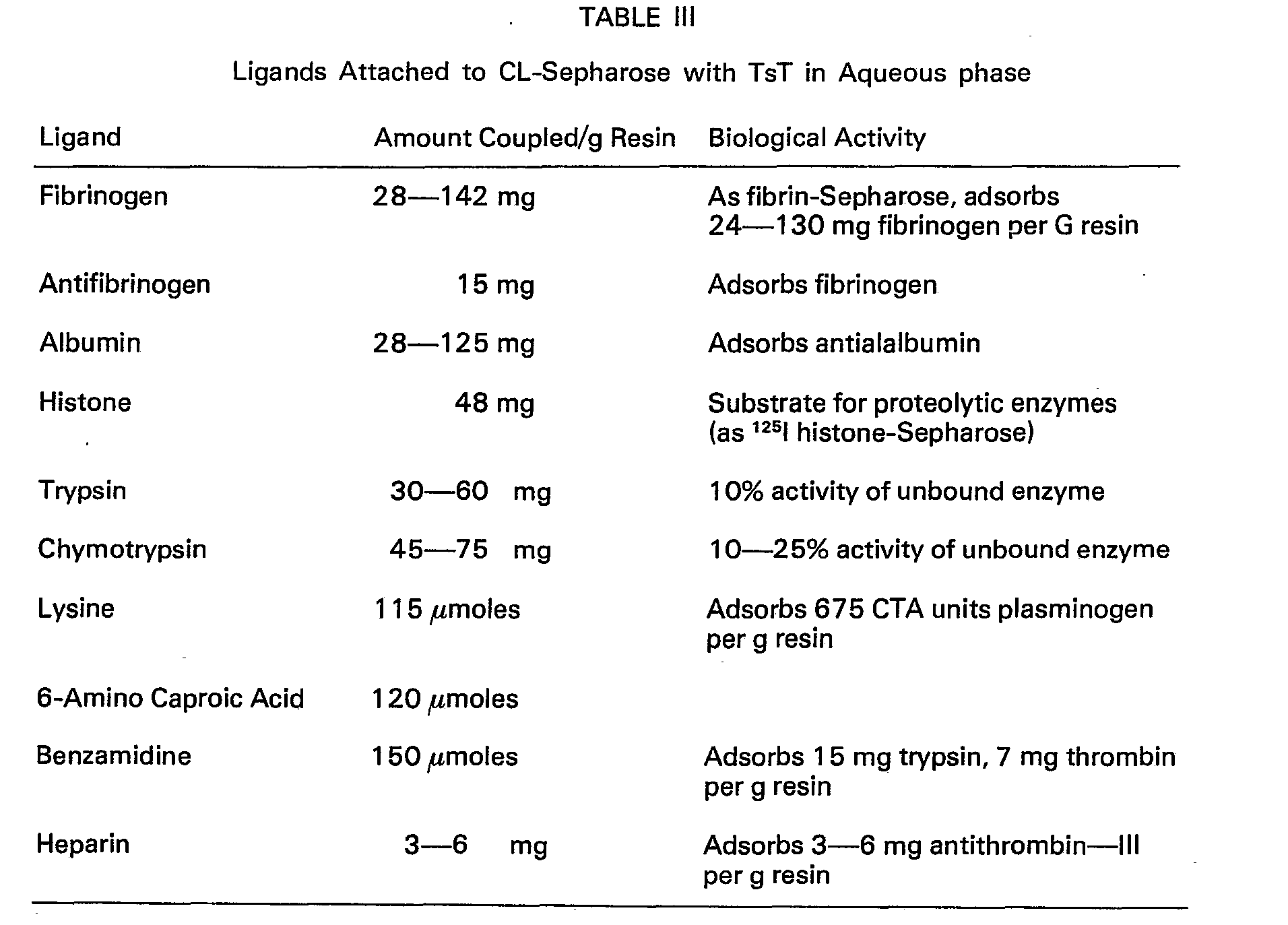
- In preparing the information as shown in Table II, reaction mixtures contained 100 mg of activated resin in a total volume of 2.0 ml 0.1 Na borate, 0.15 M NaCI, pH 8.0 at the protein concentration indicated the first column of Table II. Reactions were conducted at 25±2°C with gentle rocking for 24 hours. The resins were then washed by filtration first with 1.0 M tris-Cl, pH 8.8 followed by 0.05 M tris-Cl, 0.15 M NaCI, pH 8.3. Resins were assayed for protein and enzymic activity as described previously.
Claims (11)
Applications Claiming Priority (2)
| Application Number | Priority Date | Filing Date | Title |
|---|---|---|---|
| US05/876,240 US4229537A (en) | 1978-02-09 | 1978-02-09 | Preparation of trichloro-s-triazine activated supports for coupling ligands |
| US876240 | 1978-02-09 |
Publications (3)
| Publication Number | Publication Date |
|---|---|
| EP0012751A1 EP0012751A1 (en) | 1980-07-09 |
| EP0012751A4 EP0012751A4 (en) | 1981-08-27 |
| EP0012751B1 true EP0012751B1 (en) | 1983-07-20 |
Family
ID=25367253
Family Applications (1)
| Application Number | Title | Priority Date | Filing Date |
|---|---|---|---|
| EP79900239A Expired EP0012751B1 (en) | 1978-02-09 | 1979-08-28 | Preparation of trichloro-s-triazine activated supports |
Country Status (7)
| Country | Link |
|---|---|
| US (1) | US4229537A (en) |
| EP (1) | EP0012751B1 (en) |
| JP (1) | JPS6259124B2 (en) |
| CA (1) | CA1124190A (en) |
| DE (1) | DE2965887D1 (en) |
| IL (1) | IL56604A (en) |
| WO (1) | WO1979000609A1 (en) |
Families Citing this family (256)
| Publication number | Priority date | Publication date | Assignee | Title |
|---|---|---|---|---|
| US4357311A (en) * | 1980-10-03 | 1982-11-02 | Warner-Lambert Company | Substrate for immunoassay and means of preparing same |
| YU43849B (en) * | 1983-08-09 | 1989-12-31 | Akad Wissenschaften | Process for preparing macromolecular substances with chemically active filling substances |
| US4719176A (en) * | 1983-10-31 | 1988-01-12 | Klotz Irving M | Enzyme-free diagnostic binding reagents |
| US4693985A (en) * | 1984-08-21 | 1987-09-15 | Pall Corporation | Methods of concentrating ligands and active membranes used therefor |
| US4970300A (en) * | 1985-02-01 | 1990-11-13 | New York University | Modified factor VIII |
| DE3515586A1 (en) * | 1985-04-30 | 1986-11-06 | Boehringer Mannheim Gmbh, 6800 Mannheim | STABILIZED SARCOSINOXIDASE PREPARATION |
| US4886836A (en) * | 1987-06-03 | 1989-12-12 | Pall Corporation | Activated medium with low non-specific protein adsorption |
| US5192507A (en) * | 1987-06-05 | 1993-03-09 | Arthur D. Little, Inc. | Receptor-based biosensors |
| US5001048A (en) * | 1987-06-05 | 1991-03-19 | Aurthur D. Little, Inc. | Electrical biosensor containing a biological receptor immobilized and stabilized in a protein film |
| US5160626A (en) * | 1987-09-14 | 1992-11-03 | Gelman Sciences Inc. | Blotting methods using polyaldehyde activated membranes |
| US4961852A (en) * | 1987-09-14 | 1990-10-09 | Gelman Sciences, Inc. | Polyaldehyde activated membranes |
| US4992172A (en) * | 1987-09-14 | 1991-02-12 | Gelman Sciences, Inc. | Blotting methods using polyaldehyde activated membranes |
| AU4529289A (en) * | 1988-10-17 | 1990-05-14 | Sepracor, Inc. | Process for the covalent surface modification of hydrophobic polymers and articles made therefrom |
| JPH02219571A (en) * | 1989-02-20 | 1990-09-03 | Kanebo Ltd | Modified protease and production thereof |
| US5116964A (en) | 1989-02-23 | 1992-05-26 | Genentech, Inc. | Hybrid immunoglobulins |
| ATE110110T1 (en) * | 1989-04-04 | 1994-09-15 | Pittner Fritz | METHODS FOR IMMOBILIZING PROTEINS, PEPTIDES, COENZYMES OR THE LIKE. ON A CARRIER. |
| DE4005927A1 (en) * | 1990-02-25 | 1991-08-29 | Roehm Gmbh | IMMOBILIZATION OF PROTEINS TO TRAEGERS |
| US5133968A (en) * | 1990-08-20 | 1992-07-28 | Kanebo, Ltd. | Modified protease, method of producing the same and cosmetic products containing the modified protease |
| US5436147A (en) * | 1991-03-01 | 1995-07-25 | Nucleic Assays Corporation | Heterobifunctional crosslinked agents for immobilizing molecules on plastic substrates |
| US5279955A (en) * | 1991-03-01 | 1994-01-18 | Pegg Randall K | Heterofunctional crosslinking agent for immobilizing reagents on plastic substrates |
| GB2267502B (en) * | 1992-05-28 | 1997-01-22 | Aligena Ag | Polymeric reaction products for use in immobilized buffered gels and membranes |
| IL104734A0 (en) * | 1993-02-15 | 1993-06-10 | Univ Bar Ilan | Bioactive conjugates of cellulose with amino compounds |
| JP2871435B2 (en) * | 1993-04-22 | 1999-03-17 | イー・アイ・デュポン・ドウ・ヌムール・アンド・カンパニー | Method for producing a hydrophilic polymer coated perfluorocarbon polymer based matrix |
| DE69533472T2 (en) * | 1994-01-11 | 2006-01-12 | Dyax Corp., Cambridge | KALLIKER INHIBITING "KUNITZ DOMAIN" PROTEINS AND DERIVATIVES THEREOF |
| US6057287A (en) | 1994-01-11 | 2000-05-02 | Dyax Corp. | Kallikrein-binding "Kunitz domain" proteins and analogues thereof |
| US6045797A (en) * | 1994-03-14 | 2000-04-04 | New York University Medical Center | Treatment or diagnosis of diseases or conditions associated with a BLM domain |
| US5877016A (en) | 1994-03-18 | 1999-03-02 | Genentech, Inc. | Human trk receptors and neurotrophic factor inhibitors |
| US5561097A (en) * | 1994-04-28 | 1996-10-01 | Minnesota Mining And Manufacturing Company | Method of controlling density of ligand coupled onto supports and products produced therefrom |
| US5708142A (en) | 1994-05-27 | 1998-01-13 | Genentech, Inc. | Tumor necrosis factor receptor-associated factors |
| US5837815A (en) * | 1994-12-15 | 1998-11-17 | Sugen, Inc. | PYK2 related polypeptide products |
| US5837524A (en) * | 1994-12-15 | 1998-11-17 | Sugen, Inc. | PYK2 related polynucleotide products |
| US5807989A (en) * | 1994-12-23 | 1998-09-15 | New York University | Methods for treatment or diagnosis of diseases or disorders associated with an APB domain |
| US6300482B1 (en) * | 1995-01-03 | 2001-10-09 | Max-Flanck-Gesellschaft Zuer For{Overscore (D)}Erung Der | MDKI, a novel receptor tyrosine kinase |
| US7005505B1 (en) | 1995-08-25 | 2006-02-28 | Genentech, Inc. | Variants of vascular endothelial cell growth factor |
| US6020473A (en) * | 1995-08-25 | 2000-02-01 | Genentech, Inc. | Nucleic acids encoding variants of vascular endothelial cell growth factor |
| AU725399B2 (en) | 1995-09-15 | 2000-10-12 | Baylor College Of Medicine | Steroid receptor coactivator compositions and methods of use |
| US6998116B1 (en) * | 1996-01-09 | 2006-02-14 | Genentech, Inc. | Apo-2 ligand |
| US6030945A (en) * | 1996-01-09 | 2000-02-29 | Genentech, Inc. | Apo-2 ligand |
| US6046048A (en) * | 1996-01-09 | 2000-04-04 | Genetech, Inc. | Apo-2 ligand |
| US20050089958A1 (en) * | 1996-01-09 | 2005-04-28 | Genentech, Inc. | Apo-2 ligand |
| EP0877620A4 (en) | 1996-01-16 | 1999-04-14 | Rensselaer Polytech Inst | Peptides for altering osteoblast adhesion |
| IL126383A0 (en) * | 1996-04-01 | 1999-05-09 | Genentech Inc | Apo-2li and apo-3 apoptosis polypeptides |
| US20020165157A1 (en) * | 1996-04-01 | 2002-11-07 | Genentech, Inc. | Apo-2LI and Apo-3 polypeptides |
| US6100071A (en) | 1996-05-07 | 2000-08-08 | Genentech, Inc. | Receptors as novel inhibitors of vascular endothelial growth factor activity and processes for their production |
| US5851984A (en) * | 1996-08-16 | 1998-12-22 | Genentech, Inc. | Method of enhancing proliferation or differentiation of hematopoietic stem cells using Wnt polypeptides |
| US6159462A (en) * | 1996-08-16 | 2000-12-12 | Genentech, Inc. | Uses of Wnt polypeptides |
| US6462176B1 (en) | 1996-09-23 | 2002-10-08 | Genentech, Inc. | Apo-3 polypeptide |
| JP3394540B2 (en) | 1997-01-31 | 2003-04-07 | ジェネンテク・インコーポレイテッド | O-fucosyltransferase |
| US20040241645A1 (en) * | 1997-01-31 | 2004-12-02 | Genentech, Inc. | O-fucosyltransferase |
| US20020102706A1 (en) * | 1997-06-18 | 2002-08-01 | Genentech, Inc. | Apo-2DcR |
| EP1860187B1 (en) * | 1997-05-15 | 2011-07-13 | Genentech, Inc. | Apo-2 receptor |
| US6342369B1 (en) | 1997-05-15 | 2002-01-29 | Genentech, Inc. | Apo-2-receptor |
| US20100152426A1 (en) * | 1997-05-15 | 2010-06-17 | Ashkenazi Avi J | Apo-2 receptor fusion proteins |
| EP1003856A1 (en) | 1997-06-05 | 2000-05-31 | Board of Regents, The University of Texas System | Apaf-1, the ced-4 human homolog, an activator of caspase-3 |
| JP2002508663A (en) * | 1997-06-18 | 2002-03-19 | ジェネンテク,インコーポレイテッド | Apo-2DcR |
| EP1007099A4 (en) * | 1997-07-11 | 2004-11-24 | Univ Brandeis | METHOD FOR INDUCING APOPTOSIS BY REDUCING THE THIAMINE RATE |
| DK1009817T3 (en) * | 1997-08-26 | 2010-01-18 | Genentech Inc | RTD receptor |
| US20030175856A1 (en) * | 1997-08-26 | 2003-09-18 | Genetech, Inc. | Rtd receptor |
| US20060141036A1 (en) * | 1997-12-12 | 2006-06-29 | Andrx Labs Llc | HMG-CoA reductase inhibitor extended release formulation |
| EP1045906B1 (en) | 1998-01-15 | 2008-10-15 | Genentech, Inc. | Apo-2 ligand |
| ATE443723T1 (en) * | 1998-06-12 | 2009-10-15 | Genentech Inc | MONOCLONAL ANTIBODIES, CROSS-REACTIVE ANTIBODIES AND THEIR PRODUCTION PROCESSES |
| US6984719B1 (en) | 1998-09-17 | 2006-01-10 | Hospital Sainte-Justine | Peptide antagonists of prostaglandin F2α receptor |
| US6368793B1 (en) | 1998-10-14 | 2002-04-09 | Microgenomics, Inc. | Metabolic selection methods |
| HK1042114B (en) | 1998-10-23 | 2006-09-29 | Amgen K-A, Inc. | Dimeric thrombopoietin peptide mimetics binding to mp1 receptor and having thrombopoietic activity |
| US6660843B1 (en) * | 1998-10-23 | 2003-12-09 | Amgen Inc. | Modified peptides as therapeutic agents |
| US6982153B1 (en) * | 1998-12-03 | 2006-01-03 | Targanta Therapeutics, Inc. | DNA sequences from staphylococcus aureus bacteriophage 77 that encode anti-microbial polypeptides |
| US6861442B1 (en) | 1998-12-30 | 2005-03-01 | Sugen, Inc. | PYK2 and inflammation |
| GB9910807D0 (en) * | 1999-05-10 | 1999-07-07 | Prometic Biosciences Limited | Novel detoxification agents and their use |
| AU779689B2 (en) | 1999-06-16 | 2005-02-03 | Icos Corporation | Human poly(ADP-ribose) polymerase 2 materials and methods |
| US20040235749A1 (en) * | 1999-09-15 | 2004-11-25 | Sylvain Chemtob | G-protein coupled receptor antagonists |
| US20030138771A1 (en) * | 1999-09-30 | 2003-07-24 | Jerry Pelletier | DNA sequences from S. pneumoniae bacteriophage DP1 that encode anti-microbal polypeptides |
| US6808902B1 (en) | 1999-11-12 | 2004-10-26 | Amgen Inc. | Process for correction of a disulfide misfold in IL-1Ra Fc fusion molecules |
| ATE315789T1 (en) | 1999-11-16 | 2006-02-15 | Genentech Inc | ELISA FOR VEGF |
| FR2803926B1 (en) * | 2000-01-14 | 2002-04-05 | Thomson Csf Sextant | METHOD FOR AUTOMATICALLY GENERATING A SYMBOL TABLE OF A REAL-TIME COMPUTER |
| JP4541490B2 (en) * | 2000-04-07 | 2010-09-08 | 株式会社カネカ | Adsorbent for dilated cardiomyopathy |
| AU2001257173B2 (en) | 2000-04-21 | 2005-09-22 | Amgen Inc. | Apo-ai/aii peptide derivatives |
| US6667300B2 (en) | 2000-04-25 | 2003-12-23 | Icos Corporation | Inhibitors of human phosphatidylinositol 3-kinase delta |
| US6677136B2 (en) | 2000-05-03 | 2004-01-13 | Amgen Inc. | Glucagon antagonists |
| SG143058A1 (en) * | 2000-08-11 | 2008-06-27 | Favrille Inc | Method and composition for altering a t cell mediated pathology |
| US6911204B2 (en) | 2000-08-11 | 2005-06-28 | Favrille, Inc. | Method and composition for altering a B cell mediated pathology |
| HU229910B1 (en) | 2001-05-11 | 2014-12-29 | Amgen Inc Thousand Oaks | Peptides and related molecules that bind to tall-1 |
| US7138370B2 (en) | 2001-10-11 | 2006-11-21 | Amgen Inc. | Specific binding agents of human angiopoietin-2 |
| US7332474B2 (en) * | 2001-10-11 | 2008-02-19 | Amgen Inc. | Peptides and related compounds having thrombopoietic activity |
| US20040054082A1 (en) * | 2001-12-03 | 2004-03-18 | Bank David H | Toughened polymer blends with improved surface properties |
| US20100311954A1 (en) * | 2002-03-01 | 2010-12-09 | Xencor, Inc. | Optimized Proteins that Target Ep-CAM |
| DK2311432T3 (en) | 2002-06-07 | 2015-02-02 | Dyax Corp | Modified Kunitz domain polypeptides and their use in reducing ischemia or the onset of a systemic inflammatory response associated with a surgical procedure |
| US7153829B2 (en) * | 2002-06-07 | 2006-12-26 | Dyax Corp. | Kallikrein-inhibitor therapies |
| US7521530B2 (en) | 2002-06-11 | 2009-04-21 | Universite De Montreal | Peptides and peptidomimetics useful for inhibiting the activity of prostaglandin F2α receptor |
| TR201900937T4 (en) | 2002-08-28 | 2019-02-21 | Dyax Corp | Method for preserving organs and tissues. |
| US6919426B2 (en) | 2002-09-19 | 2005-07-19 | Amgen Inc. | Peptides and related molecules that modulate nerve growth factor activity |
| US20050054614A1 (en) * | 2003-08-14 | 2005-03-10 | Diacovo Thomas G. | Methods of inhibiting leukocyte accumulation |
| US20050043239A1 (en) * | 2003-08-14 | 2005-02-24 | Jason Douangpanya | Methods of inhibiting immune responses stimulated by an endogenous factor |
| US8399618B2 (en) | 2004-10-21 | 2013-03-19 | Xencor, Inc. | Immunoglobulin insertions, deletions, and substitutions |
| US20060134105A1 (en) * | 2004-10-21 | 2006-06-22 | Xencor, Inc. | IgG immunoglobulin variants with optimized effector function |
| US8883147B2 (en) | 2004-10-21 | 2014-11-11 | Xencor, Inc. | Immunoglobulins insertions, deletions, and substitutions |
| US20050113458A1 (en) * | 2003-10-22 | 2005-05-26 | Forest Laboratories, Inc. | Use of 1-aminocyclohexane derivatives to modify deposition of fibrillogenic a-beta peptides in amyloidopathies |
| US20090115004A1 (en) * | 2003-12-30 | 2009-05-07 | 3M Innovative Properties Company | Surface acoustic wave sensor assemblies |
| US7658994B2 (en) * | 2003-12-30 | 2010-02-09 | 3M Innovative Properties Company | Substrates and compounds bonded thereto |
| EP1704415A1 (en) * | 2003-12-30 | 2006-09-27 | 3M Innovative Properties Company | Substrates and compounds bonded thereto |
| WO2005064349A2 (en) * | 2003-12-30 | 2005-07-14 | 3M Innovative Properties Company | Detection cartridges, modules, systems and methods |
| ATE507240T1 (en) * | 2004-03-05 | 2011-05-15 | Vegenics Pty Ltd | MATERIALS AND METHODS FOR GROWTH FACTOR BINDING CONSTRUCTS |
| RU2006145450A (en) * | 2004-04-16 | 2008-06-27 | Дженентек, Инк. (Us) | ANTIBODY ANALYSIS |
| EP1761540B1 (en) | 2004-05-13 | 2016-09-28 | Icos Corporation | Quinazolinones as inhibitors of human phosphatidylinositol 3-kinase delta |
| JP2007538258A (en) * | 2004-05-15 | 2007-12-27 | ジェネンテック・インコーポレーテッド | Cross-screening system and method for detecting molecules having binding affinity for a target molecule |
| CA2567883A1 (en) * | 2004-05-25 | 2005-12-15 | Icos Corporation | Methods for treating and/or preventing aberrant proliferation of hematopoietic cells |
| CA2572765C (en) * | 2004-07-08 | 2013-05-21 | Amgen Inc. | Compound having improved bioefficiency when administered in a multidose regimen |
| GB0416699D0 (en) * | 2004-07-27 | 2004-09-01 | Prometic Biosciences Ltd | Prion protein ligands and methods of use |
| US7442778B2 (en) | 2004-09-24 | 2008-10-28 | Amgen Inc. | Modified Fc molecules |
| US7235530B2 (en) * | 2004-09-27 | 2007-06-26 | Dyax Corporation | Kallikrein inhibitors and anti-thrombolytic agents and uses thereof |
| US8802820B2 (en) | 2004-11-12 | 2014-08-12 | Xencor, Inc. | Fc variants with altered binding to FcRn |
| BRPI0517837A (en) | 2004-11-12 | 2008-10-21 | Xencor Inc | fc variants with altered link to fcrn |
| KR20070100307A (en) | 2004-12-22 | 2007-10-10 | 제넨테크, 인크. | Production method of soluble multi-membrane protein |
| WO2006089106A2 (en) * | 2005-02-17 | 2006-08-24 | Icos Corporation | Phosphoinositide 3-kinase inhibitors for inhibiting leukocyte accumulation |
| EP1899308B1 (en) * | 2005-06-10 | 2012-11-07 | ProMetic BioSciences Limited | Triazines as protein binding ligands |
| EP2004695A2 (en) | 2005-07-08 | 2008-12-24 | Xencor, Inc. | Optimized anti-ep-cam antibodies |
| US8008453B2 (en) | 2005-08-12 | 2011-08-30 | Amgen Inc. | Modified Fc molecules |
| WO2007056411A2 (en) * | 2005-11-08 | 2007-05-18 | Genentech, Inc. | Method of producing pan-specific antibodies |
| AR056806A1 (en) | 2005-11-14 | 2007-10-24 | Amgen Inc | RANKL- PTH / PTHRP ANTIBODY CHEMICAL MOLECULES |
| US7276480B1 (en) | 2005-12-30 | 2007-10-02 | Dyax Corp. | Prevention and reduction of blood loss |
| US9012605B2 (en) | 2006-01-23 | 2015-04-21 | Amgen Inc. | Crystalline polypeptides |
| EP2001500A4 (en) * | 2006-03-10 | 2010-07-28 | Dyax Corp | Formulations for ecallantide |
| US9283260B2 (en) * | 2006-04-21 | 2016-03-15 | Amgen Inc. | Lyophilized therapeutic peptibody formulations |
| US7981425B2 (en) | 2006-06-19 | 2011-07-19 | Amgen Inc. | Thrombopoietic compounds |
| ATE540681T1 (en) | 2006-06-26 | 2012-01-15 | Amgen Inc | METHOD FOR TREATING ATHEROSCLERosis |
| EP2492278A1 (en) | 2006-09-18 | 2012-08-29 | Compugen Ltd. | Antibodies against an agonist of G-protein coupled receptors and its use indiagnosis and therapy |
| US7833527B2 (en) | 2006-10-02 | 2010-11-16 | Amgen Inc. | Methods of treating psoriasis using IL-17 Receptor A antibodies |
| HUE030082T2 (en) | 2006-10-04 | 2017-04-28 | Genentech Inc | Elisa for VEGF |
| WO2008051383A2 (en) * | 2006-10-19 | 2008-05-02 | Amgen Inc. | Use of alcohol co-solvents to improve pegylation reaction yields |
| AR063384A1 (en) | 2006-10-25 | 2009-01-28 | Amgen Inc | THERAPEUTIC AGENTS BASED ON PEPTIDES DERIVED FROM TOXINS |
| US20080171344A1 (en) * | 2006-12-22 | 2008-07-17 | Kapsner Kenneth P | Methods, Kits and Materials for Diagnosing Disease States by Measuring Isoforms or Proforms of Myeloperoxidase |
| US20100151553A1 (en) * | 2006-12-29 | 2010-06-17 | Bjork Jason W | Method of detection of bioanalytes by acousto-mechanical detection systems comprising the addition of liposomes |
| EP2738257A1 (en) | 2007-05-22 | 2014-06-04 | Amgen Inc. | Compositions and methods for producing bioactive fusion proteins |
| AU2008273813B2 (en) | 2007-07-12 | 2013-06-13 | Compugen Ltd. | Bioactive peptides and method of using same |
| NZ582794A (en) | 2007-07-26 | 2012-09-28 | Amgen Inc | Modified lecithin-cholesterol acyltransferase enzymes |
| WO2009029716A1 (en) | 2007-08-28 | 2009-03-05 | Ramot At Tel Aviv University | Peptides inducing a cd4i conformation in hiv gp120 while retaining vacant cd4 binding site |
| AU2008345242B2 (en) | 2007-10-31 | 2014-02-27 | Xencor, Inc. | Fc variants with altered binding to FcRn |
| WO2010027802A2 (en) | 2008-08-25 | 2010-03-11 | New York University | Methods for treating diabetic wounds |
| KR20160091440A (en) | 2008-11-13 | 2016-08-02 | 길리아드 칼리스토가 엘엘씨 | Therapies for hematologic malignancies |
| US9492449B2 (en) | 2008-11-13 | 2016-11-15 | Gilead Calistoga Llc | Therapies for hematologic malignancies |
| US8637454B2 (en) * | 2009-01-06 | 2014-01-28 | Dyax Corp. | Treatment of mucositis with kallikrein inhibitors |
| CA2756347A1 (en) | 2009-03-24 | 2010-09-30 | Gilead Calistoga Llc | Atropisomers of 2-purinyl-3-tolyl-quinazolinone derivatives and methods of use |
| SG175259A1 (en) * | 2009-04-20 | 2011-11-28 | Gilead Calistoga Llc | Methods of treatment for solid tumors |
| AU2010276160A1 (en) | 2009-07-21 | 2012-02-09 | Gilead Calistoga Llc | Treatment of liver disorders with PI3K inhibitors |
| TW201117824A (en) | 2009-10-12 | 2011-06-01 | Amgen Inc | Use of IL-17 receptor a antigen binding proteins |
| WO2011049625A1 (en) | 2009-10-20 | 2011-04-28 | Mansour Samadpour | Method for aflatoxin screening of products |
| JP6139885B2 (en) * | 2009-10-26 | 2017-05-31 | ジェネンテック, インコーポレイテッド | Assays for detecting antibodies specific for therapeutic anti-IgE antibodies and their use in anaphylaxis |
| SG10201500895XA (en) | 2009-11-05 | 2015-04-29 | Rhizen Pharmaceuticals Sa | Chromen-4-one Derivatives As Kinase Modulators |
| ES2688093T3 (en) * | 2010-01-06 | 2018-10-30 | Dyax Corp. | Plasma kallikrein binding proteins |
| WO2011097527A2 (en) | 2010-02-04 | 2011-08-11 | Xencor, Inc. | Immunoprotection of therapeutic moieties using enhanced fc regions |
| US20110189178A1 (en) * | 2010-02-04 | 2011-08-04 | Xencor, Inc. | Immunoprotection of Therapeutic Moieties Using Enhanced Fc Regions |
| ES2575160T3 (en) | 2010-03-15 | 2016-06-24 | The Board Of Trustees Of The University Of Illinois | Inhibitors of the interactions that bind the alpha subunit of beta integrin-protein G |
| EP3450432A1 (en) | 2010-05-17 | 2019-03-06 | Incozen Therapeutics Pvt. Ltd. | Novel 3,5-disubstitued-3h-imidazo[4,5-b]pyridine and 3,5- disubstitued - 3h-[1,2,3]triazolo[4,5-b] pyridine compounds as modulators of protein kinases |
| US9254310B2 (en) | 2010-06-17 | 2016-02-09 | New York University | Therapeutic and cosmetic uses and applications of calreticulin |
| WO2012030738A2 (en) | 2010-08-30 | 2012-03-08 | Beckman Coulter, Inc. | Complex phosphoprotein activation profiles |
| EP3219731A1 (en) | 2010-10-01 | 2017-09-20 | Oxford BioTherapeutics Ltd | Anti-ror1 antibodies |
| EP2655401B1 (en) | 2010-12-20 | 2016-03-09 | The Regents of the University of Michigan | Inhibitors of the epidermal growth factor receptor-heat shock protein 90 binding interaction |
| JOP20210044A1 (en) | 2010-12-30 | 2017-06-16 | Takeda Pharmaceuticals Co | Anti-CD38 . antibody |
| IL269565B2 (en) | 2011-01-06 | 2024-06-01 | Dyax Corp | KALLIKREIN PLASMA BINDING PROTEINS |
| US9340590B2 (en) | 2011-03-16 | 2016-05-17 | Amgen Inc. | Potent and selective inhibitors of NaV1.3 and NaV1.7 |
| EP2702076A1 (en) | 2011-04-29 | 2014-03-05 | Bristol-Myers Squibb Company | Ip-10 antibody dosage escalation regimens |
| RS58326B1 (en) | 2011-05-04 | 2019-03-29 | Rhizen Pharmaceuticals S A | Novel compounds as modulators of protein kinases |
| US20140234330A1 (en) | 2011-07-22 | 2014-08-21 | Amgen Inc. | Il-17 receptor a is required for il-17c biology |
| ES2806146T3 (en) | 2011-09-22 | 2021-02-16 | Amgen Inc | CD27L antigen-binding proteins |
| US10851178B2 (en) | 2011-10-10 | 2020-12-01 | Xencor, Inc. | Heterodimeric human IgG1 polypeptides with isoelectric point modifications |
| US12466897B2 (en) | 2011-10-10 | 2025-11-11 | Xencor, Inc. | Heterodimeric human IgG1 polypeptides with isoelectric point modifications |
| TWI679212B (en) | 2011-11-15 | 2019-12-11 | 美商安進股份有限公司 | Binding molecules for e3 of bcma and cd3 |
| EA025407B1 (en) | 2012-03-05 | 2016-12-30 | Джилид Калистога Ллс | Polymorphic form i of (s)-2-(1-(9h-purin-6-ylamino)propyl)-5-fluoro-3-phenylquinazolin-4(3h)-one |
| WO2013142796A2 (en) | 2012-03-23 | 2013-09-26 | Bristol-Myers Squibb Company | Methods of treatments using ctla4 antibodies |
| WO2013148373A1 (en) | 2012-03-28 | 2013-10-03 | Genentech, Inc. | Anti-hcmv idiotypic antibodies and uses thereof |
| AP3908A (en) | 2012-03-30 | 2016-11-24 | Rhizen Pharmaceuticals Sa | Novel 3,5-disubstituted-3H-imidazo[4,5-B]pyridine and 3,5-disubstituted-3H-[1,2,3]triazolo [4,5-B] pyridine compounds as modulators of C-met protein kinases |
| WO2013155346A1 (en) | 2012-04-11 | 2013-10-17 | The Regents Of The University Of California | Diagnostic tools for response to 6-thiopurine therapy |
| AR091069A1 (en) | 2012-05-18 | 2014-12-30 | Amgen Inc | PROTEINS OF UNION TO ANTIGEN DIRECTED AGAINST THE ST2 RECEIVER |
| TW201425336A (en) | 2012-12-07 | 2014-07-01 | Amgen Inc | BCMA antigen binding proteins |
| JP6426107B2 (en) | 2012-12-20 | 2018-11-21 | アムジエン・インコーポレーテツド | APJ receptor agonists and uses thereof |
| EP2948478B1 (en) | 2013-01-25 | 2019-04-03 | Amgen Inc. | Antibodies targeting cdh19 for melanoma |
| JO3519B1 (en) | 2013-01-25 | 2020-07-05 | Amgen Inc | Antibody combinations for CDH19 and CD3 |
| WO2014122166A1 (en) | 2013-02-06 | 2014-08-14 | Pieris Ag | Novel lipocalin-mutein assays for measuring hepcidin concentration |
| MY199344A (en) | 2013-02-18 | 2023-10-24 | Vegenics Pty Ltd | Ligand binding molecules and uses thereof |
| WO2014165277A2 (en) | 2013-03-12 | 2014-10-09 | Amgen Inc. | POTENT AND SELECTIVE INHIBITORS OF Nav1.7 |
| US9546203B2 (en) | 2013-03-14 | 2017-01-17 | Amgen Inc. | Aglycosylated Fc-containing polypeptides with cysteine substitutions |
| ES2875853T3 (en) | 2013-03-15 | 2021-11-11 | Univ Texas | Method of treating fibrosis |
| EP2970449B1 (en) | 2013-03-15 | 2019-09-25 | Amgen Research (Munich) GmbH | Single chain binding molecules comprising n-terminal abp |
| US9260527B2 (en) | 2013-03-15 | 2016-02-16 | Sdix, Llc | Anti-human CXCR4 antibodies and methods of making same |
| WO2014140368A1 (en) | 2013-03-15 | 2014-09-18 | Amgen Research (Munich) Gmbh | Antibody constructs for influenza m2 and cd3 |
| EP3936521B1 (en) | 2013-03-15 | 2026-02-11 | Xencor, Inc. | Heterodimeric proteins |
| EP2970486B1 (en) | 2013-03-15 | 2018-05-16 | Xencor, Inc. | Modulation of t cells with bispecific antibodies and fc fusions |
| SG11201508829QA (en) | 2013-05-30 | 2015-12-30 | Biogen Ma Inc | Oncostatin m receptor antigen binding proteins |
| EP3042192A4 (en) * | 2013-09-04 | 2017-04-26 | Sten Ohlson | Weak affinity chromatography |
| EP3055695A1 (en) | 2013-09-12 | 2016-08-17 | Institut National de la Santé et de la Recherche Médicale | Method for in vitro quantifying allo-antibodies, auto-antibodies and/or therapeutic antibodies |
| RU2016107435A (en) | 2013-09-13 | 2017-10-18 | Дженентек, Инк. | COMPOSITIONS AND METHODS FOR DETECTING AND QUANTITATIVE DETERMINATION OF THE PROTEIN OF CELLS-OWNERS IN CELL LINES AND RECOMBINANT POLYPEPTIDE PRODUCTS |
| EP3683232A1 (en) | 2013-09-13 | 2020-07-22 | F. Hoffmann-La Roche AG | Methods and compositions comprising purified recombinant polypeptides |
| TWI688401B (en) | 2013-09-13 | 2020-03-21 | 美商安進公司 | Combination of epigenetic factors and bispecific compounds targeting cd33 and cd3 in the treatment of myeloid leukemia |
| SG11201602460QA (en) | 2013-10-11 | 2016-04-28 | Oxford Biotherapeutics Ltd | Conjugated antibodies against ly75 for the treatment of cancer |
| NZ720867A (en) | 2013-12-20 | 2018-01-26 | Gilead Calistoga Llc | Process methods for phosphatidylinositol 3-kinase inhibitors |
| WO2015095605A1 (en) | 2013-12-20 | 2015-06-25 | Gilead Calistoga Llc | Polymorphic forms of a hydrochloride salt of (s) -2-(9h-purin-6-ylamino) propyl) -5-fluoro-3-phenylquinazolin-4 (3h) -one |
| ES2803217T3 (en) | 2014-01-17 | 2021-01-25 | Minomic Int Ltd | Prostate cancer cell surface antigen for diagnosis |
| AU2015218903B2 (en) | 2014-02-20 | 2020-10-15 | Allergan, Inc. | Complement component C5 antibodies |
| KR20160126054A (en) | 2014-02-27 | 2016-11-01 | 알러간, 인코포레이티드 | COMPLEMENT FACTOR Bb ANTIBODIES |
| EP3122782A4 (en) | 2014-03-27 | 2017-09-13 | Dyax Corp. | Compositions and methods for treatment of diabetic macular edema |
| JP6775422B2 (en) | 2014-03-28 | 2020-10-28 | ゼンコー・インコーポレイテッドXencor、 Inc. | Bispecific antibody that binds to CD38 and CD3 |
| EP3155002B1 (en) | 2014-06-10 | 2019-11-27 | Amgen Inc. | Apelin polypeptides |
| JP6455995B2 (en) | 2014-06-13 | 2019-01-23 | ギリアード サイエンシーズ, インコーポレイテッド | Phosphatidylinositol 3-kinase inhibitor |
| UY36245A (en) | 2014-07-31 | 2016-01-29 | Amgen Res Munich Gmbh | ANTIBODY CONSTRUCTS FOR CDH19 AND CD3 |
| JP6749312B2 (en) | 2014-07-31 | 2020-09-02 | アムゲン リサーチ (ミュンヘン) ゲーエムベーハーAMGEN Research(Munich)GmbH | Optimized interspecific bispecific single chain antibody constructs |
| WO2016016415A1 (en) | 2014-07-31 | 2016-02-04 | Amgen Research (Munich) Gmbh | Bispecific single chain antibody construct with enhanced tissue distribution |
| US10227411B2 (en) | 2015-03-05 | 2019-03-12 | Xencor, Inc. | Modulation of T cells with bispecific antibodies and FC fusions |
| SG10202005917SA (en) | 2015-03-06 | 2020-07-29 | Genentech Inc | Ultrapurified dsba and dsbc and methods of making and using the same |
| WO2016149537A1 (en) | 2015-03-17 | 2016-09-22 | The United States Of America, As Represented By The Secretary, Department Of Health And Human Services | Bank vole prion protein as a broad-spectrum substrate for rt-quic-based detection and discrimination of prion strains |
| MX2017012966A (en) | 2015-04-10 | 2018-06-06 | Amgen Inc | Interleukin-2 muteins for the expansion of t-regulatory cells. |
| DK3283524T3 (en) | 2015-04-17 | 2023-05-30 | Amgen Res Munich Gmbh | BISPECIFIC ANTIBODY CONSTRUCTIONS AGAINST CDH3 and CD3 |
| TWI829617B (en) | 2015-07-31 | 2024-01-21 | 德商安美基研究(慕尼黑)公司 | Antibody constructs for flt3 and cd3 |
| TWI796283B (en) | 2015-07-31 | 2023-03-21 | 德商安美基研究(慕尼黑)公司 | Antibody constructs for msln and cd3 |
| EA039859B1 (en) | 2015-07-31 | 2022-03-21 | Эмджен Рисерч (Мюник) Гмбх | Bispecific antibody constructs binding egfrviii and cd3 |
| TWI793062B (en) | 2015-07-31 | 2023-02-21 | 德商安美基研究(慕尼黑)公司 | Antibody constructs for dll3 and cd3 |
| TWI717375B (en) | 2015-07-31 | 2021-02-01 | 德商安美基研究(慕尼黑)公司 | Antibody constructs for cd70 and cd3 |
| TWI744242B (en) | 2015-07-31 | 2021-11-01 | 德商安美基研究(慕尼黑)公司 | Antibody constructs for egfrviii and cd3 |
| WO2017040342A1 (en) | 2015-08-28 | 2017-03-09 | Genentech, Inc. | Anti-hypusine antibodies and uses thereof |
| BR112018011622A2 (en) | 2015-12-11 | 2018-11-27 | Dyax Corp | method to treat hereditary angioedema attack (hae) or reduce hae attack rate |
| JOP20170017B1 (en) | 2016-01-25 | 2021-08-17 | Amgen Res Munich Gmbh | Pharmaceutical composition comprising bispecific antibody constructs |
| SG11201805770UA (en) | 2016-02-03 | 2018-08-30 | Amgen Res Munich Gmbh | BCMA and CD3 Bispecific T Cell Engaging Antibody Constructs |
| CA3011942A1 (en) | 2016-02-03 | 2017-08-10 | Amgen Research (Munich) Gmbh | Psma and cd3 bispecific t cell engaging antibody constructs |
| JOP20170091B1 (en) | 2016-04-19 | 2021-08-17 | Amgen Res Munich Gmbh | Giving a bispecific formulation that binds to CD33 and CD3 for use in a modality for the treatment of myeloid leukemia |
| CN115073581A (en) | 2016-05-04 | 2022-09-20 | 美国安进公司 | Interleukin-2 muteins for expansion of T regulatory cells |
| IL262813B2 (en) | 2016-05-16 | 2025-12-01 | Baxalta GmbH | Anti-Padua Factor IX Antibodies |
| EP3484923A1 (en) | 2016-07-15 | 2019-05-22 | Takeda Pharmaceutical Company Limited | Methods and materials for assessing response to plasmablast- and plasma cell-depleting therapies |
| CN110167967B (en) | 2017-01-18 | 2022-08-05 | 豪夫迈·罗氏有限公司 | Idiotypic antibodies directed against anti-PD-L1 antibodies and uses thereof |
| AU2018214223B2 (en) | 2017-02-02 | 2025-08-14 | Amgen Inc. | Low pH pharmaceutical composition comprising T cell engaging antibody constructs |
| GB201703876D0 (en) | 2017-03-10 | 2017-04-26 | Berlin-Chemie Ag | Pharmaceutical combinations |
| KR102700015B1 (en) | 2017-05-05 | 2024-08-29 | 암젠 인크 | Pharmaceutical composition comprising a bispecific antibody construct for improved storage and administration |
| EP3694890A4 (en) | 2017-10-12 | 2021-11-03 | Immunowake Inc. | VEGFR ANTIBODY LIGHT CHAIN FUSION PROTEIN |
| TWI827570B (en) | 2017-12-11 | 2024-01-01 | 美商安進公司 | Continuous manufacturing process for bispecific antibody products |
| UY38041A (en) | 2017-12-29 | 2019-06-28 | Amgen Inc | CONSTRUCTION OF BIESPECFIC ANTIBODY DIRECTED TO MUC17 AND CD3 |
| US11065336B2 (en) | 2018-04-30 | 2021-07-20 | Medimmune Limited | Conjugates for targeting and clearing aggregates |
| GB201809746D0 (en) | 2018-06-14 | 2018-08-01 | Berlin Chemie Ag | Pharmaceutical combinations |
| MY208638A (en) | 2018-07-02 | 2025-05-21 | Amgen Inc | Anti-steap1 antigen-binding protein |
| CA3107186A1 (en) | 2018-07-30 | 2020-02-06 | Amgen Research (Munich) Gmbh | Prolonged administration of a bispecific antibody construct binding to cd33 and cd3 |
| AR117650A1 (en) | 2018-10-11 | 2021-08-18 | Amgen Inc | POST-PROCESSING OF BISPECIFIC ANTIBODIES CONSTRUCTS |
| WO2020081493A1 (en) | 2018-10-16 | 2020-04-23 | Molecular Templates, Inc. | Pd-l1 binding proteins |
| AU2020290573B2 (en) | 2019-06-13 | 2026-01-29 | Amgen Inc. | Automated biomass-based perfusion control in the manufacturing of biologics |
| UY38836A (en) | 2019-08-13 | 2021-02-26 | Amgen Inc | INTERLEUKIN-2 MUTEINS FOR THE EXPANSION OF REGULATORY T-CELLS |
| US20220306741A1 (en) | 2019-09-10 | 2022-09-29 | Amgen Inc. | Purification Method for Bispecific antigen-binding Polypeptides with Enhanced Protein L Capture Dynamic Binding Capacity |
| CA3156683A1 (en) | 2019-11-13 | 2021-05-20 | Amgen Inc. | METHOD FOR REDUCING AGGREGATE FORMATION IN DOWNSTREAM PROCESSING OF BI-SPECIFIC ANTIGEN-BINDING MOLECULES |
| CN114867749A (en) | 2019-12-17 | 2022-08-05 | 安进公司 | Dual interleukin-2/TNF receptor agonists for use in therapy |
| CA3167336A1 (en) | 2020-01-13 | 2021-07-22 | Takeda Pharmaceutical Company Limited | Plasma kallikrein inhibitors and uses thereof for treating pediatric hereditary angioedema attack |
| JP7822322B2 (en) | 2020-04-30 | 2026-03-02 | ジェネンテック, インコーポレイテッド | KRAS-SPECIFIC ANTIBODIES AND USES THEREOF |
| US12312412B2 (en) | 2020-05-19 | 2025-05-27 | Amgen Inc. | MAGEB2 binding constructs |
| AU2021281554A1 (en) | 2020-05-29 | 2022-12-15 | Amgen Inc. | Adverse effects-mitigating administration of a bispecific antibody construct binding to CD33 and CD3 |
| KR20230017822A (en) | 2020-06-01 | 2023-02-06 | 제넨테크, 인크. | Methods for making extracellular vesicles and their uses |
| EP4169949A4 (en) | 2020-06-23 | 2024-08-21 | Jiangsu Kanion Pharmaceutical Co., Ltd. | ANTI-CD38 ANTIBODIES AND USE THEREOF |
| MX2023000622A (en) | 2020-07-14 | 2023-02-22 | Genentech Inc | TESTS FOR FIXED DOSE COMBINATIONS. |
| CA3200317A1 (en) | 2020-11-06 | 2022-05-12 | Amgen Inc. | Multitargeting bispecific antigen-binding molecules of increased selectivity |
| AR125290A1 (en) | 2021-04-02 | 2023-07-05 | Amgen Inc | MAGEB2 JOINING CONSTRUCTIONS |
| WO2022234102A1 (en) | 2021-05-06 | 2022-11-10 | Amgen Research (Munich) Gmbh | Cd20 and cd22 targeting antigen-binding molecules for use in proliferative diseases |
| IL316597A (en) | 2022-05-12 | 2024-12-01 | Amgen Res Munich Gmbh | Multichain multitargeting bispecific antigen-binding molecules of increased selectivity |
| JP2025533434A (en) | 2022-09-14 | 2025-10-07 | アムジエン・インコーポレーテツド | Bispecific molecular stabilization composition |
| MX2025014635A (en) | 2023-06-14 | 2026-02-03 | Amgen Inc | T CELL MASKING HOST MOLECULES |
Family Cites Families (9)
| Publication number | Priority date | Publication date | Assignee | Title |
|---|---|---|---|---|
| US3619371A (en) * | 1967-07-03 | 1971-11-09 | Nat Res Dev | Production of a polymeric matrix having a biologically active substance bound thereto |
| US3674767A (en) * | 1967-07-14 | 1972-07-04 | Nat Res Dev | Novel polymeric materials containing triazinyl groups |
| US3824150A (en) * | 1967-07-14 | 1974-07-16 | Nat Res Dev | Enzyme bound to polymeric sheet with a triazine bridging group |
| SE343210B (en) * | 1967-12-20 | 1972-03-06 | Pharmacia Ab | |
| US3788945A (en) * | 1970-11-09 | 1974-01-29 | Standard Brands Inc | Process for isomerizing glucose to fructose |
| US3876501A (en) * | 1973-05-17 | 1975-04-08 | Baxter Laboratories Inc | Binding enzymes to activated water-soluble carbohydrates |
| US4119494A (en) * | 1973-08-22 | 1978-10-10 | Rhone-Poulenc Industries | Immobilization of enzymes in an anhydrous medium |
| US4007089A (en) * | 1975-04-30 | 1977-02-08 | Nelson Research & Development Company | Method for binding biologically active compounds |
| JPS581916B2 (en) * | 1975-09-29 | 1983-01-13 | 協和醗酵工業株式会社 | Carrier for immobilizing physiologically active substances |
-
1978
- 1978-02-09 US US05/876,240 patent/US4229537A/en not_active Expired - Lifetime
-
1979
- 1979-02-06 CA CA320,916A patent/CA1124190A/en not_active Expired
- 1979-02-07 IL IL56604A patent/IL56604A/en unknown
- 1979-02-09 DE DE7979900239T patent/DE2965887D1/en not_active Expired
- 1979-02-09 WO PCT/US1979/000081 patent/WO1979000609A1/en not_active Ceased
- 1979-02-09 JP JP54500459A patent/JPS6259124B2/ja not_active Expired
- 1979-08-28 EP EP79900239A patent/EP0012751B1/en not_active Expired
Non-Patent Citations (2)
| Title |
|---|
| N, Biochimica et Biophysica ACTA, VOLUME 198, issued 1970, Kay et al. The Chemical Attachment of Chymotrypsin To Water-Insoluble Polymer Using 2-Amino-4,6-Dichloro-S-Triazine, pages 276-285 * |
| N, Journal of Biological Chemistry, VOLUME 252, Number 11, issued 1977, Abuchowski, et al, Alternation of Immunological Properties of Bovine Serum Albumin by Covalent Attachment of Polyethylene Glycol, pages 3578-3581 * |
Also Published As
| Publication number | Publication date |
|---|---|
| IL56604A0 (en) | 1979-05-31 |
| EP0012751A4 (en) | 1981-08-27 |
| CA1124190A (en) | 1982-05-25 |
| DE2965887D1 (en) | 1983-08-25 |
| US4229537A (en) | 1980-10-21 |
| WO1979000609A1 (en) | 1979-08-23 |
| EP0012751A1 (en) | 1980-07-09 |
| IL56604A (en) | 1982-05-31 |
| JPS6259124B2 (en) | 1987-12-09 |
| JPS55500309A (en) | 1980-05-29 |
Similar Documents
| Publication | Publication Date | Title |
|---|---|---|
| US4229537A (en) | Preparation of trichloro-s-triazine activated supports for coupling ligands | |
| US4330440A (en) | Activated matrix and method of activation | |
| US4195128A (en) | Polymeric carrier bound ligands | |
| Mohr | Affinity chromatography: practical and theoretical aspects | |
| US3876501A (en) | Binding enzymes to activated water-soluble carbohydrates | |
| US4332694A (en) | Three-dimensional carrier of inorganic porous material-reactive polymer and a method for its preparation | |
| US6291216B1 (en) | Affinity supports containing ligands bound to oxirane groups | |
| US5976527A (en) | High surface area support having bound latex particles containing oxirane groups for immobilization of substances | |
| US4582875A (en) | Method of activating hydroxyl groups of a polymeric carrier using 2-fluoro-1-methylpyridinium toluene-4-sulfonate | |
| CARLSSON et al. | 10 Affinity Chromatography | |
| CA2025487A1 (en) | Hplc avidin monomer affinity resin | |
| Ngo | Procedure for activating polymers with primary and/or secondary hydroxyl groups | |
| EP0403700B1 (en) | Polyethyleneimine matrixes for affinity chromatography | |
| US4144128A (en) | Polymeric carrier bound ligands | |
| EP0184361B1 (en) | Method of activating polymeric carrier | |
| EP0186347B1 (en) | Method for producing high-active biologically efficient compounds immobilized on a carrier | |
| Goldstein | [6] Polymers bearing isonitrile functional groups as supports for enzyme immobilization | |
| JPH0586100A (en) | Modified solid substrate for immobilizing protein by covalent bond and its manufacture | |
| CA1104110A (en) | Enzyme-immobilization carriers and preparation thereof | |
| US4778888A (en) | Boron containing 1,3,5-triazines | |
| Coombe et al. | An alternative coupling procedure for preparing activated sepharose for affinity chromatography of penicillinase | |
| DK171394B1 (en) | Support or carrier in solid phase, immobilized enzyme in solid phase on such a support, ligand-linked chromatography affinity matrix and method for separating or removing a substance from solution using the support | |
| JPS5998045A (en) | Fixation of nucleophilic group-containing compound | |
| JPH0359080B2 (en) | ||
| Ghadge | Synthetic polymer based affinity matrices: separation of penicillin g acylase and penicillinase |
Legal Events
| Date | Code | Title | Description |
|---|---|---|---|
| PUAI | Public reference made under article 153(3) epc to a published international application that has entered the european phase |
Free format text: ORIGINAL CODE: 0009012 |
|
| 17P | Request for examination filed | ||
| AK | Designated contracting states |
Designated state(s): CH DE FR GB SE |
|
| GRAA | (expected) grant |
Free format text: ORIGINAL CODE: 0009210 |
|
| AK | Designated contracting states |
Designated state(s): CH DE FR GB SE |
|
| REF | Corresponds to: |
Ref document number: 2965887 Country of ref document: DE Date of ref document: 19830825 |
|
| ET | Fr: translation filed | ||
| PLBE | No opposition filed within time limit |
Free format text: ORIGINAL CODE: 0009261 |
|
| STAA | Information on the status of an ep patent application or granted ep patent |
Free format text: STATUS: NO OPPOSITION FILED WITHIN TIME LIMIT |
|
| 26N | No opposition filed | ||
| PGFP | Annual fee paid to national office [announced via postgrant information from national office to epo] |
Ref country code: GB Payment date: 19890131 Year of fee payment: 11 |
|
| PGFP | Annual fee paid to national office [announced via postgrant information from national office to epo] |
Ref country code: SE Payment date: 19890208 Year of fee payment: 11 |
|
| PGFP | Annual fee paid to national office [announced via postgrant information from national office to epo] |
Ref country code: FR Payment date: 19890209 Year of fee payment: 11 |
|
| PGFP | Annual fee paid to national office [announced via postgrant information from national office to epo] |
Ref country code: CH Payment date: 19890213 Year of fee payment: 11 |
|
| PGFP | Annual fee paid to national office [announced via postgrant information from national office to epo] |
Ref country code: DE Payment date: 19890323 Year of fee payment: 11 |
|
| PG25 | Lapsed in a contracting state [announced via postgrant information from national office to epo] |
Ref country code: GB Effective date: 19900209 |
|
| PG25 | Lapsed in a contracting state [announced via postgrant information from national office to epo] |
Ref country code: SE Effective date: 19900210 |
|
| PG25 | Lapsed in a contracting state [announced via postgrant information from national office to epo] |
Ref country code: CH Effective date: 19900228 |
|
| GBPC | Gb: european patent ceased through non-payment of renewal fee | ||
| PG25 | Lapsed in a contracting state [announced via postgrant information from national office to epo] |
Ref country code: FR Effective date: 19901031 |
|
| REG | Reference to a national code |
Ref country code: CH Ref legal event code: PL |
|
| PG25 | Lapsed in a contracting state [announced via postgrant information from national office to epo] |
Ref country code: DE Effective date: 19901101 |
|
| REG | Reference to a national code |
Ref country code: FR Ref legal event code: ST |
|
| EUG | Se: european patent has lapsed |
Ref document number: 79900239.9 Effective date: 19901107 |