EP0010265A2 - Synthetic resins based on crosslinked copolymers of mono- and polyvinyl compounds, process for their preparation and their use as inert material in ion exchange mixed-bed filters - Google Patents
Synthetic resins based on crosslinked copolymers of mono- and polyvinyl compounds, process for their preparation and their use as inert material in ion exchange mixed-bed filters Download PDFInfo
- Publication number
- EP0010265A2 EP0010265A2 EP79103929A EP79103929A EP0010265A2 EP 0010265 A2 EP0010265 A2 EP 0010265A2 EP 79103929 A EP79103929 A EP 79103929A EP 79103929 A EP79103929 A EP 79103929A EP 0010265 A2 EP0010265 A2 EP 0010265A2
- Authority
- EP
- European Patent Office
- Prior art keywords
- methacrylic acid
- und
- polyhydric alcohols
- synthetic resins
- polyvinyl compounds
- Prior art date
- Legal status (The legal status is an assumption and is not a legal conclusion. Google has not performed a legal analysis and makes no representation as to the accuracy of the status listed.)
- Granted
Links
- 229920003002 synthetic resin Polymers 0.000 title claims abstract description 24
- 239000000057 synthetic resin Substances 0.000 title claims abstract description 24
- 150000001875 compounds Chemical class 0.000 title claims abstract description 11
- 239000000463 material Substances 0.000 title claims abstract description 11
- 229920002554 vinyl polymer Polymers 0.000 title claims abstract description 11
- 229920001577 copolymer Polymers 0.000 title claims abstract description 9
- 238000000034 method Methods 0.000 title claims abstract description 6
- 238000005342 ion exchange Methods 0.000 title abstract description 5
- PPBRXRYQALVLMV-UHFFFAOYSA-N Styrene Chemical compound C=CC1=CC=CC=C1 PPBRXRYQALVLMV-UHFFFAOYSA-N 0.000 claims abstract description 19
- 125000005397 methacrylic acid ester group Chemical group 0.000 claims abstract description 13
- 150000005846 sugar alcohols Polymers 0.000 claims abstract description 10
- 150000003440 styrenes Chemical class 0.000 claims abstract description 7
- 125000003903 2-propenyl group Chemical group [H]C([*])([H])C([H])=C([H])[H] 0.000 claims abstract description 5
- 229920001289 polyvinyl ether Polymers 0.000 claims abstract description 5
- 125000003118 aryl group Chemical group 0.000 claims abstract description 4
- 238000007334 copolymerization reaction Methods 0.000 claims abstract description 4
- 229930195735 unsaturated hydrocarbon Natural products 0.000 claims abstract description 4
- MYRTYDVEIRVNKP-UHFFFAOYSA-N 1,2-Divinylbenzene Chemical compound C=CC1=CC=CC=C1C=C MYRTYDVEIRVNKP-UHFFFAOYSA-N 0.000 claims description 35
- 229920005989 resin Polymers 0.000 claims description 24
- 239000011347 resin Substances 0.000 claims description 24
- QTYUSOHYEPOHLV-FNORWQNLSA-N 1,3-Octadiene Chemical compound CCCC\C=C\C=C QTYUSOHYEPOHLV-FNORWQNLSA-N 0.000 claims description 9
- 239000000178 monomer Substances 0.000 claims description 8
- 125000004178 (C1-C4) alkyl group Chemical group 0.000 claims description 6
- OGQVROWWFUXRST-FNORWQNLSA-N (3e)-hepta-1,3-diene Chemical compound CCC\C=C\C=C OGQVROWWFUXRST-FNORWQNLSA-N 0.000 claims description 5
- SAMJGBVVQUEMGC-UHFFFAOYSA-N 1-ethenoxy-2-(2-ethenoxyethoxy)ethane Chemical compound C=COCCOCCOC=C SAMJGBVVQUEMGC-UHFFFAOYSA-N 0.000 claims description 5
- STVZJERGLQHEKB-UHFFFAOYSA-N ethylene glycol dimethacrylate Chemical compound CC(=C)C(=O)OCCOC(=O)C(C)=C STVZJERGLQHEKB-UHFFFAOYSA-N 0.000 claims description 5
- 238000006116 polymerization reaction Methods 0.000 claims description 5
- 150000001555 benzenes Chemical class 0.000 claims description 4
- 125000005843 halogen group Chemical group 0.000 claims description 4
- 125000000449 nitro group Chemical group [O-][N+](*)=O 0.000 claims description 3
- CERQOIWHTDAKMF-UHFFFAOYSA-N Methacrylic acid Chemical compound CC(=C)C(O)=O CERQOIWHTDAKMF-UHFFFAOYSA-N 0.000 claims description 2
- 239000007900 aqueous suspension Substances 0.000 claims description 2
- 238000010557 suspension polymerization reaction Methods 0.000 claims description 2
- 125000005907 alkyl ester group Chemical group 0.000 claims 1
- 239000011324 bead Substances 0.000 description 24
- HEMHJVSKTPXQMS-UHFFFAOYSA-M Sodium hydroxide Chemical compound [OH-].[Na+] HEMHJVSKTPXQMS-UHFFFAOYSA-M 0.000 description 15
- VVQNEPGJFQJSBK-UHFFFAOYSA-N Methyl methacrylate Chemical compound COC(=O)C(C)=C VVQNEPGJFQJSBK-UHFFFAOYSA-N 0.000 description 14
- 229920000642 polymer Polymers 0.000 description 14
- OMPJBNCRMGITSC-UHFFFAOYSA-N Benzoylperoxide Chemical compound C=1C=CC=CC=1C(=O)OOC(=O)C1=CC=CC=C1 OMPJBNCRMGITSC-UHFFFAOYSA-N 0.000 description 13
- 235000019400 benzoyl peroxide Nutrition 0.000 description 13
- XLYOFNOQVPJJNP-UHFFFAOYSA-N water Substances O XLYOFNOQVPJJNP-UHFFFAOYSA-N 0.000 description 13
- YLGXILFCIXHCMC-JHGZEJCSSA-N methyl cellulose Chemical compound COC1C(OC)C(OC)C(COC)O[C@H]1O[C@H]1C(OC)C(OC)C(OC)OC1COC YLGXILFCIXHCMC-JHGZEJCSSA-N 0.000 description 12
- 238000003756 stirring Methods 0.000 description 10
- QAOWNCQODCNURD-UHFFFAOYSA-N Sulfuric acid Chemical compound OS(O)(=O)=O QAOWNCQODCNURD-UHFFFAOYSA-N 0.000 description 7
- 239000003431 cross linking reagent Substances 0.000 description 4
- 230000007062 hydrolysis Effects 0.000 description 4
- 238000006460 hydrolysis reaction Methods 0.000 description 4
- 239000000203 mixture Substances 0.000 description 4
- NLHHRLWOUZZQLW-UHFFFAOYSA-N Acrylonitrile Chemical compound C=CC#N NLHHRLWOUZZQLW-UHFFFAOYSA-N 0.000 description 3
- OKKJLVBELUTLKV-UHFFFAOYSA-N Methanol Chemical compound OC OKKJLVBELUTLKV-UHFFFAOYSA-N 0.000 description 3
- 239000004793 Polystyrene Substances 0.000 description 3
- 230000002378 acidificating effect Effects 0.000 description 3
- 230000000740 bleeding effect Effects 0.000 description 3
- 239000008367 deionised water Substances 0.000 description 3
- 229910021641 deionized water Inorganic materials 0.000 description 3
- 150000002500 ions Chemical class 0.000 description 3
- 239000000126 substance Substances 0.000 description 3
- YIWUKEYIRIRTPP-UHFFFAOYSA-N 2-ethylhexan-1-ol Chemical compound CCCCC(CC)CO YIWUKEYIRIRTPP-UHFFFAOYSA-N 0.000 description 2
- LFQSCWFLJHTTHZ-UHFFFAOYSA-N Ethanol Chemical compound CCO LFQSCWFLJHTTHZ-UHFFFAOYSA-N 0.000 description 2
- LYCAIKOWRPUZTN-UHFFFAOYSA-N Ethylene glycol Chemical compound OCCO LYCAIKOWRPUZTN-UHFFFAOYSA-N 0.000 description 2
- LRHPLDYGYMQRHN-UHFFFAOYSA-N N-Butanol Chemical compound CCCCO LRHPLDYGYMQRHN-UHFFFAOYSA-N 0.000 description 2
- AMQJEAYHLZJPGS-UHFFFAOYSA-N N-Pentanol Chemical compound CCCCCO AMQJEAYHLZJPGS-UHFFFAOYSA-N 0.000 description 2
- UFWIBTONFRDIAS-UHFFFAOYSA-N Naphthalene Chemical compound C1=CC=CC2=CC=CC=C21 UFWIBTONFRDIAS-UHFFFAOYSA-N 0.000 description 2
- 239000004372 Polyvinyl alcohol Substances 0.000 description 2
- 150000001450 anions Chemical class 0.000 description 2
- QVGXLLKOCUKJST-UHFFFAOYSA-N atomic oxygen Chemical compound [O] QVGXLLKOCUKJST-UHFFFAOYSA-N 0.000 description 2
- BTANRVKWQNVYAZ-UHFFFAOYSA-N butan-2-ol Chemical compound CCC(C)O BTANRVKWQNVYAZ-UHFFFAOYSA-N 0.000 description 2
- 150000001768 cations Chemical class 0.000 description 2
- 239000000470 constituent Substances 0.000 description 2
- 150000002148 esters Chemical class 0.000 description 2
- 238000010438 heat treatment Methods 0.000 description 2
- ZSIAUFGUXNUGDI-UHFFFAOYSA-N hexan-1-ol Chemical compound CCCCCCO ZSIAUFGUXNUGDI-UHFFFAOYSA-N 0.000 description 2
- 229910052760 oxygen Inorganic materials 0.000 description 2
- 239000001301 oxygen Substances 0.000 description 2
- 239000002245 particle Substances 0.000 description 2
- 229920005990 polystyrene resin Polymers 0.000 description 2
- 229920002451 polyvinyl alcohol Polymers 0.000 description 2
- 230000008929 regeneration Effects 0.000 description 2
- 238000011069 regeneration method Methods 0.000 description 2
- 238000000926 separation method Methods 0.000 description 2
- WFJQGQNVERCLOQ-AATRIKPKSA-N (3e)-2,5-dimethylhexa-1,3-diene Chemical compound CC(C)\C=C\C(C)=C WFJQGQNVERCLOQ-AATRIKPKSA-N 0.000 description 1
- KUFLEYZWYCAZCC-AATRIKPKSA-N (3e)-2-methylhexa-1,3-diene Chemical compound CC\C=C\C(C)=C KUFLEYZWYCAZCC-AATRIKPKSA-N 0.000 description 1
- CGXVUIBINWTLNT-UHFFFAOYSA-N 1,2,3-tris(ethenoxy)propane Chemical compound C=COCC(OC=C)COC=C CGXVUIBINWTLNT-UHFFFAOYSA-N 0.000 description 1
- WVAFEFUPWRPQSY-UHFFFAOYSA-N 1,2,3-tris(ethenyl)benzene Chemical compound C=CC1=CC=CC(C=C)=C1C=C WVAFEFUPWRPQSY-UHFFFAOYSA-N 0.000 description 1
- KTRQRAQRHBLCSQ-UHFFFAOYSA-N 1,2,4-tris(ethenyl)cyclohexane Chemical compound C=CC1CCC(C=C)C(C=C)C1 KTRQRAQRHBLCSQ-UHFFFAOYSA-N 0.000 description 1
- QLLUAUADIMPKIH-UHFFFAOYSA-N 1,2-bis(ethenyl)naphthalene Chemical compound C1=CC=CC2=C(C=C)C(C=C)=CC=C21 QLLUAUADIMPKIH-UHFFFAOYSA-N 0.000 description 1
- PWAIMHPLISOZSU-UHFFFAOYSA-N 1,3,5-tris(ethenyl)cyclohexane Chemical compound C=CC1CC(C=C)CC(C=C)C1 PWAIMHPLISOZSU-UHFFFAOYSA-N 0.000 description 1
- PRJNEUBECVAVAG-UHFFFAOYSA-N 1,3-bis(ethenyl)benzene Chemical compound C=CC1=CC=CC(C=C)=C1 PRJNEUBECVAVAG-UHFFFAOYSA-N 0.000 description 1
- WEERVPDNCOGWJF-UHFFFAOYSA-N 1,4-bis(ethenyl)benzene Chemical compound C=CC1=CC=C(C=C)C=C1 WEERVPDNCOGWJF-UHFFFAOYSA-N 0.000 description 1
- KTZVZZJJVJQZHV-UHFFFAOYSA-N 1-chloro-4-ethenylbenzene Chemical compound ClC1=CC=C(C=C)C=C1 KTZVZZJJVJQZHV-UHFFFAOYSA-N 0.000 description 1
- FQNCOLLVXRCXHU-UHFFFAOYSA-N 1-chloroprop-1-en-2-ylbenzene Chemical compound ClC=C(C)C1=CC=CC=C1 FQNCOLLVXRCXHU-UHFFFAOYSA-N 0.000 description 1
- CISIJYCKDJSTMX-UHFFFAOYSA-N 2,2-dichloroethenylbenzene Chemical compound ClC(Cl)=CC1=CC=CC=C1 CISIJYCKDJSTMX-UHFFFAOYSA-N 0.000 description 1
- NEBBLNDVSSWJLL-UHFFFAOYSA-N 2,3-bis(2-methylprop-2-enoyloxy)propyl 2-methylprop-2-enoate Chemical compound CC(=C)C(=O)OCC(OC(=O)C(C)=C)COC(=O)C(C)=C NEBBLNDVSSWJLL-UHFFFAOYSA-N 0.000 description 1
- SBYMUDUGTIKLCR-UHFFFAOYSA-N 2-chloroethenylbenzene Chemical compound ClC=CC1=CC=CC=C1 SBYMUDUGTIKLCR-UHFFFAOYSA-N 0.000 description 1
- GTJOHISYCKPIMT-UHFFFAOYSA-N 2-methylundecane Chemical compound CCCCCCCCCC(C)C GTJOHISYCKPIMT-UHFFFAOYSA-N 0.000 description 1
- PIAOLBVUVDXHHL-UHFFFAOYSA-N 2-nitroethenylbenzene Chemical compound [O-][N+](=O)C=CC1=CC=CC=C1 PIAOLBVUVDXHHL-UHFFFAOYSA-N 0.000 description 1
- JJTUJRVKTPSEFZ-UHFFFAOYSA-N 3-chloroprop-2-enylbenzene Chemical compound ClC=CCC1=CC=CC=C1 JJTUJRVKTPSEFZ-UHFFFAOYSA-N 0.000 description 1
- ZCMUTXVQMSILSV-UHFFFAOYSA-N 3-diazo-2-methylpropanenitrile Chemical compound N#CC(C)C=[N+]=[N-] ZCMUTXVQMSILSV-UHFFFAOYSA-N 0.000 description 1
- PYMAXAMTORYOFP-UHFFFAOYSA-N 3-nitroprop-2-enylbenzene Chemical compound [O-][N+](=O)C=CCC1=CC=CC=C1 PYMAXAMTORYOFP-UHFFFAOYSA-N 0.000 description 1
- DBCAQXHNJOFNGC-UHFFFAOYSA-N 4-bromo-1,1,1-trifluorobutane Chemical compound FC(F)(F)CCCBr DBCAQXHNJOFNGC-UHFFFAOYSA-N 0.000 description 1
- NIXOWILDQLNWCW-UHFFFAOYSA-M Acrylate Chemical compound [O-]C(=O)C=C NIXOWILDQLNWCW-UHFFFAOYSA-M 0.000 description 1
- VEXZGXHMUGYJMC-UHFFFAOYSA-M Chloride anion Chemical compound [Cl-] VEXZGXHMUGYJMC-UHFFFAOYSA-M 0.000 description 1
- DGAQECJNVWCQMB-PUAWFVPOSA-M Ilexoside XXIX Chemical compound C[C@@H]1CC[C@@]2(CC[C@@]3(C(=CC[C@H]4[C@]3(CC[C@@H]5[C@@]4(CC[C@@H](C5(C)C)OS(=O)(=O)[O-])C)C)[C@@H]2[C@]1(C)O)C)C(=O)O[C@H]6[C@@H]([C@H]([C@@H]([C@H](O6)CO)O)O)O.[Na+] DGAQECJNVWCQMB-PUAWFVPOSA-M 0.000 description 1
- SGVYKUFIHHTIFL-UHFFFAOYSA-N Isobutylhexyl Natural products CCCCCCCC(C)C SGVYKUFIHHTIFL-UHFFFAOYSA-N 0.000 description 1
- 238000006887 Ullmann reaction Methods 0.000 description 1
- BZHJMEDXRYGGRV-UHFFFAOYSA-N Vinyl chloride Chemical compound ClC=C BZHJMEDXRYGGRV-UHFFFAOYSA-N 0.000 description 1
- QYKIQEUNHZKYBP-UHFFFAOYSA-N Vinyl ether Chemical compound C=COC=C QYKIQEUNHZKYBP-UHFFFAOYSA-N 0.000 description 1
- 239000002253 acid Substances 0.000 description 1
- 150000007513 acids Chemical class 0.000 description 1
- XECAHXYUAAWDEL-UHFFFAOYSA-N acrylonitrile butadiene styrene Chemical compound C=CC=C.C=CC#N.C=CC1=CC=CC=C1 XECAHXYUAAWDEL-UHFFFAOYSA-N 0.000 description 1
- 229920000122 acrylonitrile butadiene styrene Polymers 0.000 description 1
- 239000004676 acrylonitrile butadiene styrene Substances 0.000 description 1
- 150000001298 alcohols Chemical class 0.000 description 1
- 125000000217 alkyl group Chemical group 0.000 description 1
- XYLMUPLGERFSHI-UHFFFAOYSA-N alpha-Methylstyrene Chemical compound CC(=C)C1=CC=CC=C1 XYLMUPLGERFSHI-UHFFFAOYSA-N 0.000 description 1
- 238000011001 backwashing Methods 0.000 description 1
- MPMBRWOOISTHJV-UHFFFAOYSA-N but-1-enylbenzene Chemical compound CCC=CC1=CC=CC=C1 MPMBRWOOISTHJV-UHFFFAOYSA-N 0.000 description 1
- VUKHQPGJNTXTPY-UHFFFAOYSA-N but-2-enylbenzene Chemical compound CC=CCC1=CC=CC=C1 VUKHQPGJNTXTPY-UHFFFAOYSA-N 0.000 description 1
- 125000004432 carbon atom Chemical group C* 0.000 description 1
- 125000003178 carboxy group Chemical group [H]OC(*)=O 0.000 description 1
- 238000001816 cooling Methods 0.000 description 1
- 150000005195 diethylbenzenes Chemical class 0.000 description 1
- 238000004090 dissolution Methods 0.000 description 1
- 239000003822 epoxy resin Substances 0.000 description 1
- LNEPOXFFQSENCJ-UHFFFAOYSA-N haloperidol Chemical compound C1CC(O)(C=2C=CC(Cl)=CC=2)CCN1CCCC(=O)C1=CC=C(F)C=C1 LNEPOXFFQSENCJ-UHFFFAOYSA-N 0.000 description 1
- AHAREKHAZNPPMI-UHFFFAOYSA-N hexa-1,3-diene Chemical compound CCC=CC=C AHAREKHAZNPPMI-UHFFFAOYSA-N 0.000 description 1
- 231100000086 high toxicity Toxicity 0.000 description 1
- 230000003301 hydrolyzing effect Effects 0.000 description 1
- WGCNASOHLSPBMP-UHFFFAOYSA-N hydroxyacetaldehyde Natural products OCC=O WGCNASOHLSPBMP-UHFFFAOYSA-N 0.000 description 1
- PHTQWCKDNZKARW-UHFFFAOYSA-N isoamylol Chemical compound CC(C)CCO PHTQWCKDNZKARW-UHFFFAOYSA-N 0.000 description 1
- VKPSKYDESGTTFR-UHFFFAOYSA-N isododecane Natural products CC(C)(C)CC(C)CC(C)(C)C VKPSKYDESGTTFR-UHFFFAOYSA-N 0.000 description 1
- 239000007788 liquid Substances 0.000 description 1
- 238000004519 manufacturing process Methods 0.000 description 1
- 230000007935 neutral effect Effects 0.000 description 1
- 239000012476 oxidizable substance Substances 0.000 description 1
- DBSDMAPJGHBWAL-UHFFFAOYSA-N penta-1,4-dien-3-ylbenzene Chemical compound C=CC(C=C)C1=CC=CC=C1 DBSDMAPJGHBWAL-UHFFFAOYSA-N 0.000 description 1
- 229920006122 polyamide resin Polymers 0.000 description 1
- 229920000647 polyepoxide Polymers 0.000 description 1
- 229920002223 polystyrene Polymers 0.000 description 1
- HJWLCRVIBGQPNF-UHFFFAOYSA-N prop-2-enylbenzene Chemical compound C=CCC1=CC=CC=C1 HJWLCRVIBGQPNF-UHFFFAOYSA-N 0.000 description 1
- BDERNNFJNOPAEC-UHFFFAOYSA-N propan-1-ol Chemical compound CCCO BDERNNFJNOPAEC-UHFFFAOYSA-N 0.000 description 1
- 150000003254 radicals Chemical class 0.000 description 1
- 229910052708 sodium Inorganic materials 0.000 description 1
- 239000011734 sodium Substances 0.000 description 1
- 239000001117 sulphuric acid Substances 0.000 description 1
- 230000001960 triggered effect Effects 0.000 description 1
- 229960000834 vinyl ether Drugs 0.000 description 1
- 125000000391 vinyl group Chemical group [H]C([*])=C([H])[H] 0.000 description 1
- 238000005406 washing Methods 0.000 description 1
Images

Classifications
-
- C—CHEMISTRY; METALLURGY
- C08—ORGANIC MACROMOLECULAR COMPOUNDS; THEIR PREPARATION OR CHEMICAL WORKING-UP; COMPOSITIONS BASED THEREON
- C08F—MACROMOLECULAR COMPOUNDS OBTAINED BY REACTIONS ONLY INVOLVING CARBON-TO-CARBON UNSATURATED BONDS
- C08F220/00—Copolymers of compounds having one or more unsaturated aliphatic radicals, each having only one carbon-to-carbon double bond, and only one being terminated by only one carboxyl radical or a salt, anhydride ester, amide, imide or nitrile thereof
- C08F220/02—Monocarboxylic acids having less than ten carbon atoms; Derivatives thereof
- C08F220/10—Esters
- C08F220/12—Esters of monohydric alcohols or phenols
-
- B—PERFORMING OPERATIONS; TRANSPORTING
- B01—PHYSICAL OR CHEMICAL PROCESSES OR APPARATUS IN GENERAL
- B01J—CHEMICAL OR PHYSICAL PROCESSES, e.g. CATALYSIS OR COLLOID CHEMISTRY; THEIR RELEVANT APPARATUS
- B01J47/00—Ion-exchange processes in general; Apparatus therefor
- B01J47/02—Column or bed processes
- B01J47/04—Mixed-bed processes
-
- C—CHEMISTRY; METALLURGY
- C08—ORGANIC MACROMOLECULAR COMPOUNDS; THEIR PREPARATION OR CHEMICAL WORKING-UP; COMPOSITIONS BASED THEREON
- C08F—MACROMOLECULAR COMPOUNDS OBTAINED BY REACTIONS ONLY INVOLVING CARBON-TO-CARBON UNSATURATED BONDS
- C08F212/00—Copolymers of compounds having one or more unsaturated aliphatic radicals, each having only one carbon-to-carbon double bond, and at least one being terminated by an aromatic carbocyclic ring
- C08F212/02—Monomers containing only one unsaturated aliphatic radical
- C08F212/04—Monomers containing only one unsaturated aliphatic radical containing one ring
-
- Y—GENERAL TAGGING OF NEW TECHNOLOGICAL DEVELOPMENTS; GENERAL TAGGING OF CROSS-SECTIONAL TECHNOLOGIES SPANNING OVER SEVERAL SECTIONS OF THE IPC; TECHNICAL SUBJECTS COVERED BY FORMER USPC CROSS-REFERENCE ART COLLECTIONS [XRACs] AND DIGESTS
- Y10—TECHNICAL SUBJECTS COVERED BY FORMER USPC
- Y10T—TECHNICAL SUBJECTS COVERED BY FORMER US CLASSIFICATION
- Y10T428/00—Stock material or miscellaneous articles
- Y10T428/31504—Composite [nonstructural laminate]
- Y10T428/31855—Of addition polymer from unsaturated monomers
- Y10T428/31931—Polyene monomer-containing
Definitions
- the invention relates to new synthetic resins based on crosslinked copolymers of mono- and polyvinyl compounds, a process for their production and the use of synthetic resins as inert material for separating layers in ion exchange mixed bed filters.
- DE-PS 971 771 generally uses pearl (co) polymers of styrene and vinyl as separating materials called chloride, methacrylic acid ester, divinylbenzene and acrylonitrile.
- FR-PS 2 314 896 specifies acrylonitrile-butadiene-styrene resins, epoxy resins, polyamide resins and polystyrene resins as separating materials.
- race-T resins based on acrylate and acrylonitrile Another serious disadvantage of the known materials used as race-T resins based on acrylate and acrylonitrile is their insufficient hydrolytic stability. These resins hydrolyze under the conditions of hot regeneration of the mixed bed filter, ie when exposed to dilute acids or alkalis at temperatures up to 80 ° C. The carboxyl groups formed during hydrolysis cause sodium slippage and extended washout times for the mixed bed filter. The hydrolysis also results in an increased dissolution of the hydrophilized monomers and oligomers. The mixed bed filter is ultimately unusable due to the hydrolysis instability of the separation resins.
- New synthetic resins based on crosslinked copolymers of mono- and polyvinyl compounds have now been found which do not have the disadvantages shown for the known synthetic resins - unfavorable density, release of soluble constituents and inadequate resistance to hydrolysis - and which therefore are excellent as inert material for separating layers in ion exchanger mixed bed filters own.
- These new resins are substituted by copolymerization of (a) styrenes, the benzene nucleus of 4 alkyl groups, halogen atoms and / or N itro- groups by C 1 -C and / or its side chain by C 1 -C 4 alkyl groups; and / or methacrylic acid esters, (b) methacrylic acid esters of polyhydric alcohols and / or aromatic polyvinyl compounds, (c) unsaturated hydrocarbons which have at least 2 allyl groups in the molecule and / or polyvinyl ethers of polyhydric alcohols and optionally (d) styrene.
- Examples of styrenes whose benzene nucleus is substituted by C 1 -C 4 alkyl groups, halogen atoms and / or nitro groups and / or whose side chain is substituted by C 1 -C 4 alkyl groups are: chlorostyrene, dichlorostyrene, vinyltoluene, chlorovinyltoluene, nitrostyrene , Nitrovinyltoluene, ⁇ -methylstyrene, ⁇ -methylvinyltoluene and ⁇ -methylchlorostyrene.
- methacrylic acid esters are the esters of methacrylic acid with alcohols having 1 to 8 carbon atoms, such as methanol, ethanol, propanol, n-butanol, sec-butanol, pentanol, isopentanol, n-hexanol and 2-ethylhexanol.
- Methyl methacrylate is preferably used.
- Mixtures of substituted styrenes and methacrylic acid esters can also be used.
- the quantitative ratio of styrenes to methacrylic acid esters in these mixtures depends on the density desired for the copolymer.
- methacrylic acid esters of polyhydric alcohols to be used as component (b) are: glycol dimethacrylate, diglycol dimethacrylate, glycerol trimethacrylate. Glycol dimethacrylate is preferably used.
- aromatic polyvinyl compounds to be used as component (b) are: o-, m- and p-divinylbenzene, divinyltoluene, divinylnaphthalene, trivinylbenzene. Divinylbenzene is preferably used.
- Examples of the compounds containing at least 2 allyl groups to be used as component (c) in the molecule are: hexadiene (1,5), 2-methylhexadiene (1.5), 2,5-dimethylhexadiene (1.5), heptadiene - (1.6), octadiene- (1.7), 1,2,4-trivinylcyclohexane. Heptadiene (1.6) and octadiene (1.7) are preferably used.
- polyvinyl ethers of polyhydric alcohols to be used as component (c) are: glycol divinyl ether, diethylene glycol divinyl ether, glycerol trivinyl ether. Diethylene glycol divinyl ether is preferably used.
- the amount of crosslinking agent to be used to prepare the synthetic resins of the invention i.e. the total weight of components (b) and (c) depends on the type of components (a), the amount of styrene which may be added and the density which the synthetic resin is to have. In general, it has proven to be advantageous if the total weight of components (b) and (c) is 0.5 to 70% by weight, preferably 1 to 40% by weight, based on the total weight of components (a), (b), (c) and optionally (d).
- the quantitative ratio of the two components can vary within wide limits. In general, it has proven useful if the weight of components (b) is 2-95% by weight, preferably 10-80% by weight, based on the total weight of components (b) and (c).
- components (a), (b), (c) and optionally (d) are copolymerized in a manner customary for mixed polymerizations.
- the mixed polymerization is preferably carried out as a bead polymerization in aqueous suspension.
- the polymerization is triggered in a known manner by conventional free radical formers.
- the synthetic resins according to the invention can have both a gel structure and a macroporous structure.
- the mixed polymerization is carried out in a known manner in the presence of organic liquids (porosity makers) (see, for example, Ullmanns Encyklopadie der Technische Chemie, 4th edition, 1977, volume 13, p. 296).
- the solution of 900 g methyl methacrylate, 100 g technical divinylbenzene (composition: 62% divinylbenzene, ⁇ 36% ethyl styrene, ⁇ 2% naphthalene + diethylbenzenes and 6 g dibenzoyl peroxide is stirred in 1.5 1 0.2% aqueous tylose solution suspended and bead polymerized with stirring for 5 hours at 60 ° C. and subsequent stirring for 2 hours at 90 ° C. After cooling, the beads are suctioned off, washed with water and dried.
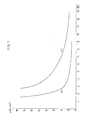
- Figure 1 shows the washout behavior of the resin A (A (a), A (c); the washout behavior of the resin A (b) could not be entered in Figure 1 because even after 15 bed volumes of wash water the conductivity was still 59 ⁇ S.cm -1 amounts).
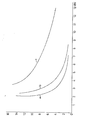
- Figure 2 shows the washout behavior of the resin B (B (a), B (b), B (c)) and Figure 3 shows the washout behavior of the resin C (C (a), C (b), C (c)).
Landscapes
- Chemical & Material Sciences (AREA)
- Chemical Kinetics & Catalysis (AREA)
- Organic Chemistry (AREA)
- Health & Medical Sciences (AREA)
- Medicinal Chemistry (AREA)
- Polymers & Plastics (AREA)
- Addition Polymer Or Copolymer, Post-Treatments, Or Chemical Modifications (AREA)
Abstract
Kunstharze auf Basis vernetzter Mischpolymerisate aus Monound Polyvinylverbindungen erhalten durch Mischpolymerisation von
- (a) substituierten Styrolen und/oder Methacrylsäureestern
- (b) Methacrylsäureestern mehwertiger Alkohole und/oder aromatischen Polyvinylverbindungen und
- (c) ungesättigten Kohlenwasserstoffen, die mindestens zwei Allylgruppierungen im Molekül aufweisen und oder Polyvinyläthern mehrwertiger Alkohole und gegebenenfalls
- (d) Styrol,
- (a) substituted styrenes and / or methacrylic acid esters
- (b) methacrylic acid esters of polyhydric alcohols and / or aromatic polyvinyl compounds and
- (c) unsaturated hydrocarbons which have at least two allyl groups in the molecule and or polyvinyl ethers of polyhydric alcohols and optionally
- (d) styrene,
Description
Die Erfindung betrifft neue Kunstharze auf Basis vernetzter Mischpolymerisate aus Mono- und Polyvinylverbindungen, ein Verfahren zu ihrer Herstellung und die Verwendung der Kunstharze als Inertmaterial für Trennschichten in Ionenaustauscher-Mischbettfiltern.The invention relates to new synthetic resins based on crosslinked copolymers of mono- and polyvinyl compounds, a process for their production and the use of synthetic resins as inert material for separating layers in ion exchange mixed bed filters.
Die Verwendung von Kunstharzen als Inertmaterial für Trennschichten in Ionenaustauscher-Mischbettfiltern ist bekannt. So werden z.B. gemäß US-PS 2 666 741 handelsübliche Polystyrole verwendet, die eine solche Dichte und eine solche Teilchengröße aufweisen, daß sie sich bei der Trennung von Kationen- und Anionenaustauschern zwischen beide Ionenaustauschertypen schieben. In der DE-PS 971 771 werden als Trennmaterialien allgemein Perl(co-)polymerisate von Styrol, Vinylchlorid, Methacrylsäureester, Divinylbenzol und Acrylnitril genannt. In der FR-PS 2 314 896 werden als Trennmaterialien Acrylnitril-Butadien-Styrol-Harze, EpoxidHarze, Polyamid-Harze und Polystyrol-Harze angegeben.The use of synthetic resins as an inert material for separating layers in ion exchange mixed bed filters is known. For example, according to US Pat. No. 2,666,741, commercially available polystyrenes are used which have such a density and such a particle size that they slide between the two types of ion exchangers when separating cation and anion exchangers. DE-PS 971 771 generally uses pearl (co) polymers of styrene and vinyl as separating materials called chloride, methacrylic acid ester, divinylbenzene and acrylonitrile. FR-
Diese bislang als Trennmaterialien in Ionenaustauscher-Mischbettfiltern verwendeten Kunstharze weisen jedoch schwerwiegende Nachteile auf. So haben z.B. die Polystyrol-Kunstharze eine zu geringe Dichte. In Folge der zu geringen Dichte müssen die Kunstharzpartikel eine für die Betriebspraxis ungeeignete Größe erhalten. "However, these synthetic resins, which have hitherto been used as separating materials in ion exchange mixed bed filters, have serious disadvantages. For example, the polystyrene resins are too low in density. As a result of the density being too low, the synthetic resin particles have to be of a size which is unsuitable for operational practice. "
Ein schwerwiegender Nachteil aller bislang als Trennmaterialien verwendeten Kunstharze ist, daß sie bei der angegebenen Verwendung fortlaufend lösliche Bestandteile (vor allem nicht vernetze, lösliche Monomere und Oligomere) an das Wasser bzw. die Regenerierchemikalien abgeben. Dieser als "Bluten" bezeichnete Vorgang setzt den Reinheitsgrad des aus dem Mischbettfilter ablaufenden Wassers erheblich herab. Das "Bluten" macht sich am ständigen chemischen Sauerstoffbedarf (CSB) des aus dem Mischbettfilter ablaufenden Wassers bemerkbar. Dieses "Bluten" der Harze ist insbesondere bei Trennharzen auf Basis von Vinylchlorid und Acrylnitril kritisch, wegen der hphen Toxizität dieser Monomeren. Manche Kunstharze lassen sich zwar durch eine besondere Behandlung von den löslichen, nicht umgesetzten Monomeren befreien, das Entfernen der löslichen Oligomeren aus den Kunstharzen ist in der Praxis aber - zumindest in dem erforderlichen Maße - nicht möglich.A serious disadvantage of all synthetic resins hitherto used as release materials is that they continuously release soluble constituents (especially non-crosslinked, soluble monomers and oligomers) into the water or the regeneration chemicals when used as specified. This process, known as "bleeding", considerably reduces the degree of purity of the water flowing out of the mixed bed filter. The "bleeding" is noticeable in the constant chemical oxygen demand (COD) of the water running out of the mixed bed filter. This "bleeding" of the resins is particularly critical in the case of release resins based on vinyl chloride and acrylonitrile, because of the high toxicity of these monomers. Although some synthetic resins can be freed from the soluble, unreacted monomers by a special treatment, the removal of the soluble oligomers from the synthetic resins is not possible in practice - at least to the extent necessary.
Ein weiterer schwerwiegender Nachteil der bekannten als Trennmaterialien verwendeten Kunstharze auf Basis Acrylsäureester und Acrylnitril ist deren unzureichende Hydrolysebeständigkeit. Unter den Bedingungen der Heißregeneration des Mischbettfilters, d.h. bei der Einwirkung verdünnter Säuren oder Alkalien bei Temperaturen bis zu 80°C hydrolysieren diese Harze. Die bei der Hydrolyse entstehenden Carboxylgruppen bewirken einen Natrium-Schlupf und verlängerte Auswaschzeiten des Mischbettfilters. Durch die Hydrolyse erfolgt außerdem ein verstärktes in Lösung gehen der hydrophilierten Monomere und Oligomere. Durch die Hydrolyseinstabilität der Trennharze wird das Mischbettfilter schließlich unbrauchbar.Another serious disadvantage of the known materials used as race-T resins based on acrylate and acrylonitrile is their insufficient hydrolytic stability. These resins hydrolyze under the conditions of hot regeneration of the mixed bed filter, ie when exposed to dilute acids or alkalis at temperatures up to 80 ° C. The carboxyl groups formed during hydrolysis cause sodium slippage and extended washout times for the mixed bed filter. The hydrolysis also results in an increased dissolution of the hydrophilized monomers and oligomers. The mixed bed filter is ultimately unusable due to the hydrolysis instability of the separation resins.
Es wurden nun neue Kunstharze auf Basis vernetzter Mischpolymerisate aus Mono- und Polyvinylverbindungen gefunden, die die für die bekannten Kunstharze aufgezeigten Nachteile - ungünstige Dichte, Abgabe löslicher Bestandteile und unzureichende Hydrolysebeständigkeit - nicht aufweisen und die sich deshalb ausgezeichnet als Inertmaterial für Trennschichten in Ionenaustauscher-Mischbettfiltern eignen. Diese neuen Kunstharze werden durch Mischpolymerisation von (a) Styrolen, deren Benzolkern durch C1-C4-Alkylgruppen, Halogenatome und/oder Nitro- gruppen und/oder deren Seitenkette durch C1-C4-Alkylgruppen substituiert ist; und/oder Methacrylsäureestern, (b) Methacrylsäureestern mehrwertiger Alkohole und/oder aromatischen Polyvinylverbindungen, (c) ungesättigten Kohlenwasserstoffen, die mindestens 2 Allylgruppierungen im Molekül aufweisen und/oder Polyvinyläthern mehrwertiger Alkohole und gegebenenfalls (d) Styrol erhalten.New synthetic resins based on crosslinked copolymers of mono- and polyvinyl compounds have now been found which do not have the disadvantages shown for the known synthetic resins - unfavorable density, release of soluble constituents and inadequate resistance to hydrolysis - and which therefore are excellent as inert material for separating layers in ion exchanger mixed bed filters own. These new resins are substituted by copolymerization of (a) styrenes, the benzene nucleus of 4 alkyl groups, halogen atoms and / or N itro- groups by C 1 -C and / or its side chain by C 1 -C 4 alkyl groups; and / or methacrylic acid esters, (b) methacrylic acid esters of polyhydric alcohols and / or aromatic polyvinyl compounds, (c) unsaturated hydrocarbons which have at least 2 allyl groups in the molecule and / or polyvinyl ethers of polyhydric alcohols and optionally (d) styrene.
Durch die erfindungsgemäße gemeinsame Verwendung der 2 verschiedenen Vernetzungsmitteltypen (Komponenten (b) und (c)) wird eine entscheidende Verbesserung der Harzeigenschaften erreicht. Dies ist deshalb überraschend, da weder bei Verwendung von Komponente (b) noch bei der Verwendung von Komponente (c) als alleinige Vernetzer für Komponente (a) Harze mit befriedigenden Eigenschaften erhalten werden.By using the 2 different types of crosslinking agent (components (b) and (c)) jointly according to the invention, a decisive improvement in the resin properties is achieved. This is surprising since, neither when using component (b) nor when using component (c) as the sole crosslinking agent for component (a), resins with satisfactory properties are obtained.
Als Styrole, deren Benzolkern durch C1-C4-Alkylgruppen, Halogenatome und/oder Nitrogruppen und/oder dessen Seitenkette durch C1-C4-Alkylgruppen substituiert ist, seien beispielsweise genannt: Chlorstyrol, Dichlorstyrol, Vinyltoluol, Chlor-vinyltoluol, Nitrostyrol, Nitrovinyltoluol, α-Methylstyrol, α-Methylvinyltoluol und α-Methylchlorstyrol.Examples of styrenes whose benzene nucleus is substituted by C 1 -C 4 alkyl groups, halogen atoms and / or nitro groups and / or whose side chain is substituted by C 1 -C 4 alkyl groups are: chlorostyrene, dichlorostyrene, vinyltoluene, chlorovinyltoluene, nitrostyrene , Nitrovinyltoluene, α-methylstyrene, α-methylvinyltoluene and α-methylchlorostyrene.
Als Methacrylsäureester seien insbesondere die Ester der Methacrylsäure mit 1 bis 8 C-Atome aufweisenden Alkoholen wie Methanol, Äthanol, Propanol, n-Butanol, sec.-Butanol, Pentanol, iso-Pentanol, n-Hexanol und 2-Äthylhexanol genannt. Vorzugsweise wird Methacrylsäuremethylester verwendet.Particularly worth mentioning as methacrylic acid esters are the esters of methacrylic acid with alcohols having 1 to 8 carbon atoms, such as methanol, ethanol, propanol, n-butanol, sec-butanol, pentanol, isopentanol, n-hexanol and 2-ethylhexanol. Methyl methacrylate is preferably used.
Es können auch Gemische aus substituierten Styrolen und Methacrylsäureestern eingesetzt werden. Das Mengenverhältnis Styrole zu Methacrylsäureestern in diesen Gemischen'richtet sich nach der für das Mischpolymerisäfgewunschten Dichte.Mixtures of substituted styrenes and methacrylic acid esters can also be used. The quantitative ratio of styrenes to methacrylic acid esters in these mixtures depends on the density desired for the copolymer.
Es hat sich in manchen Fällen, z.B. zum Einstellen einer bestimmten Dichte des Polymerisats, als vorteilhaft erwiesen, zusätzlich zu den Monomeren (a), (b) und (c) noch bis zu 5o Gew.-%, bezogen auf das Gesamtgewicht der Monomeren, Styrol einzusetzen.In some cases, e.g. To set a certain density of the polymer, it has proven advantageous to use up to 50% by weight, based on the total weight of the monomers, of styrene in addition to the monomers (a), (b) and (c).
Als Vertreter der als Komponente (b) zu verwendenden Methacrylsäureester mehrwertiger Alkohole seien beispielsweise genannt: Glykoldimethacrylat, Diglykoldimethacrylat, Glycerintrimethacrylat. Vorzugsweise wird Glykoldimethacrylat verwendet.Examples of the methacrylic acid esters of polyhydric alcohols to be used as component (b) are: glycol dimethacrylate, diglycol dimethacrylate, glycerol trimethacrylate. Glycol dimethacrylate is preferably used.
Als Vertreter der als Komponente (b) zu verwendenden aromatischen Polyvinylverbindungen seien beispielsweise genannt: o-, m- und p-Divinylbenzol, Divinyltoluol, Divinylnaphthalin, Trivinylbenzol. Vorzugsweise wird Divinylbenzol verwendet.Examples of the aromatic polyvinyl compounds to be used as component (b) are: o-, m- and p-divinylbenzene, divinyltoluene, divinylnaphthalene, trivinylbenzene. Divinylbenzene is preferably used.
Als Vertreter der als Komponente (c) zu verwendenden mindestens 2 Allylgruppierungen im Molekül aufweisenden Verbindungen seien beispielsweise genannt: Hexadien-(1,5), 2-Methyl-hexadien-(1.5), 2,5-Dimethylhexadien-(1.5), Heptadien-(1.6), Octadien-(1.7), 1,2,4-Trivinylcyclohexan. Vorzugsweise werden Heptadien-(1,6) und Octadien-(1,7) verwendet.Examples of the compounds containing at least 2 allyl groups to be used as component (c) in the molecule are: hexadiene (1,5), 2-methylhexadiene (1.5), 2,5-dimethylhexadiene (1.5), heptadiene - (1.6), octadiene- (1.7), 1,2,4-trivinylcyclohexane. Heptadiene (1.6) and octadiene (1.7) are preferably used.
Als Vertreter der als Komponente (c) zu verwendenden Polyvinyläther mehrwertiger Alkohole seien beispielsweise genannt: Glykoldivinyläther, Diäthylenglykoldivinyläther, Glycerintrivinyläther. Vorzugsweise wird Diethylenglykoldivinylether verwendet.Examples of polyvinyl ethers of polyhydric alcohols to be used as component (c) are: glycol divinyl ether, diethylene glycol divinyl ether, glycerol trivinyl ether. Diethylene glycol divinyl ether is preferably used.
Die zur Herstellung der erfindungsgemäßen Kunstharze anzuwendende Menge an Vernetzungsmittel, d.h. das Gesamtgewicht der Komponenten (b) und (c) hängt von der Art der Komponenten (a), der gegebenenfalls zugesetzten Styrolmenge und der Dichte, die das Kunstharz aufweisen soll, ab. Im allgemeinen hat es sich als vorteilhaft erwiesen, wenn das Gesamtgewicht der Komponenten (b) und (c) o,5 bis 7o Gew.-%, vorzugsweise 1 bis 4o Gew.-%, bezogen auf das Gesamtgewicht der Komponenten (a), (b), (c) und gegebenenfalls (d) beträgt.The amount of crosslinking agent to be used to prepare the synthetic resins of the invention, i.e. the total weight of components (b) and (c) depends on the type of components (a), the amount of styrene which may be added and the density which the synthetic resin is to have. In general, it has proven to be advantageous if the total weight of components (b) and (c) is 0.5 to 70% by weight, preferably 1 to 40% by weight, based on the total weight of components (a), (b), (c) and optionally (d).
Innerhalb der erfindungsgemäß zu verwendenden Vernetzungsmittel-Kombination aus den Komponenten (b) und (c) kann das Mengenverhältnis der beiden Komponenten in weiten Grenzen schwanken. Im allgemeinen hat es sich bewährt, wenn das Gewicht der Komponenten (b) 2-95 Gew.-%, vorzugsweise 10-80 Gew.-%, bezogen auf das Gesamtgewicht der Komponenten (b) und (c),beträgt.Within the crosslinking agent combination of components (b) and (c) to be used according to the invention, the quantitative ratio of the two components can vary within wide limits. In general, it has proven useful if the weight of components (b) is 2-95% by weight, preferably 10-80% by weight, based on the total weight of components (b) and (c).
Zur Herstellung der erfindungsgemäßen Kunstharze werden die Komponenten (a), (b), (c) und gegebenenfalls (d) in für Mischpolymerisationen üblicher Weise mischpolymerisiert. Die Mischpolymerisation wird vorzugsweise als Perlpolymerisation in wäßriger Suspension vorgenommen. Die Polymerisation wird in bekannter Weise durch übliche Radikalbildner ausgelöst.To produce the synthetic resins according to the invention, components (a), (b), (c) and optionally (d) are copolymerized in a manner customary for mixed polymerizations. The mixed polymerization is preferably carried out as a bead polymerization in aqueous suspension. The polymerization is triggered in a known manner by conventional free radical formers.
Die erfindungsgemäßen Kunstharze können sowohl Gelstruktur als auch makroporöse Struktur aufweisen. Zur Herstellung makroporöser Kunstharze wird die Mischpolymerisation in bekannter Weise in Gegenwart organischer Flüssigkeiten (Porösmachern) vorgenommen (siehe z.B. Ullmanns Encyklopädie der technischen Chemie, 4. Auflage, 1977, Band 13, S. 296).The synthetic resins according to the invention can have both a gel structure and a macroporous structure. To produce macroporous synthetic resins, the mixed polymerization is carried out in a known manner in the presence of organic liquids (porosity makers) (see, for example, Ullmanns Encyklopadie der Technische Chemie, 4th edition, 1977,
Die Lösung von 900 g Methacrylsäuremethylester, 100 g technischem Divinylbenzol (Zusammensetzung: 62 % Divinylbenzol, ~ 36 % Äthylstyrole, ~ 2 % Naphthalin + Di- äthylbenzole und 6 g Dibenzoylperoxid wird unter Rühren in 1,5 1 0,2 %iger wäßriger Tyloselösung suspendiert und unter 5-stündigem Rühren bei 60°C und nachfolgendem zweistündigem Rühren bei 90°C perlpolymerisiert. Nach dem Erkalten werden die Perlen abgesaugt, -mit Wasser gewaschen und getrocknet..The solution of 900 g methyl methacrylate, 100 g technical divinylbenzene (composition: 62% divinylbenzene, ~ 36% ethyl styrene, ~ 2% naphthalene + diethylbenzenes and 6 g dibenzoyl peroxide is stirred in 1.5 1 0.2% aqueous tylose solution suspended and bead polymerized with stirring for 5 hours at 60 ° C. and subsequent stirring for 2 hours at 90 ° C. After cooling, the beads are suctioned off, washed with water and dried.
Ausbeute: 922 g (Harz B).Yield: 922 g (resin B).
Die Lösung von 927 g Methacrylsäuremethylester, 33 g technischem Divinylbenzol, 40 g Octadien-(1.7) und 6 g Dibenzoylperoxid wird unter Rühren in 1,5 1 0,2 %iger wäßriger Tyloselösung suspendiert und unter den in Beispiel 1 beschriebenen Bedingungen perlpolymerisiert. Ausbeute: 984 g (Harz C).The solution of 927 g of methyl methacrylate, 33 g of technical divinylbenzene, 40 g of octadiene (1.7) and 6 g of dibenzoyl peroxide is suspended in 1.5 l of 0.2% strength aqueous tylose solution and bead polymerized under the conditions described in Example 1. Yield: 984 g (resin C).
Die Lösung aus 913 g Methacrylsäuremethylester, 67 g technischem Divinylbenzol, 20 g Octadien-(1.7) und 6 g Dibenzoylperoxid wird unter Rühren in 1,5 1 0,2 %iger wäßrige Tyloselösung suspendiert-und-unter den in Beispiel 1 beschriebenen Bedingungen perlpolymerisiert. Ausbeute an Perlpolymerisat: 944 g.The solution of 913 g of methacrylic acid methyl ester, 67 g of technical divinylbenzene, 20 g of octadiene (1.7) and 6 g of dibenzoyl peroxide is suspended in 1.5 1 0.2% aqueous tylose solution with stirring and -polymerized under the conditions described in Example 1 . Yield of polymer beads: 944 g.
Die Lösung aus 921 g Methacrylsäuremethylester, 49 g technischem Divinylbenzol, 30 g 1,3,5-Trivinylcyclohexan und 6 g Dibenzoylperoxid wird unter Rühren in 1,5 1 0,2 %iger wäßriger Tyloselösung suspendiert und unter den in Beispiel 1 beschriebenen Bedingungen perlpolymerisiert.The solution of 921 g of methyl methacrylate, 49 g of technical divinylbenzene, 30 g of 1,3,5-trivinylcyclohexane and 6 g of dibenzoyl peroxide is suspended in 1.5 l of 0.2% strength aqueous tylose solution and bead-polymerized under the conditions described in Example 1 .
Ausbeute an Perlpolymerisat: 978 g.Yield of polymer beads: 978 g.
Die Lösung aus 900 g Methacrylsäuremethylester, 33 g technischem Divinylbenzol, 60 g Octadien-(1.7) und 4 g Dibenzoylperoxid wird unter Rühren in 2 1 0,2 %iger wäßriger Tyloselösung suspendiert und unter den in Beispiel 1 beschriebenen Bedingungen perlpolymerisiert. Ausbeute an Perlpolymerisat: 976 g.The solution of 900 g of methyl methacrylate, 33 g of technical divinylbenzene, 60 g of octadiene (1.7) and 4 g of dibenzoyl peroxide is suspended with stirring in 2 1 0.2% aqueous tylose solution and bead polymerized under the conditions described in Example 1. Yield of bead polymer: 976 g.
Die Lösung aus 920 g Methacrylsäuremethylester, 17 g technischem Divinylbenzol, 30 g Heptadien-(1.6) und 10 g Dibenzoylperoxid wird unter Rühren in 2 1 1 %iger Polyvinylalkohol-Lösung suspendiert und unter den in Beispiel 1 beschriebenen Bedingungen perlpolymerisiert. Ausbeute an Perlpolymerisat: 967 g.The solution of 920 g of methyl methacrylate, 17 g of technical divinylbenzene, 30 g of heptadiene (1.6) and 10 g of dibenzoyl peroxide is suspended in 2 1 1% polyvinyl alcohol solution and bead polymerized under the conditions described in Example 1. Yield of bead polymer: 967 g.
Die Lösung aus 800 g Methacrylsäuremethylester, 67 g technischem Divinylbenzol, 13,3 g Diethylenglykoldivinyl- äther und 8 g Dibenzoylperoxid wird unter Rühren in 1,5 1 1 %iger Polyvinylalkohollösung suspendiert und unter den in Beispiel 1 beschriebenen Bedingungen perlpolymerisiert. Ausbeute an Perlpolymerisat: 856 ,g.The solution of 800 g of methyl methacrylate, 67 g of technical divinylbenzene, 13.3 g of diethylene glycol divinyl ether and 8 g of dibenzoyl peroxide is stirred in 1.5
Die Lösung aus 927 g Methacrylsäuremethylester, 33 g technischem Divinylbenzol, 40 g Octadien-(1.7) und 8 g Diazoisobuttersäurenitril wird unter Rühren in 2 1 0,2 %iger wäßriger Tyloselösung suspendiert und unter den in Beispiel 1 beschriebenen Bedingungen perlpolymerisiert. Ausbeute an Perlpolymerisat: 940 g.The solution of 927 g of methyl methacrylate, 33 g of technical divinylbenzene, 40 g of octadiene- (1.7) and 8 g of diazoisobutyronitrile is suspended with stirring in 2 1 0.2% aqueous tylose solution and bead polymerized under the conditions described in Example 1. Yield of polymer beads: 940 g.
Die Lösung aus 500 g p-Chlorstyrol, 400 g Styrol, 33 g technischem Divinylbenzol, 67 g Heptadien-(1.6) und 7 g Dibenzoylperoxid wird unter Rühren in 1,2 1 0,2 %iger wäßriger Tyloselösung suspendiert und unter den in Beispiel 1 beschriebenen Bedingungen perlpolymerisiert. Ausbeute an Perlpolymerisat: 980 g.The solution of 500 g p-chlorostyrene, 400 g styrene, 33 g technical divinylbenzene, 67 g heptadiene (1.6) and 7 g dibenzoyl peroxide is suspended with stirring in 1.2 1 0.2% aqueous tylose solution and among those in Example 1 described conditions polymerized. Yield of bead polymer: 980 g.
Die Lösung aus 890 g Methacrylsäuremethylester, 80 g technischem Divinylbenzol, 30 g Octadien-(1,7), 100 g Isododekan und 8 g Dibenzoylperoxid wird unter Rühren in 1,5 1 0,2 %iger wäßriger Tyloselösung suspendiert und unter den in Beispiel 1 beschriebenen Bedingungen perlpolymerisiert.The solution of 890 g methyl methacrylate, 80 g technical divinylbenzene, 30 g octadiene (1.7), 100 g isododecane and 8 g dibenzoyl peroxide is suspended with stirring in 1.5 1 0.2% aqueous tylose solution and among those in Example 1 described conditions polymerized.
Ausbeute aus Perlpolymerisat: 975 g.Yield from bead polymer: 975 g.
Die Lösung aus 928 g Methacrylsäuremethylester, 32 g technischem Divinylbenzol, 4o g Diethylenglykoldivinylether und 8 g Dibenzoylperoxid wird unter Rühren in 1,5 1 o,2 %iger wäßriger Tyloselösung suspendiert und unter den in Beispiel 1 beschriebenen Bedingungen perlpolymerisiert.The solution of 928 g of methacrylic acid methyl ester, 32 g of technical divinylbenzene, 40 g of diethylene glycol divinyl ether and 8 g of dibenzoyl peroxide is suspended with stirring in 1.5 l, 2% aqueous tylose solution and bead polymerized under the conditions described in Example 1.
Ausbeute an Perlpolymerisat: 94o g.Yield of bead polymer: 94o g.
Die Lösung aus 232 g Styrol, 696 g Methacrylsäuremethyl-. ester, 32 g technischem Divinylbenzol, 4o g Octadien-(1,7) und 8 g Dibenzoylperoxid wird unter Rühren in 1,8 1 o,2 %iger wäßriger Tyloselösung suspendiert und unter den in Beispiel 1 beschriebenen Bedingungen perlpolymerisiert.The solution of 232 g styrene, 696 g methyl methacrylate. ester, 32 g of technical grade divinylbenzene, 40 g of octadiene (1.7) and 8 g of dibenzoyl peroxide are suspended in 1.8% or 2% aqueous tylose solution with stirring and bead polymerized under the conditions described in Example 1.
Ausbeute an Perlpolymerisat: 941 g.Yield of bead polymer: 941 g.
Die Lösung aus 935 g Methacrylsäuremethylester, 55 g Ethylenglykoldimethacrylat, 1o g Octadien-(1,7) und 6 g Dibenzoylperoxid wird unter Rühren in 1,5 1 o,2 %iger wäßriger Tyloselösung suspendiert und unter den in Beispiel 1 beschriebenen Bedingungen perlpolymerisiert. Ausbeute an Perlpolymerisat: 983 g.The solution of 935 g of methacrylic acid methyl ester, 55 g of ethylene glycol dimethacrylate, 10 g of octadiene (1.7) and 6 g of dibenzoyl peroxide is suspended with stirring in 1.5% or 2% aqueous tylose solution and bead polymerized under the conditions described in Example 1. Yield of polymer beads: 983 g.
Die Lösung aus 993,8 g Methacrylsäuremethylester, 3,2 g technischem Divinylbenzol, 3 g Octadien-(1,7) und 8 g Dibenzoylperoxid wird unter Rühren in 1,5 1 o,2 %iger wäßriger Tyloselösung suspendiert und unter den in Beispiel 1 beschriebenen Bedingungen perlpolymerisiert. Ausbeute an Perlpolymerisat: 866 g.The solution of 993.8 g of methacrylic acid methyl ester, 3.2 g of technical divinylbenzene, 3 g of octadiene (1.7) and 8 g of dibenzoyl peroxide is stirred in 1.5% or 2% suspended aqueous tylose solution and bead polymerized under the conditions described in Example 1. Yield of bead polymer: 866 g.
In eine mit einem unteren Düsenboden und einem Drainagesystem im unteren Drittel versehenen Ionenaustauscher-Säule werden eingefüllt: 10 1 stark saurer Kationenaustauscher (H-Form; Korngröße>0,7 mm), 10 1 stark basischer Anionenaustauscher, Typ 1, (OH-Form; Korngröße o,3 - 0,8 mm) und 2,5 1 Perlpolymerisat gemäß Beispiel 2 (Korngröße o,5 - o,6 mm). Nach dem Rückspülen mit Wasser mit einer Geschwindigkeit von 6 m/h beobachtet man eine vollständige Trennung der drei Komponenten. Das Drainagesystem befindet sich dann vollständig in der Inertschicht.The following are filled into an ion exchanger column provided with a lower nozzle bottom and a drainage system in the lower third: 1 0 1 strongly acidic cation exchanger (H-shape; grain size> 0.7 mm), 1 0 1 strongly basic anion exchanger,
Zur Kennzeichnung der Beständigkeit der verschiedenen Harze wurden
- 1. der unterschiedliche chemische Sauerstoffbedarf (CSB) der mit den verschiedenen Kunstharzen behandelten Wässer bestimmt;
- 2. die schwach saure Austauschkapazität der Harze vor und nach dem Behandeln mit verdünnter Natronlauge und verdünnter Schwefelsäure und das Auswaschverhalten der Harze
nach Beaufschlagung mit 4 %iger Natronlauge bestimmt.
- 1. determines the different chemical oxygen demand (COD) of the water treated with the different synthetic resins;
- 2. The weakly acidic exchange capacity of the resins before and after treatment with dilute sodium hydroxide solution and dilute sulfuric acid and the washout behavior of the resins after exposure to 4% sodium hydroxide solution were determined.
Zur Bestimmung des CSB-Wertes wurden 150 ml Kunstharz mit 300 ml deionisiertem Wasser 8 Tage bei 20°C aufbewahrt. Nach dem Abtrennen des Wassers wurde in diesem der Gehalt an oxidierbaren Stoffen bestimmt. Die erhaltenen Werte sind in Tabelle 1 zusammengestellt.

Zur Bestimmung der schwach sauren Austauschkapazität wurden 150 ml Kunstharz mit 300 ml 4 %iger Natronlauge bzw. 300 ml 10 %iger Schwefelsäure 8 Tage auf 80°C erhitzt. Danach wurden die Harze mit deionosiertem Wasser neutral gewaschen. Die erhaltenen Werte sind in Tabelle 2 zusammengestellt.
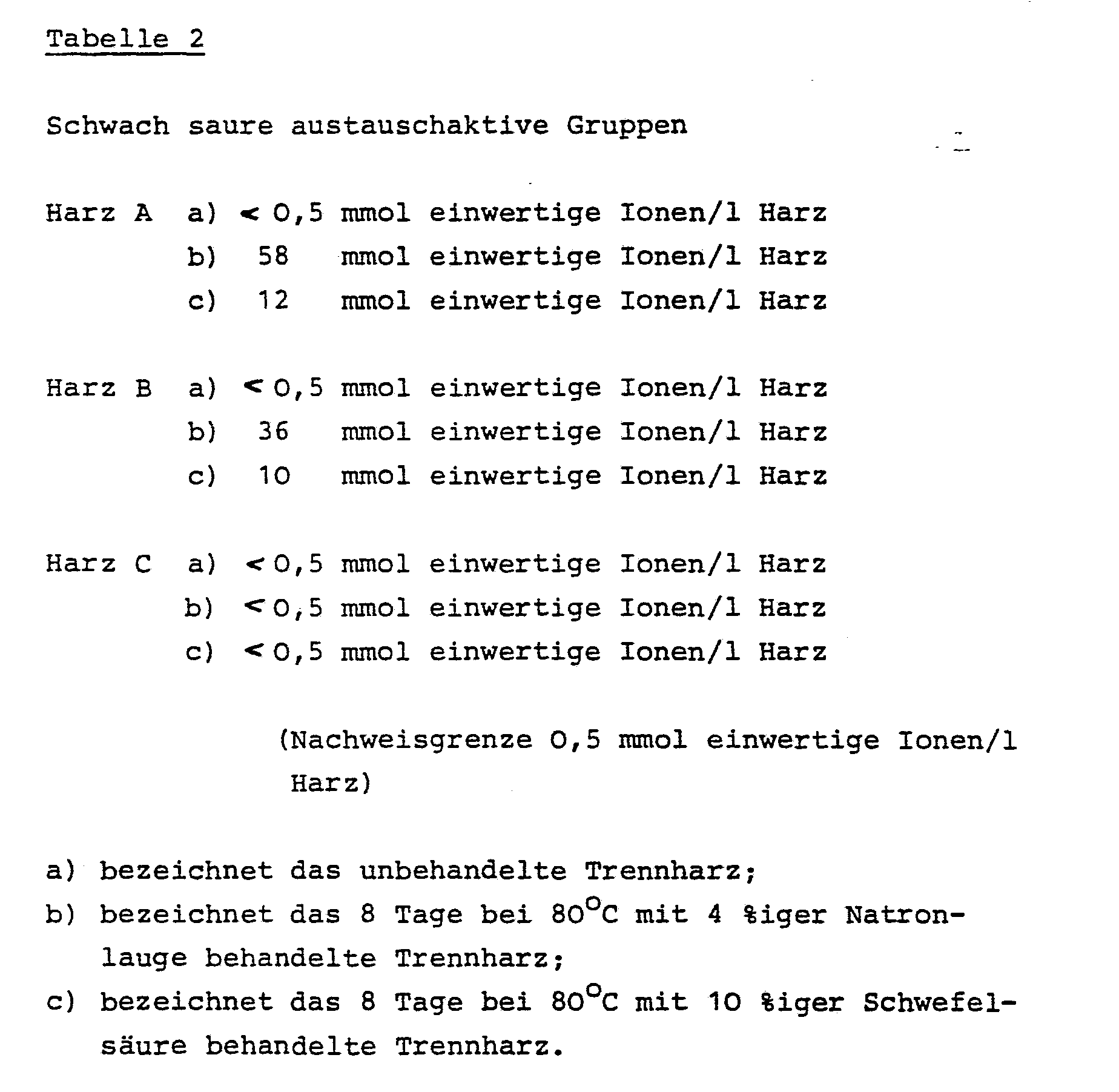
Zur Bestimmung des Auswaschverhaltens wurden je 150 ml Harz A, B und C und zwar in unbehandelter Form (a), in durch 8-tägiges Erwärmen auf 80°C mit 4 %iger Natronlauge vorbehandelter Form (b) und in durch 8-tägiges Erwärmen auf 80°C mit 10 %iger Schwefelsäure vorbehandelter Form (c) in eine Säule gefüllt und mit 4 %iger Natronlauge beaufschlagt. Anschließend wurde mit deionisiertem Wasser gewaschen und im Eluat die Leitfähigkeit bestimmt. In den Figuren 1, 2 und 3 sind die in den Eluaten gemessenen Leitfähigkeitswerte in Abhängigkeit von der Eluatmenge, d.h. der zum Waschen verwendeten Wassermenge, aufgetragen. Die Eluat-(Waschwasser)-Menge ist in Bettvolumina (BV) angegeben.To determine the washout behavior, 150 ml of resin A, B and C were used, namely in untreated form (a), in form pretreated by heating for 8 days at 80 ° C. with 4% sodium hydroxide solution (b) and in heating by 8 days at 80 ° C with 10% sulfuric acid pretreated form (c) in a column and charged with 4% sodium hydroxide solution. The mixture was then washed with deionized water and the conductivity was determined in the eluate. In Figures 1, 2 and 3, the conductivity values measured in the eluates are a function of the amount of eluate, i.e. the amount of water used for washing. The amount of eluate (wash water) is given in bed volumes (BV).
Figur 1 zeigt das Auswaschverhalten des Harzes A(A(a), A(c); das Auswaschverhalten des Harzes A(b) konnte nicht in Figur 1 eingetragen werden, weil sogar nach 15 Bettvolumina Waschwasser die Leitfähigkeit noch 59 µS.cm-1 beträgt). Figur 2 das Auswaschverhalten des Harzes B(B(a), B(b), B(c)) und Figur 3 das Auswaschverhalten des Harzes C(C(a), C(b), C(c)).Figure 1 shows the washout behavior of the resin A (A (a), A (c); the washout behavior of the resin A (b) could not be entered in Figure 1 because even after 15 bed volumes of wash water the conductivity was still 59 µS.cm -1 amounts). Figure 2 shows the washout behavior of the resin B (B (a), B (b), B (c)) and Figure 3 shows the washout behavior of the resin C (C (a), C (b), C (c)).
Claims (7)
verwendet.5) Process for the preparation of synthetic resins based on crosslinked copolymers from mono- and polyvinyl compounds by copolymerization of the monomers, characterized in that the monomers
used.
Applications Claiming Priority (2)
| Application Number | Priority Date | Filing Date | Title |
|---|---|---|---|
| DE2846187 | 1978-10-24 | ||
| DE19782846187 DE2846187A1 (en) | 1978-10-24 | 1978-10-24 | SYNTHETIC RESINS BASED ON MIXED POLYMERISATES FROM MONO AND POLYVINYL COMPOUNDS |
Publications (3)
| Publication Number | Publication Date |
|---|---|
| EP0010265A2 true EP0010265A2 (en) | 1980-04-30 |
| EP0010265A3 EP0010265A3 (en) | 1980-05-14 |
| EP0010265B1 EP0010265B1 (en) | 1982-04-14 |
Family
ID=6052953
Family Applications (1)
| Application Number | Title | Priority Date | Filing Date |
|---|---|---|---|
| EP19790103929 Expired EP0010265B1 (en) | 1978-10-24 | 1979-10-12 | Synthetic resins based on crosslinked copolymers of mono- and polyvinyl compounds, process for their preparation and their use as inert material in ion exchange mixed-bed filters |
Country Status (5)
| Country | Link |
|---|---|
| US (1) | US4319015A (en) |
| EP (1) | EP0010265B1 (en) |
| JP (1) | JPS5594914A (en) |
| BR (1) | BR7906848A (en) |
| DE (2) | DE2846187A1 (en) |
Cited By (2)
| Publication number | Priority date | Publication date | Assignee | Title |
|---|---|---|---|---|
| EP1110608A3 (en) * | 1999-12-24 | 2003-05-07 | Bayer Aktiengesellschaft | Method for preparing crosslinked ion exchangers from unsaturated aliphatic nitriles |
| DE102007003410A1 (en) | 2007-01-23 | 2008-07-31 | Produktions- Und Umweltservice Gmbh | Filter cartridge, useful in removing heavy metals and hardness-producing substances and suspended material, is produced from chemically-modified natural fibers and optionally natural fibers using normal textile method |
Families Citing this family (8)
| Publication number | Priority date | Publication date | Assignee | Title |
|---|---|---|---|---|
| US4622377A (en) * | 1984-09-20 | 1986-11-11 | Swedlow, Inc. | Plastic transparency and method for making it |
| US5583164A (en) * | 1988-12-19 | 1996-12-10 | Espe Stiftung & Co. Produktions-Und Vertriebs Kg | Dental compositions comprising bifunctional or polyfunctional acrylic-acid esters or methacrylic-acid esters |
| JP2813825B2 (en) * | 1988-12-19 | 1998-10-22 | テラ‐ゲゼルシャフト フィアー パテントフェルヴェルツング ミット ベシュレンクテル ハフツング | Dental compositions containing bifunctional acrylates or methacrylates |
| US5753772A (en) * | 1997-07-17 | 1998-05-19 | The Goodyear Tire & Rubber Company | Rubbery polymers with improved color stability |
| BR0015230A (en) * | 1999-10-21 | 2002-07-23 | Daiso Co Ltd Daiso Kabushiki K | Crosslinking agent based on poly (allyl ether) compounds |
| ES3034535T3 (en) | 2008-08-22 | 2025-08-19 | Vifor Int Ltd | Crosslinked cation exchange polymers, compositions and use in treating hyperkalemia |
| US10670071B2 (en) | 2015-03-18 | 2020-06-02 | BMTS Technology GmbH & Co. KG | Turbocharger |
| KR20200088370A (en) * | 2017-11-10 | 2020-07-22 | 디디피 스페셜티 일렉트로닉 머티리얼즈 유에스, 인크. | Component addition polymerization |
Family Cites Families (8)
| Publication number | Priority date | Publication date | Assignee | Title |
|---|---|---|---|---|
| US2788330A (en) * | 1953-04-21 | 1957-04-09 | Permutit Co | Anion exchange resins from cross-liked halogenated polyvinylaromatic polymers |
| US2810716A (en) * | 1954-06-28 | 1957-10-22 | White Lab Inc | Batchwise copolymerization technique |
| US2910456A (en) * | 1954-11-12 | 1959-10-27 | Peterlite Products Ltd | Mouldable materials |
| BE603195A (en) * | 1960-04-29 | |||
| FR1303785A (en) * | 1960-10-24 | 1962-09-14 | Miles Lab | Triallyl citrate copolymers |
| DE1570641C3 (en) * | 1965-12-31 | 1982-01-28 | Bayer Ag, 5090 Leverkusen | Crosslinked acrylic acid ester copolymers and process for their production |
| US3544488A (en) * | 1966-09-22 | 1970-12-01 | Bayer Ag | Cross-linked acrylonitrile copolymers and ion exchangers made therefrom |
| GB1292226A (en) * | 1970-03-17 | 1972-10-11 | Permutit Co Ltd | Production of copolymers |
-
1978
- 1978-10-24 DE DE19782846187 patent/DE2846187A1/en not_active Withdrawn
-
1979
- 1979-10-04 US US06/081,967 patent/US4319015A/en not_active Expired - Lifetime
- 1979-10-12 DE DE7979103929T patent/DE2962524D1/en not_active Expired
- 1979-10-12 EP EP19790103929 patent/EP0010265B1/en not_active Expired
- 1979-10-22 JP JP13534579A patent/JPS5594914A/en active Pending
- 1979-10-23 BR BR7906848A patent/BR7906848A/en unknown
Cited By (2)
| Publication number | Priority date | Publication date | Assignee | Title |
|---|---|---|---|---|
| EP1110608A3 (en) * | 1999-12-24 | 2003-05-07 | Bayer Aktiengesellschaft | Method for preparing crosslinked ion exchangers from unsaturated aliphatic nitriles |
| DE102007003410A1 (en) | 2007-01-23 | 2008-07-31 | Produktions- Und Umweltservice Gmbh | Filter cartridge, useful in removing heavy metals and hardness-producing substances and suspended material, is produced from chemically-modified natural fibers and optionally natural fibers using normal textile method |
Also Published As
| Publication number | Publication date |
|---|---|
| JPS5594914A (en) | 1980-07-18 |
| US4319015A (en) | 1982-03-09 |
| EP0010265A3 (en) | 1980-05-14 |
| DE2962524D1 (en) | 1982-05-27 |
| BR7906848A (en) | 1980-06-17 |
| EP0010265B1 (en) | 1982-04-14 |
| DE2846187A1 (en) | 1980-05-08 |
Similar Documents
| Publication | Publication Date | Title |
|---|---|---|
| DE3733033C2 (en) | ||
| DE1420737B2 (en) | Process for the production of crosslinked copolymers | |
| EP0010265B1 (en) | Synthetic resins based on crosslinked copolymers of mono- and polyvinyl compounds, process for their preparation and their use as inert material in ion exchange mixed-bed filters | |
| EP1350563B1 (en) | Process for preparing anion exchange material in form of a gel having large particle size | |
| DE69911971T2 (en) | METHOD FOR PRODUCING BISPHENOL | |
| DE2802642C2 (en) | ||
| EP0532894B1 (en) | Weakly basic anion exchange resins, process for their preparation by aminolysis and use for removing sulfates ions from acqueous solutions | |
| DE2629146A1 (en) | METHOD OF MANUFACTURING AN AMPHOTERIC POLYMERIC PRODUCT | |
| DD237480A5 (en) | INTERMEDIATE TUBE FOR A MIXED CATION AND ANION ION EXCHANGE RESIN COMPOSITION | |
| EP0185161B1 (en) | Macroporous bead polymers for the purification of acarbose | |
| DE2162508C3 (en) | Process for the production of a crosslinked, porous copolymer | |
| DE907349C (en) | Process for the suspension polymerization of unsaturated organic compounds which contain a CH: C <group in the molecule | |
| DE915267C (en) | Process for the production of synthetic, polymeric, water-insoluble sulfonation products | |
| DE848256C (en) | Process for the production of insoluble ion resin exchangers | |
| DE1468543B2 (en) | Process for the separation of polymerization inhibitors of the phenol type and optionally water from ethylenically unsaturated monomers | |
| DE2162951C2 (en) | Crosslinked copolymers and use of crosslinked copolymers containing extraction agents as adsorbents for extraction chromatographic separation processes | |
| EP0328979A2 (en) | Macroporous ion-selective exchange resins | |
| DE1542400A1 (en) | Catalyst for vinylation reactions and process for their preparation | |
| DE3202479A1 (en) | METHOD FOR SEPARATING GAS OR LIQUIDS, AND MEANS FOR CARRYING OUT THE METHOD | |
| DE1417898A1 (en) | Process and extraction mass for the extraction of heavy metals from aqueous solutions of the same | |
| DE2116350C2 (en) | Copolymers of crosslinked macroporous basic copolymers and crosslinked copolymers embedded in their pores and processes for their production | |
| DE102005040625A1 (en) | Low acid cation exchanger | |
| DE1021167B (en) | Process for the production of replacement resins | |
| DE963020C (en) | Process for the preparation of cation exchange polymers | |
| DE2258535A1 (en) | CHELATING AMINO ACID ADDITIONAL POLYMER |
Legal Events
| Date | Code | Title | Description |
|---|---|---|---|
| AK | Designated contracting states |
Designated state(s): BE DE FR GB IT NL |
|
| PUAI | Public reference made under article 153(3) epc to a published international application that has entered the european phase |
Free format text: ORIGINAL CODE: 0009012 |
|
| PUAL | Search report despatched |
Free format text: ORIGINAL CODE: 0009013 |
|
| 17P | Request for examination filed | ||
| AK | Designated contracting states |
Designated state(s): DE FR GB IT NL |
|
| AK | Designated contracting states |
Designated state(s): DE FR GB IT NL |
|
| ITF | It: translation for a ep patent filed | ||
| GRAA | (expected) grant |
Free format text: ORIGINAL CODE: 0009210 |
|
| AK | Designated contracting states |
Designated state(s): DE FR GB IT NL |
|
| REF | Corresponds to: |
Ref document number: 2962524 Country of ref document: DE Date of ref document: 19820527 |
|
| PLBI | Opposition filed |
Free format text: ORIGINAL CODE: 0009260 |
|
| 26 | Opposition filed |
Opponent name: ROEHM GMBH CHEMISCHE FABRIK Effective date: 19830110 |
|
| PGFP | Annual fee paid to national office [announced via postgrant information from national office to epo] |
Ref country code: NL Payment date: 19831031 Year of fee payment: 5 |
|
| PLBN | Opposition rejected |
Free format text: ORIGINAL CODE: 0009273 |
|
| STAA | Information on the status of an ep patent application or granted ep patent |
Free format text: STATUS: OPPOSITION REJECTED |
|
| 27O | Opposition rejected |
Effective date: 19840127 |
|
| PGFP | Annual fee paid to national office [announced via postgrant information from national office to epo] |
Ref country code: DE Payment date: 19840926 Year of fee payment: 6 |
|
| PGFP | Annual fee paid to national office [announced via postgrant information from national office to epo] |
Ref country code: FR Payment date: 19841019 Year of fee payment: 6 |
|
| PG25 | Lapsed in a contracting state [announced via postgrant information from national office to epo] |
Ref country code: NL Effective date: 19850501 |
|
| GBPC | Gb: european patent ceased through non-payment of renewal fee | ||
| NLV4 | Nl: lapsed or anulled due to non-payment of the annual fee | ||
| PG25 | Lapsed in a contracting state [announced via postgrant information from national office to epo] |
Ref country code: FR Free format text: LAPSE BECAUSE OF NON-PAYMENT OF DUE FEES Effective date: 19870630 |
|
| PG25 | Lapsed in a contracting state [announced via postgrant information from national office to epo] |
Ref country code: DE Effective date: 19870701 |
|
| REG | Reference to a national code |
Ref country code: FR Ref legal event code: ST |
|
| PG25 | Lapsed in a contracting state [announced via postgrant information from national office to epo] |
Ref country code: GB Effective date: 19881118 |