EP0008188B1 - Liquid crystal compounds and materials and devices containing them - Google Patents
Liquid crystal compounds and materials and devices containing them Download PDFInfo
- Publication number
- EP0008188B1 EP0008188B1 EP19790301523 EP79301523A EP0008188B1 EP 0008188 B1 EP0008188 B1 EP 0008188B1 EP 19790301523 EP19790301523 EP 19790301523 EP 79301523 A EP79301523 A EP 79301523A EP 0008188 B1 EP0008188 B1 EP 0008188B1
- Authority
- EP
- European Patent Office
- Prior art keywords
- liquid crystal
- compound
- compounds
- crystal compound
- bicyclo
- Prior art date
- Legal status (The legal status is an assumption and is not a legal conclusion. Google has not performed a legal analysis and makes no representation as to the accuracy of the status listed.)
- Expired
Links
Images
Classifications
-
- C—CHEMISTRY; METALLURGY
- C07—ORGANIC CHEMISTRY
- C07C—ACYCLIC OR CARBOCYCLIC COMPOUNDS
- C07C255/00—Carboxylic acid nitriles
-
- C—CHEMISTRY; METALLURGY
- C09—DYES; PAINTS; POLISHES; NATURAL RESINS; ADHESIVES; COMPOSITIONS NOT OTHERWISE PROVIDED FOR; APPLICATIONS OF MATERIALS NOT OTHERWISE PROVIDED FOR
- C09K—MATERIALS FOR MISCELLANEOUS APPLICATIONS, NOT PROVIDED FOR ELSEWHERE
- C09K19/00—Liquid crystal materials
- C09K19/04—Liquid crystal materials characterised by the chemical structure of the liquid crystal components, e.g. by a specific unit
- C09K19/06—Non-steroidal liquid crystal compounds
- C09K19/32—Non-steroidal liquid crystal compounds containing condensed ring systems, i.e. fused, bridged or spiro ring systems
- C09K19/321—Compounds containing a bicyclo [2,2,2] octane ring
Definitions
- the present invention relates to liquid crystal compounds and materials and devices containing them.
- Liquid crystal materials are organic materials which exhibit a liquid crystal phase in which the molecules are arranged over limited spatial ranges in an ordered structure.
- the materials may be single compounds or mixtures of compounds.
- liquid crystal compound having the following molecular structure: where R is an alkyl group. is a bicyclo (2,2,2) octane ring, is a phenyl ring, CN is a cyano group and n is an integer greater than 0.
- a compound (or compounds) having molecular structure (I) will be referred to as a compound (or compounds), as defined.
- the alkyl group R preferably contains less than eighteen carbon atoms, e.g. one to ten carbon atoms, and may be normal or branched. If R is branched it may contain a chiral centre in which case the compound is optically active.
- n 1 or 2 so that the compound is either
- a 'liquid crystal compound' is meant a compound in one of the following two known categories:
- Compounds in category (ii) show a 'monotropic' or 'virtual' liquid crystal to isotropic liquid transition at a temperature below the melting point of their solid phase.
- the monotropic or virtual transition may be detected respectively by rapid cooling of the liquid phase or by dissolving the compound in a material exhibiting a liquid crystal phase, observing the change in the transition to the isotropic liquid phase of the material by the addition and calculating the virtual transition temperature by extrapolation.
- Compounds in category (ii) might for example be usefully dissolved in other liquid crystal compounds to extend or vary the liquid crystal temperature ranges of the compounds or to vary the molecular helical pitch (in the case of 'cholesteric' liquid crystals).
- Material which exhibits a liquid crystal phase and either consists of or contains a compound as defined above will be referred to herein as a material 'as defined'.
- the liquid crystal phase exhibited by the material as defined may be nematic, smectic or cholesteric.
- the compound as defined should have a normal alkyl group R whilst for a cholesteric phase the compound as defined should have a branched alkyl group R containing a chiral centre.
- a compound as defined may be mixed with one or more other compounds as defined to enhance its liquid crystal properties, e.g. to extend its liquid crystal temperature range.
- compounds as defined may be mixed with one or more of the compounds in the following categories: where is a cyclohexane ring, X is a 1,4 phenylene group or a 4,4' biphenyl group or a 2,6 naphthyl group and Y is CN, or R 1 , or OR 1 or CO.O ⁇ X ⁇ Y 1 where Y 1 is CN, or R' or OR'; the definition of R' being the same as that of R.
- a liquid crystal device includes means for containing a region of liquid crystal material, a region of liquid crystal material contained in the containing means, wherein the liquid crystal material is material as defined above, and means for applying an external stimulus to the material to alter the molecular arrangement in the material.
- the means for applying an external stimulus may for example be means for applying an electric field to the region.
- the change in molecular arrangement produced by the external stimulus may be used to affect the transmission of electromagnetic radiation at any wavelength of interest through the material, for example, by changing the transmissitivity of the material or by changing the helical order of the material, if it is optically active.
- an electro-optic liquid crystal device includes two adjacent substrates at least one of which is optically transparent, a layer of liquid crystal material contained in the space between the substrates wherein the liquid crystal material is the material as defined above, and deposited on the inner facing surfaces of the substrates, a film of conducting material to allow an electric field to be applied across the layer.
- the electro-optic device may for example be a display device used, for instance, in an instrument such as a time watch or clock.
- the device may be of known 'twisted nematic' effect or '(cholesteric-to-nematic) phase change' effect types.
- the intermediate compound 1-bromo-4-alkyl substituted bicyclo[2,2,2]octane which is used in the preparations described below may be prepared by the following route: R defined as above
- Step A2 The production of 1-(4'-bromo-4"-biphenylyl)-4-substituted bicyclo[2.2.2]octane.
- Step B2 The production of 1-(4'-cyano-4"-biphenyl)-4-substituted bicyclo[2.2.2]octane.
- Step C3 The production of 4'-(4-substituted 1-bicyclo[2.2.2]octyl)benzoic acid.
- a solution of sodium hypobromite prepared by dissolving bromine (0.0168 mole) in a solution of sodium hydroxide (0.0570 mole) in water (15 cm 3 ) at 0°C, is added to a well stirred solution of 4'-(4- substituted 1-bicyclo[2.2.2]octyl)acetophenone, prepared in step B3, in dioxan (15 cm 3 ). Throughout the addition and for thirty minutes afterwards the temperature is maintained at 35-40°C. The excess of sodium hypobromite is destroyed by adding a solution of sodium metabisulphite in water. More water is added and bromoform distilled from the reaction mixture. On cooling, the solution is acidified with concentrated hydrochloric acid and the precipitated product filtered off and washed with water.
- Step D3 The production of 4'-(4-substituted 1-bicyclo[2.2.2]octyl)benzoyl chloride.
- Step E3 The production of 4'-(4-substituted 1-bicyclo[2.2.2]octyl)benzamide.
- Step F3 The production of 1-(4'-cyanophenyl)-4- substituted bicyclo[2.2.2]octane.
- R represents a normal alkyl group having the stated composition
- C-N represents solid crystal to nematic liquid crystal transition temperature (°C)
- C-I represents solids crystal to isotropic liquid transition temperature (°C)
- N-1 represents a nematic to isotropic liquid transition temperature (°C).
- n-C 10 H 21 Optically active analogues, e.g. CH 3 CH 2 CH(CH 3 )CH 2 . CN may be prepared by an analogous route.
- Optically active analogues e.g. CH 3 CH 2 CH(CH 3 )CH 2 . CN may be prepared by an analogous route.
- bicyclo-octane compounds embodying the invention may be mixed with any of the compounds in one or more of the other classes listed above.
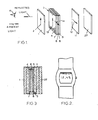
- a 'twisted nematic' type display includes a polariser 1 arranged with its polarisation axis 2 vertical.
- a liquid crystal cell 3 comprises two glass slides 4, 5 containing a layer of liquid crystal 6, consisting basically of a nematic material which may contain a small proportion (e.g. 1 %) of a cholesteric compound. Electrodes 7, 8 e.g. of tin oxide, are arranged on the inner faces of the slides 4, 5. Behind the cell 3 is an analyser or second polariser 11 arranged with its polarisation axis 12 horizontal. A brushed aluminium reflector 27 is behind the analyser 11.
- the slides 4, 5 Prior to assembling the cell the slides 4, 5 are coated on their inner faces with silicon monoxide or magnesium fluoride. This coating is formed by evaporating a stream of e.g. silicon monoxide onto the slide at an angle of about 5° to the surface as for example described in UK Patent Specification No 1,454,296. On assembly the slides are arranged with the evaporation direction on the two slides 4, 5 at 90° to one another. With such a coating liquid crystal molecules at the coated surface lie in a single direction (parallel to the evaporation direction) and at an angle'of about 25° to 35° typically about 30° to the slide surface. As a result the liquid crystal molecules progressively twist from one slide 4 to the other slide 5.
- each electrode 7, 8 When a suitable voltage is applied between the electrodes 7, 8 the molecules between the electrodes are caused to align parallel to the applied field and light transmitted by the polariser is transmitted without rotation to the analyser 11. Since the polariser and analyser 11 are crossed no light is transmitted to the reflector and no light is reflected back to the observer at those parts of the cell 3 between electrodes 7, 8 which therefore appear dark on a lighter background. Thus by shaping each electrode 7, 8 into say seven discrete parts separately connectable to a voltage source the numbers 0 to 9 may be displayed.
- the electrodes 7, 8 are arranged to provide four seven bar numeric characters plus a period dot which may be arranged to pulse once per second.
- a typical thicknesss of layer is 12 ⁇ m.
- the material used must be stable over the temperatures of use i.e. ambient temperatures which can be assumed constant for comparison purposes.
- a surface treatment i.e. evaporation of silicon monoxide at 5° giving large tilt e.g. 30° of molecules reduces the voltage necessary to turn the cell 'ON' at the expense of a degraded contrast or speed.
- a 1.5 volt battery is used to drive the oscillator and logic circuits of the watch and an up converter is used to raise the voltage to 3.0 volts for operating the display.
- Liquid crystal compounds and mixtures embodying the invention may also be used in known phase effect devices in which an optically active material is normally mixed with an nematic material to give a long helical Pitch cholesteric material which may be switched to a kematic state by the action of an electric field applied in a way similar to that described above in relation to the twisted nematic device.
- An example of a phase change effect device is described in UK Patent No 1,433,130.
- the compounds or mixtures embodying the invention may comprise either the nematic material (if R is n-alkyl) or the optically material (if R is a chiral alkyl group) or both to form the long pitch cholesteric material.
- the material may be dyed with any known suitable pleochroic dye to give enhanced contrast.
- Compounds and mixtures embodying the invention are particularly suitable in phase change devices in view of their low birefringence.
- V90, V50 and V10 are the voltages for 90, 50 and 10% transmission respectively.
- the figures brackets are the angles between the axis of measurement and the normal to the twisted nematic ce
Landscapes
- Chemical & Material Sciences (AREA)
- Organic Chemistry (AREA)
- Crystallography & Structural Chemistry (AREA)
- Engineering & Computer Science (AREA)
- Materials Engineering (AREA)
- Organic Low-Molecular-Weight Compounds And Preparation Thereof (AREA)
- Liquid Crystal Substances (AREA)
- Devices For Indicating Variable Information By Combining Individual Elements (AREA)
Applications Claiming Priority (2)
| Application Number | Priority Date | Filing Date | Title |
|---|---|---|---|
| GB7832350 | 1978-08-04 | ||
| GB3235078 | 1978-08-04 |
Publications (2)
| Publication Number | Publication Date |
|---|---|
| EP0008188A1 EP0008188A1 (en) | 1980-02-20 |
| EP0008188B1 true EP0008188B1 (en) | 1982-06-23 |
Family
ID=10498876
Family Applications (1)
| Application Number | Title | Priority Date | Filing Date |
|---|---|---|---|
| EP19790301523 Expired EP0008188B1 (en) | 1978-08-04 | 1979-07-31 | Liquid crystal compounds and materials and devices containing them |
Country Status (8)
| Country | Link |
|---|---|
| EP (1) | EP0008188B1 (cg-RX-API-DMAC10.html) |
| JP (1) | JPS5524173A (cg-RX-API-DMAC10.html) |
| CA (1) | CA1136649A (cg-RX-API-DMAC10.html) |
| DD (1) | DD145275A5 (cg-RX-API-DMAC10.html) |
| DE (1) | DE2963158D1 (cg-RX-API-DMAC10.html) |
| HK (1) | HK100685A (cg-RX-API-DMAC10.html) |
| MY (1) | MY8700221A (cg-RX-API-DMAC10.html) |
| SG (1) | SG68385G (cg-RX-API-DMAC10.html) |
Families Citing this family (2)
| Publication number | Priority date | Publication date | Assignee | Title |
|---|---|---|---|---|
| DE3205766A1 (de) * | 1982-02-18 | 1983-08-25 | Merck Patent Gmbh, 6100 Darmstadt | Benzonitrile |
| DE3530126A1 (de) * | 1985-08-23 | 1987-02-26 | Merck Patent Gmbh | Bicyclooctanderivate |
-
1979
- 1979-07-31 EP EP19790301523 patent/EP0008188B1/en not_active Expired
- 1979-07-31 DE DE7979301523T patent/DE2963158D1/de not_active Expired
- 1979-08-03 CA CA000333185A patent/CA1136649A/en not_active Expired
- 1979-08-03 JP JP9939579A patent/JPS5524173A/ja active Granted
- 1979-08-06 DD DD21482079A patent/DD145275A5/de unknown
-
1985
- 1985-09-17 SG SG68385A patent/SG68385G/en unknown
- 1985-12-18 HK HK100685A patent/HK100685A/xx not_active IP Right Cessation
-
1987
- 1987-12-30 MY MY8700221A patent/MY8700221A/xx unknown
Also Published As
| Publication number | Publication date |
|---|---|
| JPH0140025B2 (cg-RX-API-DMAC10.html) | 1989-08-24 |
| SG68385G (en) | 1986-07-25 |
| HK100685A (en) | 1985-12-27 |
| CA1136649A (en) | 1982-11-30 |
| DE2963158D1 (en) | 1982-08-12 |
| DD145275A5 (de) | 1980-12-03 |
| EP0008188A1 (en) | 1980-02-20 |
| JPS5524173A (en) | 1980-02-21 |
| MY8700221A (en) | 1987-12-31 |
Similar Documents
| Publication | Publication Date | Title |
|---|---|---|
| US4261652A (en) | Liquid crystal compounds and materials and devices containing them | |
| EP0058512B1 (en) | Liquid crystal compounds exhibiting a small dielectric anisotropy and liquid crystal materials and devices incorporating such compounds | |
| EP0072204B1 (en) | Additives to liquid crystal materials | |
| KR920010806B1 (ko) | 액정장치 | |
| EP0132377B1 (en) | Compounds containing a fluorobiphenylyl group and their use in liquid crystal materials and device | |
| US4512636A (en) | Liquid crystal compounds | |
| US3951846A (en) | Novel liquid crystal electro-optic devices | |
| EP0126601B1 (en) | Disubstituted ethanes and their use in liquid crystal materials | |
| US4542230A (en) | Liquid crystals esters | |
| US5494605A (en) | P-terphenyl derivatives and liquid crystalline compositions | |
| JPS61501920A (ja) | 異方性化合物およびそれらを用いた液晶混合物 | |
| HK15385A (en) | 4,4'-bis-(cyclohexyl)-biphenyl derivatives that contain fluorine, dielectrics containing them, and electro-optical indicator element | |
| US4357078A (en) | Liquid crystal compounds containing an alicyclic ring and exhibiting a low dielectric anisotropy and liquid crystal materials and devices incorporating such compounds | |
| EP0442266B1 (en) | Tolan derivatives, liquid crystal compositions containing them, and liquid crystal elements using them | |
| US4219256A (en) | Liquid crystal compounds and materials and devices containing them | |
| GB2071649A (en) | Liquid Crystal Bicyclo-octane Carboxylic Esters | |
| US4400061A (en) | Liquid crystal ester compounds exhibiting a low or negative dielectric anisotropy and liquid crystal materials and devices incorporating such compounds | |
| US4253740A (en) | Liquid crystal materials and devices containing them | |
| EP0008188B1 (en) | Liquid crystal compounds and materials and devices containing them | |
| US4323473A (en) | Cyclohexyl cyclohexyl dioxane liquid crystalline compounds and admixture containing same | |
| GB2065104A (en) | Liquid Crystal Bicyclo-octane Compounds | |
| JPH0416454B2 (cg-RX-API-DMAC10.html) | ||
| EP0163229A2 (en) | Ferroelectric liquid crystal composition | |
| GB2027027A (en) | Alkylbicyclo (2,2,2) octyl- phenyl-or-polyphenyl-nitriles, their use as liquid crystal compounds and materials and devices containing them | |
| US4544497A (en) | Liquid crystal materials containing substituted bicyclo(2,2,2)octanes |
Legal Events
| Date | Code | Title | Description |
|---|---|---|---|
| PUAI | Public reference made under article 153(3) epc to a published international application that has entered the european phase |
Free format text: ORIGINAL CODE: 0009012 |
|
| AK | Designated contracting states |
Designated state(s): CH DE FR IT NL |
|
| 17P | Request for examination filed | ||
| ITF | It: translation for a ep patent filed | ||
| GRAA | (expected) grant |
Free format text: ORIGINAL CODE: 0009210 |
|
| AK | Designated contracting states |
Designated state(s): CH DE FR IT NL |
|
| REF | Corresponds to: |
Ref document number: 2963158 Country of ref document: DE Date of ref document: 19820812 |
|
| ITTA | It: last paid annual fee | ||
| PGFP | Annual fee paid to national office [announced via postgrant information from national office to epo] |
Ref country code: FR Payment date: 19980611 Year of fee payment: 20 |
|
| PGFP | Annual fee paid to national office [announced via postgrant information from national office to epo] |
Ref country code: NL Payment date: 19980629 Year of fee payment: 20 Ref country code: DE Payment date: 19980629 Year of fee payment: 20 |
|
| PGFP | Annual fee paid to national office [announced via postgrant information from national office to epo] |
Ref country code: CH Payment date: 19980701 Year of fee payment: 20 |
|
| PG25 | Lapsed in a contracting state [announced via postgrant information from national office to epo] |
Ref country code: CH Free format text: LAPSE BECAUSE OF EXPIRATION OF PROTECTION Effective date: 19990730 |
|
| PG25 | Lapsed in a contracting state [announced via postgrant information from national office to epo] |
Ref country code: NL Free format text: LAPSE BECAUSE OF EXPIRATION OF PROTECTION Effective date: 19990731 |
|
| REG | Reference to a national code |
Ref country code: CH Ref legal event code: PL |
|
| PLBE | No opposition filed within time limit |
Free format text: ORIGINAL CODE: 0009261 |
|
| STAA | Information on the status of an ep patent application or granted ep patent |
Free format text: STATUS: NO OPPOSITION FILED WITHIN TIME LIMIT |